Professor Nishan Canagarajah, President and Vice-Chancellor of the University of Leicester, argues it is time for universities to engage their political muscles and shift the narrative.
Professor Canagarajah will join a panel at the Labour Party Conference on ‘What can universities do for you? How “civic universities” are supporting their communities’ on Monday, 29 September 2025 – further details are at https://www.tickettailor.com/events/universityofleicesterpublicaffairs.
An ideological challenge
‘Universities are part of a “crumbling public realm”’. Keir Starmer’s declaration in Brighton last year provided a clarion call for the need to invest in the sector which he argued, like other public services such as the NHS and prisons, had suffered a legacy of chronic underinvestment.
But what is also intrinsic in Starmer’s observation is that universities are losing their place in society. We have lost our voice – drowned out by arguments over the value of a degree, immigration and foreign students, tuition fees and ‘wokeness’. Universities are not seen as being relevant and their wider societal value is often misunderstood. In all the noise around earning a degree – often reduced to a transaction where costs and benefits are weighed – the deeper purpose is frequently lost.
It was famously said by Michael Gove that ‘the people of this country have had enough of experts’ – but perhaps now the time has come for experts in universities to re-enter the stage.
UK universities have always been a cornerstone of national progress. From pioneering life-changing research to nurturing the next generation of leaders, our institutions are woven into the fabric of our society and communities. Now more than ever, we have an opportunity to step forward with confidence to help tackle the pressing, economic, social and health challenges we are facing.
It is time for a new narrative as we engage our political muscles and demonstrate universities are vital to shaping a brighter future for Britain.
From wokeness to winner – how to change the narrative
Four years ago, the Daily Mail headline screamed ‘The University of Woke’ in describing Leicester’s efforts to widen its curriculum. In 2025, Leicester became the Daily Mail University of the Year, described as ‘a model university for the 21st century’ and was shortlisted for both Times Higher Education University of the Year and The Times and Sunday Times University of the Year.
There are lessons to be learnt from Leicester’s journey from pariah to exemplar:
Do not be afraid to do the right thing: Despite the media onslaught, Leicester persevered with its agenda to break down barriers and develop a non-elitist curriculum. Now the University is heralded as a model of inclusivity.
Be bold-stand above the parapet: Universities do not need to shout louder – they need to be heard more. We must regain the ground we have lost historically under attack of being too politically liberal, lacking ideological diversity and over free speech.
Show relevance to society: The disconnect between universities and the public must be tackled. Leicester has joined forces with others to become a part of communities, to engage with them and open its facilities. Our impacts are being brought to the attention not only of the public, but to key stakeholders and to politicians. It is about regaining political and public trust. It is why we are here in Liverpool for the Labour Party Conference.
Rediscover our confidence: From IVF to DNA profiling, the World Wide Web to AI, UK universities have shaped the modern world. At Leicester, we proudly celebrate Sir Alec Jeffreys’s discovery of genetic fingerprinting—not just for its scientific brilliance, but for its enduring inspiration. These discoveries connect with the public. But beyond the headlines are thousands of quieter innovations – new research and policy insights, business support, school outreach, and community partnerships – that improve lives every day. It’s time to shine a light on these contributions and celebrate the sector’s role in building a better Britain.
More than degrees
Universities are not just places of learning – they are engines of innovation, inclusion, and economic growth. Consider the impact:
We contribute over £115 billion to the UK economy annually and support 815,000 jobs.
International students bring a net benefit of £37.4 billion to the UK, enriching our campuses and communities.
Every £1 of public investment in universities yields £14 in economic return.
We train the doctors, nurses, teachers, and public servants who keep our country running.
Our research leads to cleaner energy, smarter cities, and healthier lives.
These contributions are felt in every region, every sector, and every household.
A paradox
Yet today, we face a paradox: a nation that benefits immensely from its universities but often questions their value. The sector is buffeted by direct and indirect policy headwinds – from immigration restrictions and post-study visa curbs to fragmented regional R&D funding and the prospect of an international levy – which according to a new report from the Centre for Cities, Town and gown: The role of universities in city economies will have a greater impact in Leicester than anywhere else in the UK.
The result of this paradox? An untapped potential that we must address head-on.
With the Labour Government more than a year into its term, we have an opportunity to put universities back at the heart of our national conversation – as a positive force for change. But we can’t expect others to make the case for us while we sit back silently and nod sagely. We must roll up our sleeves and demonstrate how we can serve Government priorities.
A solution
With Labour’s five missions – economic growth, opportunity, NHS renewal, clean energy, and safer streets – universities are uniquely placed to help deliver real change. We are not a cost to be managed, but a partner to empower the country.
At Leicester, for example, our Space Park Leicester significantly contributes to the UK government’s priorities for economic growth and clean energy by fostering a collaborative hub for the space sector and leveraging satellite data for environmental solutions. The £100m facility is an innovation hotbed for driving job creation, inward investment and working with industry to develop new technologies which support clean energy transition.
With respect to NHS renewal, we partner with the University Hospitals of Leicester NHS Trust to deliver world-class clinical innovations in areas such as diabetes, ethnic health and respiratory diseases, and secure real change in the city and beyond. We are also diversifying the medical workforce through a ground-breaking Medicine with Foundation Year programme designed as a widening-participation route to attract students from underrepresented backgrounds who have the potential to succeed in medicine.
We are creating opportunities for school-aged children from disadvantaged backgrounds through our IntoUniversity Centre, which supports young people to improve academic attainment, raise aspirations and progress into higher education or other career paths. While helping to ensure safer streets through a strong partnership with police, community engagement and research projects, including the creation of the Policing Academic Centre of Excellence which uses the latest advances in science and technology to solve strategic and operational policing challenges.
Every university in the UK has a similar story to tell with their own impactful examples that help shape a brighter future.
That’s why the University of Leicester, along with university colleagues from across the sector, will be attending this year’s party conferences, to engage constructively with policymakers, share ideas, and build alliances. We believe in collaboration, not confrontation – and in the power of shared purpose.
In a future that is increasingly knowledge intensive and in which our global success will be predicated on our use of technology, AI and big data, universities are central to the UK’s ambitions and future success. It is time for the return of the expert – time for universities to step forward, shape the debate, participate in the national conversation and ensure that universities can continue to drive progress in the way that we have for many centuries.
Amid the UK’s ongoing cost of living crisis and wider economic instability, equipping students with the skills they need to enter the workforce is more urgent than ever. The recent HEPI Policy Note10 trends that will change higher education encapsulates this focus on skills development, arguing that skills development will be the foremost area of value for students, preparing them for modern employment. Employability has become a central concern, not only for students but also for universities, incentivised through league tables and recruitment strategies to demonstrate clear outcomes for graduates.
One under-recognised but vital resource in meeting this challenge is the growing group of teaching-focused academics, those appointed on education-centred or ‘teaching and scholarship’ contracts. In Politics and International Relations (IR), this group has expanded significantly over the past two decades. A recent British Academy report found that around 20% of new academic posts in Politics and IR are now teaching track roles.
These colleagues are often at the forefront of pedagogic innovation, transforming assessment design, refining marking practices, and integrating technology in ways that directly enhance student learning. Their work is central to helping students develop the transferable, applied skills that employers demand.
Innovating for Employability
One key area of innovation is the diversification of assessment formats. By moving beyond traditional essays and exams, students are given the opportunity to experiment with different ways of communicating ideas, developing critical skills aligned with real-world careers. This diversification of assessment formats also addresses the diversity of the student body in contemporary HE. There is no longer a typical student, and as such we need to increase the range of typical assessments.
At the University of York, Jeremy Moulton and Chris Featherstone offer ‘optionality in assessment’. Jeremy gives students the choice between writing a traditional essay or a policy report, bridging academic and applied outputs. Similarly, Chris enables students to choose between blogs or policy reports, allowing them to explore formats akin to journalism or content creation. This element of student choice encourages self-reflection and strategic skill development. Some students choose to strengthen familiar skills, while others test themselves in unfamiliar formats.
Artificial intelligence (AI) is a key challenge for universities, students and employers alike. With reports that 4 out of 5 students admit to using AI in their studies, this is a huge area for higher education. Addressing the challenge that AI has levelled at the sector, Jillian Terry will be one of the first cohort of LSE AI and Education Fellows, developing a strategy for embedding and fully integrating generative AI tools into students’ experiences of learning, researching, and collaborating in the sector-leading interdisciplinary module LSE100.
Meanwhile, at King’s College London, Dr Hillary Briffa has worked to reform how diverse assessment types are marked. As a ‘rubric champion’ within the Faculty of Social Science and Public Policy, she is helping to design assessment criteria that accommodate non-traditional outputs, such as podcasts and policy briefs, while maintaining academic rigour.
Enhancing Teaching Through Research
Teaching and scholarship (T&S) staff are not only innovating in assessment but also contributing to the scholarship of teaching and learning itself. At the University of Leeds, Dr Madeleine Le Bourdon and Dr Louise Pears have conducted research on the role of social media in teaching Politics. Their findings have shaped teaching practices within the School of Politics and International Studies (POLIS), and they have also led workshops to share insights with colleagues across the discipline. Dr Le Bourdon is also leading international research into ethical approaches to global university partnerships, further demonstrating the leadership roles T&S staff are increasingly taking on.
The ASPIRE Network
To promote and connect these efforts, we established the ASPIRE Network—a community for teaching-focused academics in Politics and IR. We believe that the teaching track makes a vital contribution to educational excellence, enhancing student experience, attainment, and graduate outcomes.
ASPIRE exists to share best practices, support professional development, and advocate for the recognition of teaching and scholarship colleagues across UK higher education. But we also seek to go further, calling for structural changes in how universities support and promote teaching track staff, and urging policymakers to better value the contributions these colleagues make to student success and institutional performance.
Empowering the Teaching Track
Despite their growing presence and impact, teaching track academics often face structural barriers to progression, limited access to research funding, and a lack of visibility in institutional decision-making. If universities are serious about improving student outcomes, enhancing graduate employability, and delivering high-quality teaching, they must do more than simply acknowledge these contributions. They must actively empower teaching-focused staff. This includes creating clear promotion pathways, offering equal recognition in strategic planning, and ensuring that reward structures value pedagogic innovation on par with research achievements. The ASPIRE network is working to address this need, advocating for improvements in progression, recognition, and reward for ‘teaching track’ academics in Politics and IR, but more is needed sector-wide. Empowering the teaching track is not just a matter of fairness; it is essential for sustaining excellence in UK higher education.
Conclusion
In a sector facing financial pressures, political uncertainty, and heightened expectations around graduate employability, we cannot afford to overlook the contributions of teaching-focused academics. Their work is not peripheral, it is central to ensuring that students leave university not just with knowledge, but with the skills, confidence, and flexibility they need to thrive.
This HEPI blog was kindly authored by Dr Steve Briggs, Director of Learning, Teaching and Libraries, University of Bedfordshire
In the context of UK higher education, the terms ‘traditional’ and ‘non-traditional’ are widely used when describing students – as apparent in recent blog posts published by HEPI. In this blog, I consider why the continued use of such terminology may become increasingly problematic and what might be a viable alternative.
Who are ‘traditional’ students?
The Cambridge dictionary defines ‘traditional’ as:
Following or belonging to the customs of ways of behaving that have continued in a group of people of society for a long time without changing.
As such, one can infer that the criterion for traditional students is that they will share established characteristics that have been fixed for a significant period.
The stereotypical traditional student
In the 1970s and 1980s, university students were generally young adults who left home and moved to a new city or town to study. They would routinely live with other students on or near to campus. Many would be able to undertake studies without needing to work and would have significant time available to spend on campus and engage in clubs, societies, sports teams and other social activities. In 2025, many commentators will cite this profile as being synonymous with a traditional student.
The rise of the non-traditional student
In the context of the UK, the term ‘non-traditional student’ has been widely used to differentiate learners who do not adhere to the aforementioned traditional student convention. Examples of characteristics seen to make a student non-traditional include:
Commuting to university, rather than living on campus
Being over the age of 21
Having parental and/or caring responsibilities
Hailing from a lower socio-economic background
Being the first-in-family to study at university
Having had experience of the care system
Such individuals are often time-poor but commitment-rich and in turn have very limited availability to spend on campus outside of scheduled sessions. The use of the non-traditional label has been used increasingly since the advent of widening participation in the 1990s.
Perceptions of traditional are not fixed
The concept of a traditional student is time-bound. For example, pre-1900, there was a small number of ancient universities in the UK and relatively very low numbers of students. Increased numbers of universities opening during the 1900s meant that more individuals were able to study at university, many of whom would be labelled as non-traditional relative to those pre-1900. However, the same group has since then been re-defined as traditional relative to those who studied in the 1990s.
Over the last twenty-five years non-traditional characteristics have become increasingly common amongst the student population. For example, in 2025, HESA reported that over half of students were from IMD quintiles 1 and 2, and the vast majority of students are now over the age of 20. Following previous trends, there will come a point, potentially in the not-too-distant future, whereby the current generation of non-traditional students will become viewed as traditional. The cyclical process will then likely start again with a new conceptualisation of what is non-traditional.
More nuanced classification options
Given the time-bound nature of both traditional and non-traditional characteristics I suggest that higher education commentators should consider the use of more exact terminology when discussing student cohorts. I suggest two options:
By decade: Student groups could be framed in terms of decades, for example the demographic and characteristics of students of the 1990s, 2000s, 2010s and 2020s, etc. Such an approach could work well if there was stability over a decade however, the impact of social or global events (such as a recession, government policy or pandemic) may mean within a decade those studying within higher education could change markedly. For example, the significant impact of governmental immigration policy changes on the recruitment of international students studying in the UK during the mid-2020s.
Create generational names: Since 1950, there have been five main birth generations: Baby Boomers, Generation X, Millennials, Generation Z and Generation Alpha. Each generation has shared characteristics synonymous with being born during that period. Analogously, specific generations could be defined in terms of university students. Each generation would have a distinctive name and characteristics common amongst most members studying at university during that specific window of time. The use of student generational names would offer flexibility to account for periods of stability that lasted longer than ten years and could also accommodate sudden changes to the profile of student cohorts.
I personally favour the use of generational names given the greater flexibility. I see this as necessary given the turbulence and change experienced within the higher education sector over the last decade. For instance, I propose that the pandemic was a catalyst for the emergence of a new generation of students, a defining characteristic of which being greater experience in remote communicating and learning online.
Putting into practice
As a starter for ten, I suggest seven generations of English students over the last 150 years. A caricature for each is provided – these are intended to be illustrative of generational difference rather than exhaustive:
Ancient Generation (pre-1900): A student would study at one of the ancient universities in the UK. Students were mainly from the upper social class, and a fraction of the population attended university. Those attending university would be financially supported by personal networks.
Redbrick Generation (circa 1900-1945): Most students studied at an ancient or redbrick university. Students continued to be mainly from the upper social class, and in turn a small percentage of the population attended university.
Post-World War Two Generation (circa 1946-1989): As the number of universities progressively expanded, students had greater geographic access to higher education. Students could access maintenance grants to cover the cost of living whilst studying. This allowed students to readily engage in activities alongside their studies.
Widening Participation Generation (circa 1990 – 1997): The number of universities significantly increased following the integration of polytechnics. Concentrated efforts were made to expand access to higher education and the percentage of students from previously underrepresented groups increased. In addition to maintenance grants, students were able to access low-cost student loans.
Tuition Fee Generation (circa 1998 – 2014): The widening participation imperative remained but students now paid a tuition fee to study. Choice of where to study remained limited by student number caps. Maintenance grants were abolished and replaced with student loans. As fees progressively increased more students found they needed to undertake work whilst studying.
Free Market Generation (circa 2015 – 2019): Widening participation remained a priority. The student number cap is removed, and many universities actively expand the availability of places. Students have unprecedented choice in terms of where to study at university. Tuition fees and living costs remain a challenge for many students and numbers working whilst studying remains very high.
Pandemic Generation (circa 2020 – current): The pandemic results in a sudden and seismic shift to online education across schools, colleges and universities. This results in students have new experiences and expectations related to online and blended learning. Cost of living increases following the pandemic resulted in more student facing financial hardships in turn resulting in many spending less time on campus. Demand for mental health and well-being support increases.
Analogous to birth generations, I would see that other interpretations of higher education student generation names could emerge through research outputs, thought pieces or social events as opposed to being determined by a single group or professional body. Influential think tanks like HEPI could play a key role in providing platforms for such discussion.
I foresee there potentially being variations in proposed student generational definitions (as is the case with birth generations) but if all are clearly defined, these would all be invaluable for higher education commentators when discussing longitudinal changes in cohorts over time.
This HEPI blog was kindly authored by Rebecca Collins, Director, Sustainability and Environment Research and Knowledge Exchange Institute, University of Chester and Santiago Poeira Ribeiro, student in Natural Sciences (Physics), University of Chester.
UK universities are currently grappling with a perfect storm of disruptors: financial challenges, ambivalence from national policymakers, and, increasingly, from prospective students as they question what a university education really offers them. At the same time, the employment landscape is weathering its own storms, including those driven by accelerating technological change (particularly AI), concerns about skills deficits, geopolitical turbulence, and equivocation about whether or not this net zero business is here to stay. UK Government response to these challenges has most recently taken the form of Skills England’s analysis of the skills requirement across ten priority sectors and the promise of a new industrial strategy from 2026-27 that connects these requirements to reforms of the higher education system.
UK higher education thus seems to be quite good already at cultivating green skills for graduates, and across a wide range of subject areas. How, then, does this map onto the very varied definitions of green skills that have emerged from different sectors? The proliferation of reports concerned with this topic has not (yet) resulted in a clear, unified definition. Rather, this tends to be determined by who is doing the defining. Considering the different definitions and concepts prioritised by different institutions, we propose that these intersecting concerns can ultimately be distilled into three main types of green skill:
Technical skills: particularly those needed to accelerate decarbonisation; concentration of this need in industries such as manufacturing, transportation, utilities and infrastructure.
Green-enabling skills: otherwise known as soft or transferable skills, including systems thinking, communication, collaboration, critical thinking, adaptability.
Values-based skills: such as environmental awareness, climate justice, democratic engagement, cultural sensitivity.
Whilst definition 1 skews towards STEM subjects (as well as forms of technical expertise developed through other forms of learning, such as apprenticeships or vocational training), definitions 2 and 3 are within the purview of many other subjects commonly studied at undergraduate level, particularly within the arts, humanities and social sciences.
It is a timely moment to be reflecting on the relationship between how skills deficit narratives are framed by some corners of industry and government, and how universities position their offer in response. It feels like every academic in UK higher education has a story about recent, current or imminent institution-wide curriculum transformation. Whilst the rationales presented for these varies, one of the stronger narratives concerns ensuring students develop competencies that are fit for the future, respond directly to regional, national or global skills needs, and give students the vocabulary to articulate how the former meets the latter. As such, curriculum transformation presents an opportunity to think about how universities frame their offer, not just to prospective students but equally to the sectors those students might move into as skilled graduates.
Further, whilst driven by a range of factors, curriculum transformation presents the opportunity to articulate the role of all subjects studied in higher education, and all types of higher education providers, to contribute to the skills needed for an economy resilient to the socio-political shocks that will inevitably be invoked by environmental crises. There is a role for university leaders to be much bolder in articulating the value of all subjects – STEM and the arts, humanities, social sciences, and everything in between – and the green skills they cultivate. Now is the moment to consider how the promise of higher education might speak to or work with other agendas concerned with ensuring environmentally and socially sustainable and inclusive economies, regionally, nationally and globally. University leaders have a central role to play in advocating for a national higher education system where diversity – of student, skill and subject area – is not just celebrated as a buzzword but is demonstrated to be an essential part of a thriving, resilient and sustainable society.
This HEPI blog was authored by Elaine Jackson, Lecturer in Business and Management at the University of the West of Scotland.
Imagine earning a full salary while studying for your degree, graduating debt-free, and having a guaranteed job at the end. This isn’t fantasy, it’s exactly what graduate apprenticeships offer. Yet these programmes represent just 8% of Scotland’s university intake, despite employers desperately needing skilled workers in the very sectors where apprenticeships thrive.
The story of what’s possible starts with people like Donna. Through her graduate apprenticeship with a Local Authority, she delivered a project that secured £280,000 in funding and earned recognition as a nominee for the 2025 Convention of Scottish Local Authorities (COSLA) excellence awards. Her success demonstrates the transformative potential of combining work and study but it also highlights a troubling question: if graduate apprenticeships work so well, why aren’t there more of them?
Graduate apprenticeships (GAs), also known as Degree Apprenticeships (DAs) in the UK, represent a specific model of work-based learning where the apprentice is an employee who is simultaneously studying for a full undergraduate or master’s degree. These programmes typically last three to six years, with apprentices spending approximately 20% of their time studying and 80% working.
The scale challenge reveals a deeper problem
The numbers reveal a stark reality. Since these programmes launched in 2017, only 37,000 Scots have enrolled in Foundation and Graduate Apprenticeships combined across all years combined. To put that in perspective, 16,340 Scottish 18-year-olds accepted traditional university places in just 2024 alone. Graduate apprenticeships are growing alongside regular university degrees, offering an alternative pathway rather than replacing traditional routes, but they’re growing far too slowly.
This slow growth becomes even more puzzling when we consider the demand. Skills Development Scotland reports that social work faces a 9.3% vacancy rate, while engineering, digital technology, healthcare, and business management show similar patterns of unmet need. These are exactly the sectors where graduate apprenticeships are proving most successful, yet only 1,378 new opportunities are projected for 2024-25 across all Scottish universities.
So, what would realistic growth look like? Based on current university capacity, documented employer partnerships, and persistent skills shortages, Scotland could reasonably support 2,000-2,500 new apprentices each year, nearly doubling current numbers. This figure accounts for genuine employer capacity to provide meaningful workplace learning, not just any company willing to take on apprentices. It represents growth that the system could absorb without compromising quality.
But three fundamental barriers prevent this expansion from happening and understanding them reveals why good intentions alone aren’t enough to scale successful programmes.
Why growth remains elusive: Three critical barriers
The first barrier is financial, and it’s more complex than simply needing more money. Graduate apprenticeships cost significantly more to deliver than traditional degrees, yet they’re funded as if they were the same thing. Think about how a typical university lecture works: one professor teaches 200 students in a hall, students complete assignments independently, and most learning happens through individual study. Now consider how apprenticeships work: Glasgow Caledonian University provides one-to-one mentoring and three-way liaison between each student, their employer, and university staff throughout the entire programme. Class sizes on these programmes are typically 15-35 students, not 200, and every apprentice needs dedicated support to balance work and study successfully.
This intensive approach works, apprentices like Donna achieve remarkable outcomes. But it is expensive. Evidence from England’s apprenticeship system shows funding ranges from £1,500 to £27,000 depending on complexity, with degree-level programmes requiring the higher amounts. Yet Scottish universities, already facing a £4,000 to £7,000 funding gap per student, receive the same amount whether they’re delivering a large lecture or providing intensive one-to-one support. This creates a perverse incentive: the better the apprenticeship programme, the more money the university loses.
The second barrier involves employer readiness, and here Scotland faces a fundamental difference from countries where apprenticeships work at scale. In Germany and Switzerland, companies must meet standardised quality criteria before they can take on apprentices. They need qualified supervisors, structured learning programmes, and formal assessment processes. This ensures every apprentice receives genuine training, not just a work placement.
Scotland takes a different approach: any employer can participate without meeting specific training standards. While this sounds more flexible, it creates wildly inconsistent experiences. Some employers, like those partnering with the University of the West of Scotland, provide excellent mentoring and career development. Others treat apprentices more like temporary staff, offering limited learning opportunities. This inconsistency doesn’t just harm individual apprentices, it undermines confidence in the entire system, making other employers hesitant to participate and students uncertain about programme quality.
The third barrier is bureaucratic complexity that would frustrate even the most determined institutions. Universities wanting to create new apprenticeship programmes must navigate approval processes across Skills Development Scotland, degree-awarding bodies, and professional accreditation requirements. The Scottish Funding Council’s guidance spans multiple pages covering compliance requirements across 14 different subject areas. When universities are already struggling financially, investing scarce resources in complex approval processes for programmes that may not even cover their costs becomes increasingly difficult to justify.
These barriers explain why graduate apprenticeships remain promising but small-scale, despite clear demand from both employers and students. Early evidence suggests positive retention outcomes among graduate apprentice cohorts, though comprehensive longitudinal data is still emerging given the programmes’ recent introduction. This contrasts with broader patterns where Scotland faces challenges retaining skilled graduates, particularly in STEM fields where migration to other regions for career opportunities remains a persistent concern.
The investment case
The solutions are straightforward, though not simple to implement. First, funding must reflect delivery reality. Universities need premium funding of 125-135% of standard degree rates to cover the intensive support that makes apprenticeships effective. Given that Scottish universities already receive £2,020 less per student than English institutions, this investment would address both general underfunding and apprenticeship-specific costs.
Second, Scotland should build employer capacity systematically rather than simply recruiting more participants. This means developing quality standards for workplace learning, supporting successful employers to mentor others, and focusing on sustainable growth rather than rapid expansion that compromises quality.
Third, approval processes need streamlining. Rather than navigating multiple agencies with overlapping requirements, universities should face consolidated processes that maintain quality while reducing bureaucratic barriers to innovation.
The investment required, approximately £20-35 million annually to reach 2,000-2,500 starts, is significant but justified. Graduate apprenticeships address multiple policy priorities simultaneously: reducing student debt, developing skills where shortages are most acute, and retaining talent in Scotland rather than losing graduates to other regions.
Funding viability: A realistic investment in Scotland’s economic future
The question of funding viability deserves a data-driven response. The proposed £20-35 million annual investment represents just 0.03-0.06% of Scotland’s £59.7 billion public budget—smaller than typical annual budget variations. Scotland already invests £185 million annually in apprenticeships, making this 11-19% increase both modest and strategically targeted.
A phased expansion demonstrates fiscal responsibility while addressing urgent skills gaps. Starting with £15 million (expanding from 1,200 to 1,500 graduate apprentices), scaling to £25 million by year three (2,000 apprentices), and reaching £35 million by year five (2,500 apprentices) aligns expansion with demonstrated employer capacity while allowing quality oversight.
International benchmarking supports this scale. England’s apprenticeship system spends £1,500-27,000 per apprentice depending on complexity, with degree-level programmes requiring higher investments. Scotland’s proposed £14,000-20,000 per graduate apprentice (including university premium funding) sits within this proven range while delivering superior outcomes through integrated workplace learning.
The return on investment is compelling: each graduate apprentice avoids approximately £15,000 in student debt compared to the Scottish average, while earning during their studies and contributing immediately to productivity. Graduate apprentices also avoid the debt burden that affects traditional students, providing a genuine alternative to debt-financed higher education.
Rather than adopting loan models that would undermine the fundamental “earn while learning” proposition, Scotland should view this as infrastructure investment—comparable to the £150 million being invested in offshore wind manufacturing. Both create sustainable employment, address skills shortages, and position Scotland competitively in growth sectors. Analysis of successful apprenticeship systems consistently shows that sustainable models rely on public investment rather than employer or student financing.
The choice is strategic, not fiscal. Scotland can afford this investment; the question is whether it can afford not to make it when facing documented skills shortages in sectors critical to economic growth and the net-zero transition.
Conclusion
The choice facing Scottish policymakers is ultimately about ambition and fiscal realism. The evidence shows what works, the economic case is compelling, and the investment is demonstrably affordable through phased implementation. Scotland can accept that graduate apprenticeships remain a valuable but limited option, or it can make a modest, strategic investment to unlock their transformative potential for addressing skills shortages and retaining talent. Now it’s time to scale what works.
Steady lead generation for colleges and universities is what keeps enrollment strong. Without a consistent flow of qualified inquiries, even the best programs struggle to meet their targets. The challenge, however, is that prospective students now have more options than ever, online and on campus, at home and abroad. Competing for their attention requires more than just a few ads or a static website; it demands a thoughtful, multi-channel strategy that builds trust and delivers value.
The good news is that digital marketing offers powerful tools to do just that. From content that tells your school’s story to SEO, social media engagement, targeted ads, and personalized email campaigns, every channel plays a role in capturing interest and moving students closer to enrollment. Add in technologies like CRM systems, chatbots, and virtual events, and institutions can create highly tailored experiences that convert browsers into applicants.
This article explores nine proven strategies to boost lead generation for higher education in the current industry. We’ll highlight real-world examples, including case studies from HEM’s own work, and show how combining smart tactics with the right technology can help your institution attract, nurture, and convert more qualified student leads.
Struggling with lead generation?
Our expert digital marketing services can help you attract and enroll more students!
1. Leverage Content Marketing to Attract and Engage Prospective Students
Content marketing is one of the most reliable ways for higher education institutions to generate quality leads. By creating blog posts, videos, and downloadable guides that address real student questions, schools can attract organic traffic, build trust, and guide prospects through the enrollment funnel. Effective content also boosts SEO, keeping your institution visible when students search for programs or career paths.
How can content marketing help universities generate more leads? Content marketing attracts prospective students by answering their questions and showcasing institutional strengths. Blogs, guides, and videos build trust, improve SEO visibility, and highlight success stories. This engagement draws high-intent visitors to program pages, where they can convert into inquiries or applications.
Example: Discovery Community College’s official blog uses program-specific keywords in post titles to boost SEO. For example, one post is titled “3 Great Skills to Practice During Your Accounting and Finance Program,” directly incorporating the Accounting and Finance program name. This keyword-focused approach makes it far more likely that the content appears in search results when potential students are googling that training area. By optimizing blog content for high-intent queries, Discovery Community College increases its visibility to the right audience and draws in quality traffic (prospects already interested in those programs).
Gated content like e-books or checklists can add another layer—prospects are more willing to share contact details if the resource provides clear value, such as a scholarship checklist or career outlook guide.
2. Optimize Your Website for Search Engines (SEO)
Even the best content won’t generate leads if students can’t find it. That’s why SEO is essential. Since most students begin their school search online, ranking on the first page of Google for program- and location-based keywords (“MBA programs in Canada,” “best nursing degree in Ontario”) is critical. The higher you rank, the more qualified traffic you attract.
Effective SEO starts with understanding what prospective students are searching for and weaving those terms naturally into your program pages, blog posts, and FAQs. On-page basics, like strong titles, meta descriptions, mobile-friendly design, and fast load times, should work hand in hand with technical SEO and local optimization.
How can universities leverage SEO to improve their lead generation efforts? SEO boosts visibility when students search for programs, scholarships, or career outcomes. By optimizing program pages, blogs, and local listings with relevant keywords, universities appear in top search results. This organic traffic delivers high-intent leads, students actively seeking education opportunities, directly into the recruitment funnel.
Example: Partnering with HEM, Cumberland College invested in multilingual SEO, optimizing its website in both English and French. Within a year, organic traffic grew by 27.5%, and leads from SEO traffic surged by 386%. This data-driven strategy directly fueled a 20–35% increase in new enrollments, proving how powerful SEO can be for lead generation for higher education.
3. Optimize Your Website’s Landing Pages and Lead Capture Forms
Attracting visitors is only half the battle; converting them into leads is what drives enrollment. Landing pages and inquiry forms are at the heart of conversion rate optimization (CRO) for higher education. With education landing pages averaging a 4.5% conversion rate, small improvements can mean a big jump in inquiries. To maximize results:
Mobile-first design: Students browse on their phones, so pages must load fast and display seamlessly.
Clear, concise copy: Use scannable headlines and bullet points to highlight benefits.
Prominent CTA: Each page should push one clear action: “Request Info” or “Register Now,” with an eye-catching button.
Short forms: Ask only for essential info (name, email, program interest). Long forms create friction.
Trust signals: Add student testimonials, alumni outcomes, or accreditation badges to reassure visitors.
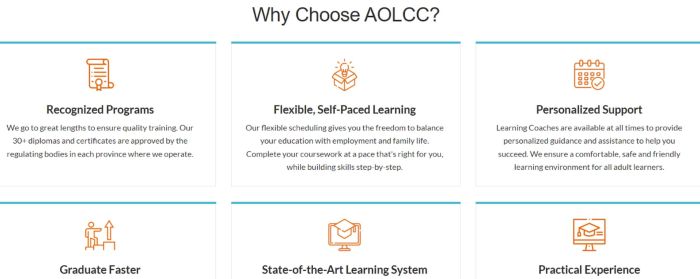
Example: The Academy of Learning Career College’s landing pages highlight clear program benefits and unique selling points to persuade visitors. AOLCC outlines its proposition value on landing pages, essentially listing what students gain from the program, and expands on each point to hold interest. By foregrounding these program benefits, AOLCC’s pages effectively communicate value and encourage prospects to take the next step (e.g., request info or apply).
4. Implement Chatbots and Live Chat for Instant Engagement
Today’s prospective students expect instant answers when they land on a university website. Chatbots and live chat make that possible, engaging visitors the moment they arrive instead of waiting for them to stumble upon a form. A chatbot that greets with a simple “Do you have questions about admissions or programs?” lowers barriers, creates an immediate connection, and often captures leads that would otherwise leave without taking action.
Configured well, education chatbots can handle common questions around deadlines, prerequisites, or housing 24/7. When a query requires a human touch, they can hand off to a live staff member or at least collect contact details for follow-up. This style of communication appeals especially to Gen Z, who spend significantly more time on messaging apps than older generations and respond well to the casual, conversational tone of chat.
Example: Unity Environmental University launched an AI virtual agent named “Una” to assist prospective students in finding suitable programs and navigating the application process. According to Unity’s press release, Una is available 24/7 as a personalized guide, providing instant answers about admissions and even helping complete application steps.
From a practical standpoint, institutions can blend live and automated support depending on resources. Staff-led chat during business hours provides personal attention, while chatbots can cover after-hours. The key is visibility: a small but inviting chat icon, integrated with your CRM to capture leads automatically, turns your site into an “always-on” recruitment assistant. In higher education lead generation, that combination of accessibility, speed, and personalization is increasingly what sets strong digital strategies apart.
5. Harness the Power of Social Media Platforms
Social media remains one of the most powerful tools for lead generation for colleges. Prospective students spend hours daily on platforms like Instagram, TikTok, Facebook, LinkedIn, and X. Making these spaces essential for reaching and engaging them. Each channel serves a slightly different role: Instagram and TikTok connect best with high school and undergraduate audiences, LinkedIn appeals to graduate and professional prospects, while Facebook often reaches parents and working adults.
What role do social media platforms play in lead generation for higher education institutions? Social media connects universities with prospects where they already spend time. Authentic posts, student takeovers, and targeted ads spark awareness, build community, and drive traffic to lead forms. Engagement nurtures interest over time, transforming casual followers into applicants and amplifying recruitment campaigns.
To generate leads, institutions should focus on consistent posting, authentic storytelling, and quick responses to comments or direct messages. Content like student takeovers, alumni testimonials, and “day in the life” videos resonates strongly, helping prospects envision themselves at your school.
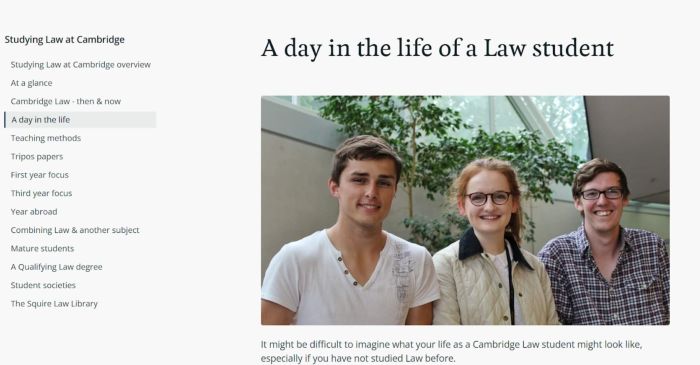
Example: The University of Cambridge leverages authentic, student-led “Day in the Life” videos on its official channels (website, YouTube, TikTok) to showcase everyday student experiences. These videos are produced through the university’s own outlets, not third-party media, ensuring they are direct primary sources from Cambridge. For instance, Cambridge’s Faculty of Law features a “Day in the life of a Law student” video on its official site and YouTube, where “three first year Law students, Robbie, Katie and Scott, give us an insight into a typical day in their lives, using hand-held cameras”. In this video, the students themselves film their lectures, study sessions, and social activities, offering a genuine glimpse into daily life in Cambridge.
Done well, social media builds community, nurtures awareness, and funnels engaged viewers toward applications or info requests.
6. Invest in Targeted Paid Advertising (SEM & Social Ads)
While organic search and social media build long-term visibility, paid advertising can accelerate lead generation for colleges by reaching the right students at the right time. Search engine marketing (SEM), such as Google Ads, is especially valuable for competitive programs or new offerings that don’t yet rank organically. Targeting keywords like “online MBA in healthcare” ensures your ads appear when students are actively searching, capturing high-intent leads ready to convert.
On social platforms, precise targeting by age, interests, location, or even undergraduate major allows you to reach audiences that align with your programs. Retargeting campaigns are equally powerful, reminding visitors who viewed your site or started an application to take the next step.
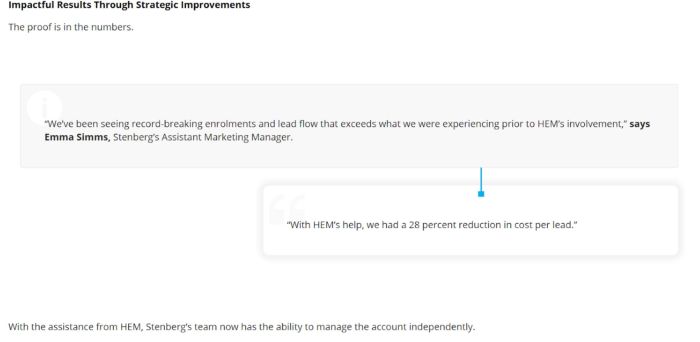
Example: Stenberg College leveraged Google Ads to attract more qualified leads for its healthcare and nursing programs. HEM’s case study notes that Stenberg uses Google Ads as a “key marketing tool to recruit students,” and with HEM’s expertise, the college’s ads now generate both more leads and better-qualified leads for admissions. The partnership allowed Stenberg to optimize keywords, ad creatives, and targeting, resulting in improved ROI on their ad spend and a healthier enrollment pipeline.
7. Nurture Leads With Email Marketing and Marketing Automation
Capturing a lead is only the start. The real work begins with nurturing that interest into enrollment. Email marketing remains one of the most powerful tools in higher ed lead generation, delivering an estimated ROI of $36 for every $1 spent. Students also welcome it: surveys show nearly 70% prefer to hear from institutions via email.
The key is relevance. Segment leads by program, stage in the decision journey, or demographics, and tailor messages accordingly. Personalization should go beyond using a first name. It should highlight specific programs, address common concerns, or share stories aligned with student interests. Mapping emails to the student journey also ensures prospects receive the right content at the right time, from early-stage guides to deadline reminders.
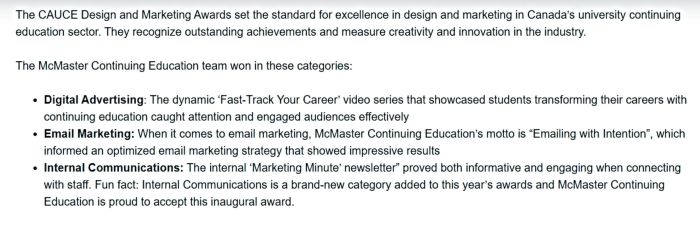
Example: By developing email campaigns tailored to specific learner personas (“Emailing with Intention”), McMaster’s Continuing Ed achieved email engagement far above industry benchmarks. In fact, its automated drip emails earned about a 27.9% open rate, outperforming average open rates (~21.5%) for education emails. This persona-driven strategy was recognized with national marketing awards, underscoring how segmenting messaging to audience needs leads to more engaged prospects and higher conversion potential.
8. Host Events and Leverage Virtual Engagement Opportunities
Events remain one of the most effective lead generation tools in higher education because they let prospects experience your institution firsthand. In-person open houses, campus tours, and information sessions build emotional connections as students meet faculty, see facilities, and imagine themselves on campus. From a lead gen perspective, event registrations and check-ins capture valuable contact information, which can then be nurtured with timely follow-up emails or calls.
Virtual events have expanded this reach even further. Online open houses, live webinars, and 360° virtual tours allow schools to engage international prospects and those unable to travel. The University of Bristol, for example, hosts a dedicated page for virtual campus and city tours, giving global audiences a way to explore on their own time.
Example: Bristol has embraced virtual engagement to reach students globally. The university maintains a dedicated page for virtual events and tours, where prospects can take self-guided 360° campus tours and even explore the city online. During the pandemic, such virtual open days were crucial: over half of UK prospective students surveyed (59%) attended at least one virtual open day. By offering rich virtual events and tours, the University of Bristol kept students engaged during lockdowns and expanded its reach beyond those able to visit in person. This virtual strategy not only sustained interest through difficult times but continues to complement in-person events as a convenient lead generator.
The most effective events, whether in-person or online, blend interactivity with personal connection. Live chats, Q&As, and student ambassador involvement ensure attendees feel engaged, while follow-up communications help convert that interest into applications.
9. Utilize CRM Systems and Data Analytics to Refine Your Outreach
Behind every strong lead generation program is a system that manages, tracks, and optimizes outreach. A Customer Relationship Management (CRM) platform, such as HubSpot, Slate, or HEM’s own Mautic CRM, centralizes prospect data, automates follow-ups, and makes it easier to measure performance.
Every new lead, whether from a form, ad, or event, flows into the CRM, where it can be segmented, scored, and assigned to counselors. Automated workflows ensure timely engagement: for example, sending a personalized welcome email immediately after an inquiry and triggering reminders if no action follows.
Example:Michael Vincent Academy overhauled its recruitment process by adopting a customized CRM automation solution with HEM. Michael Vincent Academy automated key workflows using the CRM, which dramatically improved efficiency in managing inquiries. Staff could spend less time on manual follow-ups and more on building relationships with prospects. The result was a smoother funnel, inquiries were responded to promptly, and no prospective student fell through the cracks, ultimately leading to higher enrollment yields.
Analytics make this even more powerful. By monitoring lead sources, campaign performance, and student behaviors, institutions can refine targeting and invest where returns are strongest. Business School Lausanne, for instance, leverages data insights to optimize international outreach and ensure global diversity in recruitment.
In short, a data-driven CRM approach ensures no lead slips through the cracks and every prospect receives timely, personalized attention.
Integrating the 9 Strategies Into a Cohesive Lead Generation Plan
Effective lead generation in higher education isn’t driven by one silver bullet; it’s the outcome of multiple strategies working together. Content fuels SEO, SEO drives visitors to optimized landing pages, social media and paid ads amplify your reach, while email and CRM workflows nurture prospects into applicants. Layered on top, data and analytics help refine every stage, creating a cycle of attraction, engagement, and conversion that grows stronger over time.
Real-world outcomes show the power of this integrated approach. Webster University Geneva reported a 30% surge in enrollments through digital marketing and timely follow-ups, while Cumberland College doubled its lead flow by combining SEO content with paid ads and social engagement. Even more targeted initiatives, like Queen Anne’s School’s multi-platform ad campaigns or McMaster University’s persona-based email drips, prove that each tactic can meaningfully contribute to the bigger picture when executed strategically.
Think of your role as designing a system that balances creativity with data. Keep testing new formats, from TikTok challenges to interactive quizzes, while staying agile to shifts like AI tools or evolving privacy rules. Above all, keep the student experience front and center: personalization, authenticity, and responsiveness are what today’s learners value most.
By applying the nine strategies outlined in this guide, your institution can not only attract more qualified leads but also convert them into enrolled students in a sustainable, scalable way. Lead generation may be challenging, but with a student-first mindset and a data-informed strategy, you’ll build a steady pipeline of future students ready to join your community.
Struggling with lead generation?
Our expert digital marketing services can help you attract and enroll more students!
Frequently Asked Questions
Question: How can content marketing help universities generate more leads? Answer: Content marketing attracts prospective students by answering their questions and showcasing institutional strengths. Blogs, guides, and videos build trust, improve SEO visibility, and highlight success stories. This engagement draws high-intent visitors to program pages, where they can convert into inquiries or applications.
Question: What role do social media platforms play in lead generation for higher education institutions? Answer: Social media connects universities with prospects where they already spend time. Authentic posts, student takeovers, and targeted ads spark awareness, build community, and drive traffic to lead forms. Engagement nurtures interest over time, transforming casual followers into applicants and amplifying recruitment campaigns.
Question: How can universities leverage SEO to improve their lead generation efforts? Answer: SEO boosts visibility when students search for programs, scholarships, or career outcomes. By optimizing program pages, blogs, and local listings with relevant keywords, universities appear in top search results. This organic traffic delivers high-intent leads, students actively seeking education opportunities, directly into the recruitment funnel.
Yesterday, HEPI and Cambridge University Press and Assessment jointly hosted the UK launch of the OECD’s Education at a Glance. You can see the OECD’s slides here.
Here we publish a response to the OECD from Professor Sir Chris Husbands, who is a former Vice-Chancellor of Sheffield Hallam University and also former Chair of the Teaching Excellence Framework (TEF) Panel. Chris is a Trustee of HEPI and spoke at the launch.
There is one line in the 2025 OECD Education at a Glance report which should be in bright flashing lights for this and all governments. The supporting data is on page 112 of the main report. It is this: Individuals with greater educational attainment generally face a lower risk of unemployment and earn higher wages. Race, gender, deprivation, place, subjects studied all impact outcomes in different ways, but the overall conclusion is clear, and in his HEPI briefing on the report, the OECD’s chief analyst Andreas Schleicher got the summary down to just two words: education pays.
The 2025 OECD Education at a Glance report comes in at 541 pages, and the annual appearance of the report has made it the definitive guide to education system performance and policy dynamics all around the world: in the now familiar graphs of compelling clarity, and crisp text judgements, the OECD team have made themselves indispensable to institutional leaders, policy analysts and decision makers.
This year’s report has a specific focus on tertiary education, which in OECD terms includes, but stretches a bit further than, higher education. There are some familiar and unsurprising themes in the 2025 report, but they are nonetheless important for being set out so clearly. A few key findings stood out for me, all of them speaking clearly to the English and UK policy agendas.
First, advantages are inherited: those who have at least one tertiary-educated parent are more than twice as likely to attain a tertiary qualification than those whose parents have below upper secondary attainment, though the gap is smaller in the UK than elsewhere (p.56).
Secondly, life is getting tougher for those without qualifications: the employment rate for young adults without upper secondary qualifications fell by 6 points since 2019, and by 9 points for men (pp.82-3).
Thirdly, at the same it’s getting better for the better qualified: the nearly one-in-six with a Master’s degree have higher employment rates and earnings than those with an undergraduate degree (p48).
Fourthly, education is losing the battle for public funding as the costs of health, pensions and defence rise: between 2015 and 2022, government spending on education declined from nearly 11% of budgets to just over 10% (p.278).
And fifthly, despite that decline, R&D is strengthening to drive growth and competitiveness. Where it is highest, government drives it: in the UK, Israel and Switzerland, government R&D expenditure is more than twice private expenditure (p.329).
There is more fine-grained analysis about English higher education. England, on the OECD data, is an outlier in important respects.
First: English HE is well-funded by comparison with the OECD, whatever it feels like in the sector just now. The finding is important: total tertiary expenditure per student, including R&D, is $35,000, among the highest in the OECD and 65% above the average (p.327).
Secondly, however, in the UK government tertiary expenditure is $8,000, 48% below the OECD average (p.331). This is a result of high tuition fees: undergraduate fees are three times the OECD average.
The third way in which England is an outlier is that access to higher education and completion rates within it are high – fourteen percentage points above the OECD average (p.246): access to higher education is far more a consequence of maintenance support than fee levels, but high fee levels almost certainly disincentivise non-completion. Finally, while there is a gap between economic returns to science and technology disciplines on the one hand and arts and humanities on the other in all OECD countries, the gap is much higher in the UK than in almost all other countries (p.111).
Putting all this together poses some knotty challenges. England has a successful, relatively accessible higher education system, but one which is very expensive when budgets for education are getting tighter. And this is happening when the economic returns to high levels of qualification are strengthening: masters and doctoral graduates enjoy higher returns than those with undergraduate degrees, while the least qualified face more intense difficulties. These challenges go beyond the voluminous data in Education at a Glance.
First, and painful for English higher education, the challenge is not simply the level of current funding, but funding in relation to what is a high-cost operating and delivery model. That model secures strong results in terms of access for disadvantaged students and high completion rates, but it is relatively inflexible. It’s unclear whether a lower-cost and potentially more flexible operating model would put some of the successes of the English system at risk.
Secondly, it is the economic, social and increasingly political costs of the plight of the lowest attaining young people, and especially young males without qualifications, which is attracting political attention. If money is tight, it’s more likely to go towards that problem, and the London government’s decision to move skills funding into the Department of Work and Pensions appears to be a signal of intent.
These are the leadership challenges which emerge from this year’s report: how to reshape our successful HE system so that its strengths remain, but it can be more responsive and flexible. It needs to adapt to a changing labour market and to a society in which division and inequality are being reinforced with greater ferocity.
This morning, HEPI and Cambridge University Press & Assessment, are hosting the UK launch of the OECD’s Education at a Glance, which is the most important annual international comparative education publication produced anywhere in the world.
Here, HEPI Director, Nick Hillman, takes a look at what it says.
The OECD’s Education at a Glance is the most important and the most mis-named publication in education, for this year’s edition is 541 pages long! It will take time to digest in full. But for now, here are 10 key points on what it all means for the UK (and especially England):
In England, you’re less likely to have benefited from tertiary education if your parents had a relatively low level of education … but you’re more likely to have had some tertiary education than similar people in other developed countries. This may be a surprise to people who know we still have a long way to go in widening access to higher-level education but it’s not a big surprise to anyone who has looked very closely at first-in-family students – there’s multiple ways to measure who is a first-in-family student but, on some measures, the majority of students these days are first-in-family.
The NEETs (young people Not in Employment, Education or Training) challenge is bad and has been getting worse, especially among men. Again, this won’t come as a huge surprise to anyone who has focused on the terrible educational and employment record of lower educated young men – or who has read HEPI’s recent report on the issue. But it is salutary to find out the UK is not only performing badly but that we are performing the worst of any developed country when it comes to earnings for low-skilled adults: ‘25-34 year-olds with below upper secondary education earn 43% less than those with upper secondary or post-secondary non-tertiary attainment, the largest gap among OECD countries’.
Part of the reason for the UK’s comparative success at higher education relative to other countries is the comparatively low drop-out rate. Again, this is covered by a recent HEPI report, which also noted that new initiatives like the Lifelong Learning Entitlement call for a new conception of non-continuation.
People often say it’s better to invest government money in the compulsory stage of education rather than the tertiary / voluntary stage. The OECD’s numbers suggest the UK has already taken this policy to its extreme. Government spending on higher education (per student) is around $8,000, around half of the average for the OECD and about half of the amount spent ‘at primary to post-secondary non-tertiary levels’ ($13,000). This is an even more extreme way of describing comparative spending on schooling and higher education than the way I put it in a recent speech.
While there is one international student for every three home students in the UK, across the OECD as a whole the ratio is completely different at 1:13. From the vantage point of the OECD in Paris, this is a real UK success story – though the Home Office continues to push for policies to reverse recent trends.
Our postgraduate participation rates for home students are distinctly average, at least when compared to those across the OECD as a whole: ‘In the United Kingdom, 17% of 25-34 year-olds hold a master’s or equivalent degree, which is similar to the OECD average of 16%.’ If we aspire to be as well educated as the best educated countries, then we need more home postgraduates alongside all the ones from overseas. It’s probably fair to say that higher education debates in the UK (and HEPI is perhaps guilty here too) remain overly focused on undergraduate education.
Women are more likely to obtain tertiary education across the developed world. But the gap between men and women is bigger in the UK than elsewhere and has been slowly growing while it has stayed the same on average across the OECD as a whole: ‘In the United Kingdom, they [women] accounted for 56% of first-time entrants in 2023, up from 55% in 2013. Across the OECD, women make up 54% of new entrants on average, the same share as in 2013.’
The teacher supply crisis here is particularly down to a higher-than-average proportion of teachers leaving for other roles: ‘England is among the countries with high turnover, with 0.8% of teachers retiring and 8.7% resigning each year’. The OECD think it should be easier for people to switch careers into teaching here: ‘16 out of 28 countries with available data offer dedicated alternative pathways into teaching for individuals changing careers. In contrast, England does not offer dedicated pathways for second career teachers.’ (Now Teach might have something to say about this?)
In some important respects, our school system is different: primary school teachers’ salaries have been falling in England while rising elsewhere (including in Scotland); UK school pupils have around one week less of school holiday than pupils elsewhere on average (though I recognise this might sound odd at this precise moment, given the long summer holidays have just come to an end); and primary school class sizes are above average in the UK.
There’s a (very) big difference between the conditions for lower-level academic staff and more senior ones. The former receive less than similarly qualified people while the latter earn much more: ‘In England, junior academic staff earn 16% less than workers with at least a bachelor’s or equivalent degree, while senior academic staff earn 80% more.’ Perhaps this explains why some older staff have seemed less keen on industrial action than their younger colleagues. Our report on academics’ terms and conditions explains more.
Pamela Baxter is Chief Product Officer and Managing Director of IELTS Cambridge at Cambridge University Press & Assessment
At a time when the value of higher education is being called into question, the OECD’s latest Education at a Glance report offers an unequivocal statement of support for the sector – both globally and in the UK.
This annual report gives a snapshot of the state of education in the world’s developed nations. By gathering comparative data covering the OECD’s members as well as partner countries, it lets policymakers measure their country’s achievements and set standards against best international practice.
The 2025 report’s focus on tertiary education gives many reasons for optimism. The highlight is that, with 48% of young adults in surveyed countries holding a tertiary qualification, educational attainment is higher than ever.
The share of 25 to 34-year-olds with tertiary attainment increased over the last five years across OECD and partner countries – rising from 45% (2019) to 48% (2024). In the UK, tertiary education among the same cohort grew from 52% to 60% over that period – twelve percentage points above the OECD’s average.
The report is unambiguous in stating the benefits of higher education: “Supporting equitable access to tertiary education”, it tells us, “remains crucial to strengthening social mobility as educational attainment is closely reflected in labour market outcomes.”
Adults with an undergraduate university qualification (or equivalent), the report tells us, earn on average 54% more than those with only upper secondary education. (This goes up to 83% when those adults have a postgraduate degree.)
But the benefits are not only financial. The report emphasises how tertiary education is directly linked to higher employment rates, and even to better health – with 51% of tertiary-educated adults rating their health as very good or excellent, compared to 26% of those with below upper secondary education.
The report also pinpoints areas where the developed world as a whole must do better. We are told, for instance, that completion rates of young adults going into tertiary education are low – particularly among men – with under half of new entrants finishing their programmes within the expected duration.
The rise and rise of international student mobility
The 2025 report shows the continuing growth of international student mobility in OECD countries, with the number of mobile students as a proportion of total student numbers more than doubling over the past decade. This is good news.
I was especially heartened to read that the UK continues to be one of the most attractive destinations for international students: 23% of all tertiary students in the UK were international according to 2023 numbers – an increase of six percentage points since 2013, and well above the OECD average of 7%.
International students contribute almost £42 billion a year to the UK economy – the equivalent of every UK citizen being £560 better off. This pipeline of international talent is essential to the UK government’s high-growth economic sectors, as well as our universities’ global reputation and competitiveness.
At Cambridge University Press & Assessment we are deeply aware of the importance of international students to the UK’s educational landscape – and indeed to the country’s wider strengths. International students’ ability to fully participate in, and contribute to, their chosen courses is essential not only to their future success, but to the UK’s prospects as an intellectual, economic and cultural power. We consider it our responsibility to make sure that those globally mobile students seeking paths to higher education are equipped with the right skills to thrive. We’re not alone in that.
The 2025 edition of Education at a Glance provides a vivid snapshot of the state of global education. It tells us what we are doing well and, crucially, where there is room for improvement. Cambridge welcomes these findings, and we are proud to be sponsoring its launch.
This blog was kindly written by Gary Attle, Consultant for Birketts LLP.
On Tuesday, HEPI and Cambridge University Press & Assessment will be hosting the UK launch of the OECD’s Education at a Glance. On Wednesday, we will be hosting a webinar on students’ cost of living with TechnologyOne – for more information on booking a free place, see here.
Read HEPI’s weekend blogs on governance and the Research Excellence Framework on the HEPI website here.
The Higher Education (Freedom of Speech) Act 2023 came into force, in part, on 1 August 2025. New and strengthened statutory duties were placed on higher education providers which are registered with the Office for Students (OfS), the higher education regulator in England. These duties require the governing bodies of registered higher education providers to take steps to secure freedom of speech (including academic freedom) for staff, students, members and visiting speakers and to promote the importance of freedom of speech/academic freedom. The Office for Students has a direct regulatory jurisdiction towards registered higher education providers under the provisions of the Higher Education and Research Act 2017 and as ‘principal regulator’ for those registered providers which are charities.
The current Government has indicated its intention to repeal the provisions in the 2023 Act which would have placed an express statutory duty on students’ unions for the first time to secure freedom of speech and a new regulatory power for the Office for Students to take enforcement action against students’ unions for breach of that duty. In a detailed statement to the House of Commons on 15 January this year, the Secretary of State noted the following:
“Student unions are neither equipped nor funded to navigate such a complex regulatory environment, and they are already regulated by the Charity Commission. However, I fully expect student unions to protect lawful free speech, whether they agree with the views expressed or not. I also expect HE providers to work closely with them to ensure that that happens and to act decisively to ensure their student unions comply with their free speech code of conduct.”
It is likely to be the case that a students’ union of a higher education provider which is a charity will be a separate charitable organisation itself, whether an unincorporated association of its members or an incorporated body. However, it would be prudent to check both the charitable status of the students’ union and its corporate status.
The Education Act 1994 (sections 20-22) places a statutory duty on the governing body of specified higher education ‘establishments’ in England and Wales to secure certain requirements in respect of students’ unions of those establishments. The duty extends to a range of governance and constitutional requirements, including ensuring that the students’ union operates in a fair and democratic manner, that it has a written constitution and has a complaints procedure. The governing body is required to approve the provisions of the constitution and review the constitution at intervals of not more than five years. In addition, highlighted for the purposes of this note, at least once a year the governing body of the establishment must bring to the attention of its students “any restrictions imposed on the union by the law relating to charities.”
Here, we turn to case-law of some vintage to illustrate what this might include. In 1971, the High Court in the case of Baldry -v- Feintuck [1972] WLR552 had to decide whether to grant injunctions against a number of individuals connected with the University of Sussex Students’ Union. The students’ union had passed resolutions for payments to be made in support of certain causes, including a campaign to oppose the then Government’s policy for the ending of free milk to school pupils. A student at the university and a member of the union brought legal proceedings against the students’ union officers and a member of staff at the university on the basis that such payments would be ultra vires the students’ union constitution. In granting the injunction against the President and Treasurer of the students’ union (only), the Judge noted as follows:
“although research, discussion and debate and the reaching of a corporate conclusion on social and economic problems formed part of the educational process, the proposed payments outside of the university, formed no part of that process…and no payment for political purposes could possibly be charitable.”
The Charity Commission updated its guidance on ‘Campaigning and political activity’ in November 2022 which it defines as follows:
Campaigning: “awareness raising and efforts to educate or mobilise the public’s support for an issue or to influence / change public attitudes” (including activities which seek to ensure existing laws are observed).
Political activity: “securing support for, or opposing, a change in the law or policy or decisions of central government, local government, or other public bodies, in this country or abroad”.
The basic legal position set out in the Charity Commission’s guidance is that campaigning and political activities by charities can be legitimate and valuable provided they are undertaken only in supporting delivery of the charity’s charitable purposes. The guidance helpfully explains this more fully and the factors which the charity trustees should take into account before deciding to undertake campaigning and/or political activities. The Charity Commission noted that its experience had been that charities had been over-cautious in their approach to such matters and that they were inclined to self-censor, although it noted that it would take regulatory action if there had been misuse of charitable resources.