Category: Blog

  • Snapchat School Marketing: What Schools Should Know

    Snapchat School Marketing: What Schools Should Know

    Reading Time: 14 minutes

    How effective are Snapchat school campaigns? Snapchat may no longer be the “shiny new toy” in the social media landscape, but it continues to offer something few platforms can match: authentic, ephemeral connection with Gen Z. While platforms like TikTok, Instagram, and YouTube dominate the headlines, Snapchat remains deeply embedded in the daily lives of many teens and young adults, especially in North America, Europe, and parts of the Middle East. 

    For education marketers targeting younger demographics, Snapchat’s low-friction, high-engagement environment makes it a powerful, if often underutilized, channel. From personalized outreach and peer-led takeovers to geofilter-powered event promotion, Snapchat school digital marketing campaigns meet students on their terms with content that feels spontaneous, creative, and real.

    This blog post explores how different types of institutions: business schools,  language schools, career colleges, K–12 schools, and universities, can use Snapchat strategically to support their enrollment goals, community engagement, and brand building.

    Why Snapchat Still Matters

    Globally, Snapchat’s active user base tops 850 million. In key recruitment markets like North America, parts of Europe, and the Middle East, teens and young adults continue to use Snapchat as a daily communication hub. What makes it especially powerful for education marketing is the way it enables institutions to meet students where they are in their preferred format, tone, and space.

    How does Snapchat college work? Snapchat’s college features, like School Communities, offer institutions a way to foster peer-to-peer engagement within a verified, digital campus environment. It strengthens school spirit, encourages student interaction, and creates new touchpoints for community-building in a format Gen Z prefers.

    Snapchat offers unique features that make it a great tool for engaging students and supporting education marketing. Its main appeal is that content, like photos and 10-second videos, disappears after being viewed, which makes it feel immediate and personal, unlike traditional social media. Some key features include:

    Stories: Stories allow users to string together multiple snaps (photos or videos) that are viewable for 24 hours. This feature helps schools showcase campus life, events, and student takeovers in a way that feels immediate and engaging. Schools can post regular updates, highlights of campus activities, and even have students take over the account for a day to give a personal perspective on student life.

    Snapchat School Communities: In 2024, Snapchat introduced School Communities, which let students join private groups for their school. Members can view and contribute to shared Campus Stories visible only to classmates. These communities help students connect with peers in a secure, school-specific space, making it easier to share experiences, participate in group chats, and discuss common interests. Snapchat verifies members using their official school email addresses and gives them a special badge on their profiles.

    Geofilters and AR Lenses: Geofilters are custom-designed overlays available to users in a specific location. Schools use geofilters for events like campus tours, admitted student days, or graduations, turning these moments into shareable, branded experiences. Augmented reality (AR) lenses, which add fun virtual elements to photos, can also be used to promote school spirit and engagement.

    User-Generated Content (UGC): Snapchat thrives on content created by its users. Schools encourage UGC through activities like account takeovers, contests, and Q&As. These features allow students to contribute their own content, giving a more authentic, behind-the-scenes view of campus life.

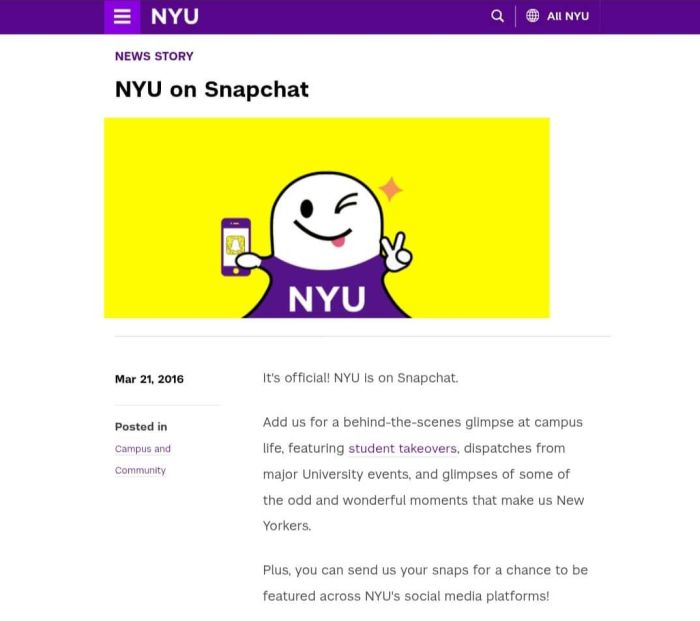
    Example: NYU (Snapchat username: nyuniversity) has leveraged Snapchat’s geofilter feature to welcome and engage prospective students. In 2016, NYU introduced a custom Snapchat geofilter for its Admitted Students Day event, even running a student design contest to create the filter. The winning filter gave visiting admits a fun way to announce their presence at NYU on Snapchat. NYU’s official news release also encouraged the community to “Add us on Snapchat” for behind-the-scenes campus glimpses and student takeovers.
    Source: NYU

    Snapchat Ads and Discover: In addition to organic content, Snapchat offers a robust ads platform and a Discover media section. While Discover is mostly for professional media partners, schools can utilize Snapchat Ads Manager to run targeted ad campaigns for recruitment. From short video ads to swipe-up web forms, Snap ads can reach users by age, location, interests, and more, crucial for enrollment marketing. 

    What does putting your school on Snapchat do? Listing your institution on Snapchat enables a digital community where students connect, share, and engage under your brand. While not managed by the school, this community becomes a valuable extension of campus life and student culture.

    How does Snapchat verify your school? Snapchat confirms membership by requiring students to use their institutional email address for verification. This automated system ensures only enrolled individuals access the community, minimizing moderation needs while maintaining student privacy and authenticity.

    With expertise in education marketing, agencies like HEM help schools navigate these ad tools as part of an integrated digital marketing strategy, ensuring Snapchat campaigns align with enrollment goals and complement efforts on other platforms. 

    To learn more about crafting cross-platform campaigns, see HEM’s digital marketing services specifically for education organizations, which cover social media, paid ads, content, and more.

    With this foundation, let’s examine how various types of educational institutions are using Snapchat in practice, from the tech-savvy prep school to the global MBA program.

    K–12 Schools: Building School Spirit With Caution and Creativity 

    K–12 schools, particularly high schools, face a unique challenge when it comes to Snapchat. While teens are highly active on the platform, schools must balance the need for engagement with a duty of care, especially considering their minor student populations. Despite these concerns, some schools have found creative ways to use Snapchat to build school spirit, communicate with students, and engage parents and alumni, all while ensuring privacy and safety.

    One common use of Snapchat in schools is to share quick glimpses of campus life and events, offering a more personal and immediate connection than traditional communications like newsletters

    Schools also leverage Snapchat’s geofilters for major events like prom, graduation, or sports games, encouraging students to use school-branded filters. These geofilters, often featuring the school name or mascot, help increase visibility and pride as students share their celebratory moments with their networks.

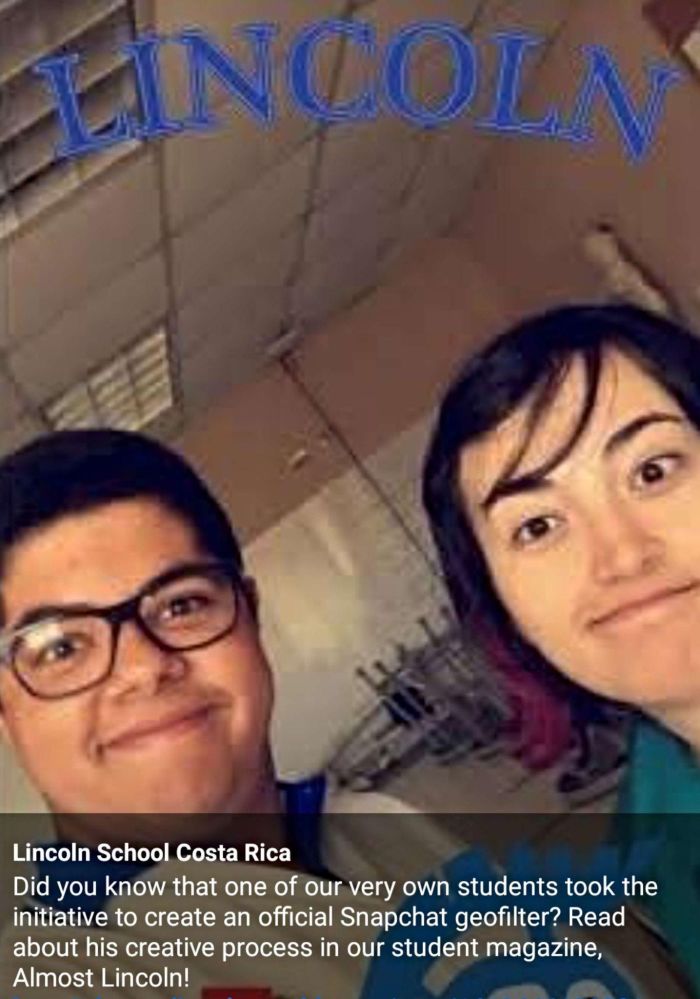
    Example: At Lincoln School in Costa Rica, a student designed an official Snapchat geofilter for the campus, enabling students to overlay a custom school graphic on their snaps. Geofilters like this rally school spirit during events and make it easy for students to share branded moments from school.
    Source: Facebook

    While Snapchat offers numerous opportunities for engagement, schools must exercise caution. Privacy concerns are paramount, and schools typically avoid following students back on the platform. They also direct more serious inquiries to email or in-person discussions.

    Ultimately, Snapchat can be a powerful tool for K–12 schools when used thoughtfully with clear goals, safety protocols, and creative student involvement. However, schools should evaluate their resources and decide if the platform aligns with their communication strategy. 

    For those who are unsure about how to get started, education marketing consultants HEM can offer guidance to help schools develop effective, safe social media strategies.

    Language Schools: Capturing Culture, Fun, and Learning in Real Time

    Language schools, including ESL institutes, immersion camps, and university pathway programs, serve a naturally youthful audience: students who are eager to share their cultural and educational experiences. For this reason, Snapchat is a fitting addition to their marketing strategy. With over 38% of Snapchat’s users aged 18 to 24, it offers a great opportunity to reach teen learners who are already on the platform. 

    Snapchat’s popularity among this age group makes it ideal for language schools looking to connect with students where they spend their time. While platforms like Facebook may be better suited for reaching parents, Snapchat helps schools tap into the social, youthful energy of their student base.

    Language schools use Snapchat in several ways to engage their audience. One key strategy is showcasing student life and local culture in real-time. By giving students control of the school’s Snapchat account, schools allow them to share their experiences, from excursions to daily activities. 

    Example: CEA ran a campaign called “10 Stages of Study Abroad,” where students shared their personal journeys through Snapchat, from arrival to cultural experiences. This user-generated content, filled with emojis and candid moments, felt real and approachable, making it an ideal way to engage teens considering studying abroad.

    Source: CEA

    Additionally, language schools use Snapchat for quick-hit teaching and engagement. Posting a “word of the day” with a fun illustration or running mini-quizzes encourages interaction and reinforces learning. These spontaneous, playful posts not only engage current students but also expand reach as followers share and respond.

    Finally, Snapchat can be used for international recruitment, particularly in regions where the platform is popular. Snapchat school campaigns can target specific countries where teens are heavy Snapchat users and run geo-targeted ads to promote their programs. 

    While Snapchat offers valuable engagement opportunities, not every language school may have the resources to manage it. If maintaining a regular presence is challenging, schools may choose to focus on other platforms like Instagram or YouTube. 

    However, if Snapchat aligns with your target demographic and storytelling style, it can be a powerful tool in your marketing mix, provided you post consistently and keep the tone light and authentic. Language learning is filled with fun and cultural moments, making Snapchat’s informal style the perfect vehicle for sharing these experiences.

    Colleges: Bringing Practical Learning to Life

    Colleges, ranging from community colleges to vocational institutes, serve a diverse audience, from recent high school grads to working adults seeking new skills. To connect with these students, platforms like Snapchat offer a unique opportunity. 

    Although adoption has been slow, career colleges that have embraced Snapchat report high engagement and significant benefits. Snapchat allows these institutions to showcase hands-on learning experiences and workforce outcomes in a way that feels authentic and immediate, which resonates with prospective students, particularly those focused on practical skills and career outcomes.

    One major way career colleges leverage Snapchat is by giving students the platform to share real-time glimpses of their training. For instance, technical institutes may use Snapchat Stories to offer behind-the-scenes looks into workshops or classrooms. This content provides a dynamic, visually engaging alternative to traditional brochures, showcasing students’ day-to-day experiences in fields like auto mechanics or culinary arts. 

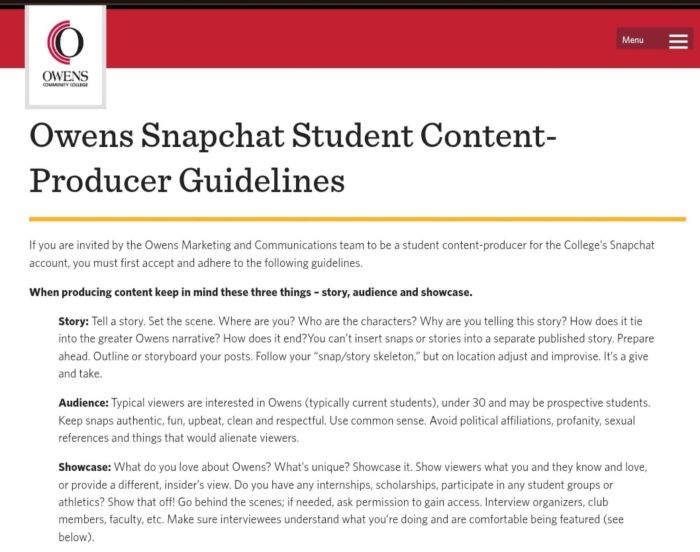
    Example: Owens Community College empowers student content producers to share everything from welding sparks to nursing students practicing IVs. This hands-on, visual storytelling appeals directly to prospective enrollees, giving them a taste of life in their chosen field.
    Source: Owens Community College 

    In addition to showcasing student life, career colleges use Snapchat to bring workforce outcomes to life. Through alumni takeovers, schools can give prospective students a “day in the life” of a graduate, showing how their programs led to real career success. This adds a personal, relatable touch that resonates more than statistics alone.

    Snapchat’s advertising tools also play a pivotal role in recruitment. Career colleges can use Snapchat Ads to target specific age groups or demographics, promoting relevant programs or seasonal events. For example, a cosmetology school could run an ad campaign targeting local teens to promote an open house, encouraging immediate sign-ups through Snapchat’s lead-gen feature.

    While Snapchat offers clear benefits, career colleges must be cautious about the content they share, especially when dealing with sensitive or confidential aspects of certain programs. Social media policies must be in place to protect privacy and ensure safety protocols are not compromised. Additionally, moderation is crucial to maintain professionalism, particularly when engaging with prospective students via interactive features like Q&As.

    Despite these considerations, career colleges that embrace Snapchat can build a modern, relatable brand, connect with a younger audience, and showcase their unique offerings. With the right strategy, Snapchat can be a powerful tool to attract the next generation of students. For colleges unsure where to start, digital marketing specialists can help create a strategy that includes content planning, staff training, and targeted ad campaigns to maximize impact.

    Universities: Scaling Engagement With Personalization

    Universities have been early adopters of Snapchat in the education space, using it to engage prospective students and strengthen their campus communities. 

    The platform’s youth-driven, real-time, and personal nature makes it a perfect fit for engaging 17–18-year-old prospects and meeting them where they already spend their time. Universities have utilized Snapchat for everything from personalized admissions outreach to virtual campus tours, showcasing the immediate and authentic experiences that Gen Z craves.

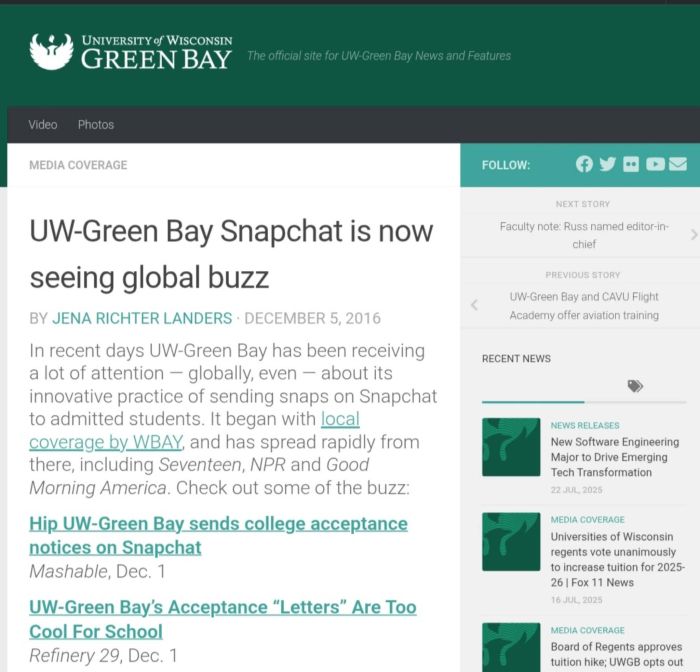
    One standout use of Snapchat is personalized admissions and outreach. The University of Wisconsin–Green Bay gained attention by notifying hundreds of accepted students through Snapchat, offering a personal touch with fun campus photos and a message like “Welcome to the Phoenix family!” This creative approach made a lasting impression, fostering a sense of connection with incoming students. Many other universities have followed suit, using Snapchat to welcome students or remind them about key deadlines, creating an interpersonal feel that’s hard to achieve with traditional email.

    Example: UW–Green Bay’s Snapchat notifications let students engage by snapping selfies back, creating an interactive and memorable admissions experience.
    Source: UW–Green Bay 

    Another common strategy is virtual campus tours and Q&As. Before virtual tours became widespread, universities like UW–Green Bay were already using Snapchat to show prospective students around campus, from dorms to dining halls, answering questions along the way. These casual, behind-the-scenes tours are an engaging way to help students envision themselves on campus, giving them a more authentic and intimate view of student life. This approach also allows universities to reach thousands of potential students in a relaxed, informal way.

    • Example: UW–Green Bay used Snapchat to host Q&A sessions on topics like financial aid and study abroad, allowing students to ask questions privately, making the experience feel more personal and accessible.

    In addition to these strategies, many universities leverage student takeovers and ambassador programs, where students take over the Snapchat account for a week to share their day-to-day experiences. This approach humanizes the institution, allowing prospective students to connect with real students in an authentic way. Universities like UNC–Chapel Hill have seen success with this model, using cross-platform promotion to ensure maximum visibility for the takeovers.

    • Example: At UNC–Chapel Hill, Snapchat takeovers are often cross-promoted on Twitter, with students sharing everything from campus life to personal milestones.

    For contests and user-generated campaigns, universities often run engagement initiatives like Snapchat scavenger hunts or spirit photo contests. These campaigns incentivize students to engage with the platform and promote the school while integrating online interaction with offline connections. Such contests increase visibility and drive student participation, making them a fun, interactive way to build community.

    • Example: Princeton’s “Snap as You Pack” contest encouraged incoming students to send snaps of their packing process, with winners receiving prizes at a campus event, turning digital interactions into real-world connections.

    Universities also utilize Snapchat ads for recruitment and yield campaigns, with many seeing impressive returns. Finally, community building and retention is a growing area for Snapchat. With features like School Communities, universities are creating digital spaces for current students and alumni to share experiences and connect. 

    In conclusion, universities have effectively integrated Snapchat into their recruitment and engagement strategies. The key takeaway is the importance of authenticity and timeliness—students respond far more to real, relatable content than polished marketing. With careful planning, universities can use Snapchat not just as a novelty but as a core element of their digital strategy, driving awareness, engagement, and ultimately, enrollment.

    Business Schools: Elevating Outcomes With Authentic Storytelling

    Business schools, though often catering to older students focused on career advancement, are increasingly turning to Snapchat to humanize their brand and engage digital-native prospects. Snapchat’s bite-sized, authentic content resonates with younger audiences, offering business schools a unique opportunity to showcase their community and career outcomes in a dynamic, engaging way.

    One of the most effective strategies employed by business schools is Snapchat alumni takeovers. Bentley University, for example, hosts monthly takeovers where alumni share “a day in the life” from their workplace, whether it’s at a Big Four accounting firm or a tech startup. These takeovers provide prospective students with a candid, behind-the-scenes look at life after graduation, helping them envision themselves in similar roles. This strategy not only promotes outcomes but also activates the alumni network, turning graduates into ambassadors for the school.

    Example: Bentley University’s alumni takeovers offer a real-life glimpse into successful careers, showcasing alumni in cities across the country working for top companies.
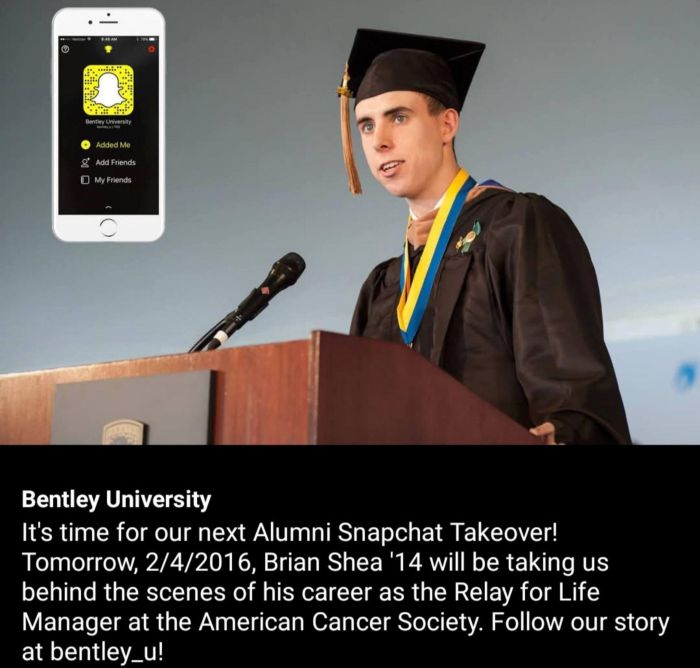
    Source: Bentley University

    Business schools also use Snapchat’s interactive features to engage prospects during admissions events. NYU’s Stern School of Business, for instance, leveraged geofilters during its admitted students’ day, allowing attendees to personalize their snaps with an NYU-themed graphic. This not only built excitement among admitted students but also turned their snaps into organic promotion for the school, reaching their personal networks and marking a milestone moment.

    • Example: NYU Stern’s geofilter campaign allowed admitted students to broadcast their campus visit excitement, effectively turning their posts into branded, organic promotions.

    In addition to these strategies, Snapchat offers a platform for student-driven content. Schools use Snapchat Stories to share authentic glimpses of student life, from MBA orientation week to team-building exercises. This unfiltered, real-time content helps prospective students connect with current students, creating a peer-to-peer relationship that traditional marketing cannot replicate.

    • Example: The University of Michigan has used Snapchat to show prospective students what the school is truly about, with current students or young alumni sharing experiences directly with their peers.

    Although Snapchat may play a supplementary role in business school marketing, especially with slightly older audiences who might prefer platforms like LinkedIn or YouTube, it offers a way to engage younger undergraduate prospects and keep them connected. As more Gen Z students enter graduate programs, Snapchat will likely become a more central tool in business school marketing strategies.

    The key takeaway from early adopters like Bentley and NYU Stern is that authenticity sells. By letting students and alumni take the lead, business schools create meaningful, relatable content that stands out. Snapchat’s interactive elements, like geofilters, contests, and Q&As, add another layer of engagement, making it a valuable tool for creating memorable touchpoints that differentiate a school’s brand.

    For business schools looking to implement these strategies, HEM offers expert support in crafting campaigns that resonate with younger audiences without compromising the professional brand. From structuring alumni takeover series to designing custom Snapchat filters, professional guidance ensures that schools’ Snapchat campaigns remain on-message and platform-appropriate.

    Best Practices for Schools Using Snapchat

    To use Snapchat effectively in education marketing:

    • Set Clear Goals: Whether you’re aiming for inquiries, event sign-ups, or community engagement, define what success looks like.
    • Assign Resources: Content doesn’t make itself. Designate staff, interns, or ambassadors. Even 1–2 days per week of content can be enough if it’s consistent.
    • Cross-Promote Aggressively: Share your Snapcode on all channels. Post reminders when live sessions or takeovers happen.
    • Encourage Participation: Ask students to snap their dorm move-ins, study setups, or event moments. Share user-submitted content with consent.
    • Use Native Features: Stickers, polls, doodles, filters; these keep your content aligned with Snapchat’s playful vibe.
    • Set Policies and Respect Privacy: Create a short social media usage policy. Don’t follow students back. Don’t show private info. Always get permission.
    • Measure Performance: Monitor views, screenshots, swipe-ups, and conversions. Define KPIs like “50 open house signups” and track accordingly.
    • Stay Flexible: Social trends shift fast. Listen to your students. If they say they love takeovers and ignore admin posts, adjust your campaign accordingly.

    Snapchat is not a magic bullet. But as the examples show, with strategy, creativity, and the right guardrails, it can drive measurable results.

    Snapchat: A Platform for the Brave and Strategic

    Snapchat isn’t right for every school. But when used strategically, it can yield exceptional engagement and even tangible ROI. From intimate glimpses into student life to full-funnel recruitment campaigns, the platform gives institutions a way to be authentic, relatable, and modern.

    Schools that embrace Snapchat thoughtfully, backed by clear goals, content planning, and a dose of Gen Z creativity, can stand out in a crowded market. And for schools unsure of how to begin, partnering with Higher Education Marketing can accelerate results, providing campaign support, creative strategy, and platform-specific training.

    Snapchat may be temporary by design, but its impact on student perception can last much longer.

     

    Frequently Asked Questions 

    Question: How does Snapchat college work?
    Answer: Snapchat’s college features, like School Communities, offer institutions a way to foster peer-to-peer engagement within a verified, digital campus environment. It strengthens school spirit, encourages student interaction, and creates new touchpoints for community-building in a format Gen Z prefers.

    Question: How does Snapchat verify your school?
    Answer: Snapchat confirms membership by requiring students to use their institutional email address for verification. This automated system ensures only enrolled individuals access the community, minimizing moderation needs while maintaining student privacy and authenticity.

    Question: What does putting your school on Snapchat do?
    Answer: Listing your institution on Snapchat enables a digital community where students connect, share, and engage under your brand. While not managed by the school, this community becomes a valuable extension of campus life and student culture.


    Source link

  • Dilemmas of research

    Dilemmas of research

    Oops! You do not have access to this page.

    The post Dilemmas of research appeared first on HEPI.

    Source link

  • Bridging the Gap: How Smart Technology Can Align University Programmes with Real-World Skills

    Bridging the Gap: How Smart Technology Can Align University Programmes with Real-World Skills

    • By Pete Moss, Business Development Director at Ellucian.

    Pouvez-vous s’il vous plaît me dire où se trouve la gare?’ – this is the extent that a colleague of mine can remember from his Introductory French module that he completed as part of a computing degree in the late 90s.  That institution’s attempt at the time to embed flexibility and cross-curriculum choice to help students develop skills out of their discipline to help with employability.  ‘It was easier to pass than the programming courses’  was the authentic feedback that my colleague gave in retrospect, but they did at least have the choice to expand their learning experience and gain some broader foundational skills.  That institution, however, has long abandoned much of that flexibility, largely due to the apparent complexity of administration.

    That is not to say that there are not fantastic examples of employability related skills initiatives across the sector, but the recent policy landscape (not least the Skills England Sector evidence on the growth and skills offer) and ever-present national growth agenda are now firmly putting the spotlight on the role of HE in this area.  The if element of HE holding that key role in the skills agenda is widely held, but now the thorny problem of how must be addressed.  Technology advancements, specifically AI, will play a contributory factor in how institutions can remove barriers that caused institutions to reduce flexibility in the past, but what of the wider considerations?

    To explore this topic further I asked Ben Rodgers, an experienced academic registrar and AHEP consultant, for his views on the topic:

    In today’s fast-moving global economy, the value of a university education is increasingly measured not just by academic achievement, but by the employability of graduates. Employers are no longer looking solely for degrees, they’re looking for skills: digital fluency, critical thinking, communication, and technical know-how that align with the needs of their industries. Meanwhile, universities are under pressure to demonstrate that their programmes deliver real-world value. The challenge is clear: how do we bridge the gap between what is taught and what is needed?

    This is where technology can make a transformative difference. At the forefront of this change is a new wave of AI-powered innovation designed to bridge the gap between academic programmes and real-world skill demands. These emerging technologies can analyse curricula, extracting the skills embedded within them and mapping those against labour market data to identify areas of alignment and gaps.

    Crucially, they work in both directions; institutions can see what skills a course develops, while students or employers can start with a desired competency like coding or digital marketing and trace back to the programmes that build those capabilities.

    It is the kind of innovation that higher education has long needed. For too long, the link between the classroom and the workplace has been inconsistent or poorly articulated. Universities may know they are delivering valuable learning, but haven’t always had the means to evidence that value in terms that resonate with employers and prospective students. These technologies bring much-needed clarity, offering structured and data-informed ways to demonstrate how academic learning contributes directly to employment readiness.

    A Game-Changer for the Lifelong Learning Entitlement (LLE)

    This kind of technology becomes even more important as the UK rolls out the Lifelong Learning Entitlement (LLE). The LLE is set to reshape the educational landscape by allowing individuals to access student finance for short courses, modular learning and skills-based development over the course of their lives. This shift away from traditional three-year degrees opens new possibilities, but also new challenges.

    How will learners know which modules to pick? How will they know what skills they need for the job they want or even the job they haven’t yet imagined? With the support of emerging AI-driven tools, learners can begin to reverse-engineer their career goals. Want to become a Data Scientist? These systems can help identify which combinations of modules across a university lead to that destination. Interested in project management? The technology can pinpoint where those skills are taught, and which courses offer them. It’s like having a careers advisor, curriculum guide, and labour market analyst all in one—offering personalised insights that connect educational choices with professional ambitions.

    This sort of capability is vital if LLE is to be more than just a funding mechanism. It needs to be supported by intelligent infrastructure that empowers learners to make informed choices. Otherwise, there’s a risk that modular study becomes a confusing patchwork of disconnected learning.

    Towards a Shared, Inter-University Skills Ecosystem

    Now imagine if we took this even further. What if a skills platform were adopted not just by individual institutions but as a shared framework across regions or even nationally? In this model, students in Glasgow, Cardiff, Birmingham, or Belfast could see the skills they need for local job markets and be directed to the institutions offering them. This would create a more agile, responsive, and learner-centred education system. Universities wouldn’t just be competing with each other; they’d be collaborating to build a broader skills ecosystem.

    The scale of opportunity here is significant and growing fast. Consider this: if every individual in the workforce has access to around £1,800 in personal development funding each year, the cumulative potential across a university’s learner base is vast. Multiply that by hundreds or thousands of learners, and you’re looking at a transformative funding stream that’s currently underutilised.

    This is not just an opportunity for students, it’s a strategic imperative for institutions. By enabling individuals to build relevant, targeted skills, universities position themselves as essential engines of workforce development, driving economic resilience at local, regional, and national levels. It’s a win-win: empowered learners, future-ready graduates, and sustainable new revenue for the sector.

    Of course, this requires a shift in thinking from institutional autonomy to inter-institutional alignment. But the benefits are compelling: more efficient use of public funding, stronger regional economies, and better outcomes for students.

    Making Programme Design More Purposeful

    Beyond helping students choose what to study, this technology also has the power to influence what universities choose to offer. If data consistently shows that a particular programme has little connection to current or emerging job markets, it is worth investigating. It does not mean the course should be cut. There may be academic or social reasons to preserve it, but it does mean the institution is equipped with the intelligence needed to make informed decisions.

    It also invites a more purposeful approach to curriculum design. Are we including this module because it is pedagogically valuable, or because it’s always been there? Are we assessing this way because it builds a skill, or because it is the easiest to administer? When you can map outcomes to employment skills, these questions become easier to answer.

    Moreover, it provides a compelling framework for conversations with students, parents, and policy-makers about the value of university education. It shows that we are listening to what the world needs and responding with academic rigour and strategic intent.

    Global Potential, Local Application

    The skills gap is not just a UK issue; it’s a global one. The World Economic Forum reports that nearly half of all workers (66 per cent) will need reskilling by 2030. Universities worldwide are grappling with how to stay relevant in an era of automation, AI and constant disruption. Emerging AI tools offer the potential for a globally shared skills taxonomy that could, with appropriate localisation, apply anywhere.

    Conclusion

    As universities continue to evolve, their role as engines of economic and social mobility becomes more important than ever. To fulfil that role, we must ensure that what we teach aligns with what the world needs. That does not mean turning every degree into job training, but it does mean being thoughtful, strategic, and transparent about the skills our programmes provide.

    Emerging technologies offer an exciting glimpse into a more connected, skills-aware future. They empower students to take greater control of their learning, help universities refine and align their programmes and ensure that the promise of Higher Education translates into meaningful, real-world opportunities.

    After all, education is a journey. It’s time the map caught up.

    Source link

  • Weekend reading: The Launch of the APPG on Students: Commission on Students in Higher Education

    Weekend reading: The Launch of the APPG on Students: Commission on Students in Higher Education

    This blog was kindly authored by Alex Stanley, NUS Vice President of Higher Education, Saranya Thambirajah, NUS Vice President Equality & Liberation and Alex Sobel Member of Parliament for Leeds Central and Headingly.

    Today, we’re proud to launch the Commission on Students in Higher Education, a project between the APPG on Students, supported by NUS UK and a group of expert Commissioners, and based on evidence, event attendance and input from over 50 students’ unions and sector organisations.

    The Commission speaks to the themes of the Department for Education’s HE Review and Post-16 Strategy and places the voices of students right at the heart of key questions on inspiring high-quality teaching and learning, access and widening participation.

    In the current financial climate for universities and for the Treasury, we would have loved to be able to produce a Commission which speaks to interventions in quality, that highlights the groundbreaking pedagogical practice that students’ unions and educational organisations were excited to share with us, and the amazing widening participation work that we have seen across the country.

    However, across all of our work we had to return to the question of funding, for students and for the sector. Right now, we risk a situation where the state of funding for students and for universities creates a double crisis, where neither the student themselves have the money to thrive while studying, nor the university has the money to adequately support them.

    We know that students are working longer and longer hours outside of their degrees, in jobs not directly relevant to their future careers. The HEPI and AdvanceHE Student Academic Experience Survey for 2025 shows that this is eating into their independent study time, with the average weekly study time dropping by two hours over the last year.

    Our evidence shows a further impact of working hours: what is suffering is not necessarily academic outcomes, but students’ overall experience in higher education. Students’ unions reported to us that the uptake of student activities, clubs, societies, and extracurricular activities is decreasing, and when asked, students stated that they were spending the time they would have liked to spend on activities undertaking paid work instead.

    This should raise significant concerns for anyone involved in higher education and student life. When a student enters university, they of course gain experience and qualifications from their academic study, but the skills and experiences gained from their additional activities are just as valuable for many students. In providing these activities, students’ unions are engines of social capital.   

    Those students who work the longest hours and come from middle and lower income families are seeing the sharpest end of the cost-of-living crisis are also those who stand to benefit from extracurricular activity. There are some widening participation initiatives actively working to rectify this, by providing mentoring and support to participate in additional activities. Evaluation of these programs, further explored in the Commission report, found that those who were enrolled in the programs were also more likely to take up leadership positions in their Students’ Unions, clubs and societies. This shows the need for financial support which supports not only academic, but social participation.

    As part of the Commission, we received proposals on how a fairer settlement for student maintenance could be reached within the current financial envelope. The Commission considered proposals on funding maintenance through a system of stepped repayments to redress regressive distributional effects in the current student loan repayment system, to instituting a graduate levy on employers who benefit from recruiting graduates, both of which have been covered in the HEPi report How should undergraduate degrees be funded?

    The cross-party consensus is clear: right now, it’s imperative that the government establish a new system of student maintenance that rises with the cost of living and ensures grant funding is available for the poorest students. We also believe that the government should have ambition toward meeting a Student Minimum Income, also fully explored here.

    In the Post-16 Review, the Department for Education has the opportunity to publish with a suite of bold, brave reforms to make like better for students. We will not be able to have the conversation about teaching, access and high-quality student experience without a foundational conversation about funding and student maintenance: we urge the Department to include a new settlement for student maintenance in the scope of the Post-16 Strategy.

    You can read the full report from the Commission here.

    Source link

  • Addressing educational poverty – HEPI

    Addressing educational poverty – HEPI

    • By Pam Tatlow, Policy Adviser to the Cathedrals Group of Universities

    The Government’s decision to extend free school meals to an estimated 500,000 primary school children is a win-win, both in addressing disadvantage and supporting learning and attainment. In fact, all primary-age school children in Scotland and London now receive free school meals, with an evaluation of the latter concluding that its impact was overwhelmingly positive and that for some children, school attendance and mental well-being had also been improved.

    It’s clear that free school meals are a worthwhile investment of Department of Education resources. It is also why Ministers should maximise take-up in England by linking auto-enrolment of Free Schools Meals with universal credit and pupil premium.

    But why should universities care about Free School Meals? The answer is quite simple, especially if, like the Cathedrals Group of Universities, you recruit students who progress to university later in life. In some universities, many students are parents and carers in their own right who will undoubtedly benefit from widening the eligibility for free school meals. It’s a policy that has inter-generational impact as well as positive impacts on the children of today.  

    Moreover, rising levels of inequality as documented by the OECD, the IMF, the World Bank and in the UK by Danny Dorling, Professor of Human Geography at the University of Oxford, constrain not only economic growth (an objective of Rachel Reeves, Chancellor of the Exchequer) but also educational attainment – a fact not lost on Professor Becky Francis, Chair of the government’s Curriculum and Assessment review who concluded in 2015 ‘that all the data supports the idea that the socioeconomic divide is the biggest issue in education’. While diverse in size, Cathedrals Group Universities continue to play a key role in educating the teachers of the future, but crucially are also united by a commitment to social justice – and this means a continuing interest in measures that address inequality.

    The June Spending Review was notable for its silence on other measures which might directly support educational attainment beyond the primary stage. There is still time for Ministers to recognise that supporting pupils and students during their studies is an investment in their futures that will pay dividends in terms of monetised and non-monetised benefits for individuals, communities and ultimately the Treasury itself.

    At the secondary phase, Education Maintenance Allowance (EMA) was a weekly payment to disadvantaged young people aged 16-19 in full-time education. Introduced in 1999, expanded nationwide in 2004, the EMA was abolished by the Coalition Government in England in October 2010, with the 2010/11 academic year marking the final year of the scheme. Replaced by a 16-19 Bursary Fund that continues today, the Fund has a significantly reduced budget and, other than for the most disadvantaged and vulnerable young people, is administered at the discretion of colleges and training providers, which decide their own schemes.

    The difference between this Fund and the EMA is stark. EMA provided direct payments to young people for which they could apply before opting for a specific post-16 education course or institution. As shown by its continuation in Scotland, Wales and Northern Ireland, the EMA remains a popular policy with young people (who were not consulted about its abolition in England). Research by the Edge Foundation confirmed that the EMA had a positive impact on post-16 education participation and retention rates among young people from lower-income families and those with disabilities. Although the school leaving age has been increased to 18 for over a decade, there are often costs associated with post-16 study, such as specialist equipment and transport, for which young people get little support. What does exist in England is discretionary and dependent on a postcode lottery.

    Then there’s higher education, which by common agreement needs a new funding model in England and, in the view of the Cathedrals Group, more direct government investment. Investment in universities and investment to address the hardship of students are two sides of the same coin. If maintenance support for students is increased by inflation, it will be welcome but not enough. London Economics research for the Sutton Trust in 2024 confirmed that the abolition of maintenance grants (which did not have to be repaid) has resulted in students from the poorest families incurring the highest debts during their studies. Moreover, parental income thresholds, which determine when parents are expected to contribute to the living costs of their children at university, have remained frozen at £25,000 pa. The same research estimated that in real terms, household income thresholds should have increased to £32,535 and that students from poorer households could graduate with over £60,000 of debt, 38% higher than those from wealthier families.

    Universities know only too well about educational poverty. Notwithstanding the pressures on institutional funding, many have increased their hardship funds. In spite of their best efforts, including money advice, demand from students for financial support outstrips budgets. Hepi and Advance HE’s 2025 Student Experience Survey confirms that cost-of-living concerns have impacted on students’ studies but also the extent to which students now combine study and paid employment with the average total of study and workload hours for students who work standing at 44.3 hours a week – ‘higher than the average full-time job in the UK’.

    And to end where we began: in Finland, there are no free school meals because the provision of free meals is an integral part of the Finnish education system – the same system which is consistently ranked first among all OECD countries in education and in terms of the outcomes and well-being of its pupils and students. Only the Treasury can now help square the circle and address educational poverty of pupils, students and their families at every stage of their educational journey. Such a strategy would not only support the government’s stated ambition to tackle inequality but also Ministers’ aspiration to improve educational attainment – a win all round.

    Source link

  • What’s New With Top Hat?

    What’s New With Top Hat?

    As you gear up for a new term, we’re excited to share some of Top Hat’s latest features—along with practical resources to help you engage students, streamline your teaching and set your course up for success.

    Affordable Learning Just Got Active 

    Interactive OpenStax Textbooks

    We’ve brought a curated selection of OpenStax textbooks into the Top Hat platform—at no extra cost to you or your students. These peer-reviewed, open-license texts are enriched with embedded assessments, accessibility upgrades and seamless integration into your course. It’s a powerful way to meet affordability goals while offering interactive, customizable materials that improve learning. Browse the OpenStax catalog.

    Making Teaching Easier and More Engaging

    Guest Mode for Presentations

    Engage any audience! Guest Mode makes it easy to use Top Hat outside the classroom, such as during conference talks, public lectures, or internal training sessions. Participants can join via QR code or session link—no login or student account needed. The perfect solution for one-time or public-facing presentations where simplicity and speed matter most. Learn more.

    Ace: AI-Powered Example Generator

    Help students see the ‘why’ behind what they’re learning. With a single highlight, you can ask Ace to generate a career-relevant or real-life scenario to bring a course concept to life. Whether you’re teaching accounting, anatomy, or sociology, Ace can tailor examples to match your students’ goals—helping them better connect with and retain the material.

    Preview New Builder Questions (Expected July)

    A new “preview” button in questions created with the new question builder allows instructors to view and interact with question content as it appears to students. You can interact with and submit responses to questions in preview mode to test things out before going live. Just note that these responses will not be saved.

    Live reactions (Expected August)

    Enable students to send real-time emoji reactions to presentation content throughout the lecture, providing even more opportunities for interactivity in class. This feature will be released first for guest mode sessions and then for regular classroom use.

    New Join Screen for Classroom Sessions (Expected July)

    We’re reducing friction even further by allowing students to join classroom sessions simply by scanning a QR code on the join screen.

    Easier In-Course Content Search

    Quickly find the materials you need, when you need them. Need to locate a quiz question, a specific slide, or an assignment from earlier in the term? Our upgraded content search lets you filter by type and keyword within your course, saving time and reducing prep friction. Learn more.

    Helpful Resources to Start the Term

    Student Engagement Toolkit

    This toolkit offers ready-to-use activities, templates, and low-stakes assessment ideas grounded in learning science to energize the classroom experience. View the Toolkit!

    Teaching with Top Hat Toolkit

    Everything you need to become a Top Hat pro. Whether you’re new to the platform or looking to level up, this toolkit walks you through the essentials—from setup and grading to extending learning outside class. Includes step-by-step tutorials, sample activities and instructional design tips. Access the Toolkit!

    Interested in learning more about Top Hat? Click here to book a platform overview.

    Source link

  • Ten Things I Learned at DETcon 2025

    Ten Things I Learned at DETcon 2025

    • By Rob Carthy, Director of International Development, Northumbria University.

    Attending Duolingo’s inaugural DETcon London, I anticipated a day focused on the evolving landscape of language testing. What I experienced was a candid, and at times controversial, conversation about the geopolitical, political, and technological pressures facing UK higher education. Duolingo may have been the convenor, but the themes of the day went to the heart of the sector’s future.

    Here are ten of my key takeaways from a thought-provoking day.

    1. Crisis is the New Business-as-Usual

    “Since I started, we’ve faced crisis after crisis.” These words from Katja Lamping, Director of Student Recruitment at UCL, resonated deeply. From the pandemic to the fall of Kabul, Ukraine, and Gaza, the past five years have demanded a level of institutional reactivity we’ve never seen before. The clear message was that this isn’t a blip. As former Home and Foreign Secretary Jack Straw bluntly put it, the first rule of preparing for uncertainty is to “expect that the unexpected is going to happen.” For university leaders, strategic planning now looks less like a road map and more like training for a cross-country race in the dark.

    2. Agility is Now a Core Competency

    The flip side of constant crisis is the need for agile solutions. We heard how the Duolingo English Test (DET) became a vital tool during the pandemic because it was accessible when physical test centres were not. This story is symbolic of a wider truth: our traditional processes and partnerships can be brittle. To keep our doors open to global talent, we must build resilience and responsiveness into our operations, from admissions to student support.

    3. The Political Headwinds are Strengthening

    Jack Straw’s portrayal of the government’s immigration white paper was sobering. He spoke of a view that some university business models are “not sustainable.” And highlighted the view in Westminster that the student visa route was being used as a “racket” for asylum claims. I might have disagreed with him – many in the room did – but this is a view held by many and is a reality we must face.

    Straw, and later in the day Rory Stewart, said the mood in Westminster is hardening regardless of who is in power. This government wants to bring down immigration. It’s often said Brits don’t mean students, but the stark reality is the government wants to get numbers down, and students are one, if not the easiest, lever they can pull. We must be on the front foot, demonstrating our commitment to robust compliance and ethical recruitment, and articulating the immense value international students bring—a value HEPI’s own research has quantified at a net £37.4 billion for the 2021/22 cohort alone.

    4. Technology Can Deliver Both Access and Integrity 

    A powerful message came from Duolingo’s CEO and co-founder, Luis Von Ahn, who shared his personal story of growing up in Guatemala and seeing how English proficiency could transform a person’s life, yet how prohibitive the cost of testing was. His core argument was that technology should be a democratising force. But most compellingly, he tackled the security question head-on. He argued that far from being less secure, an AI-powered test can offer greater integrity than a traditional test centre. The ability to use AI to monitor hundreds of behaviours simultaneously—from eye-gaze to keystroke patterns—in addition to human proctors, presented a powerful case that a digital-first approach doesn’t have to mean a compromise on security; it could, in fact, mean the opposite.

    5. The Biggest Risk of AI Might Be Inaction

    In a fascinating session on technology, Dr. Laura Gilbert OBE of the Tony Blair Institute offered a powerful counter-narrative to the usual fears around AI. She argued that the biggest risk might be “not doing it at all.” While we worry about academic integrity, we risk missing the opportunity to use AI to solve our biggest challenges, from relieving the administrative burden in admissions to revolutionising personalised learning. Her point that technology like AI is essential to sustaining public services like the NHS has direct parallels with the financial challenges in our own sector.

    6. Trust in Technology Must Be Earned

    Dr. Gilbert was clear: you cannot just demand trust in AI. It must be earned through what she called “radical transparency.” For universities adopting tools like the DET for high-stakes admissions, this is a critical lesson. We must demand evidence from our tech partners that their tools are secure, equitable, and have been rigorously evaluated for bias. Publishing that evidence, as Duolingo was highlighted as a good example, should become the industry standard.

    A crucial warning from Dr. Gilbert was that if left to market forces, AI will inevitably make the advantage more advantaged, worsening societal inequality. For a sector committed to widening participation, this is a profound challenge. As we adopt AI, we must actively and consciously steer it towards closing, not widening, access gaps. The goal of using technology to reach students from previously untapped regions is a noble one, but it requires a constant and active focus on equity.

    7. AI Isn’t Just A Buzzword

    It’s a transformative force in assessment, personalisation and inclusion. I was struck by Duolingo’s mission-led approach, especially its ability to deliver high-quality, low-cost English testing to learners across the globe, including refugee and displaced students. Innovations like adaptive testing, AI-driven speaking practice, and real-time fraud detection redefine what “secure” and “authentic” assessment looks like. The session challenged my assumptions about test integrity and proved that democratisation doesn’t mean compromise. The balance between rigour and compassion resonated strongly—proof that access and excellence can coexist. At Northumbria, we’re increasingly mindful of our role in enabling fairer pathways into UK higher education. The Duolingo English Test is no longer a disruptor—it’s fast becoming a vital enabler that we should all be paying attention to.

    8. Is it a Brave New World?

    Rory Stewart’s session offered a powerful analysis of our turbulent times, contrasting the post-1989 era of liberal democracy and globalisation with our current “shadow world” of populism, protectionism, and a retreat from a rules-based international order. Stewart highlighted key shifts, including China’s rise without democratisation, the 2008 financial crisis, and the chaotic impact of social media and failed interventions in Iraq and Afghanistan. Stewart warned that global trends, like Trump’s attacks on US universities, could easily manifest in the UK, emphasizing that “what happens in the US can come here”. These attacks include significant funding cuts and threats to academic freedom over perceived ideological biases. This serves as a stark reminder for UK higher education to remain vigilant against similar political pressures.

    9. A Little Can Go A Long Way

    The session on the carbon cost of testing made me sit up. John Crick from the International Education Sustainability Group (IESG)  revealed that switching from test centre-based exams to online alternatives can cut carbon emissions by up to 98%. The equivalent of planting a Sherwood Forest of trees every year. The analysis showed that the biggest environmental impact comes from travel to test centres, especially in regions without local provision. What struck me was how easily we overlook this area in our sustainability strategies. IESG’s meticulous modelling gives us a much-needed baseline to challenge assumptions and examine the unintended carbon consequences of our English language policies. It’s a conversation starter—but one we in international education need to have now if we’re serious about meeting climate goals.

    10. Our Soft Power is Precious, But Not Guaranteed

    The conference ended with a discussion on the UK’s soft power and the launch of Duolingo’s Welcome Project, which seeks to provide a place for students displaced by the turmoil in the US with opportunities in the UK.

    While our leading universities remain beacons of global influence, the day’s discussions made it clear this cannot be taken for granted. A domestic political narrative focused on clamping down on immigration, combined with financial models that are visibly creaking, risks tarnishing one of the UK’s greatest exports. We must collectively find a way to reconcile the need for control and sustainability with the projection of being an open, welcoming, and world-leading destination for education.


    Rob Carthy is the Director of International Development at Northumbria University, where he leads the university’s international student recruitment strategies. He is focused on developing a sustainable and diverse international community in Newcastle upon Tyne. Find him on LinkedIn.

    Source link

  • Reflections on the demand for higher education – and what UCAS data reveal ahead of Results Day 2025

    Reflections on the demand for higher education – and what UCAS data reveal ahead of Results Day 2025


    This HEPI blog was kindly authored by Maggie Smart, UCAS Director of Data and Analysis

    As we pass the 30 June deadline for this year’s undergraduate admissions cycle, UCAS’ data offers an early view of applicant and provider behaviour as we head into Confirmation and Clearing. It also marks a personal milestone for me, as it’s my first deadline release since rejoining UCAS. I wanted to take a deeper look at the data to reflect on how much things have changed since I worked here 10 years ago.

    Applicant demand has always been shaped by two key elements: the size of the potential applicant pool, and their propensity to apply. Since I last worked at UCAS in 2016, these two factors have continuously interchanged over the better part of the past decade – sometimes increasing or decreasing independently but often counterbalancing each other. Let’s take a look at how things are shaping up this year.

    Overall, by the 30 June there have been 665,070 applicants (all ages, all domiciles) this year, compared to 656,760 (+1.3%) in 2024. This is an increase in applicants of over 64,000 since UCAS last reported in January, although the profile of these additional applicants is very different. At the January Equal Consideration Deadline (ECD), over half of the total number of applicants were UK 18-year olds, who are the most likely group to have applied by that stage in the cycle. They represent just 8% of the additional applicants since January, among a much larger proportion of UK mature and international students.

    As we saw at January, the differences in demand for places between young people from the most advantaged (POLAR4 Quintile 5) and most disadvantaged (POLAR4 Quintile 1) areas at June remain broadly the same as last year – with the most advantaged 2.15 times more likely to apply to HE than those from the least advantaged backgrounds, compared to 2.17 last year.

    UK 18-year-old demand

    Demand for UK higher education (HE) has long been shaped by the 18-year-old population – the largest pool of applicants. Despite the well-known challenges facing the HE sector at present, at the 30 June deadline we see record numbers of UK 18-year-old applicants, with 328,390 applicants this year – up from 321,410 (+2%) in 2024. This trend was almost entirely locked in by the January deadline, given the vast majority of UK 18-year-old applicants have applied at this stage in the cycle.

    During my previous tenure at UCAS, the size of the UK 18-year-old population had been falling year on year but from 2020, it began to increase. This continued growth drives the increase in UK 18-year-old applicant numbers we have observed in recent cycles. But when we look at their overall application rate to understand the strength of demand among this group, the data shows a marginal decline again this year – down to 41.2% from 41.9% in 2024. The historically strong growth in the propensity of UK 18-year-olds to apply for HE, which we’ve observed across the last decade, has clearly plateaued.

    This could be due to a range of factors, such as young people choosing to take up work or an apprenticeship, or financial barriers. We know that cost of living is increasingly influencing young people’s decisions this year, with pre-applicants telling us that financial support – such as scholarships or bursaries – ranks as the second most important consideration for them (46%), followed closely by universities’ specific cost-of-living support (34%).

    Interesting to note is the number of UK 19-year-old applicants. When separating the data to distinguish 19-year-olds applying for the first time (as opposed to those reapplying), there has been a decent increase – from 46,680 last year to 48,890 this year (+4.7%). For many years, the number of first-time UK 19-year-old applicants had been falling year on year, but since 2023 this trend has started to reverse. This suggests that demand among young people may be holding up as they decide to take a year out before applying to university or college.

    Mature students

    For UK mature students (aged 21+), the picture looks very different. The number of mature students applying to university or college ebbs and flows depending on the strength of the job market, so since I was last at UCAS, we have typically seen applications decrease when employment opportunities are strong and vice versa. Alongside fluctuations linked to the employment market, rising participation at age 18 means there is a smaller pool of potential older applicants who have not already entered HE. The falling demand from mature students continues in 2025, although in recent years there have been small but significant increases in the volume of mature applicants applying after the 30 June deadline and directly into Clearing. 

    As of this year’s 30 June deadline there have been 86,310 UK mature (21+) applicants, compared to 89,690 (-3.8%) in 2024, meaning a fall in demand compared to the previous year at this point in the cycle for the fourth year in a row. However, whereas at the January deadline mature applicants were down 6.4% compared to the same point last year, at June the figure is only 3.8% down showing some recovery in the numbers. This is another indication that mature students are applying later in the cycle. While it remains too early to say whether we will see continued growth in mature direct to Clearing applicants in 2025, last year 9,390 UK mature students who applied direct to Clearing were accepted at university or college, an increase of 7.4% on 2023 and 22.7% higher than 2022.

    International students

    When looking at the UCAS data through the lens of international students, the landscape has changed significantly since 2016. Brexit led to a sharp decline in EU applicants, offset by strong growth elsewhere, the pandemic caused disruption to international student mobility, and we’ve seen intensified global competition, shifting market dynamics and geopolitics which are increasingly influencing where they choose to study. This year we’re seeing growth once more, with 138,460 international applicants compared to 135,460 in 2024 (+2.2%) – although this stood at +2.7% at January. It should be noted that UCAS does only see a partial view of undergraduate international admissions (we tend to get a more complete picture by the end of the cycle) and we don’t capture data on postgraduate taught and research pathways.

    Interest among Chinese students in UK education has held firm since my time at UCAS, and this year we’re seeing a record number of applicants from China – 33,870, up from 30,860 (+10%) in 2024. This year’s data also shows increases in applicants from Ireland (6,060 applicants, +15%), Nigeria (3,170 applicants, +23%) and the USA (7,930 applicants, +14%). 

    Offer-making

    We are releasing a separate report on offer-making this year, alongside the usual data dashboard for applications. This additional data covers offers and offer rates over the past three years, from the perspective of applicants according to their age and where they live, and from the perspective of providers by UK nation and tariff group.

    What we’re seeing as the natural consequence of increased applications this year is an uplift in offers. Universities have made more offers than ever before this year, with 2.0 million main scheme offers to January deadline applicants overall, largely driven by the rise in UK 18-year-olds applicants (who are the most likely to use their full five choices while applying). This record high surpasses the previous peak of 1.9 million offers set last year (+3.8%).

    While the main scheme offer rate has increased across all provider tariff groups, the most notable uplift is for higher tariff providers – up 3.2 percentage points to 64.4% this year.  Despite the increase in offer rates, higher tariffs do still remain the lowest, partly due to being the most selective institutions. Offer rates by medium and lower tariff providers have also increased, by 0.9 percentage points to 77.0% among medium tariff providers, and by 1.5 percentage points to 81.7% among lower tariff providers. This means that, among those who applied by the Equal Consideration Deadline in January, 72.5% of main scheme applications received an offer this year, also a record high, and 1.8 percentage points higher than in 2024.

    It’s worth noting that we’ll be updating our provider tariff groupings in time for the 2026 cycle, to reflect changes in the higher education landscape.

    Looking ahead

    For students who are intent on going to university or college, it makes this a very good year, with more opportunities than ever before. A record 94.5% of students who applied by the January deadline will be approaching the critical summer period having received at least one offer. High levels of offer-making by universities and colleges typically translates into more acceptances, which should give applicants plenty of confidence heading into results day. 

    I’m delighted to be back at UCAS, and my team will continue to dig further into the data as Confirmation and Clearing draws nearer to see how demand translates into accepted places come results day.

    UCAS

    UCAS, the Universities and Colleges Admissions Service, is an independent charity, and the UK’s shared admissions service for higher education.

    UCAS’ services support young people making post-18 choices, as well as mature learners, by providing information, advice, and guidance to inspire and facilitate educational progression to university, college, or an apprenticeship.

    UCAS manages almost three million applications, from around 700,000 people each year, for full-time undergraduate courses at over 380 universities and colleges across the UK.

    UCAS is committed to delivering a first-class service to all our beneficiaries — they’re at the heart of everything we do.

    Source link

  • Choosing the Right Enrollment Management System

    Choosing the Right Enrollment Management System

    Reading Time: 12 minutes

    Enrollment is no longer a funnel. It’s a journey.

    One shaped by search queries, digital experiences, instant communication, and high expectations. Today’s prospective students demand speed, personalization, and clarity from their first interaction. For institutions that want to grow, scale, and compete, relying on spreadsheets or legacy databases is no longer sustainable.

    You need a system that works as hard as your team does. One that doesn’t just manage applicants, but empowers strategy, fosters connection, and drives retention.

    That’s the promise of a modern Enrollment Management System (EMS), but only if you choose the right one.

    What Is an Enrollment Management System?

    An Enrollment Management System is more than a tool for admissions; it’s a digital backbone for your recruitment, application, and onboarding processes. Think of it as an intelligent, data-powered engine that drives student acquisition and supports institutional growth goals.

    While many systems include basic applicant tracking and form building, a true EMS integrates across departments, touching admissions, marketing, student services, financial aid, and beyond. It’s designed to give your team a real-time view of the applicant pipeline while also enabling automation, analytics, and multichannel communication.

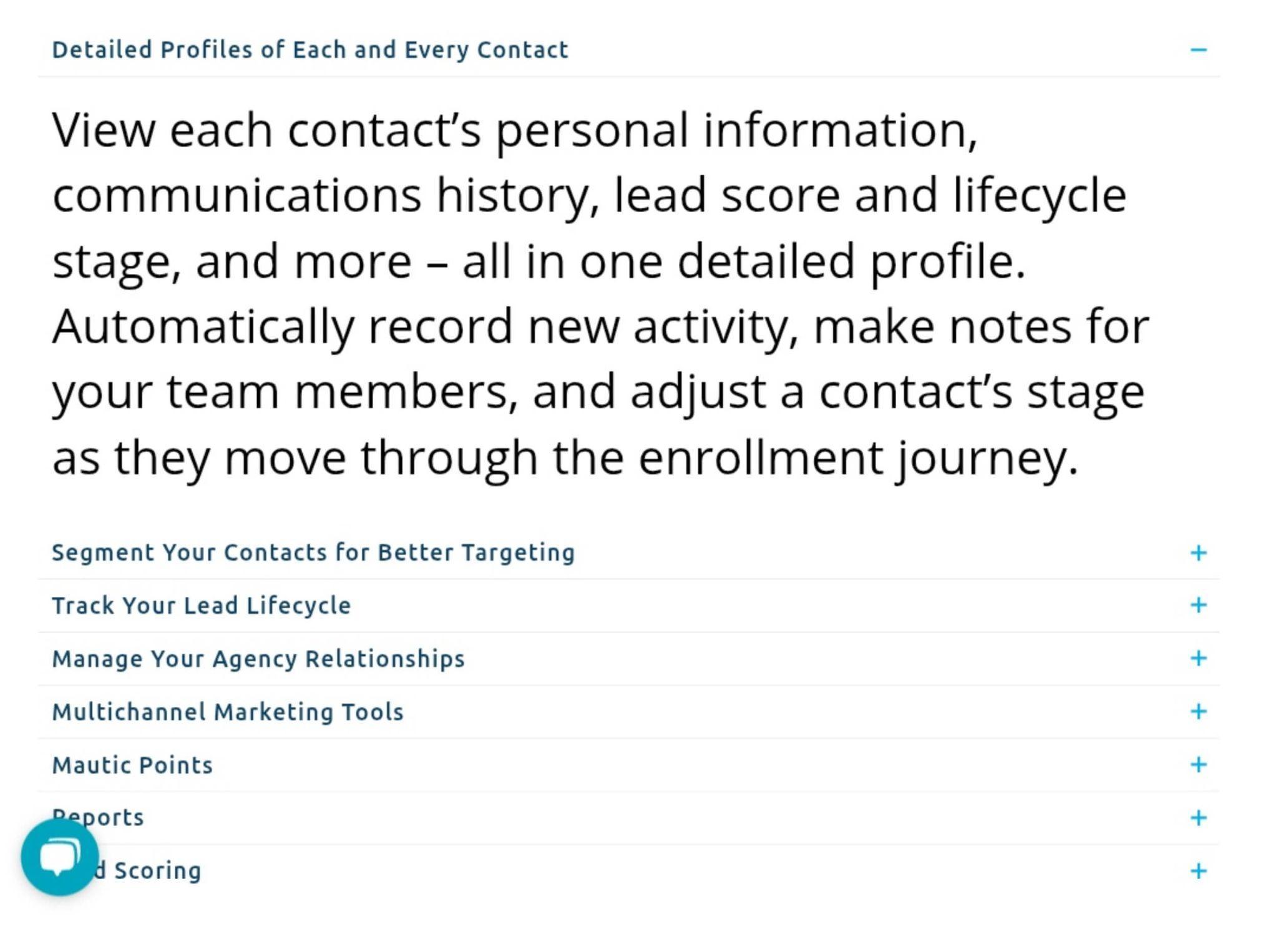
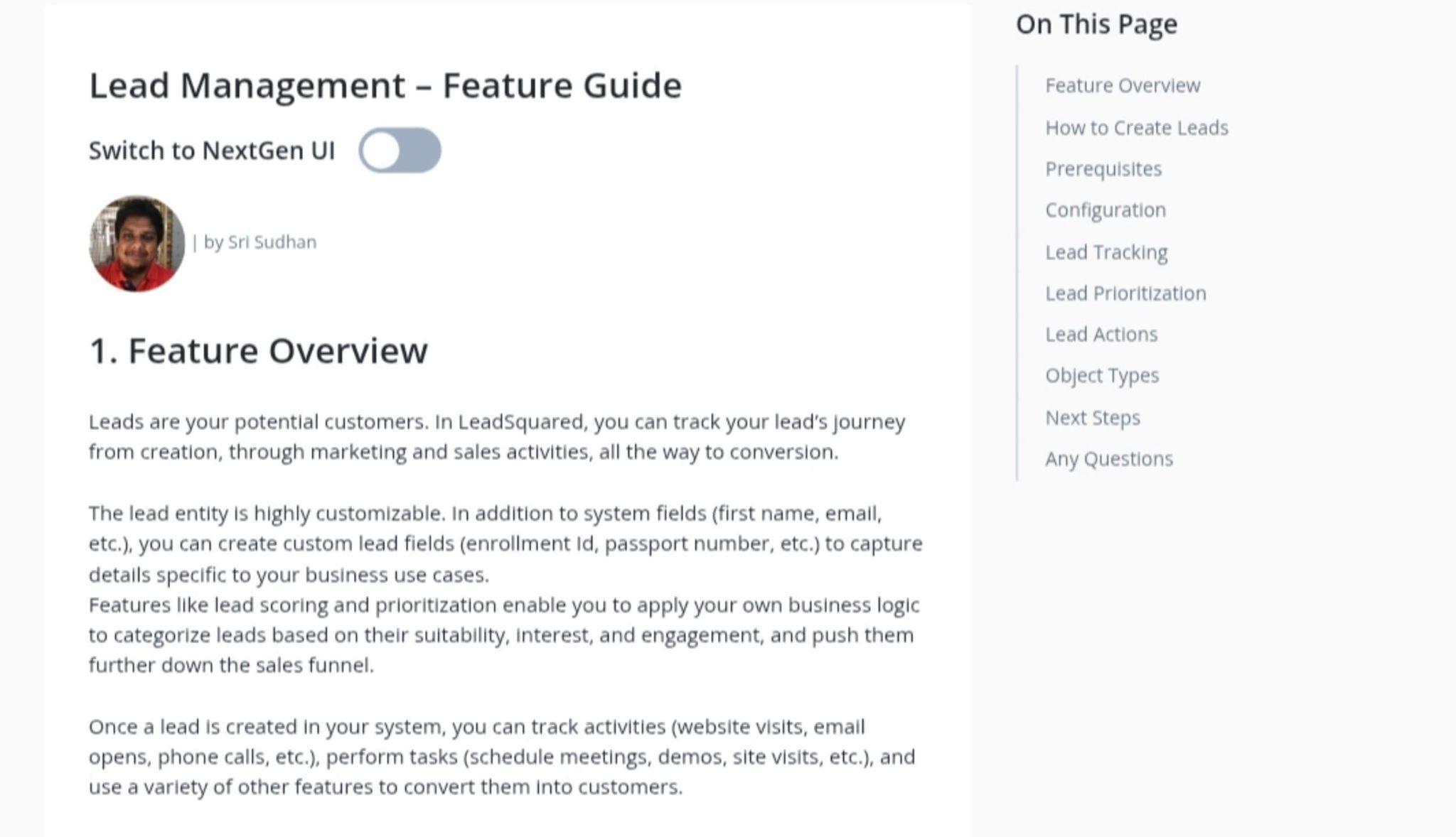
    Example: Mautic by HEM is a dedicated, all-in-one CRM and marketing automation platform for education, built on the open-source Mautic tool. It facilitates thorough applicant tracking by letting schools define custom stages and funnels for the enrollment journey: admissions teams can monitor each contact’s progress through stages (inquiry, application, accepted, etc.) and even apply lead scoring to prioritize the most engaged prospects.

    Source: HEM

    The best platforms don’t just move information. They orchestrate outcomes.

    A modern EMS aligns your people, data, and processes so that your team spends less time chasing forms and more time building relationships. It adapts to your enrollment strategy, whether that’s growing international reach, increasing diversity, boosting conversion, or all of the above.

    What Does an Enrollment System Do?

    It streamlines student recruitment and admissions, enabling your team to launch campaigns, collect inquiries, and track applicant engagement without toggling between multiple platforms. While “enrollment management” is often associated with software, it’s fundamentally a strategic function, and the right EMS becomes a catalyst for this function to succeed.

    Here’s how:

    • It streamlines student recruitment and admissions, enabling your team to launch campaigns, collect inquiries, and track applicant engagement without toggling between multiple platforms. From inquiry to enrollment, every stage is logged, measured, and improved.
      • Example: Tools like TargetX make it easy to launch campaigns, track lead engagement, and move prospects from inquiry to enrollment. TargetX is built on Salesforce and tailored for higher education, especially career colleges that need efficient outreach.
    • It enables marketing and communications teams to segment audiences, trigger campaigns, and personalize outreach across email, text, and student web portals, all with full visibility into what converts.
      • Example: EMS platforms such as Finalsite Enrollment combine CRM and marketing automation to segment audiences and personalize outreach across email, SMS, and web. Designed for independent K–12 schools, Finalsite ensures your message resonates from the first click.
    • It supports financial aid and yield strategy by syncing with your student information system (SIS) or CRM. That means your staff can track aid packages, award statuses, and net tuition impact, all within the same ecosystem.
      • Example: Integrated EMS like Anthology allows institutions to view aid packages, tuition forecasts, and academic data in one place. Anthology is especially powerful for institutions with complex admissions models or rolling start dates.
    • It strengthens student retention by providing advisors with access to academic history, risk indicators, and automated nudges that support at-risk students from the very start of their academic journey.
      • Example: By giving advisors access to risk flags and real-time data, platforms like Salesforce Education Cloud enable timely interventions that support students long after they’ve enrolled.
    • And most importantly, it delivers data analysis and forecasting that lets institutional leaders plan with precision. From demographic breakdowns to conversion rates, it provides insight into not just who applied but why they enrolled.
      • Example: With advanced analytics, tools like Technolutions Slate offer actionable insights into yield, demographics, and conversion rates, helping you refine your enrollment strategy over time.

    What is the point of strategic enrollment management? The point of strategic enrollment management (SEM) is to align an institution’s recruitment, admissions, retention, and graduation strategies with its long-term goals, using data and coordinated planning to optimize student success and institutional sustainability. An effective EMS ensures that your strategic enrollment plan becomes an operational reality, daily, seamlessly, and at scale.

    Core Features to Look For in an EMS

    1. Centralized Database and CRM

    A unified database helps you keep track of every applicant and their journey, from interactions and submitting forms to uploading documents and communication history. Look for systems that include robust CRM tools with inquiry tracking, source attribution, and segmentation capabilities.

    Example: TargetX (Liaison): Provides a single dashboard with a 360° view of each student, consolidating everything from event registrations and communication touchpoints to financial aid info, all in the same place. This unified database supports data-driven decision making in recruitment and admissions.

    Source: TargetX

    2. Online Application and Form Management

    Choose a system with customizable forms, document upload functionality, e-signature support, and user-friendly applicant portals. Features like drag-and-drop form builders and application status tracking can greatly improve the experience for both students and staff.

    Example: Classe365 supports paperless admissions with custom online application forms. Students can easily apply from home, and submitted form data is automatically mapped into the school’s SIS to avoid manual re-entry. This makes the entire application-to-enrollment workflow smooth and efficient for both applicants and staff.

    Source: Classe365

    3. Automated Multichannel Communication

    A strong student enrollment management system allows you to send personalized, automated messages via email, SMS, or in-app notifications. You should be able to build workflows, for example, a welcome message on inquiry, a reminder to complete an application, or an invitation to an open house. Some systems even offer AI chatbots for 24/7 engagement.

    Example: Mautic by HEM features built-in email and text messaging automation, enabling schools to send personalized emails or SMS updates triggered by prospect behavior.

    Source: HEM

    4. Workflow Automation and Task Management

    Look for features that reduce manual work, automatic task assignment, follow-up reminders, and to-do lists. These help your admissions team stay on top of deadlines and reduce errors.

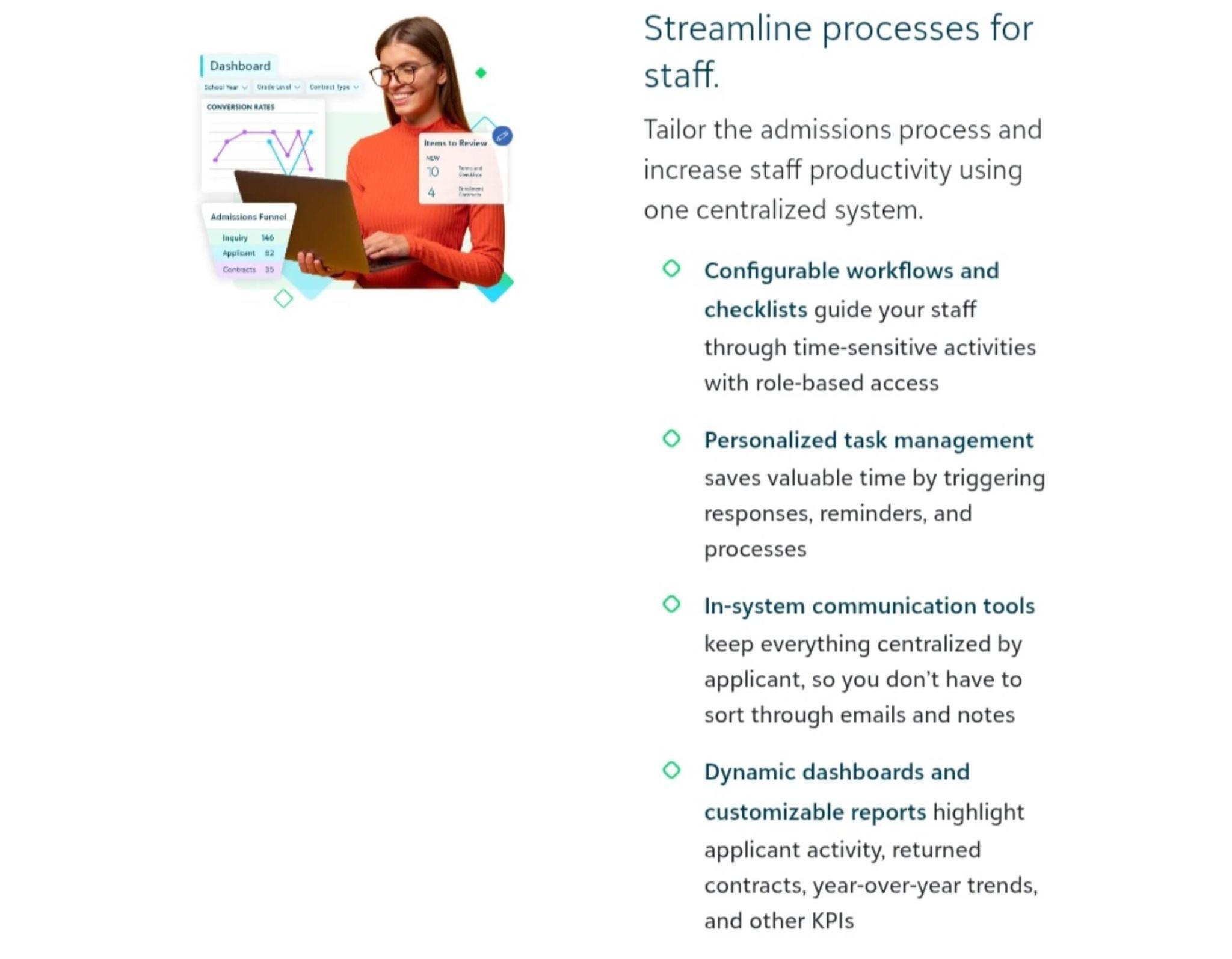
    Example: Blackbaud Enrollment Management allows schools to tailor their admissions process with configurable workflows and checklists in one centralized system. Staff have personalized task dashboards, and the system automatically triggers next steps, sending follow-up reminders, updating statuses, or notifying counselors based on defined rules. This saves time and keeps the team on schedule

    Source: Blackbaud

    5. Seamless Integration

    Your EMS should integrate with your SIS, LMS, financial software, and marketing tools. Data should flow without duplication. Look for open APIs or pre-built integrations with platforms you already use.

    Example: Slate supports bi-directional data exchange with campus systems. It can push and pull data to external SIS, LMS, financial aid systems, content management systems, and more via its Integration Center. This means application data or status updates in Slate can automatically appear in the SIS, and vice versa, ensuring consistency across all systems.

    Source: Slate

    6. Analytics and Reporting

    Analytics tools allow you to track conversion rates, demographic trends, and recruitment performance. Some EMS platforms even offer predictive analytics to identify at-risk applicants or forecast yield.

    Example: TargetX goes beyond basic reporting by incorporating predictive analytics features. It includes a Prospect Scoring tool that lets schools apply tailored scoring models to their applicant pool. This means the system can automatically evaluate and rank prospective students based on likelihood to enroll (or other success indicators), helping admissions teams focus their efforts on the best-fit leads. Of course, standard reports and real-time dashboards are also available in TargetX for monitoring application trends and campaign performance at a glance.

    Source: TargetX

    7. Customization and Scalability

    No two schools are the same. Ensure your EMS allows you to customize application workflows, add custom fields, configure user roles, and scale as your institution grows.

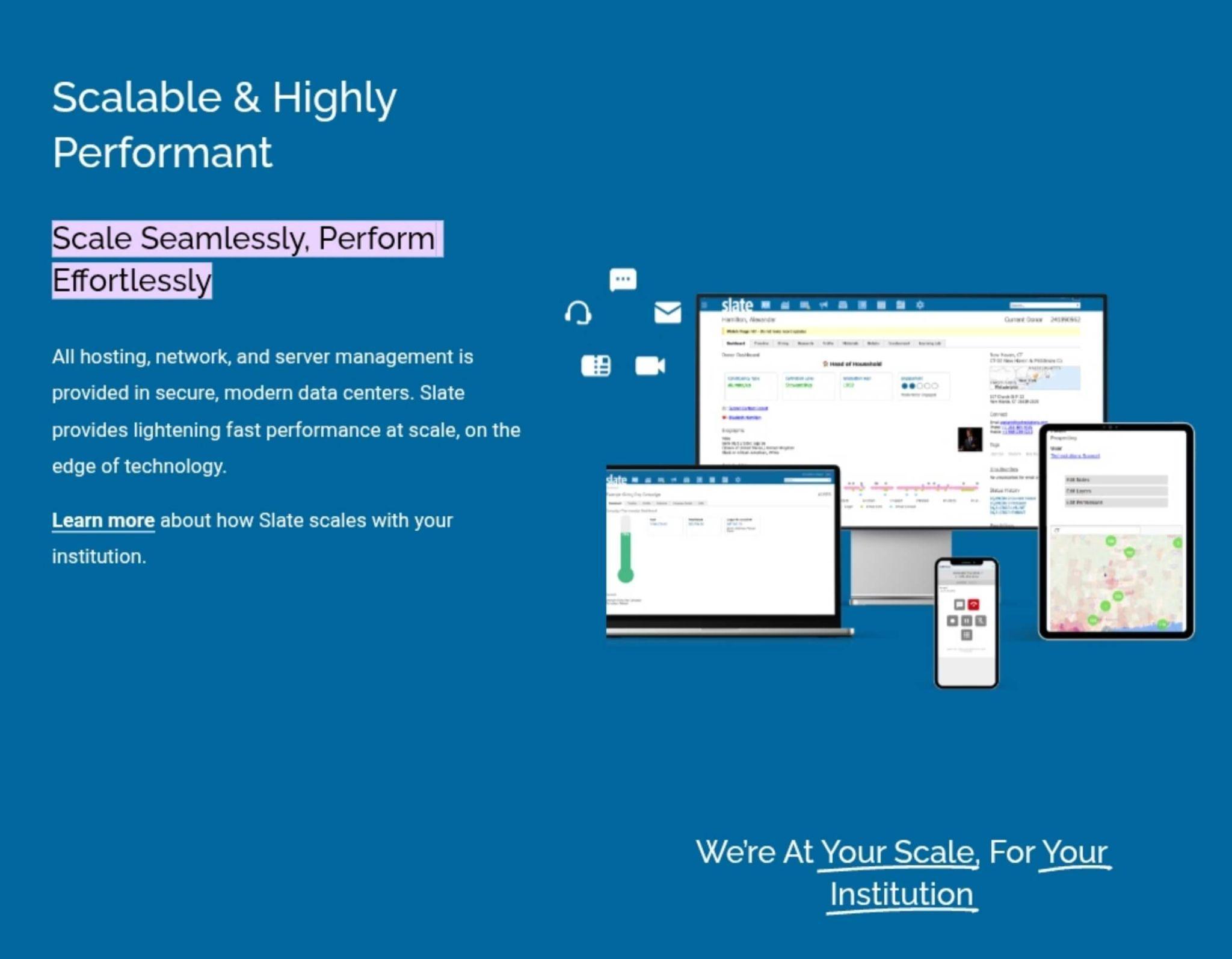
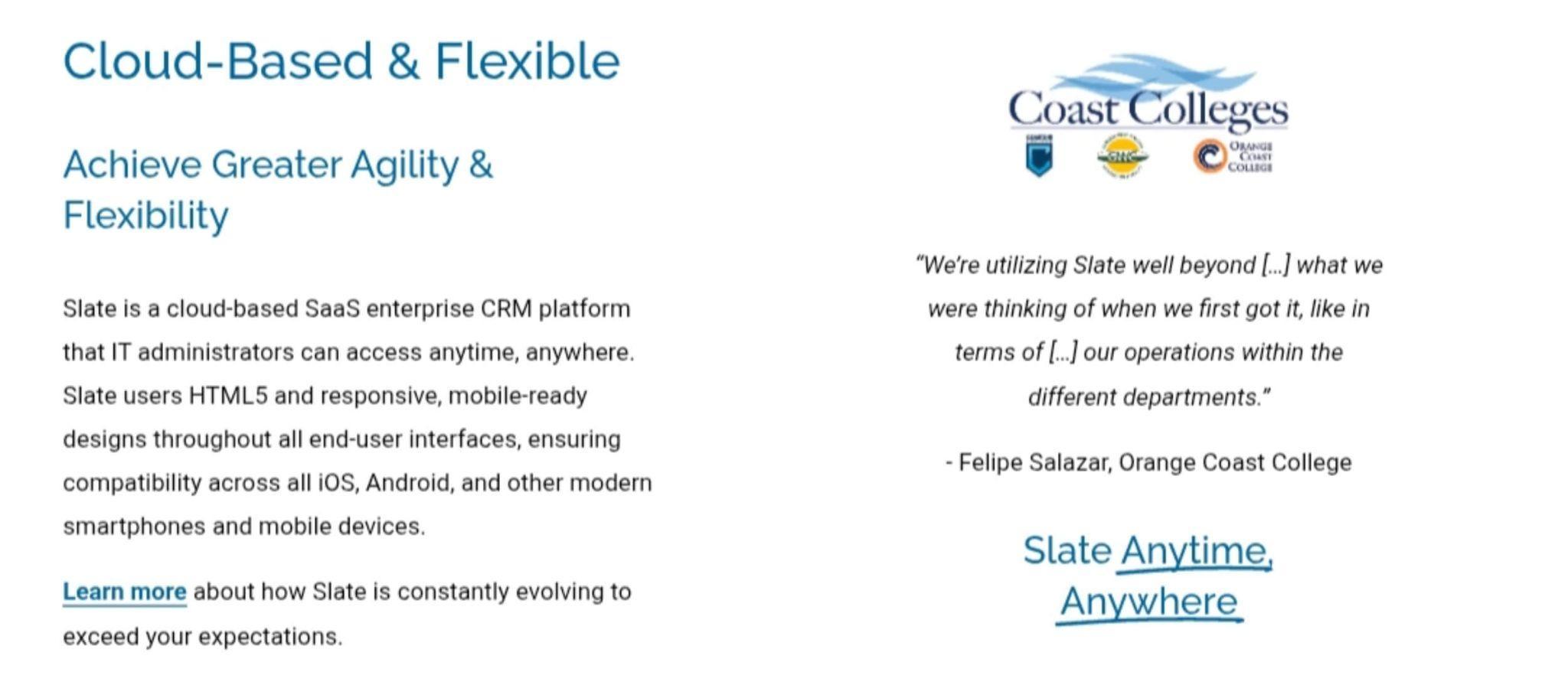
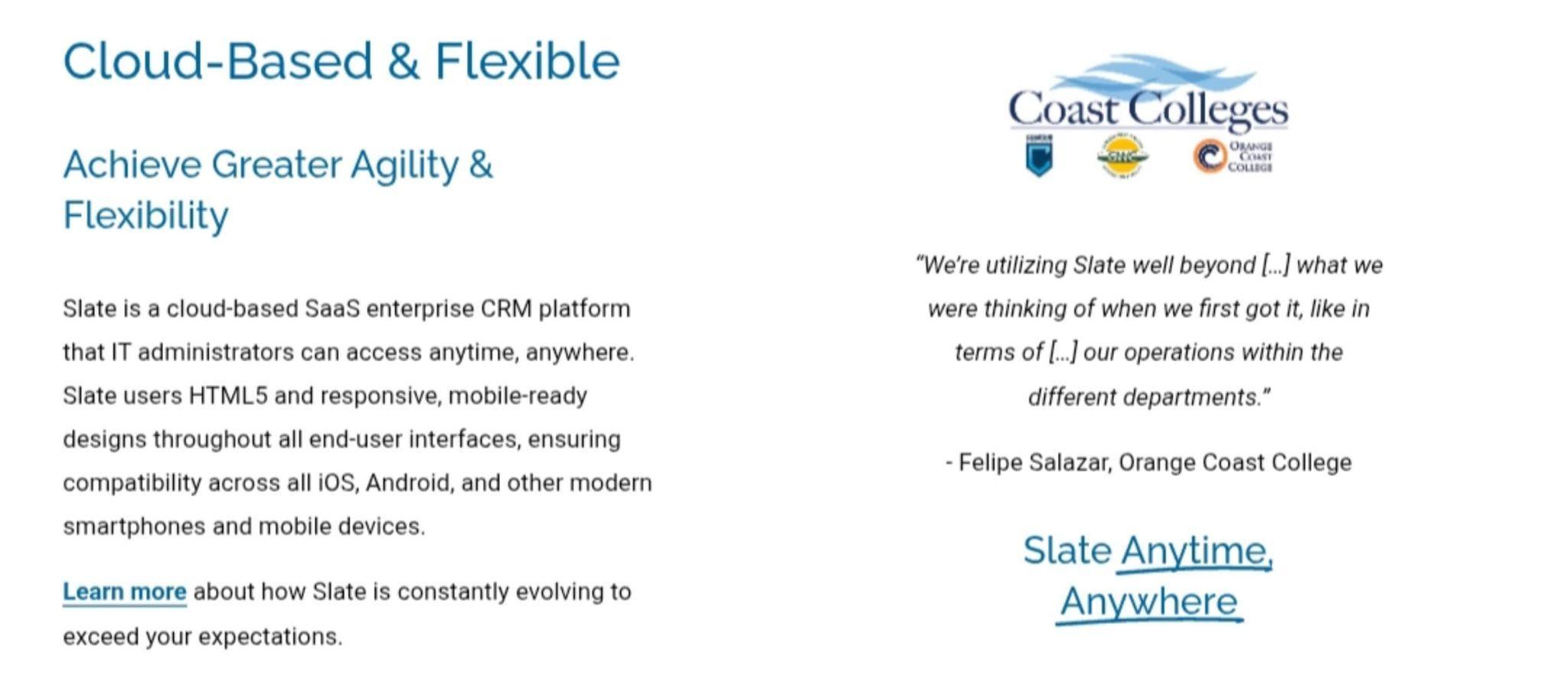
    Example: A cloud-based SaaS platform, Slate, is designed to “scale seamlessly” with an institution’s growth. All technical infrastructure is managed in modern, secure data centers, and Slate regularly updates with new features at no extra cost. This means an organization can start small and trust that Slate will accommodate more applicants, programs, or campuses over time without needing a major system overhaul. In short, EMS vendors focus on both customization (to meet unique local needs) and scalability (to support more users, records, and features as needed).

    Source: Slate

    8. User-Friendly Design

    Adoption hinges on usability. During demos, pay attention to how intuitive the interface is for both staff and applicants. If the system is difficult to use, your team simply won’t use it to its full potential.

    Example: User experience drives adoption. During evaluations, platforms like Classe365 and Class by Infospeed regularly earn praise for intuitive interfaces, which is important when your team has limited tech support.

    Source: Classe365

    9. Mobile Accessibility

    Modern students (and parents) expect mobile-friendly platforms. Responsive design or dedicated mobile apps improve application completion rates and accessibility.

    Example: Slate: Entirely web-based and built with responsive HTML5 design, so all end-user interfaces are mobile-ready by default. Admissions officers and applicants can access Slate “anytime, anywhere,” and the system is compatible across iOS, Android, and other modern smartphones without any special app required.


    Source:
    Slate

    10. Security and Compliance

    Data privacy is critical. Look for FERPA, GDPR, or other compliance features, role-based access controls, encryption, and regular security audits.

    Example: Slate emphasizes that security is an “absolute commitment.” Slate encrypts all data in transit and at rest, and is fully compliant with regulations including PCI-DSS, NACHA, FERPA, GDPR, ADA Section 508, and more. Each client institution’s data is siloed in its own private database, and features like single sign-on integration and multi-factor authentication are supported, all to protect sensitive student information.

    Source: Slate

    How to Choose the Right System: The Smart Institution’s Guide

    Too often, institutions jump into vendor demos before clearly understanding their own needs. But choosing an EMS isn’t like buying a software license. It’s like hiring a new department, one that will touch nearly every part of your student journey.

    Too many schools choose an EMS the way they might buy a printer—look at features, pick the cheapest, hope for the best.

    That’s a mistake.

    Here’s how to do it right:

    1. Audit Your Current Process

    Bring your admissions, marketing, IT, and registrar teams together. Map the journey from first touch to enrolled student. Identify bottlenecks, duplicate data entry, communication gaps, and missed opportunities.

    Ask:

    • Where are we losing leads?
    • What’s manual that should be automated?
    • What data are we not capturing?

    Example: EMS tools like LeadSquared often shine here by centralizing fragmented workflows.

    Source: LeadSquared


    2. Define (and Prioritize) Your Needs

    Don’t go in with a wishlist. Go in with a mission-critical checklist. Keep these in mind when choosing features:

    • Must-haves (SIS integration, mobile access)
    • Nice-to-haves (AI-driven insights, alumni modules)
    • Deal-breakers (data residency, language support)

    Example: If your institution works with international agents, Class by Infospeed is built for managing agent relationships and complex course offerings, a crucial feature for language schools and ESL programs.

    Source: Class Systems

    3. Involve Your End-Users

    Admissions staff. Recruiters. Advisors. These are the people who will live in the system every day. Their input is gold. Make them part of demos. Let them ask tough questions. Choosing a solution like SchoolMint, praised for its intuitive design, becomes easier when usability is prioritized.

    4. Research Vendors Strategically

    Not all systems serve all markets equally. Some are better for K-12. Others shine in graduate admissions. Some are strong in portfolio management; others in agent tracking.

    Look for:

    • Reviews from schools like yours
    • Live or recorded demos
    • Transparent pricing models
    • Implementation timelines

    Shortlist 3–5 vendors. Your shortlist should reflect your institution’s specific context. For graduate schools, Liaison CAS platforms are especially effective. For community colleges, TargetX offers a powerful combination of CRM and enrollment tools without requiring heavy configuration.

    5. Evaluate Integration and Migration

    Ask each vendor:

    • How do you integrate with our SIS, LMS, and payment gateways?
    • Can you support our CRM, or replace it?
    • How will you handle data migration?
    • Do you offer API access?

    A disconnected EMS is a ticking time bomb. Ask vendors like Technolutions Slate or Salesforce Education Cloud about APIs and migration support—they’re known for smooth onboarding and flexibility.

    6. Test the User Experience

    Never buy blind. Ask for a sandbox account or personalized demo. Simulate key tasks: submitting an application, assigning leads, pulling a report. Include both staff and mock student journeys.

    What feels intuitive? What’s clunky? What’s fast?

    Your system is only as good as the people who use it.

    7. Scrutinize Support and Training

    Great technology without support is useless. Ask:

    • Who handles onboarding?
    • Is training included or extra?
    • What’s your support SLA?
    • Can we talk to a current client?

    Look for a partner, not just a vendor. Look to vendors like Anthology, which are known for offering detailed implementation timelines, role-based training, and strong post-launch support.

    8. Evaluate Total Cost and ROI

    Look beyond license fees. Consider:

    • Implementation and training costs
    • User seat pricing
    • Support packages
    • Future upgrade fees
    • Opportunity cost of inefficiency

    For example, Classe365 offers bundled modules that can be more cost-effective for institutions seeking an all-in-one platform.

    Then flip the question:

    How much time, enrollment yield, and data quality could we gain?

    What to Avoid: Mistakes That Derail Enrollment Success

    Let’s be clear: choosing the wrong EMS won’t just slow you down, it can undermine your enrollment goals for years.

    Common mistakes include:

    • Prioritizing brand over fit. The best-known system is not always the best match for your institution’s size, staff capacity, or audience.
    • Skipping the discovery phase. Without understanding your real process needs, you risk choosing a tool that solves the wrong problems.
    • Overcomplicating the solution. Feature-rich platforms are great—if your team has the time and training to use them. Don’t choose complexity over usability.
    • Neglecting integration. A system that doesn’t talk to your CRM or SIS will create data silos and extra work.
    • Ignoring security and compliance. Your EMS will hold sensitive student data. Ensure it meets regulatory requirements like FERPA or GDPR, and ask vendors for proof of their data protection protocols.
    • Leaving end-users out of the process. If admissions and marketing staff don’t weigh in, you may end up with a system that leadership likes, but staff resents.
    • Rushing implementation. A fast deployment might sound appealing, but skipping onboarding, testing, and training will lead to low adoption and missed ROI.

    A better approach? Take your time. Do the homework. Involve your people. And choose a system that solves your real problems, not just your imagined ones.

    A Strategic Investment, Not Just a Tech Upgrade

    The right Enrollment Management System is more than a technology purchase. It’s a strategic accelerator. When implemented well, it becomes the operating system for your admissions engine, fueling smarter campaigns, stronger applicant engagement, faster decision-making, and ultimately, better student outcomes.

    Institutions that invest intentionally in their EMS see tangible results: higher yield rates, improved retention, deeper applicant insights, and more efficient operations. They don’t just fill classes, they shape them.

    But none of this happens by chance. It requires a clear vision, a methodical evaluation, and a commitment to ongoing improvement.

    Partnering for Enrollment Success

    Choosing an EMS is just the beginning. Implementing it well, and aligning it with your enrollment strategy requires experience, insight, and a steady hand.

    That’s where Higher Education Marketing (HEM) comes in. We’ve helped institutions across Canada and beyond design, implement, and optimize enrollment solutions that work. Whether you need a student-facing CRM portal, a smarter communication strategy, or guidance on vendor selection, our team can help.

    Book a free consultation with HEM today, and let’s build an enrollment strategy that’s as forward-thinking as your institution. Because better tools don’t just make your job easier, they make your goals achievable.

    Need help sorting through the multitudes of enrollment management systems for the right one for your school? Contact HEM today for more information. 

    Frequently Asked Questions

    Question: What is an enrollment management system?

    Answer: An Enrollment Management System is more than a tool for admissions; it’s a digital backbone for your recruitment, application, and onboarding processes

    Question: What does an enrollment system do?

    Answer: It streamlines student recruitment and admissions, enabling your team to launch campaigns, collect inquiries, and track applicant engagement without toggling between multiple platforms.

    Question: What is the point of strategic enrollment management?

    Answer: The point of strategic enrollment management (SEM) is to align an institution’s recruitment, admissions, retention, and graduation strategies with its long-term goals, using data and coordinated planning to optimize student success and institutional sustainability. 

    Source link

  • It’s time we moved the generative AI conversation on

    It’s time we moved the generative AI conversation on

    • By Michael Grove, Professor of Mathematics and Mathematics Education and Deputy Pro-Vice-Chancellor (Education Policy and Academic Standards) at the University of Birmingham.

    We are well beyond the tipping point. Students are using generative AI – at scale. According to HEPI’s Student Generative AI Survey 2025, 92% of undergraduates report using AI tools, and 88% say they’ve used them in assessments. Yet only a third say their institution has supported them to use these tools well. For many, the message appears to be: “you’re on your own”.

    The sector’s focus has largely been on mitigating risk: rewriting assessment guidance, updating misconduct policies, and publishing tool-specific statements. These are necessary steps, but alone they’re not enough.

    Students use generative AI not to cheat, but to learn. But this use is uneven. Some know how to prompt effectively, evaluate outputs, and integrate AI into their learning with confidence and control. Others don’t. Confidence, access, and prior exposure all vary, by discipline, gender, and background. If left unaddressed, these disparities risk becoming embedded. The answer is not restriction, but thoughtful design that helps all students develop the skills to use AI critically, ethically, and with growing independence.

    If generative AI is already reshaping how students learn, we must design for that reality and start treating it as a literacy to be developed. This means moving beyond module-level inconsistency and toward programme-level curriculum thinking. Not everywhere, not all at once – but with intent, clarity, and care.

    We need programme-level thinking, not piecemeal policy

    Most universities now have institutional policies on AI use, and many have updated assessment regulations. But module-by-module variation remains the norm. Students report receiving mixed messages – encouraged to use AI in one context, forbidden in another, ignored in a third, and unsure in a fourth. This inconsistency leads to uncertainty and undermines both engagement and academic integrity.

    A more sustainable approach requires programme-level design. This means mapping where and how generative AI is used across a degree, setting consistent expectations and providing scaffolded opportunities for students to understand how these tools work, including how to use them ethically and responsibly. One practical method is to adopt a traffic light’ or five-level framework to indicate what kinds of AI use are acceptable for each assessment – for example, preparing, editing, or co-creating content. These frameworks need not be rigid, but they must be clear and transparent for all.

    Such frameworks can provide consistency, but they are no silver bullet. In practice, students may interpret guidance differently or misjudge the boundaries between levels. A traffic-light system risks oversimplifying a complex space, particularly when ‘amber’ spans such a broad and subjective spectrum. Though helpful for transparency, they cannot reliably show whether guidance has been followed. Their value lies in prompting discussion and supporting reflective use.

    Design matters more than detection

    Rather than relying on unreliable detection tools or vague prohibitions, we must design assessments and learning experiences that either incorporate AI intentionally or make its misuse educationally irrelevant.

    This doesn’t mean lowering standards. It means doubling down on what matters in a higher education learning experience: critical thinking, explanation, problem-solving, and the ability to apply knowledge in unfamiliar contexts. In my own discipline of mathematics, students might critique AI-generated proofs, identify errors, or reflect on how AI tools influenced their thinking. In other disciplines, students might compare AI outputs with academic sources, or use AI to explore ideas before developing their own arguments.

    We must also protect space for unaided work. One model is to designate a proportion of each programme as ‘Assured’ – learning and assessment designed to demonstrate independent capability, through in-person, oral, or carefully structured formats. While some may raise concerns that this conflicts with the sector’s move toward more authentic, applied assessment, these approaches are not mutually exclusive. The challenge is to balance assured tasks with more flexible, creative, or AI-enabled formats. The rest of the curriculum can then be ‘Exploratory’, allowing students to explore AI more openly, and in doing so, broaden their skills and graduate attributes.

    Curriculum design should reflect disciplinary values

    Not all uses of AI are appropriate for all subjects. In mathematics, symbolic reasoning and proof can’t simply be outsourced. But that should not mean AI has no role. It can help students build glossaries, explore variants of standard problems, or compare different solution strategies. It can provoke discussion, encourage more interactive forms of learning, and surface misconceptions.

    These are not abstract concerns; they are design-led questions. Every discipline must ask:

    • What kind of skills, thinking and communication do we value?
    • How might AI support, or undermine, those aims?
    • How can we help students understand the difference?

    These reflections play out differently across subject areas. As recent contributions by Nick Hillman  and Josh Freeman underline, generative AI is prompting us to reconsider not just how students learn, but what now actually counts as knowledge, memory, or understanding.

    Without a design-led approach, AI use will default to convenience, putting the depth, rigour, and authenticity of the higher education learning experience at risk for all.

    Students need to be partners in shaping this future. Many already have deep, practical experience with generative AI and can offer valuable insight into how these tools support, or disrupt, real learning. Involving students in curriculum design, guidance, and assessment policy will help ensure our responses are relevant, authentic, and grounded in the realities of how they now learn.

    A call to action

    The presence of generative AI in higher education is not a future scenario, it is the present reality. Students are already using these tools, for better and for worse. If we leave them to navigate this alone, we risk widening divides, losing trust, and missing the opportunity to improve how we teach, assess, and support student learning.

    What’s needed now is a shift in narrative:

    • From panic to pedagogy
    • From detection to design
    • From institutional policy to consistent programme-level practice.

    Generative AI won’t replace teaching. But it will reshape how students learn. It’s now time we help them do so with confidence and purpose, through thoughtful programme-level design.

    Source link