This guest blog has been kindly written by Professor Diana Beech, Director of the new public policy institute – the Finsbury Institute – and Assistant Vice-President of Policy and Government Affairs at City St George’s, University of London. Diana is one of the two authors of the latest HEPI debate paper (Debate Paper 40) and she writes here about the piece came about…
Explaining the challenges facing UK universities today is not easy. The pace of change is rapid, the policy pressures are competing and the landscape is shaped by complex interplays between funding, regulation, mounting costs and increasing expectations.
This makes the job of university governors particularly taxing. Many governors come from other sectors and industries, bringing valuable external experience, but often without a deep knowledge of higher education per se. As an independent governor myself – at the University of Worcester where I am also Vice-Chair of the Board – but with a background and experience in higher education policy, I’ve long felt a responsibility to help my fellow governors across the sector make sense of it all. That’s why I created a visual tool I call the ‘HE Box’.
The original ‘HE Box’
At first, the ‘HE Box’ was simple. It was a two-dimensional model created to depict a sector squeezed on all sides. It illustrated the four immediate pressures that were boxing universities in. These comprise:
The resource wall: Domestic per-student funding has been declining in real terms across the UK, meaning the money received no longer covers the basic costs of delivery.
The cost wall: Institutions are facing rising and often hidden operational costs – some a result of government policy changes, others responding to changing student expectations – but the net result is pressure on already constrained resource.
The regulatory floor: Instead of supportive foundations, universities face growing, disproportionate, disjointed – and sometimes even politicised – regulatory demands.
The international lid: Changes to visa and immigration terms and post-study work entitlements are threatening the continued flow of overseas students into UK universities.
Although basic, this 2D box helped me to explain to university governors on my ‘board roadshow’ the main tension that has been growing in the sector of late – namely universities being forced to do more with less, with little relief or flexibility from any direction.
The moving box
Over the past year, the ‘HE Box’ has shifted in response to various policy changes. In England, for example, the one-off domestic fee increase granted by the Education Secretary should be offering some financial breathing room for providers from September 2025. Yet, any relief from the announcement was short-lived, with the hike in employers’ National Insurance contributions in April 2025 more than offsetting the gains in the scheduled domestic undergraduate fee rises.
Similarly, the regulatory floor in England should have also seen some easing last year with the promise to ‘reset’ the Office for Students’ approach to regulation following the House of Lords’ report and Independent Public Bodies Review. Yet this, too, has been recently undercut by the UK Government’s Immigration White Paper, which pledged to reduce the post-study work rights of international graduates from UK universities from two years to 18 months. Gains on one side of the box have therefore been quickly reversed by pressures from another.
Expanding the box
Short-term pressures are, however, not the whole picture of the challenges facing UK universities. After presenting my original 2D model to the Council of City St George’s, University of London, shortly before joining in April 2025, Professor André Spicer helped evolve it into a more comprehensive 3D box – adding two more sides of long-term challenges to the ‘HE Box’ based on his own thinking on the sector’s predicament. These two new sides focus on:
Demographic shifts: The UK’s domestic 18-year-old population is projected to shrink over the next decade. Meanwhile, key overseas markets like China and India are experiencing major population changes of their own, as a result of declining birth rates or societal shifts related to the education of women.
Alternative pathways: From apprenticeships to online micro-credentials, viable alternatives to traditional university degrees are growing fast. In an age of scepticism about value for money and returns on investment, universities must work harder than ever to prove their worth for individuals and for wider society.
Why the ‘HE Box’ matters
The six sides of the ‘HE Box’ capture the full range of pressures currently squeezing the sector, both immediate and existential. Our latest report outlines these pressures in more detail and suggests how university governors, senior leadership teams and policymakers, together, can help universities break free from this dire ‘boxed-in’ situation.
Of course, the sides of the ‘HE Box’ will shift again as policies evolve. But the 3D model as it stands today offers a practical framework to:
help new governors quickly grasp the policy landscape;
support better decision-making under pressure; and
push for a stronger, more strategic relationship between universities and governments right across the UK.
The challenges for the UK’s higher education sector are real, but their outcomes are not inevitable. With clearer thinking and a shared understanding of the constraints, it is my sincere hope that we can start to find our way out of the ‘HE Box’ together.
In today’s world, where attention spans are short and options are endless, student recruitment has become both an art and a science. Traditional methods (college fairs, brochures, high school visits) still play a role, but they can’t carry the weight alone anymore.
Gen Z expects more. And so do their parents. They want seamless digital experiences, personalized content, and authentic connections. If your institution isn’t delivering those things, you risk losing them to one that does. So, how do you stand out?
Whether you’re just starting to rethink your campus recruitment strategy or looking for new ways to level up, these 10 cutting-edge approaches, plus one powerful bonus, are designed to help you connect more deeply with prospective students and convert that interest into action.
Struggling with enrollment?
Our expert digital marketing services can help you attract and enroll more students!
1. Hyper-Personalize the Student Experience
Here’s the truth: blanket emails and generic web content just don’t cut it anymore.
Students today expect you to know them; their interests, their goals, even where they’re browsing from. That’s where hyper-personalization comes in. Rather than treating your prospects as a monolithic group, modern recruitment strategies for colleges leverage data to deliver one-to-one digital experiences at scale.
How does that look in action?
A high school student interested in business sees a landing page tailored with content about your BComm program, student stories, and upcoming info sessions.
An international applicant is greeted with region-specific admissions guidance and video testimonials from students from their home country.
A user who clicks on a scholarship link gets a follow-up email with a financial aid breakdown.
In short, personalization isn’t a perk. It’s expected.
Example: To personalize outreach at scale, the University of Idaho (U of I) introduced AI-driven personalized videos for interested applicants. Prospects received video messages addressing them by name, hometown, and academic interest.
Source: University of Idaho YouTube
2. Make Mobile a Priority, Not an Afterthought
More than 60% of student interactions with higher education websites now happen on mobile. If your site isn’t easy to navigate on a small screen, you’re likely losing leads by the dozen, especially since 53% of users will abandon a site that takes more than 3 seconds to load.
And it’s not just about having a “responsive” website anymore.
You also need:
Mobile-optimized application forms that are quick and easy to complete
Tap-friendly buttons and layouts that don’t frustrate the user
SMS alerts for key deadlines or virtual event reminders
Even better? Google’s mobile-first indexing means this doesn’t just affect UX, it directly influences your search rankings.
So if mobile optimization isn’t baked into your campus recruitment strategies, it’s time to fix that. Fast.
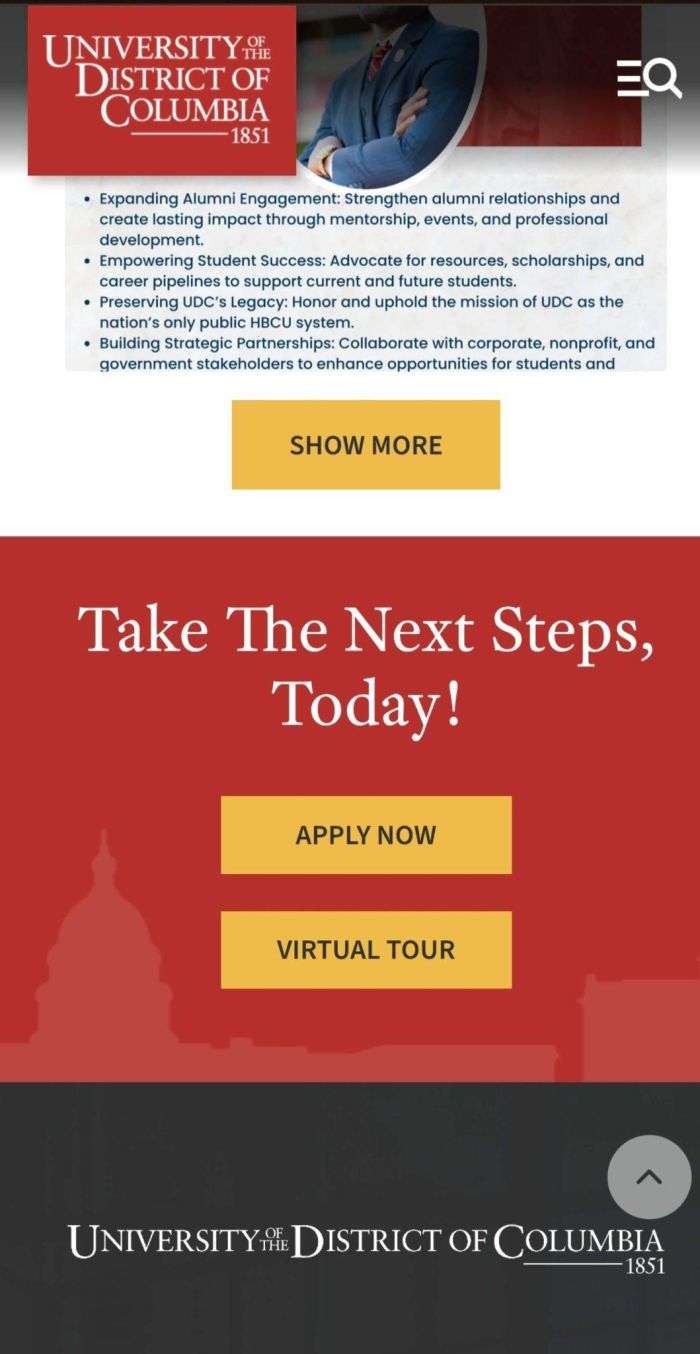
Example: University of the District of Columbia (UDC) launched a newly redesigned, mobile-first website in 2025 to enhance recruitment.
The site features a “mobile-friendly and accessible design” optimized for all devices. This responsive overhaul was part of a strategic initiative “aimed at…enhancing recruitment efforts” and making it easier for prospective students to explore academic programs. By improving navigation, search, and ensuring the site works seamlessly on phones, UDC’s digital entryway better serves today’s mobile-minded applicants.
3. Use Video to Tell Real Stories
Think about the last time you were captivated by a piece of content online. Chances are, it was a video. Video is more than just a nice-to-have. It’s one of the most effective ways to emotionally connect with prospective students and help them see themselves at your school.
Today’s students have grown up on YouTube, Instagram, and TikTok, and video content reigns supreme. Video accounts for over 80% of global internet traffic, and roughly 75% of video viewing now happens on mobile devices (aligning with Gen Z’s phone-first habits).
A recent guide on education video marketing noted that compelling videos can communicate complex ideas in seconds and resonate emotionally, which is why Gen Z “responds favorably to videos that are authentic, visually appealing, and emotionally resonant”.
Additionally, social algorithms favor video content, meaning your school’s videos are more likely to surface in feeds. With 80% of prospective students reporting that campus videos (tours, student stories, etc.) influenced their perception of a school, it’s clear that storytelling through video is no longer optional; it’s essential for recruitment success.
From quick TikToks to polished campus tours, the format you choose should match your audience and your message.
What works well?
Virtual tours for international students who can’t visit in person
Day-in-the-life vlogs from current students
Candid interviews with faculty or alumni
Instagram Reels that highlight clubs, campus life, or student events
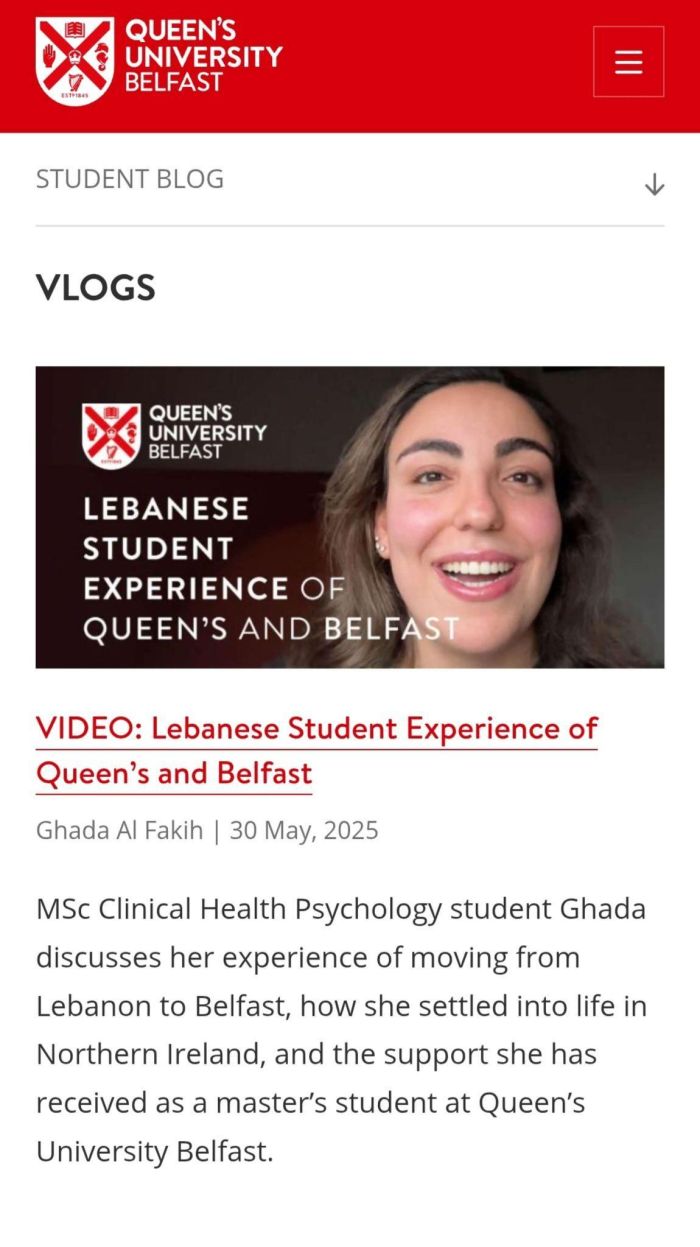
Example: Queen’s University Belfast’sofficial student blog features a dedicated “Vlogs” section where current students share their experiences via video.
These student-created videos range from day-in-the-life stories to campus tours and tips for new students. By showcasing real student life through vlogs, Queen’s gives prospective students an authentic, relatable window into the university experience.
4. Empower Student Ambassadors to Speak for You
No offense, but students trust other students more than they trust your marketing team.
That’s why student ambassadors are one of the most powerful (and underutilized) assets in your recruitment toolkit.
With just a little structure and support, they can:
Run TikTok takeovers during orientation week
Host live AMAs on Instagram about life at your school
Create vlogs or blog posts about their journeys
It’s authentic, it’s relatable, and it builds the kind of peer-driven trust that polished brochures never could. Best of all? Gen Z prefers real voices over institutional polish. So give them a platform and watch your reach expand.
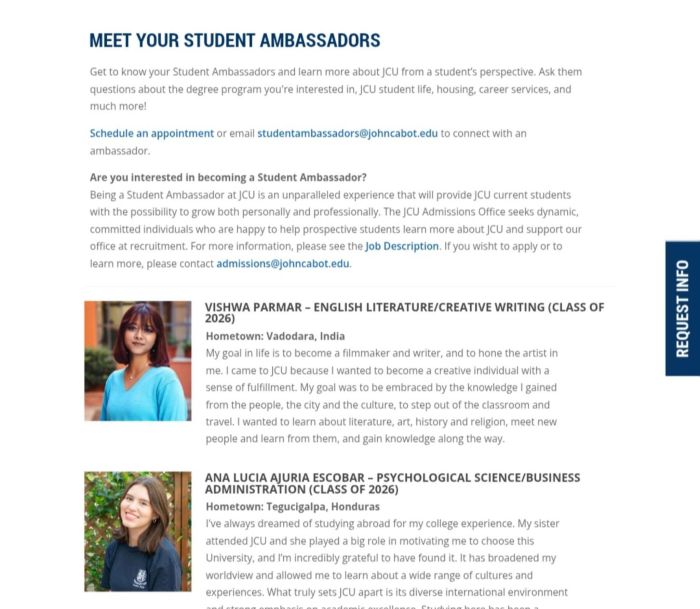
Example: John Cabot University (JCU) runs a robust Student Ambassador program that puts current students front and center in recruitment.
These ambassadors, hailing from around the world, actively engage with prospects through social media takeovers, Q&As, and one-on-one chats. JCU’s admissions website even features profiles and contact info for each student ambassador, inviting prospects to reach out directly.
5. Invest in SEO and Content That Answers Real Questions
You can’t enroll students who don’t know you exist. That’s where search engine optimization (SEO) and content marketing come in. When students start Googling “best film schools in Canada” or “how to get a student visa for the U.S.,” your institution should be right there with helpful, relevant answers.
Some essentials that build a strong foundation:
Blog posts that answer FAQs on tuition, housing, or programs
Program pages with embedded video, alumni outcomes, and clear CTAs
Long-tail keywords like “how to apply for nursing school in Ontario” that attract motivated searchers
Higher Education Marketing (HEM) helps clients rank on page one of Google for high-converting keywords, turning organic traffic into an ongoing stream of qualified leads.
And unlike paid ads, the impact of good SEO keeps compounding.
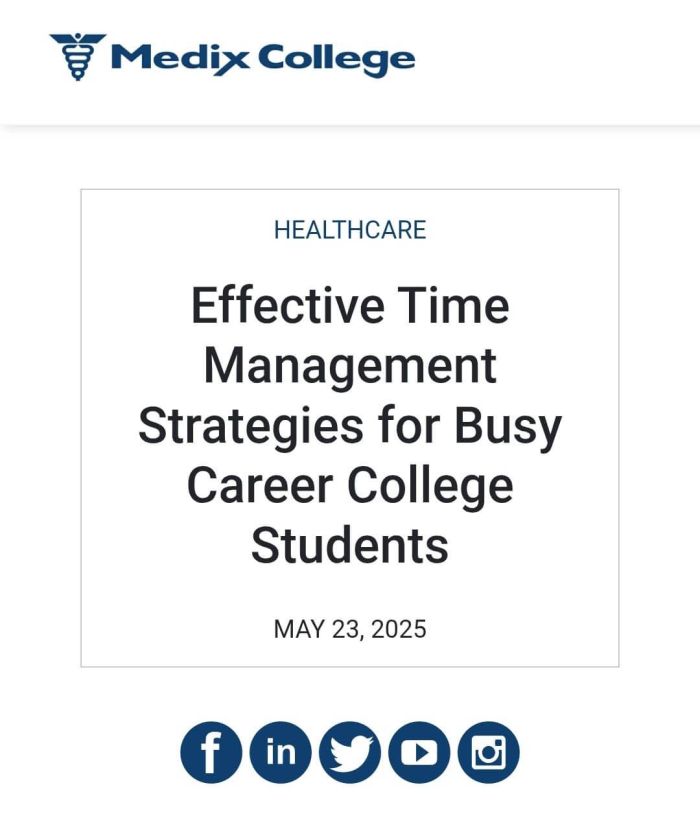
Example: Medix College attracts prospects by publishing a steady stream of useful, SEO-optimized content related to its healthcare programs. Its official blog functions as a hub of career tips, industry trends, and program insights tailored to prospective students.
By answering common career questions and highlighting emerging fields, Medix organically improves its search visibility. This content marketing strategy attracts web traffic from interested learners and establishes Medix as an authoritative, student-centric institution, leading to more inquiries and applications driven by informative content, rather than just ads.
6. Use CRM and Data Tools to Nurture Leads at Scale
Managing hundreds or thousands of prospective students without a proper system in place is a recipe for missed opportunities.
A CRM (Customer Relationship Management system) does more than just store contact info. It helps you track where students are in the funnel, personalize your outreach, and automate time-consuming tasks like follow-up emails or event reminders.
With the right CRM, you can:
Score leads based on engagement levels
Trigger personalized email or SMS messages based on behavior
Track ROI on every campaign or event
HEM’s CRM solutions are built specifically for higher ed, so you can identify, engage, and convert prospects without the guesswork.
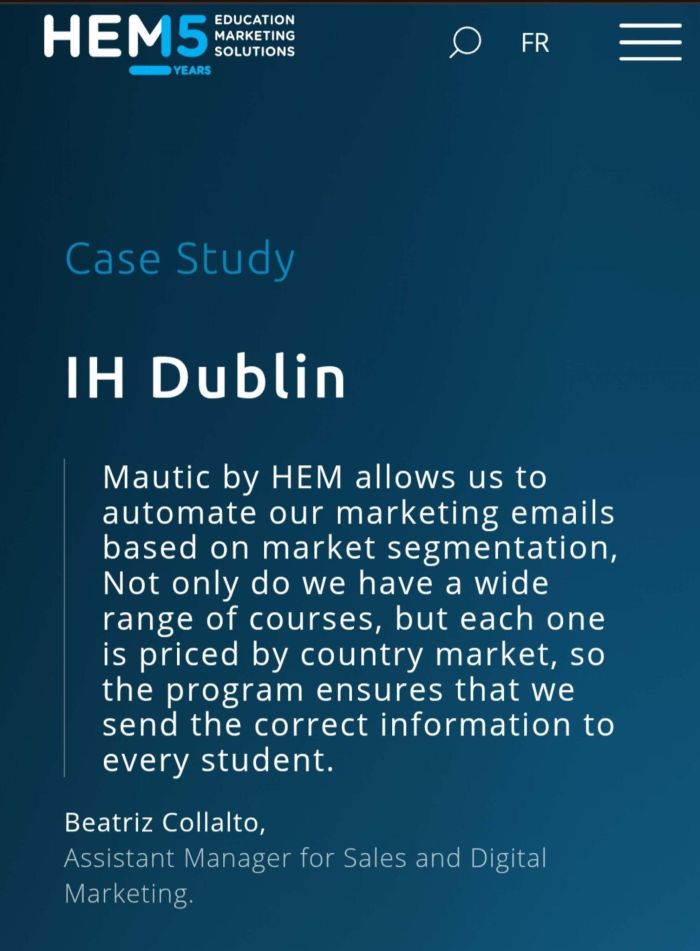
Example: IH Dublin implemented a customized CRM (Mautic by HEM) to automate and personalize its student recruitment communications, using market segmentation to ensure each prospective student receives course information tailored to their specific needs. This strategic CRM implementation streamlined lead management by automatically capturing inquiries and communications, saving staff countless hours and allowing them to focus on high-quality, individualized interactions with students.
By integrating web inquiry forms, social media, and email campaign data into one system, the school gained a comprehensive view of each prospect and leveraged these analytics insights to refine outreach strategies, improving the effectiveness of communications and boosting student recruitment conversions.
7. Strengthen Relationships with High Schools and Feeder Institutions
Want to build a pipeline that pays off year after year? Start earlier. By investing in relationships with guidance counselors, feeder schools, and partner institutions, you plant the seeds of trust long before application season.
What helps?
Hosting “College Nights” or virtual info sessions
Offering classroom-ready materials that educators can share
Regular check-ins with guidance counselors to keep your school top of mind
This long-game strategy ensures your name is the first one students hear when they start exploring their options.
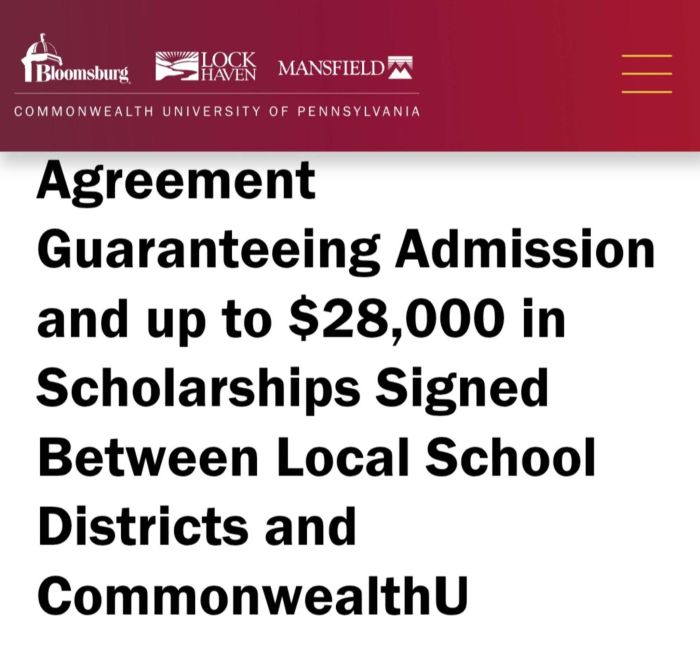
Example: Formed by the merger of Bloomsburg, Lock Haven, and Mansfield Universities, CommonwealthU has aggressively built feeder relationships in its region. In October 2022, it signed Local Scholar Agreements with 14 high school districts (expanding to 50 districts) in Pennsylvania to create a direct pipeline to its campuses. Under these agreements, any student graduating from a partner high school who meets basic criteria is guaranteed admission and up to $28,000 in scholarships to CommonwealthU.
Most application processes aren’t exactly thrilling. But what if they could be fun? That’s where gamification comes in. Adding interactive, game-like elements to your recruitment process can boost engagement and make your institution stand out. Ideas to try:
A quiz like “Which Degree Matches Your Personality?”
A digital scavenger hunt during virtual open houses
Points or prizes for completing milestones (like submitting an application or attending an event)
The result? More engagement, longer site visits, and a more memorable brand experience.
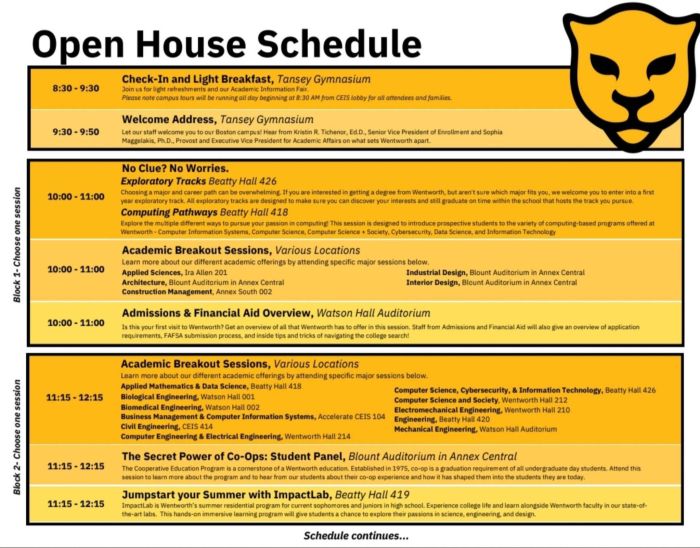
Example: To make campus visits and online events more engaging, Wentworth Institute of Technology (WIT) uses gamification elements in recruitment. For example, during a recent Open House, Wentworth organized a campus-wide scavenger hunt for visiting prospective students.
Attendees were challenged to explore campus and snap photos of specific “hidden” items or locations, then show an admissions staff member to collect a prize. This fun competition had students actively interacting with the campus environment. Wentworth also partnered with the ZeeMee app (a social platform for admitted students) to host virtual scavenger hunts and trivia nights for incoming freshmen, turning the admissions process into a game.
9. Remove Friction From the Application Process
What are the 7 steps of the recruitment process? They are planning, strategy, development, strategies, sourcing, screening, interviewing, selecting, and onboarding. Of these seven steps, the selection process is arguably the most crucial.
You’ve piqued their interest. Now don’t lose them at the finish line.
One of the biggest conversion killers? Complicated, outdated, or buggy application systems.
Here’s how to clean it up:
Make sure students can save their progress and come back later
Allow autofill using Google or LinkedIn accounts
Offer live chat support for real-time help
Automate gentle reminders for those who haven’t finished applying
The easier the process, the higher the completion rate. It’s that simple.
Example: A common trend in streamlining has been colleges joining the Common App or other unified platforms. This is because a simplified, one-stop application lowers the effort for students applying to multiple schools.
In this example, USI joins the Common Application, enabling students to apply to USI alongside multiple schools with one form. USI’s enrollment team notes that the Common App’s mobile-friendly interface and consolidation of application tasks meet students’ expectations for simplicity. Additionally, USI uses an online status portal where applicants can see missing items and upcoming steps at a glance, reducing back-and-forth emails.
10. Localize Your International Recruitment Strategy
Going global isn’t just about translation; it’s about cultural connection. To truly succeed in international markets, your recruitment approach needs to feel local, not foreign. That means:
Translating core content into key languages
Showcasing alumni from the same regions
Using familiar platforms like WeChat or WhatsApp to communicate
HEM specializes in multilingual campaigns that drive results across borders. Because when students see themselves represented, they’re more likely to say “yes.”
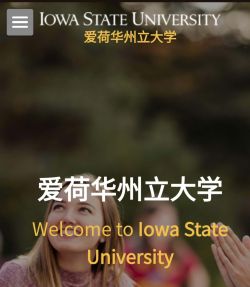
Example: To grow its Chinese student enrollment, Iowa State University invested in a heavily localized recruitment strategy for China. The university launched a fully localizedChinese-language website to engage students and parents in China on their terms. The site was hosted on a .cn domain for fast local loading and optimized for mobile, featuring ISU’s branding but with content written in Simplified Chinese.
Crucially, ISU didn’t just translate admissions info; it adapted content to address what Chinese families value (e.g., program outcomes, safety, career opportunities) and made navigation intuitive for that audience. In tandem, Iowa State ramped up its presence on Chinese social media: it ran an official WeChat account for one-to-one engagement and a verified Weibo account (China’s Twitter) for broader outreach.
BONUS: Align Marketing and Admissions
Too often, colleges treat marketing and admissions like separate silos. Be sure not to make this mistake.
Your recruitment strategy is only as strong as the connection between these two teams. When marketing generates leads but admissions isn’t looped in (or vice versa), those leads slip through the cracks. Here’s how to tighten things up:
Use shared dashboards so both teams see the same data
Hold weekly check-ins to align on goals, campaigns, and challenges
Make sure your CRM offers visibility and collaboration tools across departments
This alignment doesn’t just make your internal process smoother, it makes the entire student experience feel seamless.
Common Mistakes to Avoid
Even strong strategies can be weakened by a few missteps. Watch out for these:
Neglecting follow-up: Students expect timely responses. Delays kill momentum.
Generic messaging: One-size-fits-all language turns students off. Speak to their specific needs.
Skipping analytics: If you’re not tracking what works, how will you improve?
Fix these gaps, and your recruitment strategies for colleges will be far more effective.
HEM: Your Partner in Enrollment Success
At Higher Education Marketing, we’ve spent over a decade helping colleges and universities level up their recruitment.
We offer:
SEO and content strategy to boost visibility
CRM solutions to nurture leads efficiently
Paid ad campaigns across Google, Meta, and international platforms
Custom dashboards to track ROI and make data-informed decisions
No matter your goals, whether domestic growth, international expansion, or brand visibility. HEM is here to help you meet (and exceed) them.
Final Thoughts
The landscape of student recruitment is shifting, and fast. But that’s not something to fear. It’s an opportunity. Which is the best method for effective recruitment? A balanced mix of digital personalization and relationship-building tends to drive the best results.
By embracing data, technology, storytelling, and personalization, you can create a recruitment strategy that not only works but resonates. So here’s the real question: Are you ready to lead the way? Because the future belongs to the schools that adapt, connect, and engage with intention. Let’s build that future together.
Struggling with enrollment?
Our expert digital marketing services can help you attract and enroll more students!
Frequently Asked Questions
Question: What are the 7 steps of the recruitment process?
Answer: They are planning, strategy, development, strategies, sourcing, screening, interviewing, selecting, and onboarding.
Question: Which is the best method for effective recruitment?
Answer: A balanced mix of digital personalization and relationship-building tends to drive the best results.
Despite a flurry of announcements for the higher education sector in the first half of 2025, much remains unknown about what is to come in this summer’s promised higher education reform plans. However, it is a pretty safe bet that opportunity and access will feature prominently. The Government has put ‘breaking down barriers to opportunity’ as one of its key missions for this Parliament, and higher education remains a core driver of social mobility.
Data consistently show that higher education qualifications are clearly and unambiguously associated with increased earnings and employment prospects. Research from the Sutton Trust found that attending a Russell Group university narrows the existing gap between state school students eligible for school meals and their privately educated peers in the likelihood of becoming a top earner.
At the same time, deeply entrenched inequalities prevail, as the UPP Foundation inquiry into widening participation highlights. The stark findings in itsrecent report included the difference in progression to higher education across the country: 71.6% of 18-year-olds in Battersea, compared to just 11.1% in Barrow-in-Furness. The Government is right to be looking at ways to address this striking imbalance, and universities are ready to be even more ambitious to reach more young people.
It is undoubtedly a huge challenge – both the task itself, given these inequalities are largely set at primary school and are already entrenched by the time it comes to post-16 options; and the wider context, given the university sector’s own financial challenges.
But good progress is being made. The number of young people from the most underrepresented backgrounds studying at Russell Group universities has seen a 56% increase since 2019. The number of Black placed applicants has increased by 62% in the same period. However, there is a mixed picture across the different measures of disadvantage – not helped by a cost-of-living crisis hot on the heels of the pandemic, both of which are still having an impact.
In this context, the Russell Group has today published a new paper, Building Opportunity For All. This sets out just some of the ambitious work our universities are already doing alongside new commitments they’ve made to going further. These commitments include expanding participation in regional partnerships, committing to a tailored support package for care leavers and care-experienced students, improving transparency around contextual admissions, and supporting the new TASO Evaluation Library to track the impact of activity.
These new collective commitments build on the work already detailed in universities’ access plans. These are being supported by an investment of more than £250m a year across the Russell Group.
Widening access is not a solo endeavour, which is why many of our ambitions involve making the most of partnerships with others inside and outside higher education. Combining ambitions and resources with others means our universities can go even further. Russell Group universities already spend millions of pounds a year on third sector partnerships, enabling us to provide almost 100,000 young people across the UK with practical support in achieving their university ambitions – from tutoring to advice on completing university applications.
Across the UK, universities are thinking creatively about what participation in higher education means for different people and how we can open up our campuses and opportunities to everyone. At the University of Bristol, partnership working not only helps young people gain a place at the University but also improves community engagement more broadly. The university has two micro-campuses located in areas of the city with the lowest higher education participation rates. Since 2020, the Barton Hill campus has worked with over 60 partners annually and welcomes 160+ users each week as a hub for research, teaching and outreach. Meanwhile, the new Hartcliffe campus is co-developing a micro-qualification with local colleges, employers and community groups to create new routes into work and study.
Our partnerships with further education are also developing more flexible learning pathways to raise attainment. The University of Glasgow, for example, runs Higher National Certificate (HNC) Articulation Programmes, developed with eight West of Scotland colleges. These enable eligible students – care-experienced individuals, estranged students, carers and those with refugee or asylum seeker status – to progress directly into Year 2 of some undergraduate degrees. Integrating college-based HNC study with university-led sessions and full access to campus resources fosters academic readiness and a sense of belonging, helping participants progress further in their educational journeys.
Opportunity is a shared challenge, and the Government needs to be our partner on this. We expect the Department for Education – quite rightly – to put opportunity as a central pillar of higher education reform. Our universities are already responding by increasing their ambition and being creative in their thinking. For example, the care leaver support packages our universities are implementing encompass everything from assistance applying to university and finding accommodation, to providing kitchenware, luggage, vouchers and gym memberships to help with a smooth transition and settling into university life.
But we can’t solve everything alone. We have long been calling on successive governments to improve student maintenance to remove financial barriers. Universities are doing what they can to support students. Over 60% of Russell Group universities’ £250m annual investment in access goes on direct financial support for students who need it the most. However, while significant, this is the context of the poorest students in 2025/26 being entitled to borrow around £1,125 (10%) less in real terms towards their living costs than in 2020.
It is also challenging to narrow equality gaps that have been growing since childhood. It’s vital that the Government’s opportunity mission considers the whole lifecycle of a student’s journey, from early years to post-16 education and beyond. Universities are ready and willing to be a vital part of the picture of improving opportunity, but they are still just one element. If inequalities are addressed at a young age, it will become easier to ensure access to university for everyone – not only helping students achieve their individual ambitions, but also bringing greater rewards for the government’s skills and workforce ambitions.
By Dr Ben Lishman, Associate Dean for Students, College of Technology and Environment, London South Bank University.
London South Bank University (LSBU) launched its Energy Advice Centre (EAC) in January 2023. The concept was a simple one. The energy crisis of the previous year had seen average household gas and electricity bills increase by 54% in the spring and a further 27% that autumn. The University already had well-established legal and small business advice clinics, so why not expand the concept to have students in our College of Technology and Environment provide local residents with energy-saving advice?
With grant funding from the UPP Foundation, we have created a database of advice and ideas, which we share through a website and a drop-in clinic where local residents can talk directly to our students. The students answer questions, make suggestions for domestic changes which will reduce bills, and remove layers of complexity around domestic energy.
One of Bridget Philipson’s five priorities for reform of the higher education system is that universities play a greater civic role in their communities. With 15% of our local borough affected by fuel poverty, the Energy Advice Centre (EAC) is making an active and meaningful contribution to LSBU’s civic mission and our commitment to reducing the university’s carbon use.
Through the website, our Elephant and Castle drop-in clinic, and winter workshops held in Peckham, Camberwell and Canda water, our student advisors have, to date, provided bespoke and detailed advice to over two hundred and fifty homes, as well as schools and SMEs. By providing information and guidance on issues such as improving energy efficiency, fitting insulation, installing solar panels and applying for home improvement grants, we estimate that the Energy Advice Centre has enabled savings of £75,000 on energy bills so far – and much of the advice we’ve given should provide savings for years to come.
The impact of our work has been noticed locally, with Southwark Council making the Energy Advice Centre its official Green Homes Service, providing funding that has allowed the centre to continue once the initial grant from the UPP Foundation had been spent.
It’s not only local residents who benefit from the Centre. In addition to being paid for their time, working at the EAC provides students with the opportunity to engage in civic activities while developing work-ready skills through applying learning from the classroom into the real world. This has enabled a number of the thirty students who have worked for the EAC so far to get jobs in professional energy advice, net-zero buildings research, and jobs in sustainability across their sectors.
I’m thrilled that the UPP Foundation, having seen evidence of the effectiveness of the model, has provided us with further funding to develop a toolkit, which provides guidance on how other universities can develop their own energy advice centres. We are now working with three initial partner universities – Wrexham University, University of Reading and Kingston University London – to set up their own centres. We think there’s a need for a national network of these centres, sharing good ideas, and we want to share what we’ve learned.
If you would be interested in exploring how to set up an energy advice centre at your own institution, the toolkit is being made available on the UPP Foundation’s website. At 1pm on 4th June, HEPI is also holding a webinar on how initiatives such as the EAC can be used to embed employability and civic engagement in higher education.
By Fiona Hnatow, Chief People Officer at the University of Portsmouth.
In an era of mounting financial pressures across the UK higher education sector, the University of Portsmouth has not been immune to these difficulties. However, through considered efficiency programmes and an innovative approach to pension reform, we are emerging from the initial financial pressures into a stronger and sustainable position. As one of the largest Post-92 institutions in the UK, the University plays a vital role in the local and national economy. With nearly 4,000 staff and 29,000 students, 6,000 of whom are international, the University is not only a major employer in the Solent region but also a hub of innovation, research and global engagement.
In 2024 alone, the University contributed an impressive £1.4 billion to the UK economy, including £658 million in the Solent region and £505 million in Portsmouth, supporting over 8,800 jobs locally. These figures underscore the University’s critical role in regional development and its broader impact on the national landscape.
By early 2023, it became increasingly clear that the UK higher education sector was heading towards a financial crisis. A combination of declining undergraduate and international student applications, rising utility and employment costs and inflexible pension obligations created a perfect storm, particularly for Post-92 universities.
One of the most significant financial burdens facing these institutions is the Teachers’ Pension Scheme (TPS). Mandated by the Further and Higher Education Act 1992, Post-92 universities are required to offer TPS to all academic staff, with no option to opt out. In contrast, non-Post-92 institutions can offer alternative schemes, such as the Universities Superannuation Scheme (USS), which carry significantly lower employer contribution rates.
As of April 2025, TPS employer contributions rose from 23.68% to 28.68%. This means that employing an academic on a £50,000 salary now costs Post-92 institutions nearly £9,000 more per year than their competitors. With further increases projected in 2026, the financial strain is only expected to intensify.
The Reset Programme: A Strategic Pivot
Recognising the urgency of the situation, the University of Portsmouth launched its ‘Reset’ programme in early 2023. This comprehensive initiative was designed to reduce both staff and non-staff costs, streamline operations and build a digitally enabled, efficient institution. The goal: to ensure both operational and financial sustainability in the face of unprecedented challenges.
The Reset programme introduced a series of targeted workstreams over an 18-month period, including:
Creation of a staffing subsidiary (UASL) to employ new staff under a more affordable pension scheme.
Voluntary Severance Scheme to reduce the need for compulsory redundancies.
Enhanced vacancy management, filling only business-critical roles.
Non-pay budget reductions, including cuts to travel, training, printing, and consumables.
Removal of budget contingencies during annual planning.
Policy changes to limit professional accreditation and subscription costs.
Professional services reviews to centralise functions and reduce staffing levels.
Academic restructuring, including faculty mergers and rebalancing student/staff ratios.
Contracted services reviews to improve value for money.
Student retention initiatives to reduce withdrawals and protect tuition income.
UASL: A Bold and Necessary Innovation
In August 2024, the University launched University of Portsmouth Academic Services Limited (UASL), a wholly owned subsidiary created to employ new academic and professional services staff. While maintaining existing terms and conditions, UASL introduced a new Defined Contribution (DC) pension scheme through Aviva, offering a 12% employer contribution for permanent staff and 6% for casual staff. Additionally, the National Employment Savings Trust (NEST) scheme was introduced for casual workers, primarily students.
This move was not taken lightly as the University recognises how important pensions are to attract and retain staff. However, it was essential to avoid the unsustainable costs associated with TPS and the Local Government Pension Scheme (LGPS). Importantly, all staff employed before August 2024 retained their existing pension arrangements, helping to maintain strong relationships with unions such as UCU and Unison.
The TPS, and its statutory imposition on Post-92 providers, is a throwback to when institutions like the University of Portsmouth, as former polytechnics, were administered by their local authority. At the time, it made sense. But in the thirty years since we achieved full University status, it has become impossible to justify the retention of this outdated system. It is clear that those bodies responsible for setting and monitoring higher education funding, who are admittedly not known for their responsiveness, have failed to adapt to the realities of the higher education landscape. When vast swathes of the sector are faced with a worsening financial position, many of those being post-92 institutions, it is baffling that this outdated system remains to hinder determined efforts to manage institutional finances.
The results have been significant. In 2024/25 alone, the University is on track to save over £1 million, with projected savings rising to £2.8 million in 2025/26 and £4.4 million in 2026/27. Moreover, the new pension schemes have proven attractive, particularly to early-career professionals, international staff, and those on lower salaries—groups that had previously opted out of TPS due to affordability concerns.
Balancing Innovation with Risk
While the creation of UASL has delivered substantial financial benefits, it has also introduced new challenges. Notably, Research England and UKRI have begun placing restrictions on the eligibility of subsidiary-employed academics for research funding and participation in the Research Excellence Framework (REF). This poses a significant risk to the University’s research ambitions and its ability to compete on a national and global scale.
Despite these concerns, the University had to weigh the risks of innovation against the very real threat of insolvency. Without decisive action, the financial outlook would have been dire. In 2023/24, the University had budgeted for an income of £321 million but achieved only £304 million, resulting in a £9.2 million deficit—despite achieving £19.7 million in Resetsavings. For 2024/25, the budgeted income is £290.5 million, with a projected deficit of £2.9 million, inclusive of £24 million in planned savings.
A Call for Sector-Wide Reform
The University of Portsmouth’s experience is not unique. Many Post-92 institutions across the UK are being forced to consider similar measures, simply to remain viable. In Scotland, the government has stepped in to support institutions facing equivalent pension cost increases, highlighting the uneven playing field across the UK.
The University is now calling on the Department for Education and the UK Treasury to reform elements of the Further and Higher Education Act 1992 that tie Universities to an outdated, restrictive and overly costly pension scheme and advocates for greater flexibility in pension arrangements. Such reform would allow institutions to manage their finances more effectively, attract and retain top talent, and avoid widespread job losses and regional economic disruption. Our view is that it is wholly unfair that the Government have subsidised schools and further education colleges in England to compensate for the rising cost of TPS, yet Higher Education Institutions have not.
Conclusion: Leading Through Change
The University of Portsmouth has demonstrated that with strategic foresight, bold decision-making, and a commitment to collaboration, it is possible to navigate even the most challenging financial landscapes. However, we continue to advocate that reform is urgently needed for the good of the sector as a whole, to ensure long-term sustainability.
By Ruth Arnold, Executive Director of External Affairs, Study Group and cofounder of the #WeAreInternational campaign
This weekend, an American president stood on the tarmac by Air Force One and took questions from reporters. One picked on his current legal confrontation with one of the world’s most famous universities and one older than the United States itself, Harvard.
‘Part of the problem with Harvard,’ he said, ‘is they are almost 31% of foreigners coming to Harvard… it’s too much, because we have Americans that want to go there. No foreign government contributes money to Harvard. We do.’ Harvard’s single sentence response on X was clear, ‘Without its international students, Harvard is not Harvard.’ Within a day, the State Department had paused all US student visa appointments globally – affected students around the world immediately began rethinking their options.
Here in Britain, politics around international students has less of the overt drama of the US. Yet even as the Immigration White Paper stepped back at the eleventh hour from the most extreme measures to curtail the Graduate Visa, a link between efforts to reduce immigration statistics and to use student levers to do so is now explicit. British universities’ pride in reaching the government’s own target of 600,000 overseas students is no longer simply applauded as a success for regional economies, research capacity and soft power, but also seen as a contributor to political risk. And if we think political narratives in the US won’t travel across the Atlantic, we’ve not understood the world we now live in.
‘The Overseas Student Question’ – taking a long view of UK international education strategy
A few months ago, a friend gave me a book found in an Oxfam shop. Published in 1981 by the Overseas Student Trust, The Overseas Student Question: Studies for a Policy promised a fresh look at a growing debate – what were the costs and benefits of welcoming international students, the implications for foreign policy, the importance for ‘developing countries’ of study abroad? And what were the requirements of students themselves?
First, though, I wanted to understand who was behind this book. The Overseas Student Trust was founded in 1961 as an educational charity by a group of leading transnational companies, many of whom sponsored international students to come to the UK – Barclays, BP, ICI, Shell and Blue Circle amongst them. There had also been a companion report, Freedom to Study, and an earlier National Union of Students (NUS) survey called International Community?. I noted the ominous question mark in the title and a link to the founding of the UK Council for Overseas Student Affairs. The author and editor was Lord Carr of Hadley – a Conservative politician, pro-European former Home Secretary and such an able reformer that when Margaret Thatcher became Prime Minister and didn’t offer him a role as Foreign Secretary, she chose not to offer him an alternative to avoid having such a capable opponent in her ranks.
Lord Carr began with a recognition of policy failure and a need to do better: ‘The overseas student question has generated more heat than light in the recent past and therefore nothing but good can come from a long, cool look at its various aspects.’ Then as now, nobody was clear where in government international student policy should sit. For 30 years it had been led by overseas departments of state, and delegated to the British Council they funded. Yet the policies which actually impacted students were found ‘in the Department of Education and Science in respect of tuition fees, and the Home Office as regards immigration and employment’.
There was also a shortage of reliable data to inform decisions, and it was nearly impossible to calculate their political or even trading benefits. These were ‘so far off in time that the link between cause and effect can scarcely be recognised, and the case for overseas students is thus the victim, because unfortunately in politics the short-term tends to preempt the long-term, and the urgent usurps the place of the important.’
So Lord Carr pulled in the heavyweights of his day to make a case for the value of international education to government. In addition to the Department of Trade and CBI, the Chairmen of more than forty of Britain’s largest exporters and firms with interests abroad wrote letters to make plain the importance to their future success of ‘the foreign national who has had some of his education in Britain’. Leading industrialists argued for ‘as large a population of international students as possible in the years ahead.’
Yet Lord Carr recognised a need for balance between national priorities and the preservation of institutional autonomy in the process of selection and admissions, and he had doubts about the ability of government to make such decisions alone. ‘These are not matters to be laid solely at government’s door. Industry and the educational world should be involved, both in the thinking and the implementation.’
The Labour beginnings of international cross-subsidy
The International Student Question was written at a point of inflection. In 1963, the Robbins Committee on Higher Education described subsidies to international students as a form of foreign aid, estimated to be £9 million for 20,000 students. In 1966 it was a Labour government that first announced a differential fee, £250 compared to £70 for home students, and in 1969 Shirley Williams argued for a more restrictive policy on international students.
All this led to a change in dynamic from self-interested charity to overt trade. So Lord Carr made a new plea for ‘careful thought about how we provide for overseas students once they have arrived in this country,’ noting that students were ‘no longer subsidised objects of charity’ but have become the purchasers of services at £5000 per year. He quoted the Chairman of ICI – ‘caring pays because overseas students will expect value for money.’
This is not to say international education had lost all ideals. Carr, a post-War Private Secretary to Anthony Eden, saw a greater prize – ‘The British experience must be seen in the wider context of the international mobility of students which is one of the foundation stones of a peaceful, stable and interdependent world.’
International Education Strategies Globally
Which brings us back to our own times, where questions of peace and interdependence through international mobility still matter.
The UK refresh of the International Education Strategy is now overdue, and it will no doubt focus heavily on national priorities, on growth and innovation, inward and outbound mobility, global partnerships, transnational provision and terminology beloved of the FCDO, ‘soft power’. And yet hard forces are at play. It isn’t just a question of global trade and avoiding conflict – we now live in a multipolar era in which former colonies and adversaries are the burgeoning economic powers of the future. Our government does not act in isolation or have the ability to control the choices made by sponsors, families and students a world away. While international education strategy is written in Whitehall, the forces that drive it in actuality are global.
Home thoughts from abroad
A few years ago, I gave evidence to a parliamentary committee considering the local economic impact of international students with the then mayor of South Yorkshire and now a Labour government minister, Dan Jarvis. It wasn’t difficult for Dan to say what an influx of cash meant to a region like ours or the importance of cross-subsidy to research collaboration with industry. On his doorstep was a major new research campus on the formerly derelict waste ground of Orgreave. Inspiration had come from a Vietnamese PhD student on placement in a struggling local manufacturing firm. Her insights addressed live problems and the company won multiple orders against global competition, securing jobs. South Yorkshire wanted more of this.
But what of that student’s home country? If we want our international education policies to reflect our own times rather than the age of Empire, we need take an interest in her side of the story too. Today, Vietnam is transformed from the war-torn nation that the student and her family had left behind. In common with much of ASEAN, it is now going through its own efforts to lift manufacturing capacity and transform its economy through research, education and high-value tech manufacturing. It’s got more in common with post-industrial S Yorkshire than many realise.
Today’s Vietnamese students travel to traditional study destinations, but global education is changing. Vietnam is keen to emulate the successes of Malaysia and Singapore as a major Asian education hub. The aim is for partnerships and an education system that will lift more of its young population and so transform its prospects. We might take our own lessons from that.
International education is increasingly seen as a key driver of global development. China and India, the two great source countries for traditional study destinations, are actively building their own domestic capacity. China invests 4% of its GDP in its universities, leading to a significant increase in research output, global rankings, and international collaborations, and it is now actively seeking to attract students and scholars from overseas, including through full and partial funding for undergraduate and postgraduate studies. Meanwhile, India’s growing reputation as a global education hub, coupled with initiatives like the ‘Study in India’ programme, is boosting its appeal. Fifteen foreign universities are opening campuses in India this year, including the Universities of Southampton and Liverpool.
The so-called Big Four study destinations – the UK, America, Canada and Australia are now increasingly seen as the Big Ten and counting. Korea, Japan, Malaysia and Thailand are seeing the possibilities to lift their own institutions and economies by persuading talent and investment to stay closer to home. The Middle East is pursuing similar aims. For many students, the lure of the West and its freedoms continues, but it is no longer the only aspirational option, whatever those countries’ International Education Strategies say.
In search of a double win
One of the great challenges across the world is youth unemployment and underemployment, including among graduates. As nations all compete to move up the value chain and labour markets navigate headwinds of trade restrictions and AI disruption, old certainties about returns on higher education are taking a hit.
International Education Strategies need to find a sweet spot, and the UK government is aiming for just that. One that meets both national and international needs and desires, which lifts local communities and sustains universities, while equipping intrepid young people across the world with the degrees and cultural agility that comes from living and working overseas, fluent in what is still the dominant language of global commerce and much innovation.
The challenge for the International Education Strategy and its authors is to speak to more than their own ministers and domestic audiences. We should learn from the US. The news of an immediate threat to revoke international student visas at Harvard made its way around the world within hours. Universities in Hong Kong, China and Malaysia offered unconditional offers to ‘Harvard refugees’, a term worried international students had themselves used on social media. The UK has form here too. Negative rhetoric and the loss of post-study work led to a calamitous fall in international students and a brutal loss of trust. We don’t want to go back to that.
What we need now is something better. A strategy which acknowledges both sides of an equation, what is right for the home nation, but also improves the lives and opportunities of students from around the world. Lord Carr was right. At a time of global change and complexity, knowledge and those who seek and add to it cannot be contained behind borders. The next British International Education Strategy should honour and do right by all who contribute to global education, our students and our academics. It should enable our universities to play a full part in both the success of their own communities and of the world. This is not a matter of funding alone, but of education and identity. Let’s hope it succeeds. After all, higher education is not an island; we are international.
In a world obsessed with TikTok trends and digital ad spends, it’s easy to overlook the humble email. Yet, email marketing for universities and other higher educational institutions isn’t just surviving, it’s thriving.
While newer platforms grab headlines, email continues to deliver results where it matters most: student recruitment. In fact, email engagement has surged by a staggering 78% in recent years. That’s a clear signal: email is not just relevant, it’s essential.
Email remains one of the most powerful channels in higher education marketing, and for good reason. By the end of 2025, global email users are projected to reach 4.6 billion, with over 376 billion emails sent daily.
Our targeted email marketing services can help you attract and enroll more students.
Discover how we can enhance your recruitment strategy today!
The ROI speaks for itself: email marketing returns around $36 for every $1 spent, outshining many other channels. Here’s the surprising part. Students want your emails. In a recent survey, more than 68% of students prefer to receive content via email from higher-ed institutions.
But many schools are still doing it wrong. They send the same message to every contact, ignore personalization, and fail to align emails with the student journey. The result? Missed opportunities and low conversions.
This guide will walk you through how to craft student-first, high-converting email campaigns, from audience research to measuring real impact. Ready to turn your inbox into an enrollment engine? Let’s dive in.
Why Email? Why Now?
Let’s start from the very beginning. What is educational marketing? Educational marketing refers to the strategies and tactics used by schools, colleges, and universities to attract, engage, and enroll students. It includes campaigns across digital channels like email, social media, SEO, and paid ads to promote programs and build institutional brand awareness.
From there, we move on to the big question: Is email still relevant in 2025? Absolutely. In fact, 69% of education marketers say email provides a good to excellent ROI, outperforming heavy hitters like social media (55%), display ads (19%), and even SEO (46%).
Why is that?
Because email does three things exceptionally well. It provides a direct line to decision-makers, allows for scalable personalization, and supports long-term engagement without burning through your budget.
But, and this is key, many schools still aren’t tapping into its full potential. Too often, the same message is sent to everyone, without clearly defined audience profiles to guide the way. That’s where opportunity lives, for those willing to do it right.
Know Your Audience: Meet Sophie
Let’s talk about what separates forgettable campaigns from unforgettable ones.
It starts with understanding your audience, not just broadly, but deeply. This is where student personas come into play.
Meet Sophie.
She’s a 30-something international career professional with 3–7 years of experience. Sophie is exploring MBA programs and micro-credentials, driven by career advancement and global networking opportunities. She’s ROI-conscious, skeptical about short courses, and likely found your school via Instagram or Google.
See the difference?
When you write with Sophie in mind, you’re not just blasting content, you’re building trust. She wants to know your credentials are legit. She’s inspired by student success stories. She’s curious about cultural experiences.
So instead of saying, “Join our business program,” try, “Boost your global career with accredited micro-credentials and a community that spans five continents.” Now that’s an email that connects. Now that we’ve seen what a well-developed persona looks like, let’s explore how to apply this kind of insight through segmentation.
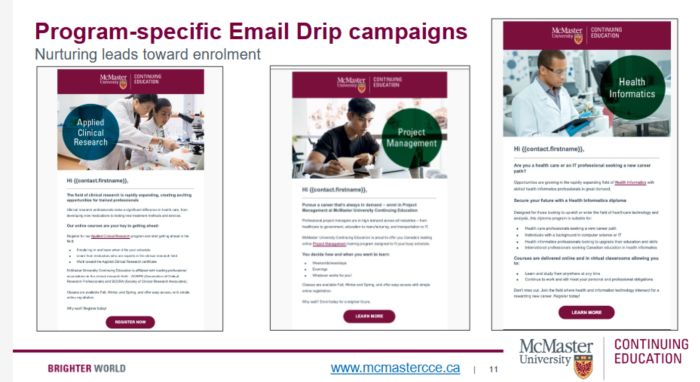
Example: McMaster University’s Continuing Education division’s persona-based email drip campaigns for lead nurturing show how each email is tailored to a persona (e.g. career changers in Project Management or Applied Clinical Research) with personalized greetings (“Hi {{FirstName}}”) and program-specific content.
Different students have different interests and needs, so your university email campaign should too.
Segmentation
By dividing your email list into meaningful groups (or “segments”), you can send each group content that truly matters to them. The result? Dramatically better performance.
How to segment effectively? Think about the factors that distinguish your prospective students. Common segmentation angles in higher ed include:
Stage in enrollment journey: Are they brand-new inquiries, applicants, or admitted students? (More on this later.)
Academic interests: What program or major are they interested in? Emails tailored by program (e.g. Engineering vs. Liberal Arts prospects) will highlight different selling points.
Demographics/Location: Is the student international or domestic? High school senior or adult learner? Local or out-of-state? Each group may respond to different messaging.
Behavioural engagement: How have they interacted with your school so far? (Attended a webinar, downloaded a brochure, etc.) Those actions can trigger targeted follow-ups.
Segmenting your list by criteria like these ensures each student gets content that speaks to their specific situation. As a result, your emails feel more relevant, and relevance drives results.
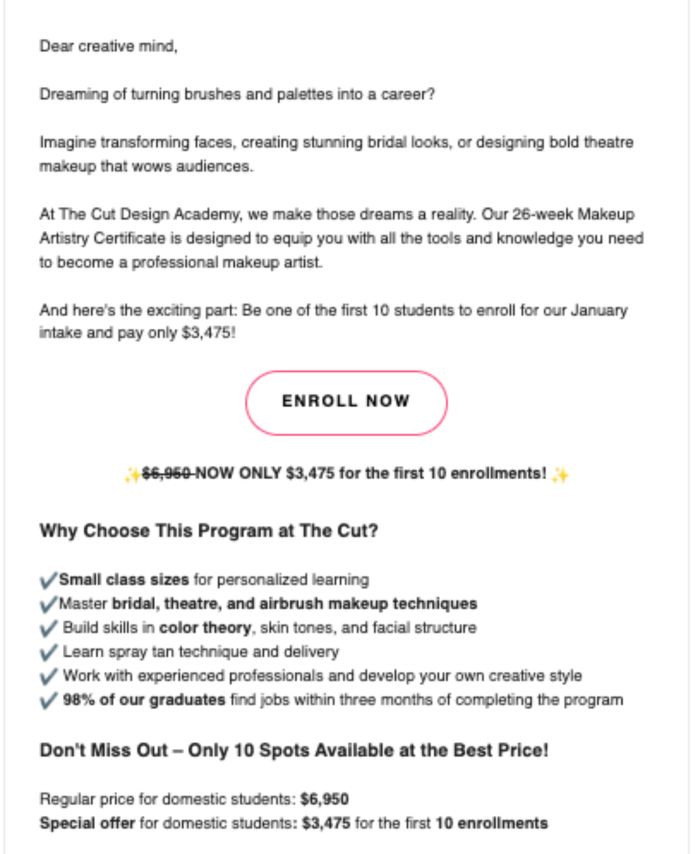
Example: The Cut Design Academy launched a promotional recruitment email targeting prospective students for its January 2025 Makeup Artistry Certificate intake. The campaign focused on driving immediate applications from students close to the decision stage, offering a limited-time tuition discount to accelerate conversions. Framed around an exclusive offer, the email used urgency, clear benefits, and student-focused messaging to stand out. The campaign leveraged personalization through tone (“Dear creative mind”) and clear calls to action, guiding prospects from interest to enrollment with stage-aligned messaging.
Segmented emails consistently outperform generic blasts, leading to stronger engagement, greater relevance, and improved results across the board. Marketers find that tailoring messages to specific audience groups makes campaigns more effective and impactful. The bottom line? When you embrace the diversity of your audience and tailor your messaging accordingly, they’ll reward you with higher engagement.
Let’s say you have a student interested in your Executive MBA. They’ve clicked on emails but haven’t registered for an event. You wouldn’t send them the same message as a high school student in Colombia interested in ESL.
Personalization
Now add personalization on top. If segmentation is about who you’re writing to, personalization is about what and how you communicate to each person. Today’s prospective students expect a personalized touch, and they respond when they get it.
Here’s why: Research shows that emails with personalized content have a 29% higher open rate and a 41% higher click-through rate than non-personalized emails. Simply put, personalization grabs attention. It signals to the student that “this is about you,” cutting through the clutter of impersonal mass communications.
Personalization can be as simple as using the student’s first name in the greeting or subject line – emails with a personalized subject are 29% more likely to be opened, according to Experian. But it goes much deeper than that. Effective enrollment emails often incorporate personal details like the student’s intended major, specific interests, or past interactions.
Let’s Look At Two Examples:
If a prospect has shown interest in your business program, your follow-up emails should reflect that. Highlight business-specific content such as alumni success stories, internship opportunities, and upcoming events related to the program. This reinforces relevance and keeps the student engaged with information they care about.
If a student clicks on a link about financial aid, your next email could focus on scholarships, bursaries, or affordability tips. This kind of targeted follow-up shows that you’re paying attention to their concerns. And students notice this effort.
An EAB survey in 2024 found that 93% of students said receiving a personalized message from a college would encourage them to explore that school further.
That’s an overwhelming majority who are more likely to engage simply because your email spoke directly to their interests or concerns. 71% of students expect personalized interactions from brands (including universities), and 76% get frustrated when they don’t get them. The message is clear: personalization isn’t just a nice touch; it’s expected.
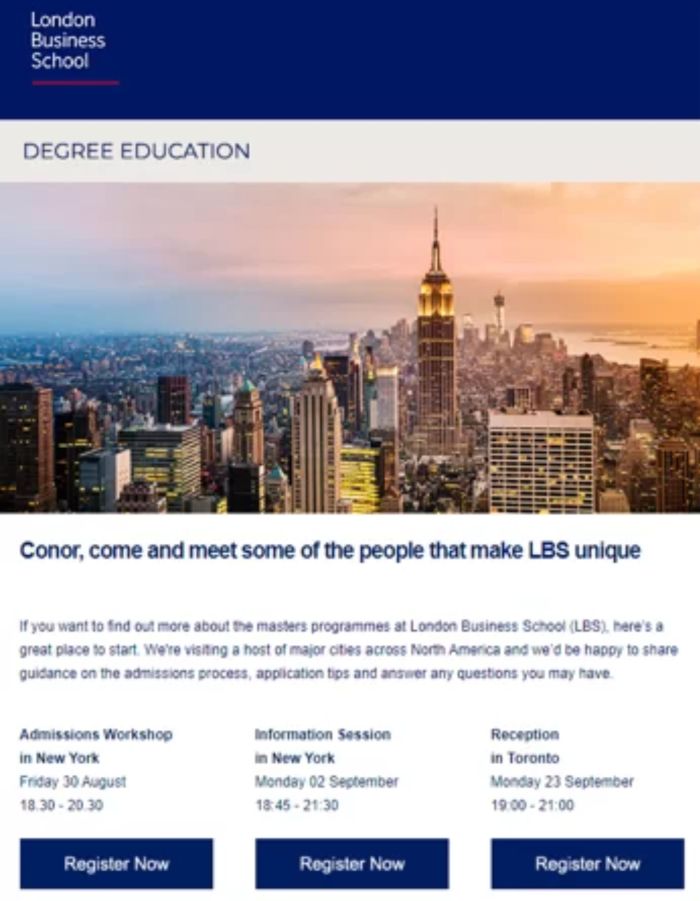
Example: This email from London Business School (LBS), addressed personally to the recipient (“Conor, come and meet some of the people that make LBS unique”), exemplifies effective personalization (using the student’s name and regional relevance) and event-based drip sequencing, reinforcing LBS’s presence and availability as the student prepares to make a decision.
So, how can you infuse personalization into your campaigns? Here are a few proven tactics (think of these as the “little things” that yield big results):
Use dynamic fields: Most email platforms allow you to insert the recipient’s name or other attributes automatically. A subject like “John, here’s info on the Computer Science program you liked” is far more engaging than a generic “Learn about our programs.”
Tailor content to personas: If you’ve segmented by persona or interest, craft the email copy and images to match each segment. A student athlete might get an email highlighting campus sports facilities and team success, whereas a fine arts prospect might see content about your art studios or student exhibits.
Leverage behavioural data: Personalization can also be triggered by what a student does. For instance, “We noticed you started an application – here are the next steps,” or “Thanks for downloading our Nursing Program guide – would you like to attend a nursing info session?” These timely, relevant messages show that you’re paying attention and ready to help.
In a nutshell, how do you develop a marketing strategy for a university? Start by defining clear goals (e.g., increase applications or improve yield), identify target audiences using personas, choose the right channels (email, social, SEO), create tailored content for each stage of the student journey, and measure results regularly to optimize performance.
Align With the Student Journey
A student’s path from curiosity to commitment isn’t linear. Your email marketing strategy shouldn’t be either.
Awareness
This is your digital handshake. Send welcome emails that reflect your institution’s voice: professional, warm, and resourceful. Keep it brief and include CTAs to helpful blog posts, reports, or program videos. The goal here? Spark interest and build trust.
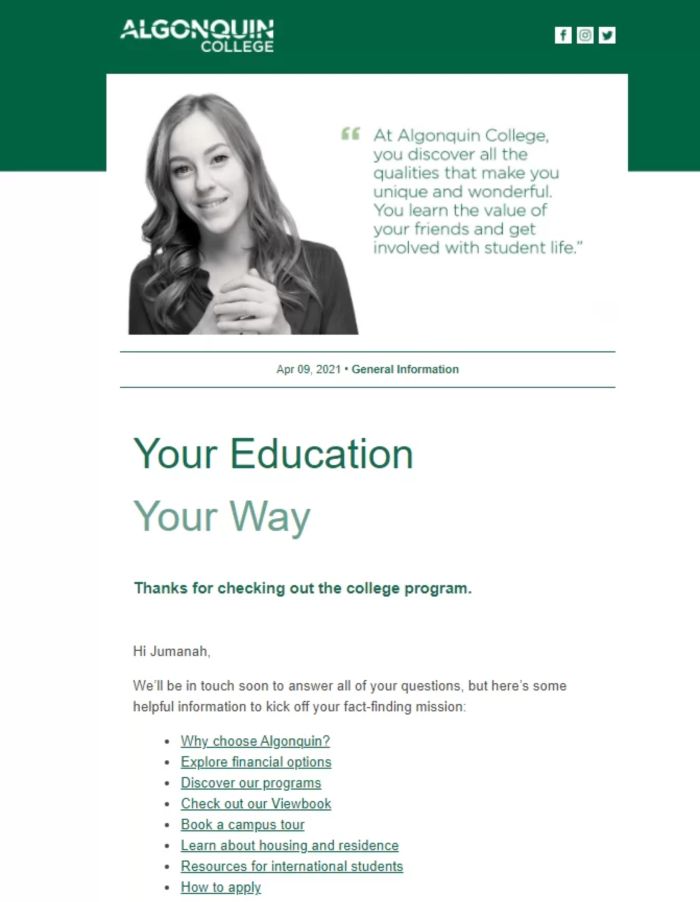
Example: Algonquin College initiated a welcome email campaign targeting newly inquiring students, aimed at supporting the awareness stage of the enrollment funnel. This automated email is sent immediately after a student checks out a program or completes an inquiry form, making it a textbook example of an early-stage drip campaign designed to keep the college top-of-mind and help prospects begin their research journey.
Now that they’re paying attention, it’s time to educate. Share program benefits, tuition details, and testimonials. Even better, offer personalized interaction, like a Q&A session with advisors. Emails at this stage become your student’s research partner.
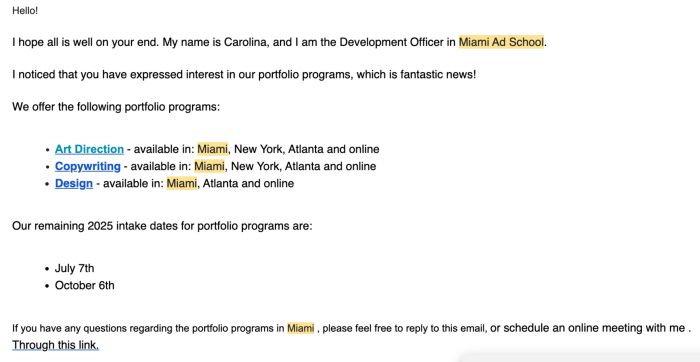
Example: Miami Ad School implemented a direct and informative follow-up email targeting prospective students who had expressed prior interest in one of its portfolio programs. The message used light personalization and concise formatting to clearly lay out the next steps for engagement. This email served as an early-stage consideration touchpoint designed to convert inquiry-stage leads into applicants.
Here’s where the magic happens, or it doesn’t. Use emails to overcome last-minute doubts, emphasize application deadlines, and make it ridiculously easy to act. Offer a call with an advisor. Include direct application links. This is where you close the loop.
Enrollment
Don’t stop now. Once students say “yes,” keep the momentum going. Celebrate with a warm welcome, then guide them through the next steps: registration links, orientation videos, and community invites. Make them feel like part of something exciting.
The Anatomy of a Winning Email
So what does a high-converting email actually look like?
1. Craft Irresistible Subject Lines
Include first names or program names
Add urgency (“Last Chance!”) or exclusivity (“Just for You”)
Steer clear of spammy ALL CAPS and excessive punctuation
Example: [Alex], Your Journey to an International Career Starts Here
Mobile-first design is a must; 55% of emails are opened on phones
Responsive layouts = higher clicks and happier readers
Stay Out of Spam and In Their Good Books
Even the best content won’t help if it lands in the junk folder. Avoid spam triggers (like “FREE!!!”). Keep your database clean, and follow laws like CAN-SPAM (US), CASL (Canada), and PECR (UK). And yes, always include that unsubscribe link; it builds trust.
Fun fact: The average inbox placement rate is 83%, so there’s room to optimize.
Build Relationships With Drip Campaigns
Think of a drip campaign as a well-timed sequence of nudges. It starts with a thank-you or auto-response after form submission.
Then, over days or weeks, you send emails that deepen interest, event invites, alumni success stories, or a reminder to complete an application. Every email has a purpose. Every message moves the needle.
Track What Really Matters
If you’re only looking at open rates, you’re missing the bigger picture.
Here’s a smarter approach:
Use open rates to gauge subject line effectiveness (aim for 46–50%)
Analyze click-through rates to measure engagement, event invites can hit 15–25%
Most importantly, track conversion rates: Are students applying, booking meetings, or showing up?
The data doesn’t lie. HEM’s insights show that most student bookings happen only after a lead is nurtured, sometimes weeks after their first touchpoint.
Final Thoughts: Your Enrollment Power Tool
We’ve covered a lot of ground, and you might be thinking, “How do I implement all of this?” The key is to view these strategies not as isolated tactics, but as complementary pieces of a holistic email marketing plan.
Segmentation gives you the framework (who gets what), personalization adds the special sauce (making content relevant to each individual), drip campaigns provide the delivery engine (timing and automation), mobile optimization ensures your efforts actually get seen on students’ preferred devices, and enrollment-stage alignment keeps your messaging strategy coherent from start to finish.
Each strategy is powerful on its own, but together they truly transform your email marketing from a simple broadcast tool into an engaging, research-backed recruitment machine.
You’ll be speaking to the right student with the right message at the right time – and that’s a recipe for higher open rates, click-throughs, and conversion to applications and enrollments. Just ask the institutions we discussed: they’ve seen application surges, increased yield, and record enrollments by putting these principles into practice.
To recap, how can colleges increase enrollment? Colleges can boost enrollment by improving lead nurturing (e.g., drip email campaigns), enhancing website conversion, offering personalized communication, streamlining the application process, and using data to better target and engage prospective students.
Done right, email isn’t just part of your marketing mix. It’s the glue that holds your enrollment strategy together.
Our targeted email marketing services can help you attract and enroll more students.
Discover how we can enhance your recruitment strategy today!
Frequently Asked Questions
Question: What is educational marketing?
Answer: Educational marketing refers to the strategies and tactics used by schools, colleges, and universities to attract, engage, and enroll students. It includes campaigns across digital channels like email, social media, SEO, and paid ads to promote programs and build institutional brand awareness.
Question: How do you develop a marketing strategy for a university?
Answer: Start by defining clear goals (e.g., increase applications or improve yield), identify target audiences using personas, choose the right channels (email, social, SEO), create tailored content for each stage of the student journey, and measure results regularly to optimize performance.
Question: How can colleges increase enrollment?
Answer: Colleges can boost enrollment by improving lead nurturing (e.g., drip email campaigns), enhancing website conversion, offering personalized communication, streamlining the application process, and using data to better target and engage prospective students.
By Vincenzo Raimo, an independent international higher education consultant and a Visiting Fellow at the University of Reading, where he was previously Pro Vice-Chancellor for Global Engagement.
Vincenzo Raimo will be joining David Pilsbury and Janet Ilieva at the International Higher Education Forum (IHEF 2025) on 4 June 2025 to discuss the topic: ‘Outdated policy and unfounded optimism drive British universities to the abyss.’
“If we want things to stay as they are, things will have to change.”
— The Leopard, Giuseppe Tomasi di Lampedusa
UK universities are awash with the language of transformation. Internationalisation and Global Engagement strategies speak of partnerships, student mobility, intercultural learning and global citizenship. Vice-Chancellors and Pro Vice-Chancellors for Internationalisation describe international education as central to institutional values and academic mission. And yet, for many, the real driver is far simpler: money.
There is a widening gap between the rhetoric of internationalisation and the reality of its execution. Strategic plans position it as an enabler of diversity, excellence and global reach, but the day-to-day reality is that it functions as a financial lifeline. In a sector facing significant funding pressures, international student income is often the difference between surplus and deficit. That tension matters. It undermines credibility, risks student experience and can lead institutions to prioritise volume over value.
The quote from The Leopard, Lampedusa’s novel of aristocratic decline during the unification of Italy, captures a central paradox of institutional reform. It speaks to the instinct to embrace the appearance of change in order to preserve the status quo. In recent months, this sentiment has felt uncomfortably familiar in UK higher education. We appear to be entering a period of cosmetic transformation: new job titles, rebranded structures and revised plans, but all too often without the deeper shifts in strategy, culture or resourcing that genuine transformation demands.
This is particularly evident in international student recruitment.
Universities in the UK have long faced political headwinds. International students are welcomed in principle but scrutinised in practice. Brief moments of progress, such as allowing students to bring dependents, are quickly reversed in response to migration debates. The result is unpredictability, which undermines confidence in the UK offer.
Despite this, the UK has historically benefited from a position of passive advantage in international recruitment. We speak the global language of higher education. Our qualifications are widely recognised. Many of our institutions enjoy long-established reputations. And our complex legacy of Commonwealth ties, colonial familiarity and cultural affinity has offered visibility and access in key markets.
But that advantage is fading.
Policy instability is only part of the challenge. Global competition is intensifying, and not just from the traditional English-speaking destinations. European countries are increasingly offering high-quality, English-taught programmes at lower cost, often with clearer post-study pathways. In Asia, more students are opting to stay closer to home, choosing emerging regional providers with improving reputations and stronger cultural fit. The UK can no longer assume it is the default choice.
In response, institutions are making changes, or at least talking about them. The mood music is shifting: towards diversification, resilience and sustainability. Yet much of this amounts to cosmetic change. Beneath the surface, many universities are still operating on the same assumptions, deploying the same strategies, and relying on the same markets and channels as they have for years.
I have argued that recruitment targets are vanity, quality and retention are sanity, but margin is king. Growth in international enrolments may look impressive, but it means little if acquisition costs are rising, if retention is falling, or if students leave feeling unsupported. In one recent project, I found that recruitment costs, dominated by agent commissions, amounted to nearly a third of the net tuition income per student. That model is unsustainable in the long term.
And the consequences are already visible: redundancies, departmental reconfigurations and even the closure of entire disciplines. The pursuit of international income has not protected the sector from financial strain. Rather, it may simply have postponed the difficult decisions needed to build genuinely sustainable institutions.
One apparent solution is transnational education (TNE). There is renewed enthusiasm for TNE as universities seek to diversify income and reach. I have worked with institutions developing long-term TNE partnerships that deliver real benefits: stronger reputation, broader access and more distributed risk. But TNE is not a short-term fix. It takes time to design and deliver well, requires significant investment and cannot plug immediate financial gaps.
Nor can TNE substitute for a broader rethink of international strategy. In my International Student Recruitment Success and TNE Success scorecards, I offer practical frameworks for assessing capabilities, identifying risks and planning more strategically. These tools are designed to help institutions move beyond tactical fixes and focus on longer-term sustainability. Key questions include:
What is our purpose in internationalisation?
How distinctive and competitive is our offer?
Are our structures and resources aligned to support quality and retention?
And are we being honest about what our strategy is really for, and is that clearly communicated across the institution and to our wider stakeholders?
Too often, international strategies present one set of values, while day-to-day activities pursue another. This misalignment makes success harder to define, measure and achieve.
The danger today is that we confuse activity with progress. Structural tweaks and strategic refreshes may signal intent, but unless they are anchored in purpose and matched by investment, they will not deliver the resilience the sector needs.
Lampedusa’s quote reminds us that change can be used either to preserve the status quo or to enable transformation. The UK higher education sector faces a choice: to make difficult, strategic changes now, or to continue changing just enough to maintain the illusion of stability, while the foundations quietly erode.
Baiyu Liu is a BSc Computer Science student studying at King’s College London (KCL). He has been elected President of the King’s College London Students’ Union (KCLSU) in March 2025. His election marks the first time a Chinese student breaks into Student Union leadership in a major London Russell Group university. In this article, Baiyu writes about his thoughts on Chinese representation in student leadership.
I have thoroughly enjoyed my time as an undergraduate student at KCL and I will look back fondly on my experience and the positive imprint the university has left on me. As I leave my undergraduate studies and move on to my new role as President of the KCLSU, I can’t help but reflect on my time. What went well, and what could be improved about university offerings to students, especially Chinese students.
Chinese students form one of the largest international student groups in the UK, yet they are strikingly underrepresented in leadership, governance, and public discourse. Until my election at King’s College London Students’ Union, there was not one East Asian President in its 150 year history. This highlights the stark imbalance of Chinese representation in student leadership at universities in the UK. We believe this underrepresentation must be addressed in order to keep UK universities competitive in attracting Chinese international students, whose tuition fees form a large part of British university income.
At King’s College London, out of the 23,000 international students, over 7,000 are Chinese. However, despite being a third of the international demographic and a fifth of the total student demographic, there is a virtually non-existent Chinese presence in the Students’ Union or senior leadership. Even with the commendable efforts of KCL’s leadership and our renowned Student Union, there is still much more to be done to bridge the gap.
We have identified two major factors that have led to this lack of leadership representation: a lack of existing minority representation and a lack of cross-cultural interaction. In the past, there have been discriminatory beliefs about Chinese students ‘keeping quiet’ or ‘keeping to themselves’. My election is a wake-up call – UK universities’ reliance on Chinese students’ tuition fees and treatment of them as merely consumers must come to an end. I picked up the mantle of leadership not because it was absent among the Chinese community, but because nobody had envisioned that a Chinese student could be an SU President.
Due to the Chinese culture of deference and Confucian principles, which value social harmony above individual agency, many Chinese international students do not believe they are empowered to speak out or stand up for their communities. They have very few role models or trailblazers – they couldn’t see themselves being student leaders.
There is of course also an element of the self-fulfilling prophecy of the bigotry of low expectations. The stereotype of Chinese students as being ‘hardworking but quiet’ rears its ugly head when many previous student leaders have presumed that students will simply accept what they are told and the changes the SU intends to make. They do not expect Chinese students to put up a fight.
As Chinese international students often cluster and stay within their own circles, they are often apathetic to the wider happenings of the Student Union. This effectively creates a distance between them and the policymaking processes in channelling their student voice.
The wider implication of the lack of Chinese representation is that their concerns are not always adequately addressed. One example at KCL is the issue of Digital Graduation Certificates (DGC), wherein the time discrepancy between receiving their degrees and having their physical certificates shipped to them in China leads to graduates missing out on crucial job application windows. For many years, Chinese students at KCL have suffered in silence as they have missed job opportunities due to the lack of DGCs. We do not believe this is an oversight from KCL’s administration, but instead simply that they did not know this was a problem.
Authentic Chinese food is absent in our kitchens, despite the sizable Chinese demographic. Many international students find the whitewashed Asian food disagreeable to their palates, whilst calls for food reform often fall on deaf ears. Similarly, hot drinking water dispensers are still unavailable for Chinese students who are not accustomed to drinking cold water.
These problems, combined with many others, lead to Chinese students questioning whether they ought to study in the UK at all, which already costs far more than Chinese universities. UK universities, it should be noted, are also beginning to fall behind in STEM fields, which Chinese parents are becoming increasingly more aware of. It is thus in the best interests of UK universities to maintain a competitive edge in the Chinese higher education market.
We believe it is imperative that we diversify the Student Unions of UK universities and empower Chinese international student voices. Although KCLSU is a start, it must not be the end. We hope more Chinese students could be emboldened to run for Student Union positions across this country.
KCL is one of the greatest academic institutions in the world, with a great diversity of students from different backgrounds and cultures. The world-class staff of the university and the student union have done great work in enriching and fostering inclusivity. We believe that King’s could serve as a beacon to the rest of the country moving forward, especially in uplifting student voices within the Chinese community. I envision a world where all students, regardless of nationality, can see themselves in top leadership positions and have their voices heard. I hope to see Chinese students not just study in UK universities, but also help to shape them.
Rayhan Abdullah Zakaria, Senior Fellow of the Higher Education Academy (HEA).
It was a rainy Monday morning, the kind where the grey skies press low and the air smells like old books and wet leaves. I was huddled in our university’s coffee house, steam rising from a chipped mug, when a colleague leaned over and said something that’s stuck with me ever since:
Universities are the last bastion of free thinking, the engines of progress. How can anyone try to silence that?
He wasn’t being dramatic. We weren’t swapping dystopian movie ideas. What we were discussing was very real, and it’s happening now.
Imagine a government freezing research funding, restricting international student recruitment, stripping universities of their tax exemptions, and tightening the grip through a maze of bureaucratic controls. It sounds like fiction, but for many institutions around the world, it’s a lived reality. Even here in the UK, where we pride ourselves on academic excellence, universities are feeling the squeeze,
As I walked back from that coffee house with my thoughts churning like the storm outside, I realised that beneath the surface of daily lectures, research deadlines, and student support, two major fault lines threaten to destabilise the sector: governance and funding. These are not abstract issues—they shape how we teach, how we research, and how we serve society. Allow me to explain:
I. The Financial Fault Line
Higher education institutions in the UK are operating under increasing financial strain. According to recent analysis by Nick Hillman, universities are facing unsustainable deficits, largely due to a combination of frozen domestic tuition fees and rising operational costs.
Frozen Tuition Fees
Domestic tuition fees have remained capped at £9,250 since 2012. In real terms, inflation has steadily eroded their value. Universities UK (2024) estimates that this cap now equates to just £6,000 in 2012 money, leading to reduced investment in teaching quality, infrastructure, and student services.
Over-Reliance on International Students
Many institutions have sought to bridge the funding gap by increasing their intake of international students. While this has provided a temporary financial cushion, it is a fragile strategy. International enrolments are highly sensitive to visa policies, geopolitical tensions, and global economic shifts. The UK Home Office’s recent tightening of post-study work rights has already triggered concern across the sector.
Rising Operational Costs
Operational expenses—including staffing, estate maintenance, and digital infrastructure—continue to rise. Inflation and energy prices compound these challenges, placing institutions in a double bind: cut services or stretch resources even thinner.
What Could Help?
We need to lobby for a sustainable fee review mechanism that accounts for inflation and rising costs.
We must diversify income streams beyond tuition: think industry partnerships, micro-credentials, alumni ventures, and lifelong learning platforms.
We also need to invest in shared services and cost-efficient digital infrastructure that reduces overhead without compromising quality.
II. The Governance Conundrum
The falling rain speeds up crushing against the single pane of my office window. I see a poor wood pigeon being blown off course by the rain and the wind, just like our university a small dingy lost in the chaotic ocean of governance. I do think alongside financial challenges, governance structures across many universities are in urgent need of reform. My first semester leadership postgrads know that effective governance is critical for institutional resilience, but UK universities current governance models often fall short.
1. Overcentralisation of Power
In some institutions, decision-making is concentrated in the hands of a powerful executive team. While strong leadership is essential, University governance HEPI (2024) should not drift toward corporate-style management that sidelines academic voices. This can lead to decisions that prioritise brand and market over mission and integrity.
2. Ineffective Councils and Boards
I think governing bodies should act as strategic stewards of the institution, ensuring transparency and long-term sustainability. Yet many lack the sectoral expertise or training to navigate complex challenges. The Committee of University Chairs has long advocated for better induction and development programmes, but uptake is uneven.
3. Overregulation and Bureaucracy
While regulation is necessary, the current landscape—especially under the Office for Students —has created a burden of compliance that can stifle innovation and demoralise staff. As HEPI and others have argued, we need a shift towards smarter regulation: outcome-focused, proportionate, and enabling.
What Could Help?
We need to rebalance executive and academic leadership to support shared governance.
We should work towards enhancing the capacity and diversity of governing councils.
We must move toward more meaningful regulation that supports innovation rather than obstructs it.
A Call for Sector-Wide Renewal
As I left my office and stepped back into the drizzle of a typical term-time Monday, I recognised that the challenges ahead are not insurmountable – but they do demand courage and collective action.
You see – reform must not be imposed from above but built through authentic dialogue across the sector. I do think that staff, students, alumni, employers, and policymakers all have a role to play. We must centre our vision not just on institutional survival, but on societal value. At the end of the day, universities are not corporations. They are civic institutions with a public mission.
As I step into my class, I am greeted by my 3rd-semester post grads
“Hey, how was the weekend?”
I acknowledge, smile, nod, and make my way to the front to connect my laptop to the overhead projector. The last thought in my head is that if we are to sustain our university mission, we need to rethink how we fund, govern, and ultimately value higher education. Not tomorrow. Now.