Professor Claire Callender OBE, who held joint professorships at UCL Institute of Education and Birkbeck, University of London, died at home amid her family on Tuesday, 15 April, after the cancer which developed in one lung and was in remission had moved to the other. She dealt with her illness and the rollercoaster of treatments, tests and diagnoses with exceptional strength, characteristic realism and eventually, open acceptance, making the best of her remaining time. Claire’s life and contributions will now be celebrated, but her passing at a relatively young age has sent a wave of sadness through UK and world higher education. She touched the lives of many as a scholar, colleague and mentor; played a central role in policy and public discussion for three decades; and had much respect and friendship in the sector. She was awarded an OBE for services to higher education in 2017.
Claire attended Notting Hill and Ealing High School between 1961 and 1972, completed a BSc in Social Administration and Sociology at Bristol in 1979, after a period as a community worker in the Beit She’an Community Centre in Israel, and a PhD in Gender and Social Policy at the University of Wales in 1988. Her thesis topic was ‘Women’s employment, redundancy and unemployment’: both gender and the labour market for graduates were to become lifelong research preoccupations. She worked successively at University College Cardiff, and the Universities of Leeds, Bradford and Sussex (in the Institute of Employment Studies), before becoming head of the Family Finances Research Group at the Policy Studies Institute in London (1994-1998). Her first chair appointment was at London South Bank University as Professor of Social Policy (1998-2008). Claire’s social research star was rising and early in the Blair years (1999-2000) she spent time in the Cabinet Office on secondment as Head of Research in the Women’s Unit and a member of the Senior Management Team.
In 2006 and 2007, Claire was a visiting scholar successively at the Center for the Study of Higher Education at Pennsylvania State University, and the Graduate School of Education at Harvard, and was also a Fulbright New Century Scholar in 2007/08, forging productive research collaborations in the United States that continued throughout her career. Her post as Professor of Higher Education Policy commenced at Birbeck in 2008, followed by the Professorship of Higher Education Studies at the Institute of Education (which merged with UCL in 2015) in 2010. She juggled the respective cultures, needs and demands of the two rather different neighbouring institutions with aplomb. Her heart might have been with Birkbeck, and there her policy focus on part-time, adult and evening students had its natural home, while UCL IoE placed her squarely in the centre of the university-policy interface and brought multiple opportunities for fruitful collaborations and ongoing academic friendships.
In 2012, she worked with Peter Scott to develop a bid to the Economic and Social Research Council (ESRC) for a five-year centre with a multi-project focus on higher education. The bid was unsuccessful but the theme caught the attention of the ESRC and the Higher Education Funding Council of England (HEFCE), and in the next ESRC centre round in 2014 there was a specific call for bids focused on the future of higher education, with HEFCE underwriting part of the cost. A team headed by myself was successful, establishing what became the ESRC Centre for Global Higher Education (CGHE) with £5.9 million for 2015 to 2020. Claire was named as a Deputy Director alongside a formidable group of England-based researcher-scholars including Peter Scott, Mike Shattock, Gareth Parry, William Locke, Lorraine Dearden, Gill Wyness and Paul Ashwin, as well as Ellen Hazelkorn at Technological University Dublin in Ireland and researchers from seven other international partner universities.
Claire convened five CGHE research projects under the heading ‘Social and Economic Impact of Higher Education’. Appropriately, given Claire’s own interests and skillset, these projects were all sharply focused on UK policy issues, while mindful also of global comparisons and relevance. The researchers on her list included the leading economists Bruce Chapman and Lorraine Dearden who together modelled income-contingent loans systems of tuition funding in a dozen countries. They achieved a major breakthrough in Columbia in 2022 where their blueprint was adopted by the ministry. Bruce and Lorraine were awarded the ESRC prize for policy impact and paid tribute to Claire’s role in supporting their work.
CGHE received a further tranche of £1.5 million in ESRC funding for 2020 to 2024 before entering its present phase as a largely self-funded operation. Claire continued as Deputy Director, central to CGHE research management and in public forums, and an appreciated mentor to junior researchers. Her own quantitative and qualitative CGHE inquiry into ‘The effects of student loan debt on graduates’ financial and life decisions’, working primarily with Ariane de Gayardon, led to successive papers on the human and social costs for diverse populations associated with the uniform system of student-user charges in England. From 1998 onwards, after fees were introduced into what had been a free higher education system, Claire had been concerned about student financing and its impact, including comparisons between England and Scotland where free education was maintained. She was frequently and eloquently public on those issues. Uncomfortable with debt financing as a deterrent, a long burden and a source of inequalities, like many in higher education she was a staunch advocate of maintenance grants. Her concern that the 2012 full fee system would discriminate against part-timers proved wholly justified when full-time enrolments held up while part-time numbers plummeted. The then Minister for Higher Education, now David (now Lord) Willetts, acknowledged that Claire’s work on the issue was unique and crucial.
As this suggests, perhaps the key aspect of Claire’s scholarly work was her eye for policy relevance. During her career she was commissioned to undertake research and/or invited to present evidence to the OECD, the European Commission and governments in Germany, Finland (where she was appointed by the Ministry of Culture and Education to the peer-review panel for the assessment of the Finnish Higher Education System in 2015), Poland, and Malaysia. She reported to numerous Parliamentary Select Committees in UK, and all the major reviews of student funding that took place in the UK after 1997 – including the most recent review, the Augar Report of 2019, where she was extensively cited. Claire’s contributions to research scholarship included more than 125 books, reports and chapters, more than 30 peer reviewed journal papers and numerous conference and seminar presentations. Some of her very best scholarly work was done in the final years. The last journal paper, with Ariane de Gayardon, was published in Policy Reviews in Higher Education earlier this year. Claire became a Fellow of the Academy of Social Sciences in 2003 and her standing in Europe was recognised in 2023 by her elevation to Academia Europaea. The OBE acknowledged her UK policy work.
The formal honours were and are appropriate, but they do not capture the essence of Claire Callender in the world: the way she focused her formidable capacity for rational thought on matters to which she was committed, her gravitas that held the room when speaking, and the warmth that she evoked without fail in old and new acquaintances. Claire leaves her partner Annette and a large circle of family and friends. She is much missed.
* Simon Marginson is Professor of Higher Education at the University of Bristol, Professor of Higher Education (emeritus) at the University of Oxford, and Joint Editor in Chief of the journal Higher Education. He was director of the ESRC Centre for Global Higher Education from 2015 to 2024.
_____________________________
The HEPI staff team were grateful to have known Claire and to have had the honour of publishing some of her critically important work. We learnt a huge amount from her and will be among the very large number of people who will sorely miss her.
Gill Evans is Emeritus Professor of Medieval Theology and Intellectual History at the University of Cambridge.
In early March 2025, the Trump administration sent letters to 60 US universities warning them that they faced ‘potential enforcement actions’ for what it described as ‘failure to protect Jewish students on campus’ during the widespread pro-Palestinian protests on campuses during the last year. This Government direction not only permitted terms to be set on which continuing funding was to be conditional for a specific higher education provider, but also allowed those terms to encroach on the academic freedom of an institution to choose what to teach and how. This ‘Project 2025’ also allowed the President to require a significant proportion of funding to go to the provision of ‘business’ courses.
There were wider consequences of these Government directions. The resulting limitation of funding for research quickly prompted hints of restricted publication of results and encouraged US academics to seek employment in Canada, the UK and Europe.
Though it was joined in its active resistance by Yale and Princeton, Harvard became a test case. It objected to the Government demand that it immediately agree:
to implement the Trump administration’s demands to overhaul the University’s governance and leadership, academic programs, admissions system, hiring process, and discipline system—with the promise of more demands to come
and thus ‘overtly seek to impose on Harvard University political views and policy preferences advanced by the Trump administration and commit the University to punishing disfavored speech’. [1] The US Education Department speedily responded, announcing on 14 April that it was freezing about $2.3bn of Harvard’s funding. On 15 April, Trump threatened to remove Harvard’s tax-exempt status,
US universities are divided into the ‘private’ and ‘public’ on the basis of their funding and therefore differ in the extent to which they are at risk of loss of funding in attacks on their academic freedom. The ‘private’ Ivy League universities enjoy substantial endowments, making them less dependent on their supplementary Government funding than their ‘public’ counterparts.
The Office for Students funds and regulates higher education in England. MEDR, the Welsh Commission for Tertiary Education and Research, funds and regulates higher education in Wales, taking these responsibilities over from the former Higher Education Funding Council for Wales. The counterpart body for Scotland is the Scottish Funding Council. This depends on the Scottish Government for the funding it disburses to providers.
English higher education providers enjoy an institutional autonomy, strengthened by the fact that Government funding for English higher education was greatly reduced with the progressive ending of a ‘block grant’ under the Higher Education Act of 2004 and the raising of tuition fees in 2012. That was replaced by much higher student tuition fees under the Higher Education and Research Act of 2017.
Under the same legislation the autonomy of higher education providers in England is protected, with express reference to their right to design their own courses, choose their students and appoint their academic staff. This extends to higher education at tertiary education levels 4 and 5 as well as to ‘degree-level’ 6 and postgraduate degrees at levels 7 and 8.
This legislative permission does not allow a free-for-all. ‘University’ is a ‘sensitive term’ in English law, as are ‘higher’ and ‘accreditation’ when used of education. New providers may grant their own degrees and call themselves ‘universities’ only if they have powers to do so. In the case of new providers that requires Registration by the Office for Students (OfS). The OfS is subject only to ‘guidance on strategic priorities from the Department for Education’, though its activity is open to expressions of Parliamentary concern. For example, on 2 April 2025, the House of Commons debated ‘the impact of university finances on jobs in higher education’. It was suggested that ‘the funding model, which depends on international students paying higher fees, has harmed universities since Brexit’, but it was recognised that only public funding and such broad policy preferences lay with the Government.
The accreditation of qualifications in the UK is the responsibility of a number of agencies, some of which are professional and some are public bodies. In the USA ‘relying on private, independent accrediting agencies has been the most important tool for preventing the centralized political control of higher education in the United States’. The authority of the Trump directive over these seemed clear at first.
What protects the institutional autonomy of US Universities? The nearest US counterpart to the Office for Students is the Higher Learning Commission, an independent agency founded in 1895. It accredits institutions granting degrees. The University of Michigan, for example seeks renewal of its accreditation from the Higher Learning Commission every ten years. Its ‘evaluations’ are conducted by reviewers from other institutions not the HLC itself.
The award of ‘University title’ and degree-awarding powers is not restricted in the US as it is in England. For example they may derive from a Charter establishing the institution. Its own Charter granted the Trustees of Columbia University degree-awarding powers and powers to create such:
ordinances and by-laws which to them shall seem expedient for carrying into effect the designs of their institution; Provided always, That such ordinances or by-laws shall not make the religious tenets of any person a condition of admission to any privilege or office in the said college, nor be inconsistent with the constitution and laws of this state, nor with the constitution and laws of the United States.
Private US universities
The privately funded Ivy League Universities were set up with a degree of constitutional independence. Each had a State-based beginning. Harvard was established as a College by the General Court of Massachusetts Bay Colony in 1636 with funding of £400. Its stated purpose was to ensure that the Puritans should be provided with educated ministers, by advancing ‘learning’ to meet the needs of ‘posterity’ and to avoid leaving churches with ‘an illiterate ministry’.Princeton, founded in 1746 by the Presbyterian Synod as the College of New Jersey, had its name changed to Princeton University in 1896. Its present charter dates from 1748. It too has Trustees. In an age when it could be expected that those arriving from England would be practising members of the Church of England, it was insistent about religious freedom:
Petitioners have also expressed their earnest Desire that those of every Religious Denomination may have free and Equal Liberty and Advantage in the Said College any different Sentiments in Religion notwithstanding.
Columbia, too, began as a College. It was granted a Royal Charter in 1754, making its governors a ‘body corporate’. In 1912, the corporate name was changed to ‘Columbia University’. A series of amendments followed, with an Act of the people of the State of New York in 1810 clarifying the position. Its Trustees were to form ‘a body politic and corporate’ ‘in the City of New York’, with ‘continual succession for ever’ and a common seal. The powers of its Trustees as governors were set out in detail, separating them decisively from the ‘professors’ and ‘tutors ‘. The Trustees were to:
have full power and authority to direct and prescribe the course of study, and the discipline to be observed in the said college, and also to select by ballot or otherwise, a president of the said college, who shall hold his office during good behavior,
but no ‘professor, tutor, or other assistant officer’ was to be a Trustee. There was to be an executive body, consisting of eleven of the Trustees, constituting ‘a quorum for the despatch of all [routine] business’.
Its Statutes include a ‘Code of Academic Freedom and Tenure’:
Academic freedom implies that all officers of instruction are entitled to freedom in the classroom in discussing their subjects; that they are entitled to freedom in research and in the publication of its results; and that they may not be penalized by the University for expressions of opinion or associations in their private or civic capacity; but they should bear in mind the special obligations arising from their position in the academic community.
In March 2025, seeking to force the University of Columbia to comply with his instructions, the President of the USA withdrew $400m of federal funding. Nine specific ’reforms’ had been called for in this case, including a change of Departmental Head and modifications to its provision of Middle Eastern, South Asian and African Studies. A Senior Vice-Provost was to review the educational programmes.
The University published a statement of its own view that certain ‘protests in academic buildings, and other places necessary for the conduct of University activities, are generally not acceptable under the Rules of University Conduct’ because of the likelihood of disrupting academic activities’. Yet Columbia acceded to the Trump administration’s demands, including an agreement to expand ‘intellectual diversity’ as ‘defined by the Trump administration’.
Princeton spoke of resistance when the ‘Trump administration suspended dozens of grants to the University from several agencies, including the Department of Energy, NASA, and the Department of Defense’, pending ‘an investigation into antisemitism on campus’. Yale too declared its resistance in a letter signed by 900 of its Faculty, protesting at ‘unlawful demands that threaten academic freedom and university self-governance’. On March 31, Cornell published an op-ed by its President in the New York Times, describing the point which had been made in the interests of freedom of speech when the University held a Panel conversation exploring ‘pathways to peace’ for Israel and Palestine.
On 24 March, the American Association of University Professors and Democracy Forward explained the decision to litigate. On 11 April 202,5 Harvard began its own litigation about ‘the Trump administration’s unlawful and unprecedented misuse of federal funding and civil rights enforcement authority to undermine academic freedom and free speech on a university campus’. It complained that on March 31 ‘an investigation of Harvard University’ had been announced and on April 3 this had been followed by an order to ‘adopt a list of vague yet sweeping programmatic and structural changes to university management, operations, and curriculum’ as a condition of the University continuing to be the ‘recipient’ of $9 billion ‘federal taxpayer dollars’.
Harvard argued that the Government had failed to take the required preliminary steps under Title VI of the Civil Rights Act. These requirements, it pointed out, existed because ‘Congress recognized that allowing federal agencies to hold funding hostage, or to cancel it cavalierly, would give them dangerously broad power in a system in which institutions depend so heavily upon federal funding’. It pointed out that the Trump administration had:
frozen over $1 billion in funding for Cornell University and $790 million for Northwestern University, with an even more shocking lack of process, not even purporting to issue communications providing notice under Title VI or any other legal authority.
Public US universities
US public universities are subject to national Government control as recipients of Government funding. State legislation about them is also significant. The University of North Carolina was established by legislation in 1789, becoming America’s first public university. Its many schools and offshoots were brought together by the North Carolina General Assembly in 1972. The Constitution of the State of Texas states that its legislature shall ‘establish, organise and provide for the maintenance, support, and direction of a University of the first class’ with a new ‘undergraduate curriculum’ and also ‘establish a more demanding standard for leadership of academic departments and research centres’. As a public research university, the University of Texas at Austin (founded 1883) now describes itself as ‘the flagship institution of the University of Texas System’.
Conclusion
A wise US university makes provision to respond to both Government and State supervision. Michigan has a Vice President for Government Relations, acting ‘as the university’s bridge between local, state, and federal governments’. Its ‘State Relations team is committed to building and nurturing strong relationships with state government officials and agencies’, seeking ‘to secure funding, influence policy, and represent the university’s interests in state-level discussions. It also has a Federal Relations team ‘dedicated to fostering and maintaining collaborative relationships between the university and federal government entities including the U.S. Congress’. It too has been subject to Donald Trump’s demands and has stopped the successful diversity, equity and inclusion (DEI) program it has run since 2016, and closed the office it had set up to deal with it.
It remains to be seen how far the present President of the USA will succeed in enlarging Government control of the nation’s institutions of higher education by linking direction of academic activity with their funding. Former President Barack Obama did not hesitate to express his support for Harvard, calling Trump’s action ‘unlawful and ham-handed‘.
[1]Harvard Faculty Chapter, and American Association of University Professors v.United States Department of Justice, filed 11 April, 2025.
But what is the hidden impact of accent bias across UK HE? How does it influence students’ academic life, belonging and wellbeing?
The Hidden Impact
In our current research (Tomé Lourido & Snell, under review), we conducted an accent bias survey with over 600 students at a Russell Group University in the North of England. It showed that a significant number of students experience accent-based disadvantages that have a lasting negative impact on their academic life. Negative experiences were most frequently reported by students from the North of England, especially from working-class backgrounds, and students who did not grow up speaking English, especially from minoritised ethnic backgrounds. These include:
Being marked as different or inferior through negative evaluation, miscategorisation and frequent microaggressions, such as having their accent mimicked, mocked and commented on.
Facing barriers to academic engagement and success. Students from these groups report feeling that their contributions in academic settings are not valued because of their accent, which makes them reluctant to participate in class. Some feel pressured to change their accent, adding an additional cognitive burden to in-class participation. These students are disadvantaged because they miss opportunities to develop and refine their thinking through dialogue with others.
Impacts on wellbeing and career aspirations: Due to negative past experiences, some students internalise negative perceptions of their accent, affecting their confidence and wellbeing, and making them reluctant to take up new opportunities or follow certain career paths. This can have a knock-on effect on their mental health.
The accent-based disadvantages reported by students are not simply representative of wider societal prejudices; for many, the university context was unique in highlighting and amplifying these prejudices. Students also recognised that accent bias intersects with other forms of discrimination – class, race, ethnicity, gender, sexuality and disability – in complex ways. Thus, we argue that HEIs should turn an analytic lens on themselves and take action to tackle accent bias and related inequities.
From Awareness to Action: A Collaborative Approach
There is work to be done for all of us in HEIs to embrace a true multilingual and multicultural ethos and challenge the idea that there is an idealised type of university student. We must “de-normalise” the microaggressions against students with accents perceived as “regional” or “foreign” and ensure that students from all backgrounds are able to participate in the classroom without feeling out of place. We propose four areas of interdisciplinary and collaborative work across the organisation:
Raise awareness of accent bias and its negative consequences in collaboration with students and student unions. Create a communications campaign, provide targeted student and staff training, engage with career offices and employers.
Tackle accent-based inequities by adopting a good practice statement about linguistic diversity and incorporating action into Equity, Diversity and Inclusion (EDI) policy and practice. Include content on linguistic diversity and discrimination in relevant university policies (e.g. mutual respect), strategies, student communications, and training (e.g. induction).
Create a safe report and support route within existing systems for linguistic discrimination, bullying and harassment. Train staff supporting students, including personal tutors, on accent bias and its impact on academic life.
Evaluate the effect of accent bias on students’ success, belonging and wellbeing. Track linguistic diversity. Assess the success of initiatives.
Accent bias remains a largely unaddressed issue in large organisations. HEIs can play a pivotal role in leading a much-awaited societal change.
Addressing accent bias in Higher Education is about breaking down barriers to opportunity and creating an environment in which all students, regardless of their background, can succeed in their studies, secure jobs, and contribute positively to society. By doing so, HEIs will support the employability of their students, a key metric for prospective students when selecting a university, and contribute to economic growth and social mobility.
We encourage senior leaders to take proactive steps to tackle the negative consequences of accent bias and foster a more inclusive and equitable Higher Education system where students from all linguistic backgrounds can thrive.
Customer Relationship Management (CRM) systems have become essential tools in higher education, transforming how universities interact with prospective students, current students, alumni, and other stakeholders. Whether you’re trying to track your enrollment funnel, streamline your recruitment process, or boost retention, CRM systems offer many unique marketing benefits for your institution.
You may have already encountered discussions about CRM platforms, but understanding their full potential in an educational context is key to optimizing your institution’s outreach, recruitment, and engagement efforts. Keep reading to learn more about higher education CRM systems, the unique marketing benefits they offer, and how you can get started.
Struggling with enrollment?
Our expert digital marketing services can help you attract and enroll more students!
Understanding Higher Education CRM
What is a CRM in higher education? It’s a powerful software solution that helps universities manage relationships at every stage of the student lifecycle. Traditionally associated with sales and customer service in corporate settings, CRM technology has evolved to meet the specific needs of educational institutions. In higher education, a CRM can track interactions with prospective students, automate communication, and analyze data to improve engagement and conversion rates.
Unlike a standard student information system (SIS), which focuses on administrative tasks like enrollment and grades, a CRM is designed for relationship-building. It allows universities to personalize outreach, streamline marketing efforts, and nurture students from the moment they express interest until they become engaged alumni. By integrating CRM technology into your institution’s marketing strategy, you can enhance recruitment efforts, improve retention rates, and foster long-term alumni engagement.
Source: HEM
Are you wondering how your university can unlock the benefits of a CRM? Reach out to learn about our tailored digital marketing solutions.
The Benefits of CRM Systems for Universities
What are universities using CRM for? Well, to be successful as an educational institution, building and maintaining positive relationships with prospective students is necessary. CRMs help schools manage those relationships at various stages of the enrollment funnel and offer valuable marketing benefits.
One of the most significant advantages of implementing a CRM in higher education marketing is the ability to centralize and manage vast amounts of student data efficiently. Rather than relying on disparate spreadsheets, email threads, and manual tracking, a CRM consolidates all interactions into a single platform, ensuring every team member has up-to-date information.
A well-implemented CRM system helps streamline the recruitment process by automating lead nurturing. When prospective students submit inquiries through your website, attend a virtual event, or download a brochure, a CRM can trigger personalized email sequences, follow-up reminders, and targeted content recommendations based on their interests. This level of automation ensures that no lead is left unattended, allowing admissions teams to focus on high-value interactions.
Beyond recruitment, CRM systems are crucial in improving student engagement and retention particularly when data from a Student Information System is integrated. Universities can use CRM and SIS analytics to monitor student behaviour, such as class attendance, engagement with academic advisors, or extracurricular activities. If a student begins to disengage, automated alerts can prompt intervention from faculty or student services, helping to improve retention rates and overall student satisfaction.
Another key area where CRMs add value is in alumni relations and fundraising. By tracking alumni career paths, donation history, and event participation, universities can segment their alumni base and tailor communications accordingly. For instance, an alumni relations team can identify graduates likely to contribute to fundraising campaigns based on past engagement, ensuring that outreach efforts are strategic and effective.
Source: HEM
Implementing a CRM System in Your University
Integrating a CRM into your university’s operations requires careful planning and execution. The first step is selecting a CRM that aligns with your institution’s needs. Some CRMs, like Salesforce Education Cloud, HubSpot, or Slate, are specifically designed for higher education, offering features tailored to student recruitment, engagement, and alumni relations.
Prioritize Data Integration
Data integration is another challenge that universities must address. Many institutions already have multiple systems for student records, financial aid, and course management. Ensuring that the CRM integrates seamlessly with these existing platforms prevents data silos and a smooth flow of information across departments. This might require working closely with IT teams or investing in middleware solutions to facilitate integration.
Measure Results and Plan Accordingly
Once a CRM is chosen, establishing clear goals and key performance indicators (KPIs) is crucial. Universities should determine what they want to achieve with their CRM, whether it’s increasing application rates, improving response times for inquiries, or boosting alumni donations. Setting measurable objectives ensures that the CRM is used strategically.
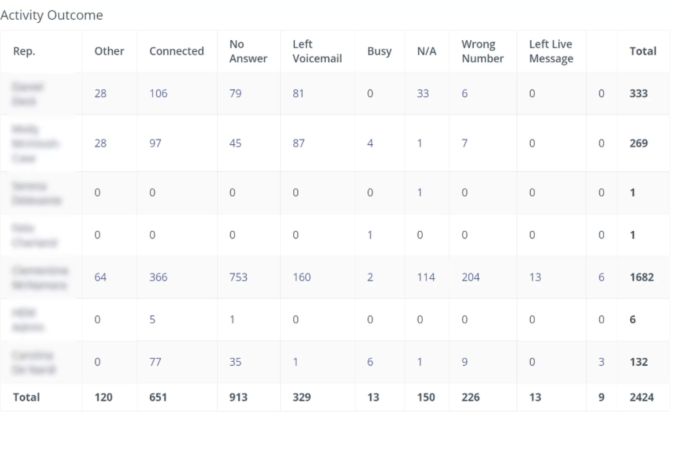
Example: A great way to measure the success of your marketing efforts using a CRM is to track the outcomes of your communications as pictured below. This data is extremely valuable as now, you know how many prospects you were able to reach, how they responded to your communications, and whether you need to obtain more accurate contact information. This is just one of the metrics you can track using our Mautic CRM system.
Source: HEM | Mautic
Get Your Whole Team Involved
Staff training is another essential component of successful CRM implementation. A CRM is only as effective as the people using it, so ensuring that admissions teams, marketing departments, and student services personnel are comfortable navigating the system is paramount. Conducting regular training sessions, creating user guides, and designating CRM champions within each department can help drive adoption and maximize efficiency.
Focus on Personalization
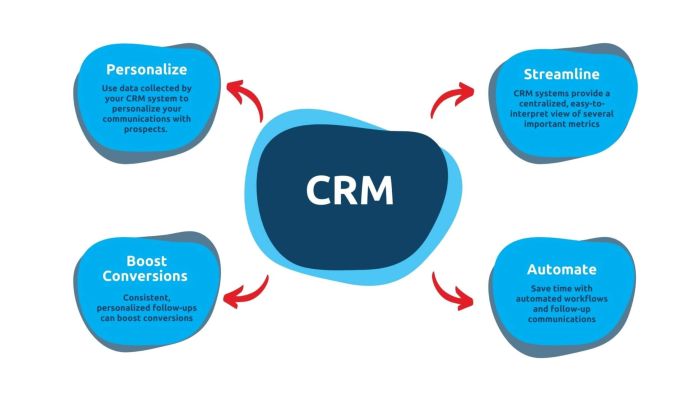
To fully leverage the potential of a CRM, universities should also focus on personalization. With the data collected through a CRM, institutions can tailor communications to different student segments. For instance, a prospective student interested in business programs should receive targeted content about faculty research, alumni success stories, and upcoming application deadlines for the business school rather than generic university-wide messaging. Personalized engagement fosters stronger connections and increases the likelihood of conversion.
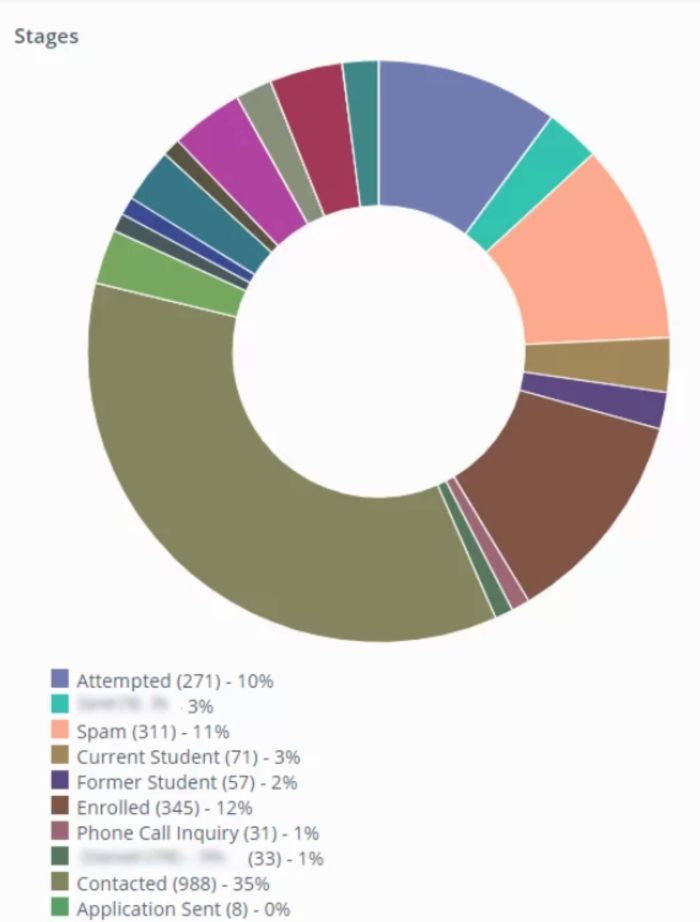
Example: How do you personalize your university marketing efforts? A great place to start if you’re still learning about your ideal prospect is tailoring marketing communications for the stage of the enrollment funnel they’re in. Through segmentation, a CRM system like Mautic can divide your contacts into groups based on their current relationship with your institution. This approach ensures you reach each lead at the right time with the right message.
Source: HEM | Mautic
Automate for Efficiency
Another best practice for CRM implementation is utilizing automation for efficiency. Many CRM platforms offer workflow automation features that simplify tasks such as sending event reminders, scheduling advisor meetings, and managing follow-ups. Automating repetitive processes reduces the administrative burden on staff, allowing them to focus on more strategic initiatives.
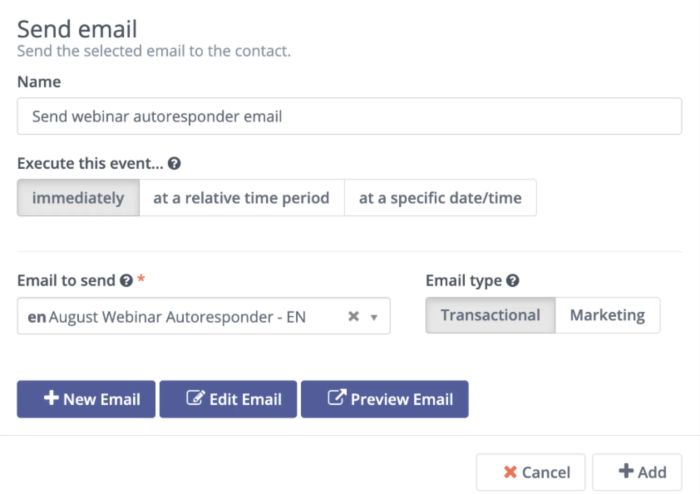
Example: A CRM system will enable you to craft automated email and SMMs to increase efficiency and ensure timely, carefully worded responses every time. Here, you can see how Mautic allows you to personalize your messages, time them, and tailor them to the purpose of your communication – to promote your university or to collect specific admission information.
Source: HEM | Mautic
The Future of CRMs in Higher Education
As technology continues to evolve, the role of CRMs in higher education will only expand. The rise of artificial intelligence and predictive analytics is already enhancing CRM capabilities, allowing universities to forecast enrollment trends, identify at-risk students before they drop out, and personalize outreach on a deeper level. Chatbots and AI-driven communication tools integrated into CRMs improve response times, ensuring prospective students receive instant answers to their inquiries.
Moreover, the shift towards hybrid and online education models has made digital engagement more critical. Universities that effectively utilize their CRM systems can provide seamless virtual experiences, track online learning engagement, and maintain meaningful connections with students regardless of physical location.
Choose a CRM Built for Higher Education
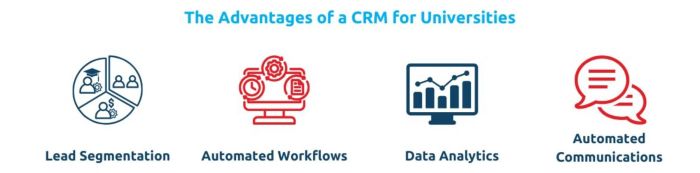
Unique needs call for unique solutions. A CRM for universities offers specialized features such as student lifecycle tracking, automated admissions workflows, alumni engagement tools, and seamless integration with existing student information systems, ensuring a more efficient and personalized approach to student recruitment, retention, and engagement.
One example of a CRM tailored specifically for higher education is Mautic by HEM. Developed from the Mautic open-source platform, Mautic by HEM offers a powerful combination of CRM and marketing automation designed to help universities streamline their lead management, supercharge their marketing efforts, and improve follow-up processes.
With tools for segmentation, automated workflows, email marketing, and analytics, Mautic by HEM enables institutions to track prospective students throughout the enrollment journey while optimizing team productivity. By leveraging this CRM, universities can enhance engagement, improve efficiency, and gain deep insights into recruitment and admissions efforts.
For university marketers and administrators looking to stay competitive, embracing CRM is an absolute must. With the right approach, a CRM can transform how your institution engages with students, streamline processes, and ultimately achieve enrollment and retention goals.
Example: For a complete view of how our CRM system can help you to reinvent your marketing strategy. In one of our previous webinars, we explored how Mautic can help you boost enrollment through effective relationship management.
Source: HEM | YouTube
Struggling with enrollment?
Our expert digital marketing services can help you attract and enroll more students!
Frequently Asked Questions
Question: What is a CRM in higher education?
Answer: It’s a powerful software solution that helps universities manage relationships at every stage of the student lifecycle.
Question: What are universities using CRM for?
Answer: Well, to be successful as an educational institution, building and maintaining positive relationships with prospective students is necessary. CRMs help schools manage those relationships at various stages of the enrollment funnel and offer valuable marketing benefits.
Dr Ismini Vasileiou is Associate Professor at De Montfort University, Director of the East Midlands Cyber Security Cluster and Director and Co-Chair of UKC3.
Higher education has always played a critical role in skills development, from professional fields like Medicine, Dentistry, and Engineering to more recent models such as degree apprenticeships. However, as the UK’s digital economy evolves at an unprecedented pace, there is a growing need to rebalance provision, ensuring that universities continue to equip graduates with both theoretical expertise and industry-ready capabilities in areas such as AI, cybersecurity, and automation.
The government’s strategic focus on workforce development underscores the importance of these changes, with higher education well-placed to lead the transformation. As industries adapt, the need for a highly skilled workforce has never been greater. The UK Government’s Plan for Jobs outlines a strategic vision for workforce development, placing skills at the heart of economic growth, national security, and regional resilience.
With the new higher education reform expected in Summer 2025, the sector faces a pivotal moment. The Department for Education has announced that the upcoming changes will focus on improving student outcomes, employment pathways, and financial sustainability in HE. While universities are autonomous institutions, government policy and funding mechanisms are key drivers influencing institutional priorities. The increasing emphasis on workforce development – particularly in cybersecurity, AI, and other high-demand sectors- suggests that universities will likely need to adapt, particularly as new regulatory and funding structures emerge under the forthcoming HE reform.
The National Skills Agenda: Why Higher Education Matters
The skills gap is no longer an abstract policy concern; it is a pressing challenge with economic and security implications. The introduction of Degree Apprenticeships in 2015 was a landmark shift towards integrating academic learning with industry needs. Subsequent initiatives, including MSc conversion courses in AI and Data Science,Level 6 apprenticeships, and the Lifelong Learning Entitlement (LLE) serve as policy levers designed to encourage and facilitate a more skills-oriented higher education landscape, rather than evidence of an inherent need for change. Through mechanisms such as Degree Apprenticeships, AI conversion courses, and the Lifelong Learning Entitlement, the government is actively shaping pathways that incentivise greater emphasis on employability and applied learning within universities.
The Plan for Change accelerates this momentum, funding over 30 regional projects designed to enhance cyber resilience and workforce readiness. One example is the CyberLocal programme, a government-backed initiative (Department for Science, Innovation and Technology) focused on upskilling local authorities, SMEs, and community organisations in cybersecurity. CyberLocal connects universities, businesses, and local governments to deliver tailored cyber resilience training, addressing the increasing threats to national digital security. More information can be found through CyberLocal’s page.
Financial Pressures and the Case for Skills-Based Education
At the same time, the financial landscape of HE is shifting. Declining student enrolments in traditional subjects, increasing operational costs, and a competitive global market have left many institutions reassessing their sustainability strategies. The upcoming higher education reform will shape policy from 2025 onwards, and universities must determine how best to adapt to new funding models and student expectations.
While skills-based education is often positioned as a solution, it is not an immediate financial fix. Many Degree Apprenticeships are run at a loss due to administrative complexities, employer engagement challenges, and high operational costs. Several articles, including those previously published at HEPI, highlight that while demand is growing, institutions face significant challenges in delivering these programmes at scale.
Government-backed funding in AI training and cybersecurity resilience offers targeted opportunities, but these remain limited in scope. Some universities have found success in co-designed upskilling and reskilling initiatives, particularly where regional economic growth strategies align with HE capabilities. The Institute of Coding, a national collaboration between universities and employers funded by the Office for Students, has developed industry-focused digital skills training, particularly in software development and cybersecurity. Additionally, the Office for Students Short Course trial has enabled universities to develop flexible, modular programmes that respond directly to employer demand in areas such as AI, digital transformation, and cybersecurity. Other examples include the National Centre for AI in Tertiary Education, which supports universities in embedding AI skills into their curricula to meet the growing demand for AI literacy across multiple sectors. However, a broader financial model that enables sustainable, scalable skills education is still required.
Regional Collaboration and Workforce Development
Since 2018, the Department for Education (DfE) has supported the creation of Institutes of Technology (IoTs), with 19 now operational across England and Wales. These institutions prioritise digital and cyber education, aligning with local skills needs and economic strategies. Strengthening collaboration between HE and IoTs could enable universities to support regionally tailored workforce development.
Examples such as the East Midlands Freeport, the Leicester and Leicestershire Local Skills Observatory, and CyberLocal illustrate the power of localised approaches. The Collective Skills Observatory, a joint initiative between De Montfort University and the East Midlands Chamber, is leveraging real-time workforce data to ensure that training provision matches employer demand. These initiatives could provide a blueprint for future HE collaboration with regional skills networks, particularly as the UK government reviews post-2025 skills policy.
Cyber Resilience, AI, and the Challenge of Adaptive Curricula
The government’s focus on cyber resilience and AI-driven industries underscores the urgent need for skills development in these areas. With AI poised to reshape global industries, universities must ensure graduates are prepared for rapidly evolving job roles. However, one of the biggest challenges is the slow pace of curriculum development in higher education.
Traditional course approval processes mean new degrees can take two to three years to develop. In fields like AI, where breakthroughs happen on a monthly rather than yearly basis, this presents a serious risk of curricula becoming outdated before they are even launched. Universities must explore faster, more flexible course design models, such as shorter accreditation cycles, modular learning pathways, and micro-credentials.
Government-backed initiatives, such as the Institute of Coding, have demonstrated alternative models for responsive skills training. As the HE reform unfolds, universities will need to consider how existing governance structures can adapt to the demands of an AI-driven economy.
A New Skills Ecosystem: HE’s Role in the Post-2025 Landscape
The forthcoming higher education reform is expected to introduce significant policy changes, including revised funding structures, greater emphasis on employability and skills-based education, and stronger incentives for industry partnerships, particularly in STEM and digital sectors.
Higher education must position itself as a leader in skills development. The recent Universities UK (UUK) blueprint, calls for deeper collaboration between the further and higher education sectors, recognising their complementary strengths. Further education offers agility and vocational expertise, while higher education provides advanced research and higher-level skills training – together, they can create a seamless learner journey.
At the same time, national initiatives such as Skills England, the Digital Skills Partnerships, and Degree Apprenticeships present opportunities for universities to engage in long-term skills planning. The integration of Lifelong Learning Entitlement (LLE) loans will further support continuous upskilling and career transitions, reinforcing the role of HE in lifelong workforce development.
Conclusion: Shaping the Future of HE Through Skills and Collaboration
With the HE reform announcement expected in Summer 2025, universities must act now to align with the government’s long-term skills agenda. The future of HE is being written now, and skills must be at the heart of it.
Personal, social, health and economic (PSHE) education is the school curriculum subject in England dedicated to supporting children’s safety, health, wellbeing and preparation for life and work. When timetabled and taught effectively, it can play a key role in improving young people’s preparedness for life beyond school, including for higher education and the graduate labour market. For instance, PSHE education can provide a safe and dedicated space for young people to learn about sex and relationships, budgeting and time management, among other things that most students will need to navigate more independently – and sometimes for the first time – during higher education.
As the official subject association for PSHE education, and a charity and membership body supporting over 50,000 teachers and schools nationally with resources, training and guidance, the PSHE Association was especially interested in the Higher Education Policy Institute’s (HEPI) recent report, One Step Beyond, which investigated how well the curriculum as a whole prepares young people for life beyond school.
The report, which is based on an analysis of data from a survey of 1,105 undergraduates in England, found that over half of participants wanted to have received more education on personal finances and budgeting (59%) and to have had more opportunities to learn ‘life skills’ (51%) prior to entering higher education. A large minority also wanted to have received more careers education (44%), a topic that PSHE education covers and which, when delivered well, can make a positive difference to young people’s confidence, sense of direction and career trajectories.
Importantly, the report also found that over half (58%) of participants wanted PSHE education to be compulsory until 18. At present, while relationships, sex and health education (RSHE) is compulsory for 16- to 18-year-olds in schools with sixth forms – and our own PSHE education planning guidance runs up to post-16 / key stage 5 – this requirement is not applicable to other settings, including sixth form and further education colleges. Furthermore, existing PSHE education content on economic wellbeing, personal financial education and careers education is optional in all but independent schools. As there is evidence to suggest that these are topics that young people from more affluent backgrounds are more likely to be taught about and discuss with their parents, all of PSHE education, including economic wellbeing, personal finance and careers education, has the potential to contribute towards narrowing social inequalities. And this is what we argue strongly for in our response to the Curriculum and Assessment Review, alongside strengthening the expectation that all young people should benefit from PSHE education up to the age of 18.
The good news is that since statutory RSHE requirements were introduced in 2020, these appear to have made a positive impact. And the findings from the One Step Beyond report support this idea, with half of the participants reporting feeling well prepared for sex and relationships in higher education in 2024 (47%) – almost double the percentage that reported feeling this way three years earlier (27%).
Another aspect of life which PSHE education can help young people to navigate during school, college and higher education is mental health. The One Step Beyond report found that most participants believed that their schools or colleges had done a ‘good’ or ‘excellent’ job of preparing them to plan and manage their workloads (61%); take care of their mental health and wellbeing (56%); and use healthy coping strategies (55%). However, a substantial minority of participants did not feel this way, suggesting that there is room to improve the quality of education that students receive on these topics – and PSHE education can play a crucial role in making this happen.
PSHE education provides opportunities for young people to learn about mental health and develop skills that can support them in taking care of it. For example, through PSHE education, young people can be taught about how to prevent and manage stress, which can aggravate or contribute towards the development of mental health difficulties. This is achieved in a variety of ways. For instance, by providing opportunities for young people to be taught about how to problem solve, develop greater emotional awareness, use healthy coping strategies, maintain good sleep routines and recognise when and how to access support for themselves or others.
After leaving school, such teaching could help young people to navigate further and higher education, which both demand greater independence and present unique opportunities and challenges. Illustrating this, when 136 A-level students were asked to describe their experience of sixth form using three words or phrases, the majority (79%) used at least one term to describe it as challenging and almost half (43%) described it as intense, stressful or overwhelming. Furthermore, across several interview studies, students have consistently described studying A-levels as a ‘massive step up’, a ‘jump’ and ‘a completely different ballgame’, which demands far more self-directed learning and can be an emotionally turbulent experience. It has also been found that experiencing education-related problems is among the main reasons why 16- to 18-year-olds contact Childline. So, PSHE education during school and post-16 education has the potential to support young people and contribute to improving higher education students’ mental health by equipping them with knowledge, understanding and skills that can help them to navigate this stage of education prior to entering it.
To conclude, high-quality PSHE education has the potential to improve young people’s preparedness for many aspects of higher education – social, academic and economic – as well as for life beyond its walls. And it is for this reason that the PSHE Association has argued in response to the Curriculum Review and Assessment Group consultation that personal finance education and careers education should be placed on the same statutory footing as RSHE and for PSHE education, comprising all these elements, to be scheduled as a school curriculum subject in all schools, with at least one timetabled lesson per week.
Findings from the One Step Beyond report indicate that PSHE education has had a positive impact on preparing young people for life beyond school, but that there is significant potential and need to build on improvements since elements of RSHE became statutory. This includes more emphasis on economic wellbeing, careers and mental health, as well as a guarantee that young people in all post-16 education settings can benefit from PSHE education until the age of 18 – not just those in specific settings.
Vincenzo Raimo is an independent international higher education consultant and a Visiting Fellow at the University of Reading where he was previously Pro Vice-Chancellor for Global Engagement.
In my recent article for The PIE News, I argued that the financial sustainability of international student recruitment deserves much closer scrutiny. With commissions, scholarships, marketing costs, and operational overheads taken into account, the margins on international enrolment are often far lower than they appear on paper – sometimes even negative.
At a time when the financial health of UK higher education is under intense pressure, it is right that we ask whether international recruitment is really worth it. But this doesn’t mean that every low-margin intake is necessarily a poor strategic decision.
In fact, there are good, sometimes essential, reasons why institutions might pursue or maintain international student recruitment with lower net financial return. But those decisions must be deliberate, transparent, and aligned with broader institutional aims. That’s not always the case.
So how can we assess whether low-margin recruitment is justified?
Here are five scenarios where low net revenue per student might make strategic sense:
1. Filling Capacity or Managing Fixed Costs
For many universities, fixed costs dominate the cost base. If recruiting a marginal cohort of international students helps fill underutilised teaching space or resources, and the marginal cost of teaching them is low, then even a small surplus can help improve the overall financial picture. This is particularly relevant in the context of declining domestic demand in some areas.
2. Maintaining Subject Diversity or Cross-Subsidising Departments
Low-margin international recruitment can sometimes help sustain strategically important but otherwise financially marginal subjects. This may include courses that support the university’s civic role or feed into regional skills needs. Used appropriately, it can help protect the breadth and integrity of an academic offer.
3. Building a Pipeline for Higher-Value Activities
In some cases, international student recruitment may have low margins, but it helps establish relationships that lead to high-value postgraduate, PhD, or alumni outcomes. It may also feed research collaborations, business engagement, or future TNE ventures. But such pipeline logic must be based on more than hope – institutions need to measure conversion, retention, and downstream value.
4. Advancing Strategic Partnerships or Market Development
An institution might accept lower margins to anchor a presence in a high-potential market or strengthen a bilateral partnership with a key international institution, government, or agency. These efforts can open the door to broader collaborations – but again, they require long-term planning and evidence of value beyond headcount.
5. Delivering Mission-Aligned Social or Cultural Impact
Some universities recruit from particular countries or communities not because it delivers high surplus, but because it aligns with their mission: widening access to UK education, supporting development goals, or enhancing campus diversity. These are valid choices – but they must be recognised as such, and the trade-offs clearly understood.
A Checklist: Is Low-Margin Recruitment Worth It?
To support institutions in making informed decisions, I’ve developed the following tool – a series of guiding questions to assess whether low-margin recruitment routes or cohorts align with institutional strategy.
This is not a tick-box exercise. Rather, it’s a framework to prompt a more strategic, evidence-based approach to planning.
The Danger of Denial
The real issue isn’t low-margin recruitment as such – it’s unexamined recruitment. Too often, institutions recruit internationally based on historic patterns, copying what others are doing or perceived opportunity, without fully evaluating cost, risk, or alignment with institutional strengths.
As pressures continue to mount, universities need to treat international recruitment with the same rigour they apply to research, teaching, and estates: as a strategic investment with benefits and risks. That starts with honest internal conversations about why we recruit, who we are recruiting, and what success looks like.
Conclusion
Low net revenue doesn’t automatically mean bad recruitment. But it should always prompt a question: Is this worth it – and why?
By adopting a more mature and transparent approach to international student recruitment strategy, UK universities can balance growth with sustainability, manage risk, and ensure they are maximising both financial and non-financial returns from their global engagement.
Catch up here on HEPI’s Weekend Reading on ‘Imperfect information in higher education’.
Joseph Morrison-Howe is an undergraduate Economics student at the University of Nottingham. He completed an internship with HEPI during the summer of 2024. In this weekend long read, he discusses the history of marketisation in higher education and considers whether applicants have enough information to make informed judgements about where and what they study.
Executive summary
Study at university can be hugely beneficial for students intellectually, socially and financially. However, degrees that lead to low earnings can make individuals who study in higher education financially worse off and can impose an external cost on the taxpayer. This HEPI Policy Note uses the economic framework of market failure to argue it is likely that too many students are studying degrees that result in low earnings. Applicants should be free to choose a course according to their preferences but, they need to be encouraged to use salary outcome data to help them make an informed decision about what degree to study.
Key findings:
Existing data suggest that one in five graduates would have been financially better off not entering higher education at all. Some 40% of undergraduate students might have chosen a different route, although only 6% would not have entered higher education.
This report argues that reforms announced in 2022 to the repayment terms of student loans, from the old Plan 2 to the new Plan 5 system, will likely make university financially worthwhile for fewer students.
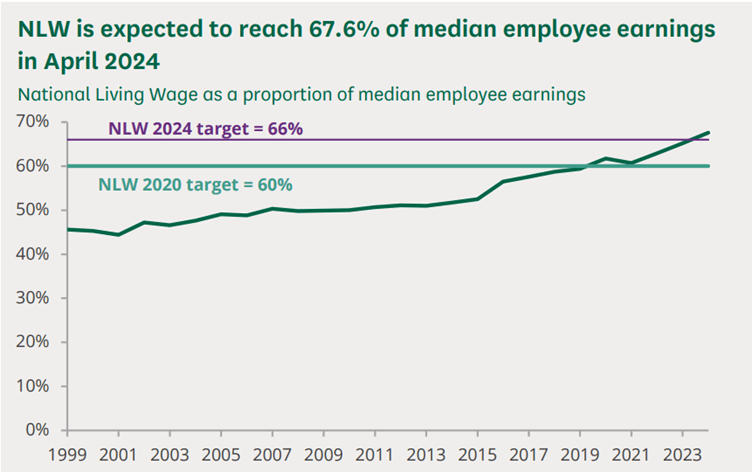
The graduate premium, the difference between the earnings of graduates and non-graduates, is also likely to decrease as the National Living Wage increases the wages of non-graduates.
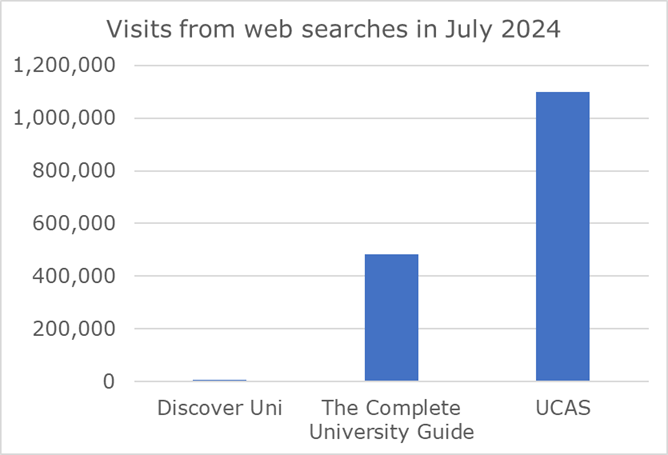
This report proposes imperfect information as a possible cause of market failure. Prospective students should make best use of information about graduate earnings when choosing what, where or whether to study at university. The official website for information about higher education, Discover Uni, had less than 7,000 website visits in July of 2024. In the same month, nearly half a million visited the website of the Complete University Guide, an online university league table.
Policy recommendations:
Discover Uni data about graduate earnings should be displayed on UCAS so that more students use this information when making decisions about university studies.
Satisfied average graduate earnings for each course should be displayed alongside the annual salary for National Living Wage work and the average graduate and non-graduate salaries. This should help students judge if studying individual courses would be financially worthwhile.
Careers advisors should support applicants to be fully informed about the benefits of higher education – including that not everyone is financially better off for attending university.
Market analysis and higher education
Prior to the 1830s, one would be hard-pressed to convincingly describe higher education in England as a competitive market – a place where many buyers choose to buy goods or services from many sellers, who compete to win the choice of these buyers. The Universities of Oxford and Cambridge maintained a duopoly (a market dominated by two sellers) for nearly 500 years.[i] Since the early nineteenth century, changes in government policy, alongside growth in the number of universities and students, have meant higher education in England has taken on more of the characteristics of a market.
The barriers to becoming a university in England have decreased over time and choice for students has broadened. Prior to the Coalition Government of 2010, the following changes happened to the higher education sector which incidentally laid the foundation for marketisation:
Growth in the number of universities, which provided more choice for students;
growth in student numbers; and
the formation of UCAS (originally UCCA, the Universities Central Council on Admissions), providing a ‘single nationwide application process’, creating a sector that resembled a marketplace.[ii]
It was the introduction and gradual increase of tuition fees paid by the student as opposed to funding via grants from the Government that really introduced market incentives to higher education in England.
By the 1990s, with growing demand from students, the government’s ability and willingness to fund the higher education sector came into question; between 1976 and 1996, government funding per student fell by 40%, according to the Dearing Report.[iii] As a result, the greater burden for funding higher education fell on students. Tony Blair’s government introduced ‘top-up’ fees of £1,000 paid upfront by students in 1998 to supplement government funding. In 2004, the fees rose to £3,000, covered by an income-contingent loan.
The Coalition Government’s rise in tuition fees to £9,000 caused the most significant change in the structure of the higher education sector in England. This is because, as David Willetts (then University Minister) wrote, the new higher fees largely
replaced funding via a Government agency providing grants to universities with funding via the fees (funded by loans) which students brought with them.[iv]
Consequently, to attract funding for teaching, universities had to compete to attract students, as the funding came directly from students. The Department for Business, Innovation and Skills (BIS) wanted ‘to ensure that the new student finance regime supports student choice, and that in turn student choice drives competition’.[v] The characteristics of choice and competition that BIS wanted to introduce are the key characteristics of a market.
The new funding model increased competition between universities for students, first because they received funding for each student they taught and secondly, because these policy changes allowed for the removal of student number caps, which had thus far artificially limited the number of places institutions could provide. More places were made available and students were given more meaningful choice about where to study.
The increasing number of universities and the introduction of UCCA were not policies intended to create a market, but there is evidence from the coalition government of purposeful marketisation. The 2011 white paper ‘Students at the Heart of the System’ from BIS showed their clear intention to introduce what they referred to as ‘a more market-based approach’ to higher education with the new funding system.[vi] The Coalition Government’s support for the new funding system was not just as a solution to the instability and underfunding of the grant-based system but because of the market incentives a fee-based funding model would introduce.
Not all aspects of the current higher education sector in England operate like a typical market. Entry requirements mean that students’ ability to choose between universities is contingent on the grades they achieve (but the growth in the number of universities means that for a given set of grades, a student can choose between many universities). Also, students only bear the cost of their studies if they can afford to do so, as student loan repayments are only made above a particular level of earnings. In typical markets, consumers bear the cost upfront. Though important for making university studies accessible, we will see, the fact that payment is not made upfront makes the sector vulnerable to market failure.
Despite these qualities, it is clear the sector has been marketised:
students now have more choice, and
universities now engage in more competition.
There are lots of reasonable critiques of marketisation. Nevertheless, since marketisation has taken place, it can be useful to apply economic analysis to higher education. This report considers the higher education sector as a market and consequently uses economic analysis to assess if the higher education sector works efficiently for both students and wider society. The purpose of this economic analysis is to identify how to improve the higher education sector so it works best for students and wider society.
Markets and market failure in higher education
Marketisation policies introduce characteristics of a market in the hopes that the outcomes of a market will materialise. The prized outcome of markets is efficiency. An efficient market is one where the resources are allocated to give the best outcomes for society; choice allows the allocation of students to the university that best suits them, and competition incentivises the allocation of university funds where they will most improve the institution. If a market is efficient, the allocation of resources cannot be changed to make someone better off without making someone else worse off.
The outcome of markets is not always efficient; markets are prone to fail.
Market failure occurs when resources are not allocated efficiently, to give the best outcomes for the consumer and wider society.
A market failure usually results in:
too much of a good being provided;
too little of a good being provided; or sometimes,
none of a certain good being provided at all.
One example of market failure might be the market for antibiotics. If antibiotics are cheap to buy, people might purchase them even if they are not sure they need them. Over time, the overuse of antibiotics can lead to the development of antibiotic resistance, where antibiotics no longer work for the people who really need them. This is a case where market failure has led to a good being provided in excess and a more efficient outcome would see less of it provided.
This report focuses on the higher education market failing and allocating too many students to degrees that result in low earnings. In this section, I discuss how students studying degrees that lead to low earnings can result in market failure, under certain conditions. In the next section, I will analyse a possible cause of this market failure.
Market failure: degrees that lead to low earnings
For the majority of graduates, studying at university gives them — and the wider economy — good financial returns. However, the market fails and allocates too many students to courses that will lead to low graduate earnings (‘low-earning degrees’). This makes individual graduates financially worse off, compared to if they had not gone to university, and imposes an external cost on the taxpayer.11 In this case the choice of degree (or to study at all) has led to suboptimal outcomes for the individual (the student) and wider society and is therefore a case of market failure.
There is evidence to suggest many students believe they would have been individually better off making a different choice of degree, institution or even entire pathway (such as doing an apprenticeship instead). In the 2024 HEPI / Advance HE Student Academic Experience Survey, four in ten students said they would have been better with a different choice (though only 6% would not have entered higher education).[vii] This suggests these students think there was a more efficient way of allocating (their own) resources even before they know what their lifetime earnings will be.
Not all degrees that result in low earnings are necessarily cases of market failure. There is only a market failure present if there could have been a better allocation of resources, that is, students could have made a different choice that bettered themselves or wider society.
It is likely many students do not just think about earnings when they consider the value of their degree. If the individual valued their Philosophy degree for other reasons – they enjoyed the content, valued the overall university experience, and so on – it may still have been worth it for them even if it did not increase their earnings. In this case, a degree like Philosophy may have been the best option for society if these benefits to the individual student outweigh the lower earnings (and another other costs to both the student and wider society). If so, the allocation would still be efficient and this would not be a case of market failure.
Another situation where a low-earning degree may not be a case of market failure is when the degree has such large social (as opposed to individual) benefits that the choice of any other alternative would lead to a worse outcome for society. For example, if a student studies to be a social worker and this leads to low earnings, the benefits to society that stem from the social work degree will be large enough that any other choice on the student’s behalf would have made society worse off.
The examples of Philosophy and Social Work degrees are not cases of market failure because of the benefits they offer to either the individual or the rest of society. These benefits are not easily quantifiable, so it is difficult to determine which low-earning degrees are examples of market failure and which are not. Below, I will argue that if students are given clear information about the earnings from different degrees, they will be more capable of making that judgement themselves.
The effect of too many students studying low-earning degrees (before reforms to loan repayment terms)
For individual students, there is a financial consequence of choosing to study a degree that will likely result in low earnings. A 2020 report by the Institute for Fiscal Studies (IFS) looked into the impact of undergraduate study on lifetime earnings. The report estimated that ‘one in five undergraduates would have been better off financially had they not gone to university.’[viii]
The IFS compared the lifetime earnings of a cohort of graduates to a counterfactual group that did not attend university, accounting for the difference in income tax, National Insurance and student loan repayments the graduates will have paid over their working life compared to the non-graduates. They then calculated the net lifetime returns for graduates, defined as ‘the lifetime gain or loss in earnings as a result of attending higher education for the individual, after taking into account the effect of the tax and student loans system.’[ix] The IFS found that a fifth of graduates earn less over their lifetimes than if they had not entered higher education.
Not all of the 20% of graduates that would have been better off had they not entered higher education will be cases of market failure. Some may be a Philosophy student that places a high personal value on the knowledge they gained, some may be social workers that provide great value for society, others may have studied a high earning degree and not utilised it. Furthermore, changing the discount rate the IFS use changes the proportion of students that finically benefited from higher education, as David Willetts points out. [x] Though, the IFS results are clear that not everyone entering higher education benefits from it financially.
When students choose to study a low-earning degree, there is also an external cost to the taxpayer. This external cost (a cost to a third party not involved in the transaction) arises because the taxpayer must cover the proportion of a student loan which a graduate has not paid back by the time their loan is written off. Prior to the implementation of reforms in the repayment terms of student loans announced in 2022, only 27% of graduates were estimated to repay their student loan in full.[xi]
The resource allocating and budgeting (RAB) charge is used to estimate the ‘cost to Government of borrowing to support the student finance system’. London Economics, an economics consultancy, estimated that the RAB charge for the 2022/23 cohort of students (who began their studies before the implementation of the 2022 reforms) was 10.2%. That is, the government was expected to cover 10.2% of the total value of the student loans taken out that year.[xii]
These costs, imposed on the student and wider society, might be avoided if students chose different degrees. Future earnings can be altered by a student’s choice of course to study and choice of institution to study at:
Even when comparing students with similar prior attainment and family background, different degrees appear to have a significantly different impact on early career earnings. Studying medicine or economics increases earnings five years after graduation by 25 per cent more than studying English or history. Attending a Russell Group university increases earnings by about 10 per cent more than the average degree.[xiii]
If students who chose to study low-earning degrees had instead chosen to study higher-earning degrees, they would have been less likely to impose an external cost on the taxpayer. Though, as I will explain, reforms to the student loan system mean the external cost to the taxpayer is now very small. Importantly, those students would also be more likely to give themselves positive net lifetime returns to their studies. These outcomes could make society better off. The current allocation of too many students to degrees that result in low earnings is an inefficient one. In the sense defined above, the higher education market is failing.
The impact of the reforms to the repayment terms of student loans (the move from Plan 2 to Plan 5)
The reforms announced in 2022 to the ‘Plan 2’ repayment terms on student loans have shifted the financial burden of low-earning degrees from the taxpayer to the graduate.
Under the new Plan 5 system, the income threshold at which graduates begin to make loan repayments was lowered from £27,295 to £25,000, the repayment period (after which loans are written off) was lengthened from 30 years to 40 years and the interest rate on student loans was reduced from RPI+3% down to just RPI (a measure of inflation).[xiv] These reforms have an uneven effect on graduates across the income distribution.[xv] The reduction in the repayment threshold will mean that lower-earning graduates will pay back more of their debt, and some will begin to pay it back for the first time. The lengthening of the repayment period will mean that low-earning graduates will pay back their loan for longer. The lowering of the interest rate will mean that high-earning graduates (who always would have paid back their loan in full) will now make smaller interest payments.
London Economics estimates that the RAB charge under the new terms of repayment will fall to 4.1% from 10.2%. This means that the reforms have transferred the costs of low-earning degrees from the government, which will now have to write off less debt, to the graduate, who must pay back more of it. As low-earning graduates will now make larger student loan repayments, attending university will not be financially worthwhile for more of them.
A fair assumption is that, since costs are only incurred in the future, prospective students will not be very responsive to these reforms by choosing low-earning degrees in lower numbers. Even after maximum fees were raised from around £3,000 to £9,000 in 2012, there was no significant long-term decrease in the number of applicants.[xvii] If this is the case, a greater proportion of students will now have negative net lifetime returns from their studies. Therefore, for this reform to have a positive outcome on low-earning graduates, these impacts would have to be available and clearly explained to prospective students.
The graduate premium and positive financial returns
The graduate premium is the increase in salary attributed to achieving a degree. To receive positive financial returns from studying, one’s graduate premium must be larger than their loan repayments and increased income tax and National Insurance payments. There is evidence to suggest that the graduate premium has fallen as the higher education sector has grown. Due to increases in the minimum wage, I believe the graduate premium is likely to fall further. This is likely to put a strain on the amount of students experiencing positive financial returns.
As the number of graduates increased throughout the 20th and into the 21st century, it was thought that the graduate premium would decrease. This is, in part, because as the supply of graduates increased their scarcity reduced meaning the premium an employer would pay to hire a graduate over a non-graduate should have fallen. A 2021 study by the Higher Education Statistics Agency (HESA) and a team at the University of Warwick found early evidence of a 7-percentage point decline in the graduate premium.[xviii]
Recent increases in the National Living Wage are likely to further reduce the graduate premium by increasing the average wage of non-graduates. To make the UK a high-wage economy, the Government has been using National Minimum Wage legislation to increase the pay of the lowest paid. In 2020, the Conservative Government asked the Low Pay Commission to ensure the National Living Wage was two-thirds of median earnings by 2024, a target which has now been met.19 Assuming non-graduates are more likely than graduates to earn the National Living Wage. As National Living Wage has increased in relation to median pay, the average wage of non-graduates will have likely increased more than that of graduates. The graduate premium is likely to have further declined. As a result, for more students, it will not have been financially worthwhile to attend university.
Conclusion
In this section, I argue that there is a market failure and too many students are choosing to study degrees that result in low earnings. The reforms to the repayment terms of student loans and a possible decline in the graduate premium are likely to increase the proportion of graduates who are financially worse off for having gone to university. The next section of this Policy Note attempts to explain why this market failure of too many students choosing to study low-earning degrees is taking place.
The causes of market failure in higher education
This section will look at imperfect information as a possible cause of the market failure. There are other possible causes, such as low teaching quality or the fact that an individual student’s decision about whether and where to study also has effects on wider society. The government’s provision of information about graduate salaries is thought to have solved the problem of imperfect information. But this Policy Note focuses on imperfect information because prospective students are not seeing the information about graduate salaries.
Imperfect information occurs when all the parties in a transaction do not have full information about the transaction. If applicants do not know about the career prospects of a low earning degree, they may choose to study it thinking it will enhance their career prospects and then struggle to find a well-paying job after graduation. This could cause an inefficient allocation of students to courses.
People familiar with the higher education sector could likely name the universities that frequently top league tables and which subjects generally lead to high earnings. They may therefore may believe that applicants have roughly enough information to choose the best course for them. This knowledge is not common for all applicants, particularly for applicants who will be the first in their family to attend university (now roughly two-thirds of current undergraduates).[xx] An A-level student who I tutor recently demonstrated that some applicants do not have perfect information about university courses. I asked him out of the universities he wanted to apply to, which he would most like to attend. He wanted to study Management. He said he would like to go to university x “because they have a brand-new building for the business school.” I then showed him that average earnings for Management graduates 5 years after completing university x’s course were over £20,000 less than those of another university he planned to apply to. After this conversation, he chose not to apply to university x. Not all applicants have sufficient knowledge about university courses and this can cause them not to choose the course that would have been best for them.
While introducing marketising reforms since 2010, successive governments have been keen to ensure that applicants do not have imperfect information. A 2016 white paper stated an ambition for ‘more competition and informed choice into higher education’.[xxi]
As a result, prospective students now arguably have access to enough information to make informed choices. The official website for information about higher education, Discover Uni (formally Unistats) provides a wealth of information to prospective students. Discover Uni has information on student satisfaction, the entry grades of past students and information about career prospects for each course at a given university. Data from the Graduate Outcomes Survey and the Longitudinal Educational Outcomes data set are used to provide prospective students with information about the employment rate of past graduates and their earnings 15 months, three years and five years after completing a course. The wealth of information available to prospective students suggests that imperfect information cannot be the reason for too many students choosing courses that will lead to them earning less over a lifetime than if they had not studied at all.
Although prospective students have access to information about employment prospects on the Discover Uni website, few choose to use it. In July 2024, only 6,600 people visited the website.22 In the same month, 481,800 people visited the website of The Complete University Guide, an online university league table, suggesting rankings like these are used more often to make decisions about what and where to study. In the same month, 1,100,000 people visited the UCAS website (the main way to apply for higher education in the UK), which gives an indication of just how many see the information about courses and institutions it provides.
The problem may not be imperfect information, but imperfect knowledge. That is, it is not the lack of availability of information that means too many students study degrees that are not financially worthwhile but instead that applicants are not seeing the information about employment prospects.
Ensuring students see information about graduate salaries will help to correct the market failure of too many students choosing to study low-earning degrees, but it may not fully address information problems. This is because, graduate outcomes data is not a perfect indicator of what a given prospective student will earn. Past data on graduate outcomes cannot tell a prospective student about future labour market changes. However, compared to using no data at all, graduate outcomes give prospective students a good indicator of what they are likely to earn.
Graduate outcomes data may not be currently used because students (and teachers) might not fully understand the implications of the new Plan 5 repayment system. Students may have less incentive to find out the financial returns of a degree if they think a negative return would be covered by the government ‘safety net’. It may therefore be more important than ever to explain that since the 2022 reforms, most students will pay back all or almost all of their loans themselves.
The next section of this report shall propose recommendations to improve the use of the data on Discover Uni.
Policy response
Some students are choosing to study degrees that will likely lead to them having low earnings. When applying to university, students are not using the information about graduate salaries for specific courses, provided on the Discover Uni website. Without the proper use of information about how financially worthwhile degrees are, a fifth of students choose degrees that result in them earning less over their lifetime than if they had not studied at undergraduate level.9
The choice of what and where to study is an individual one; it may depend on what dream job one had as a child, the fact one may have to stay close to home to care for a relative or because one wants to improve their lifetime earnings. Regardless of why one chooses to study a given course, as it is now the student who is most likely to pay for their studies, they should be free to choose what and where to study. However, students should be exposed to the reality that their choice of course may result in them earning less over a lifetime than if they had not studied at university. Students should be encouraged to use information about graduate outcomes and this information should be explained to them. Careers advisors should explain that not all degrees are financially worthwhile and help applicants navigate the available information on graduate salaries.
To prevent students from unknowingly choosing courses that will likely lead to them earning low salaries, information about graduate outcomes should be made more usable. Therefore, the main recommendation from this HEPI Policy Note is that all of the data on Discover Uni (the government website for data which students rarely use) should be integrated into the UCAS pages for individual courses. This includes the salary outcomes for each course, or the lowest level of granularity Discover Uni provides. This makes it more likely that students applying for a course via UCAS will use this information to better inform their decisions.
Discover Uni graduate earnings data should be stratified before it is integrated into UCAS information pages. This involves weighting graduate earnings by social background, reflecting the proportion each social group represents in the wider population. Stratification would ensure that high earnings statistics from a given course do not simply reflect a cohort dominated by already affluent students.
Alongside the average graduate salaries for specific courses, theaverage graduate and non-graduate salaries should be displayed. Prospective students could be shown the current salary for a full-time minimum wage worker of £23,795 to help them judge if going to university would be financially worthwhile.[xxiii]
[vi] Department for Business, Innovation and Skills, Students at the Heart of the System, June 2011, p.73 https://assets.publishing.service.gov.uk/ government/uploads/system/uploads/attachment_data/file/31384/11- 944-higher-education-students-at-heart-of-system.pdf
Ahead of TASO’s annual conference, How to evaluate, on 29–30 April, Omar Khan, CEO of TASO (the Centre for Transforming Access and Student Outcomes in Higher Education) discusses the challenges facing higher education, particularly in the face of wider discussions around the value and purpose of higher education in the UK and beyond.
We all know of the challenges facing higher education. The questions can feel existential: from the financial sustainability of institutions to the social consensus on the value and purpose of higher education itself.
Without seeming pollyannish, I believe higher education can and must continue to argue for its value and purpose in these difficult times. There remains significant agreement that higher education brings value, for individuals as well as the economy, with reputational benefits for the UK internationally too. Similarly, there is broad consensus that addressing inequalities of participation as well as of the student experience is a priority. While we shouldn’t be complacent about the impact of criticism of ‘DEI’ (diversity, equity and inclusion) in the US, so far UK higher education has remained committed to the widening participation agenda and the sector has not been subject to sustained public attacks from the government.
One reason that widening participation remains on the agenda is the legislative and regulatory environment. Significantly, for over a decade, the principle has been established that rising fees should be matched by a clear commitment to demonstrating improved access. As the sector will now know, in England this is delivered through providers submitting access and participation plans (APPs) to the Office for Students.
A commitment to evaluation
APPs are now also expected to have a clear commitment to evaluation. Unsurprisingly, given my role as CEO of the higher education What Works Centre TASO, I think this is a good thing. At TASO we’ve seen a significant improvement in the number and robustness of evaluations across the sector since our founding some five years ago.
As we gather for our fourth annual conference (29–30 April), we will continue to support the sector on understanding the evidence base on inequalities in higher education. We do this in two main ways: through synthesising and commissioning research, and by producing more practical guidance for the sector to deliver effective evaluation themselves.
A library of providers’ evaluations
Recently, we’ve announced a key way we will bring this work together: the Higher Education Evaluation Library, or HEEL (like the rest of the sector, we too love an acronym), working in partnership with HEAT, the Higher Education Access Tracker, to deliver it. The library will bring together higher education evaluations in one place, which are otherwise published across the wide range of institutions across the sector.
At our conference, we will continue our consultation with the sector about the library to ensure we understand and are responsive to how evaluators and others can best use this resource. Once we have consulted and worked with HEAT to develop the infrastructure for HEEL, and once providers upload their evaluations into this online library, we will produce regular digests summarising what we find. Ultimately, the goal or promise is that these digests will improve the evidence base, reduce duplication across the sector and improve outcomes for students.
Navigating the financial landscape
At TASO we are optimistic about the future of evaluation in the sector, not least as we have seen a wider cultural and institutional commitment to joint learning as well as to the value of equal opportunity and social mobility that motivates all of us to do this work. However, I want to recognise and to flag a serious concern that TASO (and no doubt many others) is seeing across the sector, that is, how the financial situation impacts widening participation activity.
To effectively evaluate and assess whether activities improve outcomes for students, those activities need to be adequately resourced. We have heard evidence that redundancies and cost-cutting across the sector are impacting on the ability of staff to deliver these activities, as well as to evaluate them. This is in a context where child poverty is increasing, where inequalities in school attainment are rising, and where the higher education attainment gap between free school meal students and their more advantaged counterparts is at its widest at over 20.8 percentage points.
A refocus on values and mission
We recognise that times are tight, that tough decisions need to be made and that this has an impact on staff morale. At the same time, higher education must continue to prioritise its values and mission: a commitment to evidence as well as to equality and social mobility. Furthermore, at a time of increased public scepticism of how the sector is delivering on these aims, delivering for the most disadvantaged students becomes a matter of public support and democratic consensus.
As we’ve spent the past decade building the foundations to better address inequalities in higher education, it’s vital we continue to work together to make the promise of higher education a reality for everyone who wants to access it, regardless of their background.
While TASO is here to support the sector to do this, we cannot do this alone, and I want to recognise and thank all of those who do this important work day in and day out: senior leaders, evaluators, practitioners, third sector organisations, teachers, parents and of course student leaders and activists committed to ensuring better lives for themselves and their peers.
Higher education providers are currently experiencing unprecedented degrees of pressure, not only in terms of the constraints imposed by the current financial climate but in the increased expectations placed upon them by students, policymakers and the public. At the same time, they’re having to address the challenges posed by new technologies and workplace practices, environmental concerns and economic conditions, as well as by a growing focus on fair access to higher education.
Such issues are at the fore of the sector’s own debates. Recent HEPI blogs have, for example, focused on the importance of reasonable adjustments, the value of widening participation, the UN’s Sustainable Development Goals and institutional AI initiatives. Colleagues from GuildHE have written here and elsewhere about how specialist providers are essential to the delivery of the government’s industrial strategy – just as Universities UK has argued that graduates will play a vital role in that strategy, presenting an analysis which demonstrates that ‘growth sectors identified by the government in its industrial strategy require high levels of graduate skills across all regions and nations of the UK’.
These priorities reflect those of the UK government. When the Education Secretary for England wrote to providers in November, she said she expected them to ‘play a stronger role in expanding access and improving outcomes for disadvantaged students’, ‘make a stronger contribution to economic growth’, ‘play a greater civic role in their communities’ and ‘raise the bar further on teaching standards’.
Sector bodies and think tanks have produced valuable reports on these issues. But one lower-profile resource used by educators to anchor provision to such commitments is the Subject Benchmark Statement. This instrument plays a key role in demonstrating and underpinning how HEIs deliver the industry-aligned graduate skills essential for economic growth – those skills highlighted by GuildHE and Universities UK, and required by government strategies.
Subject Benchmark Statements are curated by QAA as the sector-led descriptors of taught disciplines. They describe the nature of study and the academic standards expected of graduates in specific subject areas – showing what graduates should know and be able to do at the end of their studies. Academic staff use them to inform the design, delivery and enhancement of programmes. They are included as key reference points in guidance on cyclical review in Scotland and Wales, and in institutions’ validation and assurance of provision across the UK.
They are created by panels of academic experts and representatives of employers and Professional, Statutory and Regulatory Bodies. At a time when providers are expected to demonstrate their contribution to the UK’s industrial strategy, they use industry expertise to determine the skillsets needed for professional success and economic growth. They inform prospective students of the career paths advanced by their subjects, tell prospective employers what they can expect from a graduate of those subjects and assure policymakers of the value of those subjects.
Today, we are publishing this year’s set of Subject Benchmark Statements: revised editions of the Statements for, Accounting, Education Studies, Finance, Music, and Philosophy, as well as for Librarianship, Information, Knowledge, Records & Archives Management, and Physics, Astronomy & Astrophysics; and a new Statement for Public Policy & Public Administration.
Key to the formulation of these Statements has been the development, through consultation with sector and industry stakeholders, of a set of themes which underpin their focus. These themes align with concerns shared by policymakers across the political spectrum. They include sustainability, access and success in higher education, graduate employability and artificial intelligence.
These emphases reflect not only the key expectations set by the Education Secretary last autumn, but also government priorities in such areas as green prosperity and AI. Subject Benchmark Statements also chart strategies for the enhancement of educational quality the Secretary of State has called for. They function alongside other key sector reference points – such as the Qualifications Frameworks and the Quality Code – to underpin the standards and enhance the quality of higher education. They are a mechanism by which programmes assure and articulate their educational, economic and social value and demonstrate the continuing relevance of their subjects to governments and the public.
To see how this works, it’s worth taking a moment to look at an example from our new set of Statements. This is the first time that there’s been a separate Subject Benchmark Statement dedicated to Public Policy & Public Administration (a subject well suited to this forum), so let’s take a look at that.
Its subject panel included three representatives of the Local Government Association, alongside practitioners and educators from 13 universities. An emphasis on industry impact shines through its 25 pages. It includes articulations of core skills at varying levels of study and attainment, and explains the purposes of a degree in its discipline, as well as strategies to promote accessibility and sustainable development. It also details the approaches to be taken by the discipline in relation to professional employability, both in terms of broad expectations and in relation to its specific engagement with artificial intelligence.
In this context, it expects that ‘while degrees will have the capacity to develop career-ready students, they must also equip sector-experienced students with the knowledge, behaviours and skills that will enable them to develop and progress within the workplace’ and that ‘courses may provide and/or require opportunities for students to work individually or collaboratively with employers and/or relevant public sector stakeholders’.
It adds that its degrees should ‘promote employability in a labour market that is becoming increasingly shaped by artificial intelligence’ and ‘prepare and equip students for work environments that require professionals to work alongside smart machines’ – and that therefore ‘to ensure students can complete their studies responsibly and with integrity, and be equipped to enter a world increasingly impacted by generative AI, Public Policy and/or Public Administration degrees must recognise and respond to employer and workplace needs’.
Each Subject Benchmark Statement underpins the continuing relevance and value of its discipline to industry and students alike. As the University of Birmingham’s Dr Karin Bottom (who chaired the Public Policy & Public Administration panel) has emphasized, one of the key impacts of a Subject Benchmark Statement is that it ‘gives programmes credibility with organisations that may fund people who take these degrees and that may employ people who’ve taken these degrees’ – and ‘gives employers and practitioner groups a reference point as to what practitioners need to know’.
At a time when many academic subject areas have come under increasing pressure (whether in terms of their commercial viability, their contribution to economic growth, or the careers they support), it remains crucial for the sector, students, taxpayers and policymakers to ensure that their value is not only expressed but also underpinned by benchmarking at the level of specific disciplines.
And, as policymakers have recently stressed the need to prevent the emergence of regional ‘cold spots’ in specific subject areas, these sector-led, industry-informed, expert-written documents can also help, in the formulation of such policies, to hone a closer understanding of the impacts and contributions of their disciplines.