Category: Blog

  • Weekend Reading: Rethinking the Cost of Higher Education – A Lecture Revisited

    Weekend Reading: Rethinking the Cost of Higher Education – A Lecture Revisited

    • This lecture was originally delivered by the Rt Hon John Denham MP, former Secretary of State for Innovation, Universities and Skills in Gordon Brown’s Government. He gave this lecture from Opposition in January 2014. More than eleven years later, we revisit his lecture to consider what lessons it holds for today’s higher education sector.

    At the RSA in 2014,  I tried to address the mounting challenges facing the higher education sector:  a system with stressed finances, eye-watering fees,  educationally not fit for purpose in some parts, and in which limited public funds were written off while incentivising the provision of a monochrome one-size fits all teen-focussed education.  The National Accounting rules which framed much of the technical financial analysis have now changed.

    Overseas student fees held the crisis away much longer than I expected, albeit at the cost of financial and reputational vulnerability, but it’s with us now. I’d argue that today, ministers face much the same issues that I discussed.  

    The lecture is clearly a provocation, not a plan, but its key tenets are valid. It is better to use what money you have to teach students and reshape the sector today than write off unjustifiable debts in the future. Ministers should have the courage to incentivise a greater diversity of provision, options for cheaper study, different ways of working and closer relations with employers. Unless a lot more money is to be found, some of these questions can’t be ducked.

    John Denham, March 2025

    RSA Lecture – The Cost of Higher Education

    Good evening.

    Thank you to Matthew for hosting the meeting, Alison for agreeing to respond, and you for coming. You may not agree with me tonight. But if I don’t challenge at least some current assumptions about how we fund and deliver higher education I shall have failed.

    I want to change the terms of the debate, not present a detailed plan for university education.

    What’s the problem?

    But I suppose the first question is, why bother? Isn’t everything going very well?

    UCAS figures show the largest ever number of admissions last September, there’s further progress, in widening participation, and even a small increase in free school meal students going to the 35 most selective universities.

    And the Chancellor is apparently so flush with money he can lift the cap on student numbers, funding an extra 60,000 a year.

    I’m sure researchers and the UCU will say it’s no bed of roses, but cash from new fees means university life has been a lot more congenial than life in local government or the NHS for the past three years.

    The private cost is eye-watering but haven’t the high fees been accepted by parents and students?

    The problem, of course, is that the whole system of university finance for English students is sliding slowly but surely off a cliff.

    •  The £9000 fee is declining in real value
    • Capital spending has been slashed, pushing more universities further into debt driven investment
    •  The science budget will have fallen by 20% in real terms by 2016 – undoing the huge impact of Labour’s ten year investment
    •  The system runs so hot that a small misjudgement about student numbers creates a huge hole in the BIS budget. So we have ministers arguing about whether to cut research or support for poorer students
    •  The NAO have highlighted the black hole of unrecoverable loans, including those to EU students
    •  The cost of debt cancellation– the so-called Resource Account Budgeting or RAB charge – is rising steadily.
    •  The Chancellor’s new expansion – apparently based on the same accounting principles as Merdle’s Bank – has many questions about its sustainability.

    Across universities you hear the same story. ‘We might get through the next few years. But it can’t go on like this for long’.

    We already have the world’s most expensive public university system yet most proposals for change are variations on the theme of asking graduates to pay even more.

    But that’s not the end of the bad news.

    Quality and relevance

    English universities have huge strengths, of course. Our international research reputation is outstanding; we remain a magnet for international students; there is much excellence in our teaching.

    But concerns about what parts of higher education deliver simply won’t go away. Despite improvements, many employers remain deeply critical of the employability of too many graduates. One quote is not evidence, but it’s not hard to find ones like this one:

    ‘Despite our best efforts we have come to the decision that we would prefer to be understaffed than hire poor-quality applicants,’ said Bryan Urbick, founder and CEO of the Consumer Knowledge Centre. ‘As the economy rebalances, we will need more highly-skilled employees, particularly for young people with science, technology, engineering and maths (STEM) degrees, but businesses are struggling to recruit good graduates from the UK.’

    And

    ‘Strong overall performance on higher skills participation must not be allowed to mask the skills shortages already impacting upon key sectors of the economy, which point to a mismatch between supply and demand’ said Katja Hall, Policy Director at the CBI.

    47% of new graduates, and a third of those who graduated five years ago, don’t work in graduate jobs. They’re in debt and its not the reason many went to Uni in the first place.

    There’s some big questions here about the links between higher education, the economy and economic growth.

    Social Mobility

    Despite steady progress in widening participation we are still miles away from a genuinely meritocratic, lifelong higher education system. The change in the most selective institutions has been small and there has been a sharp fall in mature student applications and a collapse in part time student numbers. These are the routes which have previously allowed talented individuals to enter higher education later in life.

    Austerity

    And austerity has not gone away.

    £25bn of more cuts, says the Chancellor. Labour may not have signed up to those sums, but every pound will be closely scrutinised.

    As a country, we actually spend too little on higher education. But we can’t even open the case for more until we’ve scrutinised every current pound we spend.

    And that’s not just the public money.

    The cohort of students who started in September 2013 will pay back £7.8bn over the years ahead. You can’t ask people to pay sums like this if you can’t prove it will be well spent.

    Getting more from current spending is not alternative to higher investment. It’s the essential precursor to it.

    My aim tonight

    I will argue that of the £bns taxpayers spend on higher education, hardly anything is spent directly on teaching students.

    I’m going to ask a radical question – what would universities look like if the state actually spent all it could on teaching students things.

    I will argue that we have foolishly turned our backs on modes of higher education which, for the right students, would be more cost-effective and better tailored to the economy’s needs, and do more for real social mobility.

    I’ll ask what a more cost-effective university system would look like.

    I will argue that the £bns that graduates will pay are inflated by all sorts of costs which are not their responsibility, the system lacks transparency and which, despite all the talk of choice, is actually narrowing many of the options students used to enjoy.

    I’ll ask what a fairer, more diverse university system might look like.

    And finally, I will argue that current spending does far too little to foster the real partnerships with employers that would benefit students, business and the wider economy.

    I’ll ask how we could use taxpayers more effectively to boost recovery and growth.

    Taken together, I’ll show how these changes will widen student choice, reduce the costs of higher education and improve social mobility

    I want to change the terms of the debate, not present a detailed plan for university education.

    The independent policymaker faces many obstacles.

    BIS [The Department for Business, Innovation and Skills] doesn’t allow independent access to their higher education finance model so we have to rely on their crude ‘ready reckoner’ published some time ago. An updated version promised before Christmas arrived on Tuesday – too late for today. We have, for example, had to assume a RAB charge of 35%, not the 40% which now seems likely.

    I have drawn heavily on the incomparable Paul Bolton in the House of Commons Library. But I’ve asked Paul to make so many heroic assumptions and approximations that the responsibility for using the figures is mine, not his.

    Higher Education finance

    Let’s take a quick look at the public finance of higher education

    On the government’s figures, by 2015-16 (and ignoring for now the sketchy announcement in the Autumn Statement):

    •  Of the £6.7bn of tax-funded spending, just £700m will be spent directly on teaching grant
    •  Of the rest £4.2bn is spent on debt cancellation (RAB charges)
    •  £330m goes on supporting more disadvantaged students to successfully complete their courses, and £1.5bn goes on maintenance grants to low-income students.

    Taxpayers now spend £6 on debt cancellation for every £1 they spend on teaching students anything.

    Defenders of the current system will say I just don’t understand the system.

    It is fees that pay for teaching costs, they say. And that’s made possible by RAB charges which are a progressive policy which protects graduates from degrees which turn out to be of limited economic value.

    The reality of course is that RAB charges are not so much a progressive policy as a simple recognition of the political reality that you can’t get blood out of a stone.

    According to David Willetts, perhaps 50% of this September’s students will not repay their loans in full.

    Half of all today’s students will pay 9% of all their income above the repayment threshold for the next 30 years and they still won’t clear their debts. And that takes no account of bank loans, credit cards and any other debts that mount up while studying

    We do have to hope that the mind-broadening, growing up, parts of their degree are worth it, because economically it hardly looks a good deal for them, taxpayers or the wider society.

    The RAB charge was 28% under Labour’s fee system, a projected 32% when the new system was introduced, now ministers say it is 40% and many independent experts say it will be higher.

    It’s not just that rising RAB charges are a problem for the government and the public finances.

    Debt write off also forces up everyone’s fees by top-slicing money which could have been spent on teaching, so keeping fees down.

    So it’s equally true to say that every time the RAB charge goes up it means fewer and fewer successful graduates paying off the debts of more and more economically less successful graduates.

    Or to put it another way,’ if your son didn’t go to that unsuitable course at that weak university, my daughter could pay lower fees for her degree at her more prestigious college.’

    That may not be an issue in English politics today, but it will be.

    Ever rising fees will lead more and more students and parents to ask what and who they are paying for.

    I don’t know of any progressive principle which thinks it is a good idea to induce people, generally from lower income backgrounds, to take on huge loans, demand big payments, and then to tell them they don’t have to pay after all. It’s not how progressive parents bring up our children, and the state shouldn’t do it to them either.

    Of course, some people will die, fall ill, devote themselves to their children or do what I did and spend 18 years after graduation working in low paid jobs in the voluntary sector.

    But a sound, progressive, politically sustainable system would have loans sufficiently affordable that the great majority pay them in full. If we want wealthy graduates to pay more we should tax them fairly.

    The economic and political costs of a high fees policy

    If you look at HE funding again, something else may stand out.

    Look at how many elements were the consequence of introducing a high fee market system. They are either economically unavoidable, or politicians had to introduce them to allay public concerns about high fees.

    A high cost of debt cancellation is simply unavoidable, but the repayment threshold also reflects a political calculation.

    The £150m a year National Scholarship Programme which flared and died in just three years was otherwise known as the Save Nick Clegg’s Face fund.

    In one of the largest politically driven programmes, the Office of Fair Access requires universities charging more than £6000 to plough around £700m of their fee income into bursaries, fee remission and the like of little proven benefit. The cost-effective AimHigher scheme was scrapped by the coalition

    The maintenance grant was increased by Labour and again by the Coalition to offset criticism of fees – even though there is little logical connection between the two.

    Received wisdom is that this spending is politically untouchable.

    But we must dare to think differently. Crude politics has created too many bad policies in the past.

    Let’s start by taking the radical step of putting all this money into teaching. And then, put back, working from first principles, the programmes that are really needed.

    Positive feedback

    As you put more money into teaching the cost of fees comes down. As fees fall, RAB charges fall, and the % of debt repaid increases. So you plough these RAB savings back into teaching, fees fall, RAB charges come down, you put the money into teaching and so on. The effect is striking.

    In our model, which also builds in some other changes I’m going to outline, spending on teaching rises from £700m to £4800m – a seven- fold increase. The spending on debt cancellation falls from £4,200m to £2,200m. In other words we have transferred £2bn from debt cancellation into the education of students!

    My first aim was to see what happens if we put all public funding into teaching. It turns out it would nearly halve current fees.

    But I’ve explored other changes which, though they contribute to reducing the cost of fees further, are really there because they are inherently desirable.

    In my view our university system would be stronger if it offered more choice to students who cannot or do not want to spend three years full time studying for a degree; if it gave students more choices of ways to reduce their living costs; if it made it easier for employers to partner universities in the delivery of degrees; and if it freed up other resources for re-investment.

    Cutting fees and debt repayments will ease the burden on graduates. The more immediate problem for most students is surviving while they study.

    Recent NUS research shows a £7000 shortfall per year between student living costs and the maximum income from grants and maintenance loans.

    I don’t want to sound like a party hack but the term ‘cost of living crisis’ comes to mind here.

    There’s just no prospect of finding the sort of public money which could make a significant impact on student incomes. The only way is to give students more choice of less expensive modes of study, whether

    studying more intensively for a less time, mixing part-time and full time education, combining work and study, or studying from home.

    Yet we seem to be going in the opposite direction.

    A one size fits all university system?

    Even the most fervent advocates of Labour’s 50% target would surely be surprised that it has been achieved almost entirely through the most expensive mode of higher education – the three year degree studied away from home.

    Part time education is collapsing. The number of two year honours degrees has barely changed. Labour’s employer backed degrees have been dropped. Fewer mature students are applying.

    Higher education is becoming ever more a one size fits all approach.

    It is almost a rite of passage for young people, defended as much for the so-called ‘student experience’ as the quality of education.

    I wouldn’t knock it; I enjoyed it myself.

    But should our universities be so focussed on this single mode of study?

    No one suggests that Open University graduates do not have real degrees, even though they – by definition – eschew the entire ‘student experience’.

    There is second reason for challenging our ever growing reliance on the three year degree study away from home.

    Of all the OECD countries, the UK has the highest percentage of young graduates. And this was before the fall in mature and part time student applications. Today, 90% of full time English students at university are under 25.

    More than anywhere else in the OECD we have made higher education a one-shot deal, for young people to do as early as possible.

    What on earth have we done?

    Our schools system fails more than most in overcoming inequality and social disadvantage by the age of 18 or 19. Yet on top of this inequitable schools system we have imposed the youngest HE system in the world.

    It is is impossible for all young people to compete fairly in such a system.

    Now, I don’t think we should give up trying to get the Russell Group to take admissions seriously. We should support Alan Milburn’s efforts to open up the professions. We should challenge the abuse of interns.

    But for the foreseeable future, a genuine commitment to social mobility will require the construction of routes for the late developers, those who went to weak schools and those whose parents had low aspirations.

    So as part of my thought experiment I’ve looked at the role of more intensive degrees, studying from home and combining work and study.

    Two year degrees

    Two year degrees exist in both the public and private sector.

    The private University of Buckingham repeatedly tops the National Student Survey for student satisfaction.

    We can’t know the real demand for two year courses – current financial rules make it hard for public universities to introduce them. Research for Kaplan, albeit an interested party, suggests an untapped market and good awareness of the pros and cons of intensive study.

    It certainly looks as though some students could study more intensively.

    David Willetts says that students study 5 hours a week less than in the 1960s. On average, students study for 30 hours a week for 30 weeks of the year.

    The Higher Education Policy Institute and Which study highlighted variations between similar courses in different institutions.

    And according to HEPI, EU students on the Erasmus programme find our courses less intensive than in other European countries.

    I have suggested that 30% of courses – half of them employer co-sponsored – should be taught intensively.

    Suggestions of two year degrees always bring out fears of dumbing down. But given their potential to save money both for students and the taxpayer, knee jerk responses are irresponsible unless soundly evidence based.

    In my model I’ve assumed a two year intensive degree – say 39 weeks of study a year– would cost 20% less to deliver than a three year degree. This is based on both public and private sector charges.

    But I’ve also set out to graduate the same number of students – three two year cohorts every six years rather than two three year cohorts if you like.

    So at any one time, teaching costs are about 7% less than at present, and there are 10% fewer students in the system.

    But I’ve also designed the system so that overall university income remains unchanged.

    So we have fewer students at any one time, lower costs, and the same resources. Better student-staff ratios. Less pressure on facilities. New options for research time and staff sabbaticals

    There is no reason at all why standards should fall.

    The key thing here is the use of intensive periods of study.

    Someone in work could work four intensive half years over a four year period. Someone else might do a couple of part-time years at a local college followed by an intensive full year at another university.

    Intensive study may not be for everyone. It will require commitment and a maturity of approach. In fact, perfect for the somewhat older student with work experience who needs a route into higher education but neither wants nor can afford a leisurely three year degree.

    ‘Studying from home’

    In our model, the public finance effect of more students studying from home is relatively small and not enough to justify taking choice away.

    My real motive in raising this issue is to challenge the lazy assumption that it does not matter if vast numbers of students have to leave home to study a suitable course. If anything, the current competitive regime has forced more universities to trawl a national market, not their more local communities.

    The effect is to impose quite avoidable costs on students which inevitably hit the poorest hardest. A new social divide is opening between those students who can only afford to study from home and those whose family gives them the choice to study away.

    We should give students a real choice to study from home because it is much cheaper and is the only realistic way of bridging the gap between the maintenance system and the real costs of studying.

    I’ve assumed that 60% of students might choose to study from home if they could.

    We can’t make students study from home. Many couldn’t for personal or geographical reasons.

    But we are a densely populated largely urban society with many universities; there is a network of FE/HE colleges already delivering respected degrees; it should be possible to offer the vast majority of students a real, quality, choice of courses within reach of their own homes.

    It is a scandal that, too often, that choice does not exist and universities in the same locality barely talk to each other.

    I’ve no illusions about how challenging this is.

    On the one hand, it would be big cultural shift in the way many young people and their parents see university education.

    On the other, it would be an even bigger cultural challenge to universities.

    It would actually mean – heaven forbid –suggesting that they sit down together at local or sub-regional level; Russell Group members and Million+; Alliance and GuildHE, to actually cooperate and collaborate on the delivery of courses. Real flexibility of study would enable students to study mutually recognised credits at universities within their locality.

    Some may think this is where my thought experiment breaks down completely!

    But shouldn’t we challenge universities to change their insular attitudes?

    Employer sponsored degrees

    Finally let’s look at the end product of all this.

    Of course, university education is not all about getting a job; etc; etc.

    But, you know, for many students the idea of getting a decent job is probably in there somewhere.

    The ONS figures tell us that nearly 50% of new graduates, and a third of those who graduated five years ago, don’t work in graduate jobs. Things have got steadily worse during the recession, but they were not great before the banking crisis.

    The figures don’t prove we are educating too many graduates. They do show that producing more graduates doesn’t automatically increase the demand for graduates – the drivers for that lie in research, development, innovation and the incentives for long term business investment.

    But they probably also tell us that employers are not wrong when they say many graduates lack the employability which would make employers to want them in graduate jobs.

    ‘One way to address this is to develop more partnership-based provision, with greater levels of business involvement in colleges and universities, as well as boosting apprenticeships. But the market in ‘learn-while-you-earn’ models – such as higher apprenticeships and more flexible degree programmes like part-time study – is underdeveloped.’

    CBI Tomorrow’s growth: New routes to higher skills (2013)

    So my final proposal is to subsidise employers to put their employees – current employees or potential students they recruit – through university. I’ve aimed for 50,000 a year – that’s half the total number of intensive two-year degrees.

    I would base this on the workforce development programme I introduced at DIUS [Department of Innovation, Universities and Skills] which after just three years was creating 20,000 places a year with employers paying wages and an average of £3000 towards the course costs. I’m not proposing a rigid system. We already have some companies, like JLR at Warwick, who pay the full fee costs. Others could not pay much at all. It’s the principle that matters.

    Employers and universities would work together to design the right course. Big companies can do it for themselves. Smaller companies will need to work together, but that may be a real strength if employers, perhaps under the umbrella of the Local Economic Partnerships, come together to shape provision in local universities.

    Bringing it together

    I have looked at four changes.

    • We put as much money as possible into teaching.
    •  We use public and private contributions more effectively by encouraging more intensively taught degrees
    • We ensure that more students can minimise the cost of study by providing a genuine choice of quality courses within reach of home, and that there are more routes for older students
    •  And we incentivise new collaboration between employers and universities.

    A brief financial overview

    It may be helpful to run back over the key changes this makes to HE finance

    These tables will repay a longer look when I publish this lecture, but they’ll give some idea of what is going on.

    The approximate financial impact shows how we have switched resources into teaching and away from RAB charges. By putting money from widening participation and maintenance grants into teaching, and by shortening courses, with more students studying at home, and employer backed courses, we make an initial savings of £2.3bn. The second and third round impact on RAB charges releases an additional £1.2bn.

    The next slide shows that we have kept public sector spending on higher education constant – at £6.730bn.

    And the next slide on institutional steady state income shows that the total university income also remains constant – allowing for rounding errors – at £9.430bn.

    Institutional income remains the same even though we have more students on cost-effective intensive courses and fewer students in the system at any one time. That’s why, as I mentioned earlier, student-staff ratios improve and there are resources to invest in teaching quality.

    Not shown almost £700m OFFA tells universities to spend on widening participation. With fees slashed, the case for such central dictation falls away. If you end this requirement, the money available to universities rises to £10.1bn.

    We shouldn’t overstate the case.

    One of the quirks of my model is that, while graduate numbers remain constant in the first few years, overtime they would decline.

    Clearly, we don’t want this to happen. The first call for more investment would be on the spare capacity built into our model and the second on the current OFFA spending. The next model will address this but here is more than enough money in the system to deal with it.

    Investment in widening participation by the most selective universities remains essential. But even so, I believe substantial sums could be freed up for research.

    The model has considerable flexibility.

    If you feel I have pushed for too many intensive courses, aimed for too many home students, been over optimistic about employer contributions, or the student

    Estimated institutional steady state income directly connected to full time English undergraduates: higher loans fully replace grants for low income students, and 15% premium

    premium is too low, then we can draw on these funds to adjust the system or make relatively modest changes to the level of the student entitlement and fees.

    I’ve pushed change as far as I can – partly to show what could be achieved, and partly because, frankly, I think it is essential to free up resources for research if we possibly can.

    We could deliver this system in different ways, but I think we need a fresh start; as clear, transparent and fair as it can be. So let’s make a radical break with both the current system and that left by Labour.

    The student entitlement

    I suggest that every student accepted on an honours degree course attracts a flat rate student entitlement which goes to their university. Flat rate, irrespective of institution, course, length of course or current fee level charged.

    So, you take the £4.7bn we have now allocated to teaching. You top slice, of course, the extra money required to support science, engineering and other high cost courses. And then you divide the rest amongst the students.

    In the simplest form, this produces a student entitlement of £14,800 per student.

    The fee now payable is the difference between the current cost of a degree and the value of the entitlement. It would be financed and paid back as at present.

    The total fee cost of the average three year degree – and remember that in my model the great majority of degrees, 70% – would be three year degrees or longer – the average total would be less than £10,000 – about the levels fees were at when Labour left office.

    And the total fee cost of a full cost university – currently £27k – would fall to about £12,000.

    The total fee cost for a two-year degree would be less than £5000.

    For those on employer sponsored degrees of course, there would be no fees and they would receive a wage as well.

    There are many different routes through this system. But this example – a three year degree studied away from home (so the most expensive option) – show how total debt falls, total payment falls, and the % repaying in full increases.

    The second example is a two-year degree – but again, assuming study away from home, so the most expensive choice – shows an even more marked difference.

    Students get a lot of choice. Money follows the student.

    But it is an entitlement, not a voucher.

    It is high time we set aside the childish fad which said that every public service reform had to be expressed in the banal and vacuous language of consumer capitalism.

    If my proposal were adopted it would be because the people of England had decided to establish an entitlement for their children to go to university, and that’s how it should be described.

    Support for low income students

    Significant fee reductions come from investing in teaching, rather than the political and economic costs of a high fee system.

    But some students from non-traditional backgrounds do need more support to complete their courses successfully. Students from poorer homes do have to live while they study. So we need to ensure these needs are still met.

    I doubt that the OFFA-mandated money has much effect. Bursaries may shift students between institutions, not get them to apply in the first place. Fee remission is simply inequitable in a system of graduate repayments. Much of this money could be better spent either on teaching or on research.

    The needs of students who need extra support are real as Million+ have argued. We could simply retain the current widening participation spending or student opportunity as it is now called.

    But I would rather create an additional student entitlement, a student premium if you like, which would clearly make disadvantaged students financially more attractive to universities. My model builds in a 15% enhancement to the student entitlement.

    My model replaces the student grant with a loan. By doing so we ensure that the low income student has just as much money to live on as at present.

    While their maintenance debt will go up, their fees have fallen dramatically, and it is the total debt – fees and maintenance – which determines how much graduates have to pay back.

    In all the modelling we have done, low-income students will end up owing less money and paying back less money on every single mode of study and length of course. But still have as much to live on while they study.

    This is such a radically different picture to the one we have today – lower fees, lower debt, lower payments, as many graduates, and new money for research and teaching – that you might be forgiven for thinking there is some sleight of hand. Mistakes aside, there isn’t.

    All I have done is ask a few basic questions about using money better.

    What George Osborne should have done

    In the Autumn Statement George Osborne announced that he would put money from the sale of the student loans book into creating 60,000 additional student places. He says it will cost £700m a year.

    There’s too little information to incorporate it into our modelling.

    But all other things being equal, if George had invested £700m in this system, he could have created as many additional graduates, at lower cost, and had money left over to invest in teaching quality or research.

    A few closing thoughts

    I’ve packed a lot into a short lecture, so I want to allow time for Alison’s response and your questions.

    But in closing, let me touch on a few other issues

    Firstly, we have cut private repayments by £2.4bn without reducing university income. I wanted to lower the private cost of a degree.

    But this does also substantially reduce payments by the wealthiest graduates; would that be fair?

    The option is there to introduce a free standing graduate tax. A 1% tax above the threshold would produce £1bn a year after 20 years and £2.5bn in the longer term. It would take time to start as you wouldn’t want anyone to be paying more than the current 9%. But it soon be generating useful funds.

    My model doesn’t depend on it. But it may be part of the longer term answer of generating new, hypothecated income for our universities.

    Second, no one is going to price a part-time degree higher than a full time degree, so part-time degree costs will fall. So we can trigger a renaissance in part time education.

    Thirdly, you would really want to integrate these reforms with higher level apprenticeships and the real problems of taught masters. We can at least see the analogies between higher level apprenticeships and employer co-sponsored degrees, and it’s worth noting that an integrated masters degree, with intensive teaching, would cost students less than a current three year degree.

    Fourth, It won’t be long before the most research intensive universities – come along and ask ‘can we put our fees up now please?’. This is indeed more politically feasible than under the current model.

    But we shouldn’t rush into it. We’ve raised university spending by £700m, largely by reducing obligations on the more expensive universities. So we need to know more about the impact of these reforms on different types of university.

    But, in any case, tough conditions would have to be met. We would need a self-limiting clawback mechanism of the type proposed by Browne; universities would have to take responsibility for any additional fee loans and write-offs; they would have to demonstrate collaboration with other local universities on courses and mutual recognition of credits; and they would have to deliver progress, not aspiration, on widening participation.

    Fifth, I’ve not looked at implementation. But I would note that if we started now we could take advantage of the current demographic decline and reduce the number of three year degrees more than the proportion of students taking them. We could build demand for intensive courses, beginning by ring-fencing money for the growth in employer co-sponsored degrees.

    Several people have already asked whether this is about to become Labour policy.

    I certainly hope Labour will look at this, but I hope others will too.

    The modelling is crude, the assumptions broad, the approximations considerable. It’s not a detailed plan for higher education and it’s in no state to go into anyone’s manifesto!

    We’ve had enough damage done by enthusiastic politicians working on the back of envelopes already.

    Wouldn’t it be good if BIS now took this concept, put it in their more sophisticated models, and informed a genuine public debate? But that would take Ministers who don’t feel personally or ideologically wedded to the current system.


    Source link

  • Collaboration in Action: The Third Sector Forum and the OfS Equality Agenda

    Collaboration in Action: The Third Sector Forum and the OfS Equality Agenda

    Last month, the Office for Students (OfS) confirmed the successful bids for their £2 million Equality of Opportunity Innovation Fund, launched to ‘support institutions to undertake new and innovative collaborative work or projects that will reduce risks to equality of opportunity’. 

    It is the culmination of three years of collaboration, beginning in February 2022 when Impetus hosted John Blake in his first external speaking event as the OfS’s Director for Fair Access and Participation.

    This seminal event gave rise to the Third Sector Forum – a quarterly dialogue between the Office for Students and third sector organisations working to support young people into higher education.   

    As an impact funder supporting the best attainment, engagement, and employment interventions for young people from disadvantaged backgrounds, we recognise the invaluable role of the third sector in addressing deep-seated barriers. We wanted to support this knowledge-sharing in the widening participation space.  

    Three years on, I spoke to some of the CEOs of Third Sector Forum organisations on what’s made the forum a success.

    Trust and openness  

    I was struck by the number of CEOs who cited the forum’s format as key to its success. While we fund widening participation organisations, Impetus itself is not a direct delivery organisation, meaning we can provide an independent middle ground. As a result, many emphasised the forum’s open and trusting nature and the uniqueness of this set-up. Anna Searle, CEO of The Access Project, reflected on how ‘you don’t often have the [governmental regulatory body] being as open with their constituent group’.  

    Another key factor in the success of the forum was the genuine engagement from the Office for Students, and particularly John Blake. Jayne Taylor, CEO of The Elephant Group, emphasised how John ‘genuinely listens to the voices around the table’, while Anna was quick to note how he went beyond discussing challenges for the OfS and what was next and provided his genuine views and reflections.  

    Collaborating and knowledge sharing

    Sam Holmes, CEO of Causeway Education, mentioned how participating in the sessions enabled him to form partnerships with other organisations in the space. Sitting next to Jayne when the Innovation Fund was announced, he says they were ‘immediately having conversations about […] potential collaboration’. 

    For organisations such as Causeway, which occupy a different space to programmatic organisations, it was also valuable to hear from colleagues across the sector. Forum members were able to share updates which, for Sam, demonstrated the wealth of collective knowledge and painted a picture of the higher education landscape.

    Shifting the narrative

    Action Tutoring is another member of the forum who wouldn’t ordinarily describe itself as a widening participation organisation. Susannah Hardyman, then-CEO, initially wondered if it was the right place for Action Tutoring, whose tutoring stops at age 16.  Organisations focusing on Level 2 outcomes have not always been seen as part of the widening participation space, but John Blake’s conscious decision to widen the focus of the equality of opportunity agenda brought them within scope. Over time, Susannah began to feel Action Tutoring had a place, helping to shift the narrative of what ‘widening participation’ means.

    At Impetus, we know that each step up the qualification ladder halves your chances of being NEET. We also know that early intervention is critical – before the barriers that young people face become acute – making the case for the importance of Level 2 pathways in achieving equality of opportunity. For Susannah, both the dialogue and John Blake’s emphasis on GCSE attainment, ‘[genuinely] did change the narrative of how we understand widening participation’. The implications of this reverberated beyond the four walls of the forum, opening up opportunities for organisations like Action Tutoring, which was later funded by the University of Brighton to work with two secondary schools on GCSE attainment.

    What next? 

    Policy professionals will know how rare it is to attribute policy change to their work. So, while Third Sector Forum members should undoubtedly shout about the fact that their expertise and dedication have helped to bring about £2 million of funding and a change to regulatory guidance, the work doesn’t end there. 

    Last year, the widening participation gap grew to 20.8 percentage points – its highest recorded level. The number is staggering, and even more bleak when coupled with a higher education sector on its knees and a ‘fiscal blackhole’ with seemingly no money to plug it up. It is clear that fighting to achieve equality of opportunity is more important than ever, but how?

    That a key pillar of the updated regulatory guidance is collaboration with the third sector is a testament to the success of the forum, but we can and must go further. 

    For Jayne Taylor, this looks like working groups or direct-action areas to facilitate collaboration, leveraging the collective knowledge and resources of the sector. With further investment, the forum could even evolve into an ecosystem, with opportunities for publishing research, bidding and running events together. 

    Collaboration also looks like an ever-evolving partnership between third sector organisations and the regulator. Anna Searle suggested implementing mechanisms for feedback loops, such as regular newsletters, to continue to foster a transmission of knowledge between forum members and the Office for Students. 

    For some, it feels like public policy is waiting for a return to pre-pandemic conditions. They believe that to truly move forward, we need to adapt to the present socio-economic landscape. One CEO pointed out the need for realistic conversations about the economic realities of the sector. With 40% of higher education institutions thought to be in deficit in 2023/24, providers and organisations are operating in an unprecedented funding landscape. For Sam Holmes, clearer messaging for charities that have relied on university contracts is increasingly necessary. He suggests there may even be benefits to involving funders in these discussions, alongside considering alternative partnerships, funding models and strategies.

    For others, such as Susannah Hardyman, we must continue to reevaluate our understanding of ‘equality of opportunity’.  With a record 56% of students now working part-time while studying, foodbank usage doubling since 2022, and 60% stating that money concerns affected their university choice, the landscape has undoubtedly changed. Where two decades ago the focus was relatively narrow – focused mostly around supporting high-achievers from deprived areas into high tariff institutions – this understanding has moved on. For Susannah, this needs to be taken into account, not to quash ambition but to broaden the definition of opportunity to reach as wide a group as possible. 

    When we hosted the Director for Fair Access and Participation three years ago, he said,

    ‘We are not short on people who will give up days, weeks, years of their time to pour into projects supporting the vulnerable and disadvantaged. We are not short on good suggestions, possible solutions, and rough ideas how things could be better. No, what we lack, still, is enough commitment for all those dedicated people to work together…’ 

    While the past few years have demonstrated the commitment that may have been missing previously, if we are to give every young person equal opportunity to succeed, our work is far from over. 

    Source link

  • Embracing Workforce Diversity in Higher Education for a Sustainable Future

    Embracing Workforce Diversity in Higher Education for a Sustainable Future

    • Professor Antony C. Moss is Pro Vice Chancellor Education and Student Experience at London South Bank University.

    The recent announcement from Universities UK that it will be setting up a taskforce to look at efficiency and transformation across the higher education sector is very welcome, if not long overdue. As our sector faces existential challenges regarding financial sustainability, it is absolutely right that we look more critically at the way we organise ourselves and run our institutions. This means more than looking at shared professional service models, moving IT systems into the cloud, or diversifying income streams. The argument I want to develop here is that we desperately need a more diverse workforce to support a higher education sector which serves a far broader purpose for society than it did when our current workforce model was first established.

    The Uneven Growth of the Higher Education Sector

    It is a fascinating exercise to visualise the growth of the UK higher education sector over time. Robbins reported the total number of full-time UK students in 1960 was just short of 200,000. Fast forward to the latest data available via the Higher Education Statistics Agency, and in 2022/23, that number has grown to almost three million. While that 1960 figure does not include student numbers enrolled in the polytechnics of the day (which of course mostly became universities in 1992, stimulating a sudden burst of growth in student numbers), this remains an extraordinary expansion by any standard.

    As a sector, we have weathered much criticism in recent years regarding the extent to which we are recruiting too many students. While this might be a tempting conclusion given the figures cited above, it is worth keeping in mind that the needs of our labour market have also changed dramatically since 1960. For example, in 2021/22, over 160,000 of the 2.25 million students in higher education that year were studying towards a nursing qualification. In other words, the nursing student population of 21/22 equates to more than three-quarters of the entire full-time UK university student population in 1960. We all benefit from advancements in modern medicine, but this requires us to invest in a workforce with an ever-increasing level of technical knowledge and skill. This same argument could be made for the workforce in many other sectors of our economy, and so we should continue to expect expansion and diversification of our education sector to support the types of jobs and skillsets required for the future.

    While we might debate and reflect on the number of students entering higher education, it is less common to hear debates and discussions on the size of the workforce who are the backbone of our own sector. While I have been unable to locate accurate workforce data as far back as 1960, the Higher Education Statistics Agency have published data from 2005/6. At that time, UK higher education providers employed a total of 355,410 staff, of which 164,875 were in academic roles. Moving ahead to 2022/23, we now employ 480,845 staff, of whom 240,420 are in academic roles. In itself, this is a significant workforce expansion – a total increase in staffing of over a third, and a 50% increase in academic staff numbers over a 17-year period. Or in more human terms, that is a net increase of 75,545 full-time equivalent academic staff.

    What is perhaps most remarkable is that this expansion of our workforce has been, at a national level, an organic process. We have no whole-sector workforce plan and no sector-wide discussion around the shape and size of the workforce we need in 5, 10, or 25 years’ time. In their 2021 review of HE sector workforce changes, Alison Wolf and Andrew Jenkins illustrated both the expansion and changing shape of the sector workforce but also demonstrated that this has been largely reactive and not driven by a clear set of principles or plans.

    The reason this all matters in the context of discussions about financial sustainability is that the expansion of the higher education sector has been uneven in terms of the growth of our different areas of activity. As illustrated in Figure 1, over the past ten years, the overwhelming majority of our income growth has been linked to teaching.

    Figure 1: Income of UK Higher Education Providers by income type and academic year (£ millions)

    From a workforce perspective, with teaching income rising sharply against relatively stable income for research, it would be reasonable to assume that the additional 75,454 academic staff noted above would be almost entirely focused on teaching. However, the best available data we have on the proportion of time spent by academics on different activities – the Transparent Approach to Costing (TRAC) returns published by the Office for Students – shows that there has been almost no change in the proportion of academic staff time spent on research activity. For years where there are comparable TRAC data, we can see that in 18/19, research activity accounted for 35.3% of academic activity, while in 22/23 that figure was 34.1% (and from Figure 1, we can see that teaching-related income grew over this period by over £7bn, while research income only grew by £821m). If research income to the sector had been growing at the same rate as teaching income, these figures would not be a concern – but that is very clearly not the case.

    One interpretation of these figures could simply be that this is how higher education has always operated. Tuition fees are, in part, spent on recruiting academic staff, and academics are typically recruited on contracts which include an expectation of them engaging in research and scholarly activities. Moreover, the argument goes, this is fundamental to the mission of universities, which is not solely to teach degree courses but also to generate new knowledge.

    This argument is flawed, however, due to a decade of tuition fee freezes set alongside the massive growth in student numbers, which far outstrips growth in research-related income. Our workforce model cannot simply continue growing in a linear fashion while the demands and expectations placed on the workforce are changing as significantly as they have. To provide an analogy, if the government were to announce a massive boost in research funding for universities, and the sector were to respond to this by indicating that around a third of this money would actually be spent on teaching, I would expect eyebrows to be raised across the board. But this is precisely what we have been doing, over a long period of time, in relation to teaching-related income.

    Developing a Workforce Model for the Future

    As noted above, our sector does not have a workforce plan; we have essentially grown our workforce using traditional contract types and workload models. On the other hand, the NHS Long Term Workforce Plan is an example of taking a whole-sector approach to reflect on workforce needs for a large and complex sector. Importantly, the plan proposes a significant expansion of its workforce, which will depend heavily on the capacity and ability of our further and higher education sectors to deliver. This does not simply entail the expansion of current training routes for existing professions, but the diversification of the types of qualification we offer, and continued development of curricula to ensure the skills being taught reflect long-term workforce needs.

    There are many examples of other sectors and, indeed, government departments developing workforce plans and strategies which similarly rely upon the capacity and expertise of further and higher education institutions to fulfil education and training needs. What is invariably missing from such plans is any meaningful reflection on the assumptions made about the capacity and structure of our tertiary education sector. Shortages in teachers can be addressed by funding more training, but are we confident that we have a large enough workforce of teacher-educators to meet this demand? Similarly for nurses, doctors and allied healthcare professionals and, indeed, for any other sector who may be assuming that the tertiary sector is ready and waiting to absorb a continued expansion of students to meet their own future workforce needs.

    Moving beyond subject expertise and whether we can simply recruit a large enough workforce to teach, the higher education sector has also changed beyond recognition in terms of the range of qualifications we offer. The three-year undergraduate degree remains the most common study route, but higher education providers now also offer degree apprenticeships, higher technical qualifications, and a growing number of professional and technical qualifications which are quite different to traditional university study. These differences arise due to the type of students they attract, the content of the qualifications themselves, and also the very different regulatory frameworks which underpin their delivery and monitoring.

    These changes place a very different set of needs and expectations on our workforce – both academic and professional services colleagues. Degree apprenticeship programmes require a different pedagogic approach to a traditional undergraduate degree, and come with a significant set of additional regulatory expectations. Very few academics will have ever encountered the Education and Skills Funding Agency prior to the growth of apprenticeships standards, and Ofsted was the regulator of everyone except us (outside of university education departments). These changes are not trivial, but they have happened rapidly, and without overt consideration of the way we need to support, develop and expand our own workforce.

    While 1960s higher education was, in relative terms, a fairly monolithic sector, today’s higher education sector is extraordinarily diverse and delivers massive economic and societal benefits, which are incomparable to the past. Our sector has changed, and I would strongly argue it has changed for the better. However, in the current climate of deep financial challenge, we must also reflect critically on the way we develop and diversify our own workforce. This, in my view, means stepping outside the well-trodden path of introducing so-called ‘teaching only contracts’ for academics – essentially, academic contracts where the focus is on professional practice and pedagogic leadership, which still retain a career pathway through to the highest academic ranks. Rather, we need to invest in developing a new segment of our workforce, of expert educators who are specialised in areas such as skills development and technical education. If done well, this has the potential to deliver a range of benefits:

    1. Stabilising the financial precarity of our sector. When teaching income is rising faster than research income, we need to ensure we are not disproportionately growing the cross-subsidy of research from teaching income (while recognising that some degree of cross-subsidy is part of the higher education funding model).
    2. Improving the quality of education. By developing more specialised roles within the sector, we can deliver better experiences and outcomes for students, and ensure that they are better able to succeed beyond their time in higher education.
    3. Improving working conditions for all staff. Through the creation of more specialised roles and career pathways which are better aligned to the needs of the sector as a whole.
    4. Supporting our national ambitions for Growth and Skills. As Skills England looks at our future workforce needs, it is critical that we have a stable and high-performing education sector to educate and train the workforce. We cannot continue to take for granted that our education sector can organically bend itself to meet changing industrial and economic needs, without a strategy to support the reforms which will be required.

    Universities UK and its taskforce on efficiency and transformation should, I suggest, prioritise a review of our underpinning workforce model to ensure that we are collectively fit for the future. But this work cannot happen in isolation. Our sector will be able to respond more effectively to changing demands if we work together with Skills England and the Department for Education to better understand the role that higher education can play in delivering on national ambitions for growth and skills development.

    Source link

  • 10 Key Strategies to Improve Student Retention

    10 Key Strategies to Improve Student Retention

    Reading Time: 11 minutes

    Student retention is one of the most critical challenges faced by colleges and universities. While recruitment is essential to maintaining a thriving institution, keeping students engaged and enrolled until they complete their programs is just as vital. Why is that? 

    High dropout rates can impact institutional reputation, funding, and overall student satisfaction. As an education marketer, ask yourself: how can you create an experience that ensures students feel supported and motivated to stay the course? You’re in luck because today, we’re discussing the answer to this question at length. 

    Understanding the factors contributing to student retention in higher education is the first step toward building effective marketing strategies that help students persist through their academic journey. From engagement initiatives to personalized support systems, there are various approaches you can take to increase student retention and position your institution as one that truly cares about student success. Let’s explore ten of them together!

    Struggling with enrollment?

    Our expert digital marketing services can help you attract and enroll more students!

    Understanding Retention Marketing

    What is retention marketing? Retention marketing is the strategic use of targeted campaigns, communication, and engagement initiatives that keep current students enrolled and actively involved in their educational journey. Unlike traditional marketing, which focuses on acquiring new students, retention marketing is about maintaining student satisfaction and addressing concerns before they result in attrition. 

    Investing in retention marketing helps schools build stronger student relationships, providing the necessary support to ensure academic persistence. Now let us explore key college student retention strategies to incorporate into your marketing plan.

    HEM Image 2HEM Image 2

    Source: HEM

    1. Personalizing Communication to Address Individual Student Needs

    One of the most effective ways to retain students is through personalized communication. Today’s students expect tailored messaging that speaks directly to their needs, challenges, and aspirations. 

    Automated email campaigns, segmented messaging, and personalized advising can go a long way in making students feel seen and heard. Implementing AI-driven chatbots and predictive analytics can help anticipate student concerns before they escalate, allowing your institution to intervene at critical moments.

    2. Creating a Strong Sense of Community and Belonging

    Feeling connected to a campus community is a key driver of student success. Institutions that foster a sense of belonging through student organizations, mentorship programs, and social events tend to see higher levels of college student retention

    Marketing teams can contribute by showcasing stories of engaged students and alumni, creating social media groups, and facilitating virtual and in-person networking opportunities that keep students feeling involved.

    Example: Here, Nichol’s College demonstrates its commitment to student belonging with a dedicated Instagram for making its current students feel at home. In addition to fostering belonging in your classrooms, clubs, and offices, to improve retention through your digital marketing efforts, it’s essential to champion each student’s role as a valued member of your community in posts and site content.

    HEM Image 3HEM Image 3

    Source: Nichols College | Instagram

    3. Offering Robust Academic Support Services

    Academic challenges are one of the leading reasons students drop out. By promoting tutoring centers, academic coaching, and faculty office hours, your institution can reinforce its commitment to student success. Marketing these services effectively ensures students know where to get help when needed. Outreach campaigns can highlight real student success stories, demonstrating the impact of these resources.

    Beyond traditional support, schools can integrate technology-driven solutions such as virtual tutoring and on-demand academic workshops. Proactively reaching out to students who show signs of struggling, such as declining grades or low attendance, can also prevent academic disengagement. 

    Additionally, faculty can offer structured study groups or mentoring programs to ensure students receive guidance outside of class hours. By fostering a strong academic support network, institutions can significantly improve student persistence and overall satisfaction.

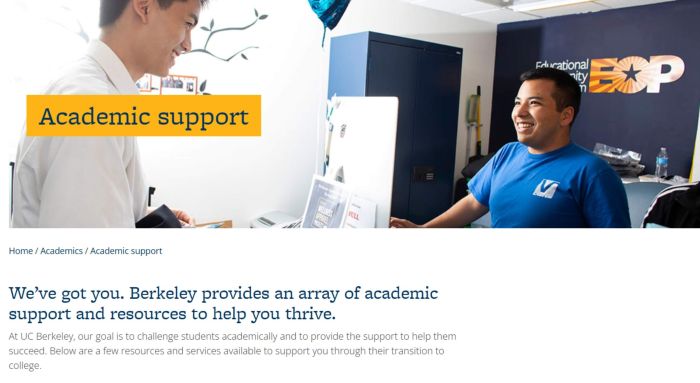
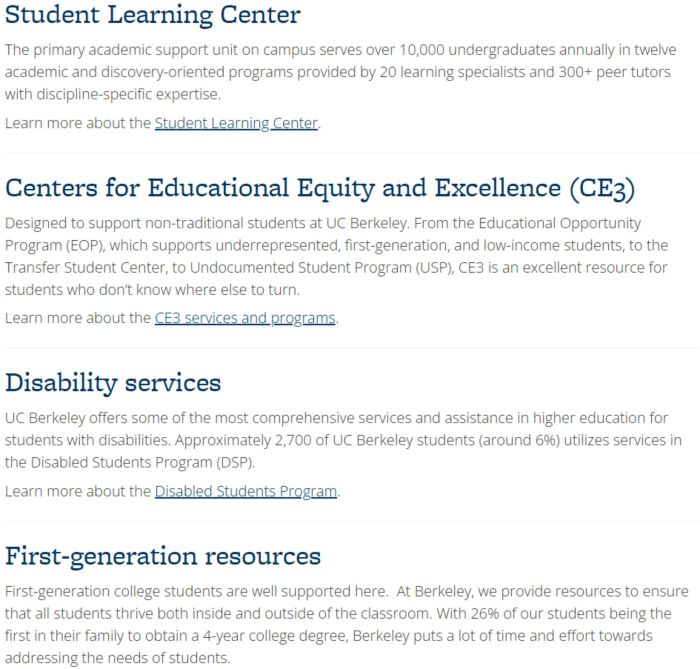
    Example: Discover the robust academic support system available to students at UC Berkeley. On their website, they make it clear that they are committed to meeting the learning needs of every student. Below, you’ll see an array of academic resources tailored to different subgroups of the Berkeley student body. Low-income, underrepresented, first-generation, and students with disabilities are acknowledged and supported to reach their full potential.

    HEM Image 4HEM Image 4

    HEM Image 5HEM Image 5

    HEM Image 6HEM Image 6

    Source: UC Berkeley

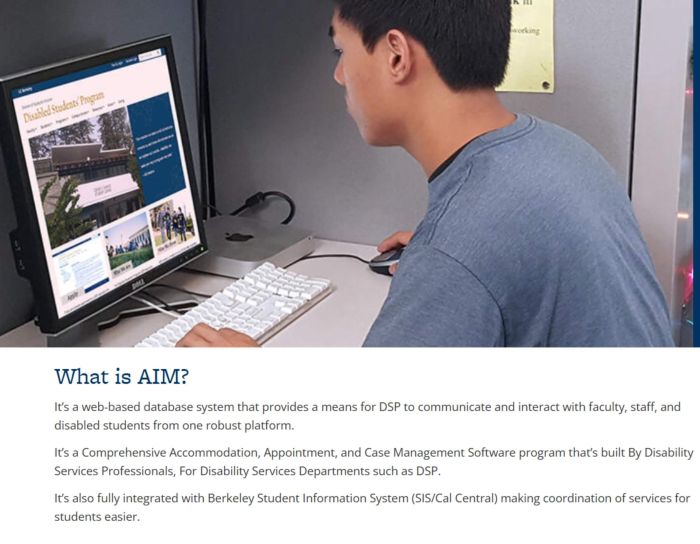
    In addition, UC Berkeley leverages technology to serve its students through the AIM platform, specifically tailored to learners with disabilities. AIM, pictured at the bottom, is an accessible Student Information System designed to facilitate communication between students and faculty, streamline the process of requesting accommodations, and centralize the management of their information.  

    To boost retention, make sure students know how you support their learning. Make it as convenient and inclusive as possible for students to access your resources. 

    4. Providing Career Development Opportunities Early On

    Students often enroll in college with long-term career aspirations in mind, yet many feel uncertain about how to achieve their goals. By integrating career services from day one, schools can help students see a clear pathway from education to employment. Internship programs, networking events, and job placement support should be at the forefront of marketing efforts. When students perceive that their investment in education will lead to tangible career outcomes, they are more likely to persist.

    To enhance engagement, institutions should provide hands-on career workshops, alumni networking events, and mentorship opportunities that connect students with professionals in their fields of interest. Career counselors can conduct personalized career assessments to help students identify potential career paths that align with their strengths and interests. 

    Additionally, integrating career-focused coursework, such as resume-building sessions and mock interviews, can help students feel more confident about their job prospects post-graduation. Schools that establish strong employer partnerships can also facilitate job placement programs, internships, and co-op opportunities that give students real-world experience while still in school, reinforcing their motivation to stay enrolled and complete their studies.

    Example: In this video, AAPS, an institution that mainly appeals to graduate students who are focused on starting or developing their careers, markets its career services which include: access to career and employment experts, resume writing support, and interview workshops.

    YouTube videoYouTube video

    Source: Academy of Applied Pharmaceutical Sciences | YouTube

    Their marketing shows how effective the career services at AAPS are, citing their 100% employer satisfaction rate and a solid 88% graduation rate. As you promote your career services, be sure to provide tangible results because that’s what your prospects and current students are looking for. 

    5. Focus on Student Engagement Initiatives 

    Student engagement plays a crucial role in student retention, as engaged students are more likely to complete their programs and feel a strong connection to their institution. Schools must take proactive steps to foster engagement through meaningful initiatives that encourage academic, social, and extracurricular involvement.

    One way to drive engagement is by creating dynamic student events, such as leadership workshops, cultural festivals, and career networking opportunities. These events provide students with valuable connections, skills, and a greater sense of belonging, reducing feelings of isolation and disengagement.

    Another highly effective strategy is gamification, where game design elements, such as rewards, leaderboards, and challenges, are integrated into academic and extracurricular activities. For instance, you could introduce a points-based system that rewards students for attending classes, participating in discussions, or completing extra-curricular workshops.

    Social media engagement is another powerful tool. Schools can create dedicated student communities on platforms like Discord, LinkedIn, or Instagram where students can connect, share experiences, and support one another. Institutions that regularly post interactive content, student highlights, and live Q&A sessions see stronger student participation.

    Additionally, peer mentorship programs help students build support networks that enhance their academic and personal experiences. New students, especially freshmen, often struggle with the transition to college life. Pairing them with experienced peers who can guide them through academic and social challenges creates a sense of stability and reassurance, leading to increased persistence.

    Finally, experiential learning opportunities, such as service-learning projects, research collaborations, and internships, allow students to see the real-world value of their education. When students feel that their coursework directly impacts their future career prospects, they are more likely to remain engaged and committed to completing their studies.

    Example: As part of their Student Life Program, the University of Toronto offers Mentorship and Peer Programs to increase student engagement, keeping them invested in both their studies and social lives at  U of T, in turn, supporting student retention. In this video, they make the voices of their student body heard, allowing them to express just how the Mentorship and Peer Support programs at U of T have impacted their education. When promoting your student engagement initiatives, try to leverage student testimonials for better relatability and credibility.

    YouTube videoYouTube video

    Source: U of T Student Life | YouTube

    6. Utilizing Data-Driven Insights to Address Student Challenges

    Predictive analytics and student data tracking allow institutions to identify at-risk students and intervene early. By analyzing factors such as attendance, engagement levels, and academic performance, schools can proactively reach out to students who may be struggling. Automated alerts and personalized advising sessions ensure students receive timely support tailored to their individual needs.

    In addition to tracking academic performance, you can use data insights to improve curriculum design and support services. For example, if a large number of students are struggling with a specific course, faculty can adjust the syllabus, provide supplemental learning materials, or offer additional tutoring sessions. 

    Schools can also analyze patterns of student engagement in extracurricular activities and campus events to determine what initiatives are most effective in fostering a sense of community. By using data to refine support systems continuously, institutions can create a proactive, student-centric approach that minimizes dropouts and maximizes success.

    7. Enhancing Financial Aid Awareness and Support

    Financial difficulties are one of the biggest reasons students leave college before completing their programs. Many students are unaware of the full range of financial aid options available. Your school’s marketing team can provide students access to vital scholarships, grants, and payment plans. Institutions should regularly communicate financial aid opportunities through social media, email campaigns, and student portals to alleviate financial stress and keep students enrolled.

    Example: Unfortunately, many students leave their education behind due to their financial situations. Surely, some of these students are unaware of the financial assistance options available to them. To boost student retention, let your community know you can help them invest in their futures. Here, Queen Beauty Institute promotes its financial aid programs on social media, letting students know that support is available should they need it.

    HEM Image 7HEM Image 7

    Source: Queen Beauty Institute Instagram

    8. Promoting a Flexible and Inclusive Learning Environment

    Flexibility is key to student retention in higher education, particularly for non-traditional students balancing work, family, and school. Online learning options, hybrid models, and asynchronous coursework can make higher education more accessible. Schools should highlight these flexible learning opportunities in their marketing materials, emphasizing how they accommodate diverse student needs and lifestyles.

    In addition to offering different learning formats, you can provide adaptive scheduling options that allow students to select courses that fit their personal and professional commitments. Some colleges have introduced weekend or evening classes to serve students with full-time jobs or family obligations. Additionally, having a robust support system for online students, such as virtual study groups, 24/7 tech support, and faculty office hours, ensures they receive the same level of engagement as in-person learners.

    Another important aspect of fostering inclusivity is providing accessible resources for students with disabilities. Ensuring that digital learning platforms are compatible with screen readers, offering captioned lecture videos, and creating inclusive classroom environments can greatly enhance the learning experience. You can also implement specialized advising services to assist students in navigating academic and personal challenges, further reinforcing your commitment to diversity and inclusion.

    Example: Here, the Academy of Learning Career College introduces students to its Integrated Learning System, an educational resource designed to put students “in the driver’s seat of their learning experience”. It fosters flexibility and was created with many learning styles and neurodiversity in mind. Make it known how your school aims to meet students where they are.

    YouTube videoYouTube video

    Source: The Academy of Learning Career College | YouTube

    9. Encouraging Faculty-Student Engagement

    Professors play a crucial role in retaining students. Meaningful connections between students and faculty members can significantly impact a student’s decision to persist in their studies. Your marketing team can facilitate this by spotlighting faculty members in newsletters, creating video content featuring faculty mentorship stories, and promoting faculty office hours as a key resource.

    Institutions can also encourage faculty to take an active role in student success by implementing early intervention programs. If a professor notices a student struggling, they can reach out with personalized support or recommend tutoring services. Additionally, fostering a culture of open communication through regular check-ins, discussion forums, and one-on-one mentorship opportunities helps build trust and rapport between faculty and students.

    Another approach is incorporating faculty-led engagement opportunities such as research projects, community outreach programs, and interdisciplinary collaborations. When students work closely with faculty on meaningful academic projects, they feel more invested in their studies and are less likely to disengage. Schools that promote faculty involvement as a cornerstone of student support will see stronger connections, higher levels of academic motivation, and improved retention rates.

    10. Establishing Clear Pathways for Student Success

    Students are more likely to stay enrolled when they clearly understand their academic roadmap. Schools should provide structured academic pathways, regular progress check-ins, and advising support to help students navigate their journey efficiently. Marketing teams can assist by crafting student success stories highlighting how structured pathways have helped past students graduate on time and achieve their goals.

    In addition to offering clear course sequences, institutions can provide academic planning workshops that help students map out their degree completion plan. Schools should also ensure that students have easy access to academic advisors who can guide them in selecting courses aligned with their career goals. By integrating digital tools such as degree audit software, students can track their progress and receive real-time updates on their academic standing. 

    Offering flexible course options, such as summer sessions or online alternatives, can further help students stay on track and avoid delays in graduation. When students feel they are making steady progress, they are more likely to stay motivated and complete their degrees successfully.

    How to Improve Student Retention With a Comprehensive Marketing Strategy

    How to improve student retention? A comprehensive marketing strategy should involve consistent engagement with students through multiple touchpoints, addressing common concerns before they lead to dropout. By implementing strategic communication, financial aid awareness, community-building initiatives, and academic support, you can foster an environment where students feel valued and encouraged to complete their education.

    At Higher Education Marketing, we specialize in crafting tailored marketing strategies that attract students and keep them engaged throughout their academic journey. HEM specializes in student retention strategies that drive measurable success. Let’s craft a marketing plan that keeps students engaged from enrolment to graduation. that fosters long-term student success.

    Struggling with enrollment?

    Our expert digital marketing services can help you attract and enroll more students!

    Frequently Asked Questions

    Question: What is retention marketing?

    Answer: Retention marketing is the strategic use of targeted campaigns, communication, and engagement initiatives that keep current students enrolled and actively involved in their educational journey.

    Question: How to improve student retention?

    Answer: A comprehensive marketing strategy should involve consistent engagement with students through multiple touchpoints, addressing common concerns before they lead to dropout. By implementing strategic communication, financial aid awareness, community-building initiatives, and academic support, you can foster an environment where students feel valued and encouraged to complete their education.

    Source link

  • Top 10 Private School Marketing Ideas

    Top 10 Private School Marketing Ideas

    Reading Time: 10 minutes

    Are you an administrator or marketer at a small private school? If so, you likely face unique challenges in growing your school community. Unlike large institutions with extensive resources, your budget may be more limited, and your brand may not have the same level of recognition. Yet, your school likely offers something invaluable: a personalized, high-quality educational experience that deserves greater visibility. Your marketing strategy should spotlight the unique selling points that differentiate your private school from other institutions. 

    How do you market a small private school? Traditional outbound marketing methods, such as print ads and direct mail, are costly and less effective in today’s digital market. Instead, try inbound marketing,  a group of strategies that offer a cost-efficient and impactful way to attract, engage, and retain families interested in your school. Keep reading to explore ten effective private school marketing ideas that will grow your community.

    Struggling with enrollment?

    Our expert digital marketing services can help you attract and enroll more students!

    What Is Inbound Marketing and Why Is It Ideal for Private Schools Like Yours?

    Inbound marketing is a strategy that focuses on attracting prospective families to your school through valuable content, SEO, social media engagement, and other digital efforts. Instead of pushing advertisements onto audiences who may not be interested, inbound marketing creates meaningful connections with families actively looking for the right educational institution.

    If you’re wondering how to market a new private school using inbound strategies, remember that the key is to build trust and provide the right information at the right time. Parents today research extensively before choosing a school for their children. Though many outbound strategies remain relevant today, namely to increase visibility, offer useful content, address concerns, and showcase your school’s strengths. Inbound marketing can position your institution as the best choice. Now, let’s explore specific ways that you can grow your private school community.

    HEM Image 2HEM Image 2

    Source: HEM

    10 Proven Inbound Marketing Strategies for Private Schools

    Incorporating these tactics into your marketing strategy can reach your target audience, create relationships by providing value, and incite desired action. An effective private school marketing campaign combines several, if not all, of the techniques discussed below. If any are missing from your current plan, now’s the time to start implementing them! 

    1. Create a High-Quality, SEO-Optimized Website

    Your website is the foundation of your school marketing strategy. It must be visually appealing, easy to navigate, and optimized for search engines. Parents should find essential information, such as tuition, curriculum, testimonials, and admissions requirements quickly and effortlessly. A well-structured website should include dedicated pages for admissions, academic programs, extracurricular activities, and student life. 

    Ensuring mobile responsiveness and fast load speeds will improve user experience and increase engagement. Incorporating multilingual and culturally adapted content can expand your reach, particularly if you’re targeting international students. Regularly updating your website with blog posts, news, and event details ensures prospective parents see a dynamic, engaged school community.

    Example: Are you trying to expand your private school community beyond borders? If so, you’ll want to borrow this effective SEO technique from Crimson Global Academy. Below, you’ll see that they’ve tailored their site content to different countries and used subdirectories in their URLs.

    Using sub-directories (/uk/, /ca/) signals to search engines that the content is tailored for a specific region. Google prioritizes localized content in search results, meaning parents and students searching for private schools in their home country are more likely to find your institution.

    The benefits of this SEO strategy are far-reaching. They include broadened international reach, higher performance in multilingual searches, and higher click-through rates due to relevance.

    HEM Image 3HEM Image 3

    Source: Crimson Global Academy

    2. Develop Engaging Blog Content

    A well-crafted blog is a valuable resource for current and prospective families, positioning your school as a thought leader in education. By publishing informative and engaging content, you can address parents’ most pressing concerns, showcase student success stories, and highlight what makes your school unique.

    For example, you can write about how to help children transition to a new school successfully by offering expert advice and real-life experiences from parents and students. Another great topic is discussing the benefits of small class sizes and how they enhance student learning, highlighting the personalized attention and academic advantages your school provides. 

    You can also explore how your school’s curriculum prepares students for future success in higher education and beyond, showcasing testimonials from alumni who have excelled. Additionally, sharing success stories from students and faculty can illustrate the positive impact of your educational programs. 

    Finally, providing a step-by-step guide for parents navigating the private school admissions process can ease their concerns and position your school as a supportive and transparent institution. Consistently publishing high-quality blog posts improves search engine rankings, making your school more visible to families searching for private education options.

    Example: The Great Lakes College of Toronto publishes blogs relevant to their prospects – students from all over the world interested in attending prestigious Canadian universities. With their target audience in mind, GLCT creates content that provides value. For example, learning tips for ESL learners, how to prepare for Canadian universities, and much more. Make sure your blog content aligns with your site visitors’ needs and provides valuable information.

    HEM Image 4HEM Image 4

    Source: Great Lakes College of Toronto

    3. Leverage Social Media Marketing

    Social media platforms like Facebook, Instagram, and LinkedIn are powerful tools for building community and engagement. Your school can foster stronger connections with prospective and current families by posting student achievements, behind-the-scenes content, and faculty highlights.

    Live Q&A sessions can address frequently asked questions about your school’s programs and admission process. Hosting interactive polls, student takeovers, and parent testimonials can increase engagement and trust.

    Additionally, investing in paid social media advertising can expand your school’s reach to target families actively searching for private school options. Schools can also create private Facebook groups for prospective and current parents, providing a space for questions and engagement.

    Example: This Instagram post from CLS West Covina highlights the strength of the school community. In addition to academic excellence, your private school should highlight other features of the student experience that contribute positively to learning, such as extracurricular activities, a nurturing environment, community involvement, global awareness, and more. Social media remains the perfect stage for your school’s unique selling points.

    HEM Image 5HEM Image 5

    Source: CLS West Covina | Instagram

    4. Implement a Lead Nurturing Email Campaign

    Once a prospective family expresses interest, it’s essential to maintain communication through well-crafted email campaigns. Personalized drip campaigns can guide them through enrolling, providing timely information about your school, key deadlines, and success stories from current students. 

    Automated email sequences can include welcome emails, event reminders for open houses, and curriculum overviews. A segmented approach, where emails are tailored to different stages of the admission journey, can significantly improve conversion rates. Sending personalized content based on user interaction, such as downloadable brochures, testimonials, and exclusive invitations, keeps families engaged throughout the decision-making process.

    5. Use Video Marketing to Showcase Your School’s Culture

    Video content is one of the most effective ways to give prospective families an immersive experience of your school. Creating high-quality video tours, faculty introductions, and student testimonials can provide a dynamic look into daily life at your institution. Highlighting classroom environments, extracurricular activities, and real-world student experiences can create an emotional connection with families. 

    Short-form videos on platforms like Instagram Reels and TikTok can help boost engagement among younger audiences, while long-form content on YouTube and your website can provide in-depth insights. Hosting live virtual tours where prospective families can ask real-time questions enhances engagement.

    6. Optimize Your Google My Business Profile

    Many parents start their search for private schools on Google. A fully optimized Google My Business profile ensures your school appears in local search results with accurate contact details, reviews, and images. Encouraging satisfied parents to leave positive reviews can significantly enhance your school’s online reputation.

    Regularly updating your profile with recent photos, upcoming events, and engaging posts can make your school stand out among competitors. Answering common parent inquiries directly on your profile, such as tuition costs and curriculum highlights, helps streamline decision-making. Additionally, responding promptly to positive and negative reviews demonstrates strong community engagement and builds trust with prospective families.

    Example: This is what your private school looks like in search results when you optimize your Google My Business account. This essential feature provides an easily digestible snapshot of your institution, presents a professional image to web users, and makes it much easier for your target audience to find you.

    HEM Image 6HEM Image 6

    Source: Groton School | Google

    7. Host Virtual and In-Person Open Houses

    In today’s digital landscape, virtual open houses offer a convenient way for parents to learn about your school from anywhere. In-person tours and interactive virtual sessions cater to a broader audience while answering common questions in real time.

    A well-structured open house should include live presentations from school leaders, faculty members, and current students who can share their experiences. Offering breakout sessions for different grade levels or programs allows parents to focus on the most relevant aspects of your school. 

    Additionally, incorporating Q&A panels, video tours of classrooms and facilities, and even virtual meet-and-greet opportunities with teachers can help prospective families get a more personal feel for your school’s community. Recording these sessions and making them available on your website also ensures that families who couldn’t attend live still have access to the information.

    Example: Queen Anne’s School makes it a priority to offer prospects a positive first impression through in-person “Open Morning” events and a virtual tour to showcase their beautiful campus. They also offer personal tours, group tours on site, taster days, and taster boarder experiences to accommodate every prospect’s preferences. Wow future students and their families by giving them a taste of your unique student life experience.

    YouTube videoYouTube video

    HEM Image 7HEM Image 7

    Source: Queen Anne’s School

    8. Invest in Paid Digital Advertising

    While organic traffic is essential, strategic paid advertising can help small private schools reach highly targeted audiences. Google Ads and Facebook Ads can be optimized to reach families searching for private school options in your area.

    Displaying retargeting ads to parents who previously visited your website can help keep your school top-of-mind. Running A/B tests on ad creatives and messaging can improve ad performance and maximize return on investment.

    9. Create Downloadable Resources to Capture LEADS

    Providing valuable downloadable resources, like e-books, checklists, and guides, can encourage prospective families to share their contact information. For instance, a downloadable guide on “Choosing the Right Private School for Your Child” can position your institution as an industry expert while generating qualified leads. Interactive tools, such as school comparison charts and tuition calculators, can further engage visitors and increase conversion rates.

    To maximize the effectiveness of downloadable resources, schools should ensure that these materials are highly relevant, visually appealing, and easy to understand. Including real-world examples, student success stories, or insights from school faculty can add credibility and value. 

    Additionally, placing lead capture forms strategically throughout the website, such as on admissions pages, blog posts, and program descriptions, can encourage more sign-ups. Schools can also create exclusive content for different stages of the enrollment journey, such as a “First-Time Parent’s Guide to Private School Admissions” or a “Step-by-Step Checklist for Enrollment Success,” providing tailored resources that guide families through the decision-making process. Regularly updating these materials ensures they remain relevant and aligned with current education trends.

    10. Utilize Retargeting Strategies

    Most parents don’t enroll immediately after visiting your website. Retargeting strategies, such as displaying ads to users who previously visited your site, can help keep your school top-of-mind. This ensures interested families receive gentle reminders to revisit your offerings and complete the application process. Email remarketing campaigns can also re-engage families who started but did not complete an application.

    To enhance retargeting effectiveness, schools should segment their audience based on engagement levels, such as visitors who viewed tuition pages, downloaded an admissions guide, or attended a virtual open house. Personalized messaging, such as an email featuring student testimonials or a special enrollment incentive, can encourage hesitant families to take the next step. 

    Schools can also leverage dynamic display ads that adjust content based on a user’s previous website activity, like showing program-specific ads for those who viewed a particular course or highlighting upcoming admissions deadlines. Schools can effectively nurture leads and increase enrollment conversions using a multi-channel approach, combining retargeting ads with personalized email follow-ups.

    Getting Professional Marketing Support Can Help Your Private School Grow

    Navigating the complexities of digital marketing can be overwhelming, especially for small private schools with limited resources. That’s where expert guidance can make all the difference. 

    At Higher Education Marketing, we specialize in helping educational institutions maximize their online presence through customized inbound marketing strategies. Whether you need assistance with content creation, SEO, social media management, or lead nurturing, our team of education marketing experts ensures that your school effectively reaches its target audience.

    With over 15 years of experience, we understand the nuances of school marketing ideas and tailor our solutions to your institution’s specific needs. Our digital marketing services include:

    • SEO Optimization
    • Paid Advertising Campaigns
    • Social Media Management
    • Website Development
    • Email Marketing Automation

    Start Growing Your Private School Today

    By embracing inbound marketing, your small private school can attract the right families, establish a strong online presence, and build a thriving school community. Whether you’re looking to optimize your digital strategy, refine your content marketing approach, or improve engagement through paid advertising, HEM is here to help. 

    The combination of a strong website, engaging blog content, an active social media presence, and targeted email marketing ensures that your school remains visible and competitive in the evolving field of education.

    Struggling with enrollment?

    Our expert digital marketing services can help you attract and enroll more students!

    Frequently Asked Questions

    Question: How do you market a small private school?

    Answer: Traditional outbound marketing methods, such as print ads and direct mail, are costly and less effective in today’s digital market. Instead, try inbound marketing,  a group of strategies that offer a cost-efficient and impactful way to attract, engage, and retain families interested in your school.

    Question: How to market a new private school?

    Answer: The key is to build trust and provide the right information at the right time. Parents today research extensively before choosing a school for their children. Though many outbound strategies remain relevant today, namely to increase visibility, offer useful content, address concerns, and showcase your school’s strengths. Inbound marketing can position your institution as the best choice.

    Source link

  • ‘How can I know what I think till I see what I say?’: How AI is changing education and writing

    ‘How can I know what I think till I see what I say?’: How AI is changing education and writing

    • Following HEPI’s recent Policy Note on students’ use of artificial intelligence (AI), HEPI Director Nick Hillman reviews a new book from the United States on what AI means for writing.

    ‘ChatGPT cannot write.’ It’s a bold statement but one near the start of the new book More Than Words: How to Think about Writing in the Age of AI that explains what comes in the following 300 pages.

    The author John Warner’s persuasive argument is that generative AI creates syntax but doesn’t write because ‘writing is thinking.’ (I hope this is the only reason why, when asked to write a higher education policy speech ‘in the style of Nick Hillman’, ChatGPT’s answer is so banal and vacuous…) People are, Warner says, attracted to AI because they’ve not previously been ‘given the chance to explore and play within the world of writing.’

    Although Warner is not as negative about using ChatGPT to retrieve information as he is on using it to write wholly new material, he sees the problems it presents as afflicting the experience of ‘deep reading’ too: ‘Reading and writing are being disrupted by people who do not seem to understand what it means to read and write.’

    The book starts by reminding the reader how generative AI based on Large Language Models actually works. ChatGPT and the like operate as machines predicting the next word in a sentence (called a ‘token’). To me, it is reminiscent of Gromit placing the next piece of train track in front of him as he goes. It’s all a bit like a more sophisticated version of how the iPhone Notes app on which I’m typing this keeps suggesting the next word for me. (If you click on the suggestions, it tends to end up as nonsense though – I’ve just done it and got, ‘the app doesn’t even make a sentence in a single note’, which sounds like gibberish while also being factually untrue.)

    ‘The result’, we are told of students playing with ChatGPT and the like, ‘is a kind of academic cosplay where you’ve dressed up a product in the trappings of an academic output, but the underlying process is entirely divorced from the genuine article.’

    Writing, Warner says, is a process in which ‘the idea may change based on our attempts to capture it.’ That is certainly my experience: there have been times when I’ve started to bash out a piece not quite knowing if it will end up as a short blog based on one scatty thought or flower into a more polished full-length HEPI paper. Academics accustomed to peer review and the slow (tortuous?) procedures of academic journals surely know better than most that writing is a process.

    The most interesting and persuasive part of the book (and Warner’s specialist subject) is the bit on how formulae make writing mundane rather than creative. Many parents will recognise this. It seems to me that children are being put off English in particular by being forced to follow the sort of overweening instructions that no great author ever considered (‘write your essay like a burger’, ‘include four paragraphs in each answer’, ‘follow PEE in each paragraph’ [point / evidence / explain]). Warner sees AI taking this trend to its logical and absurd conclusion where machines are doing the writing and the assessment – and ruining both.

    Because writing is a process, Warner rejects even the popular idea that generative AI may be especially useful in crafting a first draft. He accepts it can produce ‘grammatically and syntactically sound writing … ahead of what most students can produce.’ But he also argues that the first draft is the most important draft ‘as it establishes the intention behind the expression.’ Again, I have sympathy with this. Full-length HEPI publications tend to go through multiple drafts, while also being subjected to peer review by HEPI’s Advisory Board and Trustees, yet the final published version invariably still closely resembles the first draft because that remains the original snapshot of the author’s take on the issue at hand. Warner concludes that AI ‘dazzles on first impression but … has significantly less utility than it may seem at first blush.’

    One of the most interesting chapters compares and contrasts the rollout of ChatGPT with the old debates about the rise of calculators in schools. While calculators might mean mental arithmetic skills decline, they are generally empowering; similarly, ChatGPT appears to remove the need to undertake routine tasks oneself. But Warner condemns such analogies: for calculators ‘the labor of the machine is identical to the labor of a human’, whereas ‘Fetching tokens based on weighted probabilities is not the same process as what happens when humans write.’

    At all the many events I go to on AI in higher education, three areas always comes up: students’ AI use; what AI might mean for professional services; and how AI could change assessment and evaluation. The general outcome across all three issues is that no one knows for sure what AI will mean, but Warner is as big a sceptic on AI and grading as he is on so much else. Because it is formulaic and based on algorithms, Warner argues:

    Generative AI being able to give that “good” feedback means that the feedback isn’t actually good. We should instead value that which is uniquely human. … Writing is meant to be read. Having something that cannot read generate responses to writing is wrong.

    The argument that so many problems are coursing through education as a result of new tech reminds me a little of the argument common in the 1980s that lead pipes brought down the Roman Empire. Information is said to become corrupted by AI in the way that the water supposedly became infected by the lead channels. But the theory about lead pipes is no longer taken seriously and I remain uncertain whether Warner’s take will survive the passage of time in its entirety either.

    Moreover, Warner’s criticisms of the real-world impact of ChatGPT are scattergun in their approach. They include the ‘literal army of precarious workers doing soul-killing tasks’ to support the new technology as well as the weighty environmental impact. This critique calls to mind middle-class drug-takers in the developed world enjoying their highs while dodging the real-world impact on developing countries of their habit.

    In the end, Warner’s multifarious criticisms tot up to resemble an attack on technology that comes perhaps just a little too close for comfort to the attacks in the early 1980s by the Musicians’ Union’s on synthesisers and drum machines. In other words, the downsides may be exaggerated while the upsides might be downplayed.

    Nonetheless, I was partially persuaded. The process of writing is exactly that: a process. Writing is not just mechanical. (The best young historian I taught in my first career as a school teacher, who is now an academic at UCL, had the worst handwriting imaginable as his brain moved faster than his hand / pen could manage.) So AI is unlikely to replace those who pen words for a living just yet.

    Although, paradoxically, I also wished the author had run his text through an AI programme and asked it to knock out around 40% of his text. Perhaps current iterations of generative AI can’t write like a smart human or think like a smart human, but they might be able to edit like a smart human? Perhaps AI’s biggest contribution could come at the end of the writing process rather than the beginning? Technology speeds up all our lives, leaving less time for a leisurely read, and it seems to me that all those ‘one-idea’ books that the US floods the market with, including this one, could nearly always be significantly shorter without losing anything of substance.

    Source link

  • Bridging Further and Higher Education: Building a Truly Tertiary Education System

    Bridging Further and Higher Education: Building a Truly Tertiary Education System

    • Professor David Phoenix OBE is Vice-Chancellor of London South Bank University and Chief Executive of LSBU Group.
    • Dr Katerina Kolyva is Chief Executive Officer of The Education and Training Foundation.

    Post-16 education in England is at a pivotal moment, with increasing efforts to create a more integrated and collaborative system. While elements of competition remain, the reintegration of the sector into the Department for Education presents new opportunities for colleges and universities to enhance their contributions to local communities. Both further and higher education providers play distinct yet complementary roles in supporting diverse learners, but significant challenges remain in achieving a fully joined-up system. The establishment of Skills England, along with the skills and industrial strategies, signals a growing recognition of these complexities, highlighting the need for a cross-government approach. Achieving greater alignment across the post-16 landscape could provide an opportunity to shape a system that empowers learners, strengthens local economies, and supports national prosperity.

    In February, the Education and Training Foundation and London South Bank University therefore brought together a range of relevant stakeholders to discuss existing models of best practice and the workforce characteristics needed to help develop an effective tertiary education system.

    University and college mergers, franchise agreements, Institutes of Technology and Group models are all examples of imaginative approaches to post-16 collaboration. Workforce characteristics found within these models include a leadership team with a clear vision, strong awareness of institutional values, and resilience against the prevailing winds of policy. Having the correct personnel with a positive and creative mindset can foster strategic risk-taking and allow for continuous learning with the avoidance of blame, though people and culture initiatives alone cannot be relied upon to deliver a coherent system.

    Our marketised higher education system and a focus on further-higher education transitions around level 4 could risk missing the bigger picture. We need government to develop a national framework within which local skills and innovation strategies can be developed. Such strategies would seek to consider issues related to the skills pipeline (including key areas such as adult education and gateway qualifications) but would also look at job creation by leveraging universities to drive innovation with business. Such a system-based approach needs to also consider what post-16 provision in the schools sector looks like and how this interfaces with further education, as well as the interface between further and higher education. This is essential if we are to provide alternative study pathways that meet the needs of the majority whilst also preventing duplication and redundancy at all levels.

    Published in December 2024, the government’s Devolution White Paper could be a first step towards establishing a framework for regional collaboration and addressing these missing elements. Strategic Authorities could take an important role in working alongside further and higher education providers and employers to identify skills shortages and promote clear pathways from education and training into employment through a combination of specialist institutions. The government, through a coordinated approach across departments, could use various regulatory and financial levers to encourage genuine collaboration between providers where there is a mismatch between skill demands and provision, while also simplifying the complex regulatory landscape.

    A greater level of specialisation and the recognition of the importance of different institutional missions has the potential to support a greater diversity of missions and a shift to a more collaborative framework. When combined with designing a corresponding careers, information, advice and guidance service, this will allow institutions to build more pathways for learners, meaning a more inclusive system. Those who are educationally disenfranchised would have more options to re-enter education and work, breaking down a key barrier to opportunity and, in the long term, boosting economic growth.

    Regulation, market forces, and financial constraints can both foster and hinder collaboration. If government can find the correct balance, post-16 education will better serve learners and employers, boosting equality of opportunity and economic growth. Government commitments to boost devolution, publish an industrial strategy and reduce intra-governmental bureaucracy tacitly acknowledge the problem, but an overarching framework for addressing this is lacking. Once the IFATE Bill, which will formally establish Skills England, achieves Royal Assent, government must establish a mechanism to ensure cross-departmental coordination, bringing together Skills England, regional authorities, education providers, and employers to drive structural change.

    Source link

  • Making a sustained case for international student mobility

    Making a sustained case for international student mobility

    Today on the HEPI blog, Professor David Phoenix OBE and Dr. Katerina Kolyva explore how England’s post-16 education system can move beyond competition to create a more integrated, collaborative approach that benefits learners, local economies, and national prosperity. You can read the blog here.

    Below, colleagues at the University of Surrey explore the evolving landscape of global student mobility, highlighting innovative programmes and making the case for a new approach to student placements.

    • Professor Amelia Hadfield is Associate Vice-President for External Engagement and Founding Director of the Centre for Britain in Europe, and Liz Lynch is International Mobility Manager, both at the University of Surrey.

    In recent years, the UK’s governments have developed new initiatives such as the Turing Scheme, the Taith Scheme in Wales, and the Scottish Government’s Scottish Education Exchange Programme (SEEP). These mobility programmes aim to support students’ global experiences. While they have undoubtedly provided valuable opportunities for students – particularly for those from disadvantaged backgrounds – what is truly needed is a longer-term commitment from government to sustain and expand these life-changing opportunities.

    At the end of February, the annual Global Mobility conference hosted by Universities UK International (UUKi) brought together higher education professionals and thought leaders to explore the latest developments in global student mobility and what the future looks like. The conference showcased how universities are leveraging these funding opportunities to create meaningful and impactful programmes. However, it also highlighted the significant challenges faced by UK institutions, particularly in the aftermath of Brexit, the Covid-19 pandemic, the UK’s withdrawal from Erasmus+ and the ongoing financial pressures on both universities and students. These factors have created a complex landscape, making investment in international mobility more crucial than ever.

    The Impact of Mobility on Student Outcomes: Insights from UUKi Research

    During the conference, UUKi presented early-stage findings from their latest research, Gone International: A New Generation, conducted in collaboration with Jisc and the Northern Consortium. While the data revealed a significant decline in the number of students going abroad, perhaps reflecting the impact of recent global challenges, there remains strong evidence of the benefits to students. Reaffirming 2019 findings, the data continues to show students participating in mobility programmes not only attain higher degrees but are also more likely to earn higher salaries, secure professional-level jobs and experience lower unemployment rates. The research underscores the important role of global mobility in fostering social mobility.

    Nevertheless, while those of us working in the sector already understand the intrinsic value of international experiences, having concrete data to back up these claims strengthens the case for continued support and expansion of such opportunities. The University of Manchester, for example, has been evaluating the impact of its international mobility programmes on student outcomes, and the findings have helped raise the profile and importance of these opportunities across their institution. This kind of evidence-based approach is essential for ensuring that the sector – and governments – remain committed to facilitating global mobility for students.

    The Broader Benefits of International Mobility

    The British Council highlights the broader societal benefits of international student mobility, particularly in fostering cross-cultural understanding and long-term relationships between nations. By participating in mobility programmes, students develop cross-cultural competence, language proficiency, and global perspectives – all vital skills for success in today’s interconnected world. Inbound mobility, in particular, contributes significantly to the UK economy, with international students bringing cultural diversity, innovation, and fresh perspectives to campuses. These exchanges also build cross-cultural networks, which can endure long after students return to their home countries, fostering greater trust and understanding between nations and supporting the UK’s soft power overseas.

    All of this is in addition to the economic benefit that stems from the UK’s ability to attract international students, as discussed recently on the HEPI blog.

    Blended Mobility: Enabling flexibility and accessibility

    Blended mobility programmes represent a forward-thinking solution for making global education more accessible and flexible. Cardiff Metropolitan University, for example, has embraced a hybrid model supported by the Taith funding, combining one week of virtual learning with one week of physical mobility. This approach not only maintains the essence of cultural exchange but also offers students the flexibility to engage in international experiences that might otherwise be logistically or financially out of reach. The combination of virtual, blended, and physical mobility opens doors for students who might not be able to commit to a full-term study abroad programme, making global learning more inclusive and scalable.

    Whilst the Turing Scheme in its current form does not include blended mobility, the recent reduction in minimum duration to 14 days is a positive step towards providing greater accessibility for students. Hopefully, in future years, blended mobilities and shorter 7-day mobilities could be incorporated into future Turing projects, taking the impactful examples from both Taith and Erasmus+ as evidence of the value and enabling engagement from the most disadvantaged and underrepresented groups.  This, along with funding for staff mobility (offered by both Taith and Erasmus+), will only serve to enhance Turing overall.

    Surrey’s Approach: Empowering Students through International Mobility

    At the University of Surrey, we are committed to increasing the participation of our students in a range of international opportunities, whilst simultaneously expanding the international dimension of the student experience at our Guildford campus. In this respect, placement training options, study abroad opportunities, enhanced ‘global and cultural intelligence’ and ‘collaborative online international learning’ (COIL) content in degree pathways, as well as our Global Graduate Awards, ‘international’ is necessarily widely defined, and ‘mobility’ can take place intellectually, culturally, and socially, as well as just physically,

    Mobility also brings together traditional approaches to cross-border opportunities with enhanced approaches to supporting new demographics. A key strategic objective at Surrey, therefore, is focusing on access for underrepresented groups. We target Turing funding and additional grant funds to students who meet Surrey’s widening participation criteria to address inequality amongst underrepresented groups who may wish to experience international mobility but are unable to do so without grants. The portfolio of both longer-term and shorter mobility options we have developed facilitates equal access for all. As previous placements have illustrated, longer-term mobility provides deeper cultural experiences and learning opportunities for those able to commit to a full semester/year abroad. Shorter options can widen access for students from disadvantaged backgrounds and underrepresented groups.

    Through their international experiences, our students build global academic and professional networks and improve their job prospects. They return to Surrey as confident, resilient, and globally minded individuals, prepared to tackle the challenges of tomorrow’s world. Feedback from students who participated in Surrey’s Turing 2023 project shows the impact mobility has on their personal and professional development. 94% reported an increase in intercultural awareness, and 93% felt the experience enhanced their employability and professional skills.

    Looking Ahead: The Future of Global Mobility

    The global mobility landscape is changing, with rapid technological advancements and a growing emphasis on inclusivity and sustainability. At Surrey, we are embracing technological innovations that will enhance both the student experience and the efficiency of mobility programme management. Process automation, for example, is helping streamline administrative tasks, freeing up resources to better support students. We are also starting to use virtual reality (VR) to promote international opportunities, allowing students to virtually explore campus life abroad. Future opportunities for blended learning, as well as the incorporation of COIL projects within the curriculum, will nurture the skills necessary for students to engage with the world and develop the confidence and curiosity needed to thrive in an interconnected society.

    By incorporating data-driven approaches, we will continue to assess the impact of our mobility programmes, identifying areas for improvement and ensuring that our offerings align with both institutional and student goals. As the sector evolves, collaboration and innovation will be key in ensuring that all students can access transformative international experiences.

    Source link

  • Strengthening data and insights into our changing university research landscape by Jessica Corner

    Strengthening data and insights into our changing university research landscape by Jessica Corner

    The UK continues as a global leader in research and innovation and our universities are uniquely strong contributors, among which are the highest performing in the world. We have some of the highest-intensity innovation ecosystems in the world, with universities as the core driver. As a country, our invention record is well recognised. The UK, with its powerful life sciences effort, delivered one of the first UK COVID-19 vaccines, saving millions of lives around the world and only possible because of long-standing investment in research that became serendipitously essential. In cities across the UK, universities act as pillar institutions with positive and reinforcing effects on their local economies. We have a rich network of specialist institutions that excel in music, the arts, medicine and life sciences. Our universities continue to deliver discoveries, technologies, creative insights, talent for our industries and public services and so much more. Many have the scale and reach to deliver across the full span of research and innovation to enterprise and commercialisation.

    A unique feature, and underpinning this extraordinary record, is our dual support funding system. That system balances competitive grant funding from UKRI Research Councils, charities, business, and others with long-term stable underpinning funds to enable universities to pursue ambitious and necessary strategies, develop research strengths, foster talent, pivot towards new fields, collaborate and maintain research infrastructure.

    However, the sector faces unprecedented challenges. Erosion of the value of student fees and the growing costs of delivering education, disruptions to anticipated income from international student fees, a slow erosion of the value of QR, rising costs of research and a mismatch between this and cost recovery from grants has created a perfect storm and unsustainable operating models for most institutions. The additional £5bn a year in funding from universities’ own surpluses towards research and innovation is no longer guaranteed. The sector has and continues to evolve in response to a changing landscape, but consideration is needed about how best to support the sector to change.

    Research England’s role is to support a healthy, dynamic, diverse, and inclusive, research and innovation system in universities in England6. We work by facilitating and incentivising system coherence, acting as both champion and challenger. In partnership we aim to create and sustain the conditions for the system to continue delivering excellence and leverage resources far beyond funding provided by government. We are working to enhance the data and evidence to support our role as expert, evidence-based funder and on the outcomes that the funding delivers. In fulfilling this role and against the current context, Research England has two initiatives that we will be taking forward in the coming weeks.

    Our ongoing programme to review the principles underpinning our funding and mechanisms by which we allocate research funds to institutions has reached a point where we are seeking to increase the visibility and transparency of how these funds are deployed by institutions. We are developing an approach, designed to be light touch and low burden that asks universities to report back on their use of strategic institutional research funding. We will begin testing the approach with a selection of institutions in the coming months and, subject to the outcomes of this initial engagement, aim to roll out a pilot with institutions in the 2025/26 academic year. We will be communicating to institutions directly about the pilot in the early Autumn. In the second phase of this work, we intend to work with institutions to develop a forward-looking strategic element that will give insight into plans and then how decisions are made about the deployment of funding. For the programme, we are also reviewing the effectiveness of the different unhypothecated and ring-fenced research funds provided to institutions. When fully implemented, the information we will acquire will enable Research England greater visibility of the role of institutions and the contribution of our formula-based research funding (including QR) to the research and innovation system while also contributing to efforts to have more systematic and timely data.

    A second strand of work is our programme to monitor the implications for the sustainability of research in universities against the current financial context. We are seeking to better understand how challenges are impacting universities’ ability to deliver research and innovation and maintain research capabilities, capacity, and facilities and, in turn, further strengthen assurance with more robust data. In partnership with the Department for Innovation Science and Technology, we have commissioned the Innovation Research Caucus with OMB Research Ltd to undertake a survey into how institutions are responding to current pressures with respect to research and innovation. The survey will provide important data that can support advice to government and others on the extent of universities’ financial challenges, how these issues are being managed, and how this impacts their investment and planning in the research and innovation space. The approach is to provide insights that are currently not available at an aggregate level or in a timely way through national data sets. Additionally, Research England will be asking institutions to report on material changes they are making to research and innovation capabilities and capacity or in relation to wider changes in institutional form or organisation when these may affect the basis on which our funding is awarded.

    We continue to see our role as facilitator, enabler and partner and believe we have a strong reputation for having timely and robust insights into the conditions underpinning our great research and innovation system. These two programmes of work are being taken forward in support of universities and, against the current backdrop, will strengthen Research England’s fundamental role in the research and innovation system. We look forward to working in close partnership with universities as we take these critical work programmes forward.

    Source link

  • However: the curriculum and assessment review

    However: the curriculum and assessment review

    • Professor Sir Chris Husbands was Vice-Chancellor of Sheffield Hallam University between 2016 and 2023 and is now a Director of  Higher Futures, working with university leaders to lead sustainable solutions to institutional challenges.

    Almost everyone has views on the school curriculum. It’s too academic; it’s not academic enough; it’s too crowded; it has major omissions; it’s too subject-dominated; it doesn’t spend enough time on subject depth.  Debates about the curriculum can be wearying: just as everyone has a view on the school curriculum, so almost everyone has views about what should be added to it, though relatively few people have equally forceful ideas about what should be dropped to make room for Latin, or personal finance education, or more civic education and so on.

    One of the achievements of Becky Francis’s interim report on school curriculum and assessment is that it tries to turn most of these essentially philosophical (or at least opinionated) propositions into debates about evidence and effectiveness and to use those conclusions to set out a route to more specific recommendations which will follow later in the year. It’s no small achievement.  As the report says, and as Becky has maintained in interviews, ‘all potential reforms come with trade-offs’ (p 8); the key is to be clear about the nature of those trade-offs so that there can be an open, if essentially political debate about how to weight them.

    The methodology adopted by Becky and her panel points towards an essentially evolutionary approach for both curriculum and assessment reform.  The first half of that quoted sentence on trade-offs is an assertion that ‘our system is not perfect’ (p 8) and of course, no system is. But the report is largely positive about key building blocks of the system, and it proposes that they will remain: the structure of four key stages, which has been in place since the 1980s; the early focus on phonics as the basis of learning to read, which has been a focus of policy since the 2000s; the knowledge-rich, subject-based approach which has been in place for the last decade; and the essentials of the current assessment arrangements with formal testing at the end of Key Stage 2 (age 11), key stage 4 (essentially GCSEs) and post-16 which were established in the 1988 Education Reform Act.

    More directly relevant to higher education, the report’s view is that ‘the A level route is seen as strong, well-respected and widely recognised, and facilitates progression to higher education’ (p 30) and that ‘A-levels provide successful preparation for a three-year degree’ (p 7).  Whilst the review talks about returning to assess ‘whether there are opportunities to reduce the overall volume of assessment at key stage 4’ (p 41), it does not propose doing so for A-level. The underlying message is one of system stability, because ‘many aspects of the current system are working well’ (p 5).

    However: one of the most frequently used words in the interim report is, in fact, ‘however’: the word appears 29 times on 37 pages of body text, and that doesn’t include synonyms including ‘but’ (32 appearances), ‘while’ (19 appearances) and a single ‘on the other hand’.  Frequently, ‘however’ is used to undercut an initial judgement. The national curriculum has been a success (p 17),'[h]owever, excellence is not yet provided for all: persistent gaps remain’, The panel “share the widely held ambition to promote high standards. However, in practice, “high standards” currently too often means ‘high standards for some’”(p 5).

    These ‘however’ formulations have three effects: first, and not unreasonably in an interim report, they defer difficult questions for the final report.  The final report promises deep dives ‘to diagnose each subject’s specific issues and explore and test a range of solutions’, and ‘about the specificity, relevance, volume and diversity of content’ (p.42). It’s this which will prove very tough for the panel, because it is always detail which challenges in curriculum change. If the curriculum as a whole is always a focus for energetic debate, individual subjects and their structure invariably arouse very strong passions. The report sets up a future debate here about teacher autonomy, arguing, perhaps controversially in an implied ‘however’ that ‘lack of specificity can, counter-intuitively, contribute to greater curriculum volume, as teachers try to cover all eventualities’ (p 28). 

    Secondly, and in almost every case, the ‘however’ undercuts the positive systems judgement: ‘the system is broadly working well, and we intend to retain the mainstay of existing arrangements. However, there are opportunities for improvement’ (p 8).  It’s a repeated rhetorical device which plays both to broad stability and the need for extensive change, and it suggests that some of the technical challenges are going to rest on value – and so political – judgements about how to balance the competing needs of different groups. Sometimes the complexity of those interests overwhelms the systems judgements. The review’s intention is to return to 16-19 questions, “with the aim of building on the successes of existing academic and technical pathways, particularly considering [possibly another implied ‘however’] how best to support learners who do not study A levels or T Levels” (p 9) is right to focus on the currently excluded, but the problem is often mapping a route through overly rigid structures.

    The qualifications system has been better geared for higher attainers, perhaps exemplified by the EBacc [English Baccalaureate] of conventional academic subjects.  Although the Panel cites evidence that a portfolio of academic subjects aids access to higher education, ‘there is little evidence to suggest that the EBacc combination [of subjects] per se has driven better attendance to Russell Group universities’ (p 24) – the latter despite the rapid growth of high tariff universities’ market share over recent years. This issue is linked to one of the most curious aspects of the report from an evidential point of view.  It is overwhelmingly positive about T-levels, ‘a new, high-quality technical route for young people who are clear about their intended career destination’ which ‘show great promise’ (p 7). But (“however”) take up (2% of learners) has been very poor, and not just because not all 16-year-olds are ‘clear about their intended career pathway’.   The next phase of the Review promises to  ‘look at how we can achieve the aim of a simpler, clearer offer which provides strong academic and technical/vocational pathways for all’ (p 31).  But that ‘simpler, clearer offer’ has defied either technical design or political will for a very long time. If it is to succeed, the review will need to consider approaches which allow combinations of vocational and academic qualifications at 16-19, partly because much higher education is both vocational and academic and more because at age 16, most learners do not have an ‘intended career pathway’.

    And thirdly, related to that, the ‘howevers’ unveil a theme which looms over the report, the big challenge for national reform which seeks to deliver excellence for all. Pulling evidence together from across the report tells us that 80% of pupils met the expected standard in the phonics screening check and at age 11, 61% of pupils achieved the expected standards in reading, writing and maths (p 17). Some 40% of young people did not achieve level 2 (a grade 4 or above at GCSE) in English and maths by age 16 (p 30). To simplify: attainment gaps open early; they are not closed by the curriculum and assessment system, and one of the few graphs in the report (p 18) suggests that they are widening, leaving behind a large minority of learners who struggle to access a qualifications system which is not working for them.  As the report says, the requirement to repeat GCSE English and Maths has been especially problematic.  

    The report is thorough, technical and thoughtful; it is evolutionary not revolutionary, and none the worse for that. Curriculum and assessment policy is full of interconnection and unintended consequences.  There are tough challenges in system design to secure excellence and equity, inclusion and attainment, and to address those ‘howevers’. The difficult decisions have been left for the final report. 

    Source link