Matthew Howling, Principal Associate at Mills & Reeve LLP, and Poppy Short, Partner at Mills & Reeve, reflect on a February round table discussion amongst university leaders chaired by Nick Hillman of HEPI.
On 26 February 2025, a group of 18 university leaders, advisors and stakeholders met to reflect on how universities can best position themselves in the current financial climate. The meeting was a follow-up to our joint dinner with HEPI on 10 October 2024 at the Royal Society in London. As we remarked at the time, there was a clear desire to continue the conversation, and the fast-paced and content-rich discussion here was a testament to that desire.
Our theme was the limits of self-help. Given the current financial headwinds, institutions have been restructuring their activities on an unprecedented scale. However, once the severance schemes, asset sales and course closures have come to pass, will these remedies be sufficient to put institutions back on a sound enough financial footing to continue to serve their students and communities for the longer term? The unspoken and yet resounding understanding across the group was that further and more radical changes are needed across the sector to stabilise the situation.
What is the role of the private providers in helping to improve the financial health of the sector? Several voices suggested that foreign investment could help to save certain British universities and that the sector needs to be less reticent about such investment. Other participants thought that, while foreign investment might work in the context of smaller providers, it was less likely to be successful when dealing with larger, more complex institutions, particularly those that have a legacy of contracts with trade unions and other stakeholders. It is well known that a number of private providers and foreign investors are waiting in the wings to acquire UK degree-awarding powers from distressed higher education providers if the opportunity presents itself. The sector should be prepared to consider its response to this.
In a recent HEPI poll, when students were presented with a list of 10 options for what could happen if their own higher education institution were to fall over financially, a takeover by a foreign company was the joint least popular option. Foreign investors would have to work hard to tackle these negative perceptions.
In some ways, the antithesis of self-help is a forced merger. It was noted that, in other jurisdictions, forced mergers are not as uncommon as might be thought. Estonia, France, Germany and Denmark had all experienced forced university mergers. Is this the direction of travel for the United Kingdom? There was a feeling that, in Wales and Scotland, there was a willingness to consider higher education provision on a more holistic basis than in England.
In terms of state support, it was felt that the sector had to acknowledge government spending pressures. The evidence of cuts to budgets elsewhere (such as foreign aid) strongly suggests that there will be no chance of further increases to the home undergraduate tuition fee in the foreseeable future and despite the need, other forms of financial help are not expected.
If government funding will not be forthcoming, the other obvious source of funds is existing lenders. Participants observed that, while sector borrowing was high, much of the recent debt taken on by providers was in the form of revolving credit facilities (which provide short-term funds up to a specified limit for a stipulated period of time, all or part of which can be repaid and re-borrowed as required), rather than the term loans that universities have traditionally found more attractive (which provide long-term funds for a specified period of time). There was concern that, in some cases, banks might be considering withdrawing those lines of credit when they come up for renewal. There was also a concern about how many institutions might be relying on revolving credit facilities to satisfy the OfS’s minimum liquidity requirements. There was anecdotal evidence that certain banks were focussing their new lending on higher tariff institutions, partly because of credit risk but also because of the ancillary opportunities to make money from larger institutions. This risks a self-fulfilling cycle of winners and losers.
It was generally felt that a new Special Administration Regime would make life easier as opposed to harder in terms of access to funds. It is not necessarily about encouraging enforcement by banks. It is highly unlikely that a UK clearing bank would want the adverse publicity associated with enforcing against a UK university (although foreign lenders may be less PR squeamish). However, giving lenders a clear line of sight as to a recovery process, even if not used in practice, may further encourage commercial lending to the sector.
Beyond the question of more money, there was a feeling that certain sector skills were lacking to navigate these troubled waters. As one participant put it, transformation expertise was what was needed, not just transformation funds. And how does all this transformation happen at pace?
Above all, there was a sense that the sector needed to move as one on certain key issues. One example was the increased costs for post-92 institutions associated with the Teachers’ Pension Scheme. Another key area where the sector needs to work together is soliciting the opinion of the Competition and Markets Authority (CMA) on how universities can collaborate without breaching competition law. There were grounds for optimism: the CMA guidance on applying the competition rules to sustainability agreements and collaborations is an example of the CMA taking a proactive approach to assuage concerns that competition law should not hinder legitimate collaboration where this was in the public good. In other areas, such as procurement and shared services, it was felt that there was much that the sector could be doing together to be more efficient and reduce the cost of delivery.
As an hour of rapid and informed discussion drew to a close, perhaps the overall conclusion was that it is only by acting collectively that the sector can arrive at solutions to allow institutions to truly put their houses in order at an individual level. Universities need to start planning how they will support themselves through this next phase. To survive they will need to mobilise themselves to work at pace to foster local and regional connections to drive forward the priorities for their regions.
Marketing your summer camp successfully requires a well-rounded approach integrating digital strategies to maximize reach and engagement. With families and students searching online for the perfect summer experience, schools must stay ahead of the competition by adopting fresh, innovative methods.
This blog explores ten of the best summer camp marketing strategies to ensure your program stands out.
Struggling with enrollment?
Our expert digital marketing services can help you attract and enroll more students!
1. Leverage Content Marketing to Build Trust and Authority
You’ve probably heard this before, but we’ll say it again: Content is king! One of the most effective ways to promote your summer camp is by creating blog posts, videos, and articles about the benefits of attending your camp. This helps engage prospective attendees and parents. Highlight success stories, showcase daily camp activities, and provide insights into what makes your program unique.
The first step to creating an effective summer content marketing campaign is choosing what platforms to use. You might be wondering, “Where can I promote my summer camp?” The best places include social media sites like Facebook, Instagram, and TikTok, as well as Google Ads and YouTube for targeted paid campaigns.
Local community websites, parenting blogs, and school newsletters are effective promotional channels. Focus on building credibility and encouraging trust among parents evaluating different options.
Example:Here is a simple way to garner interest in your summer camp program. Visual Arts Mississauga posts a video of the activities they provide, including studio and outdoor creative activities, a variety of themes (a new one each week), and special guests. Try filming a few brief snippets of your daily camp activities and list some of your campers’ favorite things about the experience. With minimal editing and some upbeat music, you can certainly catch the attention of a parent searching for a positive camp experience for their child. It worked for Visual Arts Mississauga!
As you can see in the comments, a parent inquired for pricing information. The great thing about social media platforms like TikTok? You can answer questions directly. Don’t forget to obtain permission from parents and campers before posting them.
Source: Visual Arts Mississauga | TikTok
2. Optimize Your Website for Search Engines
If your website isn’t optimized for search engines, you’re missing a significant number of potential campers. Search Engine Optimization (SEO) ensures that your summer camp appears when families search for programs online. By enhancing your site’s structure, improving page speed, and using long-tail keywords like “summer camp programs in (insert your location here),” you can improve visibility.
To further enhance visibility, you should optimize your summer camp program pages by structuring them with clear headings, engaging descriptions, and high-quality images of camp activities. Adding frequently asked questions (FAQs) to the page improves user experience and provides quick answers to common inquiries.
Internal linking to other relevant pages, such as registration forms or blog posts, boosts SEO by keeping visitors engaged. Additionally, integrating schema markup allows search engines to understand the content better, increasing the chances of appearing in featured snippets.
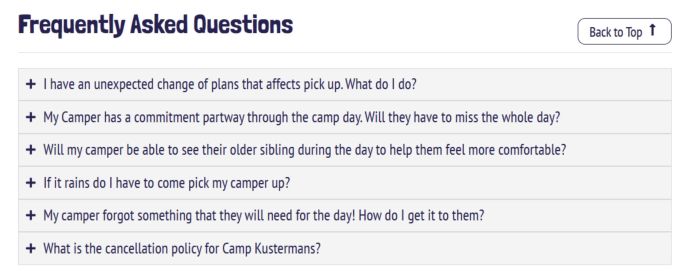
Example: This is what an FAQ section could look like on your camp landing page. Adding structured data to your FAQs increases the likelihood of appearing as a featured snippet on search engines. Be sure to use conversational language to optimize for voice search results. Don’t forget to leverage your FAQs for content planning. This is a great way to add value for site visitors – providing the answers they’re searching for in detail in more detail.
Source: Kustermans
3. Create a Strong Social Media Presence
Beyond posting regularly, an effective social media strategy involves using platform-specific features to maximize engagement. Instagram Stories and Reels allow you to share real-time updates, camper testimonials, and behind-the-scenes glimpses of camp life.
Facebook Groups can build a community of returning campers and interested parents, fostering discussion and sharing updates. TikTok offers a creative space to showcase fun camp activities through short, engaging videos that appeal to younger audiences.
Additionally, paid social media advertising is a great way to extend your reach. By running targeted ad campaigns on platforms like Facebook and Instagram, you can ensure your summer camp marketing efforts reach families actively looking for programs.
Geo-targeting and interest-based targeting allow you to refine your audience, ensuring your ads reach parents who are most likely to enroll their children. Running contests and giveaways on social media can also increase engagement and word-of-mouth promotion as parents and campers share your content with their networks.
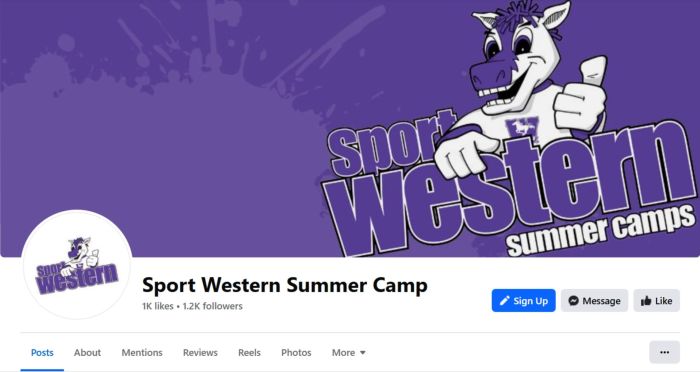
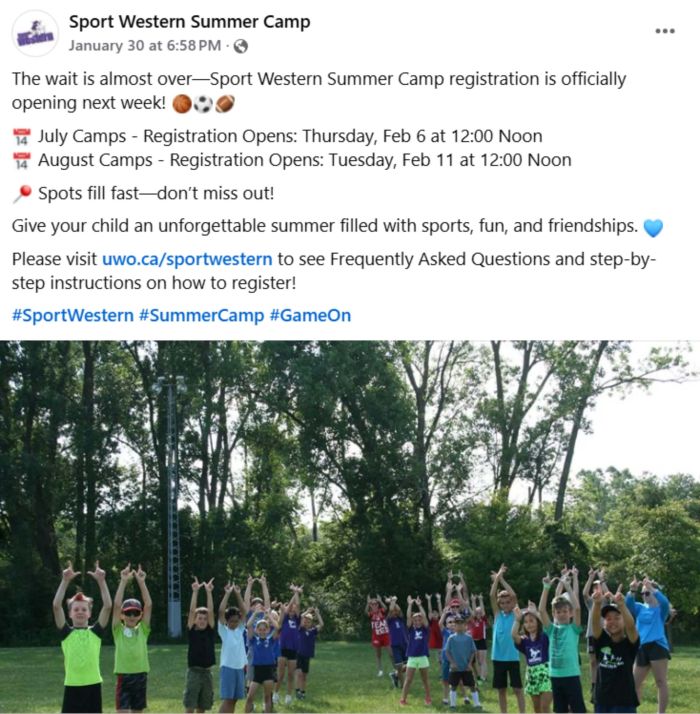
Example:Here, Western University uses its active Facebook page to maintain a strong presence, notify parents of important dates, build anticipation for the summer, and show off all of the fun activities in store. Their page features consistent branding setting them apart from other school summer camps.
Source: Sport Western Summer Camp | Facebook
4. Utilize Email Marketing Campaigns
Email marketing remains a powerful tool for reaching prospective campers and their families. Sending out newsletters with enrolment updates, discounts, and testimonials keeps your audience informed and engaged.
An effective email marketing strategy involves segmentation, where prospective families are grouped based on their engagement levels, preferences, and past interactions. You can ensure that each recipient receives relevant messaging by tailoring content to different segments, such as new inquiries, returning campers, and families who haven’t yet completed registration.
Drip email campaigns are particularly valuable for nurturing leads. These automated sequences gradually provide information about your camp, from program details to testimonials, making it easier for parents to commit. Additionally, incorporating visually appealing emails with compelling subject lines improves open rates and engagement.
5. Targeted Digital Advertising Campaigns
Traditional advertising is still effective, relevant, and part of a well-rounded marketing campaign. “How do I advertise my summer camp?” you ask. To advertise your summer camp using targeted ads, leverage platforms like Google Ads, Facebook, and Instagram to target parents actively searching for summer programs. By utilizing geo-targeting, interest-based segmentation, and retargeting campaigns, you can maximize ad visibility, drive inquiries, and increase enrolment conversions efficiently.
Google Ads enables your summer camp to appear at the top of search results when parents look for camp programs, increasing visibility. Running display ads and retargeting campaigns ensures that those who have previously visited your website are reminded of your offerings, improving conversion rates. Additionally, YouTube Ads allow you to showcase engaging video content of camp activities, testimonials, and program highlights to attract more interest.
Facebook and Instagram Ads offer detailed audience segmentation tools, allowing you to reach parents based on location, interests, and browsing behavior. Carousel, video, and story ads create immersive experiences that engage prospective campers and their families. To further boost engagement, A/B testing different ad creatives and copy variations helps refine messaging to determine what resonates best with your audience.
A/B testing involves creating multiple versions of an advertisement, landing page, or email to determine which version performs best. In digital advertising, A/B testing can compare different ad headlines, images, calls to action, and audience targeting strategies.
Advertisers can analyze performance metrics such as click-through rates (CTR), conversion rates, and engagement levels by running multiple variations simultaneously. The winning version can then be scaled for maximum impact, ensuring your budget is allocated to the most effective ad variations.
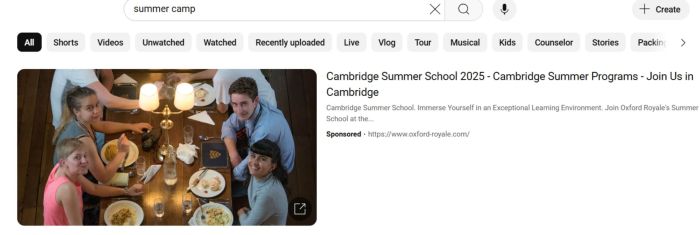
Example: When you invest in YouTube ads like the one pictured below, you can show up at the top of the platform’s summer camp search results and greatly expand your reach.
Source: YouTube
6. Encourage Camper and Parent Testimonials
Word-of-mouth remains a powerful marketing tool. Encouraging past campers and their parents to leave reviews on Google, Facebook, and your website adds credibility to your program. Video testimonials are particularly effective at providing an authentic look into the camp experience. Families researching camps trust peer reviews, and showcasing positive experiences helps establish trust and attract new registrations.
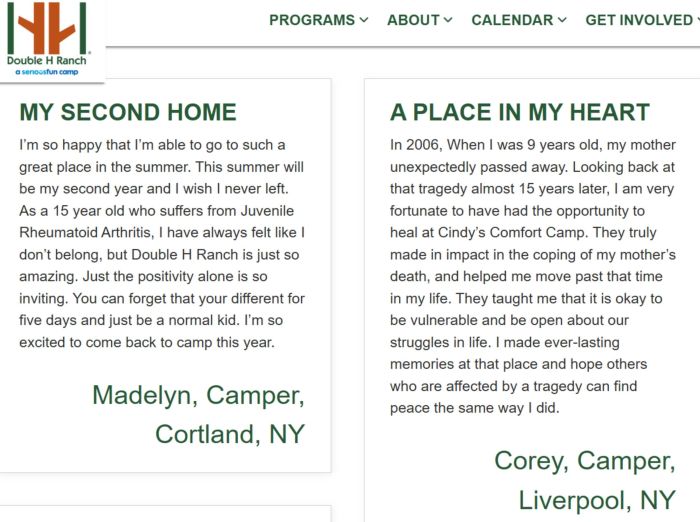
Example:Encourage happy campers to leave high-value testimonials highlighting how your program has positivly impacted their lives. The two pictured below are excellent examples of moving word-of-mouth endorsements that improve your program’s public reception and potentially incite desired action.
Source: Double H Ranch
7. Develop an Ambassador Program
Leveraging past campers as ambassadors can create a community-driven summer camp marketing effect that builds long-term brand loyalty. Encouraging past attendees to share their experiences and recommend your camp to friends and family fosters authentic promotion.
One of the most effective approaches is a structured referral program, where returning campers receive discounts or perks when they bring a friend. Offering rewards such as camp merchandise, VIP experiences, or exclusive access to special activities can further incentivize participation.
When working with minors as ambassadors, schools should obtain parental consent, follow child privacy regulations such as COPPA, and ensure that all promotional activities align with ethical guidelines to protect student identity and well-being.
Beyond peer referrals, partnering with local influencers, parenting bloggers, and community leaders can significantly amplify your reach. Inviting these ambassadors to visit your camp, create content, and share their experiences with their followers can increase visibility among parents searching for reputable programs. Providing them with branded hashtags, social media templates, and storytelling prompts ensures consistent and compelling messaging.
To sustain engagement, camps should maintain an ongoing relationship with ambassadors by featuring them in newsletters, social media posts, and alumni spotlights. Creating private groups or online communities for ambassadors fosters a sense of belonging and motivates them to continue advocating for your camp. Implementing an easy-to-use referral tracking system helps measure success and refine strategies for maximum impact.
8. Highlight Your Camp’s Unique Selling Points (USPS)
In a competitive summer camp market, it is crucial to clearly define and communicate your camp’s unique selling points (USPs) to stand out from the rest. Parents and campers have many choices, so highlighting what makes your camp different will help you attract the right audience and increase enrolment.
A USP is a distinct feature or quality that sets your camp apart. To effectively market your camp, you must identify and promote these features across your website, social media, and advertising campaigns. Below are some strong examples of USPs that summer camps can highlight:
Specialized Programs
Small Camper-to-Counselor Ratio
Exclusive Locations
Highly Qualified Staff
Customizable Camp Experiences
Unique Themes or Storylines
Exclusive Partnerships
All-Inclusive Pricing and Amenities
Once you’ve identified your USPs, ensure they are featured prominently on your website homepage, camp brochures, social media posts, and digital advertising. Use testimonials from past campers and parents to reinforce the uniqueness of your offerings.
Example: The School of Magic is unique because of its emphasis on connecting with nature and developing real-world skills. Those unique selling points are evident in the Instagram post below. What sets your summer camp program apart?
Source: The School of Magic
9. Partner With Schools and Community Organizations
Collaborating with schools and local community centers broadens your marketing reach. Schools can distribute flyers and email newsletters promoting your camp, while community organizations can help you reach families looking for summer activities. Building partnerships with educational institutions ensures that your camp gains credibility and visibility in trusted spaces where families make enrolment decisions. Create a buzz around any partnerships in your content across various platforms.
Example: On its website, the Canadian Adventure Camp has a tab called Memberships and Partnerships. There, they list and explain their collaborations and community involvement, showcasing how they add value for campers, families, and those in need. If you’re collaborating with any organization or if you’re involved in charity work, be sure to highlight how you make a difference!
Source: Canadian Adventure Camp
10. Optimize Your Camp’s Mobile Experience
With more parents researching and booking camps on their smartphones, having a mobile-optimized digital presence is essential. A slow or non-responsive website can drive potential campers away, leading to lost enrolment opportunities. To ensure a seamless mobile experience, camps should prioritize mobile usability in all aspects of their digital marketing strategy.
Responsive web design is the foundation of a successful mobile experience. Your website should automatically adjust to different screen sizes, ensuring readers can easily browse your camp’s programs, pricing, and enrolment details on any device. Without this adaptability, parents may abandon their search in favor of a competitor with a more mobile-friendly platform.
Fast load times are another critical factor. If a webpage takes too long to load, parents may become frustrated and leave before completing the registration process. Optimizing images, minimizing unnecessary code, and leveraging browser caching can significantly improve site speed. Google prioritizes fast-loading websites in search results, meaning that a well-optimized mobile site can enhance your summer camp advertisement efforts by increasing visibility in search rankings.
Once a parent arrives on your site, easy navigation and registration are essential. Mobile users should be able to access key pages; such as program descriptions, schedules, and pricing, within a few taps. Registration forms should be concise, requiring only necessary information, and offer autofill features to streamline the process.
Providing click-to-call and chat features offers immediate communication options for parents with questions. A simple button allowing users to call directly from their mobile device or engage in a live chat session with a representative can make a huge difference in converting inquiries into sign-ups. Chatbots can also be used for quick responses outside of business hours, ensuring prospective campers receive the information they need when they need it.
Finally, mobile-friendly payment options make transactions seamless. Integrating secure, one-click payment solutions like Apple Pay, Google Pay, or PayPal can speed up registration and reduce drop-offs. Parents should be able to complete payment without switching devices or navigating through a complex checkout system.
Boost Your Camp Enrolment Today!
Marketing a summer camp successfully requires a well-rounded, strategic approach that meets parents and campers where they are—online! By leveraging SEO, content marketing, social media, email campaigns, paid advertising, and mobile optimization, you can increase visibility, boost engagement, and ultimately drive more enrolments. Highlighting your camp’s unique selling points, developing a strong ambassador program, and ensuring a seamless mobile experience will set your camp apart in a competitive market.
With the right mix of digital marketing techniques, your summer camp can attract the right audience and maximize registrations year after year. Whether refining your summer camp advertisement strategy, improving your website, or launching targeted ad campaigns, a data-driven approach ensures long-term success.
At Higher Education Marketing, we specialize in helping camps and educational institutions implement proven digital marketing strategies that deliver results. If you’re ready to take your summer camp marketing to the next level, reach out to us today to learn how we can help you achieve your enrolment goals.
Struggling with enrollment?
Our expert digital marketing services can help you attract and enroll more students!
The AI Opportunities Action Plan, led by Matt Clifford CBE and announced in January, documents recommendations for the government to grow the UK’s AI sector to ‘position the UK to be an AI maker, not an AI taker’ in the field and help achieve economic growth.
The UK’s AI Action Plan highlights the critical need to harness international talent and expand the workforce with AI expertise. However, this ambition is at odds with recent moves by the British government to limit international student numbers through stricter visa regulations, leading universities to make difficult decisions—cutting courses, slashing budgets, and exploring alternative strategies to maintain financial stability and global relevance.
The AI Action Plan: A policy contradiction
Despite a well-documented skills gap in the UK’s AI sector, the Government’s actions have forced universities to pivot toward establishing global campuses in a bid to preserve financial stability and maintain and promote international collaboration in general. This trend is exemplified by universities like Coventry University, which opened a campus in Delhi last year, and the University of Lancaster’s partnership with Deakin University in Indonesia. Today, UK universities operate 38 campuses across 18 countries, educating more than 67,750 students abroad.
While these international campuses help extend the UK’s academic reach, the UK’s immigration policies are creating significant barriers to attracting top-tier AI talent to work domestically. Many international graduates, trained to UK standards, are struggling to secure postgraduate visas for themselves and their families, preventing them from contributing their skills to the UK economy.
Visa barriers for graduates
One of the main visa routes intended to help international talent integrate into the UK workforce is the High Potential Individual (HPI) visa. The HPI visa is a UK immigration pathway designed for recent graduates from 40 top global universities, allowing them to live and work in the UK for several years. However, this scheme remains restrictive. To qualify, applicants must have a qualification from one of the eligible global universities in the last five years. Of the universities included, 47.62% are from the US, and there is just one institution from the entire southern hemisphere on the list.
The AI action plan recommended the government consider reforming the HPI pathway with ‘graduates from some leading AI institutions, such as the Indian Institutes of Technology and (since 2020) Carnegie Mellon University in the US, are not currently included in the High Potential Individual visa eligibility list’.
The AI Action Plan itself highlights the need for a rethink of the UK’s immigration system to attract graduates from top AI institutions worldwide. However, the government has only ‘partially agreed‘ with this recommendation, pointing to existing visa schemes that they believe meet the needs of skilled workers, including AI graduates. However, it can be argued that the UK visa process is often expensive, and Global Talent Visas require employer sponsorship while failing to account for the challenges that international graduates face when trying to secure long-term employment, especially in industries with rapidly evolving skills like AI. Even if the HPI eligibility list was expanded, our existing visa pathways are too restrictive to support a rapid influx of skilled graduates.
Government and university collaboration
The AI Action Plan calls on the government to ‘support Higher Education institutions in increasing the number of AI graduates and teaching industry-relevant skills.’ The reality is that many UK universities have already adjusted their strategies to cope with both domestic financial pressures and the measures introduced to quell international students through restricted immigration pathways.
The question remains whether universities will be expected to reverse course, intensify efforts to recruit domestically and retain AI talent to meet the government’s urgent targets. Without a targeted and affordable visa system to support these efforts, the AI Action Plan’s goals risk falling short of their potential.
This is not about asking Universities to ensure that their international students have clear career pathways post-graduation or providing AI-specific courses. The government must create an AI-specific visa that allows graduates from top global institutions to work in the UK.
The real need lies in fostering closer collaboration between higher education institutions and government policymakers, particularly when it comes to visas. The government must take responsibility for creating a new visa pathway if it wants to meet the aims of the AI action plan. Universities cannot be expected to U-turn- develop new courses in the face of financial constraints and restrictive visa policies.
Mauve Group is a global HR, Employer of Record and business consultancy provider. Mauve specialises in supporting organisations of all sizes to expand overseas, helping companies navigate the complexities of employing workers across borders.
The Equality and Human Rights Commission is the regulator for equality and human rights issues. We intervened in the case of The University of Bristol v Dr Robert Abrahart to provide guidance to the court about the Equality Act 2010. The Act has been in force for over 10 years, so the legal duties contained within it are not new. However, we were concerned that there was confusion about how those duties are interpreted in the higher education sector.
Natasha Abrahart was 20 years old when she took her own life in April 2018. Her lecturers were aware that she was not well, noting that she did seem to have ‘a genuine case of some form of social anxiety’. However, no reasonable adjustments were made to how she was assessed, and she was still expected to attend oral interviews and participate in a group presentation. The University argued that oral communication was a ‘competence standard’, which is specifically excluded from the reasonable adjustments duty under the Equality Act.
The definition of disability is broad. Under Section 7 and Schedule 1 of the Equality Act, disability is defined as a physical or mental impairment that has a substantial and long-term adverse effect on a person’s ability to complete daily activities. ‘Long-term’ includes likely to last for more than 12 months. Although Natasha Abrahart suffered from a mental illness, physical conditions are also covered by the Act.
The court found that the University had indirectly discriminated against Natasha, discriminated against her as a consequence of her disability, and failed to make reasonable adjustments for her. The court also gave guidance to the sector, which we have distilled into our Advice Note.
The duties on universities are set out in law, which has been in force for approaching 15 years. Further, the duties apply to all students (and staff members) whether they attend university for a single term or for the rest of their student career.
Three of the key takeaways from the judgment relate to knowledge, evidence and competence standards.
In relation to knowledge, if one member of staff at a university knows about a student’s disability, then the whole university knows, and the duties not to discriminate take effect. So, if a student only tells the most junior administrator about their disability, and that staff member doesn’t pass the information on, the university is nonetheless bound by the Equality Act.
With regard to evidence, the judge in the Abrahart case said:
‘…what a disabled person says and does is evidence. There may be circumstances, such as urgency or the severity of their condition, in which a court will be prepared to conclude that it is sufficient evidence for an educational institution to be required to take action.’
This makes clear that it is not appropriate for a university to insist that a disabled student provide a doctor’s letter when the student is clearly severely ill. The duty on the university is to act, even where there is no formal medical diagnosis or evidence. There is no reciprocal duty on the student.
Competence standards are academic, medical or other standards applied for the purpose of determining whether or not a student has reached a particular level of competence or ability. A student has to reach the standard to show that they have attained the necessary level to pass or proceed on their course of studies. However, the way in which a competence standard is measured is still subject to the reasonable adjustments duty, so adjustments must be made to the method of assessment. The court found that the way in which a student’s level of knowledge or understanding, or the way their ability to actually complete the task is measured, is the method of assessment. It said this is rarely, if ever, a competence standard.
Our Advice Note provides some guidance on steps universities can take to ensure that they are complying with the Equality Act.
In addition to complying with the law, there are other potential benefits for institutions in taking those steps. These include providing a better student experience by prioritising student welfare, and reducing pressures on staff. It also allows students to gain valuable experience which will benefit them in working alongside disabled colleagues when they enter the workforce.
However, alongside the benefits to staff and student wellbeing, there are consequences for failing to comply with Equality Act duties.
Higher education students may complain to the Office of the Independent Adjudicator for Higher Education (OIAHE) in England and Wales, or to the Ombudsman in Scotland and Northern Ireland. Complaints can result in financial redress and recommendations for improvement. The OIA also publishes annual statements setting out each institution’s performance.
Students may also bring litigation in the County Court under the Equality Act. This is what Dr and Mrs Abrahart did, and it resulted in the payment of considerable damages to them by the University of Bristol, not to mention the additional costs to the University of defending complex litigation. We anticipate that the spotlight currently shining on this issue may well see an increase in these cases. Litigation can also be reputationally damaging.
There may be issues about breaches of contract where universities fail to make reasonable adjustments when these have been recommended by the Disability Service. From our perspective, the outcome of any such dispute does not detract from a separate and distinct obligation to comply with the Equality Act 2010, which is a distinct cause of action.
Of interest to the higher education sector, the Equality and Human Rights Commission may take regulatory action if institutions fail to comply with the Equality Act. We have a range of legal powers, including investigating organisations where we suspect a breach of the Act. As an alternative to an investigation, the Commission can enter into agreements and action plans with organisations to achieve compliance with the law.
We know that there is a great deal of excellent work taking place across the sector. For example, Oxford University is working on incorporating inclusivity into its teaching practices, with the joint benefits of making the environment more welcoming for disabled students and allowing its Disability Service to act as consultants on the most complex cases. The University of Bristol recently updated its regulations, is undertaking staff training, and continues with its programme of improvement to its wellbeing services. And the Open University has completed a mapping exercise to identify the key ‘crunch points’ faced by disabled students in their education journey and is working to embed robust escalation processes to ensure that adjustments are made when needed.
Reasonable adjustments could help hundreds of thousands of disabled students across the country reach their potential, and we have to make sure those students can access them. We know that the higher education sector is working hard, with limited resources, to address the issue. As Britain’s equality regulator, we will continue to support the sector as universities adapt to meet their legal duties to disabled students.
This HEPI blog was kindly authored by colleagues at the German Embassy in London and the German Academic Exchange Service (DAAD).
#ShoutOutForGerman – this is the title of a week-long campaign from 17 to 21 March to showcase all things German across the entire UK and inspire learning German. The German Embassy London and the German Academic Exchange Service are only two of the organisations behind this campaign. Why are we shouting out for German? Because the steady decline of German learners in the UK, of students pursuing German at the university level, the closure of language departments and the ongoing threat of further closures is a cause for concern.
The benefits of learning German are clear: it provides students with communication skills and enhances career opportunities, but it also fosters closer economic and cultural ties between the UK and Germany. The German Embassy in London and the German Academic Exchange Service both work to strengthen language learning in general and German in particular at British universities.
There are countless reasons for studying German. Just like learning any foreign language, it equips people with critical communication and transferable skills, opens the door to other ways of thinking, and strengthens personal connections across borders. The case for German is even stronger, as it is the most sought-after foreign language among UK employers and a key language in fields such as science, engineering, finance, and international relations. Germany remains the UK’s second-largest goods trading partner, and a strong command of the language provides a competitive advantage in the job market. German is the language of influential philosophers, writers, and scientists, offering access to a rich intellectual and cultural heritage.
Beyond the economic advantages, language learning plays a crucial role in diplomacy and international relations. The ability to speak each other’s language fosters trust, facilitates collaboration, and strengthens bilateral ties. As John le Carré once said, “The decision to learn a foreign language is an act of friendship.” Looking at the events unfolding in today’s world, it would be a gross understatement to say that the European continent is facing a multitude of challenges. To navigate the new realities, to preserve our safety, our hard-fought liberties, our prosperity and place in the world, the links between the UK and its European neighbours will be of pivotal importance – and key among them is the German-British partnership. Learning each other’s language can be understood as a commitment to strengthen and future-proof this partnership from the ground up.
A Declining Trend in German Studies
And yet, demand for studying languages at universities has been in a downtrend, and courses offered have been declining in parallel. According to HESA, the numbers of full-time students enrolled in German or German studies at British universities decreased from 1,780 in 2019 to 1,330 in 2023, marking a 25% decrease in just four years. This highlights an alarming trend that could lead to further erosion of German language education in higher education institutions. In lockstep, severaluniversities have closed their language departments entirely in recent years in response to budget constraints. Language centres can only, in part, make up for the loss that is generated by the lack of language degree courses – even though their existence is proof of the value and necessity universities attribute to language skills.
This development is, among others, a consequence of various decisions which have shaped the nature of educational politics in the UK as we know them today. It is thus more important than ever, that languages are given their due place in England’s Curriculum and Assessment Review – where the German Ambassador has made the plea for consistent language instruction over the entire educational journey. The assessment represents an important fork in the road and opportunity for a firm push towards stopping and gradually reversing the downtrend in language learning, lest it have long-term consequences for Britain’s position in global academia, diplomacy, and business.
The German Embassy and DAAD’s Commitment to German in the UK
The DAAD London has been around for over 70 years, as the DAAD’s oldest branch in the world. The German Embassy, the DAAD, and the Goethe-Institut London have been actively engaged in promoting German across all sectors in the UK for years. From providing scholarships and funding for students to supporting language teaching and teacher training at universities, we have consistently worked to strengthen German language education.
Each year, the DAAD funds many UK students to spend part of their summer at German universities, where they have the chance to learn German alongside young people from around the world. The annual German Language Competition, in collaboration with the Institute for Languages, Cultures, and Societies and other partners, encourages German learners to explore creative themes such as But Don’t Mention the War, Roads Not Taken and Love Letters between Victoria and Albert. The DAAD’s mission to promote the German language dates back to 1952, when the first DAAD Lecturer was placed at Aberystwyth University. At the time, no one could have predicted that this would lead to thousands more coming to the UK, teaching German language, literature, and culture to young Britons across UK universities. Our latest push comes in the form of our “Making the Case for German” initiative, which the German Ambassador Miguel Berger launched in late 2023 in partnership with the DAAD and the Goethe-Institut London. It serves as a comprehensive platform open to all who promote German in every sector, including schools, universities, and cultural organisations. Launched as a nationwide alliance, the initiative fosters collaboration through events, forums, and partnerships.
Such an alliance is necessary as this is a challenge we must address collectively. The Embassy, the DAAD, the Goethe-Institut and our partners will continue to support German in the UK through strategic initiatives, funding opportunities, and advocacy, but in order to reverse the trend, a national effort is needed. Universities, educators, policymakers, and businesses must work together to ensure that future generations have access to quality language education, and a communicative effort is necessary for people to recognize its immense value.
Giving a Collective #ShoutOutForGerman from 17 to 21 March
This is the reason why we came up with the idea for a #shoutoutforGerman campaign. In the week of 17 to 21 March dubbed German Week, we will celebrate all teachers and schools, university lecturers and German or Modern Languages departments, parents and pupils, students and civil society organisations such as town twinning associations as well as any individuals out there in the UK who are working very hard to keep German alive. Each and every one can take part, sharing what they like about German language, literature or culture. By sharing positive stories under the hashtag #ShoutOutForGerman, we will collectively give a huge shout out for all things German in the UK and hopefully convince some to dip their toes into the language of Klopp and Tuchel. The DAAD and the Goethe-Institut have further strengthened this campaign by offering a range of offerings to universities and schools alike.
Looking ahead
We firmly believe that multilingualism is not a luxury but a necessity in today’s world and that quality language education should be available to everybody. The Embassy, together with the Goethe-Institut, the DAAD and its partners will continue to make the case for German all across the country, by building alliances and supporting individual efforts to the best of our abilities. In this vein, the Embassy will soon start to officially recognise individuals and organisations who have shown particular dedication in promoting German in the UK. If Britain is to remain globally competitive, culturally enriched, and diplomatically agile, the decline in language learning has to be reversed. And German, as one of the most widely spoken languages in Europe and a key language of business and diplomacy, should be at the heart of that effort.
The HEPI blog was kindly authored by James Pitman, Chair of IHE and Managing Director U.K. and Ireland, Study Group
The Graduate Route has been extraordinarily powerful in driving international education value in the UK. Although all the surveys show students choose universities and courses for their reputation or fit, the opportunity to translate this into a first job in another country to strengthen English language skills as they earn is evidenced by what happens as soon as that is taken away.
The correlation between removing the Post Study Work Visa scheme on the back of statistically invalid analysis and the drop in international students choosing the UK in 2012 is irrefutable. This is strengthened by the significant international student growth linked to the re-introduction of the Graduate Route in 2021.
Why is the graduate route visa such a powerful incentive for some international students to come and study in the UK? The simplest explanation came from an agent in India, who explained:
‘An Indian student can recoup much of their investment in a UK degree over a few years of employment in the UK when it would take several decades to do the same back in India.’
International students contribute a net £100,000 to the UK economy during their degree study. A degree is required to enter the Graduate Route. Therefore, one could consider the ‘entry ticket’ for a Graduate Route visa to be a £100,000 investment in the UK – which may be worth up to £30,000 to the exchequer. From a Treasury growth perspective, international students drive employment and economic benefit in every constituency of the UK, especially in university towns and cities. I doubt the mandarins at the Treasury could think of a more cost-effective measure that seeds prosperity right across the country while building connections and loyalty that last a lifetime amongst the very group who will, in years to come, shape societies and build companies.
Oxford Economics concluded that every 10 international students supports 6 jobs, with half in Higher Education and half in the local economy. If this remains accurate, the reported loss of approximately 10,000 jobs in Higher Education last year, mainly attributed to the decline in international students, should correspond to a similar loss in local economies across the country.
And yet this is economic harm proactively driven by policy choices which raised uncertainty regarding the future of the Graduate Route. If you were thinking of making a £100,000 investment, uncertainty would not exactly be conducive to choosing to invest in the UK. As one local businessman in Sheffield put it, “If you walk past a shop window swinging a baseball bat for a couple of weeks, it doesn’t matter if you never hit it, the people inside will still get worried.” Even just the threat of future policy changes creates “a massive amount of uncertainty, and uncertainty for students is a big problem.”
Subsidising the domestic tax payer
Students on the Graduate Route, like all international students, pay the Immigration Health Surcharge (currently £776 p.a. for students and £1035 p.a. for graduates on the Graduate Route). The actual costs according to the Department of Health and Social Care in 2018 were £480 p.a. including dependants. Given the restrictions on dependants, a shift in the mix (until recent restrictions) to shorter PG courses, the prevalence of private insurance that many students have and the reality of waiting times for treatment, this is a subsidy to the NHS.
Another subsidy is less well known, but any student on the Graduate Route employed at any salary level, high or low, is actually subsiding the UK tax payer. In comparison with a domestic employee at the exact same level of remuneration, international students pay the same income tax and National Insurance, but critically, they can only access less than half of the services that those taxes pay for. International students on the Graduate Route are barred from benefiting from services provided in the areas of Education, Social Protection, and Housing, and they already subsidise the NHS, as shown above. Those four areas account for c.65% of public sector expenditure on services (PESA 2023/4). Another way of putting this is that international students employed on the Graduate Route are effectively paying income tax at double the rate of a domestic equivalent worker.
The dependants dilemma — a third way
However, the Migration Advisory Committee has argued that there is a subsidy element for international students. This seems to be based on the fact that international students could, until last year, bring unlimited numbers of dependants and that any child dependants had access to free education at the UK taxpayer’s cost. This option was then removed with a devastating knock-on impact for university finances.
However, it is instructive to note that the options considered around this issue were binary — either close the dependants route (the approach taken for any students other than for those on research-intensive PG courses) or leave the system as was. What was not considered was adapting the dependants’ visa by removing access to free childhood education but leaving the route, which would have caused far less damage to international student recruitment in 2024. Instead, removing the dependant’s route caused significant damage that disadvantaged female students and students from cultures where chaperones are required. I know the options considered, because the Home Office responded to an FOI on this matter. Let us also remember that dependants have always been (as the name implies) dependant on the international student that they accompany, not the UK tax payer.
Cost-benefit analysis
In reality, in economic terms, international graduates are more akin to tourists, having no recourse to public funds (apart from the historical significant exception of child dependants) and bringing resources into the UK to sustain themselves. However, unlike tourists, they do have to pay the Immigration Health Surcharge.
To give an indicator of the cost to the UK of restricting international students coming to study in the UK over that period, I compared the government-published data on value and growth rates of international education from 2010 to 2024 to the equivalent global international student mobility value growth rates published by Holon IQ (part of the QS Quacquarelli Symonds, group). It is only an indicator, but against the UK having been permitted by government to grow at the same growth rate as the global market (which I doubt many in the sector would have bet against), cumulative loss to GDP over that period was £66 billion, implying a cumulative loss of income to the exchequer of £23 Billion. How many hospitals, schools and roads would be in better shape today if that scale of investment had been funded by international education? What a wasted opportunity, and for what purpose?
Now, the Prime Minister tells us his priorities are security and growth. On both, international students can be a key part of a progressive policy shift. And yet it is sad to say that our new government, whilst saying the right things, has not yet done anything to undo the damage of the past. If reports are to be believed, they are even being tempted to impose even more restrictions on international students in the Immigration White Paper to be published this month, preceding the new iteration of the International Education Strategy in April.
Once again, it appears that those who are tasked with reducing immigration are acting in direct opposition to the avowed growth agenda of the Treasury, the Department of Business and Trade, the Department for Education and others and, quite frankly, considering the above, against the demonstrable interests of the UK.
Rethinking terms
I have a clear understanding of the root cause of this ambivalence towards international students, and I direct any interested readers to the HEPI blog ‘When is an Immigrant not an Immigrant’. Allpolling of the general public (most recently by Public Future) shows that they recognise international students are not immigrants, and a strong majority cannot comprehend why they are categorised in the same way. If our government is serious about growth, I urge them to separate international students from immigration immediately.
Finally, again, to demonstrate the value of international students, we should consider the increasingly dangerous situation we find ourselves in and the government’s commitment to ramp up defence spending. That incremental 0.2% GDP or £6 billion spend, announced recently, could have avoided the contentious cut in the overseas budget.
Why didn’t the Treasury consider international education instead? With no investment needed beyond the political will to enhance the UK’s international education offering, we could provide high-quality education to an additional 175,000 international students (that’s merely, on average, 1,250 per university). At current rates, this would generate around £6 billion for the exchequer from each cohort while also supporting the creation of approximately 50,000 jobs in higher education and another 50,000 jobs for hard-pressed families in local communities across the UK. Furthermore, it would significantly enhance the UK’s soft power in the long term.
Many in the international education sector believe that our ability to welcome students is, in financial terms, as near as our country can get to a golden goose, although not one that will live forever. The Graduate Route is a key golden lever in its nest. International students bring huge investments in order to access the benefits of the Graduate Route, subsidise the UK taxpayer while they are on it and can only remain in the UK after that with another category of visa.
Ronald Barnett is (www.ronaldbarnett.co.uk), Emeritus Professor of Higher Education at the Institute of Education and President of the Philosophy and Theory of Higher Education Society.
Chris Husbands’ latest HEPI blog is fine so far as it goes but, I suggest, it goes neither wide enough nor deep enough. Yes, the world is changing, and higher education institutions have to change, but the analysis of ‘change’ has to encompass the whole world (have great width) and also to burrow down into the deep structures of a world in turbulent motion (and so have much depth).
The current crisis in UK higher education – and especially in higher education in England – has to be set more fully in the context of massive global shifts that directly affect higher education. These are too many to enumerate entirely here, but they include:
A hyper-fast world: Theorists speak of cognitive capitalism, but we have already moved into a new stage of electronic capitalism (of which AI is but the most evident feature).
Volatile labour markets (disrupting the relationship between higher education and the world of work)
A fragmenting state of student being: now, their higher education is just part of an incredibly complex life and set of challenges with which students are confronted
Geo-political shifts affecting (and the reduction of) the internationalisation of higher education; and
An entirely new complex of human needs (physical, cognitive, social, political, environmental, and phenomenological) for learning to be part of life, ‘cradle-to-grave’.
In short, the world is fast-changing not only around higher education but in the depths of higher education in ways not yet fully appreciated. It is a world that is going through multiple and unimagined transformations, transformations that are replete with conflicts and antagonisms that are both material and discursive. These changes are already having effects on higher education, especially on what it is to be a student.
Now, students are increasingly part-time (whatever the formal designation of their programmes of study). Moreover, they play out their lives across multiple ecosystems – including the economy, social institutions, culture, the polity, the self, knowledge, learning, the digital environment, and Nature. In the context of these nine ever-moving ecosystems, what it is to be a student is now torn open, fragmented, and bewildering to many.
More still, many students of today will be alive in the 22nd century and will have to navigate an Earth, a world, that will exhibit many stages of anxiety-provoking and even possibly terrifying change. Sheer being itself is challenged under such circumstances and, more so, the very being of students. And we see all this in spades in (quite understandable) growing student anxiety and even suicide.
In this context, and under these conditions, a model and an idea of higher education bequeathed to the world largely from early 19th century Europe (Germany and England) no longer matches the present and the future age for which students are destined.
Crucially, here, we are confronted by profound changes that are not just institutional and material in that sense, but we are – and students are – confronted with unnoticed changes in the discourse of higher education. Not just what it means to be a student but the very meaning of student is changing in front of us; yet largely unnoticed. (Is being a student a matter of dutifully acquiring skills for an AI world or is it to set up encampments so as actively to engage with and to be a troublesome presence in world-wide conflicts?)
Fundamental here is the idea of higher education. Fifty years ago, some remnants of the idea of the university from 19th century Europe could romantically be held onto. Ideas of reason, truth, student development, consciousness-raising, critical thinking and even emancipation were concepts that could be used without too much embarrassment. But now, that discourse and the pedagogical goals and relationships that it stood for have almost entirely dissolved, overtaken and trivialised by talk of skills, work-readiness, employability, impact and of using but of being ‘critical’ of AI.
It is a commonplace – not least in the higher education consultancies and think-tanks – to hear murmurings to the effect that institutions of higher education must change (and are insufficiently changing). Yes, most certainly. And some signs of change are apparent. In England alone, we see talk of (but little concerted action on) life-long learning, formation of tertiary education as such, better higher education-further education connections, micro-credentials, ‘alternative providers’, shortened degrees, AI and recovering part-time higher education (disastrously virtually vanquished, regretted now by David Willetts, its progenitor).
These are but some of the adjustments that the large and complex higher education can be seen to be making to the challenges of the age. But it is piecemeal in a fundamental sense, namely that it is not being advanced on the basis of a broad and deep analysis of the problem situation.
Some say we need a new Robbins, and there is more to that idea than many realise. Robbins was a free-market economist, but the then general understanding as to what constituted a higher education and the balance of the Robbins committee, with a phalanx of heavy-weight educationalists, resulted in a progressive vision of higher education. Now, though, we need new levels of analysis and imaginative thinking.
Consider just one of the changes into which English higher education is stumbling, that of life-long learning and its associated idea of credit accumulation. Credit accumulation was first enunciated as an idea in English higher education in the 1980s through the Council for National Academic Awards (and there through the efforts especially of Norman Evans and Peter Toyne). But the idea of universities as a site where the formation of human beings for a life of never-ending inquiry, learning and self-formation has never seriously been pursued, either practically or theoretically.
Now, life-long learning is more urgent than ever, but the necessary depth and width of the matters it prompts are hardly to be seen or heard. However, and as intimated, this matter is just one of a raft of interconnected and mega issues around post-school education today.
As is said, there is no magic bullet here in such an interconnected world. Joined-up progress is essential, from UNESCO and suchlike to the teacher and class of students. The key is the individual institution of higher education, which now has a responsibility to become aware of its multiple ecosystem environment and work out a game-plan in each of the nine ecosystems identified above.
At the heart of that ecosystem scanning has to be the individual student. Let this design process start from the bottom-up – the flourishing of the individual student living into the C22. It would be a design process that tackles head-on what it is to live purposefully in a world of constant change, challenge and conflict and what might we hope for from university graduates against such a horizon. Addressing and answering this double question within each university – for each university will have its own perspective – will amount to nothing less than a revolution in higher education.
This HEPI blog was authored by Isabelle Bristow, Managing Director UK and Europe at Studiosity.
In a HEPI blog published almost a year ago, Student Voices on AI: Navigating Expectations and Opportunities, I reported the findings of global research Studiosity commissioned with YouGov on students’ attitudes towards artificial intelligence (AI). The intervening year would be considered a relatively small time period in a more regular higher education setting. However, given the rapid pace of change within the Gen-AI sphere, this one year is practically aeons.
We have recently commissioned a further YouGov survey to explore the motivations, emotions, and needs of over 2,200 students from 151 universities in the UK.
Below, I will cover the top five takeaways from this new round of research, but first, which students are using AI?
64% of all students have used AI tools to help with assignments or study tasks.
International student use (87%) is a staggering 27% higher than their domestic student counterparts (60%).
There’s a 21% difference between students who identify as female who said they have never used AI tools for study tasks (42%) compared with those identifying as male (21%).
Only 17% of students studying business said they have never used it, compared with 46% studying Humanities and Social Sciences.
The highest reported use is by students studying in London at 78%, and conversely, the highest non-use was reported by students studying in Scotland at 44%.
The Top Five Takeaways:
There is an 11% increase from last year in students thinking that their university is adapting fast enough to provide AI study support tools.
Following a year of global Gen-AI development and another year for institutions to adapt, students who believe their university is adjusting quickly enough remain in the minority this year at 47%, up from 36% in 2024. The remaining 53% of student respondents believe their institution has more to do.
When asked if they expect their university to offer AI support tools to students, the result is the same as last year – with 39% of students answering yes to this question. This was significantly higher for male students at 51% (up by 3% from last year) and for international students 61% (up by 4% from last year). Once again, this year, business students have the highest expectations at 58% (just 1% higher than last year). Following this, medicine (53%), nursing (48%) and STEM (46%) were more likely to respond ‘Yes’ when asked if they expect their university to provide AI tools.
Some students have concerns over academic integrity.
When asked if they felt their university should provide AI tools, students who answered’ no’ were given a free text box to explain their reasoning. Most of these responses related to academic integrity.
‘I don’t think unis support its use because it helps students plagiarise and cheat.’
‘I think AI beats the whole idea of a degree, but it can be used for grammar correction and general fluidity.’
‘Because it would be unfair and result in the student not really learning or thinking for themselves.’
Only 7% of students said they would use an AI tool for help with plagiarism or referencing (‘Ask my lecturer’ was at 30% and ‘Use a 24/7 university online writing feedback tool’ was at 21%).
Students who use AI regularly are less likely to rank ‘fear of failing’ as one of their top three study stresses
We asked all students – regardless of their AI use – of their top three reasons for feeling stressed about studying the responses were as follows:
61% of all UK students included ‘fear of failing’ in their top 3 reasons for feeling stressed about studying;
52% of all students included ‘balancing other commitments’; and
41% of all students included ‘preparing for exams and assessments’.
These statistics change when we filter by students who use AI tools to help with assignments or study tasks. Fear of failing is still the highest-ranked study stress. The percentage of respondents who rank fear of failing in their top three study stresses by AI use are as follows:
69% for those who never use AI;
62% for those who have used AI once or twice;
58% for those who have used AI a few times and;
50% for those who use AI regularly.
Looking at the main reasons students want to use the university’s AI service for support or feedback, this year, ‘confidence’ (25%) overtook ‘speed’ (16%). Female respondents, in particular, are using AI for reasons relating to confidence at 29%, compared to 20% for male students. International students valued ‘skills’ the most at 20%, significantly higher than their domestic student counterparts at 11%.
Students who feel like they belong are more likely to use AI.
We examined the correlation between students’ sense of belonging in their university community, and the amount they use AI tools to help with assignments or study tasks.
For students who feel like they belong, 67% said they have used AI tools to help with assignments or study tasks; this compares with 47% for students who do not feel like they belong.
5. Cognitive offloading (using technology to circumvent the ‘learning element’ of a task) is a top concern of academics and institutional leadership in 2025. However, student responses suggest they feel they are both learning and improving their skills when using generative tools.
When asked if they were confident they are learning as well as improving their own skills when using generative tools, students responded as follows:
12% ‘were extremely confident that they were learning and developing skills;
31% were very confident;
29% were moderately confident;
26% were moderately confident; and
Only 5% were not at all confident that this was true.
Conclusion:
Reflecting on the three years since Gen-AI’s disruptive entrance into the mainstream, the sector has now come to terms with the power, potential, and risks of Gen-AI. There is also a significantly better understanding of the importance of ensuring these tools enhance student learning rather than undermining it by offloading cognitive effort.
Leaders can look to a holistic approach to university-approved, trusted Gen-AI support, to improve student outcomes, experience and wellbeing.
—
You can download the full Annual Global Student Wellbeing Survey – UK report here.
Studiosity is a HEPI Partner. Studiosity is AI-for-Learning, not corrections – to scale student success, empower educators, and improve retention with a proven 4.4x ROI, while ensuring integrity and reducing institutional risk. Studiosity delivers ethical and formative feedback at scale to over 250 institutions worldwide. With unique AI-for-Learning technology, all students can benefit from formative feedback in minutes. From their first draft to just before submission, students receive personalised feedback – including guidance on how they can demonstrably improve their own work and critical thinking skills. Actionable insight is accessible to faculty and leaders, revealing the scale of engagement with support, cohorts requiring intervention, and measurable learning progress.
With your experience in the education field, you likely understand the benefits of cultivating strong relationships with current members of your school community. What many school administrators and marketers forget is that alumni, though they no longer attend a school, are invaluable to educational marketing strategy and an institution’s overall growth. If you haven’t already, it’s time to examine how your school can build a strong alumni network as part of your marketing efforts and general institutional development.
An alumni network is one of the most valuable assets a school can cultivate. Your graduates are living proof of your programs’ effectiveness. Their journeys from classroom to career serve as compelling testimonials that not only strengthen institutional reputation but also attract prospective students who seek assurance that your school can set them up for success. Join us as we discuss what an effective alumni network should look like, the benefits you can expect, and how to get started.
Struggling with enrollment?
Our expert digital marketing services can help you attract and enroll more students!
What’s an Alumni Network?
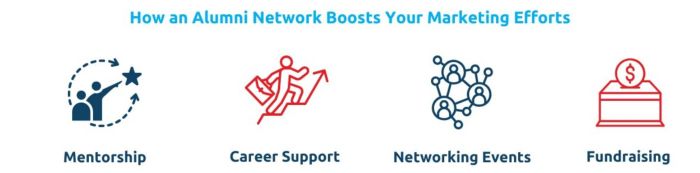
At its core, an alumni network is a community of former students who remain engaged with their alma mater. This engagement can take many forms, from mentorship opportunities and career support to networking events and fundraising initiatives. A well-developed alumni network fosters lifelong connections, enabling graduates to support each other while strengthening the institution that provided their foundation.
Enriching Education: The Power of an Alumni Network
When alumni feel connected to their school, they become brand ambassadors, willingly sharing their success stories and contributing to a culture of loyalty and pride. These graduates are more likely to participate in career panels, donate to scholarship funds, and advocate for your institution within their professional circles. Most importantly, their success becomes a tangible example of your school’s impact, which is a powerful marketing tool in itself.
Alumni relationships create a dynamic ecosystem of support, mentorship, and career growth. So in summary, why is alumni networking important? It plays a crucial role in helping graduates navigate their professional journeys, opening doors to job opportunities, industry insights, and collaborative ventures. An engaged alumni network ensures students are stepping into a lifelong professional community that enhances their career trajectory. For schools, this network fosters goodwill and credibility, proving that your programs produce graduates who thrive in competitive industries.
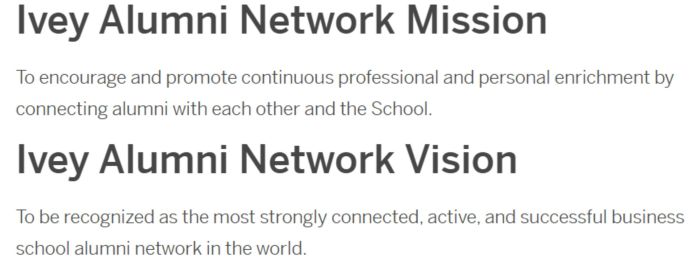
Example:On a dedicated alumni network page on their website, Ivey Business School plainly states the objective of their program” To encourage and promote continuous professional and personal enrichment by connecting alumni with each other and the school”. The alumni network is positioned as a resource for career development and support for graduates.
Source: Ivey Business School
The Unique Marketing Benefits of Alumni Networks
Now that higher education is increasingly competitive, the ability to showcase real-world success is crucial. What is the value of alumni networks when it comes to your marketing strategy? Alumni networks are excellent social proof, providing great opportunities for organic traffic, and showcasing how your school facilitates career development. Here’s how:
Your Alumni Network Offers Valuable Social Proof
In an education marketing context, social proof refers to the credibility and trust institutions build by showcasing the success and satisfaction of their alumni, current students, and faculty. When prospective students see tangible examples of graduates thriving in their careers, testimonials from successful alumni, or high employer satisfaction rates, they gain confidence that choosing your school is a worthwhile investment.
Social proof can take many forms, including video testimonials, alumni spotlights, employer endorsements, rankings, and word-of-mouth referrals. A strong alumni network serves as a powerful form of social proof, demonstrating that your institution provides quality education and equips graduates with the skills, knowledge, and professional connections necessary for long-term success.
Alumni success stories create a compelling narrative that validates the effectiveness of your curriculum, the strength of your career support services, and the credibility of your institution as a whole. Whether through personal testimonials, LinkedIn endorsements, or employer recommendations, alumni reinforce the value of your educational offerings in a way that no traditional marketing message can replicate.
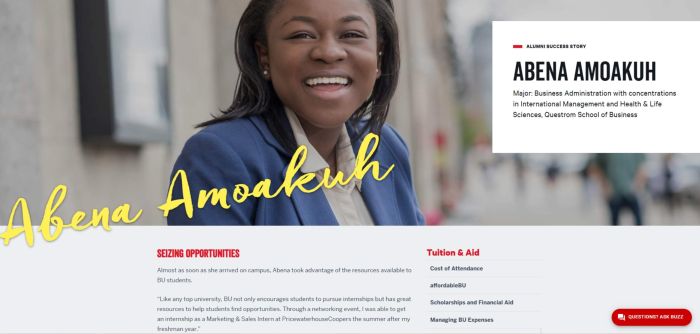
Example:On their website, Boston University showcases alumni success stories that highlight educational and career development opportunities like internships and networking events. The success of graduates provides valuable social proof for prospective students, who can identify with and look up to these role models.
Source: Boston University
Driving Organic Traffic
An engaged alumni network plays a crucial role in generating organic traffic through word-of-mouth marketing. When alumni have a positive experience with your institution, they naturally become enthusiastic advocates, sharing their journey with peers, family members, and colleagues. This organic promotion is highly credible because it comes from real-life experiences rather than institutional messaging.
Beyond personal referrals, alumni contribute to organic traffic through their online presence. When they mention your school on LinkedIn, post about their achievements on social media, or participate in professional discussions related to their field, they create a ripple effect that drives interest in your institution. Schools can amplify this impact by encouraging alumni to tag their alma mater in their career updates, engage in school-sponsored events, and contribute to online discussions within alumni groups.
Additionally, search engines favor authentic, frequently updated content. When alumni success stories are featured on your website, blog, or social media channels, they provide valuable, keyword-rich content that enhances search visibility. Prospective students searching for insights on career outcomes in their chosen field may stumble upon these stories, further reinforcing your school’s credibility and increasing inquiries and applications.
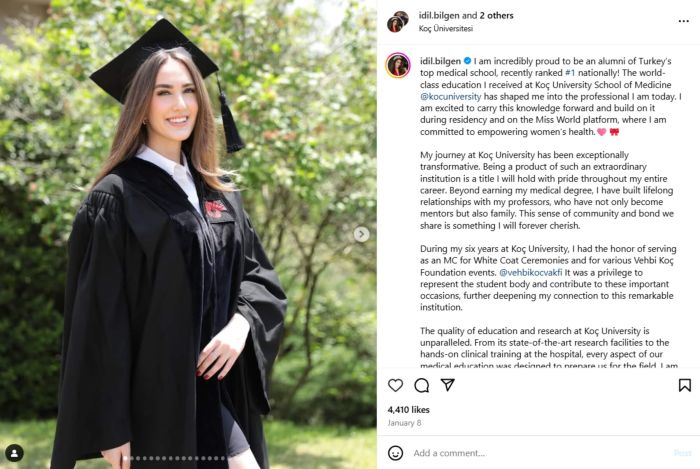
Example: Here an alumni from Koç University in Turkey posts a very valuable testimonial, even tagging her alma mater and citing it as the #1 medical school in the country. In addition to an official alumni network, encouraging UGC from graduates is an effective strategy that comes across as authentic and therefore, trustworthy. Ask alumni to tag your school in graduation posts or list you in the education section of their LinkedIn profiles for organic traffic.
Source: Instagram
Mentorship and Career Services as a Unique Selling Point
An active alumni network can significantly enhance a school’s career services by establishing mentorship opportunities and creating a direct pathway for graduates to secure employment. When alumni hold influential positions in various industries, they become a valuable resource for current students and recent graduates looking to break into their fields. Schools that foster strong alumni engagement can tap into this network to offer students real-world insights, industry-specific guidance, and professional connections that go beyond what traditional career services can provide.
By collaborating with alumni who have become hiring managers, entrepreneurs, or industry leaders, schools can develop a reliable talent pipeline that benefits both graduates and employers. Alumni who feel a deep connection to their alma mater are more likely to offer internship programs, job placements, and networking opportunities tailored specifically to students from their former institution. These partnerships not only enhance job placement rates but also reinforce the credibility of your programs, proving to prospective students that your institution delivers real career outcomes.
Moreover, alumni mentors can serve as role models, helping students navigate their career paths through professional guidance and hands-on training. Schools can structure formal mentorship programs where alumni are paired with students based on career interests, fostering long-term professional relationships that extend well beyond graduation. These interactions boost student confidence, provide practical career advice, and offer an inside look at industry trends and expectations.
When alumni return to recruit from their alma mater, it strengthens the institution’s reputation as a trusted source of skilled professionals. This cyclical relationship, where alumni continuously contribute to the success of new graduates, creates a sustainable ecosystem of career support and growth.
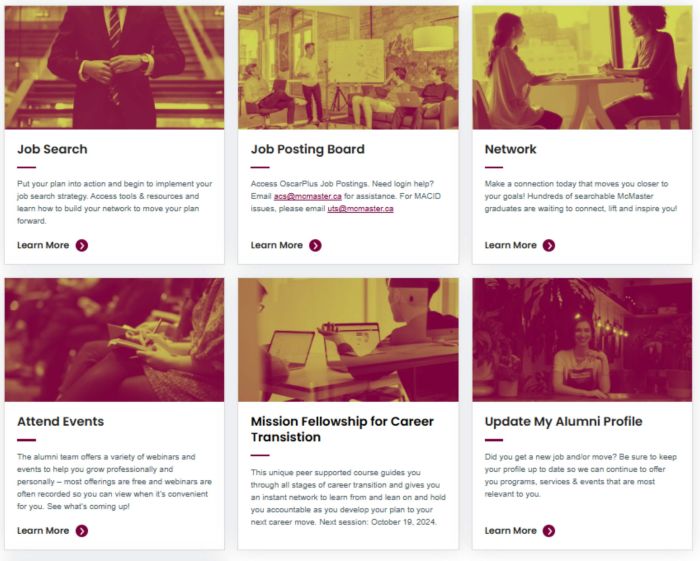
Example: McMaster University has an Alumni Services page that highlights all of the career advantages that come with being part of their alumni network. Be sure to put all of the career benefits that your alumni network offers on full display so that you can leverage them as part of the FAB marketing strategy (features, advantages, and benefits), an effective form of brand storytelling that encourages prospective students to vividly imagine their success at your institution.
Source: McMaster University
Building a Strong Alumni Network
If you want to harness the power of alumni networks, it starts with cultivating meaningful relationships from the moment students enroll. Establishing a culture of connection early on makes it easier to keep graduates engaged long after they receive their diplomas.
One of the most effective ways to build a thriving alumni network is through dedicated alumni associations. These groups should not merely exist on paper but should be actively nurtured with opportunities for engagement, such as career workshops, networking events, and mentorship programs. Leveraging digital platforms, such as LinkedIn and exclusive alumni portals, helps create spaces where former students can stay in touch, share job openings, and collaborate on projects.
Personalized outreach is key to maintaining long-term engagement. Schools that take the time to check in with alumni (through newsletters, exclusive events, or professional development opportunities) demonstrate continued investment in their graduates’ success. This encourages reciprocity, as alumni become more willing to give back, whether through donations, guest lectures, or referrals.
Video testimonials featuring alumni discussing how your programs shaped their careers are incredibly effective. Highlighting their professional achievements, career transitions, and personal growth builds trust with prospective students who are weighing their options. Success stories can be embedded into your website, showcased on social media, and included in email campaigns.
Featuring alumni in live webinars or Q&A sessions allows prospective students to ask direct questions about career outcomes. This real-time engagement adds credibility to your institution’s claims, reinforcing the message that your graduates excel in their fields. Schools that leverage alumni networks in these ways transform passive viewers into engaged applicants.
Example: Get creative with your alumni recruitment strategy! Here, Stellenbosch University promotes its alumni network app, Maties Alumni, on YouTube – an exclusive, all-in-one platform for nurturing alumni relationships, career opportunities, mentorship, and personal connections.
Source: Stellenbosch University | YouTube
Elevating Your School’s Reputation Through Alumni Success
Ultimately, the strength of your alumni network is a reflection of the strength of your institution. Schools that prioritize alumni engagement are not only fostering lifelong relationships but are also investing in an authentic, powerful marketing strategy. By celebrating alumni achievements, maintaining strong communication channels, and integrating success stories into recruitment efforts, you can build lasting credibility and attract the next generation of students eager to follow in their graduates’ footsteps.
If your institution is looking for ways to enhance engagement and incorporate alumni networks into your marketing strategy, Higher Education Marketing can help you develop targeted campaigns that amplify your alumni success stories and drive enrollment growth. Your graduates are your greatest success. Make sure their voices are heard!
Struggling with enrollment?
Our expert digital marketing services can help you attract and enroll more students!
Frequently Asked Questions
Question: Why is alumni networking important?
Answer: It plays a crucial role in helping graduates navigate their professional journeys, opening doors to job opportunities, industry insights, and collaborative ventures.
Question: What is the value of alumni networks?
Answer: Alumni networks are excellent social proof, provide great opportunities for organic traffic, and showcase how your school facilitates career development.
Last September, the Prime Minister announced a “rebalancing” of funding from the apprenticeship levy (shortly to become the Growth and Skills Levy). Employers’ ability to use the funds for postgraduate-level apprenticeships would be restricted in the hope of shoring up lower levels.
The government’s thinking arises from a belief that employers are taking advantage of apprenticeship levy funding to upskill mostly existing, mostly relatively seasoned staff with MBAs and similarly expensive qualifications. At worst, some employers may be using a claw-back of their levy (which is paid by employers at 0.5% of annual wage bills that exceed £3 million) to give training perks to middle managers.
This activity may not only be offsetting those employers’ own training budgets such that the levy isn’t increasing the overall funding available, but in the process, it is also undermining what the government would prefer, namely that the money is used to address concerns about young people leaving school without more basic levels of employability.
The Government has a point. In 2021/22, nearly half of all Level 6 and 7 apprenticeships were in ‘Business, Administration & Law’. But the employers concerned (often professional services firms, accountants and legal services) may have a point too. They may feel their commercial interests are better served (and more economic activity is generated) by training up current employees who have high demonstrable potential rather than recruiting low-level apprentices who may be less reliable, loyal or productive in the longer term. After all, they might argue, businesses don’t exist to do the government’s job of workforce planning or social engineering.
In the second decade of this century many policy papers punningly declared that they were laying out a ‘2020 vision’. One such document in 2015 laid out the Cameron Government’s reform of English apprenticeships which heralded the introduction of the Apprenticeship Levy in 2017.
This new tax – sorry, ‘levy’ – would, it was envisioned, align skills supply with skill needs and provide a superhighway of progression for apprentices while simultaneously promoting wider access and higher standards.
Given that employers recruit their apprentices and, unlike universities, they are not subject to any fair access requirements, opportunities have tended to follow traditional patterns of advantage.
Most of the fall in apprenticeships is accounted for by the 72% collapse of intermediate apprenticeships (equivalent to Level 2, ie. GCSEs), while higher apprenticeships (equivalent to Level 4 and above) have been the only part of the market to see an expansion – by nearly three times, such that they now make up more than a third of the (albeit lower) total.
There is no reason to suppose that excluding Level 7 apprenticeships from the funding system will suddenly make lower levels more attractive to employers. While it is true that the funding is drawn from the same pool, they are not seen as alternatives by employers: the Business Administration & Law sector is not likely to start offering intermediate apprenticeships to 16-year-old school leavers because they can’t offset their levy by training qualified professionals.
Rather it is in other sectors, where engagement in apprenticeships has been minimal, that the government wants to see the growth. For those employers, the fact that someone else may have been using their apprenticeship levy to fund an MBA was never stopping them from creating more junior opportunities.
What’s been stopping them is the red tape involved in setting up and running apprenticeships, the costs and inconvenience (such as the time of other staff to recruit, manage and train apprentices), and the limited perceived benefits.
Not only is defunding Level 7 apprenticeships not likely to solve the problems in the apprenticeship market, there is also a danger that babies (training that is critical to address skills gaps) might get thrown out with the bathwater (those MBAs which the government thinks should not be publicly subsidised).
Level 7 apprenticeships in engineering are vital for up-skilling (and re-skilling), which is critical for the challenges outlined in the government’s industrial strategy, such as in defence, advanced manufacturing, clean energy industries, and digital & technologies (particularly AI).
Engineering is a highly dynamic sector with an ageing population of skilled professionals. Even if we can meet the profound challenges of providing sufficient new engineers into the labour market, keeping them there and maintaining their level of expertise will rely on increasing the availability of – and demand for – a combination of in-work training and education at the highest level.
Achieving Level 7 qualifications in engineering (which are often instrumental in professional recognition) is generally too expensive for individuals to embark on at their own cost and, given the competitive demand for skilled labour in the context of shortages, employers are fearful that if they invest heavily in these staff they may be poached by competitors. This is a prime example of where a low-cost intervention by government can have large-scale impact.
In other words, Level 7 apprenticeships in engineering are strategically critical. My understanding is that they are similarly vital in certain other sectors such as health.
The government is right to ensure Growth & Skills Levy funds are spent as effectively as possible, but that will require a nuanced appraisal of what is working and what isn’t as well as a recognition that a slash and burn of waste won’t necessarily promote growth where the government wants it.