Category: Blog

  • Bloom’s Revised Taxonomy: 3 Ways To Reshape The Pyramid

    Bloom’s Revised Taxonomy: 3 Ways To Reshape The Pyramid

    Bloom’s Taxonomy is probably the most widespread and enduringly popular model in education. It was created in 1956 by Dr. Benjamin Bloom and colleagues at the Board of Examinations, University of Chicago. In 2001, the pyramid was revised by Lorin Anderson, a student of Bloom’s, resulting in Bloom’s Revised Taxonomy.

    Bloom’s Revised Taxonomy focuses on learning outcomes. The framework demands that very first thing that instructors need to think about is what students have to know by the end of the course. Learning objectives need actions to get to them. And Bloom’s Revised Taxonomy is hierarchical, requiring your students to achieve each level in succession—in order to understand a concept, you must remember it; to apply a concept you must first understand it, and so on.

    There’s no doubt that this way of classifying educational objectives has been extremely useful to millions of teachers over the years. But for those who might not have had conclusively positive results evaluating Bloom’s Revised Taxonomy or incorporating it into instruction, it’s worth considering some more ways to think outside the pyramid to improve teaching and learning. Here are three things you could bear in mind when using Bloom’s Revised Taxonomy in your lesson planning.

    1. Cultivate judgment rather than transmit information

    The instructional strategies behind Bloom’s Revised Taxonomy require educators to begin with “lower order” tasks, arguing that students need to master these first. This means we front-load our courses with information: information that can be recalled, defined, identified or another objective in the lowest layer of the pyramid.

    But constructivist theories of learning—and our own classroom experiences—tell us that learning does not happen through information transference alone. A learner is an not empty vessel into which we pour definitions. He or she is not going to truly understand something without interpreting it, questioning it, or relating to it.

    So when designing your course, try to incorporate ways to strengthen and take advantage of their faculties of judgment.

    What would it mean to cultivate judgment during a course? Start by doing. Engage your students to take action in some relevant way—through a lab experiment, for example, or by field research. Another way to do this is role-play. When I taught history, we started out by taking on the identities of various countries, coming to decisions supported by research and analysis. The historical facts—and there were many—were all taught in this context. In this way, facts are put into the service of learning, rather than becoming an initial goal in themselves.

    2. Start, rather than end, with creativity

    As educator Shelley Wright has pointed out, Bloom’s Revised Taxonomy gives the impression there’s a “scarcity of creativity.”1 Only those strong enough or talented enough to work their way up to the summit of the pyramid can be creative. The truth is that everybody is naturally creative—just think of a seven year-old at play—except that this way of being in the world is often squelched or squandered. Ken Robinson, for instance, has strongly argued that creativity is typically “educated out” of us.2

    What could it mean to start with creativity? Have your students create on day one. (OK, maybe day two or three.) Wright explains how this works for her media studies class. Instead of beginning by laying out design principles and the history of media, she gets the students to make an advert mockup. Then they compare their mockups to published adverts. Wright helps them analyze differences and introduces, through student-facilitated research, the major principles and concepts of design that help them explain their own creation and those of others.

    A create-first approach could work just as well in courses that are theory-rich and fact-heavy such as philosophy, literature, or science. In environmental science, for example, ask students to propose a solution to deforestation or ocean acidification. Then, starting from their contributions, explore the principles, factors, concepts, contingencies at play, including the ones that were omitted. Have students compare their solutions to others’. Get them to elicit the principle involved, the recent literature in the area, and articulate and fully describe the concepts and the facts.

    3. Promote awareness instead of entrenching hierarchy

    The stratification of Bloom’s Revised Taxonomy into “lower” and “higher” order objectives sets up a value proposition. It leads educators to think that certain kinds of learning necessarily reflect superior kinds of cognition.

    But as Roland Case argues, tasks at every level of Bloom’s Revised Taxonomy can be performed thoughtfully or thoughtlessly.3 It is possible to defend a position in a completely superficial way. It is possible to propose a plan that lacks good judgment or analysis. It is possible to create something without building from a base of relevant knowledge. Indeed, that is why it’s necessary to practice and develop judgment, critical thinking skills and creative problem-solving.

    When Anderson and Krathwohl revised Bloom’s Taxonomy, they accounted for this with a second scale for assessment called The Knowledge Dimension, which lies as another dimension or axis to the cognitive domain. One should assess each of the revised categories (Remember, Understand, Apply, Analyze, Evaluate, Create) according to whether factual, conceptual, procedural or metacognitive knowledge is demonstrated.

    If no category is higher or lower than any other, then leveling makes no sense. With proper consideration for The Knowledge Dimension, we are far from a pyramid… and always have been! But who knew? As Leslie Wilson points out, “what most educators are given in training is a simple chart listing levels and related accompanying verbs.”4

    Bloom’s Taxonomy revised: A pyramid alternative

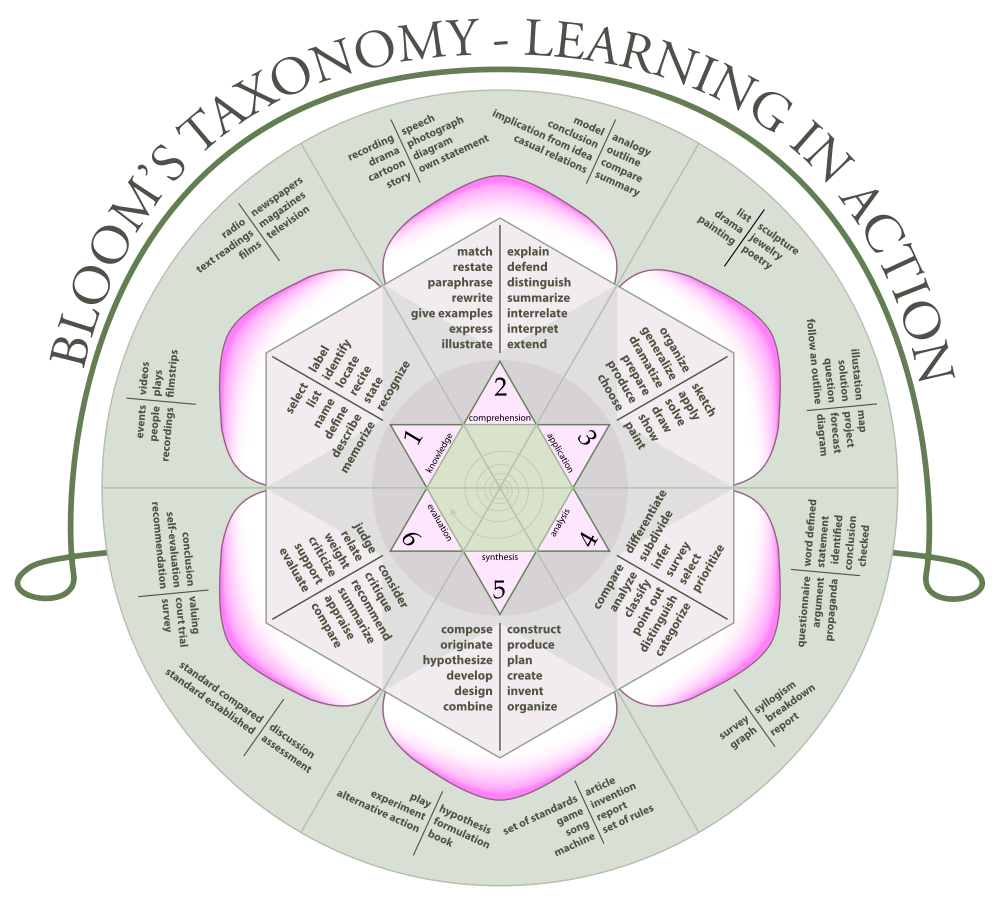
    And so, if we want to engage students’ creativity, cultivate judgment and make sure that each stage of learning is fully developed and attuned to the right outcome, then organizing anew the existing structure of Bloom’s Revised Taxonomy could go a very long way. Instead of a pyramid, how about a mandala?

    Bloom's Taxonomy in a Mandala or Rose format. CC-BY-SA 3.0 K. Aainsqatsi

    Strange things happen when we feel beholden to a structure. If lesson planning with Bloom’s Revised Taxonomy hasn’t been working for you or your class, rethink the background on how it should be applied. Reconsider the way you’re assessing student learning. Break down the hierarchy and rebuild.

    Illustration credits: CC-BY 2.0 Vanderbilt University; CC-BY-SA 3.0 K. Aqinsqatsi.

    Related stories
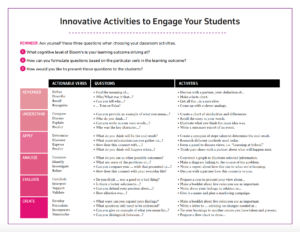
    Bloom’s verbs and how to apply them to questions

    Get a set of online teaching resources to help you develop effective teaching practices and foster active learning within your classrooms.

    Download your free Top Hat Toolkit Here:

    References

    1. Wright, S. (2012, May 15). Flipping Bloom’s Taxonomy [Blog post]. Retrieved from https://plpnetwork.com/2012/05/15/flipping-blooms-taxonomy/
    2. Parker, Q. (2018, October 3). The Possibilities of an Agile Classroom: Sir Ken Robinson [Blog post]. Retrieved from https://tophat.com/blog/sir-ken-robinson-qa/
    3. Case, R. Unfortunate Consequences of Bloom’s Taxonomy. Retrieved from https://tc2.ca/uploads/PDFs/Critical%20Discussions/unfortunate_consequences_blooms_taxonomy.pdf
    4. Wilson, L. O. (2017, January 20). Understanding the New Version of Bloom’s Taxonomy. [Blog post] https://thesecondprinciple.com/teaching-essentials/beyond-bloom-cognitive-taxonomy-revised/

    Tagged as:

    Source link

  • What Are Student Learning Outcomes?

    What Are Student Learning Outcomes?

    Learning outcomes are descriptions of the abilities, skills and knowledge that are used for assessing student learning. Learning outcomes should outline what students possess and can demonstrate upon completion of a learning experience or set of experiences. When developing a list of student learning outcomes for educators to set as curriculum objectives to improve student learning, consider the following recommendations:

    How to Build Student Learning Outcomes

    Choose between 3-5 learning outcomes: You should choose a sufficient amount of learning outcomes to ensure student progress can be measured without becoming overly complicated for educators to assess. It is also worthwhile to point out that not all educational activities will assess all learning outcomes. Each educational activity can assess students’ development and comprehension focusing on 1-2 student learning objectives for each class. Less than 3 objectives likely mean that student learning objectives are not robust enough for an entire course.

    Learning outcomes should be straightforward: The outcomes identified and described in your plan should be concise and simple. They should avoid complex phrasing or compound statements that mesh more than one statement together to communicate effectively. Each learning outcome should focus on the development of one skill or the meeting of one goal in order to be straightforward and ensure effective learning.

    Learning outcomes should be expressed in the future tense: It is very important for the proper implementation of student learning outcomes that they are expressed in the future tense. The statement should express what an individual student should be able to do as the result of specific instruction or educational activity. Outcomes should involve active learning, and be observable so they can be quantified for examining key student success metrics through learning assessment. They should create and make use of information literacy skills.

    Learning outcomes should be realistic: In order to ensure student learning outcomes are successful, they must be attainable for the students for whom they are designated. Outcomes need to be designed with students’ ability, their initial skill sets, cognitive development and the length of the institutional time frame (a week, a semester, etc) designated to attain these skill sets in mind. Further, they should also align with the material for teaching to students.

    Learning outcomes should align with the curriculum: The learning outcomes developed should be consistent with the curriculum objectives within the program and discipline in which they are taught. This is especially important when interpreting assessment results to analyze where changes in instruction should be made. Curriculum mapping is one example of an effective way to ensure that chosen learning outcomes correspond to the designated curriculum. A curriculum map is a diagram that explains which learning outcomes are plotted against specific program courses. This helps ensure that learning goals are reached in a timely manner.

    Methods of Constructing Learning Outcomes

    Implementing taxonomies: Taxonomies of learning experiences and student outcomes can be useful outlines for developing thorough and insightful lists of student outcomes. Taxonomies classify and compartmentalize the different types of student learning. Taxonomies usually follow a structure that divides learning into three categories. The first is the cognitive domain, which has six levels, ranging from the simple recall or recognition of facts, as the lowest level, up to increasingly more complex and abstract mental levels, followed by the highest order which is classified as evaluation. The second domain is the affective domain involves our feelings, emotions, and attitudes. This domain includes the ways in which humans deal with things emotionally, such as feelings, values, appreciation, enthusiasm, motivations, and attitudes. The final domain is the psychomotor domain, which focuses refers to the motor skills learners are expected to have acquired and mastered at each stage of development.

    Bloom’s Taxonomy of Educational Objectives (1956) is one traditional framework for structuring learning outcomes. Levels of performance for Bloom’s cognitive domain include knowledge, comprehension, application, analysis, synthesis, and evaluation. These categories are arranged in ascending order of cognitive complexity where evaluation represents the highest level. There are six steps within Bloom’s Taxonomy to achieve learning outcomes. The first step is knowledge, which focuses on knowing and remembering important facts, concepts, terms, principles or theories. The second step is comprehension, which focuses on the understanding of specific learning concepts or curriculum objectives. The third step is application, which focuses on skills and knowledge applications to solve problems. The fourth step is analysis, which focuses on identifying different structures and organizations of specific concepts or subjects, identifying relationships and different moving elements within an organization. The fifth step is synthesis, which focuses on the creation and integration of new ideas into a solution, in order to propose an action plan and potentially formulate a new classification scheme by using critical thinking. The sixth and final step in Bloom’s Taxonomy is evaluation, which judges the quality of knowledge more broadly or a specific learning concept based on its adequacy, use, value or logic.

    Using power verbs: When constructing learning outcomes, it is important to make use of concrete action words that are able to describe and quantify specific action that is observable and measurable.

    Using a Curriculum Map: Once learning outcomes have been developed and approved, making use of a curriculum map can help in viewing how the outcomes developed are being met in each course at an institution. A curriculum map is a straightforward way to visualize the ways in which an educator or institution can list learning outcomes in the rows and the program courses in the columns to demonstrate which courses contribute to each learning outcome. In each cell, letters can be placed to indicate how the course relates to the learning outcome. Use the letters “I,” “R,’ and “E” to identify which courses in the program “introduce”, “reinforce,” or “emphasize” the corresponding learning outcomes. By putting the curriculum maps into place, educators can watch for unnecessary redundancies, inconsistencies, misalignments, weaknesses, and gaps in their learning outcomes in order to optimize them for student success in their program review.

    Measuring Student Learning Outcomes

    Assessment of student learning outcomes: Assessment is a systematic and on-going way of collecting and interpreting information in order to analyze its effectiveness. The academic assessment process can also provide greater insight into how well learning outcomes relate and correspond to the goals and outcomes developed to support the institution’s mission and purpose. An ideal learning outcomes assessment process aims to answer the questions of what an institution is doing and how well it is doing it. Assessments begins with the expression of learning outcomes and course learning. The key to writing measurable outcomes involves describing the first three components: firstly analyzing the outcome, secondly, determining the method of assessment, Third, involves recognizing the criteria for success, as part of the student-centered assessment cycle.

    Program and Performance outcomes: program and performance outcomes describe the goals of a program rather than focusing on what students should know, do or value at the end of a given time period. Program outcomes can be as one-dimensional and simple as a completion of a task or activity, although this is not as meaningful as it could be and does not provide the educator with enough information for improvement. To accomplish the latter, educators and department heads should try to assess the effectiveness of what a given program has set out to accomplish. Performance outcomes usually have quantitative targets and specific timelines.

    Tagged as:

    Source link

  • The Ultimate Guide To Online Teaching

    The Ultimate Guide To Online Teaching

    What is Online Teaching?

    Online teaching typically refers to courses that are delivered completely online, meaning there are no physical or on-campus class sessions. Online courses can be designed for a handful of enrolled students or can be made open and accessible to a wide variety of participants. Instructors may choose to teach an online course because they want to take their teaching beyond the confines of the physical classroom. Other instructors may choose to do so because they want students to benefit from the online environment. Online teaching gives students unlimited access to resources and the ability to collaborate and connect with each other at any time of day. It also gives educators the ability to teach online classes from home.

    Contents

    1) Developing and Teaching an Online Course
    2) Planning and Designing an Online Course
    3) Synchronous vs. Asynchronous Online Teaching
    4) Online Assessments
    5) 7 Best Practices in Online Teaching
    6) Conclusion

    Developing and Teaching an Online Course

    Preparing for online teaching is not as simple as taking materials from a traditional course and putting them online. Educators engaging in online teaching for the first time will need to plan their approach thoughtfully, even full-time experienced educators. This starts with identifying learning objectives and then building educational activities to support them. Rather than make wholesale use of course content from previous classes, materials should be repurposed or adapted by taking into account the strengths and weaknesses of online learning environments. Organizing course content into units, with submodules, key concept reviews and unit tests—along with a tailored and consistent content release schedule—will help ensure students remain on track to achieve desired learning outcomes.

    Online Curriculum Development

    In online teaching, curriculum development is defined as the step-by-step process used to create positive improvements in the courses offered by a school, college or university. As new discoveries are made, they have to be incorporated into the online education curricula. Innovative teaching techniques and effective online teaching strategies are constantly being developed and refined in order to improve the student learning experience.

    Current online curriculum models can be divided into two broad categories—the product model and the process model. The product model focuses primarily on results. Grades are the primary objective, with more emphasis placed on achieving desired objectives at the summation of the course rather than on the learning process itself. The process model, however, is more open-ended and focuses on how learning progresses over the course of a semester. Both models are important when it comes to developing a holistic and effective curriculum for online teaching.

    There are three types of online curriculum design: subject-centered, learner-centered and problem-centered.

      • Subject-centered curriculum design revolves around a particular subject matter or discipline, such as mathematics, literature or biology. This type of curriculum design tends to focus on the subject matter being taught online, rather than the individual student.
        Educators create lists of topics and specific examples of how they should be studied, which are then mapped to the most effective online learning activity or method. This approach is most popular in large university or college classes taught online, where teachers focus on a particular subject or discipline in their classes.
      • Learner-centered curriculum design prioritizes student needs, interests and goals. It acknowledges that students are individuals and have different learning needs and therefore should not, in all cases, be subject to a standardized curriculum. This approach aims to empower learners to shape their education through choices and relies heavily on asynchronous online teaching and learning. This can be complex for large class sizes and is more suitable for smaller, seminar-style courses.
        Differentiated instruction and learning plans provide an opportunity to select assignments, teaching and learning experiences or activities online. This form of curriculum design is highly effective at engaging and motivating students, particularly in online teaching and learning environments by providing students with greater choice and flexibility. However, the drawback to this form of curriculum design is that it can create pressure on the educator to source learning materials online that are highly specific to each student’s personal learning needs. This can be challenging due to teaching time constraints.
      • Problem-centered curriculum design teaches students how to examine and analyze problems and develop solutions, largely using online simulations. This is considered an authentic form of learning because students are exposed to real-life issues, helping students develop skills that are transferable to the real world.
        Problem-centered curriculum design has been shown to increase the relevance of the curriculum and encourages creativity, innovation and collaboration in the online classroom. However, one shortcoming of this format is that it does not always consider individual learning styles and requires a great deal of collaboration between students.

    By considering all three types of curriculum design before you begin planning, instructors can choose the types that are best suited to their students and the learning objectives for their course.

    Planning and Designing an Online Course

    Planning for Online Teaching

    An important step in bringing your online course to life is the actual implementation. This includes aligning course materials to learning goals and in accordance with your online teaching philosophy. There are a number of things to consider during the decision-making process.

    First, it is important to understand the audience for your online course and who will be participating in supporting the delivery of modules, labs and other learning activities. Recognizing that learners may vary widely in their background, knowledge and skills is essential in order to accommodate these differences in your course design. Secondly, it is imperative to have specific learning goals in mind. An effective online pedagogy means carefully considering what you expect your students to know and be able to do at the conclusion of your course. Next, consider the different types of content your course requires. Decide how students will engage with that content and with each other. Also consider which assessment types best support the measurement of learning objectives for your students. Here are a number of helpful methods that can be used to guide the planning and development of your online teaching curriculum.

    Backward Design

    Backward design is often used in online teaching to design learning experiences and instructional techniques to meet specific learning goals. Backward design begins with identifying the objectives of a unit or course—what students are expected to learn and be able to do—and then working “backwards” to create lessons that achieve those desired goals. In online teaching, the educational goals for a course or unit are often closely aligned with a given institution’s learning standards. These are concisely written descriptions of what learners are expected to understand and be able to do at a specific stage of their education. In the context of online teaching, this includes the expectation that students have mastered certain technology tools and platforms to meet these goals.

    There are many benefits to backward design. Starting with the end goal in mind helps educators design a sequence of assessments, readings, course materials and group activities that are more likely to result in learners achieving the academic goals of a given course or unit—that is, actually learning what they were expected to learn.

    Beginning the planning process with the end goal in mind is often a counterintuitive process. However, backward design gives educators a structure they can follow when creating their curriculum, as well as planning their instructional process. Using a backward design approach also helps educators better align the different elements of their course by methodically integrating learning goals, activities and assessments at every step.

    Managing the Logistics of Online Teaching

    Even though planning for an online class may start in a similar way as an on-campus or face-to-face course, there are several important differences that those teaching online should keep in mind. First, it is important to consider how technology will influence the way you conduct your online teaching. If you would like to use an interactive lecture format, you will need to find ways to engage students in an online environment. Chat channels, discussion forums, blog postings and online office hours are a few ways for online teachers to connect with learners. Those engaging in online teaching will also need to consider how the use of virtual classroom technology will impact student learning. Do your students require specific technical knowledge or computer functionality such as a webcam? How will they interact in the online environment? What will you do to make your online classroom inclusive to all students?

    When transitioning to online teaching, educators also need to address technical issues. It is important to plan all of your components for an online course before the first day of class. Start early and seek collaboration and support from your colleagues, when possible. Many institutions have Centres for Teaching and Learning with experienced instructional designers who are able to help manage the transition for instructors and their students.

    Synchronous vs. Asynchronous Online Teaching

    Synchronous Online Teaching

    Synchronous online teaching occurs in real-time through video conferencing platforms like Zoom, Go-to-Meeting and YouTube Live. When used with an online teaching platform or learning management system, synchronous online teaching allows educators to continue many of the same learning activities found in an in-person classroom. Learners can access lecture slides, respond to interactive questions and engage with discussion threads with their peers.

    Delivering online teaching information and presentations in real-time creates a sense of speed and intimacy that helps increase student engagement. This allows educators to respond directly to student questions and discussions, provide feedback and adjust online teaching to ensure students are comprehending course material.

    To ensure synchronous online teaching is effective, it is important to have the proper technology tools and platforms in place. Ideally, video conferencing solutions should be used for delivering online lecture content, as well as an active learning platform or learning management system to support assessments, readings, live discussions and interactive questions. With large class sizes, having a remote teaching assistant is especially helpful in alerting instructors to any technical or experiential issues that may occur when using technology tools and platforms. Online teaching assistants can also provide support by responding to discussion threads directly or gathering commonly asked questions requiring further review and clarification.

    Similar to a physical classroom, it is important to balance content delivery with interactive learning activities, as well as building in time for review into the lecture schedule. A best practice is for course information to be presented in ten-minute chunks, followed by blocks dedicated for reflection exercises and interactive questions and discussions to keep students engaged.

    In the same way that the answers to in-class discussion questions inform how comprehensively course material is covered, it is important to be able to understand where students are struggling. This includes using low stakes quizzes and discussion questions to ensure students are able to achieve online teaching objectives. Synchronous online teaching provides opportunities to apply concepts and collaborate, helping to deepen learning. Real-time interaction is also particularly useful when it comes to delivering complex concepts that require immediate feedback or clarification to keep students on track.

    Asynchronous Online Teaching

    Asynchronous online teaching uses many of the same technology tools and platforms, with the main difference being student learning is self-paced. With asynchronous online teaching, educators deliver course content and assignments remotely using a combination of solutions like Zoom to record and post lectures online as well as learning management platforms to centralize assignments and other learning resources. Learners interact with digital courseware, assignments and their peers through discussion channels. Asynchronous online teaching is more convenient for students who may have children or other dependents as well as inflexible job hours. As well, not every student can afford or has easy access to the internet. The ability to learn on an individual schedule gives learners the flexibility they need to find time where they can engage with online course material. The benefit of this online teaching method is being able to utilize active learning techniques without the need for participants to be active at the same time.

    Asynchronous online teaching is particularly useful when it is difficult for your students to maintain a specific schedule. Accessing materials, readings, assignments, quizzes and lecture recordings in a single place allows students to engage with course material at their own pace. There are many simple ways to drive engagement even if much of the learning is self-directed, such as using discussion forums, integrating questions into assigned readings to test comprehension and using multimedia elements like video to dimensionalize learning. Asynchronous online teaching also provides the opportunity to promote peer collaboration, creating specific assignments that require students to work with one another or review others’ work outside the confines of a class schedule.

    Asynchronous learning requires online educators to take time to revisit learning objectives for the semester. Identifying whether there are components that can be recorded for students to view on their own schedule versus what information should be delivered live or asynchronously is an integral part of the design process. Giving thought to where students can access readings, lecture materials, assignments and instructions can help develop a more effective learning plan and identify any potential gaps that may exist in course instruction.

    Without the benefit of live interaction, it’s especially important to communicate expectations and reminders and address student questions in a timely fashion. Regular, helpful and empathetic communication is an essential tool for reducing the apathy and sense of isolation many students feel when learning remotely.

    Online Assessments

    When teaching online courses, there are two primary types of assessments: open-book tests and remotely proctored exams. There are a number of benefits to each, but the effectiveness of both is determined by how well they are designed and implemented into online teaching.

    Remote Open-Book Exams

    Online teaching provides the opportunity to look at different options beyond the traditional summative assessment. Open-book exams offer a great deal of flexibility, making it an ideal option for instructors or institutions that rely on asynchronous learning.

    An open-book assessment that is strategically designed provides interesting opportunities to test skills beyond rote memorization, such as problem-solving and critical thinking. Open-book exams are especially effective when they focus on using synthesis, analysis and evaluation to assess what students know, according to the Center for Teaching at Learning at UC Berkeley. The ability to intersperse questions with digital reference materials like images, video and audio clips also allow for more creativity and freedom when constructing an exam in relation to traditional in-class tests.

    Developing interactive digital documents with pictures and videos embedded alongside test questions creates a more dynamic assessment experience for students. Using multimedia and other reference content allows learners to discuss and assess opinions given to them within the assessment or analyze a diagram and its findings. Depending on the learning platform, open-book assessments can also include a variety of different question types, including matching, sorting, fill-in-the-blank, long-form answer and click-on-target (with multiple targets) questions.

    Proctored Tests and Exams

    In many cases, such as courses required for accreditation, open-book assessments are simply not an option. In these instances, there are a number of platforms that offer secure proctored tests and exams. Students can take on their own computers, at a pre-set time and from any location. Advanced ID verification, the ability to secure browser settings and the use of artificial intelligence to monitor students have helped assuage concerns over academic integrity.

    Using a variety of question types—multiple choice, word answer, fill in the blank, matching and long answer—instructors can provide students with an assessment that tests their knowledge as well as their analysis and communication skills. For these types of assessments, student performance can be automatically graded upon submission, making the turnaround time for student feedback much faster than manual grading.

    7 Best Practices in Online Teaching

    1) Bring who you are into the online classroom: One of the key benefits of traditional, face-to-face teaching is being able to share your passion with your students. Many educators use the performative aspect of teaching to their advantage, feeding off the energy in the classroom to deliver their lectures. However, it is easy for unique teaching characteristics—humor, emphasis, body language, facial expressions—to get lost in translation when a student can’t see or hear you. The predominant means of online communication is text, which can quickly become demotivating and uninteresting for students. It is necessary and inevitable that some components of your online course will be delivered through written communications. Assignment instructions, emails to students and weekly course-wide announcements can all be tailored to your unique voice and style:

    • Record yourself: audio or video recordings are a great way to bring your whole self to your students in addition to lecture videos (if you choose to use this functionality). Students need to know you in order to engage in learning online and showing them that you are human with a short video greeting at the beginning of your course is a great way to set the right tone.
    • Express your support: It’s important to infuse your writing with warmth when teaching online classes. As digital natives, Gen Z students are highly adept at sensing the tone of written digital communications. When reminding students about upcoming assignment deadlines, for example, don’t write, “A number of you have not completed the readings necessary for the assignment due later this week. Please note that the assignment is worth 40% of your grade.” Instead, write “Thanks for your hard work so far this semester. Small reminder to complete the specified readings before you start this week’s assignment. Please let me know what questions you have or if you need any help. Thanks all!”

    2) Be present and responsive on your online course site: Your presence is so important in teaching online college courses because it encourages bonding as the class evolves as a group and develops intellectual and personal connections. Thoughtful and consistent daily presence shows the students that the online educator cares about them and their questions and concerns, even if they are a part-time educator and busy with other responsibilities. It also shows that you are generally present for them to do the mentoring, guiding and challenging that online teaching is all about. Schedule a few hours of time each week to be visibly engaged and present in your online class. Here are a few ways to interact with your students:

    • Hold online office hours or virtual ‘coffee chats,’ to get to know your students on a more personal level.
    • Answer questions regularly in your course’s online discussion forum.
    • Post a weekly announcement to recap the previous week’s learnings or introduce the coming week’s content.

    3) Use a variety of large-group, small-group and individual learning experiences: Online teaching works best when a variety of learning experiences and activities are offered. Online courses are more enjoyable and effective when learners are given the opportunity to work through course concepts and assignments with their fellow students. However, some students learn and work most effectively on their own. Incorporating options and opportunities for students to work together and individually is beneficial for accommodating different types of learners. Small groups are particularly effective in online teaching when learners are working on complex case studies or scenarios for the first time. It is also important to have activities that involve the whole class such as discussion boards or events with invited experts for creating a sense of community in an online course.

    4) Ask for informal feedback on your online teaching: Early surveys or informal discussions are effective in getting students to provide feedback on what is working well in an online course. It is also a chance to solicit suggestions and ideas on what might help learners have a better online course experience. This early feedback should be done in week three or four of a semester so time is available to make corrections and modifications while the course is ongoing. A simple e-mail or discussion thread asking a few of these questions works well:

    • What’s working so far?
    • How could your online learning experience be improved?
    • What would you like help with?

    5) Think like a student: Teaching online means that the learning environment loses the built-in sense of community that comes more naturally to a traditional classroom environment. This can lead to feelings of isolation and disengagement and demands a different kind of support than teaching in person.

    Envisioning how your students will experience the class, having never learned this content before, helps prepare for these potential challenges. Did you give straightforward instructions for your extension policy? Have you supplied a detailed breakdown of how assignments will be graded? Are learning objectives and curriculum objectives explicitly tied to online teaching and learning activities? Students should ideally understand exactly what you are teaching online and what is expected of them as a result. Being intentional about course design is essential to ensuring students interact with course content the way that instructors intend. Here are a few ways to create a sense of community in the classroom:

    • Use a discussion board thread to have students share tidbits about their interests inside and outside of the classroom
    • Ask students to post pictures of their pets or what they’ve been watching on television (and be sure to share as well!)
    • Play music at the beginning of each lecture video

    6) Organize your content logically: When teaching online, the design and sequence of content and learning activities must be methodical, intuitive and systematic. Help students move through content and learning activities easily, so that their attention remains focused on learning the material. If they are required to leave a lecture module and use another drop-down menu or folder to watch a required video, that can be distracting—or frustrating if it’s complicated to find. When students use a lot of cognitive resources just trying to figure out where to go to access resources, they have less mental energy left for learning the content itself. This can be a bigger challenge for students who are already unmotivated in the first place. Instead, try to order materials and activities in a sequence that is straightforward and easy to navigate for students.

    7) Ground online teaching in reality: A variety of examples and explanations can help learners grasp course concepts in a way that makes the most sense to them. Examples are perhaps even more crucial in online teaching, since students don’t always have the opportunity to ideate with instructors or peers in the moment to clarify a course concept or missed detail. Online learners benefit from multiple explanations of difficult concepts and being prescriptive when it comes to the kind of work you want to see. Modelling behaviors is a good way to lead by example. For instance, use a friendly yet professional tone when writing discussion posts and assignment instructions. Demonstrate respect for diverse opinions and respect differences in learning. When you show students what you expect, they are likely to be more confident in their ability to make online learning successful. This positively impacts their motivation to engage meaningfully with course concepts, and participate in learning activities.

    Conclusion

    Online teaching can be quite different than teaching in a classroom. Teaching online requires specific competencies and skills associated with effective online course delivery and facilitation. However, it is clear that the ability to teach effectively in online environments is becoming more of a necessity than a nice-to-have in the higher education space. The good news is that there are many resources available as well as tools and platforms to support educators in making this shift. By combining the power of experience with the right technology, instructors can pivot their teaching practices online, increasing flexibility for students and accommodating the diverse needs of today’s learners.


    Tagged as:

    ,

    Source link

  • The Benefits of Distant Learning

    The Benefits of Distant Learning

    What is distance learning?

    Distance learning refers to the education of students who may not always be physically present at a school. Historically, this involved correspondence between an individual and an academic institution by mail. Today, it involves learning through online tools and platforms. A distance learning program can take place entirely in online learning environments, or a combination of distance learning and traditional classroom instruction (called blended or hybrid). Massive open online courses (MOOCs), offering large-scale interactive participation and learning resources, are more recent developments in distance learning. During the COVID-19 pandemic and subsequent campus closures, educators and institutions relied heavily on distance learning methods to complete the semester.

    Types of distance learning

    Within the scope of distance education there are two very important concepts: synchronous and asynchronous learning.

    Synchronous learning

    Synchronous learning requires some form of communication during classroom time. It has a less flexible learning plan because the classes are conducted on a set schedule using videoconferencing or live online webinars.

    • Fixed-time online courses are the most common type of distance education. Students sign into their online educational portal to access distance learning resources, including live class video streams. Using this method, students and instructors make use of live chats and discussion boards for communication.
    • Video conferencing takes advantage of tools and platforms, like Zoom, that have expansive capabilities and can be used globally. Video conferencing provides learning opportunities for students by allowing them to see their instructors and peers in real time, creating a sense of community in the virtual classroom.

    Synchronous distance learning most closely mirrors the typical in-class experience. Delivering course content virtually in real time creates a sense of intimacy and timeliness that is particularly effective for increasing student engagement. Depending on supporting technology, such as learning management platforms, educators can also respond directly to questions and discussions, provide feedback and use interactive polling and click-on-target questions to gauge comprehension and ensure students are moving in the right direction. This includes the ability for attending students to access lecture slides, engage with their peers in discussion threads, and answer interactive questions.

    Synchronous learning provides opportunities to apply concepts and collaborate. It’s especially useful when teaching material that requires immediate feedback or clarification to keep students on track. There are important social benefits as well. Given the new normal students and faculty find themselves contending with, the opportunity to connect with peers, work together and see each other can go a long way in alleviating the sense of isolation many may feel when learning in a virtual environment.

    Asynchronous learning

    Asynchronous learning allows the student to work at their own pace, and normally has a very distinct syllabus, with weekly deadlines for homework and other assignments. Students have regular access to their peers and their instructors, although this is typically managed through email and discussion boards.

    • Open schedule online courses give students the greatest amount of freedom. All deadlines are pre-set and students are encouraged to be self-sufficient and complete their assignments on their own timelines. Without dedicated class time, students complete their coursework whenever they choose to allot the time to do so. Final exams normally occur at the end of the semester, and are open for several days to provide students with some flexibility as to when they choose to take it.
    • Hybrid distance education combines synchronous and asynchronous methods of online learning. Students must adhere to specific predetermined deadlines for assignment completion. The majority of the coursework is completed online, but in some cases, the student can physically speak with an instructor in person through live chats or video conferencing. Hybrid distance education may also include attending a physical classroom for certain periods of time. Conversely, it may involve covering specific modules and then returning to distance learning to complete additional modules and assignments.

    Asynchronous learning is particularly beneficial if students with varying levels of Internet access find it difficult to follow a specific schedule. Accessing all course materials, readings and assignments in a single place allows students to explore topics in detail and at their own pace. Discussion forums and one-to-one communications through email are simple ways to create engagement, even if much of the learning is self-directed. Asynchronous learning also provides the opportunity for instructors to promote peer collaboration, creating specific assignments that require students to work with each other or review each other’s work outside the confines of a class schedule.

    Without the benefit of live interaction, it’s especially important for students and instructors alike to communicate—or over-communicate —as the case may be. One of the disadvantages of asynchronous learning is student apathy and isolation. Taking time to set course expectations, provide clear assignment instructions and responding to student emails and discussion thread posts are essential.

    How distance learning impacts students

    There are many advantages to distance education. Online courses provide a more accessible learning experience for students. Accessibility in higher education means all students are provided with an equal opportunity to access course materials. This should be top of mind for educators in planning how to deliver their courses. It is no longer realistic to expect that all students have access to online materials outside of the traditional classroom, and even when they do, it’s important to take time to orient students properly. A Top Hat survey of more than 3,000 students found that 28 percent reported difficulty navigating and using online learning resources and tools. Accessibility goes hand-in-hand with flexibility: letting students choose how and where learning takes place can reduce barriers associated with finding success in higher ed.

    Forming an accessible course starts with giving careful consideration to ensuring all students can benefit from your teaching model.

    In online learning environments, students may feel isolated from their peers and campus communities. Participation has therefore become even more important with the shift to remote education. With in-person learning, instructors can gauge by a show of hands who understood your course material. In an online environment, opportunities for participation, such as discussion questions interspersed throughout lecture presentations, can help bridge the gap. Engagement in the classroom may start with icebreaker activities and diagnostic assessments. From here, instructors should consider introducing more collaborative activities such as case studies and debates to ensure students have ample opportunity to put theory into practice.

    Academic success isn’t the only concern students face. Stable housing facilities and regular access to food, along with physical and mental health resources are also top of mind for today’s college students. This is particularly in the midst of the coronavirus pandemic. Empathetic teaching practices, such as shortening lecture modules to provide students with key takeaways and making those lectures available for students to review on their own, are essential in creating supportive learning communities. Empowering students starts with respecting their individual needs and circumstances. It’s also important to dedicate time to connect with students beyond the actual class schedule. As part of the responsibilities of teaching in an online learning environment, instructors should set aside time to answer students’ questions, provide feedback and connect with them on a more personal level, similar to on a social media site.

    The future of distance learning

    Students were okay with “good enough” online education at the height of the pandemic and subsequent school closures, according to Top Hat’s COVID-19 State of Flux Survey results. But they will be less likely to put up with subpar learning in the coming semester. The good news is that many students see value in the flexibility of virtual learning. In fact, around a third of students would prefer a blended approach, with both in-person and online components. The key to success is improving the online experience and ensuring students see the return on their academic investment.

    It is clear that distance learning is here to stay. The fall semester is approaching and pressure on institutions to be ready to teach effectively is increasing. Regardless of what the situation on college campuses looks like in the fall, it is paramount to ensure students see the value of investing their time and effort in courses that may need to be delivered online.

    Even when institutions reopen their physical doors and life returns to ‘normal,’ the ability to teach online, in-person or some combination of the two will yield important benefits in terms of flexibility, as well as dimensionalizing the learning experience. As educators and students grow more comfortable and more confident with the virtual classroom, so do the opportunities to infuse learning with new experiences and new possibilities.

    Tagged as:

    Source link

  • PeopleAdmin A PowerSchool Company

    PeopleAdmin A PowerSchool Company

    Professional development is a huge factor in retention, but getting faculty and staff to engage with professional learning can be tough.

    Creating professional development learning communities (PLCs) within higher education institutions can lead to increased employee engagement, improved retention, enhanced collaboration, and personalized learning. Below, check out a few strategies to help your institution create effective PLCs that faculty and staff are eager to be a part of:

    Build Strong Relationships and Encourage Reflective Practices

    PLCs are designed to build stronger relationships between team members through regular meetings and a shared commitment to student learning. These communities encourage reflection on instructional practices and student progress, which can lead to a more cohesive and collaborative environment.

    Establish Clear Communication and Social Presence

    Effective communication is the backbone of any community. In an online setting, it’s crucial to create a plan for communication that includes real-time meetings and opportunities for information and expertise sharing. This helps in establishing a social presence and a sense of belonging among members.

    Engage Through Shared Goals and Interests

    Research suggests that participation in learning communities is more related to student engagement than to educational outcomes. Therefore, focusing on shared goals and interests can encourage a sense of belonging and commitment among faculty and staff, which is essential for retention and engagement.
    Emphasize Collaborative Learning and Professional Growth

    Learning communities should emphasize collaborative partnerships between students, faculty, and staff. They provide opportunities for professional growth outside the classroom in a supportive and non-judgmental environment, which can lead to improved teacher satisfaction and lower turnover rates.

    Utilize Collaborative Learning Techniques

    Incorporate collaborative learning techniques to allow members to share ideas and work on common professional issues. This not only enhances the learning experience but also encourages members to become more invested in their work and the community.

    Support Continuous Improvement

    PLCs should provide continual improvement opportunities, encouraging ongoing professional development rather than one-time-learning. Continuing growth and learning is crucial for keeping faculty and staff engaged and up-to-date with the latest educational practices.

    Prioritize Personalized Learning

    Personalized learning within PLCs can cater to the individual needs and interests of faculty and staff, making the community more appealing. By allowing members to pursue their unique professional development paths, PLCs can enhance individual engagement and contribute to the overall success of the community.

    Conclusion

    Building learning communities that faculty and staff want to join requires a strategic approach that focuses on fostering strong relationships, clear communication, shared goals, collaborative learning, and continuous improvement. By creating an environment that values professional growth and personalized learning, institutions can ensure that their PLCs are engaging and beneficial for all members. If you’re interested in a tool that supports engaged professional development and learning at your institution, check out PeopleAdmin’s software or reach out to our team.

    Source link

  • PeopleAdmin A PowerSchool Company

    PeopleAdmin A PowerSchool Company

    It’s time to start leveraging data to improve your recruitment strategy.

    In today’s competitive higher education landscape, attracting and retaining top talent is more challenging than ever. Fortunately, data can be a powerful tool to inform and improve your recruitment strategy. By leveraging data analytics, HR professionals in higher education can make more informed decisions, target the right candidates, and ultimately, enhance the quality of their hires. In this blog post, we will explore how data can be used to refine recruitment strategies in the higher education sector.

    The Power of Data in Recruitment

    Data analytics can provide valuable insights into the effectiveness of your recruitment efforts. By analyzing metrics such as candidate sources, application-to-hire ratios, and time-to-fill, HR professionals can identify which channels and methods are most successful in attracting qualified candidates. This information can help in allocating resources more effectively and focusing on the most productive recruitment strategies.

    By analyzing metrics such as candidate sources, application-to-hire ratios, and time-to-fill, HR professionals can identify which channels and methods are most successful in attracting qualified candidates.Utilizing Predictive Analytics

    Predictive analytics can be particularly valuable in higher education recruitment. By analyzing historical data on successful hires, predictive models can be used to identify the characteristics and qualifications that are most likely to lead to a successful hire. This can help in creating more targeted job descriptions, screening criteria, and interview questions, leading to a more efficient and effective recruitment process.

    Enhancing Diversity and Inclusion

    Data can also play a crucial role in promoting diversity and inclusion in recruitment. By tracking and analyzing demographic data throughout the recruitment process, HR professionals can identify potential biases and disparities. This information can be used to implement targeted strategies to attract a more diverse pool of candidates and ensure a fair and inclusive recruitment process.

    Leveraging Technology

    In the digital age, there is no shortage of tools and technologies to help HR professionals collect and analyze recruitment data. Applicant tracking systems, job board analytics, and candidate relationship management platforms are just a few examples of the technologies that can provide valuable data insights. By leveraging these tools, HR professionals can make more data-driven decisions and continuously refine their recruitment strategies.

    Final Thoughts

    In conclusion, data can be a game-changer in the higher education recruitment landscape. By harnessing the power of data analytics and predictive models, HR professionals can make more informed, efficient, and inclusive recruitment decisions. As the competition for top talent continues to intensify, those who embrace data-driven recruitment strategies will be best positioned to attract and retain the best and brightest in their fields.

    Source link

  • PeopleAdmin A PowerSchool Company

    PeopleAdmin A PowerSchool Company

    As we dive into the challenges of 2024, there are some lessons we can take with us from 2023.

    In our recent webinar, Lessons from 2023 for a Bright 2024, panelists reflected on what was top of mind as they wrapped up 2023, including job advertising, the candidate experience during the hiring process, and HigherEd workforce trends. Attendees heard from Andy Boom (JobElephant), Ircka West (PeopleAdmin), and Lucas Del Priore (PeopleAdmin) as they shared their valuable insights—check out some key takeaways below.

    JobElephant’s Innovation in Job Board Optimization

    Did you know that on average, 40% of job advertising spend is wasted? Andy Boom, Director of Business Development at JobElephant, noted that his team sees this budget waste frequently because customers want to “spread the net as far and wide as possible, adding multiple publications to a campaign, which might make sense—but it all depends on the specific job description.” The reality that not all job boards are created equal, and not all are going to have the right audience for every job description. JobElephant tracks every ad they post for their customers, and has seen that some publications fail to drive traffic and lack optimization. Andy’s team utilizing machine learning and AI to curate the top ten options for specific searches. By analyzing keywords, JobElephant ensures that job descriptions are matched with the boards that promise the best potential return, reducing ad spending waste.

    Elevating the Candidate Experience

    Ircka West, Solution Engineer at PeopleAdmin, spoke about improving the candidate experience as a top trend from 2023. She emphasized the power of presentation in attracting candidates—creating excitement about the workplace begins with focusing on the candidate experience. Reflecting the candidate’s values and interests is crucial, and your team can take advantage of existing information by linking to pages that show off the institutional experience. Ircka recommended re-evaluating the application process by streamlining lengthy forms and implementing two-step application processes can encourage completion. “To get feedback on the application process, there are a few different ways,” said Ircka. “One would be to use your reporting capabilities and seeing what their actions do. What parts of the application process are they stopping at? Where are you losing them in the process? That’s a more passive way to find out some answers. Another way is to remember that everyone who works at your institution went through the application process at some point. You can reach out to your staff and get feedback from what they remember.”

    Adapting to Workforce Trends

    Lucas Del Priore, Product Manager at PeopleAdmin, spoke about the evolving landscape of workforce trends in higher education. One major trend that Lucas thought institutions should focus on is the continued normalization of hybrid and remote work, which presents a number of opportunities for growth. While hybrid work isn’t new in 2023, there are still a lot of improvements to be made with digitization and automation. “The implication is a big cultural shift of engagement, where engagement is becoming problematic for faculty and staff,” said Lucas. “The most concrete example is how to reconfigure every task and event to fit in that digital format. Not everything converts clearly, and we’re continuing to learn and understand how to implement tools that work for hybrid models and continue to encourage engagement.” In 2024, HigherEd teams should focus on institution resilience, purposeful and innovative digitization, and providing meaningful opportunities for faculty development are key strategies to navigate these changes successfully.

    Final Thoughts

    The world of HigherEd is becoming increasingly complex, and staying informed about the latest trends and leveraging innovative tools is essential. From optimizing job boards with JobElephant’s data-driven approach to enhancing the candidate experience and adapting to a digital workforce, there is a lot to learn from 2023 as we launch the strategies of 2024. Check out this webinar on-demand for more insights.

    Source link

  • PeopleAdmin A PowerSchool Company

    PeopleAdmin A PowerSchool Company

    2023 in Blogs: Key Topics and Top Tips for HigherEd

    As 2023 comes to a close, here at PeopleAdmin, we’re looking back at some of the top resources we shared this year! From onboarding to compliance, from retention to employee development, from recruitment marketing to candidate experience, we covered so many topics. Check out some of our favorite reads below!

    Hiring across campus roles

    HigherEd hiring processes are unique for many reasons, but one key reason is the different types of positions found on campus. Position types can include faculty, staff, student workers, temporary seasonal workers, hourly workers, and more, and often, each of these categories has different requirements, approvals, forms, and hiring steps. Our customers are tackling this challenge thanks to Position Management and Applicant Tracking System, and they have some tips for others to get started. Read more!

    Can digitized onboarding really make that much of a difference?

    The answer is yes! In this competitive hiring market, and with many universities facing retention challenges, onboarding is key, and digitized onboarding is the standard that organizations need to meet today. Read more from HigherEd institutions who are saying “no” to onboarding paperwork and bringing an engaging onboarding process to every new hire.

    What’s an employer brand?

    If you’re wondering what an employer brand is, you’re probably not leveraging recruitment marketing techniques to your advantage! Creating a cohesive employer brand is an important aspect of building a talent pool today. Learn more about employer branding, and check out some of our top tips to get your hiring teams to start thinking like marketers.

    Search committees don’t have to be slow

    Your team has probably dealt with the challenge of creating effective search committees, and you might have struggled to get those committees to adopt new and efficient technology. Well, our customers have tackled that challenge too. Hear from the University of Alabama – Birmingham about how they successfully leveled up their search committee experience.

    Connecting your systems

    In a PeopleAdmin poll, HigherEd institutions were asked “How connected are the various systems on your campus?” 30% responded “Not connected—we have to manually enter data in multiple systems; there’s no data flow,” while 36% responded “connected but could be better.” Notably, no one chose the option: “Very connected—there are few issues that impact my team.” With interoperability still a key issue on campus, building seamless data flow and integrating your technology should be a top priority for your team. Check out some key takeaways from a webinar about interoperability, and hear from customers about how they’re leveraging integrations.

    Career advancement impacts retention

    44% of HigherEd employees disagreed that they have opportunities for advancement, and 34% disagree that their institution invests in their career development. According to the Harvard Business Review, 86% of professionals would change jobs for more professional development opportunities—clearly, career growth is something today’s workers care about. For more, check out this post about the link between retention and career growth.

    Final thoughts

    These are just a few of the topics that we researched and wrote about here at PeopleAdmin this year! Check out more resources on our website, and dive into our Annual Report on the State of HigherEd for an in-depth look at the challenges of 2023!

    Source link

  • PeopleAdmin A PowerSchool Company

    PeopleAdmin A PowerSchool Company

    Are you ready to tackle the HigherEd HR challenges coming in 2024?

    As we approach 2024, the landscape of higher education human resources is poised to encounter a new set of challenges. Anticipating and preparing for these challenges is crucial for HR departments to navigate the evolving demands of the workforce. In this blog, we’ll dive into some of the challenges your team should anticipate, as well as innovative solutions to tackle them head-on.

    Anticipated HR Challenges in 2024

    1. Talent Acquisition in a Competitive Market

    The competition for top talent is expected to intensify in 2024, making it challenging for higher education institutions to attract skilled professionals, especially in niche industries. To address this challenge, institutions should consider investing in employer branding, providing growth opportunities, and offering attractive compensation packages. Leveraging technology like AI-driven recruitment platforms can streamline the hiring process and help in identifying and attracting top talent.

    2. Remote Work Management and Hybrid Models

    The shift towards remote work and hybrid models isn’t going anywhere, and will continue to pose challenges in managing and maintaining a cohesive workforce. HR departments should focus on developing policies and practices that support remote work, ensure effective communication, and foster a sense of belonging among remote and on-site employees.

    3. Reskilling and Upskilling the WorkforceQuote: Institutions should invest in continuous learning and development programs to equip employees with the skills needed to adapt to technological disruptions, on-campus changes, and retention challenges.

    Technology is continuing to disrupt industries, including HigherEd, making it important that your team focuses on reskilling and upskilling of the workforce to stay competitive. Institutions should invest in continuous learning and development programs to equip employees with the skills needed to adapt to technological disruptions, on-campus changes, and potential retention challenges.

    4. Managing a Multigenerational Workforce

    Your campus is already a multigenerational space, and the on-campus workforce is no exception. With Gen Z joining the workforce, and a tough economy that might discourage retirement, your faculty and staff come from multiple generations with unique work and communication styles and preferences. This can be a challenge, because it’s tough to please everyone, but embracing flexibility and dynamic communication styles can help create a positive work environment for everyone.

    How to Prepare for 2024

    As you consider the challenges to come, don’t get overwhelmed—there’s a lot your team can to do prepare. Here are a few ways to get started.

    1. Embrace Technology and Innovation

    Investing in HR technology solutions that facilitate talent acquisition, remote work management, and skills development will be crucial for higher education HR departments. Leveraging hiring and recruitment platforms, learning management systems, and communication tools can streamline processes and make your workforce more agile.

    2. Prioritizing Leader and Manager Development

    According to Gartner’s annual HR Priorities survey, leader and manager development tops the list of 2024 priorities for HR leaders. Institutions should focus on developing leadership capabilities to navigate the evolving work environment, build a talent pipeline, drive succession planning, and empower organizational success.

    3. Build a Culture of Continuous Learning

    In response to the need for reskilling and upskilling, higher education institutions should prioritize continuous learning and development programs. This includes offering relevant courses, workshops, and certifications to ensure that employees are equipped with the skills needed to adapt to technological disruptions

    Final thoughts

    HigherEd HR departments must take a proactive approach to the challenges of 2024, and that can make all the difference for their campuses. By embracing technology, prioritizing leader and manager development, creating a culture of continuous learning, and listening to the needs of employees, institutions can navigate the evolving HR landscape and ensure a resilient and adaptable workforce.


    Source link

  • PeopleAdmin A PowerSchool Company

    PeopleAdmin A PowerSchool Company

    Tips and Best Practices for Higher Ed HR Compliance

    Compliance is a key and complicated part of the role of human resources teams, and this is especially true in higher education. The HigherEd industry is highly regulated, at both the state and federal levels, making the job even more complicated for HR teams that work on a college or university campus. Noncompliance, even when unintentional, can have serious negative consequences for an institution, ranging from legal and financial (including fines and penalties) to reputational. That’s why ensuring compliance is such an important part of the role of higher education human resources teams. Read on below for some top tips and best practices for ensuring higher ed HR compliance.

    Challenges faced by Higher Ed

    There are several HR challenges faced by HigherEd that are unique, making the world of compliance even more complicated. They include:

    1. Regulatory complexity: Higher education institutions must navigate a web of federal and state regulations, including Title IX, FLSA, and ADA, which can be particularly intricate in an academic setting. Teams must navigate these human resources rules, regulations, and procedures to remain compliant.
    2. Faculty and staff diversity: Ensuring compliance with equal employment opportunity laws while managing a diverse workforce of faculty and staff presents unique challenges.
    3. Student employment: Compliance with regulations related to student employment, such as work-study programs and internships, adds another layer of complexity.
    4. Varying types of employees: Colleges and universities may have to deal with different regulations for faculty, staff, part-time faculty, hourly workers, summer employees, and more—campuses have a greater variety of types of workers than many other organizations.

    Higher Education HR Compliance Best Practices

    1. Stay informed about regulations: Regularly monitor federal and state regulations to ensure compliance with labor laws, as they often evolve in response to changes in the workforce.
    2. Document policies and procedures: Properly document all company policies and procedures, and ensure easy access for employees. This includes creating an accessible and easy-to-navigate employee handbook.
    3. Regularly audit HR policies: Conduct regular HR audits to ensure that HR policies, such as leave policy, non-discrimination policy, and compensation policy, are compliant.
    4. Establish specialized HR departments: Consider establishing specialized HR departments within colleges to address theQuote: Modern, digitized workflows can streamline the hiring process, improve data security, and facilitate compliance with regulations. unique objectives of different divisions.
    5. Promote diversity, equity, and inclusion: Initiate regular conversations on campus among staff and departments to promote diversity and inclusion, enabling the institution to move into a more inclusive environment.
    6. Leverage technology: Use HR compliance software to track regulatory requirements and obligations. Modern, digitized workflows can streamline the hiring process, improve data security, and facilitate compliance with regulations. HR compliance software can centralize and automate compliance-related tasks, such as tracking employee certifications and managing leave policies, thereby reducing the risk of non-compliance.
    7. Standardization: Standardize hiring and interviewing procedures to ensure fair hiring.
    8. Training and education: Provide thorough orientation for new hires that includes their responsibilities for HR compliance and clearly explains policies for reporting noncompliance. Provide ongoing training to HR staff, faculty, and supervisors on compliance requirements and best practices. Create higher education compliance checklists to stay on top of things.
    9. Get leadership involved: Encourage executive leaders to champion ethics and compliance, and provide ways for employees to report unethical activity.
    10. Collaboration across departments: Encourage collaboration between HR, legal, and academic departments to ensure a comprehensive approach to compliance.

    The Role of Technology in Higher Ed HR Compliance

    When it comes to HigherEd HR compliance, the right technology is key. A platform built for your HR needs supports your team in so many ways, including:

    1. Efficiency and streamlining: Technology removes administrative burdens, eliminates duplicate processes, and centralizes information, making data insights more accessible. This streamlines communication, increases security, and automates tasks, thereby saving time for HR professionals.
    2. Data management: HR technology allows for the centralization and management of vast amounts of information related to faculty and staff recruitment, onboarding, compensation, performance management, and compliance training. This helps HR professionals find more insight into information like retention, growth, and historical data about positions and job duties, and keep that information secure and accessible for compliance purposes.
    3. Strategic role of HR: By leveraging technology, HR professionals can engage in more strategic work, such as employerQuote: By leveraging technology, HR professionals can engage in more strategic work. branding to attract talent, and providing insights into retention and growth, rather than being bogged down by manual processes and administrative tasks.
    4. Data-driven decision making: HR technology provides access to critical data, which is essential for financial forecasting, succession planning, and staff performance management, enabling HR teams to make informed, data-driven decisions.

    Luckily, PeopleAdmin has the technology your team needs to keep track of employee information, stay audit-ready, and manage your employees. Built just for HigherEd, PeopleAdmin’s tools have the customizable, flexible workflows you need to tackle any HR challenge. Check out:

    • Employee Records: With all documents in one portal and visibility into processes, you’ll ensure compliance and reduce time-consuming records management tasks. Plus, digital forms management means all faculty and staff have self-service, mobile-friendly access to HR forms like change-of-address to FMLA documents without requesting them in person or via email.
    • Applicant Tracking System: In our powerful ATS, real-time dashboards with easy-to-understand visuals make it easy to interpret your data. Standard reports help you stay EEO compliant and audit-ready based on federal and state regulations. Customizable reports can be automated so you can share information with key stakeholders on your own schedule.
    • Insights: Insights helps you uncover key insights into EEO compliance, budget planning, balanced hiring, faculty and staff hiring and retention, and more. And with automated reporting, you can easily schedule specific, easy-to-understand reports for institution leaders and key stakeholders — empowering data-based decision making across the institution.

    Source link