The blog below was kindly authored for HEPI by Claire Toogood, Research and Strategic Projects Manager at AGCAS.
Elsewhere, Nick Hillman, HEPI’s Director, has responded to the Post-16 Education and Skills White Paper in a piece for Times Higher Education.
In recent years, UK higher education has made significant strides in embedding employability into the curriculum. From frameworks and toolkits to strategic initiatives, the sector has embraced the idea that employability is not an add-on, but a core element and outcome of any academic course. Yet, as the new Uncovering Skills report reveals, embedding is only part of the story. A future challenge, and significant opportunity for impact, lies in helping students uncover, recognise, and articulate the skills they are already developing.
The latest findings from the Uncovering Skills project suggest that visibility, confidence, and perceived relevance remain major barriers. Students often struggle to recognise the value of their informal experiences (such as part-time work, caring responsibilities, and volunteering) and they can lack the language to describe these in employer-relevant terms. As one focus group participant noted, ‘Students often think if it’s not linked to their degree then it is not relevant.’ Another added, ‘They disregard skills gained from everyday life – like being a parent or managing during Covid.’. To resolve this, reflection is critical, but it is inconsistently supported across higher education. Time-poor students tend to engage only when prompted by immediate needs, such as job applications. ‘Reflection from the student perspective doesn’t become a need until they’ve got an interview,’ said one participant. Others highlighted that ‘self-reflection and deeper knowledge of skills is where students fall down… poor preparation in earlier education is a factor.’.
The report also highlights that some student cohorts face compounded challenges. International students, disabled students, and those from widening participation backgrounds require tailored and targeted support to uncover and express their strengths. Institutional collaboration with career development experts is essential, yet reflections from careers professionals involved in the project show that they are not always included in curriculum design, and staff who champion employability often lack recognition, no matter where they are employed within their institution.
Technology, including AI, offers new possibilities, but also risks encouraging superficial engagement if not used intentionally. ‘Rather than learning what these skills are and having to articulate them, they just abdicate that responsibility to AI,’ warned one contributor. Another observed that students are ‘superficially surfing through university – not as connected to skills development’. The Uncovering Skills report includes a series of case studies that explain how careers professionals and academic staff at ACGAS member institutions are tackling these multiple challenges.
So, what needs to change?
The report makes six recommendations:
Make skills visible and recognisable: Use discipline-relevant language and real-world examples to help students connect academic learning to transferable skills.
Support students to uncover skills across contexts: Validate informal and non-traditional experiences as legitimate sources of skill development. Embed reflection opportunities throughout.
Equip staff to facilitate skills recognition: Provide training, shared frameworks, and recognition for staff supporting students in uncovering and articulating their skills.
Use technology to enhance, not replace, reflection: Promote ethical, intentional use of AI and digital tools to support self-awareness and skill articulation.
Tailor support to diverse student needs: Design inclusive, flexible support that reflects the lived experiences and barriers faced by different student cohorts.
Foster a culture of skill recognition across the institution: Embed uncovering skills into institutional strategy, quality processes, and cross-functional collaboration.
The report includes a call to action, stressing that it is time to build on excellent work to embed and integrate employability by fully supporting students to uncover and articulate their skills. This includes ensuring that all students can equitably access the tools, language, and support they need to succeed. It must include the creation of environments where students feel confident recognising and expressing their skills, whether from academic settings, extra-curricular spaces, or lived experiences; championing equity by validating all forms of learning. It also means investing in staff development and cross-functional collaboration.
Uncovering skills is a shared responsibility, and a powerful opportunity, to transform how students understand themselves, their experiences and learning, and their future.
The HEPI / Kaplan Soft-Power Index looks at the number of very senior world leaders (monarchs, presidents and prime ministers) who studied at a higher level in another country.
Countries that have educated a significant proportion of the world’s most senior leaders are thought to benefit from a boost to their ‘soft power’.
The results for the leading two countries, the US and the UK, are broadly comparable to those for recent years but other countries, like France and Germany, fare worse than in past years while Russia and India have improved their position.
For the first time, the results are being published according to the institution that world leaders studied at. Harvard University and the University of Oxford lead the pack, with Sandhurst, the University of Cambridge, the LSE and the University of Manchester making up the rest of the top 6.
When launching the Soft Power Council in early 2025, the UK’s then Foreign Secretary, the Rt Hon. David Lammy MP, said, ‘Soft power is fundamental to the UK’s impact and reputation around the world. I am often struck by the enormous love and respect which our music, sport, education and institutions generate on every continent.’ The HEPI / Kaplan Soft-Power Index offers one way to measure the extent of this soft power.
In 2025, the United States remains comfortably in first place, as their higher education institutions have educated 66 senior world leaders, which is only slightly lower than the US total for 2024 (68). The UK remains in a comfortable second place, having educated 59 world leaders. France performs less well than in the past but stays in third place, with 23 leaders.
The Index is based on a snapshot of world leaders for early August 2025. Changes since then are not reflected in the data. The Index should not be regarded as the only way to measure soft power and should be used alongside other sources of information.
Since the Soft-Power Index was launched in 2017, 81 (42%) of the countries in the world have had at least one very senior leader educated at a higher level in the UK. The Index is regularly quoted by UK Government Ministers – for example, last year’s results featured in this week’s Post-16 Education and Skills white paper.
World leaders educated in countries other than their own
For the first time this year, the results are also being published according to the institution that the leaders attended, with Harvard (15) and Oxford (12) topping the tree.
Harvard alone has educated more senior world leaders than all higher education institutions in Russia (13). Harvard has also educated more senior world leaders than Italy (5), Spain (5) and Germany (4) combined.
Key findings
The strong performance of the United States represents the country’s second best ever total (equal with 2022 but slightly down on 2024).
In terms of absolute score, the United Kingdom matches the best it has done since the Index began in 2017 (59), equalising the record that was also hit in 2019 and 2021.
France fares worse than in the past, with a big drop-off of 17 since 2019 from 40 to 23, but retains third place.
Russia posts its best performance, with 13 world leaders educated there, beating its previous high of 11 in 2022.
Australia (9, +2) remains in fifth place, while Switzerland is in sixth place (7, +1).
India scores its best ever performance. In 2022, only two serving very senior leaders had been educated to a higher level in India; in 2025, five had been – this is the same total as for Spain and also Italy.
Germany drops out of the top 10 for the first time, having educated just four serving world leaders, the same number as Canada, Germany, Morocco, the Netherlands and South Africa – and the same number as for the LSE alone.
The higher education institution that has educated the most current world leaders while they were international students is Harvard University (15), closely followed by the University of Oxford (13).
Five of the six best-performing institutions are situated in the UK, meaning world leaders educated in the UK tend to have been concentrated in a smaller number of institutions. While Harvard is the only US institution to have educated more than three serving world leaders, the UK has five institutions that have educated more than three: Oxford (13); Sandhurst (8); Manchester (6); Cambridge (5); and the LSE (4).
Institutions attended by very senior world leaders
Ranking
Higher education institution
Number of world leaders
1
Harvard
15
2
Oxford
12
3
Sandhurst
8
4
Manchester
6
5
Cambridge
5
6
LSE
4
7=
Boston
3
7=
Bristol
3
7=
George Washington
3
7=
New York
3
7=
Pennsylvania
3
7=
UCL
3
7=
US Army Command and Staff College
3
The 15 world leaders educated at Harvard are: i) the Prime Minister of Bhutan (Tshering Tobgay); ii) the President of Botswana (Duma Boko); iii) the Prime Minister of Canada (Mark Carney); iv) the King of Denmark (Frederik X); v) the President of Ecuador (Daniel Noboa); vi) the Prime Minister of Greece (Kyriakos Mitsotakis); vii) the Prime Minister of Israel (Benjamin Netanyahu); viii) the Prime Minister of Jordan (Jafar Hassan); ix) the Prime Minister of Lebanon (Nawaf Salam); x) the Prime Minister of Luxembourg (Luc Frieden); xi) the President of Moldova (Maia Sandu); xii) the Chief Minister of Sierra Leone (David Moinina Sengeh); xiii) the President of Singapore (Tharman Shanmugaratnam); xiv) the Prime Minister of Singapore (Lawrence Wong); and xv) the Prime Minister of South Korea (Kim Min-seok).
The 12 world leaders educated at the University of Oxford are: i) the King of Belgium (Philippe); ii) the King of Bhutan (Jigme Khesar Namgyel Wangchuck); iii) the Prime Minister of Canada (Mark Carney); iv) the President of East Timor (José Ramos-Horta); v) the Prime Minister of Hungary (Viktor Orbán); vi) the Emperor of Japan (Naruhito); vii) the King of Jordan (Abdullah II); viii) the President of Montenegro (Jakov Milatović); ix) the King of Norway (Harald V); x) the Sultan and Prime Minister of Oman (Haitham bin Tariq); xi) the President of the Philippines (Bongbong Marcos); and xii) the Prime Minister of the Solomon Islands (Jeremiah Manele).
Nick Hillman OBE, the Director of HEPI, said:
International students bring enormous benefits to the UK. They all spend money while they are here and some then contribute to the UK labour market after studying. The diplomatic benefits are less well understood even though they can be equally important. In 2025, over a quarter of the countries around the world have a very senior leader educated in the UK, which amounts to tremendous soft power.
The current UK Government have established a Soft Power Council and promised a new education exports strategy. These are welcome, but they are counterbalanced by the incoming levy on international students, huge dollops of negative rhetoric and excessive visa costs.
Recent new obstacles standing in the way of people wanting to study in Australia, Canada and the United States provide an opportunity for the UK to steal a march on our main competitors. We are at risk of squandering this opportunity.
Linda Cowan, Managing Director of Kaplan International Pathways, said:
It is fantastic to see how many of our best known universities are educating foreign leaders. This year’s list also highlights the growing diversity and range of institutions contributing to the UK’s soft power, including Cranfield, Leicester, Liverpool and Westminster.
Another trend to watch is the expansion of transnational campuses of British universities abroad, such as in India and the UAE. These initiatives have the potential to further enhance the UK’s soft power by extending the reach of our higher education sector beyond students coming to the UK – a development to watch going forward.
Professor Irene Tracey, Vice-Chancellor of the University of Oxford, said:
That so many world leaders have studied at Oxford speaks to the transformative power of education — to shape ideas, deepen understanding, and inspire service on the global stage.
Professor Duncan Ivison, the President and Vice-Chancellor of the University of Manchester, said:
If soft power is fundamental to the UK’s impact and reputation around the world, then so too are the UK’s outstanding universities.
The HEPI / Kaplan Soft-Power Index makes clear just how important international students are to the UK’s global influence – both now and into the future. Extraordinary future leaders get their start at many of our universities and retain a deep affection for our country long after. And yet the Government is, at the same time, putting up obstacles to welcoming future international students to the UK with a proposed international levy, higher visa costs and reducing the graduate visa route.
We have a once in a lifetime opportunity to make the UK the global destination for the best and the brightest in the world given what is happening elsewhere – and especially in the US and Canada. Let’s not blow it.
The 59 leaders educated in the UK lead 55 countries (as a small number of places – Bahrain, Luxembourg, Namibia and the United Arab Emirates have two very senior leaders educated in the UK). Changes affecting the UK list for 2025 are outlined in the table below. They include:
The Rt Hon. Mark Carney, the Prime Minister of Canada since early 2025, studied Economics at the University of Oxford.
Taye Atske Selassie, the President of Ethiopia since late 2024, studied International Relations and Strategic Studies at Lancaster University.
The President, Netumbo Nandi-Ndaitwah, and Prime Minister, Elijah Ngurare, of Namibia, who have both been in post since early 2025, studied in the UK – the Namibian President studied at Glasgow Caledonian University as well as Keele University and the Prime Minister studied at University of Dundee.
The Prime Minister of Rwanda since July 2025, Justin Nsengiyumva, studied Economics at the University of Leicester.
The Prime Minister of Sri Lanka since autumn 2024, Harini Amarasuriya, studied Social Anthropology at the University of Edinburgh.
Click here to download a table showing all the countries with at least one senior leader educated in the UK for the whole period from 2017 to 2025.
The 66 world leaders from 58 countries educated in the United States head the following countries:
Bahrain (2); Bangladesh; Belgium; Belize; Bhutan (2); Botswana; Bulgaria; Cambodia; Canada; Costa Rica; Denmark; Dominica; Dominican Republic; East Timor; Ecuador; Egypt; Finland; Greece; Guinea-Bissau; Guyana; Haiti (2); Iceland (2); Ireland; Israel (2); Ivory Coast; Jordan (2); Kuwait; Latvia; Lebanon; Liberia; Luxembourg; Malawi; Malaysia; Marshall Islands; Micronesia; Moldova; Monaco; Montenegro; Namibia; Nigeria; Palau; Palestine; Panama; Paraguay; Philippines; Rwanda; Saint Kitts and Nevis; Sierra Leone (2); Singapore (2); Slovenia; Somalia; South Korea; Spain; Sudan; Switzerland; Togo; Tonga; and Vatican City.
Notes for Editors
1. Leaders are defined as heads of state and heads of government (monarchs, presidents and prime ministers). Countries often have more than one (such as a president or monarch and a prime minister).
2. Countries are included if they are members of, or observers at, the United Nations, currently numbering 195 places. Palestine is therefore included but Northern Cyprus, for example, is not.
3. The HEPI / Kaplan Soft-Power Index is a measure of tertiary education. This is defined broadly but distance learning and transnational education are excluded for the soft-power benefits are thought to be less.
4. Leaders change throughout the year, so we provide a snapshot for August 2025. For example, the fieldwork was undertaken prior to the recent change of leadership in Thailand.
5. Each country is treated equally and we do not claim each individual result provides good evidence of positive soft power. No one is excluded on moral grounds.
6. Some people are educated in more than one other country and they can therefore count towards the totals for more than one country.
7. While we use multiple sources to obtain information, the educational background of some national leaders is opaque. HEPI welcomes feedback that would enable us to build up a more complete picture.
8. When new information comes to light, we update the figures. So there are some slight differences in the figures provided here for earlier years compared with what we have published in the past. For example, in the preparation of the 2025 numbers, we found new information that reduced the recent past total for the US (as we discovered two leaders were distance learners rather than in-person learners).
9. King Charles III’s higher education was delivered in the UK (at the University of Cambridge), the country where he was born and lives, and he is head of state of other countries in part by virtue of his position in the UK. So we have opted to exclude this information. This matches how we treat the President of France, Emmanuel Macron, who is one of the heads of state (Co-Prince) of Andorra.
10. The University of the West Indies (UWI) serves 18 countries and territories in the Caribbean. Attempting to unpick the place of study for those world leaders who studied at the UWI is beyond the scope of this study. Therefore, we have assumed that each one studied in their home nation. This is the same practice as followed in earlier years.
Student recruitment has never been more competitive, or more personal. The institutions standing out right now aren’t the ones shouting the loudest; they’re the ones showing the most truth. That’s where authenticity comes in.
Prospective students want to see real stories from real people, not polished marketing copy or staged photos. They want to hear from the student who filmed a late-night study session, the alum who just landed their first job, or the professor who shares genuine classroom moments. That’s the power of user-generated content (UGC). It turns your community into your most credible storytellers.
In this guide, we’ll look at what authentic content really means, why it works, how to build it into your strategy, and how to measure its impact. Along the way, you’ll see examples of schools already doing it well and learn simple ways to kickstart your own approach.
If your goal is to humanize your brand and connect with Gen Z on a deeper level, authenticity isn’t a trend. It’s the foundation. Let’s get into it.
Struggling with enrollment?
Our expert digital marketing services can help you attract and enroll more students!
What Is User-Generated Content (UGC) in Higher Education Marketing
User-Generated Content (UGC) is any material created by people outside your marketing team: students, alumni, faculty, or even parents. It includes everything from TikToks and Instagram stories to blog posts, reviews, and testimonial videos. What makes UGC powerful is its honesty. It’s not scripted or staged; it’s content created by individuals sharing their own experiences. That authenticity lends it credibility that traditional marketing can’t replicate.
Authentic content, on the other hand, goes beyond UGC. It’s any content that feels real, relatable, and trustworthy, even if your institution produces it. A student-led vlog created by your admissions team, a behind-the-scenes video from orientation week, or an unfiltered faculty Q&A on LinkedIn can all count as authentic content. The goal is to showcase genuine stories without the hard sell.
Here’s the distinction: UGC is always created by your community, while authentic content can come from anyone, as long as it feels natural and transparent. The most effective education marketers use both. Inviting their audiences to create, while also producing school-made content that keeps the same raw, human touch. Together, they tell a believable story that draws students in and builds lasting trust.
What Is Authentic Storytelling in Higher Education Marketing?
Authenticity is the backbone of modern education marketing. Students trust people more than institutions, and they can spot inauthenticity instantly, especially Gen Z, who’ve grown up spotting inauthenticity from miles away. Research shows people are about 2.4× more likely to say UGC feels authentic than brand-created content. That difference matters: authentic stories make prospects stop scrolling, listen, and believe.
Authenticity also builds emotional connection. Gen Z and Millennials want to see themselves in your content, to think, “That could be me at that school.” A student-run TikTok showing dorm life or a grad’s blog about their first job after graduation brings that feeling to life. It’s no surprise that social is now a default research channel. The vast majority of students use social media to research colleges, and peer-created posts carry even more sway.
The impact extends to engagement. Across benchmarks, UGC often delivers meaningfully higher social engagement and can drive up to ~4× higher CTR in ads. And over time, that engagement builds trust: 81% of consumers trust UGC more than branded content. In a high-stakes decision like education, that trust can make all the difference.
Benefits of UGC in Campaigns
Incorporating user-generated content (UGC) into your marketing mix delivers tangible gains in both performance and perception. The first, and often most noticeable, benefit is higher engagement. According to industry data, social campaigns featuring UGC see up to 50% higher engagement, while ads with UGC achieve 4× higher click-through rates (CTR) than standard creative. The reason is simple: real photos and videos from students feel relatable. Prospects engage with them more readily than with polished brand assets. The August 2025 HEM webinar confirmed this pattern, showing that UGC consistently lifted social engagement by 50% and CTRs by a factor of four.
UGC also stretches your marketing budget. Instead of producing every asset in-house, you can tap into the creativity of your student community. UGC can reduce content production costs by shifting more creation to students and alumni, and in paid campaigns, CPC/CPL are often lower when UGC is used.
Beyond performance metrics, UGC builds credibility. It’s a living form of social proof, real students sharing their experiences in their own words. That authenticity creates trust and fosters community pride. When students and alumni contribute content, they become advocates, helping schools turn everyday stories into powerful recruitment tools that attract, engage, and convert.
Best Practices for Implementing UGC
Launching a user-generated content (UGC) initiative takes planning and structure. Here’s how to build a sustainable, effective framework that keeps authenticity at the heart of your strategy.
Make UGC a Core Content Pillar: Treat UGC as a foundational part of your marketing plan, not an add-on. Include it in your annual content calendar alongside official updates, blogs, and campaigns. Schools that do this well, like the University of Glasgow’s #TeamUofG campaign, consistently weave student voices into their newsletters, social feeds, and websites, making authenticity a constant thread, not a seasonal feature.
Align with Enrollment Cycles: Timing matters. Match UGC themes with where prospects are in the funnel. Early awareness? Share student life and orientation highlights. Decision season? Spotlight testimonials and day-in-the-life videos. Seasonal UGC enrollment marketing tactics, like winter study sessions or graduation snapshots, keep your school top of mind year-round.
Assign Ownership and Collaboration: Even though UGC is created externally, internal management is key. Assign a small cross-functional team, including marketing, admissions, and communications, to coordinate, moderate, and track results. Admissions can identify standout students to act as ambassadors, while marketing supports them with creative direction.
Guide Contributors Without Scripted Control: Students thrive with light structure. Provide a short framework—Hook → Introduction → Key Message → Call-to-Action. To help them share meaningful stories that align with your brand. Offer practical production tips: use natural light, steady shots, and clear audio. Authentic doesn’t mean low quality.
Protect Participants and Your Brand: Always secure written permission before reposting UGC, especially when featuring minors. Create clear content-use policies, moderate posts regularly, and track your branded hashtags with social listening tools. This ensures alignment with your school’s tone and values.
Prioritize Diversity and Inclusion: Feature a range of student perspectives, including international, mature, online, and graduate learners. Authentic storytelling thrives on variety. Prospects should be able to see themselves reflected in your content.
Examples of Real UGC Applications in School Marketing
To inspire your own strategy, let’s look at the many ways schools are using UGC and authentic storytelling to strengthen engagement and humanize their brands. Across the education sector, institutions are experimenting with creative formats that empower students, faculty, alumni, and even parents to share their real experiences.
Example: Syracuse University, Student Vlog on YouTube. A Syracuse student’s “Day in the Life” YouTube vlog offers an unscripted, immersive look into campus life: lectures, study sessions, and community activities. YouTube’s longer format allows for deeper storytelling and helps prospective students experience the campus virtually.
Student “Day in the Life” Takeovers One of the most effective UGC formats is the student takeover, where a student documents a typical day on campus through Instagram or TikTok. These videos often follow an unscripted, narrative flow, showing classes, dorm life, study sessions, and social activities from morning to night. Schools typically host these takeovers on official channels or promote student posts through hashtags. This format resonates because it offers an unfiltered look at campus life and helps prospective students picture themselves in that environment.
Example: Stanford University, UGC Nature Reel Stanford University curated a student-shot Instagram Reel featuring the aurora borealis over Pinnacles National Park. The video, captured entirely by a student, embodies the spirit of authentic storytelling, showing beauty, wonder, and student life through the lens of a real experience.
Behind-the-Scenes of Events UGC thrives on authenticity, and few things feel more genuine than spontaneous moments from student events. Encouraging students to share behind-the-scenes perspectives from orientations, club fairs, or sports games helps outsiders experience the energy and community spirit that define your school. These candid glimpses make institutional content more approachable and emotionally engaging.
Faculty or Staff Takeovers and Reflections Authentic content doesn’t have to come solely from students. Faculty and staff can also contribute by sharing casual reflections or quick videos about their daily work. A professor might record a short lab update, while an admissions officer could post a quick tour from a college fair. These snapshots add a human touch to your education marketing strategies by showing the passion, personality, and commitment that drive your institution.
Student-Run Q&As and AMAs Interactive Q&A sessions, where current students answer prospective students’ questions live on Instagram or through social threads, are among the most effective UGC formats. This setup offers unfiltered, peer-to-peer insights that prospects trust. When real students respond in their own voices, it builds transparency and community, turning your social platforms into spaces for genuine connection.
Social Media Contests and Hashtag Campaigns Encouraging students to create around shared prompts or themes is another great UGC driver. Campaigns like “Show your campus pride” or “Dorm room decor challenge” can generate dozens of authentic submissions in a short time. Just ensure clear rules and creator permissions (and parent consent for minors) so you can safely feature the best entries across your platforms. These initiatives not only supply fresh content but also boost engagement and school spirit.
Testimonials from Parents and Alumni UGC isn’t limited to current students. Parents and alumni can offer powerful, credible perspectives through short testimonial videos or written stories. Sharing how a parent watched their child grow or how an alumnus found career success can feel more authentic than any scripted message, and often connects strongly with audiences considering your programs.
Example: Louisiana State University, Alumni-Submitted Carousel LSU showcased an alumna’s entrepreneurial journey through a carousel post featuring her photos and story. The alumni-submitted visuals celebrate post-graduation success while reinforcing a sense of lifelong belonging, transforming alumni into ambassadors for the LSU brand.
Fun Trends and Challenges Participating in lighthearted social trends can also create strong UGC moments. Whether it’s a campus meme, a TikTok challenge, or a humorous group video, joining or amplifying these moments signals that your institution is lively, student-centered, and culturally aware. These pieces of content not only entertain but also reinforce your brand’s relatability and spirit.
Using Podcasts to Showcase Authenticity
Podcasts have become one of the most powerful tools for education marketers looking to connect with audiences through genuine, long-form storytelling. Unlike short-form social media content, podcasts allow room for nuance, emotion, and conversation, making them ideal for showcasing the real voices and experiences that define your school community. Whether you’re featuring students, faculty, or alumni, the format gives your audience something they crave: authenticity.
Set a Clear Purpose and Goals Before launching a podcast, clarify its purpose.
What role will it play in your marketing strategy?
Is it meant to support recruitment by spotlighting programs and student experiences?
To engage current students through campus discussions?
To deepen alumni connections with nostalgia and advice?
Each episode can have a distinct focus, but your overall series should align with strategic objectives. Identify your audience: prospective students, parents, current students, or alumni, and craft episodes that meet their needs. A school emphasizing innovation might produce a series around student research and campus projects, while one focused on student life could highlight real stories about growth, belonging, and discovery.
Plan Your Content Strategy Successful podcasts rely on structure and consistency. Choose a defined theme or niche rather than covering every topic under the sun. Themes like Student Voices: First-Year Journeys or Faculty Conversations: Research That Matters help listeners know what to expect. Pre-plan your first 8–10 episodes to maintain a steady release rhythm.
Aim for a predictable cadence (biweekly or monthly) so listeners know when to expect new episodes. Formats can vary: student interviews, faculty discussions, narrative storytelling, or on-site event recordings. Involving student co-hosts or interviewers adds natural authenticity and relatability, bridging the gap between your institution and prospective students.
Focus on Storytelling and Value Every episode should deliver something meaningful. Encourage guests to share honest stories, not scripted talking points. A student might recount a defining academic challenge; a professor might discuss what inspires their teaching; an alum could describe their career journey post-graduation.
Let conversations unfold naturally; even small moments of humor or vulnerability can make an episode memorable. Strive to balance emotional connection and practical value, offering listeners insight, inspiration, or tangible takeaways.
Feature Diverse Voices Authenticity thrives on diversity. Feature a wide range of speakers—students from different backgrounds, professors across disciplines, and staff who shape campus life behind the scenes. Mixing perspectives gives your audience a fuller, more human picture of your institution. Episodes could spotlight student-led initiatives, faculty research, or stories that reflect different aspects of campus life, from residence halls to community outreach.
Production and Promotion Good audio quality matters. Use a reliable microphone, record in a quiet space, and lightly edit to maintain clarity while preserving natural conversation flow. Publish episodes consistently and promote them across channels, email newsletters, your website, and social media. Short audiograms or quote graphics can extend your podcast’s reach while reinforcing its authentic tone.
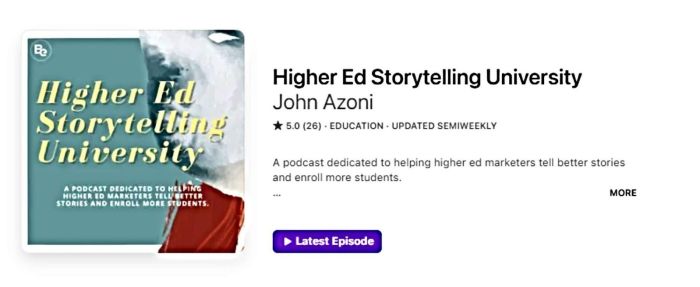
Example: Higher Ed Storytelling University Podcast. The Higher Ed Storytelling University podcast features marketers, educators, and students discussing authenticity, narrative strategy, and digital storytelling. This example illustrates how schools and industry experts are using long-form audio to humanize their messaging and reach broader audiences.
Building a successful user-generated content (UGC) strategy doesn’t require starting from scratch. With the right tools and a few well-planned quick wins, your institution can begin collecting and showcasing authentic stories almost immediately. Below are practical tools and easy-to-implement tactics that can help you get started.
UGC Creation and Curation Tools
Canva: A go-to tool for both marketing teams and students. Canva makes it easy to design branded graphics, quote cards, and short visuals using preset templates. Students can create Instagram takeover intros, testimonial cards, or club event spotlights, all while staying on-brand thanks to shared school colors and fonts.
CapCut: A free, mobile-friendly video editing app perfect for short-form social content. Encourage students to use it to trim clips, add subtitles, and polish their footage before submission. Subtitles, in particular, improve accessibility and help engagement since many viewers watch videos without sound.
Later or Buffer: Social media scheduling platforms like these help teams plan and publish UGC consistently. For example, you can schedule weekly “Student Spotlight” features or testimonial series, keeping your feeds active with minimal daily effort.
TINT or Tagboard: These UGC management tools collect content tagged with your campaign hashtags across multiple platforms into one dashboard. They also help you request permissions, filter submissions, and display curated UGC feeds on your website (such as a live “#CampusLife” wall on your admissions page).
Quick Wins to Kickstart UGC
Identify 3 Student Storytellers: Start small. Find three enthusiastic students, perhaps a club leader, athlete, or international student, and invite them to share their stories through takeovers, vlogs, or blog posts. Their content will serve as authentic examples and inspire others to participate.
Launch a Branded Hashtag: Create a memorable, campaign-specific hashtag like #[YourSchool]Life or #Future[YourMascot] and start promoting it immediately. Add it to your bios, marketing emails, and on-campus signage. Repost tagged content regularly to reward engagement and grow participation.
Pilot an Authentic Video Post: Experiment with one short, genuine video on Instagram or TikTok. Try a student Q&A, a “what I wish I knew” segment, or a move-in day recap. Compare engagement metrics with your usual posts. You’ll often find authentic, lightly produced clips outperform polished ads.
Amplify Existing UGC: Look for what’s already out there. Students are likely tagging your school in posts or videos. Engage with those by resharing or commenting, signaling that you value authentic voices.
Offer Student Club Consultations: Provide quick content workshops or audits for student groups. Helping them improve their storytelling or branding indirectly elevates the quality of UGC being created across campus.
Measuring the Impact of UGC
Just like any other marketing initiative, your user-generated content (UGC) strategy needs to be measured to prove its value and refine future campaigns. The impact of UGC goes beyond clicks and likes. It touches trust, community sentiment, and enrollment. That’s why it’s important to measure both quantitative and qualitative outcomes. Here’s how to assess what’s working and why.
Track Engagement and Reach Start with the fundamentals: likes, comments, shares, saves, and views. Compare these against your institution’s regular branded posts. UGC often performs better, signaling a stronger connection and authenticity. Also track reach and impressions—are your hashtags expanding visibility? If your student takeover generates thousands of views and dozens of replies, that’s evidence of increased awareness and interest at the top of the funnel.
Monitor Cost Efficiency If UGC is part of paid campaigns, track cost per click (CPC) and cost per lead (CPL). Ads using student-generated content tend to have higher click-through rates and lower costs because they appear more genuine. Run A/B tests: one glossy ad versus one featuring a real student photo. If the authentic ad drives more engagement at a lower cost, you’ve got clear ROI data to share with stakeholders.
Measure Conversions and ROI Track what happens after engagement. Did a UGC-driven post increase form submissions or event sign-ups? Ask applicants how they heard about your school. If they mention your social media or specific student stories, that’s qualitative proof of impact. You can also calculate Return on Ad Spend (ROAS) by comparing tuition value or lead generation to ad spend, or use proxy metrics like cost-per-application to show improved performance. Learn more in HEM’s social media playbook.
Gather Feedback from Students and Staff Numbers don’t tell the whole story. Collect feedback from your community through surveys or informal polls. Ask whether students feel represented in your content or whether prospective students found your UGC helpful. Anecdotal comments, like “Your Instagram takeovers made me want to apply,” are qualitative gold and demonstrate the emotional impact of authenticity.
Track Sentiment and Community Growth Pay attention to the tone of comments and discussions. Are people tagging friends or expressing excitement? Positive sentiment indicates your content resonates. Also, monitor the growth of branded hashtags and organic posts. If more students are tagging your school or sharing their own stories without prompting, your UGC strategy is inspiring real advocacy.
Build a UGC Dashboard Bring it all together with a simple dashboard that tracks UGC performance quarterly, engagement rates, CPC/CPL trends, sentiment highlights, and standout examples. This helps visualize the tangible outcomes of authenticity-driven marketing and makes it easier to communicate results to leadership.
Example: University of Tennessee, Knoxville A University of Tennessee senior’s “Day in the Life” video exemplifies how authentic, student-produced content can outperform traditional marketing posts. The Reel’s organic engagement, thousands of views, and high interaction highlight the measurable impact of relatability on social media reach and engagement.
Authenticity in marketing is the foundation of meaningful connection. By weaving user-generated and authentic content into your strategy, your institution can foster trust, spark engagement, and inspire real relationships with students and families. Throughout this guide, we’ve explored how to define UGC, why it works, and how to implement it strategically through proven best practices and simple quick wins. The takeaway is clear: campaigns that feel real outperform those that feel rehearsed.
Of course, launching an authenticity-driven strategy takes more than good intentions. It demands planning, creativity, and a partner who understands how to balance storytelling with measurable results. That’s where Higher Education Marketing (HEM) comes in. Our team has helped colleges and universities around the world capture genuine student stories and transform them into powerful digital campaigns. Whether you’re planning a branded hashtag initiative, building a library of student video testimonials, or training student ambassadors and UGC programmes to create engaging social content, HEM can guide you every step of the way.
Authentic voices are your greatest marketing asset, and with HEM’s expertise, you can amplify them strategically. Reach out today for a free UGC strategy consultation and discover how genuine stories can drive real enrollment results. Let’s build trust, engagement, and community authentically.
Struggling with enrollment?
Our expert digital marketing services can help you attract and enroll more students!
Frequently Asked Questions
Question: What Is User-Generated Content (UGC) in Higher Education Marketing
Answer:User-Generated Content (UGC) is any material created by people outside your marketing team: students, alumni, faculty, or even parents. It includes everything from TikToks and Instagram stories to blog posts, reviews, and testimonial videos.
Question: What Is Authentic Storytelling in Higher Education Marketing?
Answer: Authenticity is the backbone of modern education marketing. Students trust people more than institutions, and they can spot inauthenticity instantly, especially Gen Z, who’ve grown up spotting inauthenticity from miles away.
This blog was kindly authored by Dr. Ismini Vasileiou, Associate Professor at De Montfort University.
The government’s new Post-16 Education and Skills White Paper reframes how the UK prepares people for work, learning, and life. It promises a simpler, more coherent system built around quality, parity of esteem, and progression – introducing new V-Levels, reforming Level 3 and below qualifications, and setting out clearer routes into higher education and skilled employment.
Within it there is an unmistakable message for universities: higher education is no longer a separate tier but a partner in a joined-up skills ecosystem.
This direction of travel strongly echoes the recommendations of the Cyber Workforce of the Future white paper, which called for a unified national skills taxonomy, stronger coordination between education and employers, and consistent frameworks for developing technical talent. The government’s post-16 reforms, though broader in scope, now seeks to achieve at system level what the cyber sector has already begun to pilot.
Reimagining pathways: from fragmentation to flow
At the heart of the White Paper lies the ambition to create “a seamless system where every learner can progress, without duplication or dead ends.” The proposed V-Levels for 16-19-year-olds aim to sit alongside A-Levels, replacing hundreds of overlapping technical qualifications and creating a nationally recognised route into both higher technical and academic study.
Reforms to Level 2 and entry-level qualifications will introduce new “Foundation Programmes” that build essential skills and prepare learners for work or further study. Alongside these, stepping-stone qualifications in English and Mathematics will replace automatic GCSE resits, acknowledging that linear repetition has failed to deliver progress for many young people.
The emphasis on simplified, stackable routes reflects the very principles behind the Cyber Workforce of the Future model, which proposed interoperable learning pathways connecting schools, further education, higher education, and industry within a single skills continuum. What began as a sector-specific call for alignment in cyber is now being written into national policy.
Higher education’s new context
The White Paper links post-16 reform directly to the Industrial Strategy and to Skills England’s mission to align learning with labour-market demand. For universities, several themes stand out:
Progression and parity: Higher education is expected to work together with further education and employers to ensure that learners completing V-Levels and higher technical qualifications can progress seamlessly into Level 4, 5, and 6 provision.
Higher Technical Qualifications (HTQs): The expansion of HTQs in growth areas such as AI, cyber security, and green technology positions universities as key co-developers and deliverers of technical education.
Quality and accountability: The Office for Students will have powers to limit recruitment to poor-quality courses and tie tuition-fee flexibility to demonstrable outcomes, reinforcing the need for robust progression and employability data.
Lifelong learning and modularity: The commitment to the Lifelong Learning Entitlement demands interoperability of credits across further education and higher education – another concept long championed in the cyber-skills ecosystem.
Taken together, these reforms require universities to move beyond disciplinary silos and become brokers of opportunity – enabling flexible, lifelong learning rather than simply delivering three-year degrees.
From strategy to delivery: lessons from cyber that can scale
The Cyber Workforce of the Future paper provides a live example of how the government’s post-16 vision can be delivered in practice. Its framework rests on three transferable pillars:
Unified skills taxonomy – mapping qualifications and competencies against occupational standards to create a common language for education and industry.
Education – industry bridge – aligning curriculum design and placements to real-world demand through structured partnerships between universities, FE colleges, and employers.
Inclusive pipeline development – embedding equity and access by designing pathways that work for diverse learners and career changers, not just traditional entrants.
These principles are not unique to cyber; they represent a template for how any technical or digital field can align with the White Paper’s objectives. The challenge now is scaling this joined-up approach nationally across disciplines – from advanced manufacturing to health tech and green energy.
Six priorities for universities
Redefine admissions and progression routes Recognise new qualifications such as V-Levels and HTQs as rigorous, valued entry points to higher education.
Co-design regional skills ecosystems Partner with futher education colleges, local authorities, and industry to map regional growth sectors and align provision accordingly.
Develop flexible, modular curricula Build stackable learning blocks that learners can access and re-enter throughout their careers under the Lifelong Learning Entitlement.
Co-create with employers Move from consultation to collaboration, embedding placements, apprenticeships, and micro-credentials that reflect labour-market demand.
Support learner transition Provide structured academic and digital-skills support for students from vocational or stepping-stone routes.
Measure outcomes transparently Track progression, attainment, and employability by qualification route to evidence value and inform continuous improvement.
Opportunities and risks
The White Paper’s success will depend on genuine partnership between universities, further education providers, and employers. Without coordination, the new structure could replicate old hierarchies – leaving V-Levels or technical routes seen as second-tier options. Similarly, tighter regulation must not deter universities from widening participation or admitting learners who require additional support.
The cyber-skills sector demonstrates what can work when these risks are managed: clear frameworks, shared standards, and collaborative delivery that bridges academic and technical domains. Replicating this across disciplines will require sustained investment and policy stability, not short-term pilots.
A new social contract for tertiary education
The Post-16 Education and Skills White Paper represents a genuine reset for tertiary education – one that values technical excellence, lifelong learning, and regional growth alongside academic achievement.
Its goals mirror those already embedded within the Cyber Workforce of the Future initiative: building a national system where education and employment are continuous, mutually reinforcing stages of one journey. The cyber model shows that when universities act as integrators – connecting further education, employers, and government – policy ambitions translate into measurable workforce outcomes.
What began as a sector-specific experiment can now serve as a blueprint for system-wide reform. If universities across all disciplines embrace this pivot, they can help turn the White Paper’s vision into reality – a cohesive, agile, and inclusive skills ecosystem ready for the future economy.
This blog was kindly authored by Professor Abigail Marks, Associate Dean of Research, Newcastle University Business School, and member of the Chartered Association of Business Schools Policy Committee.
From January 2026, public funding for the vast majority of Level 7 apprenticeships in England will be withdrawn for learners aged 22 and over. Funding will remain for those aged 16 to 21, alongside narrow exceptions for care leavers and learners with Education, Health and Care Plans. Current apprentices will continue to be supported. Ministers present the change as a rebalancing of spending toward younger learners and lower levels, where they argue returns are higher and budgets are more constrained.
At first sight, this decision looks like a simple trade-off: concentrating scarce resources on school-leavers and early career entrants, while expecting employers to bear the costs of advanced, Master’s-level training. For business schools, however, particularly those that have invested in Level 7 pathways, such as the Senior Leader Apprenticeship, the implications for widening participation are likely to be profound. The Senior Leader Apprenticeship is often integrated with an MBA or Executive MBA. Alongside this, many institutions align Level 7 apprenticeships with specialist MSc degrees, often with embedded professional accreditation. In essence, Level 7 apprenticeships in business schools provide structured, work-based routes into advanced leadership and management education, usually culminating in an MBA or MSc.
Why Level 7 apprenticeships matter for widening participation
Since the apprenticeship levy was introduced in 2017, Level 7 programmes have provided business schools with a powerful route to widen participation, particularly among groups that have been historically excluded from postgraduate education. According to the Department for Education’s 2023 Apprenticeship Evaluation, almost half (48 per cent) of Level 7 apprentices are first-generation students, with neither parent having attended university, and around one in five live in the most deprived areas of the country. Analysis by the Chartered Association of Business Schools shows that in 2022/23, a quarter of business and management Level 7 apprentices held no prior degree qualification before starting, with a small minority having no formal qualifications at all. The age profile further underscores the differences between these learners and conventional Master’s students, with 88 per cent of business and management Level 7 apprentices aged over 31, indicating that these programmes primarily serve mature learners and career changers rather than recent graduates.
This picture contrasts sharply with the traditional MBA market, both in the UK and internationally. Research on MBA demographics from the Association of MBAs in 2023 highlights that students are typically in their late twenties to early thirties, often already possessing a strong undergraduate degree and professional background, and participation is skewed toward those with access to significant financial resources. An Office for Students analysis of Higher Education Statistics Agency data shows that conventional graduate business and management entrants are disproportionately from higher socio-economic backgrounds, with lower representation from disadvantaged areas compared to undergraduate cohorts. In practice, this means that the subsidised Level 7 apprenticeship route has been one of the few mechanisms allowing those without financial capital, prior academic credentials, or family background in higher education to gain access to advanced management education in business schools.
The economic and societal cost of defunding Level 7
Employer behaviour is likely to shift in predictable ways once the subsidy is removed. Some large levy-paying firms may continue to sponsor a limited number of Level 7 places, but many smaller employers, as well as organisations in the public and third sectors, will struggle to justify the full cost. Data from the Chartered Management Institute suggests that 60 per cent of Level 7 management apprentices are in public services such as the NHS, social care, and local government. Less than 10 per cent are in FTSE 350 companies. Consequently, there is a risk of further narrowing provision to those already in advantaged positions.
The progression ladder is also threatened. Level 7 apprenticeships have been a natural progression for people who began at Levels 3 to 5, building their qualifications as they moved into supervisory roles. Closing the door at this point reinforces the glass ceiling for those seeking to rise from technical or frontline work into leadership. With data from the Department for Education reported in FE Week reporting that 89 per cent of Level 7 apprentices are currently aged over 22, the vast majority of those who have benefited from these opportunities will be excluded from January 2026.
The consequences extend beyond widening participation metrics. Leadership and management skills are consistently linked to firm-level productivity and the diffusion of innovation. Studies such as the World Management Survey have shown that effective management correlates strongly with higher productivity and competitiveness. Restricting adult access to advanced apprenticeships risks slowing the spread of these practices across the economy. For business schools, it reduces their ability to act as engines of regional development and knowledge transfer. At a national level, the UK’s prospects for growth depend not only on new entrants but also on upskilling the existing workforce. Apprenticeships have been one of the few proven ways of achieving this. If opportunities narrow, it is possible that firms may struggle to adopt new technologies, deliver green transitions, or address regional productivity gaps. The effects may also be felt in export performance, scale-up survival, and international competitiveness.
The removal of public funding for adults over 21 threatens to dismantle a pathway that has enabled business schools to transform the profile of their postgraduate cohorts. Where once mature students, first-generation graduates, and learners from deprived regions could progress into Master’s-level management education, the policy shift risks returning provision in England to a preserve of the already advantaged. In contrast, our European counterparts, where degree and higher-level apprenticeships retain open access for adults, will continue to allow business schools to deliver on widening participation commitments across the life course.
Lessons from Europe
Germany’s dual study system has expanded, with degree-apprenticeship style programmes now making up almost five per cent of higher education enrolments. Data from the OECD shows that the proportion of young adults aged 25–34 with a tertiary degree in Germany has risen to around 40 per cent, driven partly by these integrated vocational–academic routes. Switzerland shows even more dramatic results: between 2000 and 2021, the share of 25–34-year-olds with a tertiary qualification rose from 26 to 52 per cent. Crucially, Switzerland also leads Europe in lifelong learning, with around 67.5 per cent of adults aged 25–65 participating in continuing education and training. For Swiss business schools, this creates a mature, diverse learner base and allows firms to continually upgrade leadership and management capacity. Both countries demonstrate how keeping lifelong pathways open is central to sustaining firm-level productivity, innovation, and international competitiveness.
Conclusion
The decision to defund most adult participation at Level 7 thus represents more than a budgetary tweak. It narrows opportunities in advanced management education and risks reversing progress in widening participation. Unless English business schools, employers, and policymakers act swiftly to design new pathways, the effect will be a return to elite provision. More worryingly, England risks falling behind international counterparts in building the leadership capacity that underpins innovation, productivity, and growth.
This guest blog was kindly authored by Imran Mir, Campus Head and Programme Lead, Apex College Leicester
Leadership in higher education is often measured by indicators such as retention rates, research outputs and league table positions. These are important, but leadership is far deeper than numbers. Growing up with autism and then becoming a leader in higher education has shaped how I approach leadership. Being neurodiverse means I see situations differently, notice patterns others may miss, and feel deep empathy with students and colleagues who are often invisible in our systems.
This is why neurodiverse leadership must be treated as a quality issue. Universities are rightly talking more about inclusive curriculum design and student support, but these conversations rarely extend to who sits at the decision-making table. Representation in leadership is not about tokenism. It is about ensuring the sector benefits from different ways of thinking, which is vital for quality, resilience and innovation.
Why neurodiverse leadership matters
According to the University of Edinburgh 2024, in the UK, one in seven people are neurodiverse. Advance HE 2024 report shows leadership teams in higher education remain overwhelmingly homogenous. This lack of representation is not just an issue of fairness, it is also a missed opportunity for innovation. Research by Deloitte 2017 shows that neurodiverse teams can be up to 30 per cent more productive in tasks requiring creativity and pattern recognition. Universities are currently facing challenges in relation to funding and digital disruption, and they will need this kind of productivity and resilience more than ever.
Further, Made By Dyslexia 2023 claims that one in five people are dyslexic, many of whom bring excellent problem-solving and communication skills. These strengths align with what is expected in leadership roles, where complex challenges and clear communication are requirements. Yet recruitment and promotion processes can often filter out people who think or communicate differently.
Austin & Pisano, 2017 adds that neurodiverse leaders frequently demonstrate empathy and adaptability. These qualities are imperative in higher education as institutions are trying their best to meet diverse student needs, respond to rapid change and rebuild trust in their systems. Without neurodiverse leadership, universities risk reinforcing the very barriers which they are trying to eradicate.
Lessons for higher education leaders
From my own experience, I have learned three lessons that apply directly to leadership in higher education.
The first lesson is the power of clarity. Neurodiverse staff and students excel when expectations are clear. As a leader, I have seen first-hand that communicating with clarity in strategy documents, policies and day-to-day interactions builds trust in the academic institution. Research on organisational effectiveness suggests that clear communication consistently improves outcomes across diverse teams
The second lesson is valuing flexibility. Traditional recruitment, professional development and promotion systems seem to reward conformity. This is a missed opportunity because neurodiverse teams will bring innovation and productivity benefits. Strong leaders can change this by adopting flexible approaches such as task-based interviews, blended assessments that combine written, oral and practical elements, and CPD which takes into consideration various communication styles.
The third lesson is role modelling openness. For years I believed that revealing my autism would be seen as a weakness. In reality, sharing my story has made me a stronger leader. It has encouraged colleagues to be open about their own experiences and helped students feel less isolated. Austin & Pisano 2017 show that when leaders model vulnerability and authenticity, it strengthens organisational culture and increases trust across teams.
A quality issue, not a side project
These lessons outline why neurodiverse leadership should not be viewed as a side project. Quality frameworks such as the Office for Students’ conditions and the QAA Quality Code are built on assumptions of fairness, reliability and inclusivity. If leadership itself is not inclusive, then the credibility of these frameworks is undermined. If the voices of the one-in-seven neurodiverse people are not present in leadership, then universities are failing to reflect the diversity of the communities they are trying to serve.
Neurodiverse leadership will strengthen governance, enhances decision-making and ensures policies reflect the diversity of the student body. It is a direct contributor to educational quality, not an optional extra.
Conclusion
As someone working in higher education, I know these lessons are transferable across the sector. But they feel especially urgent now, as universities face funding pressures, digital disruption and growing student expectations. In such times, leaders who think differently are not optional. They are essential.
Neurodiverse leadership is not about meeting quotas. It is about strengthening quality. The sector cannot afford to waste talent or exclude perspectives that could help it adapt and thrive. If universities want to remain resilient, they must recognise that diversity of thought at the leadership table is just as important as diversity in the classroom. At its heart, this is about shaping the future of higher education in a way that is inclusive, innovative and sustainable.
HEPI Director, Nick Hillman OBE, spent some of his weekend listening to, and participating in, discussions about higher education at the Battle of Ideas at Church House in Westminster.
Here are his remarks from a debate on whether we are now in ‘The Era of the Downwardly Mobile Graduate’.
Thanks for inviting me to speak. I agreed to do so for two reasons. First, the Battle of Ideas is a wonderful grassroots event. Secondly, Claire Fox invited me to speak immediately after the murder of Charlie Kirk. My daughter is keen on telling me where Charlie Kirk was misguided but, whether she is right or wrong, universities should be places where free and fervent debate thrives; not places where discussion gets closed down with a bullet. That should not need saying but, sadly, of course it does.
Last night, I went to a gig in Oxford by the fabulous band EMF – I first saw them as a fresher 35 years ago and, yes, they are still going. As you doubtless know, their most famous song is ‘Unbelievable’. And most of what we have heard, and are going to hear, is exactly that: unbelievable. Not in the ‘incroyable’ sense of the word, but in the sense that the claims are simply not true.
We are told there are millions upon millions of people in ‘non-graduate roles’. But this relies on weird and poorly understood definitions of what graduate jobs are. Official definitions obviously rely on jobs being categorised into graduate and non-graduate.
My favourite critique of what this means comes from an – admittedly – old article by Peter Brant (on Wonkhe), which looked at the official classification from a few years ago, writing:
A civil servant who was promoted from an Executive Officer to a Higher Executive Officer would be moving from a graduate job to a non-graduate job. Managing an off-licence is a graduate job, managing a pub or a wine bar is a non-graduate job. A singer is a graduate role, a dancer is a non-graduate role. A clown is a graduate job, the manager of a circus is a non-graduate job. And – my personal favourite – a rag-and-bone man is a graduate job, an antiques dealer is a non-graduate job. The list goes on and on.
Myth 2
Myth number 2 is the idea that graduates ‘face grim prospects’. The OECD’s new Education at a Glance, which is an annual compendium of global education facts, shows this to be untrue.
Unemployment is much lower among UK graduates than among non-graduates – irrespective of subject area studied. Indeed, unemployment is much lower among UK graduates than graduates in other developed countries too.
There isn’t time to go into the huge other benefits of higher education but they include better physical and better mental health.
The OECD also show the UK does have a problem of low incomes. But this is not among graduates, where our outcomes are positive and comparable with those in other countries. We are literally at the bottom of the OECD league when it comes to earnings for people who have left school with low or no qualifications. They are the people being most let down.
Myth 3
The third myth in the blurb for today is that AI will remove the need for employers to recruit people with higher level skills. This is just a revamped version of John Maynard Keynes’s nonsense prediction that people at the end of this current decade would in future work for just 15-hours a week.
We published a collection of essays on AI last week. Perhaps the most thought-provoking one was by Professor Rose Luckin of the UCL Knowledge Lab. She argues persuasively that:
The AI revolution represents a pivotal moment where humans need to become more intelligent, not less, as we develop increasingly sophisticated tools.
The fourth myth is that there are multiple really good alternative options to higher education. Ministers of different stripes have been telling us for years that there is about to be a huge expansion of apprenticeships for young people. Meanwhile, your children and mine are being pumped full of information about why they should do an apprenticeship rather than traditional higher education.
Yet the number of degree apprenticeships for school leaver is tiny, the number of apprenticeships has fallen since the Apprenticeship Levy was introduced and all those people who worry about university drop-outs should take a look at the high non-continuation rate for apprenticeships.
Apprenticeships don’t just happen because Keir Starmer or Kemi Badenoch say they should. Apprenticeships are jobs with training attached and the state of the labour market and the regulation of apprenticeships, not to mention the structure of the British economy, are not conducive to big increases in supply.
Myth 5
The final myth is the idea that there are tonnes of ‘disaffected university leavers’. Of course, higher education does not work out for all those who go all of the time. Indeed, we have shown in work with the University of Bristol that a high proportion of graduates would make a different choice, such as a different course and / or institution, if they were going back in time.
However, whether they chose exactly the right course or not, in our new work with King’s College Policy Institute, we show shows that a mere 8% of graduates regret their decision to enter higher education. Meanwhile other work shows younger graduates might have even lower regret rates than that.
This blog was kindly authored by Professor Paul Marshall, Vice-President (Global Campus) and Pro-Vice-Chancellor (Careers & Enterprise), University of East London.
As the UK Government prepares its long-awaited White Paper on the future of higher education, it is timely to reflect on the purpose and impact of our universities. At their best, they are not simply sites of knowledge creation – they are instruments of national capability. Few challenges illustrate that more vividly than cybersecurity.
When I joined a panel at the CyberBay Cybersecurity Conference in Tampa earlier this month, Dr Richard Munassi, Managing Director of Tampa Bay Wave, opened with a warning that set the tone for the discussion:
We are in a cyber war – a war waged by well-financed, state-backed criminal organisations so sophisticated that they have their own HR divisions.
He was right. Earlier this year, Jaguar Land Rover was forced to suspend production after a ransomware attack that rippled across its global supply chain. The UK Government’s intervention – with a support package approaching £1.5 billion – made clear that cybersecurity is not an IT issue; it is economic infrastructure.
As the sector awaits the Government’s vision for the future, one truth already stands out: higher education must not only prepare individuals for work – it must prepare the nation for risk.
At the University of East London (UEL), that challenge sits at the heart of our institutional strategy, Vision 2028, which seeks to transform lives through education, innovation, and enterprise. The strategy’s organising principle – Careers-First – redefines employability as capability.
Rather than positioning careers as an outcome of study, it embeds professional practice, enterprise, and resilience into every degree and partnership. The test for every programme is simple: does it equip our students to adapt, contribute, and lead in industries defined by constant change?
Nowhere is this approach more tangible than in cybersecurity. Our BSc Cyber Security & Networks, MSc Information Security & Digital Forensics, and Cyber Security Technical Professional Degree Apprenticeship all combine rigorous academic study with live, industry-based application.
Students work directly with BT, IBM, Fujitsu, and Ford, tackling real-time challenges in threat analysis, data forensics, and network defence. By the time they graduate, they are not simply work-ready — they are work-proven, having contributed to the resilience of the very sectors they will soon join.
The results speak for themselves:
With Siemens UK, students tested firmware vulnerabilities in industrial systems, informing Siemens’ internal training programmes.
With Barclays Eagle Labs, they created a fraud-analysis dashboard now in pilot testing.
With NHS Digital, they developed a ransomware-simulation tool to train hospital teams in incident response.
Each collaboration demonstrates a single idea: learning is most powerful when it changes the world beyond the classroom.
UEL’s Institute for Connected Communities (ICC), led by Professor Julia Davidson OBE, anchors this model in research excellence and policy leadership. The ICC brings together computing, criminology, psychology, and social science to examine the human, technical, and organisational dimensions of online safety.
Its research informs the UK Council for Internet Safety, Ofcom, UNICEF, and multiple international governments. Through projects such as Global Kids Online, ICC research directly shapes teaching, ensuring that our graduates understand not only how to secure systems, but why digital trust matters to society.
As policymakers consider the future role of universities in the forthcoming White Paper, the ICC already provides a working example of how academic research translates into practical and regulatory impact.
The White Paper will also need to consider how global collaboration strengthens national capability. UEL’s Global Campus model demonstrates how this can work in practice — connecting students and employers across India, Greece, Egypt, and the United States to create shared pathways for study, innovation, and employment.
Our developing partnership with Tampa Bay Wave, framed within the UK–Florida Memorandum of Understanding (2023), offers one illustration. We are building both virtual and physical experiences that will enable UEL students to engage with Florida’s growing cybersecurity and fintech ecosystem through mentoring, live projects, and placements, while providing a London base for US start-ups entering the UK market.
A genuine transatlantic bridge is being constructed – designed for movement in both directions, connecting students, researchers, and entrepreneurs to co-create secure-by-design technologies and governance frameworks. It is the Careers-First model, scaled globally.
The next phase of cybersecurity will occur where AI, data, and physical systems converge. Attacks will target intelligent infrastructure – transport grids, hospitals and manufacturing. UEL is already embedding these challenges into its curriculum, guided by ICC research. Students design adversarial-AI tests, examine supply-chain vulnerabilities, and develop frameworks for organisational resilience.
This approach recognises that technology evolves faster than any static syllabus. Students are therefore treated as co-creators, working alongside academics and employers to design the solutions industry will need next.
As the UK Government prepares its White Paper, one principle should underpin the national conversation: universities are not peripheral to resilience – they are central to it. They educate the workforce, generate the research, and sustain the partnerships that keep the nation secure.
UEL’s Careers-First model, aligned to Vision 2028, embodies that principle. It fuses employability, enterprise, and global engagement into one coherent system of capability. Our collaboration with Tampa Bay Wave is a single, tangible expression of this – connecting East London’s lecture theatres to innovation ecosystems across the Atlantic.
In a global cyber war, the question is not whether universities should respond, but how fast they can. At UEL, that response is already underway – this is what Careers-First looks like.
This speech was delivered by HEPI Director Nick Hillman at the University of Cardiff on Thursday, 16 October 2025.
Introduction
The other day, I was speaking to the University of Liverpool Council at the Ness Botanic Gardens on the Wirral, which as you know is four hours due north of here, pretty much on the Welsh / English border. I started my speech there by noting that I only exist because of the University of Liverpool, as my maternal grandparents met there in the early 1930s. Well, I also only exist because of the Welsh university system, as my parents met while they were students here in Wales in the early 1960s, just as my own children only exist because I met my wife in the early 1990s at university.
The fact that three generations of my family originally met while at university is a powerful reminder, at least to me, that higher education change lives. And at HEPI, we had another powerful reminder of that during our first event of this academic year, when – last month – we hosted the UK launch of the OECD’s Education at a Glance publication.
Education at a Glance
In case you have not come across it before, this is the most useful but worst titled publication on education that appears anywhere in the world each year. It is a vast 541-page compendium of comparative data that you need to pore over rather than glance at.
This year’s OECD report had a particular focus on tertiary education. While we have become used to people beating up on the UK higher education sector, the OECD actually painted a picture of a very successful sector playing to its strengths. When you look in from the outside, it seems the UK’s higher education institutions are not so bad after all.
For example, the OECD showed that, among the many developed countries covered in their report, the UK has:
higher than average participation in higher education;
lower than average graduate unemployment, irrespective of whether the individuals studied STEM, business or humanities; and
among the very highest undergraduate completion rates anywhere in the world, vying with Ireland for the top spot.
I recognise the OECD is looking at averages for the UK as a whole and the position of Wales is not necessarily the same but, in general, the weaknesses the OECD found in were on the lack of good opportunities for people who do not succeed in education first time around.
Specifically, the OECD found a profound problem among young men, a rising proportion of whom are classified as NEETs (Not in Employment, Education or Training). While the OECD use historic data for a year or two past, last week’s brand new NEET data for Wales confirms the depressing picture. Indeed, it was even more salutary, noting:
The proportion of young people aged 16 to 24 in Wales who were not in employment, education or training (NEET) was 15.1% in the year ending June 2025, an increase of 3.6 percentage points over the year.
The OECD additionally found that the UK has the biggest gap of all developed countries when it comes to the difference in earnings between low-skilled adults and those who leave school with A-Levels (or equivalent). This should perhaps worry Wales even more than the rest of the UK, given that Wales scores the worst for schoolchildren’s academic performance for any part of the UK. Indeed, Wales is the only part of the UK to perform worse than the OECD average in all three areas of Mathematics, Reading and Science.
When it comes to funding of higher education, the OECD found the UK spends more than most other countries … but the shift to loan-based finance means direct government spending on each student in higher education is only half the OECD average and only half the amount spent ‘at primary to post-secondary non-tertiary levels’ ($13,000). Of course, the UK’s figures are distorted by England’s numbers because England is much larger than the other parts of the UK and has moved towards loans to a greater degree than Scotland, Wales or Northern Ireland. That is one reason why we have worked with London Economics and the Nuffield Foundation to look at the picture in each part of the UK separately.
There are three profound differences. First, the Exchequer cost is lowest in England, which also has the highest per-student income for institutions. Scotland is at the other end of the scale, with the largest Exchequer cost but the lowest unit-of-resource for institutions. Wales is, as you may expect, somewhere in the middle, with an Exchequer cost and a per-student income for institutions that lies between those in England and Scotland.
There is a similar picture when we look – secondly – at the balance of who is paying the costs of higher education. In England, it is mainly former students via the loan system; in Scotland, it is entirely taxpayers (and then some). In Wales there is a more even split approaching 50:50 between the Exchequer and graduates, arguably reflecting the public and private benefits of higher education more accurately. There are probably lessons from Wales for the rest of the UK here, though seemingly not for Kemi Badenoch, who complained at the Conservative Party Conference last week that higher education in England still costs taxpayers too much.
The third big difference is on student maintenance, where the system in Wales is more generous and more logical than those elsewhere in the UK. Each student gets more and the non-repayable grants are more generous in Wales than elsewhere – all undergraduates have at least a small grant whereas no one currently gets a grant in England, where grants were abolished in 2016. (Ministers promised the return of grants in England at the Labour Conference a fortnight ago, but only for some students on some courses, meaning it is likely to prove a mouse of an intervention and a very complicated one at that. It is certainly set to be nothing like the Welsh system.)
Many people I know are fans of the system in Wales for the way that it tries to strike a balance. However, while there are certainly far worse systems even within the rest of the UK, I personally think the benefits of the Welsh system are sometimes oversold. For example, I think the structure of student support in Wales is excessively generous to students who come from wealthy households. In other words, it is not means tested enough, perhaps explaining the need for the recent cuts to postgraduate support.
I have held this view consistently since the current Welsh funding system was introduced on the back of the Diamond review in 2018, but it has got me in trouble. After my concerns reached the front page of the Western Mail, I got not only an official rebuke from the Welsh Government but HEPI also received a formal complaint that came jointly from Universities Wales and NUS Wales. Rather than persuading me to change my view, I must admit this mainly had the effect of making me wonder if higher education debates in Wales are sometimes a little too cosy and stifled.
Boys, Boys, Boys
One other area where the OECD painted a less positive picture is on the differential educational performance of young men and young women. Women are more likely to obtain tertiary education across the developed world but the gap between men and women is bigger in the UK than elsewhere and has been growing while it has stayed the same on average across the OECD as a whole. According to the OECD:
In the United Kingdom, they [women] accounted for 56% of first-time entrants in 2023, up from 55% in 2013. Across the OECD, women make up 54% of new entrants on average, the same share as in 2013.
This is a convenient segue into some more of HEPI’s recent output because we have long worried about the educational performance of boys and young men and have published a number of papers on the topic over the years, with the most recent one appearing in March 2025. As Mary Curnock Cook wrote in the Foreword:
Something has surely gone wrong with education if boys – in aggregate at least – do worse than girls at all stages of education from early years to higher education and beyond.
Overall, out of every 100 female school leavers, 54 proceed to higher education by the age of 19; out of every 100 male school leavers, just 40 do so.
Again, the problems are worse in Wales than elsewhere. Over half of Inner London school leavers eligible for Free School Meals reach higher education by the age of 19; it is hard to get directly comparable figures for Wales but it seems the numbers are less than half as much for FSM Welsh-domiciled school leavers. Overall, while the gap in school leavers’ entry rates to higher education between men and women is dire in England, it is even worse in Wales. In fact, the proportion of young men who make it to higher education in Wales is lower than in every other part of the UK. It has been a known problem for at least 20 years yet for whatever reason, and perhaps because of misplaced fears of seeming politically incorrect, it has not been addressed.
Yet if male educational underachievement is not tackled, it seems certain that we will store up further societal problems for the future – including having more under-educated men veering towards the political extremes. Here, I note in passing the high polling of Reform for next year’s Senedd election. It is not rocket science to solve the boy problem, however, to take just one example, some schools following a ‘boy positive’ approach have managed to equalise their results for boys and girls and there is some great work underway in our own sector – for example, at Ulster University and the Arts University Bournemouth.
What remains completely absent, however, is any concerted interest at a national and ministerial level – certainly at Westminster and as far as I can tell in the Senedd too. People who did not want to take the Black Lives Matter protests seriously a few years ago sought to deflect attention from them by saying ‘All Lives Matter’, as if that was ever in doubt. Similarly, when Ministers wish to deflect attention from the crisis in boys’ education they like to respond by saying things like ‘Opportunity should be available to all’, which is true but it papers over the specific challenges faced by young men.
Our work on male underachievement sits alongside our work on the disadvantages faced by women, such as our reports on the substantial gender pay gap that remains in higher education as well as our other work on the overall gender pay gap among graduates. It also sits alongside a new HEPI report published just three months ago on the impact of menstruation on undergraduates’ attendance, academic engagement and wellbeing.
This revealed 70% of female students report being unable to concentrate on their studies or assessments due to period pain and that female students miss an average of 10 study days per academic year due to menstrual symptoms. It also suggested that just 15% of universities have a specific menstruation policy and, for those that do, the policy relates solely to staff rather than students.
So as I hope you can sense, the topics that tend to work best for HEPI are issues – like boys’ underperformance and the impact of menstruation on learning – that we should be speaking about more than we have done. Another area where that is true is public perceptions of higher education.
Misperceptions
A year ago, I had a drink with a neighbour who has a background in banking and two graduate children, meaning – in theory at least – that he knows the value of money and the value of education. However, when it came to universities, he expressed some typical rhetoric about them being too numerous, too big, too expensive and so on.
I responded by telling him I was on the Board at the University of Manchester and asking him to guess that institution’s financial turnover. His reply was £30 million – which is between 40 and 50 times smaller than the actual number of c.£1.3 billion (and over 20 times smaller than Cardiff’s turnover). Once my hangover had subsided, I contacted Bobby Duffy of the King’s College Policy Institute, who is the UK’s greatest expert on misperceptions – that is, the difference between what is true and what we tend to believe is true. This led over a process of many months to a new research project on what the public think about higher education, which we and King’s College launched the results of last month.
The findings are worth poring over in detail and we have brought hard copies of the work along for each you. Sone of the results particularly stand out.
For example, we gave people a list of seven institutions: Manchester City, Manchester United, the University of Manchester, the University of Oxford, the Daily Mail, MoneySupermarket.com and Greggs bakery.
When the public were asked about the relative financial size of these seven, the University of Oxford came fifth and the University of Manchester seventh, at the very bottom. More than half of respondents said they thought either Manchester City or Manchester United was the biggest in terms of their financial size; only 6% chose the right answer, the University of Oxford. The University of Manchester should be third in that list of seven by the way because, while it easily beats City and United in terms of its financial size, you might be surprised to know that Greggs has a turnover of £2 billion.
Similarly, when we gave the public a list of five big industries – legal services, accountancy services, aircraft manufacturing, telecommunications and higher education – and asked them to say which is least important in terms of export revenues, higher education was the most popular option. That result could not be any more wrong because higher education actually brings in much more export income than each of the others.
Let me share three other fascinating data points from the survey with you too:
people greatly overestimate the level of graduate regret about going to higher education – on average, the public guess 40% of graduates would opt not to go to university if they had their again, when the actual proportion of graduates who say this is only 8%;
on average, the public guess half (49%) of graduates say their university debt has negatively impacted their lives – in reality only 16% of graduates feel this way; and
a majority of people, including a majority of Reform voters at the 2024 general election, have positive feelings about universities.
Oversight and regulation
Over the past decade, the oversight of tertiary education and research has been transformed in England, though not necessarily for the better. When I worked as a Special Adviser in Whitehall a dozen years ago, there was one Minister for Universities and Science who sat in one Government Department and who had oversight of one regulator that oversaw both teaching and research (known as the Higher Education Funding Council for England). But in recent years we have had different regulators, different Ministers and different Departments for the teaching and research functions of universities, meaning coordinated oversight has been missing.
Moreover, while the Westminster Government has promised more ‘clarity and coherence’, the latest Machinery of Government changes have made the current situation even more of a dog’s dinner. The Minister for Skills, who has responsibility for higher education, now has one foot in the Department for Education and another in the Department for Work and Pensions, which has just taken on the responsibility for ‘skills’, while the Minister for Science has one foot in the Department for Science, Innovation and Technology and another in the Department for Energy Security and Net Zero. Split ministerial posts tend to be a recipe for chaos, as I saw close up during my own time in Whitehall.
So while I know that the new Medr (the Commission for Tertiary Education and Research) here in Wales has had some teething challenges, on paper it makes a lot more sense than what England has. At one point, it was thought England’s long-awaited post-16 skills white paper was likely to be heavily influenced by Wales; given the latest reshuffle and associated changes, that now – perhaps regrettably – seems less likely.
International students
Finally, I want to end by touching on the issue of international students. The majority of the really big projects HEPI has undertaken over the past few years have focused on international students. Perhaps that is not surprising, given the OECD data I started with, which shows that, while there is one international student for every thirteen home students across the OECD as a whole, the ratio in the UK is completely different at 1:3.
That helps to explain why we have calculated (more than once) the net economic benefits of international students to the UK. The latest iteration found a gross benefit of £41.9 billion for just one incoming cohort of students and a net benefit (after taking account of the impact on public services and so on) of £37.4 billion. We split up this total to reveal a number for each one of the 650 parliamentary constituencies across the UK, including Cardiff South and Penarth, which is the top-performing constituency in Wales and one where international students contribute significantly over £300 million a year.
We have separately calculated the positive tax contributions of those former international students who stay in the UK to work after completing their studies, undertaken detailed studies on the Graduate Route visa and looked specifically at the experience of Chinese students in the UK. In addition, we produce each year a Soft-Power Index that looks at how many very senior world leaders have been educated to a higher level outside of their own home country. If they return home with fond memories of their time in the UK and a better understanding of our country, then this tends to bring real benefits. We will be launching the results for 2025 next week but last year’s Soft-Power Index, which is regularly quoted by Ministers, showed that, across the globe’s 195 countries, there were 58 serving world leaders who received some higher education in the UK, second only to the US.
I am going to stop here because I started the speech on a positive – on the way higher education changes lives for the better. And despite all the numerous political, financial and geopolitical challenges facing higher education across the UK, the continuing immense soft-power benefits delivered by UK higher education institutions is another area where there is a huge amount of which we can be proud.
This blog was kindly authored by Professor Annabel Kiernan, Deputy Vice-Chancellor for Education and Student Experience at Goldsmiths University. It follows her speech at a HEPI event with the same title as this blog, held at the 2025 Conservative Party Conference.
To accept this question at its face and to understand what universities can and should do to build back public support, we need to look at how we got here. In broad terms, universities are not the only institutions whose role, purpose and efficacy are being challenged. There has been a wider breakdown of trust between the public and a wide range of local and national infrastructure, both public and private – from water and train companies, to the courts and local government.
In part, this is the inevitable consequence of two periods of significant financial stress – firstly from the 2008 financial crash and its resulting ten-year austerity programme, followed swiftly by the post-COVID cost-of-living crisis. The economic bite for the personal and public purse and the knock-on impact of such economic dislocation has been a considerable shrinking of the wider public realm and a gnawing away at the previous slowly progressive move towards a more ‘bread and roses’ type of social compact for all: of needing the fundamentals of life (bread), but also making available what brings beauty, culture and wellbeing (roses) to wider society, irrespective of economic circumstance. The shrinking of the public realm has pushed back this access to public goods.
Many education institutions, including universities, have attempted to be a buttress for this impact – whether that’s filling in social, behavioural, skills and knowledge gaps from lost learning, responding to increased mental health pressures, trying to mitigate, where possible, the impacts of poverty and other generalised impacts of closures of youth centres, libraries, museums and so on.
Clearly then, universities play a key role in delivering progress to individuals and the broader public. They are core to economic and social growth, delivering these while managing the public’s varied aspirations and differing expectations. The expansion of higher education was sought to widen the benefits of a university education and experience. Even before the Blair expansion in the 2000s, my own family – my mum, the eldest of six, with a miner and a housewife as parents – were beneficiaries, with all six children going to university during the 1970s and 1980s. Despite both leaving school at 14, my grandparents knew that university was the route to a different life. It paid off for all six brothers and sisters, and here I am today, the eldest grandchild of that mobility, a Deputy Vice Chancellor contributing a HEPI blog on public trust in universities.
But, whilst the cost of university entry has now significantly increased, the mobility pay off, or graduate premium, appears more challenged. This is despite the OECD’s Education at a Glance 2025 report showing that, over the course of a lifetime, attending university still delivers financially. In times of heightened economic stress, however, the public needs more immediacy in the financial payoff and surety in the belief that infrastructure delivers a high-quality service. We can see the political articulation of the need to see, feel and believe things work and have tangible benefits for individuals, their families and communities now. People’s sacrifices need to matter, and their investment needs to pay off.
So what do universities do to play their part?
As a sector, we work very hard on our civic role, but we need to be more porous. We can’t be seen to effectively privatise public space. We need to be of our places, and lead the charge on building solutions and helping people to navigate change – from how we work with local communities to how we contribute to global challenges. In other words, we need to reemphasise our role in sustaining the social, cultural and intellectual infrastructure of society,
To support that civic role, we need to offer more seamless education journeys and be accessible for learners throughout their lifetime. That means accelerating the ways in which we work in partnership with each other, with colleges, schools, employers and local authorities. Lifelong education is a philosophy, not just a government policy. The Lifelong Learning Entitlement needs to align with a wide range of policies. For example, now that ‘skills’ is situated with the Department for Work and Pensions, what harm in referring people to a bit of modular learning to get their employment on track rather than piecemeal training or benefit sanctions? Universities are a public infrastructure, so we need to connect well with other infrastructure to deliver our part of the ecosystem for individual and collective economic and social gains.
We must remain intentional, be high quality, deliver an excellent experience. There should continue to be robust regulation of bad actors. We should deliver success for all our students and we shouldn’t be a homogeneous model; learners take different pathways through higher learning and need to access it in different ways, through different modes and will have different needs for flexibility. There are specialisms and expertise in research and teaching, and these should remain available as choices. There has been much written about the detrimental impact of out-of-town shopping centres on our high streets. Similarly, if all universities have to deliver at scale for efficiencies, the impact of closures on the towns and cities of smaller, more specialist institutions would be devastating.
At this moment, we need to emphasise our value in relation to the individual economic benefit gained from the investment of a student loan. In other words, highly paid graduate employment. I’m not sure how potent the arguments for the collective economic benefit of universities currently are. Personal storytelling of meaningful impacts, like that of my own family, may have traction in our university locales.
Overall, we need to continue to deliver and continue to engage. We work hard in these spaces already, but we need to tell our story differently and continue to adapt our model.
Importantly, universities have a central part to play in delivering space for reflection, intellectual enquiry, creative and critical action and solutions which will help to navigate us, the public, through these significant and challenging periods of rapid economic, political and technological transition.
As Oppenheim wrote in his 1911 poem:
Hearts starve as well as bodies: Give us Bread, but give us Roses.
What better challenge for universities to continue to rise to.