
Category: Budgets

  • The Meaning of 2025

    The Meaning of 2025

    So, was that a fun year, or what?

    From Marc “Tonya” Miller and the federal government knee-capping the postsecondary sector in January to Marc “Harding” Miller and the federal government coming back around in September to knee-cap the college sector specifically to Ontario college presidents calling each other whores and more…it was a year to remember. Heck of a ride.

    But as catastrophic as the current fall in revenue seems, it’s worth remembering a couple of things. First, we’re not alone in this. Australia, the UK, France, the Netherlands: they’re all going through something similar. So are some (primarily but not exclusively blue) US states. And second of all, Canada’s institutions are still on most measures better funded than those elsewhere in the OECD (although that advantage is getting narrower all the time). So there’s an argument to be made that there’s nothing special going on here, and in a way this is just reversion to the mean. Not a lot of comfort in that, obviously, but misery loves company, etc.

    There is, I think, a  world-wide phenomenon (though perhaps it does not capture the dynamics of low and middle income countries) which is: NOBODY WANTS TO PAY FOR IT. Higher education is expensive on a per-student basis and it now extends to a far higher percentage of the population than it has at any point in human history. The implicit assumption within higher education communities was that by broadening access to higher education, we would win more public approval for higher education finance. Instead, by making higher education the norm, we made the “gains” from higher education a lot harder for graduates to see since they weren’t as “exceptional” anymore. There’s a point where attempts to boost access to pos-secondary education ceases to feel like spreading opportunity and starts to feel like imposing chores. Beyond that point, public support for higher education falls.

    (More generally, the closer institutions come to being “universal,” the more they seem like utilities, and the fraction of the population that wants “world-class” utilities is vanishingly small. People just want utilities to work, quietly and properly, with no fuss—which is probably why evident dysfunction like months-long campus disruptions from encampments are so deeply unpopular.)

    In other words, we’ve spent 80 years building a system of higher education that is simply more expensive to run than the public is willing to support. Some countries have tried to get around this by financializing things a bit, imposing tuition fees but putting off the bill via student loans, and that helps somewhat as long as governments don’t use that as an excuse for continuing to reduce public funding (which, barring the UK, they mostly haven’t). Some, like Canada and Australia, have tried the neat trick of getting foreigners to pay for their higher education systems via international student tuition fees, but over-reliance on this tactic tends to run up against externalities in the housing market.

    Which means we finally have to confront the problem of nobody wanting to pay for the system we have created.

    There will be huge economic and geo-political ramifications to not paying for the system. Canadian universities depend on having fat margins in undergraduate and professional master’s degree to subsidize research. To a lesser but not insignificant extent, colleges depend on having fat margins in non-tech programs in order to cross-subsidize expensive programs in the trades programs. We don’t talk about these cross-subsidies much (in fact most institutions try to hide them as much as possible, which is a big reason that politicians and even public servants don’t really understand why universities and colleges behave the way they do), but they are fundamental to the way we organize institutions.

    Think about the consequences of reducing those cross-subsidies within universities at the exact moment when advances in technology are opening up huge potential advances in energy, materials science, and health. We (and the Brits, and the Aussies, and the Dutch) are simply going to cede advances in these areas to other countries who are not cutting back on science. China, probably. India and Turkey, maybe. And think about cutting the cross-subsidies in colleges at the exact moment when we need more and better-trained skilled tradespeople in order accelerate the construction of housing and other critical infrastructure.

    (Remember in 2016, when we could console ourselves that however big a disaster Trump was, at least Canada could profit by offering an attractive landing spot for international science and tech talent? Well, we aren’t saying that in 2024. We could be hiring up a storm of top talent, but the money isn’t there to do it, and the housing market is such a disaster we’re afraid to invite people in. Both levels of government have much to answer for.)

    Anyways, it’s easy to bitch about funding but as you’ve heard me say before, no one is coming to save us. There’s zero evidence that anyone in government is suddenly going to decide that Eating the Future is wrong, so the sector is going to have to work out solutions on its own. Non-enshittified solutions, that is. Maybe, just maybe, it’s time to re-think the whole model to make it less costly and more efficient. And that doesn’t just mean asking questions about whether we need this new building, or that academic program or this new executive position, or quite so many student services devolved to the faculty level (all of which are important!) but also some more fundamental questions, like:

    Is it integral to our model that undergraduate degrees be four years in length? (There are parts of Canada, like Manitoba, where it is not.)

    Are research and teaching really the complementary goods many claim they are, or would more specialization of effort be of benefit? (Equally: why should teaching cross-subsidize research, as it so plainly does in a variety of ways?)

    Do degrees need to be awarded along disciplinary lines (which have inconsistent relations to occupations and careers) or are there other ways to do it?

    What if, instead of giving research money to (mainly) universities and asking them to get matching funds from industry, we gave vouchers to industry to work with universities/colleges that they could either use or lose?

    What if colleges got out of skilled trades training altogether and handed it over to industry?

    Few people are going to like all the answers (or even the questions) here, but nevertheless these are the kinds of questions the post-secondary system should be asking not just itself but the rest of society as well.

    But that’s all for next year. In the meantime, happy and restful holidays to all. There will be a podcast tomorrow and our AI Newsletter on Friday, but this will be the final blog of 2024. Regular service will resume January 6. Be well

    The post The Meaning of 2025 appeared first on HESA.
    Source link

  • Fall and Rise | HESA

    Fall and Rise | HESA

    Fall and Rise

    The question I am getting more often than any other these days is: “what are you hearing about cuts at colleges and universities?” And my answer for the most part has been: “damned if I know.”

    The reason for my confusion is that publicly available details are few and far between. The HESA Towers team has been scouring the public record for details on institutional budget announcements; by our count, only 34 universities or colleges have so far announced anything concrete about their 25-26 budget plans and/or any planned cuts as a result of changing international student numbers. It’s possible more have been announced internally but just not caught the notice of the local press; we’ll be doing a lot more digging over the next couple of weeks. My guess is that many institutions are trying to avoid bad headlines by simply not going public about any plans to cut…but of course in the process, they are making it harder to convey to the public the magnitude of the downsizing being forced on the sector.

    (This is a really interesting version of the Tragedy of the Commons!).

    Some additional problems with the data: such information as one can glean from public sources is often skimpy and inconsistent: sometimes you get a figure for “loss of anticipated revenue,” sometimes you get a “projected deficit” (which sometimes is for 24-25, and other times for 25-26, and whether the figure is for operating budget or total budget take a bit of digging). Sometimes the numbers of programs being cut are announced but the identity of the programs is secret. Often you see that there will be budget cuts of $X million but there is no clarity about where those cuts will come from or the timeframe for the return to budget balance. In terms of job “cuts” as near as we can tell only five institutions have announced specific numbers for layoffs which have actually so far occurred, for a total of 214 lost jobs. You may have seen higher estimates from other sources, but these seem to include data on jobs which “will be affected” and it’s not 100% clear how many of these are permanent jobs which will be eliminated vs. permanent posts which will not be filled, or contract jobs which will not be renewed. All of these nuances may sound petty, but it’s really hard to get meaningful numbers unless you get this stuff right.

    The story of how universities and colleges deal with the sudden loss of international student income (and the long-term consequences of provincial disinvestment) is the biggest and most consequential story in Canadian postsecondary education this century. How we deal with this collectively will shape the sector for over a decade, maybe even out to 2050. The HESA Towers team is working hard to document what is happening and help the sector make sense of fast-moving events and respond appropriately. So today I want to tell you about two initiatives we’re launching.

    The first is a Retrenchment Watch, which will follow developments in institutional cutbacks not just in Canada, but around the world (albeit with a particular focus on the anglosphere). Higher education probably hit peak public funding around the globe over a decade ago, but what we’re now seeing is an actual contraction of the sector as a whole, happening via an un-coordinated set of decisions made by individual institutions according to local imperatives. Understanding how this is happening is of great importance, not just for posterity but for present-day decision makers. And we’ll be making this information freely available to all via Retrenchment Watch.

    For the moment, the Retrenchment Watch is extremely bare bones, but we’ll be filling it out very quickly over the next few weeks, with the Canadian institutions first. If you want regular updates on who is cutting what as well as some basic pattern analysis, please fill out this form, and we’ll get you signed up to our newsletter so you’re always up-to-date.

    The second is what we are calling “The Recovery Project.” We know that institutional leaders aren’t just thinking about surviving cuts, they’re also thinking about how to position their organizations to thrive in the aftermath. To help them, we’re launching a subscription research project looking at universities and colleges around the world who have faced serious financial sustainability problems over the past three decades and examining how they turned their fortunes around. In a crisis, there’s no time to re-invent the wheel: with this research institutions can understand better what works, when and why. By spreading the cost of research collectively across many institutions, we can offer this premium product—which involves monthly reports and webinar sessions for all members—at a huge discount to individual schools (and if your school is a member of the University Vice-President’s Network, we’ll be offering an even bigger discount).

    If you’re interested in joining this project, my colleague Tiffany MacLennan has been working to bring this information together. Email her at [email protected] and we’ll get back to you ASAP with a prospectus.

    There’s no disguising how the sector is taking a beating right now. It will recover. The only question is how quickly, and which institutions will be at the forefront.

    Source link

  • From Jazz to Symphony | HESA

    From Jazz to Symphony | HESA

    I spent all last week in Asia, at events put on by the International Association of Universities (IAU) in Tokyo and the Organization for Economic Co-operation and Development (OECD) in Jakarta. As usual, these meetings were interesting for me not so much because I can discover secrets of “how they do things better elsewhere” (they don’t, by and large, we’re all screwed for roughly the same reasons, which is that the public does not want to pay for the kind of institutions that academics want to work in), but simply because they help me get a wider take on the direction that global academia is heading.

    And here’s the thing: having sat through five days of meetings, I am more convinced than ever that universities are, globally, caught in a conflict of their basic institutional logics. And also, that for some reason, no one wants to talk about this openly even though it is self-evidently a pretty big deal. Let me explain.

    Over the course of the 19th and 20th centuries, at different paces in different parts of the world, universities went from being purely institutions of instruction to institutions that also engaged in advanced research. In the United States, where this process went the furthest, the fastest, it was shaped substantially by one man: Vannevar Bush, President of MIT and special scientific advisor to President Roosevelt during WWII. Bush was appropriately excited by the strides made by American science during the war, and wanted the party to continue after the war was over only with one difference: instead of giving scientists untold billions and placing them under military control as was the case for the Manhattan Project, Bush thought the correct path forward was for the government to give scientists untold billions and then leave them alone to make their own decisions about how the money should be spent. That’s not quite how things panned out, but there is no question that the system of curiosity-driven research that emerged gave an awful lot of power to individual researchers and left universities as mere intermediaries for funding. Or, as a colleague sometimes puts it, with respect to research missions, universities are simply holding companies for the research agendas of individual professors.

    And let’s face it, this worked well for many decades. The scientific output of universities working under this model has been amazing (see my interview with David Baker on global science from a few weeks ago). And it didn’t require universities to take on a particularly dirigiste role with respect to the faculty. In some ways, quite the opposite. It was during this period after all that a professor challenged then-Columbia President Eisenhower with the immortal words: “we faculty are not employees of the university…we are the university.” So as far as anyone could tell, the public could just dump money on scholars working in hubs and good things would happen.

    Somewhere over the past few decades, though, the mission of universities changed. Instead of being asked to provide research, they were asked to promote local economic growth, or provide solutions to “grand challenges” or sustainable development goals. And these were challenges that universities took on—gladly for the most part. “Look!” they said to themselves, “Society wants our knowledge/help/advice, we get to show how useful we are, and then people will love us and give us even more money.” And trust me, this is happening All. Over. The. World. Oh sure, the details vary a bit by place in terms of whether the push is more on institutions to push local economic growth or to help deliver social progress, and the extent to which this obligation is imposed on institutions and to what extent they embrace it on their own…but the trend is universal, unmistakable. 

    Except (how can I put this?) I am fairly sure that the lessons institutions learned with respect to growing research outputs do not translate well into these new missions. Research is something that can be done within academia; these new tasks require partnerships and relationships. Things which institutions are a lot more capable of delivering reliably than individual professors, whose commitment to particular endeavors may be more transitory, shaped as they often are by the availability of funding streams, changing research interests, the occasional switch of institutions, etc.

    It has taken universities awhile to work this out. The initial assumption that universities could take on all these missions could be met in much the same way that the research mission was: just assemble a lot of smart people in one place, and wonderfully imaginative solutions will naturally emerge. No central coordination necessary, and great universities could continue working as they had always done: like a great jazz band, where the anarchy is the point.

    But if these new missions actually imply a need for more durable structures to bring stability to partnerships and relationships, then a jazz band approach is probably not such a hot idea. If these missions require institutions to be able to act corporately, strategically, then jazz doesn’t cut it anymore. Neither does Big Band. You need something closer to a symphony orchestra. And boy, the implication of that change is significant. The locus of control and responsibility shifts upwards from professors to the larger institution. Professors, increasingly, would need to be treated as if they are second cello—that is, as parts of a larger musical enterprise—instead of as Thelonius Monk or John Coltrane. It would be a fundamental re-think of what it means to be an academic.

    There you have it: an old version of a university in which great things happen just because you put a bunch of smart people in close proximity to one another, and another which requires substantially more organization and (in a Weberian sense) bureaucracy. And it’s not that universities are being asked to choose—they aren’t. It’s worse than that: because these new missions are meant to be in addition to the older ones of teaching and research, universities are being asked to be both of these things at the same time. And that’s a recipe not only for unhappiness, but also for incoherence. Universities are simply becoming less effective as their missions multiply. 

    None of this has escaped the notice of governments. They were mostly quite enthusiastic about the idea of universities as community resources, places that in effect apply brain power on-demand to various types of social and economic problems and are getting frustrated that jazz-based universities can’t deliver. Despite promises to the contrary, old-style universities simply aren’t set up to deliver the promised results, leaving an expectations gap that is souring relations with that subset of governments that don’t view higher education as the enemy in the first place.

    And this, in turn, is contributing to a widespread recession in vibes around universities: simply put, they are not liked and admired the way they used to be. But more on that tomorrow.

    Source link

  • Quick Update on Research Funding

    Quick Update on Research Funding

    Remember the spring budget, when the Federal government announced a heavily back-ended $1.8 billion (spread over five years) boost to research grant funding, as well as the creation of a capstone research organization which might have its own funds to co-ordinate challenge-based research? Well, the federal government has recently been fleshing out these announcements through a series of badly coordinated media releases. And so today, we’re going to go on a quick government press release safari to try to work this out.

    The three granting councils have all issued statements about how much new funding they expect to receive over the next five years. SSHRC says that its share of the $1.8 billion will be $316 million. CIHR says it is in line for $540 million over five years. NSERC does not provide a figure over five years, but it does say it what it will receive in years one and five, and since these figures are both pretty close to the numbers CIHR cites, I’m going to go ahead and say that NSERC is set to get something around $540 million as well. Total to the councils is therefore $1.396 Billion over five years.

    In addition to this, the government says it is going to give $182 million over five years for the creation of 224 new Canada Research Chairs. It also says it will be providing $452 million to the Research Support Fund (RSF) for things such as establishing digital tools to support research and cybersecurity and supporting inclusive and indigenous research. A separate press release says it will be providing $354 million to support the indirect costs of research

    Now, if you’re counting carefully, you’ll realize that total government announcements total to $2.03 billion. Which, it should be superfluous to add, is not $1.8 billion.

    Confused? Me too.

    And the government is not done with announcements. Recall from the spring budget that one of the key announced changes was the creation of a “capstone” organization which would sit above the tri-councils without actually directing them. Details on what it would do and how were scarce, mainly because ISED and Finance were at loggerheads over the issue and so the feds did what they always do and punted the question for a few months with the magic words “details to come in the Fall Economic Statement.” 

    Now, it’s not entirely clear that there actually will be a Fall Economic Statement (Dec. 21st is fast approaching and there’s still no date set), but one key question it was meant to resolve was whether or not the capstone organization would, as recommended by l’Université de Montréal’s estimable Frederic Bouchard and the rest of his Advisory Panel, have funds of its own (beyond those run by each of the tri-councils) for a) multi- and interdisciplinary research that falls through the cracks between the councils and b) mission-driven research. I think the general assBudumption in the research community is that while the capstone organization might not get a ton of money for these activities, the sum would nevertheless be non-zero. So we’re more than likely not just $200 million dollars over the originally-announced budget but probably $300 million or more.

    It’s not peculiar that this government might go over budget on something. What is peculiar is that the current government, famous for believing (or at least giving every evidence of doing so) that spending money is in and of itself evidence of program effectiveness, wouldn’t take credit for it. If they were actually bumping up their overall spend, past form suggests they’d be shouting it from the rooftops instead of letting some random higher education blogger work it out on his own and then share it with a few thousand of his closest followers. 

    A mystery to be cleared up soon I guess. 

    One other point of note here is a wrinkle in how the additional indirect support grants will work. Overall, indirect support has been equal to about 22% of “direct” funding: that is, for every dollar of tri-council grant that goes out, 22 cents accompanies it to cover overhead (most informed observers think actual overhead is closer to 50 cents, but this is another story). The sum being allocated in these announcements—$354 million to accompany a $1.4 billion increase in council grants—is more or less in line with this figure.

    BUT—and this will be a big but for some people—the money is only going to be given to institutions which receive more than $7M/year in tri-council grants, which basically means the U15 plus a half-dozen others. Why? Well, because that 22% average is just that: an average. The biggest tri-council grant recipients (i.e. the U15) only get indirect funding equal to about 18% of their tri-council grant haul. At some of the smallest institutions, the figure can be as high as 80%. This equalization formula has, as you can imagine, driven the U15 absolutely spare over the two decades it has been in force, and so you can read this part of the announcement as a victory for the Big Rich Universities. 

    More when we get a Fall—or possible a Winter—Economic Statement. See you then.

    Source link

  • Student loans: what counts as expenditure in national accounts

    Student loans: what counts as expenditure in national accounts

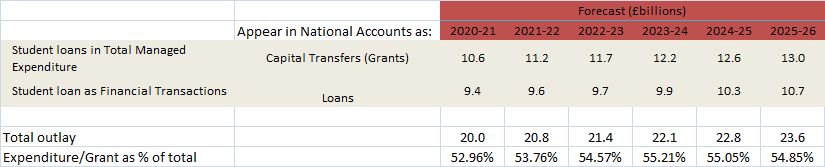
    Economic & Fiscal Outlook, Office for Budgetary Responsibility (March 2021), adapted from Tables 3.14 & 3.26

    I have constructed the table above from forecasts for Total Managed Expenditure and Financial Transactions taken from the Office for Budgetary Responsibility’s latest publication (it accompanied Wednesday’s Budget).

    It shows how newly issued student loans are now split into two components for the purposes of presentation in the National Accounts. The portion of loans that are expected to be repaid are classed as “financial transactions”, while the portion expected to be written off is recorded as capital expenditure. The latter scores in “public sector investment”, which was adopted as a new fiscal target prior to the pandemic (net investment cannot exceed 3% of national income), though the rules are currently under review.

    We can see that student loan outlay is expected to reach £20billion in the year to March 2021, rising to £23.6billion in five years’ time.
    The majority of new outlay is now expected to be written off and that share rises over the forecast period.
    By 2025/26 repayments on all existing loans are projected to re000000000000000ach nearly £5billion per year. (This figure has improved since the sale programme for post-2012 loans was abandoned, since the treasury now gets the receipts that would have gone to private purchasers).

    As mentioned in recent posts on here, the Department for Education only currently has an allocation of £4billion to cover the capital transfer / grant element of new loans and so it has to be granted large additional budgetary supplements each year. This situation has dragged on as the planned spending review has been postponed. We can now expect developments in the Autumn.


    Source link