I’ve tried a few different techniques for class discussions over the years, some that I’ve written about previously in Faculty Focus. In recent years, I’ve dialed in a 3-step process for discussion in my face-to-face classes, which has helped me create an engaged classroom climate. It’s Think-Pair-Share (TPS), with some upgrades.
I refined my TPS process after attending Jeremy Rentz’s workshop “Put Your Hammer Down” (detailed in the Best of the 2021 Teaching Professor Conference). His key idea was “The person doing the learning is the person doing the work.” I thought about how to get my students to do more “work” in my large lecture-based classes. Although I knew the active learning benefits of a technique like TPS, I struggled to implement it well. There were often too many awkward silences for TPS to be as engaging as I would have liked. After Jeremy’s workshop, I made some upgrades to TPS that invigorated it for students and for me.
Step #1: Think
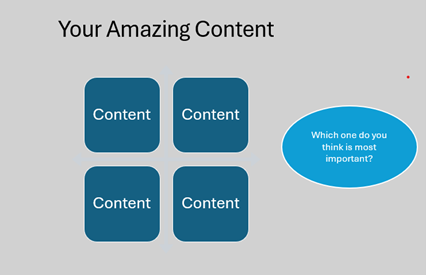
Upgrade: Discussion Bubbles
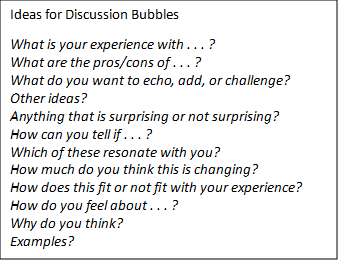
Instead of posing my discussion question after I’ve covered the content on my slide, I now put the question in a Discussion Bubble next to the content. Prior to implementing this, I would review the slide and then pose my question, either a specific one, or something general like “anyone have anything to add?” Then there would be the awkward silence while students think, and I would try to be chill. Having a Discussion Bubble primes students to think and be ready to share (in small or large groups) once I’m done reviewing the slide. It not only decreases the awkwardness (which seems to feed off itself), but it also increases small and large group discussion participation.
Sometimes these discussion bubbles include a polling question that I use to record and display students’ opinions (e.g., Do you prefer a, b, or c?). Students can then see that they are not alone in their views and are more confident to share their perspectives in Steps 2 and 3.
Step #2: Pair
Upgrade: 1-Minute Timer
I give students one minute to talk with classmates about their thoughts on the discussion bubble or their answer to the polling question. On the very first day, I tell students that I will use my watch to set a 1-minute timer and that we’ll have a few of these in every class. I believe that these short, reliable segments help students feel safe and avoid too-lengthy, awkward small-talk. At the end of the one-minute paired discussion, I don’t check to see if they need more time as I have large classes, and the level of discussion is variable. In recent course surveys (classes of 90-175 students), about 70% of students wanted to keep these 1-minute discussions and only 13% wanted to change them (some were undecided). Further, about 44% of students agreed that these 1-minute discussions helped them feel more connected to their classmates (42% had mixed or neutral feelings) and 63% said they were comfortable sharing in class. So, it’s not perfect for everyone, but it’s benefiting many students. Also, I don’t have students pair off every time that I have a discussion bubble—sometimes I skip Step 2 and go straight to Step 3.
After Step 1 and maybe 2, I incentivize large group discussion with an extra credit point for sharing aloud. I’ve written previously about my Fired-Up and Ready to Discuss process, which involves giving students up to 1 point each class (and 3-5 points total for the semester) for sharing aloud. I have undergraduate teaching assistants present and poised to enter the student’s point into the gradebook as soon as they say their name and share (and if they forget, they can find the teaching assistants after class). It’s an immediate reward that encourages sharing in a large class. Only about ½ of students in my large classes share aloud and earn Fired-up Points, but in a class of 100 students, getting 50 to talk aloud is enough to create an engaging classroom climate. In recent surveys, 70% of the students want to keep Fired Up (and only about 10% want to change it).
This upgraded TPS not only helps students “do the work,” but it also makes for a fun and engaging class. It gives my lectures a predicable rhythm that creates psychological safety for student engagement. It also helps me stay confident and relaxed, which isomorphically encourages students to relax and take the risk to share their thoughts.
Dr. Ashley Harvey is a professor in the Department of Human Development and Family Studies at Colorado State University (CSU). Since 2007, she has taught more than 10,000 students across 15 different courses in over 150 undergraduate and graduate sections. Dr. Harvey has spoken at TEDx, is a licensed marriage and family therapist, and earlier in her career worked at the CSU Veterinary Teaching Hospital as a grief counselor and educator.
References
Harvey, Ashley. “An activity that promotes engagement with required readings, even in large classes.” Faculty Focus. February 2017. https://www.facultyfocus.com/articles/effective-teaching-strategies/activity-promotes-engagement-required-readings-even-large-classes/
Harvey, Ashley. “Fired up and ready to discuss.” Faculty Focus. February 2020. https://www.facultyfocus.com/articles/effective-classroom-management/fired-up-and-ready-to-discuss/
Rentz, Jeremy. “Put the hammer down and build your teaching toolbox.” The Best of the 2021 Teaching Professor Conference. October 2021. https://www.magnapubs.com/wp-content/uploads/2021/10/free-report-Best-of-TPC-2021-opt.pdf