Category: Canada caps

  • Canada’s study permits plunge by 60% in immigration reset

    Canada’s study permits plunge by 60% in immigration reset

    New IRCC data has revealed plummeting international student arrivals from January to August this year, with stakeholders bracing for further declines as the government pushes forward with efforts to reduce temporary residents in Canada.  

    “The international education sector is rightly concerned that study permit approvals are far below the caps, but the news release makes clear that those concerns are not shared by the Carney government,” Regulated Canadian Immigration Consultant (RCIC) Matthew McDonald told The PIE News

    The figures showed less than 90,000 new international students entered Canada from January to August 2025, making it highly unlikely that Canada will meet its goal of issuing 437,000 study permits this year, as announced in January 2025.  

    While international student arrivals have fallen by 60%, the government has painted the figures as a “story of success” in reducing Canada’s temporary resident population, said McDonald.  

    Taken together, the number of work permit holders and study permit holders decreased by 22% from August 2024 to 2025 – a trend that the IRCC said was “a clear sign the measures we’ve put in place are working”.  

    The drop has brought the total number of study permit holders (including those who hold a work and study permit at the same time) down to 802,425 – 21% less than in 2024 and the lowest level since 2021 during the pandemic. 

    It sets Canada on track to drastically miss the government’s target of issuing a total of 437,000 study permits this year, which was a 10% reduction of the original 2024 cap

    Given the expected shortfall, stakeholders are calling for greater transparency about IRCC’s objectives, highlighting the detrimental impact of the decline on institutions whose budgets were largely guided by the 10% cap.  

    The TR data release is a weather balloon … to see if the Canadian public accepts the message that immigration is now under control in Canada

    Matthew McDonald, RCIC

    The timing of the release less than two weeks ahead of the 2025-2027 Immigration Levels plan has not gone unnoticed by commentators, who are expecting an update to align with the incoming 2025 budget and the shifting vision of Canada’s long-standing openness to immigration. 

    “The temporary resident (TR) data release is a weather balloon, alongside updated processing times, to see if the Canadian public accepts the message that immigration is now under control in Canada,” said McDonald. 

    “The Carney government is concerned about the floor, not the ceiling—i.e., about wrestling down the TR population below 5%,” he added.  

    Currently, the government aims to reach the 5% goal by the end of 2027, with Carney acknowledging it will take several years to reduce TR levels by restricting those coming in and transitioning more temporary residents to permanent residency.  

    Notwithstanding any surprises in the upcoming budget and Immigration Levels Plan, McDonald said he expected the government to “hold their foot” on new study and work permit approvals for several years to come.  

    Ahead of the federal budget announcement, the Canadian Bureau for International Education (CBIE) is urging the government to launch a renewed International Education Strategy to “restore Canada’s global brand to bolster its foreign policy and trade relationships”. 

    The body highlighted the economic contributions of international students who contributed nearly CA$40bn to the country in 2022, boosting local communities and filing labour shortages. 

    What’s more, CBIE emphasised the cultural perspectives international students bring to Canada’s campuses and their importance to the country’s soft power, with students who leave becoming ambassadors for Canada in their home countries.  

    Source link

  • Canada rejects nearly two in three study permit applicants 

    Canada rejects nearly two in three study permit applicants 

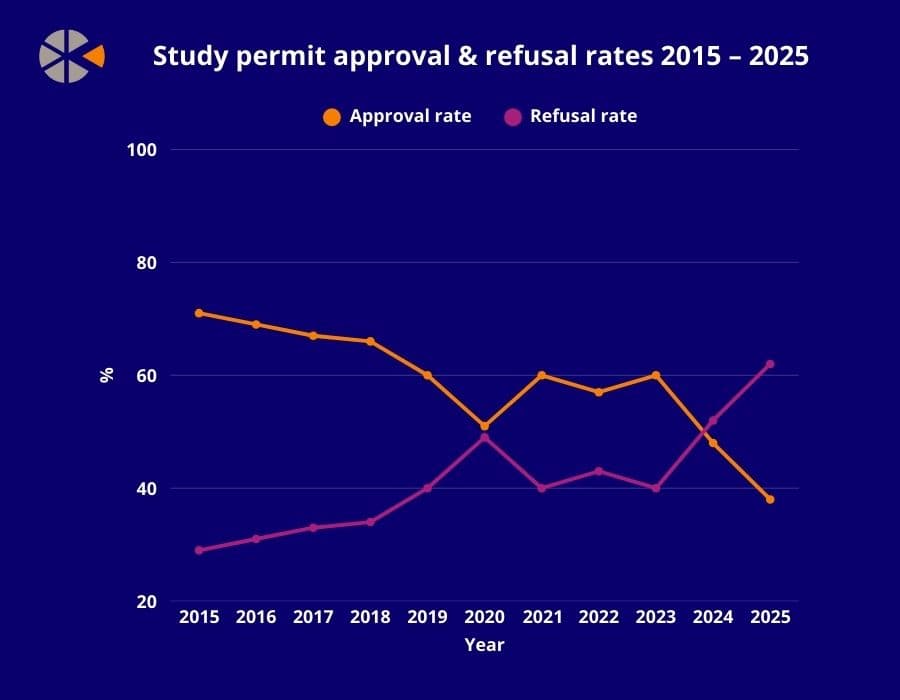
    Government figures obtained by The PIE show 62% of applicants were refused a study permit from January to July this year, with record-high volumes “raising urgent questions about transparency and application readiness,” said ApplyBoard.  

    Despite a decade of relatively stable approval ratings hovering around 60%, rates have plummeted to 38% so far this year, down from 48% in 2024 following the implementation of Canada’s study permit caps. 

    “It’s clear that Immigration, Refugees and Citizenship Canada (IRCC) is applying far greater scrutiny to new applications,” Jonathan Sherman, vice president of sales & partnership at BorderPass told The PIE, pointing to a “fundamental shift” in government processing.


    Data: IRCC

    Indian students – who comprise 40% of Canada’s international student population – have been hardest hit by soaring refusals, with four out of five Indian students receiving rejections in Q2 2025, according to BorderPass.  

    Stakeholders have pointed to a glimmer of hope in overall approval ratings rising modestly this spring, though without a “dramatic shift,” Canada will only reach one fifth of the government’s international student target for the year, Sherman warned.  

    With institutions bracing for severe declines, ApplyBoard analysis has found the most common reason for reason for rejection in 2024 was the perception by IRCC officers that students wouldn’t leave Canada after their studies, cited in over 75% of cases.  

    “While reviewers at IRCC understand that some future students hope to gain work experience in Canada after graduation… the extensive use of this reason last year suggests that many are perceived as having permanent residency as their primary purpose, instead of study,” stated the report

    Financial concerns drove three of the top five refusal reasons, after Canada more than doubled its proof-of-funds requirements from $10,000 in 2023 to $20,635 in 2024.  

    Specifically, in 53% of cases, IRCC officers said they were unconvinced that applicants would leave Canada based on financial assets, alongside doubts about insufficient resources for tuition and living expenses.  

    “While new policy caps played a role, our full-year data points to recurring applicant challenges, particularly around financial readiness and immigration intent that are preventable with the right guidance and documentation,” said ApplyBoard.  

    The report highlighted the continuing decline of unspecified reasons for refusal, following IRCC adding officer decision notes to visa refusal letters last month, which was welcomed as a much-needed step in improving transparency.  

    Other reasons for refusal include the purpose of visit being inconsistent with a temporary stay and having no significant family ties outside Canada.  

    The data comes amid a major immigration crackdown in Canada, with temporary resident targets included in the latest Immigration Levels Plan for the first time, which aims to reduce temporary resident volumes to 5% of the population by the end of 2027 – a year later than the previous government’s target.

    Many are perceived as having permanent residency as their primary purpose, instead of study

    ApplyBoard

    Approval rates are also below average for other temporary resident categories, but none so drastically as study permits, with just under half of all visitor visas approved so far this year, compared to a ten-year average of 64%.  

    After more than 18 months of federal policy turbulence, changing eligibility rules have likely contributed to the rise in study permit rejection rates.  

    Pressure to reduce IRCC backlogs and reach ambitious government targets could also be playing a role, according to immigration lawyers speaking to the Toronto Star. 

    As of July 31, over 40% of Canada’s immigration inventory was in backlog, including 56% of visitor visas, 46% of work visas and 23% of study visas, according to official data.  

    Following a swathe of new IRCC officer hires, Sherman said he expected to see improvements in consistency, though “processing backlogs may get worse before they get better,” he warned.  

    Amid the challenges, educators and advisers are doubling down on what applicants and institutions can do to ensure the best chance of success, with ApplyBoard warning that any incomplete or ineligible documentation can be grounds for refusal.  

    Source link