Category: Canada

  • Summer 2025 | HESA

    Summer 2025 | HESA

    So. This is the last blog of the academic year. Service resumes Tuesday, 2 September.

    It’s been a long year. I’m pretty tired. How about you?

    This was the year it all kind of came crashing down: not just here in Canda, but everywhere else too. It’s too long to go through and my more faithful readers already know the story. It’s not just in Canada. In France, Australia, and the UK, we saw institutions having similar problems: all these fantastic higher education institutions we’ve collectively built and, quite simply, nobody wants to pay for it. Not through public funds, not through private fees. Nobody wants to pay for it.

    And then there’s American higher education would probably be going through something similar this year, only a greater catastrophe arrived first. I’ll pass over this in silence.

    Here in Canada, the sector is increasingly friendless. Parents and students seem less convinced that universities in particular represent good value. And governments are simply indifferent, not because they dislike universities necessarily, but because they dislike or distrust the knowledge economy universities are built to serve.

    Unfortunately, I think it is going to get worse. Not a single government in Canada released a budget this year which took into account the effects of US tariffs. The result? Allegedly healthy federal and provincial balance sheets are going to get pounded this year and next (and the especially unhealthy ones — BC and Quebec in particular — are going to be especially ugly). Deficits as far as they eye can see. As the saying goes, no one is coming to save us.

    I have no doubt that community colleges will find ways to get through this, because they have so far through this crisis mostly shown themselves to have the ability to do what it takes to right the ship. They might not look too good after another round or two of cuts, and it’s not impossible that a few rural colleges might disappear or shrink radically because what they get from governments and domestic tuition fees just isn’t enough to properly serve their communities, but on the whole, I think they will be ok.

    Universities, on the other hand. Well, that’s a different story.

    About a year ago, I said that the biggest change universities were going to have to undergo in this new financial age was shifting from a belief that every problem had a revenue-side solution to one in which every problem has a cost-side solution. Institutions can no longer solve their short-term problems by just recruiting another hundred international students. They actually have to change the way they do business. They have to change processes. They have to think about production functions and work processes in a way they haven’t before. And they have to do it while trying to pivot to new missions that give them more traction with government and the public.

    I am here to say that I don’t think it’s going so well.

    The message that “there is no one coming to save us” has, thankfully, penetrated fairly deeply in universities. Maybe not quite everywhere (hello, VIU!), but in most places. But what I am not sure has penetrated quite so deeply is the corollary that actual change is necessary. My (admittedly limited) vantage point on the sector is that:

    • I still see universities spending inordinate amounts of time trying to come up with new revenue-based solutions. It’s a habit they have a hard time kicking.
    • Universities are deeply resistant to doing more than the bare minimum of restructuring to meet immediate financial needs. The idea that deep structural change might be necessary remains pretty much anathema. This bare minimum approach means that when the next round of government cuts come – due to recession, or national re-armament or whatever – they are just going to have to cut again, and again, and again. There is very little sign of anyone trying to get ahead of the curve to make both big cuts and big investments in new areas that will help them survive the turmoil.
    • I still hear, distressingly often, senior people in universities utter the worst seven words in all of higher education: “we just gotta tell our story better”. Universities are reluctant to face the possibility that governments and the mass public don’t love them the way they are and that they may need to actually, you know, change.

    We need to stop acting like the research university of today – which in Canada is really only a creature of the 1970s or perhaps 1960s — is eternal. Universities can die, and have done so rather frequently across history. Universities are the product of particular configurations of social and economic forces. And now, at the moment when the western world is basically re-considering the entire post-WWII order, the idea that universities are going to be uniquely immune to change is bananas. Past performance — which I think has been pretty good — is not a guarantee of future safety.

    I am not saying here that universities shouldn’t fight for their own corner: they should! Often more vigorously than they currently do (see my piece on Bill 33, or on how they need to gear up for a fight with Bay Street over whether temporary residents will be international students or TFWs). But they can’t do it by digging in on the status quo.

    And so, I will end the academic year by repeating something I said a few months ago. To survive this coming period, universities are going to need:

    1. Ambition. Don’t waste time doing small things.
    2. Experimentation. The worst possible thing right now is an addiction to “the way we’ve always done things”
    3. Dissemination. No one institution got us into the mess. No one institution is going to get out of it alone, either. Institutions need to commit to sharing the results of their experimentation.

    I know every university in Canada can, if it chooses, commit to those three things. I have faith. And I believe that if they do, our university sector will come out as strong or stronger than any system in the world.

    But any institution that chooses not to commit to them…well, I think they are going to have some issues in the next three years. Serious ones.

    It’s up to us. Rest up this summer. Re-charge. We’re all going to need it in ‘25–’26.

    Source link

  • Last Week in Parliament: Three Takeaways

    Last Week in Parliament: Three Takeaways

    It was a busy week in Parliament last week.  The King came to Ottawa to deliver a Speech From the Throne.  His speech – almost exclusively a re-hash of Liberal promises from the April election – was deeply depressing for anyone who thinks the words “knowledge economy” have any meaning.   

    The main feature of the Speech from the Throne was that it spelled out, in excruciating detail, how the Liberals intend to double down on re-creating the Canadian economy of the 1960s.  Oh sure, the King uttered a line in there early on about how his government is committed to “building a new economy.”  But read the document: that sentiment was in no way followed up by anything resembling a commitment to any kind of new economy.  Instead, here are the major economic elements to which the government is committed:

    • Speeding up permits for major construction projects like roads and pipelines and whatnot: because natural resources have to get to the coasts somehow!
    • Building a lot of houses
    • Spending more on defense
    • Breaking down internal trade barriers
    • Er…
    • That’s it.

    Whatever you think of the merits of the various proposals here, this is not a new economy.  It is barely even a warmed-over version of the old economy.  At best, it is about finding new markets for old products, not developing any new products.  I am unsure if it is more that the Liberals have no sweet clue about how to create a new economy, or that they are uninterested in doing so.  But it’s one of those two.

    Now some might argue otherwise because look!  Evan Solomon!  Minister of Artificial Intelligence and Digital Innovation!  How New Economy is that?  All I can say is: please try not to be that person.  Solomon is a Minster without a department with a mandate which is completely undefined.  Is it an internally-facing ministry meant to diffuse digital innovation and AI throughout government?  Or an externally-facing ministry meant to diffuse these things across the economy?  Two weeks after Solomon was named Minister, we still have no clue.   And the Liberal Manifesto and the cabinet’s One Big Mandate Letter give conflicting impressions about the extent to which the Government sees its AI/digital strategy is about skill expansion/diffusion vs. handing money to techbros (the mandate letter reads like the former, the manifesto the latter). One would be forgiven for suspecting the Carney government is making things up as it goes along.

    Anyways, the point here is still: despite Carney’s globe-trotting central banker/Goldman Sachs reputation, this government seems to be staying as far away from a Davos/future industry agenda as humanly possible.  The Liberal “new economy” is all pretty much all construction and primary industries.  This is not a world which requires a lot of higher education.

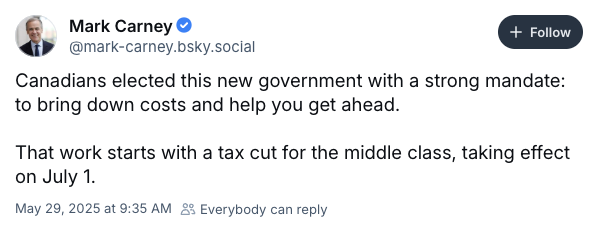
    Scared yet?  We’re just getting started.  Back on Thursday our new Prime Minister was seen to tweet:

    In other words, this government seems determined to continue in the tradition of both the former government – and the opposition parties for that matter – in framing the country’s ills as problems of costs to be solved by tax cuts and giveaways rather than problems of growth and the institutional investments required to generate it.  This way lies Peronism and perpetual stagnation. 

    And this is from our allegedly “serious” party.

    So, takeaway number one.  Universities need to throw away EVERYTHING in their playbooks for Government Relations.  Selling yourself as “the future” to a government that is desperately trying to reverse our economy into the 1960s is pointless.  This government and this Prime Minster Do. Not. Care.   Until they do, arguing for universities as “crucial” investments is a waste of time.  The real fight is over the shape of the Canadian economy.

    On to a more abstract point about budgeting.  One of the reasons we aren’t getting a budget before fall, despite the government just having been elected with a pretty detailed budget-ready manifesto and the Department of Finance being perfectly capable of putting together a set of Main Estimates for the House of Commons (as it showed on Thursday), is that Carney is trying to introduce a new set of rules with respect to public budgeting.  He spent part of this week insisting that he would balance the “operating budget” within three years, which sparked a lot of incredulity given that i) the economy is about to be in the tank and ii) the Liberals have ring-fenced most of the federal budget by saying they won’t touch transfers to provinces or transfers to institutions.  In theory, that means very significant cuts to program spending.  Like, say, research budgets.

    Except: there is currently no such thing as an “operating budget”.  What Carney wants to do is to exempt from the budget balance requirement anything that can be seen as “capital investment”, which means basically that the main game in Ottawa over the next few years is going to be how to get your favourite piece of spending classed as “capital” instead of “operating”.  And that’s a live issue because the definition the Liberals touted in the election campaign, to wit…

    …anything that builds an asset, held directly on the government’s own balance sheet, a company’s or another order of government’s.  This will include direct investments the government makes in machinery, equipment, land and buildings, as well as new incentives that support the formation of private capital (e.g. patents, plan and technology) or which meaningful raise private sector productivity.

    …is so loose you could drive a truck through it.  Will CFI spending count as capital?  Probably, but not necessarily since universities (in most provinces anyway) are neither a government nor a company.  Will tri-council spending?  Probably not, but that’s not going to stop folks claiming it supports capital formation/raises productivity, so who knows?  So, takeaway number two: get used to arguing distinctions between capital and operating because this might be the only place the sector gets traction in the next little while.

    A final point of importance is something that is not exactly new but has been given fresh salience by being in the Throne Speech, and that is the government’s commitment to limit temporary immigration – that is Temporary Foreign Workers (TFWs) plus international students – to below five percent of the population by 2027.  Or, to put it another way: every extra TFW is one international student less.  What the government has done here is set up a zero-sum game between institutions of higher education and people like the manager of the Kincardine Tim Horton’s whose business model simply cannot work if they are not allowed to employ foreign nationals at below-market rates. 

    This, my friends, is the fight post-secondary education needs to pick and needs to win.  It won’t be easy, because the captains of Canadian industry are largely clueless about competing on anything other than price, meaning low-wage labour is pretty dear to their hearts and they will fight hard for TFWs.  But it is the dilemma this country faces in a nutshell: should we use our scarce temporary immigration spots to make things cheaper in the short-term?  Or should we use them to develop a skilled workforce and build our scientific and technological talent base for the long term? 

    So, I know this won’t come easy to institutions but: screw Bay Street.  Light the torches.  Find the pitchforks.  Pick up anything you have handy and smash the windows of your local Tim Horton’s.  Fight for international students and against TFWs.  This is an existential contest: it decides whether Canada is going to be a country that gets wealthier based on investments in skills, education and science, or a country that bathes in mediocrity because we go mental if the price of a cruller goes up twenty-five cents. 

    And if the sector ducks this fight because direct confrontation with business is icky and makes some Board members uncomfortable?  Well, then the sector deserves everything it gets.  That’s the third, and most important takeaway of the last week.

    Source link

  • Between Excellence and Relevance: The Regional University Dilemma

    Between Excellence and Relevance: The Regional University Dilemma

    Hi everyone.  I’m Alex Usher and this is The World of Higher Education podcast.

    Over the past few decades, Higher Education had taken on a number of new roles.  As we discussed with Ethan Schrum on this podcast over two years, in the years after World War II, universities became obsessed with showing how essential they were with solving society’s problems.  One of these problems – particularly as universities proliferated and started showing up in more and more distant locales – was regional economic development. 

    This was a tough problem to solve.  Universities are about the knowledge economy, and by and large the knowledge economy runs most smoothly in places with significant population density.  By definition, “regional” or “peripheral” institutions are in places that lack this essential quality.  So with whom can universities in this situation partner?  It takes two to tango – a university .  And more generally, what kinds of things can universities in peripheral regions that can do to improve the economic fortunes of the places they serve?

    Today my guest is Dr. Romulo Pinheiro.  He is a professor of public policy and administration at the University of Agder in Norway.  For years now, Romulo has been writing about how universities in different parts of Europe tackle this question.  In our interview today, we go back and forth a bit about how peripheral institutions differ from metropolitan ones, how regional and global ambitions get intertwined at these institutions and how institutional and disciplinary structures do and do not affect how a peripheral universities accomplish their mission.  As a wannabe-geographer, I found this discussion fascinating – pay attention to the bits where Romulo starts diving into the intricacies of how institutions and academics weave their global and local networks together into complicated webs, and – let me underline this bit – how these webs depend crucially on something pretty simple: trust. 

    But enough from me – let’s turn it over to Romulo.


    The World of Higher Education Podcast
    Episode 3.31 | Between Excellence and Relevance: The Regional University Dilemma

    Transcript

    Alex Usher (AU): Romulo, your work often centers around issues of universities and regional development. And I guess it’s been 40 or 50 years now that regional development has been seen as a role that higher education is supposed to play. But how does that development role differ between universities in dense urban areas and, you know, less dense rural areas? What’s the difference in the role they have to play?

    Rómulo Pinheiro (RP): Alex, for universities to be able to engage with different types of regional actors, there have to be competencies on the other side. Universities differ in terms of their competencies and skills—in terms of the depth and breadth of the types of programs they offer, the research groups, as well as the traditions of regional engagement. But they also differ in their localities, right?

    Usually, you have a situation where universities in peripheral regions are thinner institutions, and they’re located in thinner institutional environments. Meaning, they don’t have a lot of interlocutors with the same level of knowledge and skills. That already creates a disadvantage.

    So, should we see the symbiosis between universities and their regional settings? By and large, we see that strong institutions tend to be located in strong regional surroundings as well. Now, that’s not to say there aren’t cases of strong institutions in more peripheral settings. What the literature tells us is that, for the most part, these regions don’t have the absorptive capacity to absorb both the graduates and the knowledge that comes from these “thick” institutions.

    Johns Hopkins is a case in point in Baltimore. And in Europe, we have, for example, the University of Lund. There have been a few studies as well. So the knowledge generated by these institutions tends to go away from the region because there’s no regional capacity to absorb what comes out of the university.

    So, very different roles.

    AU: It seems to me there are two types of rural or peripheral institutions. Let me talk about one of them first, right? So, smaller peripheral institutions—I’m thinking, you know, universities maybe in northern Norway, right? A couple thousand students. They face tight budgets, limited research capacity, and more difficulty, I imagine, in attracting top talent. Maybe not in Norway, but in some countries that would be an issue. And yet, they’re often expected to play an outsized role in regional development. How do they manage that tension?

    RP:  That’s a great question—and indeed, many don’t, right? You’re absolutely right that we should move away from the idea of just “centers” and “periphery,” because there are also centers within the periphery. There are strong institutions in peripheral settings. In northern Norway, for example, we have the University of Tromsø, which is a comprehensive, research-intensive institution. And there are many smaller regional colleges across the Nordic region that don’t have that capacity.

    Traditionally, these institutions have catered more to the applied needs of regional actors. They didn’t have the research infrastructures, so they got involved in what we call “projects,” right? Smaller projects. And that, of course, has limitations.

    Other, bolder institutions try to collaborate—develop networks. What we see, for example, in Northern Europe is a situation where, due to mergers, the smaller institutions are becoming amalgamated into larger institutions. And that, of course, creates new possibilities and new conditions, but also new tensions and dilemmas.

    Because as institutions grow—and as you know, the larger the institution, the more globally oriented scientists you have—the less likely they are to be involved with regional issues, all things being equal, as economists like to say.

    But in the end, it also goes back to the idea of engagement at the academic level—the bottom-up, right? So this combination between… well, you can have all these great strategic plans and funding in place, but if academics themselves—what Burton Clark calls the academic heartland—don’t feel keen to be engaged with regional actors, you can’t pressure them.

    AU: I’m going to come back to that global dimension in a second. But let me counter with something here. I’m not convinced that the larger institutions are necessarily more global, but they are probably more oriented towards basic research, right? As you get bigger and bigger departments, they get deeper into basic research.

    And what’s the uptake of basic research in peripheral areas? I mean, it just seems to me that when you get past a certain institutional size or complexity, it gets very hard to actually even talk with local communities—because the capacity for generating research is much bigger than the receptor capacity for it.

    I remember one example, when we were doing some work in Africa. There was a small private university outside Lagos, and they had sequenced the Ebola virus. I asked, “Can you work with local industries?” And they said, “We can’t work with the local pharmaceutical industry, because in Africa the pharmaceutical industry is packaging and marketing.” Right? Those are the only two functions.

    So what happens when the science at a small regional institution outruns the receptor capacity of the local environment? Are there any good ways to manage that?

    RP: It goes back to the example I gave earlier. For the most part, that knowledge tends to go away—to other regions or other localities. This is the global dimension. But this goes back to the point you raised about the brokering role of universities. Universities—or university actors—have to engage in a process of translating those basic research findings into something that can be applied at the local level.

    So how do they do that? There are different mechanisms. You need professors who are engaged and able to facilitate the translation of more theoretical discussions into something more concrete.

    The role of students is fundamental here—an aspect that has been somewhat neglected in the literature. In the end, the most important boundary spanners are actually students who spend time back and forth between the university and the community. And then there’s the role of graduates—former students. They maintain networks with professors and others, so they play a very important role.

    But in the end, if the companies—public or private—don’t have a need for that knowledge, or if that knowledge is not relevant to them, then they won’t use it. There’s that tendency.

    So it’s also up to the universities to try to make that basic knowledge—if they are so inclined—relevant to local actors. In northern Norway, we have the case of Tromsø, which has been able to do this: bring excellence and relevance together. They focus, for example, on the Sámi dimension, Arctic fauna and flora, or cardiovascular diseases—taking aspects that are relevant to the region and developing excellence around those areas.

    And in the process, they develop institutional capacity, which helps them with strategic profiling in a globally competitive world.

    AU: You’re raising again that issue of global excellence versus regional relevance. I’m interested in that from the perspective of university strategy. What avenues do you have to make sure that your institution is actually balancing those two properly? You used Tromsø as an example—can you think of some others? And are there any commonalities between them?

    RP: Yeah. I mean, university leaders do have some tools at their disposal. As we know, most universities—particularly large ones—are very bottom-heavy institutions. Academics tend to have a lot of autonomy and are relatively independent in what they pursue.

    That being said, they also follow incentives, as rational actors. So there are things that strategic or university leaders can do to align those incentives—whether that’s through PhD student opportunities, sabbaticals, or other types of incentives to collaborate with regional actors.

    Beyond Tromsø, there are other examples I’ve worked on. Oulu is another case in point—in Finland. There’s a very interesting anecdote, going back to the importance of networks. One study asked actors in Oulu, in Northern Finland, “Who are your most important collaborators?” People at the university mentioned individuals from industry and local government.

    Then the same question was asked in another region—northern Sweden, in a place called Luleå—which wasn’t as regionally engaged. They asked, “Who are your most important collaborators?” Regional actors in the private sector mentioned other actors in the private sector. University academics mentioned other academics.

    Those are examples of disconnected networks—networks that are operating within their own silos. So, there has to be a sort of synergy effect, and the most successful regional institutions are able to achieve that.

    One interesting caveat: when you ask these institutions whether they see themselves as regional universities, most of them don’t like that label. They say, “We are, first and foremost, a university in the region—not a regional university.” There are some negative connotations associated with being too closely tied to locality.

    AU: What I’m hearing you say is that we have to pay attention to the incentives for professors within the university to engage locally and form those local partnerships. Are there specific institutional reforms that can achieve that? And presumably, disciplinary mix matters, right? There are different incentives and different possibilities for collaboration across disciplines. So how do you manage that engagement? How do you incentivize it effectively?

    RP: There’s been a long discussion within the field about what types of incentives work. And again, there’s no one-size-fits-all—this has to be tailored. Academics are incentivized in very different ways. But we do know that, for the most part, monetary incentives have a limited effect when compared to other professions.

    So it’s more about things like whether you can gain more autonomy, develop your research group, or set up a center. What we’re seeing now, for example, in the Nordic countries is an orchestrated effort by national and regional funding agencies to ensure that research applications require buy-in from regional actors.

    I can’t submit an application to the Norwegian Research Council or to Business Finland, for example, without having partners from the region or the nation—whether from the public or private sector. Those are structural mechanisms designed to ensure that, if academics want access to significant research funding and to grow their research teams, they need to bring on board those key external actors.

    The second aspect is the very strong emphasis over the past, say, seven to ten years—especially post-COVID—on co-creation and co-production of knowledge. Rather than involving regional actors only at the end of a research project, now there’s an effort to bring them in at the design stage.

    So, researchers will go into a project already with input from those actors, understanding key questions and issues of relevance. And then, throughout the project, they involve these actors through various mechanisms—workshops, feedback exercises, and so on—to ensure there’s a loop of engagement and input.

    It’s a much more egalitarian sort of ecosystem. Whether or not this is working is still an empirical question—we don’t yet know the full results. But at least those are the intentions.

    AU: Romulo, you talked about this interface between the global and the local, right? And the global part of that is usually about relations between academics in one part of the world and academics in another. That helps a local university—a university in a region—act as kind of a window on the world for that region. It brings them into contact with these global networks.

    What’s the right way to think about developing those networks effectively? I mean, I know in Europe right now we’ve got the European Universities Initiative. And I think a number of those alliances are meant to unite institutions with similar missions. A number of them look like alliances of universities and regions. Is this promising? Is this the right way forward? Or are these initiatives missing something?

    RP: Let me touch first on the issue of networks. Most of these networks emerge organically, and they’re very much linked to the relationships that academics have with other academics—or academics have with regional actors. Students can also play a role here—if they get employment locally, and of course, former students may become part of regional government or industry.

    The key element here is trust. This is not new—trust takes time to generate. I think it’s not easy, if you’re sitting in the director’s chair at a university, to articulate a clear strategy for how to develop trust among all these actors. You have to create the conditions.

    That might mean freeing up some resources, or identifying your most engaged academics—those most likely to involve students or work regionally—and then creating a kind of ecosystem to bring these people together. We used to say that the most important thing in regional engagement is having money for lunches and dinners—that’s where people get to know each other.

    When it comes to the second part of your question—strategic alliances—I’m a bit skeptical about the extent to which these will benefit the regional engagement agenda, to be honest. Even those alliances, like the one my own institution is part of—with a regional name and focus—tend to become very inward-oriented.

    I’ve got a number of publications coming out now with a colleague, where we argue that these alliances are primarily collaborative exercises meant to enable institutions to compete globally. And there’s a tendency—despite some efforts, like policy labs for students involving regional actors and regional questions—for other strategic imperatives, outside of the region and locality, to end up dictating institutional priorities.

    That’s my sense. But again, it’s an important empirical question. We’ll have to see in the future what the results actually are.

    AU: So, there’s been a tendency in North America—probably going back to World War II or maybe even a little before—to think about universities as fixers of social or economic problems. And you’ve cautioned against assuming that universities can act as fixers of regional challenges, especially in peripheral contexts in Europe.

    I guess this is a more recent assumption about institutions—maybe 30 or 40 years old instead of 60 or 70. Where do you think that expectation comes from? And what are the risks of leaning too heavily on it?

    RP: That caution also comes from my fieldwork. I remember when I was doing my PhD many years ago, I was in South Africa at Nelson Mandela Metropolitan University, speaking with the vice-chancellor there. And he told me:

    “Look, we are keen to play an active regional role, but we are not going to clean the streets just because the local government is failing to clean the streets. We don’t have the capacity to tackle crime just because the police lack the resources to do so.”

    He was very clear in saying that part of their job was to go into the community and educate people—not just about the possibilities, but also about the limitations that universities and academics face. It is not their role to solve the failures of market forces or government systems.

    There’s a tendency among some local officials to scapegoat the university—to say, “You’re not delivering,” because they’re not helping to tackle poverty or similar issues. That’s not to say universities don’t have an important role. But most of us in the field believe universities have primarily a facilitating role—a generative role—rather than acting as engines of regional development.

    Of course, in those peripheral regions where the university is the largest employer or the only knowledge institution, expectations tend to be that the university must play a disproportionate role. Often, it tries to do so—and in many cases, it succeeds. But in the majority of cases, the university is just one of many knowledge actors in a very complex ecosystem.

    AU: Your work has obvious ramifications for higher education leaders—but also for politicians, right? The ones who are funding these institutions. If there’s one concept or one conceptual insight from your work that you think those groups should take seriously—higher education leaders and politicians—what would it be? It might not be the same for both. They could be different for the different audiences.

    RP: As a traditional academic, let me give you two instead of one.

    The first one—and I’m not the only one saying this, but I think my work reinforces it—is that both universities and regions are complex entities. They are not monolithic, but they tend to be approached by both politicians and university managers as if they are simple, strategic actors. In reality, they have deep histories and institutionalized traditions, which are very difficult to change. So, any attempt to use strategic agency to move universities or regions in a particular direction should take that into account.

    The second aspect links to my recent work on resilience. Over time, we’ve seen that universities have an innate capacity to adapt to social change and play very different roles. The “third mission” of the university—regional development or societal impact—looked very different in the early 20th century than it does today. Yet, universities have managed to withstand and adjust to adversity while retaining a degree of function and identity.

    To do that, they need two important ingredients. One is autonomy—which is currently under threat, both in terms of procedural and substantive autonomy. The second is diversity. From resilience studies, we know that resilient institutions are diverse institutions. So when politicians or managers promote a “lean” approach—saying, “we have two research groups working on similar areas, let’s kill one or merge them”—they’re actually reducing diversity. And reducing diversity reduces an institution’s ability to withstand future adversity—whether it’s a pandemic, geopolitical conflict, or other disruptions. That may seem efficient in the short term, but it’s dangerous in the long term.

    That’s why universities have historically been able to adapt to changing societal conditions—they’ve had those two ingredients, which are now at risk.

    AU: So given that, what’s the future of university–community engagement in peripheral regions? Is there a trend we can expect over the next 10 years? Are institutions going to be able to deliver more fully on the needs of their regions—or will they find it more difficult?

    RP: Well, as you know, Alex, academics are very bad at predicting the future! But we can look to history to see how things have evolved.

    What we’ve seen is that the university’s “third mission”—whether framed as regional development, social impact, or engagement—has increasingly moved closer to the university’s core activities. Today, you could argue that social impact is central to the mission of any university. That might not be new in the U.S., but at least in Europe, it’s a more recent shift over the last 10 to 15 years.

    What I think is important—and colleagues like David Charles in the UK have also emphasized—is that we need to look at the challenges facing our societies: rising polarization, the spread of illiberal democracies, the post-truth society. We should be asking: what role can universities—particularly in peripheral regions—play in helping societies navigate this turbulent environment?

    As the quintessential knowledge institutions, universities have a very important role to play. They should perhaps be more active and assertive in defending the importance of knowledge, of truth. I’m currently involved in projects on regional green transitions, and there’s a broad consensus that universities play a vital role mediating relationships among regional actors with very different agendas.

    They still retain legitimacy. They haven’t been politicized to the extent that other institutions have. So they’re uniquely positioned to bring political and community actors together and help orchestrate collective agendas.

    But that takes time. It doesn’t always yield short-term results. So university leaders need to be willing to take risks. They need to allow academics to play roles that go beyond the traditional functions of teaching and research.

    So I think what we’re seeing is a rediscovery of the civic role of universities—at an important historical moment. A shift from discussions about interests and money to discussions about values and norms.

    AU: Romulo, thank you very much for joining us today.

    RP: Thank you very much, Alex.

    *This podcast transcript was generated using an AI transcription service with limited editing. Please forgive any errors made through this service. Please note, the views and opinions expressed in each episode are those of the individual contributors, and do not necessarily reflect those of the podcast host and team, or our sponsors.

    This episode is sponsored by KnowMeQ. ArchieCPL is the first AI-enabled tool that massively streamlines credit for prior learning evaluation. Toronto based KnowMeQ makes ethical AI tools that boost and bottom line, achieving new efficiencies in higher ed and workforce upskilling. 

    Source link

  • Over 5k HE job cuts in Canada since study permit caps

    Over 5k HE job cuts in Canada since study permit caps

    • Over 5,000 higher education jobs in Canada have been cut since the government clamped down on study permit numbers – with Ontario, British Columbia and Quebec the hardest hit.
    • The thousands of job cuts tracked by a higher education expert are just those that have been made public, with the possibility that there have been many more.
    • Institutions are also having to consolidate the programs they offer, as billions of dollars worth of budget cuts make their mark.

    More than 5,000 jobs have been lost in the post-secondary education sector in Canada since the federal government first imposed a study permit cap in January 2024, according to research from higher education consultant Ken Steele. Further restrictions – capping study permits at a scant 473,000 – were introduced in September.

    But the cuts collated by Steele are just the ones that have been made public. A number of institutions are not disclosing their drops in employment in teaching and administration.

    With Liberal Mark Carney triumphing in last month’s election, his new government must address worries about jobs disappearing, such as in the auto manufacturing sector, due to US President Donald Trump’s punishing tariffs.

    Slashing jobs in education – due to the government’s own actions – is a huge mistake, Steele said.

    “The unilateral imposition of extreme, abrupt, student visa caps have thrown Canadian higher education into crisis, decimated our reputation abroad and precipitously destroyed one of our major ‘export’ industries,” he told The PIE News.

    For the past year, Steele has been tracking reported job losses at universities and colleges across the country. As expected, programs that relied heavily on international students were forced to make the biggest cuts.

    According to Steele’s data, Mohawk College in Hamilton, Ontario, has eliminated almost 450 positions. The University of Windsor, also in Ontario, has reduced employment by 157 spots.

    The total of 5,267 cuts across the country almost certainly underreports the actual job losses. “Many institutions are keeping quiet about their cuts, including the Ontario private colleges that were partnering with public colleges,” he noted.

    It’s not just jobs that are being slashed. Post-secondary institutions have been forced to eliminate programs and reduce spending.

    Fanshawe College in London, Ontario, appears to lead the way in getting rid of programs. It has suspended 50 fields of study, including advanced live digital media, construction project management and retirement residence management. In all of Canada, Ontario colleges are the top eight for suspending programs, accounting for two-thirds of the 453 cuts.

    The financial hit is significant. “So far, I have tracked CAD$2.2 billion in budget hits at post-secondary schools across the country,” Steele said. This includes last year’s cuts as well as planned reductions for next year.

    If Canada reopened its doors tomorrow, it would likely take until at least 2030 to recover the international enrolment momentum we had just two years ago
    Ken Steele, education consultant

    Ontario was most reliant on international revenues and has been hardest hit by the study permit cap. Steele’s figures suggest that 70% of the cuts have struck that province, with British Columbia and Quebec also suffering. The remaining seven provinces faced more modest losses.

    In Vancouver last month, dozens of staff and faculty at several post-secondary institutions staged a protest of the study permit cap. Taryn Thompson, vice-president of the Vancouver Community College Faculty Association, said there have been 60 layoffs at her school alone, with more expected in the coming months.

    The big question is: Will the new federal government ease the cap? The issue of post-secondary funding was hardly raised at all during the election campaign, overshadowed by concerns about Trump’s threats to annex Canada.

    There’s also the concern about restoring Canada’s reputation following the study permit debacle.

    “If Canada reopened its doors tomorrow, it would likely take until at least 2030 to recover the international enrolment momentum we had just two years ago,” warned Steele.

    Source link

  • Banking on Human Capital: How RBC Sees the Future of Talent, Innovation, and the Role of Post-Secondary Institutions

    Banking on Human Capital: How RBC Sees the Future of Talent, Innovation, and the Role of Post-Secondary Institutions

    Canada’s heading into some pretty choppy waters in 2025. For a century or so, we’ve had a one track economic strategy, closer integration with the United States. Now, the Trump administration with its faith in tariffs as an instrument of both power and corruption, has essentially nuked that strategy, at least as far as the trading goods is concerned. There’s a lot of change coming to Canada, and it’ll be costly. In much the same way that diplomatic evolution and defense needs are forcing European countries to look at higher education in a different light, Canadian universities are looking around at their new situation very nervously too.

    In Canada right now, a few people are making the case for change as strongly as John Stackhouse. John’s the ex editor-in-chief of the Global Mail. He’s now a Senior Vice President at the Royal Bank of Canada, leading that organization’s economics and thought leadership group. He’s the lead author of a recent report called “A Smarter Path, the Case for Post-Secondary Reform.” This report makes a number of, shall we say, uncomfortable observations about the relationship between Canadian higher education and the Canadian knowledge economy, in particular, between high spending and high graduate numbers on the one hand, and low productivity and significant levels of graduate underemployment on the other.

    Though the report does not directly address the issue of Trump or tariffs — it was released 48 hours before Liberation Day — it has added to the sense in Canada that the higher education sector is headed for and indeed needs a shakeup. And just to come clean for a moment, we here at Higher Education Strategy Associates are in a partnership with John and RBC and the Business Higher Education Roundtable, putting together a series of events culminating in a policy summit on post-secondary education in late September of this year.

    In the interview today, I talked to John about what the Canadian system’s biggest challenges are, how universities and businesses can more effectively partner with one another, and why Canadian political parties are increasingly shy about betting on the knowledge economy. But enough for me. Let’s turn it over to John.


    The World of Higher Education Podcast
    Episode 3.30 | Banking on Human Capital: How RBC Sees the Future of Talent, Innovation, and the Role of Post-Secondary Institutions

    Transcript

    Alex Usher (AU): Okay, John, why does a bank care so much about post-secondary education?

    John Stackhouse (JS): That’s a fair question, Alex—and thank you for including us in the podcast. If I can put it in terms of capital, maybe that’s what people would expect from a bank. Our economy, and the society that depends on it, relies on different kinds of capital. We have natural capital, technology capital, and of course, financial capital—which you’d expect from a bank. But just as critical is human capital. That’s core to the economy.

    There’s nothing new in saying that, except to emphasize that from RBC’s perspective, when we look at Canada’s prospects through the 2030s and the prosperity we hope to achieve, we need to think seriously about how we harness all these forms of capital: natural, financial, technological—and critically—human capital.

    We need to develop a more prosperous economy and society, but also the kind of vibrant communities that companies want to be part of, and that we as individuals want to contribute to. As a bank, that matters to us. Our purpose is to help clients thrive and communities prosper—and both of those depend on human capital. We hear that from our clients, our community partners, and our employees. So those are just some of the reasons why RBC is leaning into the post-secondary conversation.

    AU: In the paper you co-wrote, you describe Canada’s post-secondary education system as being slow, costly, and often out of sync with the economy. I think those are fairly common criticisms of higher education around the world. Do you think there’s something specific to Canada in that critique? Or is this more of a general observation about modern higher ed?

    JS: There’s probably some parchment from a thousand years ago where an education critic wrote, “You’re too slow, too costly, and out of touch with the economy.” -Signed, the monks of higher education. But yes, it’s fair to say that Canada isn’t alone in facing these challenges. That said, there are a few things that may be more pronounced here. One is that we’ve been a bit of a victim of our own success. We have a lot of post-secondary education in this country, but we haven’t differentiated enough within the system.

    Continental Europe, for example, continues to differentiate in ways we haven’t. So we end up producing graduates with degrees and diplomas that are too similar—and not always aligned with specific needs.

    We also haven’t allowed the business model to evolve at the pace of the economy or society, or even the expectations of students and educators. Many of them know the world is moving faster than our institutions are.

    And then on the research side—which I’m sure we’ll get to—we really lag behind. As an advanced economy, a G7 country, we’re not where we should be in post-secondary research. Part of the issue lies with the private sector—we haven’t integrated research and business to the degree that an advanced economy will need to in the 2030s.

    AU: RBC has been a really strong voice on the education–work connection. What are employers still not getting from the current system? And what responsibility do you think they have in helping to improve it?

    JS: There’s definitely a shared responsibility—and thanks for mentioning RBC’s commitment to work-integrated learning. One of the reasons we’re so invested in this is because our CEO, Dave McKay, is a product of the co-op system at Waterloo. He has a deep belief that work-integrated learning not only improves the student experience, but also strengthens the education system itself.

    When students return to the classroom after applying their knowledge in the real world, it deepens their learning. And it also improves the organizations they work with. At RBC, we hire a couple thousand co-op students every year—not just programmers from Waterloo, but fantastic interns from TMU and a wide range of colleges and universities across the country.

    We benefit from that. It improves how we work. Yes, it creates a talent pipeline—but we’ve also seen something more transformative. Over the past decade, we’ve started giving our co-op students real challenges to solve. We form teams, provide some management support, and tell them: here are some of our biggest problems—see you in August. Then they present their ideas to senior leadership in what’s essentially a competitive showcase. We’ve had around a hundred patents come out of that system.

    Students bring critical thinking, fresh perspectives, and a collaborative mindset that they develop in post-secondary. They often arrive with stronger teamwork skills than we could teach them from scratch, and they’re able to apply those skills to real problems.

    So what do employers need to do? They need to treat this as a serious investment in their own businesses. It’s a way to drive change, but it requires resources. You have to hire people who are good at managing these programs. Students don’t just walk in and figure it out on their own—it’s not Lord of the Flies. It takes organizational effort.

    AU: Let’s talk about what educational institutions are doing. I got the impression from the report that you think they still need to do more to align educational outputs with labor market needs. That said, there’s been a lot of progress over the last decade: growth in work-integrated learning, the rise of microcredentials, experiments with competency-based learning. But it sounds like you don’t think that’s enough. What more needs to happen?

    JS: Sadly—or depending on your perspective, maybe excitingly—none of us are doing enough. That’s partly because of technology, but also because of broader global forces. The world around us is changing faster than most of us are able to keep up with—including large organizations, small businesses, and educational institutions.

    The pace of change is accelerating, and it will only continue to do so. Institutions need to become much more change-minded in how they operate. That’s hard in education, for all the reasons your listeners will understand.

    One major challenge is the business model. It’s becoming a crisis. Post-secondary institutions aren’t getting the funding they need. Everyone knows that—but they’re losing the argument in the public square when it comes to making the case for new funding. And given the pressures society is under, I don’t see that changing in a meaningful way anytime soon.

    So institutions need more freedom to change—to evolve their business models, including how they generate revenue. And that means becoming more connected to, and responsive to, the broader economy around them. That’s where many of the new opportunities lie.

    AU: John, we’ve been talking mostly about human capital, which you’ve said is a key concern for RBC. But what about research and the co-production of knowledge? What are the respective roles of post-secondary institutions and businesses? Why don’t we see the kind of close connection between enterprises and universities that exists in parts of Europe or the U.S.? What’s the missing link?

    JS: That’s a tough nut to crack—and one that people far smarter than me have studied and debated for decades. But part of the challenge lies in the private sector itself. In many ways, we’ve become too much of a “branch plant” and “hinterland” economy—living off the wealth of the land, our access to the U.S. market, and the dividends of an innovation economy.

    I wouldn’t say that’s coming to an end—because that would be overly dramatic—but we’re clearly experiencing a sharp shift. In an odd way, the Trump challenge to Canada is a bit of a gift. It’s forcing us to acknowledge that we can’t be so dependent on the U.S. market. That’s become a broadly shared Canadian view. We need to build stronger connections with other parts of the world—and that’s going to require more serious investment in R&D from our businesses.

    If we want to transform branch plants into independent, globally competitive facilities, especially ones that can succeed in European and Asian markets—despite the distance—we need to invest in research and development in a way we haven’t for a generation.

    New governments—federal and provincial—need to act with urgency. They should bring business leaders together and ask, “What do we need to build?” And not just through one-off tax incentives. We need to foster a culture of collaboration and dynamism between universities, colleges, polytechnics, and businesses to shape what I’d call a post-Trump Canadian economy.

    That’s not going to happen by copying Germany’s Fraunhofer model or Japan’s approach—those are deeply rooted in specific cultural contexts. We need to develop something uniquely Canadian.

    And we can’t afford to spend years on a Royal Commission or slow-moving studies. This needs to happen quickly. A new federal government could seize this moment to bring together the provinces and private sector with a sense of urgency—and maybe even a crisis mindset.

    AU: I’ll come back to the Trump issue in a moment, but going back to the report—you lay out a number of challenges in the sector: outdated budget models, over-credentialed but under-skilled graduates, and so on. What do you think is the most pressing reform Canadian post-secondary needs right now? What’s the weakest link in the system?

    JS: That’s a great question—and a hard one to answer. But I’d go back to the funding model. Post-secondary institutions need more flexibility to innovate with how they’re funded. They need to move beyond the constraints of provincial funding and develop new approaches to tuition and fees—ones that are more closely tied to performance, outputs, and outcomes.

    There also needs to be more competition within the sector. Most people I know in post-secondary are pretty enthusiastic about that idea—though, understandably, they’d like the model to be structured so they have a good shot at succeeding.

    I think provinces need to be nudged—and maybe not even that much—to open the door to more innovation, more competition, and a bit more daring on the institutional side.

    AU: I think the words you used in the report were “reasonable deregulation.” Tell me more about increased competition—are there things we could do to incentivize more new players in the system who might be more disruptive?

    JS: There’s nothing quite like new players. I’ve studied enough sectors over the years to see that when it comes to innovation, nothing works quite as well as a vibrant, well-funded new entrant. Encouraging that kind of disruption would move us forward significantly—and it would give creative people across the sector permission to come up with ideas they’re not even thinking about yet. That’s the power of competition.

    So one key step is reducing the regulatory barriers that prevent those new players from entering the space.

    I also think employers can play a bigger role by sending clearer market signals. That could be as simple as hiring differently. We tend to recruit from the same institutions over and over—often for good reasons—but “like hires like.” If we want to encourage new entrants, we have to show that their graduates will have good job prospects. That kind of signal travels fast—even down to the high school level, where students are making decisions about their future.

    AU: Outside the scope of the report, you’ve been very outspoken in recent months about the gravity of the threat Canada faces from the U.S. under Trump. You spoke at the Business + Higher Education Roundtable event, and I know people who heard your remarks were quite sobered by them.

    There are clearly big changes coming to the country as a whole. What are the implications for universities? What changes do you think are now baked into the systems of government subsidy and regulation because of the shifting geopolitical situation?

    JS: It’s unfortunate that colleges and universities aren’t more central to the Trump-related conversation. We’re hearing a lot about pipelines, export infrastructure, and ports—which are all important. We’re also hearing a lot about trade-exposed sectors: autos, steel, aluminum, even pharmaceuticals. Guess what? All of those sectors depend on post-secondary institutions.

    So how are we thinking about the steel plant of the future that might be exporting more to Europe or Asia? It’s going to need incentives to retool. The same goes for auto plants that may need to shift into different kinds of manufacturing—including, potentially, defense production as we scale up defense spending. What kind of talent will be needed for that? How are schools in those regions adapting? And to your point about research—how can we better integrate the research side of those institutions into this transformation?

    They’ll need to develop new models—and we need to incentivize that shift. The good news is, I think there will be more money on the table. But it will be different kinds of research and institutional funding than what we’ve seen in the past. And that could be a good thing.

    So how do colleges and universities rise to that challenge? There could be tens of billions of dollars available to support economic transition. They’ll need to step up and play a leading role—and if they do, they’ll be rewarded for it.

    Interestingly, there’s already growing enthusiasm to attract academic talent from the U.S.—what some are calling “Trump intellectual refugees.”

    I’ve seen similar cycles before. After 9/11, during the Bush years, there was a similar kind of excitement. Star academics moved here as a sort of cultural vote for Canada. But that kind of movement doesn’t tend to be sustainable—or even all that interesting—from a long-term perspective.

    So how do we make it sustainable and interesting? One idea, from someone else, is to create a kind of Canada Research Chairs 2.0 for the late 2020s.

    Not a play to say “Come escape Trump,” but rather to say: if you’re an entrepreneurial, ambitious academic working in areas that matter to Canada, there’s no better place in the world to be right now than here.

    AU: One of the points you touched on earlier is that political parties seem to be responding to aggressive tariffs on exports by doubling down on producing goods. I find that kind of strange—surely one of the answers is to pivot more toward services. We’re not especially strong in that area, and in theory, that’s where universities should have an advantage. Why do you think we’re pushing so hard on goods while letting the services side drift?

    JS: That’s a great observation. We’ve become more of a services—or maybe better put, an intangibles—economy. A knowledge economy. That was a popular thing to say a decade ago, though it’s become a bit derided since.

    But we need both. You can have intangibles on their own, but the best ones tend to emerge from tangible activities.

    We need to play to our strengths, and that includes our resource economy. One of the things we noted in our study is that post-secondary doesn’t align with the resource economy as well as it should. That doesn’t mean just producing miners and rig operators—though those roles will still matter for years to come. There’s a whole spectrum of science and discovery we’ve long excelled at, and we need to scale that up if we want to lead in critical minerals, for example.

    It’s not just about having critical mineral mines or processing plants. We’ve shut down many of our best mining schools in this country, while China has established far more than we have—far more than you’d expect based on population size alone.

    So yes, we need to invest in the intangible—knowledge—side of that tangible sector. It’s not just manufacturing, as you said. It’s also processing and resource extraction, which are highly sophisticated fields. Those have earned Canada substantial academic recognition over the decades.

    We need to ensure that the intangible capacity we’re building in our universities and colleges remains closely tied to the real economy—especially to manufacturing and resource development.

    AU: Best case scenario—ten years from now—what does the Canadian post-secondary system look like? How is it different from today?

    JS: It would have much more variation. In fact, we might see something entirely new emerge—something that’s not quite a college, university, or polytechnic, but a distinct Canadian model.

    Just as Canada pioneered community colleges in the 1950s and ’60s, we have a chance to create a new tier. And this wouldn’t be at the expense of the existing systems—but something more suited to evolving needs.

    We’d have institutions that reflect and respond to the economy across all regions, including the far North. We don’t need to be physically present everywhere—we can do a lot of this remotely—but we do need our institutions to better reflect the realities of the country and the economy. And they need to be more connected to the world.

    You and I have talked a lot about the situation with international students. The real tragedy of what’s happened over the last decade would be if we abandoned the whole model. We had something that was largely good—it got mucked up—but that doesn’t mean we throw it out.

    We need to fix what went wrong. And we need to remain a destination for the best and most ambitious students from around the world. Ideally, we want them to stay—but even if they go back home, they can help connect us to the world.

    Because if we’re being honest with ourselves, what we’re really saying as Canadians—though maybe not quite this explicitly—is that we want to be a more global country. And our post-secondary system is one of the best tools we have to make that happen. But it will take a deliberate effort to reach out to the world—and there’s no sector better positioned to do that than post-secondary.

    AU: John, thanks so much for being with us today.

    JS: Thanks, Alex. I’ve really enjoyed it.

    Alex Usher: And it just remains for me to thank our excellent producers, Tiffany MacLennan, Sam Pufek, and you, our viewers, listeners, and readers for following us. If you have any questions or concerns about today’s episode or suggestions for future ones, please don’t hesitate to get in touch with us at [email protected]. Run, don’t walk to our YouTube page and hit subscribe. That way you’ll never miss an episode of the World of Higher Education Podcast.

    Join us next week when our guest will be Rómulo Pinheiro. He’s a professor at the University of Agder in Norway, and we’ll be talking about university’s role in the economic development strategies of rural and remote regions. Bye for now.

    *This podcast transcript was generated using an AI transcription service with limited editing. Please forgive any errors made through this service. Please note, the views and opinions expressed in each episode are those of the individual contributors, and do not necessarily reflect those of the podcast host and team, or our sponsors.

    This episode is sponsored by KnowMeQ. ArchieCPL is the first AI-enabled tool that massively streamlines credit for prior learning evaluation. Toronto based KnowMeQ makes ethical AI tools that boost and bottom line, achieving new efficiencies in higher ed and workforce upskilling. 

    Source link

  • Probably not the next Laurentian, but…..

    Probably not the next Laurentian, but…..

    As I noted yesterday, there are only two institutions in Canada which have run deficits in each of the last five years: St. Thomas University (STU) and Vancouver Island University (VIU). In both instances, these institutions have had deficits averaging between 4 and 5% of their total income over the course of those five years. By any definition, this puts them on some kind of watch list.

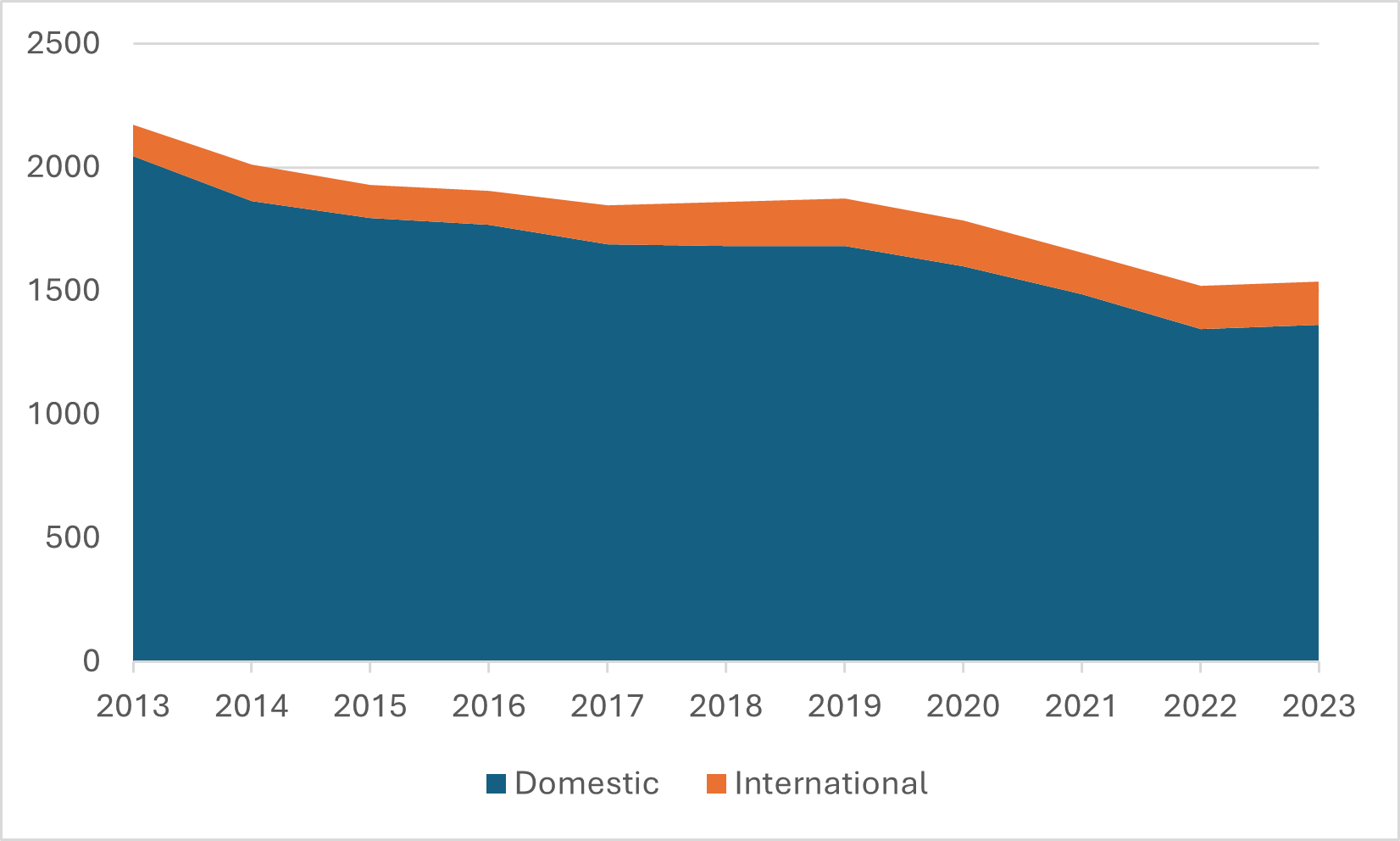
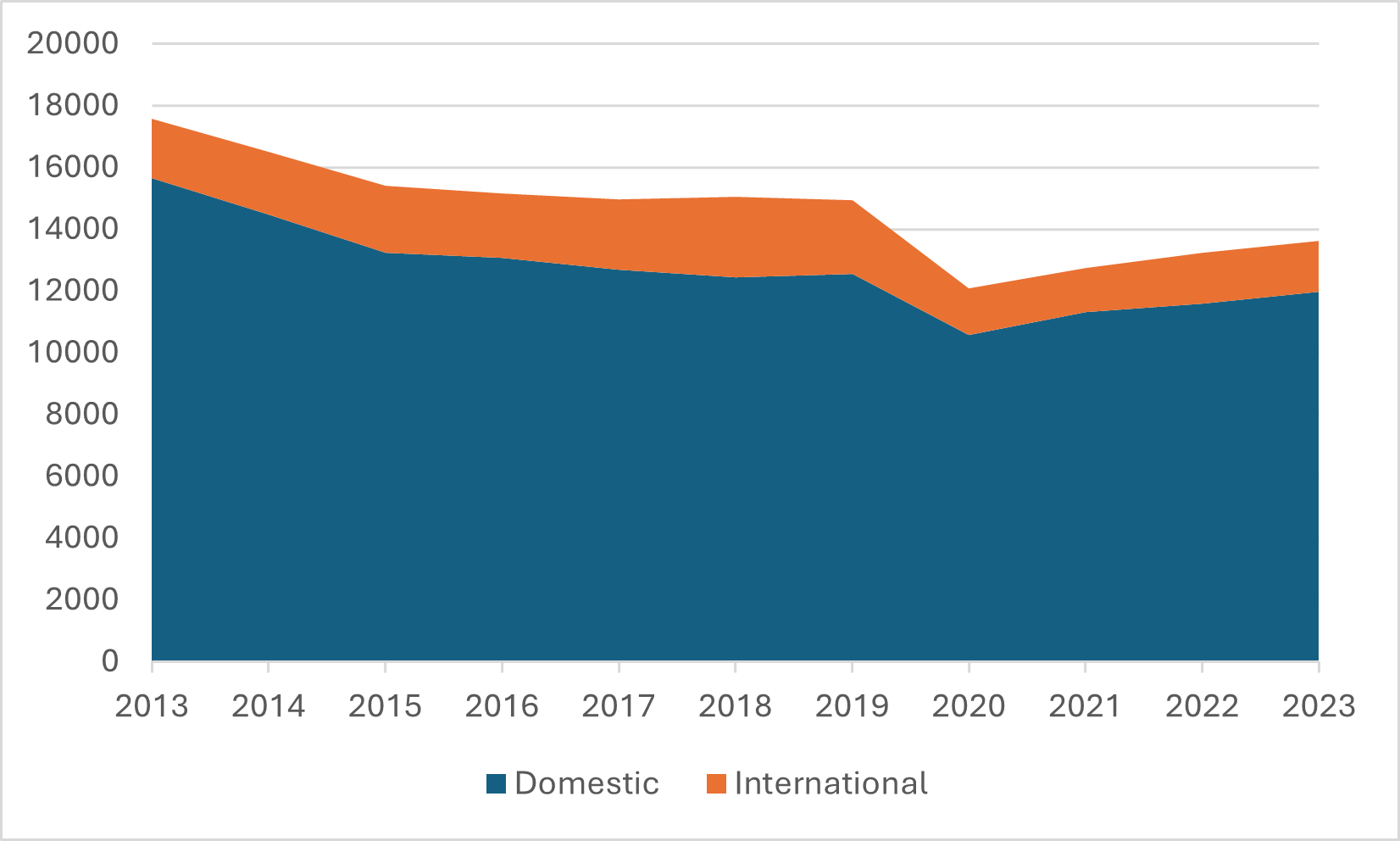
    As Figures 1 and 2 show, the root cause of both institutions’ problems is the same—namely, a big two-stage decline in enrolment. The first stage came in the early 10s, when the domestic youth population was shrinking, and the second came during Covid. The numbers are particularly bad at VIU, where the number of international students is down by over 35%. If these institutions could just get their enrolment numbers back to where they were in 2018, then STU’s tuition income would be about $3 million higher, while VIU’s would rise by roughly $20 million. In both cases, that would be enough to put the institutions well into the black. The much larger numbers at VIU are not just because it is a larger institution, but because the recent fall in student numbers is happening disproportionately on the international student side.

    Figure 1: Domestic and International Enrolment, St Thomas University, 2012-12 to 2022-23

    Figure 2: Domestic and International Enrolment, Vancouver Island University, 2012-12 to 2022-23

    At this point, folks, I am going to have to do something which some might find triggering, which is to invoke the L-word, because I am quite certain that everyone remembers the extent to which falling enrolment and a drop in tuition revenue were among the key elements in the collapse at Laurentian. I am not going to do this because I necessarily think either of these institutions is following the Laurentian path exactly. One very big dissimilarity is that neither STU nor VIU has any long-term debt, which was another of the key factors at work at Laurentian. Rather, I am doing it because I think at least some of the same dynamics are at play, particularly at VIU, which just happens to be about the same size as Laurentian in terms of enrolment and budget size, albeit without some of Laurentian’s big ambitions with respect to research. In fact, given the VIU/Laurentian similarity, I will concentrate the rest of this analysis on this west coast institution. I might come back to STU sometime, but for the moment, I will leave it aside.

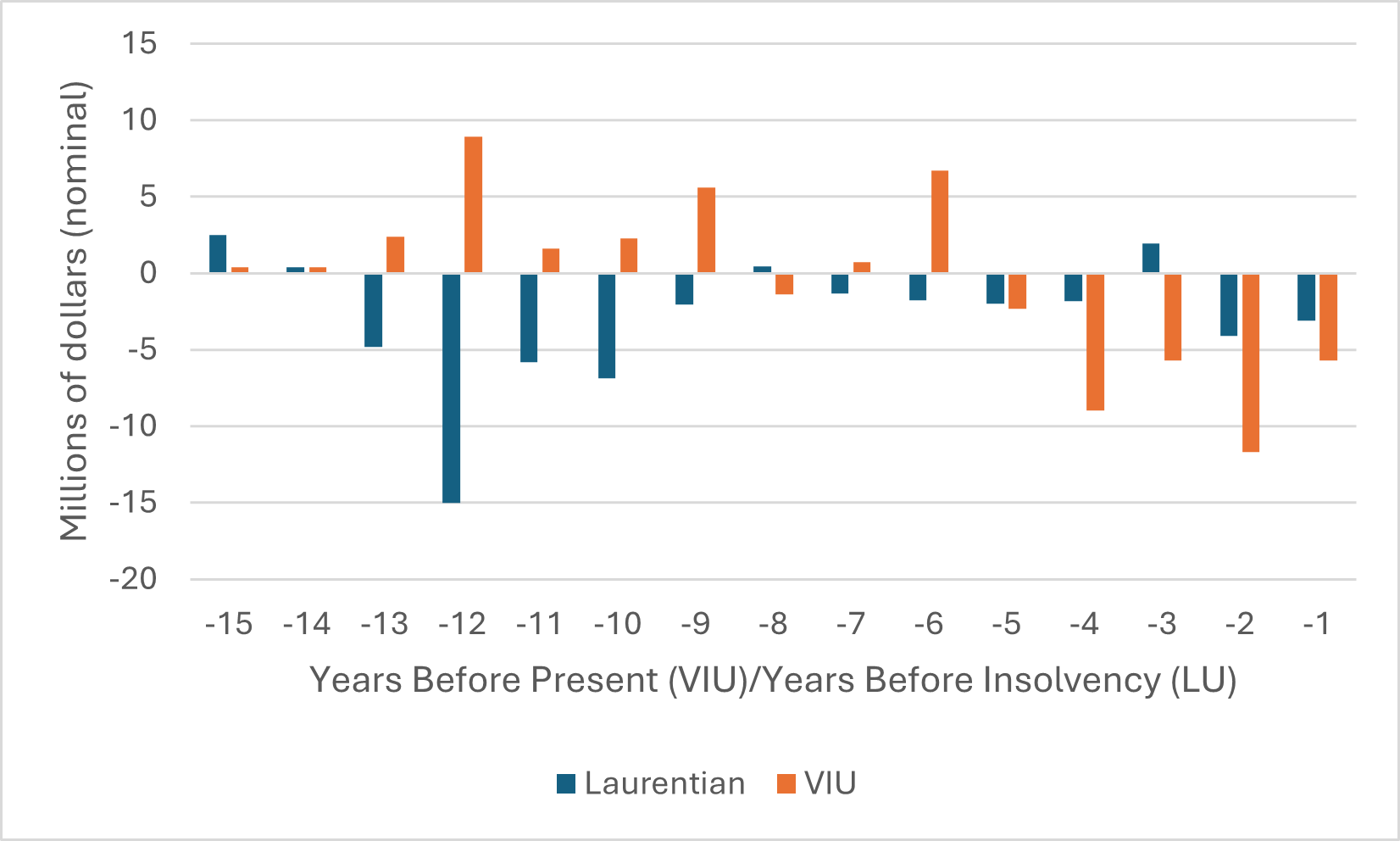
    Let’s start by looking at budget surpluses over time at VIU and Laurentian. Figure 3 shows the last fifteen years of VIU’s surpluses/deficits and compares them to the fifteen years prior to the insolvency declaration at Laurentian. Based simply on the last five years or so, there is no question that VIU is actually worse than Laurentian. The institution has spent $34 million more than it earned in the last five years; Laurentian, in contrast, was only $9 million in the red over a similar period prior to insolvency. But shift your eyes to the left of that graph for a minute, and you’ll see another difference: Laurentian ran deficits basically for most of the fifteen years prior to its events, whereas VIU was in pretty good shape. What that meant was that when the bad times started five years ago, VIU had a decent accumulated surplus to draw from. That is why the institution has been able to carry on over the past few years, but since it has now drawn down well over half of its accumulated surplus ($30.6 million in 2024, down from $78 million in 2018), that strategy doesn’t really have any more room to run.

    Figure 3: Long-term Record of Surpluses/Deficits, in Millions, Laurentian vs VIU

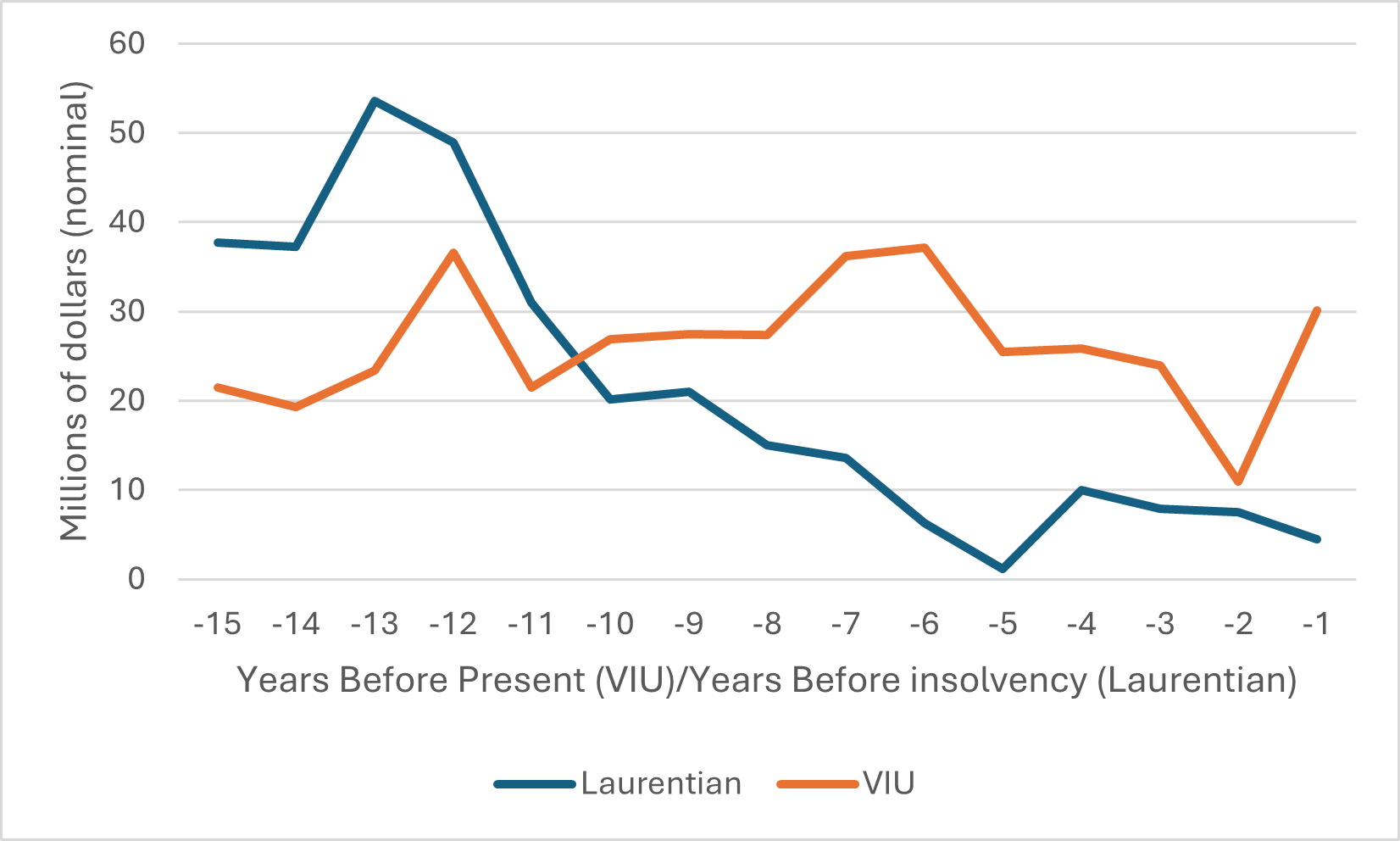
    There are also significant differences between the two institutions when you look at cash balances, as below in Figure 4. Laurentian was basically out of gas and surviving on fumes for several years prior to the collapse, with cash reserves barely enough to cover a couple of weeks of operating expenditures; VIU has never been anywhere near that point. However, note the big dip in VIU’s cash last year. It reversed itself, but only because the institution sold off a big chunk of portfolio investments precisely (I think) to boost cash reserves. There are warning signs here for sure, albeit nothing like Laurentian’s blaring klaxons.

    Figure 4: Long-term Record of Cash Position at End of Fiscal, in Millions, Laurentian vs VIU

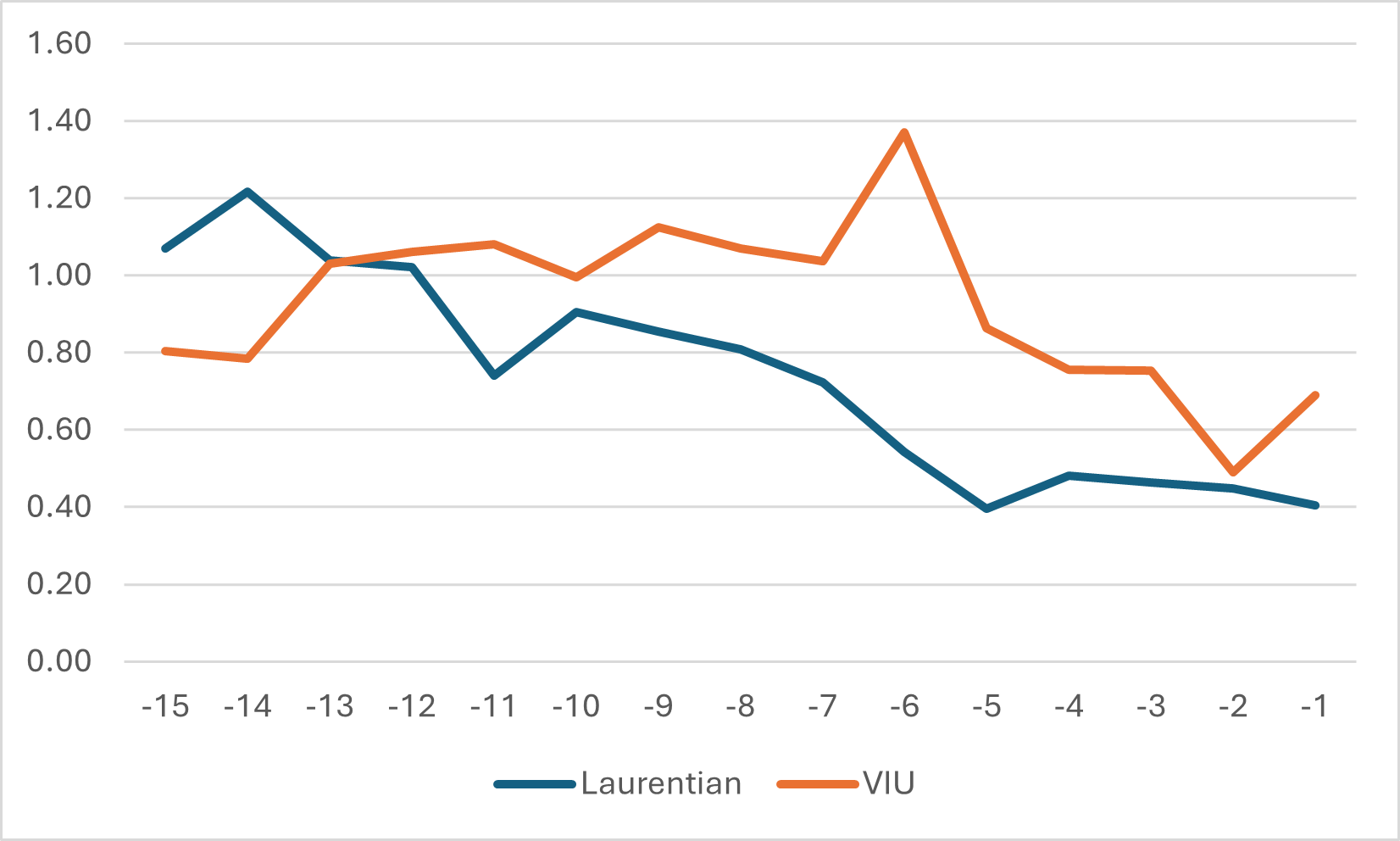
    The final comparison I want to make has to do with what is known as the “working capital ratio.” This is one of the key financial tests that the Government of Ontario uses to identify institutions in financial trouble, and it is the ratio between “current assets” (basically, cash plus accounts receivable) to current liabilities plus deferred contributions for research. Anything below a ratio of 1 puts you in the “high-risk” category.

    (Nota bene: some people think this ratio is not very useful because in a liquid market, institutions can move “long-term” investments to short-term fairly easily—as indeed VIU seems to have done last year when it sold off some of its portfolio investments in order to recharge cash reserves. However, since it’s an official government metric, it’s probably due a little respect, so I am using it here anyway.)

    One challenge in comparing VIU and Laurentian on the working capital metric is that they don’t quite calculate their liabilities identically, mainly because their respective provincial governments don’t ask them to categorize balance sheets in the same way. Specifically, VIU does not break out “current” from long-term liabilities, and also it lists substantial sums of tuition fees owed as “deferred revenue” while Laurentian does not. My read of this is therefore that to make the two sets of data on current liabilities comparable, one has to exclude from VIU’s numbers both “deferred capital contributions” and “deferred revenue”. Which is what I have done below in Figure 5.

    What Figure 5 shows is arguably similar to what Figure 3 shows: a metric in which a) neither institution looks particularly good, but b) Laurentian’s position is on the whole worse, and c) Laurentian’s deterioration is long and gradual while VIU’s is rather sharp.

    Figure 5: Long-term Record of Working Capital Ratios, Laurentian vs VIU

    To be crystal clear: I don’t think VIU is really on the verge of Laurentian-ing. It has no long-term debt. It has had a bigger cushion to fall back on. The province is on the verge of a youth boom, which should help a bit in bringing student numbers and revenues back up. It is working for a provincial government which is far more proactive than the frequently clueless one in Queen’s Park. And in fall 2023, it adopted a fairly aggressive if not especially strategic program of cost-cutting (ten percent for all units over three years), which in theory was supposed to right the ship.

    However:

    1. Even if VIU is not Laurentian, many of its key financial indicators look awfully familiar. From deficits to cash levels, to working cash ratios, it all seems very Mark Twain: history does not repeat, but it rhymes.
    2. That aggressive deficit reduction package didn’t reckon with Marc Miller, whose cuts to visas and policy of publicly crapping on the quality of Canadian institutions is likely to result in further drops in international student numbers and therefore reductions in income in the millions of dollars. There could still be problems ahead (I assume this may be what has been behind this week’s decision to consider suspending and/or cancelling roughly twenty programs at the diploma, undergraduate and graduate levels).
    3. The VIU community appears to be only dimly aware of how bad things are. When VIU President Deborah Saucier recently resigned, it was—according to CBC at least—because the VIU community would not support further cuts because they were not “supported by evidence.” Now, there may have been more to it than that (Lord knows CBC can be pretty crapulous at fact-checking post-secondary stories), but if it is anywhere near the truth, then the VIU community is clearly having some trouble facing a pretty serious reality, and that complicates any revival plan.

    Vancouver Island needs a second, flourishing undergraduate university and that can only be achieved through a strong financial base. Best wishes, therefore, to the folks at VIU as they grapple with these issues.

    Source link

  • Post-COVID University Surpluses (Deficits) | HESA

    Post-COVID University Surpluses (Deficits) | HESA

    Ok, everyone, buckle up. For I have been looking at university financial statements for 2023-24 and the previous few years, and I have Some Thoughts.

    In this exercise, I examined the financial statements from 2017-18 onwards for the 66 Canadian universities which are not federated with a larger institution and had income over $20 million. L’Université du Québec was excluded from the analysis below because it has yet to release financial statements for 2023-24.

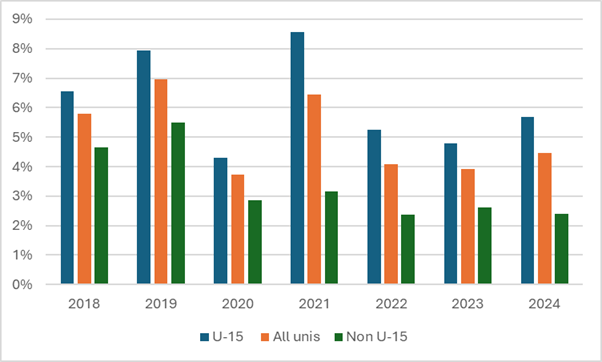
    Figure 1 shows the average net surplus (that is, total income minus total expenditures as a percentage of total income) across all institutions for the fiscal years 2017-18 to 2023-24. As is evident from the graph, fiscal years 2018 through 2021 were all pretty good, apart from 2020 (the stock market did its COVID tank right at the end of the fiscal year and radically reduced investment returns that year), and overall surpluses were in the 6% range, which is not bad. But post-COVID, things got a bit rough, and the returns dropped to about 4%. Note, though, that there is a significant gap between the “big beasts” of the Canadian university scene and everyone else. In the good years, U15 institutions, which in financial terms represent about 60% of the system, saw surpluses about two percentage points higher than non-U15 institutions. Since 2022, the gap has been about three percentage points.

    Figure 1: Average Surpluses as a Percentage of Total Income, Canadian Universities, Fiscal Years 2018 to 2024

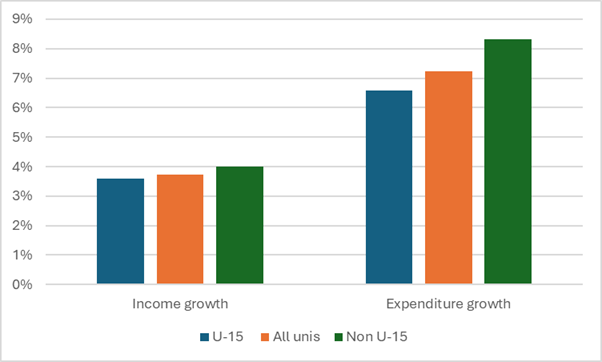
    Why have surpluses shrunk in the past few years? No surprise here: it is simply that costs have increased by about 7% in real terms for the past five years (that is about 1.4% above inflation each year), while revenues have only grown 3.7% (0.75% above inflation each year). Income growth has been pretty similar across U15 and non-U15 institutions, but expenditure growth has been significantly larger at non-U15 institutions.

    Figure 2: 5-year real change in Income and Expenditure, Canadian Universities, 2018-19 to 2023-24

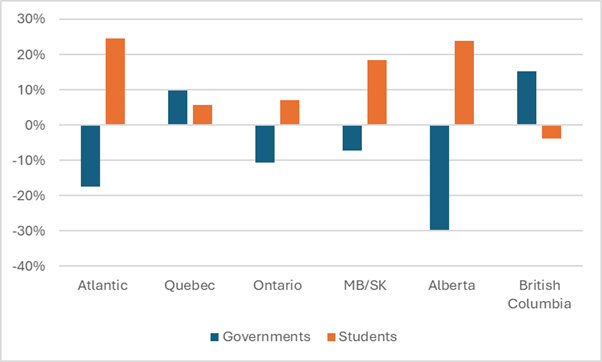
    It is worth pointing out here, though, that all of this data is from before any of the effects of the international student visa cap of 2024 come into play. In eight out of ten provinces, it has been income from students that has driven universities’ revenue growth over the past five years. Only in Quebec and British Columbia has government spending been the main driver (and yes, I know, the idea that revenue from students is declining in British Columbia was a bit shocking to me too, but I triple-checked and its true—this is the one part of the country where international student revenue was falling even before Marc Miller started swinging his axe around).

    Figure 3: 5-year real change in Income by Source and Region, Canadian Universities, 2018-19 to 2023-24

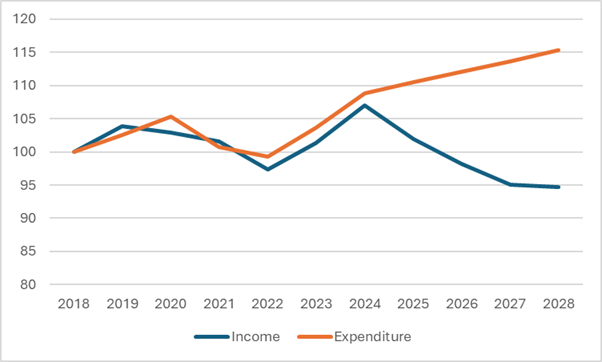
    If you assume that international student numbers overall drop by 40% over three years (which is roughly what the government says it wants to achieve), then what we are likely is a decrease of about 11% in total university revenues between now and 2027 (assuming no other changes in enrolment or tuition fees, and an annual increase in government expenditures of inflation plus 1% which is what we saw in last year’s budget cycle but I wouldn’t necessarily bet on it for the future). Meanwhile, if we keep expenditures increasing at inflation plus 1.5%, we will see an increase in expenditures of about 6% by 2028. The result is what I would call a trulyyawning financial gap over the next four years. And it is precisely this that keeps senior admins up at night.

    Figure 4: Projected changes in Income and Expenditure, Canadian Universities, 2017-18 to 2027-28, Indexed to 2017-18

    Now to be clear, I don’t expect the sector to be posting multi-billion dollar gaps implied by Figure 4 (for clarity: while Figure 4 displays changes in projected income and expenditure in index terms, if the gap that opens up between 2024 and 2028 is as depicted here, the change in net position for universities will be equal to about $7 billion in 2028, which given current surpluses of $2 billion/year implies aggregate deficits of about $5 billion/year or about 11% of total income). The income drop will probably not be quite this bad, both because I expect institutions to raise fees on international students, and because I suspect international student numbers will not fall quite this far because provinces will re-distribute spots going unused by colleges (due to the reduction in enrolments that will ensure from last fall’s changes to the post-graduate work visa program). Similarly, the increase in expenditures won’t be this high either because institutions are going to do all they can to “bend the curve” in anticipation of a fall in revenues. But bottom line: there’s a looming $5 billion income gap that has to be closed just to stay in balance, and larger if we want the system to have at least some surpluses for rainy (rainier?) days in future.

    Anyways, back to the present. We can, of course, drill down to the institutional level, too. At this point in the exercise, I have chosen to exclude two more institutions from my calculations. The first is Concordia because it has a unique (and IMHO really irritating) practice of splitting its financial reporting between the institution and its “Foundation” (don’t ask), with the result that the institution’s financial statements alone tend to show the institution as worse off than it really is. The second is Royal Roads, which uniquely took a stonking great write-down on capital investments in 2024 and so frankly looks a lot worse than I think it should.

    So with our sample now down to just 63 institutions, Table 1 shows that in fact most universities have been doing OK over the past few years. Of the institutions included in this part of the analysis, 39 have been deficit-free since 2021-22, and 28 have not shown a deficit in any of the last five years. However, there are three institutions where it might be time to start worrying: Carleton, which has posted three consecutive deficits, and St. Thomas and Vancouver Island University, which have posted deficits in each of the past five years. Carleton is a little bit less worrisome than the other two because it socked away some huge surpluses in the years prior to 2022 and so has a little bit more runway. I’ll come back to the other two in a moment.

    Years in deficit Since 2019-20 Since 2021-22
    5 2
    4 0 n/a
    3 6 3
    2 13 7
    1 16 16
    0 28 39

    Figure 5, below, shows combined net surplus over the past five fiscal years (2019-20 to 2023-24) as a percentage of total revenues. There are eight institutions which have net losses over the past five years, and another eight with surpluses between 0 and 2% of total revenues, which I would characterize as “precarious.” There are another 29 institutions with combined five-year surpluses, which are between 2 and 5% of total revenues, which are not great but not in the immediate danger zone either. Finally, there are 18 institutions with surpluses of 5% or more, which I would characterize as being “safe,” including two (Algoma and Cape Breton) which have five-year surplus rates of over 20% (this is what happens when your student body is 75%+ international)

    Figure 5: Distribution of 5-year aggregate net surpluses, Canadian Institutions, 2019-20 to 2020-24

    But note the right-hand side of that graph. There are two institutions that have five-year deficits equal to more than 4% of their total revenues. And those two are the same two that have posted deficits for each of the past five years: St. Thomas University in New Brunswick and Vancouver Island University in British Columbia. I’ll talk about them in a bit more depth tomorrow.

    Source link

  • Check-in on Administrative Bloat, 2025 Edition

    Check-in on Administrative Bloat, 2025 Edition

    Check-in on Administrative Bloat, 2025 Edition

    It’s been a little over five years since I took a serious dive into the question of “administrative bloat,” which apparently exists everywhere but in the statistics. Still, always good to check assumptions every once in a while, and I thought five years was long enough to make a new look at the data worthwhile. So here goes:

    Let’s start by reviewing what we can and cannot know about staffing at Canadian universities. StatsCan tracks the number of permanent ranked faculty pretty accurately through its University and College Academic Staff Survey (UCASS), and in a loosey-goosier fashion through the Labour Force Survey. The latter gives much higher numbers than the former, as shown below in Figure 1, which compares the number of “ranked” academics from UCASS with the number of permanent, full-time academics from the LFS.

    Figure 1 – Full-time Academic Staff Numbers According to LFS and UCASS

    StatsCan also tracks the total number of employees—both salaried and hourly—in the university sector using the Survey of Employment, Payroll and Hours (SEPH). However, in theory, if you subtract the number of FT academic staff from the number of total staff, you should be able to get the total number of non-academic staff, right? Well, unfortunately, this is where the discrepancy between UCASS and LFS runs into some problems. In Figure 2, I show the implied number of non-academics using both methods. The growth rates are different because of the difference in observations in the early period, but the two estimates do both converge on the observation that there are about 130,000 non-academic staff at Canadian universities, or about two and a half times the complement of academic staff.

    Figure 2 – Implied Non-Academic Staff Numbers using SEPH, LFS and UCASS

    So, that’s evidence of bloat, right? Well, maybe. Personally, what I take from Figure 2 is that either (or both) the LFS numbers and the SEPH numbers are probably flaming hot garbage. There’s simply no way that the number of non-academic staff has increased by 170% in the past twenty years, as a combination of the SEPH and LFS data suggests. For reasons that will become apparent shortly, I also have serious doubts that it’s increased by 85% either, as the combination of SPEH and UCASS suggests. Because there is a second set of data available to look at this question, one that shows expenditure on salaries, and it shows a much different picture.

    The annual FIUC survey shows how much money is spent on wages for ranked academics as well as how much is spent on non-academics (it also shows wages for instructional staff without academic rank,” but I exclude this here for ease of analysis). Over the past three years, it is true that non-academic salary mass has risen, and academic ones have not (score for the bloat theory!), but looked at with a 25-year lens, Figure 3 shows that the rate of increase is about the same (score one against).

    Figure 3 – Total Expenditures on Salaries by Employee Group, in millions of $2023

    Basically, the salary data in Figure 3 tells a completely different story than the SEPH/LFS/UCASS data in Figure 2. All you do is divide the spending data by the implied headcounts to see what I mean (which I do below). Figure 4 shows the implied change in average academic pay and average A&S pay, dividing total FIUC pay by the UCASS academic staff numbers and the A&S staff numbers implied by subtracting the UCASS numbers from the SEPH numbers, i.e., the orange line from Figure 2. To believe both sets of data, you have to believe that average academic salaries have increased substantially while average salaries for non-academics have declined substantially.

    Figure 4 – Change in Implied Average Pay, Academic Staff vs. A&S Staff, 2001-02 = 100

    In Figure 4, the blue line representing academic salaries is more or less consistent with the long-term trend in salaries we have seen by looking at salary survey data (which I last did back here): significant growth in the 00s and much slower growth thereafter. There are no staff salary surveys to use for comparison, but let’s put it this way: when people talk about “bloat” in non-academic staff positions, they normally mean it in the sense that the bloat is coming from expensive A&S staff, overpaid A&S staff, etc. For Figure 4 to be true, the growth in staff numbers would need to come almost entirely from more junior, less well-paid staff. It’s not impossible that this is true, but it’s not consistent with the general vibe about bloat, either

    So who knows, really? There’s a lot of contradictory data here, some of which argues strongly in favour of the bloat argument, but quite a bit of which points in the other direction. Better data is needed to answer this question probably isn’t forthcoming.

    Meanwhile, we can take one last look at A&S expenditure data. We can check to see if the pattern of A&S salary expenditures across university operating functions has changed over time. As Figure 5 shows, the answer is “a little bit.” Central Administration now takes up 25% of total A&S salary expenditures, up from 22% 20 years ago. Student services and external relations are up much more sharply in proportional terms, but since they were both starting from a low base, they don’t impact the overall numbers that much. Libraries, physical plant, and non-credit instruction are the categories losing share.

    Figure 5: Share of Total A&S Salary Mass by Function, Canadian University Operating Grants, Select Years

    And there you have it: more data than you probably needed on administrative bloat. See you back here again in 2030.

    Source link

  • Immigration policies in focus as Mark Carney sworn in as Canadian PM

    Immigration policies in focus as Mark Carney sworn in as Canadian PM

    Succeeding Justin Trudeau as Canada’s 24th Prime Minister, Carney’s swearing-in ceremony was conducted by governor general Mary Simon at Rideau Hall in Ottawa.

    Carney’s appointment as Canada’s leader comes at a time when the country is navigating through an increasingly tumultuous relationship with its closest neighbour and ally, the United States.

    Canada’s ties with the US have worsened after President Donald Trump imposed steep tariffs on Canadian goods and floated the idea of integrating Canada into the US, sparking strong backlash.

    Considered a political newcomer, who played significant roles as the governor of the Bank of Canada and the Bank of England between 2008 to 2020, Carney is known for having a tough stance on immigration. 

    Calling Canada’s immigration policy “failures of executions”, Carney stated that Canada has taken in more people than its economy has been able to handle. 

    “I think what happened in the last few years is we didn’t live up to our values on immigration,” he said at a Cardus event – a Christian non-partisan think tank – in November last year, according to Canadian media reports.

    “We had much higher levels of foreign workers, students and new Canadians coming in than we could absorb, that we have housing for, that we have health care for, that we have social services for, that we have opportunities for. And so we’re letting down the people that we let in, quite frankly.”

    Carney’s statement suggests that he will uphold the Canadian federal government’s plan to reduce immigration targets over the next three years.

    Recently, the federal government announced a shift in its immigration strategy, cutting the number of newcomers by 21% – from approximately 500,000 in 2024 to 395,000 in 2025 and 380,000 in 2026.

    In its race to reduce temporary residency numbers and overall inflow of immigrants, international students in Canada have faced the brunt of policy changes in the country.

    Canada has imposed more caps on study permits, eliminated fast-track study permit processing, increased PGWP eligibility and English proficiency requirements, in an effort to “align its immigration planning with capacity”.  

    Over the past year, policy restrictions have already had a significant impact in Canada, with the total number of study permits processed by the IRCC expected to be 39% lower than in 2023.

    A former international student himself, Carney is expected to continue with restrictive policies on the cohort, as he previously blamed Canadian provinces for “underfunding higher education”, which pushed institutions to rely on international students. 

    “Do we value higher education in this country or not? Well, if we value higher education, maybe we should start funding our universities,” stated Carney. 

    “On the foreign student side, it’s more on provincial policy, on squeezing universities, in a sense.”

    Daljit Nirman, an immigration lawyer based in Ottawa and founder, Nirman’s Law, believes aggressive student recruitment has contributed to housing shortages, an oversaturated job market, and increased strain on health care, making effective newcomer integration in Canada more difficult.

    “Given Carney’s stance and these recent policy changes, it is likely that Canada will continue implementing stricter controls on international student admissions during his tenure,” Nirman told The PIE News.

    “This measured approach aims to preserve the benefits of international education while ensuring that Canada’s infrastructure can effectively support those who choose to study and settle in the country.”

    According to Priyanka Roy, senior recruitment advisor at York University, while Carney’s stance on immigration may appear stricter, it will ultimately result in a more “balanced approach.”

    “While it may seem like a tougher stance on immigration, we believe that Prime Minister Carney’s stance is to create a balanced approach to immigration, ensuring that international student enrolment aligns with Canada’s economic capacity and does not place undue pressure on local infrastructure,” Roy told The PIE News.

    “York is proactively adapting by offering sustainable solutions, such as a four-year housing guarantee, on-campus job opportunities, and co-op programs; provisions that help our international students integrate into Canadian life while maintaining a balanced and healthy relationship with the local community.”

    Prime Minister Carney’s leadership presents a valuable opportunity to rebuild stronger ties between India and Canada, fostering an environment of trust and collaboration
    Priyanka Roy, York University

    The former banker, who won the Liberal Party race by 86% of the votes, also acknowledged immigration’s role in contributing to Canada’s economic future. 

    Emphasising the need for productivity and a growing labour force, Carney has previously highlighted that Canada’s growing labour force is “going to largely come through new young Canadians”.

    With immigration poised to be a key issue, rebuilding ties with India – one of Canada’s largest sources of migrants – will be crucial for the prime minister-designate.

    Having already expressed a willingness to mend relations following a major diplomatic crisis, Carney’s efforts to indulge in discussions with India could spell good news for Indian students eyeing Canada as a study destination.

    “Prime Minister Carney’s leadership presents a valuable opportunity to rebuild stronger ties between India and Canada, fostering an environment of trust and collaboration,” stated Roy.

    “As diplomatic relations improve, we are confident that more Indian students will continue to view Canada as an attractive destination for higher education and realign their preference for higher education in Canada.”

    Source link

  • Parents turn to international education as path to residency

    Parents turn to international education as path to residency

    If families looking to relocate to “top destinations” such as the US and Canada choose the right program for their children, they may be granted permanent residency as domestic students or even graduate from their chosen institution as residents or citizens, according to Tess Wilkinson, director of education services at Henley & Partners Education in the UK.

    “We’re now seeing a real uptick in the types of families who are now becoming aware that there is an option for them,” she told The PIE News.

    “For families looking at relocating, there can be real gains in the amount of fees they spend on education in places like Canada,” she explained. “They can they can save [up to] $150,000 on fees.”

    The sheer number of clients asking for assistance in this area signals that education is swiftly becoming “one of the key drivers for people looking at second residences to citizenships”, she added.

    Henley & Partners refers to itself as a “global leader in residence and citizenship by investment”. Its education arm, Wilkinson explained, helps to “advise transnational families who are looking for global education solutions”.

    Working with families all over the world with children and adults of all ages – from K-12 to those seeking master’s degrees or MBAs – it “assists them to find the right match”, taking into account children’s individual needs and the types of residency or citizenship that may become available to its clients through educational opportunities.

    “We can advise on all the top-tier destinations. So we have a family, for instance, who are considering the UK, the US and Australia and they’re putting in applications for all three countries,” Wilkinson shared.

    We’re now seeing a real uptick in the types of families who are now becoming aware that there is an option for them
    Tess Wilkinson, Henley & Partners Education

    With immigration policies in key markets such as the UK, the US, Canada and Australia shifting all the time, Wilkinson acknowledged that it “is not something that is simple”.

    But she said that, with expertise across a number of key markets, Henley & Partners can provide families with education counsellors to help match children to institutions that suit them best, as well as help with applying to universities or summer programs.

    The ‘big four’ international education destination countries are all seeing turbulence in their respective markets. Some of these restrictive policies are having an impact on students’ ability to study in the countries, hindering them from securing post-graduate residency in their chosen destination.

    Australia and Canada are both subject restrictions on international students, while UK universities’ international departments have been blighted by a crackdown on overseas students’ ability to bring their families into the country with them.

    Meanwhile, Donald Trump’s second term as US President continues to present challenges to the sector, as he freezes study abroad funding, battles against DEI legislation and moves to arrest or even deport international student protestors.

    Tess Wilkinson will be speaking at The PIE Live Europe at the PIEx Power Up Expanding horizons: accessing global education & opportunity via investment migration on March 11 at 16:00. Tickets are available online here.

    Source link