STEM workforce shortages are a well-known global issue. With demand set to rise by nearly 11 percent in the next decade, today’s students are the solution. They will be the ones to make the next big discoveries, solve the next great challenges, and make the world a better place.
Unfortunately, many students don’t see themselves as part of that picture.
When students struggle in math and science, many come to believe they simply aren’t “STEM people.” While it’s common to hear this phrase in the classroom, a perceived inability in STEM can become a gatekeeper that stops students from pursuing STEM careers and alters the entire trajectory of their lives. Because of this, educators must confront negative STEM identities head on.
One promising approach is to teach decision-making and critical thinking directly within STEM classrooms, equipping students with the durable skills essential for future careers and the mindset that they can decide on a STEM career for themselves.
Teaching decision-making
Many educators assume this strategy requires a full curriculum overhaul. Rather, decision-making can be taught by weaving decision science theories and concepts into existing lesson plans. This teaching and learning of skillful judgment formation and decision-making is called Decision Education.
There are four main learning domains of Decision Education as outlined in the Decision Education K-12 Learning Standards: thinking probabilistically, valuing and applying rationality, recognizing and resisting cognitive biases, and structuring decisions. Taken together, these skills, among other things, help students gather and assess information, consider different perspectives, evaluate risks and apply knowledge in real-world scenarios.
The intersection of Decision Education and STEM
Decision Education touches on many of the core skills that STEM requires, such as applying a scientific mindset, collaboration, problem-solving, and critical thinking. This approach opens new pathways for students to engage with STEM in ways that align with their interests, strengths, and learning styles.
Decision Education hones the durable skills students need to succeed both in and out of the STEM classroom. For example, “weight-and-rate” tables can help high school students evaluate college decisions by comparing elements like tuition, academic programs, and distance from home. While the content in this exercise is personalized and practical for each student, it’s grounded in analytical thinking, helping them learn to follow a structured decision process, think probabilistically, recognize cognitive biases, and apply rational reasoning.
These same decision-making skills mirror the core practices of STEM. Math, science, and engineering require students to weigh variables, assess risk, and model potential outcomes. While those concepts may feel abstract within the context of STEM, applying them to real-life choices helps students see these skills as powerful tools for navigating uncertainty in their daily lives.
Decision Education also strengthens cognitive flexibility, helping students recognize biases, question assumptions, and consider different perspectives. Building these habits is crucial for scientific thinking, where testing hypotheses, evaluating evidence objectively, and revising conclusions based on new data are all part of the process. The scientific method itself applies several core Decision Education concepts.
As students build critical thinking and collaboration skills, they also deepen their self-awareness, which can be transformative for those who do not see themselves as “STEM people.” For example, a student drawn to literacy might find it helpful to reimagine math and science as languages built on patterns, symbols, and structured communication. By connecting STEM to existing strengths, educators can help reshape perceptions and unlock potential.
Adopting new strategies
As educators seek to develop or enhance STEM education and cultures in their schools, districts and administrators must consider teacher training and support.
High-quality professional development programs are an effective way to help teachers hone the durable skills they aim to cultivate in their students. Effective training also creates space for educators to reflect on how unconscious biases might shape their perceptions of who belongs in advanced STEM coursework. Addressing these patterns allows teachers to see students more clearly, strengthen empathy, and create deeper connections in the classroom.
When educators come together to make STEM more engaging and accessible, they do more than teach content: they rewrite the narrative about who can succeed in STEM. By integrating Decision Education as a skill-building bridge between STEM and students’ everyday lives, educators can foster confidence, curiosity, and a sense of belonging, which helps learners build their own STEM identity, keeping them invested and motivated to learn. While not every student will ultimately pursue a career in STEM, they can leave the classroom with stronger critical thinking, problem-solving, and decision-making skills that will serve them for life.
Creating that kind of learning environment takes intention, shared commitment, and a belief that every student deserves meaningful access to and engagement with STEM. But when the opportunity arises, the right decision is clear–and every school has the power to make it.
Mary Call Blanusa, Alliance for Decision Education
Mary Call Blanusa is the Director of Public Policy and Partnerships at the Alliance for Decision Education, a nonprofit organization catalyzing a transformative movement to empower students with the skills and dispositions for making better decisions.
Latest posts by eSchool Media Contributors (see all)
Public debate often treats the future of work as if it were an external force. In reality it is shaped by decisions made early in life. Human capital is formed long before individuals enter the labor market. Once those foundations are set, later interventions have limited effect.
Foundations matter more than we admit
International evidence is consistent. Children who reach secondary school without secure literacy and numeracy face reduced prospects in every dimension. They are less likely to complete higher education, less likely to shift between sectors and less likely to command wage growth. Early mastery is not a marginal advantage. It sets the trajectory of adult life.
Such mastery seldom emerges on its own. It is often supported by a tutor or advisor who brings structure, continuity and interpretation. Their role is not to supply more content but to make learning coherent.
Context now outweighs content
Young people confront an abundance of information yet little clarity. They choose subjects without understanding how sectors are evolving. A student who enjoys mathematics might pursue data science, finance, engineering or modelling for the energy transition. One drawn to design might fit in product development, user experience, digital media or creative technology. The link between classroom and career is rarely obvious.
Guidance from someone with lived experience can close this gap. It helps students recognise how technology alters professional practice and how new industries emerge from the convergence of skills.
Hybrid skills have become the baseline
Employers now prioritise a combination of analytical reasoning, creative problem solving, communication and digital fluency. These attributes underpin mobility in an economy shaped by automation and AI. They cannot be taught within a single discipline. They must be developed deliberately, ideally from early adolescence and strengthened through work exposure.
Failure to cultivate such skills leaves individuals vulnerable to technological change. Success creates resilience across multiple career cycles.
Families are preparing for uncertainty, not a single profession
Parents increasingly recognise that traditional assurances are weakening. Admission to a reputable university no longer guarantees a durable career. Degrees hold value, but only when paired with adaptability. The prudent response is to plan for volatility.
Every student should finish school with a clear framework for the decade ahead. This should include a strengths profile, an understanding of key industries, a realistic view of AI’s impact and a route into early professional experience. Such preparation is not aspirational. It is necessary.
The policy implication
Societies that wish to remain competitive must invest in human capital from the earliest years. Schools and universities cannot meet this need alone. Young people require advisors who understand both how learning develops and how labor markets shift. Treating this guidance as optional will leave nations and individuals exposed.
Those who act early will shape their own economic future. Those who delay will face outcomes shaped by others.
Texas faces a widening gap between high school completion and college readiness. Educators are already doing important and demanding work, but closing this gap will require systemic solutions, thoughtful policy, and sustained support to match their efforts.
A recent American Institutes for Research report shows that just 56.8 percent of Texas’ graduating seniors met a college-readiness standard. Furthermore, 27 percent of rural students attend high schools that don’t offer Advanced Placement (AP) courses. This highlights a significant gap in preparedness and accessibility.
Among them was Saki Milton, mathematics teacher and founder of The GEMS Camp, a nonprofit serving minority girls in male-dominated studies. She stressed the importance of accessible, rigorous coursework. “If you went somewhere where there’s not a lot of AP offerings or college readiness courses … you’re just not going to be ready. That’s a fact.”
Additional roundtable participants reminded us that academics alone aren’t enough. Students struggle considerably with crucial soft skills such as communication, time management, and active listening. Many aspiring college-bound students experience feelings of isolation–a disconnect between their lived experiences and a college-ready mentality, often due to the lack of emotional support.
Says Milton, “How do we teach students to build community for themselves and navigate these institutions, because that’s a huge part? Content and rigor are one thing, but a college’s overall system is another. Emphasizing how to build that local community is huge!”
“Kids going to college are quitting because they don’t have the emotional support once they get there,” says Karen Medina, director of Out of School Time Programs at Jubilee Park. “They’re not being connected to resources or networking groups that can help them transition to college. They might be used to handling their own schedule and homework, but then they’re like, ‘Who do I go to?’ That’s a lot of the disconnection.”
David Shallenberger, vice president of advancement at the Boys & Girls Club of Greater Dallas, indicates that the pandemic contributed to that soft skills deficit. “Many students struggled to participate meaningfully in virtual learning, leaving them isolated and without opportunities for authentic interaction. Those young learners are now in high school and will likely struggle to transition to higher education.”
Purposeful intervention
These challenges–academic and soft skills gaps–require purposeful intervention.
Through targeted grants, more than 35,000 North Texas middle and high school students can access college readiness tools. Nonprofit leaders are integrating year-round academic and mentorship support to prepare students academically and emotionally.
Latoyia Greyer of the Boys & Girls Clubs of Greater Tarrant County introduced a summer program with accompanying scholarship opportunities. The organization is elevating students’ skills through interview practice. Like ours, her vision is to instill confidence in learners.
Greyer isn’t alone. At the Perot Museum of Nature and Science, Development Officer Elizabeth Card uses the grant to advance college readiness by strengthening its high school internship program. She aims to spark students’ curiosity, introduce rewarding career pathways, and foster a passion for STEM. She also plans to bolster core soft skills through student interactions with museum guests and hands-on biology experiments.
These collaborative efforts have clarified the message: We can do extraordinary things by partnering. Impactful and sustainable progress in education cannot occur in a vacuum. Grant programs such as the AP Success Grant strengthen learning and build equity, and our partners are the driving force toward changing student outcomes.
The readiness gap continues to impact Texas students, leaving them at a disadvantage as they transition to college. School districts alone cannot solve this challenge; progress requires active collaboration with nonprofits, businesses, and community stakeholders. The path forward is clear–partnerships have the power to drive meaningful change and positively impact our communities.
Jeffrey A. Elliott, UWorld
Jeffrey A. Elliott is COO at UWorld.
Latest posts by eSchool Media Contributors (see all)
Iowa City, Iowa and Dallas, Texas (November 12, 2025) – ACT, a leader in college and career readiness assessment, and Texas Instruments Education Technology (TI), a division of the global semiconductor company, today announced a comprehensive partnership aimed at empowering students to achieve their best performance on the ACT mathematics test.
This initiative brings together two education leaders to provide innovative resources and tools that maximize student potential. The partnership will start by providing:
A new dedicated online resource center featuring co-branded instructional videos demonstrating optimal use of TI calculators during the ACT mathematics test.
Additional study materials featuring TI calculators to help students build upon and apply their mathematical knowledge while maximizing their time on the ACT test.
“This partnership represents our commitment to providing students with the tools and resources they need to demonstrate their mathematical knowledge effectively,” said Andrew Taylor, Senior Vice President of Educational Solutions and International, ACT, “By working with Texas Instruments, we’re ensuring students have access to familiar, powerful technology tools during this important assessment.”
“Texas Instruments is proud to partner with ACT to support student success,” said Laura Chambers, President at Texas Instruments Education Technology. “Our calculator technology, combined with targeted instructional resources, will help students showcase their true mathematical abilities during the ACT test.”
ACT is transforming college and career readiness pathways so that everyone can discover and fulfill their potential. Grounded in more than 65 years of research, ACT’s learning resources, assessments, research, and work-ready credentials are trusted by students, job seekers, educators, schools, government agencies, and employers in the U.S. and around the world to help people achieve their education and career goals at every stage of life. Visit us at https://www.act.org/.
About Texas Instruments
Texas Instruments Education Technology (TI) — the gold standard for excellence in math — provides exam-approved graphing calculators and interactive STEM technology. TI calculators and accessories drive student understanding and engagement without adding to online distractions. We are committed to empowering teachers, inspiring students and supporting real learning in classrooms everywhere. For more information, visit education.ti.com.
Texas Instruments Incorporated (Nasdaq: TXN) is a global semiconductor company that designs, manufactures and sells analog and embedded processing chips for markets such as industrial, automotive, personal electronics, enterprise systems and communications equipment. At our core, we have a passion to create a better world by making electronics more affordable through semiconductors. This passion is alive today as each generation of innovation builds upon the last to make our technology more reliable, more affordable and lower power, making it possible for semiconductors to go into electronics everywhere. Learn more at TI.com.
eSchool Media staff cover education technology in all its aspects–from legislation and litigation, to best practices, to lessons learned and new products. First published in March of 1998 as a monthly print and digital newspaper, eSchool Media provides the news and information necessary to help K-20 decision-makers successfully use technology and innovation to transform schools and colleges and achieve their educational goals.
Wrapping up a recent course, one of my students approached and asked to talk. It turns out she wasn’t there to review an assignment or clarify a grade. Instead, she was seeking my advice on her future career: what were my thoughts on job prospects for her major; what professional pathways made sense, given our rapidly changing world.
As the conversation touched on search strategies, market forces, and even the shifting nature of work itself, I was struck by how the moment represented a growing phenomenon in higher education: helping students succeed beyond the academic setting is a shared responsibility, particularly as the call for post-academic success continues to grow.
Dedicated career centers lead the way for student success beyond campus, but when students seek guidance on their future professional roles, chances are it will be an instructor to whom they turn. That’s good news for those of us committed to academic success. When students reach out to faculty for career advice, it’s an opportunity to deepen trust and strengthen learner confidence–principles that correlate with learning success. It also allows us to link learning with purpose, while helping us more deeply understand the evolution of our disciplines.
Integrating career readiness into our courses benefits us all. Here are some simple steps to get started:
Instructors Are Career Influencers—Whether We Know It or Not
Classroom instructors are the most consistent professional mentors that students encounter throughout their college years. A passing comment about your own career trajectory, or a few minutes spent discussing potential paths in your field, can expand a student’s sense of what’s possible, particularly for those whose backgrounds lack the types of professional networks that can impact professional success. Inviting professionals into the classroom–whether through alumni networks, or local industry—is an opportunity to provide students with professional roadmaps. Sharing examples of the different ways your discipline shows up in the world can likewise orient students towards a meaningful future in which they will likely change careers multiple times. To help guide conversations, invite students to explore so-called “clusters” of careers using tools such as the U.S. Department of Labor’s Occupational Information Network which provides data on growing fields and industries.
Relevance Drives Engagement
When students understand how their academic work connects to real-world applications, their engagement deepens. They’re more likely to push through a complex assignment when they see how it builds toward the type of skills they can apply to future employment. Not every lesson needs to turn into a job training session but connecting the “what” of our teaching to the “why” that students are so often seeking strengthens outcomes and can also improve student satisfaction. Studies indicate that students gain motivation when they can see how the skills they’re developing serve a purpose beyond the classroom, so canvassing students about their future career goals and integrating conversations and activities that help them map content to careers can be highly effective.
Every Discipline Includes Transferable Skills
Supporting students with future career goals means guiding them to recognize key competencies that develop across disciplines and that are prioritized across professional fields. Key among these are the skills of critical thinking, communication, teamwork, cultural fluency, and ethical decision-making. Students won’t always recognize these as in-demand skills unless we name them, so consistently referencing their utility is an impactful step. That might mean pointing out that a history paper builds research skills; a biology lab fosters analytical reasoning; and a group project in any discipline develops collaboration and leadership skills that are prized in the workplaces of today. By drawing attention to these connections, we help students value the breadth of what they’re learning while helping them understand how to showcase these skills to future employers.
Hybrid Skills Define the Modern Workforce
Today’s employers seek graduates who bring both depth and versatility, meaning team members who know the specifics of their field, but can also communicate, adapt, and think creatively. These hybrid profiles are in demand across sectors and instructors can support their students by embedding assignments that mirror real-world demands. Case studies, presentations, simulations, along with reflective writing, all offer chances to practice skills that matter in professional life. When we give students opportunities to apply knowledge in dynamic ways, we prepare them not only for jobs, but for the type of lifelong learning these professional positions will demand.
Helping students prepare for their careers doesn’t dilute academic rigor; it strengthens it by affirming that education matters in the world beyond academics. That day in the classroom, as I listened to my student’s questions about her future, I realized she wasn’t looking for certainty, but rather the opportunity to engage in the very skills we’ve always valued in teaching: critical questioning, reflection, and the ability to envision new ways to advance. Faculty are in a unique position to offer this type of guidance. Embracing and integrating career readiness into our teaching supports the pedagogical goals of the classroom while helping students succeed well beyond them.
Juli S. Charkes, EdD, is a former Director of a Center for Teaching and Learning where she led faculty development across 100 academic programs. She has been a classroom instructor for the past 14 years, teaching organizational leadership, communications, and media studies at both the undergraduate and graduate levels.
Pleschová, G., Sutherland, K. A., Felten, P., Forsyth, R., & Wright, M. C. (2025). Trust-building as inherent to academic development practice. International Journal for Academic Development, 30(1), 1–13. https://doi.org/10.1080/1360144X.2025.2454704
Fish, N., Bertone, S., & van Gramberg, B. (2025). Improving student engagement in employability development: recognising and reducing affective and behavioural barriers. Studies in Higher Education, 1–16. https://doi.org/10.1080/03075079.2025.2461271
Wrapping up a recent course, one of my students approached and asked to talk. It turns out she wasn’t there to review an assignment or clarify a grade. Instead, she was seeking my advice on her future career: what were my thoughts on job prospects for her major; what professional pathways made sense, given our rapidly changing world.
As the conversation touched on search strategies, market forces, and even the shifting nature of work itself, I was struck by how the moment represented a growing phenomenon in higher education: helping students succeed beyond the academic setting is a shared responsibility, particularly as the call for post-academic success continues to grow.
Dedicated career centers lead the way for student success beyond campus, but when students seek guidance on their future professional roles, chances are it will be an instructor to whom they turn. That’s good news for those of us committed to academic success. When students reach out to faculty for career advice, it’s an opportunity to deepen trust and strengthen learner confidence–principles that correlate with learning success. It also allows us to link learning with purpose, while helping us more deeply understand the evolution of our disciplines.
Integrating career readiness into our courses benefits us all. Here are some simple steps to get started:
Instructors Are Career Influencers—Whether We Know It or Not
Classroom instructors are the most consistent professional mentors that students encounter throughout their college years. A passing comment about your own career trajectory, or a few minutes spent discussing potential paths in your field, can expand a student’s sense of what’s possible, particularly for those whose backgrounds lack the types of professional networks that can impact professional success. Inviting professionals into the classroom–whether through alumni networks, or local industry—is an opportunity to provide students with professional roadmaps. Sharing examples of the different ways your discipline shows up in the world can likewise orient students towards a meaningful future in which they will likely change careers multiple times. To help guide conversations, invite students to explore so-called “clusters” of careers using tools such as the U.S. Department of Labor’s Occupational Information Network which provides data on growing fields and industries.
Relevance Drives Engagement
When students understand how their academic work connects to real-world applications, their engagement deepens. They’re more likely to push through a complex assignment when they see how it builds toward the type of skills they can apply to future employment. Not every lesson needs to turn into a job training session but connecting the “what” of our teaching to the “why” that students are so often seeking strengthens outcomes and can also improve student satisfaction. Studies indicate that students gain motivation when they can see how the skills they’re developing serve a purpose beyond the classroom, so canvassing students about their future career goals and integrating conversations and activities that help them map content to careers can be highly effective.
Every Discipline Includes Transferable Skills
Supporting students with future career goals means guiding them to recognize key competencies that develop across disciplines and that are prioritized across professional fields. Key among these are the skills of critical thinking, communication, teamwork, cultural fluency, and ethical decision-making. Students won’t always recognize these as in-demand skills unless we name them, so consistently referencing their utility is an impactful step. That might mean pointing out that a history paper builds research skills; a biology lab fosters analytical reasoning; and a group project in any discipline develops collaboration and leadership skills that are prized in the workplaces of today. By drawing attention to these connections, we help students value the breadth of what they’re learning while helping them understand how to showcase these skills to future employers.
Hybrid Skills Define the Modern Workforce
Today’s employers seek graduates who bring both depth and versatility, meaning team members who know the specifics of their field, but can also communicate, adapt, and think creatively. These hybrid profiles are in demand across sectors and instructors can support their students by embedding assignments that mirror real-world demands. Case studies, presentations, simulations, along with reflective writing, all offer chances to practice skills that matter in professional life. When we give students opportunities to apply knowledge in dynamic ways, we prepare them not only for jobs, but for the type of lifelong learning these professional positions will demand.
Helping students prepare for their careers doesn’t dilute academic rigor; it strengthens it by affirming that education matters in the world beyond academics. That day in the classroom, as I listened to my student’s questions about her future, I realized she wasn’t looking for certainty, but rather the opportunity to engage in the very skills we’ve always valued in teaching: critical questioning, reflection, and the ability to envision new ways to advance. Faculty are in a unique position to offer this type of guidance. Embracing and integrating career readiness into our teaching supports the pedagogical goals of the classroom while helping students succeed well beyond them.
Juli S. Charkes, EdD, is a former Director of a Center for Teaching and Learning where she led faculty development across 100 academic programs. She has been a classroom instructor for the past 14 years, teaching organizational leadership, communications, and media studies at both the undergraduate and graduate levels.
Pleschová, G., Sutherland, K. A., Felten, P., Forsyth, R., & Wright, M. C. (2025). Trust-building as inherent to academic development practice. International Journal for Academic Development, 30(1), 1–13. https://doi.org/10.1080/1360144X.2025.2454704
Fish, N., Bertone, S., & van Gramberg, B. (2025). Improving student engagement in employability development: recognising and reducing affective and behavioural barriers. Studies in Higher Education, 1–16. https://doi.org/10.1080/03075079.2025.2461271
As a high school STEM teacher at Baldwin Preparatory Academy, I often ask myself: How can we make classroom learning more meaningful for our students? In today’s rapidly evolving world, preparing learners for the future isn’t about gathering academic knowledge. It is also about helping all learners explore potential careers and develop the future-ready skills that will support success in the “real world” beyond graduation.
One way to bring those two goals together is by drawing a clear connection between what is learned in the classroom and future careers. In fact, research from the Education Insights Report shows that a whopping 87 percent of high school students believe that career connections make school engaging–and as we all know, deeper student engagement leads to improved academic growth.
I’ve tried a lot of different tactics to get kids engaged in careers over my 9 years of teaching. Here are my current top recommendations:
Internship opportunities As many educators know, hands-on learning is effective for students. The same goes for learning about careers. Internship opportunities give students a way to practice a career by doing the job.
I advise students to contact local businesses about internships during the school year and summer. Looking local is a wonderful way to make connections, learn an industry, and practice career skills–all while gaining professional experience.
Tallo is another good internship resource because it’s a digital network of internships across a range of industries and internship types. With everything managed in Tallo, it’s easy for high school students to find and get real-world work experience relevant to school learning and career goals. For educators, this resource is helpful because it provides pathways for students to gain employable skills and transition into the workforce or higher education.
Career events In-person career events where students get to meet individuals in industries they are interested in are a great way for students to explore future careers. One initiative that stands out is the upcoming Futures Fair by Discovery Education. Futures Fair is a free virtual event on November 5, 2025, to inspire and equip students for career success.
Held over a series of 30-minute virtual sessions, students meet with professionals from various industries sharing an overview of their job, industry, and the path they took to achieve it. Organizations participating in the Futures Fair are 3M, ASME, Clayco, CVS Health, Drug Enforcement Administration, Genentech, Hartford, Honda, Honeywell, Illumina, LIV Golf, Meta, Norton, Nucor, Polar Bears International, Prologis, The Home Depot, Verizon, and Warner Bros. Discovery.
Students will see how the future-ready skills they are learning today are used in a range of careers. These virtual sessions will be accompanied by standards-aligned, hands-on student learning tasks designed to reinforce the skills outlined by industry presenters.
CTE Connections All students at Baldwin Preparatory Academy participate in a career and technical education pathway of their choosing, taking 6-9 career specific credits, and obtaining an industry-recognized credential over the course of their secondary education. As a STEM teacher, I like to connect with my CTE and core subject colleagues to learn about the latest innovations in their space. Then I connect those innovations to my classroom instruction so that all students get the benefit of learning about new career paths.
For example, my industry partners advise me about the trending career clusters that are experiencing significant growth in job demand. These are industries like cybersecurity, energy, and data science. With this insight, I looked for relevant reads or classroom activities related to one of those clusters. Then, I shared the resources back with my CTE and core team so there’s an easy through line for the students.
As educators, our role extends beyond teaching content–we’re shaping futures. Events like Futures Fair and other career readiness programs help students see the relevance of their learning and give them the confidence to pursue their goals. With resources like these, we can help make career readiness meaningful, engaging, and empowering for every student.
Jessica Stanford, RN, Baldwin Preparatory Academy
Jessica Stanford, RN, is a Health Science Instructor at Baldwin Preparatory Academy. Jessica has been a Registered Nurse for 20 years, and a health science instructor in career and technical education since 2017. She is passionate about using secondary education to harness natural curiosity and cultivating that into interest and effort toward an educational pathway that young people can pursue before high school graduation. Jessica believes that students can make great strides in planning, networking, and experiences that will catapult them into a career and lifelong success.
Latest posts by eSchool Media Contributors (see all)
“Colleges are now closing at a pace of one per week. What happens to the students?” Jon Marcus asked in a recent Hechinger Report piece. It’s not a rhetorical question — and it doesn’t have an easy answer. As educators, we’ve read the headlines, seen the numbers, and felt the pressure. Undergraduate enrollment is down. Student confidence is eroding. The enrollment cliff looms.
But instead of asking when higher education will fail, we might ask: What if this is a market correction — not a collapse? What if the problem isn’t higher education itself, but how we’ve framed its value and how we’ve taught? What if this moment is less an ending and more a beginning?
In the face of uncertainty, it’s tempting to focus on control: measurable learning outcomes, career-ready skills, standardized assessments. But today’s students are entering a competitive job market — and a world defined by accelerating change, emerging technologies, and challenges we haven’t yet named. That means our teaching needs to prepare them what’s likely and for what’s possible — and even what’s unknowable.
Ronald Beghetto’s framework for “educating for unknowable futures” offers a helpful lens. He proposes three levels of preparation:
Educating for likely futures: equipping students with foundational skills and durable knowledge.
Educating for possible futures: helping students build agency, creativity, and adaptability.
Educating for unknowable futures: inviting students to grapple with uncertainty through reflection and imagination.
Each level requires a shift in how we think about learning and a new set of pedagogical commitments.
1. Educating for Likely Futures: Redesigning Assignments Around Students’ Real Lives
Career readiness remains a core concern. But often, our tools for building it are misaligned with students’ actual experiences. Take the classic business case method, for example: many cases center Fortune 500 CEOs or global crises, which can feel abstract or inaccessible to undergraduates, especially first-generation students.
That’s why I now write my own cases: short, specific, and grounded in contexts my students know. In one recent one, I explored a conflict between student-athletes and faculty at a nearby Division III college. For my mostly student-athlete class, this was familiar and therefore grounding. Their analysis shifted. So did their engagement.
Designing assignments that reflect students’ likely futures — their majors, their industries, their regions — signals that their lives are valid sites of learning. It builds relevance. And it reminds them that professional decision-making doesn’t start “out there.” It starts here.
2. Educating for Possible Futures: Using EdTech with Purpose
Students also need to develop adaptive skills: how to think critically, navigate ambiguity, and evaluate tools in evolving environments. EdTech is a perfect place to practice this.
Today’s education market is flooded with tools — over 370 vendors across over 40 market segments, according to Encoura. But quantity isn’t quality. Too often, we adopt tools based on novelty or institutional trends rather than instructional value.
To support students in building discernment, we must model it ourselves. That means asking: Does this tool solve a real problem in my class? Does it deliver on its promises? Does it support learning equitably and sustainably?
In other words, we must shift from passive adopters to intentional evaluators and invite students into that evaluative process. Helping them think about how technology shapes learning (and their own agency within it) equips them for any environment, not just the one we’ve built.
3. Educating for Unknowable Futures: Making Space for Reflection
Preparing students for the truly unknown requires something more radical: making space for performance, yes, but also for reflection.
In a recent MBA course on negotiation and conflict, I made a bold move: I assigned weekly reflection journals — raw, stream-of-consciousness entries that linked course themes to students’ lived experiences. Some students resisted at first. But by the end, many said it changed the way they approached class and life.
Reflection is often treated as an add-on, something optional or “soft.” But it’s essential. It helps students surface assumptions, interrogate choices, and practice metacognition. And in a world where knowledge and skills are constantly evolving, the ability to learn how to learn may be the most durable skill of all.
Possibility Thinking, in Practice
If our current moment is a reckoning, then our response must be one of responsibility. We cannot guarantee our students a particular future. But we can offer them the tools to shape one.
Beghetto calls this “agentic awareness” — a belief in one’s ability to influence outcomes. It’s a curriculum and a posture. And it’s something we can model by how we teach: with creativity, clarity, and curiosity.
So the next time you see another headline about higher ed’s collapse, ask yourself: What if we treated this as a moment to reimagine rather than as a crisis to survive?
That’s resilience, and it’s possibility thinking in action.
Three Small Shifts You Can Make This Semester
Now is the perfect time to start leaning into the possibility of our problems. To do so, try:
Redesigning one assignmentto reflect your students’ actual career goals or lived experiences. Meeting students where they are will help them better envision where they’re headed.
Asking your classroom technology better questions. Push beyond features to real learning outcomes when you choose to invite EdTech into your classroom.
Making reflection part of the grade. Don’t treat it as busywork but as weighted, important meaning-making.
Higher education may be facing unprecedented disruption, but disruption doesn’t have to mean decline. In fact, the classroom may be one of the last places where we still have real influence over what comes next. Each lesson we design, each conversation we facilitate, each moment we create for reflection — these are acts of future-building.
Educating for unknowable futures doesn’t mean we need to predict what’s next. It means we help students learn to ask better questions, adapt with confidence, and recognize their own capacity to shape change. And it means we embrace that same mindset ourselves.
The future of higher education won’t be saved by sweeping reforms or silver-bullet technologies. It will be co-created — one thoughtful assignment, one intentional choice, one student at a time. And that work starts not in distant policy meetings, but right here, in our classrooms.
Laura Nicole Miller, DET, is an assistant professor in the Grenon School of Business at Assumption University, where she teaches organizational communication, marketing, and management. A first-generation college graduate and former EdTech executive, she studies how communication practices shape equity, trust, and student success in high-stakes environments.
Craft, A. (2015). Possibility thinking: From what is to what might be. In R. Wegerif, L. Li, & J. C. Kaufman (Eds.), The Routledge international handbook of research on teaching thinking (pp. 15–26). Routledge. https://doi.org/10.4324/9781315797021
Miller, L. N. (2025). “D-III students deserve better”: strategic communication with college stakeholders. The CASE Journal, 21(3), 493-516. https://doi.org/10.1108/TCJ-06-2024-0184
“Colleges are now closing at a pace of one per week. What happens to the students?” Jon Marcus asked in a recent Hechinger Report piece. It’s not a rhetorical question — and it doesn’t have an easy answer. As educators, we’ve read the headlines, seen the numbers, and felt the pressure. Undergraduate enrollment is down. Student confidence is eroding. The enrollment cliff looms.
But instead of asking when higher education will fail, we might ask: What if this is a market correction — not a collapse? What if the problem isn’t higher education itself, but how we’ve framed its value and how we’ve taught? What if this moment is less an ending and more a beginning?
In the face of uncertainty, it’s tempting to focus on control: measurable learning outcomes, career-ready skills, standardized assessments. But today’s students are entering a competitive job market — and a world defined by accelerating change, emerging technologies, and challenges we haven’t yet named. That means our teaching needs to prepare them what’s likely and for what’s possible — and even what’s unknowable.
Ronald Beghetto’s framework for “educating for unknowable futures” offers a helpful lens. He proposes three levels of preparation:
Educating for likely futures: equipping students with foundational skills and durable knowledge.
Educating for possible futures: helping students build agency, creativity, and adaptability.
Educating for unknowable futures: inviting students to grapple with uncertainty through reflection and imagination.
Each level requires a shift in how we think about learning and a new set of pedagogical commitments.
1. Educating for Likely Futures: Redesigning Assignments Around Students’ Real Lives
Career readiness remains a core concern. But often, our tools for building it are misaligned with students’ actual experiences. Take the classic business case method, for example: many cases center Fortune 500 CEOs or global crises, which can feel abstract or inaccessible to undergraduates, especially first-generation students.
That’s why I now write my own cases: short, specific, and grounded in contexts my students know. In one recent one, I explored a conflict between student-athletes and faculty at a nearby Division III college. For my mostly student-athlete class, this was familiar and therefore grounding. Their analysis shifted. So did their engagement.
Designing assignments that reflect students’ likely futures — their majors, their industries, their regions — signals that their lives are valid sites of learning. It builds relevance. And it reminds them that professional decision-making doesn’t start “out there.” It starts here.
2. Educating for Possible Futures: Using EdTech with Purpose
Students also need to develop adaptive skills: how to think critically, navigate ambiguity, and evaluate tools in evolving environments. EdTech is a perfect place to practice this.
Today’s education market is flooded with tools — over 370 vendors across over 40 market segments, according to Encoura. But quantity isn’t quality. Too often, we adopt tools based on novelty or institutional trends rather than instructional value.
To support students in building discernment, we must model it ourselves. That means asking: Does this tool solve a real problem in my class? Does it deliver on its promises? Does it support learning equitably and sustainably?
In other words, we must shift from passive adopters to intentional evaluators and invite students into that evaluative process. Helping them think about how technology shapes learning (and their own agency within it) equips them for any environment, not just the one we’ve built.
3. Educating for Unknowable Futures: Making Space for Reflection
Preparing students for the truly unknown requires something more radical: making space for performance, yes, but also for reflection.
In a recent MBA course on negotiation and conflict, I made a bold move: I assigned weekly reflection journals — raw, stream-of-consciousness entries that linked course themes to students’ lived experiences. Some students resisted at first. But by the end, many said it changed the way they approached class and life.
Reflection is often treated as an add-on, something optional or “soft.” But it’s essential. It helps students surface assumptions, interrogate choices, and practice metacognition. And in a world where knowledge and skills are constantly evolving, the ability to learn how to learn may be the most durable skill of all.
Possibility Thinking, in Practice
If our current moment is a reckoning, then our response must be one of responsibility. We cannot guarantee our students a particular future. But we can offer them the tools to shape one.
Beghetto calls this “agentic awareness” — a belief in one’s ability to influence outcomes. It’s a curriculum and a posture. And it’s something we can model by how we teach: with creativity, clarity, and curiosity.
So the next time you see another headline about higher ed’s collapse, ask yourself: What if we treated this as a moment to reimagine rather than as a crisis to survive?
That’s resilience, and it’s possibility thinking in action.
Three Small Shifts You Can Make This Semester
Now is the perfect time to start leaning into the possibility of our problems. To do so, try:
Redesigning one assignmentto reflect your students’ actual career goals or lived experiences. Meeting students where they are will help them better envision where they’re headed.
Asking your classroom technology better questions. Push beyond features to real learning outcomes when you choose to invite EdTech into your classroom.
Making reflection part of the grade. Don’t treat it as busywork but as weighted, important meaning-making.
Higher education may be facing unprecedented disruption, but disruption doesn’t have to mean decline. In fact, the classroom may be one of the last places where we still have real influence over what comes next. Each lesson we design, each conversation we facilitate, each moment we create for reflection — these are acts of future-building.
Educating for unknowable futures doesn’t mean we need to predict what’s next. It means we help students learn to ask better questions, adapt with confidence, and recognize their own capacity to shape change. And it means we embrace that same mindset ourselves.
The future of higher education won’t be saved by sweeping reforms or silver-bullet technologies. It will be co-created — one thoughtful assignment, one intentional choice, one student at a time. And that work starts not in distant policy meetings, but right here, in our classrooms.
Laura Nicole Miller, DET, is an assistant professor in the Grenon School of Business at Assumption University, where she teaches organizational communication, marketing, and management. A first-generation college graduate and former EdTech executive, she studies how communication practices shape equity, trust, and student success in high-stakes environments.
Craft, A. (2015). Possibility thinking: From what is to what might be. In R. Wegerif, L. Li, & J. C. Kaufman (Eds.), The Routledge international handbook of research on teaching thinking (pp. 15–26). Routledge. https://doi.org/10.4324/9781315797021
Miller, L. N. (2025). “D-III students deserve better”: strategic communication with college stakeholders. The CASE Journal, 21(3), 493-516. https://doi.org/10.1108/TCJ-06-2024-0184
The rapid adoption and development of AI has rocked higher education and thrown into doubt many students’ career plans and as many professors’ lesson plans. The best and only response is for students to develop capabilities that can never be authentically replicated by AI because they are uniquely human. Only humans have flesh and blood bodies. And these bodies are implicated in a wide range of Uniquely Human Capacities (UHCs), such as intuition, ethics, compassion, and storytelling. Students and educators should reallocate time and resources from AI-replaceable technical skills like coding and calculating to developing UHCs and AI skills.
Adoption of AI by employers is increasing while expectations for AI-savvy job candidates are rising. College students are getting nervous. 51% are second guessing their career choice and 39% worry that their job could be replaced by AI, according to Cengage Group’s 2024 Graduate Employability Report. Recently, I heard a student at an on-campus Literacy AI event ask an OpenAI representative if she should drop her efforts to be a web designer. (The representative’s response: spend less time learning the nuts and bolts of coding, and more time learning how to interpret and translate client goals into design plans.)
At the same time, AI capabilities are improving quickly. Recent frontier models have added “deep research” (web search and retrieval) and “reasoning” (multi-step thinking) capabilities. Both produce better, more comprehensive, accurate and thoughtful results, performing broader searches and developing responses step-by-step. Leading models are beginning to offer agentic features, which can do work for us, such as coding, independently. American AI companies are investing hundreds of billions in a race to develop Artificial General Intelligence (AGI). This is a poorly defined state of the technology where AI can perform at least as well as humans in virtually any economically valuable cognitive task. It can act autonomously, learn, plan, and adapt, and interact with the world in a general flexible way, much as humans do. Some experts suggest we may reach this point by 2030, although others have a longer timeline.
Hard skills that may be among the first to be replaced are those that AI can do better, cheaper, and faster. As a general-purpose tool, AI can already perform basic coding, data analysis, administrative, routine bookkeeping and accounting, and illustration tasks that previously required specialized tools and experience. I have my own mind-blowing “vibe-coding” experience, creating custom apps with limited syntactical coding understanding. AIs are capable of quantitative, statistical, and textual analysis that might have required Excel or R in the past. According to Deloitte, AI initiatives are touching virtually every aspect of a companies’ business, affecting IT, operations, marketing the most. AI can create presentations driven by natural language that make manual PowerPoint drafting skills less essential.
Humans’ Future-Proof Strategy
How should students, faculty and staff respond to the breathtaking pace of change and profound uncertainties about the future of labor markets? The OpenAI representative was right: reallocation of time and resources from easily automatable skills to those that only humans with bodies can do. Let us spend less time teaching and learning skills that are likely to be automated soon.
Technical Skills OUT
Uniquely Human Capacities IN
Basic coding
Mindfulness, empathy, and compassion
Data entry and bookkeeping
Ethical judgment, meaning making, and critical thinking
Mastery of single-purpose software (e.g., PowerPoint, Excel, accounting apps)
Authentic and ethical use of generative and other kinds of AI to augment UHCs
Instead, students (and everyone) should focus on developing Uniquely Human Capacities (UHCs). These are abilities that only humans can authentically perform because they need a human body. For example, intuition is our inarticulable and immediate knowledge that we know somatically, in our gut. It is how we empathize, show compassion, evaluate morality, listen and speak, love, appreciate and create beauty, play, collaborate, tell stories, find inspiration and insight, engage our curiosity, and emote. It is how we engage with the deep questions of life and ask the really important questions.
According to Gholdy Muhammad in Unearthing Joy, a reduced emphasis on skills can improve equity by creating space to focus on students’ individual needs. She argues that standards and pedagogies need to also reflect “identity, intellectualism, criticality, and joy.” These four dimensions help “contextualize skills and give students ways to connect them to the real world and their lives.”
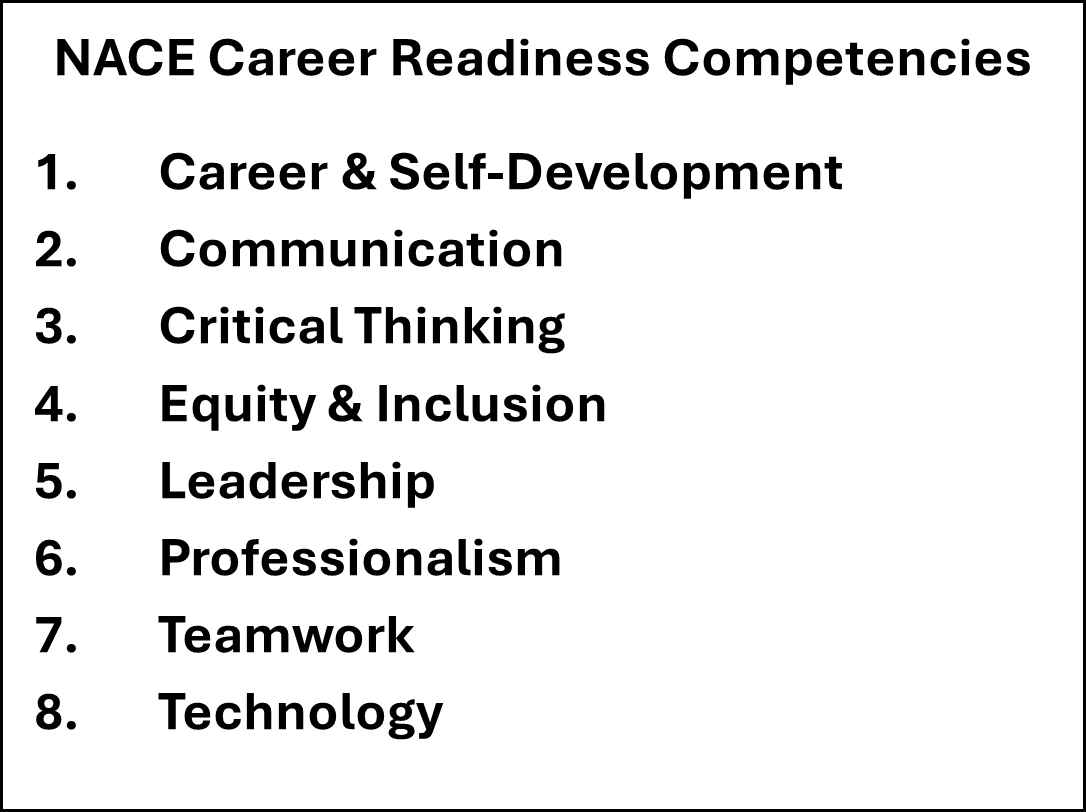
The National Association of Colleges and Employers has created a list of eight career readiness competencies that employers say are necessary for career success. Take a look at the list below and you will see that seven of the eight are UHCs. The eighth, technology, underlines the need for students and their educators to understand and use AI effectively and authentically.
For example, an entry-level finance employee who has developed their UHCs will be able to nimbly respond to changing market conditions, interpret the intentions of managers and clients, and translate these into effective analysis and creative solutions. They will use AI tools to augment their work, adding greater value with less training and oversight.
Widen Humans’ Comparative Advantage
As demonstrated in the example above, our UHCs are humans’ unfair advantage over AI. How do we develop them, ensuring the employability and self-actualization of students and all humans?
The foundation is mindfulness. Mindfulness is about being fully present with ourselves and others, and accepting, primarily via bodily sensations, without judgment and preference. It allows us to accurately perceive reality, including our natural intuitive connection with other humans, a connection AI cannot share. Mindfulness can be developed during and beyond meditation, moments of stillness devoted to mindfulness. Mindfulness practice has been shown to improve self-knowledge, set career goals, and improve creativity.
Mindfulness supports intuitive thinking and metacognition, our ability to think clearly about thinking. Non-conceptual thinking, using our whole bodies, entails developing our intuition and a growth mindset. The latter is about recognizing that we are all works in progress, where learning is the product of careful risk-taking, learning from errors, supported by other humans.
These practices support deep, honest, authentic engagement with other humans of all types. (These are not available over social media.) For students, this is about engaging with each other in class, study groups, clubs, and elsewhere on campus, as well as engaging with faculty in class and office hours. Such engagement with humans can feel unfamiliar and awkward as we emerge from a pandemic. However, these interactions are a critical way to practice and improve our UHCs.
Literature and cinema are ways to engage with and develop empathy and understanding of humans you do not know, may not even be alive or even exist at all. Fiction is maybe the only way to experience in the first person what a stranger is thinking and feeling.
Indeed, every interaction with the world is an opportunity to practice those Uniquely Human Capacities (UHCs):
Use your imagination and creativity to solve a math problem.
Format your spreadsheet or presentation or essay so that it is beautiful.
Get in touch with the feelings that arise when faced with a challenging task.
Many students tell me they are in college to better support and care for family. As you do the work, let yourself experience as an act of love for them.
AI Can Help Us Be Better Humans
AI usage can dull our UHCs or sharpen them. Use AI to challenge us to improve our work, not to provide short cuts that make our work average, boring, or worse. Ethan Mollick (2024) describes the familiar roles AIs can profitably play in our lives. Chief among these is as a patient, always available, if sometimes unreliable tutor. A tutor will give us helpful and critical feedback and hints but never the answers. A tutor will not do our work for us. A tutor will suggest alternative strategies and we can instruct them to nudge us to check on our emotions, physical sensations and moral dimensions of our work. When we prompt AI for help, we should explicitly give it the role of a tutor or editor (as I did with Claude for this article).
How do we assess whether we and our students are developing their UHCs? We can develop personal and work portfolios that tell the stories of connections, insights, and benefits to society we have made. We can get honest testimonials of trusted human partners and engage in critical yet self-compassionate introspection, and journalling. Deliberate practice with feedback in real life and role-playing scenarios can all be valuable. One thing that will not work as well: traditional grades and quantitative measures. After all, humanity cannot be measured.
In a future where AI or AGI assumes the more rote and mechanical aspects of work, we humans are freed to build their UHCs, to become more fully human. An optimistic scenario!
What Could Go Wrong?
The huge, profit-seeking transnational corporations that control AI may soon feel greater pressure to show a return on enormous investment to investors. This could cause costs for users to go up, widening the capabilities gap between those with means and the rest. It could also result in Balkanized AI, where each model is embedded with political, social, and other biases that appeal to different demographics. We see this beginning with Claude, prioritizing safety, and Grok, built to emphasize free expression.
In addition, AI could get good enough at faking empathy, morality, intuition, sense making, and other UHCs. In a competitive, winner-take-all economy with even less government regulation and leakier safety net, companies may aggressively reduce hiring at entry level and of (expensive) high performers. Many of the job functions of the former can be most easily replaced by AI. Mid-level professionals can use AI to perform at a higher level.
Finally, and this is not an exhaustive list: Students and all of us may succumb to the temptation of using AI short cut their work, slowing or reversing development of critical thinking, analytical skills, and subject matter expertise. The tech industry has perfected, over twenty years, the science of making our devices virtually impossible to put down, so that we are “hooked.”
Keeping Humans First
The best way to reduce the risks posed by AI-driven change is to develop our students’ Uniquely Human Capacities while actively engaging policymakers and administrators to ensure a just transition. This enhances the unique value of flesh-and-blood humans in the workforce and society. Educators across disciplines should identify lower value-added activities vulnerable to automation and reorient curricula toward nurturing UHCs. This will foster not only employability but also personal growth, meaningful connection, and equity.
Even in the most challenging scenarios, we are unlikely to regret investing in our humanity. Beyond being well-employed, what could be more rewarding than becoming more fully actualized, compassionate, and connected beings? By developing our intuitions, morality, and bonds with others and the natural world, we open lifelong pathways to growth, fulfillment, and purpose. In doing so, we build lives and communities resilient to change, rich in meaning, and true to what it means to be human.
The article represents my opinions only, not necessarily those of the Borough of Manhattan Community College or CUNY.
Brett Whysel is a lecturer in finance and decision-making at the Borough of Manhattan Community College, CUNY, where he integrates mindfulness, behavioral science, generative AI, and career readiness into his teaching. He has written for Faculty Focus, Forbes, and The Decision Lab. He is also the co-founder of Decision Fish LLC, where he develops tools to support financial wellness and housing counselors. He regularly presents on mindfulness and metacognition in the classroom and is the author of the Effortless Mindfulness Toolkit, an open resource for educators published on CUNY Academic Works. Prior to teaching, he spent nearly 30 years in investment banking. He holds an M.A. in Philosophy from Columbia University and a B.S. in Managerial Economics and French from Carnegie Mellon University.