Category: Charlie Kirk

  • How U.S. Higher Education Helped Create Nick Fuentes

    How U.S. Higher Education Helped Create Nick Fuentes

    In the aftermath of each new outrage involving Nick Fuentes, pundits scramble to explain how a 20-something suburban Catholic kid became one of the most influential white supremacists in America. Many insist Fuentes is an anomaly, a glitch, a fringe figure who somehow slipped through the cracks of democracy and decency. But this narrative is both comforting and false.

    Fuentes is not an anomaly. He is the logical product of the systems that shaped him—especially American higher education.

    While institutions obsess over rankings, fundraising, and branding campaigns, they have quietly abandoned entire generations of young people to debt, alienation, status anxiety, and a digital culture that preys on male insecurity. In this vacuum, extremist networks thrive, incubating figures like Fuentes long before the public notices.

    HEI warned about this trend years ago. Since 2016, the publication tracked the rise of Charlie Kirk and Turning Point USA, noting how TPUSA used campus culture wars to radicalize disaffected young men. HEI saw that for-profit-style marketing, donor-driven politics, and relentless culture-war agitation were creating an ecosystem where reactionaries could build both influence and profit. Fuentes did not arise outside that ecosystem—he evolved from it, even as he later turned on Kirk as insufficiently extreme.

    What fuels this pipeline? A generation of young men raised on the promise of meritocracy but delivered a reality of spiraling costs, precarious futures, and institutional betrayal. Many arrive at college campuses burdened by debt, anxious about their place in an unforgiving economy, and deeply online. They bear the psychological bruises of a culture that has replaced community with competition and replaced meaning with metrics.

    This is also the demographic most vulnerable to incel ideology, a misogynistic worldview built around grievance, rejection, humiliation, and resentment. Incel communities overlap heavily with the digital spaces where Fuentes built his early audience. The mix is combustible: sexually frustrated young men who feel mocked by mainstream culture, priced out of adulthood, and invisible to institutions that once guided them. The result is a fusion of white nationalism, male resentment, Christian nationalism, ironic fascism, and livestream entertainment—perfectly tailored to a generation raised on Twitch and YouTube.

    And yet the higher-education establishment insisted for years that white supremacists were primarily rural “rednecks”—poor, uneducated, easily dismissed. This stereotype blinded journalists, academics, and administrators to the reality developing right in front of them. Higher Education Inquirer knew better because we corresponded for years with Peter Simi, one of the country’s leading scholars of extremism. Simi’s research demonstrated clearly that white supremacists were not confined to rural backwaters. They were suburban, middle-class, sometimes college-educated, often tech-savvy, and deeply embedded in mainstream institutions.

    Simi’s work showed that white supremacist movements have always thrived among people with something to lose, people who feel their status slipping. They recruit in fraternities, gaming communities, campus political groups, military circles, and online spaces where young men spend their most lonely hours. They build identities around grievance and belonging—needs that universities once helped students navigate but now too often ignore.

    This is the world that produced Nick Fuentes.

    Fuentes entered higher education during a moment of fragmentation and distrust. Tuition was skyrocketing. Campuses were polarizing. Students were increasingly treated as revenue streams rather than whole human beings. Administrators were more focused on donor relations and culture-war optics than on the psychological welfare of their students. And universities outsourced so many vital functions—to police, to lobbyists, to tech platforms—that they ceded responsibility for the very students they claimed to educate.

    Into that void stepped extremist influencers who offered simple answers to complex problems, validation for resentment, and a community that cared—if only in the performative, transactional sense of internet politics.

    The tragedy is not simply that Fuentes emerged. The tragedy is that the conditions to generate many more like him remain firmly in place.

    American higher education created the environment: hyper-competition, abandonment of the humanities, the collapse of community, the normalization of precarity, and a relentless emphasis on personal failure over systemic dysfunction. It created the audience: anxious, isolated, indebted young men looking for meaning. And it created the blind spot: a refusal to take extremism seriously until it reaches mainstream visibility.

    Fuentes is not a glitch in the system. He is the system’s mirror held up to itself.

    Unless universities confront their complicity in this radicalization pipeline—economically, culturally, and psychologically—the next Nick Fuentes is already in a dorm room somewhere, streaming at 2 a.m., finding thousands of followers who feel just as betrayed as he does.


    Sources

    Angela Nagle, Kill All Normies: Online Culture Wars from 4chan and Tumblr to Trump and the Alt-Right (2017).

    Peter Simi & Robert Futrell, American Swastika: Inside the White Power Movement’s Hidden Spaces of Hate (2010, updated 2015).

    Kathleen Belew, Bring the War Home: The White Power Movement and Paramilitary America (2018).

    Joan Donovan & danah boyd, “Stop the Presses? The Crisis of Misinformation” (Harvard Kennedy School).

    Cynthia Miller-Idriss, Hate in the Homeland: The New Global Far Right (2020).

    Michael Kimmel, Healing from Hate: How Young Men Get Into—and Out of—Violent Extremism (2018).

    Whitney Phillips, “The Oxygen of Amplification: Better Practices for Reporting on Extremists.”

    Brian Hughes & Cynthia Miller-Idriss, “Youth Radicalization in Digital Spaces.”

    David Futrelle, We Hunted the Mammoth archive on incel ideology.

    Higher Education Inquirer (2016–2024 coverage of TPUSA, Charlie Kirk, and campus extremism).

    Source link

  • Tenn. Law Aimed at Students Who Make School Shooting Threats Ensnares a Retiree – The 74

    Tenn. Law Aimed at Students Who Make School Shooting Threats Ensnares a Retiree – The 74

    School (in)Security is our biweekly briefing on the latest school safety news, vetted by Mark KeierleberSubscribe here.

    Larry Bushart Jr. was just freed from a Tennessee jail cell after spending more than a month behind bars — for a Facebook post.

    The high-profile arrest of the 61-year-old retiree and former cop — which made waves in free speech circles — has all the hallmarks of a bingeworthy culture war clash in 2025: 

    • A chronically online progressive turns to Facebook to troll his MAGA neighbors about President Donald Trump’s seemingly lopsided response to school shootings compared to the murder of right-wing pundit Charlie Kirk
    • An elected, overzealous county sheriff intent on shutting him up
    • A debate over the limits of the First Amendment — and the president’s broader efforts to silence his critics
    Eamonn Fitzmaurice / T74

    The controversy, I report this morning, also calls attention to a series of recent Tennessee laws that carry harsh punishments for making school shooting threats and place police officers on campus threat assessment teams working to ferret out students with violent plans before anyone gets hurt. 

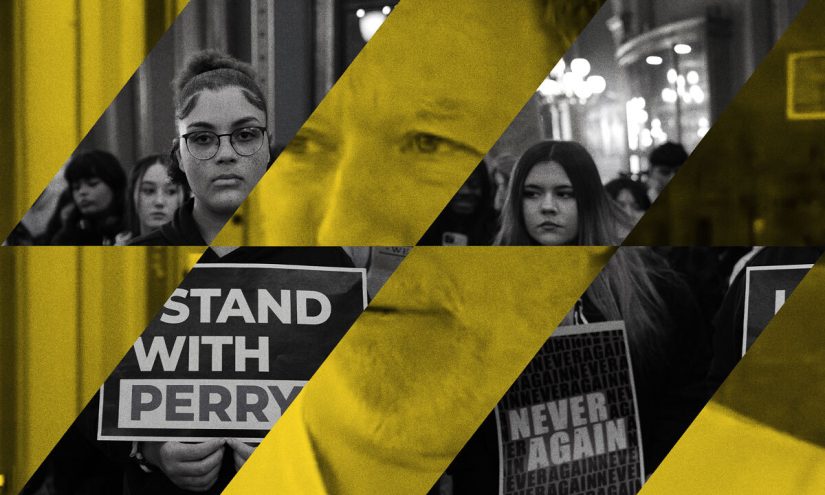
    In Bushart’s case, the sheriff maintained that his post referring to the president’s reaction to a 2024 school shooting in Perry, Iowa, constituted a threat “of mass violence at a school,” apparently the local Perry County High School. The rules that ensnared Bushart have also led to a wave of student arrests and several free speech lawsuits. His is likely to be next, Bushart’s lawyer told The Washington Post.


    In the news

    Updates in Trump’s immigration crackdown: Federal immigration officers chased a Chicago teacher into the lobby of a private preschool Wednesday and dragged her out as parents watched her cry “tengo papeles!” or “I have papers.” The incident is perhaps the most significant immigration enforcement act in a school to date. | The 74

    • Proposed federal rules would allow Immigration and Customs Enforcement to collect iris scans, fingerprints and other biometric data on all immigrants — including, for the first time, children under 14 years old — and store it for the duration of each individual person’s “lifecycle.” |  Ars Technica
    • On the same day Cornell University notified an international student that his immigration status had been revoked, Google alerted him that federal authorities had subpoenaed his personal emails. Now, the institution won’t say whether federal authorities had tapped into university “emails to track [students] as well.” | The Cornell Daily Sun
    • In California, federal immigration officers shot a U.S. citizen from behind as he warned the agents that students would soon gather in the area to catch a school bus. The government says the shots were “defensive.” | Los Angeles Times
    • ‘Deportation isn’t a costume’: A Maine middle school principal is facing pushback for a federal immigration officer Halloween costume, complete with a bulletproof vest that read “ICE.” | Boston.com
    • In Chicago communities that have seen the most significant increase in immigration enforcement, school enrollment has plunged. | Chalkbeat
    • Also in Chicago, a federal judge ordered the Trump administration to hand over use-of-force records and body camera footage after trick-or-treaters were “tear-gassed on their way to celebrate Halloween.” | USA Today

    A bipartisan bill seeks to bar minors from using AI chatbots as petrified parents testified their children used the tools with dire consequences — including suicide. Some warn the change could stifle the potential of chatbots for career or mental health counseling services. | Education Week

    • A Kentucky mom filed a federal lawsuit against online gaming communities Discord and Roblox alleging the companies jeopardized children’s safety in the name of profit. After her 13-year-old daughter died by suicide last year, the mom said, she found the girl had a second life online that idolized school shooters. | 404 Media
    • Character.AI announced it will bar minors from its chatbots, acknowledging safety concerns about how “teens do, and should, interact with this new technology.” | BBC
    Getty Images

    A jury awarded $10 million to former Virginia teacher Abby Zwerner on Thursday, two years after she was shot by her 6-year-old student. Zwerner accused her former assistant principal of ignoring repeated warnings that the first grader had a gun. The student’s mother was sentenced to nearly four years in prison for felony child neglect and federal weapons charges. | The New York Times

    ‘Creepy, unsettling’: This family spent a week with Grem, a stuffed animal with artificial intelligence designed to “learn” children’ s personalities and hold educational conversations. | The Guardian

    A judge ordered the Trump administration to release federal funds to California school districts after it sought to revoke nearly $165 million in mental health grants as part of a broader crackdown on diversity, equity and inclusion.  The grants funded hundreds of school social workers and counselors. | EdSource

    In 95% of schools, active-shooter drills are now a routine part of campus life. Here’s how states are trying to make them less traumatic. | The Trace

    Sign-up for the School (in)Security newsletter.

    Get the most critical news and information about students’ rights, safety and well-being delivered straight to your inbox.

    A lawsuit against a Pennsylvania school district alleges educators failed to keep students safe after a 12-year-old girl was attacked by a classmate with a metal Stanley drinking cup. | NBC10

    ‘Inviting government overreach and abuse’: The Education Department was slapped with two lawsuits over new Public Service Loan Forgiveness rules that could bar student borrowers from the program who end up working for the president’s political opponents, including organizations that serve immigrant students and LGBTQ+ youth. | The Washington Post


    ICYMI @The74

    1939 redlined maps of Los Angeles showing neighborhoods deemed eligible and ineligible for economic aid

    How LAUSD School Zones Perpetuate Educational Inequality, Ignoring ‘Redlining’ Past

    Students Want Schools to Incorporate AI in Learning But Express Some Fears

    LifeWise’s Big Red Bus Is Driving Thorny Questions about Church and State


    Emotional Support

    Matilda plots her escape.


    Did you use this article in your work?

    We’d love to hear how The 74’s reporting is helping educators, researchers, and policymakers. Tell us how

    Source link

  • Charlie Kirk’s Assassination Through the Lens of Collins and Hoffer (Glen McGhee and Dahn Shaulis)

    Charlie Kirk’s Assassination Through the Lens of Collins and Hoffer (Glen McGhee and Dahn Shaulis)

    The assassination of Charlie Kirk on September 10, 2025, offers a stark illustration of how violent acts against movement leaders can reconfigure political energy on U.S. campuses. Kirk was the leader of Turning Point USA, Turning Point Action (formerly Students for Trump), and Turning Point Faith. He was also the creator of the Professor Watchlist and the School Board Watchlist

    Far from diminishing conservative student mobilization, Kirk’s death appears to have amplified it—at least in the short term. Randall Collins’ sociology of interaction ritual chains and Eric Hoffer’s classic analysis of mass movements provide a useful lens for understanding both the surge and the likely limits of this moment.

    Collins’ Emotional Energy Framework Applied to Kirk’s Death

    Collins identifies four outcomes of successful ritual gatherings: group solidarity, emotional energy, sacred symbols, and moral righteousness. In the wake of Kirk’s assassination, conservative students and evangelical leaders have experienced all four in compressed, amplified form.

    Pastors quickly declared Kirk a “Christian martyr.” Rob McCoy invoked biblical precedent, while Jackson Lahmeyer described the murder as “spiritual in nature and an attack on the very institution of the church.” This religious framing elevates Kirk from activist to sacred symbol.

    The immediate response has been extraordinary. Turning Point USA claims more than 32,000 requests for new chapters in the 48 hours following his death. Collins would interpret this as emotional energy seeking new ritual outlets. In this sense, Kirk’s martyrdom has become not just a grievance but a generator of collective action.

    The memorial scheduled for September 21 at State Farm Stadium—with capacity for more than 60,000 and featuring Donald Trump—is set to be the largest ritual gathering in the history of conservative student politics. Collins would predict this to be a high-intensity moment of “collective effervescence,” the kind of event that extends emotional energy for months if not years.

    Hoffer’s Mass Movement Dynamics and Conservative Student Mobilization

    Hoffer’s The True Believer provides a complementary angle. He argued that mass movements thrive on frustration, doctrine, and the presence of either a leader or a transcendent cause. Kirk’s assassination intensified frustration while transforming him into a more powerful symbolic figure than he was in life.

    Student conservatives now have all three: grievance (left-wing violence), a sacred cause (free speech framed as religious duty), and a heroic narrative (following a martyred leader). In Hoffer’s words, martyrdom provides both “grievance and transcendent meaning.”

    The shift from Kirk as a living leader to Kirk as martyr reflects Hoffer’s principle of substitutability. Loyalty has already migrated from the man himself to the mythology of his sacrifice. College Republicans chairman William Donahue compared the killing to Martin Luther King Jr.’s assassination, framing it as a watershed for the movement.

    Sustainability and the Ritual Problem

    The paradox is that Kirk’s most important contribution—the high-energy confrontational rituals of his “Prove Me Wrong” campus debates—cannot be replicated without him. These events generated viral spectacle, solidified conservative identity, and created sacred moments of confrontation. They were, in Collins’ terms, engines of emotional energy.

    The September 21 memorial may provide a one-time boost, but Collins emphasizes that emotional energy must be renewed through repeated rituals. Without Kirk’s charisma and willingness to create confrontational spaces, conservative students risk energy dissipation. Already some students report greater enthusiasm for activism, while others express fear of being targeted themselves.

    The dilemma is clear: the rituals that generated the most energy (public confrontations) are the very ones most likely to invite violence. This tension may limit the sustainability of the movement’s current surge.

    The Profit Motive: Martyrdom as Marketplace

    Beyond the sociology of solidarity lies a material reality: martyrdom is also a business model. Conservative organizations are already converting Kirk’s death into a revenue stream. Within hours of the assassination, Turning Point USA launched fundraising appeals invoking Kirk’s “sacrifice,” while conservative merchandisers began selling commemorative t-shirts, hats, and wristbands emblazoned with slogans like “Martyr for Freedom” and “Charlie Lives.”

    Publishing houses are reportedly fast-tracking hagiographic biographies, while streaming platforms are negotiating for documentaries. Memorial events, livestreams, and “Martyrdom Tours” are being packaged as both spiritual rituals and ticketed spectacles. Kirk’s death, in other words, is generating not only emotional energy but also financial capital.

    This profit motive raises questions about the sincerity of the rhetoric surrounding Kirk’s martyrdom. While Collins and Hoffer help explain the emotional pull, the commodification of grief ensures that the “sacred symbol” is also a lucrative brand. Conservative student organizing may thus be sustained less by spontaneous devotion than by a well-financed industry of grievance, merchandise, and media spectacle.

    Indicators to Watch

    Several markers will reveal whether Kirk’s martyrdom produces lasting transformation or burns out in ritual dissipation:

    • Memorial impact: Attendance and intensity at the September 21 gathering will test whether Kirk’s death can generate lasting solidarity.

    • Chapter formation: The real test of Turning Point USA’s 32,000 claims will be functioning chapters in six months.

    • Leadership succession: Hoffer reminds us that movements need charismatic leaders. At present, Trump appears to be monopolizing the emotional energy, raising doubts about the rise of new student leaders.

    • Counter-mobilization: Collins’ conflict theory suggests left-wing backlash could shape whether conservative students double down or retreat.

    The Probable Trajectory

    For the next 6–18 months, conservative student mobilization is likely to grow. The movement now has the grievance, sacred symbolism, and transcendent narrative that both Collins and Hoffer identify as powerful motivators.

    But sustaining this surge will be difficult without Kirk’s unique talent for generating high-energy campus rituals. Unless new leaders emerge who can replicate or reimagine those ritual forms, the emotional energy of martyrdom may eventually dissipate.

    At the same time, the financial infrastructure now growing around Kirk’s death suggests the movement has a fallback strategy: keep the martyrdom alive as long as it remains profitable. In this way, Kirk’s assassination may prove to be not just a sociological event but also a business opportunity—one that reveals the convergence of politics, religion, and profit in contemporary conservative student life.

    Source link

  • How Charlie Kirk Changed Gen Z’s Politics – The 74

    How Charlie Kirk Changed Gen Z’s Politics – The 74


    Get stories like this delivered straight to your inbox. Sign up for The 74 Newsletter

    This analysis originally appeared at The Up and Up, a newsletter focused on youth culture and politics. 

    There’s been a massive effort to understand why Gen Z shifted right in the 2024 election. Part of that movement was thanks to Charlie Kirk and his work to engage young people — on and offline.

    Whether it was his college tours or the campus debate videos he brought to the forefront of social media, he changed the way young people think about, consume and engage in political discourse.

    Over the past few years, as I’ve conducted Gen Z listening sessions across the country, I’ve watched as freedom of speech has become a priority issue for young people, particularly on the right. The emphasis on that issue alone helped President Donald Trump make inroads with young voters in 2024, with Kirk as its biggest cheerleader. Just a few years ago, being a conservative was not welcomed on many liberal college campuses. That has changed.

    Even on campuses he never visited, Kirk, via his massive social media profile and the resonance of his videos online, was at the center of bringing MAGA to the mainstream. Scroll TikTok or Instagram with a right-leaning college student for five minutes, and you’re likely to see one of those debate-style videos pop into their feed. Since the news broke of the attack on his life last week, I’ve heard from many young leaders — both liberal and conservative — who are distraught and shook up. The reality is that Kirk changed the game for Gen Z political involvement. Even for those who disagreed with his politics, his focus on young voters inevitably shifted how young people were considered and included in the conversation.

    Like many of you, I’ve followed Kirk for years. Whether you aligned with his policy viewpoints or not, his influence on the conversation is undeniable. And, for young people, he was the face of the next generation for leadership in the conservative party.

    Kirk’s assassination was the latest in a string of political violence, including the political assassination in Minnesota that took the life of former House Speaker Melissa Hortman and her husband, and left state Sen. John Hoffman wounded. One of the most common fears I hear from young people across the country and the political spectrum is that political division has gone too far. Last week’s shooting also coincided with a tragic school shooting in Colorado. The grave irony of all these forces coinciding — gun violence, political violence and campus violence — cannot be ignored.

    In all my conversations with young people, one thing is clear: they are scared.

    Gen Z perspectives 

    After Wednesday’s tragedy, I reached out to students and young people I’ve met through listening sessions with The Up and Up, as well as leaders of youth organizations that veer right of center. Others reached out via social media to comment. Here’s some of what they shared.

    California college student Lucy Cox: “He was the leader of the Republican Party and the conservative movement right now especially for young people. He’s probably more famous than Trump for college students. He had divisive politics, but he never went about it in a divisive way. He’s been a part of my college experience for as long as I’ve been here. He felt like somebody I knew. His personality was so pervasive. It feels very odd that I’m never going to watch a new Charlie Kirk video again.”

    Jesse Wilson, a 30-year-old in Missouri: “From the first time I saw him, it was on the ‘Whatever’ podcast, I’ve watched that for a long long long time. Just immediately, the way he carried himself and respected the people he was talking to regardless of who they were, their walk of life, how they treated him. Immediately I just thought, ‘Man, there’s just something different about him.’ He was willing to engage. It was the care, he didn’t want to just shut somebody down. He was like, ‘These are my points, and this is what I’m about,’ and it seemed like there was a willingness to engage and meet people where they’re at. I found it really heartwarming. And we need it. That’s what’s going to make a difference.”

    Ebo Entsuah, a 31-year-old from Florida: “Charlie had a reach most political influencers couldn’t even imagine. I didn’t agree with him on a number of things, but there’s no mistaking that he held the ear of an entire generation. When someone like that is taken from the world, the impact multiplies.”

    Danielle Butcher Franz, CEO of The American Conservation Coalition: “Charlie changed my life. The first time I ever went to D.C. was because of him. He invited me to join TPUSA at CPAC so I bought a flight and skipped class. When we finally met in person he grinned and said, ‘Are you Republican Sass?’ (My Twitter at the time) and gave me a big thumbs-up. I owe so much of my career to him. Most of my closest friends came into my life through him or at his events. Because of Charlie, I met my husband. We worked with him back when TPUSA was still run out of a garage. Charlie’s early support helped ACC grow when no one else took us seriously. He welcomed me with open arms to speak at one of his conferences to 300+ young people when ACC was barely weeks old. I keep looking around me and thinking about how none of it would be here if I hadn’t met Charlie.”

    A 26-year-old woman who asked to remain anonymous: “I would be naive to not admit that my career trajectory and path would not have been possible without Charlie Kirk. He forged a path in making a career with steadfast opinions, engaging with a generation that had never been so open-minded and free, slanting their politics the exact opposite of his own. He made politics accessible. He made conservatism accessible. But damn, he made CIVICS accessible. He dared us to engage. To take the bait. To react. He was controversial because he was good at what he was doing. Good at articulating his beliefs with such conviction to dare the other side to express. He died engaging with the other side. In good or bad faith is one’s own to decide, but he was engaging. In a time where the polarization is never more clear. So I will continue to dare to engage with those I agree and those I disagree with. But it’s heartbreaking. It feels like we’ve lost any common belonging. There has not been an event in modern political history that has impacted me this much. Maybe it hits too close to home.”

    Disillusioned by a divided America 

    Over the summer, I wrote about Gen Z’s sinking American pride. Of all generations, according to Gallup data, Gen Z’s American pride is the lowest, at just 41%. At the time, I wrote that this is not just about the constant chaos which has become so normalized for our generation. It’s more than that. It’s a complete disillusionment with U.S. politics for a generation that has grown up amid hyperpolarization and a scathing political climate. What happened last week adds a whole layer.

    Beyond the shooting, there is the way in which this unfolded online. There’s a legitimate conversation to be had about people’s reactions to Kirk’s death and an unwillingness to condemn violence.

    As a 19-year-old college student told me: “This reveals a big problem that I see with a lot of members in Gen Z — that they tend to see things in black and white and fail to realize that several things can be true at once.”

    There’s also the need for a discussion about the speed at which the incredibly graphic video of violence circulated — and the fact that it is now seared into the minds of the many, many young people who watched it.

    We live in a country where gun violence is pervasive. When we zoom out and look toward the future, there are inevitable consequences of this carnage.

    Since The Up and Up started holding listening sessions in fall 2022, young people have shared that civil discourse and political violence are two of their primary concerns. One of the most telling trends are the responses to two of our most frequently asked questions: “What is your biggest fear for the country, and what is your biggest hope for the country?” 

    Consistently, the fear has something to do with violence and division, while the hope is unity.

    I think we all could learn from the shared statement issued by the Young Democrats and Young Republicans of Connecticut before Trump announced Kirk’s death, in which they came together to “reject all forms of political violence” in a way we rarely, if ever, see elected officials do.


    Get stories like these delivered straight to your inbox. Sign up for The 74 Newsletter

    Source link

  • Right Wing Influencer Charlie Kirk Killed at Utah Valley University

    Right Wing Influencer Charlie Kirk Killed at Utah Valley University

    Charlie Kirk was shot and killed at Utah Valley University today.  The killer was not immediately caught. The Higher Education Inquirer has been covering Kirk and his organization, Turning Point USA, since 2016.  Kirk has been a polarizing force in the United States, particularly on US college campuses. HEI hopes this event will not lead to further violence. Since its inception, we have urged for peace and nonviolence.   

    Source link

  • Avoid Contact with Turning Point USA

    Avoid Contact with Turning Point USA

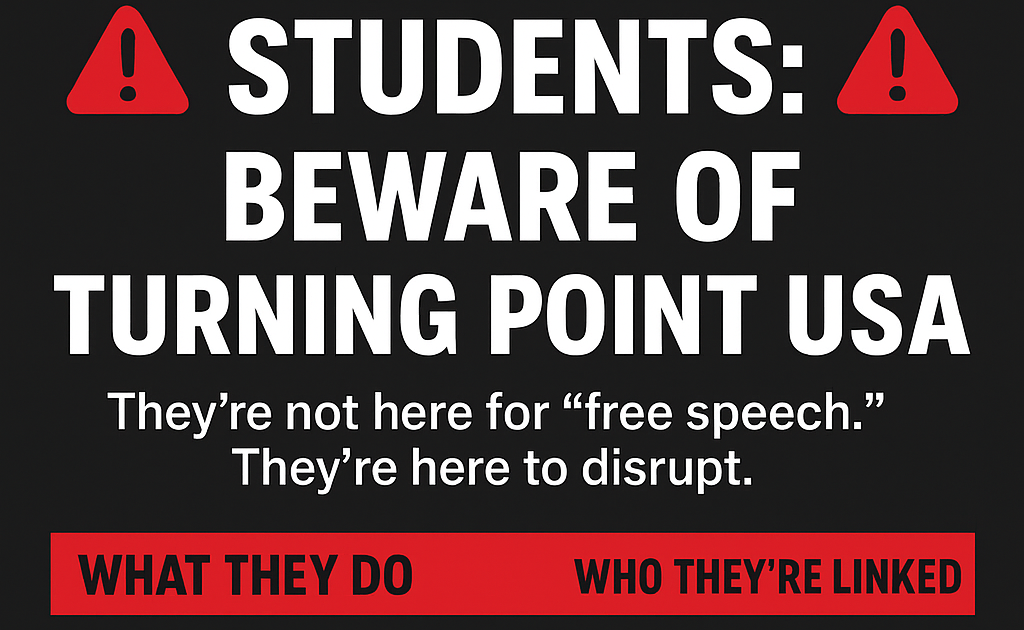
    Turning Point USA (TPUSA) brands itself as a conservative youth movement dedicated to free markets and limited government. In reality, a growing body of investigative reporting, watchdog research, and student testimony reveals an organization built on intimidation, manipulation, and close ties to extremists. Students should be aware of the risks before engaging with TPUSA in any capacity.

    From its inception, TPUSA has sought to be confrontational. One of its most notorious tools, the Professor Watchlist, publishes the names, photos, and alleged offenses of professors the group deems “anti-conservative.” This public shaming campaign has been condemned by educators and civil liberties advocates as a threat to academic freedom and personal safety. In more recent years, TPUSA has expanded its targets beyond individual professors, with initiatives like the School Board Watchlist, designed to stir distrust of public education and stoke fear around diversity, equity, and inclusion initiatives.

    These campaigns are paired with questionable political tactics. Investigations have shown that TPUSA has engaged in covert influence efforts on college campuses, including secretly funding student government elections and running coordinated online disinformation campaigns. Their political arm, Turning Point Action, has been compared to a troll farm for its use of deceptive social media operations.

    The group’s leadership and chapters have repeatedly been linked to white supremacist and far-right extremist figures. TPUSA events have hosted or associated with members of Nick Fuentes’ “Groyper” movement, Holocaust deniers, and other alt-right personalities. The Southern Poverty Law Center, Anti-Defamation League, and multiple journalists have documented these associations, which TPUSA leaders routinely downplay. Internal communications and leaked chapter messages have exposed racist, homophobic, and Islamophobic rhetoric from members. Charlie Kirk, TPUSA’s founder, once falsely claimed that a Black woman had “taken his place” at West Point, a statement criticized as both untrue and racially inflammatory.

    TPUSA’s messaging also extends beyond politics into science denial. The group has repeatedly dismissed the scientific consensus on climate change, framing environmental concerns as a hoax or left-wing scare tactic, and hosting events that platform climate change skeptics over credible experts. TPUSA has received significant funding from fossil fuel interests, including Koch network-affiliated donors, and from political megadonors such as Foster Friess and Rebekah Mercer, who are known for underwriting climate denial campaigns. Other key allies include right-wing think tanks like the Heritage Foundation and media figures such as Tucker Carlson, who have amplified TPUSA’s messaging to broader audiences. The organization has also benefitted from support by religious nationalist groups and political operatives who share its hardline positions on education, race, and gender.

    TPUSA’s confrontational model often invites chaos. At UC Davis, a TPUSA-sponsored event erupted into physical clashes involving Proud Boys. Across campuses, students and faculty report that TPUSA representatives deliberately provoke heated exchanges, record them, and circulate the footage to mobilize their base and fundraise off manufactured outrage. Former members have confirmed that such confrontations are not accidental, but rather part of the playbook.

    While TPUSA presents itself as a mainstream conservative voice, the evidence paints a darker picture: an organization willing to distort, harass, and align with extremists to achieve its goals. Students seeking honest political debate should look for groups that engage in respectful dialogue, value truth over theatrics, and reject intimidation as a tool.

    Sources:

    Southern Poverty Law Center – Turning Point USA: Case Study in the Hard Right

    Media Matters – Turning Point USA’s History of Racism and White Nationalist Ties

    The New Yorker – A Conservative Nonprofit That Seeks to Transform College Campuses Faces Allegations of Racial Bias and Illegal Campaign Activity

    Anti-Defamation League – Extremism in American Politics: Turning Point USA

    Wired – How Charlie Kirk Plans to Discredit Martin Luther King Jr. and the Civil Rights Act

    Chron – Texas A&M Turning Point Chat Exposes Racist and Homophobic Comments

    The Guardian – What I Learned When Turning Point USA Came to My Campus

    OpenSecrets – Turning Point USA Donors and Political Funding

    DeSmog – Turning Point USA and Fossil Fuel Industry Influence

    Source link

  • A Critical Look at Charlie Kirk’s Hypothesis on Male Happiness

    A Critical Look at Charlie Kirk’s Hypothesis on Male Happiness

    Conservative commentator Charlie Kirk has repeatedly asserted that men are most fulfilled when they marry and have children. This idea, rooted in a traditionalist worldview, has gained traction among some segments of the population, particularly those seeking a return to what they perceive as the moral and social stability of the past. But does the scientific evidence support this claim? A closer look at research from sociology, psychology, and economics suggests a more complex and less ideologically convenient reality.

    Marriage and Happiness: The Nuanced Evidence

    It is true that some studies show a correlation between marriage and higher reported levels of happiness and well-being. For example, a 2002 study published in the Journal of Marriage and Family found that married individuals reported higher happiness levels than their unmarried counterparts. However, the effect size was relatively modest, and subsequent research has nuanced these findings.

    A 2012 meta-analysis by Lucas and Dyrenforth in Personality and Social Psychology Bulletin suggested that the happiness boost associated with marriage is temporary. On average, individuals experience a honeymoon period after marriage, followed by a return to baseline happiness levels within a few years. This phenomenon, known as hedonic adaptation, undermines the idea that marriage itself produces sustained happiness.

    Moreover, the benefits of marriage appear to be highly contingent on the quality of the relationship. A study published in Journal of Family Psychology (Carr et al., 2014) found that people in high-conflict marriages reported significantly lower well-being than unmarried individuals. Men in unhappy marriages often experience increased psychological distress, which may lead to health problems, substance abuse, and even premature death (Whisman et al., 2006).

    Children and Male Well-being: A Complicated Relationship

    Kirk’s view also hinges on the assumption that fatherhood enhances male happiness. While parenthood is often meaningful and rewarding, the scientific literature offers mixed findings regarding its impact on overall well-being.

    A major study by Nelson et al. (2014) in Psychological Bulletin found that the association between parenthood and well-being is neither universally positive nor negative. The effects depend heavily on contextual factors like marital status, socioeconomic resources, and the age of the children. Fathers in stable, supportive relationships often report satisfaction from parenting, but those facing financial stress, lack of social support, or conflict with a co-parent frequently experience declines in mental health.

    Another longitudinal study by Herbst and Ifcher (2016) found that fathers experience both gains and losses in subjective well-being. While they may report a greater sense of purpose and life meaning, they also experience declines in leisure time, sleep quality, and perceived freedom—all factors associated with lower happiness levels. Notably, single fathers and those in contentious co-parenting arrangements report lower life satisfaction than child-free men.

    The Importance of Autonomy and Purpose

    Perhaps most revealing are studies showing that autonomy and life purpose are stronger predictors of long-term happiness than marital or parental status alone. Deci and Ryan’s Self-Determination Theory, which has been widely validated across cultures, suggests that autonomy, competence, and relatedness are the key psychological needs for well-being. Marriage and children can contribute to these needs, but they can also undermine them, especially if the roles are imposed or filled with conflict.

    Research from the Pew Research Center and Gallup also shows that life satisfaction is more closely tied to financial security, meaningful work, physical health, and strong social networks than to marital or parental status alone. Men who are engaged in purposeful careers, maintain close friendships, and have control over their time report higher levels of happiness—even if they are single or child-free.

    The Rise of Alternative Lifestyles

    Recent demographic trends reflect changing attitudes about what constitutes a fulfilling life. Census data show that marriage rates among men have declined steadily over the past 50 years. Meanwhile, increasing numbers of men are choosing to remain child-free or delay fatherhood. A 2021 Pew Research Center report found that 44% of men under 50 without children expected to remain child-free, a marked increase from previous decades.

    While some conservatives view these changes as signs of cultural decline, others interpret them as evidence that men are exercising greater personal agency in crafting their lives outside traditional expectations. Men who reject marriage and fatherhood are not necessarily unhappy or aimless. For many, this path allows greater freedom to travel, pursue creative or intellectual goals, contribute to their communities, or engage in activism and caregiving in non-familial forms.

    What About Mental Health?

    Importantly, mental health outcomes among men do not uniformly improve with marriage and children. According to the National Institute of Mental Health, men in high-conflict or financially strained marriages report elevated rates of depression, anxiety, and substance abuse. Fatherhood under conditions of instability or poverty can exacerbate stress levels. Conversely, single men who cultivate strong support systems and engage in regular exercise, therapy, or meaningful social activities often show comparable or better mental health outcomes than married peers.

    Beyond Simplistic Narratives

    Charlie Kirk’s assertion that men are “happiest” when married with children oversimplifies a set of deeply personal and variable life experiences. While marriage and fatherhood can be sources of joy, meaning, and fulfillment, they are not universal prescriptions for happiness. The scientific consensus indicates that well-being is shaped by a complex interplay of autonomy, relationship quality, health, socioeconomic status, and personal values.

    Higher education—particularly in the social sciences—has a role to play in challenging ideological assumptions with empirical research. In a pluralistic society, young men deserve the freedom to critically examine diverse paths to meaning and well-being, without being pressured into a one-size-fits-all model of masculinity. If anything, the data reveal that the happiest men are not necessarily husbands and fathers, but those who are allowed to define their own lives on their own terms.

    Sources:

    • Lucas, R. E., & Dyrenforth, P. S. (2012). Does the honeymoon last? Personality and Social Psychology Bulletin.

    • Carr, D., Freedman, V. A., Cornman, J. C., & Schwarz, N. (2014). Happy marriage, happy life? Journal of Family Psychology.

    • Nelson, S. K., Kushlev, K., & Lyubomirsky, S. (2014). Is parenthood associated with well-being? Psychological Bulletin.

    • Whisman, M. A., Uebelacker, L. A., & Weinstock, L. M. (2006). Marital distress and mental health. Journal of Consulting and Clinical Psychology.

    • Deci, E. L., & Ryan, R. M. (2000). The “what” and “why” of goal pursuits: Human needs and the self-determination of behavior. Psychological Inquiry.

    • Pew Research Center. (2021). More Americans say they are unlikely to have children.

    • Herbst, C. M., & Ifcher, J. (2016). The increasing happiness of U.S. parents. Review of Economics of the Household.

    • National Institute of Mental Health. (2023). Mental Health and Marriage.

    • Gallup (2022). Global Emotions Report.

    Source link