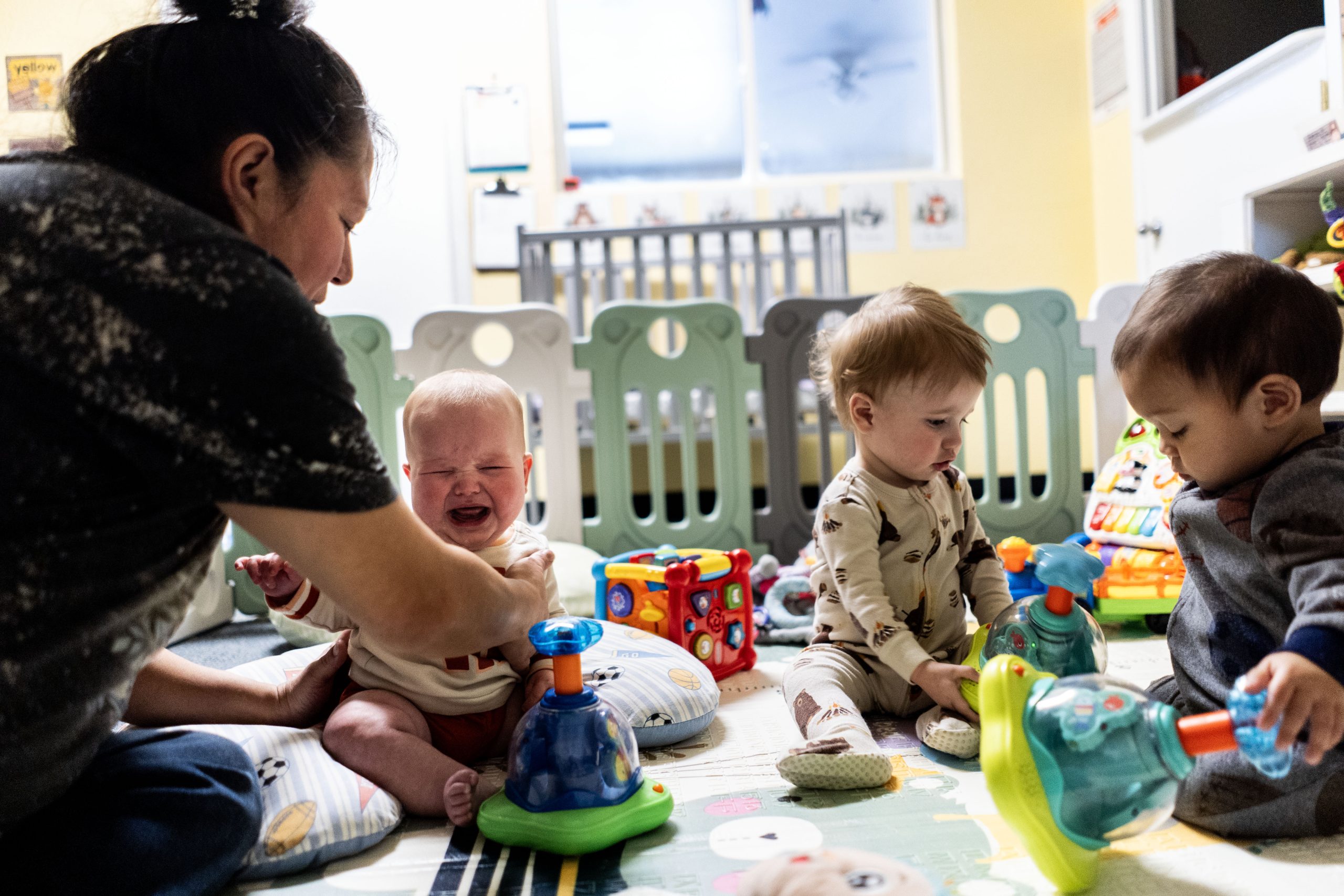
For families in more than a hundred Head Start programs across the country, November could mark the beginning of some hard decisions.
On Saturday, 134 Head Start centers serving 58,400 children would normally receive their annual federal funding, but the ongoing government shutdown has put that money in jeopardy. The federally funded Head Start provides free preschool and child care for low-income families, and is particularly important to rural communities with few other child care options.
At the same time, the federal government has said that because of the shutdown, it cannot distribute Supplemental Nutrition Assistance Program (SNAP) benefits that families also expect on the first of the month. Plus, a program that provides extra money for families to buy milk, baby formula, and fruit and vegetables is also running out of $300 million in emergency funding provided to it earlier this month.
Related: Young children have unique needs and providing the right care can be a challenge. Our free early childhood education newsletter tracks the issues.
All this means low-income families are facing upheaval on multiple fronts, said Christy Gleason, the vice president of policy, advocacy and campaigns for the nonprofit group Save the Children. Families in Head Start often receive other federal benefits, so they could simultaneously be facing a disruption in child care — and the meals provided there — and public food assistance.
“You’re going to end up with parents and caregivers who are skipping meals themselves, because that’s the way they put food on the table for their kids,” Gleason said. Save the Children manages Head Start programs in rural Arkansas, Indiana, Louisiana, North Carolina, Oklahoma and Tennessee, but its programs are not among those affected by the Nov. 1 annual funding deadline. Head Start has 1,600 programs that receive their yearly funding throughout the calendar year.
There are still a few days left to avert the crisis, Gleason said. More than two dozen states are suing the government to force it to use a pot of money that had been set aside for paying SNAP benefits in an emergency. President Donald Trump also said this week that the food aid situation would be fixed, but didn’t offer details. Federal lawmakers have also introduced different proposals to keep food assistance money flowing. A handful of states said they will continue to pay for the supplemental milk and formula program, known as WIC. Head Start programs may be able to tap local money, but that isn’t expected to last long.
“The clock is ticking,” Gleason said. “Every hour that goes by is an hour where the stress for these families grows, but it’s not too late for government action to change course and make sure children are not the ones to suffer the consequences of political decisions.”
New data quantifies child care gaps
Nearly 15 million ages 5 and under in the United States have “all available parents” — both adults in a two-parent household, or one if the child has one adult caregiver — in the workforce. The country has about 11 million licensed or registered child care slots.
That leaves about 4 million children whose families may need child care — a hard-to-grasp number that obscures the fact that some parts of the country may have greater needs than other regions because child care providers are concentrated in some areas and sparse in others.
The Buffett Early Childhood Institute, based at the University of Nebraska, is trying to address that problem. It has created a map that it says will give a more accurate view of where child care is needed the most, down to the congressional district.
The map captures the number of children with working parents and the number of available spots in licensed child care. What it cannot capture is demand — not every family needs child care, even families with parents in the workforce — but the map does allow policymakers a starting place for a more nuanced evaluation of their community’s needs.
“We know the limitations of the data, but we also know in order to address the gap, this needs to be broken down into bite-sized pieces,” said Linda Smith, director of policy at the Buffett Institute.
This story about the government shutdown was produced by The Hechinger Report, a nonprofit, independent news organization focused on inequality and innovation in education. Sign up for the Hechinger newsletter.
The Hechinger Report provides in-depth, fact-based, unbiased reporting on education that is free to all readers. But that doesn’t mean it’s free to produce. Our work keeps educators and the public informed about pressing issues at schools and on campuses throughout the country. We tell the whole story, even when the details are inconvenient. Help us keep doing that.
Too many student-parents never make it to graduation, in no small part because their campuses don’t adequately help them fit college into their lives — or even just fit in.
Yet over 3 million student-parents across the nation, myself included, are pursuing higher education, seeking the intergenerational benefits that come with earning a degree. To reap them, we must overcome many obstacles, as colleges aren’t designed for students like us.
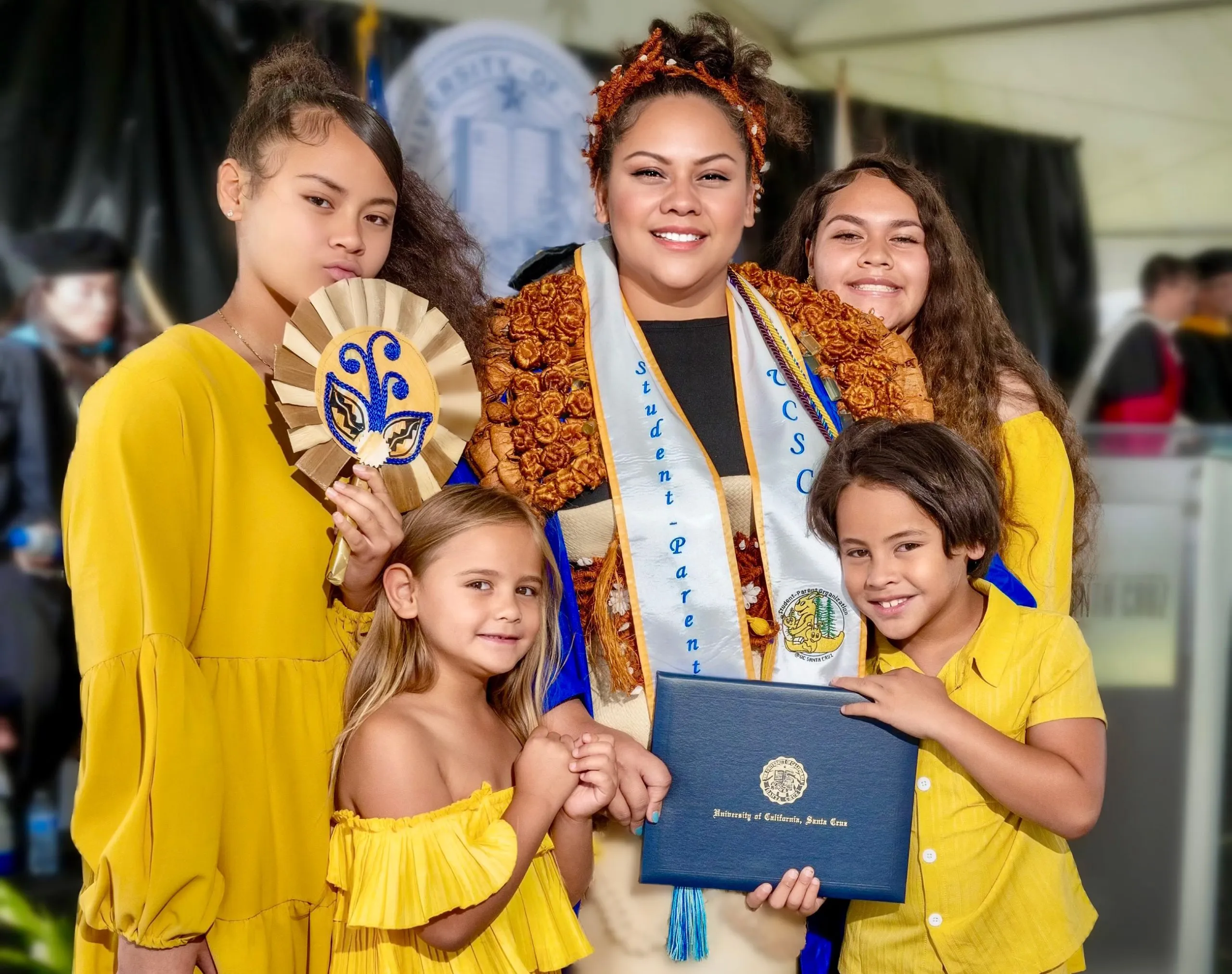
For me, the last hurdle I had to clear was graduation itself. After years of sacrifice — not just my own, but my whole family’s — walking the stage with my four children at my graduation from the University of California, Santa Cruz was deeply important.
The university, however, didn’t understand that or account for us. When I asked to accept my diploma with my kids, I was met with resistance, a particularly tough reminder of the work institutions have left to do to meet the needs and priorities of student-parents.
Related: Interested in innovations in higher education? Subscribe to our free biweekly higher education newsletter.
Earning my college degree in my late 30s was undoubtedly a major achievement, but so was going back for my bachelor’s in the first place — I didn’t even finish high school the first time around.
After I became a mom at 20, I earned my GED, hoping it would help me support my family. Continuing my education only got harder. I started and stopped community college more times than I can count, juggling bills, jobs, custody battles and parenting.
Finally, I transferred to UCSC, proud that I was taking this step two decades in the making and changing the trajectory of my and my family’s lives.
However, I didn’t fully realize what my education would cost my children. Used to our tight-knit Tongan community, they felt like cultural outsiders when we moved to Santa Cruz, no longer surrounded by family, our native language or familiar foods and music.
My children sacrificed their home and sense of belonging so that I could pursue this dream. As graduation approached, I knew I wanted to walk the stage with them. They had earned it just as much as I had.
Yet the administration denied my request, citing the added logistical difficulties. They suggested I bring my kids to a separate, informal celebration for those of us living in family student housing instead. The offer sounded like “be invisible or settle for less.”
I immediately started mobilizing UCSC’s Student Parent Organization, where I was president. Working with the student government, I drafted a resolution permitting student-parents to walk with their children. I reached out to alumni, administrators, fellow parents and friends for support.
Thanks to our collective voice, the dean of students changed his mind, offered an apology and committed to changing the policy going forward for all graduating student-parents. Though my kids and I were placed at the end of the ceremony, we crossed the stage together as a family.
That seed of inclusion will grow in them, just like it will for all the children of student-parents who walk that path in the future.
The next year, my mentee and friend walked with her son at the UCSC commencement, this time without pushback. The university invited them to rehearsal, and on graduation day, they had VIP seats. She was one of the first to walk, not the last.
That is the power of advocacy. It turns exclusion into inclusion. It rewrites the rules not just for one person, but for those who come after. I am proud to continue my advocacy work as a graduate student at the University of San Francisco and a member of The California Alliance for Student Parent Success.
I have since seen institutions across California make good progress on their efforts to support student-parents, but colleges and universities nationwide must still do more. At the University at Buffalo, university police chased a graduating student across the stage when he attempted to bring his infant son with him.
These stories and the momentum building in the wake of September’s National Student Parent Month should serve as a call to higher education leaders across the country to cultivate campus climates that build trust and belonging among student-parents.
This work should start before we even step foot on campus and continue until we graduate.
Institutions that truly wish to serve families will ensure that the value we bring to higher education is visible. They will account for student-parents when planning campus events and weave together support networks of faculty, staff and peers who can respond to our needs.
When we ask institutions for policies and practices to better accommodate our families, they will listen and act. They will hold themselves accountable to all of their students, parents included.
Walking the stage with my kids was a step in the right direction, albeit an uphill climb. Let’s keep going and do better by student-parents and their families.
The Hechinger Report provides in-depth, fact-based, unbiased reporting on education that is free to all readers. But that doesn’t mean it’s free to produce. Our work keeps educators and the public informed about pressing issues at schools and on campuses throughout the country. We tell the whole story, even when the details are inconvenient. Help us keep doing that.
Every year, tens of thousands of infants are born prematurely, at a low birthweight, or with other conditions that would make them automatically eligible for therapeutic services that could help them thrive.
When everything goes smoothly, early intervention provides those services, required by federal law for children ages birth to 3. Funding sources for the program can vary, but it’s often paid for by a mix of federal, state, local, and private insurance dollars.
But far too few of the youngest children actually receive that help. (It’s an issue I wrote about earlier this year.) One particular gap is in services provided to infants from birth to 1. Only about 1.3 percent of babies that age receive early intervention services, compared to 7.5 percent of 2- to 3-year-olds, according to a new report from the think tank New America.
Kayla Khan, a long-time speech therapist, has experienced that gap herself.
When her infant daughter was released after a month and a half in neonatal intensive care, she asked the discharge team about early intervention services. Because of her background, she knew about the therapies.
At the time, the family lived in the Washington D.C. area, and no one at the hospital was helpful. “They said, ‘You don’t want that,’ or, ‘It’s not going to help you,’” Khan recalled.
After moving to Seattle a few months later, Khan finally connected with early intervention services that provided physical and feeding therapy to her daughter. She now helps lead a decade-old effort in Seattle to provide care and support specifically to families of “tiny babies” who are transitioning from the hospital to home.
The program relies on building trust and communication with hospital staff to ensure eligible babies get referred to early intervention and speeding up the evaluation timeline so babies get seen within three days of a referral — “really, really, really fast” for a system where the requirement for referral is 45 days, Khan said. Her program also connects families with therapists who are skilled and trained in the specific needs of newborns.
“We’re making this process that was designed for all children, birth to 3, work for the tiniest babies,” Khan said.
This kind of targeted attention for the youngest is desperately needed, according to the New America report and another that focused on Illinois, from early nonprofit advocacy group Start Early. (I recently completed a reporting fellowship with New America which supported some of my writing on early intervention, among other topics.)
Among the two reports’ recommendations:
Make the list of conditions that automatically qualify a baby for early intervention easy to understand and find. States have identified scores of different qualifying conditions that make a child more likely to develop a delay, including extreme prematurity, low birthweight, a parent with a substance use disorder, and child welfare involvement. But, as the New America report points out, finding a user-friendly list of the conditions can be a challenge. “The eligibility criteria and the way things work varies so much from one state to the next,” said report co-author Carrie Gillispie, the Early Development & Disability project director at New America.
The Start Early report noted that in a related study, two families were judged ineligible for early intervention despite their children having medical conditions that should have made them automatically eligible.
Consider co-locating early intervention staff in the NICU to make the transition as smooth as possible. Coordinators would be physically present in NICUs to build relationships, participate in medical rounds, and lead the process to enroll children in early intervention programs, the Start Early authors wrote. Both reports stress the importance of providing the family with a personal connection to early intervention before a baby gets discharged from the hospital.
Improve coordination and communication with the early intervention system, hospitals and pediatricians. Pediatricians are not always notified when doctors in the hospital refer a child to early intervention services. And well-child visits are often so short that physicians miss the full developmental picture. Too often, referrals come after a child is already starting to struggle, said Sarah Gilliland, a senior policy analyst in the New Practice Lab at New America, who co-wrote the report.
Bridge cultural and language barriers with families by hiring more multilingual hospital and early intervention staff. Cultural divides are pervasive throughout the early intervention system, where the overwhelming majority of the therapists and other providers in many communities are white, English-speaking women. But even simple forms often go untranslated: One survey found that nearly three-quarters of state early intervention referral forms are only available in English, the New America report noted. The report also stressed that families should be reassured that early intervention services are meant to be support, not surveillance. “Hesitant families might benefit from a connection with families within their own communities who can explain what to expect from early intervention,” the authors wrote.
Strengthen electronic referral systems and centralize enrollmentin early intervention programs. When I reported on the too-often broken path from the NICU to early intervention in Chicago, I heard stories of a system that relied heavily on faxing paper forms. NICU physicians often had no idea what happened with referrals they made. Indeed, surveys have found that only a fraction of early intervention coordinators have access to technology that links children’s electronic health records to the referral system.
Some states and communities are introducing technological advances which could be implemented more widely, the New America report noted. For instance, one state is trying to address the problem using “e-referrals,” which share an infant’s medical records directly with the early intervention system.
We want to hear from you
We want to help you make sense of the first year of the Trump administration and the effects on education. What have you experienced? What do you want to know more about? Tell us, and you will help inspire reporting by our journalists. Email [email protected].
This story about preemies was produced by The Hechinger Report, a nonprofit, independent news organization focused on inequality and innovation in education. Sign up for the Hechinger newsletter.
The Hechinger Report provides in-depth, fact-based, unbiased reporting on education that is free to all readers. But that doesn’t mean it’s free to produce. Our work keeps educators and the public informed about pressing issues at schools and on campuses throughout the country. We tell the whole story, even when the details are inconvenient. Help us keep doing that.
Hello! This is Christina Samuels, the early education editor here at Hechinger.
By now, I hope you’ve had a chance to read my colleague Jackie Mader’s story about the important role that Head Start plays in rural communities. While Jackie set her story in western Ohio, she also interviewed Head Start parents and leaders in other parts of the country and collected their views for a follow-up article.
In a fortunate bit of timing, the advocacy group First Five Years Fund published the results of a survey it commissioned on rural Americans and their feelings on child care access and affordability. Like the people Jackie interviewed, the survey respondents, more than half of whom identified as supporters of President Donald Trump, said they had very positive views of Head Start. The federally funded free child care program received positive marks from 71 percent of rural Republicans, 73 percent of rural independents and 92 percent of rural Democrats.
The survey also found that 4 out of 5 respondents felt that finding quality child care is a major or critical problem in their part of the country. Two-thirds of those surveyed felt that spending on child care and early education programs is a good use of taxpayer dollars, and a little more than half said they’d like to see more federal dollars going to such programs.
First Five Years Fund was particularly interested in getting respondents to share their thoughts on Head Start, said Sarah Rubinfield, the managing director of government affairs for First Five Years Fund. The program has been buffeted by regional office closures and cuts driven by the administration’s Department of Government Efficiency.
“We recognize that these are communities that often have few options for early learning and care,” Rubinfield said.
In the survey, rural residents said they strongly supported not just the child care offered by Head Start, but the wraparound services such as healthy meals and snacks and the program’s support for children with developmental disabilities. Though Head Start programs are federally funded, community organizations are the ones in charge of spending priorities.
“Rural voters want action. They support funding for Head Start and for child care. They want Congress to do more,” Rubinfield said. Though the “big beautiful bill” signed into law in July expands the child care tax credit for low-income families, survey respondents “recognized that things were not solved,” she added.
The First Five Years Fund survey was released just a few days before a congressional standoff led to a government shutdown. The shutdown is not expected to touch Head Start immediately, said Tommy Sheridan, the deputy director of the National Head Start Association, in an interview with The New York Times. The 1,600 Head Start programs across the country receive money at different points throughout the calendar year; eight programs serving about 7,500 children were slated to receive their federal funding on Oct. 1, Sheridan told the Times. All should be able to continue operating, as long as the shutdown doesn’t last more than a few weeks, he said.
“We’re watching with careful concern but trying not to panic,” Rubinfield said. “We know the impacts may not be immediate, but the longer this goes on, the harder the impacts may be for families and programs.”
This story about rural Americans was produced by The Hechinger Report, a nonprofit, independent news organization focused on inequality and innovation in education. Sign up for the Hechinger newsletter.
The Hechinger Report provides in-depth, fact-based, unbiased reporting on education that is free to all readers. But that doesn’t mean it’s free to produce. Our work keeps educators and the public informed about pressing issues at schools and on campuses throughout the country. We tell the whole story, even when the details are inconvenient. Help us keep doing that.
When Starr Dixon heard the Trump administration was floating a proposal last spring to eliminate Head Start, the 27-year-old parent in rural Michigan cried for a week.
The free, federally funded early learning program has been life-changing for her and her young daughter, she said. It provided stability after Dixon, who lives about 100 miles north of Lansing, left a yearslong abusive relationship.
While her 3-year-old daughter has blossomed socially, emotionally and verbally in the program during the last year and a half, Dixon has taken on numerous volunteer positions with Head Start, gaining experience that she can put on her resume after a 7-year gap in employment. She hopes to ultimately apply for a job at Head Start.
“It has just completely transformed my life,” she said.
This year, I talked to people in communities across rural America and learned how Head Start is essential in places where there are few other child care options. Head Start also provides an economic boost for these areas and serves as direct support for parents, many of whom go on to volunteer for or get jobs at their local programs.
Related: Young children have unique needs and providing the right care can be a challenge. Our free early childhood education newsletter tracks the issues.
Though my reporting focused on western Ohio, parents in other parts of the country, like Dixon, shared similar stories with me about how critical Head Start is to their lives. But since January, the Trump administration has taken what some call a “death by a thousand cuts” approach to the program, firing federal staff, closing regional offices and offering no increase in spending on Head Start in budget proposals.
All those moves have caused chaos and upheaval. In Alabama, Jennifer Carroll, who oversees 39 Head Start sites run by the Community Action Partnership of North Alabama, told me she is reassuring the families she works with that her program’s funding is stable for at least the rest of the year. Carroll fears that if parents think Head Start funding is in jeopardy, they’ll pull their children out of the program, disrupting their learning.
Another example: Keri Newman Allred is the executive director of Rural Utah Child Development Head Start, which operates Head Start programs spread across 17,000 square miles in central and east Utah. Newman Allred estimates her programs, which employ 91 residents and serve 317 children, can survive for one more year. After that, without more money, they will have to make cuts to the program if they want to give teachers a raise to meet inflation.
While other Head Start programs can supplement operations with private donations, Newman Allred’s programs serve some of the most sparsely populated parts of America, known as “frontier counties,” where there are no deep-pocketed philanthropies. Her programs rely solely on federal funding.
In April, the Department of Government Efficiency, or DOGE, abruptly shuttered five of Head Start’s 10 regional offices. Programs in Maine that were without directors or that needed assistance with regulations, finances or federal requirements have been left to go it alone without consistent, daily support.
“The closure of regional offices has all but crippled programs,” said Sue Powers, senior director of strategic initiatives at the Aroostook County Action Program in the rural, northernmost tip of Maine. “No one’s checking in. When you’re operating in a program that is literally in crisis, and you need [regional staff] and do not have them, it’s more than alarming.”
This story about Head Start was produced by The Hechinger Report, a nonprofit, independent news organization focused on inequality and innovation in education. Sign up for the Hechinger newsletter.
The Hechinger Report provides in-depth, fact-based, unbiased reporting on education that is free to all readers. But that doesn’t mean it’s free to produce. Our work keeps educators and the public informed about pressing issues at schools and on campuses throughout the country. We tell the whole story, even when the details are inconvenient. Help us keep doing that.
Join our zero2eight Substack community for more discussion about the latest news in early care and education. Sign up now.
From her home-based day care in Washington, D.C., Alma peers out the door and down the sidewalks. If they’re clear and there are no ICE agents out, she’ll give her coworker a call letting her know it’s safe to head in for work.
They have to be careful with the kids, too. Typically, she took the five children she cares for to the library on Wednesdays and out to parks throughout the week, but Alma — who, like her coworker, does not have permanent legal status — had to stop doing that in August, when President Donald Trump declared a “crime emergency” in the district. Now, two of the kids she cares for are being pulled out of the day care. The parents said it was because they weren’t going outside.
Trump has deployed the National Guard and a wave of U.S. Immigration and Customs Enforcement (ICE) agents into the district. ICE arrests there have increased tenfold. The situation has thrust the Latinas who hold up the nation’s child care sector into a perpetual state of panic. Nationwide, about 1 in 5 child care workers are immigrants, but in D.C. it’s closer to 40 percent; about 7 percent nationally lack permanent legal status. Nearly all are women.
Many are missing work, and others are risking it because they simply can’t afford to lose pay, providers told The 19th. All are afraid they’ll be next.
“What kind of life is this?” said Alma, whose name The 19th has changed to protect her identity. “We are not delinquents, we are not bad people, we are here to work to support our family.”
Alma has been running a home-based day care for the past decade. She’s been in the United States for 22 years, working in child care that entire time. With two kids being pulled, she will have to reduce her staffer’s hours as she tries to find children to fill those spots.
Her four school-age children also depend on her. This month, she had to write out a signed document detailing what should happen to her kids if she were to be detained. Her wish is that they be brought to detention with her.
“I can’t imagine my kids here without me,” she said.
She said she understands the president’s approach of expelling immigrants with criminal convictions from the country, but teachers who are working with kids? Who haven’t committed any crime?
By targeting them, she said, the administration is “destroying entire families.”
The Multicultural Spanish Speaking Providers Association in D.C., which works with Latina child care providers, has seen this panic first hand for the past couple of weeks as more and more Latinas in child care have stopped coming into work. The center also helps workers obtain their associate’s degree in early childhood education, and since the semester started in mid-August, many teachers have asked for classes to be offered virtually so they don’t have to show up to campus at night.
Latinas have flocked to the child care industry for multiple reasons: Families seeking care value access to language education, and Latinas have a lower language barrier to entry, said Blanca Huezo, the program coordinator at the Multicultural Spanish Speaking Providers Association.
“In general, this industry offers them an opportunity for a fresh start professionally in their own language and without leaving behind their culture,” Huezo said.
The changes, coupled with increased enforcement, has fostered fear among Latinx people regardless of immigration status. That fear among workers is deepening a staffing crisis in an industry that already couldn’t afford additional losses, Huezo said.
“There is a shortage — and now even more,” she said. “There are many centers where nearly 99 percent of teachers are of Hispanic origin.”
Washington, D.C., has been a sanctuary city since 2020, where law enforcement cooperation with immigration officials was broadly prohibited. Earlier this year, however, Mayor Muriel Bowser proposed repealing that law and, in mid-August, Washington’s Metropolitan Police Department Police Chief Pamela Smith gave officers leeway to share information with ICE about individuals they arrested or stopped.
“There was some peace that living in D.C. brought more security,” Huezo said. Now, “people don’t feel that freedom to walk through the streets.”
Several child care workers are afraid to go to work in DC, now that President Trump has removed restrictions on ICE conducting enforcement at schools and daycares. (Getty Images)
Child care centers are also no longer off limits for ICE raids. The centers were previously protected under a “sensitive locations” directive that advised ICE to not conduct enforcement in places like schools and day cares. But Trump removed that protection on his first day in office. While reports have not yet surfaced of raids in day cares, ICE presence near child care care centers, including in D.C., has been reported.
A similar story of fear and surveillance has already played out in Los Angeles, where ICE conducted widespread raids earlier in the summer. Huezo said her organization has been in touch with child care providers in L.A. to learn about how they managed those months.
In the meantime, the best the organization can do, she said, is connect workers with as many resources as possible, including legal clinics, but the ones that help immigrants are at their maximum caseload. The group has put child care workers who are not leaving their homes in touch with an organization called Food Justice DMV that is delivering meals to their doorsteps. Prior to last month, people who needed food could fill out a form and get it that same week. Now, the wait time is two to three weeks, Huezo said. For those in Maryland and Virginia, it’s closer to a month.
Thalia, a teacher at a day care, said her coworkers have stopped coming to work. It’s all the staff talks about during their lunchtime conversations. When she rides the Metro into work, she looks over her shoulder for the ICE agents, their faces covered, who are often at the exits.
“They are hunting us,” she said.
Thalia, whose name has been changed because she does not have permanent legal status, has been living in the United States for nine years and working in child care that entire time. Like her, many of the Latina teachers she works with have earned certifications and degrees in early childhood education.
“We are working, we are cooperating, paying taxes,” she said. “We are there all day so other families can benefit from the child care.”
As a single mother, Thalia has also had to consider what would happen to her three children if she was detained. This past month, she retained a lawyer who could help them with their case in case anything were to happen. Her school-age kids know: Call the lawyer if mom is detained and get tickets to Guatemala to meet her there.
This is what she lives with every day now: “The fear of leaving your family and letting them know, ‘If I don’t return, it’s not because I am abandoning you.’ ”
Illinois hospital staff will soon be required by law to refer parents of severely premature infants to services that can help prevent years of intensive and expensive therapy later, when the children are older. The new law follows reporting from The Hechinger Report that exposed how hospitals often fail to connect many eligible parents to these opportunities for their children after they leave neonatal intensive care units.
Earlier this year, Hechinger contributor Sarah Carr wrote about how, across the country, far too few parents are made aware of the kinds of therapies their babies are entitled to under federal law. Such early intervention services can ultimately reduce the need for these children to require costly special education support as schoolchildren.
Carr noted: “Federal law says children with developmental delays, including newborns with significant likelihood of a delay, can get early intervention from birth to age 3. States design their own programs and set their own funding levels, however. They also set some of the criteria for which newborns are automatically eligible, typically relying on qualifying conditions like Down syndrome or cerebral palsy, extreme prematurity or low birthweight. Nationally, far fewer infants and toddlers receive the therapies than should. The stats are particularly bleak for babies under the age of 1: Just 1 percent of these infants get help. Yet an estimated 13 percent of infants and toddlers likely qualify.”
After the Hechinger Report story was published, Illinois state Rep. Janet Yang Rohr authored legislation to require that hospitals distribute materials informing parents of premature and low birth weight babies about their eligibility for early intervention therapies. The bill also required that hospitals make a nurse or physical therapist available to explain these rights to families.
Related: Young children have unique needs and providing the right care can be a challenge. Our free early childhood education newsletter tracks the issues.
“The problem is that these families often don’t know about these services,” Yang Rohr said last spring, after her chamber passed the bill. “So this bill improves that early intervention process by requiring NICU staff to share information about these services and requires hospital staff to write a referral to these programs for families that are eligible.”
Illinois Representative Janet Yang Rohr Credit: ILGA
Carr also wrote: “The stakes are high for these fragile, rapidly growing babies and their brains. Even a few months of additional therapy can reduce a child’s risk of complications and make it less likely that they will struggle with talking, moving and learning down the road. In Chicago and elsewhere, families, advocates and physicians say a lot of the failures boil down to overstretched hospital and early intervention delivery systems that are not always talking with families very effectively, or with each other hardly at all. ‘They really put the onus of helping your child get better outcomes on you,’ said Jaclyn Vasquez, an early childhood consultant who has had three babies of her own spend time in the NICU.”
“Early intervention is life-changing for many families, as these programs provide critical services and therapies as children develop,” Illinois state Sen. Ram Villivalam said when the bill was sent to Pritzker. “But, these services can only benefit those they are able to reach, which means uplifting the program and expanding its outreach to those who need it is imperative.”
Contact editor Nirvi Shah at 212-678-3445, securely on Signal at NirviShah.14 or via email at [email protected].
The Hechinger Report provides in-depth, fact-based, unbiased reporting on education that is free to all readers. But that doesn’t mean it’s free to produce. Our work keeps educators and the public informed about pressing issues at schools and on campuses throughout the country. We tell the whole story, even when the details are inconvenient. Help us keep doing that.
Across the country, Black fathers are too often seen as a threat when they speak up and advocate for their children. And it’s not just in courtrooms and on sidewalks — it’s happening in classrooms, daycares and schools.
I’ve spent my career in education and equity leadership, and I know this is part of a larger, troubling pattern. When Black parents — especially men — assert themselves in spaces not designed for them, they are too often perceived as “aggressive.”
Their advocacy is sometimes interpreted as “rude,” and their presence is framed as disruption rather than partnership, something that has played out in my own experience as a proud Black father of three.
This isn’t about one parent or teacher or even one moment. It’s about what happens when systems designed to support children carry embedded racial assumptions.
I’ll never forget picking my kids up from daycare during a lice outbreak. My wife and I had no experience dealing with lice, and I asked a few questions — just trying to understand what to expect. Instead of getting reassurance or guidance, I was met with suspicion, even subtle blame.
Or the time I raised a safety concern about an emotional child in my son’s class who had a pattern of throwing chairs. Rather than treating my concern as legitimate, it was brushed off — as if I were overreacting.
In both cases, my presence and voice weren’t welcomed. They were managed.
In a society in which Black men are still fighting to be seen as full participants in their children’s lives, we cannot ignore the role that bias plays in shaping who gets welcomed, who gets questioned and who gets believed. Daycares, schools, courts and society at large must actively affirm and restore the voices of Black fathers, rather than dismiss them.
Too often, Black men are portrayed as threats or criminals — rather than as nurturers and protectors. These images become mentally entrenched, shaping public attitudes and institutional responses. This persistent framing contributes to a cultural blind spot that brings confusion to the presence of Black fathers and negatively affects how they are treated in schools, courts and communities.
Despite this anti-Black bias, Black fathers defy stereotypes every day. Black dads, on average, are actually more involved in daily caregiving than fathers of other racial backgrounds, the National Health Statistics Reports from the Centers for Disease Control and Prevention notes. Yet media representation has not caught up with this reality.
As a student pursuing a doctorate in education leadership and policy, I study how identity shapes access to opportunity. And I know that bias against Black men starts early — when we are boys. A 2016 Yale Child Study Center report found that preschool teachers, regardless of race, were more likely to monitor Black boys for misbehavior — even when no misbehavior was apparent.
And in Indiana, studies highlight that nearly four out of every five Black children in the state will be investigated for suspected maltreatment.
These are not just statistical disparities — they’re stories of fractured trust between families and the institutions meant to serve them.
I have explored the concept of “mega-threats” introduced by researchers Angelica Leigh and Shimul Melwani — high-profile, identity-relevant events that trigger lasting psychological stress for people who share that identity. Though typically used to describe major public tragedies, these threats can be individual and personal, too. When a Black father sees himself reduced to a stereotype — his parenting undercut, his words distorted — it becomes an embodied threat, one that lingers and works to fulfill the myth that Black fathers are absent. These corrosive interactions run counter to the heroic influence and legacy that Black men have within their communities as warm demanders — men who emphatically build relationships and uphold high expectations.
If we want to support children, we must support their families. That means ensuring that early childhood professionals are trained not just in child development but in cultural competence and anti-bias practices. It means separating assumptions from observations when writing reports.
And it means reflecting on how language like “rude” or “aggressive” can carry racial undertones that reinforce long-standing stereotypes.
In my work as an educator, leader and former coach, I’ve partnered with countless families across race and class lines. What all parents want — especially those from marginalized communities — is the assurance that when they show up, they’ll be heard, not judged. That their questions will be met with respect, not suspicion.
If we truly believe in family engagement, we must be honest about the ways our systems still punish the very people we say we want more of. Black fathers are showing up.
The question is: are we ready to see them clearly?
Craig Jordan is an educator and doctoral student at Vanderbilt University’s Peabody College. A native of Gary, Indiana, he writes about equity, identity and systemic change in education. His work has been featured in IndyStar and Yahoo News.
This story about Black fathers was produced by The Hechinger Report, a nonprofit, independent news organization focused on inequality and innovation in education. Sign up for Hechinger’s weekly newsletter.
The Hechinger Report provides in-depth, fact-based, unbiased reporting on education that is free to all readers. But that doesn’t mean it’s free to produce. Our work keeps educators and the public informed about pressing issues at schools and on campuses throughout the country. We tell the whole story, even when the details are inconvenient. Help us keep doing that.
Despite having some of the most resources and economic support, a recent national study ranked Indiana’s early education system 42nd in the country — and second-to-last when it came to accessibility.
The WalletHub story, shared earlier this week, is simply the latest confirmation for Hoosier parents that Indiana’s child care market is struggling. Experts, business leaders and politicians agree that Indiana needs more child care, but can’t seem to agree on the best way to meet the moment.
Facing budgetary pressures and depressed revenue forecasts, state leaders opted to trim funding and narrow eligibility for early learning and child care resources earlier this year. Seats for state-funded preschool, known as On My Way Pre-K, have been halved while vouchers for subsidized child care have more 21,000 children on a waitlist.
One federal program, Head Start Indiana, hopes to help close the gap left by vanishing state funding, but faces its own challenges with flat federal funding.
“We are the quietest, most successful 60-year old program in the federal government’s history,” boasted Rhett Cecil, the organization’s executive director. “… (our programs) are going to support their families and children. They’re allowing families to work or get job training or further education. And our services — that child care and early education — are free for those families.”
Just under 13,000 families in all 92 counties utilize the program, which receives roughly $181 million in federal funding annually. That budget line was briefly threatened by the Trump administration, which walked back proposed cuts in favor of flat funding — which does mean services will be lost as inflation and other costs eat into the bottom line.
The second-term president also eliminated the federal Head Start office covering Indiana back in April — though the federal Administration for Children and Families announced it would dedicate one-time funding to Head Start locations earlier this week explicitly for nutrition, but not for other programming costs.
Additional federal support could allow it to expand to meet the need following state cuts, leaders hope, and continue employing almost 4,000 Hoosiers.
“Let’s say, hypothetically, we get $100 million more dollars. How many more teachers and classrooms could be opened?” Cecil mused. “How many kids could we serve off that waitlist?”
In Indiana, the shortage of child care options costs the state an estimated $4.2 billion annually, over a quarter of which is linked to annual tax revenue lost.
The 2024 study from the Indiana Chamber of Commerce emphasized the need to free up parents, mostly women, who’ve left the workforce “as a direct result of childcare-related issues.”
“There’s some data out there that one in four Hoosier parents leave their job over child care gaps, and it really impacts talent and workforce,” said David Ober, the chamber’s vice president of taxation and public finance. “It’s hindering economic momentum in the state and so it is a huge deal for us.”
For the last few years, tackling the state’s child care crisis has been a top legislative priority for the organization, which represents the interests of thousands of Hoosier employers. Ober said the chamber is working to plan a child care summit later this year to identify potential solutions.
According to Brighter Futures Indiana, average full-time weekly care costs families $181 per week — with even higher prices for infants and toddlers. That doesn’t factor in type of care or quality, and prices vary by community.
Families can spend more on their young children’s care than on a college education — if it’s even available in their communities. Rather than pay the price, many Hoosier parents simply drop out of the workforce at the same time that employers are scrambling to hire talent.
Ober highlighted recent legislative efforts to expand child care, including one that expanded a tax credit for employers directly providing their employees with child care resources. Other bills have tweaked staffing ratios and created a pilot program for so-called microcenters.
But workforce remains a challenge, even for Head Start centers, earning its own legislative study carveout. Over 20% of Indiana’s child care workers left the field during the pandemic — a shock that “has not really fully healed,” Ober said.
“If you ask any provider in the state, workforce is the hardest problem,” Ober said. “… How do you get educators and keep them? There’s so much more work to be done there and it’s challenging.”
Traditional market forces struggle to balance affordability for parents against costs for child care, a gap sometimes covered by government subsidies.
But Ober insisted that “child care is infrastructure,” especially for the businesses reliant upon employees who are parents. Changing funding is “going to just exacerbate underlying problems,” he added.
“Those numbers are pretty stark,” Ober said. “And then when you add in changes at the state and the federal level, it creates new problems that we all have to come together and work on,” he concluded.
Indiana Capital Chronicle is part of States Newsroom, a nonprofit news network supported by grants and a coalition of donors as a 501c(3) public charity. Indiana Capital Chronicle maintains editorial independence. Contact Editor Niki Kelly for questions: [email protected].
This story about children with disabilities was produced by The Hechinger Report, a nonprofit, independent news organization focused on inequality and innovation in education. Sign up for the Hechinger newsletter.
COLUMBUS, Ohio — When Selina Likely became director of the Edwards Creative Learning Center six years ago, she knew there was one longstanding practice that she wanted to change. For as long as she had taught at the thriving child care center, it had turned away many children with disabilities such as autism and Down syndrome. The practice was even encoded in the center’s handbook as policy.
Likely, the parent of a child with a disability, wanted to stop telling families no, but she knew that to do that she and her staff would need more support. “I said, ‘Let’s start getting training and see what we can do.’”
Not too long after, her effort received a big boost from a state-funded initiative in Ohio to strengthen child care teachers’ knowledge and confidence in working with young kids with disabilities and developmental delays. That program, Ohio PROMISE, offers free online training for child care workers in everything from the benefits of kids of all abilities learning and playing together to the kinds of classroom materials most helpful to have on hand. It also offers as-needed mentorship and support from trained coaches across the state.
Related: Young children have unique needs, and providing the right care can be a challenge. Our free early childhood education newsletter tracks the issues.
Child care providers across the country — including large, established centers and tiny home-based programs — struggle to meet the needs of children with disabilities, according to a 2024 report from the U.S. Government Accountability Office. More than a quarter of parents of children with disabilities said they had a lot of difficulty finding appropriate care for their kids. And even those who do find a spot regularly encounter challenges, like having their children excluded from extracurricular activities such as field trips and even academic instruction.
“It’s really hard to find child care for this population, we heard that loud and clear,” said Elizabeth Curda, a director on the GAO’s Education, Workforce and Income Security team and a coauthor of the report. Even the most well-resourced centers report that they struggle to meet the needs of children with disabilities, according to Curda.
There’s a lot of desire at the grassroots level to change that. Ohio PROMISE and a few other recent initiatives provide models for how to expand the capacity — and the will — of child care centers to serve the more than 2 million U.S. children age 5 or below who have a disability or developmental delay.
Cards on the walls at Edwards Creative Learning Center display the signs for different letters so students — whether nonverbal or not — can all learn sign language. Credit: Sarah Carr/The Hechinger Report
In Vermont, for instance, officials hope to soon unveil a free, on-demand training program aimed at helping child care teachers have more inclusive classrooms. And officials in Ohio’s Summit County, home to Akron, report growing interest from other counties in creating programs based on Summit’s more than decade-old model that provides in-person training for child care operators in inclusion of children with disabilities.
“We’re helping to create child care centers that feel they can handle whatever comes their way, especially when it comes to significant behavior concerns,” said Yolanda Mahoney, the early childhood center support supervisor for Summit County’s disabilities board.
The federal government until recently encouraged the creation of such models. In 2023, the federal Department of Education and Department of Health and Human Services issued a joint statement urging states to take steps to support inclusion in early childhood settings, including strengthening training and accountability.
Under the current president, federal momentum on the issue has largely stalled. While the administration of President Donald Trump hasn’t directly attacked inclusion in the context of special education, the president has criticized the term more broadly — especially when it comes to diversity, equity and inclusion. That can create uncertainty and a chilling effect on advocates of inclusion efforts of all kinds.
Funding for some inclusion efforts is also in jeopardy. States rely on Medicaid, which faces nearly $1 trillion in cuts over the next decade, to pay for early intervention programs for children birth to age 3 with developmental delays and disabilities. Trump has also proposed eliminating Preschool Development Grants, which states such as Vermont and Illinois have used to expand support of young children with disabilities.
That means over the next few years, progress on inclusion in child care settings could hinge largely on state and local investment. It helps that there’s a “real desire” among providers to enroll more children with disabilities, said Kristen Jones, an assistant director on the GAO’s education, workforce and income security team, who also worked on the report. “But there’s also a concern that currently they can’t do that in a safe way” because of a lack of training and resources.
In Ohio, the idea for Ohio PROMISE came after an appeal in 2022 from Republican Gov. Mike DeWine. He reported that families were coming to him saying they couldn’t find child care for their kids with disabilities.
“He said, ‘Come to me with ideas to solve that problem,’” recalled Wendy Grove, a senior adviser in the Ohio Department of Children and Youth who spearheaded development of the program.
Grove and her colleagues had already been working on a related effort. In 2020, Ohio won a federal grant that included help exploring how well — or not — children with disabilities were being included in child care and early education settings. DeWine liked the idea Grove’s team presented of morphing that work into a state-led effort to strengthen training and support for child care teachers. They also proposed more direct support to families, including the extension of child care vouchers to families with incomes above the poverty level, with a higher reimbursement rate for children with disabilities.
The training, which debuted about two years ago, is provided in three levels. Jada Cutchall, a preschool teacher at Imaginative Beginnings, an early learning center just outside of Toledo, recently completed the third tier, which for her included customized coaching. Cutchall’s coach helped her create communication tools for a largely nonverbal student, she said, including a board with pictures children can point to if, for example, they want to go to the bathroom or try a different playground activity.
As a result, Cutchall said, she has watched kids with disabilities, including those with speech impairments and autism, engage much more directly with their classmates. “They have the courage to ask their peers to play with them — or at least not distance themselves as much as they usually would,” she said. All of the children in the classroom have benefited, she added, noting that kids without disabilities have taken an interest in learning sign language, strengthening their own communication skills and fostering empathy.
Child care programs where one teacher and one administrator have completed some of the training earn a special designation from the state, which may eventually be tied to the opportunity to get extra funding to serve children with disabilities. In Ohio PROMISE’s first year, 1,001 child care centers — about 10 percent of the total number in Ohio — earned that designation, according to Grove.
For the last six years, Selina Likely has overseen the Edwards Creative Learning Center, where she’s steadily tried to enroll more children with disabilities and developmental delays. Credit: Sarah Carr/The Hechinger Report
The effort costs a little over $1 million in state dollars each year, with most of that paying for several regional support personnel who work directly with centers as mentors and advisers. Over the last two years, Ohio has seen a 38 percent increase in the number of children in publicly funded centers who qualify for the higher voucher reimbursement rate for children with disabilities, which can be double the size of the standard voucher.
Grove hopes that ultimately the effort plays a role in narrowing a critical and stubborn gap in the state: about 27 percent of children without disabilities show readiness on state standards for kindergarten; only 14 percent of children with disabilities do. Since so few disabilities exhibited at that age are related to intellectual or cognitive functioning, “we shouldn’t see that gap,” said Grove. “There’s no real reason.”
One goal of the new efforts is to reduce the number of young children with disabilities who are expelled from or pushed out of care. Those children are frequently asked to leave for behaviors related to their disability, the GAO report found.
Several years ago, a child care center in Columbus expelled Meagan Severance’s 18-month-old son for biting a staff member. The boy has several special needs, including some related to attention deficit hyperactivity disorder. Severance brought him to Edwards Creative Learning Center, where not too long after Selina Likely shifted into the role of director. The boy also bit a staff member there — not uncommon behavior for toddlers, especially those with sensory sensitivities and communication challenges.
Likely was determined to work with the child, not expel him. “They put in time and effort,” said Severance. “The response wasn’t, ‘He bit someone, he’s gone.’”
Likely empathized. Decades earlier, her own daughter had been expelled from a child care center in her hometown of Mansfield, Ohio, for biting.
“I was so angry and mad at the time — how are you going to kick out a 1-year-old?” she said. The center director didn’t think at all about how to help her child, Likely recalled, instead asking Likely what might be happening at home to make the child want to bite. She said she got no notice or grace period to find a new placement. “That left me in a disheartened place,” she said. “I was like, ‘I still have to go to work.”
Seventeen years old at the time, she was inspired by the injustice of the situation to quit her job in a factory and apply to be an assistant in a child care program. She’s been in the industry ever since, gradually trying to make more space for children like her daughter, who was later diagnosed with autism.
Meagan Severance, a parent and teacher at the Edwards center, has worked in recent years to make her classroom more inclusive for children with all different abilities. Credit: Sarah Carr/The Hechinger Report
As director, Likely displays the nameplate “chaos coordinator” on her desk. And she’s taken the stance that the center should at least try to work with every kid. She and some of her teachers have completed the first two tiers of the Ohio PROMISE training, as well as some related sessions available from the state. Likely estimates that about 10 percent of the children in her center have a diagnosed disability or developmental delay.
Liasun Meadows, whose son has Down syndrome, chose Edwards several years ago for her then 1-year-old over another program better known for its work with children with disabilities. She has not been disappointed.
Parents of kids with disabilities watch their children like a hawk, she said. “There are certain things you notice that you don’t expect others to notice, but they do at Edwards. They’ve been growing and learning alongside him.”
Severance, whose son is now 8, works at the center these days, leading the 3-year-old room, which includes two children who are largely nonverbal. She’s made the classroom more inclusive, adding fidget toys for children with sensory issues, rearranging the classroom to create calming areas, providing communication books to nonverbal children so they can more easily express needs and wants, and teaching everyone some sign language.
“For a while there was segregation in the classroom” between the kids with disabilities and those without, Severance said. But that’s lessened with the changes. “Inclusion has been good for the kids who are verbal — and nonverbal,” she said.
As in Ohio, state officials in Vermont turned to online training to help ensure young children with disabilities aren’t denied quality care. The state should soon debut the first parts of a new training program, focusing on outreach to child care administrators and support for neurodivergent children. The state wanted to focus on center leaders first because “directors that are comfortable with inclusion lead programs that are comfortable with inclusion,” said Dawn Rouse, the director of statewide systems in Vermont’s Child Development Division.
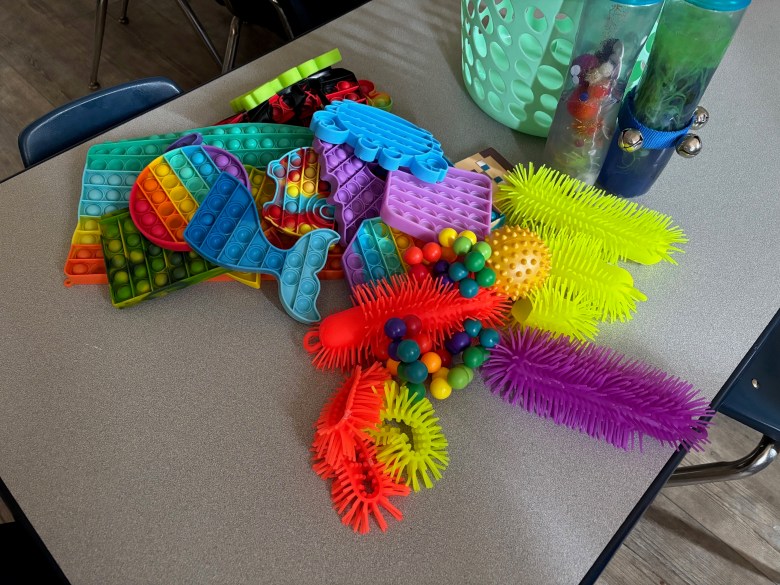
One tool for supporting and calming children with sensory issues is keeping a healthy supply of fidget toys and Pop-Its on hand. Credit: Sarah Carr/The Hechinger Report
Vermont also pumped millions of dollars into a separate program, known as the Special Accommodations Grant, that supports young children with disabilities. Since 2009 the state has set aside $300,000 a year that child care centers can tap to provide services for individual children with disabilities. It might help buy specialized equipment for a child with cerebral palsy, for instance, or be used to hire a full- or part-time aide.
The $300,000 has been maxed out every year, Rouse said. And after the pandemic, the need — and the number of applications — surged.
As a result, the state allocated some federal American Rescue Plan and Preschool Development Grant dollars to increase spending on the program by about sevenfold — to between $2 million and $2.5 million annually — an amount Rouse still describes as a “Band-Aid.” Without access to the grants, “we see a lot of children being asked to leave programs,” Rouse said. “That’s not good for any child, but for children with specialized developmental needs it’s particularly bad.”
Over time, Likely hopes, her Ohio center can play a small role in reducing that instability, although the center hasn’t yet been able to work with all such children it wants to. Likely recalls one toddler with a severe disability who climbed up anything he could. There wasn’t enough money to pay for what the child really needed: a full-time aide. “It’s hard when you know you’ve tried but still have to say no,” she said. “That breaks my heart more than anything.”
On one June morning, the center’s teachers acknowledged and celebrated several milestones in its work on inclusion, big and small. One child in the 3-year-old classroom with fine and gross motor challenges was drinking independently from a bottle. The preschool classroom held its first graduation ceremony, translated partly into sign language. All of the kids, no matter their challenges, were set to go on field trips to Dairy Queen and the zoo.
Likely dreams of someday running a center where about half of the children have a disability or delay. It may be years off, she said, but as with the milestones she sees scores of children at the center reach every day, “There’s a way — if there’s a will.”
Sarah Carr is a fellow at New America, focused on reporting on early childhood issues.
The Hechinger Report provides in-depth, fact-based, unbiased reporting on education that is free to all readers. But that doesn’t mean it’s free to produce. Our work keeps educators and the public informed about pressing issues at schools and on campuses throughout the country. We tell the whole story, even when the details are inconvenient. Help us keep doing that.