Category: Classroom Management

  • Creating a classroom built for success

    Creating a classroom built for success

    Key points:

    For decades, curriculum, pedagogy, and technology have evolved to meet the changing needs of students. But in many schools, the classroom environment itself hasn’t kept pace. Classic layouts that typically feature rows of desks, limited flexibility, and a single focal point can often make it harder for educators to support the dynamic ways students learn today.

    Classrooms are more than places to sit–when curated intentionally, they can become powerful tools for learning. These spaces can either constrain or amplify great teaching. By reimagining how classrooms are designed and used, schools can create environments that foster engagement, reduce stress, and help both teachers and students thrive.

    Designing a classroom for student learning outcomes and well-being

    Many educators naturally draw on their own school experiences when shaping classroom environments, often carrying forward familiar setups that reflect how they once learned. Over time, these classic arrangements have become the norm, even as today’s students benefit from more flexible, adaptable spaces that align with modern teaching and learning needs.

    The challenge is that classic classroom setups don’t always align with the ways students learn and interact today. With technology woven into nearly every aspect of their lives, students are used to engaging in environments that are more dynamic, collaborative, and responsive. Classrooms designed with flexibility in mind can better mirror these experiences, supporting teaching and learning in meaningful ways, even without using technology.

    To truly engage students, the classroom must become an active participant in the learning process. Educational psychologist Loris Malaguzzi famously described the classroom as the “third teacher,” claiming it has just as much influence in a child’s development as parents or educators. With that in mind, teachers should be able to lean on this “teacher” to help keep students engaged and attentive, rather than doing all the heavy lifting themselves.

    For example, rows of desks often limit interaction and activity, forcing a singular, passive learning style. Flexible seating, on the other hand, encourages active participation and peer-to-peer learning, allowing students to easily move and reconfigure their learning spaces for group work or individual work time.

    I saw this firsthand when I was a teacher. When I moved into one of my third-grade classrooms, I was met with tables that quickly proved insufficient for the needs of my students. I requested a change, integrating alternative seating options and giving students the freedom to choose where they felt most comfortable learning. The results exceeded my expectations. My students were noticeably more engaged, collaborative, and invested in class discussions and activities. That experience showed me that even the simplest changes to the physical learning environment can have a profound impact on student motivation and learning outcomes.

    Allowing students to select their preferred spot for a given activity or day gives them agency over their learning experience. Students with this choice are more likely to engage in discussions, share ideas, and develop a sense of community. A comfortable and deliberately designed environment can also reduce anxiety and improve focus. This means teachers experience fewer disruptions and less need for intervention, directly alleviating a major source of stress by decreasing the disciplinary actions educators must make to resolve classroom misbehavior. With less disruption, teachers can focus on instruction.

    Supporting teachers’ well-being

    Just as classroom design can directly benefit student outcomes, it can also contribute to teacher well-being. Creating spaces that support collaboration among staff, provide opportunities to reset, and reduce the demands of the job is a tangible first step towards developing a more sustainable environment for educators and can be one factor in reducing turnover.

    Intentional classroom design should balance consistency with teacher voice. Schools don’t need a one-size-fits-all model for every room, but they can establish adaptable design standards for each type of space, such as science labs, elementary classrooms, or collaboration areas. Within those frameworks, teachers should be active partners in shaping how the space works best for their instruction. This approach honors teacher expertise while ensuring that learning environments across the school are both flexible and cohesive.

    Supporting teacher voice and expertise also encourages “early adopters” to try new things. While some teachers may jump at the opportunity to redesign their space, others might be more hesitant. For those teachers, school leaders can help ease these concerns by reinforcing that meaningful change doesn’t require a full-scale overhaul. Even small steps, like rearranging existing furniture or introducing one or two new pieces, can make a space feel refreshed and more responsive to both teaching and learning needs. To support this process, schools can also collaborate with learning environment specialists to help educators identify practical starting points and design solutions tailored to their goals.

    Designing a brighter future for education

    Investing in thoughtfully designed school environments that prioritize teacher well-being isn’t just about creating a more pleasant workplace; it’s a strategic move to build a stronger, more sustainable educational system. By providing teachers with flexible, adaptable, and future-ready classrooms, schools can address issues like stress, burnout, and student disengagement. When educators feel valued and empowered in their spaces, they create a better work environment for themselves and a better learning experience for their students. Ultimately, a supportive, well-designed classroom is an environment that sets both educators and students up for success.

    Latest posts by eSchool Media Contributors (see all)

    Source link

  • New research highlights the importance and challenges of K-12 student engagement

    New research highlights the importance and challenges of K-12 student engagement

    This press release originally appeared online.

    Key points:

    While there is wide agreement that student engagement plays a vital role in learning, educators continue to face uncertainty about what engagement looks like, how best to measure it, and how to sustain it, according to a new study from Discovery Education

    Education Insights 2025–2026: Fueling Learning Through Engagement captures prevailing attitudes and beliefs on the topic of engagement from 1,398 superintendents, teachers, parents, and students from across the United States. Survey data was collected in May 2025 by Hanover Research on behalf of Discovery Education

    Discovery Education conducted the Education Insights report to gain a deeper understanding of how engagement is defined, observed, and nurtured in K-12 classrooms nationwide, and we are thankful to the participants who shared their perspectives and insights with us,” said Brian Shaw, Discovery Education’s Chief Executive Officer. “One of the most important findings of this report is that engagement is seen as essential to learning, but is inconsistently defined, observed, and supported in K-12 classrooms. I believe this highlights the need for a more standardized approach to measuring student engagement and connecting it to academic achievement. Discovery Education has embarked on an effort to address those challenges, and we look forward to sharing more as our work progresses.” 

    Key findings of the Education Insights 2025–2026: Fueling Learning Through Engagement report include: 

    Engagement is broadly recognized as a key driver of learning and success. Ninety-three percent of educators surveyed agreed that student engagement is a critical metric for understanding overall achievement, and 99 percent of superintendents polled believe student engagement is one of the top predictors of success at school. Finally, 92 percent of students said that engaging lessons make school more enjoyable. 

    But educators disagree on the top indicators of engagement. Seventy-two percent of teachers rated asking thoughtful questions as the strongest indicator of student engagement. However, 54 percent of superintendents identified performing well on assessments as a top engagement indicator. This is nearly twice as high as teachers, who rank assessments among the lowest indicators of engagement. 

    School leaders and teachers disagree on if their schools have systems for measuring engagement. While 99 percent of superintendents and 88 percent of principals said their district has an intentional approach for measuring engagement, only 60 percent of teachers agreed. Further, nearly one-third of teachers said that a lack of clear, shared definitions of student engagement is a top challenge to measuring engagement effectively. 

    Educators and students differ on their perceptions of engagement levels. While 63 percent of students agreed with the statement “Students are highly engaged in school,” only 45 percent of teachers and 51 percent of principals surveyed agreed with the same statement.  

    Students rate their own engagement much higher than their peers. Seventy percent of elementary students perceived themselves as engaged, but only 42 percent perceived their peers as engaged. Fifty-nine percent of middle school students perceived themselves engaged in learning, but only 36 percent perceived their peers as engaged. Finally, 61 percent of high school students perceived themselves as engaged, but only 39 percent described their peers as engaged. 

    Proximity to learning changes impressions of AI. Two-thirds of students believe AI could help them learn faster, yet fewer than half of teachers report using AI themselves to complete tasks. Only 57 percent of teachers agreed with the statement “I frequently learn about positive ways students are using AI,” while 87 percent of principals and 98 percent of superintendents agree. Likewise, only 53 percent of teachers agreed with the statement “I am excited about the potential for AI to support teaching and learning,” while 83 percent of principals and 94 percent of superintendents agreed. 

    Latest posts by eSchool Media Contributors (see all)

    Source link

  • Prioritizing behavior as essential learning

    Prioritizing behavior as essential learning

    Key points:

    In classrooms across the country, students are mastering their ABCs, solving equations, and diving into science. But one essential life skill–behavior–is not in the lesson plan. For too long, educators have assumed that children arrive at school knowing how to regulate emotions, resolve conflict, and interact respectfully. The reality: Behavior–like math or reading–must be taught, practiced, and supported.

    Today’s students face a mounting crisis. Many are still grappling with anxiety, disconnection, and emotional strain following the isolation and disruption of the COVID pandemic. And it’s growing more serious.

    Teachers aren’t immune. They, too, are managing stress and emotional overload–while shouldering scripted curricula, rising expectations, and fewer opportunities for meaningful engagement and critical thinking. As these forces collide, disruptive behavior is now the leading cause of job-related stress and a top reason why 78 percent of teachers have considered leaving the profession.

    Further complicating matters is social media and device usage. Students and adults alike have become deeply reliant on screens. Social media and online socialization–where interactions are often anonymous and less accountable–have contributed to a breakdown in conflict resolution, empathy, and recognition of nonverbal cues. Widespread attachment to cell phones has significantly disrupted students’ ability to regulate emotions and engage in healthy, face-to-face interactions. Teachers, too, are frequently on their phones, modeling device-dependent behaviors that can shape classroom dynamics.

    It’s clear: students can’t be expected to know what they haven’t been taught. And teachers can’t teach behavior without real tools and support. While districts have taken well-intentioned steps to help teachers address behavior, many initiatives rely on one-off training without cohesive, long-term strategies. Real progress demands more–a districtwide commitment to consistent, caring practices that unify educators, students, and families.

    A holistic framework: School, student, family

    Lasting change requires a whole-child, whole-school, whole-family approach. When everyone in the community is aligned, behavior shifts from a discipline issue to a core component of learning, transforming classrooms into safe, supportive environments where students thrive and teachers rediscover joy in their work. And when these practices are reinforced at home, the impact multiplies.

    To help students learn appropriate behavior, teachers need practical tools rather than abstract theories. Professional development, tiered supports, targeted interventions, and strategies to build student confidence are critical. So is measuring impact to ensure efforts evolve and endure.

    Some districts are leading the way, embracing data-driven practices, evidence-based strategies, and accessible digital resources. And the results speak for themselves. Here are two examples of successful implementations.

    Evidence-based behavior training and mentorship yields 24 percent drop in infractions within weeks

    With more than 19,000 racially diverse students across 24 schools east of Atlanta, Newton County Schools prioritized embedded practices and collaborative coaching over rigid compliance. Newly hired teachers received stipends to complete curated, interactive behavior training before the school year began. They then expanded on these lessons during orientation with district staff, deepening their understanding.

    Once the school year started, each new teacher was partnered with a mentor who provided behavior and academic guidance, along with regular classroom feedback. District climate specialists also offered further support to all teachers to build robust professional learning communities.

    The impact was almost immediate. Within the first two weeks of school, disciplinary infractions fell by 24 percent compared to the previous year–evidence that providing the right tools, complemented by layered support and practical coaching, can yield swift, sustainable results.

    Pairing shoulder coaching with real-time data to strengthen teacher readiness

    With more than 300,000 students in over 5,300 schools spanning urban to rural communities, Clark County School District in Las Vegas is one of the largest and most diverse in the nation.

    Recognizing that many day-to-day challenges faced by new teachers aren’t fully addressed in college training, the district introduced “shoulder coaching.” This mentorship model pairs incoming teachers with seasoned colleagues for real-time guidance on implementing successful strategies from day one.

    This hands-on approach incorporates videos, structured learning sessions, and continuous data collection, creating a dynamic feedback loop that helps teachers navigate classroom challenges proactively. Rather than relying solely on reactive discipline, educators are equipped with adaptable strategies that reflect lived classroom realities. The district also uses real-time data and teacher input to evolve its behavior support model, ensuring educators are not only trained, but truly prepared.

    By aligning lessons with the school performance plan, Clark County School District was able to decrease suspensions by 11 percent and discretionary exclusions by 17 percent.  

    Starting a new chapter in the classroom

    Behavior isn’t a side lesson–it’s foundational to learning. When we move beyond discipline and make behavior a part of daily instruction, the ripple effects are profound. Classrooms become more conducive to learning. Students and families develop life-long tools. And teachers are happier in their jobs, reducing the churn that has grown post-pandemic.

    The evidence is clear. School districts that invest in proactive, strategic behavior supports are building the kind of environments where students flourish and educators choose to stay. The next chapter in education depends on making behavior essential. Let’s teach it with the same care and intentionality we bring to every other subject–and give every learner the chance to succeed.

    Latest posts by eSchool Media Contributors (see all)

    Source link

  • 4 tips to create an engaging digital syllabus

    4 tips to create an engaging digital syllabus

    Key points:

    Back-to-school season arrives every year with a mixed bag of emotions for most educators, including anticipation and excitement, but also anxiety. The opportunity to catch up with friendly colleagues and the reward of helping students connect with material also comes with concern about how best to present and communicate that material in a way that resonates with a new classroom.

    An annual challenge for K-12 educators is creating a syllabus that engages students and will be used throughout the year to mutual benefit rather than tucked in a folder and forgotten about. Today’s digital transformation can be a means for educators to create a more dynamic and engaging syllabus that meets students’ and parents’ needs.

    While it can be overwhelming to think about learning any new education technology, the good news about a digital syllabi is that anyone who’s sent a digital calendar invite has already done most of the technical-learning legwork. The more prescient task will be learning the best practices that engage students and enable deeper learning throughout the year. 

    Step one: Ditch the PDFs and print-outs

    Creating a syllabus that works begins with educators stepping into the shoes of their students. K-12 classrooms are full of students who are oriented around the digital world. Where textbooks and binders were once the tools of the trade for students, laptops and iPads have largely taken over. This creates an opportunity for teachers to create more dynamic syllabi via digital calendars, rather than printed off or static PDFs with lists of dates, deadlines, and relevant details that will surely change as the year progresses. In fact, many learning management systems (LMS) already have useful calendar features for this reason. Again, teachers need only know the best way to use them. The digital format offers flexibility and connectivity that old-school syllabi simply can’t hold a candle to.

    Tips for creating an effective digital syllabus

    Classroom settings and imperatives can vary wildly, and so can the preferences of individual educators. Optimization in this case is in the eye of the beholder, but consider a few ideas that may wind up on your personal best practices list for building out your digital syllabus every year around this time:

    Make accessing the most up-to-date version of the syllabus as frictionless as possible for students and parents. Don’t attach your syllabus as a static PDF buried in an LMS. Instead, opt-in to the calendar most LMS platforms offer for the mutual benefit of educators, students, and parents. To maximize engagement and efficiency, teachers can create a subscription calendar in addition or as an alternative to the LMS calendar. Subscription calendars create a live link between the course syllabus and students’ and/or parents’ own digital calendar ecosystem, such as Google Calendar or Outlook. Instead of logging into the LMS to check upcoming dates, assignments, or project deadlines, the information becomes more accessible as it integrates into their monthly, weekly, and daily schedules, mitigating the chance of a missed assignment or even parent-teacher conference. Students and parents only have to opt-in to these calendars once at the beginning of the academic year, but any of the inevitable changes and updates to the syllabus throughout the year are reflected immediately in their personal calendar, making it simpler and easier for educators to ensure no important date is ever missed. While few LMS offer this option within the platform, subscription calendar links are like any hyperlink–easy to share in emails, LMS message notifications, and more.

    Leverage the calendar description feature. Virtually every digital calendar provides an option to include a description. This is where educators should include assignment details, such as which textbook pages to read, links to videos or course material, grading rubrics, or more. 

    Color-code calendar invitations for visual information processors. Support different types of information processors in the classroom by taking the time to color-code the syllabus. For example, purple for project deadlines, red for big exams, yellow for homework assignment due dates. Consistency and routine are key, especially for younger students and busy parents. Color-coding, or even the consistent naming and formatting of events and deadlines, can make a large impact on students meeting deadlines.

    Encourage further classroom engagement by integrating digital syllabus “Easter eggs.” Analog syllabi often contain Easter eggs that reward students who read it all the way through. Digital syllabi can include similar engaging surprises, but they’re easy to add throughout the year. Hide extra-credit opportunities in the description of an assignment deadline or add an invitation for last-minute office hours ahead of a big quiz or exam. It could be as simple as a prompt for students to draw their favorite animal at the bottom of an assignment for an extra credit point. If students are aware that these opportunities could creep up in the calendar, it keeps them engaged and perhaps strengthens the habit of checking their classroom syllabus.

    While the start of the new school year is the perfect time to introduce a digital syllabus into the classroom, it’s important for educators to keep their own bandwidth and comfortability in mind. Commit to one semester with a digital syllabus and spend time learning the basic features and note how the classroom responds. From there, layer in more advanced features or functionality that helps students without being cumbersome to manage. Over time, educators will learn what works best for them, their students and parents, and the digital syllabus will be a classroom tool that simplifies classroom management and drives more engagement year-round. 

    Latest posts by eSchool Media Contributors (see all)

    Source link

  • 3 steps to build belonging in the classroom

    3 steps to build belonging in the classroom

    Key points:

    The first few weeks of school are more than a fresh start–they’re a powerful opportunity to lay the foundation for the relationships, habits, and learning that will define the rest of the year. During this time, students begin to decide whether they feel safe, valued, and connected in your classroom.

    The stakes are high. According to the 2023 Youth Risk Behavior Survey, only 55 percent of students reported feeling connected to their school. That gap matters: Research consistently shows that a lack of belonging can harm grades, attendance, and classroom behavior. Conversely, a strong sense of belonging not only boosts academic self-efficacy but also supports physical and mental well-being.

    In my work helping hundreds of districts and schools implement character development and future-ready skills programs, I’ve seen how intentionally fostering belonging from day one sets students–and educators–up for success. Patterns from schools that do this well have emerged, and these practices are worth replicating.

    Here are three proven steps to build belonging right from the start.

    1. Break the ice with purpose

    Icebreakers might sound like old news, but the reality is that they work. Research shows these activities can significantly increase engagement and participation while fostering a greater sense of community. Students often describe improved classroom atmosphere, more willingness to speak up, and deeper peer connections after just a few sessions.

    Some educators may worry that playful activities detract from a serious academic tone. In practice, they do the opposite. By helping students break down communication barriers, icebreakers pave the way for risk-taking, collaboration, and honest reflection–skills essential for deep learning.

    Consider starting with activities that combine movement, play, and social awareness:

    • Quick-think challenges: Build energy and self-awareness by rewarding quick and accurate responses.
    • Collaborative missions: Engage students working toward a shared goal that demands communication and teamwork.
    • Listen + act games: Help students develop adaptability through lighthearted games that involve following changing instructions in real time.

    These activities are more than “fun warm-ups.” They set a tone that learning here will be active, cooperative, and inclusive.

    2. Strengthen executive functioning for individual and collective success

    When we talk about belonging, executive functioning skills–like planning, prioritizing, and self-monitoring–may not be the first thing we think of. Yet they’re deeply connected. Students who can organize their work, set goals, and regulate their emotions are better prepared to contribute positively to the class community.

    Research backs this up. In a study of sixth graders, explicit instruction in executive functioning improved academics, social competence, and self-regulation. For educators, building these skills benefits both the individual and the group.

    Here are a few ways to embed executive functioning into the early weeks:

    • Task prioritization exercise: Help students identify and rank their tasks, building awareness of time and focus.
    • Strengths + goals mapping: Guide students to recognize their strengths and set values-aligned goals, fostering agency.
    • Mindful check-ins: Support holistic well-being by teaching students to name their emotions and practice stress-relief strategies.

    One especially powerful approach is co-creating class norms. When students help define what a supportive, productive classroom looks like, they feel ownership over the space. They’re more invested in maintaining it, more likely to hold each other accountable, and better able to self-regulate toward the group’s shared vision.

    3. Go beyond the first week to build deeper connections

    Icebreakers are a great start, but true belonging comes from sustained, meaningful connection. It’s tempting to think that once names are learned and routines are set, the work is done–but the deeper benefits come from keeping this focus alive alongside academics.

    The payoff is significant. School connectedness has been shown to reduce violence, protect against risky behaviors, and support long-term health and success. In other words, connection is not a “nice to have”–it’s a protective factor with lasting impact.

    Here are some deeper connection strategies:

    • Shared values agreement: Similar to creating class norms, identify the behaviors that promote safety, kindness, and understanding.
    • Story swap: Have students share an experience or interest with a partner, then introduce each other to the class.
    • Promote empathy in action: Teach students to articulate needs, seek clarification, and advocate for themselves and others.

    These activities help students see one another as whole people, capable of compassion and understanding across differences. That human connection creates an environment where everyone can learn more effectively.

    Take it campus-wide

    These strategies aren’t limited to students. Adults on campus benefit from them, too. Professional development can start with icebreakers adapted for adults. Department or PLC meetings can incorporate goal-setting and reflective check-ins. Activities that build empathy and connection among staff help create a healthy, supportive adult culture that models the belonging we want students to experience.

    When teachers feel connected and supported, they are more able to foster the same in their classrooms. That ripple effect–staff to students, students to peers–creates a stronger, more resilient school community.

    Belonging isn’t a single event; it’s a practice. Start the year with purpose, keep connection alive alongside academic goals, and watch how it transforms your classroom and your campus culture. In doing so, you’ll give students more than a positive school year. You’ll give them tools and relationships they can carry for life.

    Latest posts by eSchool Media Contributors (see all)

    Source link

  • How we designed a space where our students connect, collaborate, and flourish

    How we designed a space where our students connect, collaborate, and flourish

    Key points:

    Our charter school, Westbrook Academy, has been serving middle and high school students in the South Los Angeles area for the past six years and stands as a beacon of opportunity for our community. With a student body comprising nearly 99 percent Black and Latinx individuals hailing from historically under-resourced communities, we confront the realities of poverty and the accompanying insecurities head-on.

    Despite the odds, our 400 students consistently demonstrate remarkable resilience and a profound capacity for excellence. Our institution is supported by generous donors and funding sources. Operated and managed by the education nonprofit LA Promise Fund, which provides students with academic and enrichment opportunities that support our mission to spark passion, empower leadership, and prepare them for their chosen college and career paths.

    At one point, our high school students were learning in a church because we didn’t have a traditional classroom set-up. We also lacked the equipment that a traditional high school might have. This changed when we moved into our forever home in South Gate, where an on-campus Empowerment Center serves as a modern, welcoming “student hub.”

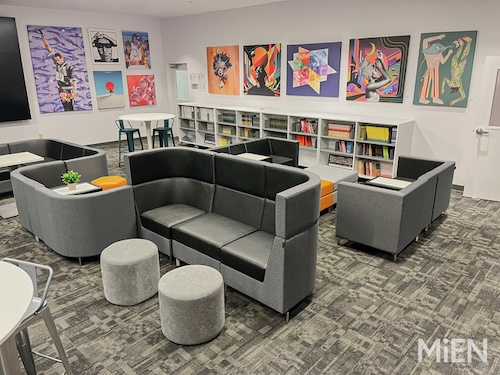
    Designed and outfitted by MiEN and Meteor Education, the Empowerment Center is where kids go to hang out, collaborate, and/or participate in school club activities. The hub is also set up with two wellness rooms where students can go to debrief and disconnect from a long day or just the stresses of being a student. It’s there for the students’ use.

    Here are the steps we took to create a space that consistently makes jaws drop and impresses parents who never thought their children would have access to such a warm, welcoming communal space on campus:

    • Add some flexibility into the process. Our original goal was to open the Empowerment Center’s doors in time for the 2023-24 school year, but getting it done the right way would require a bit more time. Our partners were willing to listen to us in terms of what we wanted to create, but within the realistic timelines. That was really cool.
    • Acknowledge the financial limitations. We largely relied on fundraising for this project and knew that some things just weren’t going to be realistic. To other schools in similar situations, I’d recommend staying flexible enough to hit the timelines and get all of the bases covered while keeping student needs in mind. We can have all the bells and whistles, but at the end of the day, if the car runs, the car runs. We know we can always add a new paint job later.
    • Get the right partners onboard early. As we went through the steps of designing the Empowerment Center, we learned a lot about architecture, planning, and construction. Through it all, having the right partners in its corner helped the school achieve its goals within budget and on time. It was really great to have our design and furniture partners sharing their best practices and other insights with us. We knew what we wanted to do, and a lot of the ideas came from our families and students. We just needed them to show us how we could get those ideas as close to reality as possible.
    • Make it personal. Special features we wanted in our Empowerment Center included a huge, interactive flatscreen TV that students, teachers, and guest speakers use to interact and work together. There’s also a large selection of donated books, the latest technology tools, and artwork that was personally selected by an art curation team. They were able to secure artists from the LA community to create and share visuals that our students are really familiar with. For example, some of the artwork spotlights female empowerment (i.e., with photos of authors like Octavia Butler) and the importance of acknowledging indigenous people. Everything in the hub is meant to spark curiosity. 
    • Brace yourself for some jaw-dropping moments. At our ribbon-cutting ceremony last year, our parents’ jaws were on the floor. They just never thought these resources would be available to their kids. A lot of them grew with us being in the church and a co-located space, and then we asked them to trust us to deliver on our promise, and now we’re able to show that as the reward for supporting us. We feel really proud that our parents were just over the moon about it.

    Hitting it out of the park

    Reflecting on the process we put in place to get our modern student hub designed, built, and open for business, I can say that the end result is an engaging, collaborative space that can be used for hanging out, structured learning, or a little of both. I think we really hit the ball out of the park with this innovative space.

    Student, teacher, and family feedback on the Empowerment Center has been extremely positive. Everyone loves it, and students are always excited to come and spend time in the modern, comfortable space that’s equipped with the technology and tools they need to be able to learn and engage.

    Latest posts by eSchool Media Contributors (see all)

    Source link