Category: Coaching

  • Higher Education Leadership in Times of Crisis – Edu Alliance Journal

    Higher Education Leadership in Times of Crisis – Edu Alliance Journal

    First in Leadership Series by Barry Ryan, PhD, JD August 11, 2025

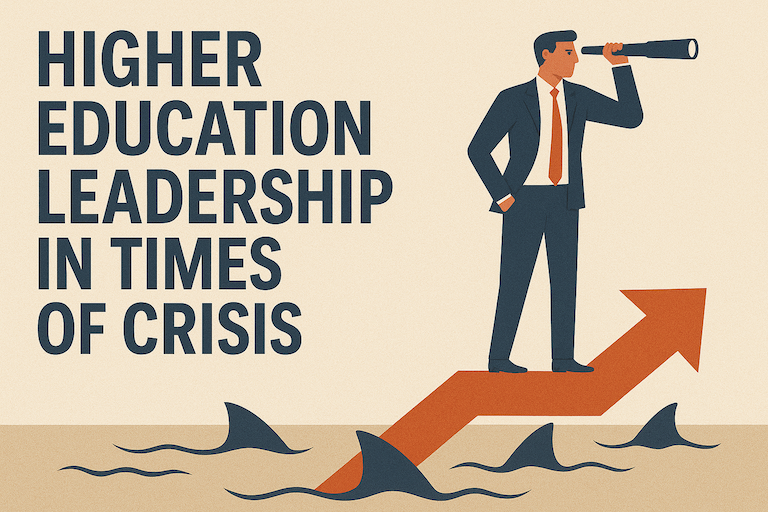
    It is hard to think of a time when higher education was swimming in a pool filled with a greater number of shark-like threats than at present.

    Some of these were predictable (in hindsight), some not so much. Let’s set aside blame, however, on either an institutional level or on a more global basis. The vital thing now is for genuine leaders to help chart courses that will lead higher education, not just to mere survival, but to new and meaningful purposes that will benefit this generation and the next.

    When situations are “normal,” we may be tempted to imagine that we need leadership that can keep the legacy intact, turn the crank, not rock the boat. But normal no longer exists, does it?

    I remember a senior university leader, who admonished me, as I began a new presidency: “everything’s going great—just don’t mess it up” (using slightly more colorful language). One year later, seismic changes in higher ed created an unexpected crisis and necessitated major changes in the institution. Almost everything that had contributed to its prior success turned, overnight, into a liability.

    There is, of course, more than one crisis in which higher ed is being buffeted. The sheer number of colleges and universities that have ceased to exist at all, or have been merged to various extents with others, or are currently teetering on the brink, appears in news stories almost every day. The root causes are legion and often woven together: financial shortfalls, a shrinking number of students, reductions in state and federal support, the disappearance of many international students, families, and prospective students increasingly unable to justify the cost of a degree, the “value” of which is seriously questioned. The list goes on.

    Of the three large “types” of higher education in the United States—public (state) colleges and universities, private not-for-profit colleges and universities, and for-profit entities—the vast majority are struggling in meaningful ways.

    If you find yourself in a leadership role in this age of crisis, what are some key things you can do to keep becoming a better leader and more effectively serve your institution and your colleagues? Here are three suggestions that you may find helpful.

    First, don’t panic.

    And even if you do feel panic welling up inside you, do your best to keep it from becoming obvious. Phil Slott, who was involved in the Dry Idea marketing campaign in the 1980s, seems to have coined a relevant phrase: “Never let them see you sweat.” It just stresses you out more and does little to inspire confidence in those who are looking to you for leadership.

    Once you’ve steadied yourself, the next critical realization is that leadership in crisis cannot be solitary work.

    Second, remember every day, you can’t do this alone.

    A 19th-century lawyer by the name of Abe Lincoln is credited with the adage: “A person who represents himself in court has a fool for a client.” That rings true for any leader who tries to do everything and assumes they have sufficient knowledge (or wisdom or experience or insight) to solve every problem on their own. No one does—no matter how experienced.

    So where do you turn for help? The answer is two-fold: internally and externally. You need to draw on both circles and find confidential, experienced, and reliable counsel.

    Choose very carefully with whom you share the issues internally. Depending on the nature of the problem you’re trying to address, success might well be thwarted if there is a lapse of absolute confidentiality. At the starting point of the process, you need to be able to rely on one other person, or perhaps a very small circle, with which you will be able to expand bit by bit as the timeline moves along.

    There are difficult audiences and stakeholders in the life of an academic institution, and ultimately, all must be included in the process of working through a crisis. The sequencing of sharing information and inviting input, though, must be very carefully structured. If you’re a president, oftentimes the first person you seek is a senior member of the administration—a provost, vice president, or someone in a similar position. At times, it could be the chair of the board or a wise and thoughtful alum. But whoever the person(s) may be, the timing of sharing the situation and seeking input for solutions is everything.

    It’s very important not to neglect external assistance as well. It is all but impossible to generate a sufficient perspective on a crisis from only one (your) vantage point, or even from that of your small, trustworthy group. You’re very likely not the first institution to face these problems, and consulting with trusted external leaders can provide not only perspective but also ideas you may not have thought of on your own.

    Some of these leaders may be in academic institutions, but not necessarily. It is always helpful to have relationships with leaders in other professional fields as well, who may be particularly helpful in providing fresh perspectives and ideas. For example, in my own experience, I’ve found such people in leadership of non-profit organizations or boards, key corporate positions, government at various levels, and experienced friends with whom I served long ago, and could provide input on both my institution’s situation and also my own strengths and weaknesses. In addition, external folks don’t have the same emotional investment as someone internal, so the chances of a more neutral observation point are increased significantly.

    There is a temptation—and often a prudent one—to seek external input from lawyers. There are, of course, a fair number of attorneys and firms with expertise in higher education, which can be a plus. Higher education is a very specialized field, and, frankly, most lawyers have a huge knowledge deficit in terms of the operational realities of a college or university. Their tendency is to think, “Well, I know higher ed—after all, I went to college and law school” (or maybe even taught a course or two). Beware the well-intentioned lawyer who does not have directly relevant practice experience.

    This, of course, does not at all preclude seeking competent legal advice for certain aspects of the problems you may be facing. For example, most institutions have or will need counsel in employment matters. Even if not the center of your challenge, these issues will likely arise as part of the need for a solution to your challenges. If it appears you will have to make difficult financial decisions that might impact faculty or staff, you should seek excellent employment counsel much sooner rather than later. With students, Title IX requirements, for example, may dictate the need for specialized counsel, as might certain types of accreditation issues.

    Third, leadership is not “one size fits all.”

    Every leader has different abilities and personalities. Even though many institutions experience similar types of crises, the circumstances of each call for a bespoke solution.

    However, some very important leadership characteristics can increase the probability of success in these situations. In part two, we’ll examine these and how to cultivate them.


    Dr. Barry Ryan invested the first half of his career in higher education in teaching and the second half in administration. During that same timeframe, he pursued a parallel career in law and legal education. He​ served as the Supreme Court Fellow in the chambers of Chief Justice William H. Rehnquist and is a​ member of numerous federal and state bars. He has been appointed as the president of five universities and provost and chief of staff at three others. Among the institutions he served have been state, private non-profit, and private for-profit universities. Included in his academic experience were two terms as a Commissioner of the regional accreditor WASC​ (WSCUC).

    He has been appointed as the president of five universities and provost and chief of staff at three others. Among the institutions he served have been state, private non-profit, and private for-profit universities. Included in his academic experience were two terms as a Commissioner of the regional accreditor WASC​ (WSCUC). Dr. Ryan has led institutions through mergers, acquisitions, and affiliations that have preserved academic​ quality, expanded access, and strengthened long-term viability. His leadership has been marked by​ transparency, shared governance, and a commitment to stakeholder engagement at every stage of these processes.

    He earned his Ph.D. from the University of California, Santa Barbara, his J.D. from the University of​ California, Berkeley, and his Dipl.GB in international business from the University of Oxford.

    Edu Alliance Journal provides expert commentary and practical insights on U.S. and international higher education, focusing on innovation, policy, and institutional growth. Published by Edu Alliance, a consulting firm with offices in the United States and the United Arab Emirates, the Journal reflects the organization’s mission to help colleges, universities, and educational organizations achieve sustainable success through strategic partnerships, market intelligence, and program development.
    Source link

  • Why Executive Coaching Works in Higher Education – Edu Alliance Journal

    Why Executive Coaching Works in Higher Education – Edu Alliance Journal

    “When a leader gets better, everyone wins!”

    July 5, 2022 by Dr. Candace Goodwin – Although every industry has undergone significant changes over the past several years, higher education has been impacted more profoundly. When the pandemic hit, traditional colleges and universities were abruptly forced to adapt their mindset and move toward thinking differently, scrambling to transform standard brick-and-mortar programs into online or hybrid delivery modalities. Colleges and universities that already had successful online programs could pivot quickly and sustain student enrollment. Universities unable to make these changes rapidly faced many challenges.

    High education leadership teams were confronted with workforce challenges they had not faced before. The changes in the economy, staffing shortages, healthcare concerns, loss of international students, diversity, equity, and inclusion were all simultaneously impacting higher education. College leadership focused on enrollment as their highest priority and lost sight of how the pandemic influenced staff and shaped their expectations and preferences. Employees were seeking out empathy, remote work, and flexible work hours and wanted to feel more connected than ever.

    As the environment of higher education leadership becomes more complicated by outside events and shifting employee motivations, the benefits of executive coaching only increase. High- quality executive coaching balances organizational priorities like enrollment with the leadership development and insight required to move those priorities forward. Executive coaching is an essential problem-solving tool for higher education executives seeking support balancing leadership challenges and understanding the higher education landscape from both the 30,000 ft elevation and the 100 ft elevation.

    1. Executive coaching activates and animates wisdom.

    Many executives and aspiring higher education leaders lean most heavily on their level of intelligence. Clayton (1982) defined intelligence as the ability to think logically, conceptualize, and abstract from reality. Intelligence focuses on how to do. It helps leaders accomplish and achieve.

    By contrast, Clayton defines wisdom as the ability to grasp human nature, which is paradoxical, contradictory, and subject to continual change. Wisdom provokes a person to consider the consequences of their actions on themselves and the effects on others.

    Wisdom helps people decide whether to pursue a course of action. Higher education executives work in concert with many others. It is incumbent on all higher education leaders to work with their wisdom.

    The difference between intelligence and wisdom can be described as knowing what vs. knowing how. According to Stenberg (2005), knowing how adds creativity and experience to our knowledge. While an executive has proven intelligence, the wisdom gained by learning from various experiences provides multiple points of view at their disposal to solve problems creatively.

    It is no longer sufficient to only have intelligence and management skills to make high- level and far-reaching leadership decisions. Wisdom is a crucial component of good leadership. Staudinger, Lopez, and Baltes (1997) found that individuals who discussed life problems with another person and reflected on the conversation before responding out-performed others. Executive coaching can make the difference in that kind of wisdom and more.

    An executive coach for higher education helps college and university executives activate and animate their wisdom. Executive coaches guide leaders to go beyond reporting metrics and learn ways to increase their wisdom through natural reciprocity, investing in their team, and developing new leadership traits. The result is a higher education leader able to make more creative and cultured decisions that are the best for university and college leadership, staff, and students.

    2. Executive coaching galvanizes conscious and intentional conversations.

    There are two conversations we have every day. One is with other people—and one is in our heads. Having conversations with other people can feel fraught in this increasingly complicated world. Higher education executives need to ensure their conversations are conscious and intentional. Executive coaching can help!

    Conscious conversations encourage connection and overcoming differences. The basis is hearing and understanding instead of judging as right or wrong. Participants in a conversation of this nature must be fully present, listen fully and respectfully, keep an open mind, and be patient. It is important to understand that conversations of this kind are a skill to be learned and built upon. There is always room to improve communication as a leader.

    Intentional conversations are purposeful and planned. Being intentional means being strategic in how to communicate, what to communicate, and to whom. Intentional conversations can make staff members feel valued and ensure that conversations are productive.

    With an executive coach, higher education executives can build confidence in their ability to have conscious and intentional conversations.

    3. Executive coaching stimulates creativity.

    With the landscape for higher education rapidly changing, a successful higher education executive needs to move beyond the same old, same old. It is time for creativity in all aspects of leadership. Nothing helps creativity like the collaboration that comes from partnering with an executive coach.

    Most executives could benefit from switching things up and taking their leadership off auto pilot. A significant outcome could be developing a flexible mindset and considering new ways to get things done. A lack of creativity could result in missing opportunities for innovation and growth. Working with an executive coach helps open the door to explore innovative ideas and getting excited by new, creative possibilities.

    4. Executive coaching creates “emotional safety.”

    Having emotional safety means feeling secure enough to be your most authentic self, and isn’t that the ideal for all employee-leader scenarios? Who wouldn’t want to bring their real selves to work? Well, that takes work. Emotional safety is an important aspect of having a satisfying connection. Connection is increasingly vital to today’s workforce. It is worth the investment.

    Higher education executive coaching cultivates emotional safety so executives can get the most out of their experience. Our brains constantly detect whether a situation is safe or dangerous. When people experience safety, they are better listeners, able to collaborate more, innovative, creative, and able to connect with others. Emotional safety has positive effects that flow to others.

    Emotional safety encourages freedom of expression and increased compassion. A skilled executive coach can help guide you to understanding and increasing emotional safety.

    Executives and leaders in higher education benefit from the investment in high-quality executive coaching. Coaching is transformative—helping leaders leverage their best selves. An executive coach empowers creativity, impact, connection, and influence. Great leaders have great coaches—everyone can use that kind of support! Especially leaders working in higher education.

    Aides, Kim. “Six Reasons to Hire an Executive Coach.” Frame of Mind Coaching, 16, Nov. 2021, https://www.frameofmindcoaching.com/blog/reasons-to-hire-an-executive-coach.

    Boeder, E. “Emotional Safety is Necessary for Emotional Connection” The Gottman Institute. https://www.gottman.com/blog/emotional-safety-is-necessary-for-emotional-connection/

    Clayton V. (1982). Wisdom and intelligence: the nature and function of knowledge in the later years.

    International journal of aging & human development, 15(4), 315–321. https://doi.org/10.2190/17tq-bw3y-p8j4-tg40 https://pubmed.ncbi.nlm.nih.gov/7183572/

    Drake, David and Webb, Peter (2018).” Coaching for Wisdom: Enabling Wise Decisions.” Research Gate, February 2018, https://www.researchgate.net/publication/323257694_Coaching_for_Wisdom_Enabling_Wise_D ecisions

    Levine, Arthur and Pelt, S. “The Future of Higher Education is Occurring at the Margins.” Inside Higher Education, 4, Oct. 2021, https://www.insidehighered.com/views/2021/10/04/higher-education- should-prepare-five-new-realities-opinion

    Staudinger, U.M., Lopez, D. F., and Baltes, P. B. (1997). The psychometric location of wisdom-related performance: Intelligence, personality and more. Personality and Social Psychology Bulletin, 23(11). 1200-1214,

    Sternberg, R. J. (2005). WICS: A model of leadership. The Psychologist- Manager Journal, 8(1), 20-43.

    Sternberg, R. J. (2005a). WICS: A model of leadership. The Psychologist-Manager Journal, 8(1), 20–43


    Dr. Candace Goodwin a member of the Edu Alliance Group Advisory Council is a culture strategist and the CEO of Organizational Leadership Partners, an organization that helps leaders achieve exceptional results through the alignment of organizational priorities and culture. Candace’s expertise in culture, employee engagement, emotional intelligence, and leadership development provides guidance to leaders who desire to create an environment where people can do their best work.

    Dr. Goodwin has a Doctorate in Organizational Leadership, an MBA in Human Resources, and a Bachelor’s degree in Finance.

    Edu Alliance Group, Inc. (EAG) is an education consulting firm located in Abu Dhabi, the United Arab Emirates, and Bloomington, Indiana, USA. We assist higher education institutions worldwide on a variety of mission-critical projects. Our consultants have accomplished university/college leaders who share the benefit of their experience to diagnose and solve challenges.

    EAG has provided consulting and successful solutions for higher education institutions in Australia, Egypt, Georgia, India, Kazakhstan, Morocco, Nigeria, Uganda,  United Arab Emirates, and the United States.

    Edu Alliance offers higher education institutions consulting services worldwide. If you like to know more about how Edu Alliance can best serve you, please contact Dean Hoke at [email protected] 

    Source link