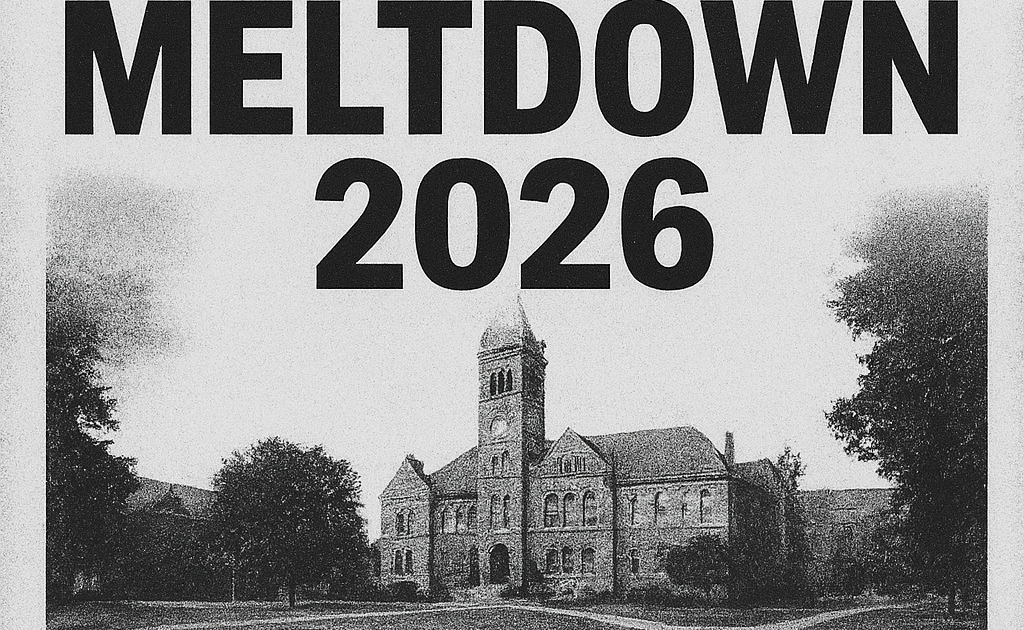
Category: college meltdown

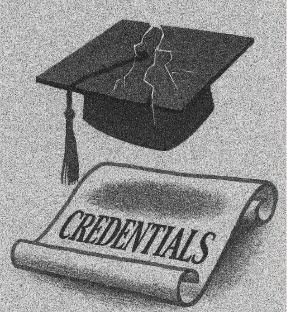
  • The Spell is Broken, But Credentials Remain

    The Spell is Broken, But Credentials Remain

    For decades, America was gripped by college mania, a culturally and structurally manufactured frenzy that elevated higher education to near-mythical importance. Students, families, and society were swept up in the belief that a college degree guaranteed status, financial security, and social validation. This was no mere aspiration; it was a fevered obsession, fueled by marketing, rankings, policy incentives, and social pressure. Today, the spell is breaking, but the demand for credentials persists.

    Historically, the term “college mania” dates to the 19th century, when historian Frederick Rudolph used it to describe the fervent founding of colleges in the United States, driven by religious zeal and civic ambition. Over time, the mania evolved. Postwar expansion of higher education through the GI Bill normalized college attendance as a societal expectation. Rankings, elite admissions, and media coverage transformed selective schools into symbols of prestige. By the early 2000s, for-profit colleges exploited the frenzy, aggressively marketing to students while federal and state policy incentivized enrollment growth over meaningful outcomes.

    The early 2010s revealed the fragility of this system in what I have described as the College Meltdown: structural dysfunction, declining returns on investment, predatory practices, and neoliberal policy failures exposed the weaknesses behind the hype. At its height, college mania spun students and families into a cycle of aspiration, anxiety, and debt.

    Now, even students at the most elite institutions are disengaging. Many do not attend classes, treating lectures as optional, prioritizing networking, internships, or social signaling over actual learning. This demonstrates that the spell of college mania is unraveling: prestige alone no longer guarantees engagement or meaningful educational outcomes. Families are questioning the value of expensive degrees, underemployment is rising, and alternative pathways, including vocational training, apprenticeships, and nontraditional credentials, are gaining recognition.

    Yet the paradox remains: for many jobs, credentials are still required. Nursing, engineering, teaching, accounting, and countless professional roles cannot be accessed without degrees. The waning mania does not erase the need for qualifications; it simply exposes how much of the cultural obsession — the anxiety, overpaying, and overworking — was socially manufactured rather than inherently necessary for employment. Students are now forced to navigate this tension: pursuing credentials while seeking value, purpose, and meaningful learning beyond the symbol of the degree itself.

    The breaking of the spell is not unique to higher education. History demonstrates that manias — economic, social, or cultural — rise and fall. College mania, once fueled by collective belief and systemic reinforcement, is now unraveling under the weight of its contradictions. Institutions must adapt by emphasizing authentic education rather than prestige, while policymakers can prioritize affordability, accountability, and outcomes. Students, in turn, may pursue paths aligned with practical skills, personal growth, and career readiness rather than chasing symbolic credentials alone.

    The era of college mania may be ending, but with the spell broken comes an opportunity. Higher education can be reimagined as a system that serves public good, intellectual development, and genuine opportunity, balancing the need for credentials with the pursuit of meaningful education.


    Sources:

    Frederick Rudolph, The American College and University: A History (1962).

    Frank Bruni, Where You Go Is Not Who You’ll Be: An Antidote to the College Admissions Mania (2015).

    Dahn Shaulis, Higher Education Inquirer, “College Meltdown and the Manufactured Frenzy” (2011–2025).

    Stanford Law Review, Private Universities in the Public Interest (2025).

    Higher Education Handbook of Theory & Research, Volume 29 (2024).

    Recent reporting on student engagement, class attendance, and labor-market requirements for degrees, 2023–2025.

    Source link

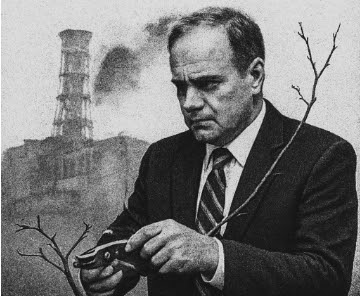
  • Higher Education Inquirer : The College Meltdown: Pruning in Chernobyl

    Higher Education Inquirer : The College Meltdown: Pruning in Chernobyl

    Since the fallout of Occupy Wall Street in 2011, a small but persistent movement has sought to expose the widening inequities and systemic failures in U.S. higher education. We have agitated, analyzed, and educated, warning that the “market-driven” model championed by elite managers—presidents, trustees, CFOs, and state policymakers—would erode both academic quality and access. Today, that warning has become reality.

    The College Meltdown is not a metaphor. It is a literal unraveling of an ecosystem where public support has eroded, tuition has skyrocketed, and students are left with crushing debt. Colleges are shuttering campuses, programs are disappearing, and adjuncts—already the backbone of instruction—face insecure employment. Meanwhile, neoliberal administrators, entrusted with guiding institutions through turbulence, have mostly engaged in cosmetic pruning rather than systemic reform.

    This is not accidental. The managerial class in higher education—driven less by pedagogy than by budgets, branding, and financialization—has embraced austerity measures that protect elite interests while passing costs to students and staff. Endowment growth, athletics spending, and executive compensation often take priority over the academic mission. HBCUs and tribal colleges, already underfunded, bear the brunt of this mismanagement.

    Efforts to stabilize the system have been tepid at best. Proposals for meaningful structural reform, from debt relief to state reinvestment, are watered down by political and market pressures. Neoliberals tout efficiency and innovation, yet rarely address the underlying moral crisis: the deliberate prioritization of profit over learning, and the failure to cultivate a socially responsible citizenry.

    Our own engagement, since 2011, has aimed to shine light on these contradictions. We have chronicled how policies favoring privatization, corporate partnerships, and debt-financed tuition have created conditions ripe for collapse. We have amplified voices of students and faculty navigating these pressures. And we have challenged complacency in the academy, insisting that higher education be measured not just by financial metrics but by its capacity to educate, empower, and expand human potential.

    “Pruning in Chernobyl” captures the essence of this moment: managerial actors trimming the edges while radioactive structural failures spread unchecked. Unless institutions confront the root causes—inequality, extractive financial models, and an erosion of public purpose—the meltdown will deepen. Our work remains to educate the public, hold decision-makers accountable, and imagine a higher education system that nurtures learning rather than merely managing decline.


    Sources:

    1. Higher Education Inquirer Archives, 2016–2025.

    2. American Injustice Archives, 2008-2012. 

    Source link

  • How Close Are We to Collapse? (Glen McGhee)

    How Close Are We to Collapse? (Glen McGhee)

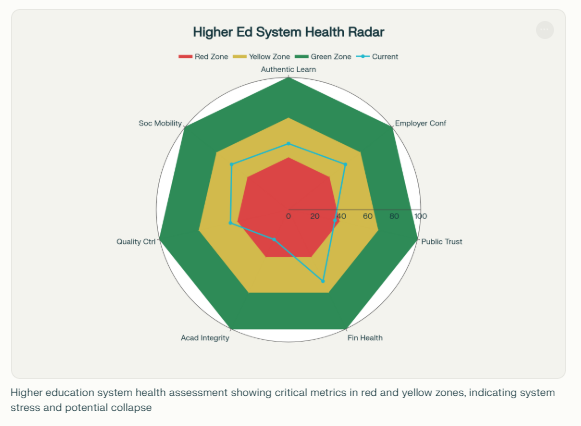
    For years, higher education leaders have avoided one of the most uncomfortable questions in the field: What is the minimum threshold of authentic learning required to keep the system operational? That threshold exists — and recent data suggest we may have already crossed it. The warning signs are visible in eroding public trust, declining employer confidence, and a growing inability to authenticate credentials. What we are watching now is not a temporary disruption, but the managed decline of mass higher education as we have known it.

    A truly viable education system has to deliver four essential functions. It must transmit knowledge — not only basic literacy, numeracy, and critical thinking, but also the domain-specific skills employers recognize, along with the ability to evaluate information in a democratic society. It must authenticate credentials by verifying learner identity, ensuring assessments are legitimate, maintaining tamper-proof records, and clearly differentiating between levels of competence. It must serve as a pathway for social mobility, providing economic opportunities that justify the investment, generating real wage premiums, and fostering professional networks and cultural capital. And it must have reliable quality assurance, with competent faculty, relevant curriculum, trustworthy measurement of learning outcomes, and external accountability strong enough to maintain standards.

    Research into institutional collapse and critical mass theory shows that each of these functions has a minimum operational threshold. The authentic learning rate must exceed 70 percent for degrees to retain their signaling value. Below that point, employers begin to see the credential itself as unreliable. Estimates today range from 30 to 70 percent, depending on the institution and delivery method. Employer confidence must stay above 80 percent for degrees to remain the default hiring credential. When fewer than eight in ten employers trust the degree signal, alternative credentialing accelerates — something already underway as skills-based hiring spreads across industries. Public trust must also remain high, but Gallup’s 2023 data put confidence in higher education at just 36 percent, far below the survival threshold. On the financial side, stability is eroding, with roughly 15 percent of U.S. institutions at risk of closure and more failing each year.

    Despite these trends, parts of the system still function effectively. Elite institutions with rigorous admissions, strong alumni networks, and powerful employer relationships continue to maintain credibility. Professional programs such as medicine, engineering, and law retain integrity through external licensing and oversight. Technical programs tied closely to industry needs still provide authenticated learning with direct employment pathways. Research universities at the graduate level preserve rigor through peer review, publication requirements, and close faculty mentorship. These pockets of quality create the illusion that the overall system remains sound, even as large portions hollow out.

    But the cracks are widening. Public trust is at 36 percent. Fraud rates are climbing beyond detection capacity, with California’s rate estimated at 31 percent. Grade inflation is erasing distinctions between levels of achievement. Authentic learning appears to be hovering somewhere between 30 and 70 percent, putting the system in a yellow warning zone. Financially, the sector remains unstable, with 15 percent of institutions on the brink.

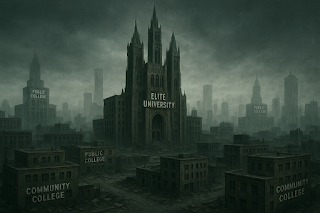
    Higher education is also becoming sharply stratified. At one end are the high-integrity institutions that still maintain meaningful standards, a group that may represent just 20 to 30 percent of the market. In the middle are the credential mills — low-integrity schools operating on volume with minimal quality control, perhaps 40 to 50 percent of the market. On the other end, alternative providers such as bootcamps, apprenticeships, and corporate academies are rapidly filling the skills gap. This stratification allows the system to stagger forward while its core mission erodes.

    Collapse becomes irreversible when several failure points converge. Employer confidence dropping below 50 percent would trigger mass abandonment of degree requirements. Public funding cuts, fueled by political backlash, would intensify. Alternative credentials would reach critical mass, making traditional degrees redundant in many sectors. A faculty exodus would leave too few qualified instructors to maintain quality. Rising student debt defaults could force the federal government to restrict lending.

    The available evidence suggests the tipping point likely occurred sometime between 2020 and 2024. That was when public trust cratered, employer skepticism intensified, financial fragility spread, and the post-pandemic environment made fraud and grade inflation harder to contain. We may already be living in a post-viable higher education system, one where authentic learning and meaningful credentialing are concentrated in a shrinking group of elite institutions, while the majority of the sector operates as a credentialing fiction.

    The question now is whether the surviving components can reorganize into something sustainable before the entire system’s legitimacy evaporates. Without deliberate restructuring, higher education’s role as a public good will vanish, replaced by a marketplace of unreliable credentials and narrowing opportunities. The longer we avoid defining the collapse threshold, the harder it will be to stop the slide.

    Sources: Gallup, Inside Higher Ed, BestColleges, Cato Institute, PMC (National Center for Biotechnology Information), Council on Foreign Relations

    Source link

  • Higher Education Inquirer : College Meltdown Fall 2025

    Higher Education Inquirer : College Meltdown Fall 2025

    The Fall 2025 semester begins under intensifying pressure in U.S. higher education. Institutions are responding to long-term changes in enrollment, public funding, demographics, technology, and labor markets. The result is a gradual disassembly of parts of the postsecondary system, with ongoing layoffs, program cuts, and institutional restructuring across both public and private sectors.

    In a stunning turn, the U.S. Department of Education has undergone a massive downsizing, slashing nearly half its workforce as part of the Trump administration’s push to dismantle the agency entirely. Education Secretary Linda McMahon framed the move as a “final mission” to restore state control and eliminate federal bureaucracy, but critics warn of chaos for vulnerable students and families who rely on federal programs. With responsibilities like student loans, Pell Grants, and civil rights enforcement now in limbo, Higher Education Institutions face a volatile landscape. The absence of centralized oversight has accelerated the fragmentation of standards, funding, and accountability—leaving colleges scrambling to navigate a patchwork of state policies and shrinking federal support.

    AI Disruption: Academic Integrity and Graduate Employment 

    Artificial Intelligence has rapidly reshaped higher education, introducing both powerful tools and profound challenges. On campus, AI-driven platforms like ChatGPT have become ubiquitous—92% of students now use them, and 88% admit to deploying AI for graded assignments. This surge has triggered a spike in academic misconduct, with detection systems struggling to keep pace and disproportionately flagging non-native English speakers Meanwhile, the job market for graduates is undergoing a seismic shift. Entry-level roles in tech, finance, and consulting are vanishing as companies automate routine tasks once reserved for junior staff. AI-driven layoffs have already claimed over 10,000 jobs in 2025 alone, and some experts predict that up to half of all white-collar entry-level positions could be eliminated within five years. For recent grads, this means navigating a landscape where degrees may hold less weight, and adaptability, AI fluency, and human-centered skills are more critical than ever.

    Unsustainable Student Loan Debt and Federal Funding 

    A recent report from the American Enterprise Institute (AEI) highlights the depth of the crisis: more than 1,000 colleges could lose access to federal student aid based on current student loan repayment rates—if existing rules were fully enforced. The findings expose systemic failures in accountability and student outcomes. Many of these colleges enroll high numbers of low-income students but leave them with unsustainable debt and limited job prospects.

    Institutional Cuts and Layoffs Across the Country

    Job losses and cost reductions are increasing across a range of universities.

    Stanford University is cutting staff due to a projected $200 million budget shortfall.

    University of Oregon has announced budget reductions and academic restructuring.

    Michigan State University is implementing layoffs and reorganizing departments.

    Vanderbilt University Medical Center is eliminating positions to manage healthcare operating costs.

    Harvard Kennedy School is reducing programs and offering early retirement.

    Brown University is freezing hiring and reviewing academic offerings.

    Penn State University System is closing three Commonwealth Campuses.

    Indiana public colleges are merging administrative functions and reviewing low-enrollment programs.

    These actions affect not only employees and students but also local communities and regional labor markets.

    Enrollment Decline and Demographic Change

    Undergraduate enrollment has fallen 14.6% since Fall 2019, according to the National Student Clearinghouse Research Center. Community colleges have experienced the largest losses, with some regions seeing more than 20% declines.

    The “demographic cliff” tied to declining birth rates is now reflected in enrollment trends. The Western Interstate Commission for Higher Education (WICHE) projects a 15% decline in high school graduates between 2025 and 2037 in parts of the Midwest and Northeast.

    Aging Population and Shifts in Public Spending

    The U.S. population is aging. By 2030, all baby boomers will be over 65. The number of Americans aged 80 and older is expected to rise from 13 million in 2020 to nearly 20 million by 2035. Public resources are being redirected toward Social Security, Medicare, and elder care, placing higher education in direct competition for limited federal and state funds.

    State-Level Cuts to Higher Education Budgets

    According to the State Higher Education Executive Officers Association (SHEEO), 28 states saw a decline in inflation-adjusted funding per student in FY2024.

    The California State University system faces a $400 million structural deficit.

    West Virginia has reduced academic programs in favor of workforce-focused realignment.

    Indiana has ordered cost-cutting measures across public campuses.

    These reductions are leading to fewer courses, increased workloads, and, in some cases, higher tuition.

    Closures and Mergers Continue

    Since 2020, more than 100 campuses have closed or merged, based on Education Dive and HEI data. In 2025, Penn State began closing three Commonwealth Campuses. A number of small private colleges—especially those with enrollments under 1,000 and limited endowments—are seeking mergers or shutting down entirely.

    International Enrollment Faces Obstacles

    The Institute of International Education (IIE) reports a 12% decline in new international student enrollment in Fall 2024. Contributing factors include visa delays and tighter immigration rules. Students from India, Nigeria, and Iran have experienced longer wait times and increased rejection rates. Graduate programs in STEM and business are particularly affected.

    Increased Surveillance and Restrictions on Campus Speech

    Data from FIRE and the Electronic Frontier Foundation (EFF) show increased use of surveillance tools on campuses since 2023. At least 15 public universities now use facial recognition, social media monitoring, or geofencing. State laws in Florida, Texas, and Georgia have introduced new restrictions on protests and diversity programs.

    Automated Education Expands

    Online Program Managers (OPMs) such as 2U, Kaplan, and Coursera are running over 500 online degree programs at more than 200 institutions, enrolling more than 1.5 million students. These programs often rely on AI-generated content and automated grading systems, with minimal instructor interaction.

    Research from the Century Foundation shows that undergraduate programs operated by OPMs have completion rates below 35%, while charging tuition comparable to in-person degrees. Regulatory efforts to improve transparency and accountability remain stalled.

    Oversight Gaps Remain

    Accrediting agencies continue to approve closures, mergers, and new credential programs with limited transparency. Institutions are increasingly expanding short-term credential offerings and corporate partnerships with minimal external review.

    Cost Shifts to Students, Faculty, and Communities

    The ongoing restructuring of higher education is shifting costs and risks onto students, employees, and communities. Students face rising tuition, fewer available courses, and increased reliance on loans. Faculty and staff encounter job insecurity and heavier workloads. Outside the ivory tower, communities will lose access to educational services, cultural events, and local employment opportunities tied to campuses.

    The Higher Education Inquirer will continue to report on the structural changes in U.S. higher education—grounded in data, public records, and the lived experiences of those directly affected.

    Sources:

    National Student Clearinghouse Research Center, Western Interstate Commission for Higher Education (WICHE), U.S. Census Bureau, State Higher Education Executive Officers Association (SHEEO), Institute of International Education (IIE), Foundation for Individual Rights and Expression (FIRE), Electronic Frontier Foundation (EFF), Government Accountability Office (GAO), The Century Foundation, Stanford University, University of Oregon, Penn State University System, Harvard Kennedy School, Vanderbilt University Medical Center, Education Dive Higher Ed Closures Tracker, American Enterprise Institute (AEI).

    Source link

  • Revisiting The Goose-Step for 2026

    Revisiting The Goose-Step for 2026

     “It is difficult to get a man to understand something, when his salary depends upon his not understanding it.”

    —Upton Sinclair

    Purpose

    This proposal seeks modest support to research and write a new book in the spirit of Upton Sinclair’s 1923 exposé The Goose-Step: A Study of American Education, a biting critique of higher education’s corruption and corporate control. The revised and updated work—tentatively titled The Goose-Step Revisited: The College Meltdown and the Future of American Higher Ed—will document the present crisis of U.S. higher education from the ground up: on campuses, in classrooms, in communities, and in conversations with students, workers, adjuncts, administrators, and those left behind.

    This is not a detached academic exercise. It is a journalistic and moral investigation into a failing system. Like Sinclair, we will name names. But we will also listen carefully to those who are rarely heard—especially debtors, dropouts, whistleblowers, and exploited faculty.

    Scope

    The project will include:

    Travel across the U.S. to visit a diverse array of colleges: from collapsing for-profits and underfunded regional publics to elite private institutions and community colleges on the brink.

    Field interviews with stakeholders in higher education, including:

    Adjuncts and contingent faculty

    Debt-burdened students and recent grads

    College workers and unions

    Policy experts and whistleblowers

    Administrators, where access is permitted

    Archival research and use of public data (IPEDS, College Scorecard, OPE, etc.)

    Photographs and dispatches for the Higher Education Inquirer along the way

    A final book manuscript, synthesizing travel writing, investigative reporting, data analysis, and historical reflection.

    Questions the Book Will Explore

    How does the current College Meltdown resemble or diverge from the problems Sinclair exposed in 1923?

    What does higher education actually provide today—for whom, and at what cost?

    How have corporatization, finance capital, and political ideology reshaped American colleges?

    Is reform still possible—or are we watching the managed decline of an unsustainable system?

    Budget and Support Needed

    This is a modest request, commensurate with the ethos of the Higher Education Inquirer. A stripped-down, independent operation. Key needs:

    Travel and lodging across the U.S. (preferably via Amtrak, bus, or car)

    Minimal tech support (phone, laptop, data storage)

    Small editorial stipend for fact-checking, manuscript preparation

    Crowdfunding, foundation support, or collaboration with independent media outlets may supplement this request.

    Why Now?

    The signs are everywhere.

    Colleges closing.

    Debt rising.

    Adjuncts starving.

    Truth distorted.

    Labor crushed.

    Meanwhile, the gatekeepers of knowledge—like those in Sinclair’s time—are too often complicit, compromised, or silent.

    This book is not intended to speak for anyone. It aims to amplify those whose stories have been buried beneath bureaucracy and branding.  It’s A Modest Proposal for a not-so-modest truth: American higher education is in a manufactured crisis. But from this so-called collapse, a more just and democratic vision might emerge—if we’re willing to listen, document, and act.

    This is a proposal to walk the ruins, record the voices, and revive the fierce spirit of Upton Sinclair.

    Source link

  • Layoffs at Southern New Hampshire University

    Layoffs at Southern New Hampshire University

    Southern New Hampshire University (SNHU), long hailed as a leader in online education and a symbol of institutional reinvention, laid off approximately 60 employees on June 27, 2025. The move came without warning to staff, according to an anonymous source close to the situation.

    Employees reportedly received a generic email from Lisa Marsh Ryerson, SNHU’s newly installed president, delivering the news of their termination. There was no video call, no face-to-face meeting, and no meaningful explanation beyond the cold language of corporate HR.

    “There was no sincerity,” the source said. “No real communication. Just a robotic email. No opportunity for questions, no acknowledgment of people’s service.”

    The layoffs have sent shockwaves through the university’s workforce—many of whom had believed that SNHU’s image as a student-centered and employee-friendly institution translated into job security. That assumption, it appears, was misplaced.

    SNHU, which once garnered praise from the Obama administration for its innovative online learning model, has undergone significant changes in recent years. Under the leadership of former president Paul LeBlanc, the university expanded its online programs rapidly and became one of the largest nonprofit providers of online degrees in the United States. But as the market for online education becomes increasingly competitive and enrollment pressures mount across the country, even big players like SNHU appear to be tightening their belts.

    What’s striking about this latest round of cuts is not just the numbers—but the tone. At a university that prides itself on personalization and student engagement, employees describe the layoff process as abrupt, impersonal, and dehumanizing.

    “They preach empathy to students,” the source noted. “But when it came to their own staff, there was none.”

    It’s unclear which departments or roles were affected. SNHU has yet to issue a public statement, and no mention of the layoffs could be found on the university’s website or social media accounts at the time of publication.

    The layoffs at SNHU follow broader trends in the higher education sector, where institutions—both public and private—are increasingly resorting to staff reductions amid enrollment declines, demographic shifts, and uncertain funding landscapes. But even in this context, the lack of transparency and empathy stands out.

    The Higher Education Inquirer will continue to monitor developments at Southern New Hampshire University and invites current and former employees to share their experiences confidentially.

    Source link