Category: College planning

  • Your Guide to the Financial Aid Appeals Process

    Your Guide to the Financial Aid Appeals Process

    As the leaves begin to turn across Central Ohio and your students head back to campus in the fall each year, we often focus on the excitement of the new semester — the football games, the homecoming dance, and the bright futures ahead. But as financial planners, we also know that life can change in an instant.  

    A few years ago, I witnessed a tragedy that hit close to home. A local family was suddenly upended when a father — the sole breadwinner of the household — passed away unexpectedly during his son’s sophomore year of college.

    The family was left reeling, navigating a dual crisis: the emotional weight of their loss and the financial reality of how to keep their son in school.

    The Silent Hero: A Proactive FAFSA filing

    While the family’s previous income level had originally disqualified them from receiving need-based aid, they had made one critical, proactive decision: they filed the FAFSA earlier that year.

    Because that document was already on file, the university didn’t have to start from scratch. They had a baseline — a “before” and “after” snapshot of the family’s reality. This allowed the school to move swiftly, recalculating the student’s eligibility in real-time.

    The “Angel” in the Financial Aid Office – A Lifeline in Record Time

    When the tragedy struck, a compassionate financial aid administrator stepped in. Because the FAFSA was already on file, the university had an immediate baseline. They collected additional information, of course, but they didn’t have to wait for new tax returns or start from scratch.

    Within just a few weeks, the university awarded the student an additional $8,000 per semester. That grant allowed the son to stay in school, providing a sense of stability when everything else felt like it was falling apart. It was the difference between the student dropping out or taking on a mountain of debt.   

    What is a “Special Circumstance Appeal”?

    In the world of higher education, the story above is a perfect example of what is known as a Special Circumstance Appeal (sometimes called “Professional Judgment”).

    Many families believe that once a financial aid package is set, it’s written in stone. In reality, financial aid offices have the authority to adjust your aid if your current financial reality no longer matches the “prior-prior” tax year data used on the FAFSA.

    New Federal Requirements: The Law is on Your Side

    Under the FAFSA Simplification Act (fully implemented for the 2024-2025 and 2025-2026 cycles), the federal government now mandates that every college have a process for “Professional Judgment.”

    Colleges are no longer allowed to have a “no-appeal” policy. They are required by law to:

    1. Publicly disclose that students can request an adjustment for special circumstances.
    2. Review every request on a case-by-case basis.
    3. Provide a clear process for families to submit their documentation.

    As a reminder, ALWAYS file the FAFSA. Even if you think you make “too much” for aid, filing creates a financial “snapshot” that serves as an insurance policy of sorts if your circumstances change mid-year. And also, keep your records organized. Having easy access to tax returns and financial aid forms allows you (or your advocate) to act swiftly during a crisis.

    How the Process Works

    If your family experiences a significant financial shift, you don’t need to “wait until next year.” As the story above shows, you should reach out to the college’s financial aid office to request a review as soon as possible. You will typically be asked to:

    • Write an Appeal Letter: Factual and concise, explaining the change in circumstances. Most schools have a form that you will be required to fill out, or a section of the school’s student portal.  
    • Provide Documentation: Such as termination letters, medical bills, or death certificates.
    • Complete a Verification: The school will verify your current income to determine a new, more accurate “Student Aid Index.”

    What Qualifies? (It’s more than you might think)

    While the loss of a parent is a clear catalyst for an appeal, schools can also reconsider your aid for several other reasons:

    • Job Loss or Significant Income Reduction: A layoff, a forced career change, or even a major reduction in overtime pay.
    • Unreimbursed Medical Expenses: High out-of-pocket costs (usually exceeding 7.5–11% of your income) that weren’t covered by insurance.
    • Divorce or Separation: When a household splits after the FAFSA has already been filed.
    • Natural Disasters: Costs associated with repairing a home or business after a flood, fire, or storm.
    • One-Time Income Spikes: If a one-time IRA distribution or inheritance artificially inflated your income on your tax return, you can ask for it to be excluded.

    Our Role as Your Partners

    If there is one thing we know for sure, it is that life is going to throw us curveballs. No one can control the future, but as financial planners, we help prepare for the worst and hope for the best. At Capstone, we don’t just manage portfolios and push paper; we help you navigate these complex life transitions.

    If your family is facing a change in circumstances, book a Complimentary College Consultation with me. I can help you gather the necessary documentation and coordinate with financial aid offices to ensure your student’s education stays on track.

    Source link

  • How to Select a Financial Advisor

    How to Select a Financial Advisor

    Did you know that just about any advisor can call themselves a financial planner even though they derive all of their income from sales commissions?

    It’s frustrating when I hear stories about “financial planners” who take advantage of families seeking reasonable advice and guidance. With so much industry jargon out there, it can be tough for families to determine which financial planner is right for them—and which firms are just trying to sell them a non-ideal product to make a commission.

    When looking for a financial advisor and planner, here are a few steps I recommend to determine whether or not they’re the right fit and whether they’ll have your best interests at heart.

    Empowerment Over Fear

    Are you hesitating because you’ve heard scary stories about financial planners? I’ve heard them too. I recently had a client share a story about a visit to a different advisor who used high-pressure sales tactics of fear and stress. The client literally left the office and cried all the way home.

    Your advisor should help you feel empowered — not afraid.

    Do They Consider Your Needs?

    Maybe this sounds like you: You have hit a point in your life when things are coming together. You are seeing success in your career. Your family is growing. You have a 401k for your retirement and 529 plans for your children. All is good. Why would you need a financial advisor when everything seems fine?

    Or maybe you’ve lost a parent. Many of us have experienced this or are about to, and according to the latest research from Cerulli Associates, an epic $84.4 trillion (and by some estimates up to $124 trillion) will be passed down from baby boomers to Generation X and millennials through 2045. What happens to their money after they are gone? Are you afraid to make a misstep?

    Perhaps you worry about retirement. Yes, you have a 401k, but is it enough? Could you be doing more? And then there is paying for college — likely the largest purchase you make besides your home. How will you get that done? What’s the best way to set your children up for long-term success?

    Your advisor needs to not only consider your current financial status and investments, but also look ahead to your future goals, needs, and dreams. 

    How to Pick a Financial Advisor Who Puts Your Interests First

    You will want to answer these questions to start:

    • What type of advisor are they? What is their fee structure, and can it influence the recommendations they give to you?
    • Do they have credentials valued by the industry, holding them to the highest standards of ethics and competency?
    • Is their expert knowledge a fit for your unique needs (like college funding or tax planning)?

    The Three Types of Advisors

    The types of financial advisors break down into three categories:

    1. The Broker or “Registered Representative”: Employed by broker-dealer companies. They earn fees based on portfolio value but can also sell products like annuities and mutual funds to collect commissions. They are, primarily, salespeople.
    2. The “Fee-Based” Advisor: Often associated with large brokerage firms. They collect an annual fee or a percentage of assets, but they also can collect commissions on products they sell to you. They often serve two masters: you and their brokerage firm.
    3. The Fiduciary (Fee-Only): Merriam-Webster defines fiduciary as “involving a confidence or trust.” These advisors must make recommendations in your best interest by law. They cannot earn commissions. They are often Registered Investment Advisors (RIAs) focused on education and long-term success. (This is the type of advisor you’ll find at Capstone Wealth Partners.)

    Check Their Credentials

    In an industry full of “alphabet soup” (CFP®, CIMA, CPWA, CFA, ChFC, etc.), the CERTIFIED FINANCIAL PLANNER™ (CFP®) remains the gold standard for ethics and competency. But you should never take an advisor’s word for it. Verify them directly using the CFP Board’s Verification Tool.

    Find a Niche Expert

    Brokers are experts in products. Niche advisors are experts in people like you. While some focus on specific employee groups or doctors, at Capstone, our primary focus is on families with college-bound children.

    In today’s college planning landscape, you need an advisor who understands the nuances of the FAFSA Simplification Act and how it impacts your specific financial aid eligibility and tax strategy. A “generalist” might miss the thousands of dollars in savings that a college-planning specialist can uncover.

    Questions to Ask in Your First Meeting

    Here’s a quick rundown of the questions you should ask when you first meet a potential advisor and planner.

    • What is your planning process and how many meetings will we have?
    • Do you use technology (like client portals) to track progress?
    • Will you help me implement the plan, or just hand me a folder?
    • How do you stay updated on changing college-funding laws?

    As niche fiduciaries, Capstone takes great pride in our responsibility to deliver the best, individually tailored plans to families looking to save for college and beyond. If you’d like to find out if we’re the right fit for your family, please schedule some free time to meet with us and ask the questions above.

    Updated December 2025

    Source link

  • Will Financial Aid Cover Summer Classes? How To Know If Your Student Can Use Aid In Summer

    Will Financial Aid Cover Summer Classes? How To Know If Your Student Can Use Aid In Summer

    One of the most common questions we hear from parents and students at The College Planning Center is:
    “Will financial aid cover summer classes?”

    The honest answer is:
    👉 Yes, financial aid can cover summer classes—but not always.

    Whether financial aid for summer classes is available depends on:

    • How much aid the student has already used in fall and spring


    • How the college structures its academic year


    • Whether the summer classes count toward the degree


    • The student’s academic standing (especially SAP)


    In this guide, we’ll walk through when financial aid covers summer classes, common myths, real-life student stories, and the steps families should take before signing up.

    The #1 Misconception About Summer Financial Aid

    A huge source of confusion is this assumption:

    “FAFSA automatically gives us new aid for summer.”

    This leads to questions like:

    • Does financial aid cover summer classes the same way it does fall and spring?
    • Will my fall financial aid cover my summer classes if I already used it during the year?
    • Can you get financial aid for summer classes without submitting anything extra?


    Most families don’t realize:

    • Summer aid usually comes from the same academic year’s funds, not a brand-new pool.
    • Summer is often attached to the prior academic year, not treated as a fresh start.
    • Federal loans do not “refresh” for summer—annual limits still apply.
    • Colleges do not all treat summer the same. Each school sets its own policies.


    This is why families are often surprised when they ask, “Will my financial aid cover summer classes?” and the answer is “maybe—depending on what’s left.”

    Who We See Taking Summer Classes (and Why It Matters for Aid)

    At The College Planning Center, we most often advise:

    • Rising high school juniors and seniors taking dual-enrollment summer classes
    • College freshmen and sophomores who need to catch up, boost GPA, or stay on track
    • Students changing majors who must complete prerequisite courses quickly
    • Transfer students trying to finish missing credits before enrolling at a new school
    • Students targeting competitive programs (nursing, engineering, education, etc.)
    • Students trying to graduate early and reduce overall tuition and housing costs

    Our recommendations always depend on:

    • Academic readiness
    • Financial aid eligibility (including summer)
    • Long-term college goals

    When a family asks us, “Can you get financial aid for summer classes in this situation?”, we don’t just check one box—we look at the entire academic and financial picture.

    What Types of Financial Aid Can Cover Summer Classes?

    So, does financial aid cover summer classes at all? In many cases, yes—but with limits.

    Depending on the school and student, financial aid for summer classes may come from:

    1. Federal Aid (FAFSA-Based)

    • Pell Grants – If the student is Pell-eligible and hasn’t used their full annual amount, some may be available for summer.
    • Federal Direct Loans – If the student has not used their full annual loan limit in fall and spring, remaining eligibility may be applied to summer.

    This is often the real answer behind “Will my financial aid cover summer classes?”
    It depends on what’s left in the federal aid bucket.

    2. Institutional Aid

    Some colleges offer:

    • Summer scholarships or tuition discounts for students who stay on track in their major
    • Limited institutional grants for summer enrollment

    Policies vary widely, so you must ask each school directly.

    3. State Aid & Private Scholarships

    • State grants or scholarships sometimes apply to summer—but not always.
    • Private scholarships may or may not allow funds to be used in summer; this depends on the scholarship rules.

    4. Work-Study

    Some schools offer summer work-study positions, but slots are often limited and may require separate applications.

    Real-Life Example: When Summer Aid Was Approved

    Student A – Rising Sophomore at Clemson University

    Question they came in with:
    Can you get financial aid for summer classes if you still have some loans left?

    Situation:
    Student A had worked with The College Planning Center through high school. Strong merit scholarships (thanks to improved SAT scores and a standout application) reduced how much they needed to borrow.

    Summer Goal:
    Take two summer courses to stay ahead in their major.

    Why Summer Aid Was Approved:

    • They did not use their full federal loan eligibility in fall and spring.
    • The summer classes were degree-applicable, which is required for federal aid.
    • They were meeting SAP (Satisfactory Academic Progress) with strong grades.

    Outcome:

    The college approved:

    • A portion of their remaining federal loans for summer
    • A small amount of institutional scholarship aid tied to their major progress

    How CPC Helped:

    • Confirmed remaining loan eligibility
    • Verified that selected classes counted toward the degree
    • Compared the cost of taking those courses in summer vs. fall

    In this case, the answer to “Will financial aid cover summer classes?” was a clear yes—because funds and eligibility were still available.

    Real-Life Example: When Summer Aid Wasn’t Available

    Student B – First-Year at University of South Carolina

    Question their family asked:
    Will my fall financial aid cover my summer classes if we already used everything we were offered?

    Situation:
    Student B had some merit aid but needed maximum federal loans during the year to cover tuition and housing.

    Summer Goal:
    Take a required math class in summer to get back on track.

    Why Summer Aid Was Denied:

    • They had no remaining federal loan eligibility for that academic year.
    • Their merit scholarship applied to fall and spring only.
    • Their academic record triggered a SAP review, temporarily blocking federal aid eligibility.

    Outcome:

    • The financial aid office denied summer aid.
    • The student delayed the class until fall and focused on academic recovery.

    How CPC Helped:

    • Guided the family through a SAP appeal
    • Created a study and support plan
    • Restructured the fall course load to protect future aid

    Here, the honest answer to “Does financial aid cover summer classes?” was no—because the student had already used up the year’s resources and lost eligibility temporarily.

    Common Pitfalls That Block Financial Aid for Summer Classes

    We see the same problems over and over when families ask, “Why won’t my financial aid cover summer classes?”

    1. Using 100% of Loan Funds in Fall and Spring

    If a student maxes out their annual loan limit during the regular school year, there may be nothing left to apply toward summer.

    2. Dropping Below Half-Time Enrollment

    Many forms of aid require students to enroll at least half-time.
    If a student drops a class or withdraws, they can fall below half-time and lose summer aid they were counting on.

    3. SAP (Satisfactory Academic Progress) Problems

    Low GPA, too many withdrawals, or not completing enough credits can all cause SAP issues.
    If SAP isn’t met, even summer aid may be blocked.

    4. Assuming Scholarships Automatically Apply in Summer

    Most merit scholarships are fall/spring only, even if the letter doesn’t say “no summer” in big bold letters.

    5. Taking Classes That Don’t Count Toward the Degree

    Federal aid usually only covers degree-applicable courses.
    Random electives or “extra” classes may not qualify.

    6. Missing the Summer Aid Request Deadline

    Some colleges require:

    • A separate summer aid application, or
    • An earlier priority deadline

    Missing this can turn a possible yes into a no.

    When Are Summer Classes Financially Wise?

    • At The College Planning Center, we take a balanced, realistic approach. We don’t just ask, “Can you get financial aid for summer classes?” We ask:

      “Does it make academic and financial sense for your student?”

    Summer Classes Are Often Worth It When They:

    • Help a student graduate early, reducing an entire semester of tuition, housing, and fees
    • Protect or restore FAFSA eligibility by maintaining or improving SAP
    • Make a major change possible without delaying graduation
    • Improve GPA for selective programs

    Reduce fall/spring overload, decreasing burnout and grade risk

    Summer Classes May Not Be Wise When:

    • The student has no remaining aid and summer would mean high out-of-pocket costs
    • Tuition per credit is significantly higher in summer
    • The classes don’t count toward the degree

    The student is struggling academically and needs a break more than another course

    Source link

  • Preparing Students for Economic Transformation: Why Executive Function Skills Matter More Than Ever

    Preparing Students for Economic Transformation: Why Executive Function Skills Matter More Than Ever

    As we witness a fundamental shift in the American economy, the question facing parents and educators is no longer simply “Should my child go to college?” but rather “How do we prepare young people to thrive in a rapidly transforming workforce?” The answer lies in early intervention – building executive functioning skills, identifying areas of strength, and cultivating the confidence and competencies that will serve students throughout their lives, regardless of the path they choose. 

    A Manufacturing Renaissance and What It Means for Our Students

    Economist Nancy Lazar recently highlighted a transformation that’s been quietly unfolding for over a decade. As she explained, “This is transformational. It has actually been unfolding for about 15 years. It started last cycle, when capital spending started to come back to the United States… we started to get goods-producing jobs increased. 2010 through 2019.”

    This shift represents more than just economics – it’s a fundamental reimagining of what career success looks like. Lazar emphasized the multiplier effect of manufacturing jobs: “When you create factories, you need a support system around it. Other smaller factories, distribution centers, and then other services eventually, eventually unfold.”

    For our students, this means opportunity. But only if we prepare them properly.

    The Skills Gap Isn’t Insurmountable – It’s a Training Challenge

    One of the most encouraging aspects of Lazar’s analysis is her pragmatic view of the “skills gap.” When asked whether skills mismatches would create friction in this economic transformation, her response was refreshingly direct:

    “I visited a prison about 6 years ago, where they were training inmates as they got parole in skills. And they would train them, and they’d go out […] and they would get a job. So you can train people to work in factories. I grew up in a factory town. I saw it myself, and it’s training.”

    This is where executive functioning skills become critical. The ability to plan, organize, manage time, regulate emotions, and adapt to new situations – these are the foundations that make any training successful. Students who develop strong executive function early don’t just learn specific skills; they learn how to learn, how to persist through challenges, and how to present themselves as valuable contributors.

    Rethinking the College Paradigm

    Lazar’s interview included a striking moment when discussing Palantir’s hiring practices: “Palantir was in the news last week. They’re hiring high school kids. Great idea. Get a job, then see if you want to go, go to college, if you need to go, if you need to go to college.”

    Let’s be clear: this isn’t an anti-college message. It’s a pro-purpose message.

    College remains an invaluable experience for many students – particularly those pursuing fields that require specific credentials or advanced study. The college environment can foster character development, expose students to the humanities and sciences that broaden perspective, and provide the space for young adults to discover who they are and what they value. These are legitimate and important outcomes.

    However, when college costs approach $400,000-$500,000 for a four-year degree at a private institution, we must ask hard questions. If the primary goal is character building and general education, a $24,000 per year public university can accomplish that beautifully. If the goal is career preparation without a specific professional credential requirement, technical training may be more appropriate and cost-effective.

    The issue isn’t whether college has value – it does. The issue is whether the value received justifies the investment made, and whether we’re honest about what we’re purchasing.

    The Dignity and Promise of Technical Education

    Lazar put it plainly: “I do think this is transformational, is healthy for the economy, not everybody needs to go to college, wants to go to college, and there should be other job opportunities.”

    The data supports this transformation. According to the Bureau of Labor Statistics, median wages for skilled trades have increased significantly over the past decade. Electricians now earn a median salary of approximately $60,000 annually, with experienced professionals in specialized areas earning well over $80,000. Similarly, HVAC technicians, plumbers, and manufacturing technicians are seeing wage growth that outpaces inflation, with many positions offering comprehensive benefits and job security.

    A 2023 report from Georgetown University’s Center on Education and the Workforce found that 30% of workers with associate degrees earn more than the median bachelor’s degree holder. In fields like industrial machinery mechanics, respiratory therapy, and radiation therapy, two-year degree holders often out-earn four-year college graduates.

    These aren’t consolation prizes – they’re dignified, skilled professions that offer security, growth, and the satisfaction of tangible, meaningful work.

    Lazar emphasized the importance of community colleges and training partnerships: “Community college system, companies working with community colleges. I’m excited about it, rather than people depending upon the government, where they can actually go out and get a healthy, good job.”

    This is where we, as educators and parents, must examine our own biases. Have we unconsciously communicated that technical careers are somehow “less than”? Have we steered capable students away from hands-on work that might actually suit their strengths and interests better than a traditional academic path?

    Early Intervention: Building the Foundation for Any Path

    This is why our work at Novella Prep focuses so heavily on executive functioning skills, confidence building, and identifying individual strengths early in a student’s educational journey. Whether a student ultimately pursues:

    • A four-year university degree
    • Technical certification
    • Community college training
    • Apprenticeship programs
    • Entrepreneurship
    • Direct workforce entry

    …they will need the same core competencies:

    Organization and Planning: The ability to manage complex projects, meet deadlines, and coordinate multiple responsibilities.

    Self-Regulation: Managing frustration, persisting through difficulty, and maintaining focus in the face of distractions.

    Metacognition: Understanding how they learn best, identifying when they need help, and continuously improving their approach.

    Communication: Presenting ideas clearly, collaborating with others, and advocating for themselves appropriately.

    Adaptability: Adjusting to new environments, learning new systems, and remaining flexible as circumstances change.

    These skills aren’t taught in a single semester. They’re developed over years, through consistent practice, reflection, and coaching. The earlier we begin, the more deeply embedded these capacities become.

    Aligning Education with Purpose

    Here’s what we should be asking our middle and high school students:

    • What activities make you lose track of time because you’re so engaged?
    • What problems in the world bother you enough that you want to help solve them?
    • What skills do you already have that others find valuable?
    • What kind of work environment appeals to you – collaborative or independent, physical or sedentary, creative or systematic?

    And then, critically: What preparation path will best develop your strengths while addressing your growth areas, at a cost that makes sense for your goals?

    For some students, that will absolutely mean a selective four-year university. For others, it might mean starting at community college and transferring. For still others, it might mean a technical certification earned while working, allowing them to enter the workforce without debt while building real-world experience.

    The Role of Executive Function in Workforce Value

    Lazar noted that “80% of jobs are created in companies with less than 500 employees,” and emphasized the importance of small business growth. In smaller organizations, employees often wear multiple hats and must demonstrate initiative, problem-solving, and reliability from day one.

    These are executive function skills in action. An employee who can:

    • Anticipate needs before being asked
    • Organize their work efficiently
    • Communicate proactively about challenges
    • Adapt when priorities shift
    • Take ownership of outcomes

    …will always be valuable, regardless of their specific technical training or degree credentials.

    This is why we emphasize these skills alongside academic content. We’re not just preparing students for college admission; we’re preparing them to be the kind of people others want to work with, hire, and promote.

    Confidence Built on Competence

    Perhaps most importantly, early executive function training builds genuine confidence. Not the hollow self-esteem of participation trophies, but the real thing – confidence rooted in demonstrated competence.

    When students experience themselves as capable – when they successfully plan and execute a complex project, when they overcome a genuine challenge through persistence, when they see tangible results from their efforts – they internalize a sense of agency that serves them forever.

    This confidence allows them to:

    • Try new things without fear of failure
    • Advocate for themselves in educational and work settings
    • Recover from setbacks without catastrophizing
    • Make decisions aligned with their values rather than others’ expectations

    A Practical Path Forward

    For parents and educators reading this, here are concrete steps:

    1. Start Early: Executive function skills develop most rapidly before age 25. Don’t wait until junior year of high school to address organization, time management, and self-regulation challenges.
    2. Identify Strengths: Help students discover what they’re genuinely good at and interested in. Resist the urge to push them toward paths that seem prestigious but don’t fit their actual abilities and interests.
    3. Explore All Options: Visit technical schools and community colleges with the same care you’d visit four-year universities. Talk to people working in trades and technical fields. Challenge assumptions about what constitutes “success.”
    4. Run the Numbers: If a four-year private college costs $400,000+, be explicit about the return on investment. What specific outcomes justify that expense? If the answer is primarily “experience” and “education,” consider whether those outcomes could be achieved at lower cost.
    5. Prioritize Skills Over Credentials: Focus on building competencies that transfer across contexts – executive function, communication, critical thinking, technical literacy. These matter more than the name on the diploma.
    6. Embrace Multiple Pathways: Success isn’t linear. Many people benefit from working before college, or combining work and school, or pursuing technical training first and academic credentials later. There’s no single “right” way.

    Conclusion: Preparation for Purpose

    Nancy Lazar concluded her interview by expressing excitement about the economic transformation: “I’m excited about it, rather than people depending upon the government, where they can actually go out and get a healthy, good job.”

    That should be our goal for every student: a healthy, good job – or better yet, fulfilling work that leverages their strengths, provides economic security, and contributes value to others.

    Getting there requires more than test scores and GPAs. Life requires executive functioning skills, self-awareness, confidence built on competence, and the wisdom to choose a path aligned with individual strengths and goals rather than generic prestige.

    At Novella Prep, this is the work we’re committed to – helping students develop not just the skills to get into college, but the capacities to thrive in whatever path they choose. Because in a transforming economy, the most valuable credential isn’t a diploma. It’s the ability to learn, adapt, contribute, and grow throughout a lifetime.


    Dr. Tony Di Giacomo is an educational expert specializing in executive function development and college preparation. Through Novella Prep, his company works with students and families to build the skills, confidence, and strategic thinking necessary for long-term success.

    Source link

  • The facts about Medicaid changes

    The facts about Medicaid changes

    I know that there is a lot of emotion going on around the new legislation that was passed last week, so I thought I would take the perilously dangerous step of letting folks know some of the facts on the Medicaid changes, no matter which side of the political spectrum you are on.

    The program currently costs more than $900 billion a year, more than two-thirds of which is paid by the federal government.

    The cost of Medicaid has grown rapidly, more than 130% in 10 years, and is paid for by each taxpayer.

    Semi-Annual Eligibility Verification
    This takes effect in October 2027
    Medicaid is intended for low-income people, so annual income certification is currently required. This will now be done every six months and includes providing proof of citizenship.

    Community Engagement Requirements
    This takes effect after January 2027
    In order to maintain eligibility, some Medicaid enrollees would be required to spend 20 hours per week in employment, educational activities, training, or community service.
    Adults who are disabled or are responsible for caring for children or other dependents are not affected.

    Cost-Sharing
    This will take effect in October 2028
    Primary care, mental health and substance abuse treatment, and emergency care provided in a hospital emergency department are exempt from this requirement.
    The bill requires states to set cost-sharing amounts to be paid by some Medicaid recipients. The cost will be determined by the State but cannot exceed $35. It applies only to patients covered under the Medicaid expansion who earn between 100 percent and 138 percent of the federal poverty level.
    Currently, prescription drugs have a mandatory cost share of $1 to $4 and remains there.

    Reduction of Medicaid Provider Taxes
    Currently, 49 states have a legal maneuver that double dips without providing additional services to Medicaid beneficiaries. This will be reduced and will be phased in incrementally from 2028 through 2032. This results in federal taxpayers having to pay $1.67 for every dollar provided in the states.
    This system allows the states to increase their Medicaid revenue at the expense of the federal government.
    The bill reduces the maximum tax states can levy on Medicaid providers from 6 percent to 3.5 percent in states that expanded Medicaid under the Affordable Care Act. Ten states that didn’t expand their programs will see no changes.

    Rural Hospital Fund
    States have grown used to the revenue from the provider tax, which allows them to increase reimbursement to some providers, including in rural areas.
    In order to not have a negative effect on rural hospitals, the bill provides for a stabilization fund for these hospitals of $50 billion. The funds are allotted at $10 billion per year from 2026 through 2030.

    If you would like to discuss your financial plans going forward, feel free to contact me and we can set up a time to meet or talk – either in person or via Zoom.
    Kind regards,
    Dave

    Tel:714-813-1703
    dcoen@sageviewadvisory / [email protected] 

    You can see more about my role as a Financial Advisor with SageView Advisory  HERE

    Tel:714-813-1703
    dcoen@sageviewadvisory / [email protected]

    This material is designed to provide accurate and authoritative information on the subjects covered. It is not, however, intended to provide specific legal, tax, or other professional advice. For specific personal assistance, the services of an appropriate professional should be sought. A diversified portfolio does not assure a profit or protect against loss in a declining market.

    Source link

  • How do I find the right colleges, and where do we start?

    How do I find the right colleges, and where do we start?

    Simple Solutions to Important Questions

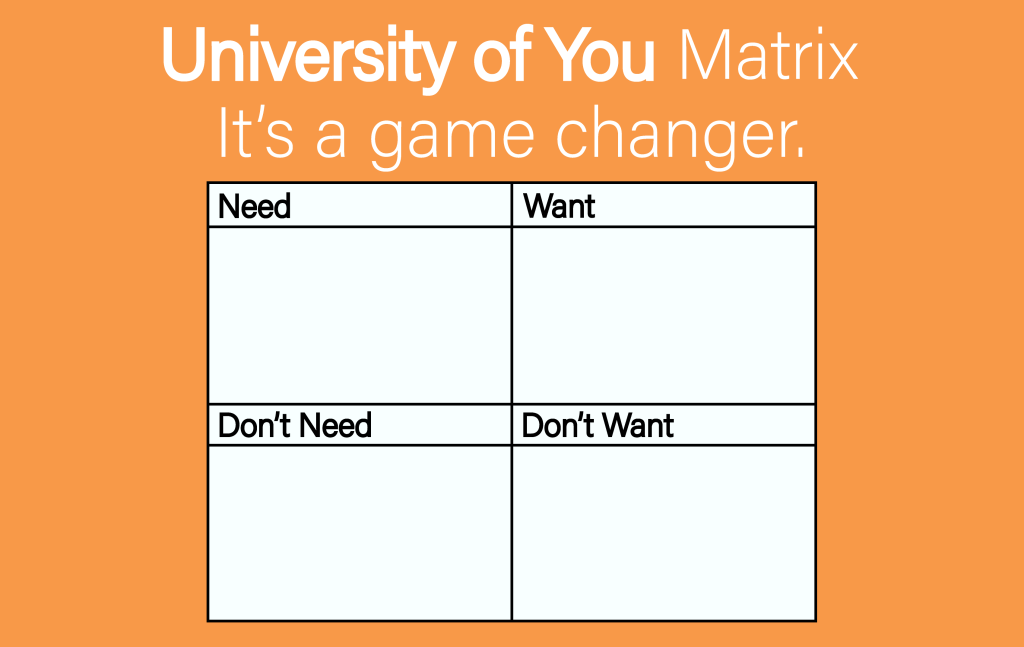
    The college search can be daunting, with an overwheling array of options and no clear start line. The graphic below shows you how to take two simple but powerful steps on the way to the University of You, and you can here me talk more about these steps on episode 24 of the Tom Talks College podcast.

    How do I find the right colleges, and where do we start?

    #1 Clarify your needs + wants.

    Fill in as much of the University of You Matrix as possible.
    Don’t sweat what you don’t know yet. It’s a work in progress.
    Avoid lazy words such as “good” and “big.” You’re better than that.

    Check out Zoe’s matrix. She’s a rockstar!

    Take time to explore colleges online and follow my campus visit rule: Visit early. Visit Often. You’ll be amazed how quickly you’ll go from “um, not sure” to “this is what I need and want,” but it doesn’t happen without effort and energy.

    #2 Start by finding A+A options.

    Skip those reach schools for now that get you all bunged up about not getting in. Match your matrix with colleges that fit both A’s.

    ACCESSIBLE = I will get in.

    AFFORDABLE = We can afford it.

    Opening your mind to a great experience at a college that ALREADY loves you is the best way to take the stress level down a notch. Maybe the best fit isn’t the one that tells the most students “no.”

    The goal is to create a great set of options from which to choose — when it’s time to choose 

    None of this is intended to create a “drive through” college search process. To do this well, it takes time, energy, patience and sometimes endurance. But it’s 100% worth it.

    Next up: How to visit campuses the right way

    In two weeks I’ll return to one of my favorite topics, and one which I’ve featured on numerous episodes.

    I have no idea what I’ll say, but I’ll come up with something YOU can use to get the most from campus visits on your way to the University of You.

    Until then…

    Connect with me if you need help building the right list of colleges for your student. Call, email, text or schedule a free consult or 15-minute phone call.

    We’re OnCampus, and we’re in your corner.

    Source link

  • 5 not so good FINANCIAL GIFTS TO GIVE TO OUR CHILDREN (The last one is the worst)

    5 not so good FINANCIAL GIFTS TO GIVE TO OUR CHILDREN (The last one is the worst)

    The VERY BEST Financial Gift we could give our kids is to not be dependent on them financially later in our lives, while they are trying to raise and educate their kids.

    Most parents love their kids dearly and would die for them. My question is always – “Should We?” Here are some decisions that start out with good intentions but could actually end up having bad consequences for our loved ones.

    1. Getting a Parent PLUS loan that the student has to pay.

    There is a reason that there is a limit on how much the government will lend to your student in their name. It’s because they should not have a massive burden coming out of college, and most students coming out of college cannot afford to pay more than the federal lending limit to them.

    Many parents are struggling to fund college AND save for retirement at the same time. If you don’t have enough money to do both, then it is probably unwise to expect your children to pay back Parent Plus Loans that you have signed for.

    Remember that if we have not saved enough for retirement and have depended on Parent loans to get the kids through college, then we might be reliant on help from our kids when we age. Is this what we really intended? Thanks a lot Dad!

    • Whole life insurance (The wrong type)

    Whole Life insurance could be a great product if structured properly, but on the PARENTS. I have seen some policies purchased with kids insured, from the same company that they buy baby food from. These are horribly inefficient policies and, in most cases, a bad idea. Most times, insurance on young kids is much more expensive than insurance for parents.

    Firstly, we should consider what the purpose of the insurance is. If we purchase with the kids as the insured, it only pay out if the child dies, which means it is pays out for your future grandchildren 2 generations away! Is that what we meant to happen? We should consider who we want to protect?

    Typically, we would want to insure the parent who is the main breadwinner, so that if something happened to them, their spouse and children would not have to face devastating financial consequences. That way they would be leaving a positive legacy for the family and not a burden.

    I STRONGLY advocate for good insurance, and personally practice what I preach so feel free to give me a call if you would like to see what is wise for your family.

    If you want to purchase timeshare, do it for yourself, and accept the long-term consequences, but don’t burden your kids with it.

    Here is something to think about:

    * The Internal Revenue Service values your timeshare, and all timeshares, as worthless.
    * No legitimate charity wants your donated timeshare. Period.

    If so, why would we think that our timeshare has any value. It has to be paid for each year and most people cannot GIVE their timeshare away. Don’t burden your kids by buying timeshare for them. With technology today and Airbnb we have so much more flexibility without the burden.

    • Champagne Taste on a Beer Budget

    If our children leave our house with the expectation that everyone can go to a private school, vacation in Hawaii or France every year, shop at expensive stores and drive expensive cars, then we have probably done them a disservice.

    Their first shock comes when they see their first paycheck, wonder why so much of it has gone to taxes and other deductions, and the realization that they have to pay for their own car and place to live. Sometimes we love to spoil our kids too much, but it ends up hurting them in the long run. The worst is when they realize that we cannot retire because we didn’t teach them.

    • Parent Financial InsecurityI have saved the toughest one for last.

    Remember the lecture we always get when we fly? “In the unlikely case of an emergency, put your own mask on before you help your children” This is the way it should be with our finances.

    I speak to families all the time who have parents who are not financially stable, who could not control their spending, who did not save enough for retirement, or didn’t have life insurance when needed or Long Term Care, who are in such bad financial shape that their children spend their nights worrying about their parents.

    One of the most wonderful financial gifts that we can give to our kids is our own financial security. That way we can be a blessing to our kids and not drag on their lives.

    As a counter to the perhaps perceived negative connotation of what we should perhaps NOT be doing, here are some things that we might think of that we SHOULD be doing.

    Five smart financial habits to teach our children early in life – can set them up for a future of success.

    Someone told me once – the way to teach our kids the value of money, borrow some from them

    1. The miracle of compounding – the earlier the better – As parents, we often wish we knew this
    • We Value What We Earn, Not What We Are Given

    Allowances – Given or Earned? Allowances are not just about money, but what lessons we could teach our kids in the process. Humans learn a lot when we earn things because of effort and dedication, rather than just being given something. My daughter once worked really hard to earn a surfboard by walking around our neighborhood selling cookie dough for her school. I will never forget when I asked her how many people said “No” to her, she told me “I don’t know dad, I was just focused on getting 75 people to say “Yes”

    It is a valuable lesson to see firsthand how effort translates into earnings and this in turn translates into the behaviors to become an “earner” in life.

    • Teach Your Kids How to Lose Money

    Yes, lose money. You see, no matter what courses they take in high school or college around personal finance, there is no greater teacher for all of us in life on what NOT to do with our money until we experience losing some money.  

    No matter which custodian we help them set up a brokerage account with, perhaps we could get them started saving into some type of investment and sit down quarterly with them to track it and teach them how their investment is performing.  

    Have them pick one stock of their favorite company and even if they lose money, they win in the long-term gaining interest on how investments work and how to make good investment decisions.

    • Spending – Questions to ask first
    • Do I want it?
    • Do I need it?
    • Can I afford it?

    If the answer to any of these is “No”, then probably think twice about it.

    Only once we have SAVED money, should we use it for our WANTS

    One thing that I learned in life is that giving early when you don’t make much, is really helpful rather than trying to start giving when you are making a lot. It just seems such a lot to get going when the number is high, but when it grows incrementally it becomes a great and rewarding habit.

    I go back to my first statement – Most parents love their kids dearly and would die for them. My question is always – “Should We?”

    If you would like to discuss how you can make wise decisions for Retirement Planning and College Planning for your family? Please don’t hesitate to contact Dave Coen to set up a no-cost consultation.

    You can see more about my role as a Financial Advisor with SageView Advisory  HERE

    Tel:714-813-1703
    dcoen@sageviewadvisory / [email protected]

    Source link

  • GIRLS IN STEM (SCIENCE, TECHNOLOGY, ENGINEERING AND MATH) UPDATE

    GIRLS IN STEM (SCIENCE, TECHNOLOGY, ENGINEERING AND MATH) UPDATE

    According to The American Association of University Women(AAUW), throughout their education, girls and women are systematically tracked away from science and math. This limits their access, preparation and opportunities to enter these fields for their careers as adults. By the time students reach college, women are significantly underrepresented in STEM majors.

    Women make up only 34% of the workforce in science, technology, engineering and math (STEM). While this is up from 28% two years ago, it is still significantly less than the existing overall percentage of women, and men vastly outnumber women majoring in most STEM fields in college. The gender gaps are particularly high in some of the fastest-growing and highest-paid jobs of the future, like computer science and engineering.

    Women in STEM Occupations
    Biological Scientists
    46%

    Chemists & Materials Scientists 40.4%
    Computer & Mathematical Occupations 25.2%
    Engineers & Architects 16.5%
    SOURCE: U.S. Bureau of Labor Statistics, “Employed persons by detailed occupation, sex, race, and Hispanic or Latino ethnicity,”
    ​Labor Force Statistics from the Current Population Survey, Table 11, 2020.

    A typical STEM worker earns two-thirds more than those employed in other fields, according to Pew Research Center. And some of the highest-earning STEM occupations, such as computer science and engineering, have the lowest percentages of women workers. Giving women equal opportunities to pursue and succeed in STEM careers helps narrow the gender pay gap, enhances women’s economic security, ensures a diverse and talented STEM workforce and prevents biases in these fields and the products and services they produce.

    To help close the STEM Gap, it is important that girls and women are given the skills and confidence to succeed in math and science. There should be improvements in STEM education and support for girls starting in early education and through K-12. Every student should be exposed to engineering and computer science, and Next Generation Science Standards. Classes should be taught by connecting STEM experiences to girls’ lives, promoting active, hands-on learning and emphasizing ways STEM is collaborative and community-oriented.

    AAUW also suggests expanding after-school and summer STEM opportunities for girls. They suggest Increasing awareness of higher education and career opportunities, pathway opportunities, role models and mentoring programs with women in STEM for girls.

    While there have been some advances, more efforts need to be made to help women close the STEM gap. Educational consultants can help encourage young women with academic aptitudes and interests in math, science, computers and engineering to explore career paths they may not have considered for their future.


    Source link

  • When is an extracurricular good enough? Part 2 – Four Years Later!

    When is an extracurricular good enough? Part 2 – Four Years Later!

    By Tim Parros

    I wrote an article four years ago about the importance of extracurriculars in the college admission process (read it here)

    Interestingly enough, it still rings true and is even more critical going into the 2023/2024 admission cycle. As a result, we see our students reaching for many colleges that take a deep look into the extracurriculars; after all, colleges want students to better their communities, and students with experience in this are very attractive to them.

    The admissions landscape continues to evolve, and schools seek students with more than perfect test scores and top grades. There are so many students with perfect scores and outstanding academics, which is still essential, but most schools take a holistic approach to the admissions process. They want students with diverse interests and backgrounds who will be a good fit for the school outside of academics. Your extracurriculars help them determine if you will be equipped to make your mark at their college in a positive and influential way.

    So why is this important again?

    Because it tells admissions more about you as a person. By looking at your activities in your free time, they learn about your interests and the key qualities you possess.

    Essentially, your extracurriculars are one of the application components (along with your college essays and letters of recommendation) that they feel determines the characteristics that you will add to their student body. Different schools may value different traits, but they all value leadership, social responsibility, commitment, drive, and determination. Many other traits will be apparent to them as they review your application. It is also true that extracurriculars make for some great essays when it comes time to apply to college.

    Generally speaking, the quality and the duration of your commitment to your extracurricular activity seem more important than how many you have on your list. The commitment you show in your extracurriculars for college over a more extended period is more impactful than being a member of many clubs for a short period. Even more important in this category is showing them what you learned, how you’ve grown, and how you will interact with their student body.

    When we have students considering some of the top colleges in the US, we start early in helping them identify extracurriculars that they are passionate about. This is critical. I will end with the same advice from 4 years ago.

    Here are some questions to ask yourself about your activities:

    1. Does it benefit your community?

    2. Could it lead to any awards?

    3. Is it possible to write about it and have it published?

    As we discuss extracurricular activities with our students, we try to get them to think outside the box and go beyond with their peers are doing. We’re not encouraging students to give up activities they enjoy, but we hope that asking these questions will spark something and stretch the student in what activities they spend their time on. 

    We want to discuss this and explore how we can help you in your college planning journey.

    Source link

  • FAQ: When should I start actively planning for college? – College Strategy

    FAQ: When should I start actively planning for college? – College Strategy


    FAQ: When should I start actively planning for college? – College Strategy – DIY College Planning Course