
Category: college students

  • 1.1 Million College Students – The 74

    1.1 Million College Students – The 74


    Get stories like this delivered straight to your inbox. Sign up for The 74 Newsletter

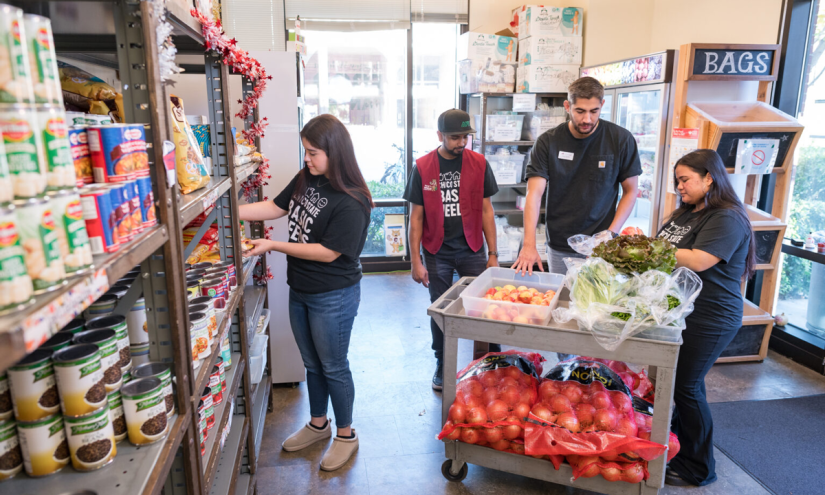
    Maia Jackson should have been cranking out a research paper for her communications class. Instead, she found herself queuing up at a food pantry to secure groceries for her household amid the nation’s longest government shutdown. 

    “I walked out with a shopping cart full of food,” the 25-year-old college senior said. “I could barely carry it all. I got cereal. I got some frozen meat, hamburger buns. I got a bag of black beans, and then I got a bag of rice.”

    Finding a package of chicken strips, a dish she knew her picky 2-year-old daughter would actually eat, almost made her cry, Jackson said. She expects the combination of perishable, bagged and canned foods to last them a month. By then, she hopes her Supplemental Nutrition Assistance Program (SNAP) payments — widely known as food stamps — will have resumed.

    On November 1, SNAP benefits ground to a halt during the federal budget impasse that began a month earlier, with President Donald Trump’s administration refusing to fully fund these payments, a matter now tied up in court. Even as the Senate has reached a framework deal that leaves lawmakers and the White House a step closer to ending the shutdown, the disruption in benefits has revealed how fragile the social safety net is for vulnerable Americans. That includes single parents and young adults experiencing food insecurity, a problem that occurs when people lack regular access to the nourishment needed to sustain their health. 

    An estimated 1.1 million college students rely on SNAP, including parents like Jackson, who attends North Dakota State University (NDSU) in Fargo. For such students, a delayed SNAP payment isn’t a mere hiccup, but a serious setback that can imperil their education, their health and stability for their children, experts contend.

    “It’s such a distraction for me as a single mom in school,” Jackson said. “I don’t have any bandwidth to give to trying to find food at pantries.”

    She tried to minimize the time she spent at the food pantry last week by making an appointment first, but she was still one of a couple of dozen people in line. The visit prevented her from completing her research paper by its due date, which will likely result in her grade being docked. Jackson, who has so far maintained a 4.0 grade point average, isn’t happy about that prospect, but with her family members an hour away and her child’s father mostly out of the picture, she had to prioritize food over her education.


    No college student should have to choose between a basic need and school, said Deborah Martin, a senior policy associate for The Institute for College Access & Success, a nonprofit that advocates for college access and affordability. 

    “A lot of students have to make these daily tough decisions where they’re wondering, ‘Where am I going to get my next meal from?’ instead of focusing on homework, on classwork,” Martin said. “We know that when students have these unmet basic needs such as food insecurity, they’re more likely to struggle academically, less likely to persist from semester to semester, and in some cases, may even drop out of college altogether.”

    Roughly 60 percent of college students are women. For the most marginalized students, the risk of quitting school due to food insecurity may be even greater. The Government Accountability Office (GAO), a nonpartisan federal agency that provides fact-based information to Congress, reported last year that about 80 percent of food-insecure students are nontraditional — meaning their parents don’t financially support them, they didn’t begin college immediately after high school or they are caring for dependents. Moreover, the 2023-2024 Student Basic Needs Survey Report from the Hope Center, a research center at Temple University focused on the food, housing and health of college students, found that around three-quarters of parenting, Black and Indigenous students experience insecurity related to a basic need

    Most of these students, the GAO discovered, do not sign up for services like SNAP, and those who do may hesitate to discuss their food insecurity. As a mom and a slightly older student who works part-time, Jackson has felt largely alone on campus as SNAP benefits have paused. Her classmates don’t appear to share her anxiety over the shutdown, if they know about it at all. 

    A woman shops at the Feeding South Florida food pantry on October 27, 2025 in Pembroke Park, Florida.
    (Joe Raedle/Getty Images)

    “A lot of the kids that I’m in class with, they’re not in the same circumstance,” Jackson said. “It’s weird to see a lot of people just carrying on as usual.”

    Since most of her classmates — about an even percentage of NDSU students are women and men — are childfree and on the school meal plan, she doesn’t want to be a “downer” by bringing up her difficulties. For the same reason, she didn’t explain to her professor why her paper was late. “I didn’t want to tell him, ‘Oh, I couldn’t write it because I was standing in the food pantry line’ because it just sounds so sad,” she said. “What’s he supposed to say? I don’t want him to feel bad for me. I don’t want to be pitied.”

    But faking normal could come at a high cost for college students who don’t reach out for help. Martin fears these young adults will resort to using high-interest payment plans or acquire credit card debt just to afford groceries.

    “The longer that students and other SNAP participants don’t receive their funds, this is just more days that students are going to have to make these difficult decisions,” she said.


    Some college administrators are taking action. When the shutdown began, Compton College President and CEO Keith Curry contacted Everytable, a food company that offers inexpensive made-from-scratch meals via carryout storefronts and a delivery service. The college, about 18 miles southeast of downtown Los Angeles, has partnered with Everytable for seven years to provide all students — approximately 6,000 of whom attend full time — with one nutritious free meal on weekdays. 

    The federal government crisis prompted Curry and Everytable CEO Sam Polk to scale up that program so SNAP-recipient and economically disadvantaged students didn’t suffer during the shutdown.

    “We need to do something. Can we split the cost?” Curry recalled asking Polk. “I think if we double the meals, at least they get another meal for the day.”

    On November 5, Compton College’s most underprivileged students began getting two free meals per day, or 10 per week. The need for such an intervention there is substantial: A 2025 basic needs survey of students found that 81 percent of them experience at least one form of insecurity related to a basic need. That includes signs of food insecurity such as skipping meals, reducing meal sizes or fearing they will run out of food. Most Compton College students are moderately food insecure, the survey revealed, indicating persistent hardship. Women make up 61 percent of the student body.

    “Right now, students have other stress, and what we’re doing to them is adding more stress,” Curry said of the shutdown. “They still want to do well in classes, but now they don’t have food.” 

    Together, Compton College and Everytable have the resources to supply students with 10 weekly meals for a month, Curry said. The students are deeply grateful for the additional provisions, according to Dee Garrett, who oversees Everytable’s operation at the college.

    “What better way to start your studies than with a stomach that’s full?” Garrett asked. “You don’t have to think about, ‘Oh, my God, my stomach. I can’t concentrate or focus.’”

    Asked what impact he hopes the scaled-up program makes, Curry said he’s more interested in letting students know they’re not alone.  

    “It’s not about the impact. It’s about our students knowing that we were there for them during this time,” he said. “In our community, when students need us most, we have to step up and be there for them, and they’re never going to forget that.”

    Martin applauds the efforts of colleges and K-12 schools, which have connected students and their families to food banks, to curb food insecurity during the shutdown. But she also advocates for long-term policies to ensure students have enough food to eat. That includes the Enhance Access to SNAP Act, proposed legislation to remove the barriers that prevent economically disadvantaged college students from utilizing benefits generally — not just during the current crisis. 

    However, Martin continued, “the most important thing that we can do right now in this moment is for these SNAP benefits to be fully funded and for them to go out to students as soon as possible.”


    Back in Fargo, Jackson has refocused her attention on her coursework now that she has a month’s worth of food. Still, she worries about the people who couldn’t make it to a pantry or that the government will cut other social services she needs. She currently earns $400 monthly working part time as an academic journal editor. The job, which she performs remotely, allows her to attend school and be her daughter’s primary caretaker when the toddler is not in day care. 

    “If they cut child care, if they cut these programs I rely on, I would have to drop out of school,” Jackson said. “But I’m trying to give my daughter a better life than that.”

    Jackson is majoring in university studies with a pre-law emphasis, a dramatic shift from her life before motherhood when she dropped out of school and struggled with addiction. Getting pregnant inspired her to undergo a transformation, which she largely credits to the Jeremiah Program. The national nonprofit provides single mothers with support for college, child care and housing, and it recently started a campaign to raise $190,000 to cover essential needs for families who have lost SNAP and other benefits because of the shutdown. The organization estimates that single-parent families represent nearly a third of families in the United States, with 80 percent of those headed by mothers.  

    Jackson has been deeply disturbed to see the misperceptions that abound about mothers like herself. She’s encountered online commenters who have characterized SNAP recipients as “welfare queens.”

    If she could confront such individuals in person, Jackson would emphasize how much value mothers add to society. “And on top of it… we are all in school and working, too,” she said. “The insinuation is that we’re just scammers, freeloaders, when, in reality, I’m working very hard every day to hopefully not need these supports.”

    This story was originally reported by Nadra Nittle of The 19th. Meet Nadra and read more of their reporting on gender, politics and policy.


    Did you use this article in your work?

    We’d love to hear how The 74’s reporting is helping educators, researchers, and policymakers. Tell us how


    Source link

  • Using SQ3R to help college students read

    Using SQ3R to help college students read

    When students arrive in college, faculty often make the assumption that they know how to read for comprehension and retention. Unfortunately, and for a variety of reasons, many students are not well versed in how to read for class. In today post, I want to share an excerpt from my book, Teaching for Learning, about how you can use SQ3R to help college students read.

    Photo credit: Marketa

    SQ3R

    Overview

    The SQ3R activity provides a framework for students to better comprehend and retain information from readings assigned for class. Students often read course readings as they would any other text: start at page 1 and read to the end without framing the content, thinking critically about the content, and engaging the content. This IDEA offers a more systematic approach to better study the material while reading (Artis, 2008).

    SQ3R is a five-step process:  survey, question, read, recite, and review. The activity helps students engage with material and improve their processing of the information through framing and reflection. Although the use of these five steps take longer than simply reading a text, the advantages of improved understanding and recall are beneficial for students and they improve the teaching experience.

    Guiding Principles

    SQ3R is built on the foundation of an information processing theory of learning (Newell & Simon, 1972; Tadlock, 1978). This theory suggests that people structure and organize information into systems of meaning. The limitations of learning are frequently attributed to limits on the ability to organize information and by encoding information in a way that facilitates recall. By providing a framework to organize new knowledge, SQ3R helps students develop understanding faster and more efficiently. 

    The activity also makes use of the ways the brain stores and retrieves information using short and long-term recall. The framework of SQ3R encourages students to slow down and spend time on information which activates the processing strengths of particularly long-term memory. By asking questions and encouraging recitation, SQ3R allows students to better store and recall information from course readings.

    Preparation

    Most frequently, the SQ3R activity is completed by the student outside of class as part of assigned readings. Prior to assigning SQ3R, provide the framework for students and also explain why the activity proves useful. Students often complain that this process increases the time it takes to complete the reading and in doing so they often fail to see the value. Providing an understanding of why it works based on the guiding principles above can help students know the value and use the activity (Tadlock, 1978).

    Process

    • Explain the framework of the activity in the class and assign (or suggest) students use it on the readings for homework. The following steps explain the process of the activity.
    • Survey helps students gather the basic structure of the topic presented in the reading including reading the title, headings, graphics, and any text called out such as definitions or objectives. 
    • Question involves turning headings and other main ideas identified in the survey stage into question. Students should then seek answers to the questions as they read. 
    • In the Read stage, students read the text to capture the main ideas as identified in the survey and question stages. The goal is to write down the answers to the questions raised by filling in the main ideas without getting too bogged down by the details. 
    • Next, students Recite material, which assists with concentration and recall. Students look at each of the questions of a section and attempt to answer the question (while covering up their notes).
    • The Review step allows the students to consolidate learning and comprehension by reviewing each of the questions and answers.   

    Pro-tips

    Many students have never been taught how to read texts or study content rich material. This activity presents a great strategy to help students by providing a versatile framework to use while reading. Many instructors find it helpful to walk students through how to complete the steps in class. Taking the time to model the process in class can improve students’ use of the activity and improve their reading comprehension as a result.

    There are many different variations that have grown out of SQ3R such as, SQ4R (survey, question, read, recite, wRite, and review) (Pauk, 1984),  PQ4R (preview, question, read, reflect, recite, and review), and FAIRER (facts, ask questions, identify major/minor details, read, evaluate comprehension, and review) (Lei, Rhinehart, Howard, & Cho, 2010). Fundamentally, these all provide frameworks for self-regulation of reading. You can use any variation of this system, as the goal is to provide a way for students to work through a framework to organize and comprehend new information.

    One of the more difficult, yet important, aspects of the SQ3R activity is developing good questions. Students often can easily turn headings and other readily identifiable major points into questions, but struggle with developing good topic spanning questions. As part of other class activities and in debriefing this activity, help students develop good questions. You may do this by sharing good questions raised by classmates or by providing some starter questions early in the course you identified. Helping students learn to ask questions can assist students in your class and throughout their education.

    (Visited 1,640 times, 1 visits today)

    Source link