In the nearly two years since the U.S. Supreme Court struck down race-conscious admissions, there have been repeatedcalls for universities to address the resulting decline in diversity by recruiting from community colleges.
On the surface, encouraging students to transfer from two-year colleges sounds like a terrific idea. Community colleges enroll large numbers of students who are low-income or whose parents did not attend college. Black and Latino students disproportionately start college at these institutions, whose mission for more than 50 years has been to expand access to higher education.
But while community colleges should be an avenue into high-value STEM degrees for students from low-income backgrounds and minoritized students, the reality is sobering: Just 2 percent of students who begin at a community college earn a STEM bachelor’s degree within six years, our recent study of transfer experiences in California found.
There are too many roadblocks in their way, leaving the path to STEM degrees for community college students incredibly narrow. A key barrier is the complexity of the process of transferring from a community college to a four-year institution.
Related: Interested in innovations in higher education? Subscribe to our free biweekly higher education newsletter.
Many community college students who want to transfer and major in a STEM field must contend with three major obstacles in the transfer process:
1. A maze of inconsistent and often opaque math requirements. We found that a student considering three or four prospective university campuses might have to take three or four different math classes just to meet a single math requirement in a given major. One campus might expect a transfer student majoring in business to take calculus, while another might ask for business calculus. Still another might strongly recommend a “calculus for life sciences” course. And sometimes an institution’s website might list different requirements than a statewide transfer site. Such inconsistencies can lengthen students’ times to degrees — especially in STEM majors, which may require five- or six-course math sequences before transfer.
2. Underlying math anxiety. Many students interviewed for the study told us that they had internalized negative comments from teachers, advisers and peers about their academic ability, particularly in math. This uncertainty contributed to feelings of anxiety about completing their math courses. Their predicament is especially troubling given concerns that required courses may not contribute to success in specific fields.
3. Course scheduling conflicts that slow students’ progress. Two required courses may meet on the same day and time, for example, or a required course could be scheduled at a time that conflicts with a student’s work schedule. In interviews, we also heard that course enrollment caps and sequential pathways in which certain courses are offered only once a year too often lengthen the time to degree for students.
To help, rather than hinder, STEM students’ progress toward their college and professional goals, the transfer process needs to change significantly. First and foremost, universities need to send clear and consistent signals about what hoops community college students should be jumping through in order to transfer.
A student applying to three prospective campuses, for example, should not have to meet separate sets of requirements for each.
Community colleges and universities should also prioritize active learning strategies and proven supports to combat math anxiety. These may include providing professional learning for instructors to help them make math courses more engaging and to foster a sense of belonging. Training for counselors to advise students on requirements for STEM pathways is also important.
Community colleges must make their course schedules more student-centered, by offering evening and weekend courses and ensuring that courses required for specific degrees are not scheduled at overlapping times. They should also help students with unavoidable scheduling conflicts take comparable required courses at other colleges.
At the state level, it’s critical to adopt goals for transfer participation and completion (including STEM-specific goals) as well as comprehensive and transparent statewide agreements for math requirements by major.
States should also provide transfer planning tools that provide accurate and up-to-date information. For example, the AI Transfer and Articulation Infrastructure Network, led by University of California, Berkeley researchers, is using artificial intelligence technology to help institutions more efficiently identify which community college courses meet university requirements. More effective tools will increase transparency without requiring students and counselors to navigate complex and varied transfer requirements on their own. As it stands, complex, confusing and opaque math requirements limit transfer opportunities for community college students seeking STEM degrees, instead of expanding them.
We must untangle the transfer process, smooth pathways to high-value degrees and ensure that every student has a clear, unobstructed opportunity to pursue an education that will set them up for success.
Pamela Burdman is executive director of Just Equations, a California-based policy institute focused on reconceptualizing the role of math in education equity. Alexis Robin Hale is a research fellow at Just Equations and a graduate student at UCLA in Social Sciences and Comparative Education.
The Hechinger Report provides in-depth, fact-based, unbiased reporting on education that is free to all readers. But that doesn’t mean it’s free to produce. Our work keeps educators and the public informed about pressing issues at schools and on campuses throughout the country. We tell the whole story, even when the details are inconvenient. Help us keep doing that.
PITTSBURGH — Stephen Wells was trained in the Air Force to work on F-16 fighter jets, including critical radar, navigation and weapons systems whose proper functioning meant life or death for pilots.
Yet when he left the service and tried to apply that expertise toward an education at Pittsburgh’s Community College of Allegheny County, or CCAC, he was given just three credits toward a required class in physical education.
Wells moved forward anyway, going on to get his bachelor’s and doctoral degrees. Now he’s CCAC’s provost and involved in a citywide project to help other people transform their military and work experience into academic credit.
What’s happening in Pittsburgh is part of growing national momentum behind letting students — especially the increasing number who started but never completed a degree — cash in their life skills toward finally getting one, saving them time and money.
Colleges and universities have long purported to provide what’s known in higher education as credit for prior learning. But they have made the process so complex, slow and expensive that only about 1 in 10 students actually completes it.
Many students don’t even try, especially low-income learners who could benefit the most, according to a study by the Western Interstate Commission for Higher Education and the Council for Adult and Experiential Learning, or CAEL.
“It drives me nuts” that this promise has historically proven so elusive, Wells said, in his college’s new Center for Education, Innovation & Training.
Stephen Wells, provost at the Community College of Allegheny County in Pittsburgh. An Air Force veteran, Wells got only a handful of academic credits for his military experience. Now he’s part of an effort to expand that opportunity for other students. Credit: Nancy Andrews for The Hechinger Report
That appears to be changing. Nearly half of institutions surveyed last year by the American Association of Collegiate Registrars and Admissions Officers, or AACRAO, said they have added more ways for students to receive these credits — electricians, for example, who can apply some of their training toward academic courses in electrical engineering, and daycare workers who can use their experience to earn degrees in teaching.
Related: Interested in innovations in higher education? Subscribe to our free biweekly higher education newsletter.
The reason universities and colleges are doing this is simple: Nearly 38 million working-age Americans have spent some time in college but never finished, according to the National Student Clearinghouse Research Center. Getting at least some of them to come back has become essential to these higher education institutions at a time when changing demographics mean that the number of 18-year-old high school graduates is falling.
“When higher education institutions are fat and happy, nobody looks for these things. Only when those traditional pipelines dry up do we start looking for other potential populations,” said Jeffrey Harmon, vice provost for strategic initiatives and institutional effectiveness at Thomas Edison State University in New Jersey, which has long given adult learners credit for the skills they bring.
Being able to get credit for prior learning is a huge potential recruiting tool. Eighty-four percent of adults who are leaning toward going back to college say it would have “a strong influence” on their decision, according to research by CAEL, the Strada Education Foundation and Hanover Research. (Strada is among the funders of The Hechinger Report, which produced this story.)
The Center for Education, Innovation & Training at the Community College of Allegheny County in Pittsburgh. The college is part of a citywide effort to give academic credit for older students’ life experiences. Credit: Nancy Andrews for The Hechinger Report
When Melissa DiMatteo, 38, decided to get an associate degree at CCAC to go further in her job, she got six credits for her previous training in Microsoft Office and her work experience as everything from a receptionist to a supervisor. That spared her from having to take two required courses in computer information and technology and — since she’s going to school part time and taking one course per semester — saved her a year.
“Taking those classes would have been a complete waste of my time,” DiMatteo said. “These are things that I do every day. I supervise other people and train them on how to do this work.”
On average, students who get credit for prior learning save between $1,500 and $10,200 apiece and nearly seven months off the time it takes to earn a bachelor’s degree, the nonprofit advocacy group Higher Learning Advocates calculates. The likelihood that they will graduate is 17 percent higher, the organization finds.
Justin Hand dropped out of college because of the cost, and became a largely self-taught information technology manager before he decided to go back and get an associate and then a bachelor’s degree so he could move up in his career.
He got 15 credits — a full semester’s worth — through a program at the University of Memphis for which he wrote essays to prove he had already mastered software development, database management, computer networking and other skills.
“These were all the things I do on a daily basis,” said Hand, of Memphis, who is 50 and married, with a teenage son. “And I didn’t want to have to prolong college any more than I needed to.”
Meanwhile, employers and policymakers are pushing colleges to speed up the output of graduates with skills required in the workforce, including by giving more students credit for their prior learning. And online behemoths Western Governors University and Southern New Hampshire University, with which brick-and-mortar colleges compete, are way ahead of them in conferring credit for past experience.
“They’ve mastered this and used it as a marketing tool,” said Kristen Vanselow, assistant vice president of innovative education and partnerships at Florida Gulf Coast University, which has expanded its awarding of credit for prior learning. “More traditional higher education institutions have been slower to adapt.”
It’s also gotten easier to evaluate how skills that someone learns in life equate to academic courses or programs. This has traditionally required students to submit portfolios, take tests or write essays, as Hand did, and faculty to subjectively and individually assess them.
Now some institutions, states, systems and independent companies are standardizing this work or using artificial intelligence to do it. The growth of certifications from professional organizations such as Amazon Web Services and the Computing Technology Industry Association, or CompTIA, has helped, too.
“You literally punch [an industry certification] into our database and it tells you what credit you can get,” said Philip Giarraffa, executive director of articulation and academic pathways at Miami Dade College. “When I started here, that could take anywhere from two weeks to three months.”
Data provided by Miami Dade shows it has septupled the number of credits for prior learning awarded since 2020, from 1,197 then to 7,805 last year.
“These are students that most likely would have looked elsewhere, whether to the [online] University of Phoenix or University of Maryland Global [Campus]” or other big competitors, Giarraffa said.
Fifteen percent of undergraduates enrolled in higher education full time and 40 percent enrolled part time are 25 or older, federal data show — including people who delayed college to serve in the military, volunteer or do other work that could translate into academic credit.
“Nobody wants to sit in a class where they already have all this knowledge,” Giarraffa said.
At Thomas Edison, police academy graduates qualify for up to 30 credits toward associate degrees. Carpenters who have completed apprenticeships can get as many as 74 credits in subjects including math, management and safety training. Bachelor’s degrees are often a prerequisite for promotion for people in professions such as these, or who hope to start their own companies.
The University of Memphis works with FedEx, headquartered nearby, to give employees with supervisory training academic credit they can use toward a degree in organizational leadership, helping them move up in the company.
The University of North Carolina System last year launched its Military Equivalency System, which lets active-duty and former military service members find out almost instantly, before applying for admission, if their training could be used for academic credit. That had previously required contacting admissions offices, registrars or department chairs.
Among the reasons for this reform was that so many of these prospective students — and the federal education benefits they get — were ending up at out-of-state universities, the UNC System’s strategic plan notes.
“We’re trying to change that,” said Kathie Sidner, the system’s director of workforce and partnerships. It’s not only for the sake of enrollment and revenue, Sidner said. “From a workforce standpoint, these individuals have tremendous skill sets and we want to retain them as opposed to them moving somewhere else.”
California’s community colleges are also expanding their credit for prior learning programs as part of a plan to increase the proportion of the population with educations beyond high school.
“How many people do you know who say, ‘College isn’t for me?’ ” asked Sam Lee, senior advisor to the system’s chancellor for credit for prior learning. “It makes a huge difference when you say to them that what they’ve been doing is equivalent to college coursework already.”
In Pittsburgh, the Regional Upskilling Alliance — of which CCAC is a part — is connecting job centers, community groups, businesses and educational institutions to create comprehensive education and employment records so more workers can get credit for skills they already have.
That can provide a big push, “especially if you’re talking about parents who think, ‘I’ll never be able to go to school,’ ” said Sabrina Saunders Mosby, president and CEO of the nonprofit Vibrant Pittsburgh, a coalition of business and civic leaders involved in the effort.
“Our members are companies that need talent,” Mosby said.
There’s one group that has historically pushed back against awarding credit for prior learning: university and college faculty concerned it might affect enrollment in their courses or unconvinced that training provided elsewhere is of comparable quality. Institutions have worried about the loss of revenue from awarding credits for which students would otherwise have had to pay.
That also appears to be changing, as universities leverage credit for prior learning to recruit more students and keep them enrolled for longer, resulting in more revenue — not less.
“That monetary factor was something of a myth,” said Beth Doyle, chief of strategy at CAEL.
Faculty have increasingly come around, too. That’s sometimes because they like having experienced students in their classrooms, Florida Gulf Coast’s Vanselow said.
Still, while many recognize it as a recruiting incentive, most public universities and colleges have had to be ordered to confer more credits for prior learning by legislatures or governing boards. Private, nonprofit colleges remain stubbornly less likely to give it.
More than two-thirds charge a fee for evaluating whether other kinds of learning can be transformed into academic credit, an expense that isn’t covered by financial aid. Roughly one in 12 charge the same as it would cost to take the course for which the credits are awarded.
Debra Roach, vice president for workforce development at the Community College of Allegheny County in Pittsburgh. The college is working on giving academic credit to students for their military, work and other life experience. Credit: Nancy Andrews for The Hechinger Report
There are other confounding roadblocks and seemingly self-defeating policies. CCAC runs a noncredit program to train paramedics, for example, but won’t give people who complete it credits toward its for-credit nursing degree. Many leave and go across town to a private university that will. The college is working on fixing this, said Debra Roach, its vice president of workforce development.
It’s important to see this from the students’ point of view, said Tracy Robinson, executive director of the University of Memphis Center for Regional Economic Enrichment.
“Credit for prior learning is a way for us to say, ‘We want you back. We value what you’ve been doing since you’ve been gone,’ ” Robinson said. “And that is a total game changer.”
Contact writer Jon Marcus at 212-678-7556, [email protected]orjpm.82 on Signal.
The Hechinger Report provides in-depth, fact-based, unbiased reporting on education that is free to all readers. But that doesn’t mean it’s free to produce. Our work keeps educators and the public informed about pressing issues at schools and on campuses throughout the country. We tell the whole story, even when the details are inconvenient. Help us keep doing that.
I recently stood before hundreds of young people in California’s Central Valley; more than 60 percent were on that day becoming the first in their family to earn a bachelor’s degree.
Their very presence at University of California, Merced’s spring commencement ceremony disrupted a major narrative in our nation about who college is for — and the value of a degree.
Many of these young people arrived already balancing jobs, caregiving responsibilities and family obligations. Many were Pell Grant-eligible and came from communities that are constantly underestimated and where a higher education experience is a rarity.
These students graduated college at a critical moment in American history: a time when the value of a bachelor’s degree is being called into question, when public trust in higher education is vulnerable and when supports for first-generation college students are eroding. Yet an affordable bachelor’s degree remains the No. 1 lever for financial, professional and social mobility in this country.
Related: Interested in innovations in higher education? Subscribe to our free biweekly higher education newsletter.
A recent Gallup poll showed that the number of Americans who have a great deal of confidence in higher education is dwindling, with a nearly equal amount responding that they have little to none. In 2015, when Gallup first asked this question, those expressing confidence outnumbered those without by nearly six to one.
There is no doubt that higher education must continue to evolve — to be more accessible, more relevant and more affordable — but the impact of a bachelor’s degree remains undeniable.
And the bigger truth is this: America’s long-term strength — its economic competitiveness, its innovation pipeline, its social fabric — depends on whether we invest in the education of the young people who reflect the future of this country.
There are many challenges for today’s workforce, from a shrinking talent pipeline to growing demands in STEM, healthcare and the public sector. These challenges can’t be solved unless we ensure that more first-generation students and those from underserved communities earn their degrees in affordable ways and leverage their strengths in ways they feel have purpose.
Those of us in education must create conditions in which students’ talent is met with opportunity and higher education institutions demonstrate that they believe in the potential of every student who comes to their campuses to learn.
UC Merced is a fantastic example of what this can look like. The youngest institution in the University of California system, it was recently designated a top-tier “R1” research university. At the same time, it earned a spot on Carnegie’s list of “Opportunity Colleges and Universities,” a new classification that recognizes institutions based on the success of their students and alumni. It is one of only 21 institutions in the country to be nationally ranked for both elite research and student success and is proving that excellence and equity can — and must — go hand in hand.
In too many cases, students who make it to college campuses are asked to navigate an educational experience that wasn’t built with their lived experiences and dreams in mind. In fact, only 24 percent of first-generation college students earn a bachelor’s degree in six years, compared to nearly 59 percent of students who have a parent with a bachelor’s. This results in not just a missed opportunity for individual first-generation students — it’s a collective loss for our country.
The graduates I spoke to in the Central Valley that day will become future engineers, climate scientists, public health leaders, artists and educators. Their bachelor’s degrees equip them with critical thinking skills, confidence and the emotional intelligence needed to lead in an increasingly complex world.
Their future success will be an equal reflection of their education and the qualities they already possess as first-generation college graduates: persistence, focus and unwavering drive. Because of this combination, they will be the greatest contributors to the future of work in our nation.
This is a reality I know well. As the Brooklyn-born daughter of Dominican immigrants, I never planned to go away from home to a four-year college. My father drove a taxi, and my mother worked in a factory. I was the first in my family to earn a bachelor’s degree. I attended college as part of an experimental program to get kids from neighborhoods like mine into “top” schools. When it was time for me to leave for college, my mother and I boarded a bus with five other students and their moms for a 26-hour ride to Vanderbilt University in Nashville, Tennessee.
Like so many first-generation college students, I carried with me the dreams and sacrifices of my family and community. I had one suitcase, a box of belongings and no idea what to expect at a place I’d never been to before. That trip — and the bachelor’s degree I earned — changed the course of my life.
First-generation college students from underserved communities reflect the future of America. Their success is proof that the American Dream is not only alive but thriving. And right now, the stakes are national, and they are high.
That is why we must collectively remove the obstacles to first-generation students’ individual success and our collective success as a nation. That’s the narrative that we need to keep writing — together.
Shirley M. Collado is president emerita at Ithaca College and the president and CEO ofCollege Track, a college completion program dedicated to democratizing potential among first-generation college students from underserved communities.
The Hechinger Report provides in-depth, fact-based, unbiased reporting on education that is free to all readers. But that doesn’t mean it’s free to produce. Our work keeps educators and the public informed about pressing issues at schools and on campuses throughout the country. We tell the whole story, even when the details are inconvenient. Help us keep doing that.
ELKHART, Ind. — Ever since Ty Zartman was little, people told him he had to go to college to be successful. “It was engraved on my brain,” he said.
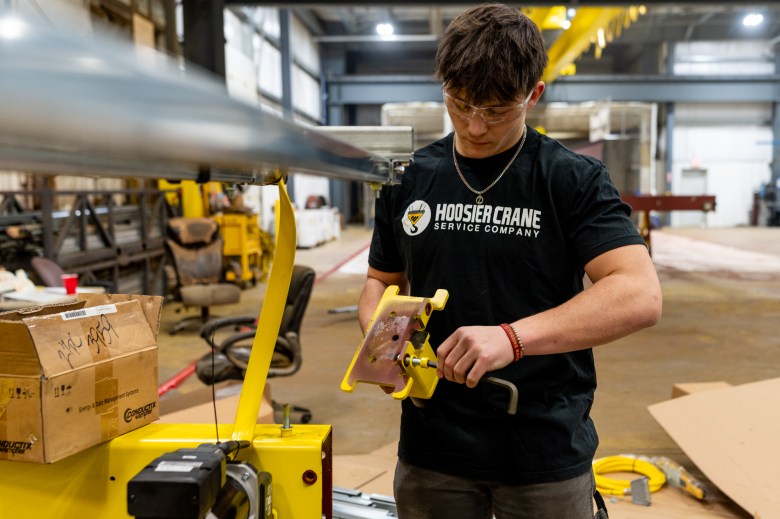
But despite earning straight A’s, qualifying for the National Honor Society, being voted prom king and playing on the high school football and baseball teams, the teen never relished the idea of spending another four years in school. So in fall 2023 he signed up through his Elkhart, Indiana, high school for an apprenticeship at Hoosier Crane Service Company, eager to explore other paths. There, he was excited to meet coworkers who didn’t have a four-year degree but earned good money and were happy in their careers.
Through the youth apprenticeship, Ty started his day at the crane manufacturing and repair business at 6:30 a.m., working in customer service and taking safety and training courses while earning $13 an hour. Then, he spent the afternoon at his school, Jimtown High, in Advanced Placement English and U.S. government classes.
In June, the 18-year-old started full-time at Hoosier Crane as a field technician.
“College is important and I’m not dissing on that,” Ty said. “But it’s not necessarily something that you need.”
Elkhart County is at the forefront of a movement slowly spreading across Indiana and the nation to make apprenticeships a common offering in high school.
In 2019, as part of a plan to boost the region’s economic prospects, county leaders launched an effort to place high schoolers in apprenticeships that combine work-based training with classroom instruction. About 80 students from the county’s seven school districts participated this academic year, in fields such as health care, law, manufacturing, education and engineering. In April, as part of a broader push to revamp high school education and add more work-based learning, the state set a goal of 50,000 high school apprentices by 2034.
Tim Pletcher, the principal of Jimtown High, said students are often drawn first to the chance to spend less time in class. But his students quickly realize apprenticeships give them work-based learning credits and industry connections that help them after graduation. They also earn a paycheck. “It’s really causing us to have a paradigm shift in how we look at getting kids ready for the next step,” he said.
Related: Become a lifelong learner. Subscribe to our free weekly newsletter featuring the most important stories in education.
This “earn and learn” model is taking hold in part because of deepening disillusionment with four-year college, and the fact that well-paying jobs that don’t require bachelor’s degrees are going unfilled nationally. The past three presidential administrations invested in expanding apprenticeships, including those for high schoolers, and in April, President Donald Trump signed an executive order calling for 1 million new apprentices. In a recent poll, more than 80 percent of people said they supported expanding partnerships between schools and businesses to provide work-based learning experiences for students.
Yet in the United States, the number of so-called youth apprenticeships for high schoolers is still “infinitesimally small,” said Vinz Koller, a vice president at nonprofit group Jobs for the Future. One estimate suggests they number about 20,000 nationally, while there are some 17 million high school students.By contrast, in Switzerland — which has been praised widely for its apprenticeship model, including by U.S. Education Secretary Linda McMahon — 70 percent of high schoolers participate. Indiana is among several states, including Colorado, South Carolina and Washington, that have embraced the model and sent delegations to Switzerland to learn more.
Elkhart, Indiana, known as the “RV capital of the world,” saw widespread unemployment during the Great Recession. That led community leaders to focus on apprenticeships as a way to diversify their economy. Credit: Camilla Forte/The Hechinger Report
Experts including Ursula Renold, professor of education systems at the Swiss Federal Institute of Technology (ETH) Zurich, note that importing the model to the United States at a large scale won’t be simple. Most businesses aren’t accustomed to employing apprentices, parents can be resistant to their students trading four-year college aspirations for work, and public transportation to take students to apprenticeships is limited, especially in rural areas. Many high schoolers don’t have a driver’s license, access to a car or money for gas. School districts already face a shortage of bus drivers that makes transporting students to apprenticeships difficult or impossible.
Still, Renold, who is known as the “grande dame of apprenticeships,” said Indiana’s commitment to apprenticeships at the highest levels of state government, as well as the funding the state has invested in work-based learning, at least $67 million, seem to be setting the state up for success, though it could take a decade to see results.
“If I had to make a bet,” said Renold, “I would say it’s Indiana who will lead the way.”
Elkhart County’s experiment with apprenticeships has its roots in the Great Recession. Recreational vehicle manufacturing dominates the local economy, and demand for the vehicles plummeted, contributing to a regional unemployment rate at that time of nearly 20 percent. Soon after, community leaders began discussing how to better insulate themselves from future economic instability, eventually focusing on high school education as a way to diversify industries and keep up with automation, said Brian Wiebe, who in 2012 founded local nonprofit Horizon Education Alliance, or HEA, to help lead that work.
Elkhart County, Indiana, was the first community in Indiana to encourage businesses to employ high school students as apprentices, where they can earn work-based learning credits and make industry connections that help them, even if they decide to go on to college. Credit: Camilla Forte/The Hechinger Report
That year, Wiebe and two dozen local and state political, business, nonprofit and education leaders visited Switzerland and Germany to learn more about the apprenticeship model. “We realized in the U.S., there was only a Plan A, a path to college,” he recalled. “We were not supporting the rest of our young people because there was no Plan B.”
HEA partnered with Elkhart County school districts and businesses, as well as with CareerWise, a youth apprenticeship nonprofit that works nationally. They began rolling out apprenticeships in 2019, eventually settling on a goal of increasing participation by 20 percent each year.
In 2021, Katie Jenner, the new secretary of education for Indiana, learned about Elkhart’s apprenticeships as she was trying to revamp high school education in the state so it better prepared students for the workforce. Elkhart, as well as six other apprenticeship pilot sites funded by Indianapolis-based philanthropy the Richard M. Fairbanks Foundation, provided a proof of concept for the apprenticeship model, said Jenner.
In December, the state adopted a new diploma system that includes an emphasis on experiential and work-based learning, through apprenticeships, internships and summer jobs.
On a weekday this winter, 17 sophomores at Elkhart’s Concord High School were sitting at computers, creating resumes they planned to use to apply for apprenticeships. The students were among some 50 sophomores at the high school who’d expressed interest in apprenticing and met the school’s attendance and minimum 2.5 GPA requirements, out of a class of roughly 400. They would receive coaching and participate in mock interviews before meeting with employers.
Becca Roberts, a former English teacher who now oversees the high school’s college and career programs, said apprenticeships help convince students of the importance of habits like punctuality, clear communication and regular attendance. “It’s not from a book,” she said. “They’re dealing with real life.”
Becca Roberts, who oversees college and career programs at Concord High School in Indiana, helps students research different companies offering apprenticeships, including job descriptions, work schedules and commuting distances. Credit: Camilla Forte/The Hechinger Report
One student, Ava Cripe, said she hoped for an apprenticeship of some sort in the health care field. She’d only been a pet sitter and was nervous at the thought of having a professional job. “You’re actually going out and working for someone else, like not for your parents or your grandma, so it’s a little scary,” she said.
CareerWise Elkhart has recently beefed up its support for students and businesses participating in apprenticeships. It employs a business partnership manager and customer success managers who help smooth over issues that arise in the workplace — an apprentice who isn’t taking initiative, for example, or an apprenticeship that isn’t sufficiently challenging. “Before, if an issue came up, a business would just fire a student or a student would leave,” said Sarah Koontz, director of CareerWise Elkhart County. “We’re now more proactive.”
In Elkhart and across the state, the embrace of work-based learning has worried some parents who fear it will limit, not expand, their children’s opportunities. In previous generations, career and technical programs (then known as vocational education) were often used to route low-income and Black and Hispanic students away from college and into relatively low-paying career paths.
Anitra Zartman, Ty’s mother, said she and her husband were initially worried when their son said he wanted to go straight to work. They both graduated from college, and her husband holds a master’s degree. “We were like, ‘Don’t waste your talent. You’re smart, go to college.’” But she says they came around after seeing how the work experience influenced him. “His maturity has definitely changed. I think it’s because he has a responsibility that he takes very seriously,” she said. “He doesn’t want to let people down.”
Her eldest daughter, Senica Zartman, also apprenticed during her final two years of high school, as a teacher’s assistant. She is now in college studying education. “The apprenticeship solidified her choice,” Anitra Zartman said, and it helped her decide to work with elementary students. Anitra Zartman said she would encourage her two youngest children to participate in apprenticeships too.
Ty Zartman works from 6 a.m. to noon at his apprenticeship at Hoosier Crane Service Company before he goes to school for afternoon classes. Credit: Camilla Forte/The Hechinger Report
Sarah Metzler, CEO of the nonprofit HEA, said apprenticeships differ from the vocational education of the past that tended only to prepare students for relatively low paid, entry-level jobs. With apprenticeships, she said, students must continually learn new skills and earn new licenses and industry certifications as part of the program.
Litzy Henriquez Monchez, 17, apprentices in human resources at a company of 50 people, earning $13.50 an hour. “I deal with payroll, I onboard new employees, I do a lot of translating. Anything that has to do with any of the employees, I deal with,” she said. She’s also earning an industry-recognized certification for her knowledge of a human resources management system, and says the company has offered to pay for her college tuition if she continues in the position.
Koontz said most companies pay for their apprentices to attend Ivy Tech, a statewide community college system, if they continue to work there. One is even paying for their apprentice’s four-year degree, she said.
Attracting employers has proven to be the biggest challenge to expanding youth apprenticeships — in Elkhart and beyond. In total, 20 companies worked with the Elkhart school districts last year, and 28 have signed on for this coming school year — only enough to employ about a third of interested students.
The obstacles, employers say, include the expense of apprentices’ salaries, training and other costs.
Metzler and others, though, point to studies showingbenefits for employers, including cost savings over time and improved employee loyalty. And in Indiana, the Fairbanks foundation and other organizations are working on ways to reduce employer costs, including by developing a standard curriculum for apprenticeships in industries like health care and banking so individual companies don’t bear the costs alone.
Business leaders who do sign on say they are happy with the experience. Todd Cook, the CEO of Hoosier Crane Service Company, employs 10 high schoolers, including Ty Zartman, as engineering and industrial maintenance technician apprentices, approximately 10 percent of his staff. He said the pipeline created by the apprenticeship program has helped reduce recruiting costs.
“We’re starting to build our own farm system of talent,” he said. Students initially earn $13 an hour, and finish their apprenticeship earning $18. If they continue with the company, he said, they can earn up to $50 an hour after about five years. And if they go on to become trainers or mentors, Cook said, “Honestly, there is no ceiling.”
Transportation has been a limiting factor too. There’s no public transit system, and students who can’t rely on their parents for rides are often out of luck. “We’d love to offer a bus to every kid, to every location, but we don’t have people to run those extra bus routes,” said Principal Pletcher.
The state has tried to help by investing $10 million to help students pay for costs such as transportation, equipment and certifications. Each school that provides work-based learning opportunities also receives an additional $500 per student.
Indiana has a goal to employ 50,000 high school students as apprentices by 2034. State leaders in business, education, government and nonprofits are working closely with Swiss experts to adopt a youth apprenticeship program similar to the one in that country. Credit: Camilla Forte/The Hechinger Report
Trump’s executive order called for the secretaries of education, labor and commerce to develop a plan by late August for adding 1 million new apprenticeships. The order does not set a date for reaching that milestone, and it applies to apprentices of all ages, not just high schoolers. Vinz Koller of Jobs for the Future said the goal is modest, and achievable; the number of youth apprenticeships has doubled just in the past few years, he said, and California alone has a goal of reaching 500,000 apprenticeships, across all ages, by 2029.
Still, the order did not include additional funding for apprenticeships, and the Trump administration’s proposed budget includes major cuts to workforce development training. In an email, a White House spokesperson said the administration had promoted apprenticeships through outreach programs but did not provide additional information including on whether that outreach had a focus on youth apprenticeships.
Back in Elkhart, Ty Zartman, the Hoosier Crane apprentice, has begun his technician job with the company after graduating in early June. He is earning $19 an hour. He is also taking a class at the local community college on electrical work and recently received a certificate of completion from the Department of Labor for completing 2,000 hours of his apprenticeship.
Anitra Zartman said she wishes he’d attended more school events like pep rallies, and sometimes worried he wasn’t “being a kid.” But Ty said his supervisor is “super flexible” and he was able to go to the winter formal and prom. “I think I still live a kid life,” he said. “I do a lot of fun things.”
Of his job, he said, “I love it so much.”
Contact editor Caroline Preston at 212-870-8965, via Signal at CarolineP.83 or on email at [email protected].
The Hechinger Report provides in-depth, fact-based, unbiased reporting on education that is free to all readers. But that doesn’t mean it’s free to produce. Our work keeps educators and the public informed about pressing issues at schools and on campuses throughout the country. We tell the whole story, even when the details are inconvenient. Help us keep doing that.
A Black History Month event, canceled. A lab working to fight hunger, shuttered. Student visas revoked, then reinstated, uncertain for how long. Opportunities for students pursuing science careers, fading.
The first six months of the Trump administration have brought a hailstorm of changes to the nation’s colleges and universities. While the president’s faceoffs with Harvard and Columbia have generated the most attention, students on campuses throughout the country are noticing the effects of the administration’s cuts to scientific and medical research, clampdown on any efforts promoting diversity equity and inclusion (DEI), newly aggressive policies for students with loan debt, revoking of visas for international students and more.
Many of the administration’s actions are being challenged in court, but they are influencing the way students interact with each other, what support they can get from their institutions — and even whether they feel safe in this nation.
The Hechinger Report traveled to campuses around the country to look at what these changes mean for students. Reporters visited universities in four states — California, Illinois, Louisiana and Texas — to understand this new era for higher education.
Related: Interested in more news about colleges and universities? Subscribe to our free biweekly higher education newsletter.
Louisiana State University
BATON ROUGE, La. — Last fall, Louisiana State University student A’shawna Smith had an idea for a new campus group to educate students about their legal rights and broader problems in the criminal justice system. Smith, a sociology major, had spent the prior summer interning at a law firm and noticed how many clients didn’t know their rights after an arrest.
Smith, now a rising senior, called it The Injustice Reform and soon recruited classmates and a campus adviser. They wrote a mission statement and trained as student group leaders. On Feb. 20, LSU’s student government, which awards money to campus groups that comes from student fees, gave them $1,200; Smith and her classmates planned to use the award to recruit members and organize events.
At Louisiana State University, in Baton Rouge, students say actions taken by the school’s administration in response to the federal crackdown on diversity, equity and inclusion are changing the campus culture and harming the operations of student government. Credit: Tyler Kaufman/AP Photo
But on April 8, Injustice Reform’s treasurer received a text message from Cortney Greavis, LSU’s student government adviser. She said LSU was rescinding the money: The group’s mission statement ran afoul of new federal and state restrictions on DEI. Its mission mentions racial disparities and police brutality, but the organizers were never told which words violated the rules. Smith and fellow leaders started chipping in their own money to keep the group going: $10 here and there, whatever they could afford, said Bella Porché, a rising senior on the group’s executive board.
Canceling awards to student groups is one way students say administrators at LSU, the state’s flagship university, have restricted what they can do and say since the U.S. Department of Education wrote to schools and colleges nationwide on Valentine’s Day. The letter described DEI efforts — designed to rectify current and historic discrimination — as discriminatory and threatened schools with the loss of federal money unless they ended the consideration of race in admissions, financial aid, housing, training and other practices.
Since the letter, discussion of DEI on campus “has become an anti-gay, anti-Black sort of conversation,” said Emma Miller, a rising senior and elected student senator. “People who are minorities don’t feel safe anymore, don’t feel represented, don’t feel seen, because DEI is being wiped away and their university is not saying anything.”
In a March 7 report, the university detailed dozens of changes made to comply with the letter’s demands. For example, it ended any preference granted to students from historically underrepresented groups for certain privately funded scholarships; opened membership in school-funded student organizations — like a women-in-business group — to all; and canceled activities perceived to emphasize race, even a fitness class kicking off Black History Month.
Student government leaders say the restrictions hinder their ability to operate. Rising junior Tyhlar Holliway, a member of the student government’s Black Caucus, said school administrators essentially shut down the caucus’ proposal that the student government issue a statement after the Department of Education letter in support of DEI programs and initiatives.
LSU public relations staff did not respond to interview requests or to an emailed list of questions, and the school’s civil rights and Title IX division director declined to speak.
Miller said administrators have told student leaders that all their proposed legislation must be reviewed by the school’s general counsel for compliance with the March 7 guidelines. The administration, for example, blocked a student government bill to fund a Black hair care event designed to help students prepare for career and professional opportunities, said senior Paris Holman, a student government member. “We have conferences and interviews and need to know how to take care of our hair,” said Holman, who is Black.
Students have also tailored the language of other bills to avoid the appearance of support for DEI. Holman said that in one case the student senate changed the language in a bill funding an end-of-year event for a minority student organization to remove any reference to the organization as serving minority students.
The school also overrode student government decisions about which groups, like A’shawna Smith’s, could be funded by student fees. In February, the student government voted to provide $641 to help a pre-med student, who is Black, attend a student medical education conference, in part so she could share what she’d learn with other pre-med students. A few weeks later, she received an email from Greavis, the student government adviser, saying she wouldn’t be able to attend with university funds because that money could no longer be used for “DEI-related events, initiatives, programs, or travel.” Greavis didn’t respond to requests for an interview.
The email didn’t specify why the medical conference crossed the line. But the sponsoring organization’s mission statement notes its commitment to “supporting current and future underrepresented minority medical students,” and a conference plenary speaker was scheduled to address the “enduring case for DEI in medicine.” Fewer than 6 percent of doctors are Black and research has shown improved health outcomes for Black patients who are seen by physicians of the same race.
“It doesn’t feel like a democracy,” said Holman of serving in student government at this moment.
She and other students say the university’s actions are starting to change the broader culture at LSU, which serves nearly 40,000 undergraduate and graduate students on its campus of Italian Renaissance buildings shaded by magnolias and Southern live oaks. About 60 percent of students are white and 18 percent are Black, according to federal data.
Mila Fair, a rising sophomore journalism major and a reporter for the campus TV station, said students tell her they’re afraid to join protests, in part because of LSU’s new anti-DEI rules and the national crackdown on student demonstrations. Those who do attend are often afraid to go on camera with her, she said.
Professor Andrew Sluyter of Louisiana State University. The university purged hundreds of webpages referencing DEI-related content, including a press release announcing a prestigious fellowship he’d won that mentioned “higher education’s racial inequities.” Credit: Steven Yoder for The Hechinger Report
Latin American studies professor Andrew Sluyter said administrators normally listen to the student government — even more than to the faculty government — but now worry about students getting the school into “political hot water.” He had his own run-in with the DEI ban: As part of a February effort to scrub school websites of diversity references, in which the university purged hundreds of webpages referencing DEI-related content, LSU deleted a 2022 press release announcing a prestigious fellowship he’d won that mentioned “higher education’s racial inequities.”
Students recognize the pressure LSU is under from the federal government, but they want administrators to stand up for them, said graduate student Alicia Cerquone, a student senator. “We want some sort of communication from the university that shows commitment to its community, that they have our backs and they’ll protect students,” she said.
— Steven Yoder
The University of California, Berkeley
BERKELEY, Calif. — Since early April, Rayne Xue, a junior at the University of California, Berkeley, has watched with trepidation as the Trump administration has taken one step after another to limit international students’ access to American higher education.
First came the abrupt cancellation, then reinstatement, of visas for 23 Berkeley students and recent graduates. Then the government cut off Harvard’s ability to enroll international students — a move since blocked by a federal judge — raising fears that something similar could happen at Berkeley. And late last month, as this year’s graduates were celebrating their recent commencements, Secretary of State Marco Rubio paused interviews for all new student visas and announced he would “aggressively revoke” those of Chinese students.
About 16 percent of University of California, Berkeley, students come from outside the United States. Credit: Eric Risberg/AP Photo
Xue, who is from Beijing and won a student senate seat this past spring on a platform of supporting international students, said the administration’s actions strike at a critical part of campus life at Berkeley.
“College is the opportunity of a lifetime to unlearn prejudices and embrace new perspectives, neither of which is possible without a student body that comes from a wide range of geographic and cultural backgrounds,” she said.
About 16 percent of UC Berkeley’s more than 45,000 students come from outside the United States to study at the crown jewel of California’s public research university system, where creeks run through campus beneath cooling redwoods and parking spaces are set aside for Nobel laureates. China, India, South Korea and Canada send the biggest numbers. International students pay higher tuition than California residents, boosting the university’s coffers and subsidizing some of their peers. Many of them conduct cutting-edge research in fields like computer science, engineering and chemistry.
Now the Trump administration’s immigration crackdown, magnified by the yanking of billions in federal research dollars, has international students worried about their future on campus. Many are changing their behavior to avoid scrutiny: Some canceled travel plans and many said they avoid walking near any campus protests in fear of being photographed.
“It’s difficult for international students to feel secure when they cannot anticipate what the administration might charge against them next — or whether they might be unfairly targeted,” said one global studies major who asked not to be identified for fear of attracting retaliation.
Tomba Morreau, a rising junior from the Netherlands studying sociology, said he stopped posting about politics on social media — just in case.
That kind of self-censorship troubles Paul Fine, co-chair of the Berkeley Faculty Association, which represents about a fifth of the university’s tenure-track faculty.
Federal policies are “creating this culture of fear where people start to censor themselves and try to stay under the radar and not show up in their full selves, whether for academic work or activism,” he said.
International students in Fine’s classes told him they wanted to attend a recent protest against federal threats to higher education but were afraid of the consequences, he said. Others told him they were skipping academic conferences outside the United States that they otherwise would have attended.
“Berkeley really prides ourselves on being an intellectual hub that convenes people from all over the world to work on the most important problems,” Fine said. Now that identity is at risk, he said, especially as actual and threatened cuts to grants make it harder for faculty to hire international graduate students and postdocs.
Most poignant, he said, was hearing from demoralized Chinese students who left a repressive government to come to the United States only to see attacks on academic freedom replicated here.
We want to hear from you.
Are you a student, professor, staff or faculty member? Our journalists want to know how the Trump administration is affecting higher education and life on your college campus.
Xue said she hopes the crisis facing universities would draw attention to the challenges international students face, including limited financial aid and the stereotype that all of them are wealthy. With her colleagues in student government, she is lobbying for Berkeley to spend more on the international office, which provides one-on-one advising on visa issues and employment.
For Lily Liu, a Chinese computer scientist, 2025 was shaping up to be a year of milestones. She graduated with a doctorate last month, has a job lined up at a leading artificial intelligence company and is engaged to be married in November.
But the Trump administration’s changing policies toward international scholars have complicated celebrations for Liu, who’s in a federal program that extends her visa for up to a year beyond graduation so she can gain work experience here. She canceled summer travel plans with her family, concerned she might not be let back into the country. And she’s considering moving her wedding to the United States from China, even though many of her relatives wouldn’t be able to attend.
“For international students, every policy affects us a lot,” she said. So Liu is careful. After the publication of her thesis was delayed, she visited Berkeley’s international office to make sure the setback wouldn’t affect her work permit. Her fiancé has a green card, which should theoretically mean his immigration status is more stable. But these days, she said, who knows?
— Felicia Mello
The University of Texas at San Antonio
SAN ANTONIO, Texas — Growing up here, Reina Saldivar had always loved science — all she wanted to watch on TV was “Animal Planet.” Yet until she applied on a whim to a program for aspiring researchers after her first year at the University of Texas at San Antonio, she assumed she would spend her life as a lab technician, running cultures.
The program, Maximizing Access to Research Careers, or MARC, was started by the National Institutes of Health decades ago at colleges around the country to prepare students, especially those from historically underrepresented backgrounds, for livelihoods in the biomedical sciences.
Saldivar got in. And through the program, she spent much of her time on campus in a university lab, helping develop a carrier molecule for a new Lyme disease vaccine. Now Saldivar, who graduated this spring, plans to eventually return to academia for a doctorate.
“What MARC taught me was that my dreams aren’t out of reach,” she said.
Saldivar is among hundreds who’ve participated in the MARC program since its 1980 founding at the University of Texas at San Antonio. She may also be among the last. In April, the university’s MARC program director, Edwin Barea-Rodriguez, opened his email inbox to find a form letter terminating the initiative and advising against recruiting more cohorts.
The letter cited “changes in NIH/HHS [Health and Human Services] priorities.” In recent months, the Trump administration has canceled at least half a dozen programs meant to train scholars and diversify the sciences as part of an effort to root out what the president labels illegal DEI.
In a statement to The Hechinger Report, NIH said that it “is committed to restoring the agency to its tradition of upholding gold-standard, evidence-based science” and is reviewing grants to make sure the agency is “addressing the United States chronic disease epidemic.”
With MARC ending, Barea-Rodriguez is searching for a way to continue supporting current participants until they graduate next academic year. Without access to federal money, however, the young scientists are anxious about their futures — and that of public health in general.
“It took years to be where we are now,” said Barea-Rodriguez, who said he was not speaking on behalf of his university, “and in a hundred days everything was destroyed.”
UTSA’s sprawling campus sits on the northwest edge of San Antonio, far from tourist sites like the Alamo and the River Walk. Forty-four percent of the nearly 31,000 undergraduate students are the first in their families to attend college; more than 61 percent identify as Hispanic or Latino. The university was one of the first nationwide to earn Department of Education recognition as a Hispanic-serving institution, a designation for colleges where at least a quarter of full-time undergraduates are Hispanic.
When Barea-Rodriguez arrived to teach at the school in 1995, many locals considered it a glorified community college, he said. But in the three decades since, the investments NIH made through MARC and other federal programs have helped it become a top-tier research university. That provided students like Saldivar with access to world-class opportunities close to home and fostered talent that propelled the economy in San Antonio and beyond.
The Trump administration has quickly upended much of that infrastructure, not only by terminating career pipeline programs for scholars, but also by pulling more than $8.2 million in National Science Foundation money from UTSA.
One of those canceled grants paid for student researchers and the development of new technologies to improve equity in math education and better serve elementary school kids from underrepresented backgrounds in a city that is about 64 percent Hispanic. Another aimed to provide science, technology, engineering and math programming to bilingual and low-income communities.
UTSA administrators did not respond to requests for comment about how federal funding freezes and cuts are affecting the university. Nationwide, more than 1,600 NSF grants have been axed since January.
In San Antonio, undergraduates said MARC and other now-dead programs helped prepare them for academic and professional careers that might have otherwise been elusive. Speaking in a lab remodeled and furnished with NIH money, where leftover notes and diagrams on glass erase boards showed the research questions students had been noodling, they described how the programs taught them about drafting an abstract, honing public speaking and writing skills, networking, putting together a résumé and applying for summer research positions, travel scholarships and graduate opportunities.
“All of the achievements that I’ve collected have pretty much been, like, a direct result of the program,” said Seth Fremin, a senior biochemistry major who transferred to UTSA from community college and has co-authored five articles in major journals, with more in the pipeline. After graduation, he will start a fully funded doctoral program at the University of Pittsburgh to continue his research on better understanding chemical reactions.
Seth Fremin, a senior biochemistry major at the University of Texas at San Antonio, with Edwin Barea-Rodriguez. Credit: Alexandra Villareal for The Hechinger Report
Similarly, Elizabeth Negron, a rising senior, is spending this summer at the Massachusetts Institute of Technology, researching skin microbiomes to see if certain bacteria predispose some people to cancers.
“It’s weird when you meet students who didn’t get into these programs,” Negron said, referring to MARC. “They haven’t gone to conferences. They haven’t done research. They haven’t been able to mentor students. … It’s very strange to acknowledge what life would have been without it. I don’t know if I could say I’d be as successful as I am now.”
With money for MARC erased, Negron said she will probably need a job once she returns to campus in the fall so she can afford day-to-day expenses. Before, research was her job.
“Without MARC,” she said, “it becomes a question of can I at least cover my tuition and my very basic needs.”
— Alexandra Villarreal
The University of Illinois Urbana-Champaign
CHAMPAIGN, Ill. — When Peter Goldsmith received notice in late January that his Soybean Innovation Lab at the University of Illinois would soon lose all of its funding, he had no idea it was coming. Suddenly Goldsmith, the lab’s director, had to tell his 30 employees they would soon be out of a job and tell research partners across Africa that operations would come to a halt. The lab didn’t even have money to water its soybean fields in Africa.
One employee, Julia Paniago, was in Malawi when she got the news. “We came back the next day,” she said of her team, “and it was a lot of uncertainty. And a lot of people cried.”
The University of Illinois’ Soybean Innovation Lab (SIL) was part of a network of 17 labs at universities across the country, all working on research related to food production and reducing global hunger, and all funded through the U.S. Agency for International Development — until the Trump administration shut down USAID.
Brian Diers is former deputy director of the University of Illinois’ Soybean Innovation Lab. The lab lost its funding because of cuts to the U.S. Agency for International Development. Credit: Miles MacClure for The Hechinger Report
Soybeans — which provide both oil and high-protein food — aren’t yet commonly grown in Malawi. SIL researchers have been working toward two related goals: helping local farmers increase soybean production and ameliorate malnutrition and generating enough interest in the crop there that a new export market will open for American farmers.
The lab’s researchers work in soybean breeding, economics and mechanical research as well as education. They hope to show that soybean production in Africa is worth further investment so that eventually the private sector will come in after them.
“The people who work at SIL, they like being right at the frontier of change,” Goldsmith said. “It’s high-risk work — that’s what the universities do, that’s what scientific research is about.”
UI, the state’s flagship with a sprawling campus spread between the cities of Urbana and Champaign, is noted for its research work, especially agricultural research.
Labs and researchers across the university lost funding in cuts made by the Trump administration; more than $25 million from agencies including NIH, NSF and the National Endowment for the Humanities was cut, Melissa Edwards, associate vice chancellor for research and innovation, said, a total of 59 grants amounting to 3.6 percent of their overall federal grant portfolio.
Annette Donnelly, who just received her doctorate in education, is among those affected. Her research focuses on educating malnourished children in Africa and developing courses to help Africans learn how to process soybeans into oil.
In April, SIL was handed a lifeline — an anonymous $1 million gift that will keep the lab running through April 2026. The donation wasn’t enough for Goldsmith to rehire all of his employees; SIL’s annual operating budget before the USAID cuts was $3.3 million (and would have kept things running through 2027). But, he said, the money will allow SIL to continue its research in the Lower Shire Valley in Malawi, a project he hopes will attract future donors to fund the lab’s work.
The April donation saved Donnelly’s job, but her priorities shifted. “We’re doing research,” she said, “but we’re also doing a lot of proposal writing. It has taken on a much greater priority.”
Donnelly hopes to attract more funding so she can resume research she had started in western Kenya, demonstrating that introducing soy into children’s diets increased their protein intake by up to 65 percent, she said.
The impact that funding cuts will have on researchers at the soybean lab pales in comparison to the impact on their partners in Africa, Donnelly emphasized. There, she said, the cuts mean processors will likely slow production, limiting their ability to deliver soy products. “The consequences there are much bigger,” she said.
The Soybean Innovation Lab was funded through the Feed the Future initiative, a program to help partner countries develop better agricultural practices that began under the Obama administration in 2010. All 17 Feed the Future innovation labs funded through USAID lost funding, except for the one at Kansas State University, which studies heat-tolerant wheat.
The soybean lab’s office is housed on a quiet edge of the Illinois campus in a building once occupied by the university’s veterinary medicine program. Across the street, rows of greenhouses are home to the Crop Science Department’s experiments.
There, Brian Diers is breeding soybean varieties that resist soybean rust, a disease that’s been an obstacle to ramping up soybean production across sub-Saharan Africa. A professor emeritus who is retired, Diers works part-time at SIL to assist with soybean breeding. The April donation wasn’t enough to cover his work. Now he volunteers his time.
“ If we can help African agriculture take off and become more productive, that’s eventually going to help their economies and then provide more opportunities for American farmers to export to Africa,” he said.
Goldsmith drew an analogy between his lab’s work and the state of American agriculture in the 1930s. As the Dust Bowl swept through the Great Plains, Monsanto or another company could have stepped in to help combat it, but didn’t. Public land-grant universities did.
“That’s where the innovation comes from, from the public land grants in the U.S.,” Goldsmith said. “And now the public land grants still work in U.S. agriculture but also in the developing world.”
Commercial soybean producers hesitate to dip their toes into unproven markets, he said, so it’s SIL’s job to demonstrate that a viable market exists. “That was our secret sauce, in that lots of commercial players liked the products, the technologies we had, and wanted to move into the soybean space, but it wasn’t a profitable market,” Goldsmith said of the African soybean market.
Diers said federal funding cuts imperil not just the development of commerce and global food production but the next generation of scientists as well.
“We could potentially lose a generation of scientists who won’t go into science because there’s no funding right now,” he said.
— Miles MacClure
Contact editor Lawrie Mifflin at [email protected] or 212-678-4078. Contact editor Caroline Preston at 212-870-8965, via Signal at CarolineP.83 or on email at [email protected].
The Hechinger Report provides in-depth, fact-based, unbiased reporting on education that is free to all readers. But that doesn’t mean it’s free to produce. Our work keeps educators and the public informed about pressing issues at schools and on campuses throughout the country. We tell the whole story, even when the details are inconvenient. Help us keep doing that.
Since January, President Donald Trump has taken countless steps to transform the nation’s colleges and universities. His administration has cut scientific and medical research, ended efforts to promote diversity equity and inclusion (DEI), introduced newly aggressive policies on loan repayment, revoked visas for international students, and more. While Trump’s battles with Harvard and Columbia have received the most attention, the administration’s actions have had consequences far beyond those two universities.
We want to know how the Trump administration is affecting higher education and life on your campus. What, if any, changes are you seeing at your college or university because of federal policy shifts? In what ways do you see higher education changing?
If you prefer, you can also email us directly at [email protected]. Contact editor Lawrie Mifflin at [email protected] or 212-678-4078. Contact editor Caroline Preston at 212-870-8965, via Signal at CarolineP.83 or on email at [email protected].
This story about higher education was produced by The Hechinger Report, a nonprofit, independent news organization focused on inequality and innovation in education. Sign up for our newsletters.
The Hechinger Report provides in-depth, fact-based, unbiased reporting on education that is free to all readers. But that doesn't mean it's free to produce. Our work keeps educators and the public informed about pressing issues at schools and on campuses throughout the country. We tell the whole story, even when the details are inconvenient. Help us keep doing that.
El College Board modificó este mes los criterios de concesión de becas del Programa Nacional de Reconocimiento o National Recognition Program, en una medida que podría desplazar decenas de miles de dólares de becas de estudiantes negros y latinos a estudiantes blancos.
Las universidades utilizaban los premios para contratar y ofrecer becas a estudiantes de alto rendimiento procedentes de grupos subrepresentados en la enseñanza superior. Anteriormente, el premio reconocía los logros académicos de estudiantes de cinco categorías: negros, hispanos, indígenas americanos, de primera generación y residentes en zonas rurales o ciudades pequeñas.
Las categorías raciales fueron eliminadas.
Ahora, los estudiantes que viven en ciudades pequeñas y zonas rurales pueden seguir obteniendo el premio si obtienen en el PSAT -precursor del SAT que se administra en las escuelas secundarias de todo el país- una puntuación que se sitúe en el 10% superior de todos los estudiantes de ciudades pequeñas y zonas rurales de su estado. Lo mismo ocurre con los estudiantes de primera generación, pero no con los de categorías raciales subrepresentadas.
Relacionados: ¿Le interesan más noticias sobre universidades? Suscríbase a nuestro boletín sobre educación superior quincenal gratuito .
Los críticos se mostraron decepcionados por la decisión del College Board.
“Creían que la desigualdad racial era algo importante que había que abordar ayer, y al cambiar eso, están dando a entender que no es algo importante por lo que luchar ahora”, dijo Rachel Perera, investigadora de estudios gubernamentales en la liberal Brookings Institution. “Esa es la cuestión central que se debate, aunque no se haga de forma explícita: ¿existe la discriminación racial?”.
En una declaración en su sitio web, el College Board recordó la sentencia del Tribunal Supremo de 2023 que prohibió el uso de la raza como criterio en las admisiones, aunque los premios del Programa Nacional de Reconocimiento se utilizaban para becas y contratación, no para admisiones.
“Las recientes acciones legales y regulatorias han limitado aún más la utilidad de estos premios para los estudiantes y las universidades”, dice la declaración. Además, el presidente Donald Trump ha dejado claro en repetidas ocasiones que desaprueba las políticas que tienen en cuenta la raza en la educación superior, y algunos estados han prohibido la consideración de la raza en las decisiones sobre becas.
En 2023-24, el College Board concedió 115.000 premios de reconocimiento y algo menos de la mitad correspondieron a categorías raciales. El año anterior hubo más de 80.000 premios y la mayoría fueron para estudiantes negros, hispanos e indígenas americanos. Aunque el College Board no reparte dinero por sí mismo, las universidades lo utilizan para seleccionar a los estudiantes que recibirán becas. Según Holly Stepp, directora de comunicaciones del College Board, éste no mantiene una lista de las instituciones que utilizaron las categorías raciales.
El College Board inició el programa en 1983 para reconocer a los estudiantes hispanos de alto rendimiento. En 2020, se añadieron las otras dos categorías raciales y las designaciones de ciudad pequeña y rural. Los estudiantes de primera generación pudieron ganar el premio a partir del año pasado. Las ciudades pequeñas podían incluir aquellas con ingresos modestos o enclaves ricos como Aspen (Colorado). Además, todos los estudiantes deben tener al menos una media de B+.
Aunque ahora estudiantes de todas las razas pueden obtener los premios, la supresión de las categorías raciales afectará probablemente de forma desproporcionada a los estudiantes negros e hispanos.
En promedio, los estudiantes asiáticos y blancos obtienen puntuaciones más altas en el PSAT. La puntuación media de los estudiantes blancos en el PSAT del año pasado fue de 994, frente a los 821 de los estudiantes negros, lo que supone una diferencia de 173 puntos. La media de los estudiantes asiáticos fue aún mayor, 1108, mientras que la de los hispanos y los indígenas americanos fue de 852 y 828 puntos, respectivamente.
“Se trata de un avance hacia las categorías que no tienen en cuenta la raza, cuando sabemos que la educación y el acceso a la educación no son independientes de la raza”, afirmó Wil Del Pilar, vicepresidente senior de EdTrust, un grupo político de tendencia izquierdista.
Sin embargo, algunos conservadores elogiaron la medida, argumentando que los programas de becas y contratación en función de la raza eran formas de eludir las sentencias de la Corte Suprema sobre la acción afirmativa y que constituían una forma de discriminación inversa.
Jonathan Butcher, investigador principal de política educativa en la conservadora Heritage Foundation, dijo que cree que la discriminación racial existe y debe abordarse, pero que las políticas educativas que tienen en cuenta la raza son ilegales e ineficaces.
“Si se utilizan preferencias raciales, se está preparando a los estudiantes para que pierdan la confianza en sí mismos cuando se enfrenten a una situación para la que no están preparados”, afirma Butcher.
En lugar de las categorías raciales, este año se ha añadido una nueva designación que reconoce a los estudiantes que obtienen una puntuación en el PSAT dentro del 10% de los mejores de su escuela secundaria.
Los expertos afirman que es poco probable que las universidades ofrezcan becas a todos los estudiantes que obtengan las mejores notas del 10% de todos las escuelas secundarias del país, dado el coste que ello supondría. Funcionarios de la Universidad de Nuevo México, por ejemplo, dijeron que dejarían de utilizar las designaciones del College Board a partir del año escolar 2026-27.
“Actualmente estamos analizando nuestra estrategia de becas, pero se harán cambios en todos los ámbitos”, dijo Steve Carr, director de comunicaciones de la universidad, en un correo electrónico.
En 2023-24, la Universidad de Nuevo México concedió becas por valor de 15.000 dólares cada una a 149 estudiantes negros, hispanos e indígenas americanos.
La Universidad de Arizona también ofreció becas a los estudiantes que obtuvieron premios del Programa de Reconocimiento Nacional en las designaciones raciales el año pasado.
“La universidad ya estaba evaluando su estrategia de becas y tendrá en cuenta el anuncio del College Board a la hora de determinar la mejor manera de avanzar y apoyar a nuestros estudiantes”, dijo Mitch Zak, portavoz de la Universidad de Arizona, en un correo electrónico.
Además de las puntuaciones obtenidas en el PSAT, los estudiantes pueden optar al premio del College Board si obtienen una puntuación de 3 o más en dos de los cinco exámenes de Colocación Avanzada o Advanced Placement realizados durante su noveno y/o décimo curso, aunque muchas escuelas secundarias no ofrecen de manera uniforme cursos AP a los estudiantes de primer y segundo año.
“No podemos hablar de méritos si no estamos todos en el mismo punto de partida en cuanto a lo que recibimos de nuestra educación primaria y secundaria”, dijo Del Pilar, “y cómo podemos desenvolvernos en el entorno de preparación de exámenes, o la falta de preparación de exámenes que reciben ciertas comunidades”.
Comunícate Meredith Kolodner en el 212-870-1063 o en [email protected] o en Signal en merkolodner.04
Esta historia sobre el College Board fue producida por The Hechinger Report, una organización de noticias independiente y sin ánimo de lucro centrada en la desigualdad y la innovación en la educación. Suscríbase al boletín de Hechinger.
The Hechinger Report provides in-depth, fact-based, unbiased reporting on education that is free to all readers. But that doesn’t mean it’s free to produce. Our work keeps educators and the public informed about pressing issues at schools and on campuses throughout the country. We tell the whole story, even when the details are inconvenient. Help us keep doing that.
The College Board this month changed the criteria for its National Recognition Program awards in a move that could shift tens of thousands of scholarship dollars from Black and Latino students to white students.
Colleges used the awards to recruit and offer scholarships to high-performing students from groups underrepresented in higher education. The award previously recognized academic achievement by students in five categories — Black, Hispanic, Native American, first-generation and those living in rural areas or small towns.
The racial categories have been eliminated.
Now, students living in small towns and rural areas can still earn the award if they score in the top 10 percent among all small-town and rural students in their state on the PSAT — a precursor to the SAT that is administered in high schools around the country. The same is true for first-generation students but not for students in underrepresented racial categories.
Related: Interested in more news about colleges and universities? Subscribe to our free biweeklyhigher education newsletter.
Critics said they were disappointed by the College Board’s decision.
“They believed racial inequality was something important to address yesterday, and by changing that, they’re implying that it’s not something important to fight for now,” said Rachel Perera, a fellow in government studies at the liberal Brookings Institution. “That’s the heart of the question that’s being debated — although it’s not being debated in explicit terms — does racial discrimination exist?”
In a statement on its website, the College Board noted the 2023 Supreme Court ruling that prohibited the use of race in admissions, although the National Recognition Program awards were used for scholarships and recruitment, not admissions.
“Recent legal and regulatory actions have further limited the utility of these awards for students and colleges,” the statement says. Also, President Donald Trump has repeatedly made clear his disapproval of race-conscious policies in higher education, and some states have banned consideration of race in scholarship decisions.
In 2023-24, the College Board issued 115,000 recognition awards, and a little less than half were in the racial categories. The previous year there were more than 80,000 awards and the majority were for Black, Hispanic and Native American students. While the College Board doesn’t hand out money itself, universities use it to select students for scholarships. The Board has not maintained a list of which institutions used the racial categories, according to Holly Stepp, College Board’s director of communications.
The College Board started the program in 1983 to recognize high-performing Hispanic students. In 2020, the other two racial categories and the small town and rural designations were added. First-generation students could win the award starting last year. Small towns could include those with modest incomes or wealthy enclaves like Aspen, Colorado. All students must also have at least a B+ average.
While students of all races can now earn the awards, the removal of the racial categories will likely disproportionately affect Black and Hispanic students.
On average, Asian and white students score higher on PSATs. White students’ average score on the PSAT last year was 994 last year compared with 821 for Black students — a gap of 173 points. Asian students’ average was even higher at 1108 while Hispanic and Native American students averaged 852 and 828 respectively.
“It’s a move towards race-blind categories when we know that education and access to education isn’t race-blind,” said Wil Del Pilar, senior vice president at the left-leaning policy and advocacy group EdTrust.
Some conservatives praised the move, however, arguing that race-conscious scholarship and recruitment programs were ways to get around the Supreme Court’s rulings on affirmative action and that they were a form of reverse discrimination.
Jonathan Butcher, senior research fellow in education policy at the conservative Heritage Foundation, said he believes that racial discrimination does exist and should be addressed, but that race-conscious education policies were both illegal and ineffective.
“If you are using racial preferences, you are setting students up for a loss of confidence when they struggle in a situation they’re not prepared for,” Butcher said.
In place of the racial categories, a new designation has been added this year that recognizes students who score in the top 10 percent of their high school on the PSAT.
Experts say colleges are unlikely to offer scholarships to all students who score in the top 10 percent of every high school in the country, given the cost that would entail. Officials at the University of New Mexico, for example, said they would stop using the College Board designations beginning in the 2026-27 school year.
“We’re currently analyzing our scholarship strategy, but changes will be made across the board,” said Steve Carr, the university’s director of communications, in an email.
In 2023-24, the University of New Mexico awarded scholarships based on the College Board designations worth $15,000 each to 149 Black, Hispanic and Native American students.
The University of Arizona also offered scholarships to students who earned National Recognition Program awards in the racial designations last year.
“The university was already evaluating its scholarship strategy and will consider the College Board’s announcement as we determine how best to move forward and support our students,” said Mitch Zak, spokesman for the University of Arizona, in an email.
In addition to the PSAT scores, students are eligible for the College Board award if they score a 3 or higher out of 5 on two Advanced Placement exams taken during their ninth and/or 10th grade year, although many high schools don’t uniformly offer AP courses to freshmen and sophomores.
“We can’t really have a conversation around merit if we’re not all at the same starting point in terms of what we receive from our K-12 education,” said Del Pilar, “and how we’re able to navigate the test prep environment, or the lack of test prep that certain communities receive.”
Contact senior investigative reporter Meredith Kolodner at 212-870-1063 or [email protected] or on Signal at merkolodner.04
The Hechinger Report provides in-depth, fact-based, unbiased reporting on education that is free to all readers. But that doesn’t mean it’s free to produce. Our work keeps educators and the public informed about pressing issues at schools and on campuses throughout the country. We tell the whole story, even when the details are inconvenient. Help us keep doing that.
After a five-year pause, the Trump administration is bringing back financial penalties for the many millions of borrowers who are too far behind on their student loan payments. It’s led to confusion and financial uncertainty.
At least 5 million people are in default, meaning they have failed to make payments on their loans for at least nine months — and millions more are projected to join them in the coming months.
The Hechinger Report spoke to student loan experts about what to expect and how to prepare, as well as about a separate effort in Congress to adjust how student loans work.
The Biden administration restarted loan repayments in October 2023. That came without any consequences, however, for about a year. But interest, which had also been frozen since the start of the pandemic, has been piling up for some borrowers since the fall of 2023.
All told, about 43 million federal student loan borrowers owe a total of $1.6 trillion in debt. Starting May 5, those in default face having tax refunds withheld and wages garnished if they don’t start making regular payments.
A college degree can be a path to long-term financial security, but the process of repaying loans can lead to financial hardship for many borrowers. About half of all students with a bachelor’s degree graduate with debt, which averages more than $29,000. And although average debt tends to be lower for graduates of public universities (about $20,000), close to half of people who attend those schools still leave with debt.
Related: Interested in more news about colleges and universities? Subscribe to our free biweekly higher education newsletter.
The student loan landscape is likely to change in some way over in the coming months: The Trump administration is expected to push the limits on aggressive collection practices, while Republicans in Congress are determined to adjust repayment options. Here’s what we know about what the Trump administration’s actions mean for student borrowers.
Once you’ve failed to make a loan payment in 270 days, you will probably enter into default. That means, as of May 5, the government can take your federal tax refund and apply it to your debt. Starting in June, the government can also withhold up to 15 percent of any money you receive from Social Security, including disability payments. And later this summer, officials said, they will start the process of taking a cut ofyour paycheck, although borrowers have the right to appeal. Going into default can also harm your credit score, which can make it harder to rent an apartment or borrow money for other reasons, like buying a car.
Can I go back to school to avoid repaying my loans?
Some influencers on social media have recommended enrolling in school as a way to delay making payments. It’s true that most loans are deferred while you’re in school, meaning you wouldn’t have to pay while you’re taking classes, but you may also add to what you already owe if you spend more time in college. Unless you’re confident a new certificate or degree will boost your income, delaying repayment and increasing what you owe could make paying off your loans even more difficult.
I can’t afford to repay my loan. What should I do?
There are other options. One type links your monthly payments to what you earn. These income-based repayment plans can shrink your monthly loan bill. There is also a graduated repayment plan that can lower your payments initially, after which they increase every two years. A third option is an extended repayment plan, which lowers your monthly payments but adds months or years to the time it will take to pay off your loans. The government’s Loan Simulator is one way to find options available to you.
Where can I go if I need help?
The Education Department’s Default Resolution Group can help provide advice for borrowers who are already in default. The Federal Student Aid call center is set up to answer questions. Borrowers can also reach out to their loan servicers for guidance.
What’s the difference between loan deferment, loan forbearance and default?
Loan deferment: The Education Department may grant a loan deferment for several reasons, including when a borrower is experiencing an extreme economic hardship or is unemployed. That means the borrower can temporarily stop paying off the loan without any financial penalties; in the case of subsidized undergraduate loans, interest doesn’t keep accruing during that time.
Forbearance: A loan forbearance also allows a borrower to stop payments, or make smaller ones, without any penalties. However, interest usually keeps building on all loans during that time.
Default: If a borrower is in default, it means they have failed to make payments for at least 270 days without permission. That’s when the government can begin to garnish tax refunds, Social Security benefits and wages, and a borrower’s credit score will drop.
I’ve heard income-driven repayment plans are in trouble. Is that true?
There are several types of income-driven repayment plans, which are meant to keep payments affordable. The Biden administration’s Saving for a Valuable Education (SAVE) plan is on hold because of legal challenges from Republican-led states. That plan previously offered eligible borrowers a repayment plan with lower monthly payments and a quicker path to loan forgiveness than other previously available options. But borrowers can still enroll in the Pay As You Earn (PAYE) plan and other income-based repayment options, in which payments are capped at 10 percent of a borrower’s income, or the Income-Contingent Repayment Plan, which requires payments of up to 20 percent of income and allows full repayment more quickly. Congressional Republicans hope to eliminate several of these plans in favor of just one income-based repayment plan, but it’s unclear if that bill will pass the Senate.
What’s happening with the court cases challenging the SAVE program?
Courts have effectively paused the SAVE plan. The 8 million borrowers who are enrolled don’t have to make payments, and interest will not be added while the court decides the case. With those payments paused, borrowers in this group who are intending to seek loan forgiveness for working in public service are also not making progress toward that goal. If Congress eliminates the SAVE program or the courts officially kill it, those borrowers would need to enroll in a different repayment plan.
Does Public Service Loan Forgiveness (PSLF) still exist?
Yes, the Public Service Loan Forgiveness program is still available. Borrowers should still be eligible if they are in an income-driven repayment plan and make regular payments for 10 years. They must work for the federal, state or local government — teachers and firefighters are eligible, for example — or for qualifying nonprofit organizations, such as some health care clinics or foster care agencies. The goal of PSLF is to encourage graduates to pursue careers that may pay less than jobs with private companies but which benefit their communities or the country as a whole.
The Trump administration issued an executive order in March aimed at limiting which organizations’ jobs could qualify for PSLF — for instance, a nonprofit could be excluded if the government decides it is “supporting terrorism,” engaging in civil disobedience or aiding undocumented immigrants in violation of federal law. So far, it’s unclear what the effect will be.
What other changes might be in store for student loans?
As part of the federal budget process, congressional Republicans have proposed a slew of changes to student loans that some policymakers worry will make borrowing more expensive for students — especially those in graduate programs.
The proposals include changes to:
Subsidized loans: Congressional Republicans want to get rid of subsidized loans for undergraduates, which would mean interest would accrue while a student was in college. They also want to cap total undergraduate borrowing at $50,000.
Grad Plus: They also want to end the Grad Plus program, which allows students to borrow money to cover the cost of graduate school. Student advocates worry that this would push more students into the private student loan market, which has fewer protections for borrowers.
Income-driven repayment: One proposal would simplify income-driven repayment into one option and prevent interest from causing student debt to balloon for students in income-driven repayment plans.
The proposed changes are included in the federal budget bill and may undergo many revisions as Congress figures out its spending priorities for the year.
This story about student loan repayment was produced by The Hechinger Report, a nonprofit, independent news organization focused on inequality and innovation in education. Sign up for the Hechinger newsletter.
The Hechinger Report provides in-depth, fact-based, unbiased reporting on education that is free to all readers. But that doesn’t mean it’s free to produce. Our work keeps educators and the public informed about pressing issues at schools and on campuses throughout the country. We tell the whole story, even when the details are inconvenient. Help us keep doing that.
Patricia McGuire has always been an outspoken advocate for her students at Trinity Washington University, a small, Catholic institution that serves largely Black and Hispanic women, just a few miles from the White House. She’s also criticized what she calls “the Trump administration’s wholesale assault on freedom of speech and human rights.”
In her 36 years as president, though, McGuire told me, she has never felt so isolated, a lonely voice challenging an agenda she believes “demands a vigorous and loud response from all of higher education. “
It got a little bit louder this week, after Harvard University President Alan Garber refused to capitulate to Trump’s demands that it overhaul its operations, hiring and admissions. Trump is now calling on the IRS to rescind Harvard’s tax-exempt status.
The epic and unprecedented battle with Harvard is part of Trump’s push to remake higher education and attack elite schools, beginning with his insistence that Harvard address allegations of antisemitism, stemming from campus protests related to Israel’s bombardment of Gaza following attacks by Hamas in October 2023.
Related: Become a lifelong learner. Subscribe to our free weekly newsletter featuring the most important stories in education.
Garber responded that “no government — regardless of which party is in power — should dictate what private universities can teach, whom they can admit and hire, and which areas of study and inquiry they can pursue” — words that Harvard faculty, students and others in higher education had been urging him to say for weeks. Students and faculty at Brown and Yale are asking their presidents to speak out as well.
Many hope it is the beginning of a new resistance in higher education. “Harvard’s move gives others permission to come out on the ice a little,” McGuire said. “This is an answer to the tepid and vacillating presidents who said they don’t want to draw attention to themselves.”
Harvard paved the way for other institutions to stand up to the administration’s demands, Ted Mitchell, president of the American Council on Education, noted in an interview with NPR this week.
Stanford University President Jonathan Levin immediately backed Harvard, noting that “the way to bring about constructive change is not by destroying the nation’s capacity for scientific research, or through the government taking command of a private institution.”
Former President Barack Obama on Monday urged others to follow suit.
A minuscule number of college leaders had spoken out before Harvard’s Garber, including Michael Gavin, president of Delta College, a community college in Michigan; Princeton University’s president, Christopher Eisgruber; Danielle Holley of Mount Holyoke; and SUNY Chancellor John B. King Jr. Of more than 70 prominent higher education leaders who signed a petition circulated Tuesday supporting Garber, only a handful were current college presidents, including Michael Roth of Wesleyan, Susan Poser of Hofstra, Alison Byerly of Carleton, David Fithian of Clark University, Jonathan Holloway of Rutgers University and Laura Walker of Bennington College.
Speaking out and opposing Trump is not without consequences: The president retaliated against Harvard by freezing $2.2 billion in grants and $60 million in contracts to Harvard.
Many higher ed leaders think it’s going to take a bigger, collective effort fight for everything that U.S. higher education stands for, including those with more influence than Trinity Washington, which has no federal grants and an endowment of just $30 million. It’s also filled with students working their way through school.
About 15 percent are undocumented and live in constant fear of being deported under Trump policies, McGuire told me. “We need the elites out there because they have the clout and the financial strength the rest of us don’t have,” she said. “Trinity is not on anyone’s radar.”
Some schools are pushing back against Trump’s immigration policies, hoping to protect their international and undocumented students. Occidental College President Tom Stritikus is among the college presidents who signed an amicus brief this month detailing concerns about the administration’s revocation of student and faculty visas and the arrest and detention of students based on campus advocacy.
“I think the real concern is the fear and instability that our students are experiencing. It is just heartbreaking to me,” Stritikus told me. He also spoke of the need for “collective action” among colleges and the associations that support them.
The fear is real: More than 210 colleges and universities have identified 1,400-plus international students and recent graduates who have had their legal status changed by the State Department, according to Inside Higher Ed. Stritikus said Occidental is providing resources, training sessions and guidance for student and faculty.
Many students, he said, would like him to do more. “When I’m around students, I’m more optimistic for our future,” Stritikus said. “Our higher education system has been the envy of the world for a very long time. Clearly these threats to institutional autonomy, freedom of expression and the civil rights of our community put all that risk.”
Back at Trinity Washington, McGuire said she will continue to make calls, talk to other college presidents and encourage them to take a stronger stand.
“I tell them, you will never regret doing what is right, but if you allow yourself to be co-opted, you will have regret that you caved to a dictator who doesn’t care about you or your institution.”
The Hechinger Report provides in-depth, fact-based, unbiased reporting on education that is free to all readers. But that doesn’t mean it’s free to produce. Our work keeps educators and the public informed about pressing issues at schools and on campuses throughout the country. We tell the whole story, even when the details are inconvenient. Help us keep doing that.