
Category: collegemeltdown

  • Phoenix Education Partners, FAFSA Fraud, and the Familiar Dance of Blame

    Phoenix Education Partners, FAFSA Fraud, and the Familiar Dance of Blame

    When Phoenix Education Partners (PXED) CEO Chris Lynne publicly blamed the U.S. Department of Education for missing fraud in FAFSA applications—fraud that allowed the University of Phoenix to enroll individuals engaged in financial-aid misconduct—he likely hoped to redirect scrutiny away from his own shop. Instead, the maneuver sent up a flare. For many observers of the for-profit college sector, it felt like the return of a well-worn tactic: deflect, distract, and deny responsibility until the heat dies down.

    The pivot toward blaming the Department of Education does not merely look defensive; it echoes a pattern that helped bring down an entire generation of predatory schools. And it raises a simple question: why is PXED responding like institutions that have something to hide?


    The Old Script, Updated

    The University of Phoenix, under PXED’s ownership, carries not just a long memory of investigations and settlements but a structural DNA shaped by years of aggressive enrollment management, marketing overreach, and high-pressure tactics. When the industry was confronted with evidence of systemic abuses—lying about job placement, enrolling ineligible students, manipulating financial-aid rules—the typical industry defense was to claim that problems were caused by bad actors, by misinterpreted regulations, or by a sluggish and incompetent Department of Education.

    Those excuses were not convincing then, and they ring even more hollow now.

    If individuals involved in financial-aid fraud managed to slip into the system, an institution with PXED’s history should be the first to strengthen internal controls, not pass the buck. Schools are required under federal law to verify eligibility, prevent fraud, and monitor suspicious patterns. Pretending that ED is solely responsible ignores the compliance structure PXED is obligated—by statute—to maintain.

    Why Blame-Shifting Looks So Suspicious

    Instead of demonstrating transparency or releasing information about internal controls that failed, PXED’s leadership has opted for a public relations gambit: blame the regulator. This raises several concerns.

    First, shifting responsibility before releasing evidence suggests that PXED may be more focused on reputational management than on institutional accountability. If the organization’s processes were sound, those facts would speak louder—and more credibly—than an accusatory press statement.

    Second, the posture is déjà vu for people who have tracked the sector for decades. Corinthian Colleges, ITT Tech, Education Management Corp., and Career Education Corporation all blamed ED at various stages of their collapses. In each case, deflection became part of the pattern that preceded deeper revelations of systemic abuse.

    When PXED’s CEO adopts similar rhetoric, observers reasonably wonder whether history is repeating itself—again.

    Finally, PXED’s argument undermines trust at a moment when the University of Phoenix is already under skepticism from accreditors, policymakers, student-borrower advocates, and the public. Instead of strengthening compliance, PXED’s messaging signals defensiveness. Institutions with nothing to hide usually take a different approach.

    The Structural Issues PXED Doesn’t Want to Discuss

    PXED acquired the University of Phoenix with promises of modernization, stabilization, and responsible stewardship. But beneath the marketing, core challenges remain:

    A business model dependent on federal aid. The more a school relies on federal dollars, the stronger its responsibility to prevent fraud—not the weaker.

    A compliance culture shaped by profit pressure. For-profit education has repeatedly shown how financial incentives can distort admissions and oversight.

    A credibility deficit. PXED took over an institution known internationally for deceptive advertising and financial-aid abuses. Blaming ED only magnifies the perception that nothing has fundamentally changed.

    A fragile regulatory environment. With oversight tightening and student-protection rules returning, PXED cannot afford to gesture toward the old for-profit playbook. Doing so suggests they are trying to manage optics instead of outcomes.

    What Accountability Would Look Like

    If PXED wanted to demonstrate leadership rather than defensiveness, a different response was available:

    • Conduct and publish a full internal review of financial-aid intake processes
    • Outline steps to prevent enrollment of fraudulent actors
    • Acknowledge institutional lapses—and explain how they occurred
    • Invite independent audits rather than blaming federal partners
    • Demonstrate an understanding of fiduciary obligations to students and taxpayers

    This is the standard expected of Title IV institutions. It is also the standard PXED insists they meet.

    A Familiar Pattern at a Familiar Institution

    Every moment of pressure reveals something about institutional culture. PXED’s choice to immediately fault the Department of Education—without presenting evidence of its own vigilance—suggests that the company may still be operating according to the old Phoenix playbook: when in doubt, blame someone else.

    But in 2025, the public, regulators, and students have seen this movie before. And they know how it ends.

    Sources
    U.S. Department of Education, Federal Student Aid Handbook
    Senate HELP Committee, For-Profit Higher Education: The Failure to Safeguard the Federal Investment and Ensure Student Success
    Federal Trade Commission, University of Phoenix Settlement Documents
    U.S. Department of Education, Program Review and Compliance Requirements
    Higher Education Inquirer archives
    Source link

  • How Close Are We to Collapse? (Glen McGhee)

    How Close Are We to Collapse? (Glen McGhee)

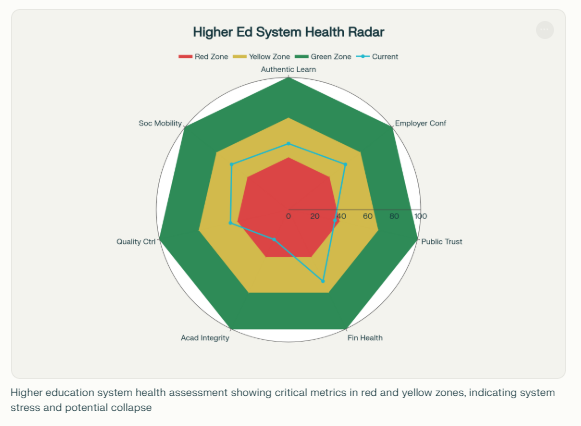
    For years, higher education leaders have avoided one of the most uncomfortable questions in the field: What is the minimum threshold of authentic learning required to keep the system operational? That threshold exists — and recent data suggest we may have already crossed it. The warning signs are visible in eroding public trust, declining employer confidence, and a growing inability to authenticate credentials. What we are watching now is not a temporary disruption, but the managed decline of mass higher education as we have known it.

    A truly viable education system has to deliver four essential functions. It must transmit knowledge — not only basic literacy, numeracy, and critical thinking, but also the domain-specific skills employers recognize, along with the ability to evaluate information in a democratic society. It must authenticate credentials by verifying learner identity, ensuring assessments are legitimate, maintaining tamper-proof records, and clearly differentiating between levels of competence. It must serve as a pathway for social mobility, providing economic opportunities that justify the investment, generating real wage premiums, and fostering professional networks and cultural capital. And it must have reliable quality assurance, with competent faculty, relevant curriculum, trustworthy measurement of learning outcomes, and external accountability strong enough to maintain standards.

    Research into institutional collapse and critical mass theory shows that each of these functions has a minimum operational threshold. The authentic learning rate must exceed 70 percent for degrees to retain their signaling value. Below that point, employers begin to see the credential itself as unreliable. Estimates today range from 30 to 70 percent, depending on the institution and delivery method. Employer confidence must stay above 80 percent for degrees to remain the default hiring credential. When fewer than eight in ten employers trust the degree signal, alternative credentialing accelerates — something already underway as skills-based hiring spreads across industries. Public trust must also remain high, but Gallup’s 2023 data put confidence in higher education at just 36 percent, far below the survival threshold. On the financial side, stability is eroding, with roughly 15 percent of U.S. institutions at risk of closure and more failing each year.

    Despite these trends, parts of the system still function effectively. Elite institutions with rigorous admissions, strong alumni networks, and powerful employer relationships continue to maintain credibility. Professional programs such as medicine, engineering, and law retain integrity through external licensing and oversight. Technical programs tied closely to industry needs still provide authenticated learning with direct employment pathways. Research universities at the graduate level preserve rigor through peer review, publication requirements, and close faculty mentorship. These pockets of quality create the illusion that the overall system remains sound, even as large portions hollow out.

    But the cracks are widening. Public trust is at 36 percent. Fraud rates are climbing beyond detection capacity, with California’s rate estimated at 31 percent. Grade inflation is erasing distinctions between levels of achievement. Authentic learning appears to be hovering somewhere between 30 and 70 percent, putting the system in a yellow warning zone. Financially, the sector remains unstable, with 15 percent of institutions on the brink.

    Higher education is also becoming sharply stratified. At one end are the high-integrity institutions that still maintain meaningful standards, a group that may represent just 20 to 30 percent of the market. In the middle are the credential mills — low-integrity schools operating on volume with minimal quality control, perhaps 40 to 50 percent of the market. On the other end, alternative providers such as bootcamps, apprenticeships, and corporate academies are rapidly filling the skills gap. This stratification allows the system to stagger forward while its core mission erodes.

    Collapse becomes irreversible when several failure points converge. Employer confidence dropping below 50 percent would trigger mass abandonment of degree requirements. Public funding cuts, fueled by political backlash, would intensify. Alternative credentials would reach critical mass, making traditional degrees redundant in many sectors. A faculty exodus would leave too few qualified instructors to maintain quality. Rising student debt defaults could force the federal government to restrict lending.

    The available evidence suggests the tipping point likely occurred sometime between 2020 and 2024. That was when public trust cratered, employer skepticism intensified, financial fragility spread, and the post-pandemic environment made fraud and grade inflation harder to contain. We may already be living in a post-viable higher education system, one where authentic learning and meaningful credentialing are concentrated in a shrinking group of elite institutions, while the majority of the sector operates as a credentialing fiction.

    The question now is whether the surviving components can reorganize into something sustainable before the entire system’s legitimacy evaporates. Without deliberate restructuring, higher education’s role as a public good will vanish, replaced by a marketplace of unreliable credentials and narrowing opportunities. The longer we avoid defining the collapse threshold, the harder it will be to stop the slide.

    Sources: Gallup, Inside Higher Ed, BestColleges, Cato Institute, PMC (National Center for Biotechnology Information), Council on Foreign Relations

    Source link

  • Secretary of Education Linda McMahon Scheduled for ASU+GSV Summit, April 8, 2025

    Secretary of Education Linda McMahon Scheduled for ASU+GSV Summit, April 8, 2025

    On April 8, 2025, US Secretary of Education Linda McMahon will give a fireside chat at ASU+GSV, an edtech conference held in San Diego, California.  

    President Trump has tasked McMahon with dismantling the federal agency that oversees federally funded K-12 and higher education programs. In less than two weeks she has done just that.  

    Half of ED’s staff have already been fired or taken a payout, and the $1.7T student loan portfolio is likely to be transferred to the US Treasury. 

    There is no word yet on whether there will be demonstrators at the conference, but we expect some form of vocal nonviolent resistance.  AFT President Randi Weingarten is also scheduled to appear.  

    Source link