In a sector under constant strain, Campus.edu is being heralded by some as the future of community college—and by others as a slick repackaging of the troubled for-profit college model. What many don’t realize is that before it became Campus.edu, the company was known as MTI College, a private, for-profit trade school based in Sacramento, California.
Campus.edu rebranded in 2020 under tech entrepreneur Tade Oyerinde, is backed by nearly $100 million in venture capital. Campus now markets itself as a tech-powered alternative to traditional community colleges—and a lifeline for students underserved by conventional higher ed.
The rebranding, however, raises red flags. While Campus.edu pitches a student-first mission with attractive promises—zero-cost tuition, free laptops, elite educators—the model has echoes of the troubled for-profit sector, with privatization, outsourcing, and digital-first delivery taking precedence over public accountability and academic governance.
The Promises: What Campus.edu Offers
Campus.edu markets itself with a clean, six-step path to success. The pitch is aspirational, accessible, and designed to appeal to working-class students, first-generation college-goers, and those shut out of elite institutions. Here’s what the company promises:
Straightforward Application – A simple application process, followed by matching with an admissions advisor who helps identify a student’s purpose and educational fit.
Tech for Those Who Need It – A free laptop and Wi-Fi access for students who lack them, ensuring digital inclusion.
Personal Success Coach – Each student is assigned a personal success coach, offering free tutoring, career advising, and 24/7 access to wellness services.
Elite Educators – Courses are taught live via Zoom by faculty who also teach at top universities like Stanford and Columbia.
Enduring Support – Whether transferring to a four-year college or entering the workforce, Campus promises help with building skills and networks.
More Learning, Less Debt – For Pell Grant-eligible students, Campus markets its programs as costing nothing out-of-pocket, with some students completing degrees debt-free.
It’s a compelling narrative—combining social mobility, digital access, and educational prestige into a neat online package.
Behind the Curtain: MTI College and the For-Profit Legacy
Campus.edu did not rise out of nowhere. It emerged from the bones of MTI College, a long-running, accredited for-profit vocational school. MTI offered hands-on training in legal, IT, cosmetology, and health fields—typical offerings in the for-profit world. The purchase and transformation of MTI into Campus.edu allowed Oyerinde to retain accreditation, avoiding the long and uncertain process of seeking approval for a brand-new college.
This kind of maneuver—buying a for-profit and relaunching it under a new brand—is not new. We’ve seen similar strategies with Kaplan (now Purdue Global), Ashford (now the University of Arizona Global Campus), and Grand Canyon University. What makes Campus.edu unique is the degree to which it blends Silicon Valley aesthetics with the structural DNA of a for-profit college.
Missing Data, Big Promises
Campus.edu boasts high engagement and satisfaction, but as of now, no independent data on student completion, debt outcomes, or long-term career impact is publicly available. The company remains in its early stages, with aggressive growth goals and millions in investor backing—but little regulatory scrutiny.
Campus.edu is savvy. Its marketing strikes all the right notes: digital equity, economic mobility, mental health, and student empowerment. It presents itself as the antidote to everything wrong with higher education.
But as its past as MTI College shows, branding can obscure history. And as for-profit operators adapt to a new digital age, it’s essential to distinguish innovation from opportunism. Without transparency, regulation, and democratic oversight, models like Campus.edu could replicate the same old exploitation—with better user interfaces.
The stakes are high. For students already at the margins, a false promise can be more damaging than no promise at all.
This story was originally published by CalMatters. Sign up for their newsletters.
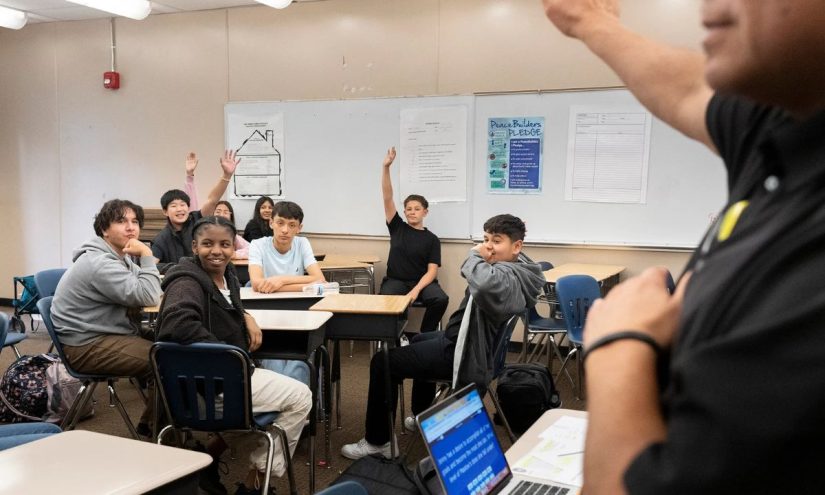
By 2:45 p.m. the regular school day at August Boeger Middle School had already ended, but one class is about to start. More than 20 eighth graders drop their backpacks and settle into desks — not for extra credit but for college credit.
These 13- and 14-year-old students in East San Jose are taking their first college course, an entry-level class on career planning. This middle school is one of the first in the state to offer a college-level course. In the coming years, the San Jose Evergreen Community College District wants all middle school students in this school district to be able to complete three college courses before they start high school, and soon, the district plans to offer other courses, such as sociology and ethnic studies, said Beatriz Chaidez, the chancellor for the community college district.
Middle schoolers have long been eligible to enroll in college classes in California, though only a few, high-achieving students actually do it. By offering a college class at a middle school — especially one in a high-poverty area — the community college district is looking to make that enrollment easier. The class is taught by a middle school staff member, and it’s reserved exclusively for middle school students.
But with so few programs, there is little research about whether students are benefitting, and the local faculty union is worried middle school students might not be ready.
Chaidez disagrees. “Navigating (college) as early as middle school is unheard of in their community,” she said. “So when they experience success, it really motivates them to continue.”
California is increasingly pushing high schools to offer community college classes directly to students during the regular school day, a set-up known as “dual enrollment.” Unlike AP classes, which include expensive exams and are limited to certain subjects and high-performing students, these community college classes cover a range of topics and are open to all students. By 2030, California Community Colleges Chancellor Sonya Chiristian wants all high school students to graduate with at least four college courses completed.
Chaidez wants to go further. She wants every local high school student to be able to complete about 20 college courses by the time they graduate — enough to earn an associate’s degree.
CalMatters reached out to the college district’s faculty union, which was surprised to learn the district is offering classes at a middle school.
“This opens up some problems,” said Jessica Breheny, an English professor and the union’s vice president. “I’m sure there are 12-year-olds that are college-ready, but there are just less of them and it’s less likely. Developmentally, they have other things going on.”
Research shows that high schoolers who take college classes are more likely to attend college and graduate, but there’s little research on how middle school students fare, said John Fink, a senior researcher at Columbia University’s Community College Research Center. “Nationally, and in most states, this is very, very rare, and in many states this is not allowed.” Instead, he said the focus is typically on enrolling more 10th, 11th and 12th graders in college courses.
A college-level course, with a few middle school games
About 10% of California’s high school students took a community college class in the 2021-22 school year, according to an analysis by professors at UC Davis using the most recent data. California’s community college system doesn’t track how many middle school students take college courses.
So far, the Mount Pleasant Elementary School District, which includes August Boeger Middle School, offers only one college course, called “Career Planning,” and it’s almost indistinguishable from any other class on its campus. The college course is taught in a regular middle school classroom, and the professor, Oscar Lamas, already works at the middle school, where he’s a counselor. Perhaps the only noticeable difference is the timing: The middle school day ends at 2:30 p.m. and Lamas’ course starts at 2:45. He’s paid separately by the community college to teach the course.
Career Planning helps students learn about career paths, practice resume-writing and learn psychological theories related to professional success. A governing board of college district professors, known as the Academic Senate, sets the objectives for each college course, but Lamas has broad discretion in teaching it. The Academic Senate responsible for setting the parameters of Lamas’ course did not respond to multiple requests for comment.
The dean of the community college’s counseling department, Victor Garza, refused an interview request from CalMatters but issued a written statement. Garza said the middle school class is akin to other dual enrollment courses, which maintain the college’s “academic rigor.”
“Some adjustments might be needed to cater to the unique needs and experiences” of students, he added.
On a Thursday before spring break, Lamas tries to make his class more fun by breaking the students into five teams to play a Jeopardy-style quiz game on the topic of the day, Maslow’s Hierarchy of Needs.
Natalie Mendoza, 14, becomes the default spokesperson of her team, named the “Tacos R Us Club,” but she answers the first question wrong, putting her team back 300 points and prompting her classmates to burst into chatter and analyze their mistakes.
As part of the class, she has to study a career, write a short essay about it and present it at a career fair. She picked intellectual property law. “A lot of people say I’m assertive,” she said. “I think that’s a really good trait for a lawyer, and I think it’d be fun to fight for people who have created stuff.”
Natalie said she’d be the first in her family to attend college but she’s already planning to go and has a few schools in mind, including UC Berkeley and San Jose State. If she does attend one of those schools, her grade in this counseling class would be part of her official college transcript.
Breheny, with the union, said she’s concerned about the quality of the classes, especially once the college district begins teaching other subjects, such as ethnic studies.
“Faculty designed their courses for adult learners,” Breheny said. An ethnic studies class may cover topics such as sexual violence and genocide, she added — topics that may be difficult to convey to a middle schooler. “Some of the material assumes a certain knowledge about the world, about politics, which you may not have at 11, 12, 13 years old.”
High schools offer few dual enrollment classes
August Boeger Middle School sits at the base of the Diablo Range mountains, tucked between the ranch-style homes and strip malls that color East San Jose. Teachers and staff greet each other with mucho gusto instead of hello. All around the open-air campus, murals tell the story of the region’s multi-cultural heritage, especially its Mexican and Chicano roots.
That celebration of culture is a direct response to a history of adversity, Lamas said. “East San Jose has always been a marginalized, disadvantaged environment.” As a result, schools in the community contend with education disparities, he said, such as a high dropout rate and a high teen pregnancy rate.
Offering a college class to these middle school students allows them to “see a possibility for their future that doesn’t exist within these walls here” and can inspire them to reach for a higher goal, said Marisa Peña, a school advisor.
Male students, Black and Latino students and students from rural areas are underrepresented in the community college courses offered at California’s school districts. California lawmakers have signed numerous bills in the hopes of expanding access but certain regions in the state, such as Los Angeles, enroll a higher percentage of students.
Natalie said she hopes to continue taking college courses when she starts at Mount Pleasant High School this fall, which is just around the corner from her middle school. But her options are limited.
Mount Pleasant High School offers just three community college courses, which serve about 10% of the school’s roughly 1,000 students, said Kyle Kleckner, the school district’s director of instructional services. All of the classes are in “multimedia” studies, he said, which teaches students how to create their own podcasts or YouTube channels, along with other digital marketing skills.
Although Mount Pleasant High School’s dual enrollment is about on par with the state average, it trails other districts in the region. Less than 20 miles away, at high schools in the Milpitas Unified School District, roughly 25% of students enrolled in a community college class in 2021-22, according to the UC Davis analysis.
Finding professors to teach middle school
Part of the dual enrollment challenge is finding qualified college professors who are willing and able to work at a high school or middle school. Existing middle and high school teachers are allowed to teach college courses but they have to meet the qualifications, which usually include a master’s degree in the area of instruction. Most of California’s high school and middle school instructors lack a master’s degree, according to a study by the Public Policy Institute of California.
“We have graduation requirements that students have to accomplish,” Kleckner said. “The trick is finding that community college course that also fulfills those requirements and also finding a teacher who can teach it.” He said Mount Pleasant High School is committed to expanding the number of college courses but noted that it’s smaller and therefore has fewer teachers who meet the requirements to teach a college course.
In turn, many college professors lack experience teaching children, said Breheny, who teaches at San Jose City College. “We have had some problems already with dual enrollment where faculty have gone to different (high schools) to teach and have dealt with classroom management issues that they wouldn’t have in a college course.” In one case, she said a college faculty member saw bullying in a high school classroom but didn’t feel equipped to respond.
Lamas has a master’s degree, which is required for most school counselors. He’s gentle with the middle school students in his class, occasionally awarding points in the Jeopardy game even when the answer isn’t perfect. Lamas had two quiz games planned that day, each one covering a different topic, but the first game took up almost all of the class time.
He ends class by taking questions about the upcoming final project. Although spring break is minutes away, the students sit still through the final minutes, except for the occasional joke and bursts of laughter. Not a single phone was in sight.
Once class ends, however, chatter ensues, the students pull out their phones, and staff escort them to the parking lot. While they may be taking a college course, they still must wait for their parents to pick them up.
MUSCATINE, Iowa — The suspect moved menacingly toward her, but Elexiana Oliva stood her ground, gun drawn and in a half crouch as she calmly tried to talk him down.
The confrontation wasn’t real, and neither was the gun. But the lesson was deadly serious.
Oliva is a criminal justice major at Muscatine Community College in this largely agricultural community along the Mississippi River. She was in a simulation lab, with that scenario projected on a screen as classmates watched, spellbound.
Just 18, Oliva is determined to become a police detective, a plan that includes earning a bachelor’s degree after she finishes her associate degree here. But she’ll have to go somewhere else to do it — likely, in her case, to a university in Texas.
“It’s not our fault that we grew up in a place where there’s not a lot of big colleges and big universities,” Oliva said.
Related: Interested in innovations in higher education? Subscribe to our free biweekly higher education newsletter.
Iowa has joined a growing number of states that are considering letting community colleges like this one offer bachelor’s degrees, or where community colleges have already started adding them, as a way of filling these so-called rural higher education deserts and training workers in rural places for jobs in fields where there are growing shortages.
“It would be a big game-changer, especially for those who have a low income or a medium income and want to go and further our education,” Oliva said.
Downtown Muscatine, Iowa. About an hour from the nearest public university, Muscatine could benefit from a proposal to let community colleges offer bachelor’s degrees. Credit: Mike Rundle for The Hechinger Report
Abouthalf of states allow community colleges to offer bachelor’s degrees. In Iowa, which is among the half that don’t, lawmakers have commissioned a study to determine whether it should add bachelor’s degrees in some programs at the state’s 15 community colleges. An interim report is due in May.
A similar proposal in Illinois is backed by that state’s governor, JB Pritzker, who has said the move would make it easier and more affordable for residents to get degrees — “particularly working adults in rural communities.” Three-quarters of community college students in Illinois said they would pursue bachelor’s degrees if they could do it on the same campus, according to a survey released by Pritzker’s office.
And in Texas, Temple College will open a center in June where students at the two-year public institution will be able to earn bachelor’s degrees through partner Texas A&M University-Central Texas, including in engineering technology with a concentration in semiconductors.
“When you can offer university classes on community college campuses, that makes a world of difference” to rural students, said Christy Ponce, the president of Temple.
What’s been blocking many of these students from continuing their educations, Ponce said, “is the sheer distance. There’s not a public university option within an hour or more away. And affordability and transportation barriers are huge issues.”
Fewer than 25 percent of rural Americans hold bachelor’s degrees or higher, according to the National Center for Education Statistics, compared to the national average of 33 percent. And the gap is getting wider, the U.S. Department of Agriculture finds in its most recent analysis of this.
Significantly fewer students in rural places than in urban areas believe that they can get degrees, a Gallup survey for the Walton Family Foundation found, citing the lack of nearby four-year universities as a principal reason.
In those states that already allow community colleges to offer bachelor’s degrees, they’re often limited to certain high-demand fields, such as teaching and nursing. Even as this idea has spread, America’s 960 public community colleges collectively confer only about 1 percent of bachelor’s degrees each year, the American Association of Community Colleges reports.
In many places, what’s stopping them from giving out more is opposition from four-year universities and colleges, many of which are increasingly hard up for students as the number of 18-year-olds begins to fall — a phenomenon enrollment managers have dubbed the demographic cliff.
That Illinois proposal, for example, is stalled in committee after several public and private university presidents issued a statement opposing it. Negotiations are continuing.
While community colleges in California have been allowed since 2021 to offer bachelor’s degrees, several have been blocked from adding four-year programs that the California State University System contends it already offers. An independent mediator has been brought in to resolve the impasse.
And while the two-year, public College of Western Idaho will launch a bachelor’s degree in business administration in the fall, it’s doing so only over the objections of Boise State University, which said it “could hurt effective and efficient postsecondary education in Idaho, cannibalizing limited resources available to postsecondary education and duplicating degree offerings.”
Community colleges also need more students; their enrollment declined by 39 percent from 2010 to 2021, and they face that same impending demographic cliff. Those that add bachelor’s degrees increase their full-time enrollment from 11 percent to 16 percent, research conducted at the University of Michigan has found.
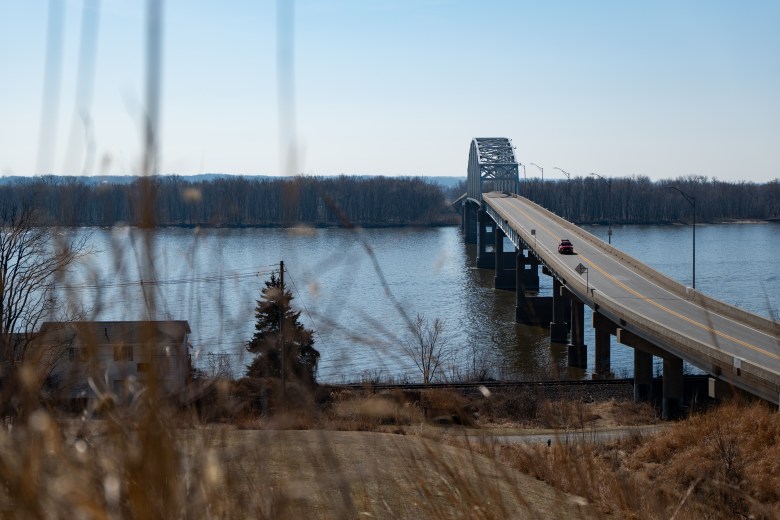
The Norbert F. Beckey Bridge, seen from the Mark Twain Overlook in Muscatine, Iowa, which links Muscatine with Rock Island County, Illinois, across the Mississippi River. Credit: Mike Rundle for The Hechinger Report
The principal impetus for the largely bipartisan push to offer bachelor’s degrees at community colleges, however, is to train more workers for those fields in which there are shortages.
“What I think is misunderstood is that, in general, these are not like the baccalaureates that conventional four-year institutions offer,” said Davis Jenkins, a senior research scholar at the Community College Research Center at Teachers College, Columbia University. (The Hechinger Report, which produced this story, is an independent unit of Teachers College.)
Bachelor’s degrees at community colleges, said Jenkins, “meet an economic need for bachelor’s degree graduates that isn’t being met by other institutions.”
That includes by helping rural workers move up in their jobs without leaving home. “It’s all about serving our workforce needs,” said Iowa state Rep. Taylor Collins, Republican chair of Iowa’s House Committee on Higher Education, who requested the study into whether bachelor’s degrees should be offered at community colleges in that state. “It’s a way to upskill our workforce.”
In his own district, south of Muscatine, “we’re kind of on an island where we only have the community college” — especially since the closing of nearby private Iowa Wesleyan University in 2023. “There are a lot of students who are place-bound. There are a lot of students who want to live locally” and not move away to get a bachelor’s degree.
That’s a focus of the ongoing study, said Emily Shields, executive director of Community Colleges for Iowa, which is conducting it. “Sometimes people have ties, responsibilities, jobs, family things, where moving to where there is a degree available isn’t an option for them,” Shields said.
Sure, she said, rural students can take courses online. But “you’re not getting the student services, you’re not getting activities, you’re not getting the other sort of enrichment support and belonging that a lot of our students, I think, are looking for.”
Many also say they’re looking for the kind of individual attention they get in their hometown and at a community college such as the one in Muscatine, which has an enrollment of 1,800.
Shiloh Morter stayed in his hometown of Muscatine, Iowa, to go to community college. Among the advantages, he says: “The sunsets here are pretty nice. I can tell you, there’s not a whole lot of other places that have clouds like we do.” Credit: Mike Rundle for The Hechinger Report
Shiloh Morter bikes to campus on all but the very coldest days. He plans to become an engineer, but “figured I would save the money and go to community college and try and branch out and develop better habits” first, said Morter, who is 20.
In the automotive technology garage off the main corridor of the small school, cars were lined up neatly with their hoods popped. Nursing students worked on anatomically correct crash test dummy-style “patients.”
Twenty-year-old Mykenah Pothoff enrolled at the college when it debuted a registered nursing program, saving herself money on tuition and a nearly hourlong drive, each way, to the University of Iowa. She also was worried about “just, like, finding my way around” the university, which has more than 30,000 students.
Jake Siefers is majoring in psychology at an Iowa community college. If he could stay and get his bachelor’s degree in the same place, “it would be huge,” he says. “There’s a lot of untapped human potential” in rural places that could benefit from more access to higher education. Credit: Mike Rundle for The Hechinger Report
Jake Siefers, 32, is a psychology major planning to go on to get bachelor’s and master’s degrees. Siefers said he hopes to help other people who, like him, are recovering from alcoholism, and for whom he said there are too few services in Iowa. So he came home to Muscatine to start working toward an associate degree at the community college.
“I could afford it, and it was close and I actually know a lot of people that work here,” said Siefers. “It’s great coming in here and being, like, ‘Hey, I went to high school with you, and you work in the office.’ I mean, that’s everyone in Iowa, right?”
If he could stay and get his bachelor’s degree in Muscatine, “it would be huge,” he said. “There’s a lot of untapped human potential” in rural places that could benefit from the kind of access to a higher education that is now more limited, said Siefers.
Letting students like them finish bachelor’s degrees near where they live “would make it easier for everybody,” said Jaylea Perez, 19, another psychology major who also plans to earn one.
Jaylea Perez is enrolled in community college in Iowa but eventually hopes to earn a bachelor’s degree in psychology. Adding bachelor’s degrees at community colleges “would make it easier for everybody,” she says. Credit: Mike Rundle for The Hechinger Report
Simply having bachelor’s degrees available would make rural students aspire to them who otherwise might not, said Naomi DeWinter, president of Muscatine Community College.
“Everything opens up to them,” said DeWinter, in a coffee shop across the highway from the Walmart.
She sees the most potential among people already working, such as paraprofessionals in schools who want to become teachers; a state job board lists nearly 1,000 vacancies in Iowa for teachers.
DeWinter recalled a graduate so exemplary that he was featured in a promotional video, who after earning his associate degree started substitute-teaching while commuting in his free time to the University of Iowa to get his bachelor’s degree — one course at a time.
“He said, ‘That’s how I’m juggling my work, my family and the affordability,’ ” she said. “His whole career is going to be over before he’s a [full-time] teacher. I feel as though we failed him.”
Like the substitute teacher, students said they want to stay in Muscatine, despite those limits. They like the peace and quiet compared to cities — hardly anyone ever honks, they noted — and the sense of community evident among the friends who run into each other at the Hy-Vee.
“We don’t have the best view of the Milky Way, but we for sure definitely don’t have a bad one,” said Shiloh Morter, ticking down a list of advantages to living on the sweeping plain carpeted with cultivated fields and dotted with barns and silos. “And, yeah, the sunsets here are pretty nice. I can tell you, there’s not a whole lot of other places that have clouds like we do.”
The Hechinger Report provides in-depth, fact-based, unbiased reporting on education that is free to all readers. But that doesn't mean it's free to produce. Our work keeps educators and the public informed about pressing issues at schools and on campuses throughout the country. We tell the whole story, even when the details are inconvenient. Help us keep doing that.
After a five-year pause, the Trump administration is bringing back financial penalties for the many millions of borrowers who are too far behind on their student loan payments. It’s led to confusion and financial uncertainty.
At least 5 million people are in default, meaning they have failed to make payments on their loans for at least nine months — and millions more are projected to join them in the coming months.
The Hechinger Report spoke to student loan experts about what to expect and how to prepare, as well as about a separate effort in Congress to adjust how student loans work.
The Biden administration restarted loan repayments in October 2023. That came without any consequences, however, for about a year. But interest, which had also been frozen since the start of the pandemic, has been piling up for some borrowers since the fall of 2023.
All told, about 43 million federal student loan borrowers owe a total of $1.6 trillion in debt. Starting May 5, those in default face having tax refunds withheld and wages garnished if they don’t start making regular payments.
A college degree can be a path to long-term financial security, but the process of repaying loans can lead to financial hardship for many borrowers. About half of all students with a bachelor’s degree graduate with debt, which averages more than $29,000. And although average debt tends to be lower for graduates of public universities (about $20,000), close to half of people who attend those schools still leave with debt.
Related: Interested in more news about colleges and universities? Subscribe to our free biweekly higher education newsletter.
The student loan landscape is likely to change in some way over in the coming months: The Trump administration is expected to push the limits on aggressive collection practices, while Republicans in Congress are determined to adjust repayment options. Here’s what we know about what the Trump administration’s actions mean for student borrowers.
Once you’ve failed to make a loan payment in 270 days, you will probably enter into default. That means, as of May 5, the government can take your federal tax refund and apply it to your debt. Starting in June, the government can also withhold up to 15 percent of any money you receive from Social Security, including disability payments. And later this summer, officials said, they will start the process of taking a cut ofyour paycheck, although borrowers have the right to appeal. Going into default can also harm your credit score, which can make it harder to rent an apartment or borrow money for other reasons, like buying a car.
Can I go back to school to avoid repaying my loans?
Some influencers on social media have recommended enrolling in school as a way to delay making payments. It’s true that most loans are deferred while you’re in school, meaning you wouldn’t have to pay while you’re taking classes, but you may also add to what you already owe if you spend more time in college. Unless you’re confident a new certificate or degree will boost your income, delaying repayment and increasing what you owe could make paying off your loans even more difficult.
I can’t afford to repay my loan. What should I do?
There are other options. One type links your monthly payments to what you earn. These income-based repayment plans can shrink your monthly loan bill. There is also a graduated repayment plan that can lower your payments initially, after which they increase every two years. A third option is an extended repayment plan, which lowers your monthly payments but adds months or years to the time it will take to pay off your loans. The government’s Loan Simulator is one way to find options available to you.
Where can I go if I need help?
The Education Department’s Default Resolution Group can help provide advice for borrowers who are already in default. The Federal Student Aid call center is set up to answer questions. Borrowers can also reach out to their loan servicers for guidance.
What’s the difference between loan deferment, loan forbearance and default?
Loan deferment: The Education Department may grant a loan deferment for several reasons, including when a borrower is experiencing an extreme economic hardship or is unemployed. That means the borrower can temporarily stop paying off the loan without any financial penalties; in the case of subsidized undergraduate loans, interest doesn’t keep accruing during that time.
Forbearance: A loan forbearance also allows a borrower to stop payments, or make smaller ones, without any penalties. However, interest usually keeps building on all loans during that time.
Default: If a borrower is in default, it means they have failed to make payments for at least 270 days without permission. That’s when the government can begin to garnish tax refunds, Social Security benefits and wages, and a borrower’s credit score will drop.
I’ve heard income-driven repayment plans are in trouble. Is that true?
There are several types of income-driven repayment plans, which are meant to keep payments affordable. The Biden administration’s Saving for a Valuable Education (SAVE) plan is on hold because of legal challenges from Republican-led states. That plan previously offered eligible borrowers a repayment plan with lower monthly payments and a quicker path to loan forgiveness than other previously available options. But borrowers can still enroll in the Pay As You Earn (PAYE) plan and other income-based repayment options, in which payments are capped at 10 percent of a borrower’s income, or the Income-Contingent Repayment Plan, which requires payments of up to 20 percent of income and allows full repayment more quickly. Congressional Republicans hope to eliminate several of these plans in favor of just one income-based repayment plan, but it’s unclear if that bill will pass the Senate.
What’s happening with the court cases challenging the SAVE program?
Courts have effectively paused the SAVE plan. The 8 million borrowers who are enrolled don’t have to make payments, and interest will not be added while the court decides the case. With those payments paused, borrowers in this group who are intending to seek loan forgiveness for working in public service are also not making progress toward that goal. If Congress eliminates the SAVE program or the courts officially kill it, those borrowers would need to enroll in a different repayment plan.
Does Public Service Loan Forgiveness (PSLF) still exist?
Yes, the Public Service Loan Forgiveness program is still available. Borrowers should still be eligible if they are in an income-driven repayment plan and make regular payments for 10 years. They must work for the federal, state or local government — teachers and firefighters are eligible, for example — or for qualifying nonprofit organizations, such as some health care clinics or foster care agencies. The goal of PSLF is to encourage graduates to pursue careers that may pay less than jobs with private companies but which benefit their communities or the country as a whole.
The Trump administration issued an executive order in March aimed at limiting which organizations’ jobs could qualify for PSLF — for instance, a nonprofit could be excluded if the government decides it is “supporting terrorism,” engaging in civil disobedience or aiding undocumented immigrants in violation of federal law. So far, it’s unclear what the effect will be.
What other changes might be in store for student loans?
As part of the federal budget process, congressional Republicans have proposed a slew of changes to student loans that some policymakers worry will make borrowing more expensive for students — especially those in graduate programs.
The proposals include changes to:
Subsidized loans: Congressional Republicans want to get rid of subsidized loans for undergraduates, which would mean interest would accrue while a student was in college. They also want to cap total undergraduate borrowing at $50,000.
Grad Plus: They also want to end the Grad Plus program, which allows students to borrow money to cover the cost of graduate school. Student advocates worry that this would push more students into the private student loan market, which has fewer protections for borrowers.
Income-driven repayment: One proposal would simplify income-driven repayment into one option and prevent interest from causing student debt to balloon for students in income-driven repayment plans.
The proposed changes are included in the federal budget bill and may undergo many revisions as Congress figures out its spending priorities for the year.
This story about student loan repayment was produced by The Hechinger Report, a nonprofit, independent news organization focused on inequality and innovation in education. Sign up for the Hechinger newsletter.
The Hechinger Report provides in-depth, fact-based, unbiased reporting on education that is free to all readers. But that doesn’t mean it’s free to produce. Our work keeps educators and the public informed about pressing issues at schools and on campuses throughout the country. We tell the whole story, even when the details are inconvenient. Help us keep doing that.
This story was originally published by CalMatters. Sign up for their newsletters.
Students tap on their keyboards as a professor lectures at the front of the room. It looks like any other college course, except that it’s taking place at a high school. This year, more than 150,000 California teens are earning college credit in dual enrollment courses.
Dual enrollment offers high schoolers the chance to attend community college, typically for free, often without having to leave their campuses. By helping students tackle the college academic experience, the programs increase the likelihood that students attend college after graduating high school.
About 80% of California’s dual enrolled high school students go on to a community college or university, compared to 66% of California 12th grade students in general, the Public Policy Institute of California found. More than a third of California’s dual enrolled students go on to attend the same community college they attended while in high school after they graduate, according to the Community College Research Center.
Many college and high school administrators have pushed to increase students’ college attainment rates, and the state has invested more than $700 million in dual enrollment, leading to a significant expansion. The number of students in these courses tripled between spring 2015 and spring 2024, according to state data. The Public Policy Institute of California found that about 30% of California’s high school graduating class of 2024 took at least one dual enrollment course.
The growth of high schoolers is a bright spot in overall student totals at the state’s community colleges, which have struggled to fully rebound after enrollment tanked during the pandemic. However, some community college faculty have pushed back against widespread dual enrollment due to concerns about academic rigor and working conditions for educators.
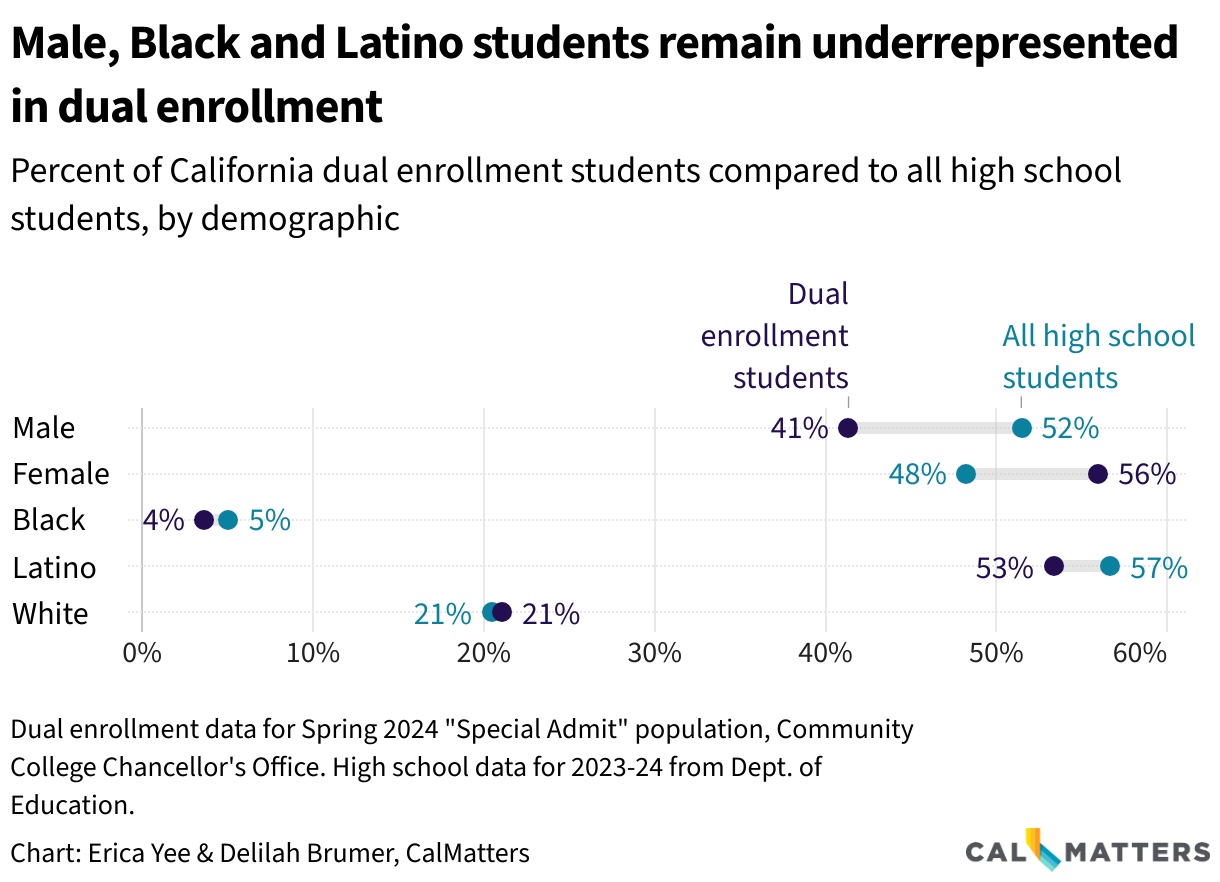
Furthermore, data shows that some of California’s rural students, as well as males and students of color, don’t enroll in and complete these courses at the same rate as others. Some experts and administrators say they’re not just missing out on a couple of college credits, they’re not getting the same opportunities to envision themselves as future college students.
“When high schoolers complete these courses, they are able to fulfill requirements that help them access associate degrees and bachelor’s degrees,” said Daniel Payares-Montoya, a PPIC research associate. “The students benefit, but so do the community colleges, because it helps them enroll more students.”
Rural schools and colleges face dual enrollment hurdles
In Siskiyou County, at the northern tip of California, the only community college serves a sprawling region that covers mountains, forests and rural towns. Although the county has a population of just 43,000, it is the fifth largest county in California by area, meaning that often the hardest part of supporting dual enrolled students isn’t the actual teaching — it’s having the right technology and transportation to reach them in the first place.
“The personal interaction is a challenge, because we have high schools that are two hours away,” said Kim Peacemaker, a counselor and dual enrollment coordinator at College of the Siskiyous. The college currently has about 230 dual enrolled high school students and about 2,390 students total, based on state data.
Peacemaker said the college has worked to make dual enrollment accessible by allowing professors to meet virtually with students in their high school classrooms. However, she added that some students don’t have reliable internet access at home for homework or tutoring. In Siskiyou County, 13.7% of households don’t have broadband internet.
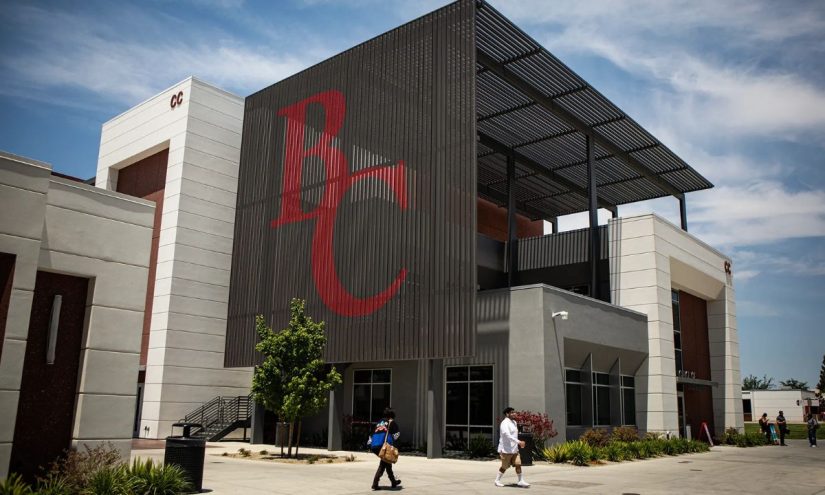
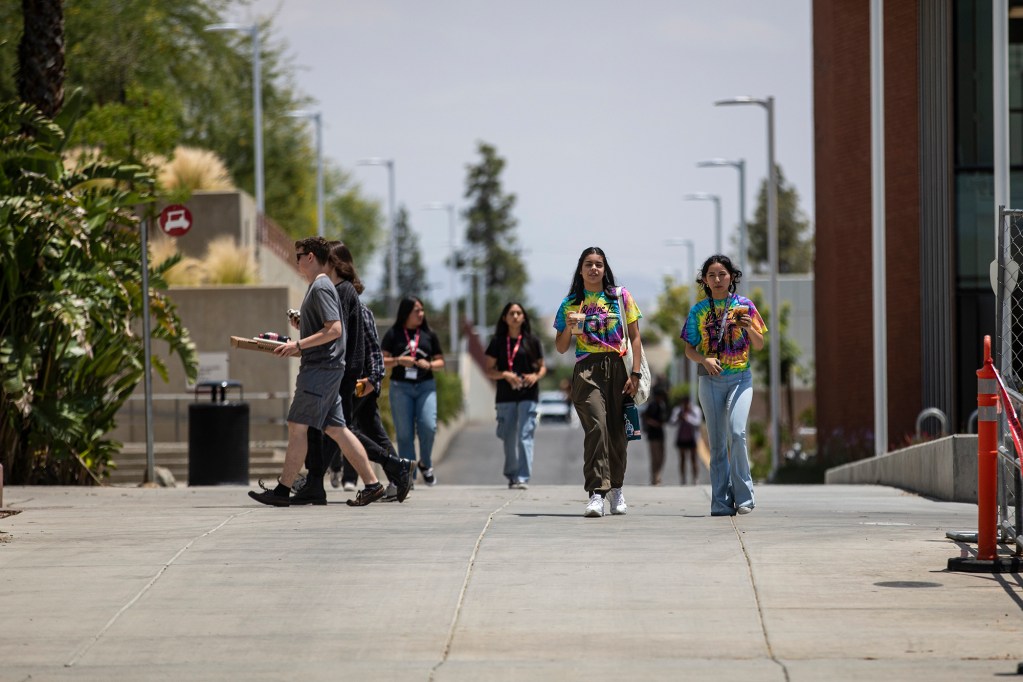
Students walk through one of the main walkways onto Bakersfield College on June 14, 2023. (Larry Valenzuela, CalMatters/CatchLight Local)
California’s rural colleges generally lag behind urban colleges in dual enrollment. Kern Community College District in the southern Central Valley and the Compton Community College District near Los Angeles had the two highest percentages of high school students in 2024, at 41% and 36% respectively, based on state data. In comparison, 9.7% of students at College of the Siskiyous are dual enrolled high schoolers, and this drops to about 5% in some other parts of the state.
Sonya Christian, the chancellor of the California Community College system, previously led the Kern Community College District, spearheading its expansion of dual enrollment. Now, dual enrollment in the district is “one of the most successful models in the state,” Christian said in an emailed statement to CalMatters.
“I prioritized dual enrollment because I saw it as a potential pathway to increase college-going rates, accelerate degree completion and provide students — especially those in rural and low-income communities — with early exposure to college-level coursework,” Christian said in the statement.
For many high school students in the small city of Blythe, which sits along California’s border with Arizona, the only people they know with bachelor’s degrees are their teachers. That’s why Clint Cowden, the vice president of instruction and student services at Palo Verde College, said the exposure to college that dual enrollment provides these students can be transformative.
“It’s really a win-win for the community,” Cowden said.
A recent alumnus of Palo Verde College’s dual enrollment program, Manuel Milke earned his high school diploma and his associate degree simultaneously, while juggling varsity soccer and football. Now Milke, who is 19, is set to graduate in the fall from San Diego State with a bachelor’s degree in kinesiology. Milke said he chose to attend San Diego State to stay close to his family in Blythe, and aspires to work as a physical therapist somewhere nearby.
“Everyone should do dual enrollment,” said Milke. “It saved me time, it saved me money and it made me feel more prepared for college.”
Student gaps remain in dual enrollment
As a Latino male, Milke is in the minority for dual enrollment. Based on state data, Black and Latino students are both underrepresented in dual enrollment courses. In the spring 2024 semester, 41% of dual enrollment students were male, while 56% were female. According to Payares-Montoya, these gaps in access to dual enrollment can make it so Black, Latino and male students are less likely to see higher education as an option, compared to their dual enrolled peers.
For Jesse Medrano, an 18-year-old senior at Daniel Pearl Magnet High School in the Los Angeles Unified School District, dual enrollment has provided “a good outline of what college is like.” His high school first placed him in dual enrollment in ninth grade, and since then he has taken five classes, covering topics including economics and political science.
“I didn’t have the drive to seek these courses out, so the fact that they put me in them set this standard for me, and now I’m meeting it,” said Medrano, who is Latino and plans to study accounting at Cal State Northridge. “I didn’t have the motivation, but now I do, and I’m able to succeed.”
At Compton College more than a third of the current students are still in high school, according to state data. Latino and Black students comprise 75% and 9% of dual enrollees, respectively, which are significantly higher than state averages. Keith Curry, the college’s president, said that when students of color complete dual enrollment courses, this gets them comfortable with college academics and leads to better representation at colleges and universities.
Some faculty push back against expansion
Some community college faculty have raised concerns about the process by which dual enrollment partnerships are established, the level of readiness of high school students for college courses, and who teaches these classes. In many districts across the state, some dual enrollment courses are not taught by community college faculty, but by existing high school teachers who hold the credentials required to teach at a college level. In the Kern Community College District, about 60% of dual enrollment courses held on high school campuses are taught by high school teachers who meet the college qualifications, according to district spokesperson Norma Rojas.
Tim Maxwell, an English professor at College of San Mateo, is a “conscientious objector” to California’s expansion of dual enrollment. Maxwell said he is concerned about what he sees as a focus to get as many students to graduate and earn college credits as quickly as possible, sacrificing college-level rigor and evaluation.
“Completion is important, but our primary responsibility is for students to learn something along the way,” said Maxwell, who has taught community college courses for about 30 years.
Maxwell has taught creative writing courses on his college campus with several dual enrolled students, one as young as 15 years old, and he said these students are “phenomenal.” But, he added, there’s a difference between a handful of proactive high schoolers going to a community college campus and a high school classroom that “switches to a college class during fifth period.” He said he is concerned about poor working conditions for professors, primarily adjunct faculty, who have to travel to high schools and teach without the proper background or support.
“We need to resist this, and we need lawmakers who understand something about education and not just spreadsheets,” Maxwell said.
Wendy Brill-Wynkoop, the president of the Faculty Association of California Community Colleges, said dual enrollment is beneficial for students, but that she has “heard grumblings” about a need for faculty to have a more active role in setting standards and policies for dual enrollment.
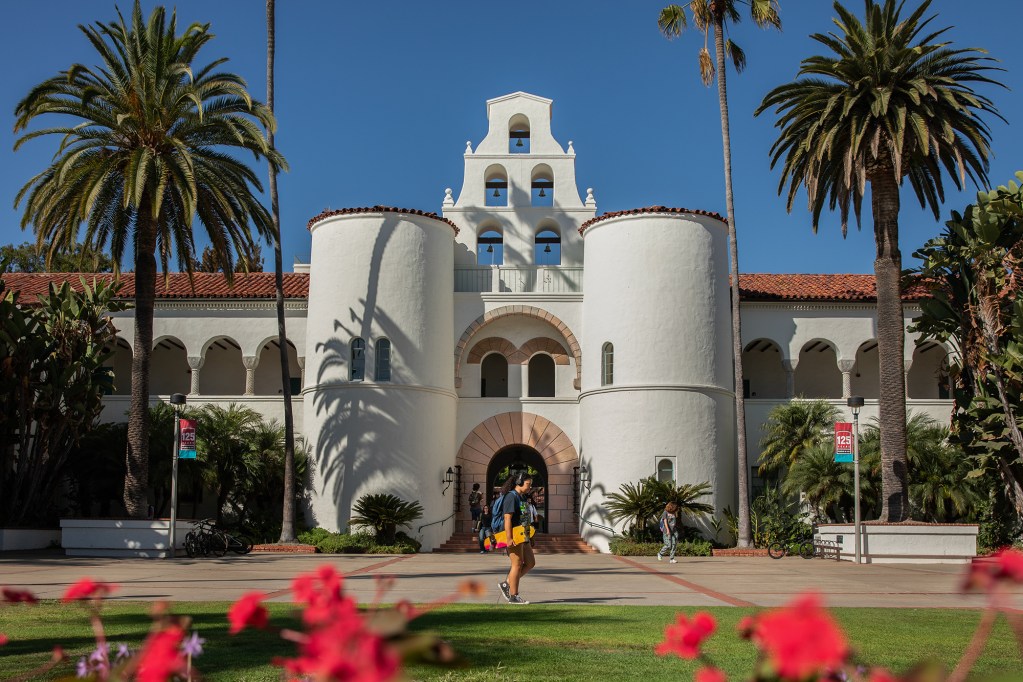
Students walk near Hepner Hall at San Diego State University in San Diego on Oct. 10, 2024. (Adriana Heldiz/CalMatters)
While in high school in Blythe, Milke said his dual enrollment courses were generally easier than the courses he takes at San Diego State. But they still challenged him and prepared him for a college-level workload, he said.
Lawmakers work to continue growth
Several state laws have been enacted in the past decade to expand dual enrollment in California. In 2015, Assembly Bill 288 established the College and Career Access Pathways program, allowing community colleges and high schools to enter into dual enrollment partnerships. These institutions bring the courses to students, as opposed to those students having to seek them out. The state streamlined the pathways program with the passage of Assembly Bill 30 in 2019, allowing students to submit fewer forms to enroll. Assembly Bill 731, which is currently in committee, would, among other changes, increase the number of units that students in the program can take.
Based on PPIC research, students in the College and Career Access Pathways program now account for about 37% of dual enrollees. This program has a higher percentage of underrepresented students compared to other dual enrollment programs, in part because it eliminates some of the restrictions that can make it hard for schools to offer broad and barrier-free dual enrollment.
As dual enrollment continues to expand, it increases costs to California beyond the more than $700 million that the state has already invested. That’s because both community colleges and high school districts are typically both able to receive state funding for dual enrolled students, according to the Legislative Analyst’s Office.
According to the statement from Christian, state leaders are working to increase dual enrollment access by expanding partnerships between high schools and colleges.
“My vision is to make dual enrollment a standard opportunity for all California students, not just an option for a select few, increasing equitable access to higher education and workforce-aligned learning,” Christian said in the statement.
Alana Althaus-Cressman, who runs the dual enrollment program at Golden Eagle Charter School, a K-12 school in Siskiyou County, markets the program to all students, not just those who already have a record of high achievement. She studied dual enrollment access for rural students for her graduate school dissertation at Sacramento State University, and started the early college high school program at Golden Eagle Charter in 2024. Students in the program take dual enrollment courses for part of the school day, and high school courses for the rest.
Althaus-Cressman said that because dual enrollment offers students a glimpse of college, it’s important that the classes aren’t only filled with students who already plan to attend college. Some high schools require minimum grade point averages or have other barriers to entry for dual enrollment, which Althaus-Cressman said can perpetuate inequalities.
The early college high school program enrolls about a third of Golden Eagle Charter’s ninth graders. Althaus-Cressman attributes this level of participation to extensive outreach, which included working with school staff to call the families of every incoming high school student to invite them to a dual enrollment orientation.
“We don’t want students to think that they aren’t the type of student for this program,” Althaus-Cressman said. “It’s for everybody.”
Patricia McGuire has always been an outspoken advocate for her students at Trinity Washington University, a small, Catholic institution that serves largely Black and Hispanic women, just a few miles from the White House. She’s also criticized what she calls “the Trump administration’s wholesale assault on freedom of speech and human rights.”
In her 36 years as president, though, McGuire told me, she has never felt so isolated, a lonely voice challenging an agenda she believes “demands a vigorous and loud response from all of higher education. “
It got a little bit louder this week, after Harvard University President Alan Garber refused to capitulate to Trump’s demands that it overhaul its operations, hiring and admissions. Trump is now calling on the IRS to rescind Harvard’s tax-exempt status.
The epic and unprecedented battle with Harvard is part of Trump’s push to remake higher education and attack elite schools, beginning with his insistence that Harvard address allegations of antisemitism, stemming from campus protests related to Israel’s bombardment of Gaza following attacks by Hamas in October 2023.
Related: Become a lifelong learner. Subscribe to our free weekly newsletter featuring the most important stories in education.
Garber responded that “no government — regardless of which party is in power — should dictate what private universities can teach, whom they can admit and hire, and which areas of study and inquiry they can pursue” — words that Harvard faculty, students and others in higher education had been urging him to say for weeks. Students and faculty at Brown and Yale are asking their presidents to speak out as well.
Many hope it is the beginning of a new resistance in higher education. “Harvard’s move gives others permission to come out on the ice a little,” McGuire said. “This is an answer to the tepid and vacillating presidents who said they don’t want to draw attention to themselves.”
Harvard paved the way for other institutions to stand up to the administration’s demands, Ted Mitchell, president of the American Council on Education, noted in an interview with NPR this week.
Stanford University President Jonathan Levin immediately backed Harvard, noting that “the way to bring about constructive change is not by destroying the nation’s capacity for scientific research, or through the government taking command of a private institution.”
Former President Barack Obama on Monday urged others to follow suit.
A minuscule number of college leaders had spoken out before Harvard’s Garber, including Michael Gavin, president of Delta College, a community college in Michigan; Princeton University’s president, Christopher Eisgruber; Danielle Holley of Mount Holyoke; and SUNY Chancellor John B. King Jr. Of more than 70 prominent higher education leaders who signed a petition circulated Tuesday supporting Garber, only a handful were current college presidents, including Michael Roth of Wesleyan, Susan Poser of Hofstra, Alison Byerly of Carleton, David Fithian of Clark University, Jonathan Holloway of Rutgers University and Laura Walker of Bennington College.
Speaking out and opposing Trump is not without consequences: The president retaliated against Harvard by freezing $2.2 billion in grants and $60 million in contracts to Harvard.
Many higher ed leaders think it’s going to take a bigger, collective effort fight for everything that U.S. higher education stands for, including those with more influence than Trinity Washington, which has no federal grants and an endowment of just $30 million. It’s also filled with students working their way through school.
About 15 percent are undocumented and live in constant fear of being deported under Trump policies, McGuire told me. “We need the elites out there because they have the clout and the financial strength the rest of us don’t have,” she said. “Trinity is not on anyone’s radar.”
Some schools are pushing back against Trump’s immigration policies, hoping to protect their international and undocumented students. Occidental College President Tom Stritikus is among the college presidents who signed an amicus brief this month detailing concerns about the administration’s revocation of student and faculty visas and the arrest and detention of students based on campus advocacy.
“I think the real concern is the fear and instability that our students are experiencing. It is just heartbreaking to me,” Stritikus told me. He also spoke of the need for “collective action” among colleges and the associations that support them.
The fear is real: More than 210 colleges and universities have identified 1,400-plus international students and recent graduates who have had their legal status changed by the State Department, according to Inside Higher Ed. Stritikus said Occidental is providing resources, training sessions and guidance for student and faculty.
Many students, he said, would like him to do more. “When I’m around students, I’m more optimistic for our future,” Stritikus said. “Our higher education system has been the envy of the world for a very long time. Clearly these threats to institutional autonomy, freedom of expression and the civil rights of our community put all that risk.”
Back at Trinity Washington, McGuire said she will continue to make calls, talk to other college presidents and encourage them to take a stronger stand.
“I tell them, you will never regret doing what is right, but if you allow yourself to be co-opted, you will have regret that you caved to a dictator who doesn’t care about you or your institution.”
The Hechinger Report provides in-depth, fact-based, unbiased reporting on education that is free to all readers. But that doesn’t mean it’s free to produce. Our work keeps educators and the public informed about pressing issues at schools and on campuses throughout the country. We tell the whole story, even when the details are inconvenient. Help us keep doing that.
SHINGLETOWN, Calif. — On a cold morning in October, the sun shone weakly through tall sugar pines and cedars in Shingletown, a small Northern California outpost whose name is a reminder of its history as a logging camp in the 1800s. Up a gravel road banked with iron-rich red soil, Dylan Knight took a break from stacking logs.
Knight is one of 10 student loggers at Shasta College training to operate the heavy equipment required for modern-day logging: processors to remove limbs from logs that have just been cut, skidders to pull logs out of the cutting site, loaders to stack and sort the logs by species and masticators to mulch up debris.
For centuries, logging was a seasonal, learn-on-the-job trade passed down from father to son. But as climate change and innovations in the industry have changed logging into a year-round business, there aren’t always enough workers to fill jobs.
“Our workforce was dying,” said Delbert Gannon, owner of Creekside Logging. “You couldn’t even pick from the bottom of the barrel. It was affecting our production and our ability to haul logs. We felt we had to do something.”
Related: Interested in innovations in higher education? Subscribe to our free biweekly higher education newsletter.
Around the country, community colleges are stepping in to run apprenticeship programs for heritage industries, such as logging and aquaculture, which are too small to run. These partnerships help colleges expand the workforce development programs central to their mission. The partnerships also help keep small businesses in small industries alive by managing state and federal grants and providing the equipment, courses and staff to train workers.
As industries go, logging is small, and it’s struggling. In 2023 there were only about 50,000 logging jobs in the U.S., but the number of logging companies has been on the decline for several years. Most loggers are over 50, according to industry data, and older generations are retiring, contributing to more than 6,000 vacant positions every year on average. The median annual salary for loggers is about $50,000.
Student logger Bryce Shannon operates a wood chipper at a logging site as part of his instruction at Shasta College in Redding, Calif. Credit: Minh Connors for The Hechinger Report
Retirements have hit Creekside Logging hard. In 2018 Gannon’s company had jobs to do, and the machines to do them, but nobody to do the work. He reached out to Shasta College, which offers certificates and degrees in forestry and heavy equipment operation, to see if there might be a student who could help.
That conversation led to a formal partnership between the college and 19 timber companies to create a pre-apprenticeship course in Heavy Equipment Logging Operations. Soon after, they formed the California Registered Apprenticeship Forest Training program. Shasta College used $3.5 million in grant funds to buy the equipment pre-apprentices use.
Logging instruction takes place on land owned by Sierra Pacific Industries lumber company — which does not employ its own loggers and so relies on companies like Creekside Lumber to fell and transport logs to mills.
Each semester, 10 student loggers like Knight take the pre-apprenticeship course at Shasta College. Nearly all are hired upon completion. Once employed, they continue their work as apprentices in the forest training program, which Shasta College runs in partnership with employers like Gannon. State apprenticeship funds help employers offset the cost of training new workers, as well as the lost productivity of on-the-job mentors.
For Creekside Logging — a 22-person company — working with Shasta College makes participation in the apprenticeship program possible.Gannon’s company often trained new loggers, only to have them back out of the job months later. It can cost tens of thousands of dollars to train a new worker, and Creekside couldn’t afford to keep taking the financial risk. Now Gannon has a steady flow of committed employees, trained at the college rather than on his payroll. Workers who complete the pre-apprenticeship know what they’re getting into — working outdoors in the cold all day, driving big machines and cutting down trees.
Workers who complete the apprenticeship, Gannon said, are generally looking for a career and not just a seasonal job.
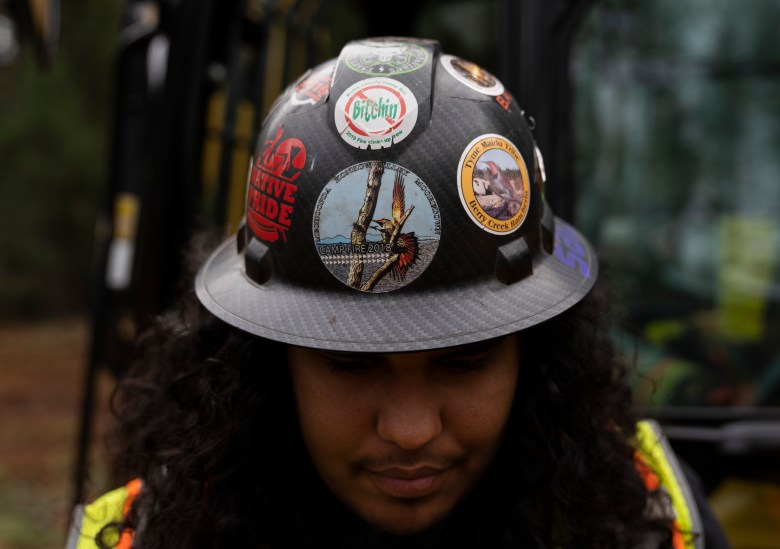
Talon Gramps-Green, a student logger at Shasta College in Redding, Calif., shows off stickers on his safety helmet. Credit: Minh Connors for The Hechinger Report
“You get folks that are going to show up every day,” Gannon said. “They got to test drive the career and know they like heavy equipment. They want to work in the woods. The college has solved that for us.”
Apprentices benefit too. Workers who didn’t grow up around a trade can try it out, which for some means tracking down an elusive pathway into the work. Kyra Lierly grew up in Redding, about 30 miles west of Shingletown, and previously worked for the California Department of Forestry as a firefighter. She’s used to hard work, but when she looked into getting a job as a logger she couldn’t find a way in. Some companies had no office phone or website, she says. Jobs were given out casually, by word of mouth.
“A lot of logging outfits are sketchy, and I wanted to work somewhere safe,” said Lierly, 25. She worked as an apprentice with Creekside Lumber but is taking a break while she completes an internship at Sierra Pacific Industries, a lumber producer, and gets a certificate in natural resources at Shasta College.
“The apprenticeship made forestry less intimidating because the college isn’t going to partner with any company that isn’t reputable,” Lierly said.
Apprenticeships, with their combination of hands-on and classroom learning, are found in many union halls but, until now, was not known to be common practice in the forested sites of logging crews.
State and federally registered apprenticeships have gained popularity in recent years as training tools in health care, cybersecurity and telecommunications.
Federal funding grew steadily from $145 million in 2018 to more than $244 million during the last years of the Biden administration. That money was used to support apprenticeships in traditional building trades as well as industries that don’t traditionally offer registered apprenticeships, including teaching and nursing.
The investment aims to address the shortage of skilled workers. The number of working adults in the U.S. doesn’t align with the number of skilled jobs, a disparity that is only slowly recovering after the pandemic.
Labor shortages hit especially hard in rural areas, where trades like logging have an outsized impact on their local economies. For regional heritage trades like logging, just a few apprentices can make the difference between staying in business and shutting down.
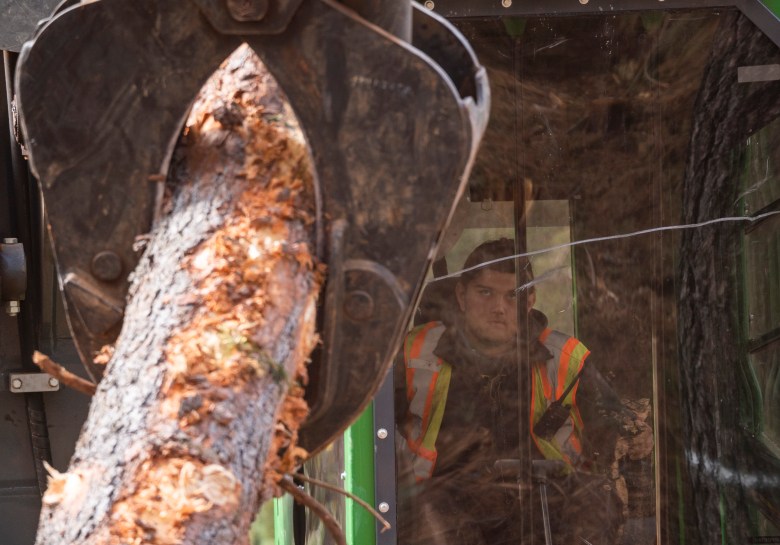
Lucas Licea, a student logger at Shasta College in Redding, Calif., operates a loader. Credit: Minh Connors for The Hechinger Report
“There’s a common misconception of registered apprentices that they’re only in the building trades when most are in a variety of sectors,” said Manny Lamarre, who served as deputy assistant secretary for employment and training with the Labor Department during the Biden administration. More than 5,000 new occupations have registered with the department to offer apprenticeships since 2021, he said. “We can specifically support unique small occupations in rural communities where a lot of people are retiring.”
Education Secretary Linda McMahon, who was confirmed earlier this month, said in her confirmation hearing that she supports apprenticeships. But ongoing cuts make it unclear what the new federal role will be in supporting such programs.
However, “sharing the capacity has been an important way to get apprenticeships into rural and small employers,” said Vanessa Bennett, director at the Center for Apprenticeship and Work-Based Learning at the nonprofit Jobs for the Future. It’s helpful when employers partner with a nonprofit or community college that can sponsor an apprenticeship program, as Shasta College does, Bennett said.
Once Knight, the student logger, completes the heavy equipment pre-apprenticeship, he plans to return to his hometown of Oroville, about 100 miles south of Shingletown. His tribe — the Berry Creek Rancheria of Tyme Maidu Indians — is starting its own logging crew, and Knight will be one of only two members trained to use some of the most challenging pieces of logging equipment.
“This program is awesome,” said Knight, 24. “It’s really hands-on. You learn as you go and it helps to have a great instructor.”
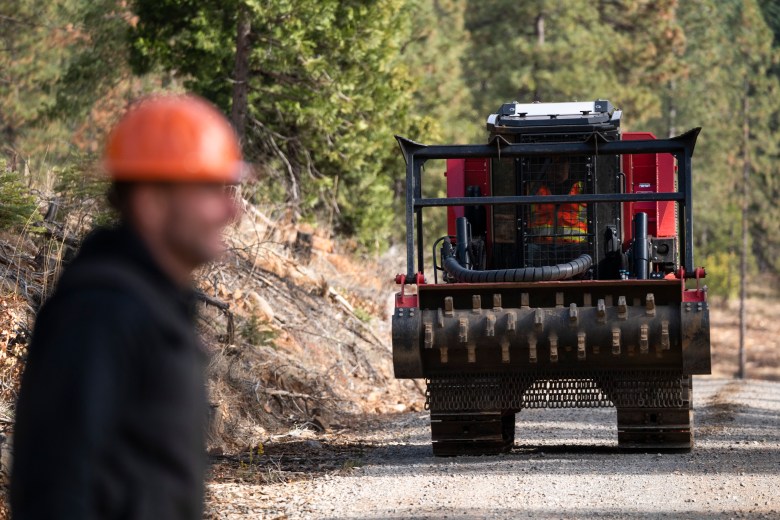
Student logger Dylan Knight drives a masticator, which grinds wood into chips, as Shasta College instructor Chris Hockenberry looks on. Credit: Minh Connors for The Hechinger Report
Across the country in Maine, a community college is helping to train apprentices for jobs at heritage oyster, mussel and kelp farms that have struggled to find enough workers to meet the growing demand for shellfish. Often classified as seasonal work, aquaculture jobs can become year-round careers for workers trained in both harvesting shellfish and planning for future seasons.
“I love the farm work and I feel confident that I will be able to make a full-length career out of this,” said Gabe Chlebowski, who completed a year-long apprenticeship with Muscongus Bay Aquaculture, which harvests in Damariscotta, Maine. A farm boy from rural Pennsylvania, Chlebowski worked in construction and stone masonry after high school. When his parents moved to Maine, he realized that he wanted a job on the water. With no prior experience, he applied for an oyster farming apprenticeship and was accepted.
“I was the youngest by five years and the only person who’d never worked on water,” said Chlebowski, 22. “I grew up in a landlocked state surrounded by corn fields. I had the work ethic and no idea what I was doing in boats.”
The apprenticeship program was launched in 2023 by the Gulf of Maine Research Institute, which joined with the Maine Aquaculture Association and Educate Maine to create a yearlong apprenticeship with Southern Maine Community College. Apprentices take classes in shellfish biology, water safety, skiff driving and basic boat maintenance. Grants helped pay for the boots, jackets and fishing bibs apprentices needed.
“The workforce here was a bottleneck,” said Carissa Maurin, aquaculture program manager for GMRI. New workers with degrees in marine biology were changing their minds after starting training at aquaculture farms. “Farms were wasting time and money on employees that didn’t want to be there.”
Chlebowski completed the apprenticeship at Muscongus Bay in September. He learned how to repair a Yamaha outdoor motor, how to grade oysters and how to work on a 24-foot, flat-bottom skiff. He stayed on as an employee, working at the farm on the Damariscotta River — the oyster capital of New England. The company is known for two varieties of oysters: Dodge Cove Pemaquid and Wawenauk.
Oyster farming generates local pride, Chlebowski said. The Shuck Station in downtown Damariscotta gives oyster farmers a free drink when they come in and there’s an annual summer shucking festival. But the company is trying to provide careers, Chlebowski said, not just high-season jobs.
“It can be hard to make a career out of farming, but it’s like any trade,” he said, adding that there is work to do year-round. “Welding and HVAC have trade schools and apprenticeships. Why shouldn’t aquaculture?”
Chlebowski’s apprenticeship turned into a career. Back in Shingletown, students in the logging program hope for the same result when they finish.
Until then, they spend Mondays, Wednesdays and Fridays in the woods learning how to operate and maintain equipment. Tuesdays and Thursdays are spent on Shasta College’s Redding campus, where the apprentices take three classes: construction equipment operation, introduction to forestry and wood products and milling.
At the end of the semester, students demonstrate their skills at a showcase in the Shingletown woods. Logging company representatives will attend and scout for workers. Students typically get offers at the showcase. So far, 50 students have completed the pre-apprenticeship program and most transitioned into full apprenticeships. Fifteen people have completed the full apprenticeship program and now earn from $40,000 to $90,000 a year as loggers.
Mentorship is at the heart of apprenticeships. On the job, new workers are paired with more experienced loggers who pass on knowledge and supervise the rookies as they complete tasks. Pre-apprentices at Shasta College learn from Jonas Lindblom, the program’s heavy equipment and logging operations instructor.
At the logging site, Lindblom watches as a tall sugar pine slowly falls and thuds to the ground. Lindblom’s father, grandfathers and great-grandfather all drove trucks for logging companies in Northern California.
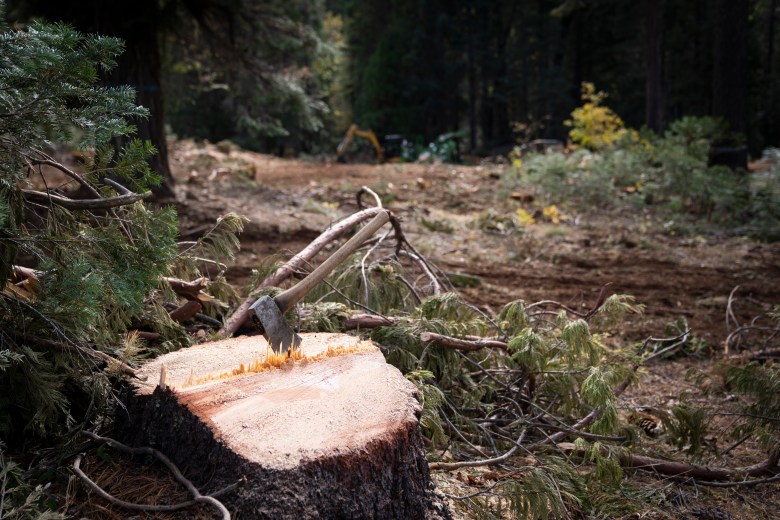
An axe sticks out of a freshly cut tree at a logging site used to train student loggers enrolled at Shasta College in Redding, Calif. Credit: Minh Connors for The Hechinger Report
This is a good area for apprentices to “just be able to learn at their pace,” he said. “They’re not pushed and they can get comfortable in the machines without developing bad habits along the way.”
Lindblom, who studied agriculture education at Chico State University, spent all his breaks during college working as a logger. He works closely with the logging companies that partner with the program to make sure he’s teaching up-to-date practices. It’s better for new loggers to learn in this outdoor classroom, he said, than on the job.
“The majority of these students did not grow up in logging families,” he said. “This is a great opportunity to pass on this knowledge and share where the industry is going.”
Contact editor Christina A. Samuels at 212-678-3635 or [email protected].
The Hechinger Report provides in-depth, fact-based, unbiased reporting on education that is free to all readers. But that doesn't mean it's free to produce. Our work keeps educators and the public informed about pressing issues at schools and on campuses throughout the country. We tell the whole story, even when the details are inconvenient. Help us keep doing that.
This spring, the number of high school graduates in the United States is expected to hit its peak. Starting in the fall, enrollment will likely enter a period of decline that could last a decade or more.
This looming “demographic cliff” has been on the minds of education leaders for nearly two decades, dating back to the start of the Great Recession. A raft of college closures over the past five years, exacerbated by the pandemic, has for many observers been the canary in the coal mine.
In the years to come, schools at all levels — reliant on per-pupil funding for K-12 and on tuition dollars for colleges and universities — will begin feeling the squeeze.
The question now is whether to treat the cliff as a crisis or an opportunity.
Related: Interested in innovations in the field of higher education? Subscribe to our free biweeklyHigher Education newsletter.
As they prepare for enrollment shortfalls, superintendents and college presidents are primarily focused on crisis management. With good reason, they’re spending the bulk of their time on the hard short-term decisions of cutting programs and personnel to meet looming budget shortfalls.
In the precious few years before the situation becomes even more dire, the question is whether schools should just continue bracing for impact — or if they can think bigger in ways that could be transformative not just for the landscape of education, but for the economy more broadly. In my view, they should think about what it would look like to make a moment of crisis a real opportunity.
Here are some ideas about how that could happen. The first involves blurring the lines between high school and college.
Colleges today feel immense pressure because there aren’t enough high school graduates. High schools feel similar pressure because there are fewer young people around to enroll each year — not to mention the chronic absenteeism and disengagement that has persisted since the pandemic.
What if the two worked more closely together — in ways that helped high schools keep students engaged while enabling colleges to reach a broader range of students?
In many states, this is already happening. At last count, 2.5 million high schoolers took at least one dual-enrollment course from a college or university. But it’s not enough to just create tighter connections between one educational experience and another. Today’s students — and today’s economy — also demand clearer pathways from education to careers. It makes sense to blur the lines between high schools, colleges and work.
So imagine taking these changes even further — to a world in which instead of jumping from high school to college, students in their late teens entered entirely new institutions that paid them for work-based learning experiences that would lead them to a degree and eventually a career.
That’s a lofty goal. But it’s the kind of big thinking that both high schools and colleges may need to reinvent themselves for the country’s shifting demographics.
Colleges have an opportunity right now to double down on creating and expanding job-relevant programs — and to think even bigger about who they serve. That could include expanding opportunities for adult learners who have gained skills outside the classroom through credit for prior learning and competency-based learning. It could also mean speeding up the development of industry-relevant coursework to better align with the needs of the labor market and leaning into short-form training programs to upskill incumbent workers.
Not every student is ready to invest four years of time and money to earn a bachelor’s degree. But they shouldn’t have to be — and colleges have a chance to expand their offerings in ways that give students more pathways into today’s fast-changing economy and further education if they so choose.
Part of the problem with the current trajectory from high school to college is that the wrong things get incentivized. Both K-12 schools and colleges get money and support based on the number of students they enroll and (sometimes) the number of people who graduate — not on how well they do at helping people gain the skills to effectively participate in the economy.
That’s not anyone’s fault. But it often boils down to a matter of policy. Which means that changing policy can create new incentives to tighten the connections between high school, college and work.
States like Colorado are already taking the lead on this shift. Colorado’s “Big Blur” task force put out a report with recommendations on how to integrate learning and work, including by creating a statewide data system to track the outcomes of educational programs and updating the state’s accountability systems to better reflect “the importance of learners graduating ready for jobs and additional training.”
If schools and policymakers stay the course in the decade to come, they already know what’s ahead: declining enrollment, decreased funding and the exacerbation of all the challenges that they’ve already begun to face in recent years.
It’s not the job of the education system to turn the tide of demographic change. But the system does have a unique, and urgent, opportunity to respond to this changing landscape in ways that benefit not only students but the economy as a whole. The question now is whether education leaders and policymakers can seize that opportunity before it’s too late.
This story about demographic cliff in higher education was produced by The Hechinger Report, a nonprofit, independent news organization focused on inequality and innovation in education. Sign up for Hechinger’s weekly newsletter.
The Hechinger Report provides in-depth, fact-based, unbiased reporting on education that is free to all readers. But that doesn’t mean it’s free to produce. Our work keeps educators and the public informed about pressing issues at schools and on campuses throughout the country. We tell the whole story, even when the details are inconvenient. Help us keep doing that.
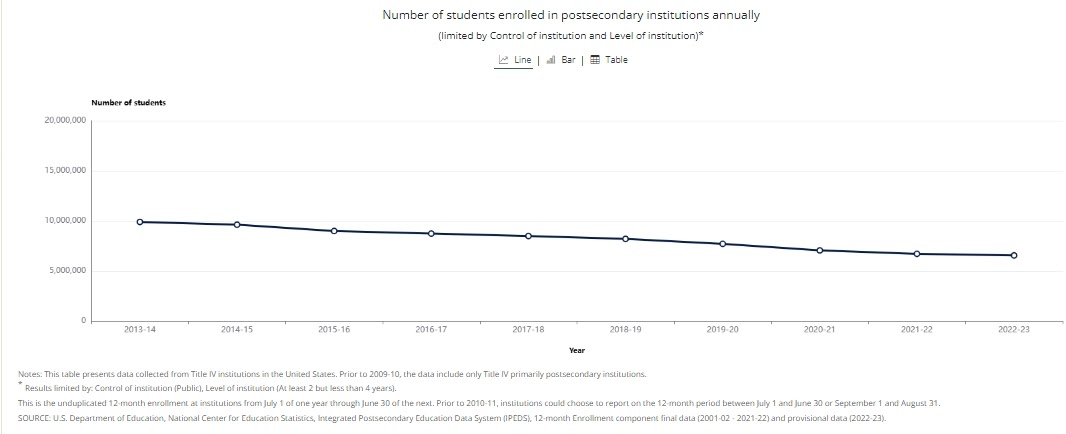
The question we are asking now is, where is the floor for the community college meltdown? The answer, from what we gather, is not clear. Folks should not assume the bottom has already been felt, even if there are signs of a rebound.
The downward path for community colleges is likely the result of several factors related to economics (including the economics of individual states and counties), demographics, and consumer choices. And we do not see these variables, in general, improving in the near future. Especially in states with declining youth and young adult populations.
If state-level austerity lies ahead for many states, the floor could be lowered, even though these community colleges provide job training at a fraction of the cost of state universities. Working class folks, in particular, would have to change the way they think about themselves and their perceptions of community colleges. And community colleges would need to provide stronger returns on investment for those who attend.
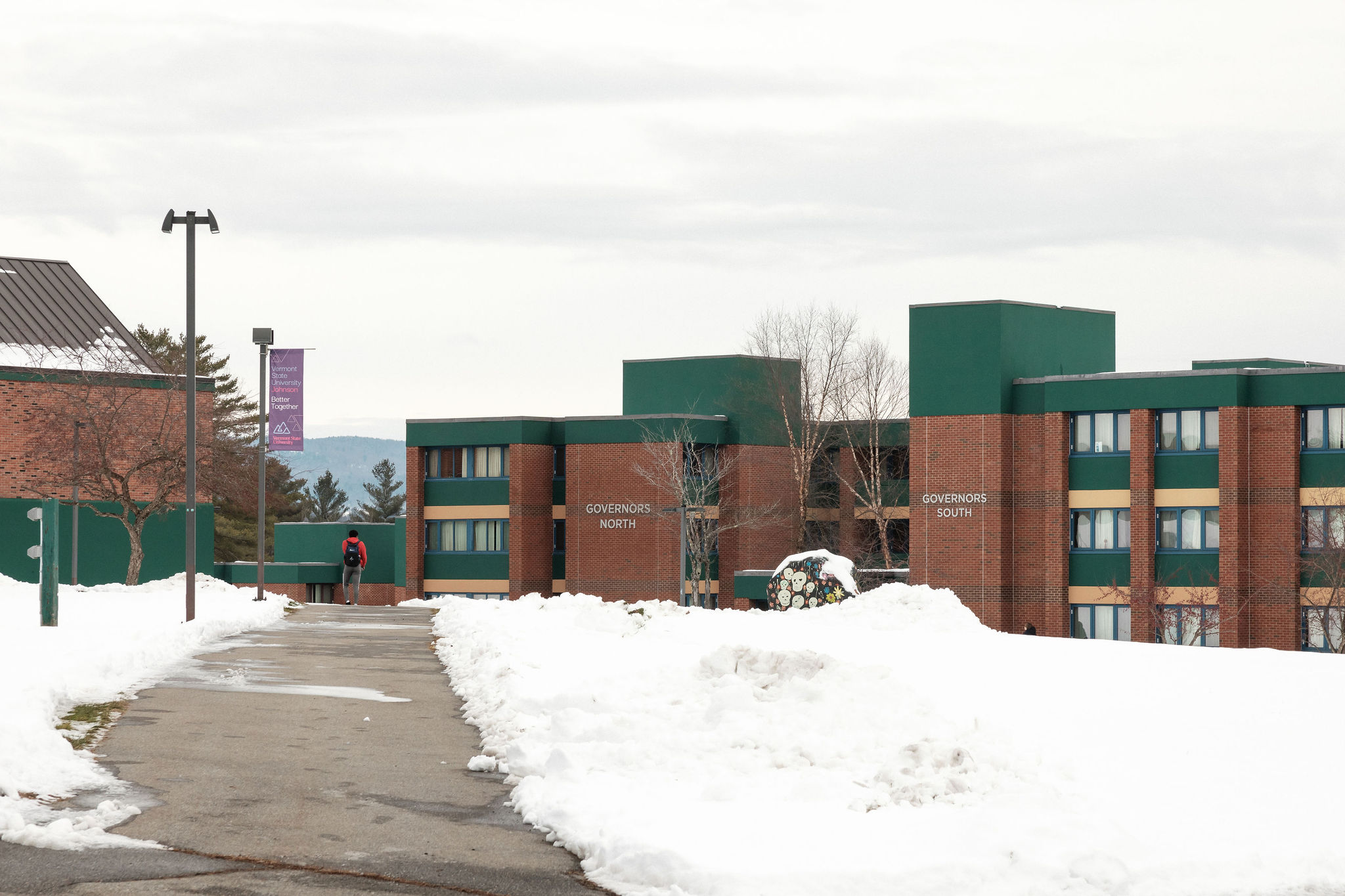
RANDOLPH, Vt. — The thermostat was turned low in the admissions office at Vermont State University on a cold winter morning.
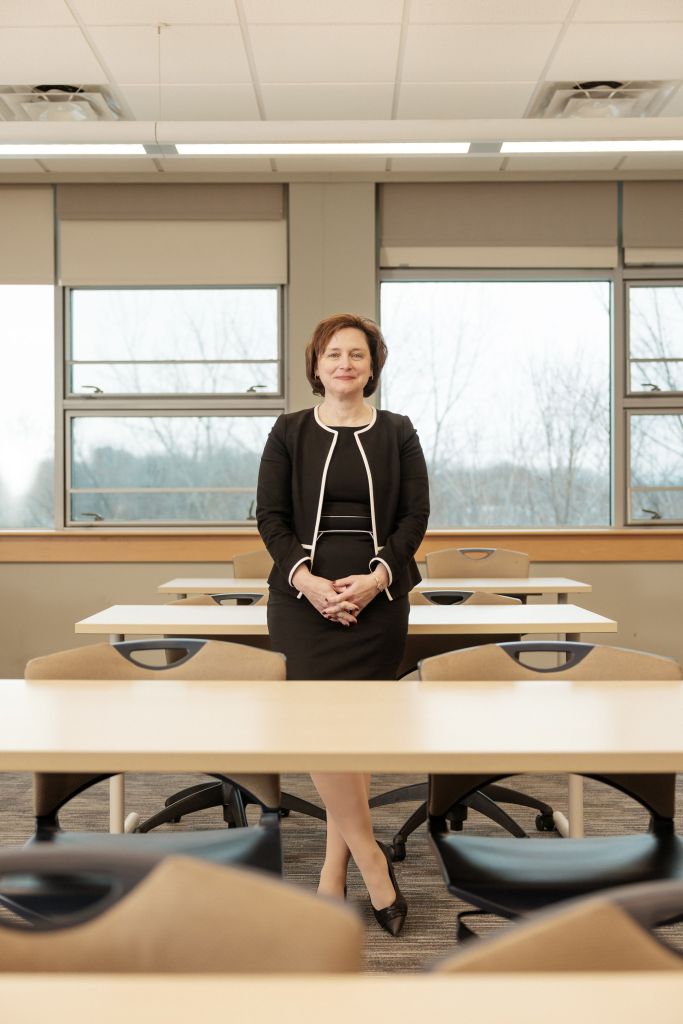
It’s “one of our efficiencies,” quipped David Bergh, the institution’s president, who works in the same building.
Bergh was joking. But he was referring to something decidedly serious: the public university system’s struggle to reduce a deficit so deep, it threatened to permanently shutter several campuses after dramatic drop-offs in enrollment and revenue.
While much attention has been focused on how enrollment declines are putting private, nonprofit colleges out of business at an accelerating rate — at least 17 of them in 2024 — public universities and colleges are facing their own existential crises.
State institutions nationwide are being merged and campuses shut down, many of them in places where there is already comparatively little access to higher education.
David Bergh, president of the newly consolidated Vermont State University, in the building where he works at the VTSU campus in Randolph. “Public institutions are not exempt from the challenges” facing higher education, Bergh says. Credit: Oliver Parini for The Hechinger Report
“Public institutions are not exempt from the challenges” facing higher education, Bergh said. “We are already seeing it, and we’re going to see more of it, and it’s particularly acute in some more rural states, where there’s a real need to balance limited resources but maintain access for students.”
Vermont is a case study for this, and an example of how political and other realities make it so hard for public universities and colleges to adapt to the problems confronting them.
“The demographics of fewer traditional-age college students, the over-building of these campuses, the change in the demand for what we need for our workforce in terms of programs — this is something that’s happening everywhere,” said Vermont State Rep. Lynn Dickinson, who chairs the Vermont State Colleges System Board of Trustees.
Related: Interested in innovations in higher education? Subscribe to our free biweekly higher education newsletter.
Public university and college mergers have already happened in Pennsylvania, Georgia, California and Minnesota, and public campuses have closed in Ohio and Wisconsin. A merger of public universities and community colleges in New Hampshire is under study.
When state university and college campuses close, the repercussions for communities around them can be dire.
Until this month, local students had a college “in their backyard,” said Thomas Nelson, county executive in Outagamie County, Wisconsin, where the two-year Fox Cities outpost of the University of Wisconsin Oshkosh this spring will become the sixth public campus in that state to be shuttered since 2023, after a long enrollment slide. “We’ve had this institution for 60 years in our community, and now it’s gone.”
Not only students are affected. In many rural counties, “there really isn’t a lot beyond the university,” Nelson said. “So that’s going to be devastating for the economy. It’s going to kill jobs. It’s going to be one more strike against them when they are competing with other communities with more amenities.”
Attempts to close these campuses attract the intervention of politicians, who have more control over whether public than private nonprofit colleges in their districts close. After all, “they own the place,” said Dan Greenstein, former chancellor of Pennsylvania’s State System of Higher Education, who — after that state’s enrollment fell by nearly one-fifth — led a reconfiguration that resulted in six previously separate public universities there being merged into two systems.
Even trying to rename a public university can have political consequences. When Augusta State University in Georgia was combined with Georgia Health Sciences University to become Georgia Regents University, there was a local outcry over the fact that “Augusta” was no longer in the name. Within two years, the merged school had yet another new name: Augusta University.
“Public institutions are complex structures,” said Ricardo Azziz, who led that consolidation, served as president of the resulting institution and now heads the Center for Higher Education Mergers and Acquisitions at the Foundation for Research and Education Excellence. “They’re influenced by politics. They’re influenced by elected officials.”
When the proposal to close campuses in Vermont was met with public and political resistance, state planners backed down and decided instead to merge them, laying off staff and cutting programs. That did not go well, either, and resulted in raucous public meetings, votes of “no confidence,” plans that were announced and then rescinded and a revolving door of presidents and chancellors. Only now, in its second year, has the process gotten smoother.
Alarm bells started sounding about problems in Vermont’s state universities before the Covid-19 pandemic. With the nation’s third-oldest median age, after Maine and New Hampshire, according to the Census Bureau, the state had already seen its number of young people graduating from high school fall by 25 percent over the previous decade.
Enrollment at the public four-year and community college campuses — not including the flagship University of Vermont, which is separate — was down by more than 11 percent. A fifth of the rooms in the dorms were empty. And with the birthrate in the state lower than it was before the Civil War, there was no rebound in sight.
These trends have contributed to the closings of six of Vermont’s in-person undergraduate private, nonprofit colleges and universities since 2016.
“We’d be keeping our head in the sand if we didn’t think that those same forces were going to affect our public higher education system,” said Jeb Spaulding, who, as chancellor at the time, merged two of Vermont’s five state colleges, in Johnson and Lyndon, in 2018.
The red ink continued to flow. Two years later, just after Covid hit, Spaulding recommended that three of the five public campuses be shut down altogether — Johnson and Lyndon, plus Vermont Technical College in Randolph.
“What we needed to do was save the Vermont State Colleges System as a whole,” which has 145 buildings for fewer than 5,000 students, Spaulding recalled. That same problem of excess capacity is affecting higher education nationwide.
“It was well known that we had too much bricks and mortar for the number of traditional-type students that were going to be available in Vermont,” Spaulding said. “We saw all that coming, and we had started a process of educating people and working on what would be a realistic public-sector consolidation plan so that we could actually put our resources into having a smaller constellation, but well financed and up to date.”
The reaction to the plan was explosive, even in the midst of a pandemic. At socially distanced drive-by protests, critics brandished signs that said: “Start Saving: Fire Jeb.” Within four days, the proposal to close campuses was withdrawn. A week after that, Spaulding resigned.
“I guess I didn’t realize that in the public realm, you can’t make the kind of difficult decisions that if you were at a private institution you would have to make,” he recounted. “When the politics got involved, then it became clear to me that there was no way that I was going to be able to get that through.”
Instead of closing the campuses, the state decided to combine them with the other two, in Castleton and Williston, all under one umbrella renamed Vermont State University, or VTSU. In exchange, the blended institutions would be required to cut spending to help reduce a deficit estimated at the time to be about $22 million.
That decision was almost as contentious. As in Georgia, even the name was controversial. Alumni petitioned in vain for the new system to be called Castleton University instead of Vermont State, to preserve the legacy of the state’s oldest and the nation’s 18th-longest-operating higher education institution, founded in 1787, instead of demoting it to “Castleton Campus.”
Beth Mauch, who as chancellor has overseen VTSU and Vermont’s community college campuses since January, said she gets this kind of sentiment. “There are community members who have had these institutions in their community. There are folks who are alumni of these institutions who remember them in a certain way,” said Mauch. “Really, they are in the fabric of a community.”
Beth Mauch, chancellor of the Vermont State University system and the state’s community college campuses. “Really, they are in the fabric of a community,” Mauch says. Credit: Oliver Parini for The Hechinger Report
That close relationship between the universities and their communities only resulted in additional friction when 23 full-time faculty positions were cut, out of the then-existing 208. So were an equal number of administrators and staff. Not only were there more beds and buildings than were needed for the number of students, there were too many faculty compared to other comparably sized universities, a planning document said.
Neighbors of the campuses, and their elected representatives, didn’t see it that way.
“The people that work at the colleges are local. Everyone knows people that work at these colleges,” said Billie Neathawk, a librarian at what was formerly Castleton University for more than 25 years, and a union officer. “They’re related to people. Especially in a small state like Vermont, everybody knows everybody.”
The layoffs went through anyway. There were also cuts to majors. Ten academic programs were eliminated, 10 others changed locations and still others were consolidated. That meant students at any campus could take the remaining courses in a format combining in-person and online instruction that the system dubbed “In-Person Plus.”
Lilly Hudson is a junior at Vermont State University, whose consolidation means some programs are being offered online. Hudson prefers learning in a classroom but liked being able to take a class online from another campus that wasn’t available on hers. Credit: Oliver Parini for The Hechinger Report
Lilly Hudson, a junior at Castleton, said she prefers learning in a classroom. “It’s just such a difference to be able to see people and meet your professors and go in person,” said Hudson, who is majoring in early education. But she was also able to take a class online from another campus that wasn’t available on hers.
That can be an underappreciated upside to mergers, said Greenstein, now managing director of higher education practice at the consulting firm Baker Tilly. “You can only run as many programs, majors and minors as you can enroll students into,” he said. But by merging institutions and letting students take courses from other campuses online, “now they can go from 20 programs to 80 or 90.”
While that seemed a step forward, the consolidated university’s inaugural president, Parwinder Grewal, next announced that, to cut costs, its libraries would go all-digital and give away their books, the Randolph campus would no longer field intercollegiate sports teams, and athletics on the Johnson campus would move from the NCAA to the less prestigious U.S. Collegiate Athletic Association.
This proved another blunder in a state so fond of its libraries that it has the nation’s highest per-capita number of library visits, and where rural communities rally around even Division 3 athletics. Faculty and staff unions and student government associations on every campus voted “no confidence” in the university’s administration. Athletes transferred away. Grewal was loudly booed when he met with students.
“There was a hot streak there where, every email, we were, like, now what’s going on?” said Raymonda Parchment, a student who was halfway toward her bachelor’s degree at the time.
Raymonda Parchment, who just graduated from Vermont State University, is grateful that a plan to close some public campuses was reversed. “If you can’t afford to go out of state for college, and you can’t afford to pay for maybe a dorm for a couple of years, where does that leave you if there’s no school within commuting distance?” she asks. Credit: Oliver Parini for The Hechinger Report
The library and athletics decisions were eventually reversed, too, and Grewal was out before he’d served a full year. But the damage was done. When the new university finally debuted, at the start of the 2023-24 school year, freshman enrollment was down by about 14 percent from what it had been at the separate campuses the year before.
“I know a lot of friends whose programs were consolidated and shuffled around,” said Parchment, in an otherwise empty study room on the snow-covered Johnson campus. “That was probably the biggest change for students that had direct impact on them. Some people’s programs don’t exist anymore. Some people’s programs have been moved to a different campus.”
Vermont is still working out the kinks, said Bergh, the system’s current president, who was the president of private, nonprofit Cazenovia College in New York when it closed in 2023.
Although first-year enrollment went up about 14 percent this fall, he said, “We’re still surfacing places where our systems aren’t talking to each other as well as they should be, and that we need to correct.”
Parchment likes that it’s easier now to move from one campus in the system to another, without having to go through the red tape of the transfer process. She graduated at the end of the fall semester after moving from Castleton to Johnson to be closer to an internship.
And no campuses were ultimately closed, as had been proposed — a relief to students, prospective students and community members, Parchment said. “Because if you can’t afford to go out of state for college, and you can’t afford to pay for maybe a dorm for a couple of years, where does that leave you if there’s no school within commuting distance?”
Hudson, the Castleton student, whose father is a sixth-generation farrier — a specialist in trimming, cleaning and shoeing horses’ hooves — agreed.
The campuses are “in the middle of an area where there’s a lot of rural towns,” she said. Keeping them in operation means that students nearby who want to go to college “don’t have to pick up their lives and move.”
But Spaulding, the former chancellor, warned that public higher education budget and enrollment problems aren’t likely to subside, in Vermont or many other states.
“I don’t think the storm is over by any stretch of the imagination.”
The Hechinger Report provides in-depth, fact-based, unbiased reporting on education that is free to all readers. But that doesn't mean it's free to produce. Our work keeps educators and the public informed about pressing issues at schools and on campuses throughout the country. We tell the whole story, even when the details are inconvenient. Help us keep doing that.