Category: Compensation

  • CUPA-HR’s Equal Pay Day Data for Higher Education: Women in Higher Ed Are Paid Just 82 Cents on the Dollar, Most Women of Color Are Paid Even Less – CUPA-HR

    CUPA-HR’s Equal Pay Day Data for Higher Education: Women in Higher Ed Are Paid Just 82 Cents on the Dollar, Most Women of Color Are Paid Even Less – CUPA-HR

    by Julie Burrell | March 12, 2024

    Since 1996, the National Committee on Pay Equity has acknowledged Equal Pay Day to bring awareness to the gap between men’s and women’s wages. This year, Equal Pay Day is March 12 — symbolizing how far into the year women must work to be paid what men were paid in the previous year.

    To help higher ed leaders understand, communicate and address gender pay equity in higher education, CUPA-HR has analyzed its annual workforce data to establish Higher Education Equal Pay Days for 2024. Tailored to the higher ed workforce, these dates observe the gender pay gap by marking how long into 2024 women in higher ed must work to make what White men earned the previous year.

    Higher Education Equal Pay Day fell on March 5, 2024, for women overall, which means that women employees in higher education worked for more than two months into this year to gain parity with their White male colleagues. Women in the higher ed workforce make on average just 82 cents for every dollar a White male employed in higher ed makes.

    Highlighting some positive momentum during this Women’s History Month, some groups of women are closer to gaining pay equity. Asian American women in higher ed worked two weeks into this year to achieve parity on January 14 — not ideal, but by no means insignificant. In fact, during the academic year 2022-23, Asian American women administrators in particular saw better pay equity than most other groups, according to CUPA-HR’s analysis.

    But the gender pay gap remains for most women, and particularly for women of color. Here’s the breakdown of the gender pay gap in the higher ed workforce, and the Higher Education Equal Pay Day for each group.* These dates remind us of the work we have ahead.

    • March 5 — Women in Higher Education Equal Pay Day. On average, women employees in higher education are paid 82 cents on the dollar.
    • January 14 — Asian Women in Higher Education Equal Pay Day. Asian women in higher ed are paid 96 cents on the dollar.
    • March 1 — White Women in Higher Education Equal Pay Day. White women in higher ed are paid 83 cents on the dollar.
    • March 12 — Native Hawaiian/Pacific Islander Women in Higher Education Equal Pay Day. Native of Hawaii or Pacific Islander women in higher ed are paid 80 cents on the dollar.
    • March 28 — Black Women in Higher Education Equal Pay Day. Black women in higher ed are paid 76 cents on the dollar.
    • April 12 — Hispanic/Latina Women in Higher Education Equal Pay Day. Hispanic/Latina women in higher ed are paid 72 cents on the dollar.
    • April 22 — Native American/Alaska Native Women in Higher Education Equal Pay Day. Native American/Alaska Native women are paid just 69 cents on the dollar.

    CUPA-HR research shows that pay disparities exist across employment sectors in higher ed — administrators, faculty, professionals and staff — even as the representation of women and people of color has steadily increased. But with voluntary turnover rising, not addressing pay disparities could be costly.

    CUPA-HR Resources for Higher Education Equal Pay Days

    As we observe Women’s History Month and Higher Education Equal Pay Days for women, we’re reminded that the fight for equal pay is far from over. But data-driven analysis with the assistance of CUPA-HR research can empower your fight for a more equitable future.

    See our interactive graphics that track gender and racial composition, as well as pay, of administrative, faculty, professional, and staff roles, collected from CUPA-HR’s signature surveys:


    *Data Source: 2023-24 CUPA-HR Administrators, Faculty, Professionals, and Staff in Higher Education Surveys. Drawn from 633,020 men and women for whom race/ethnicity was known.




    Source link

  • What HR Should Know About Tenure and Academic Freedom – CUPA-HR

    What HR Should Know About Tenure and Academic Freedom – CUPA-HR

    by Julie Burrell | February 6, 2024

    From an HR perspective, faculty positions can often look very different from other professional and staff roles on campus, especially when it comes to those faculty on the tenure track. But as HR’s role in academic staffing expands, it’s critical to understand tenure and its role in supporting academic freedom, says Joerg Tiede, the director of the department of research and public policy with the American Association of University Professors (AAUP). In his recent CUPA-HR webinar, Tenure: Past, Present and Future, Tiede explains the nuances of tenure and academic freedom through an HR lens. Here are some key takeaways.

    Tenure and Academic Freedom

    Tenure

    Tenure is an “indefinite appointment that can be terminated only for cause or under extraordinary circumstances such as financial exigency and program discontinuation,” according to the AAUP.

    Tiede notes that this simple definition is often surprising to many in higher ed, because tenure frequently comes with other advantages, such as sabbatical or the ability to vote for or hold a position in faculty senate. But these other benefits are often part of an institution’s culture or a faculty member’s contract, rather than inherent to tenure itself.

    Academic Freedom

    Tiede stresses that tenure exists not as an individual perk, but to protect academic freedom. The AAUP defines academic freedom as “the freedom of a teacher or researcher in higher education to investigate and discuss the issues in his or her academic field, and to teach or publish findings without interference from political figures, boards of trustees, donors, or other entities.” The concept of academic freedom applies to faculty members’ speech and writing on campus as teachers and advisors, in their research, and in their “intramural speech” (e.g., institutional governance) and “extramural speech” (e.g., when speaking as a citizen).

    The AAUP’s 1940 Statement of Principles on Academic Freedom and Tenure is the most widely adopted description of both academic freedom and tenure at institutions of higher education.

    Non-Tenure-Track Faculty

    Not all professors have or are eligible for tenure, including non-tenure-track faculty who may work full time as salaried employees with benefits but are not eligible for tenure. An example of this kind of faculty may be someone whose job functions involve instruction rather than a mix of instruction and research. Other non-tenure-track faculty include adjuncts, who are paid per course and typically do not have a benefits package. The breakdown of who is eligible for tenure differs by institution, with some institutions not having a tenure system at all. See the AAUP’s data on the academic workforce.

    The Future of Tenure and Academic Freedom

    “Tenure is indispensable to the success of an institution,” says Tiede. This is because academic freedom not only strengthens individual institutions by protecting the teaching and research of faculty, but also upholds the public good. The AAUP’s FAQs on academic freedom states: “Those teaching and researching in higher education need academic freedom because the knowledge produced and disseminated in colleges and universities is critical for the development of society and for the health of a democracy, an idea often expressed by the phrase ‘for the common good’ or ‘for the public good.’” In theory, tenure shields faculty from political or religious agendas. It also protects tenured faculty who work in areas that are or may become controversial.

    Tiede notes that academic freedom would be made secure with more broadly inclusive tenure policies. One way this can be accomplished is by converting non-tenure-track positions into tenure-track positions, with the AAUP recommending “only minor changes in job description.” In particular, the conversion of teaching-focused positions from non-tenure-track to tenure-track is recommended. Though tenure is often tied to research accomplishments, Tiede and the AAUP do not view this as inherent to the definition of tenure.

    A more inclusive tenure process also includes reviewing for implicit bias. In breaking down who is tenured or on the tenure track, CUPA-HR has found that more women faculty are represented in non-tenure-track roles than in tenure-track roles. Moreover, with each increase in rank, the proportions of women faculty and faculty of color decrease for both tenure-track and non-tenure-track faculty. Taken together, this means that women are over-represented in the lowest-paying and lowest-ranking positions.

    Who gets tenured also has implications for pay equity. Faculty pay raises are commonly tied to promotion and tenure, which is often the only time faculty see a significant increase in their salary. When there is bias in promoting women and faculty of color to successive ranks, this results in career earnings gaps.

    Additional Resources

    Watch Tiede’s webinar, Tenure: Past, Present and Future, which covers the origins and history of tenure and answers HR-specific questions, like whether academic freedom applies to provocative posts on social media and how best to nurture a merit-based culture within a tenure system.

    CUPA-HR’s Toolkit on Academic Freedom contains real-world examples of academic freedom policies at various institutions.

    In Opening Doors for Strategic Partnerships With Academic Leadership, Gonzaga University’s HR pros explain how they cultivated the relationship between HR and the campus community, including leveraging the power of HR champions on their campus.

    Check out CUPA-HR’s e-learning courses, including Boot Camp, which offers a higher ed perspective on essential HR topics, and Understanding Higher Education, which is designed to help all employees be more effective in their roles by developing a deeper understanding of institutional structure and culture.

    Ways to support an increasingly contingent faculty workforce are explored in the article The Way Forward: Envisioning New Faculty Models for a Changing Professoriate. The focus is on The Delphi Project, part of the University of Southern California’s Pullias Center for Higher Education, which explores how non-tenure-track faculty working conditions are tied to student success.


    Source link

  • Newly Updated CUPA-HR Data Shed Light on Trends in Representation and Pay Equity in the Higher Ed Workforce – CUPA-HR

    Newly Updated CUPA-HR Data Shed Light on Trends in Representation and Pay Equity in the Higher Ed Workforce – CUPA-HR

    by Julie Burrell | January 22, 2024

    Progress in both representation and equitable pay for women and people of color remained sluggish in most roles on college and university campuses in academic year 2022-23, according to the newest data. Through several interactive graphics representing years of research, CUPA-HR highlights the progress that has been made and the disparities that persist. The data track gender and racial composition as well as pay of administrative, faculty, professional, and staff roles, collected from CUPA-HR’s signature surveys.

    While the representation of women and people of color across all roles has steadily increased, inequity remains, especially when it comes to compensation for women and people of color. However, there were some notable areas of progress when it comes to compensation. Asian women and men of color (except for Native American/Alaskan Native men) in administrative roles saw better pay equity than most other groups.

    Administrators

    The share of racial and ethnic minorities in administrative roles continued to grow over the past decade, but gaps in both representation and pay remained steady. This is especially true for women of color, who represented less than 11% of these roles and, for the most part, received lower salaries than White men.

    In 2022-23, people of color made up 18.7% of administrators, up from 12.9% in 2011-12. Although the proportion of people of color in higher ed administrator positions grew steadily over the last decade, these increases have not kept pace with the rate at which minorities are obtaining graduate degrees.

    No improvement was shown in pay disparities for most women administrators. All female administrators except for Asian women received lower salaries than White men. Conversely, men of color, except for Native American/Alaskan Native men, were paid salaries greater than those of White men.

    The Administrators in Higher Education Survey collects data on administrator positions that manage a higher ed institution or a division within it.

    See the Administrators Composition and Pay Equity by Gender and Race/Ethnicity interactive graphics, as well as data broken out by CEO, provost and chief HR officer.

    Faculty

    There are two notable findings regarding faculty composition. First, more women faculty were represented in non-tenure-track roles than in tenure-track roles in 2022-23. Second, with each increase in rank, the proportions of women faculty and faculty of color decreased for both tenure-track and non-tenure-track faculty. Taken together, this means that women were over-represented in the lowest-paying and lowest-ranking positions.

    Pay gaps within rank persist, particularly for women faculty at the professor level, regardless of tenure status. These gaps are most notable for female professors of color in non-tenure-track positions. Pay gaps for assistant and associate professors have narrowed over time, particularly for tenure-track faculty.

    The factor that most impacts faculty pay is promotion to a higher rank, which is often the only time faculty receive significant increases in salary. When there is bias in promoting women and faculty of color to successive ranks, as our data continued to show, this results in career earnings gaps that far exceed what is often detected in pay equity studies within rank for a given year.

    The Faculty in Higher Education Survey collects data on tenure-track faculty positions and non-tenure-track teaching faculty positions.

    See the Faculty Composition and Pay Equity by Gender and Race/Ethnicity interactive graphics.

    Professionals

    In academic year 2022-23, women of all races and ethnicities were paid less than their male counterparts in professional roles, while women’s representation increased from 58% to 61% across all professional positions since 2016-17. The growth is due to slight increases in the representation of women of color, from 13.1% in 2016-17 to 15.7% in 2022-23.

    Representation by gender and race/ethnicity varied widely by position. Human resources had the greatest share of women professionals, with 82% being women, including 28% women of color. Information technology had the lowest percentage of professional women (27%), and librarians and development/fundraising professionals had the lowest representation of professionals of color (14%).

    While pay was more equitable for most groups (apart from Hispanic/Latina women and men of two or more races), pay disparities persisted. Women of all races and ethnicities were paid less than their male counterparts. In addition, Hispanic/Latino men, Native Hawaiian men, and men of two or more races were paid less than White men.

    The Professionals in Higher Education Survey collects data on positions in specific functional areas in higher ed institutions, such as academic or student services, that usually require a baccalaureate degree.

    See the Professionals Composition and Pay Equity by Gender and Race/Ethnicity interactive graphics.

    Staff

    Staff roles continued to have a higher representation of people of color than any other higher ed employee group last year. Staff also continued to be the lowest-paying positions in higher ed, with women particularly hard hit by pay disparities.

    In 2022-23, women of color represented about 19% of all higher ed staff, and men of color represent about 13% of all higher ed staff — a modest increase since 2016-17. Skilled craft employees were the least racially diverse, a finding that has persisted across the past six years. Notably, skilled craft staff are among the highest-paid staff positions.

    Since 2016-17, women were paid consistently and considerably less than White men. Pay equity for American Indian/Alaska Native women, Asian women, and Native Hawaiian/Other Pacific Islander women was better in 2022-23 than in 2016-17. Pay equity was the same or worse in 2022-23 than in 2016-17 for Black women, Hispanic/Latina women, women of two or more races, and White women. Men of color fared considerably better than women of color when it came to pay equity.

    The Staff in Higher Education Survey collects data on positions that are generally non-exempt and do not require a college degree.

    See the Staff Composition and Pay Equity by Gender and Race/Ethnicity interactive graphics.

    CUPA-HR Research

    CUPA-HR is the recognized authority on compensation surveys for higher education, with its workforce surveys designed by higher ed HR professionals for higher ed HR professionals and other campus leaders.


    Source link

  • Pay Equity Still Lags for Women Administrators – CUPA-HR

    Pay Equity Still Lags for Women Administrators – CUPA-HR

    by Julie Burrell | November 29, 2023

    An analysis of two decades worth of CUPA-HR data on gender and pay in higher ed administrative roles paints a troubling picture of pay equity. In 2022, women made up 51% of administrators in college and universities, but they were paid 93 cents for each dollar a man in an administrator position was paid. This represents an increase of just 3 cents from 2002, when women made 90 cents for each dollar a man was paid.

    Among chief human resources officers, the pay disparity is even wider. Though three in four (76%) of CHROs are women, their pay in 2022 was only 89 cents for each dollar male CHROs were paid. Deputy CHROs who are women were paid only 83 cents, a figure that remained unchanged from 2002 through 2022.

    The Higher Ed Administrators: Trends in Diversity and Pay Equity From 2002 to 2022 report also found that people of color — women especially — are increasingly represented in administrative positions. Drawing on 10 years of data, CUPA-HR found that between 2012 and 2022, the representation of people of color in higher ed administration increased by 41%. In 2012, people of color comprised 13% of administrators and in 2022, 18% of administrators. Women of color went from comprising 7% of higher ed administrators in 2012 to 10% of higher ed administrators in 2022.

    Despite these gains in representation, women of most races and ethnicities are still paid less than White men in the same administrator positions.

    The Report’s Major Findings Include:

    • The past 20 years saw an increase of 20% of women in administration, from 43% in 2022 to 51% in 2022, but pay equity for women has not kept pace. In 2002, women in administrator positions were paid 90 cents for each dollar men in administrator positions were paid. Two decades later, women in administrator positions were paid just 93 cents for each dollar men in administrator positions are. These wage gaps are not explained by the fact that women may have greater representation in lower-paying positions.
    • From 2012-2022, the representation of people of color in administrative roles increased by 41%. The biggest increases were among administrators of two or more races (290% increase) and Asian administrators (76%). Women of color have seen more than double the percentage increase in representation than men of color (54% increase for women versus 26% for men).
    • But people of color are still underrepresented in administrative positions. Using the percentage of people of color with U.S. graduate degrees (31%) as a comparison, we find that only 18% of higher ed administrators were people of color in 2022.
    • Women’s representation in executive roles increased, but pay inequity still exists. In 2022, women held one in three campus presidencies, an increase of 60% from 2002. In 2002, female presidents were paid 92 cents on the dollar to male presidents and saw only a 1-cent increase in the 20 years since. The worst pay equity for presidents was for Hispanic or Latina women, who were paid 82 cents per dollar paid to White men. In the same time span, the representation of women provosts increased, comprising nearly half (48%) of provosts in 2022. The gender pay gap narrowed as well: Female provosts were paid 91 cents on the dollar compared to male provosts in 2002, and in 2022, female provosts were paid 96 cents on the dollar compared to male provosts.
    • CHRO gender pay equity remains low. In 2022, three in four (76%) CHROs were women, with White women representing 60%. In 2002, female CHROs were paid 86 cents for each dollar male CHROs were paid. In 2022, female CHROs were paid only 89 cents for each dollar male CHROs were paid.

    Addressing the Administrative Pay Gap

    Addressing pay inequity and increasing the representation of people of color among higher ed administrators requires long-term solutions like conducting pay analyses. CUPA-HR’s DataOnDemand for the Administrators in Higher Education Survey features the most comprehensive data available on higher ed administrator salaries, as well as data on pay equity and representation for women and people of color for every administrative position.

    Recruiting a more diverse pool of faculty candidates and mitigating bias in faculty promotions are also important to succession planning, as one notable path to the presidency is to start off as a faculty member, ascend to dean, then to provost, and then to president.

    You also might consider what talent pipeline programs exist on your campus. For inspiration, see these models of internal talent development:


    Source link

  • New Research Shows Women in the Leadership Pipeline in Higher Education Have Better Representation and Pay in Institutions With Female Presidents and Provosts – CUPA-HR

    New Research Shows Women in the Leadership Pipeline in Higher Education Have Better Representation and Pay in Institutions With Female Presidents and Provosts – CUPA-HR

    by CUPA-HR | January 24, 2022

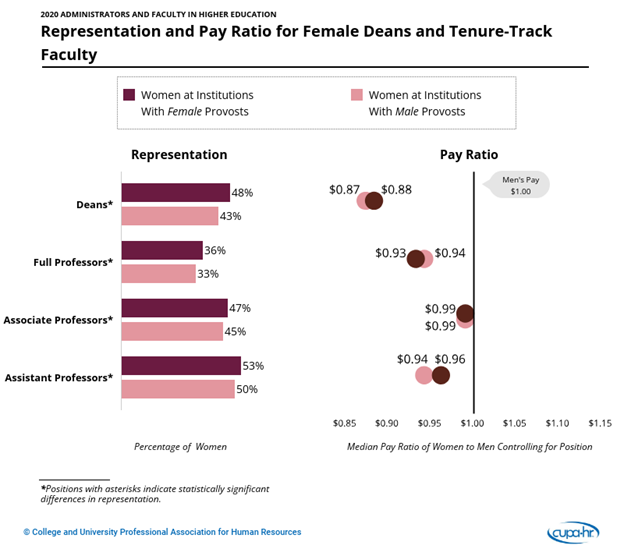
    New research by CUPA-HR has found that U.S. colleges and universities with women presidents or provosts have higher representation of women in administrative, dean and faculty positions than institutions led by men. The study also found that colleges and universities with women presidents have higher pay for women in administrative positions than institutions led by men. These positions tend to be pipelines for the senior-most executive positions in higher ed, which underscores the significance of the findings.

    Women Administrators Pay and Representation in Institutions With Female Presidents

    Findings show that institutions with female presidents have a higher percentage of women in all administrative categories — senior institutional officers, institutional administrators and heads of divisions. Although female administrators are generally paid less than male administrators in the same positions regardless of the sex of the president, female senior institutional officers, institutional administrators, and heads of divisions are paid more equitably at institutions with a female president than at institutions with a male president.

    Female Deans and Faculty Pay and Representation in Institutions With Female Provosts

    Institutions with female provosts have a significantly higher representation of women in dean positions and in all faculty ranks. Provost sex does not have a strong or consistent impact on pay equity for deans and faculty; however, it is worth noting that better representation at higher faculty ranks and in dean positions has an impact on pay, as these positions make higher salaries.

    The representation of women drops with successive faculty ranks (from assistant to associate to full professor). These promotions represent the few times in a faculty member’s career when appreciable salary increases are granted. If women are not being promoted, they are not receiving these pay raises. In addition, those in dean positions are generally promoted from senior faculty ranks. Therefore, if women are not adequately represented in senior faculty, they will not have the same likelihood as men of being considered for a higher-paying dean position.

    To sum up the findings, higher ed institutions with female executives have better representation of women throughout their institutions in positions that: a) are paid higher salaries and b) serve as key points in the executive leadership pipeline. Jackie Bichsel, CUPA-HR’s director of research and co-author of the new report, noted that, “In an era where institutions are adapting to shifting workforce expectations, adjusting to continuous decreases in budgets, contemplating changes in enrollment, addressing challenges of recruitment and retention, and rethinking their mission, more openness to change and less tolerance of risk may be just what is needed to navigate this new landscape. Providing more (and more equitable) opportunities for women to advance within higher education seems an obvious path forward in this navigation.”

    Read the full report, Women in the Leadership Pipeline in Higher Education Have Better Representation and Pay in Institutions With Female Presidents and Provosts.


    Source link