Category: Critical Thinking

  • Reaching peak engagement in K-12 science education

    Reaching peak engagement in K-12 science education

    Key points:

    More than half of science teachers believe the most important value of science education is how it contributes to students’ curiosity, critical thinking, and creativity, according to a new report from LEGO Education. But are today’s students truly engaging with science education?

    LEGO Education’s State of Classroom Engagement Report: Science Edition surveyed more than 6,000 global teachers, parents, students, and U.S. administrators to gather data that can offer insight to support educators as they strive to engage their students in science learning.

    Science learning builds life skills students will use even if they do not pursue the science in college or as a career. It also increases student engagement and well-being, but here’s the catch: Students have to feel connected to the material in order to build these skills.

    Just over half of global science teachers say their students are engaged in science, which points to a critical need to boost engagement in the subject, according to the report. Interestingly, students say they are more engaged in science than they are in school overall. Only one-third of teachers worldwide indicate that their students are engaged in the classroom. Schools could leverage students’ interest in science to build schoolwide engagement–a key factor tied to student well-being.

    When students aren’t engaged in science, what’s behind that lack of engagement? Often, they’re intimidated before they even learn the material, and they assume the topics are too challenging. Students lose confidence before they even try. Of students who say science is their least-favorite topic, 45 percent say science is too hard and 37 percent say they are bad at science. What’s more, 77 percent of global teachers say they believe students struggle because of complex concepts and curricula, and they’re searching for for impactful resources that support every student’s success.

    “If students think they’re not good at the subject or avoid it, we risk losing an entire generation of innovators and problem solvers,” said Victor Saeijs, president of LEGO Education, in the report.

    How can educators reach students who struggle to engage with science? Hands-on science learning is the key to piquing student curiosity, prompting them to engage with learning material and build confidence as they explore science concepts. Sixty-two percent of science teachers say hands-on activities drive student engagement in science. Seventy-five percent of science teachers who do incorporate hands-on activities believe this approach leads to higher test scores and grades.

    More students need access to hands-on science learning. Only 55 percent of students say they regularly get hands-on experiences–these experiences usually require extra time and resources to plan and execute. Eighty-two percent of science teachers say they need more ways to teach science with play and hands-on methods.

    Having access to hands-on science learning experiences increases students’ confidence, giving them the boost they often need to tackle increasingly tough-to-learn concepts:

    • 73 percent of students with access to hands-on learning opportunities report feeling confident in science
    • Just 52 percent of students who do not have access to hands-on learning report feeling confident in science

    Hands-on experiences in science drive:

    • Learning outcomes: 71 percent of science teachers who incorporate hands-on, playful learning believe the methodology supports higher test scores and grades
    • Engagement for all learners: 84 percent of U.S. teachers and 87 percent of administrators think that hands-on experiences help all types of learners engage with science concepts
    • Love of science: 63 percent of students who love science credit their passion to regular hands-on experiences
    • Confidence: 79 percent of students who have hands-on science experiences are confident in the subject

    Administrators and science teachers are short on time and need hands-on tools and resources to quickly engage students in learning:

    • 59 percent of U.S. administrators and 54 percent of science teachers say they need more tools to engage students in science
    • Nearly one-third of U.S. students do not get hands-on science experiences.

    Laura Ascione
    Latest posts by Laura Ascione (see all)

    Source link

  • The TRAP Test to Spot AI Deepfakes and How to NOT Be Deceived – Sovorel

    The TRAP Test to Spot AI Deepfakes and How to NOT Be Deceived – Sovorel

    Everyone needs to develop AI Literacy skills in order to use AI properly and increase effectiveness/efficiencies, yet another vital part of AI Literacy is to develop critical thinking and awareness skills to avoid being deceived by synthetic data such as AI created deepfakes. Cyber Magazine, an international news source, expressed the importance of this issue by stating:

    Deepfakes are inevitably becoming more advanced, which is making it harder to spot and stop those that are used with bad intentions. As access to synthetic media technology increases, deepfakes can be used to damage reputations, fabricate evidence and undermine trust.

    With deepfake technology increasingly being used for mal-intent, businesses would do well to ensure that their workforce is fully trained and aware of the risks associated with AI-generated content. (Jackson, 2023)

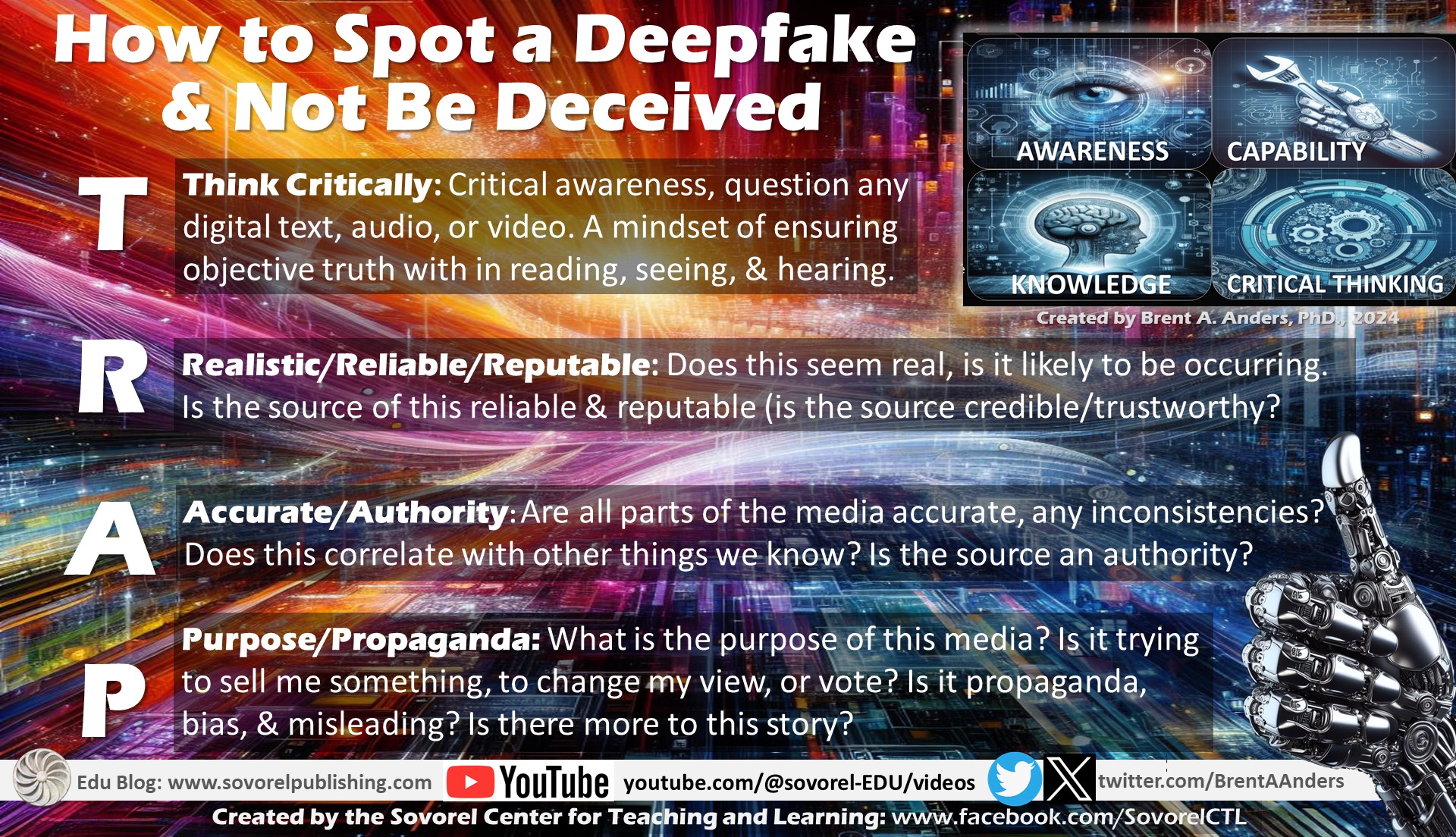
    To address this important issue I have created the TRAP test:

    T: Think Critically. All of us must now have a critical awareness and mindset when using any type of digital media since all digital media can now be easily manipulated and created with generative AI. When encountering any digital text, images, audio, or video we need to realize that it might not be real and it might be trying to manipulate our perception. We need to use the TRAP test to ask further questions to help ensure that we are getting the object truth.

    R: Realistic/Reliable/Reputable: When using digital media or viewing a video, we need to ask ourselves the question “does this seem real and is it likely to occur?” We must also consider whether or not the source of the information is reliable and if it is coming from a reputable source. Is it from an official source, a well known news source, a government agency, or established organization? Always check the source.

    A: Accurate/Authority: Check to see if all parts of the digital media are accurate. As an example, if watching a video, are all parts accurate and consistent. Are there any issues with the eyes, the background, or the light sources? Is it similar and consistent with other videos, images, or text? Additionally, has the media been released or authenticated by an authority? These questions must be verified and answered to help ensure validity and accuracy.

    P: Purpose/Propaganda: When reviewing any digital media we must ask ourselves, “what is the purpose of this media? If the answer is that they are trying to get your money or to sway your vote in an election then you should be extra sure that the information is completely truthful. Ask yourself if the digital information presented is simply just propaganda, full of bias and misleading. Be sure to ask if there is more to the story that you are reading/watching.

    Using the TRAP test and asking these questions will help to prevent everyone from being scammed and/or deceived. Students, faculty, and everyone must develop AI Literacy skills like these.

    All aspect of this defined AI Literacy are important (Anders, 2023), but Awareness and Critical Thinking are key in developing the proper mindset to use the TRAP test. This is something that must be continually developed and used in order to ensure its greatest effectiveness.

    All of us in academia must work to ensure that student and everyone else develop these skills to use AI in the right way and be able to properly spot AI deepfakes and avoid being deceived. Please share this information with colleagues, students, family, and friend; especially the elderly who can at times be even more vulnerable. Together we make a major difference and improve our new world filled with AI.

    A video describing the TRAP test is also available on the Sovorel Educational YouTube channel:

    “How to Spot a Deepfake and NOT Be Deceived” (Anders, 2024)

    Please share your thoughts and comment below:

    References

    Anders, B. (2023). The AI literacy imperative: Empowering instructors & students. Sovorel Publishing.

    Jackson, A. (2023, October 13). The rising tide of deepfakes as AI growth cause concern. Cyber Magazin, Technology: AI. https://cybermagazine.com/technology-and-ai/the-rising-tide-of-deepfakes-as-ai-growth-cause-concern

    Source link