Category: Culture

  • Understanding why students cheat and use AI: Insights for meaningful assessments

    Understanding why students cheat and use AI: Insights for meaningful assessments

    Key points:

    • Educators should build a classroom culture that values learning over compliance
    • 5 practical ways to integrate AI into high school science
    • A new era for teachers as AI disrupts instruction
    • For more news on AI and assessments, visit eSN’s Digital Learning hub

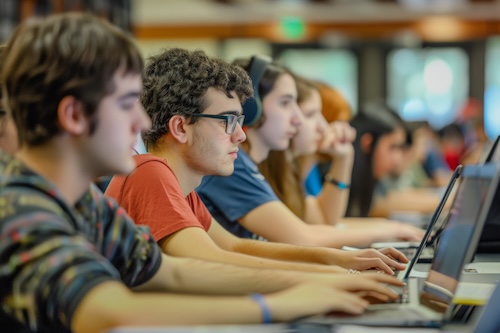
    In recent years, the rise of AI technologies and the increasing pressures placed on students have made academic dishonesty a growing concern. Students, especially in the middle and high school years, have more opportunities than ever to cheat using AI tools, such as writing assistants or even text generators. While AI itself isn’t inherently problematic, its use in cheating can hinder students’ learning and development.

    More News from eSchool News

    Many math tasks involve reading, writing, speaking, and listening. These language demands can be particularly challenging for students whose primary language is not English.

    As a career and technical education (CTE) instructor, I see firsthand how career-focused education provides students with the tools to transition smoothly from high school to college and careers.

    As technology trainers, we support teachers’ and administrators’ technology platform needs, training, and support in our district. We do in-class demos and share as much as we can with them, and we also send out a weekly newsletter.

    Math is a fundamental part of K-12 education, but students often face significant challenges in mastering increasingly challenging math concepts.

    Throughout my education, I have always been frustrated by busy work–the kind of homework that felt like an obligatory exercise rather than a meaningful learning experience.

    During the pandemic, thousands of school systems used emergency relief aid to buy laptops, Chromebooks, and other digital devices for students to use in remote learning.

    Education today looks dramatically different from classrooms of just a decade ago. Interactive technologies and multimedia tools now replace traditional textbooks and lectures, creating more dynamic and engaging learning environments.

    There is significant evidence of the connection between physical movement and learning.  Some colleges and universities encourage using standing or treadmill desks while studying, as well as taking breaks to exercise.

    This story was originally published by Chalkbeat. Sign up for their newsletters at ckbe.at/newsletters. In recent weeks, we’ve seen federal and state governments issue stop-work orders, withdraw contracts, and terminate…

    English/language arts and science teachers were almost twice as likely to say they use AI tools compared to math teachers or elementary teachers of all subjects, according to a February 2025 survey from the RAND Corporation.

    Want to share a great resource? Let us know at [email protected].

    Source link

  • Can fiction help us get to the truth about climate change?

    Can fiction help us get to the truth about climate change?

    Truth in fiction

    That’s where fiction can come in. But most climate fiction presents gloomy scenarios: think the waterless world of Arrakis in Frank Herbert’s “Dune” series or our earth after a virus wiped out most of human life in Margaret Atwood’s “Oryx and Crake” trilogy.

    In contrast, Baden’s story showed more positive solutions. Her own research found that 98% of her readers changed their attitudes. A month after reading the story 60% of readers actually adopted a green alternative.

    She’s set to release “Murder in the Climate Assembly“, a fictional story about the ramifications of a murder that takes place in a citizens’ assembly on climate.

    Some media organizations are now including climate change awareness initiatives that use fictional examples into their marketing campaigns.

    Baden worked with BAFTA, the British Academy of Film and Television Arts, to create social media content that provided solutions with a tinge of humour. For example, they contrasted the carbon footprint of two popular characters from books and movies: James Bond who drives a gas guzzling sports car and has a walk-in wardrobe versus Jack Reacher who traveled by bus and shopped second-hand.

    Making environmentalism fun

    Pilot testing showed interesting results: “If we just presented the negative one like James Bond, some people laughed and thought it was funny, but a few people thought they were being a bit preached at and switched off,” Baden said. “Whereas when you kind of had both together with a bit of humor, that seemed to hit the right spot.”

    Pike agreed: “Comedy too allows us to let our guard down. When we open our mouth to laugh, our mind is open to learn.”

    When Pike was in Chile working on the PhD that led to her book she found that she loved the animated series “The Simpsons“. In 2008, one of the three TV channels played Simpsons episodes endlessly, she said. Simpsons creator Matt Groening intended his show to make people aware of environmental challenges and complications in ways that start conversations, she said.

    Context makes a difference too. “I read ecoactivist discourse in South America and it seemed so darn white and privileged,” Pike said. “If you read “Burning Rage of a Dying Planet” in a comfortable U.S. suburb, it’s one thing. If you read the same book in Chile, it feels different, almost too precious, definitely not the tone I would take in talking about ecology in South American countries.”

    The Center for Health Communication at Harvard University says that showing, not telling induces stronger emotional responses as visual imagery and helps our brains understand abstract and complex associations like those between climate and health.

    Connecting emotion to change

    Telling stories through books, plays or social media also help to create emotion, and change beliefs and behaviours. They may also reduce feelings of anxiety and depression that surface when bombarded with alarmist news about the climate crisis. Focusing on solutions is more effective.

    Pike said the way to get through the barrage of media messages and talk about the climate crisis is with honesty, independence and humour. “Acknowledge the hypocrisy and move on toward solutions,” Pike said. “A solution offers me a choice, agency, a chance to put up a sail and navigate to a goal.”

    Pike taught a class called “Environmental Reporting for a Hopeful Planet” in the spring 2024 semester. One assignment was “Forest Friday”: students were asked to read, watch or listen to examples of environmental storytelling.

    One week, the students were assigned a video of Rebecca Solnit. She’s a writer, historian and activist who has been examining hope and the unpredictability of change for more than two decades. In 2023 she co-edited an anthology called “It’s Not Too Late”, a guide for finding hope even while climate change-induced disasters continue. This is what one student said after they watched that video:

    “I felt reassured by her calmness and her endless lists of knowledge of times and places in which meaningful change has occurred. I think she makes many great points about the way that just because ideas don’t always get the opportunity to fully take shape they are still impactful on society as a whole.”

    So, what’s the best way to write about the climate crisis?

    “Read environmental writing and write,” Pike said. “Be so deeply curious about how ecology works, how nature and culture interact, how businesses and institutions works and their role in the climate crisis.”

    Ways to write effectively

    Having a community of people who also write about and care about the environment can also help. But most importantly, Pike said: “Work to tell a story well.”

    This means reading the publications which interest you and seeing if your story would be a good fit. Try different mediums. Take Dr. Seuss’ “The Lorax”. It’s a children’s book written in 1971 about a character who speaks for the trees as a business tycoon destroys the environment. The story encourages activism and involvement in making the situation better. In it the Lorax tells us: “Unless someone like you cares a whole awful lot, nothing is going to get better. It’s not.”

    More recently, there are films like “Flow“, which won an Academy Award for Best Animated Feature and was nominated for Best International Feature Film, and “The Wild Robot“, which was nominated for three Academy Awards including Best Animated Feature.

    In both, climate change is a world-building element; one showed a submerged Golden Gate Bridge, the other showed a flood of biblical proportions. But they’re both animated films, with cute animals coming together to save the world, reaching a younger audience who will grow up with climate change and its impacts.

    Creating a story that can make people think about our planet and how we can tackle climate change isn’t easy. Pike said it is worth persevering.

    “If you get tired, don’t give up,” Pike said. “Rest and get back to it when you can. We all plant seeds and it’s hard to say which ones will take.”


    Three questions to consider:

    1. What makes you switch off the news when a story about climate change comes on?
    2. What happens to our brain when we show, rather than tell, in our writing on climate change?
    3. What might you learn in a course like “Environmental Reporting for a Hopeful Planet?” 


    Source link

  • What stories can teach us about the world

    What stories can teach us about the world

    In a time of widespread misinformation, disinformation, fake news and outright lies throughout the world, many people are wondering what the truth really is and how to find it.

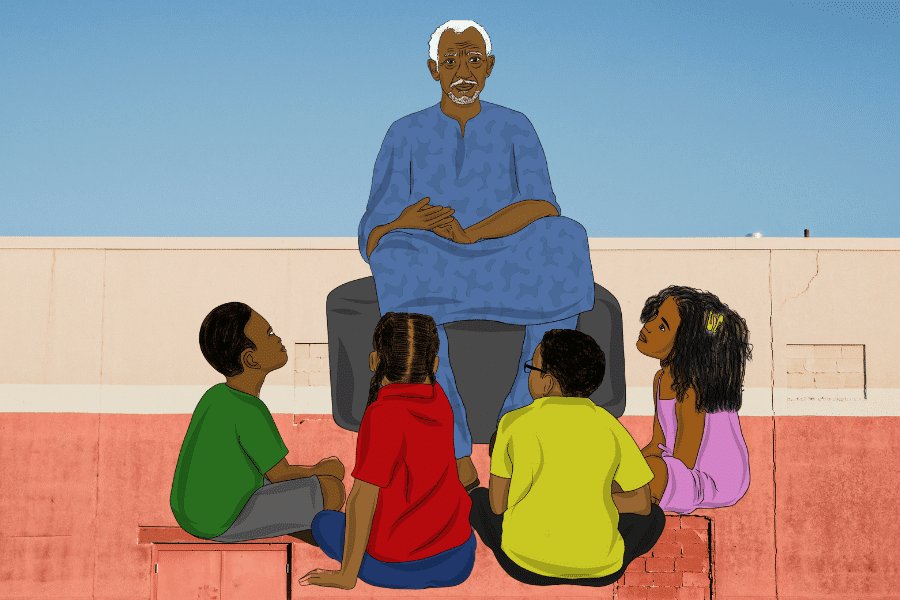
    In Africa, it is embedded in the power of story.

    “The oral tradition has always been a hallmark of West African culture for generations long before colonization, and so storytellers have been the truth tellers,” said Dr. Geremie Sawadogo, a World Bank talent manager and storyteller, who, as a child growing up in Burkina Faso, would gather with his family to listen to story hour on national radio every Tuesday evening.

    David Thuku, an executive coach and storyteller in Nairobi, Kenya, agreed. “Stories are a very structured system of managing life and giving knowledge about such things as governance, values, laws, social sciences and medicine. Medicine men, for example, would tell people which plants to use for different illnesses,” Thuku said.

    “They also taught us morals and our code of acceptable behaviours,” Sawadago added. For many, they are a form of timeless, universal truth.

    African stories can come in many different forms: two- to three-hour speeches, long monologues, oral renditions, poems, sayings, proverbs, fables, folklore tales, visual language, songs and even dance.

    Source link

  • When world leaders descend on your town

    When world leaders descend on your town

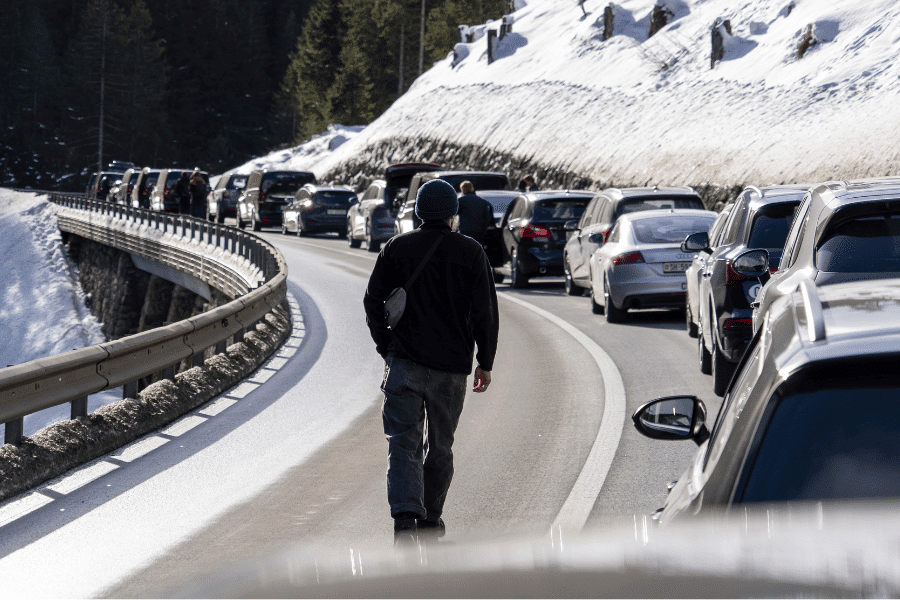
    When Linda Zaugg’s baby caught a high fever in January, it took an hour and a half to walk him to the hospital — a journey that usually takes 10 minutes. But this was Davos, Switzerland during the week of the World Economic Forum (WEF). Some 3,000 politicians and business leaders from all around the world had descended on the city to discuss important political and economic issues. 

    Zaugg is a member of the local parliament in Davos, a town in the Swiss Alps with a permanent population of about 11,000 people. She has been spearheading a campaign to raise awareness of the local impacts the conference has and find ways to mitigate them. 

    During the forum, traffic becomes so bad, she said, that ambulances have trouble finding their way through the streets of Davos, causing response times to increase significantly. 

    Traffic isn’t the only problem. During this time Davos experiences a massive influx of people, causing rent prices to explode by up to 10 times.

    “This is the real problem with the WEF,” she said. “Not the conference itself, but all the people and companies that come along with it to make money and advertise.”

    Economic effects of an economic forum

    Albert Kruker, the tourism director of Davos, warned that these price increases may cause a price spiral which would affect the town year-round.

    During the forum, local businesses go into overdrive trying to supply the politicians, journalists and other attendees with everything they require. When asked about it, the owner of a local bakery, Bäckerei Weber, said that it is one of the most profitable but also intense weeks of the year.

    “During the conference you get all these catering companies coming in and the hotels are full, so we have a lot more orders,” he told us. “During the conference we work 24 hours a day. Because of the security, we usually start delivering at two o’clock in the morning.”

    Many other business and house owners during this time either stock up on their goods or rent out their buildings for exorbitant prices. A banker living in Zurich with an apartment in Davos said that he can rent out his apartment for a single week during the conference for approximately three months’ rent.

    In an apartment block right next to the conference hall, many inhabitants move out during the week. These apartments are then rented by journalists, attendees and large companies.

    Disruption in Davos

    One resident of an apartment block told us that he is never home during the WEF. “I rent out my apartment and go on holiday during this time,” he said.

    The housing crunch during the forum is so intense that to accommodate attendees, some renters and families are forced out of their homes for the duration of the conference.

    Zaugg said that some landlords even include a clause in the renter’s agreement dictating that the renters must leave during this period. A side effect of this is that many children must live temporarily outside the city and cannot attend school.

    This problem is worsened by the fact that the streets are constantly congested and filled with drivers that aren’t used to Davos.

    These drivers often do not respect speed limits or pedestrian only zones, requiring even more attention by commuters, which is especially difficult and dangerous for children and the elderly as they aren’t used to this amount of traffic.

    Additionally, the public transportation system is bogged down during this time, once again causing confusion among society’s most vulnerable.

    Crowds and congestion

    Stephan Büchli, a local bus driver, said that there are no fixed schedules during this time as the traffic is simply too unpredictable. Additionally, they must use smaller buses, as the streets are too congested to allow the manoeuvring of the traditional ones.

    Furthermore, the new drivers often also park in restricted zones, further impacting public transport.

    “Last year I saw an old man at the local bus station during the conference. He was crying very heavily and was confused. It really made me angry,” Zaugg told us.

    The level of congestion also brings other problems with it.

    All this traffic creates substantial emissions. In 2023, the private jets attending the Forum alone generated 7,500 tons of CO2, roughly equivalent to the yearly emissions of 5,000 cars.

    Minimising the carbon footprint

    Part of the problem, Büchli said, is that limousines, trucks and taxis often leave their engines on while standing still, sometimes for upwards of half an hour. He himself has frequently witnessed cars idling with the engine running while stuck in traffic.

    As a high-profile event, the WEF requires a lot of temporary structures, internal furnishings and food to function. Every year these temporary structures are erected in late December and then taken down again afterwards. Some of them only get used once and thrown away after only one week’s use.

    The same is true for internal furniture such as carpets, shelves, computers and TV screens, as well as any leftover food. Several residents told us that after the WEF there are heaps of electronic equipment that gets thrown away. 

    Still, while many residents feel the effects, many keep their irritation to themselves out of fear of being labelled a WEF hater.

    While there are several key problems with the Forum in its current form, the organisers aren’t sitting idle. Over the past few years, several steps have been taken to lessen the impact of these problems.

    The road ahead

    The most obvious of these steps is the reduction in waste. The organisers of the conference and the government of Davos have issued regulations on the number of temporary structures and their reusability. This has caused their number to noticeably decrease over the last few editions.

    Old furniture and electronic devices are sold to the local inhabitants at reduced prices and spare food is offered to the residents for free, further contributing to making the WEF more sustainable.

    To ensure that people can travel around in a manageable timeframe, the municipality has also set up extra trains that commute from one end of the town to the other. Entry into Davos by car was also restricted this year for visitors and tourists.

    One of the most impactful changes was the installation of temporary ambulance stations. These stations are scattered across Davos, allowing them to respond quickly to emergencies and save lives.

    Over the last few years, both the WEF organisation and Davos itself have taken several different measures to lessen the negative impacts of the conference. However, these issues still persist and require solutions.

    Only time will tell if the people who organize a conference meant to bring people together to improve the state of the world can improve the lives of the people who live in this small town in the Alps, for one week of the year. 

    “You truly notice how the ideological part of the WEF, the bringing together of people, gets pushed into the background in favour of economic reasons,” Zaugg said.


    Questions to consider:

    • What is the World Economic Forum?

    • In what ways is the town of Davos negatively affected by the WEF?

    • Is there an event that disrupts life near where you live? How do people deal with it?


    Source link

  • Is freedom of speech the same as freedom to lie?

    Is freedom of speech the same as freedom to lie?

    Meta will stop checking falsehoods. Does that mean more free speech or a free-for-all?

    “First, we’re going to get rid of fact-checkers,” Mark Zuckerberg, the founder of Meta, said in a video statement early this January. “Second, we’re going to simplify our content policies and get rid of a bunch of restrictions on topics like immigration and gender that are just out of touch with mainstream discourse.”

    This statement marks another turn in the company’s policies in handling disinformation and hate speech on their widely used platforms Facebook, Instagram and Threads. 

    Meta built up its moderation capabilities and started its fact-checking program after Russia’s attempts to use Facebook to influence American voters in 2016 and after it was partially blamed by various human rights groups like Amnesty International for allowing the spread of hate speech leading to genocide in Myanmar. 

    Until now, according to Meta, about 15 thousand people review content on the platform in 70 languages to see if it is in line with the company’s community standards.

    Adding information, not deleting

    For other content, the company involves professional fact-checking organizations with journalists around the world. They independently identify and research viral posts that might contain false information. 

    Fact-checkers, like any other journalists, publish their findings in articles. They compare what is claimed in the post with statistics, research findings and expert commentary or they analyze if the media in the post are manipulated or AI generated. 

    But fact-checkers have a privilege that other journalists don’t – they can add information to the posts they find false or out of context on Meta platforms. It appears in the form of a warning label. The user can then read the full article by fact-checkers to see the reasons or close the warning and interact with the post.

    Fact-checkers can’t take any further action like removing or demoting content or accounts, according to Meta. That is up to the company. 

    However, Meta now likens the fact-checking program to censorship. Zuckerberg also argued for the end of the program saying that the fact-checkers “have just been too politically biased and have destroyed more trust than they’ve created.”

    Can untrained people regulate the Web?

    For now, the fact-checking program will be discontinued in the United States. Meta plans to rely instead on regular users to evaluate content under a new program it calls “Community Notes.” The company promises to improve it over the course of the year before expanding it to other countries.

    In a way, Meta walking back on their commitments to fight disinformation wasn’t a surprise, said Carlos Hernández- Echevarría, the associate director of the Spanish fact-checking outlet Maldita and a deputy member of the governance body that assesses and approves European fact-checking organizations before they can work with Meta called the European Fact-Checking Standards Network. 

    Zuckerberg had previously said that the company was unfairly blamed for societal ills and that he was done apologizing. But fact-checking partners weren’t warned ahead of the announcement of the plans to scrap the program, Hernández- Echevarría said.

    It bothers him that Meta connects fact-checking to censorship.

    “It’s actually very frustrating to see the Meta CEO talking about censorship when fact-checkers never had the ability and never wanted the ability to remove any content,” Hernández-Echevarría said. He argues that instead, fact-checkers contribute to speech by adding more information. 

    Are fact-checkers biased?

    Hernández-Echevarría also pushes back against the accusation that fact-checkers are biased. He said that mistakes do occur, but the organizations and people doing the work get carefully vetted and the criteria can be seen in the networks’ Code of Standards

    For example, fact-checkers must publish their methodology for choosing and evaluating information. Fact-checkers also can’t endorse any political parties or have any agreements with them. They also have to provide proof of who they are owned by as well as publicly disclose information about their employees and funding.

    Meta’s own data about Facebook, which they disclose to EU institutions, also shows that erroneous decisions to demote posts based on fact-checking labels occur much less often than when posts are demoted for other reasons — nudity, bullying, hate speech and violence, for example. 

    In the period from April to September last year, Meta received 172,550 complaints about the demotion of posts with fact-checking labels and, after having another look, reversed it for 5,440 posts — a little over 3%. 

    However, in all other categories combined, the demotion had to be reversed for 87% of those posts.

    The sharing of unverified information

    Research shows that the perception of the unequal treatment of different political groups might form because people on the political right publish more unreliable information.

    A paper published in the scientific magazine Nature says that conservative users indeed face penalties more often, but they also share more low-quality news. Researchers therefore argued that even if the policies contain no bias, there can be an asymmetry in how they are enforced on platforms.

    Meta is also making other changes. On 7 January, the company published a revised version of its hateful conduct policies. The platform now allows comparing women to household objects and “insulting language in the context of discussing political or religious topics, such as when discussing transgender rights, immigration, or homosexuality”. The revised policies also now permit “allegations of mental illness or abnormality when based on gender or sexual orientation”.

    LGBTQ+ advocacy group GLAAD called these changes alarming and extreme and said they will result in platforms becoming “unsafe landscapes filled with dangerous hate speech, violence, harassment, and misinformation”. 

    Journalists also report that the changes divided the employees of the company. The New York Times reported that as some upset employees posted on the internal message board, human resources workers quickly removed the posts saying they broke the rules of a company policy on community engagement.

    Political pressure

    In a statement published on her social media channels. Angie Drobnic Holan, the director of the International Fact-Checking Network, which represents fact-checkers in the United States, linked Meta’s decision to political pressure.

    “It’s unfortunate that this decision comes in the wake of extreme political pressure from a new administration and its supporters,” Holan said. “Fact-checkers have not been biased in their work. That attack line comes from those who feel they should be able to exaggerate and lie without rebuttal or contradiction.”

    In his book “Save America” published in August 2024, Donald Trump whose term as U.S. President begins today, accused Zuckerberg of plotting against him. “We are watching him closely, and if he does anything illegal this time he will spend the rest of his life in prison,” he wrote. 

    Now, with the changes Zuckerberg announced, Trump is praising Meta and said they’ve come a long way. When asked during a press conference 7 January if he thought Zuckerberg was responding to Trump’s threats, Trump replied, “Probably.”

    After Meta’s announcement, the science magazine Nature published a review of research with comments from experts on the effectiveness of fact-checking. For example, a study in 2019 analyzing 30 research papers covering 20 thousand participants found an influence on beliefs but the effects were weakened by participants’ preexisting beliefs, ideology and knowledge. 

    Sander van der Linden, a social psychologist at the University of Cambridge told Nature that ideally, people wouldn’t form misperceptions in the first place but “if we have to work with the fact that people are already exposed, then reducing it is almost as good as it as it’s going to get”. 

    Hernández-Echevarría said that although the loss of Meta’s funding will be a hard hit to some organizations in the fact-checking community, it won’t end the movement. He said, “They are going to be here, fighting disinformation. No matter what, they will find a way to do it. They will find support. They will do it because their central mission is to fight disinformation.”


    Questions to consider:

    • What is now allowed under Meta’s new rules for posts that wasn’t previously?

    • How is fact-checking not the same as censorship?

    • When you read social media posts, do you care if the poster is telling the truth?


    Source link