Every year, Hispanic Heritage Month offers the United States a chance to honor the profound and varied contributions of Latino communities. We celebrate scientists like Ellen Ochoa, the first Latina woman in space, and activists like Dolores Huerta, who fought tirelessly for workers’ rights. We use this month to recognize the cultural richness that Spanish-speaking families bring to our communities, including everything from vibrant festivals to innovative businesses that strengthen our local economies.
But there’s a paradox at play.
While we spotlight Hispanic heritage in public spaces, many classrooms across the country require Spanish-speaking students to set aside the very heart of their cultural identity: their language.
This contradiction is especially personal for me. I moved from Puerto Rico to the mainland United States as an adult in hopes of building a better future for myself and my family. The transition was far from easy. My accent often became a challenge in ways I never expected, because people judged my intelligence or questioned my education based solely on how I spoke. I could communicate effectively, yet my words were filtered through stereotypes.
Over time, I found deep fulfillment working in a state that recognizes the value of bilingual education. Texas, where I now live, continues to expand biliteracy pathways for students. This commitment honors both home languages and English, opening global opportunities for children while preserving ties to their history, family, and identity.
That commitment to expanding pathways for English Learners (EL) is urgently needed. Texas is home to more than 1.3 million ELs, which is nearly a quarter of all students in the state, the highest share in the nation. Nationwide, there are more than 5 million ELs comprising nearly 11 percent of the U.S. public school students; about 76 percent of ELs are Spanish speakers. Those figures represent millions of children who walk into classrooms every day carrying the gift of another language. If we are serious about celebrating Hispanic Heritage Month, we must be serious about honoring and cultivating that gift.
A true celebration of Hispanic heritage requires more than flags and food. It requires acknowledging that students’ home languages are essential to their academic success, not obstacles to overcome. Research consistently shows that bilingualism is a cognitive asset. Those who are exposed to two languages at an early age outperform their monolingual peers on tests of cognitive function in adolescence and adulthood. Students who maintain and develop their native language while learning English perform better academically, not worse. Yet too often, our educational systems operate as if English is the only language that matters.
One powerful way to shift this mindset is rethinking the materials students encounter every day. High-quality instructional materials should act as both mirrors and windows–mirrors in which students see themselves reflected, and windows through which they explore new perspectives and possibilities. Meeting state academic standards is only part of the equation: Materials must also align with language development standards and reflect the cultural and linguistic diversity of our communities.
So, what should instructional materials look like if we truly want to honor language as culture?
Instructional materials should meet students at varying levels of language proficiency while never lowering expectations for academic rigor.
Effective materials include strategies for vocabulary development, visuals that scaffold comprehension, bilingual glossaries, and structured opportunities for academic discourse.
Literature and history selections should incorporate and reflect Latino voices and perspectives, not as “add-ons” during heritage month, but as integral elements of the curriculum throughout the year.
But materials alone are not enough. The process by which schools and districts choose them matters just as much. Curriculum teams and administrators must center EL experiences in every adoption decision. That means intentionally including the voices of bilingual educators, EL specialists, and, especially, parents and families. Their life experiences offer insights into the most effective ways to support students.
Everyone has a role to play. Teachers should feel empowered to advocate for materials that support bilingual learners; policymakers must ensure funding and policies that prioritize high-quality, linguistically supportive instructional resources; and communities should demand that investments in education align with the linguistic realities of our students.
Because here is the truth: When we honor students’ languages, we are not only affirming their culture; we are investing in their future. A child who is able to read, write, and think in two languages has an advantage that will serve them for life. They will be better prepared to navigate an interconnected world, and they carry with them the ability to bridge communities.
This year, let’s move beyond celebrating what Latino communities have already contributed to America and start investing in what they can become when we truly support and honor them year-round. That begins with valuing language as culture–and making sure our classrooms do the same.
Altagracia “Grace” Delgado, Texas Association for Bilingual Education & Assessment for Good
Altagracia “Grace” Delgado has devoted 30 years to education, serving as a bilingual teacher, literacy coach, and both a school and central office administrator. A passionate advocate for students in special populations, she collaborates with various organizations to ensure they receive the support and resources they need. Grace serves as a Board Member of the Texas Association for Bilingual Education and an Advisory Board Member for Assessment for Good, a project of the Advanced Education Research & Development Fund, as well as the Houston Christian University’s Women in Leadership Program.
Latest posts by eSchool Media Contributors (see all)
Classroom teachers are handed a curriculum they must use when teaching. That specific curriculum is designed to bring uniformity, equity, and accountability into classrooms. It is meant to ensure that every child has access to instruction that is aligned with state standards. The specific curriculum provides a roadmap for instruction, but anyone who has spent time in a classroom knows that no single curriculum can fully meet the needs of every student.
In other words, even the most carefully designed curriculum cannot anticipate the individual needs of every learner or the nuances of every classroom. This is why supplementing curriculum is a vital action that skilled educators engage in. Supplementing curriculum does not mean that teachers are not teaching the required curriculum. In fact, it means they are doing even more to ensure student success.
Students arrive with different strengths, challenges, and interests. Supplementing curriculum allows teachers to bridge inevitable gaps within their students. For example, a math unit may assume fluency with multiplying and dividing fractions, but some students may not recall that skill, while others are ready to compute with mixed numbers. With supplementary resources, a teacher can provide both targeted remediation and enrichment opportunities. Without supplementing the curriculum, one group may fall behind or the other may become disengaged.
Supplementing curriculum can help make learning relevant. Many curricula are written to be broad and standardized. Students are more likely to connect with lessons when they see themselves reflected in the content, so switching a novel based on the population of students can assist in mastering the standard at hand.
Inclusion is another critical reason to supplement. No classroom is made up of one single type of learner. Students with disabilities may need graphic organizers or audio versions of texts. English learners may benefit from bilingual presentations of material or visual aids. A curriculum may hit all the standards of a grade, but cannot anticipate the varying needs of students. When a teacher intentionally supplements the curriculum, every child has a pathway to success.
Lastly, supplementing empowers teachers. Teaching is not about delivering a script; it is a profession built on expertise and creativity. When teachers supplement the prescribed curriculum, they demonstrate professional judgment and enhance the mandated framework. This leads to a classroom where learning is accessible, engaging, and responsive.
A provided curriculum is the structure of a car, but supplementary resources are the wheels that let the students move. When done intentionally, supplementing curriculum enables every student to be reached. In the end, the most successful classrooms are not those that follow a book, but those where teachers skillfully use supplementary curriculum to benefit all learners. Supplementing curriculum does not mean that a teacher is not using the curriculum–it simply means they are doing more to benefit their students even more.
Dr. Yuvraj Verma, Bessemer City Middle School and William Howard Taft University
From Texas to Florida to Arizona, school voucher policies are reshaping the landscape of American education. The Trump administration champions federal support for voucher expansion, and many state-level leaders are advancing school choice programs. Billions of public dollars are now flowing to private schools, church networks and microeducation platforms.
The push to expand school choice is not just reallocating public funds to private institutions. It is reorganizing the very purpose of schooling. And in that shift, something essential is being lost — the public mission of education as a foundation of democracy.
Civic education is becoming fragmented, underfunded and institutionally weak.
In this moment of sweeping change, as public dollars shift from common institutions to private and alternative schools, the shared civic entities that once supported democratic learning are being diminished or lost entirely — traditional structures like public schools, libraries and community colleges are no longer guaranteed common spaces.
The result is a disjointed system in which students may gain academic content or career preparation but receive little support in learning how to lead with integrity, think across differences or sustain democratic institutions. The very idea of public life is at risk, especially in places where shared experience has been replaced by polarization. We need civic education more than ever.
If we want students who can lead a multiracial democracy, we need schools of every type to take civic formation seriously. That includes religious schools, charter schools and homeschooling networks. The responsibility cannot fall on public schools alone. Civic formation is not an ideological project. It is a democratic one, involving the long-term work of building the skills, habits and values that prepare people to work across differences and take responsibility for shared democratic life.
What we need now is a civic education strategy that matches the scale of the changes reshaping American schooling. This will mean fostering coordinated investment, institutional partnerships and recognition that the stakes are not just academic, they are also democratic.
Americans overwhelmingly support civic instruction. According to a 2020 survey in Texas by the Center of Women in Politics and Public Policy and iCivics, just 49 percent of teachers statewide believed that enough time was being devoted to teaching civics knowledge, and just 23 percent said the same about participatory-democracy skills. This gap is not unique to Texas, but there is little agreement on how civics should be taught, and even less structural support for the schools trying to do it.
Without serious investment, civic formation will remain an afterthought — a patchwork effort disconnected from the design of most educational systems.
This is not an argument against vouchers in principle. Families should have options. But in the move to decentralize education, we risk hollowing out its civic core. A democratic society cannot survive on academic content alone. It requires citizens — not just in the legal sense, but in the civic one.
A democratic society needs people who can deliberate, organize, collaborate and build a shared future with others who do not think or live like they do.
And that’s why we are building a framework in Texas that others can adopt and adapt to their own civic mission.
The pioneering Democracy Schools model, to which I contribute, supports civic formation across a range of public and private schools, colleges, community organizations and professional networks.
Civic infrastructure is the term we use to describe our approach: the design of relationships, institutions and systems that hold democracy together. Just as engineers build physical infrastructure, educators and civic leaders must build civic infrastructure by working with communities, not for or on them.
We start from a democratic tradition rooted in the Black freedom struggle. Freedom, in this view, is not just protection from domination. It is the capacity to act, build and see oneself reflected in the world. This view of citizenship demands more than voice. It calls for the ability to shape institutions, policies and public narratives from the ground up.
The model speaks to a national crisis: the erosion of shared civic space in education. It must be practiced and must be supported by institutions that understand their role in building public life. Historically Black colleges and universities like Huston-Tillotson University offer a powerful example. They are not elite pipelines disconnected from everyday life. They are rooted in community, oriented toward public leadership and shaped by a history of democratic struggle. They show what it looks like to educate for civic capacity — not just for upward mobility. They remind us that education is not only about what students know, but about who they become and what kind of world they are prepared to help shape.
Our national future depends on how well we prepare young people to take responsibility for shared institutions and pluralistic public life. This cannot be accomplished through content standards alone. It requires civic ecosystems designed to cultivate public authorship.
We have an enormous stake in preparing the next generation for the demands of democratic life. What kind of society are we preparing young people to lead? The answer will not come from any single institution. It will come from partnerships across sectors, aligned in purpose even if diverse in approach.
We are eager to collaborate with any organization — public, private or faith-based — committed to building the civic infrastructure that sustains our democracy. Wherever education takes place, civic formation must remain a central concern.
Robert Ceresa is the founding director of the Politics Lab of the James L. Farmer House, Huston-Tillotson University.
The Hechinger Report provides in-depth, fact-based, unbiased reporting on education that is free to all readers. But that doesn’t mean it’s free to produce. Our work keeps educators and the public informed about pressing issues at schools and on campuses throughout the country. We tell the whole story, even when the details are inconvenient. Help us keep doing that.
How to design reliable, valid and fair assessment in an AI-infused world is one of those challenges that feels intractable.
The scale and extent of the task, it seems, outstrips the available resource to deal with it. In these circumstances it is always worth stepping back to re-frame, perhaps reconceptualise, what the problem is, exactly. Is our framing too narrow? Have we succeeded (yet) in perceiving the most salient aspects of it?
As an educational development professional, seeking to support institutional policy and learning and teaching practices, I’ve been part of numerous discussions within and beyond my institution. At first, we framed the problem as a threat to the integrity of universities’ power to reliably and fairly award degrees and to certify levels of competence. How do we safeguard this authority and credibly certify learning when the evidence we collect of the learning having taken place can be mimicked so easily? And the act is so undetectable to boot?
Seen this way the challenge is insurmountable.
But this framing positions students as devoid of ethical intent, love of learning for its own sake, or capacity for disciplined “digital professionalism”. It also absolves us of the responsibility of providing an education which results in these outcomes. What if we frame the problem instead as a challenge of AI to higher education practices as a whole and not just to assessment? We know the use of AI in HE ranges widely, but we are only just beginning to comprehend the extent to which it redraws the basis of our educative relationship with students.
Rooted in subject knowledge
I’m finding that some very old ideas about what constitutes teaching expertise and how students learn are illuminating: the very questions that expert teachers have always asked themselves are in fact newly pertinent as we (re)design education in an AI world. This challenge of AI is not as novel as it first appeared.
Fundamentally, we are responsible for curriculum design which builds students’ ethical, intellectual and creative development over the course of a whole programme in ways that are relevant to society and future employment. Academic subject content knowledge is at the core of this endeavour and it is this which is the most unnerving part of the challenge presented by AI. I have lost count of the number of times colleagues have said, “I am an expert in [insert relevant subject area], I did not train for this” – where “this” is AI.
The most resource-intensive need that we have is for an expansion of subject content knowledge: every academic who teaches now needs a subject content knowledge which encompasses a consideration of the interplay between their field of expertise and AI, and specifically the use of AI in learning and professional practice in their field.
It is only on the basis of this enhanced subject content knowledge that we can then go on to ask: what preconceptions are my students bringing to this subject matter? What prior experience and views do they have about AI use? What precisely will be my educational purpose? How will students engage with this through a newly adjusted repertoire of curriculum and teaching strategies? The task of HE remains a matter of comprehending a new reality and then designing for the comprehension of others. Perhaps the difference now is that the journey of comprehension is even more collaborative and even less finite that it once would have seemed.
Beyond futile gestures
All this is not to say that the specific challenge of ensuring that assessment is valid disappears. A universal need for all learners is to develop a capacity for qualitative judgement and to learn to seek, interpret and critically respond to feedback about their own work. AI may well assist in some of these processes, but developing students’ agency, competence and ethical use of it is arguably a prerequisite. In response to this conundrum, some colleagues suggest a return to the in-person examination – even as a baseline to establish in a valid way levels of students’ understanding.
Let’s leave aside for a moment the argument about the extent to which in-person exams were ever a valid way of assessing much of what we claimed. Rather than focusing on how we can verify students’ learning, let’s emphasise more strongly the need for students themselves to be in touch with the extent and depth of their own understanding, independently of AI.
What if we reimagined the in-person high stakes summative examination as a low-stakes diagnostic event in which students test and re-test their understanding, capacity to articulate new concepts or design novel solutions? What if such events became periodic collaborative learning reviews? And yes, also a baseline, which assists us all – including students, who after all also have a vested interest – in ensuring that our assessments are valid.
Treating the challenge of AI as though assessment stands alone from the rest of higher education is too narrow a frame – one that consigns us to a kind of futile authoritarianism which renders assessment practices performative and irrelevant to our and our students’ reality.
There is much work to do in expanding subject content knowledge and in reimagining our curricula and reconfiguring assessment design at programme level such that it redraws our educative relationship with students. Assessment more than ever has to become a common endeavour rather than something we “provide” to students. A focus on how we conceptualise the trajectory of students’ intellectual, ethical and creative development is inescapable if we are serious about tackling this challenge in meaningful way.
The early years are a critical time to teach the foundations of math. That’s when children learn to count, start identifying shapes and gain an early understanding of concepts like size and measurement. These years can also be a time when children are confronted with preconceived notions of their abilities in math, often based on their race, which can negatively affect their math success and contribute to long-standing racial gaps in scores.
These are some of the motivating factors behind the Racial Justice in Early Math project, a collaboration between the Erikson Institute, a private graduate school focused on child development, and the University of Illinois Chicago. The project aims to educate teachers and provide resources including books, teacher tips and classroom activities that help educators combat racial bias in math instruction.
I sat down with Danny Bernard Martin, professor of education and mathematics at the University of Illinois Chicago, project director Priscila Pereira and Jennifer McCray, a research professor at the Erikson Institute, to learn more about their work. This conversation has been edited for length and clarity.
What are some of the key examples of racial injustice that you see in early math education?
Martin: If I say to you, ‘Asians are good at math,’ that’s something that you’ve heard, we know that’s out there. When does that kind of belief start? Well, there’s something called ‘racial-mathematical socialization’ that we take seriously in this project, that we know happens in the home before children come to school. Parents and caregivers are generating messages around math that they transmit to children, and then those messages may get reinforced in schools.
Even at the early math level, there are research projects beginning to construct Black children in particular ways, comparing Black children to white children as the norm. That is a racial justice issue, because that narrative about white children, Black children, Asian American children, Latinx children, then filters out. It becomes part of the accepted truth, and then it impacts what teachers do and what principals and school leaders believe about children.
What does this look like in schools?
McCray: Perhaps the math curriculum doesn’t represent them or their experience. We all know that often schools for children of color are under-resourced. What often happens in under-resourced schools is that the curriculum and the teaching tends to focus on the basics. There might be an overemphasis on drilling or doing timed tests. We also have those situations where people are doing ability grouping in math. And we know what the research says about that, it’s basically ‘good education for you, and poor education for you.’ It’s almost impossible to do any of that without doing harm.
One line of research has been to watch teachers interact with children and videotape or study them. And in diverse classrooms with white teachers … often it is observed that children who are Black or Latina aren’t called on as often, or aren’t listened to as much, or don’t have the same kind of opportunity to be a leader in the classroom.
What should teacher prep programs, administrators and families do to address racial justice issues in early math?
McCray: Maybe the white teacher is reflecting on themselves, on their own biases … trying to connect with families or communities in some way that’s meaningful. We want teachers to have that balance of knowing that sometimes you do want to teach a procedure, but you never want to be shutting down ideas for creative ways to solve a math problem, or culturally distinct ways to solve a math problem that might come from your students.
It might be something like, you’re working on sorting in an early childhood classroom. And what if a child is thinking about a special craft that their parent does that’s like the [papel picado], or papers that get cut in very elaborate designs in Mexico. … If the teacher doesn’t have space to listen, it could be a shutdown moment, instead of a moment of connection, where the child is actually bringing something … that is associated with their own identity.
Pereira: I do feel that sometimes the conversations of racial justice really put the weight on teachers and teachers alone. Teaching is part of a larger structure. Maybe your school will not allow you to do the work that is needed. I’m thinking about [a teacher] who was required to follow a scripted curriculum that did not promote the positive math identity for Black children. It needs to be a whole community effort.
How is your initiative changing this?
Pereira: There are resources in terms of opportunities that we offer to teachers to engage with our content and ideas: webinars, a fellowship and an immersive learning experience in the summer of 2026. These spaces are moments in which educators, researchers and people that are engaged in the education of young learners, can come together … and disrupt mainstream notions of understanding what is racial justice and how one gets that in the classroom.
Right now, research and initiatives zeroing in on race are under scrutiny, especially at the college level. Do you foresee any additional challenges to this work?
Pereira: There was a National Science Foundation grant program focused on racial equity in STEM and we had been planning to apply for funds to do something there. … It’s gone. … The only place we’re welcome is where there’s a governor who is willing to take on Trump. We just have to keep doing the work, because we know what’s right. But it is challenging, for sure.
The Hechinger Report provides in-depth, fact-based, unbiased reporting on education that is free to all readers. But that doesn’t mean it’s free to produce. Our work keeps educators and the public informed about pressing issues at schools and on campuses throughout the country. We tell the whole story, even when the details are inconvenient. Help us keep doing that.
Researchers at the University of Kansas have produced a set of guidelines to help educators from preschool through higher education responsibly implement artificial intelligence in a way that empowers teachers, parents, students and communities alike.
Earlier this year, President Donald Trump issued an executive order instructing schools to incorporate AI into their operations. The framework is intended to help all schools and educational facilities do so in a manner that fits their unique communities and missions.
“We see this framework as a foundation,” said James Basham, director of CIDDL and professor of special education at KU. “As schools consider forming an AI task force, for example, they’ll likely have questions on how to do that, or how to conduct an audit and risk analysis. The framework can help guide them through that, and we’ll continue to build on this.”
The framework features four primary recommendations.
Establish a stable, human-centered foundation.
Implement future-focused strategic planning for AI integration.
Ensure AI educational opportunities for every student.
Conduct ongoing evaluation, professional learning and community development.
First, the framework urges schools to keep humans at the forefront of AI plans, prioritizing educator judgment, student relationships and family input on AI-enabled processes and not relying on automation for decisions that affect people. Transparency is also key, and schools should communicate how AI tools work, how decisions are made and ensure compliance with student protection laws such as the Individuals with Disabilities Education Act and Family Education Rights and Privacy Act, the report authors write.
The document also outlines recommendations for how educational facilities can implement the technology. Establishing an AI integration task force including educators, administrators, families, legal advisers and specialists in instructional technology and special education is key among the recommendations. The document also shares tips on how to conduct an audit and risk analysis before adoption and consider how tools can affect student placement and identification and consider possible algorithmic error patterns. As the technologies are trained on human data, they run the risk of making the same mistakes and repeating biases humans have made, Basham said.
That idea is also reflected in the framework’s third recommendation. The document encourages educators to commit to learner-centered AI implementation that considers all students, from those in gifted programs to students with cognitive disabilities. AI tools should be prohibited from making final decisions on IEP eligibility, disciplinary actions and student progress decisions, and mechanisms should be installed that allow for feedback on students, teachers and parents’ AI educational experiences, the authors wrote.
Finally, the framework urges ongoing evaluation, professional learning and community development. As the technology evolves, schools should regularly re-evaluate it for unintended consequences and feedback from those who use it. Training both at implementation and in ongoing installments will be necessary to address overuse or misuse and clarify who is responsible for monitoring AI use and to ensure both the school and community are informed on the technology.
The framework was written by Basham; Trey Vasquez, co-principal investigator at CIDDL, operating officer at KU’s Achievement & Assessment Institute and professor of special education at KU; and Angelica Fulchini Scruggs, research associate and operations director for CIDDL.
“The priority at CIDDL is to share transparent resources for educators on topics that are trending and in a way that is easy to digest,” Fulchini Scruggs said. “We want people to join the community and help them know where to start. We also know this will evolve and change, and we want to help educators stay up to date with those changes to use AI responsibly in their schools.”
Mike Krings, the University of Kansas
Mike Krings is a Public Affairs Officer with the KU News Service at the University of Kansas.
Latest posts by eSchool Media Contributors (see all)
Exam scores always seem to go up. Whether it’s the SAT when applying for college or an AP score to earn college credit, competitive scores seem to be creeping up. While faculty are invaluable, students who recently completed classes or exams offer insight that bridges the gap between the curriculum and the exam. I believe students who recently excelled in a course should be allowed and encouraged to serve as teaching assistants in high school.
Often, poor preparation contributes to students’ disappointing exam performance. This could be from not understanding content, being unfamiliar with the layout, or preparing the wrong material. Many times, in courses at all levels, educators emphasize information that will not show up on a standardized test or, in some cases, in their own material. This is a massive issue in many schools, as every professor has their own pet project they like to prioritize. For example, a microbiology professor in a medical school may have an entire lecture on a rare microbe because they research it, but nothing about it will be tested on the national board exams, or even their course final exams. This was a common theme in high school, with history teachers loving to share niche facts, or in college, when physics professors loved to ask trick questions. By including these things in your teaching, is it really benefiting the pupil? Are students even being tested correctly over the material if, say, 10 percent of your exam questions are on information that is superfluous?
Universities can get around this issue by employing teaching assistants (TAs) to help with some of the confusion. Largely, their responsibilities are grading papers, presenting the occasional lecture, and holding office hours. The lesser-known benefit of having and speaking with TAs is the ability to tell you how to prioritize your studying. These are often older students who have been previously successful in the course, and as a result, they can give a student a much better idea of what will be included on an exam than the professor.
When I was a TA as an undergrad, we were required to hold exam prep sessions the week of a big test. During these sessions, students answered practice questions about concepts similar to what would show up on the exam. All the students who showed up to my sessions performed extremely well on the tests, and they performed well because they were prepared for the exam and knew the concepts being tested. As a result, they would finish the course with a much higher grade because they knew what they should be studying. It is much more effective to give a student a practice question that uses similar concepts to what will be on their exam than it is for a professor to give a list of topics that are covered on a test. For example, studying for a math test is more impactful when answering 50 practice questions versus a teacher handing you a list of general concepts to study, such as: “Be able to manipulate inequalities and understand the order of operations.”
Universities seem to know that professors might not provide the best advice, or at the least, they have used TAs as a decent solution to the problem. It is my opinion that having this style of assistance in high school would be beneficial to student outcomes. Having, say, a senior help in a junior-level class may work wonders. Teachers would have a decrease in their responsibilities based on what they trust their TA to do. They could help grade, run review sessions, and make and provide exam prep materials. In essence, all the unseen work in teaching that great teachers do could be done more efficiently with a TA. Every student has had an amazing teacher who provides an excellent study guide that is almost identical to the test, making them confident going into test day. In my experience, those guides are not completed for a grade or a course outcome, and effectively become extra work for the educator, all to help the students who are willing to use them effectively. Having a TA would ease that burden–it would encourage students to consider teaching as a profession in a time when there is a shortage of educators.
There are many ways to teach and learn, but by far the best way to be prepared for a test is by talking to someone who has recently taken it. Universities understand that courses are easier for students when they can talk to someone who has taken it. It is my opinion that high schools would be able to adopt this practice and reduce teacher workload while increasing the student outcomes.
Samuel M. Baule, U.S. Army & Marian University
Sam Baule is a third-year medical student at Marian University and a lieutenant in the U.S. Army. He graduated in May 2023 with a bachelor’s degree in biomedical engineering from the University of Iowa.
Latest posts by eSchool Media Contributors (see all)
In Alpine School District, we serve a wide range of students, from Title I to highly affluent communities. While our population has traditionally been predominantly white and middle income, that’s changing. In response to this growing diversity and shifting needs, one of my missions as professional learning and curriculum director for secondary schools has been to provide needs-based professional learning, just in time for educators, and to give them a real voice in what that looks and feels like.
I lead a team of full-time educator equivalents across every discipline: math, science, social studies, ELA, the arts, health, and PE. Together, we guide professional learning and instructional support. Over the past several years, we’ve had to take a hard look at how we teach, how we engage students, and how we prepare educators for long-term success.
Where we started: Tier 1 challenges and high turnover
When I first became curriculum director, I noticed in our data that our schools were not making much progress, and in some cases had stagnated in growth scores. We were leaning heavily on Tier 2 interventions, which told us that we needed to shore up our Tier 1 instruction.
At the same time, we were hiring between 400 and 500 teachers each year. We’re located near several universities, so we see a continuous flow of new educators come and go. They get married, they relocate, or a spouse gets into medical school, which translates to a constant onboarding cycle for our district. To meet these challenges, we needed professional learning that was sound, sustainable, and meaningful, especially early in a teacher’s career, so they could lay a strong foundation for everything that would come after.
Teacher clarity and engagement by design
Several years ago, we joined the Utah State Cohort, doing a deep dive into the Teacher Clarity Playbook. That experience was a real turning point. We were the only team there from a district office, and we took a train-the-trainer approach, investing in our strongest educators so they could return and lead professional learning in their content areas. Since then, we’ve used Engagement by Design as the framework behind much of our PD, our classroom walkthroughs, and our peer observations. It helped us think differently: How do we support teachers in crafting learning intentions and success criteria that are actually meaningful? How do we align resources to support that clarity? We’ve embedded that mindset into everything.
Coming out of the pandemic, Alpine, like many districts around the country, saw decreased student engagement. To focus deeply on that challenge, we launched the Student Engagement Academy, or SEA. I co-designed the Academy alongside two of our content specialists, Anna Davis and Korryn Coates. They’re both part-time teacher leaders at the district office and part-time visual arts teachers in schools, so they live in both worlds. That was important because we believe professional learning should always be contextualized. We don’t want teachers burning extra bandwidth trying to translate strategies across subject areas.
SEA is a yearlong, job-embedded learning experience. Teachers participate in PLCs, conduct peer observations, and complete a personalized learning project that showcases their growth. Our PLC+ coaches work directly with our lead coach, Melissa Gibbons, to gather and analyze data that shapes each new round of learning. We also included classroom observations, not for evaluation, but to help teachers see each other’s practice in action. Before observations, Anna and Korryn meet with teachers in small groups to talk through what to look for. Afterward, they debrief with the teachers: What did we see? What evidence did we see of student engagement? What did we learn? What are we still wondering? As we answer these questions about teaching, we’re also asking students about their experience of learning.
Learning from student surveys
Hearing from our students has been one of the most powerful parts of this journey. With the support of our Director of Student and Educator Well-eing, we created a student survey. We asked a random group of students questions such as:
What are you learning?
How are you learning it?
How do you know how you’re doing?
Why does it matter?
The responses were eye-opening. Many students didn’t know why they were learning something. That told us our teachers weren’t being as clear or as intentional as they thought they were. One specific question we asked was based on the fact that attendance in world language classes stayed high during the pandemic, while it dropped in other subjects. We asked students why. The answer? Relationships, expectations, and clarity. They said their world language teachers were clear, and they knew what was expected of them. That led other disciplines to reflect and recalibrate.
Today, teachers across subjects like ELA, math, and social studies have participated in a SEA cohort or aligned learning. We’re seeing them plan more intentionally, better target skills, and align instruction with assessment in thoughtful ways. They’re starting to see how mirroring instruction with how learning is measured can shift outcomes. It’s been truly exciting to witness that change. Engaging students through improved teacher clarity, positive classroom relationships (with each other, the teacher, and the content), and providing the students with appropriate levels of rigor has been a game changer.
Building teacher leadership teams
Next year, we’re focusing on developing teacher leadership skills, knowledge, and dispositions across the full geographic area of our district. We’re building professional capacity through leadership teams using the PLC+ model, with an emphasis on facilitation skills, research-based practice, and advocacy for strong instruction in every discipline.
If you’re a district leader looking to boost student engagement through professional development, my advice is simple: You can’t do it alone. You need a team that shares your values and your commitment to the work. You also have to be guided by research–there’s too much at stake to invest in strategies that don’t hold water. Finally, this is a marathon, not a sprint. Aim for small, incremental changes. There’s no silver bullet, but if you stay the course, you’ll see real transformation.
Dr. Mari Braithwaite, Alpine School District
Dr. Mari Braithwaite is the professional learning & curriculum director at Alpine School District in American Fork, Utah. She can be reached at [email protected].
Latest posts by eSchool Media Contributors (see all)
What happens when over 100 passionate educators converge in Chicago to celebrate two decades of educational innovation? A few weeks ago, I had the thrilling opportunity to immerse myself in the 20th anniversary of the Discovery Educator Network (the DEN), a week-long journey that reignited my passion for transforming classrooms.
From sunrise to past sunset, my days at Loyola University were a whirlwind of learning, laughter, and relentless exploration. Living the dorm life, forging new connections, and rekindling old friendships, we collectively dove deep into the future of learning, creating experiences that went far beyond the typical professional development.
As an inaugural DEN member, the professional learning community supported by Discovery Education, I was incredibly excited to return 20 years after its founding to guide a small group of educators through the bountiful innovations of the DEN Summer Institute (DENSI). Think scavenger hunts, enlightening workshops, and collaborative creations–every moment was packed with cutting-edge ideas and practical strategies for weaving technology seamlessly into our teaching, ensuring our students are truly future-ready.
During my time at DENSI, I learned a lot of new tips and tricks that I will pass on to the educators I collaborate with. From AI’s potential to the various new ways to work together online, participants in this unique event learned a number of ways to weave digital citizenship into edtech innovation. I’ve narrowed them down to five core concepts; each a powerful step toward building future-ready classrooms and fostering truly responsible digital citizens.
Use of artificial intelligence
Technology integration: When modeling responsible AI use, key technology tools could include generative platforms like Gemini, NotebookLM, Magic School AI, and Brisk, acting as ‘thought partners’ for brainstorming, summarizing, and drafting. Integration also covers AI grammar/spell-checkers, data visualization tools, and feedback tools for refining writing, presenting information, and self-assessment, enhancing digital content interaction and production.
Learning & application: Teaching students to ethically use AI is key. This involves modeling critical evaluation of AI content for bias and inaccuracies. For instance, providing students with an AI summary of a historical event to fact-check with credible sources. Students learn to apply AI as a thought partner, boosting creativity and collaboration, not replacing their own thinking. Fact-checking and integrating their unique voices are essential. An English class could use AI to brainstorm plot ideas, but students develop characters and write the narrative. Application includes using AI for writing refinement and data exploration, fostering understanding of AI’s academic capabilities and limitations.
Connection to digital citizenship: This example predominantly connects to digital citizenship. Teaching responsible AI use promotes intellectual honesty and information literacy. Students can grasp ethical considerations like plagiarism and proper attribution. The “red, yellow, green” stoplight method provides a framework for AI use, teaching students when to use AI as a collaborator, editor, or thought partner–or not at all.This approach cultivates critical thinking and empowers students to navigate the digital landscape with integrity, preparing them as responsible digital citizens understanding AI’s implications.
Digital communication
Technology integration: Creating digital communication norms should focus on clarity with visuals like infographics, screenshots, and video clips. Canva is a key tool for a visual “Digital Communication Agreement” defining online interaction expectations. Include student voice by the integration and use of pictures and graphics to illustrate behaviors and potentially collaborative presentation / polling tools for student involvement in norm-setting.
Learning & application: Establishing clear online interaction norms is the focus of digital communication. Applying clear principles teaches the importance of visuals and setting communication goals. Creating a visual “Digital Communication Agreement” with Canva is a practical application where students define respectful online language and netiquette. An elementary class might design a virtual classroom rules poster, showing chat emojis and explaining “think before you post.” Using screenshots and “SMART goals” for online discussions reinforces learning, teaching constructive feedback and respectful debate. In a middle school science discussion board, the teacher could model a respectful response like “I understand your point, but I’m wondering if…” This helps students apply effective digital communication principles.
Connection to digital citizenship: This example fosters respectful communication, empathy, and understanding of online social norms. By creating and adhering to a “Digital Communication Agreement,” students develop responsibility for online interactions. Emphasizing respectful language and netiquette cultivates empathy and awareness of their words’ impact. This prepares them as considerate digital citizens, contributing positively to inclusive online communities.
Content curation
Technology integration: For understanding digital footprints, one primary tool is Google Drive when used as a digital folder to curate students’ content. The “Tech Toolbox” concept implies interaction with various digital platforms where online presence exists. Use of many tools to curate content allows students to leave traces on a range of technologies forming their collective digital footprint.
Learning & application: This centers on educating students about their online presence’s permanence and nature. Teaching them to curate digital content in a structured way, like using a Google Drive folder, is key. A student could create a “Digital Portfolio” in Google Drive with online projects, proud social media posts, and reflections on their public identity. By collecting and reviewing online artifacts, students visualize their current “digital footprint.” The classroom “listening tour” encourages critical self-reflection, prompting students to think about why they share online and how to be intentional about their online identity. This might involve students reviewing anonymized social media profiles, discussing the impression given to future employers.
Connection to digital citizenship: This example cultivates awareness of online permanence, privacy, responsible self-presentation, and reputation management. Understanding lasting digital traces empowers students to make informed decisions. The reflection process encourages the consideration of their footprint’s impact, fostering ownership and accountability for online behavior. This helps them become mindful, capable digital citizens.
Promoting media literacy
Technology integration: One way to promote media literacy is by using “Paperslides” for engaging content creation, leveraging cameras and simple video recording. This concept gained popularity at the beginning of the DEN through Dr. Lodge McCammon. Dr. Lodge’s popular 1-Take Paperslide Video strategy is to “hit record, present your material, then hit stop, and your product is done” style of video creation is something that anyone can start using tomorrow. Integration uses real-life examples (likely digital media) to share a variety of topics for any audience. Additionally, to apply “Pay Full Attention” in a digital context implies online viewing platforms and communication tools for modeling digital eye contact and verbal cues.
Learning & application: Integrating critical media consumption with engaging content creation is the focus. Students learn to leverage “Paperslides” or another video creation method to explain topics or present research, moving beyond passive consumption. For a history project, students could create “Paperslides” explaining World War II causes, sourcing information and depicting events. Learning involves using real-life examples to discern credible online sources, understanding misinformation and bias. A lesson might show a satirical news article, guiding students to verify sources and claims through their storyboard portion. Applying “Pay Full Attention” teaches active, critical viewing, minimizing distractions. During a class viewing of an educational video, students could pause to discuss presenter credentials or unsupported claims, mimicking active listening. This fosters practical media literacy in creating and consuming digital content.
Connection to digital citizenship: This example enhances media literacy, critical online information evaluation, and understanding persuasive techniques. Learning to create and critically consume content makes students informed, responsible digital participants. They identify and question sources, essential for navigating a digital information-saturated world. This empowers them as discerning digital citizens, contributing thoughtfully to online content.
Collaborative problem-solving
Technology integration: For practicing digital empathy and support, key tools are collaborative online documents like Google Docs and Google Slides. Integration extends to online discussion forums (Google Classroom, Flip) for empathetic dialogue, and project management tools (Trello, Asana) for transparent organization.
Learning & application: This focuses on developing effective collaborative skills and empathetic communication in digital spaces. Students learn to work together on shared documents, applying a “Co-Teacher or Model Lessons” approach where they “co-teach” each other new tools or concepts. In a group science experiment, students might use a shared Google Doc to plan methodology, with one “co-teaching” data table insertion from Google Sheets. They practice constructive feedback and model active listening in digital settings, using chat for clarification or emojis for feelings. The “red, yellow, green” policy provides a clear framework for online group work, teaching when to seek help, proceed cautiously, or move forward confidently. For a research project, “red” means needing a group huddle, “yellow” is proceeding with caution, and “green” is ready for review.
Connection to digital citizenship: This example is central to digital citizenship, developing empathy, respectful collaboration, and responsible problem-solving in digital environments. Structured online group work teaches how to navigate disagreements and offers supportive feedback. Emphasis on active listening and empathetic responses helps internalize civility, preparing students as considerate digital citizens contributing positively to online communities.
These examples offer a powerful roadmap for cultivating essential digital citizenship skills and preparing all learners to be future-ready. The collective impact of thoughtfully utilizing these or similar approaches , or even grab and go resources from programs such as Discovery Education’s Digital Citizenship Initiative, can provide the foundation for a strong academic and empathetic school year, empowering educators and students alike to navigate the digital world with confidence, integrity, and a deep understanding of their role as responsible digital citizens.
In addition, this event reminded me of the power of professional learning communities. Every educator needs and deserves a supportive community that will share ideas, push their thinking, and support their professional development. One of my long-standing communities is the Discovery Educator Network (which is currently accepting applications for membership).
Dr. Stephanie J. Madlinger, Discovery Educator Network (DEN)
Dr. Stephanie J. Madlinger, Ed.D., is an experienced educator and inaugural member of the Discovery Educator Network (DEN). With a deep passion for integrating technology into learning environments, she focuses on innovative teaching strategies and the responsible use of technological tools to enhance student engagement and promote digital citizenship. Her work emphasizes preparing students to be future-ready learners who can navigate the digital world with confidence and integrity. As a seasoned educator, professor, and staff developer, Stephanie is dedicated to fostering innovative learning environments in both traditional and online settings. Dr. Madlinger has facilitated and taught thousands of learners in traditional, online, and hybrid formats. She actively attends & presents at educational events and is the proud parent of four adult children, including three educators.
Latest posts by eSchool Media Contributors (see all)
ELKHART, Ind. — The numbers were discouraging, and in some cases getting worse. Nearly 30 percent of Indiana’s high schoolers were chronically absent in 2022. Only about 52 percent of students in the state enrolled in collegein 2023, a 12-percentage-point drop in seven years. Fewer students were pursuing other paths, too: The share of students enlisting in the military, for example, declined by 41 percent from 2018 to 2022.
When Katie Jenner toured the state after becoming education secretary in 2021, she heard from many students who said they simply didn’t value high school or see how it would help them.“That was really hard to hear,” Jenner said. “We had to look in the mirror and say, ‘OK, this is the reality. Let’s do better.’”
Jenner and her team began redesigning what high school looks like in Indiana, in an effort to make it more relevant to young people’s futures and help them gain a better grasp of career paths. For too long, she and others argued, kids had been pushed to plan for four-year college, yet only about half of seniors actually enrolled, and those who did go often dropped out before graduating.
When a draft of the plan was released in early 2024, it drew fierce protest from many parents and educators who worried the state was prioritizing workforce learning over academics. Jenner and her staff reworked the proposal, eventually crafting a plan that alleviated some, though not all, of the concerns.
The “New Indiana Diploma” — which was signed into law in April and goes into effect for all incoming first-year students this academic year — gives students the option to earn different “seals” in addition to a basic diploma, depending on whether they plan to attend college, go straight to work or serve in the military. Jenner describes it as an effort to tailor the diploma to students’ interests, expose students to careers and recognize different forms of student achievement.
Experts said the template is something of a model nationally, at a time when more states are reconsidering how to help students prepare for careers and the federal government is also pushing alternatives to four-year college. Elements of that effort have earned bipartisan support: Presidents from both parties have advocated for expanding work-based learning, and President Donald Trump recently called for the creation of 1 million new apprenticeships.
“The basic architecture of American high school is being questioned and challenged,” said Timothy Knowles, president of the Carnegie Foundation.* Indiana is at the forefront of an effort to incorporate more experiential learning instead of restricting education to school buildings, he said: “Indiana is really breaking ground.”
The initial proposal Jenner’s agency drafted would have created two high school diplomas, “Graduates Prepared to Succeed” and “Graduates Prepared to Succeed Plus.” Both would have scaled back math and science requirements and loosened recommendations for world languages and other electives. Meanwhile, they would have encouraged all students to participate in work-based learning in apprenticeships, internships or job shadowing, with at least 75 hours in such activities required for the “plus” diploma.
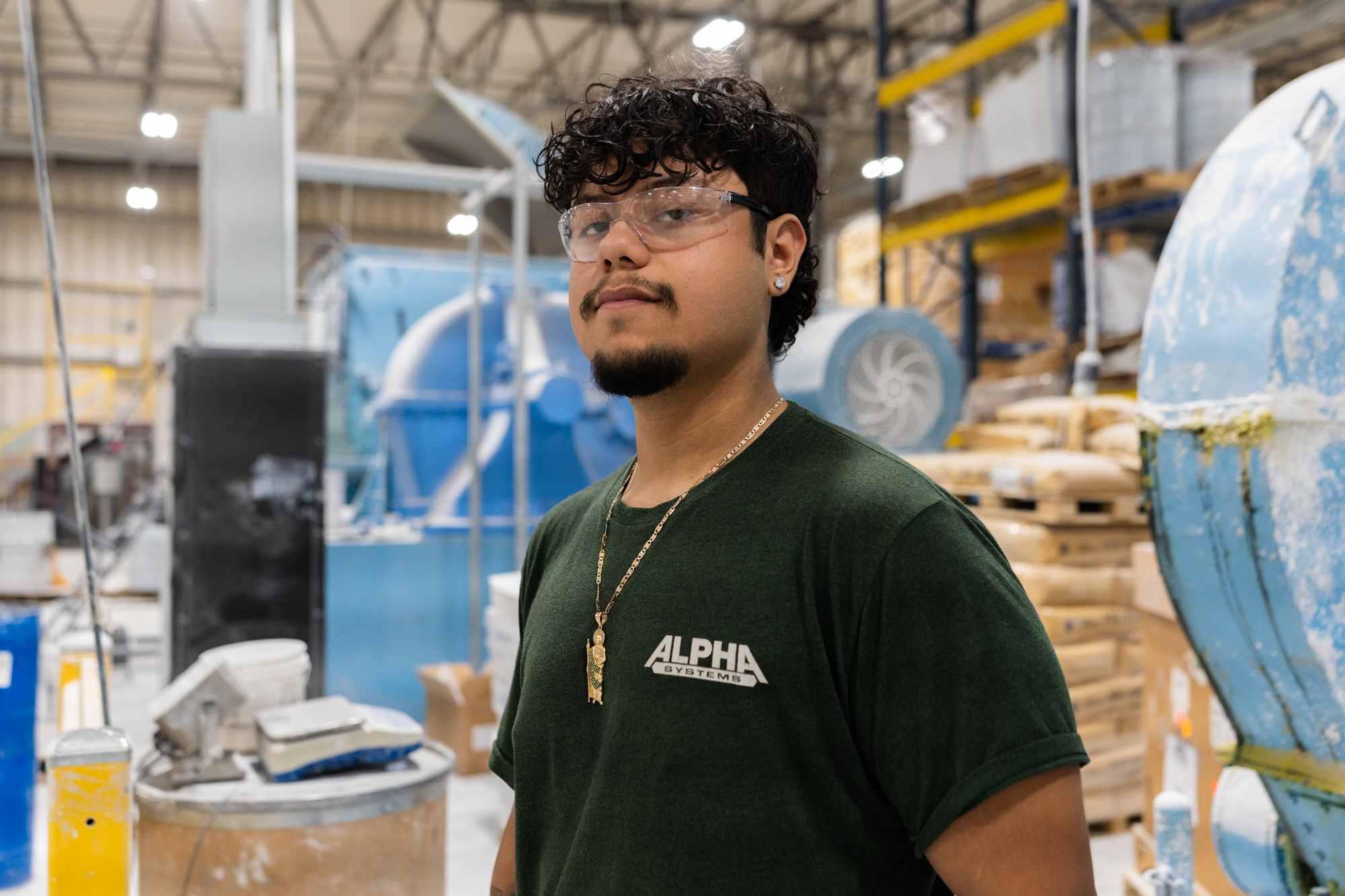
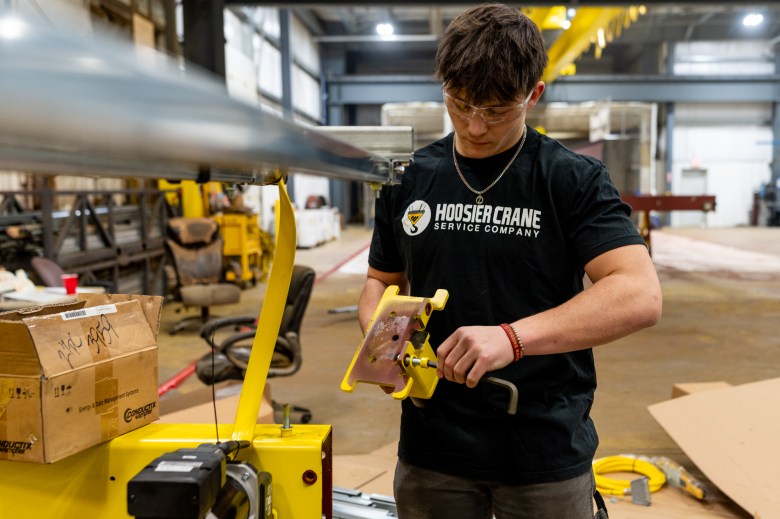
Indiana hopes that work-based learning opportunities at companies like Alpha Systems and Hoosier Crane Service Company, in Elkhart, Indiana, can flourish under the new diploma system. Credit: Camilla Forte/The Hechinger Report
In 2024, the state board of education held dozens of meetings to gather feedback on the proposal for the revamped diplomas — and the backlash was intense. Leaders of higher education institutions, including the state’s flagship schools, Indiana and Purdue universities, said students graduating under the new system would not meet minimum requirements for admission. Purdue’s president, Mung Chiang, wrote a letter to Jenner showing that the proposed diploma system required too few credits in every subject except English.
Hoosier parents were furious that their children might have to sacrifice more challenging courses to fulfill the mandatory work experience requirement under the “plus” option. At an Indiana Department of Education hearing in June 2024, parent Michelae Hill was among dozens who criticized the proposal, calling it “intentionally dumbing down our population” and warning that “what will happen is that we are ensuring a permanent underclass, we are ensuring cheap workers.” There were also questions about the logistics of workplace learning, including transportation and possible safety issues on job sites.
State education policy makers went back to the drawing board. The revised version, adopted last December, establishes one basic diploma that all graduates earn, plus the seals students can pursue depending on their post-high-school plans. Even within each seal, students have several ways of meeting the requirements.
For example, to receive the “enrollment” seal — meant primarily for college-bound students — high schoolers can choose from more advanced classes in math, science, social studies and world languages, and may earn additional credits in Advanced Placement, International Baccalaureate or other such college-level courses. An “enrollment honors plus” seal requires that students concurrently obtain a credential such as an associate’s degree or technical certificate and complete 75 hours of work-based learning in apprenticeships, internships or other such programs.
“We wanted rigor and flexibility and less cookie cutter,” said Jenner.
Even the updated system has critics, though. For the basic diploma, students must earn a minimum of 42 credits, two more than before. But how students reach that threshold is different: Economics, geometry and Algebra II are no longer required, while courses in financial literacy and communication are. Physical education is one credit instead of two, and world languages and fine arts are no longer recommended electives.
Professor Michael Hicks, who runs the Center for Business and Economic Research at Ball State University in Indiana, said he worries about the reduced mathematics rigor in particular. While most states do not require Algebra II for graduation, the class is often seen as a necessity for admission to selective colleges and for certain careers. Hicks said high-achieving, well-resourced students may benefit from the flexibility of the new diploma, as could students committed to the military. But many other students could be harmed, he said, if they are left with the impression that the basic diploma alone will prepare them well for college when it does not.
“It is essentially funneling children away from academic opportunity very early at a time when we really needed to have more kids pushed into the academic options that would get them into college,” he said, arguing that people with college degrees outearn those with only a high school education and have also fueled the state’s and country’s economic growth of the past several decades. “This curriculum will cause the Indiana economy to stall and potentially go into reverse.”
At public meetings last winter, some parents and educators raised concerns that the new system amounted to an unfunded mandate for school districts and would put a huge burden in particular on counselors, who would be working closely with students to help chart their diploma paths. Critics also objected to the de-emphasis of other classes like music and foreign languages. Megan Worcester, the president of the Indiana Foreign Language Teachers Association, said the reduced emphasis on foreign language would hurt the state’s economy; she cited a study in which nearly 1 in 4 employers surveyed said they had lost or couldn’t pursue a business opportunity because of language barriers.
Jenner, a former high school teacher, said the new diploma allows students greater flexibility to choose electives depending on their goals, which could include language and music study. While Algebra II is no longer required, students must take four math credits beyond the required Algebra I and personal finance, she said. Jenner also said the state had allocated a portion of $50 million in discretionary funding to train counselors in helping students navigate the new diploma system. In addition, it dedicated up to $10 million in grants to help students pay for transportation, equipment and certifications related to work-based learning, and also provided financial assistance to companies that take on apprentices. Each school that offers work-based learning will receive an extra $500 per participating student.
The new plan eventually quieted the concerns of many education leaders. Several universities, including Indiana and Purdue, released letters of support. “We appreciate the thoughtful adjustments to the work based learning requirements, AP testing and transferability of dual credits,” wrote Pamela Whitten, president of Indiana University. (Neither university agreed to an interview with its leaders.) All major education groups in the state, including the Indiana State Teachers Association, Indiana School Boards Association and the Indiana Association of Public School Superintendents, endorsed the plan.
Ty Zartman, a student apprentice at Hoosier Crane Service Company in Elkhart, Indiana, decided to go straight to work after graduating high school, despite being a straight A student. Parents and educators objected to Indiana’s first proposal for a new high school diploma system, arguing that the emphasis on workplace experience would crowd out academic learning. Credit: Camilla Forte/The Hechinger Report
In April, Gov. Mike Braun announced that beginning this year, students who earn the state’s “enrollment honors plus” seal will be automatically accepted into the state’s public colleges and universities, including Purdue and Indiana, potentially persuading more students to enroll.
Parent Chantee Eldridge said she believes the new diploma will make higher education more affordable and help students sharpen their career plans at an earlier age. Her son, Micah, is a 16-year-old senior at Brownsburg High School, near Indianapolis, and has already taken dual credit courses through a partnership with Vincennes University. College credits can be expensive, she said, so earning them at no cost in high school can be a big money saver.
Micah, who has a 3.7 GPA and plays semi pro soccer, said he’s always enjoyed challenging classes and plans to go to college. “When things get repeated, that’s when I get bored and start to tap out mentally,” he said. In college, he anticipates studying psychology — a surprise to his mother, who expected him to pursue math or physics, two topics he’s always excelled in. She likes the idea of him doing an internship with a psychologist, so he can learn more about the field and gain practical work experience before he goes to college; that’s the sort of opportunity that will become more common under this new diploma system.
“Very rarely do you know exactly what you want to do between 16 and 18,” Eldridge said. “That will help students and their families make an informed decision.”
For students who want to go straight into the workforce, the employment seals are designed to provide exposure to career options and work experience that boost students more quickly into higher-paying roles. Under the “employment honors” seal, students must: take coursework or earn a credential aligned to a specific occupation; complete 150 hours of work-based learning; and demonstrate communication, collaboration and work ethic skills. The “employment honors plus” seal requires that students also earn an associate’s degree or advanced industry certificate and complete 650 hours of work-based learning.
Matt Mindrum, president and CEO of the Indy Chamber, said that most of the 150,000 vacant jobs in Indiana right now don’t require a four-year degree. “And yet 100 percent of our high school students are pushed through a college preparatory path. That makes no sense,” he said. He believes an alternate path is critical for driving economic growth in the state, by helping to fill existing jobs and attract new businesses.
Edgar Soto, a senior at Concord High School in Elkhart, is the kind of student Mindrum has in mind. Soto said he has never wanted to attend a four-year college. To get workforce experience, he enrolled in an apprenticeship through his school and is up before dawn each morning to start work with manufacturing technology company Alpha Systems. “It’s something new every day. I love it,” he said. He earns $17 an hour and gives half his paycheck to his mom for family expenses. When school is in session, he spends his afternoons taking classes back at Concord High.
Indiana’s Elkhart County has been at the forefront of expanding apprenticeships to high schoolers, but it’s had trouble recruiting companies — a challenge for the state as it tries to expand work-based learning. Credit: Camilla Forte/The Hechinger Report
Working has motivated him to study harder at school, he said; he’s never cared for math, but when he realized it was important for his job, he began asking his teacher for extra help. “I got a taste of the real world and I want to be that type of person who does things right,” he said.
Alpha Systems pays for him to take classes in industrial systems through the state community college system, Ivy Tech, and has promised to pay for any further postsecondary education if he stays with the company. In just a few years, company executives said, he could easily make more than $40 an hour, approximately $80,000 a year.
Mindrum is working with employers around the state to try to increase work-based learning opportunities so they match student demand, a particular challenge in rural areas. Communities that have already made a commitment to work-based learning have had trouble recruiting enough employers: For example, in Elkhart County, only 1 in 3 high schoolers who apply for an apprenticeship gets one. Schools will also have to reorganize class schedules and overcome transportation challenges to ensure students can complete the necessary work-based learning under the various seals. The state has a goal of 50,000 apprenticeships by 2030. “It’s an aggressive but achievable target,” Mindrum said.
Supporters hope the revamped diploma will also encourage more students to enlist in military service. Nationally, the military is struggling to recruit, and according to Army data, just 23 percent of 17- to 24-year-olds who apply to the U.S. military meet its medical fitness and academic requirements. In Indiana, the number of students enlisting in the National Guard dropped by 38 percent between 2018 and 2022, the sharpest decline of any state.
Retired Maj. Gen. Dale Lyles, who led the Indiana National Guard and helped create the “enlistment” seal criteria, said students often don’t know much about enlisting and the benefits of military service. In Indiana, for example, serving in the National Guard unlocks free tuition to state colleges.
The new diploma options are meant to fix that: Students in the “enlistment honors” and “enlistment honors plus” seals are taught about each branch of service, what it means to swear an oath to your country and the many different job opportunities available. They also must take a public service course or complete a year of Junior ROTC and receive a certain score on the military’s aptitude test, the Armed Services Vocational Aptitude Battery, among other requirements. Students can receive coaching for the test and have the opportunity to visit Camp Atterbury-Muskatatuck, a nearly 35,000-acre military post, for hands-on learning opportunities.
“Today’s military is much different than it was even five years ago, just because of the high degree of technology,” said Lyles, citing the Indiana National Guard’s platoon that flies automated aerial drones and its cyber warfare battalion. “We are in a battle for talent.” He added that the pathway emphasizes that there are other ways to serve, including as a firefighter, as a police officer or in the Department of Homeland Security.
Nicholas Purdy, a 17-year-old from Marion, has three grandparents who served in the military and said he’s always been interested in enlisting. In his first year of high school, he signed up for JROTC, and he said he loves traveling to other states for competitions and leadership camps where students participate in activities such as rappelling, water operations and land navigation. “It doesn’t matter what your background is, how much money you have, your looks,” he said of the experience. “The only thing that matters is your character.”
His mother, Stephanie Purdy, said she’s seen his confidence deepen as a result of his experiences with JROTC. Nicolas has won ribbons and pins for marksmanship and leadership that he wears on his uniform, and he likes the idea that under the new seals, those accomplishments would be reflected on his high school transcript. Nicholas wants to become a combat medic in the army. “The training set me up for really good opportunities, and it’s all paid for,” he said.
Jenner’s work continues — with a pressing deadline, as schools roll out these changes for first-year students this year. Her office is working on an online advising tool, a pilot program to help communities identify solutions to transportation challenges, guidance for educators on the new diploma options and courses, and incentives for school districts to measure skills like communication, collaboration and work ethic, not just academic outcomes.
It’s a big task. “This is new terrain for our country when you think about the level of scale we’re trying to accomplish,” said Jenner. “We don’t have a model to just copy and paste, so we’re going to learn some lessons along the way.”
*Due to an editing error, an earlier version of this story included an inaccurate description of the Carnegie Foundation.
Contact editor Caroline Preston at 212-870-8965, via Signal at CarolineP.83 or on email at [email protected].
The Hechinger Report provides in-depth, fact-based, unbiased reporting on education that is free to all readers. But that doesn’t mean it’s free to produce. Our work keeps educators and the public informed about pressing issues at schools and on campuses throughout the country. We tell the whole story, even when the details are inconvenient. Help us keep doing that.