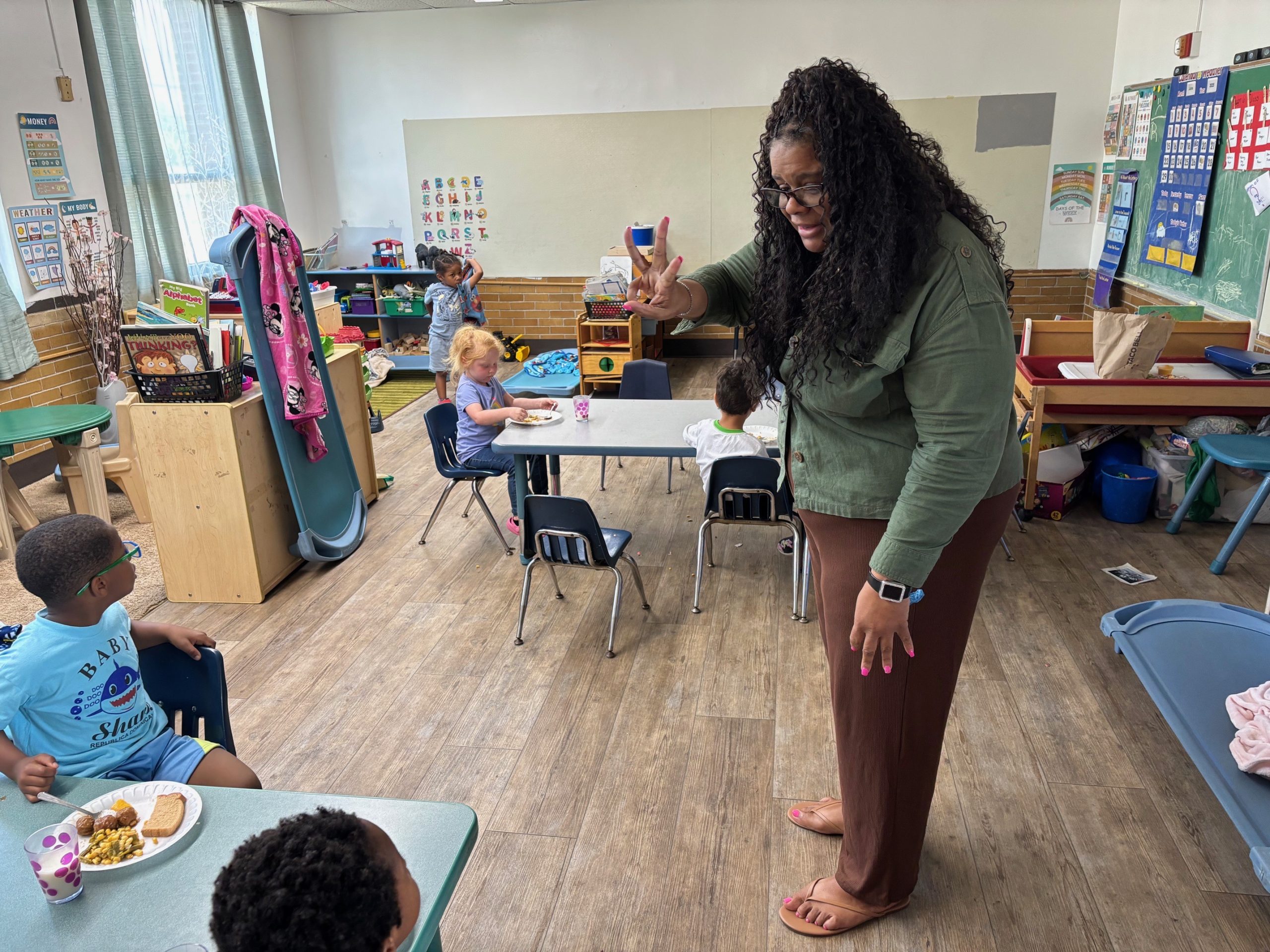
Selina Likely, a child care director in Columbus, Ohio, understands the desperation that parents feel when they can’t find a good placement for their children with disabilities. When Likely’s daughter was a child, the little girl was abruptly kicked out of her daycare center for biting, leaving her mother with little recourse.
“I was so angry and mad at the time,” said Likely, whose daughter is now an adult. “How are you going to kick out a 1-year-old?”
Thanks to a new state initiative, Likely and other child care providers like her can now receive additional training on how to support children with disabilities, who are far more likely than other children to be expelled from child care programs. Some states have similar programs, with the ultimate goal of creating more child care slots where young children with disabilities and delays can thrive.
How Hechinger inspired a bill
Earlier this year, my colleague Sarah Carr published a piece revealing that in Illinois and other states many families of premature babies are leaving the hospital with no information or guidance on critical therapies they are entitled to. In June, the Illinois Legislature passed a bill that would require hospitals to distribute detailed information on early intervention — those required therapies for babies and toddlers with disabilities and developmental delays — to most families with severely premature infants. The new law was proposed by state Rep. Janet Yang Rohr after Sarah’s story was published.
The bill, which awaits action by the governor, would also require the state’s early childhood systems to prioritize, in a public awareness campaign, the early identification of infants who automatically qualify for the therapies because of their low birth weight.
This story about children with disabilities was produced by The Hechinger Report, a nonprofit, independent news organization focused on inequality and innovation in education. Sign up for the Hechinger newsletter.
The Hechinger Report provides in-depth, fact-based, unbiased reporting on education that is free to all readers. But that doesn’t mean it’s free to produce. Our work keeps educators and the public informed about pressing issues at schools and on campuses throughout the country. We tell the whole story, even when the details are inconvenient. Help us keep doing that.
As the first in my family to attend college, I felt a profound commitment to excel academically and gain admission to a top university. Growing up amid the hustle and bustle of Silicon Valley, I always envisioned a bright future ahead, with college at the forefront of my goals since elementary school.
At my Title I elementary and middle schools, student-to-teacher ratios were even higher than those listed online. There was a lack of classroom technology and resources like history textbooks. Our two middle school counselors each managed students by the hundreds, making it nearly impossible for them to keep track of individual academic progress and educational goals. Afterward, I attended a private high school, thanks to support from my family. Our caring teachers made the effort to get to know each student, and dedicated counselors advocated for me when it mattered most.
Yet when conversations about college came around, navigating the complex system was difficult. I had to chart my own path to success through independent research, often looking at data that was scattered and inconsistent. It hindered my ability to educate myself on college-going rates, costs, outcomes and employment prospects post-graduation.
Related: Interested in innovations in higher education? Subscribe to our free biweekly higher education newsletter.
Limited resources available at many underserved schools across the nation make it a more challenging environment for students to get support and excel, thus limiting their true academic potential.
In my senior year of high school, after gaining newfound confidence while serving as a commissioner at-large in my county’s youth commission, I decided to try to challenge the status quo in higher education through the power of data and find a way to speak up for other first-generation students who find themselves interacting with systems not designed with their experiences in mind. My mentors at a regional food bank where I volunteered shaped me to lead with confidence and heart.
When I received my admission letter from the University of California, Berkeley, I felt deeply honored to earn a place at one of the world’s leading research and teaching institutions.
I am now an advisory board member of the recently formed California Cradle-to-Career Data System, the state’s longitudinal system that connects education and career outcomes data in one central place. I have learned firsthand that the resources available for students to gauge their potential postgraduate earnings often rely on self-submitted data or estimates, rather than on an accurate overview of college and career outcomes.
As part of this work, I am now helping my state’s leaders develop tools like the Student Pathways dashboard, which provides insights on the higher education options available to students after high school.
The tool provides information on a single website for everyone to access at any time. By streamlining access to this data, it allows students and the adults helping them to easily pinpoint which types of degrees or certifications are right for them, which may lead to employment opportunities where they live and which colleges or universities the students’ classmates are headed to.
Students need access that can help them map out their futures — whether they hope to attend college, earn a certificate or enter the workforce directly after high school. Using data in the pathways tool can clarify how others have navigated to and through college and hopefully help students chart their own paths.
As the youngest advisory board member, I have the opportunity to provide proposals and recommendations from a student’s perspective on how the system can engage with communities to make its data more accessible. Community engagement involves ensuring that Californians are aware of the data system, can understand and interpret the available data and have an opportunity to share their feedback.
I often think about how the countless hours I spent trying to find information to help guide my goals and decision-making were both a burden and barrier to attending college. I know firsthand how the power of data can help build a successful future.
Today, many first-generation and low-income college students do not have the opportunity to assess which pathways will yield the most fruit. I’m confident that with accessible facts and data for our decision-making, we can confidently forge the paths that will bring our dreams to life.
Mike Nguyen is a rising junior studying business administration and science, technology, and society at the Haas School of Business at the University of California, Berkeley. This piece was written in collaboration with Alexis Takagi, a basic needs coordinator at Santa Clara University. Both Nguyen and Takagi are advisory board members of the California Cradle-to-Career Data System.
The Hechinger Report provides in-depth, fact-based, unbiased reporting on education that is free to all readers. But that doesn’t mean it’s free to produce. Our work keeps educators and the public informed about pressing issues at schools and on campuses throughout the country. We tell the whole story, even when the details are inconvenient. Help us keep doing that.
Last August, Republican Rep. Gino Bulso looked out at a room filled with dozens of fellow state lawmakers as he touted new legislation he had just helped become a reality in Tennessee. Under the law, a fetal ultrasound or a video of a computer-animated fetus developing in the womb had become mandatory viewing for students in the state’s sex education classes.
Bulso was there at the request of the event’s host, anti-abortion advocacy nonprofit Live Action. The group had gathered legislators from across the country to provide them “with the policy information and persuasion strategies they need to end abortion,” according to its annual report.
Bulso’s panel, “The Agenda for Life in Schools and Beyond,” focused on how he had successfully shepherded his bill into becoming the second so-called fetal development education law in the country.
When lawmakers returned to their home states after the Live Action event, The Hechinger Report found, at least 10 of them sponsored bills similar to Bulso’s, in some cases proposing that students as young as third grade watch fetal development videos. Another legislator who introduced such a bill had sent his chief of staff and wife to the event. And the volume of legislation stemming from the gathering may be higher: Live Action keeps its list of attendees private, though many lawmakers posted about the event on social media or were featured in Live Action’s promotional materials.
Since 2023, when North Dakota became the first state to pass fetal development education legislation, anti-abortion lawmakers in more than 20 additional states have proposed such bills; 6 of those states, including Bulso’s, have passed them. As a result, this fall, nearly 4 million children will attend school in a state that requires them to watch a video or ultrasound of a fetus in the womb during sex education classes. And this year, legislators in four states tried to go even further: Their proposals would have required students to view depictions of abortions, including computer-animated videos.
After the fall of Roe v. Wade in 2022, public schools have become an increasingly important battleground in the fight over abortion rights. Even though 12 states now ban abortion in all circumstances, the number of procedures has increased nationwide since the Supreme Court’s decision to overturn Roe.Public support for abortion rights has also risen. Many anti-abortion advocates hope that getting their message in front of students can help them win the hearts and minds of young people and change these trends in the long run.
While critics, including medical professionals and some parents, say that the fetal development education materials being introduced to schools are manipulative and little more than propaganda, Live Action and other groups that produce them maintain they are medically accurate and unbiased. Experts in sex education and abortion policy say a related problem is the dearth of sex education in schools — students, on average, receive only about six hours during their high school years — that creates a vacuum for anti-abortion groups to move into.
“They’re attempting to reach children at an age where I would assume most haven’t been exposed to issues of an abortion,” says Alisa Von Hagel, a political science professor at University of Wisconsin-Superior who has studied the strategies of the anti-abortion movement. “They’re attempting to be the first to imprint this quote, unquote ‘knowledge’ or opinion about these issues.”
During a debate earlier this year in the Arkansas Senate, Republican Sen. Alan Clark referred to his state’s proposal as “one of the most important pro-life bills that’s ever come before us.” He also said, “It will shape the minds of kids from now on.”
The proposal would have required showing a video created by Live Action to students starting in sixth grade. In the video, titled “Meet Baby Olivia,” a narrator tells the viewer that life begins at conception and says the fetus, named Baby Olivia, begins playing and exploring as early as 11 weeks.
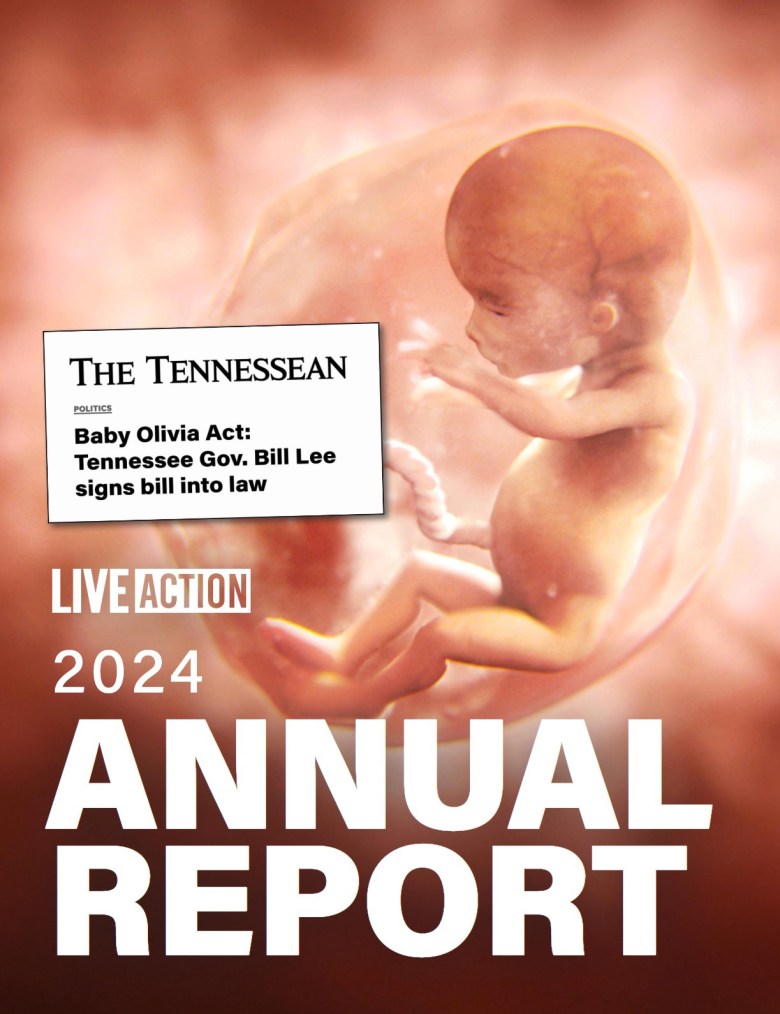
In an annual report, Live Action noted that its “Meet Baby Olivia” video caused a “37-point shift towards the pro-life perspective among viewers.” The organization also highlighted the impact its materials can have on kids, in particular, to help “instill a reverence for life as children at impressionable ages develop their world view.”
Tennessee state Rep. Gino Bulso sponsored the nation’s second fetal development education law. He credits the anti-abortion group Live Action with helping him get it passed. Credit: George Walker IV/AP Images
Both Bulso and Noah Brandt, Live Action’s vice president of communications, have said the only goals of Baby Olivia and fetal development education are to teach and inform students — but they also expected it to leave an impression. “It is intuitive that, after watching that, people would be less likely to support abortion on demand,” Brandt said.
Live Action’s work to connect with students is also part of playbooks for other anti-abortion organizations. Take Heartbeat International, for example, a group that supports clinics known as “crisis pregnancy centers,” which provide limited medical care and encourage people not to have abortions. Heartbeat also offers in-person and online training, including one program on how to “Change the Nation with Pro-life Education,” featuring specific tactics for working with public schools. One speaker at Heartbeat’s 2023 national conference described performing an ultrasound on a pregnant woman in front of public school students to “plant a seed of life.”
Before creating “Meet Baby Olivia,” Live Action was best known for anti-abortion campaigns and undercover stings against Planned Parenthood, and largely worked outside of policymaking. But as the organization has grown in recent years, it has begun to coordinate directly with legislators.
Live Action held its inaugural lawmaker summit in 2022, two months after Roe was overturned. The following spring, North Dakota passed a fetal development education law, the nation’s first.
Many proposed fetal development education bills mention the video “Meet Baby Olivia” by name. Critics say that the video is designed to manipulate the viewer’s emotions, while its creator, Live Action, says it is accurate. Credit: Live Action
By 2024, the summit had doubled in size to host 70 lawmakers at a four-star hotel in Chapel Hill, North Carolina. Lawmakers attended panel discussions titled “Saving Our Children and Helping Their Mothers” and “Communications and Persuasion: Winning the Messaging War.” Live Action also screened its abortion videos, including “Meet Baby Olivia.”
On his panel, Bulso walked through every step of creating Tennessee’s law, from filing the bill to committee deliberations to its eventual passage. He gave Live Action credit for providing him with resources to help make the case that “Meet Baby Olivia” was scientifically accurate.
Most of the proposed fetal development education bills don’t prescribe a specific video, but many suggest the Baby Olivia video. Two bills in Texas do mention alternatives: A 1983 film by PBS’s NOVA called “The Miracle of Life” and a video produced by the St. John Paul II Life Center, a crisis pregnancy center.
Said Brandt, it’s up to “lawmakers, school board members, teachers, that kind of thing, to try to make prudential judgments about, ‘Is the actual resource I’m using a good resource to accomplish the goal that I’ve been tasked to accomplish?’”
“Meet Baby Olivia” in particular, has been sharply criticized by medical experts since Live Action released the video in 2021. Many doctors have raised concerns about its language and portrayal of the timeline of fetal development. Parents and students in Fargo, North Dakota, used arguments such as these to convince the school district to use a different video to meet the state law.
“The Baby Olivia video is designed to manipulate students’ emotions rather than to share objective facts about embryonic and fetal development,” Nisha Verma, senior advisor of reproductive health policy and advocacy for the American College of Obstetricians and Gynecologists, said in a statement. “The video attempts to advance anti-abortion policies such as fetal personhood and uses non-scientific language about conception, pregnancy, embryos, and fetuses to evoke an emotional response.”
Live Action maintains the video is medically accurate — and has its own roster of anti-abortion doctors who endorse it, including a handful who collaborated with the organization on the video’s creation.
The approval of some medical professionals was part of the appeal of “Meet Baby Olivia” and another Live Action video series called “What Is Abortion?” for New Hampshire Rep. John Sellers, another Republican who attended the group’s lawmaker summit. The series shows a computer rendering of three different points in the pregnancy process.
Since 2023, getting fetal development education into public schools has been a priority for the anti-abortion group, Live Action. Credit: Live Action
In January, Sellers filed two bills to make Live Action’s videos required viewing for New Hampshire students — including college students in the case of “Meet Baby Olivia.” Both bills, however, faced opposition: Nearly 700 residents officially recorded their objection with the state or submitted testimony opposing the fetal development bill, and 1,080 registered their opposition to the abortion video legislation. By comparison, the number of residents who registered in favor was 23 and 30, respectively.
Many of those who submitted written testimony called the bill an attempt to indoctrinate students; Sellers maintained the legislation was nonpolitical. “We’re just trying to get the information out to the kids so they’re educated,” he said in an interview. “I don’t know how you indoctrinate somebody with the truth of the development of life … or the truth that these are the types of procedures of abortions. I can’t see that being indoctrination.”
Sellers said further that he hoped education could help people “make a better decision of, ‘Should I get an abortion or not?’”
Several people who opposed Sellers’ bills agreed that the videos contained some factual information and that topics such as fetal development and abortion could be useful to learn about in schools, but it was the presentation of the information — and that it came from an anti-abortion group — that worried them, they explained.
“My biggest concern is that it’s set up to come from a moralistic and fear-based place as opposed to a medical or wellness model,” said Stephanie Vazzano, a therapist who lives in New Hampshire who submitted written testimony opposing the abortion video bill. “They do have some facts. When you watch them you can be really seduced by those facts … but then these other things get slipped in.”
During the hearing for his bills, Sellers repeatedly said he was open to other abortion videos being shown but didn’t know of any. This lack of alternativeshas allowed Live Action to succeed in getting into schools so far, said Mary Ziegler, a law professor at University of California-Davis and author of several books on the history of abortion debates. “Part of what they’ve exposed is that there are gaps in the way we’ve done sex education,” she points out. “There’s truth in the sense that sex education programs across the board, including those favored by progressives, don’t have enough information about pregnancy, childbirth, abortion or fetal development.”
In many ways, Live Action’s efforts — as well as those of Heartbeat International and other organizations working to reach K-12 students — are a response to groups that run comprehensive sex education programs. Five states require comprehensive sex education, and individual districts in other states also provide it. These programs typically cover an array of topics including contraception, gender identity, consent, and options if one becomes pregnant. Planned Parenthood offers such a program to schools and has become the single-largest provider of sex ed nationwide.
“I’m sympathetic if someone says we wouldn’t want any organization that has any point of view creating any materials for our public school system,” Brandt of Live Action said. “But I would just say that’s not the reality that’s happening across the country. It’s tough to find curriculum that is from a group that no one would oppose.”
Even some anti-abortion Republicans have drawn a line at directly promoting the use of Live Action materials in public schools. Among them is Arkansas Sen. Breanne Davis, who led the opposition to a bill that specifically called for “Meet Baby Olivia” to be shown in schools. She raised concerns about requiring content from “a political advocacy group.” Davis said in an interview, “That’s just out of bounds for what we should be putting into law.”
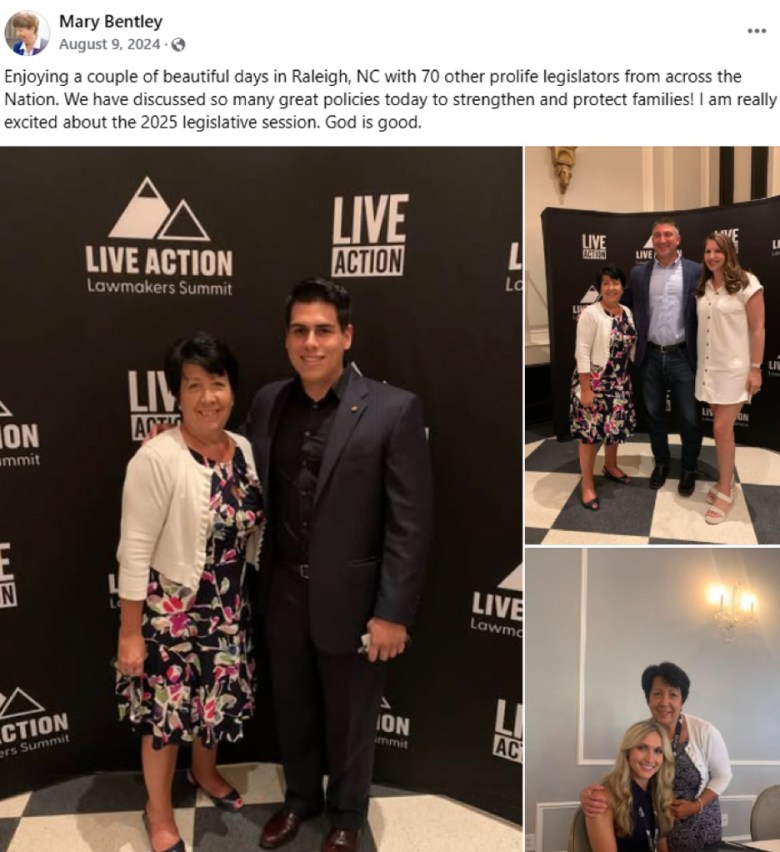
At least 11 state legislators who attended Live Action’s Lawmaker Summit, including Arkansas Rep. Mary Bentley, introduced fetal development legislation during the 2025 legislative session. Credit: Facebook
In hearings, Arkansas representative and bill sponsor Mary Bentley argued it would be easier and better for school districts to be told which video to use rather than have to make that determination themselves. She remains staunchly in support of the Baby Olivia video: “I think it’s so good to help kids understand the process of fetal development,” she said. “I just assumed that it would get the support that we needed in the most pro-life state in the nation.”
Davis proposed a competing bill, one that would require the Arkansas department of education to adopt standards for age-appropriate fetal development education, including showing an ultrasound, in the future. No video would be required, but districts could still show one, such as “Meet Baby Olivia,” if they chose to.
In the end, Bentley’s bill died and Davis’s legislation was signed into law in April.
For Brandt, of Live Action, the law falls short of what he considers the “gold standard” of fetal development education, but “We’re happy that they passed some version of it,” he said. “That is definitely better than nothing, and maybe can even be improved upon in the future.”
Contact investigations editor Sarah Butrymowicz at [email protected] or on Signal: @sbutry.04.
The Hechinger Report provides in-depth, fact-based, unbiased reporting on education that is free to all readers. But that doesn’t mean it’s free to produce. Our work keeps educators and the public informed about pressing issues at schools and on campuses throughout the country. We tell the whole story, even when the details are inconvenient. Help us keep doing that.
In his criminally underread 1978 book The Grasshopper, the philosopher Bernard Suits takes seriously the science-fiction commonplace that, once robots are doing everything for us, humans will have to find something else to do.
His response is that we’d play, living lives of leisure, like Aesop’s grasshopper, and engaging in activities with a lusory attitude: living playfully, engaging in activities not because we have to, but because we want to. Fully-automated luxury play! As much as I could easily play videogames all day, work isn’t going anywhere any time soon. But the rise of AI in education has prompted me to revisit this topic.
Universities are, quite rightly, thinking very carefully about what their staff and students do with AI, emphasising the ways in which it can enhance, and perhaps even replace, aspects of our work. But there are separate, parallel questions: what can’t AI do for us, and what shouldn’t it do? And what are we going to do with all the time it saves us?
Doing and being seen to have done
Human lives are full of experiences, and there’s a danger with the rise of AI that we weaken our connection with the actual doing of things. AI might help us to plan a holiday itinerary, book a hotel or draft a jealousy-inducing social media post (or even deepfake pics from a holiday that didn’t happen), but it can’t go on holiday for us. And similarly, in learning environments, whilst it can enhance learning, overreliance on AI runs the risk of hollowing out the experiential core of learning and leaving students not having actually done anything.
A real challenge for educators is to know how to get students to understand the value of experience in a world that incentivises taking shortcuts. I lead Rise at Manchester Met: a co-curricular programme that is designed to draw together all the things that students do that aren’t their degree, and our team works hard to help students to understand that they are more than their degree subject.
The traditional catch-all term for this is “extra-curricular” – it’s the things that students do in addition to the curricula they are following. But in practice “co-curricular” is a more accurate term. “Co” indicates that activity happens alongside and with the curriculum. There is a crossover in the experiences that students are having. Picture the curriculum and co-curricular activities as two streams that are sometimes totally divergent, sometimes parallel, and often overlapping in productive ways.
Identity shapes participation
Students don’t stop being students when they engage in co-curricular activities, but similarly they don’t stop being a community organiser, or a hockey player, or a freelance arts journalist, when they’re in the classroom. My doctoral thesis argued that half of the “game” of higher education is students understanding how they can bring their own identities to transform their participation, and “position-switch” between roles. The co-curricular is at its most powerful when these distinct identities and experiences begin to transform and enhance each other.
Moving from “extra” to “co” also challenges the primacy of the core curriculum as the foundation of student experience, and acknowledges that, for many of our students, “student” might not be their primary identity. We must accept that, for some students, their co-curricular activity might be more engaging, more relevant and more career-focused than their core degree programme. For others, the stuff they are doing outside their degree programme might be necessary and unavoidable, and will often pre-date their involvement at university; paid-work and caring responsibilities tend to take precedence over lectures, and there may be ways to make this count too.
However, when you type “co-curricular” into your search engine of choice, you won’t really see university websites. It’s a term that, at present, seems to be owned by the upper-end of British private boarding schools. In a sense this stands to reason; pupils essentially live in these schools during term time, and activities take place as part of their wider life at school. Here “co-curricular” is an expectation, and provides the social and cultural capital building for which British private schools are famous.
This conceptual dominance raises an issue of social justice, though. There is a sense that all of the “extra” stuff, at both schools and universities, is the domain of students who are privileged enough to take part, and who have the time and resources to make it happen. Working outside the curriculum is too often seen as a privilege for the privileged, and effectively becomes self-fulfilling as students with the free time to volunteer reap the developmental benefits of volunteering their time. Other students are already on the back foot when it comes to claiming their share of experience.
Embarrassment of riches
Rise was set up to challenge this narrative, by giving students time and resource to develop their social capital in flexible ways, and to recognise developmental activities that might not have traditionally been included under the extra-curricular umbrella. There’s a broader conversation to be had in the sector, not about how we encourage already busy students to do more, but about how we encourage students to recognise their learning beyond the curriculum.
In Manchester and beyond, the skills pendulum seems to swinging once more away from digital skills and towards “soft skills” – again, reflecting AI’s dominance of education conversations. Co-curricular space has a valuable contribution to make to developing empathy, critical thinking and interacting with other human beings. It is, ultimately, about sharing experiences, and the more we can expand this, the more everyone will benefit.
Students will have experiences outside of their degree programmes whether we design for it or not, but a renewed emphasis on co-curricular activity would allow them (and us) to understand that formal education settings don’t have a monopoly on learning and development. We worry so much about students being “time-poor”; what happens if we understand this as “experience-rich” instead, and recognise their learning accordingly?
In an AI-dominated dystopia, the co-curricular might be where we find the last vestiges of human experience in higher education. Being more optimistic, in a Grasshopper-influenced utopia, we’d all have the time to luxuriate in human experience. Co-curricular space provides insight into what this might look like, and gives students ways to develop away from the curriculum that might speak to future possibilities.
Interested in thinking more about co-curricular experience? At Manchester Met we’re pulling together a cross-sector group of HE professionals working in co-curricular space, and we’d love your input. Click here to sign up for updates.
In the race to help students recover from pandemic-related learning loss, education leaders have overlooked one of the most powerful tools already at their disposal: experienced teachers.
For decades, a myth has persisted in education policy circles that after their first few years on the job, teachers stop improving. This belief has undercut efforts to retain seasoned educators, with many policymakers and administrators treating veteran teachers as replaceable cogs rather than irreplaceable assets.
But that myth doesn’t hold up. The evidence tells a different story: Teachers don’t hit a plateau after year five. While their growth may slow, it doesn’t stop. In the right environments — with collaborative colleagues, supportive administrators and stable classroom assignments — teachers can keep getting better well into their second decade in the classroom.
This insight couldn’t come at a more critical time. As schools work to accelerate post-pandemic learning recovery, especially for the most vulnerable students, they need all the instructional expertise they can muster.
That means not just recruiting new teachers but keeping their best educators in the classroom and giving them the support they need to thrive.
In a new review of 23 longitudinal studies conducted by the Learning Policy Institute and published by the Thomas B. Fordham Institute, all but one of the studies showed that teachers generally improve significantly during their first five years. The research review also found continued, albeit slower, improvement well into years 6 through 15; several of the studies found improvement into later years of teaching, though at a diminished pace.
These gains translate into measurable benefits for students: higher test scores, fewer disciplinary issues, reduced absenteeism and increased postsecondary attainment. In North Carolina, for example, students with highly experienced English teachers learned more and were substantially less likely to skip school and more likely to enjoy reading. These effects were strongest for students who were most at risk of falling behind.
While experience helps all teachers improve, we’re currently failing to build that experience where it’s needed most. Schools serving large populations of low-income Black and Hispanic students are far more likely to be staffed primarily by early career teachers.
And unfortunately, they’re also more likely to see those teachers leave after just a few years. This churn makes it nearly impossible to build a stable, experienced workforce in high-need schools.
It also robs novice teachers of the veteran mentors who could help them get better faster and robs students of the opportunity to learn from seasoned educators who have refined their craft over time.
To fix this, we need to address both sides of the equation: helping teachers improve and keeping them in the classrooms that need them most.
Research points to several conditions that support continued teacher growth. Beginning teachers are more likely to stay and improve if they have had high-quality preparation and mentoring. Teaching is not a solo sport. Educators who work alongside more experienced peers improve faster, especially in the early years.
Teachers also improve more when they’re able to teach the same grade level or subject year after year. Unfortunately, those in under-resourced schools are more likely to be shuffled around, undermining their ability to build expertise.
Perhaps most importantly, schools that have strong leadership and which foster time for collaboration and a culture of professional trust see greater gains in teacher retention over time.
Teachers who feel supported by their administrators, who collaborate with a team that shares their mission and who aren’t constantly switching subjects or grade levels are far more likely to stay in the profession.
Pay matters too, especially in high-need schools where working conditions are toughest. But incentives alone aren’t enough. Short-term bonuses can attract teachers, but they won’t keep them if the work environment drives them away.
If we’re serious about improving student outcomes, especially in the wake of the pandemic, we have to stop treating teacher retention as an afterthought. That means retooling our policies to reflect what the research now clearly shows: experience matters, and it can be cultivated.
Policymakers should invest in high-quality teacher preparation and mentoring programs, particularly in high-need schools. They should create conditions that promote teacher stability and collaboration, such as protected planning time and consistent teaching assignments.
Principals must be trained not just as managers, but as instructional leaders capable of building strong school cultures. And state and district leaders must consider meaningful financial incentives and other supports to retain experienced teachers in the classrooms that need them most.
With the right support, teachers can keep getting better. In this moment of learning recovery, a key to success is keeping teachers in schools and consciously supporting their growing effectiveness.
Linda Darling-Hammond is founding president and chief knowledge officer at the Learning Policy Institute. Michael J. Petrilli is president of the Thomas B. Fordham Institute, a visiting fellow at the Hoover Institution and an executive editor of Education Next.
The Hechinger Report provides in-depth, fact-based, unbiased reporting on education that is free to all readers. But that doesn’t mean it’s free to produce. Our work keeps educators and the public informed about pressing issues at schools and on campuses throughout the country. We tell the whole story, even when the details are inconvenient. Help us keep doing that.
More than 400,000 K-12 educators across the country will get free training in AI through a $23 million partnership between a major teachers union and leading tech companies that is designed to close gaps in the use of technology and provide a national model for AI-integrated curriculum.
The new National Academy for AI Instruction will be based in the downtown Manhattan headquarters of the United Federation of Teachers, the New York City affiliate of the American Federation of Teachers, and provide workshops, online courses, and hands-on training sessions. This hub-based model of teacher training was inspired by work of unions like the United Brotherhood of Carpenters that have created similar training centers with industry partners, according to AFT President Randi Weingarten.
“Teachers are facing huge challenges, which include navigating AI wisely, ethically and safely,” Weingarten said at a press conference Tuesday announcing the initiative. “The question was whether we would be chasing it or whether we would be trying to harness it.”
The initiative involves the AFT, UFT, OpenAI, Microsoft, and Anthropic.
“We are actually ensuring that kids have, that teachers have, what they need to deal with the economy of today and tomorrow,” Weingarten said.
The academy will be based in a city where the school system initially banned the use of AI in the classroom, claiming it would interfere with the development of critical thinking skills. A few months later, then-New York City schools Chancellor David Banks did an about-face, pledging to help schools smartly incorporate the technology. He said New York City schools would embrace the potential of AI to drive individualized learning. But concrete plans have been limited.
Vincent Plato, New York City Public Schools K-8 educator and UFT Teacher Center director, said the advent of AI reminds him of when teachers first started using word processors.
“We are watching educators transform the way people use technology for work in real time, but with AI it’s on another unbelievable level because it’s just so much more powerful,” he said in a press release announcing the new partnership. “It can be a thought partner when they’re working by themselves, whether that’s late-night lesson planning, looking at student data or filing any types of reports — a tool that’s going to be transformative for teachers and students alike.”
Teachers who frequently use AI tools report saving 5.9 hours a week, according to a national survey conducted by the Walton Family Foundation in cooperation with Gallup. These tools are most likely to be used to support instructional planning, such as creating worksheets or modifying material to meet students’ needs. Half of the teachers surveyed stated that they believe AI will reduce teacher workloads.
“Teachers are not only gaining back valuable time, they are also reporting that AI is helping to strengthen the quality of their work,” Stephanie Marken, senior partner for U.S. research at Gallup, said in a press release. “However, a clear gap in AI adoption remains. Schools need to provide the tools, training, and support to make effective AI use possible for every teacher.”
While nearly half of school districts surveyed by the research corporation RAND have reported training teachers in utilizing AI-powered tools by fall 2024, high-poverty districts are still lagging behind their low poverty counterparts. District leaders across the nation report a scarcity of external experts and resources to provide quality AI training to teachers.
OpenAI, a founding partner of the National Academy for AI Instruction, will contribute $10 million over the next five years. The tech company will provide educators and course developers with technical support to integrate AI into classrooms as well as software applications to build custom, classroom-specific tools.
Tech companies would benefit from this partnership by “co-creating” and improving their products based on feedback and insights from educators, said Gerry Petrella, Microsoft general manager, U.S. public policy, who hopes the initiative will align the needs of educators with the work of developers.
In a sense, the teachers are training AI products just as much as they are being trained, according to Kathleen Day, a lecturer at Johns Hopkins Carey Business School. Day emphasized that through this partnership, AI companies would gain access to constant input from educators so they could continually strengthen their models and products.
“Who’s training who?” Day said. “They’re basically saying, we’ll show you how this technology works, and you tell us how you would use it. When you tell us how you would use it, that is a wealth of information.”
Additionally, Trevor Griffey, a lecturer in labor studies at the University of California Los Angeles, warned the New York Times that tech firms could use these deals to market AI tools to students and expand their customer base.
This initiative to expand AI access and training for educators was likened to New Deal efforts in the 1930s to expand equal access to electricity by Chris Lehane, OpenAI’s chief global affairs officer. By working with teachers and expanding AI training, Lehane hopes the initiative will “democratize” access to AI.
“There’s no better place to do that work than in the classroom,” he said at the Tuesday press conference.
Chalkbeat is a nonprofit news site covering educational change in public schools.
Novato, CA – The Buck Institute for Education (dba PBLWorks), a national provider of professional development and curriculum for high-quality Project Based Learning (PBL), has announced the recipients of its 2025 PBL Champions and John Larmer “JL” Lifelong Learning Awards.
The recipients were honored during the organization’s 2025 PBL World conference in Napa Valley, California.
The 2025 PBL Champions
The PBL Champions program recognizes an individual, a school, and a school district that have demonstrated a commitment to PBL; have done quality, lasting work; and have shown evidence of impact on students. The 2025 recipients are:
District PBL Champion: Lynn Public Schools in Lynn, Massachusetts
This 16,000-student district is transforming teaching and learning through its implementation of PBL. In a little over a year, the team at Lynn established high-functioning district and school leadership teams and trained a cadre of educators who have designed more than 70 projects for students. The district has implemented PBL at all seven of its secondary schools with a goal of having all students participate in two or more high-quality PBL experiences per year by the end of the 2029-30 school year.
School PBL Champion: University Prep Academy (UPA) High School in Detroit, Michigan
University Prep Schools (UPrep) stands among Detroit’s earliest and longest-running charter school networks. Known for its unwavering commitment to student success, UPrep (UPA) has proudly upheld its signature “90/90 promise”—ensuring that at least 90% of students graduate from high school and 90% of those graduates go on to enroll in college. UPA teachers and leaders have leveraged PBL as a way that empowers students to be a part of the future of their city – from working on keeping their unhoused population warm in the winter through a physics project on heat transfer, to urban gardens that allowed students to provide farm-to-table food to local food pantries and shelters. PBL has opened their eyes to the challenges students face, encouraged them to see and explore those challenges through the lens of solutionists, and has brought UPA closer to the community it serves.
Individual PBL Champion: Kim Mishkin, Head of School at the Hudson Lab School (HLS) in Hastings, New York
Kim Mishkin has been instrumental in embedding Project Based Learning as the foundation of the school’s curriculum. As both an educator and school leader, she has built structures, cultivated partnerships, and championed interdisciplinary, real-world learning experiences that empower students and educators alike. Through her leadership, HLS has become a model for how schools can integrate PBL at every level, ensuring that learning is not just about content, it is about empowering students to be problem-solvers, leaders, and changemakers.
The John Larmer “JL” Lifelong Learning Award
The John Larmer “JL” Lifelong Learning Award, named after PBLWorks’ Senior Fellow John “JL” Larmer, recognizes educators who are impacting and expanding the work of Project Based Learning. A significant advocate and thought leader in the field, JL has dedicated decades to advancing high-quality PBL and is the author of several foundational books that have shaped how educators design and facilitate high-quality PBL. This award celebrates those who carry forward that legacy with passion, purpose, and an unwavering commitment to deeper learning. The 2025 recipients are:
Rue Graham, Project Based Learning lead advisor and coach at the Pagosa Peak Open School, Archuleta County School District in Pagosa Springs, Colorado
Stephanie Tuttle, fourth grade teacher at Fairfield Elementary School, Rockbridge County Public Schools in Rockbridge, Virginia
“Project Based Learning is an incredibly powerful way to engage students and ignite their passion for learning – and it all starts with having administrators and teachers who are committed to its success,” said PBLWorks CEO Bob Lenz. “Our awards programs recognize the incredible passion and hard work demonstrated by schools, districts, and individuals in implementing PBL. Congratulations to our 2025 award recipients!”
About PBLWorks
The Buck Institute for Education/ PBLWorks believes that all students, especially Black and Brown students, should have access to high-quality Project Based Learning to deepen their learning and achieve success in college, career, and life. Its focus is on building the capacity of teachers to design and facilitate high-quality Project Based Learning, and on supporting school and system leaders in creating the conditions for these teachers to succeed with all students.
eSchool Media staff cover education technology in all its aspects–from legislation and litigation, to best practices, to lessons learned and new products. First published in March of 1998 as a monthly print and digital newspaper, eSchool Media provides the news and information necessary to help K-20 decision-makers successfully use technology and innovation to transform schools and colleges and achieve their educational goals.
Two years ago, I bought each of the teachers at Hamilton Elementary in San Diego’s City Heights neighborhood a blue chair. I told them to put it in the back of their classrooms, and that if a parent or caregiver wanted to visit to see how their children are learning — no matter what the reason — that this would be a dedicated space for them.
I may have earned some exaggerated eye-rolls from educators that day. After all, I can appreciate the disruption to learning that classroom visitors can sometimes cause, especially among excitable elementary schoolers.
But school is our home, and it is our responsibility to invite families into our home and welcome them. And this was a necessary olive branch, my way of saying to families: “From here on out, things are going to be different.”
And they were. They also can be different at other schools, because the benefits of family engagement go well beyond student achievement.
Research has long shown that when parents and caregivers are involved and engaged with their children’s education — whether that’s by attending parent-teacher conferences or participating in school events — student achievement, motivation and social-emotional well-being increase.
Parent involvement with reading activities has a positive impact on reading achievement, language comprehension, expressive language skills and level of attention in the classroom, according to the National Literacy Trust.
Research also shows that educators enjoy increased job satisfaction and are more likely to keep teaching at the school, families enjoy stronger relationships with their children and feel less isolated, and even school districts themselves become better places to live and raise children.
None of this was the case when we returned to normalcy following Covid. Just 13 percent of students were reading on grade level, and 37 percent were chronically absent. I knew right away that before we even attempted to tackle academics, we needed to engage families and make them feel deeply connected and committed to the community I envisioned building here.
Today, 45 percent of students are reading at grade-level, and chronic absenteeism, at 12 percent on the most recent official numbers, is down to 10 percent in our own tracking, with a goal of pushing it down to 8 percent in 2025-26.
But it wasn’t easy given the distrust that had boiled over during the pandemic, with families skeptical of our ability to effectively support their children and school staff feeling defensive and exhausted.
It was clear to me that families weren’t excited to send their kids to school, didn’t feel informed about what was happening on our campus and, moreover, didn’t feel comfortable — let alone capable — of communicating their needs to us.
Complicating matters further was the need to share information across many languages other than English, which can make relationship-building and communicating expectations difficult.
Roughly half of our students are English learners, and while the majority of their families are Spanish-speakers, there are growing populations of students whose first languages are Haitian-Creole, Pashto and Vietnamese.
The first thing I did was establish open communication with parents using ClassDojo, a mobile app that gives families an easy, intuitive central access point to our teachers and staff, automatically translates all messages into parents’ native languages and allows us to share stories about what is happening in school.
It became an easy way to build trust and collaboration between families and staff.
Creating that type of visibility was key to breaking down walls between us. And in those early days, we didn’t post about literacy, math or anything related to academics. Instead, we focused solely on attendance and getting families to come inside the school as much as possible.
We focused on relationship-building activities and joyful learning. We hosted after-school art classes and monthly family Fridays, when families could come to school to engage in a fun activity.
We organized a Halloween costume drive with candy and fun games for kids; we hosted a Read Across America event where we passed out Play-Doh; and we organized other low-stakes events at school, rooted in building a partnership between home and school.
Again, our goal wasn’t learning during these meet-ups. It was all in service of building trust and creating meaningful relationships with students and their families.
Once we had the foundation in place, we added a focus on academics — though we rooted that learning in family engagement, too. For example, our schoolwide focus last year was phonics, so we sent activities home for families to complete with their children that were tied specifically to concepts the students needed reinforced, based on their individual assessments, like long vowel patterns and sight words.
These activities were taught by the students and their teachers to family members during conferences.
Beyond helping students, the exercise challenged a false narrative so many families had assumed — that they either didn’t know enough about what was happening in school to help, weren’t confident enough to help or didn’t have enough time.
Today, the atmosphere at Hamilton feels radically different than when I first walked through the doors. When we first started hosting Family Fridays, about 10 family members and their children showed up.
Now, we have roughly 200 caregivers at every meet-up. Families run most of the community-based initiatives at the school — from a boutique where families can shop among donated clothes twice a month, to a food distribution center, to a book club, English classes and a monthly meet-up where families can socialize.
When district leaders visit, they’re always impressed by the participation. I tell them, if you care about family engagement, it has to be so deeply embedded into the system that people don’t have a choice but to do it.
That’s why I’m constantly thinking about how to center family engagement in staff meetings, in attendance meetings, in literacy and math plans, in behavioral and counseling plans and in meetings about school procedures and budgets.
It’s a strategy that not only involves families but also supports academic achievement and student well-being. For me, family engagement is the ultimate strategy for academics.
Sometimes in the K-12 world we keep outreach and academics separate, but in reality, engagement is the key that unlocks our ability to hit academic goals and create a joyful school community.
The Hechinger Report provides in-depth, fact-based, unbiased reporting on education that is free to all readers. But that doesn’t mean it’s free to produce. Our work keeps educators and the public informed about pressing issues at schools and on campuses throughout the country. We tell the whole story, even when the details are inconvenient. Help us keep doing that.
In the nearly two years since the U.S. Supreme Court struck down race-conscious admissions, there have been repeatedcalls for universities to address the resulting decline in diversity by recruiting from community colleges.
On the surface, encouraging students to transfer from two-year colleges sounds like a terrific idea. Community colleges enroll large numbers of students who are low-income or whose parents did not attend college. Black and Latino students disproportionately start college at these institutions, whose mission for more than 50 years has been to expand access to higher education.
But while community colleges should be an avenue into high-value STEM degrees for students from low-income backgrounds and minoritized students, the reality is sobering: Just 2 percent of students who begin at a community college earn a STEM bachelor’s degree within six years, our recent study of transfer experiences in California found.
There are too many roadblocks in their way, leaving the path to STEM degrees for community college students incredibly narrow. A key barrier is the complexity of the process of transferring from a community college to a four-year institution.
Related: Interested in innovations in higher education? Subscribe to our free biweekly higher education newsletter.
Many community college students who want to transfer and major in a STEM field must contend with three major obstacles in the transfer process:
1. A maze of inconsistent and often opaque math requirements. We found that a student considering three or four prospective university campuses might have to take three or four different math classes just to meet a single math requirement in a given major. One campus might expect a transfer student majoring in business to take calculus, while another might ask for business calculus. Still another might strongly recommend a “calculus for life sciences” course. And sometimes an institution’s website might list different requirements than a statewide transfer site. Such inconsistencies can lengthen students’ times to degrees — especially in STEM majors, which may require five- or six-course math sequences before transfer.
2. Underlying math anxiety. Many students interviewed for the study told us that they had internalized negative comments from teachers, advisers and peers about their academic ability, particularly in math. This uncertainty contributed to feelings of anxiety about completing their math courses. Their predicament is especially troubling given concerns that required courses may not contribute to success in specific fields.
3. Course scheduling conflicts that slow students’ progress. Two required courses may meet on the same day and time, for example, or a required course could be scheduled at a time that conflicts with a student’s work schedule. In interviews, we also heard that course enrollment caps and sequential pathways in which certain courses are offered only once a year too often lengthen the time to degree for students.
To help, rather than hinder, STEM students’ progress toward their college and professional goals, the transfer process needs to change significantly. First and foremost, universities need to send clear and consistent signals about what hoops community college students should be jumping through in order to transfer.
A student applying to three prospective campuses, for example, should not have to meet separate sets of requirements for each.
Community colleges and universities should also prioritize active learning strategies and proven supports to combat math anxiety. These may include providing professional learning for instructors to help them make math courses more engaging and to foster a sense of belonging. Training for counselors to advise students on requirements for STEM pathways is also important.
Community colleges must make their course schedules more student-centered, by offering evening and weekend courses and ensuring that courses required for specific degrees are not scheduled at overlapping times. They should also help students with unavoidable scheduling conflicts take comparable required courses at other colleges.
At the state level, it’s critical to adopt goals for transfer participation and completion (including STEM-specific goals) as well as comprehensive and transparent statewide agreements for math requirements by major.
States should also provide transfer planning tools that provide accurate and up-to-date information. For example, the AI Transfer and Articulation Infrastructure Network, led by University of California, Berkeley researchers, is using artificial intelligence technology to help institutions more efficiently identify which community college courses meet university requirements. More effective tools will increase transparency without requiring students and counselors to navigate complex and varied transfer requirements on their own. As it stands, complex, confusing and opaque math requirements limit transfer opportunities for community college students seeking STEM degrees, instead of expanding them.
We must untangle the transfer process, smooth pathways to high-value degrees and ensure that every student has a clear, unobstructed opportunity to pursue an education that will set them up for success.
Pamela Burdman is executive director of Just Equations, a California-based policy institute focused on reconceptualizing the role of math in education equity. Alexis Robin Hale is a research fellow at Just Equations and a graduate student at UCLA in Social Sciences and Comparative Education.
The Hechinger Report provides in-depth, fact-based, unbiased reporting on education that is free to all readers. But that doesn’t mean it’s free to produce. Our work keeps educators and the public informed about pressing issues at schools and on campuses throughout the country. We tell the whole story, even when the details are inconvenient. Help us keep doing that.