As students navigate an increasingly complex world defined by artificial intelligence, social media, and rapid technological change, the need for essential life skills has never been greater. A new curriculum called The Edge immerses students in real-life, complex scenarios that challenge them to think critically, collaborate effectively, and apply social-emotional learning (SEL) to everyday situations. Hear how educators are using these next-generation strategies in classrooms today.
The computer-generated transcript is below:
Kevin Hogan,
Content Director, eSchool News
This episode is brought to you by ascend now. Ascend now is an online education platform focused on providing personalized, academic and beyond academic coaching and mentoring to students aged 7 to 17. With a particular emphasis on fostering entrepreneurial skills and mindset by integrating entrepreneurship education into their curriculum. Aiming to normalize kid entrepreneurs through tailored programs and personalized learning paths. OK. Hello and welcome to this special edition of Innovations in Education, the podcast that explores how tech can enable districts to improve teaching and learning in their classrooms. I’m Kevin Hogan, content director for eSchool News. And I’m glad you found us. Believe it or not, it’s been five years this month that the world and schools shut down due to the COVID pandemic. Since then, so much has changed from student behavior to the way that schools respond to that behavior. Many through the use of social emotional learning, or SEL techniques. I had the pleasure to speak with Jesse Bushman. Jesse is the senior director of SEL at. Fayette Valley Community School District in Iowa about their efforts by using a new program called the. We also spoke with the creator of that curriculum, Devi Sahny. She’s the CEO and founder of Ascend now, now designed in collaboration with educators and aligned with the Castle Framework. The. The first curriculum to meet educators demands for high quality instructional materials for SEL and life skills readiness. The curriculum helps students cultivate communication, problem solving and self-awareness, as well as essential life skills like entrepreneurs. Negotiation, financial literacy and networking to boost their academic abilities. I think you’ll find their insights valuable. Have a listen. OK. Devi, Jesse, thanks so much for joining me today. Really appreciate it.
Devi Sahny
CEO and Founder, Ascend Now & The Edge
I’m happy to be here. Thanks for having us.
Kevin Hogan
And as I was mentioning right before we started the recording here, I guess it’s hard to believe, but it’s five years ago to this month, it was actually Friday the 13th. Believe it or not that Jesse, I mean I know a lot of school districts, that’s when we. Into this great. Beta test in education with remote learning and COVID. Years. So tired of talking about it. However, it is still really kind of with us in the way that it has changed education and especially with the work that Jesse you do and Devi that you do that really took one of those acronyms I’ve always heard in education SEL, which was kind of like a nice to have probably for districts who might be kind of more well off than others. That would introduce that to where social emotional learning became front and Center for everybody in this. Group trauma together districts have spread apart. If they had the luxuries or the privileges to be able to set up remote right away. Most of the, if I recall correctly, in my conversations, most of those conversations involved around social emotional learning. You OK at home? How are you doing at home? People those first few months. No more worried about standardized testing, right? Everybody was worried. Just kind of keeping it all together. Jesse, we can get. Let me talk about that time for you in. In your district, in what you were doing in what SEL mean back then. And what does it mean? And Devi, I promise we’ll get into the news of the edge and how this all comes part and parcel.
Jessie Bushman
Senior Director SEL,
North Fayette Valley Community School District,
Yeah. You’re totally correct. At that time it was like scary. We’re all learning to adjust. The kids were learning to adjust to and as educators. That was our most important thing was to tune in with the kids. Sure, they were safe. Check in on how they were doing and as staff we did that together as well, so we would check in on each other. A lot of our first meetings were just talking about how everybody was doing. So coming back, it did change a lot of things kids were. And teachers were. So as a school, we had to change things.
Kevin Hogan
Yeah. And Devi, let’s get into the news a little. I mean, just here in January, now you’ve announced this new curriculum called The Edge. How have the past few years informed the work and the ultimate release of this new service? You’re providing.
Devi Sahny
Yeah. And and just to answer that first part of the question about COVID, I think COVID certainly transformed education for K12. In a lot of ways, I think in one way teachers overnight had to have this accelerated adoption of technology, some that was super helpful and integrated really easily and others that may have perhaps even. Slow down learning. I think teachers out of all stakeholders during Covic with the heroes, because overnight they had to change their delivery and immediately adapt. And I think that’s in a very entrepreneurial thing. One of the other big changes we saw through Covic was this increased emphasis on social emotional learning. Think there was a report. Brookings stating that nearly 40% of teachers report students struggling more with depression and anxiety than before. COVID and over 80% of those teachers still have students that are struggling with depression and anxiety. So I think the overemphasis of technology combined with an entirely new world landscape reframed this focus of, hey, we should maybe turn back the pendulum and focus on the important skills. And with AI and technology, everything is advancing. But certain skills like networking and grit and resilience and communication, they still remain incredibly important. And one of the reasons we decided to create the edge is we felt that students in their middle and high school years did not really feel those skills were learnable. They thought I’m either born with strong public speaking skills or I’m not. I’m either born. With a learning mentality and a strong mentality or I’m not and we wanted to break that belief and provide them with student friendly resources, but I think yeah, COVID certainly changed a lot and I think now more than ever SEL is critical the amount of times we hear. Teacher saying we don’t have time for essay and I always. Well, that’s actually going to reframe and support your your students to be ready for. But even the teachers need SEL. I mean, Jesse and I were just talking about one of her students who I think Jesse was saying, like, found purpose through essay.
Jessie Bushman
Yeah, we had a great conversation when we were working on a lesson. It would just like the light bulb went off, he and he said. Now have a purpose like. There’s a reason, like I understand why I need to learn this, because this is my future. And so it wasn’t just another thing to teach. At that moment, for him, this was like I need to learn this. Is life.
Kevin Hogan
Yeah, it seems to me with both you’re talking about two is the change in student behavior right? Of the experiences of the of the past couple years. One of the net positives, if you can call it that or a silver lining, whatever cliche you you wanna use. You’re describing a self-awareness that I still don’t think I have for myself. That said, students of that age and having gone through this experience, are aware of their learning journeys. Aware of where they might need to improve and also don’t kind of shrug it off as. This sort of like, well, that’s just for people with depression. Or that’s just for certain part of the kids in class, maybe who aren’t succeeding like, this really is beneficial for everybody, right?
Devi Sahny
Absolutely. And I think that when we talk about soft skills and we talk about Sela, lot of the resources that currently exist remain a bit outdated and they’re not student friendly and a lot of the teachers we’ve spoken to have said we’re using the same curriculum, that’s 50. Older. 30 years old to teach, you know, stress and anxiety, and it’s not as simple as just a deep breath. There’s more to it, and there’s more conversation involved. So one of the things we did when we created this program, the edge is we try to identify what the future skills are. How do we actually figure out what are those skills? And how are they learnt? Are they acquired? So we went on this crazy research experiment where we interviewed different stakeholders. We interviewed 500 educators from different demographics and socio economic backgrounds to ask them what are the scales you wish you could teach in your classroom but don’t have the resources for. Then we interviewed 500 students different ages in middle and high school to understand what skills they wish they could learn, and some really interesting responses. Like networking, which is one of our more. Skill. And then we interviewed about 200 chief learning officers from different Fortune 500 companies to ask them when you teach your employees in these higher Ed programs whether the skills you focus on. Then we cross reference that with HR and recruitment industry to understand what they hire for across sectors, whether that be education, technology, human resources, fin. We came up with a list of about 6000 schools. We then took that. We spoke with OECD World Economic. We’re actually one of the partners and I was at Davos recently in January speaking about this and we looked at the future of jobs report and we took all that data and all that research. To create our own framework which is called the Life readiness playbook by. Edge and this playbook is not necessarily, as you pointed out, Kevin, for students to get ready for an outcome like good grades or a university outcome or a good job, it’s actually just to have them ready for life. And these are skills that are lifelong. You know, I’m constantly working on my listing skills, my stress management skills. And the way that students can consume this content is pretty exciting. Like if a student wants to. Consume the content, grit the skill, grit they can learn from Michael Jordan. Not making his high school basketball team and the cool thing is the video format. It’s funny. Quirky. It’s engaging. But it still has all those learning outcomes tied to it, which is something, frankly, I wish I had when I was in middle high school.
Kevin Hogan
Yeah. Jesse, talk a little bit about what that means on a day-to-day basis for our listeners, our readers who are either running districts themselves or their principal of a school or even at the classroom level, I mean. These are great theoretical topics, but what? About science class between 10:30 and 12:30 on a Tuesday. How do these curricula? Do these topics kind of show themselves in the day-to-day of educating students?
Jessie Bushman
Well, I’m gonna step. Just one step and kind of explain how we. There. I think that’ll make a little bit more sense looking for something. We just know that we needed something to add for our students and looking for a curriculum we couldn’t find what we needed. They were not rigorous enough. Wasn’t the correct content. Not engaging for our students or didn’t have enough depth as as far as lessons to make it through a school year or to do a 612 model so. Once I saw the edge, the skies parted and I was like, this is exactly what we need. And so once we started teaching those things, we noticed that the students confidence changed. They became more confident in themselves in what they can do, looking forward to their futures. And so we had a lot less behaviors. So those started decreasing because. There was. We’ve also seen absentee change. Kids want to be at school, they want to be engaged. It’s great with our staff as well. Like you said, adults need this too. This is stuff for all of us. It’s been great teaching it because it’s a reminder myself as well on a lot of these skills that you don’t think. Every day.
Kevin Hogan
Yeah, especially when you look at again. I hate to go back to COVID, but there really was a significant chasm there in, I would say the soft skills versus the hard skills. But we we kind of focus on the on the reading and and the math scores that go down. I see it from my own kind of COVID kids here to see. Of having a person to person in person conversation with someone if they weren’t in school for 18 months between the time they were an eighth grader up to sophomore, they’re still struggling to recover on how to. Behave in person for for a lot of stuff, right? But maybe Devi, you could talk a little bit. I know that you you had this integrated school framework, you had this educator friendly design that you put these things together. What is your hope terms of turning those soft skilled potentials into real world accomplishments?
Devi Sahny
Yeah, I think that in the digital age and like you said, the students that were were most impacted during COVID. Many of them have lost what’s called human skills. Actually hate the term soft skills because I think soft and hard skills, but all human skills, right? Portions of soft skills have pieces of hard scales, etc. We actually focus on both soft and hard. But I would. That turning the pendulum back and saying how can we help these students develop self-confidence, self-awareness, resilience, grit through stories of themselves through activities, through gamified examples that will really take them forward into the real life. It’s funny that you say this because I gave a talk at one of the leading international schools and recently and I asked the students, I think it was about 200. I asked them who here is confident with the skill networking and is confident speaking to people they have never met before in person. And I have 200 students, maybe 3 raise their hands. Then I reframe that question. Said. Who here in this classroom is confident speaking to someone they haven’t met before online? Maybe 30 raised their hand. So there’s this confidence and this comfort with online communication that is so easy for students to accept. It’s interesting. I I I will say that sometimes I’m like that too, right? When I’m in person, meeting changes into zoom, I’m like, yeah. Like I don’t have to like wear anything. Know too too fancy. I can do it in my hoodie. There is a bit of that right and I think there there’s an honesty to that and I think that’s important. But I think the. The fear with this new generation is that the human skills are not getting practised at all. Again, very weird example which I’ll put in quotations. You may want to cut out, but some of our students, one of our students I’m speaking to recently, she’s 19 years old, she said to me, I have a boyfriend. I said, oh, great. Where did you meet him? She said no. We’ve been dating for a year, but I never met him in person.
Kevin Hogan
It’s amazing, yeah.
Devi Sahny
So it’s like is the world changing that way or is it, you know, the skills or what’s happening, right? But I think you know, Jesse’s been Jesse’s such an inspiring educator for this reason. Jesse’s smart enough to know that teachers themselves also need to work on their SEL. All do. Adults, professors, everyone and so in parallel. If teachers working on their SEL, they’re teaching students SEL. The students are teaching the teachers. And that’s such a beautiful process because. Learning can happen in any sort of. But that’s really our. My hope is to help students to fundamentally figure out who they are, their purpose, like Jesse’s student who figured out what made himself tick. The Edge is designed for students to figure out who they are, what their strengths are, what skills they’d like to work on and for. Kevin, I’ll be honest that the edge is designed as a one stop shop, easy to use resource that helps them use these skills in their classroom with no prep that gives them maybe 10 minutes extra with their, with their kids or their partner. That they don’t have to write a whole Lesson plan or learning sequence, right? And that’s important to us too, because they’re the heroes.
Jessie Bushman
That was a huge. Point that I fell in love with when I saw it is these are lessons that I can just pick up. I can pick it up, I can read it, and I can teach it, and it’s not something that’s going to be another thing on. Plate right now I have a lot of things on my plate, so when I’m able to pick it up, the slides are ready for a whole group. Very little needed. It also has the online component. It has all the pieces to it prepped and ready, so it’s not one more thing for me to have to do.
Kevin Hogan
Yeah, another aspect I know which is important for districts. Again, when it came to social emotional learning techniques in the past, you might have had that guy, usually a guy on the school board saying. Show me the results. Show me the data. Show me how this is actually been effective and don’t give me the squishy anecdotes. Me the the hard numbers. And I know that with the eggs, there are some real time analytic techniques that are connected with it.
Devi Sahny
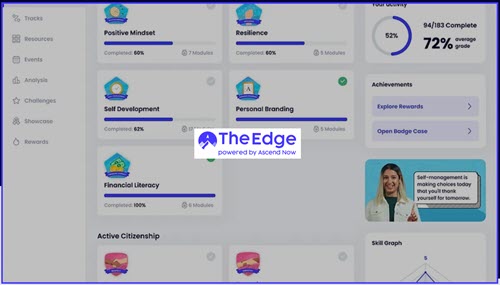
Absolutely. So you as a teacher or a district can see how your students are performing across every. Personal development, communication, employability, skills, active citizenship and learning, and you can actually get a score to see how your students are progressing on a grade level. Age level. Student level. You can compare that data geographically so you can see what kids. In China or in Asia or Europe are doing compared to your students, at least those of our school partners that are working with us, we work with quite a few international schools too, like International School partnerships, Dulwich College, Xcl Cognita School, some of the American schools and so. Interesting to compare that data with some of the data in the US and to see how students. But overall, we’re seeing that a lot of students are like, wow, I didn’t know I could learn financial literacy. Didn’t know I could learn about. I didn’t know I could learn about entrepreneurship in such a friendly way, so that’s really important to us, but also to feed the schools with unique data to see where the holes and the gaps are, because as schools. Ton of things you have to, you know, kind of take care of chronic absenteeism, teacher retention, you know, school leadership. So many things involved. I mean this is really just designed to see how can we. And we also have a mental health teacher track coming up too, which I’m really excited about because that’s something that can really support the teachers.
Kevin Hogan
Yeah. And Jesse, to kind of to go back a little bit, give us a little bit of a day in the. I mean, are these seen as extracurricular activities that happen after the Bell ring in the afternoon or they are they tied into actual classes? Kind of give us the specifics there.
Jessie Bushman
Well, the one thing that I love about this curriculum is it’s super. So according to your school, you can adapt it and switch it to. However, it’s going to work best for you. We as a district started off with it in the special Ed program. Actually, and we needed a curriculum there 1st and looking at that then we saw the need like the rest of the kids need this information as well. Looking into putting it into advisory, that portion of time. A lot of times teachers are trying to fill that time with lessons themselves or create these types of lessons. So using it as universal gives the kids the the vocabulary, the information, and then we can use it all the way into special Ed. So it’s an intensive program as well. It’s very. That was huge for me that my students are going to have the same vocabulary from 6:00 to 12:00. In. Ed and special Ed.
Kevin Hogan
And it says to me that it’s pretty much teacher driven or educated driven. That fair to say.
Jessie Bushman
Yeah, it’s very engaging. All the material is very. And it’s very relevant to the kids. The kids can relate to it. Stuff that’s happening in their lives. The discussions. It’s not just role. It’s great discussions on actual problems in the world and tools that they can actually use right there in the classroom as well, so. They’re discussing things that are happening right around us.
Kevin Hogan
Excellent. Now I think we’ve gotten a really good sense of the state of play of where we are with social emotional learning. Now, if you are up in progressive schools or districts like Jesse’s, let’s talk about. Next steps, Devi, where do you see? This is just the edges that’s been launched here in January. What are your hopes to see your services as they continue to evolve over the next several months and and years?
Devi Sahny
Yeah. What we’re doing in parallel supporting districts now, 200 schools and total. So we just enter the US, but we already work with seven districts here as well as Georgetown University Summer School and two other summer schools in the process. But my hope really is that as we have all these amazing districts using us to take as much feedback and see how we can make this product as easy to use and helpful for teachers. One of the feedbacks we’ve gotten is we love this so much. You include a teacher mental health track. And mental health videos for teachers to help us do what we’re doing every single day. We have tracks that include entrepreneurship and internships. A lot of employability skills in college and career readiness, but we have two more tracks. Is called AI interpretation and another is graphic design in the making. So what happens in these tracks is the students can reapply the skills they were learning. But through an experience through something a different context where they can basically trans context, apply that skill again. So that’s really cool because at the end of the entrepreneurship track, there’s a Shark Tank for kids where they can compete, and the best business gets funding. Actually, that funding is funded by Ascend. Now, over the past seven years, actually we’ve. We funded student businesses as prize money essentially, and the internship track they can, you know, apply to different companies to apply for internships. So there’s a bit of that, but overall my hope is. Is that we have this next generation of future ready, SCL, smart skill, savvy students across the world that know themselves that find their own edge through essay. Because essay everywhere and to have 30 minutes a week in SEL. I don’t think that’s enough. You know, I really Don. So it’s a. It’s a good start, but we need to do better, so I think valuing the Selma as a society would be something that I would be very interested to see what happens in the next few years.
Kevin Hogan
Yeah. And Jesse will leave the last word with you about where your hopes to see this sort of work and how we can kind of continue to evolve and benefit your students.
Jessie Bushman
I’m just excited to see what they can do with their futures as we’re learning these skills and you see the light in their eyes and they’re able to you do the challenges and apply the skills that they’re learning in real life. Talking about networking, the challenges to go. And network and come back with three business cards. So we’re putting it right in their. And so when they’re learning, it guided with us, I mean, just excited to see what they’re going to be able to do in the future.
Kevin Hogan
Yeah. Well, once again, it’s a difficult topic and you add in COVID. It’s just always a tough conversation, but at the end of it I come out feeling better. Congratulations on your launch. Congratulations on on the work that you’re doing. Jesse at your district glass always seems half full. When I when I sit. With a few educators for 15 or 20 minutes this way, and here the the real work and the real successes you’re having. Thanks again for your time and for your insights.
Devi Sahny
Thanks so much Kevin for having us. We really appreciate it and love talking to you.
Jessie Bushman
Thank you.
Kevin Hogan
And that wraps up the special edition of Innovations in Education, which was brought to you by ascend. Now a US based education startup committed to increasing both college and career readiness for all students. For more information, you can find them on the web at buildmyedge.com.
Kevin is a forward-thinking media executive with more than 25 years of experience building brands and audiences online, in print, and face to face. He is an acclaimed writer, editor, and commentator covering the intersection of society and technology, especially education technology. You can reach Kevin at
[email protected]
Latest posts by Kevin Hogan
(see all)