In the nearly two years since the U.S. Supreme Court struck down race-conscious admissions, there have been repeatedcalls for universities to address the resulting decline in diversity by recruiting from community colleges.
On the surface, encouraging students to transfer from two-year colleges sounds like a terrific idea. Community colleges enroll large numbers of students who are low-income or whose parents did not attend college. Black and Latino students disproportionately start college at these institutions, whose mission for more than 50 years has been to expand access to higher education.
But while community colleges should be an avenue into high-value STEM degrees for students from low-income backgrounds and minoritized students, the reality is sobering: Just 2 percent of students who begin at a community college earn a STEM bachelor’s degree within six years, our recent study of transfer experiences in California found.
There are too many roadblocks in their way, leaving the path to STEM degrees for community college students incredibly narrow. A key barrier is the complexity of the process of transferring from a community college to a four-year institution.
Related: Interested in innovations in higher education? Subscribe to our free biweekly higher education newsletter.
Many community college students who want to transfer and major in a STEM field must contend with three major obstacles in the transfer process:
1. A maze of inconsistent and often opaque math requirements. We found that a student considering three or four prospective university campuses might have to take three or four different math classes just to meet a single math requirement in a given major. One campus might expect a transfer student majoring in business to take calculus, while another might ask for business calculus. Still another might strongly recommend a “calculus for life sciences” course. And sometimes an institution’s website might list different requirements than a statewide transfer site. Such inconsistencies can lengthen students’ times to degrees — especially in STEM majors, which may require five- or six-course math sequences before transfer.
2. Underlying math anxiety. Many students interviewed for the study told us that they had internalized negative comments from teachers, advisers and peers about their academic ability, particularly in math. This uncertainty contributed to feelings of anxiety about completing their math courses. Their predicament is especially troubling given concerns that required courses may not contribute to success in specific fields.
3. Course scheduling conflicts that slow students’ progress. Two required courses may meet on the same day and time, for example, or a required course could be scheduled at a time that conflicts with a student’s work schedule. In interviews, we also heard that course enrollment caps and sequential pathways in which certain courses are offered only once a year too often lengthen the time to degree for students.
To help, rather than hinder, STEM students’ progress toward their college and professional goals, the transfer process needs to change significantly. First and foremost, universities need to send clear and consistent signals about what hoops community college students should be jumping through in order to transfer.
A student applying to three prospective campuses, for example, should not have to meet separate sets of requirements for each.
Community colleges and universities should also prioritize active learning strategies and proven supports to combat math anxiety. These may include providing professional learning for instructors to help them make math courses more engaging and to foster a sense of belonging. Training for counselors to advise students on requirements for STEM pathways is also important.
Community colleges must make their course schedules more student-centered, by offering evening and weekend courses and ensuring that courses required for specific degrees are not scheduled at overlapping times. They should also help students with unavoidable scheduling conflicts take comparable required courses at other colleges.
At the state level, it’s critical to adopt goals for transfer participation and completion (including STEM-specific goals) as well as comprehensive and transparent statewide agreements for math requirements by major.
States should also provide transfer planning tools that provide accurate and up-to-date information. For example, the AI Transfer and Articulation Infrastructure Network, led by University of California, Berkeley researchers, is using artificial intelligence technology to help institutions more efficiently identify which community college courses meet university requirements. More effective tools will increase transparency without requiring students and counselors to navigate complex and varied transfer requirements on their own. As it stands, complex, confusing and opaque math requirements limit transfer opportunities for community college students seeking STEM degrees, instead of expanding them.
We must untangle the transfer process, smooth pathways to high-value degrees and ensure that every student has a clear, unobstructed opportunity to pursue an education that will set them up for success.
Pamela Burdman is executive director of Just Equations, a California-based policy institute focused on reconceptualizing the role of math in education equity. Alexis Robin Hale is a research fellow at Just Equations and a graduate student at UCLA in Social Sciences and Comparative Education.
The Hechinger Report provides in-depth, fact-based, unbiased reporting on education that is free to all readers. But that doesn’t mean it’s free to produce. Our work keeps educators and the public informed about pressing issues at schools and on campuses throughout the country. We tell the whole story, even when the details are inconvenient. Help us keep doing that.
UPDATE: After this story was published, the Education Department issued a press release Monday afternoon, July 7, announcing that Matthew Soldner will serve as acting commissioner of the National Center for Education Statistics, in addition to his role as acting director of the Institute of Education Sciences. The job of statistics chief had been vacant since March and had prevented the release of assessment results.
The repercussions from the decimation of staff at the Education Department keep coming. Last week, the fallout led to a delay in releasing results from a national science test.
The National Assessment of Educational Progress (NAEP) is best known for tests that track reading and math achievement but includes other subjects, too. In early 2024, when the main reading and math tests were administered, there was also a science section for eighth graders.
Why the delay? There is no commissioner of education statistics to sign off on the score report, a requirement beforeit is released, according to five current and former officials who are familiar with the release of NAEP scores, but asked to remain anonymous because they were not authorized to speak to the press or feared retaliation.
Related: Our free weekly newsletter alerts you to what research says about schools and classrooms.
Peggy Carr, a Biden administration appointee, was dismissed as the commissioner of the National Center for Education Statistics in February, two years before the end of her six-year term set by Congress. Chris Chapman was named acting commissioner, but he was fired in March, along with half the employees at the Education Department. The role has remained vacant since.
A spokesman for the National Assessment Governing Board, which oversees NAEP, said the science scores will be released later this summer, but denied that the lack of a commissioner is the obstacle. “The report building is proceeding so the naming of a commissioner is not a bureaucratic hold-up to its progress,” Stephaan Harris said by email.
The delay matters. Education policymakers have been keen to learn if science achievement had held steady after the pandemic or tumbled along with reading and math. (Those reading and math scores were released in January.)
The Trump administration has vowed to dismantle the Education Department and did not respond to an emailed question about when a new commissioner would be appointed.
Keeping up with administration policy can be head-spinning these days. Education researchers were notified in March that they would have to relinquish federal data they were using for their studies. (The department shares restricted datasets, which can include personally identifiable information about students, with approved researchers.)
But researchers learned on June 30 that the department had changed its mind and decided not to terminate this remote access.
Lawyers who are suing the Trump administration on behalf of education researchers heralded this about-face as a “big win.” Researchers can now finish projects in progress.
Still, researchers don’t have a way of publishing or presenting papers that use this data. Since the mass firings in mid-March, there is no one remaining inside the Education Department to review their papers for any inadvertent disclosure of student data, a required step before public release. And there is no process at the moment for researchers to request data access for future studies.
“While ED’s change-of-heart regarding remote access is welcome,” said Adam Pulver of Public Citizen Litigation Group, “other vital services provided by the Institute of Education Sciences have been senselessly, illogically halted without consideration of the impact on the nation’s educational researchers and the education community more broadly. We will continue to press ahead with our case as to the other arbitrarily canceled programs.”
Pulver is the lead attorney for one of three suits fighting the Education Department’s termination of research and statistics activities. Judges in the District of Columbia and Maryland have denied researchers a preliminary injunction to restore the research and data cuts. But the Maryland case is now fast-tracked and the court has asked the Trump administration to produce an administrative record of its decision-making process by July 11. (See this previous story for more background on the court cases.)
Just as the Education Department is quietly restarting some activities that DOGE killed, so is the National Science Foundation (NSF). The federal science agency posted on its website that it had reinstated 114 awards to 45 institutions as of June 30. NSF said it was doing so to comply with a federal court order to reinstate awards to all University of California researchers. It was unclear how many of these research projects concerned education, one of the major areas that NSF funds.
Researchers and universities outside the University of California system are hoping for the same reversal. In June, the largest professional organization of education researchers, the American Educational Research Association, joined forces with a large coalition of organizations and institutions in filing a legal challenge to the mass termination of grants by the NSF. Education grants were especially hard hit in a series of cuts in April and May. Democracy Forward, a public interest law firm, is spearheading this case.
The Hechinger Report provides in-depth, fact-based, unbiased reporting on education that is free to all readers. But that doesn’t mean it’s free to produce. Our work keeps educators and the public informed about pressing issues at schools and on campuses throughout the country. We tell the whole story, even when the details are inconvenient. Help us keep doing that.
Education Secretary Linda McMahon has repeatedly said that the February and March cancellations and firings at her department cut not only the “fat” but also into some of the “muscle” of the federal role in education. So, even as she promises to dismantle her department, she is also bringing back some people and restarting some activities. Court filings and her own congressional testimony illuminate what this means for the agency as a whole, and for education research in particular.
McMahon told a U.S. House committee last month she rehired 74 employees out of the roughly 2,000 who were laid off or agreed to separation packages. A court filing earlier this month says the agency will revive about a fifth of research and statistics contracts killed earlier this year, at least for now, though that doesn’t mean the work will look exactly as it did before.
The Trump administration disclosed in a June 5 federal court filing in Maryland that it either has or is planning to reinstate 20 of 101 terminated contracts to comply with congressional statutes. More than half of the reversals will restart 10 regional education laboratories that the Trump administration had said were engaged in “wasteful and ideologically driven spending,” but had been very popular with state education leaders. The reinstatements also include an international assessment, a study of how to help struggling readers, and Datalab, a web-based data analysis tool for the public.
Related: Our free weekly newsletter alerts you to what research says about schools and classrooms.
Even some of the promised reinstatements are uncertain because the Education Department plans to put some of them up for new bids (see table below). That process could take months and potentially result in smaller contracts with fewer studies or hours of technical assistance.
These research activities were terminated by Elon Musk’s Department of Government Efficiency (DOGE) before McMahon was confirmed by the Senate. The Education Department’s disclosure of the reinstatements occurred a week after President Donald Trump bid farewell to Musk in the Oval Office and on the same day that the Trump-Musk feud exploded on social media.
See which IES contracts have been or are slated to be restarted, or under consideration for reinstatement
Description
Status
1
Regional Education Laboratory – Mid Atlantic
Intends to seek new bids and restart contract
2
Regional Education Laboratory – Southwest
Intends to seek new bids and restart contract
3
Regional Education Laboratory – Northwest
Intends to seek new bids and restart contract
4
Regional Education Laboratory – West
Intends to seek new bids and restart contract
5
Regional Education Laboratory – Appalachia
Intends to seek new bids and restart contract
6
Regional Education Laboratory – Pacific
Intends to seek new bids and restart contract
7
Regional Education Laboratory – Central
Intends to seek new bids and restart contract
8
Regional Education Laboratory – Midwest
Intends to seek new bids and restart contract
9
Regional Education Laboratory – Southeast
Intends to seek new bids and restart contract
10
Regional Education Laboratory – Northeast and Islands
Intends to seek new bids and restart contract
11
Regional Education Laboratory – umbrella support contract
Intends to seek new bids and restart contract
12
What Works Clearinghouse (website, training reviewers, but no reviewing of education research)
Approved for reinstatement
13
Statistical standards and data confidentiality technical assistance for the National Center for Education Statistics
Reinstated
14.
Statistical and confidentiality review of electronic data files and technical reports
Approved for reinstatement
15
Datalab, a web-based data analysis tool for the public
Approved for reinstatement
16
U.S. participation in the Program for International Student Assessment (PISA), an international test overseen by the Organization for Economic Cooperation and Development (OECD)
Reinstated
17
Data quality and statistical methodology assistance
Reinstated
18
EDFacts, a collection of administrative data from school districts around the country
Reinstated
19
Demographic and geospatial estimates (e.g. school poverty and school locations) used for academic research and federal program administration
Approved for reinstatement
20
Evaluation of the Multi-tiered System of Supports in reading, an approach to help struggling students
Approved for reinstatement
21
Implementation of the Striving Readers Comprehensive Literacy Program and feasibility of conducting an impact evaluation of it.
Evaluating whether to restart
22
Policy-relevant findings for the National Evaluation of Career and Technical Education
Evaluating whether to restart
23
The National Postsecondary Student Aid Study (how students finance college, college graduation rates and workforce outcomes)
Evaluating whether to restart
24
Additional higher ed studies
Evaluating whether to restart
25
Publication assistance on educational topics and the annual report
Evaluating whether to restart
26
Conducting peer review of applications, manuscripts and grant competitions at the Institute of Education Sciences
Evaluating whether to restart
The Education Department press office said it had no comment beyond what was disclosed in the legal brief.
Education researchers, who are suing the Trump administration to restore all of its previous research and statistical activities, were not satisfied.
Elizabeth Tipton, president of the Society for Research on Educational Effectiveness (SREE) said the limited reinstatement is “upsetting.” “They’re trying to make IES as small as they possibly can,” she said, referring to the Institute of Education Sciences, the department’s research and data arm.
SREE and the American Educational Research Association (AERA) are suing McMahon and the Education Department in the Maryland case. The suit asks for a temporary reinstatement of all the contracts and the rehiring of IES employees while the courts adjudicate the broader constitutional issue of whether the Trump administration violated congressional statutes and exceeded its executive authority.
The 20 reinstatements were not ordered by the court, and in some instances, the Education Department is voluntarily restarting only a small slice of a research activity, making it impossible to produce anything meaningful for the public. For example, the department said it is reinstating a contract for operating the What Works Clearinghouse, a website that informs schools about evidence-based teaching practices. But, in the legal brief, the department disclosed that it is not planning to reinstate any of the contracts to produce new content for the site.
In the brief, the administration admitted that congressional statues mention a range of research and data collection activities. But the lawyers argued that the legislative language often uses the word may instead of must, or notes that evaluations of education programs should be done “as time and resources allow.”
“Read together, the Department has wide discretion in whether and which evaluations to undertake,” the administration lawyers wrote.
The Trump administration argued that as long as it has at least one contract in place, it is technically fulfilling a congressional mandate. For example, Congress requires that the Education Department participate in international assessments. That is why it is now restarting the contract to administer the Program for International Student Assessment (PISA), but not other international assessments that the country has participated in, such as the Trends in International Mathematics and Science Study (TIMSS).
The administration argued that researchers didn’t make a compelling case that they would be irreparably harmed if many contracts were not restarted. “There is no harm alleged from not having access to as-yet uncreated data,” the lawyers wrote.
One of the terminated contracts was supposed to help state education agencies create longitudinal data systems for tracking students from pre-K to the workforce. The department’s brief says that states, not professional associations of researchers, should sue to restore those contracts.
In six instances, the administration said it was evaluating whether to restart a study. For example, the legal brief says that because Congress requires the evaluation of literacy programs, the department is considering a reinstatement of a study of the Striving Readers Comprehensive Literacy Program. But lawyers said there was no urgency to restart it because there is no deadline for evaluations in the legislative language.
In four other instances, the Trump administration said it wasn’t feasible to restart a study, despite congressional requirements. For example, Congress mandates that the Education Department identify and evaluate promising adult education strategies. But after terminating such a study in February, the Education Department admitted that it is now too difficult to restart it. The department also said it could not easily restart two studies of math curricula in low-performing schools. One of the studies called for the math program to be implemented in the first year and studied in the second year, which made it especially difficult to restart. A fourth study the department said it could not restart would have evaluated the effectiveness of extra services to help teens with disabilities transition from high school to college or work. When DOGE pulled the plug on that study, those teens lost those services too.
The Hechinger Report provides in-depth, fact-based, unbiased reporting on education that is free to all readers. But that doesn’t mean it’s free to produce. Our work keeps educators and the public informed about pressing issues at schools and on campuses throughout the country. We tell the whole story, even when the details are inconvenient. Help us keep doing that.
The courts have pushed back against much of President Donald Trump’s agenda, but he did win a small victory this week in a dispute with education researchers.
On June 3, a federal judge in Washington, D.C., denied a request by four education research trade associations for a preliminary injunction, which means that the Education Department doesn’t have to temporarily reinstate fired employees and canceled contracts within its research and data arm, the Institute of Education Sciences.
Researchers had hoped to return the research division to its pre-Trump status while the court takes time to decide the overall issue in the case, which is whether the Trump administration exceeded its executive authority in these mass firings and contract terminations. Now, the cuts in the research arm of the department will remain while the case proceeds.
Four education research groups (the Association for Education Finance and Policy (AEFP), the Institute for Higher Education Policy (IHEP), the National Academy of Education (NAEd) and the National Council on Measurement in Education (NCME)) are suing the Education Department because their federally funded studies, evaluations and surveys have been slashed and their access to data is slated to be curtailed. They also contend that historical data archives are at risk, along with future data quality. Their legal argument is that the cuts were arbitrary and capricious and they say that the Trump administration eliminated many activities that Congress requires by law.
U.S. District Judge Trevor McFadden acknowledged that the “upheaval” at the Institute of Education Sciences is “understandably jarring for those who rely on studies and data produced by the Institute.” However, McFadden explained in a written opinion that the law that the researchers are using to sue the executive branch, the Administrative Procedure Act, was “never meant to be a bureaucratic windbreak insulating agencies from political gales.”
“It is not this Court’s place to breathe life back into wide swathes of the Institute’s cancelled programs and then monitor the agency’s day-to-day statutory compliance,” McFadden wrote.
In the opinion, McFadden noted that some of the researchers’ complaints, such as losing remote access to student data for research purposes, may be “ripe for standalone challenges,” but bundling all of their grievances together is a “losing gambit.”
The ruling not only denied researchers the short-term remedy they sought but also cast doubt on the prospects of their overall case. “We are disappointed with and disagree with the Court’s decision, and are evaluating our next steps,” said Adam Pulver, an attorney at Public Citizen, a nonprofit advocacy organization representing two of the research organizations.
A federal judge in Maryland is still considering a similar request to temporarily restore research-related cuts at the Education Department by two other education research groups. That suit, which also accuses the Trump administration of exceeding its executive power, was brought by the American Educational Research Association (AERA) and the Society for Research on Educational Effectiveness (SREE).
Educators fighting the cuts have had one victory so far, in a separate case filed in federal district court in Boston. On May 22, U.S. District Judge Myong Joun ordered the Trump administration to reinstate 1,300 Education Department employees terminated in March. The Trump administration is challenging the decision, but the court said on June 4 that the Education Department couldn’t postpone rehiring everyone while the appeal works its way through the courts. This case was brought by two Massachusetts school districts, a teachers union and 21 Democratic attorneys general.
This story about education researchers suing the Trump administration was written by Jill Barshay and produced by The Hechinger Report, a nonprofit, independent news organization focused on inequality and innovation in education. Sign up for Proof Points and other Hechinger newsletters.
The Hechinger Report provides in-depth, fact-based, unbiased reporting on education that is free to all readers. But that doesn’t mean it’s free to produce. Our work keeps educators and the public informed about pressing issues at schools and on campuses throughout the country. We tell the whole story, even when the details are inconvenient. Help us keep doing that.
When hackers hit a school district, they can expose Social Security numbers, home addresses, and even disability and disciplinary records. Now, cybersecurity advocates warn that the Trump administration’s budget and personnel cuts, along with rule changes, are stripping away key defenses that schools need.
“Cyberattacks on schools are escalating and just when we need federal support the most, it’s being pulled away,” said Keith Krueger, chief executive officer of the Consortium for School Networking, an association of technology officials in K-12 schools.
Related: Our free weekly newsletter alerts you to what research says about schools and classrooms.
The stakes are high. Schools are a top target in ransomware attacks, and cyber criminals have sometimes succeeded in shutting down whole school districts. The largest such incident occurred in December, when hackers stole personal student and teacher data from PowerSchool, a company that runs student information systems and stores report cards. The theft included data from more than 60 million students and almost 10 million teachers. PowerSchool paid an undisclosed ransom, but the criminals didn’t stop. Now, in a second round of extortion, the same cyber criminals are demanding ransoms from school districts.
Of chief concern is a cybersecurity service known as MS-ISAC, which stands for Multi-State Information Sharing and Analysis Center. It warns more than 5,700 schools around the country that have signed up for the service about malware and other threats and recommends security patches. This technical service is free to schools, but is funded by an annual congressional appropriation of $27 million through the Cybersecurity and Infrastructure Security Agency (CISA), an agency within the Department of Homeland Security.
On March 6, the Trump administration announced a $10 million funding cut as part of broader budget and staffing cuts throughout CISA. That was ultimately negotiated down to $8.3 million, but the service still lost more than half of its remaining $15.7 budget for the year. The non-profit organization that runs it, the Center for Internet Services, is digging into its reserves to keep it operating. But those funds are expected to run out in the coming weeks, and it is unclear how the service will continue operating without charging user fees to schools.
“Many districts don’t have the budget or resources to do this themselves, so not having access to the no cost services we offer is a big issue,” said Kelly Lynch Wyland, a spokeswoman for the Center for Internet Services.
Sharing threat information
Another concern is the effective disbanding of the Government Coordinating Council, which helps schools address ransomware attacks and other threats through policy advice, including how to respond to ransom requests, whom to inform when an attack happens and good practices for preventing attacks. This coordinating council was formed only a year ago by the Department of Education and CISA. It brings together 13 nonprofit school organizations representing superintendents, state education leaders, technology officers and others. The council met frequently after the PowerSchool data breach to share information.
Now, amid the second round of extortions, school leaders have not been able to meet because of a change in rules governing open meetings. The group was originally exempt from meeting publicly because it was discussing critical infrastructure threats. But the Department of Homeland Security, under the Trump administration, reinstated open meeting rules for certain advisory committees, including this one. That makes it difficult to speak frankly about efforts to thwart criminal activity.
Non-governmental organizations are working to resurrect the council, but it would be in a diminished form without government participation.
“The FBI really comes in when there’s been an incident to find out who did it, and they have advice on whether you should pay or not pay your ransom,” said Krueger of the school network consortium.
A federal role
A third concern is the elimination in March of the education Department’s Office of Educational Technology. This seven-person office dealt with education technology policies — including cybersecurity. It issued cybersecurity guidance to schools and held webinars and meetings to explain how schools could improve and shore up their defenses. It also ran a biweekly meeting to talk about K-12 cybersecurity across the Education Department, including offices that serve students with disabilities and English learners.
Eliminating this office has hampered efforts to decide which security controls, such as encryption or multi-factor authentication, should be in educational software and student information systems.
Many educators worry that without this federal coordination, student privacy is at risk. “My biggest concern is all the data that’s up in the cloud,” said Steve Smith, the founder of the Student Data Privacy Consortium and the former chief information officer for Cambridge Public Schools in Massachusetts. “Probably 80 to 90 percent of student data isn’t on school-district controlled services. It’s being shared with ed tech providers and hosted on their information systems.”
Security controls
“How do we ensure that those third-party providers are providing adequate security against breaches and cyber attacks?” said Smith. “The office of ed tech was trying to bring people together to move toward an agreed upon national standard. They weren’t going to mandate a data standard, but there were efforts to bring people together and start having conversations about the expected minimum controls.”
That federal effort ended, Smith said, with the new administration. But his consortium is still working on it.
In an era when policymakers are seeking to decrease the federal government’s involvement in education, arguing for a centralized, federal role may not be popular. But there’s long been a federal role for student data privacy, including making sure that school employees don’t mishandle and accidentally expose students’ personal information. The Family Educational Rights and Privacy Act, commonly known as FERPA, protects student data. The Education Department continues to provide technical assistance to schools to comply with this law. Advocates for school cybersecurity say that the same assistance is needed to help schools prevent and defend against cyber crimes.
“We don’t expect every town to stand up their own army to protect themselves against China or Russia,” said Michael Klein, senior director for preparedness and response at the Institute for Security and Technology, a nonpartisan think tank. Klein was a senior advisor for cybersecurity in the Education Department during the previous administration. “In the same way, I don’t think we should expect every school district to stand up their own cyber-defense army to protect themselves against ransomware attacks from major criminal groups.”
And it’s not financially practical. According to the school network consortium only a third of school districts have a full-time employee or the equivalent dedicated to cybersecurity.
Budget storms ahead
Some federal programs to help schools with cybersecurity are still running. The Federal Communications Commission launched a $200 million pilot program to support cybersecurity efforts by schools and libraries. FEMA funds cybersecurity for state and local governments, which includes public schools. Through these funds, schools can obtain phishing training and malware detection. But with budget battles ahead, many educators fear these programs could also be cut.
Perhaps the biggest risk is the end to the entire E-Rate program that helps schools pay for the internet access. The Supreme Court is slated to decide this term on whether the funding structure is an unconstitutional tax.
“If that money goes away, they’re going to have to pull money from somewhere,” said Smith of the Student Data Privacy Consortium. “They’re going to try to preserve teaching and learning, as they should. Cybersecurity budgets are things that are probably more likely to get cut.
“It’s taken a long time to get to the point where we see privacy and cybersecurity as critical pieces,” Smith said. “I would hate for us to go back a few years and not be giving them the attention they should.”
The Hechinger Report provides in-depth, fact-based, unbiased reporting on education that is free to all readers. But that doesn’t mean it’s free to produce. Our work keeps educators and the public informed about pressing issues at schools and on campuses throughout the country. We tell the whole story, even when the details are inconvenient. Help us keep doing that.
Why do so many students struggle to understand what they read, even after they learn how to read?
That’s a topic of hot debate among reading researchers. One camp has been arguing that schools have been going about it all wrong. These critics say that instead of drilling students on the main idea (similar to questions students will see on annual state exams), teachers should spend more time building students’ background knowledge of the world.
The theory is that the more familiar students are with science, history, geography and even art, the easier it will be for students to grasp new ideas when reading. Many educators are embracing this theory, and knowledge building lessons have been spreading rapidly across the country, from Baltimore to Mississippi to Colorado.
Related: Our free weekly newsletter alerts you to what research says about schools and classrooms.
But the evidence for this approach is still emerging, and some reading researchers urge caution. They worry that sometimes, too much time is being spent on background knowledge rather than actually reading and discussing texts. These skeptics argue students aren’t going to magically understand what they are reading just from knowing more about the world, and they need to be explicitly taught how to identify the main idea and how to summarize.
Debates like this are common in education as new research addresses unresolved issues, such as exactly how to teach reading once students have learned phonics and how to decode the words on the page.
“Early research showed that background knowledge plays a part,” said Kausalai Wijekumar, a professor of education at Texas A&M University, who has been studying reading instruction and recently produced a study that sheds more light on the debate. “People with good background knowledge seem to be able to read faster and understand quicker.”
For some children, particularly children from affluent families, she said, background knowledge is “enough” to unlock reading comprehension, but not for all. “If we want all the children to read, we have proven that they can be taught with the right strategies,” said Wijekumar. She has a body of research to back her position.
Wijekumar agrees that drilling students on the main point or the author’s purpose isn’t helpful because a struggling reader cannot come up with a point or a purpose from thin air. (She’s also not a fan of highlighting key words or graphic organizers, both common strategies for reading comprehension in schools.) Instead, Wijekumar advocates for a step-by-step process, conceived in the 1970s by her mentor and research partner, Bonnie J.F. Meyer, a professor emeritus at Penn State.
The first step is to guide students through a series of questions as they read, such as “Is there a problem?” “What caused it?” and “Is there a solution?” Based on their answers, students can then decide which structure the passage follows: cause and effect, problem and solution, comparisons or a sequence. Next, students fill in blanks — like in a Mad Libs worksheet — to help create a main idea statement. And finally, they practice expanding on that idea with relevant details to form a summary.
Wijekumar analyzed the story of Cinderella for me, using her approach. The problem? Cinderella is bullied by her stepmother and stepsisters. We learn this because she’s forced to do extra chores and isn’t allowed to attend the ball. The cause of the problem? They’re jealous of her. That’s why they take away her pretty clothes. Finally, the solution: A fairy godmother helps Cinderella go to the ball and meet Prince Charming. Students can then put all these elements together to come up with the main idea: Cinderella is bullied by her stepmother and stepsisters because they are jealous of her, but a fairy godmother saves her.
It’s a formulaic approach and there are certainly other ways of seeing or expressing the main idea. I wouldn’t have analyzed Cinderella that way. I would have guessed it’s a story about never giving up on your dreams even if your life is wretched now. But Wijekumar says it’s a helpful start for students who struggle the most.
“It’s very structured and systematic, and that provides a strong foundation,” Wijekumar said. “This is just the starting point. You can take it and layer on more things, but 99 percent of the children are having difficulty just starting.”
Wijekumar transformed Meyer’s strategy into a computerized tutor called ITSS, which stands for Intelligent Tutoring using the Structure Strategy. About 200,000 students around the world use ITSS. Wijekumar’s nonprofit, Literacy.IO, charges schools $40 a student plus teacher training, which can run $800 per teacher, depending on school size.
The tutor allows students to practice reading comprehension at their own pace. ITSS was one of only three online learning technologies that demonstrated clear evidence for improving student achievement, according to a February 2021 report by the Institute of Education Sciences, the research and development arm of the U.S. Department of Education.
Since then, Wijekumar has continued to refine her reading program and test it with more students. Her most recent study, a large-scale replication in high poverty schools, was highly successful according to one yardstick, but not so successful, according to another measure. It was published last year in the Journal of Educational Psychology.
A team of six researchers led by Wijekumar randomly assigned 17 of 33 schools in the Northeast and along the Texas border to teach reading with ITSS, while the remaining 16 schools taught reading as usual. More than 1,200 fifth graders practiced their reading comprehension using ITSS for 45 minutes a week over six months. Their teachers received 16 hours of training in how to teach reading comprehension this way and also delivered traditional analog reading lessons to their students.
After six months, students who received this reading instruction posted significantly higher scores on a researcher-designed assessment, which measured students’ ability to write main ideas, recall key information and understand text structures. However, there was no statistically significant difference between the two groups on a standardized test, the Gray Silent Reading Test (GSRT), which measured students’ general reading comprehension. The researchers did not report state test scores.
Earlier studies with wealthier students showed improvements on the standardized reading comprehension test. It’s hard to make sense of why this study showed giant benefits using one measure, but none using another.
Substantial changes in the instruction were needed for these high-poverty students. Some were such weak readers that Wijekumar’s team had to draft easier texts so that students could practice the method. But the biggest change was 14 hours of additional teacher training and the creation of instructional guides for the teachers. Wijekumar’s strategies directly contradicted what their schools’ textbooks told them to do. At first, the students were confused with the teachers teaching them one way and ITSS another. So Wijekumar worked with the teachers to scrap their textbook instructions and teach her way.
I consulted with Marissa Filderman,a respected reading expert who has reviewed the literature on comprehension instruction for children who struggle with reading and is an assistant professor at the University of Alabama. She said despite the imperfect evidence from this study, she sees Wijekumar’s body of research as evidence that explicit strategy instruction is important along with building background knowledge and vocabulary. But it’s still an evolving science, and the research isn’t yet clear enough to guide teachers on how much time to spend on each aspect.
Improving reading comprehension is critical, and I’ll be watching for new research to help answer these questions for teachers.
The Hechinger Report provides in-depth, fact-based, unbiased reporting on education that is free to all readers. But that doesn’t mean it’s free to produce. Our work keeps educators and the public informed about pressing issues at schools and on campuses throughout the country. We tell the whole story, even when the details are inconvenient. Help us keep doing that.
A fourth round of cutbacks took place on May 9. NSF observers were still trying to piece together the size and scope of this wave of destruction. A division focused on equity in education was eliminated and all its employees were fired. And the process for reviewing and approving future research grants was thrown into chaos with the elimination of division directors who were stripped of their powers.
Meanwhile, there was more clarity surrounding a third round of cuts that took place a week earlier on May 2. That round terminated more than 330 grants, raising the total number of terminated grants to at least 1,379, according to Grant Watch, a new project launched to track the Trump administration’s termination of grants at scientific research agencies. All but two of the terminated grants in early May were in the education division, and mostly targeted efforts to promote equity by increasing the participation of women and Black and Hispanic students in STEM fields. The number of activegrants by the Division of Equity for Excellence in STEM within the education directorate was slashed almost in half, from 902 research grants to 461.
Related: Our free weekly newsletter alerts you to what research says about schools and classrooms.
Combined with two earlier rounds of NSF cuts at in April, education now accounts for more than half of the nearly 1,400 terminated grants and almost three-quarters of their $1 billion value. Those dollars will no longer flow to universities and research organizations.
Cuts to STEM education dominate NSF grant terminations
… and nearly three-quarters of their $1 billion value are in education
Data source: Grant Watch, May 7, 2025. Charts by Jill Barshay/The Hechinger Report
The cuts are being felt across the nation. Grant Watch also created a map of the United States, showing that both red and blue states are losing federal research dollars.
Source: Grant Watch, May 7, 2025
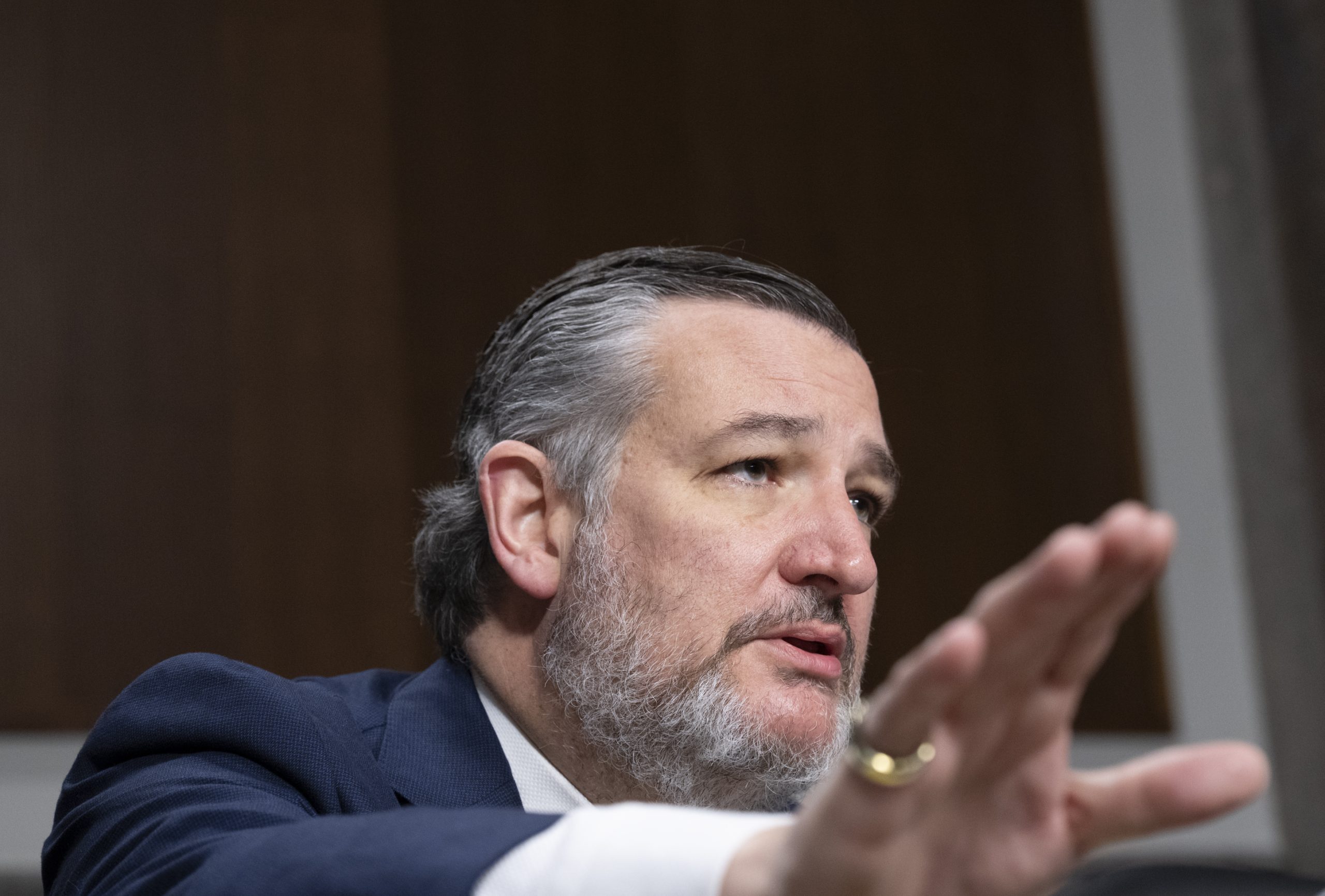
It remains unclear exactly how NSF is choosing which grants to cancel and exactly who is making the decisions. Weekly waves of cuts began after the Department of Government Efficiency or DOGE entered NSF headquarters in mid April. Only 40 percent of the terminated grants were also in a database of 3,400 research grants compiled last year by Sen. Ted Cruz, a Texas Republican. Cruz characterized them as “questionable projects that promoted Diversity, Equity, and Inclusion (DEI) or advanced neo-Marxist class warfare propaganda.” Sixty percent were not on the Cruz list.
Source: Grant Watch, May 7, 2025
Other NSF cuts also affect education. Earlier this year, NSF cut in half the number of new students that it would support through graduate school from 2,000 to 1,000. Universities are bracing to hear this summer if NSF will continue to support graduate students who are already a part of its graduate research fellowship program.
NSF watchers were still compiling a list of the research grants that were terminated on May 9, the date of the most recent fourth round of research cuts. It was unclear if any research grants to promote equity in STEM education remained active.
The Division of Equity for Excellence in STEM, a unit of the Education Directorate, was “sunset,” according to a May 9 email sent to NSF employees and obtained by the Hechinger Report, and all of its employees were fired. According to the email, this “reduction in force” is slated to be completed by July 12. However, later on May 9, a federal judge in San Francisco temporarily blocked the Trump administration from implementing its “reduction in force” firings of federal employees at the NSF and 19 other agencies.
An initial hearing for a group of three legal cases by education researchers against the Department of Education is scheduled for May 16. At the hearing, a federal judge in Washington, D.C., will hear arguments over whether the court should temporarily restore terminated research studies and data collections and bring back fired Education Department employees while it considers whether the Trump administration exceeded its executive authority.
A first hearing scheduled for May 9 was postponed. At the May 16 hearing, the court will hear two similar motions from two different cases: one filed by the Association for Education Finance and Policy (AEFP) and the Institute for Higher Education Policy (IHEP), and the other filed by National Academy of Education (NAEd) and the National Council on Measurement in Education (NCME). A third suit by the American Educational Research Association (AERA) and the Society for Research on Educational Effectiveness (SREE) was filed in federal court in Maryland and will not be part of the May 16 hearing.
The Hechinger Report provides in-depth, fact-based, unbiased reporting on education that is free to all readers. But that doesn’t mean it’s free to produce. Our work keeps educators and the public informed about pressing issues at schools and on campuses throughout the country. We tell the whole story, even when the details are inconvenient. Help us keep doing that.
UPDATE: The hearing scheduled for May 9 has been postponed until May 16 at the U.S. District Court for the District of Columbia. The court will hear two similar motions at the same time and consider whether to temporarily restore the cuts to research and data collections and bring back fired federal workers at the Education Department. More details on the underlying cases in the article below.
Some of the biggest names in education research — who often oppose each other in scholarly and policy debates — are now united in their desire to fight the cuts to data and scientific studies at the U.S. Department of Education.
The roster includes both Grover J. “Russ” Whitehurst, the first head of the Institute of Education Sciences (IES) who initiated studies for private school vouchers, and Sean Reardon, a Stanford University sociologist who studies inequity in education. They are just two of the dozens of scholars who have submitted declarations to the courts against the department and Secretary Linda McMahon. They describe how their work has been harmed and argue that the cuts will devastate education research.
Professional organizations representing the scholars are asking the courts to restore terminated research and data and reverse mass firings at the Institute of Education Sciences, the division that collects data on students and schools, awards research grants, highlights effective practices and measures student achievement.
Related: Our free weekly newsletter alerts you to what research says about schools and classrooms.
Three major suits were filed last month in U.S. federal courts, each brought by two different professional organizations. The six groups are the Association for Education Finance and Policy (AEFP), Institute for Higher Education Policy (IHEP), American Educational Research Association (AERA), Society for Research on Educational Effectiveness (SREE), National Academy of Education (NAEd) and the National Council on Measurement in Education (NCME). The American Educational Research Association alone represents 25,000 researchers and there is considerable overlap in membership among the professional associations.
Prominent left-wing and progressive legal organizations spearheaded the suits and are representing the associations. They are Public Citizen, Democracy Forward and the Legal Defense Fund, which was originally founded by the National Association for the Advancement of Colored People (NAACP) but is an independent legal organization. Allison Scharfstein, an attorney for the Legal Defense Fund, said education data is critical to documenting educational disparities and improve education for Black and Hispanic students. “We know that the data is needed for educational equity,” Scharfstein said.
Officers at the research associations described the complex calculations in suing the government, mindful that many of them work at universities that are under attack by the Trump administration and that its members are worried about retaliation.
“A situation like this requires a bit of a leap of faith,” said Elizabeth Tipton, president of the Society for Research on Educational Effectiveness and a statistician at Northwestern University. “We were reminded that we are the Society for Research on Educational Effectiveness, and that this is an existential threat. If the destruction that we see continues, we won’t exist, and our members won’t exist. This kind of research won’t exist. And so the board ultimately decided that the tradeoffs were in our favor, in the sense that whether we won or we lost, that we had to stand up for this.”
The three suits are similar in that they all contend that the Trump administration exceeded its executive authority by eliminating activities Congress requires by law. Private citizens or organizations are generally barred from suing the federal government, which enjoys legal protection known as “sovereign immunity.” But under the Administrative Procedure Act of 1946, private organizations can ask the courts to intervene when executive agencies have acted arbitrarily, capriciously and not in accordance with the law. The suits point out, for example, that the Education Science Reform Act of 2002 specifically requires the Education Department to operate Regional Education Laboratories and conduct longitudinal and special data collections, activities that the Education Department eliminated in February among a mass cancelation of projects.
The suits argue that it is impossible for the Education Department to carry out its congressionally required duties, such as the awarding of grants to study and identify effective teaching practices, after the March firing of almost 90 percent of the IES staff and the suspension of panels to review grant proposals. The research organizations argue that their members and the field of education research will be irreparably harmed.
Of immediate concern are two June deadlines. Beginning June 1, researchers are scheduled to lose remote access to restricted datasets, which can include personally identifiable information about students. The suits contend that loss harms the ability of researchers to finish projects in progress and plan future studies. The researchers say they are also unable to publish or present studies that use this data because there is no one remaining inside the Education Department to review their papers for any inadvertent disclosure of student data.
The second concern is that the termination of more than 1,300 Education Department employees will become final by June 10. Technically, these employees have been on administrative leave since March, and lawyers for the education associations are concerned that it will be impossible to rehire these veteran statisticians and research experts for congressionally required tasks.
The suits describe additional worries. Outside contractors are responsible for storing historical datasets because the Education Department doesn’t have its own data warehouse, and researchers are worried about who will maintain this critical data in the months and years ahead now that the contracts have been canceled. Another concern is that the terminated contracts for research and surveys include clauses that will force researchers to delete data about their subjects. “Years of work have gone into these studies,” said Dan McGrath, an attorney at Democracy Forward, who is involved in one of the three suits. “At some point it won’t be possible to put Humpty Dumpty back together again.”
In all three of the suits, lawyers have asked the courts for a preliminary injunction to reverse the cuts and firings, temporarily restoring the studies and bringing federal employees back to the Education Department to continue their work while the judges take more time to decide whether the Trump administration exceeded its authority. A first hearing on a temporary injunction is scheduled on Friday in federal district court in Washington.*
A lot of people have been waiting for this. In February, when DOGE first started cutting non-ideological studies and data collections at the Education Department, I wondered why Congress wasn’t protesting that its laws were being ignored. And I was wondering where the research community was. It was so hard to get anyone to talk on the record. Now these suits, combined with Harvard University’s resistance to the Trump administration, show that higher education is finally finding its voice and fighting what it sees as existential threats.
The three suits:
Public Citizen suit
Plaintiffs: Association for Education Finance and Policy (AEFP) and the Institute for Higher Education Policy (IHEP)
Attorneys: Public Citizen Litigation Group
Defendants: Secretary of Education Linda McMahon and the U.S. Department of Education
Date filed: April 4
Where: U.S. District Court for the District of Columbia
A concern: Data infrastructure. “We want to do all that we can to protect essential data and research infrastructure,” said Michal Kurlaender, president of AEFP and a professor at University of California, Davis.
Status: Public Citizen filed a request for a temporary injunction on April 17 that was accompanied by declarations from researchers on how they and the field of education have been harmed. The Education Department filed a response on April 30. A hearing is scheduled for May 9.
Democracy Forward suit
Plaintiffs: American Educational Research Association (AERA) and the Society for Research on Educational Effectiveness (SREE)
Attorneys: Democracy Forward
Defendants: U.S. Department of Education, Institute of Education Sciences, Secretary of Education Linda McMahon and Acting Director of the Institute of Education Sciences Matthew Soldner
Date filed: April 14
Where: U.S. District Court for the District of Maryland, Southern Division
A concern: Future research. “IES has been critical to fostering research on what works, and what does not work, and for providing this information to schools so they can best prepare students for their future,” said Ellen Weiss, executive director of SREE. “Our graduate students are stalled in their work and upended in their progress toward a degree. Practitioners and policymakers also suffer great harm as they are left to drive decisions without the benefit of empirical data and high-quality research,” said Felice Levine, executive director of AERA.
Status: A request for a temporary injunction was filed April 29, accompanied by declarations from researchers on how their work is harmed.
Legal Defense Fund suit
Plaintiffs: National Academy of Education (NAEd) and the National Council on Measurement in Education (NCME)
Attorneys: Legal Defense Fund
Defendants: The U.S. Department of Education and Secretary of Education Linda McMahon
Date filed: April 24
Where: U.S. District Court for the District of Columbia
A concern: Data quality. “The law requires not only data access but data quality,” said Andrew Ho, a Harvard University professor of education and former president of the National Council on Measurement in Education. “For 88 years, our organization has upheld standards for valid measurements and the research that depends on these measurements. We do so again today.”
Status: A request for a temporary injunction was filed May 2.*
* Correction: This paragraph was corrected to make clear that lawyers in all three suits have asked the courts to temporarily reverse the research and data cuts and personnel firings. Also, May 9th is a Friday, not a Thursday. We regret the error.
The Hechinger Report provides in-depth, fact-based, unbiased reporting on education that is free to all readers. But that doesn’t mean it’s free to produce. Our work keeps educators and the public informed about pressing issues at schools and on campuses throughout the country. We tell the whole story, even when the details are inconvenient. Help us keep doing that.
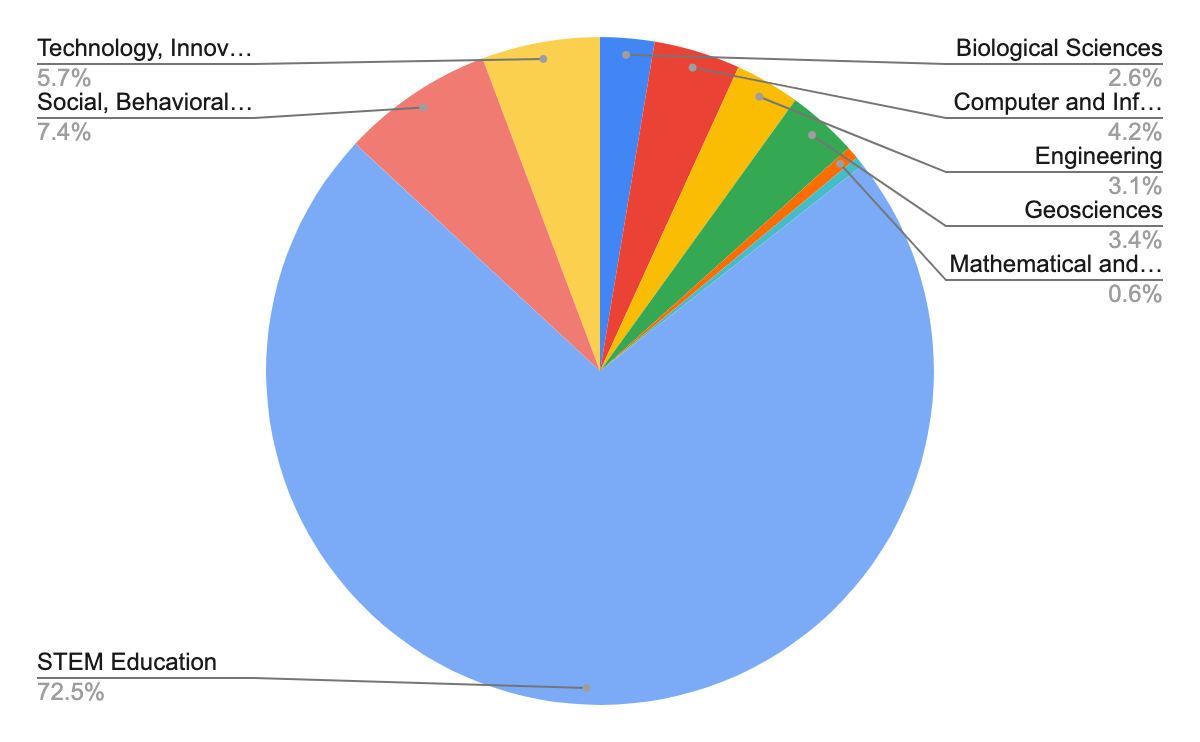
Of the more than 1,000 National Science Foundation grants killed last month by Elon Musk’s Department of Government Efficiency, some 40 percent were inside its education division. These grants to further STEM education research accounted for a little more than half of the $616 million NSF committed for projects canceled by DOGE, according to Dan Garisto, a freelance journalist reporting for Nature, a peer-reviewed scientific journal that also covers science news.
The STEM education division gives grants to researchers at universities and other organizations who study how to improve the teaching of math and science, with the goal of expanding the number of future scientists who will fuel the U.S. economy. Many of the studies are focused on boosting the participation of women or Black and Hispanic students. The division had a roughly $1.2 billion budget out of NSF’s total annual budget of $9 billion.
Related: Our free weekly newsletter alerts you to what research says about schools and classrooms.
Neither the NSF nor the Trump administration has provided a list of the canceled grants. Garisto told me that he obtained a list from an informal group of NSF employees who cobbled it together themselves. That list was subsequently posted on Grant Watch, a new project to track the Trump administration’s termination of grants at scientific research agencies. Garisto has been working with outside researchers at Grant Watch and elsewhere to document the research dollars that are affected and analyze the list for patterns.
“For NSF, we see that the STEM education directorate has been absolutely pummeled,” Noam Ross, a computational disease ecologist and one of the Grant Watch researchers, posted on Bluesky.
Terminated grants fall heavily upon STEM Education
Graphic by Dan Garisto, a freelance journalist working for Nature
Many, but not all, of the canceled research projects at NSF were also in a database of 3,400 research grants compiled by Sen. Ted Cruz, a Texas Republican. Cruz characterized them as “questionable projects that promoted Diversity, Equity, and Inclusion (DEI) or advanced neo-Marxist class warfare propaganda.”
Ross at Grant Watch analyzed the titles and abstracts or summaries of the terminated projects and discovered that “Black” was the most frequent word among them. Other common words were “climate,” “student,” “network,” “justice,” “identity,” “teacher,” and “undergraduate.”
Frequent words in the titles and summaries of terminated NSF research projects
Word cloud of the most frequent terms from the titles and abstracts of terminated grants, with word size proportional to frequency. Purple is the most frequent, followed by orange and green. Source: Noam Ross, Grant Watch
At least two of the terminated research studies focused on improving artificial intelligence education, which President Donald Trump promised to promote in an April 23 executive order,“Advancing Artificial Intelligence Education for American Youth.”
“There is something especially offensive about this EO from April 23 about the need for AI education… Given the termination of my grant on exactly this topic on April 26,” said Danaé Metaxa in a post on Bluesky that has since been deleted. Metaxa, an assistant professor of computer and information science at the University of Pennsylvania, was developing a curriculum on how to teach AI digital literacy skills by having students build and audit generative AI models.
Another canceled grant involved college students creating educational content about AI for social media to see if that content would improve AI literacy and the ability to detect misinformation. The lead researcher, Casey Fiesler, an associate professor of information science at the University of Colorado Boulder, was almost midway through her two-year grant of less than $270,000. “There is not a DEI aspect of this work,” said Fiesler. “My best guess is that the reason it was flagged was the word ‘misinformation.’”
Confusion surrounded the cuts. Bob Russell, a former NSF project officer who retired in 2024, said some NSF project officers were initially unaware that the grants they oversee had been canceled. Instead, university officials who oversee research were told, and those officials notified researchers at their institutions. Researchers then contacted their project officers. One researcher told me that the termination notice states that researchers may not appeal the decision, an administrative process that is ordinarily available to researchers who feel that NSF has made an unfair or incorrect decision.
Some of the affected researchers were attending the annual meeting of the American Educational Research Association in Denver on April 26 when more than 600 grants were cut. Some scholars found out by text that their studies had been terminated. Normally festive evening receptions were grim. “It was like a wake,” said one researcher.
The Trump administration wants to slash NSF’s budget and headcount in half, according to Russell. Many researchers expect more cuts ahead.
The Hechinger Report provides in-depth, fact-based, unbiased reporting on education that is free to all readers. But that doesn’t mean it’s free to produce. Our work keeps educators and the public informed about pressing issues at schools and on campuses throughout the country. We tell the whole story, even when the details are inconvenient. Help us keep doing that.
DRESDEN, Tenn. — In early February, seventh grade math teacher Jamie Gallimore tried something new: She watched herself teach class. The idea had come from Ed Baker, district math coach at Tennessee’s Weakley County Schools. Baker set up an iPad on a cabinet in Gallimore’s classroom at Martin Middle School and hit record.
Gallimore watched the videos twice, and she and Baker ran through them together. They dissected the questions she asked during the lesson, looked at how much time she took to work through problems and analyzed how she’d moved around the room. As a veteran teacher, she did a lot right — but the meeting with Baker also made her change a few things.
Instead of throwing out questions to the whole class, now Gallimore more often calls on individuals. When a student answers, she might turn to the other side of the room and ask, “What did they just say?” The tactics, she said, have helped keep her students engaged.
Coaching is one strategy Weakley administrators and teachers credit with boosting middle school math scores after they crashed during the pandemic. Weakley’s third through eighth graders are more than half a grade ahead of where they were at the same time in 2022 and about a third of a grade ahead of 2019, according to a national study of academic recovery released in February. In three of the district’s four middle schools, the percentage of students meeting grade-level expectations on Tennessee’s standardized math test, including among economically disadvantaged students, rose in 2024 above pre-pandemic levels.
Teacher Jamie Gallimore uses a few new tactics in her seventh grade math classroom at Martin Middle School after working with district math coach Ed Baker. Credit: Andrea Morales for The Hechinger Report
Amid a grim landscape nationwide for middle school math, Tennessee fared better than most states. In two districts in the state that bucked the national trend — Weakley and the Putnam County School District — educators point to instructional coaches, a dramatic increase in class time devoted to math and teachers systematically using student performance data to inform their teaching and push students to improve.
How students do in middle school can predict how they do in life. Higher achievement in eighth grade math is associated with a higher income, more education later and with declines in teen motherhood and incarceration and arrest rates, a 2022 study by Harvard’s Center for Education Policy Research found. In addition, middle school grades and attendance are the best indicators of how a student will do in high school and whether they’re ready for college at the end of high school, a 2014 study found.
Nationally, the news coming in shows trouble ahead: In January, for example, the National Assessment of Educational Progress, known as the Nation’s Report Card, showed that average eighth grade scores in 2024 were below those of 2019 and didn’t budge from 2022, when scores were the lowest in more than 20 years. Worse, the gaps between high and low achievers widened.
Tennessee, though, was one of five jurisdictions where the percentage of eighth graders scoring proficient in math — meaning they were able to handle challenging tasks like calculating square roots, areas and volumes — increased from 2022 to 2024. That reflects a longer-term trend: Since 2011, Tennessee has climbed from the 45th-ranked state to the 19th for average eighth grade math scores.
But researchers have struggled to determine which interventions were most effective in helping students recover. A June 2024 study that looked at different strategies came to no conclusion because the strategies weren’t comparable across districts, said Dan Goldhaber of the nonprofit American Institutes for Research. In March, the Trump administration eliminated nearly all staff at the Department of Education unit that runs the Nation’s Report Card, which educators and researchers worry could make it even harder to compare how students in different states and districts perform and draw lessons about what works.
In the absence of systematic research, attention has turned to states like Tennessee and districts like Weakley and Putnam where kids have climbed out of an academic hole. At Martin Middle School, the percentage of students meeting grade level expectations on the state math exam cratered during the pandemic, falling from 40 percent in 2019 to 24 percent in 2022. But in 2024 that number jumped to 43 percent.
Weakley County sits in the state’s northwest corner, its flat farmland populated with small towns of mostly modest ranch homes. The county is poorer than most in the country, with a median household income under $50,000.
When the first federal Covid relief money arrived in early 2020, the district had to choose what to prioritize. Weakley focused on hiring staff who could help kids recover lost learning — instructional coaches for each school to focus on teaching strategies, plus subject-area coaches like Baker, whose role the district created in 2021. “Bottom line, we decided people over things,” said school system Director Jeff Cupples.
Research indicates that coaching can make a big difference in student outcomes. A 2018 study summarizing the results of 60 prior studies found that coaching accelerated student learning by the equivalent of four to six months, according to Brown University associate professor Matthew Kraft, who led the research team. In a survey of Tennessee school districts last year, 80 of 118 that responded said they employ math coaches.
Two Tennessee school districts credit the systematic use of student achievement data for helping their middle schoolers rebound from the pandemic-era slide in middle-school math scores. Credit: Andrea Morales for The Hechinger Report
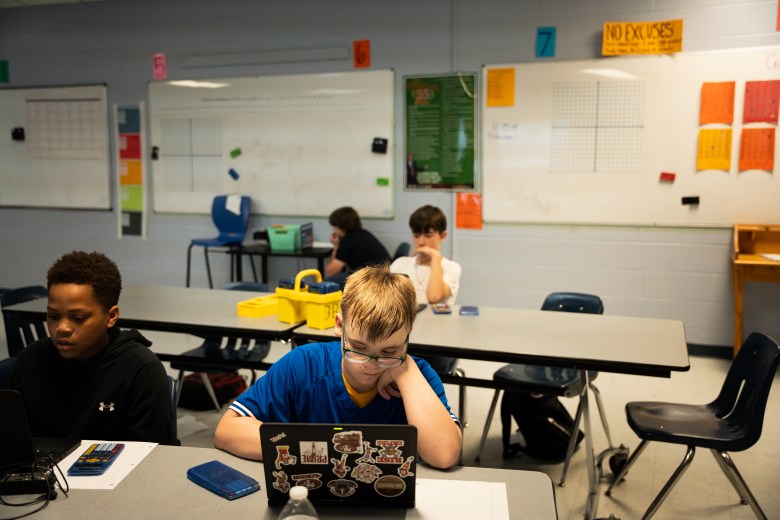
In 2022, Martin Middle made another big change, nearly doubling the time kids spend in math class. In place of a single 50-minute class are two 45-minute periods that the school calls “core” and “encore,” with the encore session meant to solidify what students get in the first.
On an overcast March day, Becky Mullins, a longtime math and science teacher who’s also assistant principal, helped sixth graders in her encore class calculate area and volume. On a screen at the front of the classroom, she pulled up problems many of them had trouble with in their core class taught by math teacher Drew Love. One asked them to calculate how many cubes of a certain volume would fit inside a larger prism. “What strategy have you learned from Mr. Love on how to solve this problem?” she asked.
When a student in the back named Charlie raised his hand and said he was stuck, Mullins pulled up a chair beside him. They worked through the procedure together, and after a few minutes he solved it. Mullins said helping students individually in class works far better than assigning them homework. “You don’t know what they’re dealing with at home,” she said.
Martin Middle seventh grader Emma Rhodes, 12, said individual help in her sixth grade encore class last year helped her through fractions. Her encore teacher was “very hands on,” said Rhodes. “It helps me most when teachers are one on one.”
Yet studies of double-dose math show mixed results. One in 2013 found a double block of algebra substantially improved the math performance of ninth graders. Another a year later concluded that struggling sixth graders who received a double block of math had higher test scores in the short term but that those gains mostly disappeared when they returned to a single block.
The share of Martin Middle School students meeting grade level expectations on the state math exam was higher in 2024 than before the pandemic. Credit: Andrea Morales for The Hechinger Report
Weakley and Putnam County staff also credit the systematic use of student achievement data for helping their middle schoolers rebound. Tennessee was a pioneer in the use of academic data in the early 1990s, devising a system that compiles fine-grained details on individual student achievement and growth based on state test results. Both Weakley and Putnam teachers use that data to pinpoint which skills they need to review with which students and to keep kids motivated.
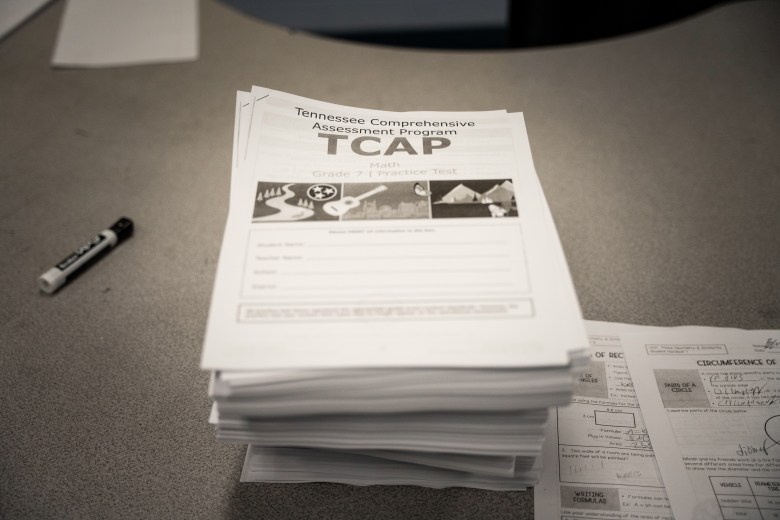
A four-hour drive east of Weakley in Putnam County on a day in early March, seventh grade math teacher Brooke Nunn was reviewing problems students had struggled with. Taped to the wall of her classroom was a printout of her students’ scores on each section of a recent test in preparation for the Tennessee state exam in April. One portion of that exam requires students to work without calculators. “This non-calculator portion killed them, so they’re doing it again,” Nunn said of the exercises they’re working on — adding and subtracting negatives and positives, decimals and fractions.
The data on her wall drove the lesson and the choice of which students to have in the room at Prescott South Middle School, where she teaches. Starting about 10 years ago, the district began requiring 90 minutes of math a day, split into two parts. In the second half, teachers pull out students in groups for instruction on specific skills based on where the data shows they need help.
Teachers also share this data with students. In a classroom down the hall, after a review lesson, fellow seventh grade math teacher Sierra Smith has students fill out a colorful graphic showing which questions they got and which they missed on their most recent review ahead of the state test. Since Covid, apathy has been a challenge, district math coach Jessica Childers said. But having kids track their own data has helped. “Kids want to perform,” she said, and many thrive on trying to best their past performance.
The district is laser focused on the state tests. It created Childers’ math coach role in 2019 with district funds and later other instructional coach jobs using federal pandemic relief money. Much of Childers’ job revolves around helping teachers closely align their instruction with the state middle school math standards, she said. “I know that sounds like teaching to the test, but the test tests the standards,” said Childers.
Something in what the district is doing is working. It’s not well off: The share of its families in poverty is 4 percent higher than the national average. But at all six district middle schools, the percentage of students meeting expectations on the state math exam was higher in 2024 than in 2019, and at all six the percentage was above the state average.
Goldhaber, the AIR researcher, speculated that the focus on testing might help explain the rebound in Tennessee. “States have very different orientations around standards, accountability and the degree to which we ought to be focused on test scores,” he said. “I do believe test scores matter.”
The share of Martin Middle School students meeting grade level expectations on the state math exam was higher in 2024 than before the pandemic. Credit: Andrea Morales for The Hechinger Report
If Trump administration layoffs hamstring the ability to compare performance across states, successful strategies like those in the two districts might not spread. Weakley and Putnam have taken steps to ensure the practices they’ve introduced persist regardless of what happens at the federal level. Most of the federal Covid relief dollars that paid for academic coaches in both districts stopped flowing in January, but both have rolled money for coaches into their budgets. They also say double blocks of math will continue.
Cupples, the Weakley superintendent, worries about the effect of any additional federal cuts — without federal funds, the district would lose 90 positions and 10 percent of its budget. It would be “chaos, doom, despair,” he said, laughing. “But one thing I’ve learned about educators — as one myself and working with them — we overcome daily,” he said.
“It’s just what we do.”
Contact editor Caroline Preston at 212-870-8965, via Signal at CarolineP.83 or on email at [email protected].
The Hechinger Report provides in-depth, fact-based, unbiased reporting on education that is free to all readers. But that doesn’t mean it’s free to produce. Our work keeps educators and the public informed about pressing issues at schools and on campuses throughout the country. We tell the whole story, even when the details are inconvenient. Help us keep doing that.