
Category: Denmark

  • The European international education stories you should know from 2025

    The European international education stories you should know from 2025

    1. Denmark tightens restrictions on international students

    In late September, news broke that Denmark – a growing educational destination – was taking steps to make it harder for international applicants to study at Danish universities. The policy would impose stricter academic entry requirements, restrictions on spouses, national reviews of forged documents, and shorter post-study work permits for third-country students in response to rising concerns over fears education is being used as a back door into the Danish labour market. This was The PIE News’s most-read story of the year, showing rising interest in Denmark as a study destination.

    2. The UK’s education secretary issues a warm welcome to international students

    After years of increasingly restrictive polices affecting the international education sector, many stakeholders welcomed a new Labour government, led by Prime Minister Keir Starmer, that seemed to be rolling out the welcome mat for international students. Education secretary Bridget Phillipson released a video message addressing students thinking of choosing the UK as their study destination, reassuring them that the country is “a wonderful and safe place to study”.

    3. The UK ushers in a levy on international student fees

    Under the immigration white paper, a road map outlining the UK’s plans to control immigration, the Starmer government laid out plans to introduce a tax on international student fees. An announcement in the Autumn budget released more details; a £925-per-international-student flat fee for institutions in England with more than 220 overseas students. While it’s widely understood that the controversial policy was designed to help the higher education sector prove the value of international education – with the cash raised from the levy set to go towards domestic maintenance grants – critics have aired concerns that overseas students could be put off from studying in the UK if the levy is passed on in higher fees.

    4. UK Graduate Route condensed by six months

    In another major development for the UK sector in 2025, the international white paper introduced plans to shorten the Graduate Route – originally set at two years – to just 18 months. The condensed post-graduate work stream will come into effect in January 2027.

    5. Capping student numbers would lose the Netherlands serious money

    The Netherlands has long been a popular destination for international students – offering value for money and many programs taught in English. But the international education sector in the country is facing its fair share of headwinds, including right-wing politicians’ attempts to curb overseas enrolments. But research shows that capping international students at just five of the Netherlands’ universities could cause countrywide losses of up to €5bn – an eye-watering number that should leave policymakers thinking twice.

    6. Germany’s international students return eightfold investment

    Another major European study destination, Germany has been steadily rising in popularity over the past few years. But while students are flocking to the country, local communities can expect benefits in return. Research from the German Academic Exchange Service (DAAD) shows that international students in Germany contribute eight times more to public budgets than the amount the government spends on them.

    7. Rising international student numbers in Malta

    A rising ELT hub, Malta is also attracting its fair share of international students in higher education due to its friendly locals, proximity to mainland Europe, balmy climate and attractive post-graduate opportunities. This is showing up in the growing number of higher education international enrolments, with this number shooting up by more than a quarter in just one year between 2022/23 and 2023/24, according to data from the country’s National Statistics Office.

    8. French institutions cash in on US policy turmoil

    With the US – traditionally the most sought-after study destination in the world – facing significant challenges with Donald Trump back in the White House, other countries are seeing an influx of students looking for alternative places to study. Some, like France, are actively positioning themselves as an attractive alternative. The country has also introduced a new fellowship for American students, launched in anticipation of the 250th anniversary of the American Declaration of Independence.

    9. International students flock to Ireland as Celtic Tiger roars

    Ireland is fast becoming a regional hub for international education, as the largest English-speaking country still in the EU following Brexit. International students are flocking to the country in their droves, leading the the inaugural PIE Live Ireland being held in Dublin this October – at which Ireland’s higher education minister gave a video address welcoming international students.
    Source link

  • Would you sell your country to Trump?

    Would you sell your country to Trump?

    Greenland is three times the size of the U.S. state of Texas, making it the world’s largest island if you don’t count the continent of Australia.  

    It sits on critical rare earth minerals and fossil fuel reserves. Its retreating ice, due to global warming, is opening up new trade routes and longer shipping seasons

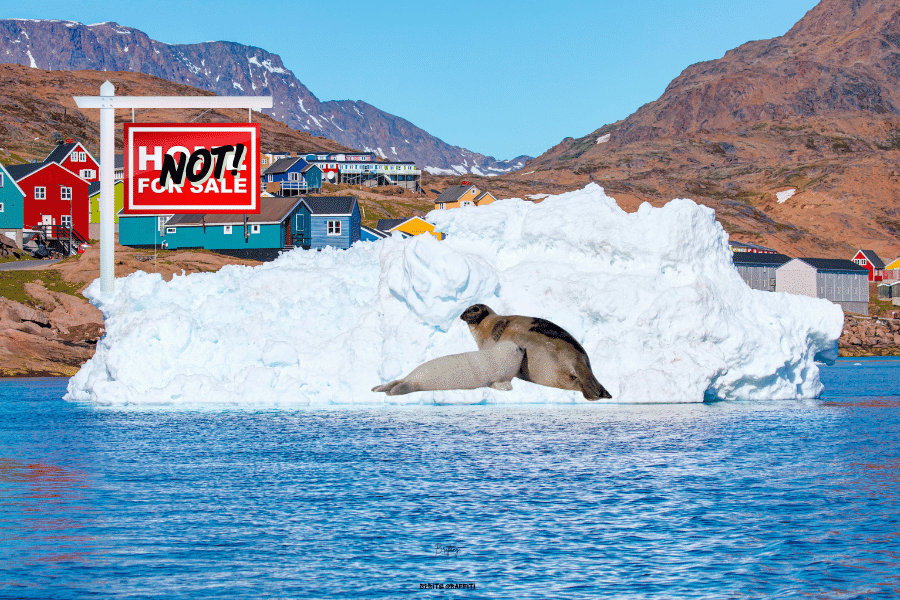
    No wonder U.S. President Donald Trump wants it for the United States. A purchase price would be steep. Based on past purchases of territory and Greenland’s economic potential, it is estimated that the price of Greenland could be anywhere between $12.5 billion and $77 billion. And he only has to convince the 56,000 people who live there that they would prosper under U.S. rule. 

    Greenland is a former Danish colony that still relies heavily upon Denmark for its economy.

    If Trump were able to buy it, he’d have to take it as is, and the country suffers from high rates of suicide, alcoholism and sexual abuse

    Is there art in the deal?

    A Google map of Greenland.

    Trump made an offer in December, called “absurd” by Danish Prime Minister Mette Frederiksen. It was the second time he broached this subject, having first spoken of it during the lead up to his first presidential term. 

    This time, he said he won’t rule out using economic or military force to buy the world’s biggest island based on the logic that Greenland is necessary for “national security and freedom” of the United States. Greenland and the United States are separated by about 2,289 kilometers (1,422 miles) of water between the two closest points — Grand Manan in the U.S. state of Maine and Nanortalik in Greenland.

    Much of the world has been laughing at Trump’s demand but it is no laughing matter for Denmark. This week, Danish Prime Minister Mette Frederiksen visited German Chancellor Olaf Scholz, French President Emmanuel Macron and NATO General Secretary Mark Rutte, to talk about strengthening the EU’s security and defence and to further prioritise the Arctic.

    In the meantime, Greenlanders are feeling their value to Denmark has risen.

    Greenland was a Danish colony until 1953, when it became a self-governing region of Denmark. This means that it has its own local government and two seats in the Danish parliament. The relationship also means that Greenlanders are citizens of the European Union, with the benefits that come with that. 

    A fractured relationship

    The relationship between Greenland and Denmark is still recovering from that colonial past. The majority of Greenlanders support full independence from Denmark despite its deep reliance on the Danish government. 

    Denmark is still responsible for Greenland’s foreign, security and defence policy, and provides Greenland an annual financial aid of DKK 3.9 billion (roughly €522 million), which makes up around 20% of Greenland’s gross domestic product. That’s the value of all the goods and services a country produces and it is used as a measurement of a nation’s economic health. 

    The scars of colonialism are still fresh for many Greenlanders. In 1953 Denmark allowed the forced relocation of an Indigenous population from the Dundas area in Greenland, for a U.S. military base. The Thule tribe had been semi-nomadic catchers in the Dundas area for thousands of years. Their relocation took place over just a few days. 

    Later, in the 1960s and 70s, Danish health authorities fitted thousands of Inuit women and girls the IUD contraceptive device, many without proper notification or consent. An investigation into the procedure suggests that its aim was to curb a growing population — which worked. Many of these women went on to suffer health issues due to the IUD. 

    Now Greenlanders are being told that their future is theirs to decide. 

    There’s green beneath the ice.

    What does Trump want with Greenland? 

    Greenland’s ice sheet covers nearly 80% of the country, which is losing mass at a rate of around 200 gigatonnes per year due to climate change. That seems like an incomprehensible amount. It is the equivalent of 200 billion metric tons or, according to NASA, if you could picture it, two million fully-loaded aircraft carriers. 

    Trump has framed his interest in Greenland as a matter of national security and freedom. By this, he points to the island’s strategic value: its untapped reserves of rare earth minerals and fossil fuels, as well as emerging trade routes enabled by retreating ice. 

    Greenland’s mineral reserves are largely untouched. The island harbors significant deposits of rare earth elements, essential for various high-tech applications, including electronics, renewable energy technologies and defence systems. 

    Owning Greenland would ease U.S. concerns over China’s dominance in the rare earth market, with China currently controlling 70–80% of the world’s critical rare earth minerals. Acquiring access to Greenland’s mineral reserves could serve to diversify and secure the U.S. supply chain, reducing reliance on Chinese exports. 

    Controlling the Arctic

    Exploiting Greenland’s mineral wealth still presents considerable challenges. The island’s harsh climate and limited infrastructure means large start-up costs for mining projects.

    Having control over new trade routes in the Arctic is also appealing, as well as having an expanded military presence in the region to monitor Russian navy vessels and nuclear submarines.  

    Is it possible to buy another country? 

    This isn’t the first time the United States has offered to buy Greenland. In 1946, President Harry Truman offered Denmark $100 million for the island. Denmark rejected the proposal but permitted the construction of the Pituffik Space Base which is responsible for missile warning systems and monitoring of satellites in space. 

    But for an exchange from Greenland to the United States to happen, both Denmark and Greenland would need to agree to the sale, with an Act on Greenland Self-Government stating that the people of Greenland have a right to self-determination.

    And right now, Greenlanders don’t want to be under anyone’s rule but their own

    The international news service Reuters reported 29 January that a poll commissioned by the Danish paper Berlingske, found that 87% of Greenlanders would turn down Trump’s offer and another 9% are undecided.

    But they’re not telling the United States to go away. While Greenland’s Prime Minister Mute Egede said that his country is not for sale, Greenlanders are open to cooperating with the United States on defence and exploration of its minerals

    And then there’s golf. With all that melting ice, maybe Trump is picturing a fabulous par-72 resort. Right now Greenland only has two courses. Just picture those sand traps on the edge of the Arctic. 


    Three questions to consider:

    1. How would the United States benefit from controlling Greenland?
    2. What’s Greenland’s relationship with Denmark?
    3. If you were a Greenlander, would you vote to become part of the United States? Why?


    Source link