Category: design

  • KU researchers publish guidelines to help responsibly implement AI in education

    KU researchers publish guidelines to help responsibly implement AI in education

    This story originally appeared on KU News and is republished with permission.

    Key points:

    Researchers at the University of Kansas have produced a set of guidelines to help educators from preschool through higher education responsibly implement artificial intelligence in a way that empowers teachers, parents, students and communities alike.

    The Center for Innovation, Design & Digital Learning at KU has published “Framework for Responsible AI Integration in PreK-20 Education: Empowering All Learners and Educators with AI-Ready Solutions.” The document, developed under a cooperative agreement with the U.S. Department of Education, is intended to provide guidance on how schools can incorporate AI into its daily operations and curriculum.

    Earlier this year, President Donald Trump issued an executive order instructing schools to incorporate AI into their operations. The framework is intended to help all schools and educational facilities do so in a manner that fits their unique communities and missions.

    “We see this framework as a foundation,” said James Basham, director of CIDDL and professor of special education at KU. “As schools consider forming an AI task force, for example, they’ll likely have questions on how to do that, or how to conduct an audit and risk analysis. The framework can help guide them through that, and we’ll continue to build on this.”

    The framework features four primary recommendations.

    • Establish a stable, human-centered foundation.
    • Implement future-focused strategic planning for AI integration.
    • Ensure AI educational opportunities for every student.
    • Conduct ongoing evaluation, professional learning and community development.

    First, the framework urges schools to keep humans at the forefront of AI plans, prioritizing educator judgment, student relationships and family input on AI-enabled processes and not relying on automation for decisions that affect people. Transparency is also key, and schools should communicate how AI tools work, how decisions are made and ensure compliance with student protection laws such as the Individuals with Disabilities Education Act and Family Education Rights and Privacy Act, the report authors write.

    The document also outlines recommendations for how educational facilities can implement the technology. Establishing an AI integration task force including educators, administrators, families, legal advisers and specialists in instructional technology and special education is key among the recommendations. The document also shares tips on how to conduct an audit and risk analysis before adoption and consider how tools can affect student placement and identification and consider possible algorithmic error patterns. As the technologies are trained on human data, they run the risk of making the same mistakes and repeating biases humans have made, Basham said.

    That idea is also reflected in the framework’s third recommendation. The document encourages educators to commit to learner-centered AI implementation that considers all students, from those in gifted programs to students with cognitive disabilities. AI tools should be prohibited from making final decisions on IEP eligibility, disciplinary actions and student progress decisions, and mechanisms should be installed that allow for feedback on students, teachers and parents’ AI educational experiences, the authors wrote.

    Finally, the framework urges ongoing evaluation, professional learning and community development. As the technology evolves, schools should regularly re-evaluate it for unintended consequences and feedback from those who use it. Training both at implementation and in ongoing installments will be necessary to address overuse or misuse and clarify who is responsible for monitoring AI use and to ensure both the school and community are informed on the technology.

    The framework was written by Basham; Trey Vasquez, co-principal investigator at CIDDL, operating officer at KU’s Achievement & Assessment Institute and professor of special education at KU; and Angelica Fulchini Scruggs, research associate and operations director for CIDDL.

    Educators interested in learning more about the framework or use of AI in education are invited to connect with CIDDL. The center’s site includes data on emergent themes in AI guidance at the state level and information on how it supports educational technology in K-12 and higher education. As artificial intelligence finds new uses and educators are expected to implement the technology in schools, the center’s researchers said they plan to continue helping educators implement it in ways that benefit schools, students of all abilities and communities.

    “The priority at CIDDL is to share transparent resources for educators on topics that are trending and in a way that is easy to digest,” Fulchini Scruggs said. “We want people to join the community and help them know where to start. We also know this will evolve and change, and we want to help educators stay up to date with those changes to use AI responsibly in their schools.”

    Latest posts by eSchool Media Contributors (see all)

    Source link

  • 4 ways to transform your classroom through playful gamification 

    4 ways to transform your classroom through playful gamification 

    Key points:

    Every educator hopes to instill a lifelong love of learning within their students. We strive to make each lesson engaging, while igniting a sense of curiosity, wonder, and discovery in every child.

    Unfortunately, we don’t always succeed, and recent reports suggest that today’s students are struggling to connect with the material they’re taught in school–particularly when it comes to STEM. While there are many potential culprits behind these numbers (shortened attention spans, the presence of phones, dependency on AI, etc.), educators should still take a moment to reflect and strategize when preparing a new lesson for their class. If we truly want to foster a growth mindset within our students, we need to provide lessons that invite them to embrace the learning process itself.

    One way to accomplish this is through gamification. Gamification brings the motivational elements of games into your everyday lessons. It increases student engagement, builds perseverance, and promotes a growth mindset. When used strategically, it helps learners take ownership of their progress and encourages creativity and collaboration without sacrificing academic rigor.

    Here are just 4 ways that educators can transform their classroom through playful gamification:

    1. Introduce points and badges: Modern video games like Pokémon and Minecraft frequently use achievements to guide new players through the gaming process. Teachers can do the same by assigning points to different activities that students can acquire throughout the week. These experience points can also double as currency that students can exchange for small rewards, such as extra free time or an end-of-year pizza party.
    2. Create choice boards: Choice boards provide students with a range of task options, each with a point value or challenge level. You can assign themes or badges for completing tasks in a certain sequence (e.g., “complete a column” or “complete one of each difficulty level”). This allows students to take ownership of their learning path and pace, while still hitting key learning targets.
    3. Host a digital breakout: Virtual escape rooms and digital breakouts are great for fostering engagement and getting students to think outside the box. By challenging students to solve content-based puzzles to unlock “locks” or progress through scenarios, they’re encouraged to think creatively while also collaborating with their peers. They’re the ideal activity for reviewing classwork and reinforcing key concepts across subjects.
    4. Boss battle assessments: This gamified review activity has students “battle” a fictional character by answering questions or completing tasks. Each correct response helps them defeat the boss, which can be tracked with points, health bars, or progress meters. This engaging format turns practice into a collaborative challenge, building excitement and reinforcing content mastery.

    When implemented correctly, gamification can be incredibly fun and rewarding for our students. With the fall semester drawing closer, there has never been a better time to prepare lessons that will spark student curiosity, creativity, and critical thinking.

    We can show our students that STEM learning is not a chore, but a gateway to discovery and excitement. So, get your pencils ready, and let the games begin.

    Latest posts by eSchool Media Contributors (see all)

    Source link

  • Embracing complexity in writing instruction

    Embracing complexity in writing instruction

    Key points:

    Early in our careers, when we were fresh-faced and idealistic (we still are!) the prepackaged curriculum and the advice of more experienced colleagues was the go-to resource. Largely, we were advised that teaching writing was a simple matter of having students walk through and complete organizers, spending about one day for each “stage” of the writing process. At the end of the writing unit, students had finished their compositions–the standardized, boring, recreated ideas that we taught them to write.

    As we matured and grew as teachers of writing, we learned that teaching writing in such simplistic ways may be easier, but it was not actually teaching students to be writers. We learned with time and experience that writing instruction is a complex task within a complex system.

    Complex systems and wicked problems

    Complexity as it is applied to composition instruction recognizes that there is more than just a linear relationship between the student, the teacher, and the composition. It juggles the experiences of individual composers, characteristics of genre, availability of resources, assignment and individual goals, and constraints of composing environments. As with other complex systems and processes, it is non-linear, self-organizing, and unpredictable (Waltuck, 2012).

    Complex systems are wicked in their complexity; therefore, wicked problems cannot be solved by simple solutions. Wicked problems are emergent and generative; they are nonlinear as they do not follow a straight path or necessarily have a clear cause-and-effect relationship. They are self-organizing, evolving and changing over time through the interactions of various elements. They are unpredictable and therefore difficult to anticipate how they will unfold or what the consequences of any intervention might be. Finally, they are often interconnected, as they are symptoms of other problems. In essence, a wicked problem is a complex issue embedded in a dynamic system (Rittel & Webber, 1973).

    Writing formulas are wicked

    As formulaic writing has become and remains prevalent in instruction and classroom writing activity, graphic organizers and structural guides, which were introduced as a tool to support acts of writing, have become a wicked problem of formula; the resource facilitating process has become the focus of product. High-stakes standardized assessment has led to a focus on compliance, production, and quality control, which has encouraged the use of formulas to simplify and standardize writing instruction, the student writing produced, and the process of evaluation of student work. Standardization may improve test scores in certain situations, but does not necessarily improve learning. Teachers resort to short, formulaic writing to help students get through material more quickly as well as data and assessment compliance. This serves to not only create product-oriented instruction, but a false dichotomy between process and product, ignoring the complex thinking and design that goes into writing.

    As a result of such a narrow view of and limited focus on writing process and purpose, formulas have been shown to constrain thinking and limit creativity by prioritizing product over the composing process. The five-paragraph essay, specifically, is a structure that hinders authentic composing because it doesn’t allow for the “associative leaps” between ideas that come about in less constrained writing. Formulas undermine student agency by limiting writers’ abilities to express their unique voices because of over-reliance on rigid structures (Campbell, 2014; Lannin & Fox, 2010; Rico, 1988).

    An objective process lens: A wicked solution

    The use of writing formulas grew from a well-intentioned desire to improve student writing, but ultimately creates a system that is out of balance, lacking the flexibility to respond to a system that is constantly evolving. To address this, we advocate for shifting away from rigid formulas and towards a design framework that emphasizes the individual needs and strategies of student composers, which allows for a more differentiated approach to teaching acts of writing.

    The proposed framework is an objective process lens that is informed by design principles. It focuses on the needs and strategies that drive the composing process (Sharples, 1999). This approach includes two types of needs and two types of strategies:

    • Formal needs: The assigned task itself
    • Informal needs: How a composer wishes to execute the task
    • “What” strategies: The concrete resources and available tools
    • “How” strategies: The ability to use the tools

    An objective process lens acknowledges that composing is influenced by the unique experiences composers bring to the task. It allows teachers to view the funds of knowledge composers bring to a task and create entry points for support.

    The objective process lens encourages teachers to ask key questions when designing instruction:

    • Do students have a clear idea of how to execute the formal need?
    • Do they have access to the tools necessary to be successful?
    • What instruction and/or supports do they need to make shifts in ideas when strategies are not available?
    • What instruction in strategies is necessary to help students communicate their desired message effectively?

    Now how do we do that?

    Working within a design framework that balances needs and strategies starts with understanding the type of composers you are working with. Composers bring different needs and strategies to each new composing task, and it is important for instructors to be aware of those differences. While individual composers are, of course, individuals with individual proclivities and approaches, we propose that there are (at least) four common types of student composers who bring certain combinations of strategies and needs to the composition process: the experience-limited, the irresolute, the flexible, and the perfectionist composers. By recognizing these common composer types, composition instructors can develop a flexible design for their instruction.

    An experience-limited composer lacks experience in applying both needs and strategies to a composition, so they are entirely reliant on the formal needs of the assigned task and any what-strategies that are assigned by the instructor. These students gravitate towards formulaic writing because of their lack of experience with other types of writing. Relatedly, an irresolute composer may have a better understanding of the formal and informal needs, but they struggle with the application of what and how strategies for the composition. They can become overwhelmed with options of what without a clear how and become stalled during the composing process. Where the irresolute composer becomes stalled, the flexible composer is more comfortable adapting their composition. This type of composer has a solid grasp on both the formal and informal needs and is willing to adapt the informal needs as necessary to meet the formal needs of the task. As with the flexible composer, the perfectionist composer is also needs-driven, with clear expectations for the formal task and their own goals for the informal tasks. Rather than adjusting the informal needs as the composition develops, a perfectionist composer will focus intensely on ensuring that their final product exactly meets their formal and informal needs.

    Teaching writing requires embracing its complexity and moving beyond formulaic approaches prioritizing product over process. Writing is a dynamic and individualized task that takes place within a complex system, where composers bring diverse needs, strategies, and experiences. By adopting a design framework, teachers of writing and composing can support students in navigating this complexity, fostering creativity, agency, and authentic expression. It is an approach that values funds of knowledge students bring to the writing process, recognizing the interplay of formal and informal needs, as well as their “what” and “how” strategies; those they have and those that need growth via instruction and experience. Through thoughtful design, we can grow flexible, reflective, and skilled communicators who are prepared to navigate the wicked challenges of composing in all its various forms.

    These ideas and more can be found in When Teaching Writing Gets Tough: Challenges and Possibilities in Secondary Writing Instruction.

    References

    Campbell, K. H. (2014). Beyond the five-paragraph essay. Educational Leadership, 71(7), 60-65.

    Lannin, A. A., & Fox, R. F. (2010). Chained and confused: Teacher perceptions of formulaic writing. Writing & Pedagogy, 2(1), 39-64.

    Rico, G. L. (1988). Against formulaic writing. The English Journal, 77(6), 57-58.

    Rittel, H. W. J., & Webber, M. M. (1973). Dilemmas in a general theory of planning. Policy Sciences, 4(2), 155–169.

    Sharples, M. (1999). How we write : writing as creative design (1st ed.). Routledge. https://doi.org/10.4324/9780203019900

    Waltuck, B. A. (2012). Characteristics of complex systems. The Journal for Quality & Participation, 34(4), 13–15.

    Latest posts by eSchool Media Contributors (see all)

    Source link

  • Solving our literacy crisis starts in the lecture hall

    Solving our literacy crisis starts in the lecture hall

    Key points:

    The recent NAEP scores have confirmed a sobering truth: Our schools remain in the grips of a literacy crisis. Across the country, too many children are struggling to read, and too many teachers are struggling to help them. But why? And how do we fix it?

    There are decades of research involving thousands of students and educators to support a structured literacy approach to teaching literacy. Teacher preparation programs and school districts across the nation have been slow to fully embrace this research base, known as the science of reading. Since 2017, consistent media attention focused on the literacy crisis has created a groundswell of support for learning about the science of reading. Despite this groundswell, too many educators are still entering classrooms without the skills and knowledge they need to teach reading.

    While there is steady progress in teacher preparation programs to move toward the science of reading-aligned practices, the National Council on Teacher Quality’s latest report on the status of teacher preparation programs for teaching reading (2023) still shows that only 28 percent of programs adequately address all five components of reading instruction. Furthermore, according to the report, up to 40 percent of programs still teach multiple practices that run counter to reading research and ultimately impede student learning, such as running records, guided reading, leveled texts, the three cueing systems, etc. This data shows that there is still much work to be done to support the education of the teacher educators responsible for training pre-service teachers.

    The disconnect between theory and practice

    When it comes to literacy instruction, this problem is especially glaring. Teachers spend years learning about teaching methods, reading theories, and child development. They’re often trained in methods that emphasize comprehension and context-based guessing. However, these methods aren’t enough to help students develop the core skills they need to become proficient readers. Phonics–teaching students how to decode words–is a critical part of reading instruction, but it’s often left out of traditional teacher prep programs.

    One primary reason this disconnect happens is that many teacher prep programs still rely on outdated methods. These approaches prioritize reading comprehension strategies that focus on meaning and context, but they don’t teach the foundational skills, like phonics, essential for developing fluent readers.

    Another reason is that teacher prep programs often lag when it comes to incorporating new research on reading. While the science of reading–a body of evidence built from decades of research and studies involving thousands of students and educators about how humans learn to read and the instructional practices that support learning to read–has been gaining deserved traction, it’s not always reflected in the teacher preparation programs many educators go through. As a result, teachers enter classrooms without the knowledge, skills, and up-to-date methods they need to teach reading effectively.

    A way forward: Structured literacy and continuous professional development

    For real progress, education systems must prioritize structured literacy, a research-backed approach to teaching reading that includes explicit, systematic instruction in phonics, decoding, fluency, and comprehension. This method is effective because it provides a clear, step-by-step process that teachers can follow consistently, ensuring that every single student gets the support they need to succeed.

    But simply teaching teachers about structured literacy is not enough. They also need the tools to implement these methods in their classrooms. The goal should be to create training programs that offer both the theoretical knowledge and the hands-on experience teachers need to make a lasting difference. Teachers should graduate from their prep programs not just with a degree but with a practical, actionable plan for teaching reading.

    And just as important, we can’t forget that teacher development doesn’t end once a teacher leaves their prep program. Just like doctors, teachers need to continue learning and growing throughout their careers. Ongoing professional development is critical to helping teachers stay current with the latest research and best practices in literacy instruction. Whether through in-person workshops, online courses, or coaching, teachers should have consistent, high-quality opportunities to grow and sharpen their skills.

    What do teacher educators need?

    In 2020, the American Federation of Teachers published an update to its seminal publication, Teaching Reading is Rocket Science. First published in 2000, this updated edition is a collaboration between the AFT and the Center on Development and Learning. Although some progress has been made over the past 20 years in teaching reading effectively, there are still too many students who have not become proficient readers.

    This report outlines in very specific ways what pre-service and in-service teachers need to know to teach reading effectively across four broad categories:

    1. Knowing the basics of reading psychology and development
    2. Understanding language structure for word recognition and language comprehension
    3. Applying best practices (based on validated research) in all components of reading
    4. Using validated, reliable, efficient assessments to inform classroom teaching

    There should be a fifth category that is directly related to each of the four areas listed above: the knowledge of how to address the specific oral language needs of multilingual learners and speakers of language varieties. Structured, spoken language practice is at the heart of addressing these needs.

    Moving forward: Reimagining teacher training

    Ultimately, fixing the literacy crisis means changing the way we think about teacher preparation and ongoing professional development. We need to create programs that not only teach the theory of reading instruction but also provide teachers with the practical skills they need to apply that knowledge effectively in the classroom. It’s not enough to just teach teachers about phonics and reading theory; they need to know how to teach it, too.

    Literacy instruction must be at the heart of every teacher’s training–whether they teach kindergarten or high school–and ongoing professional development should ensure that teachers have the support they need to continuously improve.

    It’s a big task, but with the right tools, knowledge, and support, we can bridge the gap between theory and practice and finally begin to solve a literacy crisis that has stubbornly endured for far too long.

    Latest posts by eSchool Media Contributors (see all)

    Source link

  • What the End of DoED Means for the EdTech Industry

    What the End of DoED Means for the EdTech Industry

    The Fed’s influence over school districts had implications beyond just funding and data. Eliminating The Office of Education Technology (OET) will create significant gaps in educational technology research, validation, and equity assurance. Kris Astle, Education Strategist for SMART Technologies, discusses how industry self-governance, third-party organizations, and increased vendor responsibility might fill these gaps, while emphasizing the importance of research-backed design and implementation to ensure effective technology deployment in classrooms nationwide. Have a listen:

    Key Takeaways

    More News from eSchool News

    In recent years, the rise of AI technologies and the increasing pressures placed on students have made academic dishonesty a growing concern. Students, especially in the middle and high school years, have more opportunities than ever to cheat using AI tools.

    As technology trainers, we support teachers’ and administrators’ technology platform needs, training, and support in our district. We do in-class demos and share as much as we can with them, and we also send out a weekly newsletter.

    Math is a fundamental part of K-12 education, but students often face significant challenges in mastering increasingly challenging math concepts.

    Throughout my education, I have always been frustrated by busy work–the kind of homework that felt like an obligatory exercise rather than a meaningful learning experience.

    During the pandemic, thousands of school systems used emergency relief aid to buy laptops, Chromebooks, and other digital devices for students to use in remote learning.

    Education today looks dramatically different from classrooms of just a decade ago. Interactive technologies and multimedia tools now replace traditional textbooks and lectures, creating more dynamic and engaging learning environments.

    There is significant evidence of the connection between physical movement and learning.  Some colleges and universities encourage using standing or treadmill desks while studying, as well as taking breaks to exercise.

    This story was originally published by Chalkbeat. Sign up for their newsletters at ckbe.at/newsletters. In recent weeks, we’ve seen federal and state governments issue stop-work orders, withdraw contracts, and terminate…

    English/language arts and science teachers were almost twice as likely to say they use AI tools compared to math teachers or elementary teachers of all subjects, according to a February 2025 survey from the RAND Corporation.

    During the seven years I served on the Derry School Board in New Hampshire, the board often came first. During those last two years during COVID, when I was chair, that meant choosing many late-night meetings over dinner with my family.

    Want to share a great resource? Let us know at [email protected].

    Source link

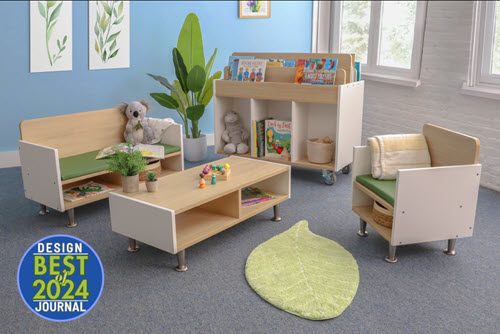
  • Whitney Brothers® elevatED™ CollectionReceives Design Journal BEST of 2024 Award

    Whitney Brothers® elevatED™ CollectionReceives Design Journal BEST of 2024 Award

    Keene, NH – Acclaimed furniture brand Whitney Brothers® today announced its new elevatED™ Collection of furniture for young learners received a BEST of 2024 award from Design Journal, a leading global trade resource for interior designers, architects and facility managers.

    A Design Journal panel of 2,400 internationally renowned interior designers, architects and facility managers cited the elevatED™ Collection’s distinct contemporary style and its inventive adaptation across 46 individual pieces in the collection. Each piece is constructed in textured white oak and white melamine structural elements that form crisp, pleasing lines with refined contrasting color accents. Brushed nickel legs add design counterpoint and rich visual interest.

    The elevatED™ Collection comprises 46 individual and modular pieces for young learner activities including art, STEM / sensory, literacy development, play, tables, seating, lockers and storage. Each piece is flexible, mobile or modular to enable furnishing a dynamic learning environment for young learners completely within the elevated™ Collection.

    Technical attributes of the collection include FSC certified wood material and Eco-Certified Composite (ECC) certification, an exemplary commitment to sustainability and environmental stewardship. The finish on each piece includes proven antimicrobial properties, an important attribute that contributes to the health and well-being of young children.

    “The Design Journal BEST of 2024 award recognizes how a fresh, modern expression of furniture can play a central role in creating a dynamic learning environment for our youngest learners,” said Mike Jablonski, president of Whitney Brothers®. “The elevatED™ Collection is another great example of our brand’s innovation and commitment to furnish learning environments that inspire and engage young children.”

    About Design Journal
    Design Journal is a leading international trade resource for interior designers, architects and facility managers since 1988. The Design Journal awards program is one of the most prominent design recognition platforms in the world for the fields of architecture and design. Each year, a global advisory board of 2,400 internationally renowned industry professionals preside over a rigorous evaluation process to select projects and products that represent the highest standards of design excellence.

    About Whitney Brothers®
    Founded in 1904, Whitney Brothers® is a 100% employee-owned producer of furniture for Early Learning and institutional childcare environments sold through educational distributors and dealers to schools, childcare centers, Head Start facilities, churches, libraries, museums and residential homes throughout North America and around the world. The brand’s rich 121-year history reflects old world craftsmanship blended with state of the art manufacturing technology to create products of uncompromising quality, design, innovation, safety, durability and value. Each product is UL GREENGUARD® Gold and antimicrobial certified, qualifies for LEED credits, meets or exceeds applicable CPSIA, ASTM and BIFMA requirements, supported by a Limited Lifetime Warranty and proudly made in America.

    eSchool News Staff
    Latest posts by eSchool News Staff (see all)

    Source link