Postcard views, luxurious watches, delicious cheese and chocolate — the country that comes to mind is idyllic Switzerland in central Europe.
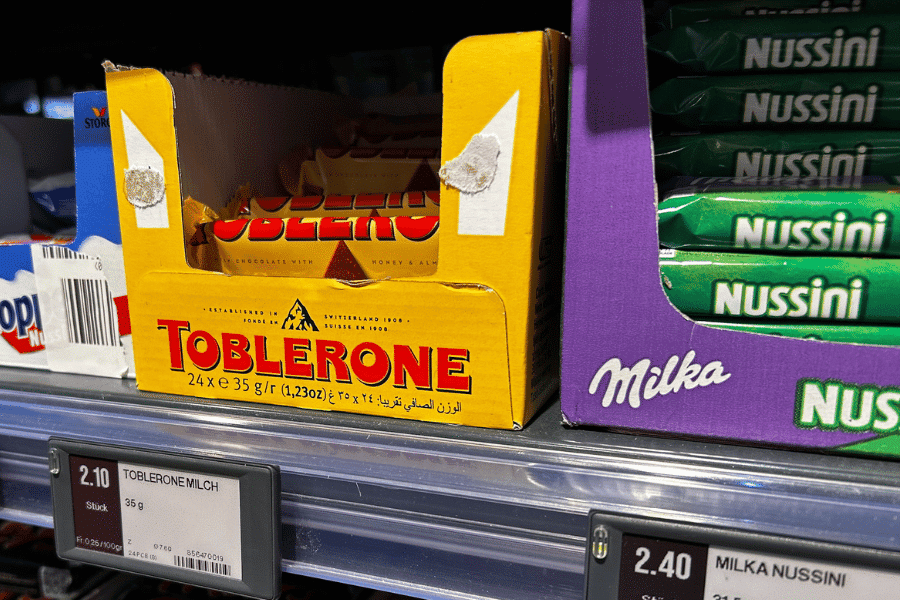
But this seemingly perfect country comes at a price: its high cost of living. According to Coop and Carrefour, two leading supermarket chains in Switzerland and France, one chocolate bar in Switzerland costs more than one and a half times as much as the same chocolate bar in neighbouring France.
“The price of chocolate with regards to its quality in Switzerland is fair and for me worth paying,” said Andrina Deragisch, a 17-year-old student of Kantonsschule Zürich Nord, a Swiss high school.
Chocolate’s price is affected by various factors, most importantly the price of the cocoa bean. Nowadays that is at an all-time high due to climate change, plant-affecting pests in Africa and East Asia and packaging prices and taxes. Its price is four to five times higher than a year ago, according to Migros, the second-largest retail company in Switzerland. But what makes the difference in Switzerland?
“The most significant factor is the labour,” says Richie Gray, global head of SnackFutures, the Corporate Venture Capital Hub of Mondelez that invests in businesses in the snack industry.
How much would you pay for a chocolate bar?
Workers in Switzerland are paid well, which makes them able to keep up with the high cost of living. This leads to a high-end price of chocolate in comparison to neighbouring countries. To avoid such high labour costs, Mondelez moved Toblerone’s production to Slovakia in 2023, imitating various international companies such as Nestlé and Barry Callebaut, that have shifted a great part of their production operations to Eastern Europe and Asia.
According to the 2017 “Swiss Manufacturing Survey“ from the University of St. Gallen, 46% of the interviewed firms are considering outsourcing parts of their manufacturing operations to China, Germany or Eastern Europe.
As a result, the Swiss manufacturing industry is seeing rising unemployment; the number of jobs has already fallen by 10% since 1990, and lower taxes from the international companies to Swiss authorities. In further development this leads to reduced purchasing power of customers and state incomes, weakening the country’s economy.
According to data from the Federal Statistical Office and the National Institute for Statistics and Economic Studies, the average Swiss person earns a little over 6,750 Swiss francs (CHF) monthly whereas in France, average wages are about 2,570 CHF a month. Switzerland counts as one of the best-earning countries in the world, creating a high-quality of life for its population.
According to Human Development Reports, Switzerland’s Human Development Index placed first among the whole world, providing wealth, comfort, material goods and exceptional healthcare and education.
A strong labour market
High productivity and competitiveness shape the Swiss labour market, said Christian Gast, chief economist at Swissrock, an asset management company based in Zurich. “Switzerland is considered to be fully employed, with only 1.3% of the entire population having no job,” he said.
The demand for labour results in high pay. Moreover, when people earn more, they have more money to spend on products like chocolate.
Another factor is the strong Swiss franc. The European Central Bank reports that the exchange rate between the Swiss franc and the euro has constantly increased from 0.87 EUR per Swiss franc in 2018 to around 1.06 EUR per Swiss franc today.
“If you’re coming from another country, you need more of your own currency to buy a Swiss franc,” Gast said.
But what makes the Swiss currency so strong?
“Our fiscal policy is strongly regulated,” Gast said. “This means the expenses of the government are largely balanced with its incomes.”
An attractive place for money
If there is a stable relationship between expenses and income, there is little debt result and interest rates remain low. This makes Switzerland attractive to international investors. Purchases are made within the country, boosting its economy and simultaneously its prices.
However, where does Switzerland’s well-working economy with excessive prices for services and products originate from? The small country in the heart of Europe with no environmental advantages developed into a financial powerhouse with banks as its mines.
According to the Swiss Bankers Association, Swiss banks held over a quarter of all assets present in all the banks across the globe in 2018. This means that 27.5% of global revenue, amounting to US.$6.5 trillion was stored in Swiss banks.
“There are barely any countries with more international banks than Switzerland,” Gast said. Since World War II, countless wealthy people have chosen to store their money in Swiss banks as Switzerland has a proven track record for its secrecy, neutrality and stable political system.
But wouldn’t there be frustration towards such high living costs among the population? On average, prices in Switzerland are 58.4% times higher than in the rest of the countries in the European Union. Consider that in the United States, Donald Trump won a second term as president in part because he promised lower prices and affordable living costs. However, Swiss people tend to accept the high prices in the country since the quality of life is also so high.
Additionally, the inflation rates in Switzerland are low — the price level has been relatively constant or only increasing minimally. According to the Federal Statistical Office, inflation rates were only at 1.1% in 2024, whereas in the United States it was at 2.9% in December 2024. People in the United States are displeased with the sudden higher prices which means they want a solution to solve this. At the same time, Swiss people have not experienced a drastic change and therefore are not as keen to make prices lower.
As Swiss people consume around 10kg of chocolate per person each year, there’s no doubting its popularity. We are both very fond consumers of Swiss chocolate and eat at least one bar of chocolate a week. The sweetness and comforting feeling of chocolate melting on your tongue is a sensation nobody can resist.