Everyone makes mistakes. To be credible you have to fess up when you get things wrong. Doing so doesn’t make you look bad. It shows you care about the truth.
Source link
Category: education
-

Top Tips: To err is human
-

Ignite Reading Again Approved as 1:1 High-Dosage Early Literacy Tutoring Provider in Massachusetts
BOSTON — Ignite Reading — a Science of Reading-based virtual tutoring program serving students in 18 states nationwide — today announced its approval by the Massachusetts Department of Elementary and Secondary Education (DESE) to continue providing 1:1 high-dosage evidence-based literacy tutoring to K-3 students across the commonwealth.
Massachusetts Governor Maura Healey’s administration called on her state to invest heavily in high-dosage tutoring (HDT) earlier this year, earmarking $25 million in her state budget proposal to help accelerate literacy growth, “complementing the more systemic, long-term improvement work” being supported under the administration’s five-year literacy improvement campaign, Literacy Launch.
In its approval process, DESE evaluated Ignite Reading’s services to Massachusetts districts over the past three school years and approved the literacy company to again provide school districts and charter schools with tutoring that is focused on building foundational skills — including phonological awareness, phonics knowledge and decoding skills — to help students become independent fluent readers in the early grades.
Since Ignite Reading first gained DESE approval during the 2022-23 school year:
- 30 Massachusetts schools and districts have partnered with Ignite Reading to provide students with 15 minutes of daily, 1:1 virtual tutoring.
- Ignite Reading’s tutor educators have delivered differentiated, evidence-based early literacy instruction to more than 7,800 Massachusetts students.
- Researchers at Johns Hopkins University’s Center for Research and Reform in Education have followed approximately 2,000 Massachusetts 1st graders enrolled in the program. The quasi-experimental study found the number of students reading on benchmark increased 213% after a year of Ignite Reading tutoring. At the same time, the percentage of students who required intensive reading intervention decreased 55%. All student groups — including Black and Hispanic students, those with IEPs and Multilingual Learners — had equitable skills growth, and those meeting end-of-year reading benchmarks grew more than 125%.
The Healey-Driscoll Administration recently announced that schools and districts in Massachusetts are invited to apply for high-dosage early literacy tutoring for K-3 students with 1st grade as the state’s top priority.
“When we get kids reading proficiently by the end of 1st grade, we set them up for a lifetime of academic success,” said Ignite Reading CEO Jessica Sliwerski. “Our continued approval by DESE means we can keep delivering the intensive, personalized support that Massachusetts 1st graders need to learn to read on grade level and on time. We are honored to be able to continue to partner with Massachusetts districts to ensure all students can access the tools they need to succeed as readers.”
For more information about Ignite Reading’s Massachusetts partnerships, visit https://info.ignite-reading.com/massachusetts.
About Ignite Reading
Ignite Reading is on a mission to ensure every student can access the tools they need to be a confident, fluent reader by the end of 1st grade. School districts nationwide depend on Ignite Reading’s virtual tutoring program to deliver literacy support at scale for students who need help learning to read. Our highly trained tutors provide students with 1:1 tutoring in foundational literacy skills each school day, helping them go from learning to read to reading to learn.
A recent study by the Center for Research and Reform in Education at Johns Hopkins University found that Ignite Reading students across demographics — including students who are English Learners, Black, Hispanic, and those with Individualized Education Programs (IEPs) — achieve the same outstanding gains of more than 5 months of additional learning during a single school year. For more information about Ignite Reading, visit www.ignite-reading.com.
Latest posts by eSchool News Staff (see all) -

How the House Budget Threatens Student-Athletes – Edu Alliance Journal
A Uniquely American Model Under Threat
June 8, 2025, by Dean Hoke: Intercollegiate athletics occupy a powerful and unique place in American higher education—something unmatched in any other country. From the massive media contracts of Division I football to the community pride surrounding NAIA and NJCAA basketball, college sports are a defining feature of the American academic landscape. Unlike most nations, where elite athletic development happens in clubs or academies, the U.S. integrates competitive sports directly into its college campuses.
This model is more than tradition; it’s an engine of opportunity. For many high school students—especially those from underserved backgrounds—the chance to play college sports shapes where they apply, enroll, and succeed. According to the NCAA, 35% of high school athletes say the ability to participate in athletics is a key factor in their college decision [1]. It’s not just about scholarships; it’s about identity, community, and believing their talents matter.
At smaller colleges and two-year institutions, athletics often serves as a key enrollment driver and differentiator in a crowded marketplace. International students, too, are drawn to the American system for its academic-athletic fusion, contributing tuition revenue and global prestige. Undermining this model through sweeping changes to federal financial aid, without considering the downstream effects, risks more than athletic participation. It threatens a distinctively American approach to education, access, and aspiration.
A New Threshold with Big Impacts
Currently, students taking 12 credit hours per semester are considered full-time and eligible for the maximum Pell Grant, which stands at $7,395 for 2024-25 [2]. The proposed House budget raises this threshold to 15 credit hours per semester. For student-athletes, whose schedules are already packed with training, competition, and travel, this shift could be devastating.
NCAA academic standards require student-athletes to maintain full-time enrollment (typically 12 hours) and make satisfactory academic progress [3]. Adding another three credit hours per term may force many to choose between academic integrity, athletic eligibility, and physical well-being. In sports like basketball, where teams frequently travel for games, or in demanding STEM majors, completing 15 credit hours consistently can be a formidable challenge.
Financial Impact on Student-Athletes
Key Proposed Changes Affecting Student-Athletes:
- Pell Grant Reductions: The proposed budget aims to cut the maximum Pell Grant by $1,685, reducing it to $5,710 for the 2026–27 academic year. Additionally, eligibility criteria would become more stringent, requiring students to enroll in at least 15 credit hours per semester to qualify for full-time awards. These changes could result in approximately 700,000 students losing Pell Grant eligibility [4].
- Elimination of Subsidized Loans: The budget proposes eliminating subsidized federal student loans, which currently do not accrue interest while a student is in school. This change would force students to rely more on unsubsidized loans or private lending options, potentially increasing their debt burden [5].
- Cuts to Work-Study and SEOG Programs: The Federal Work-Study program and Supplemental Educational Opportunity Grants (SEOG) are slated for significant reductions or elimination. These programs provide essential financial support to low-income students, and their removal could affect over 1.6 million students [6].
- Institutional Risk-Sharing: A new provision would require colleges to repay a portion of defaulted student loans, introducing a financial penalty for institutions with high default rates. This could strain budgets, especially at smaller colleges with limited resources [7].
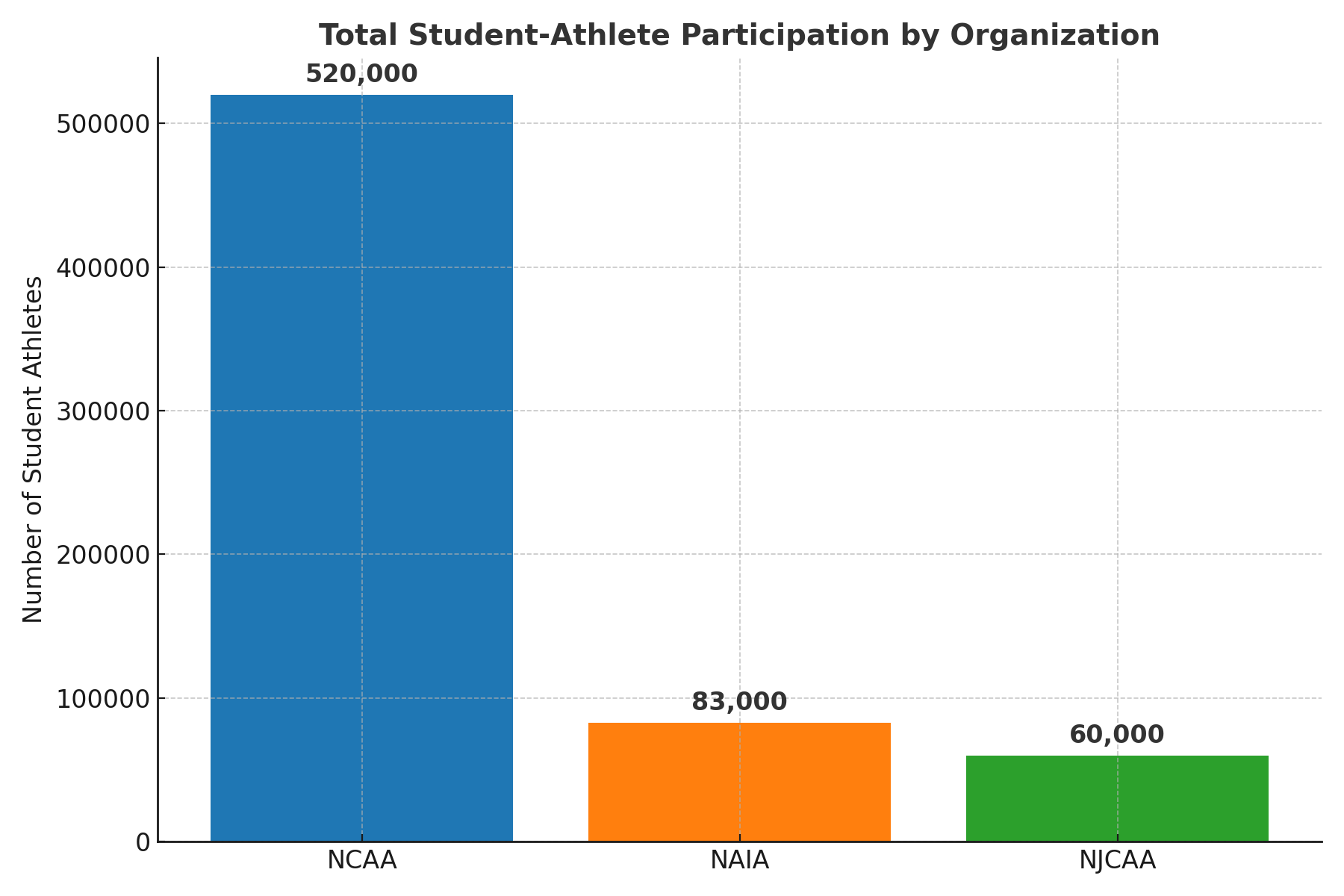
Figure 1: Total student-athletes by national athletic organization (NCAA, NAIA, NJCAA).
While Figure 1 highlights the total number of student-athletes in each organization, Figure 2 illustrates how deeply athletics is embedded in different types of institutions. NAIA colleges have the highest ratio, with student-athletes comprising 39% of undergraduate enrollment. Division III institutions follow at approximately 8.42%, and the NJCAA—serving mostly commuter and low-income students—relies on athletics for 8.58% of its total student base [8].
Even Division I, with its large student populations, includes a meaningful share (2.49%) of student-athletes. These proportions underscore how vital athletics are to institutional identity, especially in small colleges and two-year schools where athletes often make up a significant portion of campus life, retention strategy, and tuition revenue.
Figure 2: Percentage of student-athletes among total undergraduate enrollment by organization (NCAA Divisions I–III, NAIA, NJCAA).

The Pell Grant Profile: Who’s Affected
Pell Grants support students with the greatest financial need. According to a 2018 report, approximately 31.3% of Division I scholarship athletes receive Pell Grants. At individual institutions like Ohio State, the share is even higher: 47% of football players and over 50% of women’s basketball players. In the broader NCAA system, over 48% of athletes received some form of federal need-based aid in recent years [9].
There are approximately 665,000 student-athletes attending college. The NCAA reports that more than 520,000 student-athletes currently participate in championship-level intercollegiate athletics across Divisions I, II, and III [10]. The National Association of Intercollegiate Athletics (NAIA) oversees approximately 83,000 student-athletes [11], while the National Junior College Athletic Association (NJCAA) supports around 60,000 student-athletes at two-year colleges [12].
The NAIA and NJCAA systems, which serve many first-generation, low-income, and minority students, also have a high reliance on Pell Grant support. However, exact figures are less widely published.
The proposed redefinition of “full-time” means many of these students could lose up to $1,479 per year in aid, based on projections from policy experts [13]. For low-income students, this gap often determines whether they can afford to continue their education.
Fewer Credits, Fewer Dollars: Academic and Athletic Risks
Another major concern is how aid calculations based on “completed” credit hours will penalize students who drop a class mid-semester or fail a course. Even if a student-athlete enrolls in 15 credits, failing or withdrawing from a single 3-credit course could drop their award amount [14]. This adds pressure to persist in academically unsuitable courses, potentially hurting long-term academic outcomes.
Athletic departments, already burdened by compliance and recruitment pressures, may face added strain. Advisors will need to help students navigate increasingly complex eligibility and aid requirements, shifting focus from performance and development to credit-hour management.
Disproportionate Effects on Small Colleges and Non-Revenue Sports
The brunt of these changes will fall hardest on small, tuition-dependent institutions in the NCAA Division II, Division III, NAIA, and NJCAA. These colleges often use intercollegiate athletics as a strategic enrollment tool. At some NAIA schools, student-athletes comprise 40% to 60% of the undergraduate population [8].
Unlike large Division I schools that benefit from lucrative media contracts and booster networks, these institutions rely on a patchwork of tuition, modest athletic scholarships, and federal aid to keep programs running. A reduction in Pell eligibility could drive enrollment declines, lead to cuts in athletic offerings, and even force some colleges to close sports programs or entire campuses.
Already, schools like San Francisco State University, Cleveland State, and Mississippi College have recently announced program eliminations, citing budgetary constraints [15]. NJCAA institutions—the two-year colleges serving over 85,000 student-athletes—also face a precarious future under this proposed budget.
Economic Importance by Division
Division I: Athletics departments generated nearly $17.5 billion in total revenue in 2022, with $11.2 billion self-generated and $6.3 billion subsidized by institutional/government support or student fees [16]. Many Power Five schools are financially resilient, with revenue from TV contracts, merchandise, and ticket sales.
Division II: Median revenue for schools with football was around $6.9 million, but generated athletic revenue averaged only $528,000, leading to significant deficits subsidized by institutional funds [17].
Division III: Division III schools operate on leaner budgets, with no athletic scholarships and total athletics budgets often under $3 million per school. These programs are typically funded like other academic departments [18].
NAIA and NJCAA: These schools rely heavily on student-athlete enrollment to sustain their institutions. Athletics are not profit centers but recruitment and retention tools. Without Pell Grants, many of these athletes cannot afford to enroll [11][12].
Figure 3: Estimated number of NAIA, Division III, and NJCAA programs by state.

Unintended Tradeoffs: Equity and Resource Redistribution
Attempting to offset lost federal aid by reallocating institutional grants could result in aid being shifted away from non-athletes. This risks eroding equity goals, as well as provoking internal tension on campuses where athletes are perceived to receive preferential treatment.
Without new revenue sources, institutions may also raise tuition or increase tuition discounting, potentially compromising their financial stability. In essence, colleges may be forced to choose who gets to stay in school.
The High-Stakes Gamble for Student-Athletes
Figure 4: Estimated impact of Pell Grant changes on student-athletes, including projected dropouts and loan default rates.

For many student-athletes, especially those from low-income backgrounds, the Pell Grant is not just helpful—it’s essential. It makes the dream of attending college, competing in athletics, and earning a degree financially feasible. If the proposed changes to Pell eligibility become law, an estimated 50,000 student-athletes could be forced to drop out, unable to meet the new credit-hour requirements or fill the funding gap [19]. Those who remain may have no choice but to take on additional loans, risking long-term debt for a degree they may never complete. The reality is sobering: Pell recipients already face long-term student loan default rates as high as 27%, and for those who drop out, that figure climbs above 40% [20]. Stripping away vital support will almost certainly drive those numbers higher. The consequences won’t stop with individual students. Colleges—particularly smaller, tuition-dependent institutions where athletes make up a significant share of enrollment—stand to lose not just revenue, but the very programs and communities that give purpose to their campuses.
Colleges, athletic associations, policymakers, and communities must work together to safeguard opportunity. Student-athletes should never be forced to choose between academic success and financial survival. Preserving access to both education and athletics isn’t just about individual futures—it’s about upholding a uniquely American pathway to achievement and equity.
Dean Hoke is Managing Partner of Edu Alliance Group, a higher education consultancy. He formerly served as President/CEO of the American Association of University Administrators (AAUA). With decades of experience in higher education leadership, consulting, and institutional strategy, he brings a wealth of knowledge on small colleges’ challenges and opportunities. Dean is the Executive Producer and co-host for the podcast series Small College America.
References
- NCAA. (n.d.). Estimated probability of competing in college athletics. Retrieved from https://www.ncaa.org/sports/2021/11/4/estimated-probability-of-competing-in-college-athletics.aspx
- Federal Student Aid. (2024). Federal Pell Grants. Retrieved from https://studentaid.gov/understand-aid/types/grants/pell
- NCAA. (n.d.). Academic Standards and Eligibility. Retrieved from https://www.ncaa.org/sports/2021/6/17/academic-eligibility.aspx
- Washington Post. (2025, May 17). Most Pell Grant recipients to get less money under Trump budget bill, CBO finds. Retrieved from https://www.washingtonpost.com/education/2025/05/17/pell-grants-cbo-analysis/
- NASFAA. (2024). Reconciliation Deep Dive: House Committee Proposes Major Overhaul of Federal Student Loans, Repayment, and PSLF. Retrieved from https://www.nasfaa.org/news-item/36202/Reconciliation_Deep_Dive_House_Committee_Proposes_Major_Overhaul_of_Federal_Student_Loans_Repayment_and_PSLF?utm
- U.S. Department of Education, FY2025 Budget Summary. (2024). Proposed Cuts to Campus-Based Aid Programs. Retrieved from https://www2.ed.gov/about/overview/budget/index.html
- Congressional Budget Office. (2025). Reconciliation Recommendations of the House Committee on Education and the Workforce. Retrieved from https://www.cbo.gov/publication/61412
- NJCAA, NAIA, and NCAA. (2023). Student-Athlete Participation Reports.
- NCAA. (2018). Pell Grant data and athlete demographics. Retrieved from https://www.ncaa.org/news/2018/4/24/research-pell-grant-data-shows-diversity-in-division-i.aspx
- NCAA. (2023). 2022–23 Sports Sponsorship and Participation Rates Report. Retrieved from https://www.ncaa.org/research
- NAIA. (2023). NAIA Facts and Figures. Retrieved from https://www.naia.org
- NJCAA. (2023). About the NJCAA. Retrieved from https://www.njcaa.org
- The Institute for College Access & Success (TICAS). (2024). Analysis of Proposed Pell Grant Reductions. Retrieved from https://ticas.org
- Education Trust. (2024). Consequences of Redefining Full-Time Status for Financial Aid. Retrieved from https://edtrust.org
- ESPN. (2024, March); AP News. (2024, November). Athletic program eliminations at Cleveland State and Mississippi College.
- Knight Commission on Intercollegiate Athletics. (2023). College Athletics Financial Information (CAFI). Retrieved from https://knightnewhousedata.org
- NCAA. (2022). Division II Finances: Revenues and Expenses Report. Retrieved from https://www.ncaa.org/sports/2022/6/17/finances.aspx
- NCAA. (2023). Division III Budget Reports and Trends. Retrieved from https://www.ncaa.org
- Internal projection based on available data from NCAA, NAIA, NJCAA, and CBO Pell Grant impact estimates.
- Brookings Institution. (2018). The looming student loan default crisis is worse than we thought. Retrieved from https://www.brookings.edu/articles/the-looming-student-loan-default-crisis-is-worse-than-we-thought
-

Why Teachers Can’t Afford to Wait on the Sidelines
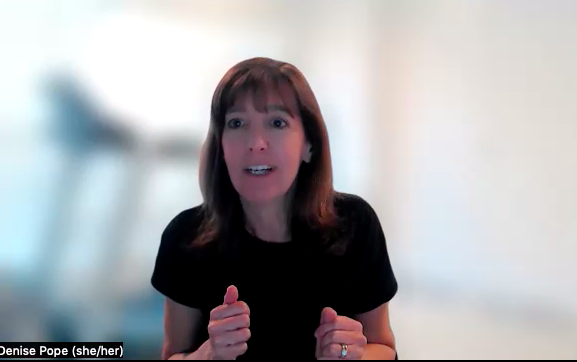
Tired of talking about AI? That’s too bad. The technology remains the most impactful force in education. The challenge becomes avoiding all the Claptrap. Thankfully, that’s where Denise Pope, Co-Founder of Challenge Success at the Stanford Graduate School of Education, comes in.
I had the chance to explore the current AI state-of-play from her perspective. One striking disparity I haven’t heard talked about: While AI usage among students has skyrocketed—from 25% to 60% at the middle school level and 45% to 75% at the high school level over just two school years—only 32% of teachers report using AI for academic purposes.
This gap has created what Denise describes as an educational “La La Land,” where students are experimenting with AI tools while many schools lack clear policies or guidance. The absence of structured approaches is breeding anxiety among both educators and students, who are left wondering when and how AI should appropriately be used in academic settings.
Click through to hear how Denise believes this issue can be addressed:
Latest posts by Kevin Hogan (see all) -

Teacher stress levels have surpassed pandemic-era highs
Key points:
America’s K-12 educators are more stressed than ever, with many considering leaving the profession altogether, according to new survey data from Prodigy Education.
The Teacher Stress Survey, which polled more than 800 K-12 educators across the U.S., found that nearly half of teachers (45 percent) view the 2024-25 school year as the most stressful of their careers. The surveyed educators were also three times more likely to say that the 2024-25 school year has been the hardest compared to 2020, when they had to teach during the height of the COVID-19 pandemic.
Student behavior challenges (58 percent), low compensation (44 percent), and administrative demands (28 percent) are driving teacher burnout and turnover at alarming rates. Public school teachers were more likely to report stress from unrealistic workloads, large class sizes, school safety concerns, and student behavior issues than their private school counterparts.
“The fact that stress levels for so many teachers have exceeded those of the pandemic era should be a wake-up call,” said Dr. Josh Prieur, director of education enablement at Prodigy Education and former assistant principal in the U.S. public school system. “Teachers need tangible, meaningful, and sustained support … every week of the year.”
Additional key findings include:
- The vast majority of teachers (95 percent) are experiencing some level of stress, with more than two-thirds (68 percent) reporting moderate to very high stress. K-5 teachers were the most likely to feel extremely/very stressed (33 percent). Sixty-three percent of teachers report that their current stress levels are higher than when they first started teaching.
- Nearly one in 10 teachers surveyed (9 percent) are planning to leave the profession this year, while nearly one in four (23 percent) are actively thinking about it. One-third of teachers do not expect to be teaching three years from now, likely because nearly half (48 percent) of teachers don’t feel appreciated for the work that they do.
- Teachers are finding ways to prioritize their well-being, but time limits and job pressures often get in the way. Seventy-eight percent of teachers say they actively make time for self-care, but nearly half (43 percent) feel guilty for spending time on self-care and 78 percent have skipped self-care due to work demands. Implementing school-provided self-care perks and mandatory self-care breaks would appeal to teachers, with 85 percent and 76 percent taking advantage of each benefit, respectively.
- Top solutions that would reduce teachers’ stress include a higher salary (59 percent), a four-day school week (33 percent), stronger classroom discipline policies (32 percent), and smaller class sizes (25 percent). Public school teachers were more likely to prefer a shorter week, while private school educators opted for higher pay.
“Teacher Appreciation Week should serve as the starting point for building systems that show we value teachers’ time, talent, and well-being,” said Dr. Prieur. “Districts can do this by investing in tools that reduce the burden on teachers, prioritizing time for self-care and implementing policies that reinforce teachers’ value as an ongoing commitment to bettering the profession.”
This press release originally appeared online.
Latest posts by Laura Ascione (see all) -

Why Global Talent is Turning Away from U.S. Higher Education—and What We’re Losing – Edu Alliance Journal
In 2025, much of my professional focus has been on small colleges in the United States. But as many of you know, my colleague and Edu Alliance co-founder, Dr. Senthil Nathan, and I also consult extensively in the international higher education space. Senthil, based in Abu Dhabi, UAE—where Edu Alliance was founded was asked by a close friend of ours, Chet Haskell, about how the Middle East and its students are reacting to the recent moves by the Trump Administration. Dr. Nathan shared a troubling May 29th article from The National, a UAE English language paper titled, “It’s not worth the risk”: Middle East students put US dreams on hold amid Trump visa crackdown.
The article begins with this chilling line:
“Young people in the Middle East have spoken of their fears after the US government decided to freeze overseas student interviews and plan to begin vetting their social media accounts. The directive signed by Secretary of State Marco Rubio and sent to diplomatic and consular posts halts interview appointments at US universities.”
The UAE, home to nearly 10 million people—90% of whom are expatriates—is a global crossroads. Many of their children attend top-tier international high schools and are academically prepared to study anywhere in the world. Historically, the United States has been a top choice for both undergraduate and graduate education.
But that is changing.
This new wave of student hesitation, and in many cases fear, represents a broader global shift. Today, even the most qualified international students are asking whether the United States is still a safe, welcoming, or stable destination for higher education. And their concerns are justified.
At a time when U.S. institutions are grappling with enrollment challenges—including a shrinking pool of domestic high school graduates—we are simultaneously sending signals that dissuade international students from coming. That’s not just bad policy. It’s bad economics.
According to NAFSA: Association of International Educators, international students contributed $43.8 billion to the U.S. economy during the 2023–2024 academic year and supported 378,175 jobs across the country. These students fill key seats in STEM programs, support local economies, and enrich our campuses in ways that go far beyond tuition payments.
And the stakes go beyond higher education.
A 2024 study found that 101 companies in the S&P 500 are led by foreign-born CEOs. Many of these executives earned their degrees at U.S. universities, underscoring how American higher education is not just a national asset but a global talent incubator that fuels our economy and leadership.
Here are just a few examples:
- Jensen Huang: Born in Taiwan (NVIDIA) – B.S. from Oregon State, M.S. from Stanford
- Elon Musk: Born in South Africa (Tesla, SpaceX) – B.A. from the University of Pennsylvania
- Sundar Pichai: Born in India (Alphabet/Google) – M.S. from Stanford, MBA from Wharton
- Mike Krieger: Born in Brazil (Co-founder of Instagram) B.S. and M.S. Symbolic Systems and Human-Computer Interaction, Stanford University
- Satya Nadella: Born in India (Microsoft) – M.S. from the University of Wisconsin–Milwaukee, MBA from the University of Chicago
- Max Levchin: Born in Ukraine (Co-founder of PayPal, Affirm), Bachelor’s in Computer Science, University of Illinois at Urbana-Champaign
- Arvind Krishna: Born in India (IBM) – Ph.D. from the University of Illinois, Urbana-Champaign
- Safra Catz: Born in Israel (Oracle) – Undergraduate & J.D. from University of Pennsylvania
- Jane Fraser: Born in the United Kingdom (Citigroup) – MBA from Harvard Business School
- Nikesh Arora: Born in India (Palo Alto Networks) – MBA from Northeastern
- Jan Koum: Born in Ukraine (Co-founder of WhatsApp), Studied Computer Science (did not complete degree) at San Jose State University
These leaders represent just a fraction of the talent pipeline shaped by U.S. universities.
According to a 2023 American Immigration Council report, 44.8% of Fortune 500 companies were founded by immigrants or their children, including iconic firms like Apple, Google, and Tesla. Together, these companies generate $8.1 trillion in annual revenue and employ over 14.8 million people globally.
The Bottom Line
The American higher education brand still carries immense prestige. But prestige alone won’t carry us forward. If we continue to restrict and politicize student visas, we will lose not only potential students but also future scientists, entrepreneurs, job creators, and community leaders.
We must ask: Are our current policies serving national interests, or undermining them?
Our classrooms, campuses, corporations, and communities are stronger when they include the world’s brightest minds. Let’s not close the door on a future we have long helped build.
Dean Hoke is Managing Partner of Edu Alliance Group, a higher education consultancy. He formerly served as President/CEO of the American Association of University Administrators (AAUA). With decades of experience in higher education leadership, consulting, and institutional strategy, he brings a wealth of knowledge on international partnerships and market evaluations.
-

Top Tips: Be naive
Young people are often accused of naivety. But in journalism, naivety can be powerful.
Being naive means sounding innocent or unsophisticated about something. You often get accused of naivety when you question why things are the way they are. Many people hate being accused of that, so they accept generally accepted standards — a fancy term I like is “prevailing paradigms.”
Often these are notions that some problems are so rooted that they can’t be fixed so you just have to accept them: polluted rivers or entrenched corruption or homelessness or discriminatory policies.
When you question these notions you might be accused of being naive. I say wear that like a badge. Why? Because if we accept problems without seeking solutions we won’t ever improve a community or society or nation. And that means that you must reject the idea that some problems can’t be solved.
It means we have to go back to the idea that everyone deserves clean air and water, healthy food, a basic education, shelter and safety. Nowadays you might add internet access, heat and electricity to that list and maybe a decent transportation system. The more I add, the more naive I sound.
Question prevailing paradigms.
Good journalism comes from asking why people don’t have these things, not from accepting that they don’t have them.
So I suggest this: Draw an imaginary line. It represents a perfect world. In a perfect world everyone would have those things I listed: clean air and water, healthy food, etc. Then draw a line next to it that represents the current situation, and make the space between them wider the more off we are from that perfect world. Therein lies your story.
How far off is your community from having clean water or clean air? How bad are diets or how bad is the food shortage?
Then ask why. Why are people drinking or fishing out of contaminated water streams? Why are people going hungry? Why are people homeless? These are basic questions that come from the naive perspective that these problems shouldn’t exist in a perfect world.
Only when you ask these questions can you get to the heart of causes. Here is the hard part. The accusation of naivety comes not because these problems can’t be solved. It comes because the solutions are complicated. Sometimes they are really complicated. So the naivety comes in the idea that no one — including you or me — is willing to take the time and effort and brain power to unravel all those complications to get to solutions.
Prove them wrong.
This all gets to the two traits that make someone a great journalist: Persistence and patience. It is the persistence to not just walk away when someone tells you that you are being naive or that a problem is too complicated, and the patience to work through the complicated elements.
All the complications people will throw at you are like protective layers around a problem. They are like the levels you need to surmount in a video game.
Once you peel them away, you get to causes that are pretty basic: Not enough money because people with money aren’t willing to spend it; a lack of power because people with power aren’t willing to cede it; and basic human failings like racism, homophobia, sexism or greed.
If you can call out people or communities or government representatives on their racism or homophobia or sexism or greed, maybe you can get them to work on solutions. Only by finding solutions to problems can we get a little closer to that perfect world.
Isn’t a perfect world the one you want to work towards? Or am I being naive?
Questions to consider:
1. What does the author mean by “prevailing paradigms”?
2. Why can naivety be powerful in journalism?
3. What are some problems in your community that people seem to accept without question?
-

Why agentic AI matters now more than ever
Key points:
For years now, the promise of AI in education has centered around efficiency–grading faster, recommending better content, or predicting where a student might struggle.
But at a moment when learners face disconnection, systems are strained, and expectations for personalization are growing, task automation feels…insufficient.
What if we started thinking less about what AI can do and more about how it can relate?
That’s where agentic AI comes in. These systems don’t just answer questions. They recognize emotion, learn from context, and respond in ways that feel more thoughtful than transactional. Less machine, more mentor.
So, what’s the problem with what we have now?
It’s not that existing AI tools are bad. They’re just incomplete.
Here’s where traditional AI systems tend to fall short:
- NLP fine-tuning
Improves the form of communication but doesn’t understand intent or depth. - Feedback loops
Built to correct errors, not guide growth. - Static knowledge bases
Easy to search but often outdated or contextually off. - Ethics and accessibility policies
Written down but rarely embedded in daily workflows. - Multilingual expansion
Translates words, not nuance or meaning across cultures.
These systems might help learners stay afloat. They don’t help them go deeper.
What would a more intelligent system look like?
It wouldn’t just deliver facts or correct mistakes. A truly intelligent learning system would:
- Understand when a student is confused or disengaged
- Ask guiding questions instead of giving quick answers
- Retrieve current, relevant knowledge instead of relying on a static script
- Honor a learner’s pace, background, and context
- Operate with ethical boundaries and accessibility in mind–not as an add-on, but as a foundation
In short, it would feel less like a tool and more like a companion. That may sound idealistic, but maybe idealism is what we need.
The tools that might get us there
There’s no shortage of frameworks being built right now–some for developers, others for educators and designers. They’re not perfect. But they’re good places to start.
Framework Type Use LangChain Code Modular agent workflows, RAG pipelines Auto-GPT Code Task execution with memory and recursion CrewAI Code Multi-agent orchestration Spade Code Agent messaging and task scheduling Zapier + OpenAI No-code Automated workflows with language models Flowise AI No-code Visual builder for agent chains Power Automate AI Low-code AI in business process automation Bubble + OpenAI No-code Build custom web apps with LLMs These tools are modular, experimental, and still evolving. But they open a door to building systems that learn and adjust–without needing a PhD in AI to use them.
A better system starts with a better architecture
Here’s one way to think about an intelligent system’s structure:
Learning experience layer
- Where students interact, ask questions, get feedback
- Ideally supports multilingual input, emotional cues, and accessible design
Agentic AI core
- The “thinking” layer that plans, remembers, retrieves, and reasons
- Coordinates multiple agents (e.g., retrieval, planning, feedback, sentiment)
Enterprise systems layer
- Connects with existing infrastructure: SIS, LMS, content repositories, analytics systems
This isn’t futuristic. It’s already possible to prototype parts of this model with today’s tools, especially in contained or pilot environments.
So, what would it actually do for people?
For students:
- Offer guidance in moments of uncertainty
- Help pace learning, not just accelerate it
- Present relevant content, not just more content
For teachers:
- Offer insight into where learners are emotionally and cognitively
- Surface patterns or blind spots without extra grading load
For administrators:
- Enable guardrails around AI behavior
- Support personalization at scale without losing oversight
None of this replaces people. It just gives them better support systems.
Final thoughts: Less control panel, more compass
There’s something timely about rethinking what we mean by intelligence in our learning systems.
It’s not just about logic or retrieval speed. It’s about how systems make learners feel–and whether those systems help learners grow, question, and persist.
Agentic AI is one way to design with those goals in mind. It’s not the only way. But it’s a start.
And right now, a thoughtful start might be exactly what we need.
Latest posts by eSchool Media Contributors (see all) - NLP fine-tuning
-

Federal judge blocks Trump’s Education Dept. shutdown, orders reinstatement of laid off staff
This story was originally published by Chalkbeat. Sign up for their newsletters at ckbe.at/newsletters.
A federal judge on May 22 issued a preliminary injunction blocking President Donald Trump’s executive order to shut down the U.S. Department of Education and said the agency must reinstate the employees who were fired as part of mass layoffs.
After U.S. Education Secretary Linda McMahon announced the agency’s plans in March to slash its workforce by roughly half, she called it a first step in getting rid of the agency. Trump followed days later with his executive order aiming to eliminate the department, a move he has long wanted.
But only Congress can actually eliminate the department, and the administration’s attempt at getting around that influenced U.S. District Judge Myong Joun’s Thursday ruling.
The Trump administration argued that they implemented agency layoffs to improve “efficiency” and “accountability,” the Massachusetts judge wrote, but then said: “The record abundantly reveals that [the administration’s] true intention is to effectively dismantle the Department without an authorizing statute.”
Joun added: “A department without enough employees to perform statutorily mandated functions is not a department at all. This court cannot be asked to cover its eyes while the Department’s employees are continuously fired and units are transferred out until the Department becomes a shell of itself.”
Within hours of the Joun’s ruling, the Trump administration filed an appeal.
“This ruling is not in the best interest of American students or families,” Madi Biedermann, Deputy Assistant Secretary for Communications, wrote in a statement.
Calls for the injunction came from lawsuits filed by the Somerville and Easthampton schools districts in Massachusetts along with the American Federation of Teachers, other education groups, and 21 Democratic attorneys general.
They argued that the gutting of the department rendered the agency incapable of performing many of its core functions required by Congress.
For example, all of the attorneys from the agency’s general counsel office who handle grants for K-12 schools and grants under the Individuals with Disabilities Education Act, or IDEA, had been fired. The dismantling of the Office for Civil Rights made it difficult to enforce civil rights protections. The department’s Financial Student Aid programs, which provide financial assistance to almost 12.9 million students across approximately 6,100 postsecondary educational institutions, were also hampered.
Trump’s executive order instructed McMahon to “take all necessary steps to facilitate the closure of the Department of Education and return authority over education to the States and local communities” to the “maximum extent appropriate and permitted by law.”
At the same time, the order said McMahon should ensure “the effective and uninterrupted delivery of services, programs, and benefits on which Americans rely.”
Trump said he would move the agency’s student loan portfolio to the Small Business Administration, and the Department of Health and Human Services would replace the Education Department’s role in “handling special needs.”
Before the layoffs, the Education Department was the smallest of the 15 cabinet-level departments in terms of staffing, according to the judge, with around 4,100 employees. And the plaintiffs said the agency was strained meeting its obligations even then.
The ruling was not based on the employees’ job rights, but rather how the agency was able to fulfill its obligations.
“It’s not about whether employees have a right to a job,” said Derek Black, a University of South Carolina law professor. “It’s about whether the department can fulfill its statutory obligations to the states and to students.”
The case made by former department employees, educational institutions, unions, and educators, Joun wrote, paints “stark picture of the irreparable harm that will result from financial uncertainty and delay, impeded access to vital knowledge on which students and educators rely, and loss of essential services for America’s most vulnerable student populations.”
American Federation of Teachers President Randi Weingarten heralded the judge’s ruling, calling it “a first step to reverse this war on knowledge and the undermining of broad-based opportunity.”
But Biedermann, from the Education Department, said the ruling was unfair to the Trump administration.
“Once again, a far-left Judge has dramatically overstepped his authority, based on a complaint from biased plaintiffs, and issued an injunction against the obviously lawful efforts to make the Department of Education more efficient and functional for the American people,” she said in a statement.
Chalkbeat national editor Erica Meltzer contributed reporting.
Chalkbeat is a nonprofit news site covering educational change in public schools.
For more news on federal policy, visit eSN’s Educational Leadership hub.
Latest posts by eSchool Media Contributors (see all) -

Maine Parents, Educators Describe Trauma from Restraint and Seclusion – The 74
Get stories like this delivered straight to your inbox. Sign up for The 74 Newsletter
Krystal Emerson never imagined her son would spend his days at school being forcibly moved against his will by school staff and shut in an empty room.
But during the 2023-24 school year at Ellsworth Elementary-Middle School, that’s what happened — at least 18 times, according to Emerson and school district incident reports reviewed by the Maine Morning Star. Staff members put the 7-year-old boy in holds, forced him into empty rooms and did not let him out until he calmed down or his parents picked him up.
“It broke him, and it broke me,” Emerson said.
The trauma became so severe that her son, now a third grader, no longer attends school in person, she said.
What happened to Emerson’s son is not an isolated case. Across Maine, schools use restraint and seclusion on students more than 10,000 times each year, according to Maine Department of Education data — with some districts resorting to the emergency tactics regularly while others have changed policies and taken other steps so that such interventions are only used as a last resort.
In recent years, Maine as a whole has made an effort to reduce restraint and seclusion in schools, particularly for students with disabilities, with the U.S. Department of Education citing staff and student injuries and the resulting trauma for students as the reasons to curtail their use. The department has also condemned and discouraged these practices for years under multiple presidential administrations. Rare cases have resulted in serious injuries to students and even death.
A 2021 state law limits restraint and seclusion to emergencies. But as Maine educators report more challenging student behavior in the years since pandemic school closures, there have been calls to allow school staff to restrain and seclude children more often. A newly proposed bill would broaden the circumstances under which school staff could restrain or seclude students, igniting debate among educators, parents and lawmakers about how to manage student behavior without inflicting harm.
The Maine Education Association and the Maine School Management Association, representing teachers and administrators statewide, both support the proposal, citing increased reports of disruptive and violent student behavior — something educators nationwide have also reported in recent years.
The Gardiner-area school system, Maine School Administrative District (MSAD) 11, has led the push for that proposal. Victoria Duguay, principal of River View Community School in Gardiner, and MSAD 11 Superintendent Patricia Hopkins shared stories with lawmakers of students who hit and spit at adults, scream in hallways, throw chairs and destroy other students’ schoolwork.
Under the 2021 state law, school staff can only restrain students (immobilize them and move them against their will) or seclude them (isolate them in a room that they can’t leave) if their behavior “poses an imminent danger of serious physical injury” — requiring medical intervention beyond first aid, according to the Maine Department of Education regulations that govern restraint and seclusion.
“Staff are being hit, they’re being bit, but it doesn’t meet the threshold of serious imminent danger, because a 5-year-old isn’t going to [cause] an injury that requires medical care,” Hopkins said during an April 23 public hearing.
This extreme behavior, when it happens in a public place at school, traumatizes other students who witness it, Duguay said. The school sometimes has to close off access to common spaces — the gym or cafeteria — if a student acts out in a hallway through which students would need to pass.
Under the legislation MSAD 11 is supporting, staff would be able to move students against their will to a seclusion room or another quiet space without it counting as a restraint, which districts have to record, document, and report to the state.
But some educators who have pursued alternative training don’t agree that loosening restraint and seclusion requirements is the answer.
“The consequences of passing this bill will only inflict more trauma on students,” said Audrey Bartholomew, associate professor and coordinator of special education programs at the University of New England, who trains special education teachers. “Additionally, the behavior will keep happening, because restraint and seclusion is not an appropriate response to challenging behavior, and it will in no way help students remediate their behavior. These should not be referred to as strategies, treatments or solutions.”
Inside the three-hour restraint and seclusion of a 7-year-old
In October 2023, Emerson’s son started a behavior plan to help with concentration and self-regulation. The plan, which Emerson shared with the Maine Morning Star, highlighted the mother’s concerns about her son’s anger, dysregulation, anxiety and ADHD, and noted Emerson’s finding that occupational therapy had helped her son better regulate.
One week after the plan was put into place, the boy arrived at Ellsworth Elementary-Middle School already agitated, hit another student with a Pete the Cat stuffed animal and tried to leave the classroom, setting off a series of escalating interventions in which staff physically restrained him, relocated him against his will, and ultimately placed him in a small room where he stayed until his father arrived, according to incident reports shared with the Maine Morning Star.
The reports, which staff or administrators are required to write, offer an inside look at the behavior leading up to the restraint, how the situation escalated as staff restrained and secluded the boy, and how it continued for three hours, ending when Seth Emerson picked his son up from a seclusion room.
When the second grader initially tried to leave his classroom, two educators cornered the boy in a hallway nook, according to the report written by the school’s assistant principal. When he tried to push past them, they placed a mat between themselves and the child to block him from hitting them, and initiated the first of several physical holds. Each time he was released, he briefly calmed down but didn’t follow directions to sit still or stay in a designated spot, prompting a cycle: he would attempt to flee, staff would block him, the boy would resist, and staff would restrain him again, the report says.
About an hour in, while hiding in a locker, he asked to go home. A staff member moved him to a classroom, where he hid under a desk, retrieved rocks from his backpack, and threw them at staff, the report said. While the report described the projectiles as rocks, Emerson said her son had pebbles in his backpack.
Two hours in, staff called his parents. Even after he calmed down, they placed him in a seclusion room — referred to as a “quiet room” in the report — where they continued telling him to sit in a specific spot. When his father arrived, the boy walked out on his own, calm and cooperative.
Incidents like that continued for several more months for reasons that Emerson said did not warrant these measures: After he pulled books off shelves, punched a door, or refused to accompany staff to a quiet room, staff would put him in a physical hold or placed him in a room alone, according to a complaint Emerson filed with the district.
“I never condoned any of the behavior, whether he was throwing a book or whether he was yelling or running out of the classroom,” she said. “But he was not getting any education whatsoever last year. He was literally just going to school and being restrained and secluded.”
Frequent seclusions push an educator to quit
It’s not only students and their families who feel the trauma from restraints and seclusion. The educators who are told to put their hands on children feel it, too, several current and former teachers and education technicians told the Maine Morning Star.
Ashley Rose took a job as an ed tech at SeDoMoCha Elementary School in Dover-Foxcroft in August while working toward a degree in special education. But after months of witnessing staff placing students in empty rooms as they screamed and cried to be let out, she changed course.
In March, Rose switched her major, deciding she no longer wanted to become a teacher. On April 28, she resigned, writing to Superintendent Stacy Shorey that she had repeatedly raised concerns with supervisors about the school’s frequent use of seclusion, the lack of staff training on student behavior, and the absence of alternatives — without seeing meaningful change.
SeDoMoCha Elementary School has “quiet rooms” located within special education classrooms — which Rose described as 10-by-6-foot rooms with no windows. Some have benches and one light, while others are entirely empty, she said. All the doors have windows in them so staff can monitor students.
In her 10 years of working in special education, she has never seen such frequent use of quiet rooms, Rose said.
In December, Rose found herself participating in her first seclusion. The student she was working with wasn’t physically aggressive, just loud, and Rose’s plan had been to escort her into the special education classroom — not the quiet room — to help her calm down.
The student went with her voluntarily but was crying, she said. When they got to the classroom, another staff member who had worked at the school longer said it was part of that student’s behavior plan to go to the quiet room.
“That wasn’t my plan,” Rose said. “That room scares me just looking at it as an adult.”
As the student became more agitated, Rose said her own anxiety rose. If the student didn’t calm down, the other employee told Rose she had to shut the door. Rose complied, and then her colleague told her to hold the door shut with her foot to keep the student inside, she said.
Inside the room, the student began having what appeared to be an anxiety attack and threatened to break the window. She calmed down after about 20 minutes, and Rose let her out. Rose said she was not directed to file an incident report, nor was she told if someone else in the district did, despite the requirement in state law that districts document every seclusion.
Over the holiday break that followed, Rose said she had trouble sleeping. “All I can think about is the student I put in that room,” she said. “School should be their safe place, and these students were not feeling safe.”
Shorey, the superintendent, said staff members are required to report every incident, but she did not know about the particular incident Rose described. Special Education Director Sue Terrill said it’s possible that a staff member other than Rose wrote a report, but the district was unable to locate any documentation of that event.
The district trains employees in safety care — crisis management and prevention practices — Terrill said. It is open to other trainings, too, she said, including one that Rose brought to Terrill’s attention in February offered by the Maine nonprofit Lives in the Balance, which other districts have used to dramatically reduce their reliance on restraint and seclusion.
Quiet rooms present a gray area
Rose said she saw staff members keep students in seclusion rooms even when they were calm, using those same rooms for a variety of reasons beyond seclusion, which is banned or strictly regulated in at least seven states, according to the MOST Policy Initiative, a Missouri nonprofit. Maine came close to banning the rooms in 2021, but the final version of the law was amended to allow their use in emergencies.
Rose said she saw staff place students in quiet rooms to calm down after acting out, and then not allow them to exit for 20 minutes after they calmed down. If the seclusion happened at the end of the school day, sometimes the student would be expected to return to the quiet room the next day, she said.
Terrill recalled Rose raising this as an issue but denied keeping students in the rooms after they calmed down and no longer met the legal threshold for confinement.
But the district does use these rooms as timeout spaces, either by student choice or by staff direction, Terrill confirmed. Often, Terrill said, staff members are positioned outside the rooms, as they would be in a seclusion incident, but the student is typically free to leave the room, which is not the case in a seclusion.
Sometimes, the door is open, or a student can choose to shut the door with a staff member standing outside, she said.
“It can be the same room used if the student was in seclusion,” she said. “But if they’re taking a break because of something that happened, and that’s being used as a break space, the student might continue to work in there until they’re ready to go back to the classroom.”
Like RSU 68 in Dover-Foxcroft, districts across Maine also use seclusion rooms as quiet spaces, according to Ben Jones, a former Disability Rights Maine attorney who now works for Lives in the Balance.
“I think it’s actually more the rare case that the school is like, ‘We’re going to build this room and we’re going to call it the seclusion room, and it’s going to be used just for seclusion,’” he said.
If a student has voluntarily shut themselves in the seclusion room with a staff member outside and is free to go at any time, it would not count as seclusion under Maine law, he said. But if staff members ask students to stay in there to complete their work, as Rose described, whether it would count as a seclusion that districts are required to report to the state is “open to interpretation,” Jones said.
“The overall thing is, the kid is not learning, not in the classroom, in something that could easily turn into seclusion,” he said. “It’s inappropriate at best and potentially illegal if it’s an unrecorded seclusion.”
When are students and staff in “imminent danger”?
Education technicians like Rose — aides who often work with students one-on-one or in small groups — are often the ones handling student outbursts or potential violence, said Greg Kavanaugh, who spent 13 years working as an ed tech and special education teacher in Biddeford, Portland, and Yarmouth.
Ed techs are among the lowest-paid professionals in education, and often the least trained — including on behavior management techniques.
“They’re having to make good decisions about when to restrain, when to seclude, and their judgment is going to be really hard because they’re so stressed, overwhelmed, underpaid,” Kavanaugh said. “That just leads to more mistakes, more lapses in judgment.”
In his experience, Kavanaugh said, restraint and seclusion were consistently treated as last-resort measures — used only in extreme situations.
Staff received training on managing student behavior, they debriefed after restraints and seclusions, and they held regular conversations with parents, he said, which disability rights advocates recommend as best practices.
But working in a functional life skills program with students with moderate to severe disabilities, Kavanaugh said, deciding whether to restrain or seclude a child was never easy despite clear protocols in place. Even when a student threw a laptop across the room or hit him, he had to determine whether the behavior posed an imminent danger of serious injury that would require medical intervention beyond first aid — the standard in Maine law — and only intervene physically if it did. He also had to keep calm if students hit him, he said, because that still did not meet the legal standard.
Every time he did restrain or seclude a child, it stayed with him long after. He said he often questioned whether it had been the right call, thought about how families would respond, and considered the lasting effects the practice might have on the student — and on himself.
“Anytime there was a hold, a restraint or a seclusion, you’re taking that home, and you’re thinking about that kid when you’re at home, trying to move on with your day,” he said. “I’m a pretty strong-willed person, but there are plenty of times I would quietly be in tears, or going home and having an extra glass of wine, because I’m just not processing it well in the aftermath.”
Other students in the classroom witnessing these incidents are also traumatized, Kavanaugh said.
“You see the terror on their classmates’ faces, and you feel bad for the kid in a certain way because this is going to hurt their relationships,” he said.
But talking to parents afterward would always make him feel better, Kavanaugh said, because parents of students with disabilities are often dealing with similar behavior challenges at home.
District response to a parental complaint
Emerson, the parent in Ellsworth, complained to the school board, Superintendent Amy Boles, and the Maine Department of Education in August 2024, alleging that staff members had not met the legal threshold for using restraint and seclusion so often on her son.
Boles wrote back in October, saying in cases where Emerson’s son was hitting, scratching, and kicking staff, “it is my conclusion that active behavior like this toward another person does create an ‘imminent danger’ that the other person could be sufficiently injured that he or she may need more than ‘routine first aid.’”
“The incident may not in fact have caused an injury requiring that level of care, but a reasonable and prudent person could reasonably conclude that this could occur,” Boles wrote in her letter, reviewed by Maine Morning Star.
But the investigation the district launched in response to Emerson’s complaint found that staff had improperly restrained and secluded her son in at least five of the 18 incidents to which his mother objected. Some incident reports were also vaguely written, Boles wrote, which was the case for the three-hour incident in October 2023 — making it difficult to determine whether restraints and seclusion were warranted.
Nonetheless, Boles concluded in her letter to Emerson that all staff need training on the proper use of restraint and seclusion, and she agreed the district should rely on the practice less often.
Boles declined to comment on the investigation or specific incidents, but said district staff have undergone an initial training with Lives in the Balance, and followup trainings are planned.
“Behavior is an issue across the board. I mean, it’s skyrocketing everywhere. It’s not just Ellsworth,” she said. “But we’re working really hard to try to be preventative before it gets to that extreme state, trying to teach staff day-to-day strategies to prevent the behavior before it escalates.”
Emerson said her son is still visibly shaken every time he passes by the school, or even when someone mentions the word “school” around him.
On April 23, she testified at a public hearing, telling Maine lawmakers restraint and seclusion in public schools must stop. The day before, her son had said he was still afraid to go to school in person.
“His world has become so small since these events, he rarely leaves our home,” she said. “Everyone continues about their day, and yet I’m left to pick up the pieces.”
Maine Morning Star is part of States Newsroom, a nonprofit news network supported by grants and a coalition of donors as a 501c(3) public charity. Maine Morning Star maintains editorial independence. Contact Editor Lauren McCauley for questions: [email protected].
Get stories like these delivered straight to your inbox. Sign up for The 74 Newsletter