Category: engineering

  • AI and Art Collide in This Engineering Course That Puts Human Creativity First – The 74

    AI and Art Collide in This Engineering Course That Puts Human Creativity First – The 74

    I see many students viewing artificial intelligence as humanlike simply because it can write essays, do complex math or answer questions. AI can mimic human behavior but lacks meaningful engagement with the world.

    This disconnect inspired my course “Art and Generative AI,” which was shaped by the ideas of 20th-century German philosopher Martin Heidegger. His work highlights how we are deeply connected and present in the world. We find meaning through action, care and relationships. Human creativity and mastery come from this intuitive connection with the world. Modern AI, by contrast, simulates intelligence by processing symbols and patterns without understanding or care.

    In this course, we reject the illusion that machines fully master everything and put student expression first. In doing so, we value uncertainty, mistakes and imperfection as essential to the creative process.

    This vision expands beyond the classroom. In the 2025-26 academic year, the course will include a new community-based learning collaboration with Atlanta’s art communities. Local artists will co-teach with me to integrate artistic practice and AI.

    The course builds on my 2018 class, Art and Geometry, which I co-taught with local artists. The course explored Picasso’s cubism, which depicted reality as fractured from multiple perspectives; it also looked at Einstein’s relativity, the idea that time and space are not absolute and distinct but part of the same fabric.

    What does the course explore?

    We begin with exploring the first mathematical model of a neuron, the perceptron. Then, we study the Hopfield network, which mimics how our brain can remember a song from just listening to a few notes by filling in the rest. Next, we look at Hinton’s Boltzmann Machine, a generative model that can also imagine and create new, similar songs. Finally, we study today’s deep neural networks and transformers, AI models that mimic how the brain learns to recognize images, speech or text. Transformers are especially well suited for understanding sentences and conversations, and they power technologies such as ChatGPT.

    In addition to AI, we integrate artistic practice into the coursework. This approach broadens students’ perspectives on science and engineering through the lens of an artist. The first offering of the course in spring 2025 was co-taught with Mark Leibert, an artist and professor of the practice at Georgia Tech. His expertise is in art, AI and digital technologies. He taught students fundamentals of various artistic media, including charcoal drawing and oil painting. Students used these principles to create art using AI ethically and creatively. They critically examined the source of training data and ensured that their work respects authorship and originality.

    Students also learn to record brain activity using electroencephalography – EEG – headsets. Through AI models, they then learn to transform neural signals into music, images and storytelling. This work inspired performances where dancers improvised in response to AI-generated music.

    The Improv AI performance at Georgia Institute of Technology on April 15, 2025. Dancers improvised to music generated by AI from brain waves and sonified black hole data.

    Why is this course relevant now?

    AI entered our lives so rapidly that many people don’t fully grasp how it works, why it works, when it fails or what its mission is.

    In creating this course, the aim is to empower students by filling that gap. Whether they are new to AI or not, the goal is to make its inner algorithms clear, approachable and honest. We focus on what these tools actually do and how they can go wrong.

    We place students and their creativity first. We reject the illusion of a perfect machine, but we provoke the AI algorithm to confuse and hallucinate, when it generates inaccurate or nonsensical responses. To do so, we deliberately use a small dataset, reduce the model size or limit training. It’s in these flawed states of AI that students step in as conscious co-creators. The students are the missing algorithm that takes back control of the creative process. Their creations do not obey AI but reimagine it by the human hand. The artwork is rescued from automation.

    What’s a critical lesson from the course?

    Students learn to recognize AI’s limitations and harness its failures to reclaim creative authorship. The artwork isn’t generated by AI, but it’s reimagined by students.

    Students learn chatbot queries have an environmental cost because large AI models use a lot of power. They avoid unnecessary iterations when designing prompts or using AI. This helps reducing carbon emissions.

    The Improv AI performance on April 15, 2025, featured dancer Bekah Crosby responding to AI-generated music from brain waves.

    The course prepares students to think like artists. Through abstraction and imagination they gain the confidence to tackle the engineering challenges of the 21st century. These include protecting the environment, building resilient cities and improving health.

    Students also realize that while AI has vast engineering and scientific applications, ethical implementation is crucial. Understanding the type and quality of training data that AI uses is essential. Without it, AI systems risk producing biased or flawed predictions.

    Uncommon Courses is an occasional series from The Conversation U.S. highlighting unconventional approaches to teaching.

    This article is republished from The Conversation under a Creative Commons license. Read the original article.


    Source link

  • Common Sense Media releases AI toolkit for school districts

    Common Sense Media releases AI toolkit for school districts

    Key points:

    Common Sense Media has released its first AI Toolkit for School Districts, which gives districts of all sizes a structured, action-oriented guide for implementing AI safely, responsibly, and effectively.

    Common Sense Media research shows that 7 in 10 teens have used AI. As kids and teens increasingly use the technology for schoolwork, teachers and school district leaders have made it clear that they need practical, easy-to-use tools that support thoughtful AI planning, decision-making, and implementation.

    Common Sense Media developed the AI Toolkit, which is available to educators free of charge, in direct response to district needs.

    “As more and more kids use AI for everything from math homework to essays, they’re often doing so without clear expectations, safeguards, or support from educators,” said Yvette Renteria, Chief Program Officer of Common Sense Media.

    “Our research shows that schools are struggling to keep up with the rise of AI–6 in 10 kids say their schools either lack clear AI rules or are unsure what those rules are. But schools shouldn’t have to navigate the AI paradigm shift on their own. Our AI Toolkit for School Districts will make sure every district has the guidance it needs to implement AI in a way that works best for its schools.”

    The toolkit emphasizes practical tools, including templates, implementation guides, and customizable resources to support districts at various stages of AI exploration and adoption. These resources are designed to be flexible to ensure that each district can develop AI strategies that align with their unique missions, visions, and priorities.

    In addition, the toolkit stresses the importance of a community-driven approach, recognizing that AI exploration and decision-making require input from all of the stakeholders in a school community.

    By encouraging districts to give teachers, students, parents, and more a seat at the table, Common Sense Media’s new resources ensure that schools’ AI plans meet the needs of families and educators alike.

    This press release originally appeared online.

    eSchool News Staff
    Latest posts by eSchool News Staff (see all)

    Source link

  • Students Explore STEM with Engineers

    Students Explore STEM with Engineers

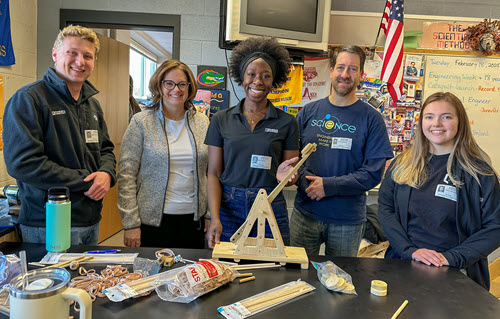
    Middletown, PA – Phoenix Contact engineers head back into the classroom this week to teach sixth-grade science class at Middletown Area Middle School in Middletown, Pa. The classes are part of Phoenix Contact’s National Engineers Week celebration.

    Phoenix Contact has worked with the school every February since 2007. The engineers lead hands-on lessons that make science fun. The goal is to inspire young people to consider careers in science, technology, engineering, and math (STEM).

    The lessons include:

    • Building catapults
    • Racing cookie tins down ramps
    • Building an electric motor
    • Learning about static electricity with the Van de Graaff generator

    “Our engineering team created this outreach program many years ago, and the partnership with Middletown Area School District has stood the test of time,” said Patty Marrero, interim vice president of human relations at Phoenix Contact. “National Engineers Week is a special time for them to share their passion for technology with students. It’s also our chance to thank our engineers for the creativity and innovations that drive our company forward.”

    About Phoenix Contact

    Phoenix Contact is a global market leader based in Germany. Since 1923, Phoenix Contact has created products to connect, distribute, and control power and data flows. Our products are found in nearly all industrial settings, but we have a strong focus on the energy, infrastructure, process, factory automation, and e-mobility markets. Sustainability and responsibility guide every action we take, and we’re proud to work with our customers to empower a smart and sustainable world for future generations. Our global network includes 22,000 employees in 100+ countries. Phoenix Contact USA has headquarters near Harrisburg, Pa., and employs more than 1,100 people across the U.S.

    For more information about Phoenix Contact or its products, visit www.phoenixcontact.com, call technical service at 800-322-3225, or email [email protected].

    eSchool News Staff
    Latest posts by eSchool News Staff (see all)

    Source link

  • More engineering applications don’t make for more engineers

    More engineering applications don’t make for more engineers

    The latest UCAS data (applications by the January ‘equal consideration’ deadline) suggests a 14 per cent increase in applications to engineering and technology courses.

    It’s the second double-digit surge in two years.

    Good news, right? Sadly, it’s mostly not.

    STEM swing

    The upsurge in interest in engineering can be seen as part of a “swing to STEM” (science, technology, engineering, and medicine).

    As higher education has shifted to a reliance on student debt for funding, many people suspect applicants have felt greater pressure to search for clear, transactional returns which, it may seem, are offered most explicitly by STEM – and, most particularly, by engineering, which is not just STEM, but vocational too.

    Certainly, there’s a keen labour market for more engineers. Engineering UK has suggested the shortfall is around 29,000 graduates every year. According to the British Chambers of Commerce, it’s pretty much the largest skills gap in the UK economy.

    Engineering is also a key driver of the growth that the government is so keen to stimulate, adding £645b to the UK – that’s nearly a whopping third of the entire value of the economy. And – unlike financial services, say – engineering is a powerhouse of regional development as it is spread remarkably evenly throughout the country.

    And it drives that other key government mission, opportunity. An engineering degree confers a higher and more equal graduate premium than almost any other discipline.

    The downside

    So with all these benefits, why is the increase in engineering applications not good news?

    The answer is because it reveals the extent of the lost opportunity: most of these extra potential engineers will be denied places to study, dashing their hopes and the hopes of the country.

    Last year’s rise in applications did not lead to a rise in the number of UK engineering students. Absolute student numbers have more or less stagnated since 2019.

    It used to be that the number of engineering applications broadly aligned with places because it was a highly regarded discipline with great outcomes that universities would expand if they felt they could. The limiting factor was the number of able students applying.

    Now that demand outstrips supply, universities cannot afford to expand the places because each additional UK engineering student represents an ever-growing financial loss.

    Engineering courses are among the most expensive to teach. There are long contact hours and expensive facilities and materials. The EPC estimates the average cost per undergraduate to be around £18,800 a year. Even allowing for top-up funding that is available to many engineering degrees on top of the basic fee income, that leaves an average loss of £7,591 per year.

    It used to be that the way to address such losses was to try to admit more students to spread the fixed costs over greater numbers. That did run the risk of lowering standards, but it made financial sense.

    Now, however, for most universities, the marginal cost of each additional student means that the losses don’t get spread more thinly – they just keep piling up.

    Cross-subsidy

    The only way out is to bring in ever more international students to directly subsidise home undergraduates.

    Although the UCAS data shows a glimmer of hope for recovering international demand, at undergraduate level, there are only a few universities that can make this work. Most universities, even if they could attract more international engineering students, would no longer use the extra income to expand engineering for home students, but rather to shore up the existing deficits of maintaining current levels.

    The UCAS data also show higher tariff institutions are the main beneficiaries of application increases at the expense of lower tariff institutions which, traditionally have a wider access intake.

    What this means is that the increased demand for engineering places will not lead to a rise in engineering student numbers, let alone in skilled engineers, but rather a narrowing of the access to engineering such that it becomes ever harder to get in without the highest grades.

    High prior attainment correlates closely with socioeconomic advantage and so, rather than engineering playing to its strength of driving social mobility, it will run the risk of becoming ever more privileged.

    What about apprenticeships?

    Not to worry, suggests Jamie Cater, head of employment and skills at trade body Make UK, a university degree is not the only option available for acquiring these skills and “the apprenticeship route remains highly valued by manufacturers”.

    That’s small comfort, I’m afraid. The availability of engineering higher apprenticeships suggests competition is even fiercer than it is for degrees and, without the safeguard of fair access regulation, the apprenticeship access track record is poor. (And don’t get me started on drop-outs.)

    This is why I haven’t unfurled the bunting at applicants’ rising enthusiasm for engineering.

    Of course, it is wonderful that so many young people recognise engineering as a fulfilling and forward-looking discipline. An estimated £150m has been spent the last decade trying to stimulate this growth and there are over 600 third sector organisations working in STEM outreach in schools. It would be nice to think this has not been wasted effort.

    But it’s hard to celebrate a young person’s ambition to be an engineer if it’s likely to be thwarted. Similarly, I struggle to summon enthusiasm about kids wanting to get rich as TikTok influencers. Indeed, it’s all the more tragic when the country actually does need more engineers.

    This is why the Engineering Professors’ Council has recently called on the government to plug the funding gap in engineering higher education (and HE more widely) in the forthcoming Comprehensive Spending Review.

    Asking for nearly a billion pounds may seem ambitious, but the ongoing failure to fill the engineering skills gap may well be costing the country far more – possibly, given the importance of engineering to GDP, more than the entire higher education budget.

    Johnny Rich is Chief Executive of the Engineering Professors’ Council, the representative body for UK Engineering academics.

    Source link