Category: English

  • Celebrating heritage means honoring students’ languages

    Celebrating heritage means honoring students’ languages

    Key points:

    Every year, Hispanic Heritage Month offers the United States a chance to honor the profound and varied contributions of Latino communities. We celebrate scientists like Ellen Ochoa, the first Latina woman in space, and activists like Dolores Huerta, who fought tirelessly for workers’ rights. We use this month to recognize the cultural richness that Spanish-speaking families bring to our communities, including everything from vibrant festivals to innovative businesses that strengthen our local economies.

    But there’s a paradox at play.

    While we spotlight Hispanic heritage in public spaces, many classrooms across the country require Spanish-speaking students to set aside the very heart of their cultural identity: their language.

    This contradiction is especially personal for me. I moved from Puerto Rico to the mainland United States as an adult in hopes of building a better future for myself and my family. The transition was far from easy. My accent often became a challenge in ways I never expected, because people judged my intelligence or questioned my education based solely on how I spoke. I could communicate effectively, yet my words were filtered through stereotypes.

    Over time, I found deep fulfillment working in a state that recognizes the value of bilingual education. Texas, where I now live, continues to expand biliteracy pathways for students. This commitment honors both home languages and English, opening global opportunities for children while preserving ties to their history, family, and identity.

    That commitment to expanding pathways for English Learners (EL) is urgently needed. Texas is home to more than 1.3 million ELs, which is nearly a quarter of all students in the state, the highest share in the nation. Nationwide, there are more than 5 million ELs comprising nearly 11 percent of the U.S. public school students; about 76 percent of ELs are Spanish speakers. Those figures represent millions of children who walk into classrooms every day carrying the gift of another language. If we are serious about celebrating Hispanic Heritage Month, we must be serious about honoring and cultivating that gift.

    A true celebration of Hispanic heritage requires more than flags and food. It requires acknowledging that students’ home languages are essential to their academic success, not obstacles to overcome. Research consistently shows that bilingualism is a cognitive asset. Those who are exposed to two languages at an early age outperform their monolingual peers on tests of cognitive function in adolescence and adulthood. Students who maintain and develop their native language while learning English perform better academically, not worse. Yet too often, our educational systems operate as if English is the only language that matters.

    One powerful way to shift this mindset is rethinking the materials students encounter every day. High-quality instructional materials should act as both mirrors and windows–mirrors in which students see themselves reflected, and windows through which they explore new perspectives and possibilities. Meeting state academic standards is only part of the equation: Materials must also align with language development standards and reflect the cultural and linguistic diversity of our communities.

    So, what should instructional materials look like if we truly want to honor language as culture?

    • Instructional materials should meet students at varying levels of language proficiency while never lowering expectations for academic rigor.
    • Effective materials include strategies for vocabulary development, visuals that scaffold comprehension, bilingual glossaries, and structured opportunities for academic discourse.
    • Literature and history selections should incorporate and reflect Latino voices and perspectives, not as “add-ons” during heritage month, but as integral elements of the curriculum throughout the year.

    But materials alone are not enough. The process by which schools and districts choose them matters just as much. Curriculum teams and administrators must center EL experiences in every adoption decision. That means intentionally including the voices of bilingual educators, EL specialists, and, especially, parents and families. Their life experiences offer insights into the most effective ways to support students.

    Everyone has a role to play. Teachers should feel empowered to advocate for materials that support bilingual learners; policymakers must ensure funding and policies that prioritize high-quality, linguistically supportive instructional resources; and communities should demand that investments in education align with the linguistic realities of our students.

    Because here is the truth: When we honor students’ languages, we are not only affirming their culture; we are investing in their future. A child who is able to read, write, and think in two languages has an advantage that will serve them for life. They will be better prepared to navigate an interconnected world, and they carry with them the ability to bridge communities.

    This year, let’s move beyond celebrating what Latino communities have already contributed to America and start investing in what they can become when we truly support and honor them year-round. That begins with valuing language as culture–and making sure our classrooms do the same.

    Latest posts by eSchool Media Contributors (see all)

    Source link

  • Using MindTap for English to Help Monitor Students’ Use of AI

    Using MindTap for English to Help Monitor Students’ Use of AI

    Reading Time: 4 minutes

    Depending on the era in which we began learning, formally or informally, we all have a diverse range of valuable definitions and perspectives about artificial intelligence pertaining to teaching and learning.

    Teaching and learning with AI

    When I was a student in elementary school during the 1980s, AI was using a calculator rather than longhand or a traditional adding machine for arithmetic. Additionally, the entire school only had six computers for student use, which were housed in the library. Only students acting responsibly earned access to time on these devices to play The Oregon Trail, “an educational game that simulates the hardships of [1848] …”

    With all of this in mind, AI has been teaching us, and we’ve been learning from it, for quite some time, in and out of school.

    However, with the advancement of generative AI, the implications for teaching and learning now have to do more with academic integrity. And academic dishonesty policies about original work vs. AI in education have come into the conversation. This is where MindTap features like Turnitin can be applied to help monitor students’ acceptable and ethical use of AI in English composition courses.

    My conversation with students

    My students may engage in conversations about acceptable, ethical uses of GenAI and academic integrity before they even enroll in my courses. This is because I post the policies in my syllabus. Students learn that there is a monitoring system in place in MindTap for English by Turnitin. Once enrolled in MindTap, there are discussions, in both online and face-to-face modalities, about these policies at length. Policies are also copied into each of the writing assignments in MindTap. Our focus is on ethics, or academic integrity, to ensure students’ coursework is original. Valuable feedback, information and resources can be provided for students to learn and progress rather than to get a grade.

    Since students cannot prove learning and mastery of learning outcomes without work being original, I discuss with them and copy in their assignments that they should not use any words that are not original. MindTap provides me with access to Turnitin to monitor academic integrity.

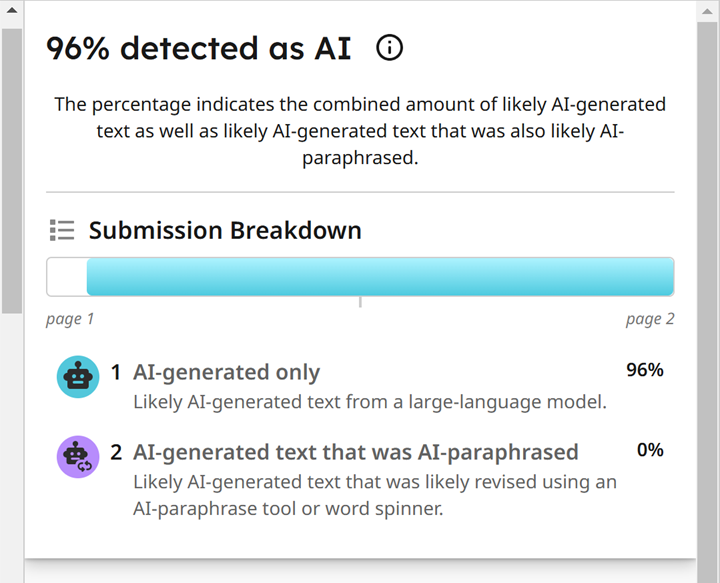
      Turnitin AI detector screenshot

    Suggestions for monitoring

    To help monitor students’ use of AI, parameters in MindTap for English with Turnitin should be set. For example, students need to submit more than 300 words for the detector to perform. Once students submit work, the detector generates an originality report. This can be downloaded to provide the instructor and learner with feedback about the percentage amount of acceptable and ethical usage of AI or plagiarism.

    Turnitin inbox where the similarity percentage can be viewed and clicked on for expanded, detailed information.
    Inbox where the similarity percentage can be viewed and clicked on for expanded, detailed information.

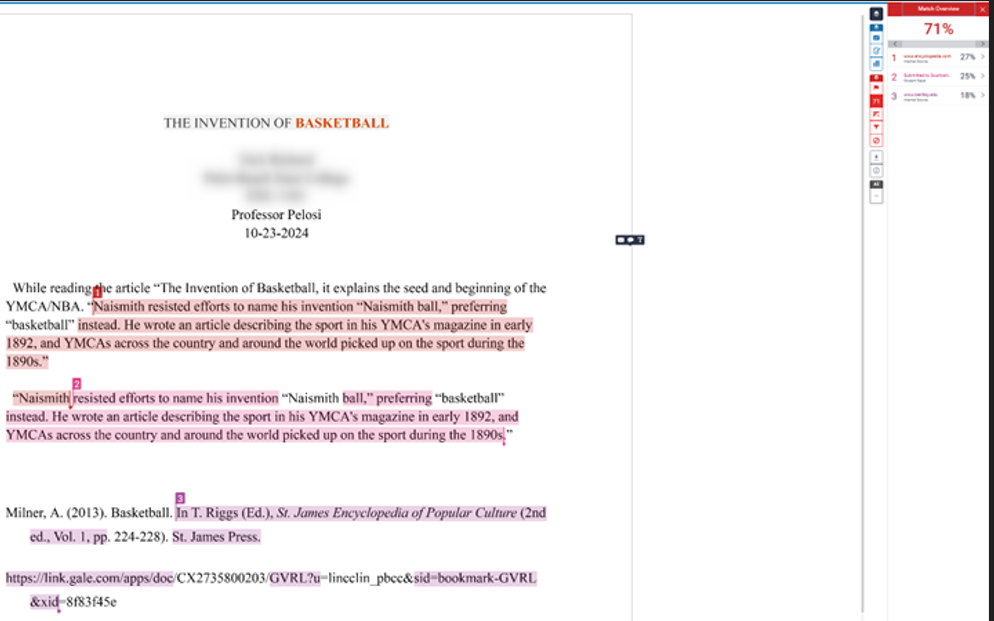
    The report highlights where originality is in question directly on the student’s document. Some instructors will set percentage parameters as well, instructing students that there cannot be more than 15% flagged by the detector in MindTap. Clicking on what the detector has highlighted shows the possible source where information may have been taken or just generally that AI has been used. Note: this is just a monitoring system. So, please be mindful that the report is a tool instructors can use to have conversations with their students. We cannot accuse academic dishonesty based on a report alone.

    Turnitin shows the match overview with all of the plagiarism flagged, which can also be AI. Each part can be clicked on and expanded to show the original source.
    Shows the match overview with all of the plagiarism flagged, which can also be AI. Each part can be clicked on and expanded to show the original source.

    MindTap’s monitoring system has always been correct for me, but conversations are still beneficial for assurance. I use this monitoring document for every submission in MindTap.

    The big picture to consider

    AI can be used ethically as a tool for teaching and learning, bridging student learning gaps and strengthening their mastery of skills. However, when it comes to academic integrity, the concern is that GenAI is being used not as an aid, but as a tool devoid of the values of teaching and learning. According to Cengage’s recent research, 82% of instructors expressed concern specifically about AI and academic integrity. Setting policies and parameters with clear definitions and having conversations with students is essential to my ability to monitor my students’ acceptable use of AI.

    Do you use AI in your English composition classroom? Reach out to discuss the ways you’re utilizing AI as an ethical tool to advance teaching and learning.

    Written by Faye Pelosi, Professor in the Communications Department at Palm Beach State College and Cengage Faculty Partner. 

    Stay tuned for Professor Pelosi’s upcoming video demo of how she uses the MindTap Turnitin feature in her English course.

    Source link

  • Almost 2,000 Schools and Districts Choose Lexia® English Language Development™ to Support Emergent Bilingual Students’ English Language Acquisition

    Almost 2,000 Schools and Districts Choose Lexia® English Language Development™ to Support Emergent Bilingual Students’ English Language Acquisition

    BOSTON (March 31, 2025) – In recent months, almost 2,000 schools and districts have purchased or renewed licenses for Lexia English Language Development (Lexia English) from Lexia, a Cambium Learning Group brand. Using powerful speech recognition technology, the program supports students in grades K-6 to build their linguistic confidence in academic English.

    “More than 162,000 students and 77,000 educators at 7,400 schools used the program during the 2024 school year. In addition, those students practiced academic conversations 4.3 million times in the program,” said Lexia President, Nick Gaehde. “The numbers show just how much students and educators have needed access to a culturally responsive language learning solution.”

    One of those educators who used the program is Lynmara Colón, the director of Student Opportunity and Multilingual Services at Prince William County Schools in Virginia. After a pilot, the district has allowed individual middle and elementary schools to purchase Lexia English during the 2024-2025 school year. Prince William County Schools serves more than 20,000 English learners who speak 140 languages. “We are the 10th most diverse district in the nation,” Colón said. “But when I try to find tools for diverse students, there’s not a lot that meets the specific needs of the student population we serve.”

    Colón noted that the program had boosted student growth to the point of reducing her worries about providing staff with a high-quality tool focused on helping Emergent Bilingual students. She expressed appreciation for the way the program helps her forecast and make sense of language acquisition data. “With Lexia, I can have visibility into how they’re doing with language comprehension,” she said. “I always know to expect the best from our Lexia partners. I have high expectations, and they never disappoint.”

    Lexia English’s approach to English language learning is to empower emergent bilinguals by honoring their heritage languages and offering culturally responsive, adaptive learning pathways to foster academic and linguistic growth. Seventeen characters with diverse backgrounds help students practice speaking skills by engaging with content in academic subjects such as math, science, social studies, and general knowledge.

    Gaehde concluded, “With Lexia English, educators can celebrate multilingualism in the classroom, providing students with the tools to succeed in both English language development and overall academic achievement.”

    About Lexia

    Lexia®, a Cambium Learning® Group brand, is transforming literacy education, driving change in 1 of every 3 school districts across the United States. For more than 40 years, Lexia has been a thought leader in literacy education, delivering award-winning, research-based solutions grounded in the science of reading. With a full spectrum of offerings, including professional learning, curriculum, and embedded assessment tools, Lexia provides educators with Structured Literacy solutions that are proven effective and designed to drive meaningful literacy outcomes. By empowering educators with unparalleled ease of use and the knowledge and tools they need, Lexia helps more students unlock their potential to read, write, and speak with confidence. For more information, visit lexialearning.com.

    About Cambium Learning Group

    Cambium Learning Group is the education essentials company, providing award-winning education technology and services for K-12 educators and students. With an intentional collection of respected global brands, Cambium serves as a leader, helping millions of educators and students feel more seen, valued, and supported every day. In everything it does, the company focuses on the elements that are most essential to the success of education, delivering simpler, more certain solutions that make a meaningful difference right now.

    To learn more, visit www.cambiumlearning.com or follow Cambium on Facebook, LinkedIn, and X. The Cambium family of brands includes: Cambium Assessment®, Lexia®, Learning A-Z®, ExploreLearning®, and Time4Learning®.

    eSchool News Staff
    Latest posts by eSchool News Staff (see all)


    Source link

  • Embracing a growth mindset when reviewing student data

    Embracing a growth mindset when reviewing student data

    Key points:

    In the words of Carol Dweck, “Becoming is better than being.” As novice sixth grade math and English teachers, we’ve learned to approach our mid-year benchmark assessments not as final judgments but as tools for reflection and growth. Many of our students entered the school year below grade level, and while achieving grade-level mastery is challenging, a growth mindset allows us to see their potential, celebrate progress, and plan for further successes amongst our students. This perspective transforms data analysis into an empowering process; data is a tool for improvement amongst our students rather than a measure of failure.

    A growth mindset is the belief that abilities grow through effort and persistence. This mindset shapes how we view data. Instead of focusing on what students can’t do, we emphasize what they can achieve. For us, this means turning gaps into opportunities for growth and modeling optimism and resilience for our students. When reviewing data, we don’t dwell on weaknesses. We set small and achievable goals to help students move forward to build confidence and momentum.

    Celebrating progress is vital. Even small wins (i.e., moving from a kindergarten grade-level to a 1st– or 2nd-grade level, significant growth in one domain, etc.) are causes for recognition. Highlighting these successes motivates students and shows them that effort leads to results.

    Involving students in the process is also advantageous. At student-led conferences, our students presented their data via slideshows that they created after they reviewed their growth, identified their strengths, and generated next steps with their teachers. This allowed them to feel and have tremendous ownership over their learning. In addition, interdisciplinary collaboration at our weekly professional learning communities (PLCs) has strengthened this process. To support our students who struggle in English and math, we work together to address overlapping challenges (i.e., teaching math vocabulary, chunking word-problems, etc.) to ensure students build skills in connected and meaningful ways.

    We also address the social-emotional side of learning. Many students come to us with fixed mindsets by believing they’re just “bad at math” or “not good readers.” We counter this by celebrating effort, by normalizing struggle, and by creating a safe and supportive environment where mistakes are part of learning. Progress is often slow, but it’s real. Students may not reach grade-level standards in one year, but gains in confidence, skills, and mindset set the stage for future success, as evidenced by our students’ mid-year benchmark results. We emphasize the concept of having a “growth mindset,” because in the words of Denzel Washington, “The road to success is always under construction.” By embracing growth and seeing potential in every student, improvement, resilience, and hope will allow for a brighter future.

    Latest posts by eSchool Media Contributors (see all)

    Source link

  • Revolutionizing storytelling with AI: Empowering ELLs

    Revolutionizing storytelling with AI: Empowering ELLs

    Key points:

    Imagine this: You assign your students a writing prompt, and while some eagerly begin crafting their stories, others stare at the blank page, muttering, “I have nothing to write,” or “I can’t think of a story.” For English Language Learners (ELLs), this scenario is even more daunting due to limited vocabulary or fear of making mistakes. In fact, studies show that a lack of confidence and linguistic resources often prevents ELLs from fully engaging in creative writing, despite their rich cultural and personal experiences.

    As educators, we constantly seek ways to help students overcome these barriers. Enter artificial intelligence (AI)–a powerful tool that transforms storytelling into an accessible and engaging experience for every student. By integrating AI into storytelling, we can empower students to generate ideas, build confidence, and create compelling narratives, all while developing their language skills.

    Getting started: Using AI to spark creativity

    A simple and engaging way to introduce AI in storytelling is by using a writing prompt and generating an example story opening with ChatGPT. For instance, you might ask: “Write the opening to a mysterious story about an abandoned lighthouse.”

    ChatGPT could respond: “The wind howled through the cracks of the abandoned lighthouse, carrying whispers of secrets long forgotten. The light, extinguished for decades, seemed to flicker faintly as if trying to tell a story no one had yet heard.”

    Students can take this opening and continue the story in their own words, expanding the scene, introducing new characters, or creating a plot twist. This method not only sparks creativity but also provides ELLs with a scaffold, building their confidence to dive into storytelling.

    To bring their stories to life, students can use AI image generators like DALL-E or tools like Canva to create visuals matching their narratives. For example, they could create an eerie image of the abandoned lighthouse with flickering light and stormy skies. This connection between words and visuals reinforces comprehension and engages students in the storytelling process.

    The final step is sharing stories and visuals with the class. Presenting their work allows students to practice speaking, gain confidence, and showcase their creativity.

    How AI enhances storytelling

    AI tools offer unique opportunities to support ELLs in their storytelling journey. When
    students struggle to come up with ideas, tools like ChatGPT can provide engaging prompts and vivid descriptions to spark creativity. For example, a student might request a description of a magical forest and receive a response like: “A forest bathed in golden sunlight, where trees tower like ancient guardians and the air shimmers with tiny, glowing orbs.” Such detailed imagery can inspire students to dive into their stories with greater confidence.

    In addition to idea generation, AI tools help expand students’ vocabulary. ELLs can use AI to explore synonyms or alternative ways to describe scenes, enriching their language repertoire.

    For instance, if a student wants to avoid repeating the word “beautiful,” the AI might suggest options like “stunning,” “captivating,” or “breathtaking,” enabling more nuanced and expressive writing.

    Visual storytelling is another area where AI shines. Tools like DALL-E or Adobe Express allow students to create images that align with their narratives, making their stories come to life. For example, a student writing about a mysterious glowing orb could generate a corresponding image, blending creative thinking with visual artistry.

    Once students have drafted their stories, AI-based writing assistants like Grammarly can help refine their grammar, spelling, and sentence structure. This process encourages independence and self-correction, teaching students to identify and address their mistakes while improving the overall clarity and polish of their work.

    Interactive platforms like Twine take storytelling to a new level by enabling students to create “choose your own adventure” narratives. For example, students might create a mystery where readers decide whether to follow a shadowy figure or stay hidden, leading to different outcomes. This fosters critical thinking and collaboration as students craft branching storylines and engage in problem-solving to connect various plot points.

    Classroom example: AI in action

    In a Grade 8 ESL classroom, students were given the prompt: “Write about a strange object you find buried in your backyard.” After brainstorming ideas with ChatGPT, one student created a story about a glowing orb that transported them to another dimension. They used DALL-E to generate an image of the orb, and Twine to develop a branching narrative where the reader decides whether to touch the orb or call for help. The result was an immersive storytelling experience that combined creativity with critical thinking.

    By incorporating AI tools, students not only created more engaging stories but also developed their language skills in a meaningful and enjoyable way.

    Making storytelling accessible and engaging

    Using AI in storytelling doesn’t just overcome barriers; it transforms the experience for students. Visual elements and interactivity keep learners engaged, while tools for grammar and vocabulary improvement build confidence. For ELLs, AI provides scaffolding and encouragement to take creative risks and express themselves authentically.

    Guiding responsible AI use

    While AI opens doors to creativity, teaching students to use these tools responsibly is
    essential.

    Students need to understand the concept of AI “hallucinations,” where AI generates
    inaccurate or entirely fabricated information. For instance, an AI might describe a historical event inaccurately or create a fictional fact that seems plausible. Educators should teach students to verify AI-generated information with reliable sources.

    Equally important is teaching students how to craft clear and specific prompts. For example, instead of asking, “What happens in a story?” they might ask, “Can you suggest a story idea about a character who solves a mystery in a small town?”

    Modeling this process helps students see how precise wording yields better results.
    Encouraging critical thinking is also crucial. Teachers can create opportunities for students to analyze AI-generated content by asking: “Does this make sense? Is it accurate? Can I verify it elsewhere?” Such discussions help students see AI as a helpful tool, but not an infallible one.

    Students should also learn that AI is a partner in creativity, not a replacement for their
    original thinking. They must guide the AI, evaluate its outputs, and make creative decisions to ensure their work remains authentically theirs. Additionally, students should be encouraged to credit AI-generated content appropriately to foster ethical use.

    Conclusion

    Storytelling is a cornerstone of language learning, offering ELLs opportunities to build
    vocabulary, practice grammar, and express their ideas. With AI, the storytelling process becomes more accessible, engaging, and impactful. From generating prompts to creating visuals and refining drafts, AI supports students in overcoming challenges and discovering the joy of storytelling.

    By integrating AI tools responsibly, educators empower every student to find their voice and share their unique stories with confidence. In the intersection of creativity and technology, AI has the potential to revolutionize the way we teach and learn storytelling

    Latest posts by eSchool Media Contributors (see all)

    Source link