Category: Enrollment Management

  • InsightsEDU 2026: The Sessions Higher Ed Can’t Afford to Ignore  

    InsightsEDU 2026: The Sessions Higher Ed Can’t Afford to Ignore  

    Higher ed is no longer inching towards change; it’s being forced to confront it. Demographic shifts, economic pressures and the rise of AI have exposed the cracks in legacy systems. The old playbook isn’t just outdated—it’s a liability. Institutions that cling to it risk irrelevance. 

    InsightsEDU 2026, happening February 17-19, 2026 at the Westin Fort Lauderdale, arrives with clear purpose: help higher ed leaders move faster, think bigger and build adaptive strategies that meet the moment

    This year’s theme, The Future Unbound, is a call to action. It invites leaders to challenge assumptions, dismantle silos and make bold decisions that drive real transformation. 

    In service of that mission, we’ve curated a speaker lineup and session program built around reinvention, student-centered innovation and the levers of growth that will define the next era. 

    Here’s your first look at the voices and ideas shaping InsightsEDU 2026. 

    Explore the Sessions Reinventing Higher Ed’s Playbook 

    The Great Reinvention 

    A candid fireside conversation with university presidents who are leading from the front. Expect bold perspectives on what higher ed must dismantle, redesign and accelerate to stay relevant in a rapidly shifting landscape. 

    Opening Session: The Modern Learner Intel 

    Get exclusive first-look access to EducationDynamics’ 2026 research on today’s Modern Learners—what they value, how they make decisions and why flexibility, career outcomes and undeniable ROI now drive every enrollment decision. 

    The AI-Powered Marketer: Evolving Your Approach for the ChatGPT Era 

    EducationDynamics’ Vice President of Marketing reveals how AI is rewriting the rules of search, content and digital engagement—and what marketers must do now to stay ahead. Learn how to unify search, social and storytelling into a single, high-performing strategy that meets today’s learners on their terms and moves them from first click to enrollment.  

    Aligning for Impact: Credentialing That Connects Campuses, Students & Employers  

    See how one institution built stackable, employer-aligned credentials that meet workforce demand and create clear career pathways, plus practical strategies any campus can use to deepen employer partnerships and market high-value programs. 

    AI for All Learners: Integrating AI Across Career Pathways 

    Learn how institutions are integrating AI across disciplines through accessible, scalable curriculum design. Attendees will leave with a sample syllabus, implementation roadmap and lessons learned from bringing AI education to diverse learners, including high-barrier communities. 

    Leading After Rapid Transformation: Culture, Clarity, and “What’s Next” in Higher Ed Marketing 

    Leaders from University of Cincinnati Online reflect on how to move forward after organizational transformation, discussing how they rebuilt culture, aligned teams and kept momentum amid ongoing change. Expect honest insights on sustaining creativity, clarity and trust in a world where transformation never stops. 

    Unifying Your Enrollment: Building a Cohesive Strategy for the Modern Learner 

    This session brings together university leaders and EducationDynamics enrollment experts to unpack how to break down silos and build a unified enrollment strategy that strengthens your brand, improves outcomes and meets the diverse needs of today’s Modern Learner. 

    InsightsEDU 2026 brings together changemakers from across the sector—each session designed to spark new thinking, foster connection and fuel collective reinvention. Explore the full, evolving agenda here.  

    Meet the Speakers Disrupting the Status Quo  

    From enrollment innovators to digital trailblazers, this year’s speakers are united by one goal: help institutions evolve faster than the market around them. Here’s a preview of who’s taking the stage. 

    Gregory Clayton

    President of Enrollment Management Services at EducationDynamics
    With over 30 years of experience in the higher education space, Greg brings valuable expertise in enrollment management and performance marketing. As President of Enrollment Management Services at EducationDynamics, he leads a comprehensive team offering agency marketing, enrollment services, strategic consulting, and research, all tailored to the higher ed sector. His leadership and career position him as a visionary strategist, equipped to offer insightful commentary on the higher education landscape and enrollment solutions. Join his session to learn more about how to better serve the Modern Learner and implement strategies that drive institutional success.

    Session: Opening Session,The Modern Learner Intel

    Amanda Serafin

    Associate Vice President of Enrollment at Indiana Wesleyan University 
    With more than twenty years in higher education enrollment, Amanda serves as the Associate Vice President of Enrollment at Indiana Wesleyan University, where she leads strategic initiatives and a high-performing team supporting IWU’s National & Global programs.

    At InsightsEDU, Amanda joins EducationDynamics’ Vice President of Enrollment Management Consulting to unpack three years of competitive research—revealing what secret shopping uncovered about competitor strategies, the depth and quality of student nurturing across the market and how IWU leveraged those insights to strengthen enrollment outcomes.

    Session: Mystery Shopping 2.0

    Alex Minot

    Client Partner Lead at Snapchat
    As Client Partner Lead at Snapchat, Alex helps higher ed institutions and nonprofits modernize their marketing through full-funnel strategies built for Gen Z and Millennial audiences. With experience spanning Snapchat, Reddit, Facebook and Google, he brings a deep understanding of how today’s learners discover, evaluate, and choose their next step.

    At InsightsEDU 2026, Alex will break down why traditional enrollment marketing no longer works—and what it takes to earn trust in a world where Gen Z is curating their own narratives. Joined by EducationDynamics’ Senior Social Media Strategist, Jennifer Ravey, he’ll explore how to design a content ecosystem that creates belonging, builds confidence and inspires advocacy from first touch to final decision..

    Session: From Awareness to Advocacy: Designing a Full-Funnel Strategy for Gen Z Engagement

    Chris Marpo

    Head of Education Partnerships at Reddit
    As Head of Education Partnerships at Reddit, Chris leads the charge in building high-impact collaborations with higher ed institutions and agencies. At InsightsEDU 2026, he’ll share how Reddit’s unique communities—and the behaviors driving them—are reshaping the way universities reach and influence the Modern Learner.

    Drawing on his experience helping scale advertising businesses at LinkedIn, Pinterest and Quora, Chris brings a sharp understanding of the digital landscape and what truly resonates with today’s audiences. Attendees can expect actionable insights on how institutions can meet prospective students where they are and stay relevant in an era of rapid change.

    Session: From Keywords to Conversations: Winning Student Mindshare in the Age of AI Search

    Kevin Halle


    VP of Enrollment at Wayne State College
    With more than a decade of experience leading undergraduate, transfer, graduate, and financial aid teams, Kevin brings a deep understanding of how to build enrollment pipelines that serve diverse learner groups.

    At InsightsEDU, he’ll unpack what it takes to break down the silos separating traditional, graduate and adult learner strategies and how institutions can create one unified approach that works for all students.

    Session: Unifying Your Enrollment: Building a Cohesive Strategy for the Modern Learner

    Katie Tomlinson

    Katie Tomlinson

    Senior Director of Analytics and Business Intelligence at EducationDynamics
    Prepare to unlock insights with Katie Tomlinson. As the Senior Director of Analytics and Business Intelligence, Katie expertly manages data and reporting, uncovering key trends to support EducationDynamics in delivering data-driven solutions for the higher ed community. Learn from her as she discusses findings from EducationDynamics’ latest report, where attendees will gain a deeper understanding of the evolving learning environment and the significant factors that influence Modern Learners’ educational choices.

    Session:  Opening Session, The Modern Learner Intel

    The voices shaping InsightsEDU continue to grow. Check out the full speaker lineup and new additions on our Speakers page

    This Isn’t Just a Conference. It’s a Catalyst. 

    Higher ed doesn’t need just another conference. It needs transformation. 

    InsightsEDU 2026 is where bold leaders confront what’s broken, challenge what’s outdated and build what’s next. If you’re ready to lead the future of higher education, this is your moment. 

    Join us in Fort Lauderdale and help rewrite the playbook for what comes next. 

    Source link

  • The 2026 Growth Strategy Higher Ed Needs Right Now

    The 2026 Growth Strategy Higher Ed Needs Right Now

    Why Playing It Safe Is the Riskiest Strategy 

    The convergence of changing demographics, economic volatility and the relentless disruption of AI presents every leader with a stark choice: drive transformative growth or manage a legacy of decline. The choice is yours.

    The era of steady traditional enrollment is over. Beginning in 2026, most institutions will confront a lasting decline in their core undergraduate market. At the same time, public faith in higher education’s value is weakening, leaving institutions to rebuild trust through proof, not promises.

    Findings from EducationDynamics’ 2026 Landscape of Higher Education Report highlight a critical truth: volatility is the new normal and transformation is no longer optional.

    Growth in this new era demands more than adaptation—it demands reinvention. Institutions must lead with strategy, act with urgency and build around the Modern Learner. Because in a market defined by disruption, there are only two paths forward: reinvent or risk irrelevance.

    Key Takeaway #1: An Unstable Economic and Employment Landscape 

    Economic volatility is rising as job creation slows, and uncertainty spreads. The workforce is growing more cautious than ambitious, and in this climate, the traditional promise of a college degree is under siege.

    College graduates still enjoy higher employment rates, yet public faith in that value is eroding. The perception gap is widening, and institutions can no longer rely on reputation alone to carry their story.

    This is the moment to lead with proof, not platitude.

    Institutions must demonstrate return on investment with clarity and consistency. Publish outcomes data. Showcase alumni success. Connect every program to real career mobility. This isn’t just about convincing students, it’s about rebuilding trust across the entire ecosystem of alumni, employers, policymakers and the public.

    In today’s economy, outcomes are the new currency of reputation. The institutions that clearly and consistently prove their value will be the ones that grow.

    Key Takeaway #2: A Radically Transformed Enrollment Environment 

    Institutions now operate in a fundamentally different enrollment landscape. The long-anticipated demographic cliff is no longer a future threat; it’s here. The 2025 cycle marked the high-water mark for traditional-aged undergraduates. From 2026 on, institutions will face a sustained and irreversible decline in their core market. 

    But this doesn’t have to be a crisis. It’s an opportunity to pivot and capture where growth has moved. The new lifeblood of higher education lies in: 

    • Adult learners seeking rapid reskilling in a volatile economy 
    • Dual-enrollment students accelerating their path to a degree 
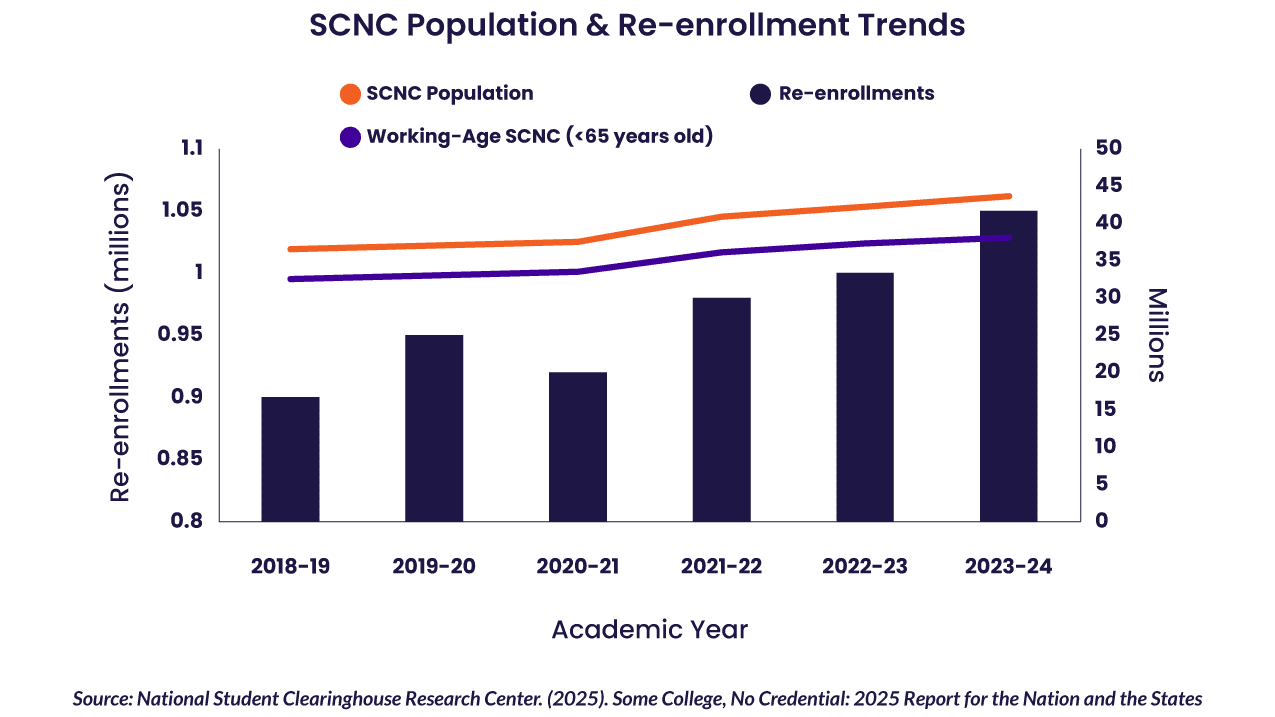
    • “Some college, no credential” learners returning to finish what they started 

    The lines between traditional and nontraditional students have disappeared. These aren’t separate segments—they’re one unified audience shaping the future of higher education.

    Leaders who continue to operate with outdated distinctions risk designing strategies for a market that no longer exists. Modern Learners value cost, convenience and career outcomes—and they expect institutions to deliver all three.

    This is the moment to retire the old playbook, embrace a new mindset and build for the learner who’s already redefining what comes next.

    Key Takeaway #3: AI Is an Unmistakable Force with Far-Reaching Implications 

    AI is accelerating change across every dimension of higher education, from how institutions engage to how graduates build careers. 

    While the technology itself isn’t new, its rapid integration is rewriting the rules. AI has fractured the traditional recruitment funnel. Modern Learners use AI-powered tools to search, compare and evaluate options before they reach an institution’s website. The student journey is now self-directed, hyper-personalized and constantly evolving, demanding that marketing and enrollment teams adapt in real time. 

    But AI’s impact extends far beyond recruitment. Its growing influence in the workforce is forcing institutions to rethink their academic mission. Institutions that lead will design education for the AI era by combining technical fluency with human-centered skills such as creativity, critical thinking and ethics. 

    Key Takeaway #4: AI Is an Unmistakable Force with Far-Reaching Implications 

    Incrementalism is now the greatest risk. In an age of constant disruption, small adjustments and siloed strategies hinder growth. The institutions that succeed will lead with clarity, agility and a unified vision centered on the Modern Learner. 

    Sustained growth demands leadership that acts decisively across three dimensions: 

    1. Align program portfolios with high-growth sectors. Move beyond tradition-bound curriculums. Invest in programs that meet labor-market demand and retire those that no longer serve a clear purpose. 
    2. Unify brand and enrollment strategies. The boundaries between undergraduate, graduate and online student populations are disappearing. Institutions must speak with one voice and focus on the three factors that drive every learner’s decision: cost, convenience and career outcomes. 
    3. Lead the conversation on value and outcomes. Public trust cannot be rebuilt through messaging alone. It must be earned through transparency, data and measurable results.

    This is the moment that will define the next decade of higher education. The difference between survival and sustainable growth hinges on decisive, informed action. Leaders must either seize this moment to shape the future or watch their institutions be defined by it. 

    From Insight to Action: Ten Strategic Imperatives for Sustainable Growth 

    The era of incremental adjustment is over. Conviction is now the currency of leadership. This moment demands bold leadership and a decisive strategy that converts disruption into a roadmap for measurable growth. 

    The EducationDynamics’ 2026 Landscape of Higher Education Report delivers that roadmap. Our Ten Strategic Imperatives are pragmatic, research-driven levers designed to help your institution build resilience and sustainable momentum for 2026 and beyond. 

    Imperative #1: Prove Outcomes. Protect Reputation.  

    Publish transparent results and illustrate career alignment to help students understand program value. 

    Imperative #2: Market ROI Relentlessly. 

    Lead with affordability and clearly communicate a projected and proven return on investment. 

    Imperative #3: Capture the Dual Enrollment Surge.   

    Build structured high school-to-degree pipelines. 

    Imperative #4: Own the Adult Learner Market.

    Offer flexible, online and stackable options with the support working learners need to balance their multiple priorities. 

    Imperative #5: Prioritize Accessibility through the Three C’s.  

    Deliver education that meets learners on cost, convenience and career outcomes. 

    Imperative #6: Lead in Responsible AI Adoption.  

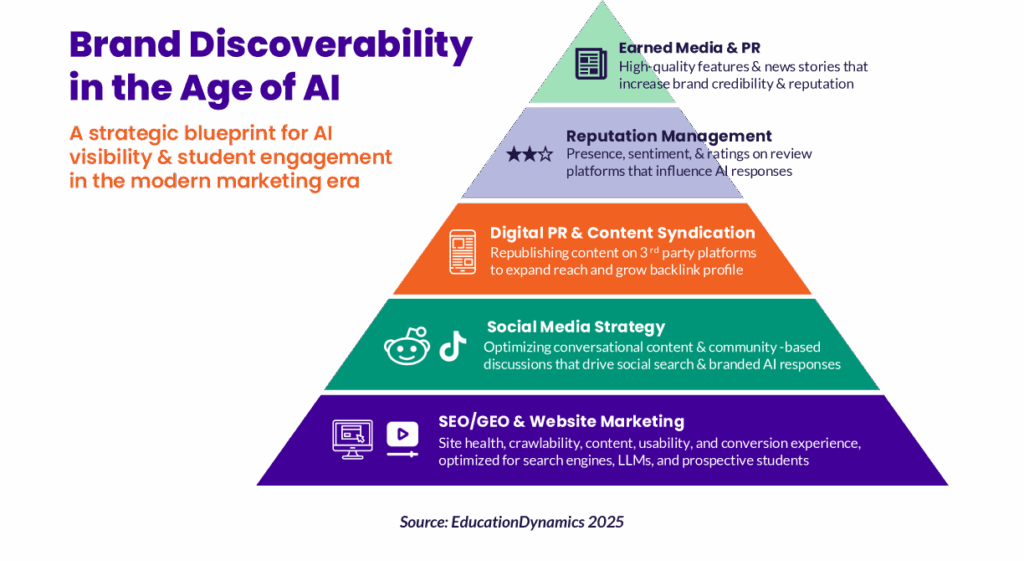
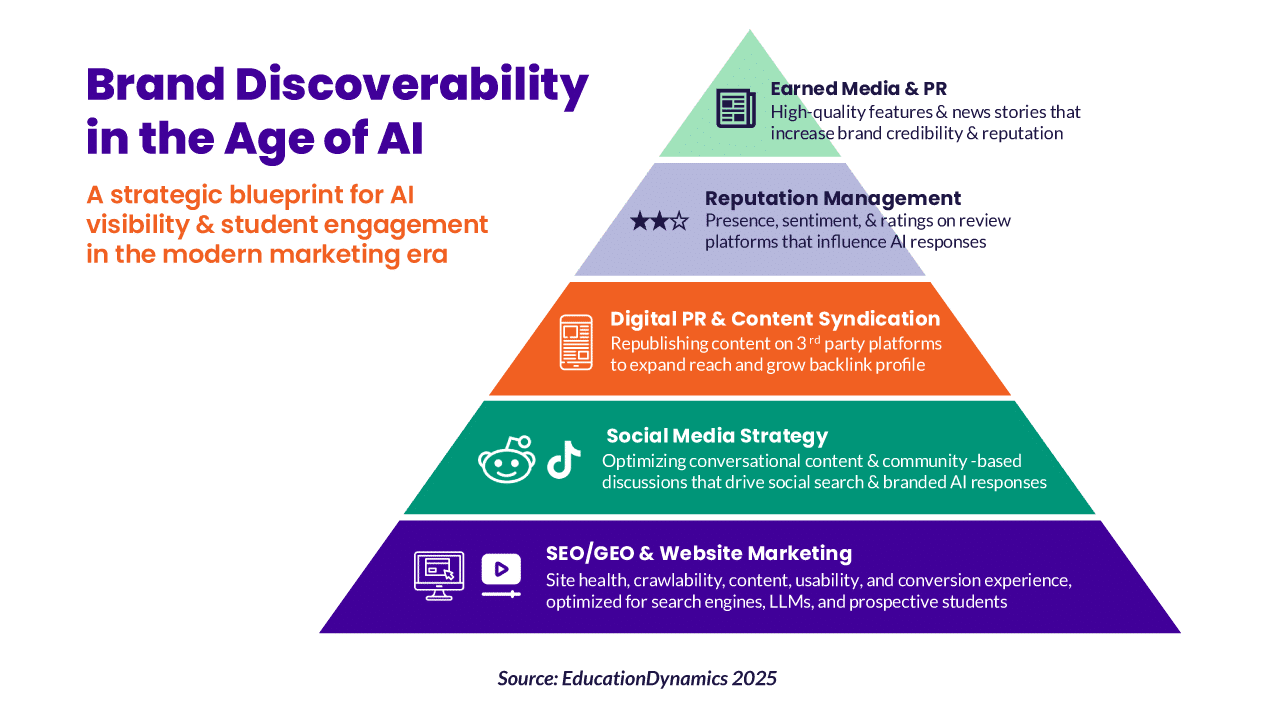
    Optimize marketing for AI discoverability and AI powered platforms, while Integrating AI into advising, engagement and instruction. 

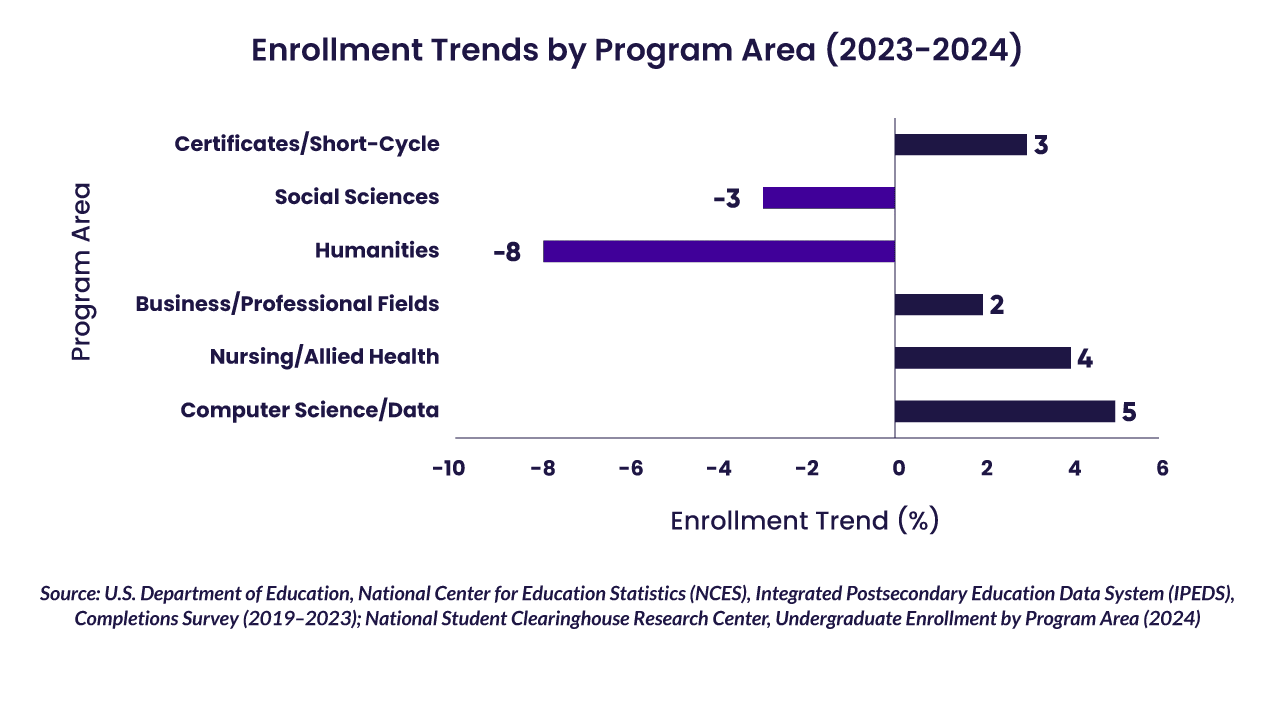
    Imperative #7: Reinvent Vulnerable Disciplines.  

    Reframe liberal arts around adaptability and skills attainment. 

    Imperative #8: Re-engage the Stopped-Out Majority. 

    Convert the 43 million with some college, no credentials into completers through credit recovery, tailored pathways and adult-first design. 

    Imperative #9: Stack Credentials into Careers.  

    Link short-term certificates to degree pathways. 

    imperative #10: Advocate for Policy Stability. 

    Simplify aid communication and push for predictable funding. 

    Together, these imperatives form a blueprint for how higher education can evolve from reactive adaptation to proactive growth. 

    Transform Disruption into Growth

    The time for caution has passed. Those who hesitate or fail to act with purpose will fall behind in a marketplace that does not wait. 

    At EducationDynamics, we partner with colleges and universities prepared to lead this transformation—those who understand that meeting the Modern Learner where they are is not just an enrollment strategy but the new mission of higher education. 

    For deeper insights and actionable strategies, download the full 2026 Landscape of Higher Education Report and learn how your institution can stay ahead of the curve. 

    Source link

  • Why Some Colleges are Thriving While Others Are Falling Behind 

    Why Some Colleges are Thriving While Others Are Falling Behind 

    The New Reality of Enrollment Management 

    For many colleges, the fall 2025 enrollment numbers brought a mix of emotions. While some institutions are celebrating record-breaking classes and hitting their targets, others—equally committed to their mission—fell short. This stark contrast isn’t just a symptom of demographic shifts; it reveals a deeper, more urgent truth: the status quo is failing higher education.

    Many institutions are struggling not just because of demographics, but because of outdated, fragmented enrollment strategies. They are kept in silos—admissions, marketing, financial aid—creating an inconsistent student experience that leads to missed starts, early attrition and lost potential.

    Today’s Modern Learners are more discerning than ever. They expect speed, personalization and transparency, making fragmented approaches not only ineffective but unsustainable. The future of higher education does not belong to those defending the past. It belongs to institutions bold enough to build what’s next—a unified, data-informed strategy that transforms these challenges into opportunities for sustainable growth.

    Missed Starts: The Silent Threat to Student Recruitment  

    Enrollment managers face a stark reality: the decision-making window has never been shorter. Students aren’t shopping around like they once did. Students are making decisions faster than ever. According to our latest Engaging the Modern Learner Report, 67% inquire at only one or two institutions, and 45% apply to just one. This is a fundamental shift. In 2015, only 43% of learners would enroll at the first school that contacted them. By 2025, that figure has skyrocketed to nearly three in four. For your institution, this is a wake-up call. The window to turn interest into enrollment is closing, and any delay, inconsistent follow-up or fragmented outreach means you lose students before they even begin their journey.

    Speed and consistency are not just critical—they are the price of admission. Slow, fragmented communication—whether through delayed responses, inconsistent messaging, or glaring gaps across departments—is not an inefficiency. It is a direct cause of a hemorrhaging enrollment funnel. The only way to transform this challenge is with a unified enrollment management approach.

    Think of the bright prospective student who loves your campus culture after a visit. The prospective student sends a follow-up email with a simple question about a scholarship deadline, but the admissions team is swamped, and a response is delayed. Meanwhile, another school sends a personalized text message with the needed information, along with a link to a testimonial from a student in the desired major. This prospective student’s trust is built and stolen by the competing school, and your school is now completely out of the consideration mix—not because of your academics or campus life, but because of a missed connection.

    The Four Pillars of Strategic Enrollment Management

    The path to reversing missed starts and early attrition isn’t guesswork—it’s a disciplined, coordinated approach. The Four Pillars of Strategic Enrollment Management give institutions a clear framework to turn insights into action, strengthen recruitment and improve student success. By combining brand alignment, AI-driven analytics, full-funnel marketing and student-centric engagement, campuses can act decisively, close gaps in the enrollment process, and ensure every touchpoint moves students toward enrollment and persistence. 

    Strategic Brand Alignment for Student Recruitment 

    In a crowded market, a compelling and authentic brand is not optional—it’s the foundation of any winning student recruitment strategy. Reputation drives decisions more than ever, with 31% of all applicants and 51% of traditional undergraduates ranking it among their top factors for choosing a school. Most Modern Learners start their search with the institution itself rather than a specific program, which means that without a strong, visible brand, your institution risks being overlooked before the conversation even begins. For marketing and enrollment leaders, this makes it clear that visibility and authenticity are essential for influencing enrollment outcomes.

    Brand is also about proving value. Affordability remains important, but today’s Modern Learners are increasingly focused on career outcomes and program benefits in addition to cost. Messaging must clearly convey the tangible return on investment and the real-world impact of a degree to resonate with prospective students. By aligning programs with student aspirations and demonstrating clear student success outcomes, institutions can create meaningful, personalized engagement that drives enrollment forward.

    AI-Powered Analytics and Performance Optimization 

    Data alone won’t drive results; insights must inform every decision. Integrating AI into your enrollment strategy isn’t a strategy of the future—it’s a strategy of now. Competitive institutions use predictive insights to identify which students are most likely to apply, enroll and persist, turning complex data into actionable strategies. By analyzing engagement, inquiries, social sentiment and historical trends, enrollment managers can uncover funnel leaks, prioritize outreach, and allocate resources effectively. 

    At EducationDynamics, we combine AI-driven insights with human expertise to ensure recommendations are contextually grounded. This lets teams act quickly, maintain consistency and optimize every touchpoint. Integrated with targeted marketing insights, these analytics help institutions reach the right students with personalized messaging, strengthening enrollment management and driving long-term success. 

    Full-Funnel Marketing for Student Recruitment and Retention 

    Modern Learners move seamlessly across digital, social, email, and traditional channels—and they expect institutions to meet them wherever they are. A full-funnel marketing approach ensures every interaction reinforces the institution’s brand while delivering timely, personalized and meaningful engagement. 

    Now more than ever, students’ attention spans are short and their decision-making windows are fast. Consistent, relevant communication at every stage of the journey is critical: it keeps prospects engaged, strengthens trust, and positions your institution as a top choice. By aligning program-specific messaging with the broader institutional brand, enrollment managers create a unified narrative that drives conversions, builds credibility, and strengthens student engagement across the entire enrollment journey. 

    Every touchpoint—from initial awareness to follow-up engagement—works in concert to reduce lost starts, increase inquiry-to-application conversion and support long-term student success. This integrated approach ensures your marketing investments deliver measurable results while keeping prospective students moving efficiently through the enrollment funnel. 

    Student-Centric Enrollment and Retention for Student Success 

    Personalized engagement is a critical pillar in turning prospects into enrolled students and lifelong advocates. Students expect timely guidance, responsiveness and a sense that their individual goals are understood and valued. AI tools, including chatbots and virtual assistants, provide 24/7 support for routine questions, ensuring no inquiry is left unanswered. While technology handles the routine, your team’s expertise remains the essential ingredient. It’s the human connection—the empathy, the guidance and the personal touch—that ultimately drives commitment. Technology amplifies your reach; your team delivers the relationships.

    A student-centric approach ensures every touchpoint aligns with the learner’s journey, making communications, guidance, and support feel relevant and meaningful. With the right tools, data, and training, campuses can anticipate student needs, address obstacles proactively, and build confidence early in the enrollment process. This approach strengthens trust, boosts engagement, improves persistence, and turns every interaction into an opportunity to reinforce your institution’s brand while driving measurable student success.

    Uncover the Student Experience 

    By now, it’s clear: fragmented enrollment strategies and inconsistent outreach cost institutions students. Modern Learners expect speed, personalization and clarity—anything less, and they move on. The challenge for enrollment managers is not just knowing where students drop off, but having the tools to act before interest is lost.

    Mapping the student journey provides that clarity. By tracing the entire enrollment process from inquiry to start, it uncovers friction points—broken links, slow follow-up, confusing financial aid—that silently derail prospects. Enrollment teams can pinpoint exactly where disengagement happens, intervene strategically and ensure every touchpoint reinforces your brand promise while supporting student success.

    To take it a step further, you can secretly shop your own institution to reveal how your enrollment experience truly feels to the student. Delayed responses, generic messaging or unhelpful chat functions aren’t just minor inefficiencies—they signal misalignment and break trust. By uncovering these gaps, this process informs targeted improvements in communication, staff workflows and recruitment strategies, keeping your institution competitive in a fast-moving market.

    Together, these tools offer a concrete roadmap to unify brand, marketing and engagement efforts—turning insights into action, closing gaps before students disengage, and ensuring every interaction drives measurable enrollment and student success.

    In today’s competitive landscape, the institutions winning enrollment aren’t just reacting—they’re thinking bigger. They recognize that success comes from cross-functional collaboration, where departments work together to deliver cohesive, personalized experiences for Modern Learners.

    A Unified Enrollment Strategy turns isolated efforts into a coordinated system designed to:

    • Capture student intent faster
    • Reduce missed starts
    • Increase retention
    • Strengthen long-term student success

    This is more than efficiency—it’s a strategic mindset. By aligning every department around the student journey, anticipating needs, and curating experiences that reflect the expectations of Modern Learners, institutions build trust, enhance engagement and position themselves for sustainable growth and measurable outcomes.

    Transform Your Enrollment Strategy 

    The status quo won’t carry institutions into 2026 and beyond. To stay competitive, enrollment leaders must move beyond fragmented processes and adopt integrated strategies that deliver speed, personalization, and authenticity at scale. At EducationDynamics, we do more than unify departments—we help institutions transform scattered efforts into a cohesive system that drives measurable student success. 

    Don’t let a fragmented strategy define your future. It’s not too late to turn things around. We help institutions move beyond the status quo to build a unified system that fixes funnel leaks, increases retention and delivers measurable student success. 

    Source link

  • Key Performance Indicators that Matter in 2026

    Key Performance Indicators that Matter in 2026

    Securing steady enrollment growth and keeping students happily on board are top priorities in higher education. But how do you ensure you’re truly meeting student needs and demands? It’s all about measuring performance effectively. Gone are the days of navigating blindly through raw data; Key Performance Indicators (KPIs) are the laser-focused measures that cut through the noise, providing clear direction and a true sense of what’s working. It’s time to harness the power of data to steer your institution toward success.

    Key Performance Areas

    So, where do you start?

    Determining your institution’s unique strategic goals is the first step. Once you know your target destination, KPIs become the navigation tools that guide you there. Look beyond generic metrics and choose a balanced set of KPIs across six performance areas:

    AI Readiness

    AI Readiness is the next-generation key area that proves you’re building a university that is smarter, more efficient and more responsive than anything the old systems could produce. If AI isn’t a core part of your institution’s DNA, you’re not just falling behind, you’re becoming obsolete. This isn’t about having a chatbot on your admissions page. It’s about a complete institutional transformation.

    You can’t manage what you don’t measure. Here are the metrics that will expose whether your institution has truly embraced the future.

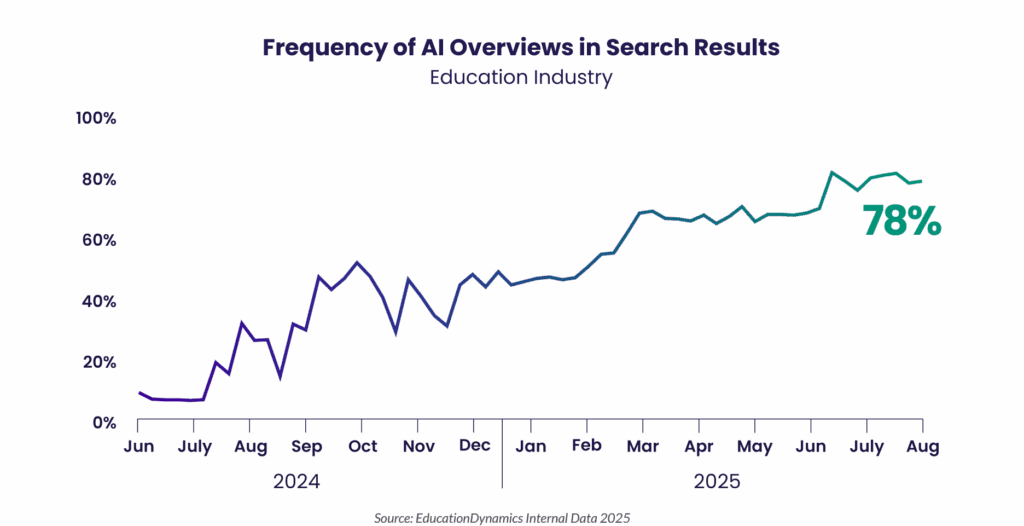
    • AI density: Percentage of keywords that are ranking in AI overviews.
    • Engagement metrics from AI chatbots such as engaged sessions and views.
    • AI-Driven Workflow Automation Rate: Percentage of key administrative processes (e.g., admissions review, financial aid queries) that are fully or partially automated by AI.
    • AI-Informed Decision-Making Rate: Percentage of high-level strategic decisions made based on predictive analytics and AI models.
    • Student Support AI Integration: The percentage of student inquiries (e.g., in financial aid, advising or registrar services) handled by AI-powered tools.
    • Personalized Learning Platform Adoption: The percentage of courses or students utilizing AI-powered platforms to tailor educational content and pace.

    Enrollment and Student Retention Metrics

    Strong enrollment and retention lead to higher graduation rates, reduced revenue loss and an improved institutional reputation. Driving college or university enrollment and retention involves pinpointing relevant Persistence, Progression, Retention and Completion (PPRC) metrics, gathering data from all angles (think systems, surveys, records) and using those insights to craft action plans.

    These numbers aren’t just about growth. They are a measure of your institution’s ability to engage and keep students in a hyper-competitive market.

    We delve deeper into this area by tracking:

    • Enrollment rate: Percentage of applicants who accept and enroll in the program.
    • Retention rate: Percentage of students who continue their studies from one semester/year to the next.
    • Time-to-degree completion: Average time it takes students to graduate.
    • Student satisfaction: Overall satisfaction with the educational experience, measured through surveys or feedback.
    • Application start rate: Percentage of people who begin an application.
    • Application completed rate: Percentage of people who finish and submit an application.
    • New student start rates: Percentage of accepted students who actually begin their studies.

    Financial and Operational Performance

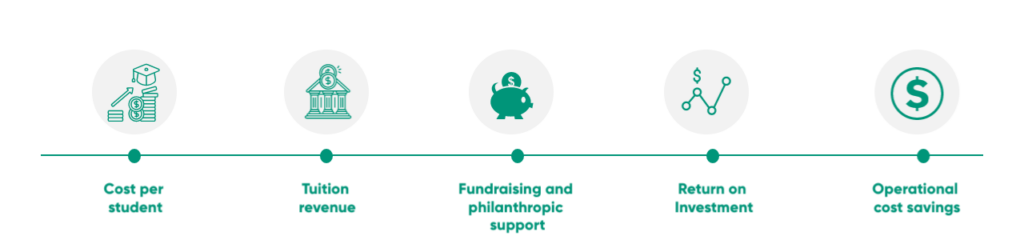
    A healthy financial and operational performance ensures sustainability, resource optimization, and the ability to reinvest in student success. We monitor:

    • Cost per student: Average cost of educating each student.
    • Tuition revenue: Income generated from student tuition fees.
    • Fundraising and philanthropic support: Donations and grants received to support the institution.
    • Return on investment: Measurable benefit in relation to resources invested.
    • Operational cost savings: Reductions in operational expenses without compromising quality.
    Infographic presenting key performance indicators (KPIs) for financial and operational performance of an educational institution. KPIs include: cost per student, tuition revenue, fundraising and philanthropic support, return on investment, and operational cost savings.

    Student Engagement and Learning Outcomes

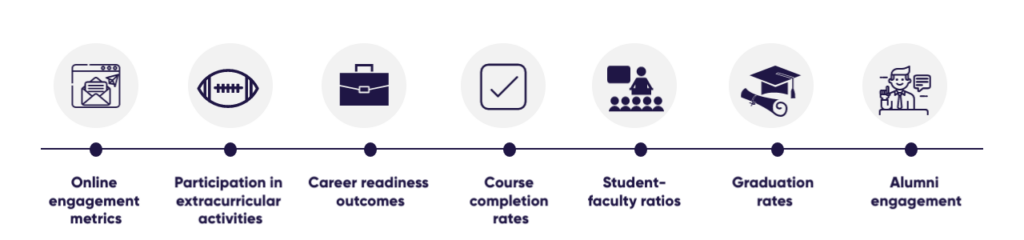
    High student engagement and successful learning outcomes translate to greater student satisfaction, improved graduate employability and a boost to your institution’s reputation. Track the following key performance indicators:

    • Online engagement metrics: Measures of student interaction and participation in online learning platforms.
    • Participation in extracurricular activities: Level of student involvement in non-academic activities.
    • Career readiness outcomes: Success of graduates in securing employment and achieving career goals.
    • Course completion rates: Percentage of students who successfully complete each course.
    • Student-faculty ratios: Number of students assigned to each faculty member.
    • Graduation rates: Percentage of students graduating within the expected or predefined timeframe.
    • Alumni Engagement: Level of engagement and involvement of graduates with the institution.
    Infographic showcasing KPIs related to student engagement, learning outcomes, and alumni involvement. KPIs include: online engagement metrics , participation in extracurricular activities, career readiness outcomes, course completion rates, student-faculty ratios, graduation rates, and alumni engagement.

    Diversity, Equity and Inclusion

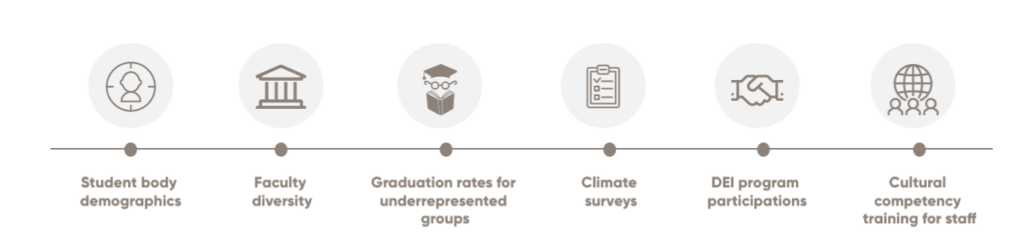
    Fostering a diverse and inclusive environment promotes equity in student success, attracts a wider talent pool, and strengthens your community. We assess:

    • Student body demographics: Representation of different ethnicities, genders, socioeconomic backgrounds, etc. in the student population.
    • Faculty diversity: Representation of different groups among faculty members.
    • Graduation rates for underrepresented groups: Success rates of students from minority or disadvantaged backgrounds.
    • Climate surveys: Assessments of the campus environment in terms of inclusivity and belonging.
    • DEI program participations: Number of students, faculty, and staff engaging in diversity, equity, and inclusion initiatives.
    • Cultural competency training for staff: Efforts to equip staff with knowledge and skills to support a diverse student body.
    Infographic displaying Diversity, Equity, and Inclusion (DEI) KPIs relevant to colleges and universities. KPIs include: student body demographics (e.g., race, ethnicity, gender), faculty diversity (representation of diverse identities), graduation rates for underrepresented groups, climate surveys (assessing inclusivity and belonging), DEI program participation (engagement in diversity initiatives), and cultural competency training for staff (developing understanding and skills to interact respectfully with diverse groups).

    Brand Key Performance Indicators for Reputation and Marketing Effectiveness

    Effective marketing strategies to increase student enrollment play a key role in establishing a strong brand reputation and contributing to a positive public image.
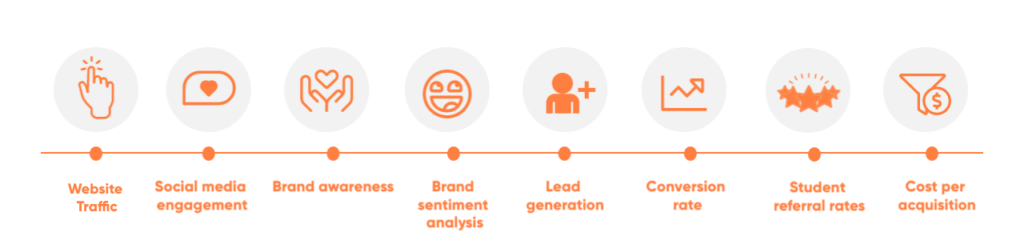
    We monitor these key performance indicators:

    • Website traffic: Number of visitors to the institution’s website.
    • Social media engagement: Likes, shares, comments, and other interactions on social media platforms.
    • Brand awareness: Recognition and familiarity with the institution by the target audience.
    • Brand sentiment analysis: Understanding public perception and opinion of the institution.
    • Lead generation: Number of potential students identified through marketing efforts.
    • Conversion rate: Percentage of leads who actually enroll in the program.
    • Student referral rates: Number of new students enrolled through recommendations from current or former students.
    • Cost per acquisition: Average cost of acquiring a new student through marketing campaigns.
     Infographic showcasing KPIs for brand reputation and marketing effectiveness of colleges and universities. KPIs include: website traffic (number of visitors), social media engagement (likes, shares, comments), brand awareness (recognition and familiarity), brand sentiment analysis (public perception), lead generation (potential student identification), conversion rate (leads enrolled), student referral rates (new students from recommendations), and cost per acquisition (average marketing cost per new student).

    Implementing KPIs for Success

    You’ve chosen your key performance indicators (KPIs). But hold up, don’t get lost in a sea of data just yet. We must translate those fancy metrics into real action.

    First things first, let’s talk SMART goals. Ditch the vague aspirations and define clear, measurable objectives. Instead of “improve student satisfaction,” aim for “increase student satisfaction score by 5% within the next semester.” See how much more focused and actionable that is?

    Data is your fuel, but dashboards are your engine. Imagine analyzing spreadsheets manually – cumbersome, right? Data visualization tools and dashboards are your secret weapons for making sense of all that information. They reveal trends, highlight areas for improvement and showcase your progress in a clear, digestible way.

    Collaboration is key. Don’t work in silos! Involve different departments – admissions, finance, academics, marketing – everyone who plays a role in achieving your goals. Share your KPIs, gather their insights and work together to track progress and make informed decisions. Remember, a data-driven culture thrives on shared ownership and collective action.

    Remember, adaptability is your superpower. The higher education landscape is dynamic, so your KPIs should be too. Review and update them based on new priorities, data-driven insights and feedback regularly. Be flexible, be responsive and embrace continuous improvement as your guiding principle.

    The Future is Not an Improvement. It’s a Revolution.

    Your competitors—the legacy players—are selling you on a slightly better version of the past. More data, a slightly cleaner CRM, a new consulting strategy. But what if the problem isn’t a lack of optimization but a fundamental design flaw?

    The next generation of enrollment demands a completely new approach built on intelligence, not just data.

    • From “Sticker Shock” to Financial Clarity
      You can’t afford to lose students to sticker price anxiety. The future is about radical transparency. It’s about a clear, simple financial aid process that tells a student their true cost of attendance from day one. No surprises. No opaque spreadsheets. Just clarity.
    • From Data Overload to Predictive Intelligence:
      Stop drowning in data. The future is about leveraging AI and predictive analytics to identify the students most likely to enroll and graduate. It’s about understanding their unique needs before they even ask and delivering a hyper-personalized experience that feels like it was designed just for them.
    • From Siloed Chaos to a Seamless Student Journey:
      Overthrow the departmental silos. The future of enrollment is an all-in-one platform that connects every stage of the student journey—from initial search to application, financial aid and enrollment. It’s one portal, one point of contact, one seamless experience.

    Stop Tinkering. Start Transforming.

    You have a choice. You can keep doing what you’ve always done, hoping a better website or a new consulting firm will solve a systemic problem. Or you can admit the old way of doing things is broken and choose to fundamentally transform your approach.

    Your KPIs aren’t just a measure of your progress; they are proof that the traditional system is failing. It’s time to stop measuring the problem and start building the solution.

    Ready to dismantle the old way and build the next generation of enrollment? Partner with EDDY to identify crucial KPIs, develop effective strategies to increase student enrollment, and track progress toward sustainable growth. Together, we can turn your data into a powerful force for positive change and empower your institution to reach its full potential.

    Take the first step today! Contact EDDY to learn how we can help you leverage the power of KPIs and achieve your strategic goals.

    Source link

  • Protecting Revenue and Reputation from Fraud  

    Protecting Revenue and Reputation from Fraud  

    A New Era of Risk and Responsibility  

    Higher Education is under intensifying scrutiny as federal regulations tighten, and public trust continues to waver. A growing threat to this is student aid fraud. Organized schemes are exploiting institutional systems to siphon millions in financial aid, particularly targeting Pell Grant disbursements and student aid refunds. The result is a direct hit to both institutional revenue and reputation. Institutions can no longer afford to operate passively. They must lead with transparency, accountability and systems built to withstand obstacles. In an era already marked by increasing skepticism surrounding higher education, this is a risk that institutions cannot afford to ignore 

    In June 2025, The US Department of Education announced identity verification measures for over 125,000 FAFSA applicants—a clear signal that proactive fraud prevention is no longer optional. Failure to act risks financial loss, audit exposure and reputational damage. Explore how your institution can recognize the warning signs, implement smart prevention strategies and build a strong foundation of trust that supports both reputational and revenue goals.  

    Understanding the Modern Fraudster’s Playbook  

    Today’s fraudsters are highly strategic. They understand how to game institutional processes—enrolling just long enough to trigger student aid refunds, then disappearing soon after. By carefully selecting enough credits to qualify for more aid, these fraudsters have fueled the rise of “ghost enrollments” — fraudulent student records created to claim federal aid without actual attendance.  

    This surge is fueled by gaps in infrastructure, less stringent verification procedures and siloed systems, all challenges that hit resource-limited institutions hardest. The rapid expansion of online learning has outpaced the sophistication of verification systems, reducing touchpoints to confirm student legitimacy. Adding to this challenge, outdated or isolated internal systems often lack real-time data sharing between critical departments such as admissions, financial aid and academic offices. 

    These deceptive tactics lead to more than just financial losses; they corrupt enrollment data, misguide long-term strategic planning and damage an institution’s reputation. Enrollment fraud is not just a compliance problem but a strategic issue that compromises the very accuracy of the data institutions depend on to create budgets, predict enrollment trends and allocate resources effectively.  

    Without real-time data sharing and alignment between systems, institutions remain vulnerable to fraud and flawed decision-making. EducationDynamics supports colleges and universities in closing these gaps through integrated data strategies that prioritize accuracy and system-wide consistency. 

    Identifying the Warning Signs 

    Early detection is an institution’s strongest defense against coordinated financial aid fraud. As schemes grow more sophisticated, so must the systems and vigilance required to stop them. Fraudsters are increasingly leveraging tools like AI to complete assignments, VPNs to hide their locations and fake identities to access financial aid. Even with these evolving tools, fraud leaves detectable patterns—and catching these patterns can become a valuable asset for institutions. 

    Red Flag Reports are among the most valuable tools institutions can use to identify fraudulent activity before financial aid is disbursed. These reports highlight anomalies in student data that may otherwise go unnoticed, offering a proactive mechanism to pause and review questionable activity. Implementing this type of reporting is a critical step toward closing system gaps and elevating your fraud prevention infrastructure. 

    To effectively intercept fraud, institutions should actively monitor for specific indicators across the enrollment and financial aid process, such as: 

    • Multiple students tied to the same bank account or IP address  
    • Invalid or recycled phone numbers tied to applicants  
    • Unusual enrollment or participation patterns, such as registering for the maximum credit load with no subsequent academic engagement 
    • Last-minute documentation or sudden changes to refund delivery preferences 
    • VPN usage that obscures geographic location, particularly when login or application behavior conflicts with submitted residence information 

    In response to these growing concerns,  The Department of Education has expanded identity verification requirements under V4/V5 processes, encouraging institutions to adopt similar protocols—including video-based ID confirmation and tighter front-end validation of applicant information.  

    By actively seeking out these red flags and embracing modern verification practices, institutions can significantly bolster their defense.

    Actionable Strategies for Institutional Defense 

    This is the era of proactive defense, demanding that institutions build workflows that not only accommodate scrutiny but leverage it to strengthen their practices. 

    To achieve this, institutions must: 

    Empower Staff for Early Detection 

    Use Red Flag Reports to monitor for suspicious indicators such as shared IP addresses, duplicate bank accounts and invalid phone numbers. These reports empower your staff to pause questionable disbursements and trigger manual reviews, catching issues that might otherwise slip through. 

    Build Verification Workflows to Withstand Volume  

    Build scalable, repeatable workflows to efficiently handle identity checks, document intake and federal verification requirements. Implement triage systems that ensure timely reviews, minimizing student disruption while maintaining operational efficiency and compliance.   

    Create Strategic Friction 

    Introduce intentional friction points that deter fraudsters without impeding legitimate students. Examples include phone verification for refund information or holding disbursements until after the add/drop period. These small process shifts significantly raise the barrier for fraudulent activity, preventing large-scale losses. 

    Require the Financial Responsibility Agreement  

    Make it standard practice to collect signed Financial Responsibility Agreements (FRAs) before disbursement. Doing so strengthens your paper trail and creates another point of identity verification, helping deter those attempting to abuse the system.  

    Modernize Refund Security  

    Require muti-factor authentication (MFA) when students update refund profiles, and default to e-refunds over checks. Limit paper disbursements and ensure funds are only returned to verified payment methods, significantly reducing fraud risk and maintaining transaction integrity. 

    Showcase Strong Digital Infrastructure 

    When institutions adopt secure, transparent payment systems, they project competence. Adopting strong digital infrastructure is more than an operational improvement; it’s a powerful brand message. A secure system builds public trust and reinforces your institution’s responsible stewardship of student funds. 

    Break Down Silos and Align Teams

    Financial Aid cannot combat fraud in isolation. Establish a collaborative task force with key stakeholders from IT, Registrar and Academic Affairs. Faculty, for instance, are often early observers of suspicious academic behavior. When departments share insights, vulnerabilities are closed far more swiftly. 

    Create Real-Time Communication Loops  

    Facilitate consistent touchpoints between Financial Aid, Accounts Receivable and IT to rapidly flag and act on anomalies. Integrated communication accelerates response times and minimizes oversight risks. 

    Strengthen Awareness Across Campus 

    Incorporate scam awareness into existing financial literacy programs. Students who understand phishing and fraud risks are less likely to fall victim and more likely to report suspicious behavior.  

    Develop a Crisis Communication Playbook 

    A public incident of financial aid fraud extends beyond headlines; it directly threatens an institution’s credibility. Build a comprehensive crisis communication playbook that ensures a fast, transparent, and coordinated response. Proactive planning is crucial, and institutions can significantly strengthen their efforts by partnering with trusted reputation management experts

    When institutions elevate fraud prevention to a core business function, they safeguard far more than their balance sheets, protecting their reputation, enrollment pipeline and overall standing. 

    Why This Matters for Institutional Leaders 

    Fraud prevention is a strategic responsibility that demands the attention of every institutional leader. The consequences of fraud aren’t limited to financial aid offices. Fraud compromises presidential planning, marketing performance and enrollment numbers—all while chipping away at public trust.  If institutional leaders want to chart a course for sustainable growth, defense against fraud must be built into the foundation of that strategy.  

    Presidents

     For presidents, fraud erodes the central pillars that define institutional stability—financial resilience and decision-making confidence. Ghost enrollments and fake students distort budget forecasts, inflate success metrics and mask areas of real vulnerability. 

    Fraud prevention supports long-term vision by ensuring that enrollment, funding and performance data reflect institutional realities, not manipulations. In an environment where every resource must be justified, clarity is a leadership requirement.  

    Marketing Leaders

    Marketing teams are measured by outcomes. Fraud makes those outcomes unreliable. Invalid inquiries and ghost enrollments inflate to the top of the funnel, while wasting precious budget. For leaders who rely on brand perception to drive engagement and attract prospects, fraud directly undermines their efforts, risking a loss of trust and diminished return on investment.  

    Enrollment Leaders

    Enrollment leaders face rising stakes driven by declining traditional student populations and heightened expectations for conversions. In this environment, fraud distorts the metrics that enrollment leaders depend on. It artificially inflates applicant numbers, conceals melt and obscures true student movement through the funnel.  

    More importantly, fraudulent applications divert the time and energy of enrollment coaches. Every moment spent chasing a ghost applicant is a moment stolen from a real applicant who may never get the support they need. Over time, this leads to higher melt, poorer service and declining performance. Strategic financial aid conversations can refocus coaching efforts on real prospects and improve yield through trust-building and transparency. 

    Fraud prevention empowers enrollment leaders to understand their true audience and make decisions rooted in authentic student behavior, not artificial patterns. Aligning enrollment management strategies with proactive fraud prevention creates a foundation that drives sustained success.  

    Building a Resilient Institution 

    Fraud prevention is an ongoing commitment to institutional resilience. As fraudsters evolve their tactics, institutions must continually refine their defenses with smarter workflows, updated red flag criteria and technology. The most resilient schools treat fraud prevention as core infrastructure, integrating it into strategic planning rather than siloing it within financial departments. More importantly, many fraud safeguards also enhance the experience of students and staff by eliminating confusion and freeing teams to focus on supporting real students. When institutions take a proactive approach to fraud, they’re not only protecting their operations—they’re actively preserving the credibility and brand reputation that define long-term success. 

    EducationDynamics is here to help you turn defense into momentum. By aligning revenue strategy with reputation stewardship, we empower institutions to lead with clarity, act with confidence and build a foundation for success in an increasingly high-stakes environment.    

    Source link

  • The Enrollment Cliff Is Here and Now What?  

    The Enrollment Cliff Is Here and Now What?  

    Higher education is facing a pivotal moment. Institutions across the country are bracing for a significant decline in enrollment—a phenomenon widely known as the Enrollment Cliff. This looming challenge is not a distant threat but a present reality. According to EducationDynamics’ 2025 Landscape of Higher Education report, 29% of Americans perceive the cost of education as unjustifiable, raising concerns about affordability and value. At the same time, the last several years have been marked by year-over-year enrollment declines, with freshman enrollment declining by 1.5% overall in fall 2022, including a 5.6% drop at highly selective institutions.  These continued losses signal a diminishing undergraduate pipeline, making it increasingly difficult for colleges to recover pre-pandemic enrollment levels. 

    Colleges and universities that rely on traditional enrollment strategies find themselves at risk as the pool of prospective students shrinks.  

    The question is no longer whether institutions will be impacted but rather how they will adapt. Understanding and engaging the Modern Learner is critical to developing sustainable enrollment strategies. Institutions that recognize this shift and align their marketing, recruitment and engagement strategies accordingly will be the ones that thrive in the changing landscape.  

    What Caused the Enrollment Cliff?

    The Enrollment Cliff stems from a variety of factors, including demographic and behavioral changes. Declining birth rates in the early 2000s have resulted in fewer high school graduates, meaning a smaller population of traditional college-aged students. At the same time, the percentage of high school graduates choosing to enroll in college has been significantly decreasing, with 9% choosing not to pursue college after completing high school. Amid this environment, the value of a degree has also been increasingly questioned. Rising tuition costs, skepticism about degree value, and the rise in alternative pathways have all contributed to this shift.

    For decades, institutions have relied on a steady pipeline of high school graduates to sustain enrollment. However, this model is no longer sustainable. Institutions must rethink their recruitment strategies and expand their focus beyond the traditional student demographic to remain competitive in an increasingly uncertain landscape.

    Why is College Enrollment Declining?

    While the Enrollment Cliff is primarily driven by demographic trends, the decline in college enrollment is also influenced by shifting student priorities and perceptions of higher education. Economic uncertainties, rising concerns about student debt, and the growing number of alternative credentials have made prospective students more hesitant about pursuing a four-year degree. As we discussed in our previous blog article, Seeing Past the Enrollment Cliff of 2025, this shift is compounded by the growing demand for more flexible, career-oriented education options, alongside the growing belief among students that the cost of a traditional college education is increasingly unjustifiable. 

    Despite overall enrollment projections remaining flat throughout 2030, this stagnation masks a critical shift—the student population is becoming more diverse in age and educational backgrounds. Non-traditional students—working adults, career changers, and life-long learners—are now a growing factor in higher education. Institutions that fail to recognize and adapt to these changing dynamics are falling behind.   

    Additionally, the financial health of many colleges and universities is increasingly at stake. Since 2019, institutional risk levels have risen, signaling heightened financial pressures due to enrollment declines. As tuition revenue declines, schools must find innovative ways to attract and retain students.  

    Who is the New College Student? It’s the Modern Learner.

    To combat the Enrollment Cliff, institutions must first understand who they are trying to reach—the Modern Learner.  

    The Modern Learner is not bound by traditional academic pathways. They prioritize flexibility and accessibility, seeking educational experiences that align with career objectives, financial constraints, and personal commitments. Modern Learners are the architects of their own educational journeys, emphasizing cost, convenience, and career outcomes as their primary decision-factors.  

    Modern Learners expect institutions to meet them where they are—whether that means offering online and hybrid courses, providing transparent career-aligned curriculums, or delivering personalized learning experiences. The assumption that age determines learning modality is outdated. Today, students of all backgrounds demand control over how, when, and where they learn. 

    Institutions that recognize these evolving preferences and tailor their offerings accordingly will be best positioned to sustain and grow their enrollment in coming years.  

    How to Combat the Enrollment Cliff with a Unified Strategy

    Higher education professionals can effectively navigate the enrollment cliff, but success in this new landscape necessitates intentional strategic adjustments. Higher education professionals must adopt a unified enrollment and marketing strategy that directly addresses the evolving preferences of Modern Learners. A nonunified approach will not be sufficient; institutions need an integrated strategy that builds brand strength, prioritizes engagement and delivers tailored messaging at critical moments to impact student decision-making

    Build a Strong Brand and Reputation

    A strong institutional brand is essential for long-terms sustainability. More than just a marketing tool, a well-defined brand communicates an institution’s value proposition and helps establish trust with prospective students. A compelling brand differentiates an institution from its competitors, making it easier to attract and retain students. 

    Data from the 2025 Modern Learner report underscores the importance of brand on enrollment decisions, with 58% of students initiating their search by looking for schools first, not programs. Institutions that effectively position themselves as student-centered, outcome-focused and accessible will gain a competitive advantage.  

    Focus on Engagement and Personalization 

    Understanding Modern Learners is only the first step. Engaging them effectively is what is truly critical. Institutions must shift from broad, one-size-fits all marketing approaches to highly personalized engagement strategies. Modern Learners want to feel valued. Their perception of higher education is influenced by their interactions with an institution, from the first website visit to ongoing conversations with admissions personnel. Research from the Modern Learner Report reveals that only one-third of Modern Learners are considered active promoters when it comes to their educational experience. This highlights a significant opportunity to innovate engagement strategies and approach outreach with a student-oriented mindset, as institutions that prioritize personalized communication and meaningful interactions can foster stronger connections, increase student satisfaction, and ultimately drive enrollment and retention.  

    Deliver the Right Message at the Right Time in the Right Place

    Modern Learners move quickly through the decision-making process. Institutions must ensure their messaging is consistent, compelling, and delivered at the right time. A cohesive communication strategy is essential for guiding students through their enrollment journey. 

    Data from the Modern Learner Report illustrates how rapidly prospective students compile a shortlist of schools. Once they identify potential institutions, they make application decisions swiftly. Across both undergraduate and graduate Modern Learners, most students take fewer than three weeks between building a consideration set and making their initial inquiries. Notably, 20% of undergraduate Modern Learners complete this process within just one week. While this trend holds across most Modern Learner segments, traditional undergraduate students tend to take longer, with 34% waiting one to months before making inquiries. Colleges and universities that provide timely, relevant, and persuasive messaging will have a stronger chance of converting interest into enrollment by remaining top of mind.  

    Will Higher Education Survive?

    The Enrollment Cliff is not merely a challenge; it is a catalyst for change. While institutions that fail to adapt may struggle, those that embrace change will find opportunities for growth and innovation.  

    The future of higher education belongs to institutions that recognize the needs of the Modern Learner and evolve accordingly. Those that prioritize flexibility, career alignment, and student-centric engagement will not just endure the Enrollment Cliff—they will turn it into an opportunity for strategic transformation. 

    At EducationDynamics, we aim to be a trusted partner in your journey. By leveraging data-driven insights, personalized marketing and strategic enrollment management, we help you build stronger connections with prospective students, strengthen institutional reputation, and drive sustainable revenue growth. Together, we can navigate these changes and create lasting impact.  

    The Enrollment Cliff is here. The time to act is now. Partner with EducationDynamics to create a unified enrollment and communication strategy that will position your institution for long-term success. 

    Source link

  • Introducing the InsightsEDU Echo Webinar Series

    Introducing the InsightsEDU Echo Webinar Series

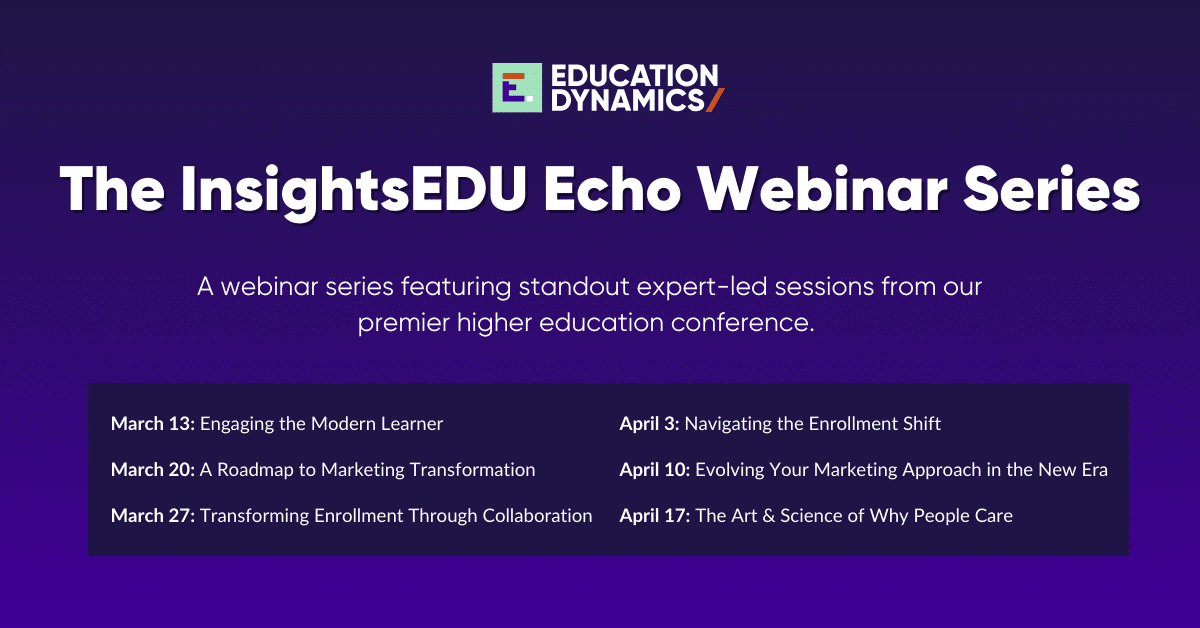
    EducationDynamics is excited to announce our new webinar series — the InsightsEDU Echo Webinar Series. This series is designed to expand access to the impactful sessions delivered at InsightsEDU 2025. Whether you attended the conference or are looking to gain valuable insights into higher education marketing, recruitment, and enrollment strategies, this webinar series brings expert-led presentations directly to you.

    Join us throughout March and April for these exclusive webinars:

    March 13: Engaging the Modern Learner | 1 PM ET

    This webinar presents insights and discoveries from our most recent report, “Engaging the Modern Learner: 2025 Report on the Preferences & Behaviors Shaping Higher Ed.” These findings lay out the framework for a strategic approach built upon strengthened institutional reputation and engagement strategies that deliver the right message, at the right time to all students and institutional stakeholders.

    Speakers: Greg Clayton, President of Enrollment Management Services, and Katie Tomlinson, Sr. Director of Analytics and Business Intelligence.
    Register Here

    March 20: A Roadmap to Marketing Transformation | 2 PM ET

    Discover proven strategies for navigating marketing transformation in higher education. This session will explore how institutions can modernize their marketing tactics to better align with today’s digital-first landscape.

    Speakers: Jamie Ceman, Senior Executive Vice President, RW Jones Agency.
    Register Here

    March 27: From Silos to Synergy: Transforming Enrollment Through Collaboration | 2 PM ET

    Learn how cross-departmental collaboration can unlock new strategies for enrollment growth. This webinar will provide actionable steps for aligning marketing, admissions, and academic teams.

    Speakers: Dr. Jodi Blinco, Vice President for Enrollment Management Consulting.
    Register Here

    April 3: Navigating the Enrollment Shift | 2 PM ET

    Join EducationDynamics and the experts from EY Parthenon for a solutions-focused conversation about the impact and implications of the Enrollment Cliff. Participants will leave with a better understanding of the full impact of the changes facing higher education and the opportunities available for thriving in the evolving educational landscape.

    Speakers: Tracy Kreikemeier, Chief Relationship Officer at EducationDynamics, Kate Kruger, Partner/Principal at EY-Parthenon, and Elizabeth Palmer, Senior Director at EY-Parthenon.
    Register Here

    April 10: Evolving Your Marketing Approach in the New Era | 2 PM ET

    Explore how AI is transforming search algorithms, user behavior, and website optimization. This session, led by Sarah Russell, VP of Marketing at EducationDynamics, will deliver practical techniques to future-proof your SEO efforts and create a full-funnel marketing strategy that moves students from awareness to enrollment.

    Speakers: Sarah Russell, Vice President of Marketing, EducationDynamics.
    Register Here

    April 17: The Art and Science of Why People Care | 2 PM ET

    Uncover the psychological and strategic factors that influence student decision-making and engagement. Learn how to craft messaging and brands that resonate, inspire, and build lasting relationships.

    Speakers: Kelly Ratliff, Director of Client Success and Solutions, RW Jones Agency, and Renee Daly, VP of Brand Strategy, RW Jones Agency.
    Register Here

    Source link

  • Modern Learners, Modern Strategies: The New Rules of Engagement

    Modern Learners, Modern Strategies: The New Rules of Engagement

    Brett is a working professional with a packed schedule, balancing career growth with personal responsibilities. He knows that advancing in his field requires new skills and credentials, but he needs a program that fits his life, one that is flexible, aligned with his career and worth the investment. Brett is just one example of Modern Learner, a growing population of students who prioritize efficiency, affordability and real-world outcomes in their education.  

    Higher education has undergone a decade of transformation, from evolving enrollment patterns to advancements in technology and changing student expectations. As the landscape continues evolves, so do the behaviors and preferences of students like Brett—giving rise to the Modern Learner.  

    EducationDynamics’ latest report, “Engaging the Modern Learner: The 2025 Report on the Preferences and Behaviors Shaping Higher Ed,” examines these emerging trends. For over a decade, we have tracked student behavior and preferences, adapting our research to reflect the evolving higher education environment. Previously known as the Online College Students Report, this study has expanded in scope to provide a more comprehensive understanding of Modern Learners and their needs.  

    Explore the most significant changes over the past ten years, key findings from our research and actionable strategies to help higher education leaders challenge the status quo and drive innovative outcomes.  

    How Have Student Behaviors and Preferences Changed in the Last Decade?

    Student search, decision-making, and engagement behaviors have shifted significantly over the past decade. Strategies that once drove enrollment may no longer be as effective, requiring institutions to adapt. By examining these changes, we can identify emerging patterns that will shape the future of higher education.  

    Modern Learners Expect Immediate Admit Decisions 

    With greater access to information through technology, prospective students are making decisions faster than ever before. As a result, Modern Learners expect rapid responses from institutions. In 2015, 43% of fully online learners said that they would enroll at the first school that contacted them. By 2025, the urgency has increased significantly, with nearly 75% of online learners indicating that they would enroll in the first school that admits them. This shift underscores the growing need for institutions to streamline their admissions processes, ensuring quick response times and efficient decision-making to remain competitive in enrolling Modern Learners.

    Search Initializes at the Brand Level

    Student search behavior is another trend that has faced a significant shift in recent years, with more students starting their search by focusing on schools rather than specific programs.

    Recent data reveals that 58% of respondents begin their search by considering schools first. This trend is even more pronounced among online learners, where approximately 60% prioritize finding a school before narrowing down their program options. Following school, the next most common search is subject area, with students increasingly exploring broader categories before selecting a specific program.

    Given this shift, higher education marketing strategies need to reflect an approach that encompasses both promotion of programs and the institution itself. As prospective students often initiate their search with a school-focused mindset, schools must position their brand clearly to effectively engage and capture early interest, which will guide students towards relevant programs as they progress through the enrollment funnel.

    AI Impacts Consideration Sets 

    The adoption of AI tools, such as website chatbots and on-demand engagement platforms, has grown steadily over the past decade. Recent data highlights notable increases in the use of chatbots. In 2015, only about 15% of online learners engaged with website chatbots or live chat agents. Now, in 2025, that number has more than doubled, reaching 30% of fully online students.  

    Moreover, students increasingly turn to AI tools like Search Generative Experience (SGE) for answers to critical questions about schools and their offerings, with 37% of Modern Learners using AI for information gathering. As students refine their consideration sets, AI-driven engagement tools provide timely and relevant information, making them a key touchpoint in the decision-making process. The growing reliance on these platforms calls for institutions to employ the use of informative and accessible AI tools to offer students seamless support throughout their research and decision-making processes.  

    Preference and Acceptance of Online Modality has Increased

    It’s no secret that in the past decade, online education has not only gained traction but has become the preferred education modality for a growing population of students. In 2015, only 32% of fully online students believed their online education was better than their previous classroom study. However, that number has more than doubled for today’s respondents. 71% of online learners express a preference for online higher education experiences when compared to classroom education, indicating a fundamental change in student expectations and satisfaction with digital learning environments.  

    Engaging the Modern Learner

    At EducationDynamics, our research continually seeks to understand the evolving needs of students. Through years of research and emerging insights from our 2025 survey, a clear picture of the Modern Learner has emerged—one defined by a focus on flexibility, career, and a desire for personalized education experiences. Modern Learners are not only looking to complete a degree, they also aim to shape their own learning journeys in ways that align with their personal and professional goals. 

    Shared Demands and Preferences 

    Despite their diverse backgrounds, Modern Learners share several key expectations. They prioritize affordability, flexible learning formats and responsive support. If their needs aren’t met, they will quickly seek alternative options. This shift in expectations means that institutions need to rethink how they attract, engage and support students. Meeting the Modern Learner where they are is no longer optional; it is essential for long-term success. 

    The Power of Brand & Reputation

    A strong institutional brand plays a crucial role in the student decision-making process. As students begin their search with a school-focused mindset, a well-established reputation can be the deciding factor in where they apply. In fact, reputation ranked as the third most influential factor in application decisions, cited by 31% of students overall and 51% of traditional undergraduates, in our 2025 survey. To remain competitive, institutions must build a credible and respected brand that not only attracts prospective students but also reinforces trust and long-term value throughout their educational journey. 

    Value and Affordability

    While cost is a significant consideration for Modern Learners, affordability alone doesn’t drive enrollment decisions. A well-rounded value proposition plays an equally important role. Our research shows that 46% of students cite tuition cost as a critical factor, but other factors like program relevance to careers, flexibility, and reputation also weigh heavily in their decision-making process. 

    Supporting students with financial literacy is crucial, as 38% of students identify it as a helpful resource during the enrollment process. By clearly communicating both affordability and long-term value such as career outcomes, program flexibility and personalized support, schools can resonate with the priorities of cost-conscious, value-driven Modern Learners.  

    The Importance of Career Focus

    For Modern Learners, education is a direct pathway to career advancement. Regardless of age or background, they share a strong motivation to upskill quickly and gain credentials that lead to tangible career outcomes. This focus on career alignment is evident, with 20% of Modern Learners citing a program’s relevance to their career as a determining factor in their enrollment decision.

    The Modern Learner Survey reveals that 76% of students feel their institution clearly outlines potential career paths related to their program. While this is positive, gaps remain. Traditional undergraduates are the most informed, with 84% receiving clear career guidance, compared to 73% of non-traditional students and 77% of graduate students. These gaps highlight the need for institutions to consistently communicate career values across all Modern Learner segments, ensuring they understand how their education supports their professional goals.

    The Demand for Flexible Learning Models

    Flexibility is no longer an educational preference; it is a necessity for Modern Learners. As today’s students move away from traditional classroom modalities and increasingly seek flexible environments, institutions must invest in program models that accommodate careers and family commitments.  

    When deciding where to apply, 31% of Modern Learners cited flexible course schedules as a key factor. This need is particularly evident among graduate students, who are more likely to be balancing family and work responsibilities. While 53% of respondents do not have children under 18 at home, a notable portion are managing family commitments in addition to their studies. Among fully online students, the number of children at home has increased by 15%, reinforcing the growing demand for learning models that complement busy schedules. 

    The Role of AI and Social Media

    AI and social media play an increasingly important role in shaping student decisions. Social media is no longer merely an avenue for entertainment; it has evolved into a tool for student engagement and research throughout the entire decision-making process. With students interacting across multiple platforms daily, schools must harness these channels to stay visible and relevant as students progress through the consideration phase. To successfully leverage social media, marketing teams should prioritize creating dynamic, visually engaging experiences, particularly through video content, which resonates strongly with Modern Learners.  

    At the same time, AI enhances this by personalizing interactions and providing real-time insights into student preferences, helping institutions refine their marketing strategies. With the rise of generative AI tools, nearly 70% of Modern Learners now use AI in some capacity, including AI chatbots like ChatGPT, to assist their search for school information. Approximately 37% use these tools specifically to gather information about schools, with tuition fees (57%), course offerings (51%), and admission requirements (43%) being the most sought-after details. This highlights the opportunity for schools to integrate AI into their marketing strategies to provide comprehensive, accessible information that supports prospective students with their enrollment decision.  

    Modern Strategies to Engage the Modern Learner 

    As the needs and expectations of students continue to evolve, it’s important for institutions to adapt in ways that truly serve and support Modern Learners. Here are actionable steps to create a personalized, student-centered experience that fosters trust and drives success.  

    1. Embrace Data-Driven Decision Making: Modern Learners expect personalized experiences, and data is the key to delivering them. Through leveraging market research and insights, like those from the 2025 Modern Learner Report, institutions can better understand student preferences and behaviors. To turn those insights into action, invest in tools for data collection and analysis that allow for continuous improvement and refinement.  
    2. Build a Strong and Authentic Brand: A cohesive and authentic brand is integral to connecting with students. Focus on building a positive online experience that bolsters brand visibility, while garnering trust that your institution can provide timely and reliable information that students seek.  
    3. Prioritize Career Outcomes: Career outcomes are top of mind for students as they consider their educational investment. Make career pathways clear by showcasing programs, internship opportunities, alumni success stories and career counseling services to help students see the tangible benefits of their degree.  
    4. Create Flexible and Personalized Learning Pathways: Flexibility is essential for meeting the diverse needs of Modern Learners. Offer programs with adaptable schedules and learning formats, allowing students to choose a pathway that best aligns their lifestyle and goals.  
    5. Optimize the Digital Experience (Especially Websites and Al): An engaging digital experience is critical to attracting and retaining students. Through regular website updates and the integration of AI-powered tools to offer support, institutions can streamline the user experience to ensure a smooth journey from inquiry to enrollment. 
    6. Enhance Communication Speed: Modern Learners expect timely and informative responses and are quicker to make decisions than in years past. Adopt tools that provide real-time communication capabilities, such as chatbots or automated updates, to keep students engaged and informed throughout the enrollment process.   
    7. Develop a Dynamic Social Media Strategy: Social media is a powerful tool for building connections and increasing brand awareness among Modern Learners. With platforms like Instagram, TikTok, and YouTube playing a major role in their online engagement, video content is especially effective in capturing their attention.  By understanding your audience’s media habits and aligning your content with platforms they use the most, you can deliver the right message at the right time, keeping your institution top of mind.  
    8. Don’t Forget About the Human Touch: While technology undoubtedly plays a significant role in modern times, students still seek personal connections. Ensure that students can engage with advisors, staff, or faculty to guide them through the enrollment process, while providing the support they need.

    Aligning with Modern Learners: A New Era in Enrollment

    In this evolving landscape, Modern Learners are placing greater emphasis on career relevance, affordability, and flexibility, demanding more from their education than ever before. The findings from the Modern Learner Survey underscore the importance of aligning educational programs with career paths, improving financial transparency, and providing tailored support to meet diverse needs. The time is now for higher education leaders to challenge outdated enrollment strategies that no longer resonate with today’s highly discerning, cost-conscious, and value-focused students.  

    To navigate these changes effectively, institutions must adopt innovative, data-driven strategies that speak directly to the Modern Learner’s priorities. For a deeper dive into these insights and actionable recommendations, explore the full “Engaging the Modern Learner” report today.  

    Source link

  • What’s New at InsightsEDU 2025? Key Updates You Won’t Want to Miss

    What’s New at InsightsEDU 2025? Key Updates You Won’t Want to Miss

    With InsightsEDU 2025 just around the corner, we’re excited to share some of the key updates and new features coming to this year’s conference, happening February 12-14, 2025 in New Orleans, Louisiana. As the premier conference for higher education marketing and enrollment management, this year’s event promises to be our most engaging yet. Attendees can expect immersive experiences, innovative sessions, and exceptional speakers, all aimed at equipping higher education leaders with the skills and strategies needed to serve today’s Modern Learners. From the welcome reception to our new customized workshop experience, InsightsEDU 2025 is full of exciting opportunities. Read on to see what’s in store!

    This year, we’re embracing the vibrant culture of New Orleans with the Bourbon Street Bash, a celebration that will give attendees the perfect opportunity to unwind, network, and experience NOLA in style. The evening will kick off with a second-line parade, leading attendees through the historic streets of New Orleans to the iconic Bourbon Vieux venue. With a live jazz performance, this event promises to be a memorable way to start an exciting conference experience with the higher ed community.

    For the first time, InsightsEDU is offering a hands-on, interactive workshop led by Dr. Jodi Blinco, Vice President of Enrollment Management Consulting at EducationDynamics.

    The workshop, “Unlocking Enrollment Success: A Customized Consulting Workshop Experience,” is designed specifically for higher education leaders who want to explore the complexities of enrollment models. The workshop provides an opportunity to enhance strategies for attracting, enrolling, and retaining students.

    This session will foster focused discussions, tailored insights, and actionable takeaways, allowing attendees to apply the knowledge gained from the conference directly to their own enrollment strategies.

    This year, we are excited to welcome Po-Shen Loh, an acclaimed entrepreneur, mathematician, and Carnegie Mellon University professor, to the InsightsEDU stage.

    His keynote session, “The Power of Reinvention: Unlocking Innovation to Inspire Action,” will challenge attendees to rethink problem-solving, leadership, and innovation in the ever-evolving higher education landscape. Drawing from his diverse experiences in academia and social entrepreneurship, Po-Shen Loh will explore how institutions can apply startup strategies to innovate and create programs that resonate with students’ needs. His unique experiences throughout higher ed and entrepreneurship make him uniquely qualified to address the conference’s innovative goals and inspire strategies for institutions looking to drive meaningful change.

    Expect to hear from top industry leaders at InsightsEDU, with companies such as EY Parthenon, Slate, Google, Meta, and Reddit, joining to share their expertise in digital engagement, advertising, and marketing strategies. These sessions will help institutions stay ahead of emerging trends, enhance their online presence, and develop strategies to connect with students in innovative ways. Attendees will gain exclusive insights into how leading platforms are shaping the future of student engagement and higher education marketing.

    With RW Jones Agency recently becoming a part of the EducationDynamics team, InsightsEDU 2025 will feature even more expert-led sessions and strategic insights. RW Jones Agency’s expertise in public relations, crisis communications, and higher education marketing is sure to provide valuable perspectives for attendees.

    Here are some of the key sessions featuring RW Jones Agency’s team:

    • A Roadmap to Marketing Transformation: Learn how to implement a marketing maturity model to enhance strategy, optimize resources, and gain real results for your MarCom division. This session will provide insights from experienced professionals who have successfully implemented maturity models to drive impactful results at institutions.
    • A Behavior-Informed Approach to Prospective Student Engagement: Discover how student personas can transform outreach efforts. Building on insights from a recent nationally representative survey of high schoolers, this session explores students’ primary motivations and factors surrounding decision making, offering key insights for higher ed marketers, communicators, and enrollment leaders.
    • Lights, Camera, Connections: How to Produce Compelling Videos That Connect: Join Karolyn Pearson, a former network news producer, and Morgan Aguilar, a former TV reporter, for an exciting session on crafting engaging and authentic visual storytelling to captivate student audiences and enhance your institution’s brand.
    • The Art and Science of Why People Care: Learn how to create audience-centered messaging that aligns with students’ values, increases engagement, and builds lasting relationships while authentically marketing your brand.
    • From Interest to Enrollment: Building Real Student Connections on Social Media: Explore the latest tactics and insights to address an evolving social media landscape and cater to Gen Z and Millennial audiences. This session will explore the latest trends, engagement strategies, and creative tools to foster meaningful interactions on social media that lead to enrollment.

    With an impeccable lineup of sessions, RW Jones Agency’s expertise will provide valuable new perspectives at InsightsEDU 2025, ensuring that attendees leave with actionable strategies to better connect and serve Modern Learners.

    With immersive experiences, groundbreaking discussions, and an incredible lineup of speakers and sessions, this year’s conference is shaping up to be the best one yet. Whether you’re looking to refine your enrollment strategy, explore new marketing tactics, or simply connect with industry leaders, InsightsEDU 2025 is the place to be for higher education professionals.

    We look forward to seeing you at InsightsEDU 2025!

    Source link

  • Personalized Communication Strategies That Drive Student Engagement in Higher Education

    Personalized Communication Strategies That Drive Student Engagement in Higher Education

    Key Takeaways:

    • Personalized, timely, and relevant communication is key to engaging prospective students and meeting enrollment goals in higher education.


    • Effective strategies rely on immediacy, relevance, automation, and trackability, ensuring impactful and consistent interactions.


    • Omnichannel outreach, using a mix of email, SMS, print, and digital platforms, enhances visibility and builds trust by meeting students where they are.


    • Data-driven tools enable tailored, personalized communication, real-time adjustments, and sustainable strategies.


    Connecting with prospective undergraduate students in meaningful ways requires a thoughtful blend of strategy, immediacy, and personalization. Gone are the days when generic messaging could effectively spark interest or drive engagement. Today’s prospective students expect communications that reflect an understanding of their individual needs, aspirations, and priorities and their value to your institution.

    Institutions aiming to enhance their enrollment strategies must adopt a more data-informed and strategic approach to communication. This means reaching out with the right message, at the right time, and through the right channels.


    Laying the Foundation for Communication Success

    Effective communication with students is built on four key principles: immediacy, relevance, automation, and trackability. Each element plays a critical role in ensuring that interactions resonate with students and influence their decision-making process.

    • Immediacy: Quick and timely responses that change as students’ behaviors change demonstrate attentiveness and can make a significant impression on prospective students. Delays in following up on inquiries or campus visits risk the loss of momentum and interest. Statistics show that the school that responds to inquiries first is more likely to convince that student to enroll.


    • Relevance: Tailored, personalized communication should go beyond basic name inclusion. Students expect messages that address their specific interests. Misaligned content, such as sending information unrelated to a student’s expressed major, can quickly undermine trust.


    • Automation: Streamlined, automated workflows keep communication consistent and dependable, even during staff transitions or times of high demand. Manual processes, such as college fair follow-ups that sit unprocessed for long periods, can derail engagement. Automation prevents these bottlenecks, enabling timely responses even when staff are unavailable.


    • Trackability: Monitoring communication effectiveness helps institutions refine their strategies and optimize ROI.

    By integrating these principles, higher education institutions can deliver a cohesive and impactful communication strategy that strengthens student engagement and builds trust.


    The Importance of Omnichannel Outreach

    While email has long been—and remains—a cornerstone of communication, relying on it exclusively is no longer sufficient. The sheer volume of emails students receive daily makes it easy for even the most well-crafted messages to be overlooked. To stand out, institutions must adopt an omnichannel approach with campaigns that combine email with print materials, SMS messaging, voice blasts, digital ads, social media engagement, and microsites, all tailored to student interests.

    Each channel serves a unique purpose for student engagement in higher education. Print materials, for example, are particularly effective at involving families in the decision-making process. A well-designed brochure placed on a kitchen table can spark conversations among family members, especially parents, who are often key influencers in the college selection process.

    Similarly, integrating consistent, tailored messaging across multiple channels ensures that students receive a seamless experience. Whether they encounter an institution on social media, via a targeted ad, by SMS message, or through an email campaign, the message should feel cohesive and tailored to their interests. Omnichannel strategies, timed appropriately through the enrollment timeline, not only improve visibility but also demonstrate an institution’s commitment to meeting students where they are, thus building trust and rapport.


    Leveraging Data for Personalization

    Modern communication strategies must be rooted in data. By analyzing student preferences and behaviors, institutions can craft messages that resonate on an individual level. With data-informed insights, institutions can identify what matters most to prospective students—whether that’s career outcomes, financial aid, or specific academic opportunities—and address those priorities directly.

    For example, students interested in STEM programs may be more receptive to communications highlighting research opportunities and faculty expertise, while first-generation students may appreciate messages emphasizing affordability and support services.

    To further maximize impact, institutions can use surveys and initial engagement data to tailor their outreach strategies, which allows them to deploy resources efficiently while maintaining relevance. For example, expensive print materials can be reserved for students who show strong interest in particular programs, while a social media campaign may be more appropriate for inquiries earlier in the enrollment cycle.

    Real-time data tracking lets institutions segment their strategies dynamically. If a particular campaign underperforms across the board or for certain cohorts of students, modifications can be made immediately to better align with student preferences. This agility is essential for maintaining relevance and impact throughout the recruitment cycle.


    Building a Sustainable Communication Infrastructure

    Sustainable communication strategies rely on the integration of advanced tools and technologies. While a customer relationship management (CRM) system lays a strong foundation, institutions often need more specialized solutions to elevate their outreach efforts. Liaison offers a suite of products designed to enhance and streamline communication and enrollment strategies, including:

    • Enrollment Marketing (EM): Liaison’s EM software and marketing services help institutions manage and analyze personalized, automated omnichannel campaigns, ensuring consistent and effective messaging across multiple channels.


    • Othot: This AI-driven tool leverages predictive and prescriptive analytics to optimize communication strategies and enrollment decisions, tailoring outreach to align with student behavior and institutional goals.


    • Centralized Application Service (CAS): By simplifying the admissions process for students and providing institutions with tools for marketing, data management, and application processing, CAS supports efficient communication with applicants.

    By incorporating these technologies, along with Liaison’s CRMs, institutions can maintain a seamless and unified communication flow so that prospective students receive timely, relevant, and personalized messages. These solutions also allow institutions to monitor campaign performance and adjust strategies in real-time, maximizing the effectiveness of resources and making messaging more impactful for target audiences. This integration reduces reliance on fragmented workflows, preventing gaps or delays caused by disconnected platforms.

    Aligning tools and strategies across departments using Liaison’s technologies keeps messaging consistent and impactful, even as prospective students engage with multiple touchpoints throughout their journey.


    Achieving Long-Term Engagement

    Effective communication with students is about building relationships that extend beyond the initial stages of recruitment. Institutions that invest in understanding and addressing the unique needs of their prospective students position themselves as partners in their academic journey.

    By delivering personalized, timely, and relevant messages through multiple channels, institutions can foster deeper connections and enhance student engagement in higher education. As the competitive landscape of enrollment continues to shift, adopting a strategic and data-informed approach to communication will remain essential for success.

    Ready to elevate your communication strategies? Discover how Liaison’s advanced tools and technologies can transform how you connect with prospective students. From personalized, omnichannel campaigns to data-driven insights, our solutions help you engage students meaningfully and meet your enrollment goals. Contact us today to learn more.

    About the Author

    Craig Cornell is the Vice President for Enrollment Strategy at Liaison. In that capacity, he oversees a team of enrollment strategists and brings best practices, consultation, and data trends to campuses across the country in all things enrollment management. Craig also serves as the dedicated resource to NASH (National Association of Higher Education Systems) and works closely with the higher education system that Liaison supports. Before joining Liaison in 2023, Craig served for over 30 years in multiple higher education executive enrollment management positions. During his tenure, the campuses he served often received national recognition for enrollment growth, effective financial aid leveraging, marketing enhancements, and innovative enrollment strategies.

    Source link