Category: Enrollment

  • Setting the Gold Standard for College Recruitment Campaigns

    Setting the Gold Standard for College Recruitment Campaigns

    Marketing messages bombard students from every direction, so capturing their attention—and inspiring them to take action—requires creative that truly stands out. That’s exactly what the RNL creative team delivers, crafting award-winning campaigns that engage, resonate, and drive results across every channel, from digital to direct mail. We work closely with our campus partners to ensure every undergraduate and graduate campaign is both strategic and impactful—proven by the many gold award-winning projects we’re celebrating this year.Here are 11 that took home gold medals—and one Best of Show—at the 40th annual Educational Advertising Awards.

    Illinois College Agribusiness Management |SEO Video (Best of Show)

    Video isn’t just eye-catching—it’s a powerful SEO booster that keeps visitors on the page longer to improve search rankings. For this project, we paired SEO-optimized web copy with a compelling long-form video designed to engage skimmers and drive inquiries. Illinois College’s campus team fully embraced the collaboration, delivering stunning unique footage that brought their story to life. The result? A versatile, high-impact asset that drove a 7,000% increase in web page visits. Watch the video.

    University of Tulsa | Standout Integrated Search Campaign
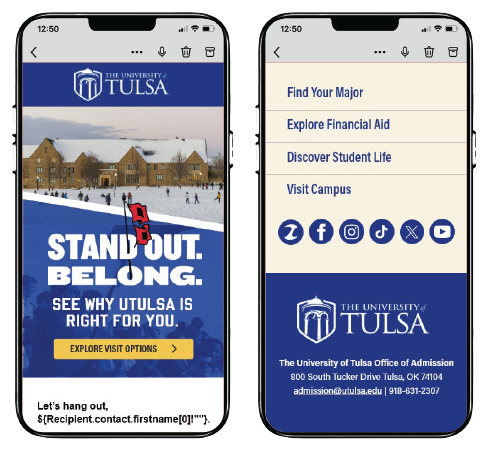
    University of Tulsa: Image of ad campaign on cell phoneUniversity of Tulsa: Image of ad campaign on cell phone

    Reaching high school sophomores and juniors means meeting them where they are—in their inboxes, on their feeds, and in their hands. This multi-channel campaign reinforces the University of Tulsa’s bold message: students don’t have to choose between fitting in and standing out. Rich Art Deco design and conversational copy celebrating personal and academic uniqueness helped elevate brand nationwide while encouraging students to find their fit at UTulsa.

    Linfield University | Personalized Applicant Direct Mail
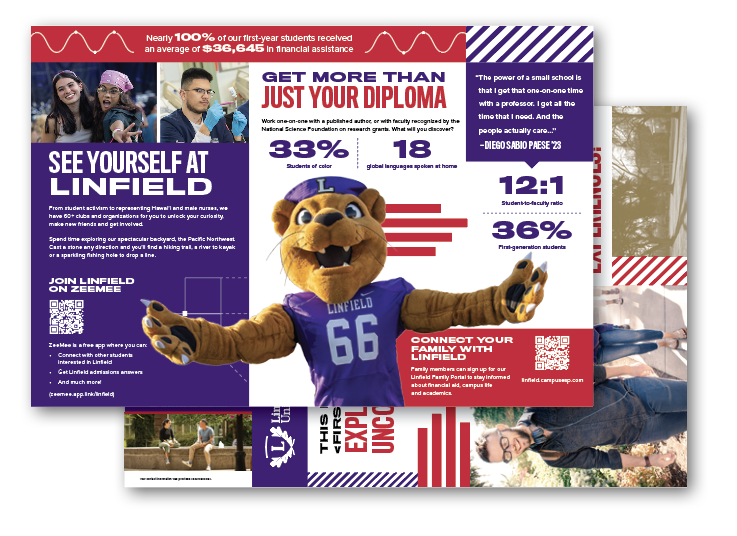
    Linfield University student postcardLinfield University student postcard

    This eye-catching mailer puts Linfield’s bold purple and cardinal branding front and center, using standout stats and a dynamic design to capture attention. Featuring Mack the Wildcat, it reinforces school spirit while guiding students toward their next step—applying with confidence.

    American Musical and Dramatic Academy | Dream-Making Applicant Mailer
    American Musical and Dramatic Academy mailingAmerican Musical and Dramatic Academy mailing

    Designed to attract aspiring performers to perform, create, and wow at campuses in New York and Los Angeles, this high-energy mailer steals the spotlight with bold visuals and dynamic performance imagery. Filled with upbeat performance industry lingo, it sets the stage for students to step into their future—and apply.

    University of Mount Union | Bold, Strong Instagram Ads
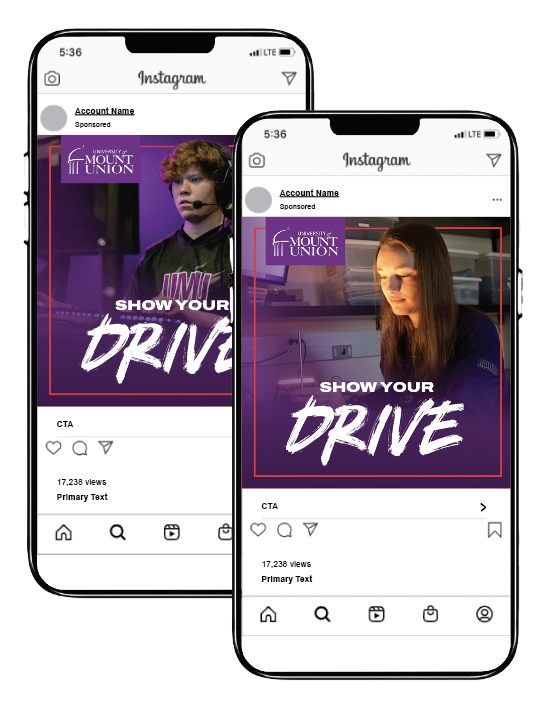
    Mount Union Instagram adsMount Union Instagram ads

    These dynamic search campaign ads put real students front and center, showcasing hands-on learning in action. With bold visuals and empowering copy, the campaign encourages prospects to show up strong, seize opportunities, and own their moment—both in college and beyond.

    Rockford University | Feed-Stopping Facebook Ads
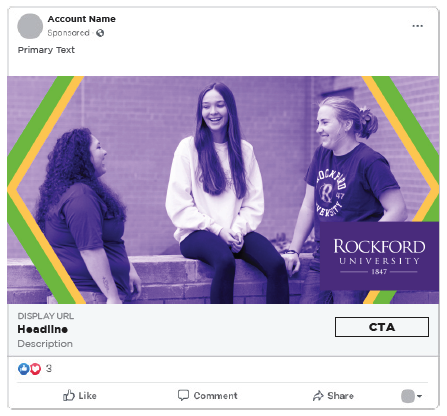
    Rockford University Facebook adsRockford University Facebook ads

    These bright branded ads grab attention alongside the question “RU Ready?”, sparking curiosity about the welcoming environment and numerous opportunities at “RockU.” The campaign is designed to stand out in feeds and aims to inspire students to see themselves on campus and take the next step toward getting there.
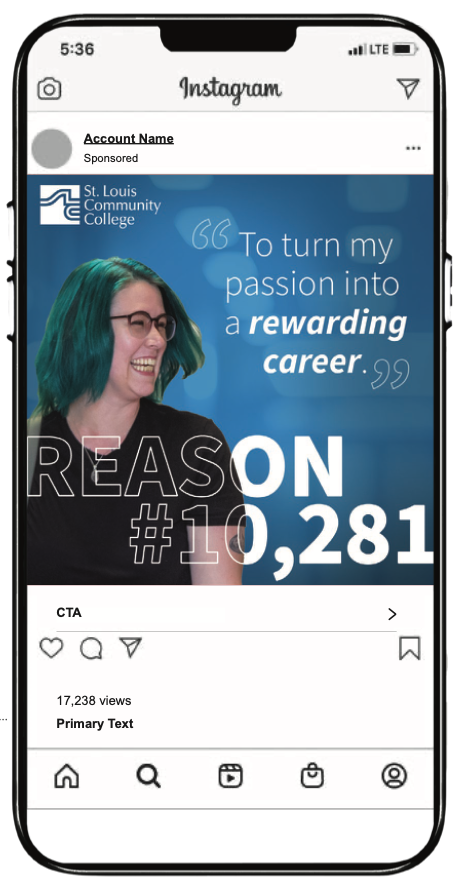
    St. Louis Community College Instagram AdsSt. Louis Community College Instagram Ads

    Featuring proud, hopeful, and joyful students, this campaign highlights reasons students choose STLCC to pursue their dreams. The result? Authentic, inspiring ads that encourage prospects to find their reason at STLCC.

    Jackson State University | THEE Standard for Search Campaigns

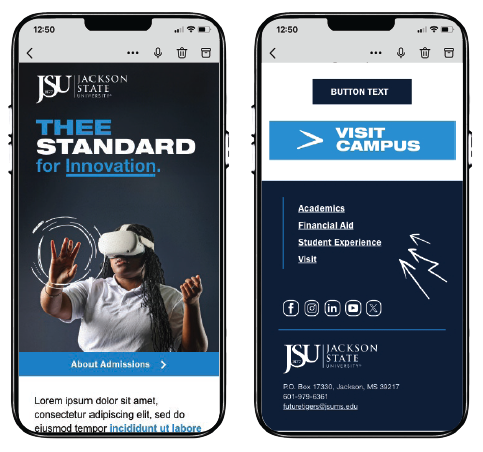
    Jackson State University student search campaignJackson State University student search campaign

    Inspired by Jackson State University’s iconic fight song, this email campaign set the tone with bold headers inviting prospects to learn more about THEE standard for research, academics, innovation, and success. Playful illustrations drawn over dynamic student portraits bring energy and spirit to every email, reinforcing why JSU is THEE place to be.

    University of Washington Bothell | Find Your Fit Facebook Ads
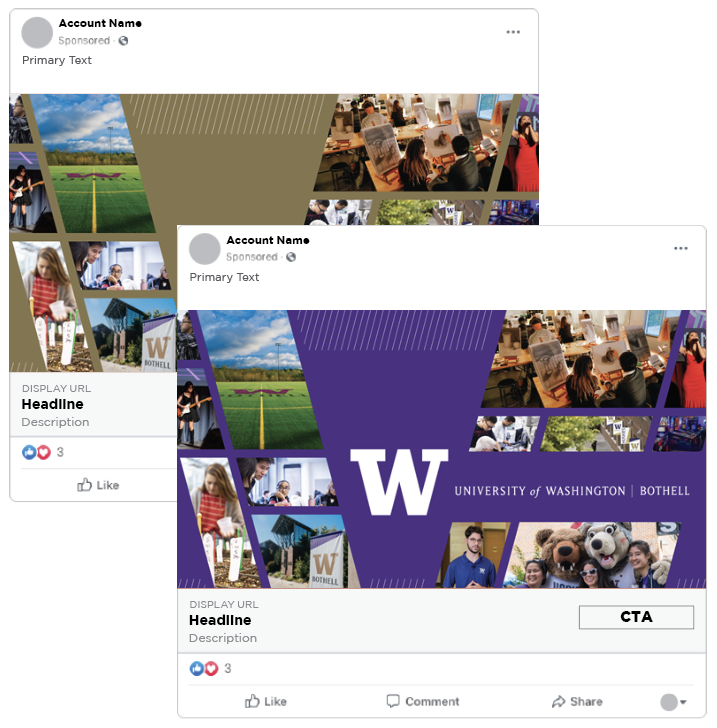
    University of Washington Bothell Facebook AdsUniversity of Washington Bothell Facebook Ads

    This dynamic ad brings exciting campus life to the forefront, featuring lively action shots shaped into a bold “W.” Paired with inviting copy, it highlights the University of Washington Bothell’s close-knit community where students find big opportunities, exciting challenges, and lifelong friends.

    Lamar University | Parent Postcard
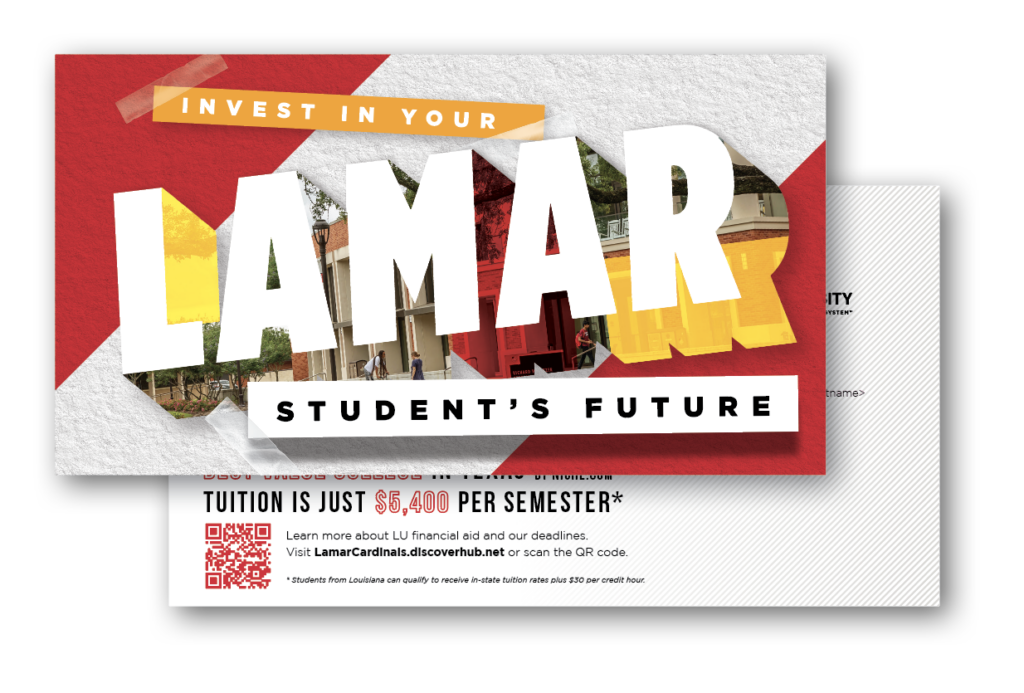
    Lamar University parent postcardLamar University parent postcard

    This gold award-winning postcard spoke directly to parents, highlighting the $20+ million in aid and low tuition that make Lamar University the best-value college in Texas. A clear, compelling message reassures families that a smart investment today means big opportunities for their student’s future.

    University of Central Florida | Universe of Opportunity Email Series
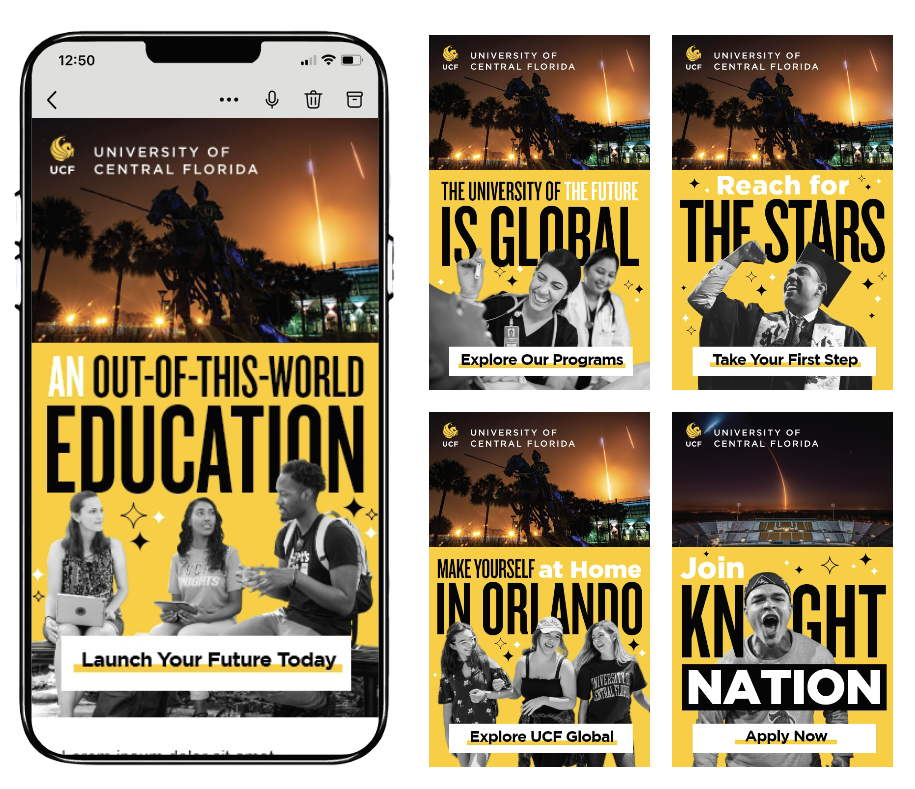
    University of Central Florida recruitment emailsUniversity of Central Florida recruitment emails

    With a prime location between NASA, the Space Coast, and Orlando’s endless experiences, UCF Global offers a launchpad for limitless possibilities. This inquiry-to-application email flow features stunning nightscape imagery and star-inspired design elements reinforcing the university’s spirit of exploration and innovation.

    Create your own winning connections with future students 

    Want to turn your marketing into an award-worthy success? RNL’s creative team brings strategic insight, compelling storytelling, and a track record of 100+ awards in five years to every campaign. Whether you’re engaging undergraduate, graduate, or online students, we’ll help you stand out and drive results. Let’s talk—schedule a complimentary consultation today.

    Request consultation

    Source link

  • What’s Working in College Marketing and Recruitment in 2025?

    What’s Working in College Marketing and Recruitment in 2025?

    What’s Working in 2025 (From Both Sides of the Desk)

    Ever wonder if enrollment professionals and students actually speak the same language? Fresh data from RNL’s 2025 Marketing and Recruitment Practices for Undergraduate Students and the forthcoming 2025 E-Expectations reports reveal some fascinating alignments (and a few mismatches) between how we recruit and how students actually make decisions.

    The human touch still rules (surprise!)

    Remember when we thought Zoom would replace campus tours? Well, the data tell a crystal-clear story that shows the importance of face-to-face connections.:

    • In-person meetings hit 100% effectiveness across all institution types
    • 88% of students who visit campus find it helpful
    • College fairs are crushing it with 85% helpfulness ratings

    Translation: In our AI-everything world, humans still want to talk to actual humans. Revolutionary, right?

    Digital sweet spots (when we get it right)

    Here’s where it gets interesting. Both students and enrollment leaders agree that digital works best when it’s personal and purposeful.

    What’s working:

    • Mobile-responsive websites: 100% effectiveness at private institutions (but only 77% are using them – make it make sense!)
    • SMS messaging: 100% effectiveness across the board
    • Personalized videos: 96% effectiveness when used (but only 49% of private institutions are creating them)
    • Student connection platforms: Up to 100% effective when used properly

    The email plot twist

    Breaking news: Students read your emails!

    • 89% engage with college emails
    • 88% find them helpful
    • 96-100% effectiveness rating from institutions
    • 61% either like or expect personalized experiences

    The secret sauce? Personalization that doesn’t feel like it came from a robot.

    The AI elephant in the room

    Some interesting gaps here:

    • AI chatbots: 74% of students find them helpful (and 68% are using them)
    • Live chat: 79% helpful (71% usage)
    • Digital advertising: Up to 100% effectiveness for institutions

    Key insight: Students are more open to AI than we think—they just need to know these tools exist.

    Your game plan: 3 key takeaways

    1. Keep it human: Those perfect effectiveness ratings on in-person meetings aren’t accidents
    2. Double down on digital personalization: But please, make it authentic
    3. Mind the gaps: Your most effective tools are often your least used (looking at you, personalized videos)

    Stop choosing between high-tech and high-touch—you need both. Just make sure your human connection has a mobile-responsive website to back it up. Because some things never change, and some things really, really need to.

    Find out more in our reports and even more at the RNL National Conference

    These results come from the 2025 Marketing and Recruitment Practices for Undergraduate Students report and from our forthcoming 2025 E-Expectations Report (coming June 2025).

    We’ll also be diving into these reports and much, much more at our 2025 RNL National Conference, July 22-24 in Atlanta. Check out the program for more details on our 120 conference sessions.

    Attend the 2025 RNL National Conference

    Choose from more than 120 sessions across six tracks:

    • Undergraduate marketing and recruitment
    • Graduate and online enrollment
    • Student success
    • Financial aid
    • Strategic planning
    • AI and innovations

    See the session descriptions and save big when you register early.

    2025 RNL National Conference Session Descriptions

    Source link

  • Unlock Your Enrollment Potential: Real Strategies for Real Results

    Unlock Your Enrollment Potential: Real Strategies for Real Results

    Engaging students wherever they are is critical to enrollment success.

    With eight years of experience at Ruffalo Noel Levitz working with more than 100 campuses across the country and following more than two decades leading enrollment efforts on campus, I know firsthand the challenges you face in enrollment. And in today’s environment it can feel like information overload on what you should be doing.

    I recently hosted a webinar sharing insights from our 2025 Marketing and Recruiting Best Practices for Undergraduate Students study, where 114 institutions of all types completed our survey about their use and effectiveness of recruitment strategies. We covered everything from the fundamentals of outreach to the latest in AI-powered chatbots. In survey responses, we found a lot of shared experiences and opportunities for strategy enhancement. Specifically, we identified seven strategies that should form the foundation of your annual marketing and recruitment plan, as well as a few others we recommend incorporating to drive your recruitment to the next level.

    Let’s talk real numbers (and real support)

    In our survey, we asked about written marketing and recruitment plans. Only 29% of institutions have a fully implemented, data-driven plan. So if you’re among the 71% of institutions still working on creation of a full plan, you’re in good company—we’re all trying to navigate this evolving landscape. The encouraging part is you’re committed to improvement. We found that most institutions rate their plans as “good,” but you’re aiming for “excellent.” That drive to excel is what we’re here to support.

    Discovering what truly works (together)

    Through survey responses, we found some powerful strategies that are working for colleges right now. Virtually every institution that uses them rates personalized videos and video calls with students as effective, although fewer than half of you are using those outreach tactics. And implementing new AI-based digital assistants on your website will meet an expectation that students and families have to receive real-time answers to their questions 24/7 about application status, academic programs, and aid packages—but only 22% of institutions have taken this important step.

    Search engine optimization (SEO) stood out as a leading strategy with 75% of institutions pursuing this and 100% of institutions rating it as effective. But we also know that most institutions don’t invest enough or broadly in SEO. Students are increasingly turning to search sites to find university sites and program information, and if you’re not in the top seven links, you’re effectively invisible. You need to incorporate into our annual plans ongoing SEO across your website to develop and maintain relevant content that speaks directly to student interest, both for traditional search engines and AI tools like ChatGPT and Gemini. You then need to track site traffic to measure ROI and so you know when it’s time to revisit those pages again. SEO is not a one-and-done process! Let’s make your website a powerful tool for student recruitment.

    7 practical steps to optimizing your enrollment management outreach

    1. Revisit your core: start with the fundamentals. Don’t underestimate the power of the basics! Make sure those foundational strategies are rock-solid and you have a documented plan for implementation. A strong foundation allows you to build from there and creates the space you’ll need to deal with mid-cycle unforeseen challenges.
    2. Refine your digital approach: digital marketing practices and calls to action. Take a fresh look at your digital marketing. Are your calls to action clear and compelling? Personalize your ad content to the audiences you’re targeting.
    3. Boost your visibility through SEO. SEO is key to being found. Make sure your website content is discoverable by both traditional searches and AI tools. Track your traffic so you know what’s working and what isn’t.
    4. Advertising strategies. Get smart about your advertising. Are you spending your dollars where your students are today or just where you have always spent them? In the last 4 years we’ve seen a significant shift away from “traditional media” and to digital advertising.
    5. Connect authentically on social media. Focus on the platforms where your students are spending their time. Remember, authenticity is key. They’re looking for real glimpses into campus life, not just polished perfection. Show them the genuine experience.
    6. Create tailored experiences with personalized video. Imagine how students will feel when they receive a video that’s just for them! Work to create personalized, customized content based on each student’s interests and watch who’s watching by incorporating tracking metrics.
    7. Enhance student support with AI chatbots. Digital assistants have come a long way in just a couple of years. Use today’s technology to provide 24/7 support so your prospective students can get specific answers in real time.

    We can help you navigate the digital shift and engage students 24/7

    While the ongoing shift toward digital strategies can feel overwhelming, we’re here to support you every step of the way. We’ll help you find the right balance for your institution and your audience.

    Source link

  • Are You Meeting Students Where They Are?

    Are You Meeting Students Where They Are?

    As AI continues to weave its way into our lives, it’s no surprise that high school students are increasingly turning to these tools for college planning. However, our recent study, The AI Divide in College Planning: Students Adoption, Resistance, and Impact, conducted by RNL and TeenVoice, reveals that students aren’t all the same when it comes to AI. Some love it, some are curious but cautious, and some are unsure. Our study identified “Four Faces” of AI adoption among high school students, each with distinct characteristics:

    1. AI Pioneers (33%): These tech-savvy students embrace AI with enthusiasm and trust its capabilities. Representing a significant portion of younger teens, they actively use AI in their college search.
    2. AI Aspirers (33%): The largest group, they are curious but cautious, motivated by the practical benefits AI offers, especially in helping with making scholarship searches, career planning, and college research more efficient. They are prevalent among 15- and 16-year-old teens.
    3. AI Fence Sitters (19%): Uncertain about AI’s role, they rely on traditional methods but are open to compelling evidence. This group, often older teens, requires more information and reassurance.
    4. AI Resistors (9%): Preferring human interaction, they resist AI due to unfamiliarity. However, they are open to learning from trusted advisors like school counselors. This group is more common among Asian/Pacific Islanders and older teens, and in the West and Northeast.

    Overall, the Pioneers and Aspirers tended to be the younger high school students, while those hesitant about using AI in the college planning were more likely to be from the 2025 incoming class. A key takeaway from this study is that if you are not already thinking about how to “wow” potential students with AI tools, you need to start. Similar to how admitted student portals evolved from a novelty to a necessity, intuitive AI tools for college planning will soon become a student expectation.

    Report: The AI Divide in College Planning, image of two female college students sitting on steps and looking at a laptop
    Read the full report

    AI can deliver the 24/7 engagement that prospective students expect

    Consider the potential of AI-powered chat tools or digital assistants that provide instant application status updates, personalized program recommendations, or streamlined scholarship searches. Students expect 24/7 accessibility and seamless navigation throughout the application process and their college experience. Or use AI to add personalized videos throughout your enrollment communication plan. AI can help you identify what is important to individual students and build video content that speaks directly to them like never before.

    In addition, the research clearly shows students still rely on the people in their circle they trust the most—their family, high school guidance counselors, and friends. That’s not at risk of changing anytime soon. AI is an addition, not a replacement. It gives us another way to connect, becoming more important every day. However, as more students move into the AI Pioneer group, integrating AI becomes an essential part of your recruitment mix.

    Understanding how students adopt AI will help you meet their expectations

    Here’s the bottom line: AI isn’t some far-off idea anymore; its already changing what students expect from us. By understanding the “Four Faces of AI Adoption,” you can tailor your engagement strategies to meet students where they are. And embracing AI tools like digital assistants and personalized content creation will not only enhance your university’s appeal but also streamline the study journey and free up time for you to have more real conversations with them.

    Are you ready to embrace the AI revolution in higher education? If you’re new to AI or seeking to enhance your understanding, RNL’s free online course, “AI Essentials for Higher Education Professionals,” is an excellent starting point. Equip yourself with the knowledge and skills needed to navigate this evolving landscape and ensure your institution remains at the forefront of student engagement. Start your AI education today!

    Source link

  • AI Is Changing How Students Search: Will Your Website Show Up?

    AI Is Changing How Students Search: Will Your Website Show Up?

    AI is no longer a distant disruption. It’s already influencing how prospective students and families search, navigate, and make decisions on higher education websites. As teams responsible for delivering seamless digital experiences, we need to understand the behavioral shifts underway and how to respond strategically.

    Across the institutions we support, we’re seeing early but consistent signals: users expect smarter, faster, and more personalized interactions. These changes are subtle in some places and dramatic in others. But they’re accelerating.

    How AI is changing search behavior

    AI tools like Google’s Search Generative Experience (SGE), ChatGPT, and other large language models are changing how people expect to interact with information. According to a 2023 Pew Research study, 58% of U.S. adults are aware of ChatGPT, and younger audiences are among the most active users. Meanwhile, Google continues testing SGE, which presents AI-generated summaries above traditional search results.

    Students are learning to type full, natural language questions — and they expect precise, context-aware responses in return. This behavior is now showing up in on-site search patterns.

    Across higher ed websites, here are a few things we’re noticing:

    • A rise in long-form, conversational search queries, especially within internal site search tools
    • Increased use of search bars over menu navigation (particularly on mobile). A recent E-Expectations Trend report found that half of high school students use the site search to navigate a website.
    • Across the higher ed websites we support, we see stronger performance on pages that are tailored to high-intent topics like cost, admissions, and outcomes. A recent analysis of over 200 higher ed sites found that 53% of engaged sessions come from organic search — highlighting the importance of content that’s built for both SEO and AI-driven discovery.
    • Additionally, research indicates that 80% of high school juniors and seniors consider an institution’s website the most influential resource when exploring schools. This highlights the critical role of personalized and relevant content in engaging prospective students effectively.
    • These findings emphasize the necessity for higher education institutions to develop and maintain website content that is specifically tailored to the needs and questions of their target audiences to enhance engagement and support enrollment goals.
    • Parents and adult learners demonstrate similar behavior as they vet institutions with a clearer sense of goals and outcomes.

    Ready for a Smarter Way Forward?

    Higher ed is hard — but you don’t have to figure it out alone. We can help you transform challenges into opportunities.

    We still need to get the fundamentals right

    It’s important to say: AI-driven search doesn’t eliminate the need for strong site structure. Navigation menus, clear page hierarchy, and thoughtful content design still matter — a lot. Most users move fluidly between browsing and searching. What’s changing is the expectation for speed, relevance, and control.

    To meet this moment, higher ed websites should focus on:

    • Modernizing internal search tools to move beyond keyword matching and support relevance-based or semantic search with tools like Vertex AI in full-site search tools or even program finders.
    • Designing content around user intent, not just institutional priorities. Emphasize topics that students are searching for — like affordability, flexibility, and outcomes — rather than internal program structures or catalog-style descriptions.
    • Making calls to action easy to find and easy to act on (especially for first-time visitors.) We help partners optimize for conversion with AB testing for placement, messaging, and functionality that best resonates with your audience.
    • Better leveraging personalized and dynamic content to deliver tailored experiences based on user behavior, location, or stage in the journey. For instance, high-intent pages like “How to Apply” can be leveraged to serve personalized content blocks based on the visitor’s context. A returning user who previously viewed graduate programs might see a prompt to schedule a call with a graduate admissions counselor. A visitor browsing from New York in the evening hours could be shown a message about flexible online options for working professionals. These dynamic cues guide prospective students forward in their journey without overhauling the entire site.

    Why this isn’t a one-time fix

    This is not a single redesign or one-time upgrade. Optimizing your site for how people actually use it needs to be a continuous process.

    This should include the following:

    • Reviewing analytics and user behavior regularly
    • Conducting search query audits to identify gaps
    • A/B testing calls to action and user pathways
    • Collecting both qualitative and quantitative research to understand different audience needs

    Higher ed website performance is directly tied to enrollment growth. According to a 2024 survey conducted by UPCEA and Collegis Education to better understand the perspectives of post-baccalaureate students, 62% of respondents said not being able to easily find basic program information on the institution’s website would cause them to disengage.

    The survey focuses on program preferences, delivery methods, and expectations during the inquiry and application processes and offered insights into how these preferences vary by age and degree level.

    How to prepare for what’s next

    To stay competitive and relevant, institutions need to invest in both smart search experiences and a streamlined digital journey. Here are some high-level recommendations:

    1. Audit your internal search functionality. How are users searching your site, and are they getting the right results?
    2. Map user journeys for key audiences. This includes traditional students, adult learners, and family decision-makers.
    3. Evaluate AI integration options. Tools like Google’s Vertex AI or other semantic search platforms can enhance search accuracy and personalization.
    4. Don’t overlook AEO (answer engine optimization). As AI-powered tools reshape how students discover and evaluate schools, it’s time to think beyond traditional SEO. AEO focuses on structuring content to directly answer the natural-language questions students now ask in tools like ChatGPT and Google’s SGE. We can help you begin integrating AEO into your strategy and content planning, so your institution stays visible in the next wave of search.
    5. Treat optimization as ongoing. Staying competitive in the AI era requires continuous improvements grounded in data, user behavior, and evolving search trends. Ongoing commitment to this initiative is crucial.

    Smarter web experiences start now

    The future of higher ed websites isn’t just about making information accessible. It’s about making it findable, meaningful, and actionable – and being able to act fast and stay committed to this work.

    Institutions that recognize how AI is already reshaping user expectations, and respond with thoughtful, strategic digital experiences, will meet today’s learners where they are and build trust for the long-term.

    We’re paying close attention to these shifts and helping institutions make smart, scalable updates. If you’re rethinking how your website supports recruitment, engagement, or conversion, now is the right time to start. Collegis Education supports institutions with strategic marketing and web solutions designed to meet these evolving needs.

    Let’s talk about how we can work together to future proof your web and digital experiences to best support enrollment growth for years to come. 

    See how your website stacks up — Contact us to request your AI Readiness Assessment

    Innovation Starts Here

    Higher ed is evolving — don’t get left behind. Explore how Collegis can help your institution thrive.

    Source link

  • Student Satisfaction at HBCUs | Ruffalo Noel Levitz

    Student Satisfaction at HBCUs | Ruffalo Noel Levitz

    Student satisfaction at HBCUs: Male student walking past a university building.
    How does student satisfaction at HBCUs compare to institutions nationally?

    Student satisfaction is a critical component for student success. At RNL, we have observed that satisfaction can vary based on the institution type. Student satisfaction levels at a four-year private may differ from a four-year public. In addition, we have seen that students at schools with a specific identity or mission (such as Christian colleges) may also have different levels of satisfaction. This is why it is helpful for institutions to have an external perspective for comparing their satisfaction scores with institutions that are most like theirs—by type, region of the country, or by the particular population of students they serve.

    The value and impact of Historically Black Colleges and Universities (HBCUs) is well known and documented. HBCUs play a crucial role in advancing educational equity, fostering leadership, and preparing students to excel in a global workforce. Despite comprising roughly 3% of U.S. colleges and universities, HBCUs produce nearly a quarter of all Black graduates, with impact extending beyond academic preparation, serving as powerful engines of economic growth, providing supportive learning environments, and culturally affirming communities at critical times in the student development cycle.

    HBCUs have experienced a surge in student interest over the past several years, leading many campuses to review and refine recruitment and student success strategies. As a result of the increased prioritization of student satisfaction, over the past three years, RNL has created a national comparison group of four-year private and public HBCUs, offering the best external comparison by which institutions may compare themselves. These data can also inform our understanding of the student experience at HBCUs.

    How satisfied are students attending HBCUs?

    The RNL Student Satisfaction Inventory (SSI) is a survey instrument that measures student satisfaction and priorities. The assessment informs campuses of satisfaction levels of various aspects of the student experience, including instructional effectiveness, academic advising, and recruitment and financial aid. The assessment then identifies how those satisfaction levels affect student decisions related to persistence. Over the past three academic years (2021-22, 2022-23, and 2023-24), 8,938 students attending 20 HBCUs have completed the SSI, providing an opportunity for us to assess their satisfaction and compare it to students at other four-year public or private institutions.

    Why do students choose HBCUs?

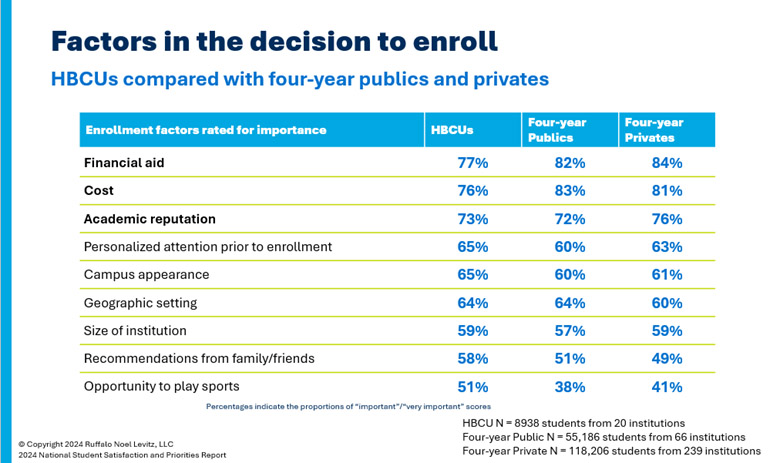
    The SSI asks students to rate the importance of factors that influenced their decision to enroll at their college or university. When we explore the results for students at HBCUs compared with students at the other two institution types, we see the following levels of importance placed on each factor:

    HBCUs and student satisfaction: Table showing that the top 3 factors to enroll at HBCUs are Financial aid, Cost, and Academic reputationHBCUs and student satisfaction: Table showing that the top 3 factors to enroll at HBCUs are Financial aid, Cost, and Academic reputation

    Note the higher importance levels HBCU students placed on recommendations from family and friends, underscoring the importance of highlighting student and alumni outcomes. These results invite university leaders, including admissions and enrollment officers, institutional advancement/transformation officers, and leadership within alumni affairs, to consider how they are positioning various factors and what messaging they may want to emphasize throughout the recruitment process.

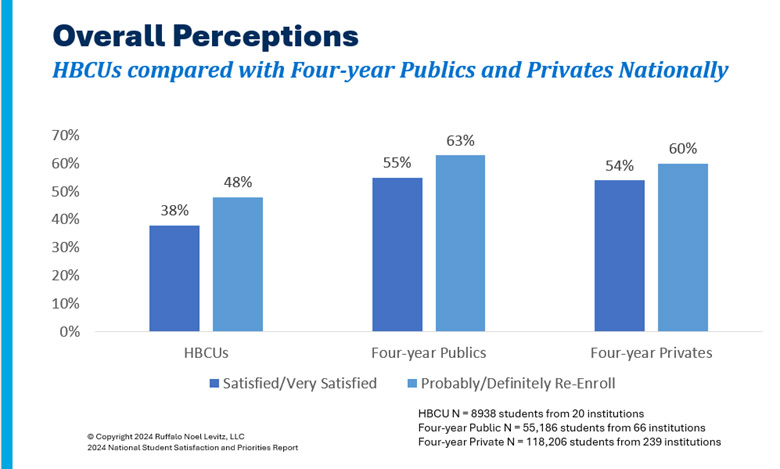
    HBCUs and student satisfaction: Chart showing that 38% of students at HBCUs are satisfied with their institution compared to 55% at other four-year institutions, and that 48% would re-enroll compared to 60% at four-year institutions.HBCUs and student satisfaction: Chart showing that 38% of students at HBCUs are satisfied with their institution compared to 55% at other four-year institutions, and that 48% would re-enroll compared to 60% at four-year institutions.

    As this chart on overall perceptions indicates, students at HBCUs have lower levels over overall satisfaction and were less likely to say they would re-enroll at their institution if they had to do it all over again compared to four-year institutions nationally. Although several factors may contribute to differences in satisfaction levels, this indicates that there is potential for improvement in serving students at HBCUs and meeting their expectations. Several factors may contribute to the differences in satisfaction levels. The call to action, however, is clear—campuses must create and implement concrete action plans to address high priority concerns.

    The Power of Institutional Choice

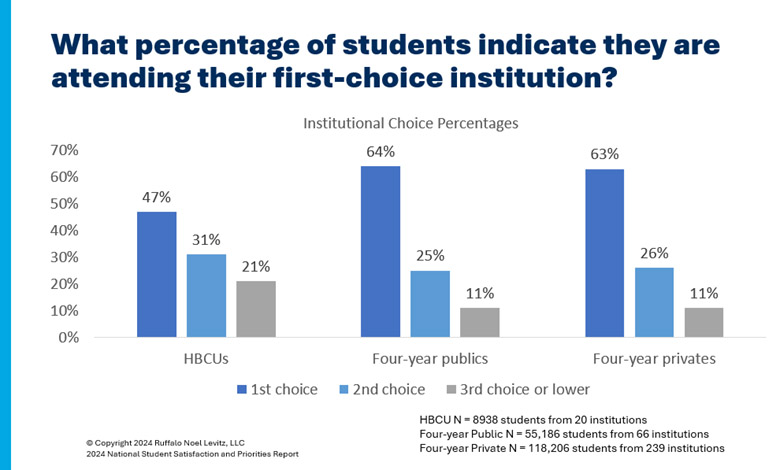
    For years, RNL has noted that students attending their first-choice institution tend to have higher satisfaction than students attending their second- or third-choice institution. Ideally, an institution should strive to have the majority population believe the institution is their first choice, to be in the best position for higher satisfaction scores. In this HBCU data set, the impact of institutional choice is clearly seen. As illustrated in the chart below, only 47% of students indicate that the HBCU was their first choice, as compared with 64% of students at four-year public nationally and 63% of students at four-year private institutions.

    HBCUs and student satisfaction: Chart showing that 47% of students at HBCUs are at their first-choice institution vs 60%+ for four-year institutionsHBCUs and student satisfaction: Chart showing that 47% of students at HBCUs are at their first-choice institution vs 60%+ for four-year institutions
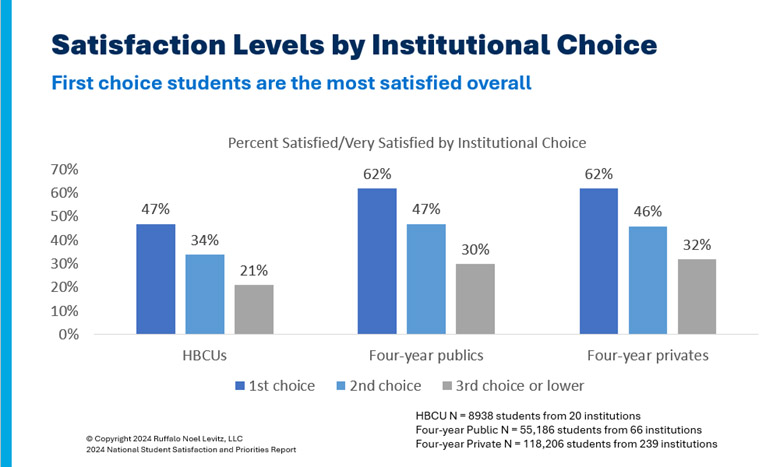
    HBCUs and student satisfaction: Chart showing satisfaction levels by institutional choice, with 47% of HBCU students at their first-choice institution and 62% of students at their first-choice four-year institutions indicating they are satisfied. HBCUs and student satisfaction: Chart showing satisfaction levels by institutional choice, with 47% of HBCU students at their first-choice institution and 62% of students at their first-choice four-year institutions indicating they are satisfied.

    While these two charts look similar, the second one shows the percentage of students who said they were satisfied or very satisfied with their experience based on whether they thought the school was their first-, second- or third-choice. These percentages decline considerably for students who did not want to attend the institution.

    This indicates that HBCUs have an opportunity to better position themselves as a first-choice institution for the population of students they are actively recruiting and to communicate why their college is the best fit and the best option for the student. Larger sample sizes from HBCU campuses could further assist with understanding the impact of institutional choice on satisfaction levels.

    Many strengths and a few challenges

    The SSI asks students to indicate both a level of importance and a level of satisfaction with a variety of student experiences both inside and outside of the classroom. The combination of these scores lead to the identification of strengths (high importance and high satisfaction) and challenges (high importance and low satisfaction). Strengths and challenges are identified for individual institutions administering the survey instrument and can also be indicated for the national comparison data sets.

    When we reviewed the national HBCU group of 8,938 students, more strengths than challenges were identified.

    Strengths

    • My academic advisor is knowledgeable about requirements in my major.
    • Major requirements are clear and reasonable.
    • I am able to experience intellectual growth here.
    • Tutoring services are readily available.
    • Nearly all of the faculty are knowledgeable in their field.
    • My academic advisor is approachable.
    • The content of the courses within my major is valuable.
    • Library resources and services are adequate.
    • There is a strong commitment to racial harmony on this campus.
    • Faculty are usually available after class and during office hours.
    • There is a commitment to academic excellence on this campus.
    • Class change (drop/add) policies are reasonable.
    • Student disciplinary procedures are fair.
    • The student center is a comfortable place for students to spend their leisure time.
    • Library staff are helpful and approachable.
    • Bookstore staff are helpful.

    While many of these strengths overlap with what we see in the national four-year private and public data sets, it is still noteworthy to highlight that, despite the generally lower satisfaction scores at HBCUs, there are still many areas to celebrate. Students value the support received by faculty and staff. Students appreciate the availability of academic resources. Students are highly appreciative that their campus communities are accepting and affirming of who they are and support who they are seeking to become.

    Challenges

    Only five challenges were identified in the national HBCU data set:

    • I am able to register for classes I need with few conflicts.
    • Tuition paid is a worthwhile investment.
    • Security staff respond quickly in emergencies.
    • This institution shows concern for students as individuals.
    • Faculty provide timely feedback about student progress in a course.

    Again, most of these items overlap with challenges identified at the other institution types, which says that the experience students are having at HBCUs may be more similar than it is different. However, that does not discount the fact that the HBCUs bring something special to the marketplace for students.

    Survey your students

    While observing national norms is valuable, the greatest value comes when institutions survey their own student populations to determine satisfaction levels and to see specific strengths and challenges that apply to their college or university. Please contact Julie Bryant if you are interested in learning more about assessing student satisfaction on your campus. If you are an HBCU, RNL will provide the additional comparison group of just HBCUs to you at no additional charge.

    RNL supports HBCUs through various initiatives aimed at enhancing enrollment, student success, and fundraising efforts. Key contributions include:

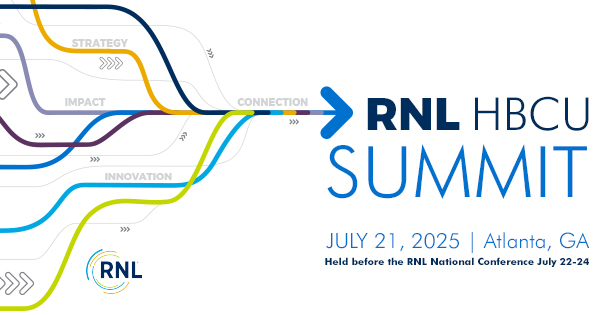
    • Annual HBCU Summit: RNL organizes a yearly summit tailored for HBCU leaders to network, share data, exchange ideas, and develop actionable plans for immediate campus implementation. This year’s summit will take place July 21 in Atlanta, Georgia, and will focus on marketing, recruitment, student success strategies, the impact of trends and technology on HBCUs and the impact sociopolitical climate shifts will have on operational strategy.
    • On-demand webinars: RNL offers webinars such as “Amplifying Excellence: Enhancing Student Success and Retention at HBCUs,” which explore data on first-year students and HBCUS while providing strategies to support student retention and degree attainment.
    • Dedicated team for HBCUs: RNL has an established team of senior-level consultants focused on supporting HBCUs. I lead this team, and we aim to help institutions enhance service to students, meet enrollment and revenue goals, and fulfill their mission.

    Through these efforts, RNL demonstrates a commitment to empowering HBCUs with the tools and knowledge necessary to thrive in a competitive educational landscape.

    2025 RNL HBCU Summit

    July 21, 2025 in Atlanta

    Join us for this one-day Summit held before the RNL National Conference. You’ll hear key strategies for meeting your goals for marketing, recruitment, and retention. Registration is complimentary when you also register for the RNL National Conference.

    See more details and register

    2025 HBCU Summit, July 21 in Atlanta2025 HBCU Summit, July 21 in Atlanta

    Source link

  • Hundreds Waitlisted for Pre-K in South Carolina Despite Thousands of Open Seats – The 74

    Hundreds Waitlisted for Pre-K in South Carolina Despite Thousands of Open Seats – The 74


    Get stories like this delivered straight to your inbox. Sign up for The 74 Newsletter

    COLUMBIA — Hundreds of 4-year-olds across South Carolina are on waitlists to access state-funded preschool programs, even though there are thousands of open seats, according to a report presented Monday to the state Education Oversight Committee.

    The state funds a dual system of full-day kindergarten for 4-year-olds deemed “at risk.” Students are eligible under state law if they qualify for Medicaid or free or reduced-price meals, or if they are homeless, in foster care or show developmental delays. Many public school districts use local property tax dollars to expand that eligibility.

    The state Department of Education oversees programs in public schools, while First Steps, a separate state agency, oversees state-funded classes in approved private schools and child care centers.

    As of November, 400 4-year-olds were waiting for spots to open up to enroll at their local public school. At the same time, First Steps 4K reported more than 2,300 open seats, often in the same counties as the districts with the longest waitlists, according to the report.

    “It’s just a matter of finding an open seat for a child on a waitlist or finding an eligible child for the open seat,” said Jenny May, a committee researcher who presented the report.

    Because 4K is a one-year program, students who are on the waitlist are unlikely to end up in a preschool program before starting kindergarten. Children need at least 120 days of preschool to prepare, so even if a slot happens to open up toward the end of the school year, they will start kindergarten less ready than other 5-year-olds, according to the study.

    It’s not clear why some 4-year-olds are on a waiting list for a public school when vacancies exist in private programs, May said.

    In some cases, the issue could be that another preschool program isn’t available nearby. The four counties with the longest waitlists — Lexington, Anderson, Berkeley and Newberry — all have at least one First Steps 4K program with availability, according to the report. However, that doesn’t account for potential cross-county drives.

    Other parents may not know that other options are available, May said. Having a person designated to help direct parents to other preschool options, such as the nearest First Steps 4K program with open seats, could help reduce that waitlist, May said.

    “It’s likely that if we had a more efficient process, we could serve most of the 400 kids on a waitlist on one of the First Steps seats,” May said.

    The state already has several websites meant to help parents figure out what programs they’re eligible for and how to enroll. Palmetto Pre-K, launched in 2020, tells parents whether they’re eligible for state-funded preschool programs. First Five SC does the same but includes all early childhood programs with federal or state funding.

    But having a person parents can call, or who can reach out to families with children on waitlists, could help reach some parents who might not know about the websites or have other concerns, the study suggests. That person, who the committee dubbed a 4K navigator, could then talk parents through the differences in programs, find available seats and answer any other questions parents might have, researchers said.

    First Steps 4K has a similar program, in which applicants are directed to a central phone line or website that helps parents find the right fit for their child. That has helped prevent First Steps from having its own waitlist, May said. The 4K navigators, who the study suggested trying out in areas with the largest waitlists first, would have a broader knowledge of pre-K programs, the report said.

    If a school district has a persistent waitlist of more than 20 students, that suggests the population has risen in that area, and state officials should consider giving the district more funding to create enough slots for those students, the report suggested.

    The waitlisted students represent less than 1% of students who are eligible for the program but not enrolled. More than 18,000 4-year-olds, or about 55% of all eligible, are living in poverty but not enrolled in a 4K program, according to the report.

    That’s a decrease from the 2022-2024 school year, when 60% of eligible students were not enrolled in districts. Still, it’s not enough, May said.

    Even if every student on a waitlist enrolled in one of the available spots, programs would have space left over to take on at least 1,900 more students, according to the report. That suggests there are barriers other than program space keeping parents from enrolling their students in state-funded preschool, May said.

    In many cases, the problem might be that parents don’t know about 4K programs or their benefits, May said. The state should put more funding and effort into outreach to help those students, the report suggests.

    Data shows preschool programs are highly beneficial, helping students learn skills in reading, math and socialization, studies have found. According to the report, at-risk students who attended a state-funded pre-K program were more likely to be prepared for school than their counterparts who didn’t, according to the report.

    “So, we want those students who are eligible and not served to be able to access it, and we definitely want those students who are on a waitlist to be able to access the program,” said Dana Yow, executive director of the committee.

    SC Daily Gazette is part of States Newsroom, a nonprofit news network supported by grants and a coalition of donors as a 501c(3) public charity. SC Daily Gazette maintains editorial independence. Contact Editor Seanna Adcox for questions: [email protected].


    Get stories like these delivered straight to your inbox. Sign up for The 74 Newsletter

    Source link

  • AI Runs on Data — And Higher Ed Is Running on Empty

    AI Runs on Data — And Higher Ed Is Running on Empty

    Let’s cut to it: Higher ed is sprinting toward the AI revolution with its shoelaces untied.

    Presidents are in boardrooms making bold declarations. Provosts are throwing out buzzwords like “machine learning” and “predictive modeling.” Enrollment and marketing teams are eager to automate personalization, deploy chatbots, and rewrite campaigns using tools like ChatGPT.

    The energy is real. The urgency is understandable. But there’s an uncomfortable truth institutions need to face: You’re not ready.

    Not because you’re not visionary. Not because your teams aren’t capable. But because your data is a disaster.

    AI is not an easy button

    Somewhere along the way, higher ed started treating AI like a miracle shortcut — a shiny object that could revolutionize enrollment, retention, and student services overnight.

    But AI isn’t a magic wand. It’s more like a magnifying glass, exposing what’s underneath.

    If your systems are fragmented, your records are outdated, and your departments are still hoarding spreadsheets like it’s 1999, AI will only scale the chaos. It won’t save you – it’ll just amplify your problems.

    When AI goes sideways

    Take the California State University system. They announced their ambition to become the nation’s first AI-powered public university system. But after the headlines faded, faculty across the system were left with more questions than answers. Where was the strategy? Who was in charge? What’s the plan?

    The disconnect between vision and infrastructure was glaring.

    Elsewhere, institutions have already bolted AI tools onto outdated systems, without first doing the foundational work. The result? Predictive models that misidentify which students are at risk. Dashboards that contradict themselves. Chatbots that confuse students more than they support them.

    This isn’t an AI failure. It’s a data hygiene failure.

    You don’t need hype — You need hygiene

    Before your institution invests another dollar in AI, ask these real questions:

    • Do we trust the accuracy of our enrollment, academic, and financial data?
    • Are we still manually wrangling CSVs each month just to build reports?
    • Do our systems speak the same language, or are they siloed and outdated?
    • Is our data governance robust enough to ensure privacy, security, and usefulness?
    • Have we invested in the unglamorous but essential work (e.g., integration pipelines, metadata management, and cross-functional alignment)?

    If the answer is “not yet,” then congratulations — you’ve found your starting point. That’s your AI strategy.

    Because institutions that are succeeding with AI, like Ivy Tech Community College, didn’t chase the trend. They built the infrastructure. They did the work. They cleaned up first.

    What true AI readiness looks like (a not-so-subtle sales pitch)

    Let’s be honest: there’s no shortage of vendors selling the AI dream right now. Slick demos, lofty promises, flashy outcomes. But most of them are missing the part that actually matters — a real, proven plan to get from vision to execution.

    This is where Collegis is different. We don’t just sell transformation. We deliver it. Our approach is grounded in decades of experience, built for higher ed, and designed to scale.

    Here’s how we help institutions clean up the mess and build a foundation that makes AI actually work:

    Connected Core®: Your data’s new best friend

    Our proprietary Connected Core solution connects systems, eliminates silos, and creates a single source of truth. It’s the backbone of innovation — powering everything from recruitment to reporting with real-time, reliable data.

    Strategy + AI alignment: Tech that knows where it’s going

    We don’t just implement tools. We align technology to your mission, operational goals, and student success strategy. And we help you implement AI ethically, with governance frameworks that prioritize transparency and accountability.

    Analytics that drive action

    We transform raw data into real insights. From integration and warehousing to dashboards and predictive models, we help institutions interpret what’s really happening — and act on it with confidence.

    Smarter resource utilization

    We help you reimagine how your institution operates. By identifying inefficiencies and eliminating redundancies, we create more agile, collaborative workflows that maximize impact across departments.

    Boosted conversion and retention

    Our solutions enable personalized student engagement, supporting the full lifecycle from inquiry to graduation. That means better conversion rates, stronger persistence, and improved outcomes.

    AI wins when the infrastructure works

    Clean data isn’t a project — it’s a prerequisite. It’s the thing that makes AI more than a buzzword. More than a dashboard. It’s what turns hype into help.

    And when you get it right, the impact is transformational.

    “The level of data mastery and internal talent at Collegis is some of the best-in-class we’ve seen in the EdTech market. When you pair that with Google Cloud’s cutting-edge AI innovation and application development, you get a partnership that can enable transformation not only at the institutional level but within the higher education category at large.”

    — Brad Hoffman, Director, State & Local Government and Higher Education, Google

    There are no shortcuts to smart AI

    AI can only be as effective as the foundation it’s built on. Until your systems are aligned and your data is trustworthy, you’re not ready to scale innovation.

    If you want AI to work for your institution — really work — it starts with getting your data house in order. Let’s build something that lasts. Something that works. Something that’s ready.

    Curious what that looks like? Let’s talk. We’ll help you map out a real, achievable foundation for AI in higher ed.

    You stuck with me to the end? I like you already! Let’s keep the momentum going. If your wheels are turning and you’re wondering where to start, our Napkin Sketch session might be the perfect next step. It’s a fast, collaborative way to map out your biggest data and tech challenges—no pressure, no sales pitch, just a conversation. Check it out!

    Innovation Starts Here

    Higher ed is evolving — don’t get left behind. Explore how Collegis can help your institution thrive.

    Source link

  • How a Napkin Sketch Can Unlock Higher Ed Innovation at Your Institution

    How a Napkin Sketch Can Unlock Higher Ed Innovation at Your Institution

    In higher education, it’s easy to feel stuck.

    You know something isn’t working — maybe enrollment processes are clunky, or student support services feel disconnected. You’ve tried new tools, updated systems, created initiatives to create change, and added staff, but the problem persists.  It’s like there’s a giant boulder in your way, and no matter how hard you push, it doesn’t budge.

    It turns out, you don’t need a bulldozer – just a napkin sketch to start building momentum to move the boulder standing in the way.

    It’s a surprisingly simple concept, using visual design thinking exercises to help colleges and universities get unstuck. Not with more tech, or a fancy AI solution, but with more clarity to understand how things work today to create a framework for change tomorrow.

    Because real innovation in higher education doesn’t come from software or a technology — it starts with understanding the systems and the processes you already have so you can visualize what they could be.

    What is a napkin sketch?

    The napkin sketch is exactly what it sounds like: a back-of-the-napkin-style drawing that quickly maps out how a particular process actually works in your institution so it can be reimagined.

    It’s low-tech, but high-impact.

    Think of it as building a gameboard for players to play. Like a Monopoly board, everyone knows the players, the rules, and the steps. It makes the choices that need to be made for each player’s turn clear.  When these choices are laid out visually, it becomes much easier to pinpoint where the real opportunities (and challenges) are.

    What does the napkin sketch exercise entail?

    I usually start these sessions by asking one simple questions with a key follow-up

    • What’s the opportunity for ‘impact’? (What are you trying to accomplish?)
    • What’s preventing progress?

    Then we get to work. Together, we sketch out the entire process: from first interaction to the final outcome. We account for every step, system, and stakeholder that’s involved. We highlight the costs, the tools and technology handoffs, potential delays, and where things might be falling through the cracks.

    We typically conduct the sketch in a virtual drawing space, where we can collaborate in real time to map out the full process. It’s not about polished visuals — it’s about building a shared understanding of how things operate today.

    And in about 60-90 minutes, we always have at least one person in the group say out loud “I didn’t realize that’s how it actually works.” And another will inevitably ask “You’re going to send us this napkin sketch, right? I want to print it out.”

    Ready for a Smarter Way Forward?

    Higher ed is hard — but you don’t have to figure it out alone. We can help you transform challenges into opportunities.

    What can the napkin sketch reveal?

    In our experience working with hundreds of institutions of all shapes and sizes, we’ve found that many face surprisingly similar challenges. This exercise consistently shines a light on hidden opportunities, creating a blueprint for change.

    Common things we uncover include:

    • Manual, repetitive tasks that could be automated or streamlined
    • Workarounds that have become permanent fixtures without anyone questioning them
    • Disconnects between departments, systems, or technologies
    • Operational silos that prevent teams from seeing the full picture or collaborating effectively
    • Missed opportunities to better track, analyze, or act on data
    • Unclear ownership of key steps in the process

    In short, the napkin sketch helps institutions see what’s really going on — and what needs to change to move forward.

    Why does it work?

    Higher ed innovation often stalls because teams are too close to the problem or too deep in their own silo to see the bigger picture. The napkin sketch breaks through that by creating a space for everyone involved to step back and collaborate.

    Here’s why it’s effective:

    • It’s fast — most sessions take an hour or two.
    • It’s visual — helping teams align quickly and clearly.
    • It’s collaborative — bringing together voices from across departments.
    • It’s actionable — revealing next steps that are grounded in reality.

    Most importantly, it shifts the focus away from jumping to solutions and toward understanding the system. Once you understand the system, smart solutions become much more obvious — and effective.

    Real examples of the napkin sketch in action

    Whether it’s enrollment workflows, transcript processing, student communications, or data handoffs between systems or teams, the napkin sketch exercise can help untangle a wide variety of operational challenges. No two institutions are exactly alike, but many face similar complexities — manual processes, siloed teams, and unclear ownership that stall progress.

    Here are a few discoveries we uncovered in recent napkin sketch sessions I’ve led:

    • One institution realized how many steps were involved in processing transcripts — with staff toggling between platforms, uploading the same file in multiple places, and doing manual comparisons. Once the process was mapped, we explored how AI could handle the course match evaluations — saving hours of staff time each week.
    • Another team sketched out their enrollment outreach process and discovered they were sending multiple conflicting messages to students at the same time. The sketch helped them realign their communications and reduce student confusion.
    • A third school wanted to integrate a new tool into their tech stack, but the sketch revealed that the underlying workflow was broken — and that no tool would help until the foundational process was improved.

    In each case, the aha moment didn’t come from buying something new — it came from clearly seeing what was already happening so it could be improved upon.

    What could your napkin sketch uncover?

    If you’re wrestling with outdated processes, disconnected systems, or unclear handoffs — you’re not alone. Many institutions are trying to drive higher ed innovation with limited resources and overwhelming complexity.

    But you don’t need to have all the answers right now. You just need a clearer view of the problem so you can develop a thoughtful solution.

    That’s what the napkin sketch offers: a simple, collaborative way to map your reality, uncover opportunity, and take a smarter next step forward.

    Let’s sketch it out — and see what we find!

    Ready to uncover what’s holding you back?

    Reach out to schedule your own session and take the first step toward smarter solutions.

    Source link

  • Why Timing Matters: Enhancing Graduate Recruitment Strategies with Prompt Communication

    Why Timing Matters: Enhancing Graduate Recruitment Strategies with Prompt Communication

    Graduate enrollment is more competitive than ever. As an admissions leader, you’re not just striving to hit enrollment targets––you’re also navigating the complex needs of prospects who are balancing careers, families, and other responsibilities. It’s no small task. 

    Our recent collaboration with UPCEA confirmed something many of us already suspected: Timely, meaningful communication is the key to standing out in a crowded market. 

    To dig deeper, we enlisted Kate Monteiro, associate director of communication strategy at Collegis Education, to share her perspective on why prompt, responsive interactions matter. Her insights reveal how intentional communication builds trust and drives results. 

    3 key benefits of effective, early communication 

    “Plans and interests can change as quickly as they develop,” Monteiro explains. “Capitalizing on a prospective student’s excitement early can help you keep their momentum going — and dramatically improve their likelihood of enrolling.” 

    From that very first touchpoint, graduate students are evaluating your institution. Are you responsive? Are you supportive? These early interactions set the tone for how they perceive your school will engage with them once they are enrolled – and this can make or break their decision. Here’s why they matter so much: 

    1. Making a strong first impression 

    Your first interaction says a lot. A quick, thoughtful response shows students that their time and interest matter. “Quick responses instill confidence,” Monteiro shares. “They signal that your institution is organized, efficient, and genuinely cares—all of which are qualities students associate with the experience they’ll have if they enroll.” 

    2. Alleviating anxiety and uncertainty 

    Navigating graduate admissions can be overwhelming, especially for students juggling applications to multiple institutions. A delayed response could be viewed as a red flag by students who feel overlooked or unworthy of attention. 

    On the flip side, timely and helpful communication reassures students that they’re a priority. That sense of trust could be the difference between a completed application and a missed opportunity. 

    3. Setting the tone for future interactions 

    “Students notice when there’s a lack of responsiveness,” Monteiro cautions. “If their early experiences are stressful or unclear, they’ll assume that’s what they can expect moving forward.” 

    Consistency is key. A reliable, nurturing communication strategy not only establishes trust but encourages forward momentum toward enrollment. 

    The data on communication preferences 

    If you’re wondering just how much communication matters, numbers tell the story. A 2023 Ruffalo Noel Levitz study found that 65% of enrolled students identified personalized attention as a critical factor in choosing their school. 

    And when it comes to how students want to connect, the data from our survey with UPCEA confirms that email is the clear favorite for all stages. Email was reported as preferred by 47% of students for initial inquiries, 67% for follow-ups, 74% when approaching application, and 69% for application decision notifications.  

    “Email provides a professional yet low-pressure way to engage,” Monteiro adds. “It’s also something students can reference later, which helps minimize miscommunication or misunderstanding.” 

    This data emphasizes a key takeaway: Schools that respond quickly and deliberately, particularly through the channels students prefer, are the most likely to earn trust and secure enrollments. 

    5 strategies to master timely communication 

    A thoughtful approach to communication doesn’t just make a good impression—it sets your team up for long-term success. Here are five strategies to help you get there: 

    1. Develop a structured outreach plan 

    Without a clear communication plan, students can easily fall through the cracks. Monteiro often sees institutions struggle here: “A lot of schools don’t have an outlined communication plan or fail to hold their staff accountable to it. By having a clear and structured plan, you ensure students receive the outreach they need at the right time.” 

    Your outreach plan should have a strategic mix of emails, calls, and texts, with pre-written templates, clear timelines, and designated responsibilities outlined for your team. This ensures consistent, proactive communication with prospective students throughout the funnel. 

    2. Leverage technology 

    Technology is your ally in timely communication, but its effectiveness depends on the strength of your data foundation. CRM systems, AI chatbots, and automated workflows streamline outreach while keeping things personal—provided your data is accurate and well-organized. 

    Automated emails can deliver the communication students prefer, and chatbots can address frequently asked questions 24/7, ensuring students get quick answers—even outside standard business hours. However, without a solid data infrastructure, these tools may fall short. While not a replacement for human connection, they can provide efficient support when and where students need it most—if your data house is in order. 

    3. Foster collaboration across teams 

    Admissions, marketing, and academic teams all play a role in student outreach. Monteiro highlights the disconnect she often sees: “Each team assumes the other is responsible. But ultimately, prospective students are everyone’s responsibility.” 

    Breaking down silos between teams ensures consistent messaging and a seamless student experience. 

    4. Use data to inform strategies 

    Data can reveal what’s working in your current graduate recruitment strategies—and what isn’t. For example, if students are engaging more with email than phone calls, it might be time to shift your focus toward crafting compelling email campaigns. Data can also provide insights into how long students typically take to move through the admissions funnel, allowing teams to optimize communication frequency, timing, and format. 

    5. Balance speed with personalization 

    Quick responses powered by automation are essential, but it’s the personal touch that leaves a lasting impression. Pairing automated emails with personalized follow-ups—whether by phone, text, or email—ensures your outreach feels both efficient and authentic. 

    Level up your graduate recruitment strategies 

    Improving communication isn’t just a nice-to-have—it’s a need-to-have for institutions looking to thrive in today’s competitive graduate market. With a structured plan, the right tools, and data-driven insights, you can build trust and guide more students to enrollment. 

    “Our Collegis Enrollment Specialists hear it all the time from the students at our partner institutions: The level of support and responsiveness is what ultimately compels them to move forward.” 

    – Kate Monteiro, Associate Director of Communication Strategy

    To learn more about how Collegis Education can help enhance your graduate recruitment strategies, explore our Enrollment and Recruitment Services page. For more actionable insights on engaging and enrolling graduate students, request your copy of the report below.

    Optimize Your Enrollment Funnel

    Get the latest on graduate student enrollment trends. Download the full report now.

    Source link