Category: Enrollment

  • Do More with Less: 7 Strategic Advantages of Shared Services in Higher Education

    Do More with Less: 7 Strategic Advantages of Shared Services in Higher Education

    College administrators wear many hats to ensure their institutions thrive. Stakeholders expect them to be visionaries, budget stewards, tech experts, and student champions. However, wearing too many hats can hinder the ability to meet more strategic and forward-thinking institutional demands, effectively diluting leadership capacity and outcomes. 

    How can administrators remove some of those hats without losing control or spending more? 

    How can they guide their institutions to achieve better outcomes with fewer resources?  

    At the 2024 Collegis Education Summit, keynote speaker Dr. John Smith-Coppes, president of Joyce University, shared his advice for achieving higher ed excellence amid market paradigms, shifting learner expectations, and capacity constraints.

    “Embrace your institutional superpower and then partner for expertise. You have to know what you are really good at, but also where you might need help. Having the bravery to objectively look at the brutal facts can take you from good to great. Keep this in mind: Your institution is perfectly designed to get the outcomes it’s getting.”

    -Dr. John Smith-Coppes, President of Joyce University

    Dr. Smith-Coppes is right. If you’re not getting the results you want, you have to shine a light on the operation and consider what adjustments or changes will better position your institution for desired outcomes.

    To echo Dr. Smith-Coppes and answer the earlier questions, working with a strategic partner who has deep expertise in higher education shared services and can manage certain responsibilities more efficiently can get your institution closer to turning aspiration into reality. A true partnership is not about simply outsourcing tasks. Rather, it’s a strategic way to gain access to specialized knowledge, proven methodologies, and scalable resources, all while enabling administrators to focus on their core areas of expertise.

    Mounting challenges facing higher ed leaders

    When I talk to administrators, the conversation inevitably turns to the challenge of doing more with less. They consistently grapple with four key issues:

    • Budget Cuts: Funding is uncertain or shrinking, forcing them to rethink the allocation of resources.
    • Advancing Technology: Technology is rapidly evolving, leaving administrators to scramble after the next advancement or emerging capability.
    • Socioeconomic Pressures: With some questioning the value of postsecondary education, relevant programs with affordable tuition have never been more critical.
    • Employee Turnover: Retaining top talent is difficult, leaving critical gaps.

    But none of these issues surprise us. On the contrary, Collegis Education has partnered with numerous public and private institutions of varying sizes and levels of brand recognition to address these challenges, uncovering advantageous pathways toward more sustainable and fruitful operations.

    The results speak for themselves. Administrators gain more time to leverage their core strengths to elevate their institution’s mission and educational outcomes while actualizing a variety of clear benefits. Here is what Collegis Education continues to deliver for our shared-service partners.

    Seven ways shared services in higher education deliver results

    Institutions that leverage shared services experience benefits in a variety of key areas. Explore some of the most significant advantages:

    1. Improved financial stability

    Predictability and optimization are the key words here. With our solutions for technology management, enrollment management, and student services, institutions know exactly what to budget every year. At the same time, we find cost savings by getting a better return on technology investments, strategically decommissioning redundancies, and renegotiating contracts.

    2. Enhanced operational efficiency

    Is there a better way to reach an institution’s goals more efficiently? More often than not, the answer is yes. We help bring these opportunities to the surface by fully assessing the school’s infrastructure, technology, processes, and other operating procedures. This assessment denotes areas of excellence and points of failure as well as identifies where lag or waste exists. With these insights, we can identify and prioritize emerging opportunities to drive improvement. All this informs a multiyear roadmap that guides higher ed leaders on how to thoughtfully implement changes that engage key stakeholders to accelerate the change management cycle.

    3. Objective perspective & best practices

    We bring a unique perspective to our recommendations based on our work with other schools while protecting each school’s anonymity and uniqueness. This helps give you a baseline of how your school performs when compared to similar ones. Are you leading or lagging? As an unbiased third party, we offer fresh ideas backed by the knowledge of the results they have produced. It’s a great way to eliminate the “but this is how we’ve always done it” objection and gain buy-in from internal staff.

    4. Risk mitigation & accountability

    There’s rarely a higher ed situation we haven’t already dealt with at another institution. Our partners benefit from this experience, allowing them to proactively avoid operational and technical risks. They also benefit tremendously from having a partner who holds themselves accountable to quantifiable outcomes measured by agreed-upon service level agreements (SLAs). Together, these provide a lot of peace of mind when it comes to issues like cybersecurity, compliance, disaster recovery, and business continuity.

    5. Specialized expertise without the overhead

    Hiring and retaining experienced staff is challenging enough. Finding people with skill sets to leverage evolving technology capabilities like artificial intelligence (AI) is a whole other story. That’s why our partners rely on Collegis to provide the expertise that’s hard to find. We’re software-agnostic and implement solutions that are in the school’s best interest from a financial, operational, and strategic perspective without the need for full-time employees to manage them.

    6. Data-enabled decision making with full transparency

    Data at most institutions is stored in siloes, with limited stewardship and governance over its quality and consistency. However, many of the “data” solutions in the market today are complicated and difficult to implement and support.

    This is why we built Connected Core, a scalable higher education industry cloud solution that integrates siloed data sets, systems, and applications to enable institutional intelligence. This proven approach and methodology for collecting, connecting, and activating institutional data eliminates data doubt and gives leaders the confidence to make quickly make strategic decisions with confidence.

    7. Focus on core mission & educational outcomes

    By outsourcing some functions, administrators can redirect resources and energy to what truly matters: student success. By reducing the number of hats they wear, leaders can instead focus on using the tools they have on hand to manage strategic initiatives that drive institutional growth.

    Strategic delegation to yield better outcomes

    Some leaders fear losing control through outsourcing, and rightfully so. Too many vendors tout “partnership” when, in fact, they are trying to build an unhealthy dependency that is not mutually beneficial.

    That’s just not us. It fundamentally goes against our values and who we are as a company.

    Our partnerships are built on collaboration and shared governance. Institutions set priorities, and all actions follow clear assessments, implementation plans, and progress reviews. Our partners gain greater control over technology, enrollment, and budgets. Control isn’t lost, but visibility and accountability are gained.

    Shared-services models allow administrators to confidently offload specific responsibilities. Leveraging external expertise amplifies your internal strengths and empowers your leaders to focus on building and maintaining a thriving campus community.

    But the first step is starting the conversation with the right partner.

    Innovation Starts Here

    Higher ed is evolving — don’t get left behind. Explore how Collegis can help your institution thrive.


    Source link

  • Leading Your Institution in Times of Disruption and Uncertainty

    Leading Your Institution in Times of Disruption and Uncertainty

    Blog on higher education navigating turbulent waters: Image of a lighthouse in rough seass
    How can you illuminate a path to success in a turbulent environment?

    This last half decade has delivered unprecedented disruption for university leaders. The pandemic, economic uncertainty, greater need among students and families, and sweeping governmental changes have buffeted campuses of every size, type, and mission. As we move through 2025 and look at the landscape beyond, it’s clear that adaptability, resilience, and innovative thinking are crucial for successful university management.

    As my colleagues and I partner with university leaders on key areas such as strategic enrollment planning and working with university boards, we help leaders assess and address five key challenges that impact institutional sustainability. Addressing these areas strengthens fiscal health, campus alignment and collaboration, efficiency, and other challenges that are roadblocks to a campus achieving its full potential.

    Embracing Enterprise Risk Management

    There is one preliminary key strategy that has become especially vital for navigating uncertain times: Enterprise Risk Management (ERM). This approach replaces siloed risk management that dilutes campus resources and responses with a stronger, integrated perspective—allowing senior leaders and boards of trustees to gain a comprehensive view of potential threats and their interconnections. By implementing ERM, universities can develop more effective strategies for identifying, mitigating, and managing risks across all aspects of their operations.

    Addressing five key challenges

    Once you have embraced ERM, that can help guide your strategies and tactics in addressing these five key university challenges.

    1. Financial stability and funding

    With potential changes in federal funding and financial aid structures, universities must diversify their revenue streams and explore new partnerships. This may include collaborations with private industry, international organizations, and philanthropic entities to sustain critical academic research and support student access to education.

    Additionally and perhaps more urgently, leaders need to dive deep into financial aid budgets, leveraging strategies, funding sources, and how they tie to recruitment and admissions strategies. RNL is working closely with our partners to redesign models if/when funding sources disappear, ensuring that you can meet your enrollment goals and serve your mission amidst tremendous uncertainly regarding government sources of funding.

    2. Technological integration

    The rapid advancement of technology, particularly artificial intelligence, is disrupting traditional teaching and learning methods. University leaders must navigate this transformation by:

    • Investing in faculty training for AI integration
    • Updating curricula to reflect emerging technologies
    • Developing ethical guidelines for AI use in academia

    Along those lines, it is critical that institutions have an AI governance framework in place. However, few universities do. In our recent survey of marketing and recruitment practices for undergraduate students, only one out of 10 four-year institutions reported having an AI governance plan. With AI revolutionizing the college journey for students and families, you need to ensure you have a sound AI governance framework.

    3. Crisis preparedness

    From pandemics to natural disasters disrupting higher education, having a comprehensive crisis management plan is essential. This should include:

    • Regular scenario planning and contingency exercises
    • Clear communication protocols for all stakeholders
    • Ongoing training for staff and administrators

    Most institutions have the logistics of crisis management figured out: crisis captains, protocols, policies, and procedures. What they have not accommodated for in the midst of myriad external forces is the long-term impact of these singular events and ongoing circumstances on their communities—students, families, faculty, and staff. The mental health crisis in education is on the rise and now, more than ever, campuses need to lead with compassion and understanding to bring communities together. Ultimately, your institution needs to be able to anticipate potential crisis and be ready to adapt rapidly to ensure that students are cared for and their college experience can continue.

    4. Fostering a culture of innovation and adaptability

    Taking the optimal approach to technological changes and crisis preparedness requires cultivating a culture of continuous innovation. This involves:

    • Creating dedicated teams to explore new areas of innovation
    • Encouraging interdisciplinary collaboration
    • Promoting flexibility in learning paths and program offerings

    The higher education marketplace does not stand still, and universities therefore cannot afford to be set in their ways and be slow to adapt.

    5. Prioritizing stakeholder trust and communication

    Addressing these challenges and achieving goals in a period of disruption requires unity, transparency, and communication among key stakeholders. University leaders should:

    • Maintain open lines of communication with all stakeholders
    • Build trust through consistent and honest messaging
    • Engage in active listening to address concerns and gather feedback

    Difficult messages can be difficult to deliver, but more transparency and dialogue with stakeholders will increase collaboration and focus that will produce transformative results.

    Great university leadership is needed more than ever

    Managing a university during times of great disruption and uncertainty requires a delicate balance of strategic foresight, agile decision-making, and compassionate leadership. By embracing risk management, fostering innovation, and prioritizing clear communication, university leaders can navigate these challenging waters and emerge stronger, more resilient, and better equipped to fulfill their educational missions in an ever-changing world.

    As we face the future, it’s clear that the most successful universities will be those that can adapt quickly, leverage new technologies thoughtfully, and maintain an unwavering commitment to their core values and the communities they serve. My colleagues and I stand ready to help you face this future and achieve immediate and long-term success. Please reach out and we can arrange a convenient time to share our insights and what’s working for institution’s like yours.

    Source link

  • How 24/7 Technical Support Drives Student Success and Retention

    How 24/7 Technical Support Drives Student Success and Retention

    From speed-to-lead to 24/7 support: Meeting student needs in the digital age

    In our recent webinar, “The Importance of Speed to Lead in Meeting Your Enrollment Goals,” we highlighted how rapid, personalized responses to prospective students can significantly impact their perception of an institution’s quality and commitment. This principle of timely, relevant communication extends beyond the admissions process and into the heart of the student experience, particularly in online education. In this post, we’ll delve into how this same philosophy applies to technical support, forming a crucial component of student success and retention.

    The critical role of 24/7 technical support in online education

    Building on the speed-to-lead concept, the need for swift and effective technical support in online learning environments has become paramount. As we transition from initial student engagement to ongoing support, responsive assistance becomes even more critical. Let’s explore why timely technical support is essential and how it ties to student retention, institutional credibility, and mission fulfillment.

    The importance of quick response to technical needs

    Just as rapid responses to inquiries can influence a student’s decision to enroll, quick resolution of technical issues can determine a student’s ability to succeed in their coursework. Student satisfaction is closely tied to the quality of the overall experience institutions provide to students, including addressing technical issues and how the institution responds to the students as individuals when they have a concern. When students encounter technical barriers without immediate resolution, their frustration can lead to disengagement and even withdrawal from courses.

    The importance of swift technical support in higher education cannot be overstated, as exemplified by several leading institutions.

    • Penn State University’s IT Service Desk stands out with its comprehensive 24/7 technology support model. Utilizing a blend of 20 students and full-time staff members, they efficiently manage up to 600 daily requests during peak periods. This continuous operation throughout the year, pausing only for university holidays, ensures that the Penn State community receives timely assistance for diverse IT-related issues, from learning management systems to account access and new IT service implementations.
    • Arizona State University (ASU): ASU’s help center provides round-the-clock service for their large student body. They have 81 employees and 22 student representatives who offer 24/7 support for approximately 100,000 students, including both on-campus and online learners. The center serves as a comprehensive “front door” to the university, assisting with various inquiries beyond just technical issues.
    • The University of Central Florida (UCF) has adopted a strategic approach to technical support. By deploying technicians during high-demand hours, UCF effectively minimizes downtime for both students and faculty. This proactive strategy maintains the continuity of the learning process and demonstrates the institution’s commitment to student success.

    In instances where staffing may be limited, universities are increasingly turning to AI-powered solutions to meet the demand for immediate, round-the-clock support. For example, Thompson Rivers University has implemented a 24/7 chatbot support system. This AI-driven tool automates 83% of incoming chats to their Future Student department, providing instant responses outside of regular business hours. Moreover, a number of innovative platforms such as RNL’s Compass digital assistant provide AI-powered chatbots designed for higher education. These AI-powered assistants can seamlessly integrate with various campus systems, including SIS/ERP, ITSM, and LMS, to address a wide range of inquiries related to IT, admissions, financial aid, and more. By leveraging such technologies, institutions can significantly reduce support costs while ensuring students and faculty receive timely, personalized assistance at any hour.

    The case for a 24×7 support model

    A 24/7 support model aligns with the flexibility that online education promises. Students often engage with coursework outside traditional hours, making access to technical assistance at any time a necessity rather than a luxury. Institutions like Faith Christian School emphasize the importance of uninterrupted access to educational resources, which fosters independence and self-directed learning. Similarly, Google Cloud’s Student Success Services leverage virtual assistants to provide instant answers around the clock, freeing up staff for more personalized guidance.

    Moreover, research shows that institutions offering comprehensive support services see higher retention rates. RNL data show how targeted outreach and timely interventions can significantly improve student outcomes and graduation rates. By addressing technical issues promptly, universities not only retain students but also fulfill their mission of guiding them toward successful program completion.

    Perception of a well-equipped university

    The availability of 24/7 technical support is increasingly viewed as a marker of institutional quality. Students now expect seamless access to both academic content and support services when selecting a university. Institutions that fail to meet these expectations risk damaging their reputation and losing prospective students. RNL student satisfaction and priorities data shows that approximately two-thirds of students value institutions addressing their personal needs throughout the recruitment process, which can factor in their decision to enroll at the institution. Offering robust technical support signals that a university is technologically advanced and committed to providing an optimal learning environment.

    Enabling student success and institutional mission

    Timely technical support directly contributes to student success by removing barriers to learning. When students can focus on their studies without being derailed by technical difficulties, they are more likely to persist in their programs. This aligns with the broader mission of most universities: helping students succeed academically and graduate. Demonstrating the lived expression of institutional mission through 24/7 support for student services can enhance retention and overall well-being. By addressing both academic and non-academic challenges in real-time, universities create an ecosystem where students thrive.

    Conclusion: Timely support is critical to the online student experience

    From the initial point of contact through to graduation, the principle of timely, personalized support remains crucial. The importance of responding quickly to students’ technical needs is a natural extension of the speed-to-lead philosophy in enrollment management. A 24/7 support model not only ensures uninterrupted learning but also strengthens institutional credibility and fosters student retention. By prioritizing timely assistance across all aspects of the student journey, universities can live up to their mission of empowering students to succeed academically and graduate with confidence. As these examples illustrate, investing in comprehensive support systems is an investment in both student success and institutional sustainability.

    We’re here to help you navigate the technology you need to engage students and provide them with that 24/7 support. Reach out and we’ll set up a time to talk with an RNL enrollment technology expert.

    How can you leverage technology across the student lifecycle?

    With students expecting personalized attention 24/7, you need to be able to engage them at any point in the student lifecycle. Talk with our experts about how you can use the latest technology to create those connections to strengthen recruitment and retention.

    Ask for a complimentary consultation

    Source link

  • AI and College Planning: The Four Types of Students

    AI and College Planning: The Four Types of Students

    How different students navigate college planning

    Let’s talk about how students really tackle college planning. Forget the stereotypes about Gen Z being glued to their phones or allergic to human interaction. Our latest research reveals something more interesting: there isn’t just one type of college searcher anymore.

    In our recent research with TeenVoice we identified four distinct personalities in how students approach their college planning, especially when it comes to using AI tools. And trust me, the results might surprise you!

    Meet the cast of characters

    First are the AI Pioneers – your early adopters who aren’t afraid to try new things. They’re all over college websites (62% of them use them!), but here’s the kicker: they still heavily rely on counselors (46%) and family input (48%). These students aren’t replacing human connection with technology; they combine both. They’re natural experimenters, comfortable jumping between digital and traditional resources to find what works best for each task.

    Then there’s the AI Resistors. Despite their name, these students aren’t living under a rock – they’re actually the most likely to use counselors (55%). They’re old school in the best way possible, preferring face-to-face conversations over digital solutions. They are the “let’s grab a coffee and talk about it” crowd. For them, learning is deeply personal and relationship-based.

    The AI Aspirers are our “interested but cautious” group. They’re spread evenly across their resources – about 40% use college websites, counselors, and social media. They’re curious about AI but haven’t fully embraced it yet. Think of them as methodical learners who want to understand all their options before diving in.

    Finally, we have the AI Fence Sitters. These students are taking a more minimal approach across the board. They use college websites (40%) and family advice (38%), but they’re less likely to engage with any resource intensively. They might be overwhelmed by choices or still finding their preferred learning style.

    The bigger picture: it’s about learning styles, not just tools

    Here’s what makes these personas so fascinating: they’re not just about technology preferences. They reveal fundamental differences in how students learn, process information, and make decisions. The AI Pioneer isn’t just tech-savvy; they’re likely an active learner who thrives on exploring multiple information channels. The AI Resistor isn’t anti-technology; they’re probably someone who processes information best through dialogue and personal interaction.

    Remember when we started talking about differentiated instruction in education? How we recognized that students learn differently and need various pathways to success? Well, these personas are telling us the same story about college planning. Some students will grasp complex college decisions better through AI-powered interactive tools, while others need face-to-face conversations to process the same information, and that’s OK, or it should be!

    The evolution of college planning

    This isn’t just about adding new tools to the toolbox. It’s about recognizing that the college planning journey itself looks different for each student. An AI Pioneer might start their search with ChatGPT, bounce to a college’s website, then validate their findings with a counselor. An AI Resistor might begin with a counselor meeting, use that framework to explore college websites, and rely on family discussions to process what they’ve learned.

    Think about it: we’ve spent decades in K-12 education adapting to different learning styles – visual, auditory, kinesthetic, you name it. Isn’t it time we brought that same thoughtful approach to college planning? Our research suggests students are already naturally gravitating toward their preferred learning styles. Now it’s our turn to meet them there!

    Supercharge your enrollment outreach with AI

    RNL’s enrollment experts can help you understand how AI can help you engage more students on a personalized level at a scale your institution can handle. Ask for a complimentary consultation and we’ll discuss the best ways to add AI to your toolkit.

    Request now

    What does this mean for institutions?

    Understanding these personalities is only helpful if it leads to action. So, how can colleges adapt?

    1. Mix it up, but keep it human

    Every group, even the most tech-savvy, still values real human connections. AI can be useful, but it shouldn’t replace personalized outreach. Offer multiple ways for students to engage—AI chat tools, live Q&A sessions, and good old-fashioned phone calls.

    2. Optimize college websites for different search styles

    Since college websites are a top resource across all groups, they must serve different user preferences. Consider interactive AI tools for Pioneers and Aspirers while ensuring Resistors and Fence Sitters can easily find traditional contact options.

    3. Equip counselors with the right tools

    Counselors are still a major influence, especially for Resistors. Provide them with updated guides, resources, and training so they can confidently support all types of students—whether AI-driven or not.

    4. Keep families in the loop

    Parents remain a critical influence in college decisions. Institutions should create family-friendly resources that explain AI tools while reinforcing the importance of personal conversations.

    5. Offer AI as an option—not a requirement

    Some students love AI, and some won’t touch it. The key is providing flexibility. Let students decide how they engage rather than pushing AI as the default solution.

    The bottom line

    College planning isn’t one-size-fits-all (if it ever was). Some students will embrace AI, while others prefer traditional methods. The most successful institutions will be those that respect these differences, offering flexible pathways that meet students where they are—not where we think they should be. Because, at the end of the day, college search is personal. Whether students chat with AI, sit down with a counselor, or lean on family advice, what truly matters is that they feel supported in finding the right fit.

    Click for larger size

    Learn more in our webinar

    Be sure to watch our webinar, The Four Faces of AI In College Planning, where we will dive into these personas and what we have learned about them. During our session, we will discuss how to:

    • Identify and understand student personas: Gain practical insights into the four distinct student personas.
    • Optimize AI tool strategies: Develop actionable strategies to effectively integrate AI tools in college planning, tailored to meet the needs and preferences of each student persona, ensuring maximum engagement and support.
    • Enhance communication and support systems: Learn how to implement communication and support systems that resonate with each persona, utilizing a blend of digital outreach, peer interaction, and traditional counseling to create a comprehensive support environment.

    Source link

  • The Evolution of College Recruitment: What’s Working in 2025

    The Evolution of College Recruitment: What’s Working in 2025

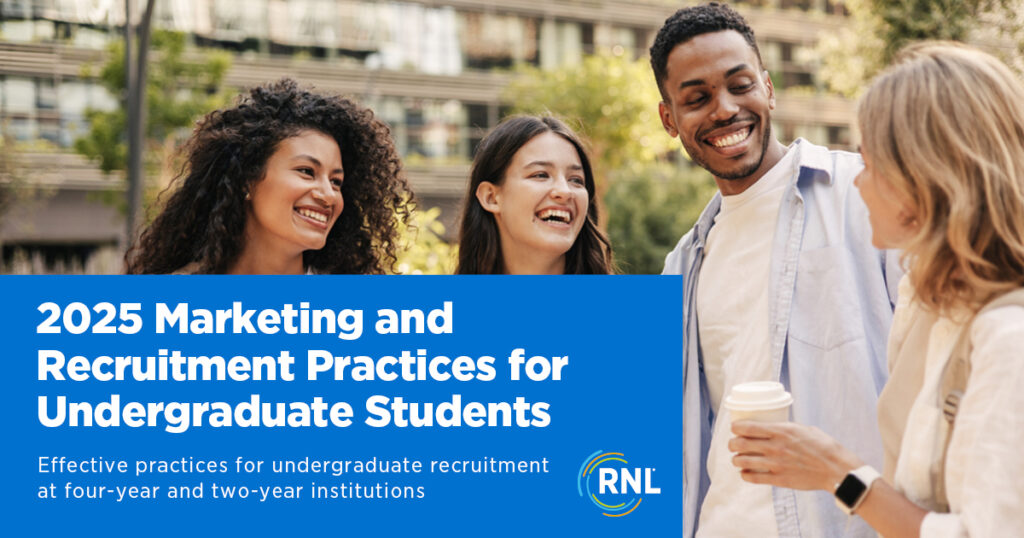
    As higher education faces what experts call an “enrollment cliff,” with projections showing a potential 15% decline in traditional college-aged students, institutions are radically re-imagining their recruitment strategies. The latest data from RNL’s 2025 Marketing and Recruitment Practices For Undergraduate Students report reveals fascinating shifts in how different institutions connect with prospective students in this challenging landscape.

    The human touch remains supreme

    In an era dominated by digital technology, the enduring power of human connection stands out prominently in the data. Face-to-face interactions continue to be the most effective recruitment tool for both four-year private and public institutions while ranking as the second most effective strategy for two-year colleges. This finding reinforces what many enrollment professionals have long suspected: despite technological advances, students crave authentic, personal connections when making significant life decisions.

    The effectiveness of in-person meetings spans various formats—from traditional campus tours to innovative “mini-sessions” with faculty and current students. These interactions provide prospective students with tangible experiences that digital alternatives cannot replicate. Recent research from Higher Education Marketing confirms that prospective students in 2025 seek personalized experiences that resonate with their individual aspirations and concerns.

    Digital innovation takes center stage

    While the human element remains crucial, the digital recruitment landscape has evolved beyond basic email campaigns into a sophisticated ecosystem of interconnected strategies. Two-year institutions are particularly notable for successfully adopting digital advertising as their primary recruitment tool, demonstrating how smaller institutions can effectively compete in the digital space.

    Personalized videos have emerged as a powerful medium across all institution types, appearing in the top three most effective strategies for public universities and community colleges in the RNL Marketing and Recruitment report. These aren’t generic promotional videos—they’re customized content pieces that speak directly to individual student interests, academic goals, and career aspirations.

    Text messaging has become a crucial communication channel, particularly for four-year institutions. This shift reflects the broader trend of meeting students where they are—on their mobile devices. Successful institutions are using texting not just for announcements but for meaningful engagement, including quick Q&A sessions, application status updates, and deadline reminders.

    The advertising landscape

    The advertising strategies employed by institutions reveal a nuanced understanding of their target audiences. Social media advertising dominates the scene for four-year private and two-year institutions, while public universities are finding success with a more diverse media mix, including television ads. This divergence suggests that different institutional types successfully identify and leverage the channels most effective for their specific audience segments.

    Re-targeted ads have proven particularly effective in the top three strategies for private institutions and community colleges. This sophisticated approach indicates a deep understanding of the modern student’s digital journey—from initial awareness through the final enrollment decision. Video advertising’s strong performance across all categories underscores the growing importance of dynamic, visual content in capturing and maintaining student attention in an increasingly competitive digital landscape.

    Digital strategy deep dive

    Search engine optimization (SEO) has emerged as a cornerstone of digital strategy, particularly for private institutions. This emphasis on SEO reflects a fundamental truth about modern student behavior: the college search process overwhelmingly begins online. Institutions that excel at SEO are ensuring they’re visible at the crucial moment when students begin their higher education journey.

    Request for information (RFI) forms continue to play a vital role, though their implementation has evolved significantly. The most successful institutions are now embedding RFI forms within interactive content experiences and using AI-powered chatbots to provide immediate, personalized responses. This shift toward automated yet personalized engagement represents a crucial evolution in how institutions manage initial student inquiries.

    Management practices: The rise of AI and analytics

    Behind the scenes, the most transformative changes occur in how institutions manage and analyze their recruitment efforts. The integration of AI in admissions has reached a tipping point, with eight in 10 colleges now utilizing some form of artificial intelligence in their processes. This technology is used for basic tasks, sophisticated predictive modeling, and personalized communication strategies.

    Private institutions are leading the charge in leveraging AI for enrollment operations, while all institution types are embracing increasingly sophisticated tracking and analytics tools. Behavioral scoring and engagement tracking have moved from an innovative approach to an essential practice, indicating a decisive shift toward data-driven decision-making in enrollment management.

    CRM systems have become particularly crucial for two-year institutions according to the RNL report, suggesting a growing emphasis on relationship management throughout the enrollment funnel. These systems are no longer simple contact databases but have evolved into comprehensive platforms that track, analyze, and optimize every student interaction.

    Looking forward

    These findings paint a picture of an industry in transition, balancing traditional high-touch approaches with innovative digital solutions. Success in 2025’s challenging enrollment landscape requires a sophisticated blend of:

    • Personal connection through face-to-face interactions
    • Strategic digital engagement across multiple channels
    • Data-driven decision-making powered by AI and analytics
    • Personalized communication at scale

    For enrollment professionals, the message is clear: while the tools and techniques may evolve, the fundamental goal remains unchanged—connecting with prospective students in meaningful ways that address their individual needs and aspirations.

    The institutions that will thrive can effectively combine the warmth of personal interaction with the efficiency of digital innovation, all while maintaining authentic connections with their prospective students.

    Want to dive deeper? Read the report

    2025 Marketing and Recruitment Practices for Undergraduate Students: Effective practices for undergraduate recruitment at four-year and two-year institutions.

    Ready to transform your institution’s recruitment strategy with data-driven insights? Download the complete 2025 Marketing and Recruitment Practices Report to access:

    • Detailed breakdowns by institution type
    • Implementation guides for top strategies
    • Benchmark data to compare your performance
    • Expert analysis and recommendations
    • Case studies from successful institutions

    Download the full report now and get exclusive access to comprehensive data and insights that will shape your 2025 recruitment strategy.

    Source link

  • Graduate Student Insights and Perspectives

    Graduate Student Insights and Perspectives

    Facing challenges in enrollment, retention, or tech integration? Seeking growth in new markets? Our strategic insights pave a clear path for overcoming obstacles and driving success in higher education.

    Unlock the transformative potential within your institution – partner with us to turn today’s roadblocks into tomorrow’s achievements. Let’s chat.

    Source link

  • Rethinking Your Student Population

    Rethinking Your Student Population

    Rethink your student population whitepaper

    Adult learners are higher ed’s future

    Reskilling, upskilling and lifelong learning are creating a big opportunity for higher education to become the go-to resource for career-minded adults. But not all adult learners are alike. In this report, we break them down into four types of adult learners (Career Advancer, Career Builder, Discerning Academic and Hesitant Learner).

    Download the white paper with the following insights for each persona:

    • Top motivations
    • Recruitment strategies
    • Program optimization recommendations

    Collegis Education surveyed 1,000 adult learners interested in pursuing degrees for this white paper, Rethink Your Student Population. Discover who makes up the majority of the adult learner market and how to target your outreach to grow your enrollment in this untapped population.

    Also, get key takeaways in our infographic The Adult Learners You’re Ignoring.

    Download Now

    MktoForms2.loadForm(“//087-TII-060.mktoweb.com”, “087-TII-060”, 1789);

    Additional Resources

    The post Rethinking Your Student Population appeared first on Collegis Education.

    Source link

  • How to Unlock Graduate Enrollment Growth [Webinar]

    How to Unlock Graduate Enrollment Growth [Webinar]

    Your graduate programs should be thriving, but if you’re relying on outdated outreach tactics, you’re leaving enrollments on the table. Today’s grad students expect more personalization, relevance, and connection. And if you’re not aligning with their needs, another institution will. The only way to meet them where they are is by asking the right questions and getting real answers. That’s exactly what Collegis Education and UPCEA did, and now we’re pulling back the curtain to share what we found.

    Unlock Graduate Enrollment Growth
    Proven Strategies for Engaging Graduate Students
    Date
    : April 8, 2025
    Time: 2:00 pm (Eastern) / 1:00 pm (Central)

    Tracy Chapman

    Chief Academic Officer

    Collegis Education

    Headshot of Bruce Etter

    Bruce Etter

    Senior Director Research & Consulting
    UPCEA

    Join Tracy Chapman, Chief Academic Officer at Collegis Education, and Bruce Etter, Senior Director of Research & Consulting at UPCEA, for their upcoming webinar “Unlock Graduate Enrollment Growth: Proven Strategies for Engaging Graduate Students.” In this session, they’ll reveal some surprising discoveries about graduate enrollment and the factors that drive impact and growth.

    • Graduate student needs and expectations
    • Why grad students disengage during their enrollment journey
    • What information grad students are willing to give you and when
    • How to best communicate and reach graduate students actively evaluating programs
    • Presidents
    • Provosts
    • Enrollment leaders 
    • Marketing leaders

    At the end, we’ll leave room for questions and conversion, and all attendees will receive a copy of the entire research report. 

    See you on April 8! 

    Source link

  • How to Be Proactive in an Evolving Higher Education Landscape

    How to Be Proactive in an Evolving Higher Education Landscape

    How can you make the future of your campus more clear and sustainable?

    As colleges and universities continue to rise above the challenges brought on by the pandemic five years ago, it has become clear that the new normal for higher education demands more than resilience—it requires strategic foresight and proactive leadership. Institutions today must navigate shifting policies, demographic changes, public sentiment, natural disasters, economic pressures, compliance mandates, safety concerns, talent turnover, operational efficiency demands, and increasing pressure for measurable results.

    Is your institution prepared to proactively face these challenges, knowing that disruption is not just possible but highly probable?

    • Will your strategic plan ensure financial sustainability if events on the scale of the pandemic disrupt your revenue streams?
    • Does your current enrollment strategy include innovative approaches to capture new market share despite declining numbers of prospective students?
    • Is your institution leveraging artificial intelligence to drive innovation and efficiency?
    • Does your academic master plan align with program demand, employer talent needs, and student success outcomes?
    • Can your organization prioritize limited resources effectively and use data to inform critical budget decisions?
    • Do your stakeholders understand that your institution’s reputation and competitive standing depend on academic innovation, excellence, community engagement, and student success—achieved through accountability, continuous improvement, campus engagement, agility, and clear prioritization?

    If your answer isn’t a confident “YES!”, it’s time to act. Consider investing two days at RNL’s Strategic Planning Executive Forum (April 1–2, Chicago).

    Building a foundation for strategic planning in two days

    RNL quite literally wrote the book—three of them, in fact—on Strategic Enrollment Planning. For decades, RNL has guided institutions in transforming their approach and achieving their missions through a proven, data-informed strategic planning framework.

    Today, institutions discover that this framework goes beyond enrollment—it is adaptable to address every facet of university and college operations, including institutional culture, financial health, academic excellence, technology integration, student success, community engagement, branding, and institutional value. This approach aligns your institution’s goals with the realities of the evolving higher education landscape, ensuring long-term enrollment success and financial sustainability.

    While many institutions simply set goals and outline steps, true strategic planning thrives at the intersection of creativity, critical thinking, data analysis, and action. The RNL Strategic Planning Forum is designed to elevate your institution’s capacity by focusing on essential, foundational steps:

    • Analyzing your institution’s strengths, weaknesses, opportunities, and threats (SWOT)
    • Identifying key performance indicators (KPIs)
    • Fostering a data-informed decision-making culture
    • Developing actionable strategy plans with clear accountability and measurable ROI
    • Establishing prioritization protocols by assessing risk, resistance, and required effort
    • Implementing, managing, and refreshing dynamic strategic plans through effective dashboards and processes

    What to expect at the forum

    The forum offers practical case studies and shared experiences from transformation leaders. Sessions will highlight best practices in areas such as:

    • Strategic enrollment planning
    • Institutional strategic planning
    • Academic program revitalization

    Breakout sessions will cater to specific institutional needs—whether from two-year colleges, four-year public universities, or private institutions—offering space to share best practices and tackle unique challenges.

    Institutional assessment with expert guidance

    Your leadership team will have the opportunity to complete a strategy assessment and receive live feedback from RNL experts with decades of higher education experience in:

    • Marketing and market research
    • Recruitment and financial aid strategy
    • Student success initiatives
    • Academic program planning
    • Online learning and delivery models
    • Advancement and venture philanthropy
    • Artificial intelligence applications in higher education

    Discussion and collaboration are at the heart of this event. You’ll dive into critical areas of strategic planning while engaging with industry experts, higher education leaders, and peers from other campuses. This will spark meaningful conversations within your own team, setting the stage for momentum and change.

    RNL Strategic Planning ExecutiveForum: A history of driving enrollment and revenue success

    Many institutions that have participated in this event have seen transformative results, including:

    • Record-breaking enrollment growth
    • Enhanced student outcomes
    • Millions in additional revenue generation
    • Stronger community engagement
    • Streamlined operations and improved efficiency

    Equip your institution for future-focused success

    Empower your institution with actionable insights, dynamic strategies, and the tools necessary for growth, resilience, and meaningful impact in today’s higher education environment.

    See the agenda and register for the Forum today. Bring your leadership team and ignite the discussions that will drive action and measurable results for your institution’s future. You’ll be hard-pressed to find a more impactful event to propel your institution forward.

    Source link

  • A Year of AI-Powered Progress: RNL’s Product Evolution

    A Year of AI-Powered Progress: RNL’s Product Evolution

    The last year has been one of significant strides for RNL. We embarked on a journey to enhance our existing tools, aiming to provide our partners with even more powerful and effective solutions. This commitment has driven us to develop a suite of AI-powered tools designed to strengthen your connections with students and donors.

    A focus on data-driven decisions and user-friendly solutions

    Our primary goal was to create AI tools that are not only secure but also user-friendly and insightful. We aimed to provide you with a comprehensive view of your data, empowering you to make informed decisions and develop winning strategies. We understand the importance of ease of use, ensuring that our tools are accessible to everyone, regardless of their technical expertise.

    Key achievements: RNL Insights, Compass, and RNL Answers

    • RNL Insights: This AI-powered data management platform revolutionizes how you work with your data. By integrating data from various sources, including your enrollment CRM, financial aid modeling tool, and marketing analytics, Insights provides a unified view for informed decision-making. Its intuitive conversational interface allows you to ask questions and receive immediate answers, uncovering valuable insights you might have otherwise missed.
    • RNL Compass: Our AI-powered digital assistant, Compass, streamlines communication and enhances efficiency. By automating responses to common student and parent inquiries, Compass frees up your admissions team to focus on more strategic tasks. Integrated with your CRM, Compass provides personalized answers, ensuring each interaction is tailored to the individual’s needs.
    • RNL Answers: This AI copilot leverages your institution’s private data to provide valuable insights and support. Whether it’s crafting compelling marketing messages, assisting traveling admissions officers, or building robust knowledge bases for new team members, RNL Answers offers a secure and reliable AI-powered solution.

    Beyond technology: Empowering partners with AI expertise

    We recognize the importance of responsible AI adoption. To this end, we have introduced AI Governance and Education Consulting Services. These services provide guidance on integrating AI into your institution, including:

    • AI Education: Training leadership teams, faculty, and staff on the fundamentals of AI.
    • AI Governance Frameworks: Assisting in the development of frameworks that ensure ethical and responsible AI usage.

    Collaboration and continuous improvement

    To ensure our solutions remain aligned with your evolving needs, we have established the Leadership AI Council and the Product Advisory Council. These groups, comprised of our valued partners, provide valuable feedback and insights, shaping the future of our AI-powered solutions.

    Looking ahead: A future of innovation

    We have also began migrating some of the outbound communication tools our agents use to deliver your omnichannel outreach services to our new all-in-one platform—RNL Reach. While as a partner, your involvement in transitioning to RNL Reach is very minimal, but you will feel the benefit of the solution because your agents will be able to be more efficient in how they execute your campaigns and provide stronger analytics and reporting. This is the first step to making the new solutions and services we have planned in 2025 possible!

    In 2025, we are committed to building upon the strong foundation we’ve established this year. We will leverage our expertise in consulting, data analysis, and AI to develop innovative solutions that address your unique challenges and help you achieve your goals.

    A note of gratitude

    We extend our sincere gratitude to all our partners for their trust and collaboration. We are honored to work alongside you and contribute to your success. We look forward to a continued partnership in the years to come.

    Discover RNL Edge, the AI solution for higher education

    RNL Edge is a comprehensive suite of higher education AI solutions that will help you engage constituents, optimize operations, and analyze data instantly—all in a highly secure environment that keeps your institutional data safe. With limitless uses for enrollment and fundraising, RNL Edge is truly the AI solution built for the entire campus.

    Ask for a Discovery Session

    Source link