Category: Enrollment

  • Understanding Digital Marketing Strategy and Costs to Effectively Budget for Growth

    Understanding Digital Marketing Strategy and Costs to Effectively Budget for Growth

    In today’s digital-first world, higher education institutions are increasingly turning to digital marketing to educate, engage, enroll, and retain students. However, one of the key challenges that the campus decision-makers face is understanding the potential costs associated with digital marketing and how to effectively budget for growth.

    As someone deeply immersed in the world of digital strategy, I often find myself having the same conversation with campus leaders: how do we set realistic expectations about what it really costs to do effective digital marketing? And more importantly, how do we directly link those costs with your institution’s growth objectives? In this blog, I will highlight the key data-driven strategies for assessing ROI and how these strategies inform a strategic budget plan that strengthens your institution’s overall portfolio and drives sustainable growth.

    The importance of setting realistic expectations

    Success in higher education landscape, particularly when managing a large portfolio, is driven by a disciplined, metrics-oriented approach. From my experience, the institutions that excel are those that rely on crisp numbers, rigorously evaluate their plans ahead of time, and understand the value of projections and estimations. By leveraging detailed forecasts and aligning resources accordingly, we can navigate the complexities of enrollment growth with precision and confidence, always mindful that incremental progress, evaluated at every stage, is key to achieving long-term goals.

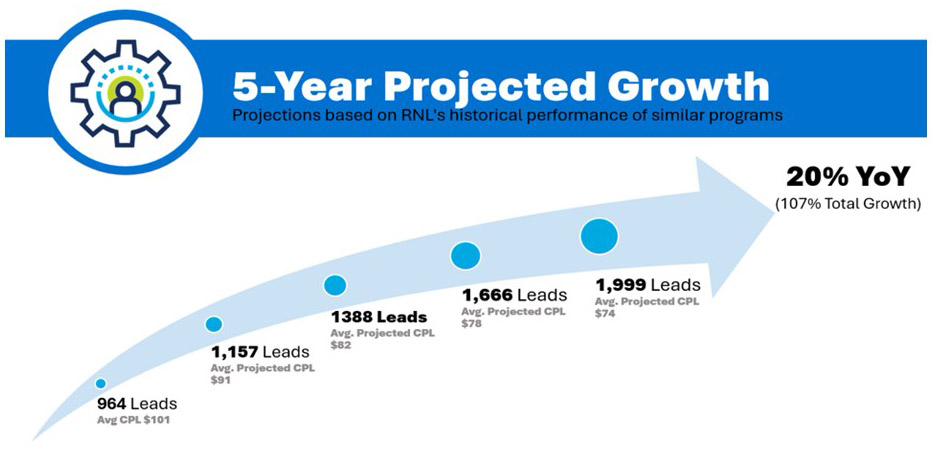
    Setting expectations means recognizing that significant results take time and careful planning. This translates to setting realistic growth expectations based on an understanding that reaching your enrollment goals will take multiple academic terms. When I am collaborating with our partners, we adopt a structured five year growth trajectory where Year 1 serves as the “foundational” phase, establishing the core infrastructure and strategic alignment. Year 2 is focused on “scaling,” optimizing initial investments to drive measurable growth. Years 3 and beyond are dedicated to “sustained value creation,” with a continuous focus on refining processes and maximizing returns through ongoing optimization and strategic enhancements. This phased approach allows for calculated risk-taking and ensures a clear path to long-term, scalable success.

    Chart showing 5-year projected growth for digital leads with 20%YoY growth

    Once we’ve set realistic expectations for our digital strategy, it’s crucial to ensure that every tactic -whether paid digital marketing, SEO, or creative content, all work together seamlessly to achieve your goals. These elements don’t function in isolation; rather, they complement each other to drive greater visibility, engagement, and, ultimately, enrollments. A well-rounded strategy that integrates SEO to boost discoverability, paid digital marketing for targeted reach, and compelling content to engage prospective students will create a strong foundation for success. By understanding how these components interrelate, you’ll be better equipped to assess their effectiveness and make data-driven adjustments as needed.

    From here, let’s dive into how digital strategy translates into budget planning and ROI. Understanding the interconnectedness of these key elements will help you allocate resources more efficiently and set a clear path for measuring the success of your investments.

    Connecting strategy to ROI and crafting a strategic budget plan for growth

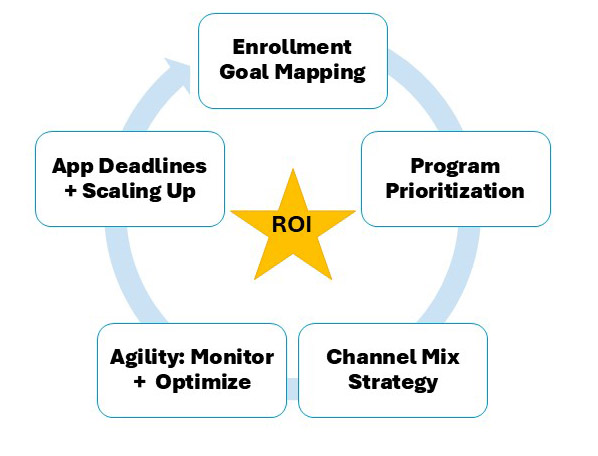
    The connection between strategy and ROI is grounded in the ability to align your digital marketing efforts with measurable outcomes, and it all starts with the establishment of clear and precise enrollment goals. Prioritizing top programs ensures that marketing resources are directed toward the areas with the highest demand or growth potential, improving overall program performance. The right channel mix is crucial to reaching the right audience, maximizing visibility, and efficiently converting interest into applications. Monitoring data and optimizing it in real-time ensures that marketing efforts are continuously adjusted for maximum effectiveness, enhancing the likelihood of meeting targets and improving ROI. Finally, effective allocation based on application timing, seasonality projections, and market revisions allows for strategic adjustments in campaigns to account for fluctuating demands, ensuring marketing spend is optimized throughout the enrollment cycle. Collectively, these elements create a robust framework for maximizing ROI, ensuring that marketing investments lead to increased applications, conversions, and, ultimately, student enrollment.

    Graphic of connecting digital marketing strategy to ROI: Enrollment Goal Mapping, Program Prioritization, Channel Mix Strategy, Monitor&Optimize, App Deadlines and Scaling UpGraphic of connecting digital marketing strategy to ROI: Enrollment Goal Mapping, Program Prioritization, Channel Mix Strategy, Monitor&Optimize, App Deadlines and Scaling Up

    How do you craft a budget that supports your growth goals? Whether you are the decision-making authority or a decision influencer, here are the essential steps to craft a budget plan that aligns with your institution’s growth objectives and maximizes your enrollments:

    1. Define your enrollment goals in detail

    When you think of marketing costs, what comes to mind first? How much will it cost to meet your enrollment goals, right? So, your first step in planning a budget is to have your overall Enrollment goal (and, for graduate or online programs, a goal for every program) in front of you. With the goal (or program-level goals) in hand, determine what that means in terms of percentage growth from the current state. You may also have subsidiary goals like enhancing brand awareness, building more brand equity, or engaging alumni. If these are going to be part of your plan, they should also have tangible goals for what you are trying to do. Defining your enrollment goals helps you allocate your budget accordingly and measure ROI effectively.

    STRATEGY TIP

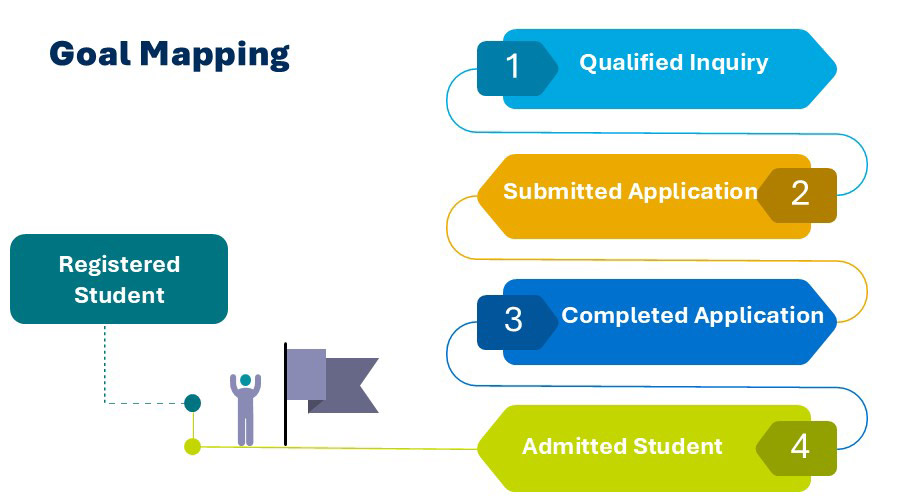
    Develop a “Goal Mapping” Scenario or you can say a Reverse Funnel (for each program). After you set enrollment goals (for the year or the term) you then need to understand the lead to enroll ratio. This will help you work backwards to determine how many accepted apps/admits will be needed, how many completed apps, how many submitted apps, and finally how many qualified leads will be needed. Based on the program category, dig deeper into what the Cost per Leads (CPL’s) are, based on industry benchmarks. That will help you calculate the estimated ad spend needed to generate those qualified leads.
    Goal Mapping for digital marketing: 1. Qualified Inquiry 2. Submitted Application 3. Completed Application 4. Admitted StudentGoal Mapping for digital marketing: 1. Qualified Inquiry 2. Submitted Application 3. Completed Application 4. Admitted Student

    A note on program-level goals: If you don’t have program-level enrollment goals for your online and graduate programs, finalize those as soon as possible. Until then, focus marketing on building brand awareness. It is likely that people in your own backyard could be less familiar with your program than you may think they are. Brand advertising will ensure that awareness rises so that when you have your program goals, you can build your campaigns on a higher level of familiarity with your institution. However, given that Google reports that 75 percent of graduate and online program searches don’t include an institution name, remember that branding alone will not be enough to fill your classes.

    Institutional example: When we began work with one of our partners nearly two years ago, they had not established program-level goals. So, in year one, we focused the largest portion of the budget on institutional awareness, with mini-campaigns focused on specific programs of importance to the institution. By the beginning of the second year, the institution had set program-level goals based on a greater understanding of market conditions. At that point, we began transitioning our campaigns to focus (ultimately 80 percent of the budget) on the programs with the “mini campaign” focused on continuing the brand equity efforts.

    2. Prioritize your programs

    It is highly unlikely that most institutions can spend marketing dollars on every program they offer. This means that in order to maximize the ROI of your marketing budget, you must prioritize your programs. But how? Take a data-driven approach, prioritizing programs for which you a) know there is market demand both among students and employers, and b) understand the competitor environment. These are the “cash cows” that will demonstrate the best ROI on your marketing spend and support the programs that, while not demonstrating significant market demand, are critical to the institutional mission.

    STRATEGY TIP

    Spreading a $100K marketing budget across 15 -20 programs will only dilute the ad spend, by spreading it too thin. Instead, identify the top 5-7 programs that have the greatest market demand and focus on them. Note that sometimes, the programs that seem most in need of a “marketing boost”, really aren’t. They are struggling because their market demand situation is not what it once was.

    Institutional example: A partner institution recently commissioned RNL to conduct a Program Prioritization and Positioning study focused on their current program mix. The goal was to take a data-driven deep dive into 12 programs vying for marketing dollars, with a focus on understanding student demand and employer needs in the region. The results indicated that while one of the programs they had planned to prioritize came out on top, two others that they hadn’t been planning to focus on also demonstrated strong demand, and one of the programs that they had questioned was confirmed as having weak local market demand.

    3. Determine your channel strategy

    Once you have prioritized your programs for marketing ROI, setting your channel strategy is pivotal. Personas (at the graduate and online levels developed for each program) dictate the channels on which you should focus. You don’t want (or need) to be present on every single channel just for the sake of “eyeballs.” Be mindful of the budget and how best to use it in order to maximize return, which can only be accomplished if you apply the personas that will inform you where your target student spend their “digital time.” So, for example, not every program may benefit from marketing on LinkedIn. Since it is expensive with a $10 minimum ad spend, a persona-based approach may indicate that other platforms are a much better match. But you can only do this if you know the characteristics of your audience, and that comes from the program personas.

    STRATEGY TIP

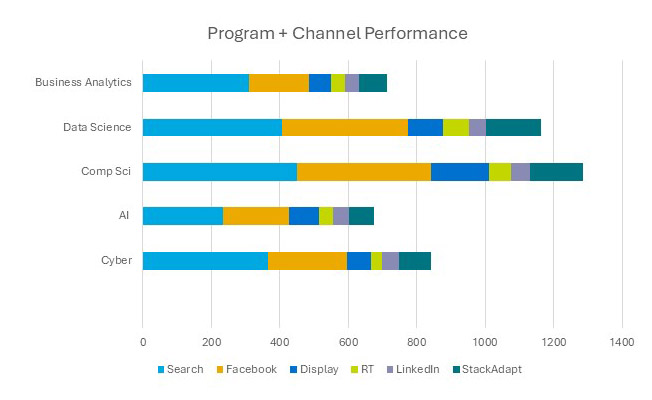
    The critical element in increasing marketing ROI is to engage the right students at the right time on the right channel, without spreading your budget too thin. In contrast, being too invested in any single channel exclusively or too long is also almost always the wrong strategy. There is always a point of diminishing returns as students cycle to different platforms, and you want to be sure to know where to go next before you approach that point by being able to tap into the next new thing.
    Chart of program and channel performance for different degrees and channels.Chart of program and channel performance for different degrees and channels.

    Institutional example: One of our prestigious campus partners was struggling with recent market shifts that resulted in an overall decline in applications. We dug into market and performance data to help them prioritize programs that had the highest lead-to-enroll ratios, lowest cost per acquisition, and good search volume with an eye to increasing marketing ROI and overall success. This approach not only helped regain their momentum at the top of the funnel but also generated strong conversion volume that exceeded goals and sustainably reduced cost per conversion. These changes benefited not only the marketing operation but were also felt by the call center, and further down the funnel where we saw an increase in applications.

    Talk with our digital and enrollment experts

    We’re to help you find the right digital marketing and recruitment strategies. Let’s set up a time to talk.

    Contact us

    4. Analyze data regularly and optimize with agility

    If (quality) content is king, data is queen! Sustained growth can only occur when data and insights are continuously incorporated into strategy. Analyzing performance data is crucial to understanding which programs and channels are yielding the largest numbers of applications and enrollments and, hence, generating the best return on ad spend (ROAS). This type of analysis allows for a data-driven approach to strategic pivots on how the marketing budget is allocated to ensure the highest ROI (or ROAS) across channels and the program portfolio. As the cost of marketing has risen, so has the need for marketers to make an effective case to senior leadership for additional marketing dollars. You can only do this if you can demonstrate that you are the best possible stewards of current resources.

    STRATEGY TIP

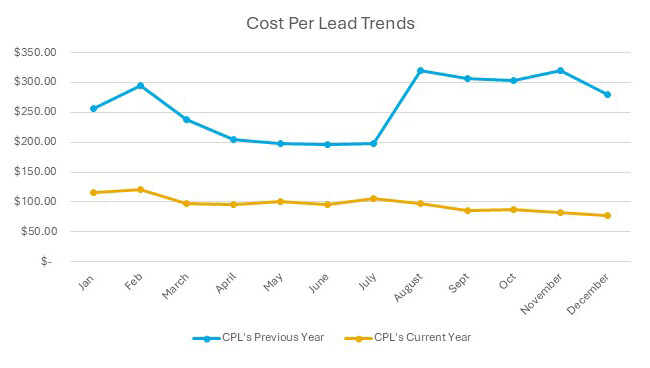
    As you continue to increase your campaign efficiency and success with the focus on ROI, your cost per lead will gradually start to go down – on average by 5 – 10 percent in year 2 and beyond. So, campaigns can generate more qualified leads efficiently over the years (for the same cost), thereby maximizing the return on your ad spend (ROAS). This helps you not just grow but also helps in building forecasts and projections for growth compounded over several years – and it also provides a strong ROI-driven basis for any requests you may need to make for additional funds elsewhere.
    Cost-per-lead trends over one year, showing how current CPL has been greatly reduced from the previous year.Cost-per-lead trends over one year, showing how current CPL has been greatly reduced from the previous year.

    A note on analytics platforms: The fact that resources have become increasingly scarce at the same time as marketing costs have skyrocketed has resulted, out of necessity, in more sophisticated tracking of ROI. If your internal systems are set up in the correct manner (or if you are working with a strategic partner like RNL) every lead can be tracked to its source, thereby allowing for the assessment of just how effectively each marketing dollar has been used.

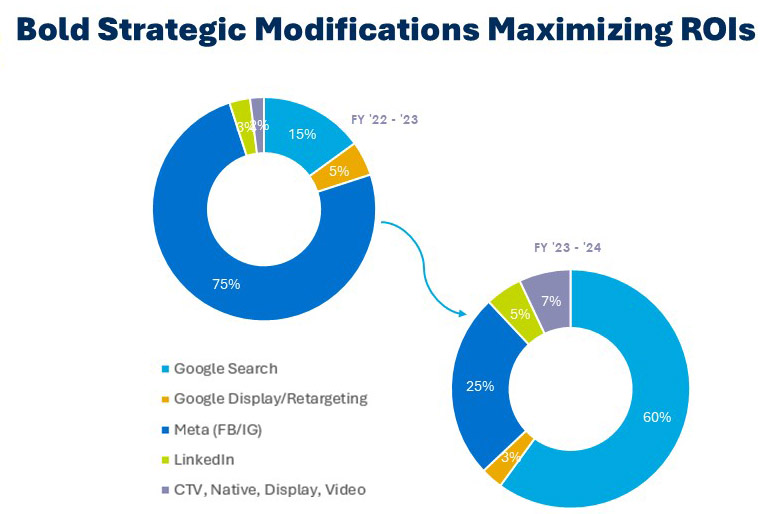
    Institutional example: A prestigious campus partner was having challenges with converting leads to applications and enrollments. We reviewed their full-funnel data (compete with attribution percentages) and realized something wasn’t working. The top of the funnel was healthy, with good lead volume. However, down the funnel we saw that a disproportionate number of leads were not converting to apps and enrollments. As a result of the review and data analysis, we made a bold strategic pivot to shift significant budget allocations to the channel (Google search) that we could see was producing the greatest numbers of applications and enrollments. Without the data, solving the challenge would have been impossible. With the data, it was easy. Since we made this change, applications, and enrollments have consistently increased each academic period.

    Graphic showing two circle charts and the reallocation of channel spend from Facebook as the largest channel to Google Search as the largest channelGraphic showing two circle charts and the reallocation of channel spend from Facebook as the largest channel to Google Search as the largest channel

    Making sure that the top of the funnel strategy is guided by down funnel numbers is the KEY! Effective strategy must evolve through ongoing optimizations with thoughtful placements across diverse media platforms that are informed by performance data. Remember that the path to enrollment is rarely linear and an integrated media strategy allows you to provide a personalized message in the right place at the right time.

    5. Understand and account for seasonality/application timings/expansion

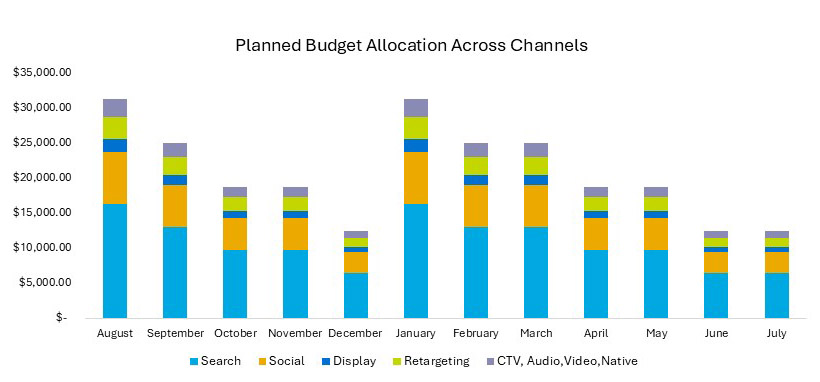
    Another aspect of the dynamic nature of the marketing process relates to the seasonality of lead flow – and subsequent enrollment. This requires flexibility to adjust your strategies based on real-time performance data collected throughout the year. For any program or institution, there are times of the year during which more or fewer leads are generated. Fully understanding these trends takes time; you can make preliminary judgments on when the lead volume is highest and lowest within one year, but multiple years will allow for greater certainty. As you build your capacity to track lead generation – and conversion throughout the funnel – by program and source – you can create visualizations that map these factors by month. They can be used to build monthly budget allocations like those presented below.

    Bar chart showing budget allocation over the year for search, social, display, retargetingBar chart showing budget allocation over the year for search, social, display, retargeting

    Institutional example: For one campus partner we used the annual performance data in an innovative way. Our data insights indicated that there was more market share to capture, by having the program leverage low cost per conversion at the top of the funnel at certain points in the year, and low cost per acquisition at the bottom at other points of the year. There was time to scale up both applications and enrollments. We developed a forecast plan to address the potential areas of opportunity, calculated the cost, and pitched it to the partner. Once approved, we moved with agility, and implemented additional ad spend on the top champion programs and frontloaded the budgets for the academic periods yielding the highest number of applicants and enrollments. With this, we were not only able to meet the qualified lead goal but also exceeded the enrollments by 19% for the following academic period.

    The lifetime value of the student

    As you budget for growth, it’s crucial to consider the lifetime value (LTV) of a student. LTV refers to the total revenue a student generates throughout their academic journey and beyond. This value encompasses tuition fees, ancillary revenues (like housing and meal plans), alumni donations, and increasingly in our era lifelong learning opportunities.

    Talk with our digital and enrollment experts

    We’re to help you find the right digital marketing and recruitment strategies. Let’s set up a time to talk.

    Contact us

    Source link

  • What High School Students Really Think About College

    What High School Students Really Think About College

    Let’s talk about the elephant in the room: colleges struggle to connect with their most important audience—students. Fresh data RNL’s research studies show a big disconnect between what higher education offers and what students need. A new report from the Western Interstate Commission for Higher Education is waving red flags about dropping enrollment numbers and workforce gaps if colleges can’t step up their game and prove their worth.

    But what’s going on here?

    Show me the money: The cost crisis

    Here’s what keeps students up at night: money. Nearly all (93%) of prospective students are stressing about college costs (RNL & Halda, 2024). Let that sink in—we’re talking about almost every student thinking about college.

    The money story gets even more complicated:

    • 82% say they might not even apply because they’re worried about costs (RNL & ZeeMee, 2024)
    • 73% aren’t sure if their family can foot the bill (RNL & Halda, 2024)
    • Many don’t even try for financial aid because they assume they won’t qualify (RNL, Ardeo & Halda, 2024)

    “Is it worth it?”—The million-dollar question

    Students aren’t just worried about paying for college—they’re questioning whether it’s worth the investment. The stats tell us:

    • 60% wonder if college is worth the time, money, and effort
    • Only 63% see a job offer after graduation as their main goal
    • Half of students think they can make good money without a degree
      (RNL & Halda, 2024)

    Lost in the college maze

    In 2024, you’d think finding college info would be easy. Spoiler alert: it’s not. Check this out:

    • 72% say applying to college is just too hard (RNL, Ardeo & Halda, 2024)
    • 63% can’t figure out how to choose the right school (RNL & ZeeMee, 2024)
    • 53% don’t know where to get help with college planning
    • 51% are stuck at square one, not knowing where to start
      (RNL & Halda, 2024)

    Transforming the college experience: A blueprint for change

    The days of one-size-fits-all higher education are over. How can offer what students need?

    1. Simplify the journey

    Colleges must strip away the bureaucracy that scares away promising students. This means:

    • Creating a streamlined, user-friendly application process
    • Building intuitive websites that guide rather than confuse
    • Offering clear, step-by-step roadmaps to enrollment
    • Providing personalized application support based on each student’s background and needs

    2. Talk money from day one

    No more financial surprises or hidden costs. Colleges should:

    • Present total costs upfront, including living expenses and materials
    • Break down financial aid options in clear, everyday language
    • Show concrete examples of return on investment
    • Create customized financial planning tools that account for individual circumstances

    3. Show Real Results

    Students deserve to see the real impact of their investment:

    • Share detailed job placement data by major and career path
    • Report actual salary ranges for recent graduates
    • Feature diverse alumni success stories across different fields
    • Match potential career outcomes to students’ individual interests and goals

    3. Innovate the Learning Experience

    Education shouldn’t be rigid. Modern colleges must:

    • Design flexible learning paths that fit different lifestyles
    • Develop focused credential programs for specific career goals
    • Create clear pathways from certificates to full degrees
    • Offer personalized learning tracks based on student strengths and career objectives

    The future of higher education isn’t just about making things easier—it’s about making them work better for each individual student. Colleges that embrace these changes won’t just survive; they’ll thrive by truly serving their students’ needs.

    The future of higher education: A student-first revolution

    Let’s be honest: the old college playbook isn’t cutting it anymore. Students are drowning in debt, juggling full-time jobs with classes, and questioning whether a degree is worth the sacrifice. They’re not asking for less rigor—they’re asking for a system that acknowledges their reality.

    The WICHE report plainly states, “Demography need not be destiny.” But this isn’t just about numbers.

    • It’s about Darla raising two kids while pursuing her nursing degree.
    • It’s about Javier, the first in his family to consider college and has no roadmap to follow.
    • It’s about Sophia working two jobs just to afford textbooks.
    • It’s about Tyler, a baseball standout from rural Iowa whose guidance counselor is stretched too thin to help him navigate the recruiting process his parents never experienced.
    • It’s about Emma, whose well-meaning parents have taken over her college search entirely, leaving her silent and stressed about expressing her own dreams.

    These students aren’t looking for handouts. They’re looking for:

    • A system that respects their time and responsibilities
    • Clear paths that connect their education to real careers
    • Flexible options that don’t force them to choose between life and learning
    • Proof that their investment will pay off in tangible ways

    The colleges that will thrive aren’t the ones with the fanciest buildings or the most prestigious names. They’re the ones who dare to ask: “What do our students need to succeed?”

    Because here’s the truth: higher education isn’t just about preserving institutions. It’s about transforming lives. And right now, too many bright, capable students are being left behind by a system that wasn’t built for them.

    The future belongs to colleges brave enough to change. Not just with fancy words and mission statements but with real, student-centered solutions that make education accessible, achievable, and worth every dollar and hour invested.

    Reports cited in this blog—available for free download

    Source link

  • Why Personalization in College Planning Matters More Than Ever

    Why Personalization in College Planning Matters More Than Ever

    College planning has become far more complex than filling out forms and writing essays. RNL’s research reveals a striking truth: Today’s students are overwhelmed, skeptical, and craving personalized guidance more than ever before.

    The modern student’s dilemma

    Picture this: Seven out of ten high school students find navigating the college application process challenging. They’re not just intimidated by the paperwork—they’re questioning the entire value proposition of higher education. Half believe they can build a successful career without a college degree, while 60 percent wrestle with whether college is worth their time and money.

    These aren’t just statistics. They represent real students sitting at kitchen tables across the country, staring at their laptops, trying to make one of the most significant decisions of their lives.

    The financial reality check

    Money talks, and it’s speaking louder than ever in college planning. The numbers tell a sobering story: over 90 percent of high school juniors and seniors find financing their education somewhere between “somewhat difficult” and “very difficult.” Even more telling, 60 percent of juniors and 65 percent of seniors will immediately cross a college off their list based on the sticker price alone.

    But here’s where it gets interesting: Financial aid and scholarships have become the primary hook for attracting students, with 81 percent of juniors and 78 percent of seniors ranking them as crucial factors in college choice. This isn’t just about affordability—it’s about perceived value and accessibility.

    The shifting sands of student priority

    What catches a student’s attention these days? The research shows a clear hierarchy:

    • Financial aid and scholarships (63%)
    • Athletic programs (47%) if they are interested in playing sports at the college level
    • Academic programs (43%)
    • Career placement (38%)

    But getting students interested is only half the battle. Our study reveals a fascinating pattern of why initial interest fades. Cost remains the primary deal-breaker, with 57 percent of students citing it as why they lose interest in a school. However, other factors like program availability (37%) and admission concerns (24%) play significant roles, too.

    The power of late-stage decisions

    The most surprising finding is this: 66 percent of students discover and become interested in new colleges during their senior year, and 89 percent apply to these late-discovered schools. This challenges the conventional wisdom about early outreach being the only path to enrollment success.

    The personalization imperative

    Today’s students aren’t just looking for information—they’re looking for recognition. They expect colleges to:

    • Provide program-specific details tailored to their interests
    • Deliver accurate, personalized responses to their questions
    • Acknowledge their unique situations and backgrounds
    • Communicate in culturally relevant ways
    • Use their names (yes, it matters)
    • Recognize and respect their diverse identities

    Making it personal: The path forward

    For colleges and universities, the message is clear: Generic, one-size-fits-all recruitment approaches no longer cut it. The future lies in personalized admissions counseling, tailored communication campaigns, and customized campus experiences. But most importantly, institutions need to address students’ financial concerns head-on with transparent, customized information about costs, aid, and scholarships.

    The bottom line

    The college planning landscape has evolved beyond recognition. Today’s students are savvier, more skeptical, and more demanding than ever. They’re not just looking for a college—they’re looking for one that understands them, values them, and can demonstrate why their investment will pay off.

    The opportunity is enormous for institutions willing to embrace this new reality and invest in personalization. After all, in a world where 72 percent of students find applying to college difficult, being the institution that makes it easier, more precise, and more personal isn’t just good service—it’s a competitive advantage.

    The future of college recruitment isn’t about reaching more students; it’s about reaching each student in the way that matters most to them.

    Learn more about what research says about personalization

    The Importance of Personalization in College Planning: From Interest to Application

    Join me and presenters from our partners Halda for our webinar, The Importance of Personalization in College Planning: From Interest to Application. We will cover trends that may surprise you, insights that can help you increase engagement with students, and actionable strategies you can use.

    Register now to hear more about what the latest research tells us about personalization with students.

    Source link

  • Making Higher Education More Affordable: The Role of Financial Aid Strategies

    Making Higher Education More Affordable: The Role of Financial Aid Strategies

    Key Takeaways:

    • Financial aid optimization transforms financial resource allocation into a strategic enrollment tool, aligning affordability for students with institutional goals.


    • By leveraging real-time data and tools like Liaison Othot, institutions can craft tailored financial aid strategies that address individual student needs and enrollment strategies.


    • Optimization enables proactive adjustments to financial aid strategies, ensuring accessibility while supporting student retention and institutional sustainability.


    • Strategic financial aid leveraging balances affordability for students with long-term enrollment and revenue objectives.


    The rising costs of higher education and fear of long-term debt have left many prospective students and their families questioning whether they can afford to pursue their academic dreams. For institutions, this presents a dual challenge: attracting diverse students and ensuring enrollment goals align with their mission. An effective and aligned financial aid optimization strategy offers a powerful tool to meet a campus’s enrollment goals. By combining institutional funds with federal and state resources effectively, colleges and universities can increase access and affordability in higher education while achieving broader enrollment objectives.

    From offering enough aid to make tuition manageable to continuously refining financial aid strategies based on real-time information, optimizing plays a pivotal role in strategic enrollment management (SEM). It transforms financial aid awarding from a static process into a dynamic tool that not only attracts and enrolls students but also supports their retention by effectively meeting their financial needs.


    What Is Financial Aid Optimization?

    Financial aid optimization transforms the allocation of financial resources into a critical enrollment tool. By aligning the overall enrollment leveraging strategy—regularly and in real-time at the individual level—optimization allows campuses to address student affordability needs in a unique and tailored way.

    At its core, optimization is a dynamic, data-informed process. Institutions develop annual plans for allocating financial aid (leveraging), basing decisions on previous cycles’ successes and challenges. Unlike traditional static leveraging models, modern optimization approaches incorporate continuous adjustments informed by real-time data. This lets colleges and universities respond proactively to shifting enrollment trends and keeps their financial aid strategies effective throughout the year.


    How to Make Higher Education More Affordable and Accessible

    More accessible higher education starts with understanding the financial challenges students face. For many undergraduates, the cost of tuition, housing, books, and other expenses can make college seem out of reach, even with federal and state aid. For example, a student from a low-income household may find that even the maximum Pell Grant award leaves a significant financial gap. Similarly, a middle-income family might struggle to cover tuition despite not qualifying for significant need-based aid.

    Financial aid leveraging allows institutions to tackle these challenges head-on by creating tailored aid packages that remove financial barriers for students. This approach relies on a mix of need-based and merit-based strategies, often informed by tools like FAFSA data and predictive analytics.

    One of the key advantages of financial aid optimization is its flexibility. Institutions can use data to fine-tune aid offerings based on unique student needs and behaviors. For instance, Liaison’s Othot platform, a cloud-based predictive and prescriptive analytics tool designed specifically for higher ed, can analyze factors such as a student’s location, academic profile, and campus engagement to build aid packages thatneeds. This granularity ensures that the financial aid awarding strategy not only meets the affordability threshold for students also aligns with the overall enrollment strategy being employed on the campus. An aligned optimization approach ensures that the affordability component is integrated into the strategy for specifically targeted cohorts or students, maximizing the likelihood of their enrollment.

    Optimization also lets institutions adapt aid policies for entire cohorts or demographic groups. For example, schools can address rising inflation in high school GPAs by recalibrating merit-based awards to prioritize equity and maintain fairness in their financial aid distribution. This adaptability keeps aid plans relevant as the dynamics of higher education continue to shift. By relying on data and continuously streamlining their financial aid models, institutions can make higher education more attainable for all students while maximizing their impact.


    The Strategic Impact of Financial Aid Optimization

    Financial aid optimization goes beyond simply helping students cover tuition—it’s about achieving a delicate balance between affordability for students and sustainability for institutions. By carefully crafting aid packages that meet the financial needs of students without overextending institutional resources, colleges and universities can enhance their enrollment efforts while maintaining financial health.

    For example, reallocating funds for strategic distribution among students could result in higher net tuition revenue (NTR) without sacrificing enrollment numbers. This demonstrates how strategic adjustments can yield significant results when financial aid decisions are guided by data, tailored to meet institutional priorities, and aligned to overall enrollment strategies.

    Retention and persistence are critical factors to consider when determining how to optimize financial aid. An effective leveraging model doesn’t stop at enrollment and the conclusion of a successful first year—it considers the long-term success of students. By analyzing which cohorts are more likely to persist and graduate, institutions can refine their aid offerings to improve outcomes for all students. This approach ensures that financial aid strategies not only attract students but also support their success throughout their academic journey.


    Aligning Financial Aid With Student Success and Institutional Goals

    Financial aid optimization is a powerful way to make higher education more accessible while helping institutions achieve their objectives. By combining institutional, federal, and state resources with data-driven optimization tools, colleges and universities can craft aid strategies that address affordability, bolster student retention, and maximize their impact.

    Institutions looking to enhance their financial aid and enrollment can benefit from Liaison’s suite of solutions, including Othot. Whether your team is just beginning to explore financial aid leveraging or has years of experience, Liaison’s tools provide the flexibility and insights needed to meet your unique goals. From devising an initial plan to optimizing existing processes, our solutions are designed to assist schools at every stage of their journey. Contact us today to learn more.


    Source link

  • Moving Beyond New Year’s Resolutions to Embrace a Multi-Year Enrollment Strategy 

    Moving Beyond New Year’s Resolutions to Embrace a Multi-Year Enrollment Strategy 


    Developing New Year’s resolutions for personal growth is something many of us do. Unfortunately, it is often a set-it and forget-it process that is simply reupped the following year. When done correctly, however, creating a resolution that is developed as a sustained, long-term strategy—and that is regularly returned to and adjusted as needed—seems to be the best way to meet our personal goals.  
     
    As enrollment managers, we all have pursued the first approach in our professional lives by evaluating last year’s successes and failures annually, making a few tweaks, and then seeing how it all works out again the following year. The truth of the matter is that this approach was relatively sustainable for a time. Simply buying more names, adjusting the aid-leveraging model annually, or a developing a wider marketing plan often could drive greater enrollments—mostly because those tactics generally were designed to “add more fuel to the fire.” As long as the applications continued to grow, annual tweaks could help to maintain the core enrollments as well as improve on the margins for many institutions.  


    The Need for More Effective Strategic Enrollment Strategies

    Unfortunately, outside of key private and public flagship institutions, headwinds have developed over the past decade that are affecting higher education enrollments in significant ways. Ultimately, they may lead to campus closures for some, and to campus financial distress for many. As outlined in a paper from the Federal Reserve Bank of Philadelphia, “Predicting College Closures and Financial Distress,” those pressures include:

    • Post-pandemic enrollment challenges from traditional students (decreasing 15% from 2010-2021).


    • Changes among adult learners (“The number of adult students over the age of 25 has fallen by nearly half since the Great Recession”).


    • Growing competition.


    • A lack of public support for higher education nationally. 

    The combination of all these factors has brought about the need for enrollment managers to develop a wider multi-year strategy that includes tools with the ability to enable deeper, more highly data-informed fine tuning throughout any given cycle. A one-size-fits-all approach to creating a nuanced strategy can no longer work in an environment of shrinking applications and increased competition. 


    Liaison’s Partnership Philosophy

    Liaison is uniquely positioned to assist with higher education institutions in a true partnership. With the technology, services, and consultative approach that we provide our partners throughout the nation, we can assist in developing a comprehensive enrollment approach unique to your campus—ranging from single-point to full-enrollment planning solutions that are uniquely tailored to your unique needs. Liaison’s partnership philosophy, technology solutions, and industry knowledge and insights can not only help strengthen your enrollment planning and goals for this year but also set you up for long-term enrollment success.  


    Craig Cornell is the Vice President for Enrollment Strategy at Liaison. In that capacity, he oversees a team of enrollment strategists and brings best practices, consultation, and data trends to campuses across the country in all things enrollment management. Craig also serves as the dedicated resource to NASH (National Association of Higher Education Systems) and works closely with the higher education system that Liaison supports. Before joining Liaison in 2023, Craig served for over 30 years in multiple higher education executive enrollment management positions. During his tenure, the campuses he served often received national recognition for enrollment growth, effective financial aid leveraging, marketing enhancements, and innovative enrollment strategies.

    Source link

  • How Admissions and Marketing Teams Can Collaborate

    How Admissions and Marketing Teams Can Collaborate

    Fostering Interdepartmental Collaboration to Drive a More Effective and Engaging Student Journey

    Achieving success in your higher education marketing strategy requires seamless collaboration between your admissions and marketing teams to create a connected, consistent student journey experience. When these teams align, they move beyond their isolated efforts and build a unified strategy that not only captures students’ attention but also drives meaningful engagement and enrollments.

    Admissions teams gain critical, real-time insights from their conversations with prospective students, and marketing teams transform those insights into strategies and assets that resonate with the right audiences. By sharing their insights, both teams can better inform campaigns, conversations, and touchpoints, ensuring every interaction feels intentional, relevant, and student-centered.

    However, this alignment doesn’t happen by chance. It requires deliberate collaboration, thoughtful planning, and the strategic use of data at every stage. From discovery interviews and customer relationship management (CRM) data analysis to shared campaign development, each step in the process plays a vital role in delivering a cohesive, engaging experience that guides prospective students from curiosity to commitment.

    The Importance and Benefits of Collaboration Between Admissions and Marketing Teams 

    In an increasingly competitive higher ed landscape, having admissions and marketing teams that collaborate and communicate with each other regularly can make a meaningful difference in the experience that an institution delivers to prospective students, while optimizing its marketing efforts for maximum impact.  

    When admissions and marketing operate in silos, the cohesion breaks down. Collaboration prevents these gaps, ensuring every message, from the first ad to the final admissions call, feels aligned and purposeful.

    Creating a Unified Message

    Students don’t distinguish between “admissions” and “marketing” — they only see the institution. That’s why a unified message is so crucial to every higher education marketing strategy. A consistent and unified message — whether it’s delivered through ads, emails, website visits, or conversations with admissions personnel — builds trust, strengthens the brand, and guides prospective students smoothly through their decision-making journey.

    Building a Powerful Feedback Loop  

    When admissions and marketing teams stay in consistent communication, they create a powerful feedback loop that strengthens the institution’s messaging and better serves its prospective students.

    Admissions teams are on the front lines, having daily conversations with students and hearing their motivations, hesitations, and questions firsthand. These interactions provide invaluable qualitative insights that can flow back into marketing assets and strategies. 

    For example, if students frequently ask about program outcomes — such as what they can do with a certain degree — marketing can develop targeted blog content, alumni video spotlights, or landing page updates showcasing career opportunities, industry connections, and success stories related to the degree. Additionally, if there are common points of confusion that come up in students’ conversations with admissions staff, marketing materials can be created that clearly and directly address these issues. 

    By tapping into this feedback loop, both teams can make meaningful, real-time adjustments that align the institution’s messaging with students’ priorities, enhance engagement, and drive better outcomes.

    Empowering Teams With Critical Insights and Knowledge

    Both admissions and marketing teams bring something unique and valuable to the table when it comes to understanding the institution’s brand, its offerings, and its students. While there are areas of overlap, each team also has its own distinct focal points that allow it to provide useful details the other team can benefit from, creating a richer and more comprehensive appreciation of how each team can best serve the institution’s students.

    Practical Ways to Collaborate 

    Now that we’ve established the importance of collaboration, let’s take a look at some practical ways to bring this strategy to life. 

    Coordinate and Share Learnings During a Discovery Process

    The first step is discovery, the phase where both admissions and marketing teams collaborate to analyze and uncover insights that will make their work more accurate, impactful, and aligned. The discovery process includes in-depth conversations with key university stakeholders; audits of existing school resources, marketing collateral, and program materials; and market research and competitive analysis to understand the institution’s positioning and audience needs.

    Each team adds unique value to the process. Admissions teams gather information about program-specific details, students’ motivations, and nuances that resonate during enrollment conversations, while marketing teams analyze the institution’s competitive positioning, audience behaviors, and key differentiators. By sharing and coordinating these efforts upfront, teams can reduce redundancies, ensure alignment, and create a more cohesive strategy that delivers consistent, tailored messaging. 

    Here are some tactics that can help in coordinating and consolidating discovery efforts:

    Schedule Ongoing Check-Ins With Teams

    Consistent communication is critical for collaboration. Regular monthly or quarterly meetings that include both admissions and marketing staff create space for sharing insights, identifying trends, and closing messaging gaps. 

    Admissions teams can spotlight common motivations, pain points, and areas of confusion among students, so marketing teams can update campaigns to address these themes in real time. These sessions ensure all higher education marketing strategies stay aligned and adaptive, making the student experience feel more cohesive.

    Leverage CRM Data

    Every interaction with a student leaves a breadcrumb trail of data. By tapping into call notes and CRM system data, admissions and marketing teams can track students’ questions, motivations, and hesitations. 

    Analyzing this data can reveal trends that marketing can address through website updates, FAQs, and ad campaigns. Sharing actionable summaries allows admissions teams to prepare for upcoming conversations and marketing teams to preemptively answer students’ concerns, creating a more seamless experience for prospects.

    Share and Understand Key Resources

    Developing key marketing resources, such as a Strategic Marketing Guide (SMG), and sharing them across teams can help keep admissions and marketing teams’ collaboration efforts on track. 

    An SMG isn’t just a document — it’s the framework that ensures every team is aligned in understanding the key components of the institution’s brand, story, and students. Personas, unique value propositions (UVPs), brand stories and positioning, and messaging frameworks outlined in an SMG help admissions and marketing teams speak the same language and tell a shared story.  

    Connect Your Admissions and Marketing Teams Through Collaboration With Archer

    At Archer Education, we don’t just build marketing strategies — we build lasting capabilities. Our approach goes beyond campaign launches and lead generation to focus on sustainable online infrastructure that empowers universities to thrive long after our work is done. From aligning admissions and marketing teams to developing data-driven messaging frameworks, we act as a true partner in developing custom higher education marketing strategies that work. 

    Our collaboration is designed to transfer knowledge, not just deliver results. We equip your teams with the tools, training, and insights they need to operate with confidence, ensuring your institution isn’t reliant on outside support to maintain momentum. The result is a marketing engine that runs smoothly long after Archer’s involvement has ended, empowering your teams to lead with agility in an ever-changing higher education landscape. 

    Contact us today to learn more. 

    Subscribe to the Higher Ed Marketing Journal:

    Source link

  • 2025 Higher Education Trends: What to Watch & How You Can Plan

    2025 Higher Education Trends: What to Watch & How You Can Plan

    Higher education is experiencing transformative shifts as institutions respond to societal, economic, and technological changes. This year is set to bring new opportunities and challenges. We’re always keeping a pulse on the industry and where it’s headed so we can stay proactive and prepared –– ready to support our partners through whatever conditions they’re facing.

    10 most impactful higher ed trends for 2025

    To help institutions stay ahead, we asked our team of experts to share their predictions for this year’s most impactful trends in higher education. From AI and digital transformation to new enrollment strategies, these insights highlight what’s shaping the future of higher ed— and how institutions can adapt.

    1. Increased mergers and consolidations

    The pace of mergers and consolidations among smaller colleges is expected to accelerate in 2025, according to Collegis Education CEO Kim Fahey. With financial pressures and declining enrollment, many institutions will view mergers as a strategic alternative to closure. But these transitions are anything but simple.

    “Mergers involve unique technology requirements and complex data management challenges,” Fahey explains. Successfully integrating applications, systems, and hardware requires expert guidance. Higher ed leaders will look to partner with experienced organizations to help navigate these intricacies.

    2. Heightened focus on data privacy and security

    The information security landscape is becoming increasingly intricate. With 21 comprehensive state privacy laws, alongside European Union (EU) regulations, federal rules, and Title IV requirements, compliance challenges are mounting.

    “Smaller schools often lack the experience and qualifications to manage these threats,” notes Dr. Jason Nairn, CISSP, Collegis VP of Information Technology. Cyberattacks, like phishing and social engineering, are relentless. In 2025, institutions must prioritize more robust cybersecurity measures, leveraging external partnerships and security tools to protect sensitive data.

    3. Acceleration of digital transformation

    Cloud migration will take center stage as institutions transition away from outdated, on-campus systems. While many schools still rely on highly customized platforms, which limits their ability to adopt or migrate to more modern technology, the adaptability and scalability of cloud platforms are simply too compelling to ignore.

    Furthermore, technology infrastructures must be sufficiently modernized in order to capitalize on emerging tech innovations in AI and predictive analysis. This process can’t happen overnight –– it’s an evolution, according to Fahey.

    “Cloud migrations take 18+ months, so schools need to act now,” she emphasizes. An institution-wide commitment to digital transformation will not only modernize operations but also position institutions to stay competitive in an increasingly tech-driven environment.

    4. Adoption of shared services models

    Financial constraints will push smaller schools toward shared services and consortium models to access the technology and expertise they need at a manageable scale. These models allow institutions to pool resources and reduce costs but require significant change management, according to Jeff Certain, VP of Solution Development at Collegis.

    “This will require schools to standardize and make some concessions,” Certain explains. “This could pose a challenge, but they may not have an option.” Institutions must embrace these shifts to remain sustainable while navigating limited budgets.

    5. Growth in career-focused and flexible education

    Programs aligning with workforce needs will gain momentum in 2025. Alternative credentials like microcredentials and certificates will become more prominent, offering shorter, career-oriented pathways for learners.

    “Institutions will increasingly recognize and credit learning outside the classroom, exploring more direct pathways into the workforce,” predicts Dr. Tracy Chapman, Chief Academic Officer for Collegis. This reflects growing demand for flexible, career-focused education that meets student and employer expectations.

    6. Ed tech consolidation and market impact

    It is not just colleges and universities facing consolidation. Ed tech companies and services providers are also reshaping the landscape with their own mergers and acquisitions. While these changes may offer schools more comprehensive solutions, they may not necessarily align with institutional objectives.

    “Some recent acquisitions have led to poorer customer experiences,” Fahey observes. Institutions must carefully evaluate new partnerships to ensure they will deliver meaningful improvements.

    7. Higher Focus on Retention

    With the “enrollment cliff” looming, institutions must double down on maintaining their existing student base as a key to sustainability. Purposeful and cost-effective retention strategies will play a pivotal role in maintaining financial health, as retaining current students is often more cost-effective than recruiting new ones.

    “Retention strategies build stronger, more loyal communities,” says Patrick Green, VP of Enrollment Strategy. Forward-looking schools have perceived the importance of fostering a sense of belonging across the student lifecycle and are providing robust support networks that improve student persistence and satisfaction.

    8. Rise of value-focused marketing

    Students and families are increasingly demanding clear ROI from their education. As a result, institutions will need to demonstrate how their programs lead directly to employment and career advancement.

    “Building relationships with regional industries and showcasing job placement rates will be essential,” advises Tanya Pankratz, AVP of Marketing at Collegis. Marketing efforts will need to start highlighting tangible outcomes (e.g., alumni success stories, job placement rates, and employer partnerships) to win over prospective students.

    9. Expanded role of AI and emerging technologies

    AI and other emerging technologies will revolutionize higher education operations. From enrollment management and personalized marketing to virtual campus tours using augmented reality (AR) and virtual reality (VR), technology has the means to dramatically enhance the student experience –– or wreak technical havoc if data, platforms and tools are misaligned.

    “AI-driven tools make personalization more accessible, but the strategy remains critical,” notes Dan Antonson, AVP of Data and Analytics. Institutions must invest in data infrastructure to fully harness these advancements in order to build and maintain a competitive edge.

    10. Proliferation of strategic partnerships

    Higher ed institutions are increasingly recognizing that they don’t need to own the entire value chain. In 2025, strategic partnerships will play a more prominent role.

    “Institutions will double down on their core mission of education and seek out partners to support other critical functions,” Dr. Chapman explains. These partnerships provide access to technology, expertise, and resources, allowing schools to focus on what they do best — educating students.

    Opportunities on the horizon for higher ed

    As evident in this compilation of higher ed trends, the landscape is set for significant change in 2025 and beyond. Institutions that proactively address these trends will be well-positioned to navigate challenges and seize opportunities. By embracing digital transformation, fostering strategic partnerships, and adopting value-driven approaches, schools can ensure long-term success in an evolving marketplace.

    Excited about the opportunities that lie ahead? Collegis Education has the experience and expertise to guide you through any twists and turns you may face. We’ll help you stay on the leading edge instead of chasing trends. Connect with us and let’s start creating solutions together.

    Innovation Starts Here

    Higher ed is evolving — don’t get left behind. Explore how Collegis can help your institution thrive.

    Source link

  • The Evolution of the Traditional Admissions Funnel: Adapting to a New Era

    The Evolution of the Traditional Admissions Funnel: Adapting to a New Era

    The traditional admissions funnel has long served as a trusty blueprint for ushering prospective students from initial interest to enrollment. But times, they are a-changin’. Technological leaps, shifting student expectations, and newfangled marketing strategies have all conspired to transform this once-straightforward model. So, let’s dive into how the admissions funnel has evolved and what these changes spell out for colleges and universities.

    From Linear to Non-Linear Journeys

    Gone are the days of the straight-line path from prospect to enrollment. The old funnel—prospect, inquiry, application, admission, acceptance, enrollment—was neat and tidy. Today, the student journey is a lot more like a hopscotch game. Prospective students zigzag through stages, start an application, go back to gathering info, and flip-flop on decisions multiple times before finally enrolling. This behavior calls for admissions teams to be nimble and ready to pivot at a moment’s notice.

    The Digital Revolution

    The rise of digital tech has turned the admissions process on its head. Now, online platforms, social media, and virtual tours are the main highways for students discovering and engaging with colleges. Virtual events, webinars, and interactive content are must-haves to grab the attention of today’s digital-savvy students. To keep up, institutions need to master digital marketing and create a seamless online experience.

    Today’s students expect nothing less than personalized communication and experiences. With advanced data analytics, colleges can track student interactions and preferences, tailoring their outreach and engagement efforts. This means sending targeted messages, recommending specific programs, and offering personalized content that hits home with individual students. Such a personalized approach strengthens connections and boosts conversion rates.

    Increased Emphasis on Early Engagement

    Early engagement is now a cornerstone of the modern admissions funnel. Building relationships with prospective students well before the application stage is critical. This involves nurturing leads through meaningful interactions from as early as middle school. Colleges are investing in long-term outreach programs, summer camps, and pre-college initiatives to establish and maintain connections throughout the student journey.

    Focus on the Student Experience

    The student experience has become a pivotal factor in the admissions process. Prospective students are seeking more than academic offerings; they want institutions that align with their values, offer a supportive community, and provide opportunities for personal growth. Colleges need to showcase their unique campus cultures, highlight student success stories, and emphasize holistic support services to attract and retain students.

    Adapting to Changing Demographics

    Demographic shifts, like increasing diversity and the rise of non-traditional students, demand that colleges adapt their recruitment strategies. Institutions are developing more wide-ranging marketing campaigns and creating pathways for adult learners, transfer students, and international applicants. Understanding and addressing the unique needs of these diverse populations is crucial for staying competitive in today’s landscape.

    There you have it—the modern admissions funnel is a dynamic, digital, and personalized journey. Colleges and universities that embrace these changes and adapt their strategies will be the ones that thrive in this new era.

    We do NOT recruit and retain students when they understand us (the institution). We recruit and retain when students see we understand who they are.


    Mondy Brewer, Ph.D., brings over 30 years of diverse experience in higher education, having held key leadership positions in admissions, marketing communications, and student success. He has also served as an Assistant Professor of Leadership in Business. In addition to his consulting work specializing in enrollment management, he currently serves as AVP – Enrollment Strategy at Liaison. Dr. Brewer holds a Doctorate in Leadership with a focus on higher education administration. His doctoral research explored the engagement of first-generation college students, offering insights into the institutional support mechanisms that promote their success.

    Source link

  • How to Recruit Undergraduate Students Who Persist

    How to Recruit Undergraduate Students Who Persist

    Key Takeaways:

    • Today’s undergraduate enrollment and recruitment strategies should be data informed and personalized, prioritizing quality over quantity.
    • “Flipping the funnel” shifts the focus from mass marketing to building meaningful, tailored connections with students, ensuring better matches and higher retention rates.
    • Student personas and data analytics enable institutions to craft targeted messaging that resonates with individual student goals.
    • Liaison’s tools empower colleges to use predictive analytics, real-time engagement, and tailored outreach to attract and retain students who are well-suited to their programs.

    For today’s higher education institutions, attracting the right students is more important than reaching a high volume of applicants. Traditional enrollment models that rely on casting a wide net and filtering through broad pools of applicants are no longer enough. Colleges and universities must instead adopt data-informed, personalized strategies that focus on quality over quantity.

    Liaison’s suite of advanced tools makes this possible, offering data-focused insights, real-time engagement capabilities, and tailored outreach options. This approach not only streamlines recruitment but also ensures a stronger match between students and their chosen programs, leading to higher yield and retention rates and ultimately providing a more fulfilling educational journey.

    Flipping the Funnel: Moving From Volume to Value

    Historically, institutions have used a “funnel” approach to undergraduate admissions and recruitment, beginning with a large pool of prospective students and narrowing the field. But with today’s intensified competition, this model is proving less effective. Rather than expanding the top of the funnel by acquiring more student names, “flipping the funnel” is a strategic approach that begins with the end goal in mind: enrolling and retaining the students who will thrive at your institution.

    Flipping the funnel shifts the focus from raw numbers to meaningful connections. Instead of mass marketing, this approach encourages institutions to recruit based on the distinct needs, goals, and interests of each student cohort. Just as each program or field has unique strengths, each student brings unique aspirations and potential. This customized outreach means that a prospective engineering student, for instance, might receive information about hands-on lab opportunities, while a fine arts student sees highlights of campus studios and faculty profiles. Liaison’s Enrollment Marketing and CRM solutions facilitate this tailored approach, allowing schools to reach specific audiences on digital platforms with messages that resonate with individual student interests.

    Building Student Personas to Enhance Targeting

    Understanding how to recruit undergraduate studentswho are likely to succeed and remain engaged throughout their academic journey requires a clear understanding of those students. Creating detailed student personas—representations of ideal applicants based on real data—lets institutions tailor their outreach with pinpoint accuracy. For example, Liaison’s CRM solutions facilitate this process by analyzing key data points such as academic background, geographic location, and behavioral insights, helping teams identify the students most likely to flourish and stay enrolled.

    With clear student personas in mind, institutions can deliver customized messaging that aligns with students’ priorities. For example, a prospective first-generation student may be most interested in affordability and support services, while a STEM-oriented applicant might respond better to information about research facilities and career pathways. Crafting communications based on these personas enhances engagement and strengthens student bonds from the beginning. By sending recruitment messages that truly speak to students’ goals, institutions foster a sense of belonging, which in turn improves retention and satisfaction rates.

    Utilizing Data Analytics for Personalized Interactions

    Data analytics has become an essential tool for individualizing outreach to connect with the right students with the right message at the right time. Real-time data enables institutions to track student responses, identify prospective students’ preferences, and adapt strategies based on what works best. Liaison’s AI solutions are designed for this agile approach, allowing institutions to monitor interactions and adjust their recruitment efforts dynamically throughout the enrollment cycle.

    With predictive and prescriptive analytics, schools can employ advanced tactics like retargeting, which reconnects with students who may have previously shown interest but haven’t yet committed. By capturing students’ attention during “micro-moments” as they browse social media or search online, institutions can stay relevant and timely in their communications. This data-informed approach—using Liaison’s Enrollment Marketing and digital services—increases enrollment numbers and forms trust with students by providing content that aligns with their journeys. The result? Stronger engagement and a greater likelihood of success.

    Transforming Enrollment With Data-Informed Precision

    In higher education, student recruitment requires a thoughtful, data-centered approach that emphasizes quality over quantity and personalization over generalization. By leveraging tools like Liaison’s Enrollment Marketing, TargetX, Outcomes, Search, and Othot, institutions can move beyond traditional methods and create recruitment strategies that attract students who are well-suited to their programs. By creating tailored recruitment strategies aligned to student cohort needs, you inspire students with a stronger sense of belonging and deeper engagement throughout the enrollment cycle. That, in turn, drives long-term success on your campus.

    To discover how Liaison’s technology solutions can transform your recruitment practices, reach out to us today. Our team is ready to help you implement data-backed, individualized outreach strategies that benefit your institution and future students alike. Contact us for a demo or a consultation to see how Liaison’s tools can elevate your enrollment efforts!


    About the Author

    Craig Cornell is the Vice President for Enrollment Strategy at Liaison. In that capacity, he oversees a team of enrollment strategists and brings best practices, consultation, and data trends to campuses across the country in all things enrollment management. Craig also serves as the dedicated resource to NASH (National Association of Higher Education Systems) and works closely with the higher education system that Liaison supports. Before joining Liaison in 2023, Craig served for over 30 years in multiple higher education executive enrollment management positions. During his tenure, the campuses he served often received national recognition for enrollment growth, effective financial aid leveraging, marketing enhancements, and innovative enrollment strategies.

    Source link

  • How Community Colleges Can Simplify the Student Enrollment Process

    How Community Colleges Can Simplify the Student Enrollment Process

    Key Takeaways:

    • Community colleges play a vital role in addressing enrollment barriers, offering tailored support to first-generation and working students.
    • Proactive strategies, such as early communication, community outreach, and wraparound services like food assistance and mental health support, help students navigate challenges and stay engaged.
    • Leveraging technology like CRM systems and AI tools simplifies the student enrollment process and enhances conversion rates.
    • Measuring success through metrics such as conversion rates, re-enrollment, and first-semester engagement lets colleges refine their strategies and better support student persistence and retention.

    The enrollment journey at community colleges can be far from straightforward, as many students face barriers beyond academics—from concerns over affordability to balancing family and work responsibilities and navigating financial aid. For example, nearly 75% of public two-year college students work while enrolled, including 46% working full time, and two-thirds of people enrolled in community colleges are first-generation students, who often do not receive the guidance and support that other students might receive from within their support systems.

    Community colleges are uniquely positioned to open doors for these students who might otherwise never step foot into higher education. By breaking down enrollment barriers, fostering early communication, and utilizing technology, community colleges can create an enrollment experience that meets students where they are. In turn, they can build pathways that lead to success, one student at a time.

    Identifying Enrollment Barriers

    For students new to the world of higher education, the student enrollment process can feel daunting. While community colleges are open-access institutions, this does not always translate to an easy path. Many students come from communities where attending college is not the norm, and some face resistance from family members or struggle with time constraints due to family responsibilities. Financial aid is also a common sticking point. Some students worry about taking on debt, while others have families unwilling to fill out the FAFSA due to privacy concerns, which adds to the complexity of obtaining financial assistance.

    Community colleges that proactively identify these barriers can uncover solutions tailored to each student’s situation. For instance, understanding the unique financial, familial, or community pressures facing students can inform how colleges offer support. Identifying opportunities to become more transparent, such as having standardized institutional aid packages that allow students to see how much aid they would receive, exemplifies this shift toward recognizing and removing institutional barriers. By locating obstacles early, colleges can guide students more effectively throughout the enrollment process, keeping them on track and engaged.

    Strategies for Eliminating Barriers in the Student Enrollment Process

    Addressing these challenges often requires creative solutions that reach beyond academic support. A critical strategy lies in educating students—and, when possible, their communities—on the value of a college education. Many students find themselves questioning the worth of a degree, particularly in communities where traditional college education may be seen as unnecessary. To address this, some colleges have begun integrating community outreach programs that outline the tangible benefits of a college education, from career advancement to personal growth. Tracking college enrollment trends also offers insight into where additional guidance might be needed, ensuring that community colleges can adapt and refine their programs.

    Community colleges can better aid students by offering wraparound services, such as food assistance, mental health counseling, transportation services, and financial literacy courses. Food insecurity, for example, is a widespread problem affecting 23% of community college students. Liaison’s IMPACT Grant, which champions initiatives such as on-campus food pantries, is an excellent example of how colleges can tackle this barrier head-on. By promoting awareness of available resources, colleges make sure students know where to find the support they need, allowing them to focus on their studies rather than their next meal or car troubles.

    Free community college programs, now offered in 36 states, also alleviate the financial strain of pursuing a credential by removing student debt as a barrier to entry. As more colleges promote these programs, the cost of higher education becomes less intimidating, particularly for first-generation and low-income students who might otherwise forgo college due to cost concerns.

    The Critical Role of Early Communication

    Community colleges often enter the higher education conversation with prospective students later than four-year institutions, missing critical opportunities to provide guidance. While some universities engage students as early as their freshman year of high school, community colleges might not start outreach until a student’s senior year. This timing can make a significant difference: earlier communication lets students weigh all their options without feeling pressured by high tuition at traditional four-year colleges. It also opens up time to explore scholarships, grants, and other options.

    Reaching students sooner can reduce enrollment anxiety, allowing them to explore programs that align with their financial needs and career goals. By actively promoting programs and resources through social media, local events, and high school partnerships, community colleges can position themselves as accessible, affordable, and valuable options for higher education.

    Leveraging Technology to Support Enrollment Journeys

    Innovative technology, such as CRM systems and AI-driven tools, plays a transformative role in simplifying the enrollment process. Liaison’s TargetX and Outcomes CRMs, for example, provide tailored platforms for managing student engagement and application processing. With tools for omnichannel marketing, application management, and progress tracking, these platforms allow students to communicate with advisors and gain clear guidance throughout the admissions process. As a result, institutions are able to improve conversion rates and enroll more best-fit students.

    AI-powered chatbots, now integrated into these CRMs, also assist students in navigating questions and concerns in real-time. This technology offers immediate, practical support that keeps students on track toward enrollment and reduces logistical barriers.

    Measuring Enrollment Success

    To understand the impact of their enrollment strategies, community colleges must look at specific metrics that reflect student progress and satisfaction. Identifying conversion rates at each enrollment stage offers insight into where students might drop off and allows administrators to refine support systems accordingly. Once students are on campus, tracking their first-semester engagement—particularly through the crucial first four weeks—can highlight early challenges and help colleges design interventions to boost retention as well as persistence after the first year.

    Examining re-enrollment rates from semester to semester is another key indicator of success. Demonstrating steady improvements in these areas reflects well on the effectiveness of a school’s holistic support and technology. Such data can also indicate how effectively institutions are offsetting the rate of community college enrollment decline, a pressing issue for those seeking to sustain their missions.

    Community colleges serve as the best opportunity to access higher education for many students. By removing enrollment barriers, actively communicating early and often, and leveraging technology to simplify the admissions process, community colleges can create pathways that lead students to fulfilling educational journeys. The more colleges embrace these strategies, the more efficient and successful the enrollment journey becomes for all students, leading to an increasingly inclusive and accessible higher education landscape.

    Liaison is committed to helping community colleges streamline admissions and improve student outcomes. Contact us today to learn more about our products and services.


    Source link