Category: Enrollment

  • Online Learners: Generational Influences on Expectations and Satisfaction

    Online Learners: Generational Influences on Expectations and Satisfaction

    Earlier this year, I was interested to read RNL’s Generations of Online Learners report, which was produced by cross-tabbing our national survey of (largely) prospective online students by the three primary student generations. There has been greater awareness in recent years of the influence of generational differences in higher education, and this made me interested to explore the perceptions of students by age within our National Online Learners dataset.

    These data reflect the responses to the RNL Priorities Survey for Online Learners (PSOL) over the past three academic years (fall 2021 through spring 2024), which now reflects a fully post-pandemic point of view. The total data represents 101,925 student records from 153 institutions. The PSOL asks students to indicate a level of importance and a level of satisfaction on a variety of experiences associated with their online study.

    While the standard age categories used in the PSOL don’t exactly line up with the generational parameters, we can get close with these designations:

    Age Indicator Generational Designation
    19-24 Gen Z
    25-34 Millennial (One)
    35-44 Millennial (Two)
    45 -54 GenX

    Tuition paid is a worthwhile investment

    One of the high priority items on the PSOL is the perception of “Tuition paid is a worthwhile investment.”

    Tuition paid is a worthwhile investment.

    Gen Z Millennial (One) Millennial (Two) Gen X
    Importance* 86% 89% 91% 92%
    Satisfaction** 62% 67% 71% 76%

    *% of students who indicated the item was important/very important
    **% of students who indicated they were satisfied/very satisfied with this item

    While this item is just 6 percent less important to Gen Z students than it is to Gen Xers, Gen Z students are 14 percent less satisfied than the Gen Xers. The older the student, the more likely they are to be satisfied with their tuition investment. What this says to online programs is you may need to more intentionally build the case for the investment of time and resources when you are recruiting and looking to retain Gen Z students (the primary “traditional age” student cohort) than you may need to be when recruiting (and seeking to retain) either Millennials or Gen X online students.

    Items of less importance to Gen Z/more important to Gen X

    Three other items stand out as being much less important to Gen Z students than they are to Gen X students:

    • This institution has a good reputation.
    • Factor to enroll: Reputation of the institution
    • Source of information: Catalog (online)

    Each of these items saw at least 10 percent less importance among Gen Z online students when compared with Gen X.

    This could be considered in the reverse: these items are actually more important to older students than they are younger students. If you are an online program that is specifically looking to recruit online learners who are older, you may want to emphasize your overall reputation and include reliable resources that speak to the quality of the education you are providing.

    These Gen X ratings may be (at least in part) due to a lack of exposure that this generation had to online learning options when they were younger; they may need more evidence that online learning is an acceptable way to get a degree. In addition, older online students may be more accustomed to reviewing catalogs and expecting to see a complete catalog as an online resource as they are determining their program and direction for course work.

    Conversely, the relative lack of concern that Gen Z students give to issues of reputation (likely as a placeholder for “quality” of the program) is likely an indicator of their comfort with the online modality – which for them does not represent something experimental or new. Particularly after the pandemic (and their exposure to online or remote learning) they may not have loved those experiences, but they did become quite comfortable with them.

    Five areas where Gen Z students are much less satisfied than Gen X

    There were a number of factors for which Gen Z online students indicated satisfaction levels which are 10 percent or more lower than among Gen X online students.

    Faculty provide timely feedback about student progress.

    Gen Z Millennial (One) Millennial (Two) Gen X
    Satisfaction* 66% 71% 73% 76%

    *% of students who indicated they were satisfied/very satisfied with this item

    The quality of instruction is excellent.

    Gen Z Millennial (One) Millennial (Two) Gen X
    Satisfaction* 65% 70% 72% 76%

    *% of students who indicated they were satisfied/very satisfied with this item

    Adequate financial aid is available.

    Gen Z Millennial (One) Millennial (Two) Gen X
    Satisfaction* 59% 66% 68% 70%

    *% of students who indicated they were satisfied/very satisfied with this item

    I receive timely information on the availability of financial aid.

    Gen Z Millennial (One) Millennial (Two) Gen X
    Satisfaction* 64% 72% 74% 74%

    *% of students who indicated they were satisfied/very satisfied with this item

    This institution responds quickly when I request information.

    Gen Z Millennial (One) Millennial (Two) Gen X
    Satisfaction* 68 % 76 % 78 % 80 %

    *% of students who indicated they were satisfied/very satisfied with this item

    These data make it clear that the youngest online students are clearly less satisfied with their experience than are older generations. Note that all respondents are in fully online programs and are not reflecting any of the “emergency remote learning” that occurred during the pandemic – a period that precedes the data collection window. Having said this, these younger students may be more ready to be critical of fully online learning due to possible pandemic-era remote learning experiences. Alternatively, their lifelong exposure to all things online may just make them have higher expectations of their online programs than older students. As we have documented elsewhere, their expectations may be informed by the many other highly personalized and speedy online interactions they have in other spheres of their lives.

    The results reflected here provide an opportunity for online programs to consider the student populations they are targeting for recruitment purposes and how they can best retain them through to completion of the program – and thereby maximize their student success outcomes. Targeted initiatives and communication related to these priority areas for younger students may best serve institutions with achieving their goals, recognizing that students in different age groups have different perceptions and perspectives that they bring with them to the higher education experience.

    Survey your students

    The most relevant and useful data points that will maximize student success are always specific to each institution. For this reason, it is important that institutions (and in this case online programs) need to survey their own student population to identify areas of importance and satisfaction (and dissatisfaction). Once you have data for your own institution (or online program), you can isolate it by various demographics and then target your activities for subpopulations that may be less satisfied with their experience. The work you do to gather student feedback data, to explore it for insights and to use it to inform actions will have the greatest impact on student success.

    Contact me if you would like to learn more about administering the Priorities Survey for Online Learners with your students.

    I also invite you to download the 2024 National Student Satisfaction and Priorities Report to learn more about the perceptions of students by class level in traditional and online programs

    Source link

  • Helping Families See the True Cost of College

    Helping Families See the True Cost of College

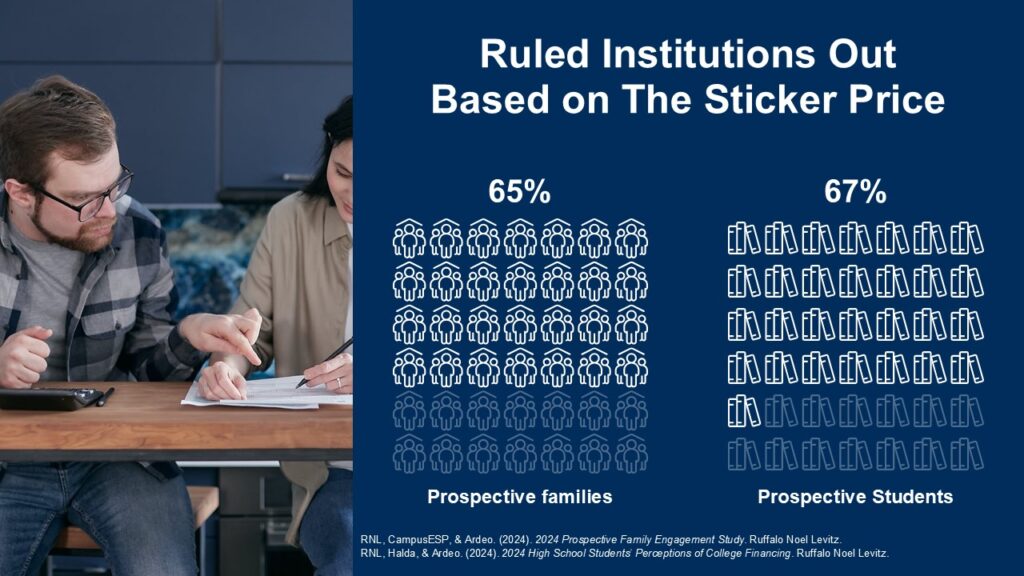
    When it comes to choosing a college, the sticker price can be a major turnoff. A significant 65% of prospective students and 67% of their families report ruling out institutions based solely on the advertised “sticker price”.

    Source: 2024 Prospective Family Engagement Report

    But what does this mean for colleges and universities, and how can they help families look beyond the sticker shock to understand the true affordability of a degree?

    The rising tide of sticker shock

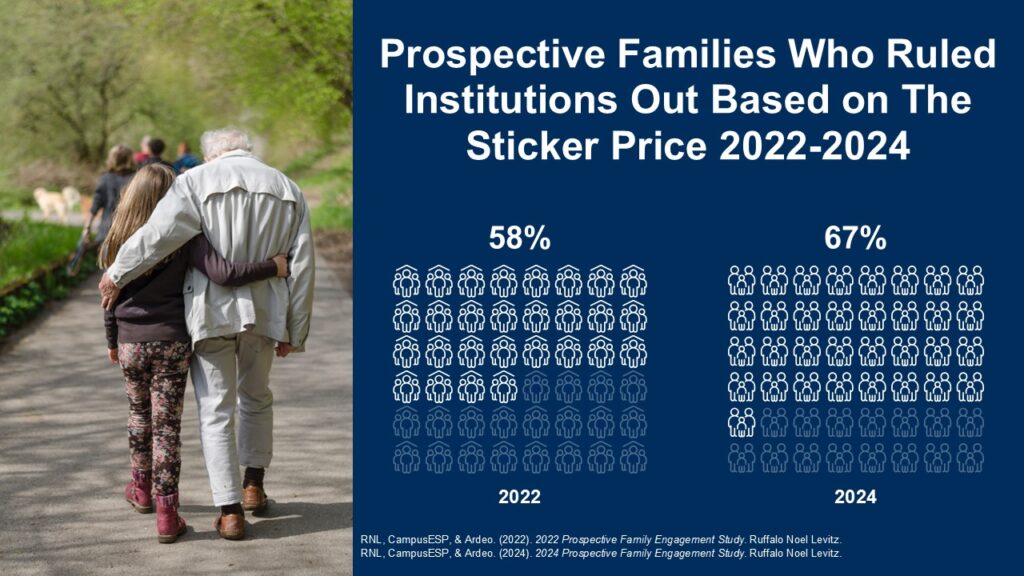
    Chart showing increase in number of families ruling out campuses because of price, from 58% in 2022 to 67% in 2024Chart showing increase in number of families ruling out campuses because of price, from 58% in 2022 to 67% in 2024
    Sources: 2024 Prospective Family Engagement and 2022 Prospective Family Engagement reports


    Ruling out colleges based on the sticker price is on the rise – and it’s happening fast. In just three years, the percentage of families eliminating schools from consideration due to high upfront costs has jumped from 58% in 2022 to 67% in 2024.

    This suggests that concerns about affordability are increasingly driving the college planning process, with families taking a hard look at the bottom line before even exploring other factors. But is this sticker shock reaction always a rational response, or might colleges be losing out on applicants who could afford to attend with the help of financial aid?

    The generational divide

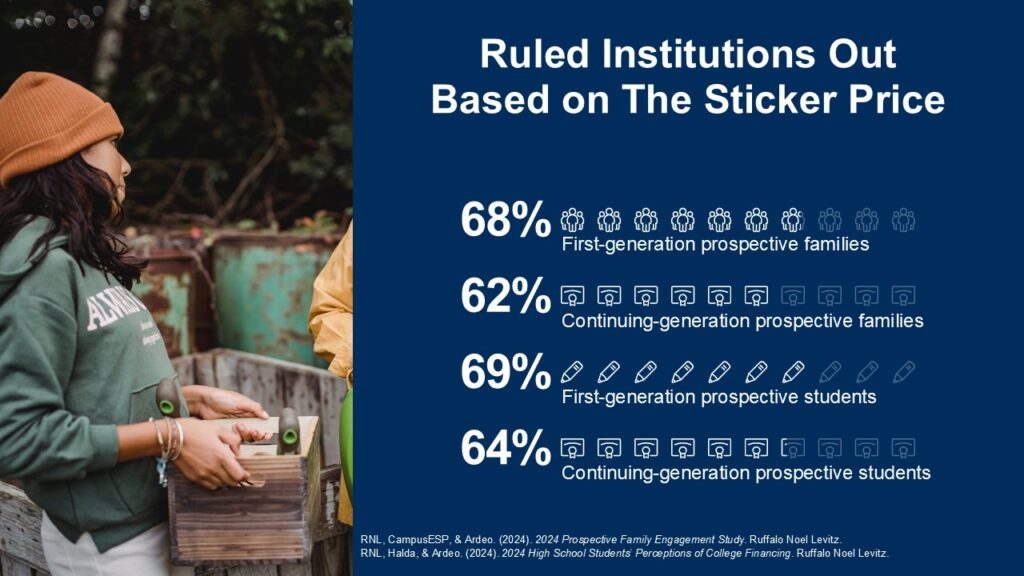
    Chart showing that that nearly 70% of first generation students and families have ruled out an institution based on price.Chart showing that that nearly 70% of first generation students and families have ruled out an institution based on price.
    Sources: 2024 Prospective Family Engagement and 2024 High School Students’ Perceptions of College Financing

    A notable divide emerges when comparing the sticker shock responses of first-generation college students to their continuing-generation peers. A full 69% of first-generation students reported ruling out schools based on sticker price, compared to 64% of continuing-generation students.

    This disparity is also reflected in families’ perceptions, with 68% of first-generation families eliminating schools due to cost versus 62% of continuing-generation families. This could suggest that first-generation students and families are less familiar with the intricacies of college financing and the crucial distinction between sticker and net price.

    As a result, they may be more likely to focus on the daunting upfront cost without fully exploring the available aid options. How can colleges better reach, educate, and support these first-generation students about affordability to prevent them from ruling out institutions that could be a great fit financially and academically?

    The role of family involvement

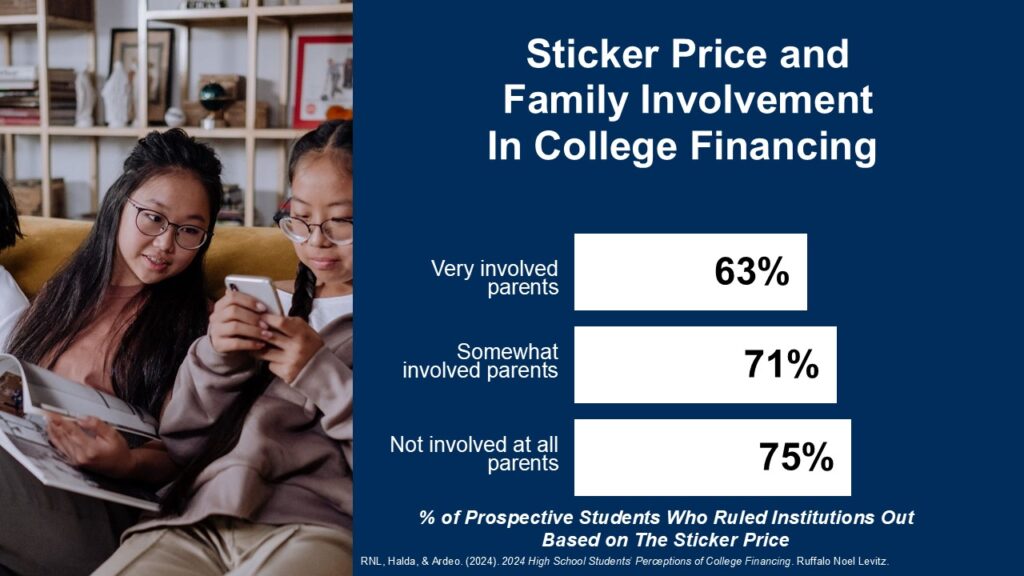
    Chart showing that 75% of students whose families are not involved in college planning will rule out an institution based on sticker price.Chart showing that 75% of students whose families are not involved in college planning will rule out an institution based on sticker price.
    Source: 2024 High School Students’ Perceptions of College Financing

    The level of family involvement in the college search process also plays a role in sticker shock decisions. Students with very involved parents were less likely to rule out colleges based on sticker price (63%), suggesting that parental guidance may help applicants look beyond the initial cost to consider the bigger financial picture.

    But what about students with less involved parents? A striking 75% of students with uninvolved parents ruled out colleges based on sticker price. How can colleges step in to provide the necessary counseling and education about affordability for these applicants?

    Loan anxiety and sticker shock: A shared concern for students and families

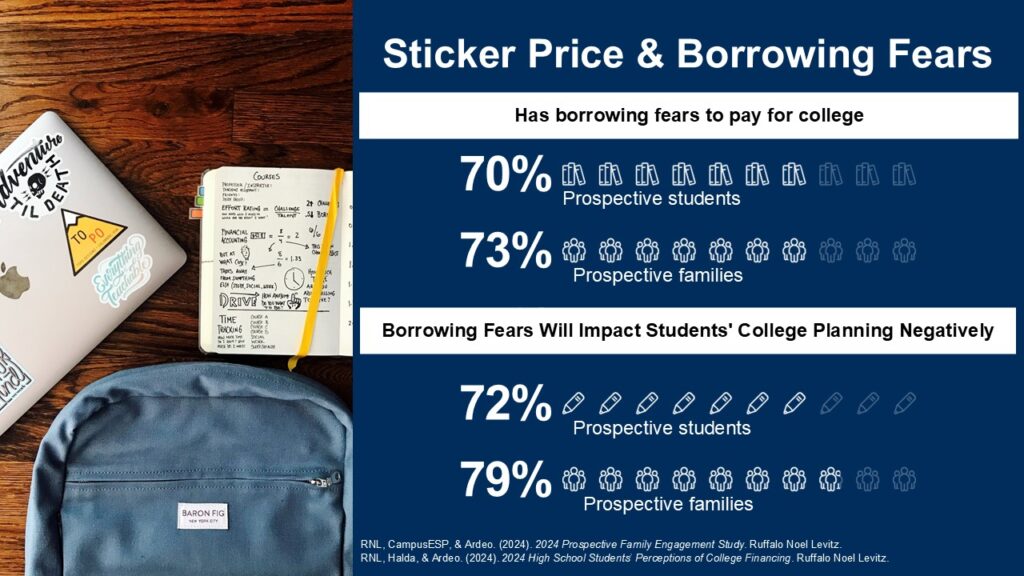
    For both students and their families, concerns about loan debt play a significant role in the sticker shock equation. A striking 70% of students who expressed concerns about borrowing to finance their education were more likely to rule out colleges based on high prices. Families share this loan anxiety – 73% of families with loan concerns reported ruling out institutions based on sticker price. This underscores the need for colleges to address loan concerns head-on through transparent communication about financing options, debt management strategies, and a degree’s long-term return on investment.

    Chart showing more than 70% of students have fears about borrowing to pay for college.Chart showing more than 70% of students have fears about borrowing to pay for college.
    Source: 2024 High School Students’ Perceptions of College Financing

    By providing reassurance and resources, institutions can help applicants feel more comfortable with the financial commitment and less likely to rule out schools due to initial sticker shock. Importantly, 72% of students and 79% of families reported that their borrowing concerns were negatively impacting their college planning, suggesting that proactive support from institutions is crucial in mitigating loan anxiety and promoting a more holistic view of affordability.

    The net price imperative

    While sticker price can be a major deterrent, the actual net price of attendance paints a very different picture. Institutions must do a better job of clearly communicating net price information to prospective students and families.

    This means highlighting available aid, scholarships, and financing options to demonstrate affordability. Tools like net price calculators can be powerful in helping applicants understand the true cost of attendance. But are these resources being effectively utilized and communicated to offset the sticker shock reaction?

    To help families and students look beyond sticker shock, institutions can take the following steps:

    1. Clearly communicate net price information: Highlight the difference between sticker price and net price on your website and in recruitment materials.
    2. Provide transparent financing information: Break down the costs of attendance and explain financing options in clear, easy-to-understand language.
    3. Offer user-friendly net price calculators: Help families estimate their actual out-of-pocket costs with interactive net price calculators.
    4. Proactively counsel about aid: Don’t wait for families to ask – offer personalized financial aid counseling to prospective students.
    5. Address loan anxiety: Provide resources and guidance to help students and families understand responsible borrowing and debt management.
    6. Highlight value beyond price: Showcase the long-term value and outcomes of a degree from your institution to demonstrate the return on investment.
    7. Partner with high schools: Collaborate with high school counselors to provide early education about college financing and affordability.
    8. Target outreach to first-gen students and their families: Recognize that first-generation students may need additional support and education about the college financing process.
    9. Follow up with sticker-shocked applicants: If a student expresses interest but seems deterred by the sticker price, proactively reach out with information about aid and affordability options.
    10. Leverage video and AI to personalize the process: Use video content and artificial intelligence tools to provide personalized, interactive explanations of financial aid and affordability. AI-powered chatbots can offer 24/7 support to answer families’ financing questions, while personalized video messages can break down complex aid packages in an easy-to-digest format. By embracing these technologies, institutions can create a more engaging, self-service-oriented experience that empowers families to confidently navigate the affordability landscape.

    The bottom line and more findings from our Perceptions report

    The sticker shock phenomenon is a real and growing concern in college admissions. However, by understanding the factors that drive these decisions and taking proactive steps to educate families, colleges can help prospective students see beyond the advertised tuition rate to consider the true affordability of a degree. This requires a nuanced understanding of the college financing landscape and a commitment to clear, transparent communication. With the right approaches, institutions can attract diverse applicants who may have otherwise been deterred by sticker shock.

    You can read more insights and findings in the 2024 High School Students’ Perceptions of College Financing report, co-sponsored by our partners Ardeo and Halda. This report captures data from a survey of more than 2,100 11th- and 12th-grade students. Read it now.

    Source link

  • 5 Reasons to Administer the Refreshed College Employee Satisfaction Survey (CESS)

    5 Reasons to Administer the Refreshed College Employee Satisfaction Survey (CESS)

    The expectations of higher education faculty and staff have changed. Understanding the experiences, opinions, and satisfactions of your faculty and staff is invaluable to creating a healthy culture and work environment. But it’s not just about fostering a positive atmosphere—it’s also critical for retaining your employees, improving the student experience, and reducing the risk of lost institutional knowledge.

    To help institutions better understand and support their faculty and staff, RNL is excited to introduce the refreshed College Employee Satisfaction Survey (CESS), designed with enhanced features to delve deeper into employee engagement and satisfaction at colleges and universities. Here are five reasons your institution should consider administering the updated CESS in 2024-2025.

    1. Gain a comprehensive view of your employee experience

    The updated CESS measures key aspects of faculty and staff morale, including workplace recommendations, overall job satisfaction, and retention rates. With this data, you’ll have a clear picture of your university’s workplace culture, helping you make meaningful improvements driven by faculty and staff input.

    2. Identify what matters most to your team

    The refreshed CESS explores key aspects of the employee experience including internal communication, prioritization of institutional goals, work-life balance, and satisfaction with compensation. Your employees also highlight institutional strengths and opportunities for improvement, giving you direct feedback on what they value most.

    3. Benefit from detailed, actionable reports

    With your participation in the CESS, you’ll receive comprehensive reports, including faculty and staff segment analyses, the raw survey data, and the RNL CESS Benchmark National Norms report.* This information empowers you to take targeted action to boost employee morale.

    4. Support accreditation and strategic planning

    Survey results from the CESS can be a powerful asset in accreditation and strategic planning processes. Demonstrating a commitment to understanding the employee experience helps to demonstrate compliance with key standards and conveys that your institution is proactive about maintaining a thriving educational environment.

    5. Take advantage of special pricing and longitudinal analysis

    To celebrate the launch of the refreshed survey, RNL is offering a 25% discount on standard administration fees for surveys conducted in 2025. Moreover, institutions engaging in the CESS more than once within a five-year span will receive a complimentary longitudinal comparison report. This report is invaluable for tracking changes and trends over time, providing a deeper understanding of the long-term impact of implemented policies and changes.

    The refreshed College Employee Satisfaction Survey from RNL is more than just a survey; it’s a comprehensive tool that empowers higher education institutions to thrive by fostering a healthy campus culture and satisfying work environment. By participating in the CESS, your institution can gain critical insights, enhance strategic planning, and ultimately, elevate the overall campus culture.

    To learn more or to schedule your institution’s participation, please visit our dedicated College Employee Satisfaction Survey webpage.

    *Benchmark reports will be sent to participating institutions once seven institutions of their type like 4-year publics, 2-year publics, or 4-year private conduct the 2024 CESS.

    Source link

  • Troubled FAFSA Rollout Linked to Sharp Decline in First-Year College Enrollment

    Troubled FAFSA Rollout Linked to Sharp Decline in First-Year College Enrollment

    Title: Fewer Freshmen Enrolled in College This Year Following Troubling FAFSA Cycle

    Author: Katharine Meyer

    Source: Brookings Institution, National Student Clearinghouse Research Center

    The rollout of the new FAFSA form last year triggered cascading consequences across the higher education community. The launch was delayed, customer calls remained unanswered, and the number of filings decreased by about three percent. As the form’s issues compounded, experts predicted that the fumbled rollout would likely negatively impact the higher education sector across several metrics, particularly new student enrollment.

    The National Student Clearinghouse Research Center collected data at the beginning of the academic year to begin painting the updated enrollment picture and will follow up with final enrollment numbers for the 2024-25 academic year. The Brookings Institution analyzed the preliminary data and observed large declines in FAFSA filings, followed by a decrease in first-year enrollment.

    Across all institutions, first-year enrollment is down 5.8 percent among 18-year-olds and 8.6 percent among 19-20-year-olds. At public four-year institutions, first-year enrollment declined 8.5 percent, and it declined 6.5 percent at private four-year institutions. White freshman enrollment declined the most (11.4 percent), followed by multiracial (6.6 percent) and Black (6.1 percent) first-year student enrollment. Enrollment at HBCUs, however, increased 5.9 percent from last year and has cumulatively increased 12.6 percent since fall 2022.

    First-year enrollment at four-year schools declined across all levels of Pell Grant recipience. Institutions that experienced the largest declines in first-year enrollment, though, were public and private four-year institutions with the highest shares of students receiving Pell Grants (-10.4 and -10.7 percent, respectively). First-year enrollment at four-year colleges is also down across all levels of selectivity, with the largest decline occurring at very competitive public four-year institutions (-10.8 percent), followed by competitive public four-year institutions (-10.3 percent).

    Despite declines in first-year enrollment, total college enrollment increased three percent, due in part to a 4.7 percent increase in community college enrollment. Interestingly, this increase occurred at certain types of two-year institutions but not all of them. At colleges that predominantly award associate degrees and some bachelor’s degrees, freshman enrollment increased 2.2 percent, and at two-year institutions that enroll a higher proportion of low-income students, first-year enrollment increased 1.2 percent. At community colleges only awarding associate degrees, however, enrollment decreased by 1.1 percent.

    The author notes these insights come with caveats; many factors have contributed to enrollment decline over the last decade, notably falling public confidence in higher education and the ever-growing cost of attending college. The sharp decline in first-year enrollment, however, correlates with the troubled FAFSA launch. Continuing to collect data over time will provide more insight into the implications of recent disruptions to enrollment trends, particularly following the COVID-19 pandemic and the FAFSA rollout. The 2025-26 FAFSA form will be available this December, and its functionality will determine the gravity of the past year’s enrollment decline.

    To view the National Student Clearinghouse Research Center data dashboard, click here. To read the Brookings Institution analysis, click here.

    —Erica Swirsky


    If you have any questions or comments about this blog post, please contact us.

    Source link

  • College Recruitment Strategies and Ideas to Boost Enrollment

    College Recruitment Strategies and Ideas to Boost Enrollment

    Student Recruitment Ideas for Better Enrollment Marketing

    College recruitment strategies have undergone a seismic shift in recent years with the rise of an always-on digital audience and the growing accessibility of online programs. Fewer geographical constraints and heightened competition have fueled this realignment, prompting institutions to craft student recruitment strategies that are as dynamic as the students they aim to enroll. 

    In the modern, digital-first landscape of higher education, recruitment season is no longer confined to the traditional August to December window. Students are applying and enrolling year-round, and your institution must constantly assess which strategies are driving results and which are falling flat. 

    By embracing smarter, data-driven marketing tactics, you can stand out in the crowded landscape of online education, uniting students under the shared mission of your institution. 

    The Importance of Student Recruitment Strategies 

    You’ve been working in higher education for over a decade, but recently, student recruitment seems harder. You’re not alone. Prospective students are going in less traditional directions and finding cheaper, faster ways to become qualified for the workforce through modalities such as online certificates and boot camp programs. Inflation isn’t helping either. 

    But through a realignment of strategy to meet digital native consumers, you can meet students where they are and capitalize on projected enrollment growth

    Don’t get scared into sticking with outdated ways of reaching prospective students. Instead, rise to the challenge, get a better understanding of the landscape you’re working with, and refresh your enrollment marketing strategy. 

    3 Student Recruitment Strategies

    We won’t tell you that all traditional marketing strategies are outdated, but we do want to make it crystal clear that students are online. They’re surfing the web on their smartphones and discovering new universities and programs through (mostly mobile) online journeys. If your enrollment strategy isn’t rooted in this reality, you’re at risk of losing more than half of your potential students. 

    1. Meet Them Where They’re At (On Their Phones!)

    With 91% of the U.S. residents owning a smartphone, it’s no surprise prospective students are surfing the web from their mobile devices. In fact, a recent report by Oberlo tells us that over 60% of all internet traffic comes from mobile devices. 

    Most of the time, however, our web developers, brand managers, and marketing professionals are viewing and building websites on their desktop computers. While working from a computer is convenient, it’s imperative that every single UX/UI change made to your university/program website is tested on both desktop and mobile. 

    Don’t lose out on prospects just because you didn’t consider both desktop and mobile website views in your design process. It may seem obvious, but plenty of colleges and universities aren’t considering this important strategic detail. 

    2. Consider Utilizing Paid Media

    Now that you’ve cleaned up your mobile site, you’re ready to start pushing students from other platforms to your program pages through a key college recruitment strategy: paid media. While paid media isn’t the cheapest option, it’s often one of the most effective. Google Ads, LinkedIn, and Facebook provide fairly straightforward ways to spend for clicks. 

    We recommend starting with PPC (pay per click) campaigns to attract prospective students to your site. These campaigns help the most with bringing in entirely new audience members whom you may not have been able to reach through organic efforts. The internet is vast, and it’s not always easy to track down potential candidates without some extra help. 

    After bringing in new prospects from platforms like Google and LinkedIn, your job is to create a journey where they’ll sign up for your newsletter or respond to a survey so you can effectively follow up and make their click worthwhile. It may seem pricey at first, but once the leads start coming in and you’re able to connect with them well after that first click, you’ll see the return on investment. 

    PPC campaigns can also help speed up the process if you’re finding yourself behind on your goals this quarter.

    3. Tap Into Popular Platforms and Their Users

    If paid media feels a bit too far out of reach, some high-growth organic options can help your student recruitment strategy. 

    Use Instagram to Engage With Students

    Most institutions now have a presence on LinkedIn and Facebook, but university marketers may be missing a huge opportunity with Instagram. A recent article from RivalIQ cited higher ed’s impressive average engagement rate of 2.43% on Instagram, compared with the median across all industries of 0.43%. 

    Instagram should be used in a completely different way than Facebook and LinkedIn, which can be deterring for content teams, but clearly prospective students are interested in engaging there. Be sure to connect with them and provide tailored content.

    Harness the Power of Testimonials

    When you hear the words “influencer marketing,” you may think of famous teenagers with millions of followers dancing their hearts out to a 15-second song. While plenty of those influencers are out there, so are users who share their educational journeys, financial tips and tricks, and personal stories about their lives and experiences. 

    With the number of graduates, administrators, and staff members your school has on social media, you’re sure to find some influential users who are willing to share their satisfaction with your program on their channels. It doesn’t require millions of followers either. 

    Nano influencers (influencers with a following between 1K and 10K) are “everyday people” who come across as more authentic and with much more enthusiasm than the players in the big leagues (micro/macro influencers). According to a recent study from Matter Communications, 69% of consumers depend on recommendations from influencers, family members, and friends over information provided by brands. That means two of every three consumers want to read reviews from online personalities they see as trustworthy sources — an amplified version of word-of-mouth marketing.

    Use Short-Form Video to Reach New Audiences

    Short-form video is an important college recruitment strategy for engaging with students. Though the style of content may seem daunting and the editing may seem like a lot of work, recent studies have indicated that Gen Z users prefer TikTok for search over Google — making it an indispensable part of your strategy. 

    Although prospective student demographics look different across universities, your target students are likely on TikTok. And more importantly, they’re using it as a source of information. The hashtag #LearnOnTikTok had over 360 billion views as of 2024, according to The Leap

    Think of the reasons users visit your website — and the questions they have — and use that insight to inform the kinds of content you can provide to educate prospective students. 

    We Can Help Build Your Online College Recruitment Strategies

    The higher-ed landscape is still undergoing unexpected shifts at a faster rate than most of us are ready for. Some days, you might feel like you’ll be playing catch-up for ages, and evolving marketing tactics might make that race feel even harder. It’s a lot to manage a robust omnichannel college recruitment strategy, but you don’t have to do it all internally. 

    At Archer Education, we partner with colleges and universities to create effective messaging that will illuminate your brand’s strengths and unique values to attract and convert high-quality students. Our experts are always in the know, employing tech-enabled, modern enrollment tactics to attract prospective students’ attention, drive engagement, and facilitate action. Don’t overstretch your team members — let us help. Contact us today for more information.

    Source link

  • New Program Strategy: Go Deep, Not Wide

    New Program Strategy: Go Deep, Not Wide

    How to Strategically Expand Your Online Adult Degree Programs

    So you’ve built a successful online adult degree program. No small feat. Now you need to keep your foot on the gas to keep the momentum going. 

    Your first instinct might be to “go wide” with your program expansion strategy by launching a variety of new, unrelated programs to pair with your successful offering. While this diversification strategy might reap great rewards for consumer packaged goods giants like Unilever and Procter & Gamble, higher education is different. Your institution is different.  

    I find myself making the following recommendation over and over again when it comes to expanding online degree programs: Go deep, not wide. 

    This means building upon the success of your existing program by developing specialized offerings within the same field. The “go deep” method might not be the most popular, but in my experience, it’s often the most effective. Let’s break it down further — or should I say, dig deeper — to see if this approach is right for your school. 

    What Does Going Wide Mean for Your Online Adult Degree Programs?

    Let’s start with a hypothetical example: You have established a successful online Master of Business Administration (MBA) program with a positive reputation in the region. 

    Recently, you’ve heard cybersecurity and nursing degree programs are experiencing industry growth, so you decide to pursue programs in those areas next to build out a wider range of offerings. 

    Unfortunately, this strategic path can be a mistake. Here’s why: 

    However, expanding within the existing framework of business administration can allow for the amplification of this established brand equity, rather than starting from scratch with each new offering.

    Why Going Deep Is More Effective

    In higher education, the smart, strategic allocation of resources is crucial. You could put your institution’s limited resources toward a whole new program, such as a Bachelor of Science in Nursing (BSN) program or a Master of Science in Cybersecurity program. Or, you could just attach a new or adjacent offering to your successful online MBA program to channel your resources into an established program realm. 

    Forget efficacy for a moment. Which strategy sounds more efficient? 

    The good news is that going deep in one area of program offerings is often more effective and efficient. Instead of developing an entirely new adult degree program from scratch, you can simply add value to your existing online business program. 

    This might come in the form of added concentration options, such as MBA concentrations in entrepreneurship, accounting, finance, marketing, management, or strategic communications. 

    It could also involve adding another relevant degree program within the same area of study. For example, since you’re seeing a lot of success with your MBA program, you could add a finance or accounting degree program to build on the success and reputation of the established program.

    Key Benefits of Going Deep With Your Online Adult Degree Programs

    I’ve had experiences both ways: some institutions go wide, others go deep. For those that go wide, I’ve often seen siloed marketing efforts, inefficient allocations of resources, and sporadic and unpredictable enrollment. For those that go deep, I see the following benefits: 

    More Students Attracted

    Broadened appeal for students already interested in the primary program: By offering more concentrations within a well-established program, or adjacent degrees within the same field, your institution can appeal to a broader range of interests and career goals within your current student audience base.

    More options for prospective students due to increased specialization: Specialized degrees and concentrations allow students to tailor their education to their specific interests and career paths, making the program more attractive to applicants seeking focused expertise.

    Increased Marketing Efficiency

    Ability to leverage existing web pages and SEO for the main program: Concentration pages can be added as subpages to the main program’s page, which likely already has a strong search engine optimization (SEO) presence. This setup benefits from the existing search engine rankings and requires less effort than starting marketing from scratch for a new program.

    Faster path to high search rankings for new concentrations, creating a marketing loop: The SEO efforts for the main program boost the visibility of the new concentrations, which in turn contribute to the overall authority and ranking of the main program’s page. This synergy creates a self-reinforcing cycle that enhances the visibility of all offerings.

    Enhanced paid marketing efficiencies: Adding concentrations in areas where significant traffic already exists for broad terms — like “MBA,” “business degree,” or “finance degree” for an MBA program — allows institutions to more effectively utilize their paid advertising budgets. Expanding the program options for your existing traffic allows you to improve your click-to-lead conversion rates, increase your number of leads, and enhance your downstream successes in areas such as enrollments and completions. This approach allows for a more efficient use of marketing investments, providing more options for prospective students within the same budget.

    Faster Accreditation Process

    Streamlined accreditation process by expanding within an already accredited program: Adding concentrations within an existing program simplifies the accreditation process. Because the core program is already accredited, expanding it with concentrations requires fewer approvals and less bureaucracy than launching an entirely new program.

    Ready to Go Deep With One of Your Online Adult Degree Programs?

    If you’ve seen success with an online adult degree program offering, you’ve already taken a momentous step toward growth — which is something to be proud of. It also creates massive opportunity, and Archer Education is poised to help you capitalize on it. 

    Archer is different from other agencies. We work as your online growth enablement partner, helping you to foster self-sufficiency over the long haul through collaboration, storytelling, and cutting-edge student engagement technology. 

    We’ve helped dozens of institutions increase enrollment and retention through a going deep approach, and your institution could be next. And once you’ve solidified the reputation and success of your core online offering by going deep, we’ll be ready to help you pivot to a wider approach to expand your position in online learning.

    Contact us today to learn more about what Archer can do for you. 

    Subscribe to the Higher Ed Marketing Journal:

    Source link

  • Student Engagement in Higher Education

    Student Engagement in Higher Education

    How to Deliver a Personalized Experience Throughout the Student Journey

    Imagine this: a prospective student fills out a request for information on your website, sharing personal details like their program of interest, transfer status, and intended start date. What happens next? Too often, the response is a generic email or text urging them to apply. Then, perhaps unsurprisingly, many institutions see declining contact rates and applications. 

    Delivering an engaging, personalized experience — at scale, across programs, and from the very first interaction — is no small feat. But it’s also essential in today’s competitive higher education landscape. While complex communication plans and sophisticated automation tools play a role, sometimes the simplest approach can make the biggest difference: Asking the right questions.

    Focusing on the right questions can strengthen student relationships, increase lead-to-application rates, and even drive application-to-enrollment success, helping institutions connect personally with students and boost engagement at every stage of their journey.

    What Is Student Engagement in Higher Ed? 

    Before we can start asking students questions, we must first ask ourselves an obvious question: What is student engagement? 

    Engagement rates are metrics that show how actively involved your audience is with your content. By tracking specific metrics, your institution can analyze the effectiveness of your marketing campaigns. You should track the number of people who interact with your follow-up communications: whether they open, click, respond to, or visit a website.

    Every interaction a prospective student has with your institution’s website, social media posts, texts or emails, and other digital content generates data that you can use to capture information about leads (prospective students) and better understand and optimize future marketing efforts

    Tracking and analyzing “clicks” can tell you:

    At Archer, we’ve seen clients have 44% higher application-to-start rates and 33% higher application rates when prospective students engage with an institution’s post-inquiry communication. This makes for an efficient use of resources, as you’ve already generated the inquiry. A bump in conversion rates can go a long way in stretching a limited budget. 

    One Simple Thing You Can Do to Increase Student Engagement

    Imagine you have the opportunity to meet with every prospective student in person for coffee. What would you do? How would you engage with them? You’d probably begin to build rapport by asking them lots of questions. 

    A digital meetup should be treated no differently than an in-person engagement. “Digital” is simply another method of communication. Granted, you’re not able to sit at your computer and chat online with every prospect, but in terms of how to interact and build student engagement, you should think of it the same way: as a two-way conversation. 

    Simply put, stop talking at prospective students and start communicating with them.

    As much as you’re tempted to begin by telling them how great your school and program are, it’s best to first understand where a student is coming from and what they’re looking for.

    At Archer, our team and our proprietary end-to-end student support solution — called Onward — are available to students 24/7. Built exclusively for the student journey, Onward collects and analyzes data on digital student engagement and optimizes digital student communication with a goal of increasing post-inquiry engagement. It has taught us a lot.  

    We’ve found that one of the most impactful things we can do in our follow-up communication with students to boost engagement rates — at any stage of the student lifecycle — is to ask questions. Indeed, in follow-up exchanges where we ask students specific questions (and provide an option to answer directly in that communication), we see click-through rates 42% higher than average.

    It’s Not Too Late to Start Asking Questions 

    Even if you’ve already missed a key opportunity to ask questions of new prospects, circling back to get to know them better at any point in their student journey can have an impact.

    Working with our partner Peru State College, we started sending a “What’s holding you back?” email to prospective students who weren’t taking the next step forward. The email not only asked “What’s holding you back from enrolling with us?” but also let the recipient click on an answer. For that email, we saw an average open rate of 16% — which doesn’t look too impressive until you consider these prospects had stopped engaging — and, more importantly, an average 33% click-through rate (with a majority of clicks leading to “apply now” pages). Not only did the email help the college reconnect with “lost” students, but we learned how to better connect with unconverted prospects going forward.

    The email allowed us to determine who was stopping out and why.

    • The top reason for not moving forward was related to finances (35%).
    • More than 20% of prospective students had enrolled elsewhere.
    • 5% said they weren’t ready to enroll yet but wanted to attend in the future.

    These insights informed our follow-up digital communication, as well as our one-on-one admissions team follow-up. As a result, we reengaged with a meaningful percentage of stopped-out prospects by understanding some of their challenges and following up with relevant information. Moreover, 20% of this audience took action by clicking to start or finish their application and/or call an admissions rep.

    Student Engagement Strategies for Every Higher Ed Stage 

    We used this same engagement strategy for first-time students enrolled in Peru State College’s online programs. Before we could view information in our partner’s learning management system to see if students were showing up for class or turning in assignments — leading indicators of student success — we wanted to check in with these new students directly to ask how their first week was going. The email asked, “How are you feeling about your first week?”

    This email had an average open rate of 71% and an average click-through rate (CTR) of 31%.

    Using a similar email, Archer helped another partner intervene to help 14 students who had indicated they weren’t having the best first-week experience. By asking follow-up questions to learn what wasn’t working for them, and forwarding that information to our admissions team, we were able to connect those students with a success coach at the university.

    Optimize Student Engagement at Your Higher Education Institution 

    Higher-ed marketers and enrollment professionals know from experience that the success of every student is important to an institution’s long-term success. Providing a more personalized and engaging student experience can have a positive impact on enrollment growth and student retention. 

    It’s time for you to start having meaningful digital conversations that make an impact. 

    While Archer Education uses Onward, our easily scalable end-to-end student support solution, to deliver personalized communication and tailored post-inquiry follow-up 24/7, you don’t need a sophisticated lead nurturing tool to improve your student engagement strategies. Simply start asking questions in your communication with students and provide them with an easy way to respond. 

    Want to learn more about how to modernize your student experience and increase enrollment and retention rates with Archer’s Onward student support solution? Reach out to us and learn more today.

    Avatar photo


    Angie Mohr

    Director of Marketing & Communications

    Angie Mohr is the senior vice president of student engagement at Archer Education. With a background in marketing, communications, and CRM and marketing automation, she has over 15 years of strategic communications and higher education experience. In her current role at Archer Education, a full-service marketing and enrollment solutions provider for higher education institutions, Angie focuses on supporting student acquisition and life cycle delivery services, utilizing scalable communications strategies and technologies to help prospective students engage, enroll, and persist in their student journey.

    Source link

  • Busting Roadblocks in the Community College Enrollment Cycle

    Busting Roadblocks in the Community College Enrollment Cycle

    Top Student Enrollment Roadblocks and How to Overcome Them

    In my more than two decades of steering enrollment management at various institutions, I’ve seen students encounter numerous hurdles on their journey to and through higher education. 

    My experience has consistently shown that the decision to enroll is heavily influenced by four critical factors: 

    Understanding these priorities is critical to attracting and retaining students in the community college space. By aligning your enrollment strategies with the needs and expectations of prospective students, you can ensure a smoother, more engaging educational journey that benefits both the students and your educational institution alike. 

    Common Ease of Enrollment Roadblocks for Students

    The pursuit of higher education is a daunting task in itself. When students encounter challenges at the enrollment phase — before the actual coursework even starts — it can be easy for them to bow out of the process altogether. To ensure that doesn’t happen, avoid these common pitfalls in the community college enrollment journey: 

    Complex Enrollment Processes

    Orientation and Information Overload

    Confusing Websites

    Placement Testing Delays

    How to Overcome Ease of Enrollment Roadblocks

    So, those are the potential enrollment roadblocks for community college students. But what are the enrollment solutions? Solutions for overcoming enrollment roadblocks for community college students include the following: 

    Common Clear Path to Graduation Roadblocks for Students

    Now that you’ve mowed down the enrollment roadblocks, it’s time to ensure that the ride stays smooth. Remember, it’s never too late for students to change their direction. They might do so if these issues persist: 

    Course Registration Problems

    Technology Barriers

    How to Create a Clear Path to Graduation

    Constructing a clear path to graduation isn’t easy, and with limited resources, it can be difficult to avert every bump in the road. But in my experience, you can keep most students on track by focusing on these two key areas: 

    Common Reasonable Degree Completion Roadblocks for Students

    You’ve cleared two major hurdles by easing the enrollment process and creating a clear path to graduation. But you’re only halfway home. Here are some common mistakes institutions make when it comes to the time it takes to complete a degree: 

    Inadequate Academic Advising

    Lack of Clear Communication

    Social and Emotional Challenges

    How to Help Students Reach Their Goals in a Reasonable Amount of Time

    When it comes to keeping students on track, intervention is key. Follow these tips: 

    Common Cost/Benefit Roadblocks for Students

    You’ve now reached the last but never the least critical roadblock in higher education: return on investment. It’s why your students are showing up, and if the numbers don’t make sense, they can — and should — turn back. Here are some financial concerns that your students are likely to face: 

    Housing and Transportation Challenges

    Cost of College Data Is Hard to Find

    Ways to Help Students With Their Financial Concerns

    Your institution is responsible for ensuring that students understand their financial obligations and how to meet them. Here are a few ways that you can do this: 

    Bust Down Roadblocks by Partnering With Archer 

    In my 20 years of experience, I’ve helped lots of institutions navigate these potential roadblocks to enrolling and retaining more students. And I’m far from alone in my expertise at Archer. Our full-service team partners with colleges of all kinds to help them build and scale their capacities. 

    Is your institution ready for a collaborative partner who takes the time to get to know you, then makes custom recommendations based on decades of experience? Reach out to us today

    Subscribe to the Higher Ed Marketing Journal:


    Brian Messer

    Brian Messer has over 20 years of experience overseeing all aspects of university administration, including online, operations, academic affairs, enrollment management, marketing, financial management, and human resources and student affairs. Specifically, his extensive experience in scaling marketing and enrollment initiatives in all sectors of nontraditional higher education have contributed to student success and growth at many institutions of higher learning.
    Messer holds a doctorate in higher education administration from Saint Louis University.

    Source link

  • Tips for the Student Journey- Archer Education

    Tips for the Student Journey- Archer Education

    5 Tips for Keeping Students Engaged Throughout the Admissions Process

    In higher education, the enrollment funnel can feel like a battleground for institutions vying to convert interest into commitment. 

    Traditionally, the enrollment funnel has been viewed simply: attract, engage, and enroll. But the modern student’s journey is anything but straightforward — it’s a complex, winding path influenced by numerous digital touchpoints and personalized interactions.

    The health of the enrollment funnel extends beyond mere numbers; it represents the institution’s ability to connect with prospective students through every phase of their decision-making process. With technology reshaping expectations and behaviors, colleges and universities must not only catch the eye of prospective students but also keep them engaged through multiple channels and strategies. 

    This article unpacks key elements of the enrollment and admissions funnel, offering actionable insights and innovative tips to capture and retain students’ attention from their first inquiry through their enrollment stages. As we explore these strategies, you’ll discover the vital role that continuous, tailored engagement plays in transforming interest into activity, setting the stage for a successful educational journey.

    The Modern Student Journey

    Today’s students embark on their educational journeys equipped with a wealth of information and digital tools at their fingertips, making their paths to enrollment more complex and multifaceted than ever before. 

    Complexities and Challenges

    The student journey is far from linear. It involves numerous interactions across various platforms and touchpoints. Each student’s path is unique and influenced by personal, financial, and academic factors. 

    For instance, a modern student, such as a working professional returning to education or a parent seeking to balance family responsibilities with schooling, may have different priorities and use different resources compared to a younger, first-time college student.

    Technology has diversified the ways students gather information, and also how they engage with institutions. Prospective students might start their journey by conducting a simple Google search, but they will also often visit social media platforms, participate in virtual campus tours, and attend online webinars before starting their application. During this time, they are continuously evaluating their options and being influenced by each interaction they have with a school’s digital presence.

    Impact of Technology

    The proliferation of digital platforms has dramatically altered the student journey, both for students and institutions, in ways such as the following: 

    Given these technological influences, it is essential for educational institutions to adapt their enrollment strategies to meet the changing behaviors and preferences of modern students. Integrating data analytics, enhancing digital communication channels, and providing personalized experiences are all critical to effectively engaging with prospective students throughout their decision-making journey.

    Understanding the Enrollment Funnel 

    The enrollment and admissions funnel is a foundational concept in higher education marketing that illustrates the progressive stages a student navigates, from awareness through enrollment. The funnel is not just a theoretical model but a practical guide for shaping effective engagement strategies. 

    6 Stages of the Enrollment Funnel

    The enrollment funnel can be divided into several key stages, each requiring specific strategies to move prospective students to the next step:

    A deep understanding and effective management of the enrollment and admissions funnel is crucial for any educational institution aiming to increase its student body. Let’s see how it’s done. 

    How to Keep Students’ Attention Through the Enrollment Funnel

    Maintaining the attention of prospective students throughout their educational journey is crucial for successful enrollment. Here are key strategies to keep students engaged from initial inquiry through enrollment:

    1. Consistent Engagement Across Channels

    Leverage multiple channels to engage with students to ensure your institution remains top of mind. Implement a mix of digital and traditional marketing strategies to reach students where they are most active, such as the following:

    2. Personalization and Differentiation

    Tailor your communications to meet the specific needs and interests of each prospective student, and utilize data from their interactions with your digital content to personalize messages. Strategies to achieve these goals include the following:

    3. Incentives and Urgency

    Create a sense of urgency and motivation by offering incentives that encourage prospective students to take the next step:

    4. Building Relationships

    Foster a sense of community and belonging from the first interaction through forums such as the following:

    5. Continuous Improvement

    Regularly assess and refine your engagement strategies based on feedback and analytics tools and processes:

    It’s Time to Build Out Your Enrollment Funnel 

    The landscape of higher education is competitive, but the enrollment funnel could be your institution’s edge. By engaging prospective students at every stage of their journey with tailored strategies and personalized communications, institutions can significantly enhance their enrollment rates. If you’re ready to elevate your enrollment marketing strategies, Archer Education is here to take you to the next level. Reach out to us, and let us help you create a robust enrollment funnel that not only attracts but also converts prospective students into committed learners.


    John Van Fleet

    John Van Fleet is the Chief Marketing Officer at Archer Education. With more than 20 years of experience in higher ed marketing, John has a continuous track record of successfully supporting institutional growth.

    Source link

  • Improving the Student Experience – Archer Education

    Improving the Student Experience – Archer Education

    Attract and Retain the Right Students for Your Institution

    Choosing a higher education program is often a defining moment in a person’s life. Whether it’s a teenager deciding on a traditional, on-ground undergraduate program, or someone in their late 30s selecting an online master’s program — it’s a big decision, and one that can be heavily influenced by the experiences they have with the institutions they’re considering. 

    Your students don’t just deserve a great experience, they expect it. Which is why identifying opportunities to enhance the student journey at your institution is essential. 

    In the competitive world of higher ed enrollment, the ability to attract and retain students goes beyond offering picturesque campus views or flexible online scheduling. It hinges on understanding and navigating the complexities of the process a student goes through, from their initial awareness of your program all the way through to their graduation, and identifying where students can get stuck, or worse, drop off. 

    When it comes to enhancing the student journey, I’m often asked, “Where is the best place to start?” To that end, this article dives into some of the most common areas for improvement. Focus on these areas and you’ll be on your way toward delivering a stand-out student experience. 

    This article explores:

    Common Bottlenecks in the Student Journey 

    Institutions aiming to enhance the overall student experience need to understand where students tend to get stuck. By pinpointing these bottlenecks, your university can devise strategies that streamline the journey and boost student engagement and retention. Some common points of friction in the enrollment process include: 

    Top of the Funnel: Driving Awareness               

    Every student journey begins with awareness, but getting potential students to visit your institution’s website to gain awareness of its programs can be a stumbling block. Many universities face challenges due to poor audience targeting, ineffective creative strategies, or a lack of investment in organic channels like websites and content strategies. 

    If your awareness efforts are falling short, your potential students won’t land on your university’s digital doorstep. This means opportunities to engage and inform them go untapped, which sets the stage for a cascade of engagement issues downstream. 

    It’s called an enrollment funnel for a reason — if you don’t attract enough qualified traffic at the top, the bottom of your funnel will fall short of your goals. 

    Mid-Funnel: Generating Interest

    Let’s say your awareness efforts are working, and your brand, story, and program marketing tactics are finding prospective students. Once these prospects are aware of your institution and have visited your site, the next challenge is to convert them into active inquirers. In other words, getting them interested enough to raise their hand by filling out a form, contacting an enrollment advisor, or even starting their application. 

    This stage often suffers from two main issues: 

    If your paid ads told one story and your website tells a totally different one, it can be a turnoff for prospective students. If the content does not resonate with potential students’ academic aspirations, they are less likely to take the next step. If you’re not highlighting what makes an education at your institution truly unique or how it connects to your target audience, it’s likely that your content won’t resonate, even if you did identify the right audience. 

    Bottom of the Funnel: Growing Application Submissions

    What’s every enrollment leader’s least favorite word? Melt. Even after marketing to the right audience and generating inquiries, there’s often a drop-off before the application stage — commonly known as the application melt. 

    This is a delicate phase, where bad strategy moves and overly clunky processes can cause big problems. This could include generic follow-up communications that fail to engage the interests of prospective students, a lack of personalized experiences that can make students feel valued, or insufficient time spent nurturing and managing these warm leads. Each of these factors can lead to a significant reduction in the number of completed applications.

    Methods to Identify Student Experience Bottlenecks 

    Now that we’ve covered the most common bottlenecks, let’s talk about how to identify where these bottlenecks are showing up in your student experience. Once you identify them, you can target improvements effectively and efficiently. Methods to identify bottlenecks include: 

    Benchmarking               

    A powerful starting point for identifying pain points is benchmarking your institution’s performance against your peers or similar programs. Benchmarking involves a comprehensive comparison of your processes, outcomes, and student satisfaction levels to those of other institutions. 

    By evaluating where you stand in relation to your peers, you can identify specific areas where you lag behind. Benchmarking provides a clear, external perspective on your institution’s relative strengths and weaknesses, guiding you toward the most impactful areas for enhancement.

    Leveraging Internal Data

    Once you understand the external picture, you can dive in internally. Your internal data is an invaluable resource for tracking the effectiveness of changes in the student experience. By analyzing metrics such as enrollment rates, drop-off points, and student feedback before and after implementing changes, you can gauge their impact. 

    This approach helps you identify which efforts are helping the student experience and which aren’t, allowing you to make data-driven decisions. It also enables you to adapt your strategies dynamically, continuously improving the student journey as students’ needs continue to evolve. 

    Intuition and User Testing

    As we all know, data alone isn’t enough. Intuition and direct feedback play a crucial role in creating the full picture of your student experience. Conducting user testing sessions in which potential or current students navigate your enrollment process can reveal obstacles that data might not capture. This can be as simple as a conversation or as intricate as a survey.

    Additionally, personally walking through each stage of the student journey yourself can provide you with insights into the emotional and practical challenges prospective students face. Think of it as acting like a secret shopper — fill out an inquiry form and see what happens. This method helps you uncover hidden roadblocks that might not be evident from quantitative data alone, adding a human element to your analysis.

    Fixing Bottlenecks With ICE Scoring 

    Now that you’ve got a list of bottlenecks to fix, you need a system to prioritize them. This next critical step ensures that you properly allocate your time and resources. The ICE scoring framework, which stands for impact, confidence, and effort, is a structured approach to evaluating potential fixes and deciding which ones to tackle first. 

    Impact              

    The first step, impact, involves evaluating how much a potential fix could enhance the student experience. 

    Fixes that address issues at the top of the funnel, such as increasing awareness and initial engagement, often get a high score because they can influence the largest number of prospective students. The more qualified prospective students you can get into your enrollment funnel, the more you’re likely to enroll. 

    By prioritizing high-impact fixes, you can see substantial improvements in overall student engagement and satisfaction.

    Confidence

    Confidence measures how certain your institution is about the effectiveness of a proposed fix. This assessment is based on evidence from user testing, adherence to best practices, personal experience, and insights from experts in the field. 

    For example, if you get a large volume of inquiries outside of business hours, you can give a high confidence score to an effort that would engage students at any hour, like Onward or a chatbot. 

    A high confidence score indicates a strong belief that the fix will achieve the desired outcome, reducing the risk associated with resource allocation. You are more likely to succeed when you base your decisions on robust, tested solutions.

    Effort

    The final component of the ICE framework is effort, which estimates the time, financial investment, and organizational energy required to implement a fix. This step also considers the level of internal buy-in necessary to move a project forward. 

    Effort scoring helps you understand the resource demands of each potential fix, allowing you to consider its feasibility against its expected benefits. Implementing a new learning management system (LMS) is a huge project that requires organization-wide input and execution. This equals a high effort score. Refreshing your creative assets? Much less effort. 

    Prioritizing fixes that require reasonable effort but offer significant impact can lead to more sustainable and effective improvements.

    Implementation and Iteration in the Student Experience 

    Improving the student experience is not a one-time thing. It’s an ongoing process that demands continuous attention and optimization. As your institution implements changes,  you’ll need to monitor the effects and iteratively refine your efforts based on the outcomes. 

    Monitoring Results

    The first step after implementing any change is to closely monitor the results. Key performance indicators (KPIs), such as cost per lead, application melt, enrollment numbers, student retention rates, and satisfaction scores, are a gold mine. Continuous monitoring validates the effectiveness of new strategies and highlights areas that may require further attention. 

    Rinse and Repeat

    Once the initial results are known, the next step is to apply the ICE framework again — this time to any new bottlenecks or existing issues that were deprioritized in earlier rounds. This iterative approach ensures that your resource allocation remains dynamic and responsive to the evolving needs of your students and your institution. 

    Ready to Improve Your Institution’s Student Experience

    At Archer Education, we understand the transformative power of full-funnel data visibility when you’re improving your student experience. Our commitment to transparency and knowledge sharing drives our partnerships with colleges and universities, helping higher ed leaders and marketers exceed their online learning growth and enrollment goals. 

    Our experienced team is adept at identifying and addressing the bottlenecks that can hinder student journeys, utilizing strategies like those outlined in this article to maximize impact. By applying the ICE framework, we help institutions prioritize and implement improvements that significantly enhance the student experience. 

    If you’re ready to transform your student journey and achieve remarkable outcomes, contact our team today, and explore how our offerings can bring your educational goals to fruition.

    Subscribe to the Higher Ed Marketing Journal:

    Source link