Category: Featured

  • School Admissions Anxiety Hits Parents of Young Children, Too – The 74

    School Admissions Anxiety Hits Parents of Young Children, Too – The 74

    A few factors have made selecting an elementary school particularly challenging in recent years. For one, there are simply more schools for parents to pick from over the past few decades, ranging from traditional public and private to a growing number of magnet and charter programs. There are also new policies in some places, such as New York City, that allow parents to select not just their closest neighborhood public school but schools across and outside of the districts where they live.

    As a scholar of sociology and education, I have seen how the expanding range of school options – sometimes called school choice – has spread nationwide and is particularly a prominent factor in New York City.

    I spoke with a diverse range of more than 100 New York City parents across income levels and racial and ethnic backgrounds from 2014 to 2019 as part of research for my 2025 book, “Kindergarten Panic: Parental Anxiety and School Choice Inequality.”

    All of these parents felt pressure trying to select a school for their elementary school-age children, and school choice options post-COVID-19 have only increased.

    Some parents experience this pressure a bit more acutely than others.

    Women often see their choice of school as a reflection of whether they are good moms, my interviews show. Parents of color feel pressure to find a racially inclusive school. Other parents worry about finding niche schools that offer dual-language programs, for example, or other specialties.

    Navigating schools in New York City

    Every year, about 65,000 New York City kindergartners are matched to more than 700 public schools.

    New York City kindergartners typically attend their nearest public school in the neighborhood and get a priority place at this school. This school is often called someone’s zoned school.

    Even so, a spot at your local school isn’t guaranteed – students get priority if they apply on time.

    While most kindergartners still attend their zoned schools, their attendance rate is decreasing. While 72% of kindergartners in the city attended their zoned school in the 2007-08 school year, 60% did so in the 2016-17 school year.

    One reason is that since 2003, New York City parents have been able to apply to out-of-zone schools when seats were available. And in 2020, when the COVID-19 pandemic began, all public school applications moved entirely online. This shift allowed parents to easily rank 12 different school options they liked, in and outside of their zones.

    Still, New York City public schools remain one of the most segregated in the country, divided by race and class.

    Pressure to be a good mom

    Many of the mothers I interviewed from 2015 through 2019 said that getting their child into what they considered a “good” school reflected good mothering.

    Mothers took the primary responsibility for their school search, whether they had partners or not, and regardless of their social class, as well as racial and ethnic background.

    In 2017, I spoke with Janet, a white, married mother who at the time was 41 years old and had an infant and a 3-year-old. Janet worked as a web designer and lived in Queens. She explained that she started a group in 2016 to connect with other mothers, in part to discuss schools.

    Though Janet’s children were a few years away from kindergarten, she believed that she had started her research for public schools too late. She spent multiple hours each week looking up information during her limited spare time. She learned that other moms were talking to other parents, researching test results, analyzing school reviews and visiting schools in person.

    Janet said she wished she had started looking for schools when her son was was 1 or 2 years old, like other mothers she knew. She expressed fear that she was failing as a mother. Eventually, Janet enrolled her son in a nonzoned public school in another Queens neighborhood.

    Pressure to find an inclusive school

    Regardless of their incomes, Black, Latino and immigrant families I interviewed also felt pressure to evaluate whether the public schools they considered were racially and ethnically inclusive.

    Parents worried that racially insensitive policies related to bullying, curriculum and discipline would negatively affect their children.

    In 2015, I spoke with Fumi, a Black, immigrant mother of two young children. At the time, Fumi was 37 years old and living in Washington Heights in north Manhattan. She described her uncertain search for a public school.

    Fumi thought that New York City’s gifted and talented programs at public schools might be a better option academically than other public schools that don’t offer an advanced track for some students. But the gifted and talented programs often lacked racial diversity, and Fumi did not want her son to be the only Black student in his class.

    Still, Fumi had her son tested for the 2015 gifted and talented exam and enrolled him in one of these programs for kindergarten.

    Once Fumi’s son began attending the gifted and talented school, Fumi worried that the constant bullying he experienced was racially motivated.

    Though Fumi remained uneasy about the bullying and lack of diversity, she decided to keep him at the school because of the school’s strong academic quality.

    Pressure to find a niche school

    Many of the parents I interviewed who earned more than US$50,000 a year wanted to find specialty schools that offered advanced courses, dual-language programs and progressive-oriented curriculum.

    Parents like Renata, a 44-year-old Asian mother of four, and Stella, a 39-year-old Black mother of one, sent their kids to out-of-neighborhood public schools.

    In 2016, Renata described visiting multiple schools and researching options so she could potentially enroll her four children in different schools that met each of their particular needs.

    Stella, meanwhile, searched for schools that would de-emphasize testing, nurture her son’s creativity and provide flexible learning options.

    In contrast, the working-class parents I interviewed who made less than $50,000 annually often sought schools that mirrored their own school experiences.

    Few working-class parents I spoke with selected out-of-neighborhood and high academically performing schools.

    New York City data points to similar results – low-income families are less likely than people earning more than them to attend schools outside of their neighborhoods.

    For instance, Black working-class parents like 47-year-old Risha, a mother of four, and 53-year-old Jeffery, a father of three, who attended New York City neighborhood public schools themselves as children told me in 2016 that they decided to send their children to local public schools.

    Based on state performance indicators, students at these particular schools performed lower on standard assessments than schools on average.

    Cracks in the system

    The parents I spoke with all live in New York City, which has a uniquely complicated education system. Yet the pressures they face are reflective of the evolving public school choice landscape for parents across the country.

    Parents nationwide are searching for schools with vastly different resources and concerns about their children’s future well-being and success.

    When parents panic about kindergarten, they reveal cracks in the foundation of American schooling. In my view, parental anxiety about kindergarten is a response to an unequal, high-stakes education system.

    Bailey A. Brown, Assistant Professor of Sociology, Spelman College

    This article is republished from The Conversation under a Creative Commons license. Read the original article.

    Source link

  • Power, Proxy, and the People Caught in Between

    Power, Proxy, and the People Caught in Between

    The Western Hemisphere is entering a new and dangerous phase of global rivalry—one shaped by old imperial habits, new economic pressures, and resurgent great-power maneuvering. From Washington to Beijing to Caracas, political leaders are escalating tensions over Venezuela’s future, reviving a familiar script in which Latin America becomes the proving ground for foreign powers and a pressure cooker for working-class people who have no say in the geopolitical games unfolding above them.

    What looks like a confrontation over oil, governance, or regional security is better understood as a collision of neoliberal extraction, colonial legacies, and competing empires, each claiming moral authority while pursuing strategic advantage. In this moment, it is essential to remember what history shows again and again: ordinary people—soldiers, students, workers—pay the highest price for elite ambitions.


    A Long Shadow: U.S. Intervention in Latin America Since the 1890s

    The U.S. role in Latin America cannot be separated from its imperial foundations. Over more than a century, Washington has repeatedly intervened—militarily, covertly, and financially—to shape political outcomes in the region:

    • 1898–1934: The “Banana Wars.” U.S. Marines were deployed throughout the Caribbean and Central America to secure plantations, protect U.S. investors, and maintain favorable governments in Cuba, Puerto Rico, Nicaragua, Haiti, the Dominican Republic, Panama, and Honduras.

    • 1954: Guatemala. The CIA overthrew democratically elected President Jacobo Árbenz after he challenged United Fruit Company landholdings.

    • 1961: Bay of Pigs Invasion. A failed U.S.-backed attempt to overthrow Fidel Castro.

    • 1973: Chile. U.S. support for the coup against Salvador Allende ushered in the Pinochet dictatorship and a laboratory for neoliberal economics.

    • 1980s: Nicaragua, El Salvador, Guatemala. Funding death squads, supporting Contra rebels, and fueling civil wars that killed hundreds of thousands.

    • 1989: Panama. A full-scale U.S. invasion to remove Manuel Noriega, with civilian casualties in the thousands.

    • 2002: Venezuela. U.S. officials supported the brief coup against Hugo Chávez.

    • 2020s: Economic warfare continues. Sanctions, diplomatic isolation, and support for factions opposing Nicolás Maduro all sustain a long-running pressure campaign.

    This is not ancient history. It is the operating system of U.S. hemispheric influence.


    China’s Expanding Soft Power and Strategic Positioning

    While the U.S. escalates military signaling toward Venezuela, China is expanding soft power, economic influence, and political relationships throughout Latin America—including with Venezuela. Beijing’s strategy is centered not on direct military confrontation but on long-term infrastructure, trade, and diplomatic partnerships designed to reduce U.S. dominance.

    Recent statements from Beijing underscore this shift. Chinese President Xi Jinping publicly backed Venezuelan President Nicolás Maduro, describing China and Venezuela as “intimate friends” as the U.S. intensifies military pressure in the region. China’s role extends beyond rhetoric: loans, technology transfers, energy investments, and political support form a web of influence that counters U.S. objectives.

    This is the new terrain: the U.S. leaning on sanctions and military posture, China leveraging soft power and strategic alliances.


    Russia as a Third Power in the Hemisphere

    Any honest assessment of the current geopolitical climate must include Russia, which has expanded its presence in Latin America as part of its broader campaign to counter U.S. power globally. Moscow has supplied Venezuela with military equipment, intelligence support, cybersecurity assistance, and diplomatic cover at the United Nations. It has strengthened ties with Nicaragua, Cuba, and other governments willing to challenge U.S. regional dominance.

    Russia’s involvement is not ideological; it is strategic. It seeks to weaken Washington’s influence, create leverage in distant theaters, and embed itself in the Western Hemisphere without deploying large-scale military forces. Where China builds infrastructure and invests billions, Russia plays the spoiler: complicating U.S. policy, reinforcing embattled leaders when convenient, and offering an alternative to nations seeking to escape U.S. hegemony.

    The result is a crowded geopolitical arena in which Venezuela becomes not just a domestic crisis but a theater for multipolar contention, shaped by three major powers with very different tools and interests.


    Neoliberalism, Colonialism, and the Repeating Pattern

    Viewed in historical context, today’s crisis is simply the newest iteration of a long-standing pattern:

    1. Colonial logics justify intervention. The idea that Washington must “manage” or “stabilize” Latin America recycles the paternalism of earlier eras.

    2. Neoliberal extraction drives policy. Control over energy resources, access to markets, and geopolitical leverage matter more than democracy or human well-being.

    3. Foreign powers treat the region as a chessboard. The U.S., China, and Russia approach Latin America not as sovereign equals but as terrain for influence.

    4. People—not governments—bear the cost. Sanctions devastate civilians. Military escalations breed proxy conflicts. Migration pressures rise. And working-class youth are recruited to fight battles that are not theirs.

    This is why today’s developments must be understood as part of a wider global system that treats nations in the Global South as resources to exploit and battlegrounds to dominate.


    A Warning for Those Considering Enlistment or ROTC

    In moments like this, the pressure on young people—especially working-class youth—to join the military increases. Recruiters frame conflict as opportunity: tuition money, job training, patriotism, adventure, or stability. But the truth is starker and more political.

    Muhammad Ali’s stance during the Vietnam War remains profoundly relevant today. He refused the draft, famously stating that the Vietnamese “never called me [a slur]” and declaring that he would not fight a war of conquest against people who had done him no harm.

    The same logic applies to today’s geopolitical brinkmanship. Young Americans are asked to risk their lives in conflicts that protect corporate interests, reinforce imperial ambitions, and escalate global tensions. Venezuelan workers, Chinese workers, Russian workers, and U.S. workers are not enemies. They are casualties-in-waiting of decisions made by governments and corporations insulated from the consequences of their actions.

    Before enlisting—or joining ROTC—young people deserve to understand the historical cycle they may be pulled into. Wars in Latin America, proxy or direct, have never served the interests of everyday people. They serve empires.


    Sources

    • Firstpost. “Xi Backs Maduro, Calls China and Venezuela ‘Intimate Friends’ as Trump Steps Up Military Pressure.”

    • Greg Grandin, Empire’s Workshop: Latin America, the United States, and the Rise of the New Imperialism

    • Naomi Klein, The Shock Doctrine

    • Stephen Kinzer, Overthrow: America’s Century of Regime Change

    • U.S. Congressional Research Service reports on U.S. policy in Venezuela and China-Latin America relations

    • UN Human Rights Council documentation on sanctions and civilian impact

    Source link

  • Data: who’ll be worst affected by England’s international fee levy?

    Data: who’ll be worst affected by England’s international fee levy?

    Long-awaited details of the mooted levy on international students at English universities – due to take effect in 2028 – were released with Rachel Reeves’ Budget earlier this week to a largely negative reaction from international education stakeholders.

    Instead of the expected 6% tax on international student income suggested in the immigration white paper, the Treasury is instead consulting on a £925-per-international-student flat fee.

    However, under the proposals, each provider will receive an allowance covering their first 220 international students each year – meaning that many small or specialist institutions will be spared the tax.

    But larger institutions with higher numbers of international students will bear the brunt of the levy.

    HESA data from the 2023/24 academic year – the most recently available figures – gives an indication of which providers could be worst hit by the levy, although enrolment numbers may have changed since then and could shift dramatically before the policy finally comes into effect.

    London is the region set to be most impacted by the levy, with England’s capital welcoming the most international students. Meanwhile, the North East had the fewest.

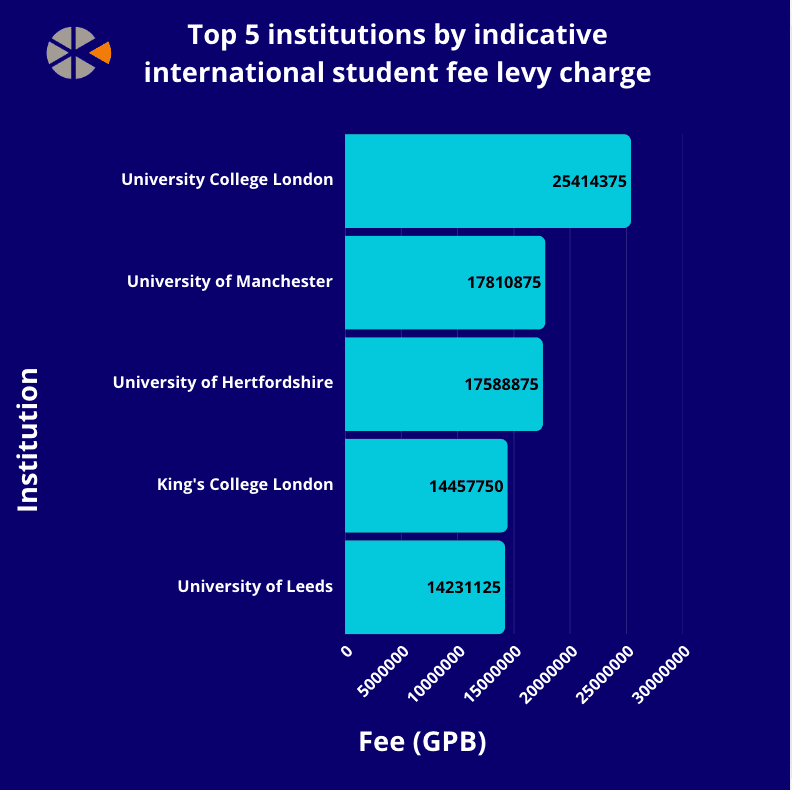
    Here’s our round up of the top five institutions that risk losing out the most.

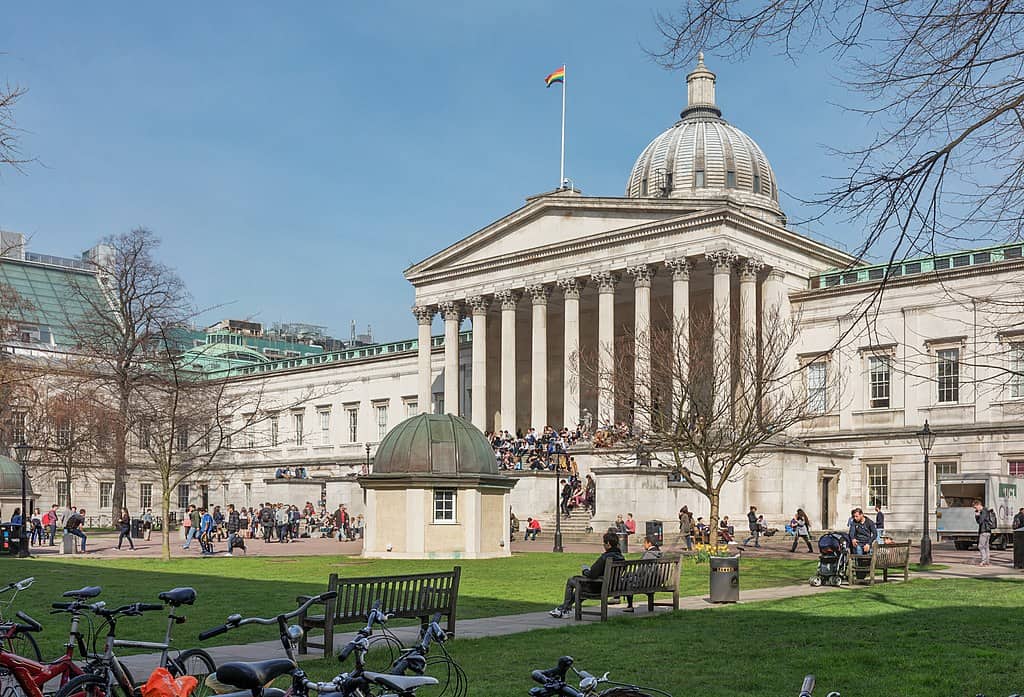
    University College London (UCL)

    Of the 614,000 international students at English institutions in the 2023/24 academic year, UCL was home to the largest amount, at 27,695.

    Under the proposals, if UCL had the same number of international students under the levy, it would be liable to pay over £25 million.

    The University of Manchester

    Coming in second is the University of Manchester, which had 19,475 international students in 2023/24. This would mean it would have to pay almost £18m under the levy proposals.

    The University of Hertfordshire

    In third place is the University of Hertfordshire, with 19,235 international students in 2023/24 – a levy amount of just over £17.5m.

    Kings College London

    Up next is Kings College London, with 15,850 international students, meaning it would be taxed a little under £14.5m

    The University of Leeds

    Another large metropolitan university set to be hit hard by the levy is the University of Leeds, with 15,605 international students. If enrolments numbers stay the same into 2028, it could face costs of over £14.2m.

    Source link

  • Fewer New International Students Enroll at U.S. Colleges Amid Trump Restrictions – The 74

    Fewer New International Students Enroll at U.S. Colleges Amid Trump Restrictions – The 74


    Get stories like this delivered straight to your inbox. Sign up for The 74 Newsletter

    New international students enrolling at U.S. colleges declined sharply this fall, a concerning development for universities that rely on those students for research, tuition revenue and the diversity they bring to campus culture. It could, however, create more space for U.S. residents at those campuses.

    Enrollments of new international students were down 17% compared to fall 2024, according to a report released Monday by the Institute of International Education, which surveyed more than 800 colleges about their fall 2025 enrollments. The institute, a nonprofit organization based in New York, publishes an annual report that examines the enrollment of international students. 

    The fall data was not broken down by state, so the scale of decline in California is unclear. At USC, which enrolls more international students than any other California college, overall enrollment of international students is down 3% this fall, according to a campus spokesperson. That includes returning and first-time students, so the drop could be much higher for new arrivals. USC this fall enrolls about 12,000 international students, or 26% of its total student population, according to the college. About half of those students are from China. 

    The declines come amid a changing landscape for international students under the Trump administration, which has delayed visa processing, created travel restrictions and pressured some campuses to recruit and admit fewer students from other countries. The colleges surveyed this fall by the institute cited visa application concerns and travel restrictions as top factors in the decline. 

    “We are confronting major headwinds with what I would say are poor policy decisions that the administration is taking. And that is creating a climate for international students that signals that you’re not welcome here,” said Fanta Aw, CEO of NAFSA, a nonprofit for international education and exchange.

    President Donald Trump has said that he wants to lower the number of international students at U.S. colleges to leave more room at those campuses for U.S. students. “It’s too much because we have Americans that want to go there and to other places, and they can’t go there,” he said earlier this year, referencing the number of international students at Harvard and other universities.

    For the full 2024-25 academic year, new international student enrollments were down by 7%, driven by a 15% drop among new international graduate students, compared to 2023-24. However, the number of new undergraduates was up by 5%. Trump took office in January, just before the start of the spring semester at most colleges. 

    In the U.S., students from India were the largest group of international students, accounting for 30.8% of all international students, followed by students from China, with 22.6% of enrollments.

    In the 2024-25 academic year in California, the largest share of international students were from China, and they made up 35.4% of enrollments, followed by students from India at 20.9%. Overall enrollment of international students in California was down 1.1% in 2024-25. 

    USC enrolled the most international students of any California university, followed by four University of California campuses: Berkeley, Los Angeles, San Diego and Irvine. According to the report, the total number of enrolled international students were: 12,020 at Berkeley, 10,769 at UCLA, 10,545 at San Diego, and 7,638 at Irvine.

    Across the state, international students make up about 7% of enrollments at four-year colleges, according to the Public Policy Institute of California. They make up a large share of graduate students, accounting for 31% of graduate students at UC campuses, 15% at private nonprofit universities, and 12% at California State University campuses. 

    Freya Vijay, 20, a third-year student from Canada studying business administration at USC, said she always planned to come to the United States for college. 

    “In terms of business and just the economy, you have Wall Street, you have New York, Chicago, L.A., and San Francisco, all these big cities that dominate what’s going on in the world,” she said. “So immediately, in terms of opportunity, my mind was set on the States.” 

    In addition to visa and travel restrictions, the Trump administration has directly requested — or threatened, as some have called it — California campuses to limit enrollments of international students. The administration’s compact offer to USC last month would have forced the university to cap international enrollment at 15% for undergraduates and limit enrollment from any one country to 5%.

    USC has since rejected the compact, which also would have required the university to make a number of other changes, including committing to “transforming or abolishing institutional units that purposefully punish, belittle and even spark violence against conservative ideas.” 

    Separately, in a settlement proposal to UCLA, the Trump administration calls on the campus to ensure that “foreign students likely to engage in anti-Western, anti-American, or antisemitic disruptions or harassment” are not admitted. UCLA is still in negotiations with the administration and has not yet reached a deal. The Trump administration has charged the campus with antisemitism and civil rights violations. 

    Even amid the turmoil, experts say they expect California universities to continue recruiting international students. Julie Posselt, a professor of education at USC’s Rossier School of Education, noted that at research universities, much of the research is being carried out by international graduate students. 

    “Especially in STEM fields, international students are really central to the research functions of universities,” Posselt said. “Enrolling international students is not optional. It is absolutely a part of the fabric of what makes universities great.” 

    On top of that, colleges have financial incentives to enroll international students. That’s especially true at UC campuses, which charge international students and students from other states much higher rates of tuition than California residents. In the 2026-27 academic year, new international and out-of-state undergraduates at UC will pay nearly $52,000 in tuition, more than triple what in-state students will be charged. Nonresidents in graduate programs also generally pay higher rates than residents.

    Facing pressure from the state Legislature to make more room for California residents, UC in 2017 passed a policy to cap nonresident enrollment at 18%, with a higher percentage allowed for campuses that were already above that mark. But the system still gets significant tuition revenue from nonresidents, including international students, which UC says supports the system’s core operations and helps to lower the cost of attendance for California residents.  

    In a Nov. 10 interview with Fox News, Trump seemed to acknowledge the importance of international students, saying colleges might “go out of business” without them.

    “You don’t want to cut half of the people, half of the students from all over the world that are coming into our country — destroy our entire university and college system — I don’t want to do that,” he said. 

    International students also bring diverse perspectives and “a richness to the campus culture,” said Stett Holbrook, a spokesperson for the University of California system. “That’s something we really appreciate and try to cultivate.”

    At USC, the presence of international students from more than 130 countries means there are “innumerable opportunities at USC to encounter different perspectives” and “experience new cultures,” a spokesperson said in a statement. 

    Vijay, the USC student from Canada, said she regularly boasts about USC to friends, adding that she hopes attending remains an option for other international students. 

    “I always think it’s just such a great opportunity and that no international student should ever take it for granted,” she said. “I wish other internationals could experience it.”

    This story was originally published on EdSource.


    Did you use this article in your work?

    We’d love to hear how The 74’s reporting is helping educators, researchers, and policymakers. Tell us how

    Source link

  • Why Prospective Enlistees and Supporters Should Think Twice

    Why Prospective Enlistees and Supporters Should Think Twice

    For many young Americans, the Reserve Officers’ Training Corps (ROTC) or other military‑linked opportunities can look like a ticket to education, steady income, and a chance to “see the world.” But the allure of scholarships, structure, and economic opportunity often hides a deeper reality — one that includes moral danger, personal risk, and long-term uncertainty.

    Recent events underscore this. On November 24, 2025, the United States Department of Defense (DoD) announced it was opening a formal investigation into Mark Kelly — retired Navy captain, former astronaut, and current U.S. Senator — after he appeared in a video alongside other lawmakers urging U.S. troops to disobey “illegal orders.” The DoD’s justification: as a retired officer, Kelly remains subject to the Uniform Code of Military Justice (UCMJ), and the department said his statements may have “interfered with the loyalty, morale, or good order and discipline of the armed forces.”

    This episode is striking not only because of Kelly’s prominence, but because it shows how even after leaving active service, a veteran’s speech and actions can be subject to military law — a stark reminder that joining the military (or training through ROTC) can carry obligations and consequences long after “service” ends.

    Moral, Legal & Personal Risks Behind the Promise

    When you consider military service — through ROTC or otherwise — it’s important to weigh the full scope of what you may be signing up for:

    Potential involvement in illegal or immoral wars: ROTC graduates may eventually be deployed in foreign conflicts — possibly ones controversial or condemned internationally (for example, interventions in places like Venezuela). Participation in such wars raises real moral questions about complicity in human rights abuses, “regime-change,” or other interventions that may lack democratic or legal legitimacy.

    Domestic deployment and policing: Military obligations are increasingly stretching beyond foreign wars. Service members — even reservists — can be called in to deal with domestic “disputes,” civil unrest, or internal security operations. This raises ethical concerns about policing one’s own communities, and potential coercion or suppression of civil and political rights.

    Long-term oversight and limited freedom: The investigation of Senator Kelly shows that veterans and officers remain under DoD jurisdiction even after service ends. That oversight can restrict free speech, dissent, or political engagement. Those seeking to escape economic hardship or limited opportunities may overlook how binding and enduring those obligations can be — even decades later.

    Psychological and bodily danger: Military service often involves exposure to combat, trauma, physical injury — not to mention risks such as sexual assault, racism, sexism, and institutional abuse. Mental health consequences like PTSD are common, and the support systems for dealing with them are widely criticized as inadequate.

    Institutional racism, sexism, and inequality: The military is an institution with historic and ongoing patterns of discrimination — which can exacerbate systemic injustices rather than alleviate them. For individuals coming from marginalized communities, the promise of “a way out” can come with new forms of structural violence, exploitation, or marginalization.

    Career precarity and institutional control: Even after completing education or training, the reality of “limited choices” looms large. Military obligations — contractual, legal, social — can bind individuals long-term, affecting not just their mobility but their agency, conscience, and ability to critique the system.

    Why Economic Incentives Often Mask the Real Costs

    For many, the draw of ROTC is economic: scholarships, stable income, a way out of challenging socioeconomic circumstances, or a ticket out of a hometown with limited opportunity. These incentives are real. But as the recent case with Mark Kelly makes clear, the costs — legal, moral, social — can be far greater and more enduring than advertised. What looks like an escape route can become a lifetime of obligations, constraints, and potential complicity in questionable policies.

    A Call for Caution, Conscience, and Awareness

    Prospective enlistees deserve full transparency. The decision to join ROTC or the military should not be sold merely as an educational contract or a job opportunity — it is an entrance into a deeply entrenched institution, one with power, obligations, and potential for harm. The new controversy around Mark Kelly ought to serve as a wake-up call: if even a decorated former officer and sitting U.S. senator can be threatened decades after service, young people should consider carefully what they may be signing up for.

    If you — or someone you care about — is thinking of joining, ask: What kind of wars might I be asked to fight? What does “service” really cost — and who pays?

    Sources:

    Source link

  • Integrity Bill passes as government vows crackdown on “quick-buck” operators

    Integrity Bill passes as government vows crackdown on “quick-buck” operators

    The Albanese government has passed legislation that it says will strengthen the integrity of the international education sector, despite sector concerns about some elements of the reforms set to impact higher and international education.

    The Education Legislation Amendment (Integrity and Other Measures) Bill 2025 proposes amendments across several key acts within education, including the Education Services for Overseas Students Act (ESOS)

    “With the passing of this legislation, we now have more tools to stop unscrupulous individuals in the international education system trying to make a quick buck,” said education minister Jason Clare.

    In a statement on the Bill’s passing, the federal government chose to highlight some of the changes it is set to bring about, including:

    • Enabling the banning of commissions to education agents for onshore student transfers
    • Requiring most prospective VET providers excluding TAFEs to first deliver courses to domestic students for two years before they can apply to teach overseas students as evidence of their commitment to quality education
    • Cancelling the registration of providers that fail to deliver a course to overseas students for 12 consecutive months to help deal with ‘phoenixing’
    • Giving ministers the power to limit or cancel a providers’ ability to deliver courses where it is in the public interest or there are systemic quality issues

    Education providers will also now require authorisation from TEQSA to deliver Australian degrees offshore. The government described these changes as “light-touch, set transitional arrangements and utilise information that providers already hold”.

    “Australia’s future success requires a focus on quality, integrity and a great student experience. That’s why we’re cracking down on exploitation, increasing transparency, and safeguarding the reputation of our sector,” said Julian Hill, assistant minister for international education.

    We’re cracking down on exploitation, increasing transparency, and safeguarding the reputation of our sector
    Julian Hill, assistant minister for international education

    According to Hill, the changes will “protect genuine students and support high-quality providers”.

    Ministers say the reforms are about “safeguarding” Australia’s reputation as a world leader in education but certain parts of the Bill garnered fierce criticism from the sector. A public call for submissions gathered concerns about changes to the definition of an education agent and whether ministerial intervention powers were appropriately balanced, among other changes.

    The Bill is set to tighten oversight of education agents by broadening the legal definition of who qualifies as an agent and introducing new transparency requirements around commissions and payments.

    Elsewhere, one of the most significant points of concern related to new ministerial powers over provider and course registrations. The Bill would allow the minister to make legislative instruments suspending the processing of applications for provider registration – or registration of new courses – for periods of up to 12 months.

    The new Bill closely mirrors last year’s version but drops the proposed hard cap on international student enrolments that contributed to the earlier Bill’s failure in parliament. Instead, the government is managing new enrolments through its National Planning Level and visa processing directive MD115, rather than legislated limits.

    Source link

  • What does the UK’s Autumn budget mean for international higher education?

    What does the UK’s Autumn budget mean for international higher education?


    Nicholas Cuthbert

    Nick began his career with Nottingham Trent University in the UK working in international student recruitment, before going on to a wide range of leadership and consultancy roles in the private sector. He joined The PIE in 2021 and is a key commentator on the current trends in the global higher education industry. He curates content for our PIE Live conferences and is the co-host of the Tales from the Departure Lounge podcast. Get in touch with Nick at [email protected]


    View all articles by Nicholas

    Source link

  • What the NAEP Proficient Score Really Means for Learning – The 74

    What the NAEP Proficient Score Really Means for Learning – The 74


    Get stories like this delivered straight to your inbox. Sign up for The 74 Newsletter

    In September, The 74 published Robert Pondiscio’s opinion piece discussing how people without strong reading skills lack what it takes “to effectively weigh competing claims” and “can’t reconcile conflicts, judge evidence or detect bias.” He adds, “They may read the words, but they can’t test the arguments.”

    To make his case, Pondiscio relies on the skill level needed to achieve a proficient score or better on National Assessment of Educational Progress, a level that only 30% of tested students reached on 2024’s Grade 8 reading exam. Only 16% of Black students and 19% of Hispanics were proficient or more.

    Yet naysayers argue that the NAEP standard is simply set too high and that NAEP’s sobering messages are inaccurate. There is no crisis, according to these naysayers.

    So, who is right?

    Well, research on testing performance of eighth graders from Kentucky indicates that it’s Pondiscio, not the naysayers, who has the right message about the NAEP proficiency score. And, Kentucky’s data show this holds true not just for NAEP reading, but for NAEP math, as well.

    Kentucky offered a unique study opportunity. Starting in 2006, the Bluegrass State began testing all students in several grades with exams developed by the ACT, Inc. These tests include the ACT college entrance exam, which was administered to all 11th grade public school students, and the EXPLORE test, which was given to all of Kentucky’s public school eighth graders.

    Both the ACT and EXPLORE featured something unusual: “Readiness Benchmark” scores which ACT, Inc. developed by comparing its test scores to actual college freshman grades years later. Students reaching the benchmark scores for reading or math had at least a 75% chance to later earn a “C” or better in related college freshman courses.

    So, how did the comparisons between Kentucky’s benchmark score performance and the NAEP work out?

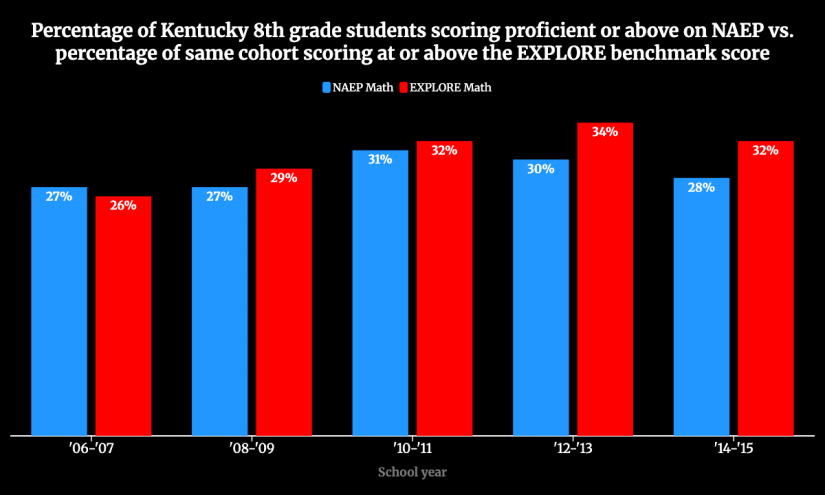
     Analysis found close agreement between the NAEP proficiency rates and the share of the same cohorts of students reaching EXPLORE’s readiness benchmarks. ​

    For example, in Grade 8 reading, EXPLORE benchmark performance and NAEP proficiency rates for the same cohorts of students never varied by more than four percentage points for testing in 2008-09, 2010-11, 2012-13 or 2014-15.

    The same, close agreement was found in the comparison of NAEP grade 8 math proficiency rates to the EXPLORE math benchmark percentages. 

    EXPLORE to NAEP results were also examined separately for white, Black and learning-disabled students. Regardless of the student group, the EXPLORE’s readiness benchmark percentages and NAEP’s proficient or above statistics agreed closely.

    Doing an analysis with Kentucky’s ACT college entrance results test was a bit more challenging because NAEP doesn’t provide state test data for high school grades. However, it is possible to compare each student cohort’s Grade 8 NAEP performance to that cohort’s ACT benchmark score results posted four years later when they graduated from high school. Data for graduating classes in 2017, 2019 and 2021 uniformly show close agreement for overall average scores, as well as for separate student group scores.

    It’s worth noting that all NAEP scores have statistical sampling errors. After those plus and minus errors are considered, the agreements between the NAEP and the EXPLORE and ACT test results look even better.

    The bottom line is: Close agreement between NAEP proficiency rates and ACT benchmark score results for Kentucky suggests that NAEP proficiency levels are highly relevant indicators of critical educational performance. ​Those claiming NAEP’s proficiency standard is set too high are incorrect.

    That leaves us with the realization that overall performance of public school students in Kentucky and nationwide is very concerning. Many students do not have the reading and math skills needed to navigate modern life. Instead of simply rejecting the troubling results of the latest round of NAEP, education leaders need to double down on building key skills among all students.


    Did you use this article in your work?

    We’d love to hear how The 74’s reporting is helping educators, researchers, and policymakers. Tell us how

    Source link

  • When the clock ticks

    When the clock ticks

    I always respond the same: Give me a deadline you feel you can comfortably meet and then I can put it on our publishing calendar. What I don’t want is for the person to give me an early date and then not be able to meet it.

    So, how does a reporter writing a story for News Decoder come up with that deadline? It comes down to “doability”. That means what it says: what you can do, what is feasible. In determining doability, it helps to look at the opposite: Something that isn’t doable.

    Some things are difficult.

    What makes something not doable? The idea for the story is great, but realistically you won’t be able to interview anyone for it. Wouldn’t it be great to do a story on Russian hackers? But do you know any Russian hackers or anyone who knows Russian hackers? What about a story on the wealthy people giving money to political campaigns? Again, do you know anyone or can you realistically reach anyone who would give you information about that?

    In assessing the doability of a story, the first question to ask, then, is where your information will come from. You might not need to know key sources personally, but you need a way to be able to reach them and a reason to feel confident that they will talk to you.

    The second criteria is your financial wherewithal. To find the information, will you need to travel to get it? Do you have the money and time to do that?

    Third, if the subject deals with an uncomfortable subject — sexual assault, race, abortion, religion or suicide, for example — do you have the emotional resolve to be able to ask people difficult questions about their experiences? Not everyone can do that. You need to be honest with yourself about your willingness to tackle such topics.

    Last, what other responsibilities do you have that might interfere? How much time do you have to work on the story? If you have classes to attend or a job, will you only have a few hours here and there? That needs to be part of your calculation on how long it will take you to do the story.

    Many editors want to see these criteria explained when you pitch the story. They want to know that you have a solid plan for getting the information you need and the interviews to humanize the story. They want to know that you also have the wherewithal to do it.

    Be conservative. That means never overpromise. If you think it will take 20 hours to do the story, allow for 30. If you think you will need to spend $100 on travel costs, budget twice that. If you think you can turn in a story by Friday, promise it for the following Wednesday.

    No reporter was ever fired for turning in a solid story early. But if you want more story assignments you need to always, always turn them in when you promise them.


    Questions to consider:

    1. Why are deadlines so important in journalism?

    2. What is one piece of advice the author provides for meeting deadlines?

    3. Did you ever have a deadline that was difficult to meet? How did you handle it?


    Source link

  • Trump vows to “permanently pause” migration from “third world countries”

    Trump vows to “permanently pause” migration from “third world countries”

    The President made the statement in a Thanksgiving post on Truth Social, in which he said the measures would allow the “US system to fully recover”, while vowing to remove anyone who is not an “asset” to the country. 

    Trump said he would end all federal benefits and subsidies to “noncitizens” in the US and deport any foreign national deemed a security risk or deemed to be “non-compatible with Western Civilisation”. 

    His remarks follow the shooting of two National Guard members in Washington DC on November 26, one of whom died the following day. The suspect in the shooting is an Afghan national who is said to have arrived in the US in September 2021. 

    Officials say the accused came to the country legally, under a program that offered immigration protections to Afghanistan nationals who worked with US forces and feared retribution from the Taliban.  

    No details of Trump’s immigration suspension plan or what would be considered a “third world” country have been released, and the State Department did not immediately respond to The PIE News’ request for comment. 

    Trump previously said after Wednesday’s shooting that the attack constituted an “act of terror”, and vowed to remove people “from any country who doesn’t belong here”. 

    Only REVERSE MIGRATION can fully cure this situation

    Donald Trump, US President

    As announced by USCIS director Joseph Edlow on Thursday: “Effective immediately, processing of all immigration requests relating to Afghan nationals is stopped indefinitely pending further review of security and vetting protocols.” 

    In June 2025, the Trump administration imposed an all-out travel ban on 12 nations including Afghanistan, and a partial ban on a further seven, barring the entry of international scholars and students. Only Afghan nationals holding Special Immigration Visas were among the few exceptions to the policy.

    Those holding valid visas before the ban was announced were allowed to remain in the US, and in 2024/25 there were a total of 712 Afghan students studying at US institutions, according to Open Doors data.

    The countries currently impacted by the ban are Afghanistan, Burma, Chad, Republic of the Congo, Equatorial Guinea, Eritrea, Haiti, Iran, Libya, Somalia, Sudan, and Yemen, whose nationals are obstructed from all types of travel to the US including immigrant and nonimmigrant visas.  

    Nationals of Burundi, Cuba, Laos, Sierra Leone, Togo, Turkmenistan, and Venezuela are subject to partial restrictions. 

    “Only REVERSE MIGRATION can fully cure this situation”, Trump continued on Truth Social.  

    His presidency has seen a widespread crackdown on immigration, including the revocation of 80,000 non-immigrant visas, 10% of which were for international students.  

    The administration’s arrests, detentions and attempted deportations of international students for their pro-Palestinian advocacy have drawn widespread condemnation from within the US and globally, with a court ruling them illegal last month.  

    Source link