Category: Featured

  • Canada bears the brunt of ‘big four’ woes

    Canada bears the brunt of ‘big four’ woes

    The study, conducted by ApplyBoard, highlighted the absence of consistent communication around policy shifts in Canada, the US, UK and Australia last year – a persistent issue that it said would likely drive subdued demand across the four in 2026. 

    Although a slowdown in Canada was widely expected, ApplyBoard CEO Meti Basiri said the projected 54% decline in new study permits this year was “stark”, setting Canada on track to issue the lowest total international study visas of the big four in 2025.  

    As per ApplyBoard estimates, Canada will see the sharpest drop in new international students, granting just 80,000 postsecondary study visas this year, while the US and Australia are set to see less dramatic drops.

    The UK – the only ‘big four’ destination without a projected decline – is on track to maintain 2024 study visa issuance levels, in line new Home Office data showing a 7% increase in applications this year, though this could be slightly tempered by pending changes proposed by the immigration white paper.
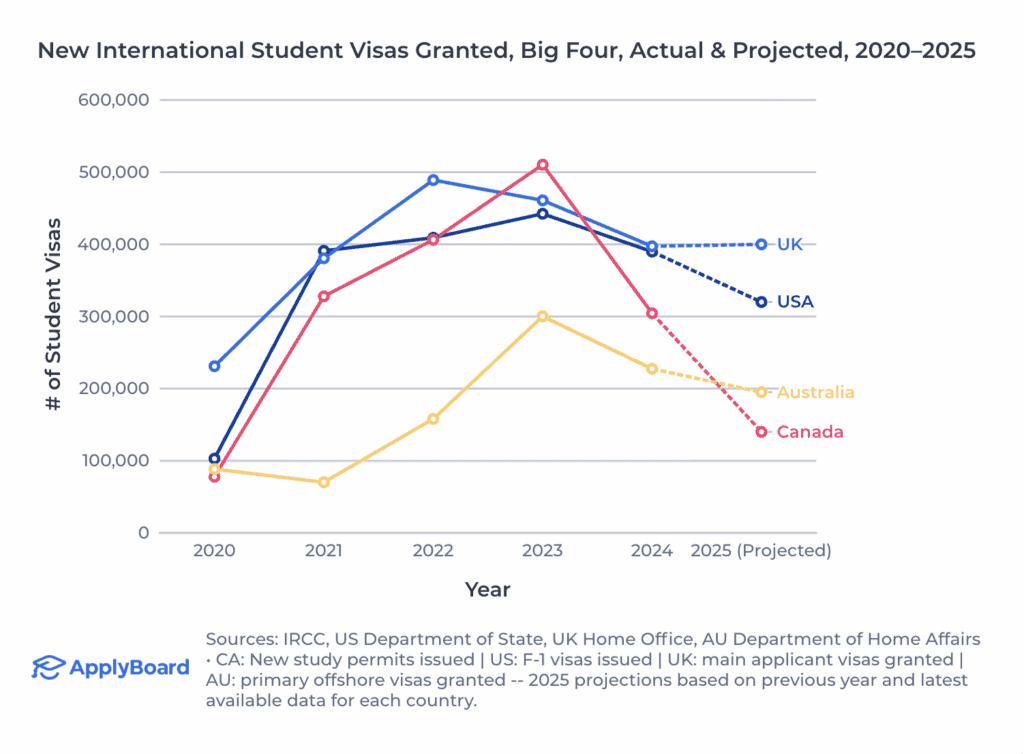
    Source: ApplyBoard.

    Basiri said Canada’s projected 80,000 new study permits would mark the lowest number of post-secondary approvals for the past decade, including during the pandemic. Elsewhere, stakeholders have raised concerns about the country’s plummeting study visa approval rate, which dropped below 40% this year.

    As the government pursues its goal of reducing Canada’s temporary resident population to below 5% by the end of 2027, the sector has been hit with two years of federal policy changes leading to lower application volumes, lower approval rates, and a higher proportion of onshore extensions.

    At the same time, in a recent student survey, Canada scored highly on welcomeness – with roughly 71% of students viewing it as open, safe and welcoming – but it also had one of the highest levels of disagreement for this metric. 

    “That polarisation suggests that international students are picking up on the tension between Canada’s long-standing reputation, and the current reality of caps, more limited work rights, and public debate that often links international students to housing and affordability pressures,” said Basiri.

    The report highlighted the impact of domestic political pressures around housing and net migration causing governments to tighten visa requirements, impose caps, reduce post-study work streams and raise compliance thresholds.  

    However, Basiri said the deciding factor for students increasingly came down to financial considerations, including the cost of study, cost of living and the ability to work during and after their studies.  

    “While political decisions set the rules of the game, affordability is often the filter through which students evaluate those rules – making it the more powerful force driving more students to consider more financially accessible destinations across Europe and the Asia-Pacific region,” he said.  

    “The speed at which alternative destinations are stepping up is remarkable,” Basiri added, highlighting the efforts of Germany, France, Spain, New Zealand, South Korea, and the UAE establishing clearer career pathways and expanding work rights, among other factors to boost internationalisation. 

    The speed at which alternative destinations are stepping up is remarkable

    Meti Basiri, ApplyBoard

    While traditional destinations are experiencing dips in demand, overall international student mobility continues to flourish, with more than 10 million students expected to study outside their home countries by the end of the decade, up from 6.9m in 2024.  

    The emergence of alternative destinations has not gone unnoticed, with another recent report tracking the rise of education “powerhouses” across Asia, fuelled by more English-taught programs, growing job opportunities and affordable study options.  

    Meanwhile, Europe is catching students’ attention, with European countries accounting for eight out of the top 10 destinations – outside the big four, Germany and Ireland – in ApplyBoard’s recent survey of student advisors.

    Basiri identified Germany and Spain as the destinations poised for the most growth next year: “Each offers a strong combination of affordability, workforce alignment, and clear post-study pathways that align with student priorities … Together, they are helping to shape the next wave of student mobility,” he said. 

    The rise of Germany in recent years has been widely reported on across the sector, with international enrolments on track to surpass 400,000 last year. What’s more, two-thirds of Germany’s international students say they intend to stay and work in the country after graduating.  

    Meanwhile, this summer the Spanish government authorised a policy to fast-track international students impacted by US visa restrictions, alongside authorising part-time work for students this academic year.  

    Coupled with previous measures relaxing visa requirements and new work and dependents rights, Spain is becoming “one of the most student-friendly destinations in Europe” said Basiri, noting its heightened appeal among Latin American students due to language and cultural affinities, as well as streamlined routes into the workforce.  

    Source link

  • UK study visa applications up 7% while dependant numbers plummet

    UK study visa applications up 7% while dependant numbers plummet

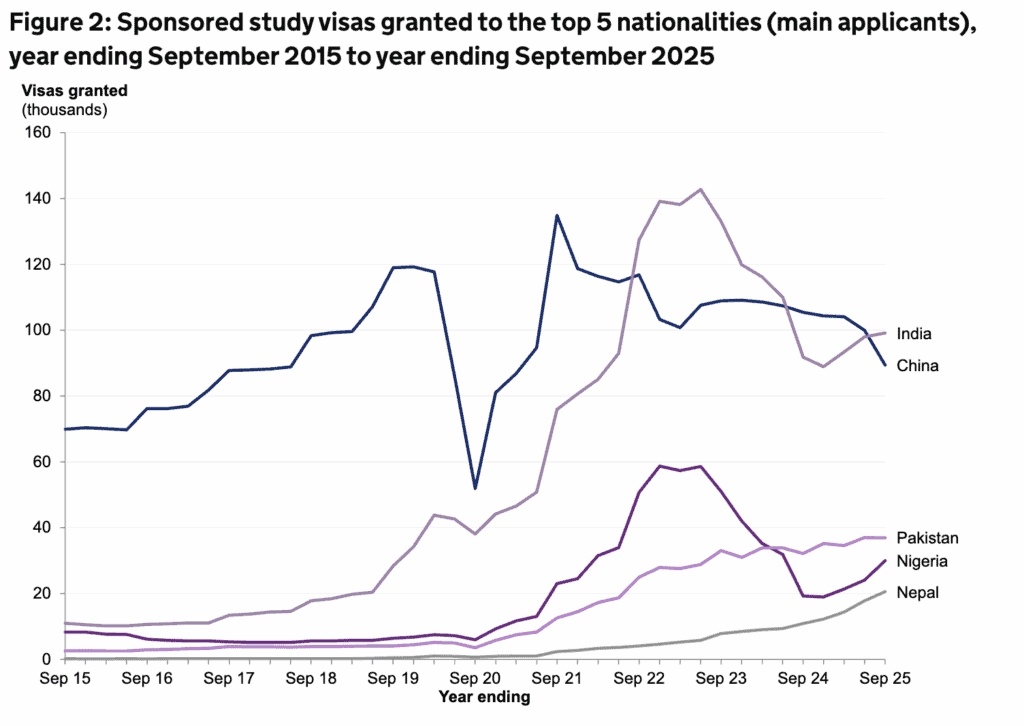
    New Home Office migration statistics show the full effect of an almost outright ban on dependants – with numbers dropping sharply for the second year in a row since the policy was announced.

    While there were 419,558 main applications for UK study visas in the year ending September 2025, marking a 7% increase on the previous year, there were 20,366 dependants – a 57% decrease year on year.

    It marks the second consecutive year of falling dependants, with this number decreasing annually by a whopping 87% in the year ending September 2024.

    It follows new rules introduced in January 2024 to ban students on postgraduate-taught programs from bringing their dependants with them to the UK.

    The number of UK study visas issued to international students and their dependants rose sharply after 2016 – reaching a post-Covid peak of 652,072 in 2023. Now, since the dependants ban, the number of study visas issued has fallen to 439,924.

    According to the Home Office, there has been roughly one dependant for every 20 main study visa applicants since the year ending March 2025 – a stark decline since the year ending September 2023, when this number stood at six per 20 main applicants.

    Source: Home Office

    Indian students were issued the most sponsored study visas in the year ending September 2025, with 99,18 visas issued. Chinese students made up the second biggest cohort – with 89,397 visas issued, 15% fewer than the previous year.

    Pakistani students were the third biggest group – issued 39,924 study visas, while there were gains for Nepali students (up 89% to 20,572) and Nigerian students (up 56% to 30,009).

    According to James Pitman, chairman of Independent Higher Education (IHE) and CEO of Studygroup, the effect of the dependants ban has been discriminatory – disproportionately affecting women.

    Speaking in a personal capacity at yesterday’s IHE annual conference, Pitman acknowledged that the dependants visa has “a major flaw”, but said that this could have been corrected rather than withdrawing the scheme entirely for taught degrees.

    “As predicted by the sector, that withdrawal was gender discriminatory, leading to the loss of 19,000 female students vs prior year in the January 2024 intake alone,” he said. “Every one of those was a human story, of ambitions denied, families fractured, careers restricted and yet again women being discriminated against – in this case by UK government policy.”

    Every one of those was a human story, of ambitions denied, families fractured, careers restricted and yet again women being discriminated against
    James Pitman

    Home Office figures obtained by Pitman via a freedom of information request show a marked year-on-year decline in women issued sponsored study visa grants for courses at RQF level 6-8 or equivalent starting in January.

    In 2023, of 81,079 total student visas, 45% were issued to women, compared to 55% that were issued to men. But the following year, after the dependants ban was brought in, the gender split was 66% in favour of men. These numbers stayed stable in 2025, the data showed, with 65% of sponsored study visas issued to men.

    Source link

  • Podcast: Budget, R&D, Scotland’s tertiary bill

    Podcast: Budget, R&D, Scotland’s tertiary bill

    This week on the podcast we examine how Budget 2025 reshapes the university funding model – from the international levy and modest new maintenance grants, to confirmed tuition fee uplifts and changes to pension tax arrangements that will affect institutional costs.

    We discuss what the package tells us about the government’s approach to public finances, the politics of international recruitment, and the sustainability of cross-subsidy in a tight fiscal environment for higher education.

    Plus we discuss research and innovation announcements and get across debate in Holyrood on the Tertiary Education and Training (Funding and Governance) (Scotland) Bill.

    With Ken Sloan, Vice-Chancellor and CEO at Harper Adams University, Debbie McVitty, Editor at Wonkhe, David Kernohan, Deputy Editor at Wonkhe and presented by Jim Dickinson, Associate Editor at Wonkhe.

    On the site:

    Budget 2025 for universities and students

    Universities now need to be much clearer about the total cost of a course

    Student finance changes in the budget – Director’s cut

    Reclassification ghosts and jam tomorrow at stage 2 of Scotland’s tertiary bill

    A government running out of road still sets the economic weather for higher education

    A change in approach means research may never be the same again

    You can subscribe to the podcast on Apple Podcasts, YouTube Music, Spotify, Acast, Amazon Music, Deezer, RadioPublic, Podchaser, Castbox, Player FM, Stitcher, TuneIn, Luminary or via your favourite app with the RSS feed.

    Source link

  • What Football Can Tell Us About How to Teach Reading – The 74

    What Football Can Tell Us About How to Teach Reading – The 74


    Get stories like this delivered straight to your inbox. Sign up for The 74 Newsletter

    When I go to my son’s football games, I can tell you which team will win — most of the time — just by watching them warm up. It’s not necessarily having the flashiest uniforms or the biggest player; it’s about the discipline, the focus and the precision of their routines.

    A school is no different.

    In my Texas school district, I can walk into a classroom and, in the first five minutes, tell you if effective reading instruction is happening. I don’t need to see the lesson plan or even look at the teacher. I just need to look at the kids. Are they engaged? Are they in a routine? Are they getting the “reps” they need?

    For too long, districts have been losing the game before it starts. They buy a new playbook (i.e., a curriculum) as a “hail Mary,” hoping for a fourth-quarter miracle. Still, they ignore the fundamentals, practice and team culture required for sustainable success.

    Chapel Hill Independent School District is committed to educating all children to compete in an ever-changing world. To that end, we’ve made literacy a nonnegotiable priority across all campuses. We anchor our approach in research-based practices and a culture of continuous learning for both students and staff.

    We’re building for the long run: a literacy dynasty. But our literacy success hasn’t come without putting in the work. We have a relentless focus on the fundamentals and, most importantly, a culture where every player — every teacher and administrator — fits our system.

    Trust the Analytics, Not Your Gut

    In reading instruction, we can’t make assumptions; all instruction has to start with the fundamentals. For decades, instruction was based on gut feelings, like an old-school coach deciding whether to go for it on fourth down or punt based on a hunch. But today, the best coaches trust the analytics, not their gut. They watch the game film.

    Chapel Hill is an analytics district; we do our research. And our game film is the science of reading.

    Many years ago, we started using structured literacy for a small group of students with dyslexia. It worked so well that we asked ourselves: If structured literacy is effective for a small group of students with dyslexia, shouldn’t it be essential for all students?

    We didn’t just adopt a new curriculum; we redesigned our literacy infrastructure — from structured literacy professional development for every teacher to classroom coaching and a robust tiered system of support to ensure no student falls through the cracks.

    That logic is our offensive strategy. It’s why we use tools like the Sold a Story podcast to show our staff why we’ve banned the strategies of a bygone era, like three-cueing. We have to be willing to reprogram the brain to align with what research proves works. But having the right playbook is only half the battle.

    A great playbook is useless without the right team to execute it.

    This is the most crucial part: “First who, then what.” In the NFL draft, teams don’t always draft the most talented player available. They conduct interviews and personality assessments and ultimately draft the player who best fits their system—the cultural fit.

    Tom Brady is arguably the greatest quarterback of all time, but he couldn’t run a read-option offense, which requires a fast, running quarterback. He wouldn’t fit the system, and the team would fail. But put Brady in a play-action offense, sit back and watch the magic happen.

    We operate the same way. When we interview, we’re not just looking for a teacher with excellent credentials and experience; we’re looking for a “Chapel Hill Way” teacher. It’s a specific profile: someone who believes in our philosophy of systematic, explicit, research-based instruction.

    This culture starts with our team captains: our campus principals. We need them to believe in our playbook, not just buy in because the district office said so. We invest in their development so they can champion literacy daily, monitor instruction and ensure every classroom executes our playbook with fidelity. It’s their conviction that turns a curriculum on a shelf into a living, breathing part of our culture.

    Talented teams win games. Disciplined, team-first organizations build dynasties.

    Building a dynasty requires sacrifice. When an educator joins our team, whether they’re a rookie or a seasoned veteran, we ask them to let go of the “I’ve always done it this way” mindset. That’s the equivalent of a player prioritizing their personal stats over a team win.

    It’s a team-first mindset. It’s about a willingness to put personal preference aside to build a championship team. For Chapel Hill ISD, our championship is ensuring every child learns to read.

    Our team-first philosophy has translated into measurable results: Across campuses, students are gaining the foundational skills they need, and data shows growth for every subgroup, including students with dyslexia and multilingual learners. We want students to become a product of our expectations, rather than their environment. Our district, which serves a diverse population, including a high percentage of students classified as low socioeconomic status, consistently scores above the state average in third-grade reading.

    At Wise Elementary, our largest campus[MOU1] , 56% of third graders met grade-level standards, and 23% scored above grade level on the 2023-2024 STARR assessment. And we had similar results across the district.

    So to my fellow education leaders: Before you shop for a new playbook, ensure you have the right team culture in place. Define your culture. Draft the right players. Build your team. Coach your captains. And obsess over the fundamentals.

    That’s how you win.


    Did you use this article in your work?

    We’d love to hear how The 74’s reporting is helping educators, researchers, and policymakers. Tell us how

    Source link

  • A partnership across the Atlantic to inform the world

    A partnership across the Atlantic to inform the world

    Preety Sharma is a public health and development consultant currently based in Northern India, near the border with Nepal. She is also a News Decoder correspondent, one of dozens who came to News Decoder through a journalism fellowship at the Dalla Lana School of Public Health at the University of Toronto.

    For more than five years, the University of Toronto and News Decoder have partnered to help train health professionals in journalism, with the goal of meeting this need: Too much disinformation in the world about important health issues and too much factual information presented to the public in articles that are difficult to read.

    Under the program, mid-career professionals spend a year in journalism training at the University of Toronto and as part of the program, pitch stories to professional news organizations. But to get published, the articles must meet the strict standards of each news organization that accepts the story pitches.

    To publish on News Decoder, for example, the stories must be written in way that is accessible to young people and to those who read English as a foreign language. This is challenging for many professional journalists. The stories must also have a global angle and show how the problems in the stories play out in different parts of the world.

    Sharma’s first story for News Decoder was on how a relatively inexpensive food product made from algae could be the solution to ending world hunger. Another story she wrote, on the problem of plastics in children’s toys, became News Decoder’s most-read story of all time.

    “My first couple of stories were with News Decoder,” Sharma said. “I am glad to have had an opportunity to share it with a diverse and young audience globally.”

    Sharma is now a News Decoder correspondent, someone who writes periodically for the site.

    Bringing specialized knowledge to journalism

    Marcy Burstiner, News Decoder’s educational news director, has worked with Sharma on all her stories and thinks the Dalla Lana program and its partnership with News Decoder is unique and important. “When I taught university journalism, I often told science majors that they should consider going into journalism,” she said. “There are a thousand medical publications but they are not written with a general audience in mind and meanwhile most journalists lack the specialized knowledge to really understand and put into context what is happening in medicine and the hard sciences.”

    For News Decoder, this problem is particularly important, she said. “Health and science are two subjects that young people are hungry for information on and that’s our target audience,” Burstiner said. “But, because so much of the information is dense, they turn to sites on the internet that present pseudo science and they can’t tell the difference.”

    Sharma agrees. “In the age of fake news and social media information explosion, it is crucial to have a credible and trusted media outlet that can present complex issues, ideas and concepts to youth in a simple and educational style,” she said.

    News Decoder Founder Nelson Graves said that the partnership between the University of Toronto and News Decoder was a win-win proposition from the start. “Fellows at the Dalla Lana School of Public Health have a chance to publish stories examining some of the world’s most pressing issues on our global platform,” he said. “They benefit from editing by journalists with deep international experience.”

    The students in News Decoder’s global community and readers around the globe also benefit from the fellows’ reporting and insights, he said and that helps to maintain News Decoder’s breadth and depth.

    “News Decoder’s association with the University of Toronto encapsulates our nonprofit’s commitment to global citizenship and to fostering connections across borders and between generations,” Graves said.

    Connecting with young people

    Correspondent Norma Hilton also came to News Decoder through the University of Toronto’s fellowship in global journalism. Her first story was on K-Pop and social media influencers, a topic that’s important to News Decoder’s teen audience. Hilton said it was a great learning experience. “I’d never really written for a youth audience or taken more of an education angle to my stories before,” she said. “So, it was great to understand what young people want to hear about and write for them.”

    Hilton is also one of many University of Toronto fellows who have not only written stories for News Decoder, but become an integral part of the News Decoder team. She participated in workshops and cross-border roundtables with students and produced articles and videos that serve as journalism tutorials on such things as how to cover events, how to fact-check articles and how to cover traumatic situations.

    “I’ve never really thought I’d be on a panel of any kind, but being able to talk about my journalism experience and hopefully help younger people be interested in journalism and its power, has been the honour of a lifetime,” Hilton said.

    News Decoder Managing Director Maria Krasinski argued that the partnership with the University of Toronto is unique. “Neither of our organisations is a traditional journalism school,” she said. “Rather, we both recognize that learning journalism skills helps people, no matter their discipline or profession, communicate clearly and with impact.”

    She said that, for the students News Decoder works with, journalism is an entry point, a way to take action and engage with the issues affecting their communities and participate meaningfully in civic dialogue. “Young people discover that journalism isn’t just writing stories, it’s about learning to question, to listen and to make sense of the world,” she said.

    For the University of Toronto fellows, meanwhile, the journalism fellowship adds a powerful new skill to their already impressive toolkits. “It helps them translate their knowledge and expertise into stories that resonate beyond academic and industry circles,” Krasinski said. “Many of the fellows stay connected to News Decoder well after their fellowship ends. They are based all over the world and bring a diversity of perspectives and experience that enriches our news platform.”

    Source link

  • Higher Education’s Long Reckoning With Indigenous Oppression

    Higher Education’s Long Reckoning With Indigenous Oppression

    [Editor’s note: United American Indians of New England host the National Day of Mourning. Their website is at United American Indians of New England – UAINE.]

    Each November, while much of the United States celebrates Thanksgiving, Indigenous communities and their allies gather in Plymouth, Massachusetts, and across the country for the National Day of Mourning. It is a day that confronts the mythology of national innocence and replaces it with historical clarity. For Higher Education Inquirer, the significance of this day extends directly into the heart of American higher education—a system built, in no small part, on the expropriation of Indigenous land, the exploitation of Native Peoples, and the continued structural racism that shapes their educational opportunities today.

    From the earliest colonial colleges to the flagship research institutions of the twenty-first century, U.S. higher education has never been separate from the project of settler colonialism. It has been one of its instruments.

    Land, Wealth, and the Origins of the University

    America’s oldest colleges—Harvard, Yale, William & Mary, Dartmouth—were founded within the colonial order that dispossessed Indigenous communities. While missionary language framed some of these institutions’ early purposes, they operated through an extractive logic: the seizure of land, the conversion of cultural worlds, and, eventually, the accumulation of immense academic wealth.

    The Morrill Land-Grant Acts of 1862 and 1890 expanded this pattern on a national scale. Recent research documented by the “Land-Grab Universities” project shows that nearly eleven million acres of Indigenous land—taken through coercive treaties, forced removal, or outright theft—were funneled into endowments for public universities. Students today walk across campuses financed by displacements their own institutions have yet to fully acknowledge, let alone remedy.

    Higher Education as an Arm of Assimilation

    The United States also used education as a tool for forced assimilation. The Indian boarding school system, with the Carlisle Industrial School as its model, operated in partnership with federal officials, church agencies, and academic institutions. Native children were taken from their families, stripped of their languages, and subjected to relentless cultural destruction.

    Universities contributed research, training, and personnel to this system, embedding the logic of “civilizing” Indigenous Peoples into the academy’s structure. That legacy endures in curricula that minimize Indigenous knowledge systems and in institutional cultures that prize Eurocentric epistemologies as default.

    Scientific Racism, Anthropology, and the Theft of Ancestors

    American universities played a central role in producing scientific racism. Anthropologists and medical researchers collected Indigenous remains, objects, and sacred items without consent. Museums and university labs became repositories for thousands of ancestors—often obtained through grave robberies, military campaigns, or opportunistic scholarship.

    The 1990 Native American Graves Protection and Repatriation Act (NAGPRA) was designed to force institutions to return ancestors and cultural patrimony. Yet decades later, many universities are still out of compliance, delaying repatriation while continuing to benefit from the research collections they amassed through violence.

    Contemporary Structural Racism in Higher Education

    The oppression is not confined to history. Structural racism continues to constrain Native Peoples in higher education today.

    Native students remain among the most underrepresented and under-supported groups on American campuses. Chronic underfunding of Tribal Colleges and Universities (TCUs) reflects a broader political disregard for Indigenous sovereignty and self-determination. Meanwhile, elite institutions recruit Native students for marketing purposes while failing to invest in retention, community support, or Indigenous faculty hiring.

    Some universities have begun implementing land acknowledgments, but these symbolic gestures have little impact when institutions refuse to confront their material obligations: returning land, committing long-term funding to Indigenous programs, or restructuring governance to include tribal representatives.

    What a Real Reckoning Would Require

    A genuine response to the National Day of Mourning would require far more than statements of solidarity. It would involve confronting the ways American higher education continues to profit from dispossession and the ways Native students continue to bear disproportionate burdens—from tuition to cultural isolation to the racist violence that still occurs on and around campuses.

    Real accountability would include:

    • Full compliance with NAGPRA and expedited repatriation.

    • Transparent reporting of land-grant wealth and the return or shared governance of those lands.

    • Stable, meaningful funding for TCUs.

    • Hiring, tenure, and research policies that center Indigenous scholarship and sovereignty.

    • Long-term institutional commitments—financial, curricular, and political—to Indigenous communities.

    These steps require institutions to shift from performative recognition to structural transformation.

    A Day of Mourning—And a Call to Action

    The National Day of Mourning is not merely a counter-holiday. It is a reminder that the United States was founded on violence against Native Peoples—and that its colleges and universities were not passive beneficiaries but active participants in that violence.

    For higher education leaders, faculty, and students, the question is no longer whether these histories are real or whether they matter. They are documented. They are ongoing. They matter profoundly.

    The real question is what institutions are willing to give up—land, power, wealth, or narrative control—to support Indigenous liberation.

    On this National Day of Mourning, HEI honors the truth that Indigenous survival is an act of resistance, and Indigenous sovereignty is not a symbolic aspiration but an overdue demand. The future of higher education must move through that truth, not around it.

    Sources

    Roxanne Dunbar-Ortiz, An Indigenous Peoples’ History of the United States.

    The Land-Grab Universities Project (High Country News & Land-Grab Universities database).

    David Treuer, The Heartbeat of Wounded Knee.

    Margaret D. Jacobs, A Generation Removed: The Fostering and Adoption of Indigenous Children in the Postwar World.

    NAGPRA regulations and compliance reports.

    Source link

  • Students must intentionally develop durable skills to thrive in an AI-dominated world

    Students must intentionally develop durable skills to thrive in an AI-dominated world

    Key points:

    As AI increasingly automates technical tasks across industries, students’ long-term career success will rely less on technical skills alone and more on durable skills or professional skills, often referred to as soft skills. These include empathy, resilience, collaboration, and ethical reasoning–skills that machines can’t replicate.

    This critical need is outlined in Future-Proofing Students: Professional Skills in the Age of AI, a new report from Acuity Insights. Drawing on a broad body of academic and market research, the report provides an analysis of how institutions can better prepare students with the professional skills most critical in an AI-driven world.

    Key findings from the report:

    • 75 percent of long-term job success is attributed to professional skills, not technical expertise.
    • Over 25 percent of executives say they won’t hire recent graduates due to lack of durable skills.
    • COVID-19 disrupted professional skill development, leaving many students underprepared for collaboration, communication, and professional norms.
    • Eight essential durable skills must be intentionally developed for students to thrive in an AI-driven workplace.

    “Technical skills may open the door, but it’s human skills like empathy and resilience that endure over time and lead to a fruitful and rewarding career,” says Matt Holland, CEO at Acuity Insights. “As AI reshapes the workforce, it has become critical for higher education to take the lead in preparing students with these skills that will define their long-term success.”

    The eight critical durable skills include:

    • Empathy
    • Teamwork
    • Communication
    • Motivation
    • Resilience
    • Ethical reasoning
    • Problem solving
    • Self-awareness

    These competencies don’t expire with technology–they grow stronger over time, helping graduates adapt, lead, and thrive in an AI-driven world.

    The report also outlines practical strategies for institutions, including assessing non-academic skills at admissions using Situational Judgment Tests (SJTs), and shares recommendations on embedding professional skills development throughout curricula and forming partnerships that bridge AI literacy with interpersonal and ethical reasoning.

    Latest posts by eSchool Media Contributors (see all)

    Source link

  • From detection to development: how universities are ethically embedding AI-for-learning

    From detection to development: how universities are ethically embedding AI-for-learning

    Author:
    Mike Larsen

    Published:

    • HEPI Director Nick Hillman’s verdict on the Budget can be found on the Times Higher website here.
    • Today’s blog was kindly authored by Mike Larsen, Chief Executive Officer at Studiosity, a HEPI Partner.

    The future of UK higher education rests upon the assurance of student learning outcomes. While GenAI presents the sector with immense opportunities for advancement and efficiency, the sector is constrained by an anachronistic model of plagiarism detection rooted in adversarialism. I believe the ‘Police and Punish’ model must now be replaced by ‘Support and Validate’.

    A reliance upon detection was perhaps once a necessary evil but it has never aligned with the fundamental values of higher education. The assumption that policing student behaviour is the only way to safeguard standards no longer applies.

    Such a punitive policy model has become increasingly untenable, consuming valuable university resources in unviable investigations and distracting from universities’ core mission. I believe there is a compelling alternative.

    As assessment methods undergo necessary change, higher education institutions must consciously evaluate the risks inherent in abandoning proven means of developing durable critical thinking and communication skills, such as academic writing. New learning and assessment methodologies are required but must be embraced via evidence and concurrently protect the core promise of higher education.

    An emerging policy framework for consideration and research is ‘support and validate’ which pairs timely, evidence-based academic support with student self-validation of authorship and learning.

    Building capability, confidence and competence provides the ideal preparation for graduates to embrace current and future technology in both the workplace and society.

    The combination of established and immediate academic writing feedback systems with advanced authorship and learning validation capabilities creates a robust and multi-layered solution capable of ensuring quality at scale.

    This is an approach built upon detecting learning, not cheating. Higher education leaders may recognise this integrated approach empowers learners and unburdens educators, without compromising quality. It ensures the capabilities uniquely developed by higher education, now needed more than ever, are extended and amplified rather than replaced by techno-solutionism.

    We must build a future where assessment security explicitly prioritises learning, not policing. For UK higher education, a pivot from punishment to capability-building and validation may be the only sustainable way to safeguard the value of the degree qualification.

    Studiosity’s AI-for-Learning platform scales student success at hundreds of universities across five continents, with research-backed evidence of impact. Studiosity has recently acquired Norvalid, a world leader in tech-enabled student self-validation of authorship and authentic learning, shifting how higher education approaches assessment security and learning.


    Source link

  • 5 cheat sheets for parents of preschoolers

    5 cheat sheets for parents of preschoolers

    by Jackie Mader, The Hechinger Report
    November 27, 2025

    When my oldest child was a 2-year-old, we relocated to a new state and I found myself back at square one with my search for child care. In my new city, I now had a very good problem: There was an abundance of programs with availability, and I had a choice of where to enroll my son. As I toured a half-dozen of them, however, I worried that even as an early childhood reporter, I wasn’t asking the right questions or paying attention to the right thing. 

    A few months later, our early childhood team at Hechinger launched a project digging into the elements of a high-quality preschool. That article and the corresponding video became a quick and easy guide as I looked at options for my second child. It’s what I sent to friends who asked me for advice while navigating their own searches. 

    While I love telling stories from the field, my colleagues and I are also passionate about providing helpful tools and guides for teachers and caregivers. Here are a few of my favorite early ed “cheat sheets” from our decade of reporting on early childhood.

    1.  The five elements of a good preschool: What should you look for when you step inside a preschool classroom? What clues can you find on the walls or bookshelves? What questions should you ask teachers and school administrators? This video and article break it down. While classrooms and programs will vary by setting, many of these elements, like the way teachers talk to children and an emphasis on play, apply everywhere.

    2. Cracking down on unsafe sleep products: As an anxious new parent, nothing scared me more than hearing about infant deaths due to unsafe sleep products. Still, when desperate and exhausted, I tried several items that I heard would help my babies sleep, including some that the American Academy of Pediatrics later discouraged in updated safe sleep guidelines in 2022. While reporting this article, I was stunned by the lack of evidence and oversight of products that many parents like myself believe are tested before they are available to buy.

    3. How to boost math skills by talking about math with your kids: Most parents know how important it is to read to children. But did you know that there are easy ways caregivers can develop math skills? Earlier this year, my colleague Jill Barshay looked at a wave of research from the past dozen years on simple things adults can do to lay an early foundation in math. 

    4. How to answer tough questions about race and racism with your children: Research shows racial stereotypes start early, and that’s why it’s important to talk to young children about different races and read books and offer toys that have diverse characters. Many parents feel ill equipped for these conversations, however. In 2020, I asked three experts how they would respond to real questions from young kids about race and racism so adults feel better prepared for the questions that children inevitably ask.

    5. How parents can support their kids with play: With all the challenges of being a parent, it can be hard to hear there’s yet another thing we should be doing. But this 2023 conversation with researcher Charlotte Anne Wright helped me reframe the way I think about play and my role in it with my own children. While it’s important to give children opportunities for free play, Wright’s research shows “guided play,” or play with a learning goal in mind and light support from a parent, can have benefits for children, too. It’s not as heavy of a lift as it sounds, and Wright provides simple ways parents can engage in playful learning with their children on bus rides and trips to the laundromat.

    This story about preschoolers was produced by The Hechinger Report, a nonprofit, independent news organization focused on inequality and innovation in education. Sign up for the Hechinger newsletter.

    This <a target=”_blank” href=”https://hechingerreport.org/5-cheat-sheets-for-parents-of-preschoolers/”>article</a> first appeared on <a target=”_blank” href=”https://hechingerreport.org”>The Hechinger Report</a> and is republished here under a <a target=”_blank” href=”https://creativecommons.org/licenses/by-nc-nd/4.0/”>Creative Commons Attribution-NonCommercial-NoDerivatives 4.0 International License</a>.<img src=”https://i0.wp.com/hechingerreport.org/wp-content/uploads/2018/06/cropped-favicon.jpg?fit=150%2C150&amp;ssl=1″ style=”width:1em;height:1em;margin-left:10px;”>

    <img id=”republication-tracker-tool-source” src=”https://hechingerreport.org/?republication-pixel=true&post=113560&amp;ga4=G-03KPHXDF3H” style=”width:1px;height:1px;”><script> PARSELY = { autotrack: false, onload: function() { PARSELY.beacon.trackPageView({ url: “https://hechingerreport.org/5-cheat-sheets-for-parents-of-preschoolers/”, urlref: window.location.href }); } } </script> <script id=”parsely-cfg” src=”//cdn.parsely.com/keys/hechingerreport.org/p.js”></script>

    Source link