Category: Featured

  • Iowa board reworks anti-DEI course policy proposal following pushback

    Iowa board reworks anti-DEI course policy proposal following pushback

    This audio is auto-generated. Please let us know if you have feedback.

    Dive Brief:

    • The Iowa Board of Regents has removed references to “critical race theory” and “diversity, equity and inclusion” from a controversial proposal to limit what courses the state’s three public universities can require. The regents plan to vote on the issue during a special meeting on Tuesday.
    • Under the original proposal, academic programs would not have been able to require students to take classes containing “substantial content that conveys DEI or CRT.” Universities that wanted an exemption would have had to gain board approval every other year.
    • Following public pushback, the board reworked the proposal to state that “faculty may teach controversial subjects” when relevant to course content, but they are expected to “present coursework in a way that reflects the range of scholarly views and ongoing debate in the field.” The revision also leaves the board the option to “periodically” review the universities’ compliance.

    Dive Insight:

    The Iowa Board of Regents — which oversees the University of Iowa, Iowa State University and the University of Northern Iowa — has so far delayed the vote on the proposal twice, last postponing the decision at its July 30 meeting. 

    The original language included extensive examples of DEI topics that would have been restricted, including anti-racism, “transgender ideology,” systemic oppression, and unconscious or implicit bias.

    “One of the primary reasons we are not taking up the DEI/CRT policy is that the discussions on how to best implement the ideas that were brought forward are still ongoing,” Board President Sherry Bates said in prepared remarks, citing responses from the community. “It has become clear that we would be better served by something more comprehensive.”

    Much of the local response has been negative.

    Five Iowa educator advocacy groups joined together to form the Iowa Higher Education Coalition to oppose the policy and launched a petition “to urge the Iowa Board of Regents to firmly reject efforts to restrict what students can learn.” The petition, which does not address the updated policy, had garnered 470 signatures as of Friday afternoon.

    The faculty union at the University of Northern Iowa, one of the members of the coalition, voiced opposition at the board’s June meeting, when it was first scheduled to vote on the proposal.

    “There is no middle position, no position of slight appeasement,” United Faculty President Christopher Martin told board members at the meeting. “Either you stand for free expression at Iowa’s universities or you don’t. And God help Iowa, its public universities and all the citizens of this state if you don’t.”

    Martin said that the proposal came from two out-of-state think tanks’  generic recommendations, and he alleged that it runs contrary to state law.

    Since that meeting, the board has reworked the language significantly.

    “University teachers shall be entitled to academic freedom in the classroom in discussing the teachers’ course subject, but shall not introduce into the teaching controversial matters that have no relation to the subject,” the updated version said.

    Regardless of how the board votes next week, the Iowa Legislature may step in.

    State Rep. Taylor Collins, chair of the Legislature’s newly created Higher Education Committee and an avid opponent of DEI efforts, voiced support for the board’s original policy proposal last month.

    “If this policy is not adopted, the House Committee on Higher Education stands ready to act,” he said on social media after the board delayed a vote on the policy for the second time.

    Iowa Gov. Kim Reynolds signed a bill in May 2024 that prohibits public universities from maintaining or funding DEI offices or from officially weighing in on a wide array of issues. The list includes allyship, cultural appropriation, systemic oppression, social justice, racial privilege or “any related formulation” of the listed topics. 

    The law prompted PEN America, a free expression advocacy group, to include Iowa on its yearly list of states that enacted “educational gag orders.”

    The board of regents has also moved to limit diversity work on campus. In 2023, it ordered the universities under its purview to cut all campuswide DEI efforts not required to comply with the law or accreditation standards.
    Source link

  • Stanford’s student newspaper sues President Trump

    Stanford’s student newspaper sues President Trump

    The Stanford Daily has filed a federal lawsuit against former President Donald Trump, marking a bold legal move from one of the country’s most prominent student newspapers. Editors at the Daily argue that Trump-era immigration policies targeting international students for political speech violated constitutional protections and created a climate of fear on campus.

    This legal action arrives during a moment of institutional turmoil at Stanford. Just days before the lawsuit was filed, university officials announced layoffs of more than 360 staff members, following $140 million in budget cuts. Administrators cited federal funding reductions and a steep endowment tax—legacies of Trump’s policies—as major factors behind the financial strain.

    Student journalists now find themselves confronting the same administration that reshaped higher education financing, gutted transparency, and targeted dissent. Their lawsuit challenges the chilling effect of visa threats against noncitizen students, particularly those who criticize U.S. or Israeli policy. Two international students joined the case anonymously, citing fear of deportation for expressing political views.

    Stanford holds one of the largest university endowments in the world, valued between $37 and $40 billion. Despite this immense wealth, hundreds of staff—including research support, technical workers, and student service roles—face termination. The disconnect between administrative austerity and executive influence speaks to a larger crisis in higher education governance.

    The Daily’s lawsuit cuts to the core of that crisis. Student reporters are asking not only for legal accountability, but also for transparency around how universities respond to political pressure—and who gets silenced in the process.

    HEI’s Commitment to Student-Led Accountability

    The Higher Education Inquirer is elevating this story as part of an ongoing effort to highlight courageous journalism from student-run newsrooms. Editorial boards like The Stanford Daily’s are producing investigative work that professional media often overlook. These journalists aren’t waiting for permission. They’re filing FOIA requests, confronting billion-dollar institutions, and—when necessary—taking their cases to court.

    HEI will continue amplifying these efforts. Student reporters are already reshaping the media conversation around academic freedom, labor justice, and the political economy of higher education. Their work deserves broader attention and support.

    Sources:

    Source link

  • Revisiting The Goose-Step for 2026

    Revisiting The Goose-Step for 2026

     “It is difficult to get a man to understand something, when his salary depends upon his not understanding it.”

    —Upton Sinclair

    Purpose

    This proposal seeks modest support to research and write a new book in the spirit of Upton Sinclair’s 1923 exposé The Goose-Step: A Study of American Education, a biting critique of higher education’s corruption and corporate control. The revised and updated work—tentatively titled The Goose-Step Revisited: The College Meltdown and the Future of American Higher Ed—will document the present crisis of U.S. higher education from the ground up: on campuses, in classrooms, in communities, and in conversations with students, workers, adjuncts, administrators, and those left behind.

    This is not a detached academic exercise. It is a journalistic and moral investigation into a failing system. Like Sinclair, we will name names. But we will also listen carefully to those who are rarely heard—especially debtors, dropouts, whistleblowers, and exploited faculty.

    Scope

    The project will include:

    Travel across the U.S. to visit a diverse array of colleges: from collapsing for-profits and underfunded regional publics to elite private institutions and community colleges on the brink.

    Field interviews with stakeholders in higher education, including:

    Adjuncts and contingent faculty

    Debt-burdened students and recent grads

    College workers and unions

    Policy experts and whistleblowers

    Administrators, where access is permitted

    Archival research and use of public data (IPEDS, College Scorecard, OPE, etc.)

    Photographs and dispatches for the Higher Education Inquirer along the way

    A final book manuscript, synthesizing travel writing, investigative reporting, data analysis, and historical reflection.

    Questions the Book Will Explore

    How does the current College Meltdown resemble or diverge from the problems Sinclair exposed in 1923?

    What does higher education actually provide today—for whom, and at what cost?

    How have corporatization, finance capital, and political ideology reshaped American colleges?

    Is reform still possible—or are we watching the managed decline of an unsustainable system?

    Budget and Support Needed

    This is a modest request, commensurate with the ethos of the Higher Education Inquirer. A stripped-down, independent operation. Key needs:

    Travel and lodging across the U.S. (preferably via Amtrak, bus, or car)

    Minimal tech support (phone, laptop, data storage)

    Small editorial stipend for fact-checking, manuscript preparation

    Crowdfunding, foundation support, or collaboration with independent media outlets may supplement this request.

    Why Now?

    The signs are everywhere.

    Colleges closing.

    Debt rising.

    Adjuncts starving.

    Truth distorted.

    Labor crushed.

    Meanwhile, the gatekeepers of knowledge—like those in Sinclair’s time—are too often complicit, compromised, or silent.

    This book is not intended to speak for anyone. It aims to amplify those whose stories have been buried beneath bureaucracy and branding.  It’s A Modest Proposal for a not-so-modest truth: American higher education is in a manufactured crisis. But from this so-called collapse, a more just and democratic vision might emerge—if we’re willing to listen, document, and act.

    This is a proposal to walk the ruins, record the voices, and revive the fierce spirit of Upton Sinclair.

    Source link

  • North Carolina Launches Expanded Direct Admission Program for 62,000 High School Seniors

    North Carolina Launches Expanded Direct Admission Program for 62,000 High School Seniors

    North Carolina is taking bold steps to democratize college access with the expansion of its NC College Connect program, which will offer direct admission to more than 62,000 public high school seniors this fall. The initiative represents a significant shift toward equity-focused admissions practices that prioritize accessibility over traditional application barriers.

    The program targets students who complete their junior year with a weighted GPA of 2.8 or higher. By eliminating the often overwhelming application process, NC College Connect removes financial and procedural obstacles that disproportionately affect first-generation college students and those from underrepresented communities.

    “NC College Connect represents a fundamental shift in how we approach college admissions in North Carolina,” said Peter Hans, President of the University of North Carolina System. The initiative reflects growing national recognition that traditional admissions processes can perpetuate educational inequities.

    Maurice “Mo” Green, State Superintendent of Public Instruction, praised the collaborative nature of the effort.

    “When our entire education community works together like this, students win. NC College Connect removes barriers and creates clear pathways to college for thousands of our students,” he said.

    The program’s inclusive design addresses systemic challenges that have historically limited college access for students from diverse backgrounds. By providing direct admission letters and eliminating complex application requirements, the initiative particularly benefits students who might otherwise be deterred by navigating multiple institutional processes.

    Participating institutions span the full spectrum of North Carolina’s higher education landscape, including UNC System universities, independent colleges and universities, and community colleges. This comprehensive approach ensures students have pathways to various types of post-secondary education that align with their academic goals and financial circumstances.

    Dr. Jeff Cox, President of the North Carolina Community College System, highlighted the program’s potential to transform access to affordable education. 

    “By removing barriers and simplifying the process, we’re helping more students access the life-changing opportunities our community colleges provide—close to home and at a price they can afford,” he said.

    Community colleges have long served as crucial entry points for students from diverse socioeconomic backgrounds, offering both career preparation and transfer pathways to four-year institutions. The inclusion of community colleges in NC College Connect recognizes their vital role in democratizing higher education access.

    The program’s commitment to equity extends beyond admissions to address affordability concerns through targeted financial aid initiatives. The Next NC Scholarship and NC Need-Based Scholarship specifically support students from households earning $80,000 or less, covering tuition and fees at participating institutions.

    Additionally, students attending Elizabeth City State University, Fayetteville State University, University of North Carolina at Pembroke, and Western Carolina University benefit from the NC Promise plan’s $500 per semester tuition rate. These historically Black institutions and regional universities serve particularly diverse student populations, making the affordable tuition structure especially impactful for underrepresented students.

    Hope Williams, President of North Carolina Independent Colleges and Universities, noted the unique value proposition of smaller institutions: the personalized attention and specialized programs that can be particularly beneficial for students who might struggle in larger university environments.

    The program builds on a successful pilot year that served more than 70,000 students, demonstrating the demand for streamlined college access. The expansion indicates that initial outcomes validated the approach’s effectiveness in connecting students with higher education opportunities.

    Students can verify their eligibility through the NCCollegeConnect.com portal or by consulting with high school counselors, ensuring multiple touchpoints for information and support. Eligible seniors will receive official admission letters this fall for the 2026-27 academic year, providing ample time for planning and preparation.

    NC College Connect positions North Carolina as a leader in reimagining college admissions to prioritize access and equity. As higher education institutions nationwide grapple with declining enrollment and questions about traditional admissions practices, North Carolina’s comprehensive approach offers a replicable model for other states.

    The initiative’s success will likely be measured not just in enrollment numbers, but in its ability to diversify the state’s college-going population and create pathways for students who might otherwise forego higher education. By removing procedural barriers and addressing financial constraints, NC College Connect represents a holistic approach to educational equity that extends well beyond the admissions office.


    Source link

  • The Problem with Capitulating to Fascism in Higher Education

    The Problem with Capitulating to Fascism in Higher Education

    Higher education serves different purposes for different people. For some, it represents transformation and expanded horizons. For others, it remains a site of oppression—a place where white supremacy and anti-Blackness flourish while administrations proclaim commitments to diversity even as their actions contradict these stated values. The commitments to diversity, equity, and inclusion (DEI) have long been performative at most predominantly white institutions (PWIs). Now, institutions no longer need to maintain even this pretense.

    Dr. Frederick Engram JrThe current presidential administration has made anti-Black, anti-immigrant, anti-LGBTQ+, and anti-women policies central to its agenda. We are not approaching fascism—we are immersed in it. The fundamental problem with higher education and liberal politics more broadly is that while we all recognized the warning signs, no substantive preventative measures were taken to counter the impending assault.

    When the previous Trump administration targeted K-12 education—falsely claiming that critical race theory was being taught in elementary schools and suspending administrators in states like Texas—higher education watched passively, believing itself safe from similar attacks. Instead of mounting resistance and uniting against authoritarian overreach, higher education capitulated. Institutions cancelled classes and programs designed to educate students about historical injustices, prioritizing the comfort of white students and families while disregarding everyone else.

    As Professor Emeritus Dr. John R. Thelin documents in his seminal work A History of American Higher Education, the system was designed from its inception to serve wealthy, white, cisgender, able-bodied men. Higher education was never intended to include marginalized people of color or women. The argument that white men are now being excluded from spaces where they have always been centered would be absurd if it weren’t so dangerous.

    Anti-discrimination DEI initiatives became necessary precisely because white men were not voluntarily making space for others—supported by white women who were themselves fighting for inclusion. The notion that white men feel excluded from higher education reflects a false sense of entitlement and the sting of having their mediocrity exposed. This wounded sense of supremacy drives them to destroy institutions rather than share them.

    Fascism is not approaching—it has arrived.

    The targeted attacks on Harvard, UCLA, University of Pennsylvania, minority-serving institutions (MSIs), and historically Black colleges and universities (HBCUs) are rooted in anti-Black rhetoric that was explicitly outlined in Project 2025. This blueprint seeks to create a dystopian America where marginalized voices are silenced and governance is built around white anxieties and grievances.

    The worst possible response from higher education institutions is capitulation. Instead of forming coalitions, deploying legal resources, and mobilizing their extensive alumni networks, institutions are either confronting this administration in isolation or retreating into silence. Someone should inform higher education that fascism doesn’t reward compliance. It seeks total destruction and will not protect those who failed to oppose it simply because they remained quiet.

    Our institutions and academic disciplines face existential threats. Regardless of how compliant we choose to be, when the destruction is complete, nothing will remain standing. We cannot measure progressive politics by white comfort levels, nor should white feelings determine whether we defend the most vulnerable among us.

    Understanding liberation and resistance in this moment requires recognizing that active opposition is our only viable option. Millions have died, millions are dying, and millions more await death—all to satisfy the bloodlust of mediocre leaders drunk on power. Our resistance must be meaningful and sustained.

    What purpose will silence serve when we lose everything anyway?

    The time for half-measures and performative gestures has passed. Higher education must choose between principled resistance and institutional suicide. The stakes could not be higher, and history will judge our response.

    _________

    Dr. Frederick Engram Jr. is an assistant professor of higher education at at Fairleigh Dickinson University.

    Source link

  • BRENDAN L. JOHNSON | Diverse: Issues In Higher Education

    BRENDAN L. JOHNSON | Diverse: Issues In Higher Education

    Dr. Brendan L. JohnsonBrendan L. Johnson has been appointed as the new Director of Bands at Benedict College, where he will lead all ensembles, including the nationally recognized Benedict College Band of Distinction (BCBOD). Johnson brings a decade of transformative leadership from Darlington High School, where he served as Director of Bands. During his tenure, he grew the program from 75 to 225 members, making it one of the largest high school bands in South Carolina. He was selected for the Benedict role following an extensive nationwide search for elite musicians and conductors. 

    A dual graduate of Bethune-Cookman University, Johnson holds bachelor’s degrees in music education and liberal studies. While at Bethune-Cookman, he made history a the third Mr. Bethune-Cookman University. He later earned a master’s in education from Anderson University, and a Doctorate from the University of Southern Mississippi.

    Source link

  • the start of recovery or another false dawn?

    the start of recovery or another false dawn?

    Last week’s The PIE Live Asia Pacific event on the Gold Coast brought sector leaders together to ask a hard question: do recent announcements signal the start of broad recovery (for both the currently blessed AND the inexplicably damned) – or another false dawn? Hardly had delegates returned to their desks when a long-awaited government announcement landed in inboxes, setting fresh expectations.

    For those outside Australia, here’s a quick refresher: it’s been 454 days since the government first revealed plans to cap international student numbers. Four days ago, officials announced an increased National Planning Level – often referred to as a “soft cap” – for 2026.

    The intervening period included a federal election marked by damaging narratives: international students labelled as “cash cows”, unfairly blamed for systemic issues; education agents painted as “racketeers”; and fierce competition stoked between education sectors, sometimes even across providers. This turmoil has sown confusion and undermined confidence in Australia as a study destination.

    It’s important to remember Australia is far from alone in navigating complex policy shifts; as IEAA’s Phil Honeywood recently observed, “optimism [in Australia] is partly a reflection of the poor state of the sector in other study destination countries: the US, Canada and increasingly the UK.” 

    Yet, despite this turbulence, interest in Australia remains high. At the aggregate, student numbers appear stable – but the reality is far more uneven. Vocational education and training (VET) and English language (ELICOS) programs have seen sharp declines, forcing several established providers to close their doors. Higher education enrolments remain buoyed largely by Chinese students enrolling in leading public universities along the eastern seaboard, but this dynamic intensifies issues around market concentration. 

    Outside these major players, regional universities and independent higher education providers alike generally recognise the government’s current visa management tool – Ministerial Direction (MD) 111 is “less bad” than its predecessor MD107, though that’s hardly high praise. Crucially, MD111 has not yet been tested through a cycle which includes the major intake of the antipodean year – and neither will it now be given its own imminent replacement.

    Although replaced, the impacts of MD107 are still felt – many prospective students clearly understood the implications of those policy settings. That, irrespective of their preferred provider (whether university, independent higher education or other), their assured route to Australia study was via a public university with opportunities for transfer to their intended provider once onshore. This has created a secondary market onshore – one much larger and more nuanced than under normal policy settings. 

    Recruiting onshore presented a viable pathway to survival for providers unable to recruit with confidence offshore given de-prioritisation and subjective visa refusals (courtesy of MD107 and its partner MD106). However, it has also created a sizable opportunity for unethical behaviour and poaching by other bad actors.

    This week’s announcement of increased “National Planning Levels” for 2026 is a positive signal, but it falls short of providing certainty to many, especially independent VET and ELICOS providers still facing precarious futures. Crucially, many key elements remain unresolved, including the replacement of MD111 and the anticipated reintroduction of amendments to the Education Services for Overseas Students (ESOS) Bill.

    These frameworks will include determination as to who is considered “an agent”, for which students commissions may be paid, what powers the Minister holds over providers (including the unfettered personal ability to cancel a provider’s license outside regulatory oversight), and rules around student transfers onshore — all issues that directly affect providers and, ultimately, the students they serve.

    Many in the sector do genuinely welcome the headline increase in the 2026 caps as a sign of clearer direction and potential stability.  The planning underpinning the 2026 caps and exemptions is detailed and generally coherent – rectifying many of the deficiencies of the previous approaches (both the proposed legislation and then last-minute instrument in December). 

    Whilst some allocation numbers are yet to be finalised, the Department has indicated that the methodology for public universities remains a similar approach as 2025 (a holistic consideration of student volumes across 2019 to 2023) – although with the new ability to apply for a greater allocation if there is strategic engagement with South East Asia and/or there is adequate provision of student accommodation. The operations and “bidding process” for these extra places is awaited – although it’ll happen rapidly if the Department delivers on its intent to confirm final allocations by October.

    However, the much-criticised approach for allocation to independent providers continues into 2026 – where the formula perversely rewards providers who recruited en masse in 2023, regardless of studentsatisfaction and outcomes, institutional risk ratings or whether the student was poached from another provider with no visa process oversight.

    This is a particularly disappointing outcome for many quality providers. Some of the most egregious behaviours committed by bad actors and permitted by deficient policies continue unfettered whilst quality providers are penalised for continuing sound and ethical practices.

    The 2026 cap announcement is a welcome step, but it’s far from the journey’s end. It will mean little without swift clarity on ESOS amendments, visa policy reform, and the first tests of the 2026 planning levels. As well as the obvious headline figures, Australia’s critical KPIs includes the diversity and distribution of students (across geographies and providers), the linking of exceptional student outcomes and ethical provider behaviours to opportunities for growth and creating the enabling environment for a rich ecosystem of providers to co-exist.

    Australia’s choice is clear: act decisively now to rebuild trust offshore, or risk being remembered not for recovery, but for squandering a once-unrivalled position in the global student market.

    Source link

  • Integrating AI into education is not as daunting as it seems

    Integrating AI into education is not as daunting as it seems

    Key points:

    Forty-some years ago, students sat in straight rows with books, papers, and pencils neatly lined up on their desks. But beginning in the 1990s, educators faced very different classrooms as computers found their way into schools.

    For most teachers, it felt daunting to figure out how to integrate new tools into curriculum requirements–and how to find the time to make it happen. To help this digital transformation then, I joined the South Dakota Department of Education to lead summer immersion teacher training on technology integration, traveling the state to help schools understand how to use new tools like video systems. I was one of many who helped educators overcome that initial learning curve–and now tools like computers are an integral part of the education system.

    Let’s face it: The advent of new technologies can be overwhelming. Adjusting to them takes time. Now, with the coming of age of AI, teachers, administrators, students, and parents have endless questions and ideas on how it might positively or negatively influence education. I’ve seen it in my current role, in which I continue to empower educators and states to use modern technology to support student learning. And while concerns about AI are valid, there are many positive potential outcomes. For educators in particular, AI can be a huge value-add, automating certain administrative tasks, helping understand and predict student success and struggles, and even helping tailor instruction for individual students.

    The upside is huge. As schools embark on their AI journeys, it’s important to remember that we’ve been here before–from the introduction of the internet in classrooms to the abrupt shift to e-learning at the outset of COVID-19. Superintendents, boards of education, and other education leaders can draw on important lessons from prior technological transformations to fully take advantage of this one.

    Here are some rules of the road for navigating the integration of disruptive technologies:

    1. Choose the right tools. The AI tool(s) you choose can have varying results. School districts should prioritize proven technologies with a track record in education. For students, this includes adaptive learning platforms or virtual tutors. Some of the best tools are those that are specifically designed by and for educators to expedite administrative tasks such as grading and lesson planning. Even more valuable is the ability to support education-specific issues such as identifying struggling students with early warning systems and using AI to provide projections for student futures.

      2. Training is everything. With proper training, AI can be less intimidating. We don’t expect students to understand a new concept by reading a few paragraphs in a textbook, and we shouldn’t expect teachers to figure out how to best use AI on their own. President Trump’s recent executive order prioritizes the use of AI in discretionary grant programs for teacher training, which is an important step in the right direction.

      3. Engage parents. Moms and dads may be concerned if they hear–without a deeper explanation–that a school board is rolling out an AI tool to help with teaching or administrative tasks in their children’s education. Keep an open line of communication with the guardians of students about how and why AI is being used. Point parents to resources to help them improve their own AI literacy. To a reasonable degree, invite feedback. This two-way communication helps build trust, allay fears and clarify any misconceptions, to the benefit of everyone involved, including, most importantly, the students.

      4. Humans must be involved. The stakes are high. AI is not perfect. Administrators must ensure they and the educators using AI tools are double checking the work. In the parlance of responsible AI, this is known as having a “human in the loop,” and it’s especially important when the outcomes involve children’s futures. This important backstop instills confidence in the parents, students and educators.

      5. Regularly evaluate if the tools are living up to expectations. The point of integrating AI into teachers’ and administrators’ workstreams is to lighten their load so they can spend more time and energy on students. Over time, AI models can decay and bias can be introduced, reducing the effectiveness of AI outputs. So, regular monitoring and evaluating is important. Educators and administrators should regularly check in to determine if the integration of AI is supporting their goals.

      6. The learning curve may create more work at first–but the payoff is exponential. Early adoption is important. I worked with school districts that pushed off integrating digital technologies–ultimately, it put the educators behind their peers. AI can make a difference in educators’ lives by freeing them up from administrative burdens to focus on what really matters–the students.

      This is the start of a journey–one that I believe is truly exciting! It’s not the first nor the last time educators adopt new technologies. Don’t let AI overwhelm or distract you from tried-and-true integration techniques. Yes, the technology is different–but educators are always adapting, and it will be the same with AI, to the benefit of educators and students.

      Latest posts by eSchool Media Contributors (see all)

    Source link

  • 4 tips to support the literacy needs of middle and high school students

    4 tips to support the literacy needs of middle and high school students

    Key points:

    Today’s middle schoolers continue to struggle post-pandemic to read and write at the level needed to successfully navigate more complex academic content in the upper grades and beyond, according to a new report from NWEA, a K-12 assessment and research organization.

    Based on NWEA’s research, current 8th graders would need close to a full academic year of additional instruction to catch up to their pre-pandemic peers in reading. This trend was reiterated in recent assessment results from the National Assessment on Educational Progress (NAEP), with only 30 percent of eighth-grade students performing at or above the NAEP proficient level.

    While early literacy initiatives have garnered attention in recent years, the fact remains that many students struggle to read and are not prepared for the rigors of middle school. Students quickly find themselves challenged to keep up as they no longer receive explicit, structured reading instruction, even as they are expected to comprehend increasingly complex materials across subjects, like science, history, or English Language Arts.

    The report, Policy recommendations for addressing the middle school reading crisis, is co-authored by Miah Daughtery, EdD, NWEA VP of Academic Advocacy at HMH (NWEA’s parent company), and Chad Aldeman, founder of Read Not Guess.

    “Our current middle and high schoolers were just starting their literacy journey when the pandemic hit, and we cannot lessen the urgency to support them. But, middle school literacy is complex even for students who are reading on grade level. This demands intentional, well-funded, and focused policy leadership that includes support across the K-12 spectrum,” said Daughtery. “Simply put, learning to read is not done when a student exits elementary school; support cannot stop there either.”

    Policymakers and district leaders must adopt a systems-level approach that supports both early learners and the unique literacy needs of middle and high school students.

    The new report provides four components that can be leveraged to make this happen:

    1. Use high-quality, grade-appropriate assessments that provide specific data on the literacy needs of middle schoolers.
    2. Look at flexible scheduling and policies that promote literacy development throughout the entire school day and help districts more effectively use instructional time.
    3. Understand and support the unique literacy needs of middle schoolers across subjects and disciplines from a systems perspective and invest in teacher professional learning in all disciplines, including at the upper grades, within state and district literacy plans.
    4. Curate relationships with external partners, like community organizations and nonprofits, who share similar goals in improving literacy outcomes, and can both support and reinforce literacy development, stretching beyond the school’s hours and resources.
    eSchool News Staff
    Latest posts by eSchool News Staff (see all)

    Source link

  • Why this New Jersey school requires parents to volunteer

    Why this New Jersey school requires parents to volunteer

    This audio is auto-generated. Please let us know if you have feedback.

    At LEAP Academy University School — a K-12 public charter school in Camden, N.J. — parents are required to volunteer at the school for 40 hours over the academic year. 

    School officials say volunteer engagement builds strong home-school connections and helps LEAP — which stands for Leadership, Education and Partnership — better understand and respond to parents’ needs. Parents, meanwhile, say volunteering gives them more voice and authority in school activities and helps build trust among the school community.

    “The child sees that the parent trusts the school, and the parent is learning from the school and getting resources from the school,” says Cheree Coleman, a parent of rising 8th and 9th graders. “So now the student looks at the school like, ‘This is family. This is a place that I can go if I can’t get help from my parents or, you know, other resources.’ It’s stability.”

    The school works with families to try to ensure the 40-hour requirement is not burdensome. Maria Cruz, director of LEAP’s Parent Engagement Center, says school leaders work with each family to find ways for them to help out within their own schedules or situations. Students’ relatives can also contribute to the families’ volunteer hours.

    Volunteer hours can be gained by participating in any event at the 1,560-student school, including reading to students, planning special events, fundraising, attending parent workshops, serving on committees, sending emails to school groups, or any other activity that supports school efforts.

    Cruz adds that while the school tracks the volunteer hours, no student would lose their spot if their family failed to meet the 40 hours. 

    “We work with them” to fill the hours, Cruz says. “We don’t tell them that the volunteer hours are mandatory. The word ‘mandatory’ is kind of like a negative term for them, so we don’t use it. We talk to them, let them know that the reason why we’re doing the volunteer hours is so they can be engaged in the school.”

    The school, founded in 1997, has a long history of parent engagement, says Stephanie Weaver-Rogers, LEAP’s chief operation officer. “We opened based on parent needs so parents have always been integral and we are very focused on having parents involved in every aspect of the school.”

    A room full of adults and a few children are sitting on chairs and at tables looking at a speaker.

    Parents attend a workshop on special education topics at LEAP Academy University School in Camden, N.J. in May 2025.

    Permission granted by LEAP Academy University School


    Educating students and parents

    In addition to volunteering, the school engages parents through workshops specifically for them. Held weekly at the school, these optional parent workshops offer learning on a variety of topics and skills, such as homeownership, English language, employment, nutrition and technology.

    Along with the free classes, parents get dinner, child care and parking also at no charge, Cruz says. She and other school staff work to recruit experts in the community — including other parents — to lead the classes.

    The skills-based classes help parents “move forward” in their lives “and also help them better themselves for their children,” Weaver-Rogers says.

    To further parent engagement efforts, the school encourages parents to apply for open positions, but Cruz noted that hires are made based on skills, experience and job fit. Currently, approximately 10-15% of LEAP staff are parents of current or former students. 

    Having parents on staff has several benefits, Weaver-Rogers said. It can give parents “a step up economically.” Plus, students behave better knowing their parents or their friends’ parents are in the building.

    “It’s an all-around win,” Weaver-Rogers says.

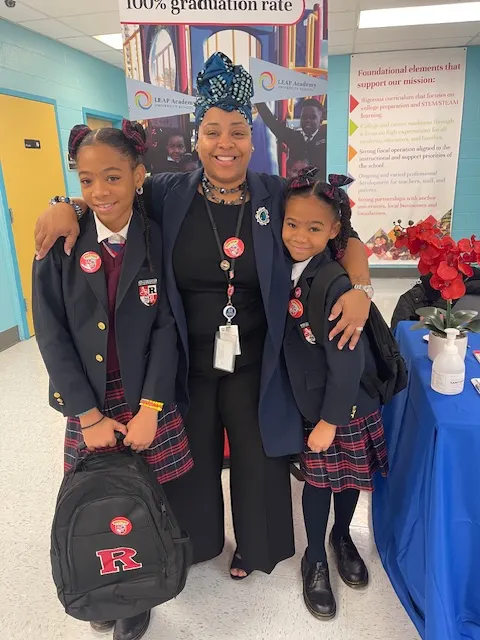
    An adult stands with two students in a school hallway. Everyone is looking at the camera

    Cheree Coleman and her daughters Cy’Lah Coleman (left) and Ca’Layla Coleman attend a school ceremony on May 29, 2024, at LEAP Academy University School in Camden, N.J.

    Permission granted by Cheree Coleman


    Coleman, who worked at the school as a parent ambassador for three years, adds, “What I love the most when it comes to the parent engagement with LEAP Academy is the fact that they don’t just educate the student, they educate the parents as well.”

    Being engaged in the community

    The home-school connections at LEAP don’t end at graduation. The school, which has four buildings within two blocks, makes efforts to stay in touch with and support alumni through job awareness efforts, networking opportunities and resources for struggling families.

    Coleman says LEAP staff and families have also supported students and families in need at other schools in the community. 

    The school opens its doors to the public for certain school events and celebrations — for instance, with community organizations and government service providers setting up information tables, Cruz says.

    Hector Nieves, a member of the school’s board of trustees and chair of the parent affairs committee, says parents are encouraged to bring friends, neighbors and family to some school get-togethers, especially those held outside to accommodate larger crowds. “We have music. We have all kinds of games for the kids. There’s dancing,” he says. 

    Cruz added that this “all are welcome” approach helps the school recruit new students, too.

    Four young students in school uniforms are holding plastic bags and looking at the camera. They are standing in front of a table with items.

    The whole school community participates in LEAP Academy University School’s holiday fundraiser, last held Dec. 5-14, 2024, at the school in Camden, N.J.

    Permission granted by LEAP Academy University School


    Additionally, LEAP’s partnership with Rutgers University provides support to families for their children from birth through postsecondary education. LEAP is located along Camden’s “Education Corridor,” which includes campuses for Rutgers University-Camden and Rowan University. Both Rutgers and Rowan provide dual enrollment, early college access and other learning opportunities for LEAP students.

    Nieves, who had three children graduate from LEAP — including one who now teaches English at the school — says the holistic approach of serving students and families has empowered the school community over the years and helped families improve their financial situations.

    “I believe that somehow, whether they came and worked here, we gave them classes, we helped them along, all of a sudden, I see this growth,” says Nieves. “I believe we had a lot to do with that.”

    Source link