Category: Featured

  • After DOJ Sues, Okla. Ends In-State Tuition for Noncitizens

    After DOJ Sues, Okla. Ends In-State Tuition for Noncitizens

    The U.S. Department of Justice sued the state of Oklahoma Tuesday over a state law that allows undocumented students to pay in-state tuition rates. Oklahoma is now the fourth state the DOJ has sued for having such a policy.

    The state’s Republican attorney general, Gentner Drummond, swiftly sided with the federal government and filed a joint motion in support of quashing the law. He said in a statement that it’s “discriminatory and unlawful” to offer noncitizens lower in-state tuition rates “that are not made available to out-of-state Americans.”

    “Today marks the end of a longstanding exploitation of Oklahoma taxpayers, who for many years have subsidized colleges and universities as they provide unlawful benefits to illegal immigrants in the form of in-state tuition,” Drummond said.

    Now the state and the DOJ await a ruling from the U.S. District Court for the Eastern District of Oklahoma.

    Oklahoma’s quick support for the legal challenge is reminiscent of what happened in Texas when the DOJ sued the state in June: Within hours of the lawsuit, Texas sided with the Justice Department and a judge ruled in favor of a permanent injunction, ending in-state tuition for noncitizens. The DOJ then filed similar lawsuits against Kentucky and Minnesota, though those legal fights are still ongoing.

    The lawsuits follow an executive order issued by President Donald Trump in April calling for a crackdown on so-called sanctuary cities and state laws unlawfully “favoring aliens over any groups of American citizens,” citing in-state tuition benefits for noncitizens as an example.

    Source link

  • Commercial speech and the First Amendment

    Commercial speech and the First Amendment

    Imagine the government forcing you to label your
    all-natural milk product as “imitation.”

    Florida tried to make one dairy farm do just that,
    sparking a First Amendment question: Where’s the line between a
    business’s right to speak and protecting consumers from
    deception?

    In this episode, we explore how far free speech
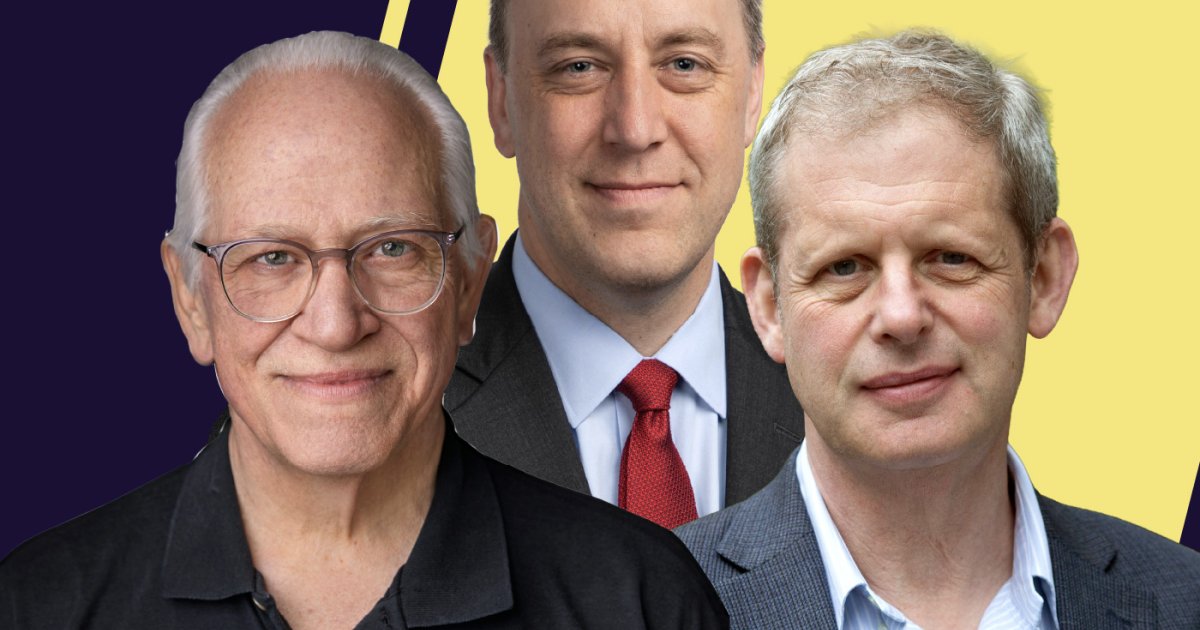
    protections go for commercial speech with:

    Timestamps:

    00:00 Intro

    05:03 What exactly is commercial speech?

    08:25 The evolution of commercial speech law

    13:59 Early regulation of commercial speech

    23:03 What is false or misleading commercial
    speech?

    26:04 Controversial regulations of non-misleading
    commercial speech

    37:35 Future of commercial speech regulations

    Read the transcript:
    https://www.thefire.org/research-learn/so-speak-podcast-transcript-state-commercial-speech

    Coming up: Live episode of So To Speak

    On Monday, August 11th at 4 p.m. Eastern Time, Nico
    will be speaking with former Treasury Secretary/Harvard University
    president,
    Larry Summers
    , and FIRE President/CEO,
    Greg Lukianoff
    . They will discuss the Trump
    administration’s campaign against elite universities, including
    Harvard, what outcomes we can expect from that campaign, and what
    those outcomes might mean for free speech, academic freedom, and
    university independence.

    Register for the livestream here:
    https://thefire-org.zoom.us/webinar/register/5817544039734/WN_AISudjopTvu2Yzk2pXkDYg
    .

    Enjoy listening to the podcast? Donate to FIRE today and
    get exclusive content like member webinars, special episodes, and
    more. If you became a FIRE Member
    through a donation to FIRE at thefire.org and would like access to
    Substack’s paid subscriber podcast feed, please email [email protected].

    Show notes:

    Source link

  • OfS Outcomes (B3) data, 2025

    OfS Outcomes (B3) data, 2025

    The Office for Students’ release of data relating to Condition of Registration B3 is the centerpiece of England’s regulator’s quality assurance approach.

    There’s information on three key indicators: continuation (broadly, the proportion of students who move from year one to year two), completion (pretty much the proportion who complete the course they sign up for), and progression (the proportion who end up in a “good” destination – generally high skilled employment or further study).

    Why B3 data is important

    The power comes from the ability to view these indicators for particular populations of students – everything from those studying a particular subject and those with a given personal characteristic, through to how a course is delivered. The thinking goes that this level of resolution allows OfS to focus in on particular problems – for example a dodgy business school (or franchise delivery operation) in an otherwise reasonable quality provider.

    The theory goes that OfS uses these B3 indicators – along with other information such as notifications from the public, Reportable Event notifications from the provider itself, or (seemingly) comment pieces in the Telegraph to decide when and where to intervene in the interests of students. Most interventions are informal, and are based around discussions between the provider and OfS about the identified problem and what is being done to address it. There have been some more formal investigations too.

    Of course, providers themselves will be using similar approaches to identify problems in their own provision – in larger universities this will be built into a sophisticated data-driven learner analytics approach, while some smaller providers primarily what is in use this release (and this is partly why I take the time to build interactives that I feel are more approachable and readable than the OfS versions).

    Exploring B3 using Wonkhe’s interactive charts

    These charts are complicated because the data itself is complicated, so I’ll go into a bit of detail about how to work them. Let’s start with the sector as a whole:

    [Full screen]

    First choose your indicator: Continuation, completion, and progression.

    Mode (whether students are studying full time, part time, or on an apprenticeship) and level (whether students are undergraduate, postgraduate, and so on) are linked: there are more options for full and part time study (including first degree, taught postgraduate, and PhD) and less for apprenticeships (where you can see either all undergraduates or all postgraduates).

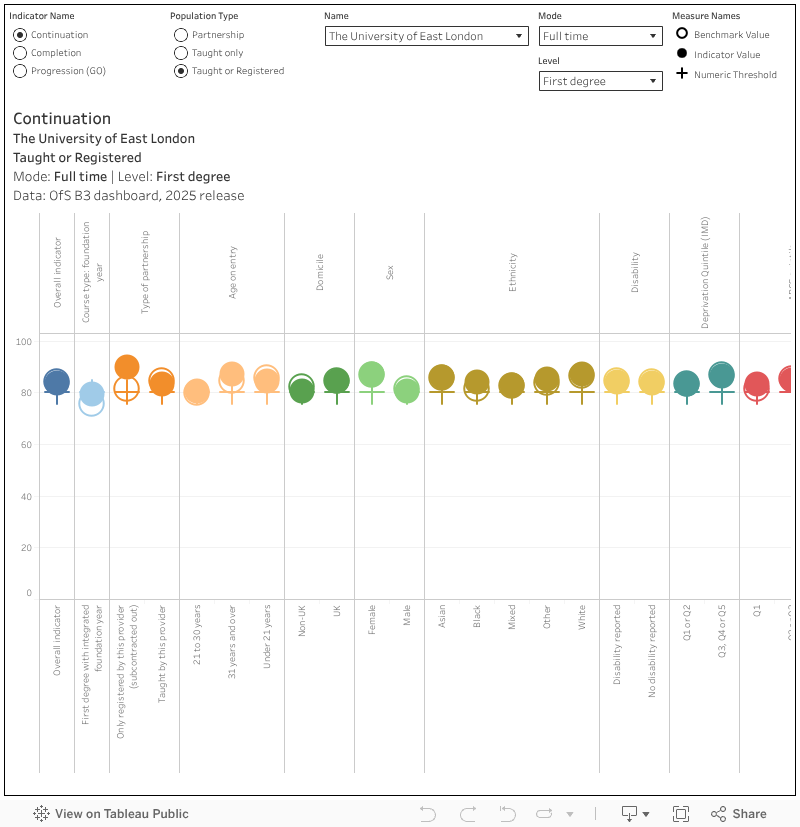
    The chart shows various splits of the student population in question – the round marks show the actual value of the indicator, the crosses show the current numeric threshold (which is what OfS has told us is the point below which it would start getting stuck in to regulating).

    Some of the splits are self-explanatory, others need a little unpacking. The Index of Multiple Deprivation (IMD) is a standard national measure of how socio-economically deprived a small area is – quintile 1 is the most deprived, quintile 5 is the least deprived. Associations Between Characteristics of Students (ABCs) is a proprietary measure developed by OfS which is a whole world of complexity: here all you need to know is that quintile five is more likely to have good outcomes on average, and quintile 1 are least likely to have good outcomes.

    If you mouse over any of the marks you will get some more information: the year(s) of data involved in producing the indicator (by definition most of this data refers to a number of years ago and shouldn’t really be taken as an indication of a problem that is happening right now), and the proportion of the sample that is above or below the threshold. The denominator is simply the number of students involved in each split of the population.

    There’s also a version of this chart that allows you to look at an individual provider: choose that via the drop down in the middle of the top row.

    [Full screen]

    You’ll note you can select your population: Taught or registered includes students taught by the provider and students who are registered with a provider but taught elsewhere (subcontracted out), taught only is just those students taught by a provider (so, no subcontractual stuff), partnership includes only students where teaching is contracted out or validated (the student is both registered and taught elsewhere, but the qualification is validated by this provider)

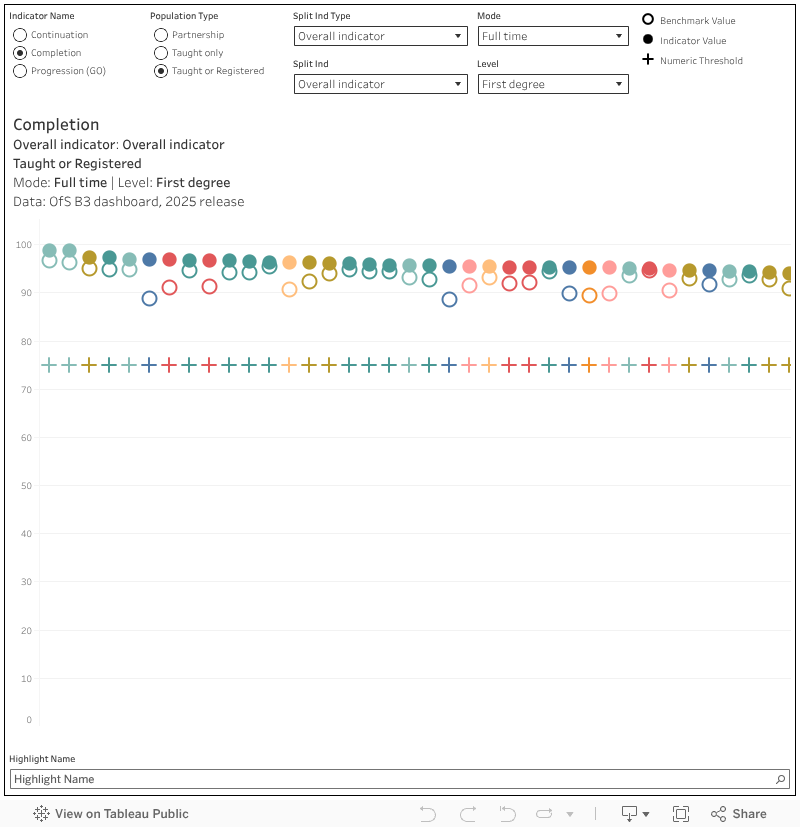
    On the chart itself, you’ll see a benchmark marked with an empty circle: this is what OfS has calculated (based on the characteristics of the students in question) the value of the indicator should be – the implications being that the difference from the benchmark is entirely the fault of the provider. In the mouse-over I’ve also added the proportion of students in the sample above and below the benchmark.

    OfS take great pains to ensure that B3 measures can’t be seen as a league table, as this would make their quality assurance methodology look simplistic and context-free. Of course, I have built a league table anyway just to annoy them: the providers are sorted by the value of the indicator, with the other marks shown as above (note that not all options have a benchmark value). Here you can select a split indicator type (the group of characteristics you are interested in) and then the split indicator (specific characteristic) you want to explore using the menus in the middle of the top row – the two interact and you will need to set them both.

    You can find a provider of interest using the highlighter at the bottom, or just mouse over a mark of interest to get the details on the pop-up.

    [Full screen]

    With so much data going on there is bound to be something odd somewhere – I’ve tried to spot everything but if there’s something I’ve missed please let me know via an email or a comment. A couple of things you may stumble on – OfS has suppressed data relating to very small numbers of students, and if you ever see a “null” value for providers it refers to the averages for the sector as a whole.

    Yes, but does it regulate?

    It is still clear that white and Asian students have generally better outcomes than those from other ethnicities, that a disadvantaged background makes you less likely to do well in higher education, and that students who studied business are less likely to have a positive progression outcome than those who studied the performing arts.

    You might have seen The Times running with the idea that the government is contemplating restrictions on international student visas linked to the completion rates of international students. It’s not the best idea for a number of reasons, but should it be implemented a quick look at the ranking chart (domicile; non-uk) will let you know which providers would be at risk in that situation: for first degree it’s tending towards the Million Plus end of things, for taught Masters provision we are looking at smaller non-traditional providers.

    Likewise, the signs are clear that a crackdown on poorly performing validated provision is incoming – using the ranking chart again (population type: partnership, splits: type of partnerships – only validated) shows us a few places that might have completion problems when it comes to first degree provision.

    If you are exploring these (and I bet you are!) you might note some surprisingly low denominator figures – surely there has been an explosion in this type of provision recently? This demonstrates the achillies heel of the B3 data: completion data relates to pre-pandemic years (2016-2019), continuation to 2019-2022. Using four years of data to find an average is useful when provision isn’t changing much – but given the growth of validation arrangements in recent years, what we see here tells us next to nothing about the sector as it currently is.

    Almost to illustrate this point, the Office for Students today announced an investigation into the sub-contractual arrangement between Buckinghamshire New University and the London School of Science and Technology. You can examine these providers in B3 and if you look at the appropriate splits you can see plenty of others that might have a larger problem – but it is what is happening in 2025 that has an impact on current students.

    Source link

  • LAWSUIT: FIRE challenges unconstitutional provisions Rubio uses in crusade to deport legal immigrants over protected speech

    LAWSUIT: FIRE challenges unconstitutional provisions Rubio uses in crusade to deport legal immigrants over protected speech

    • The First Amendment trumps the statutes that the government is abusing to deport people for speech alone
    • This lawsuit seeks a landmark ruling that the First Amendment forbids the government from deporting lawfully present noncitizens for constitutionally protected speech
    • FIRE attorney: ‘In a free country, you shouldn’t have to show your papers to voice your opinion’

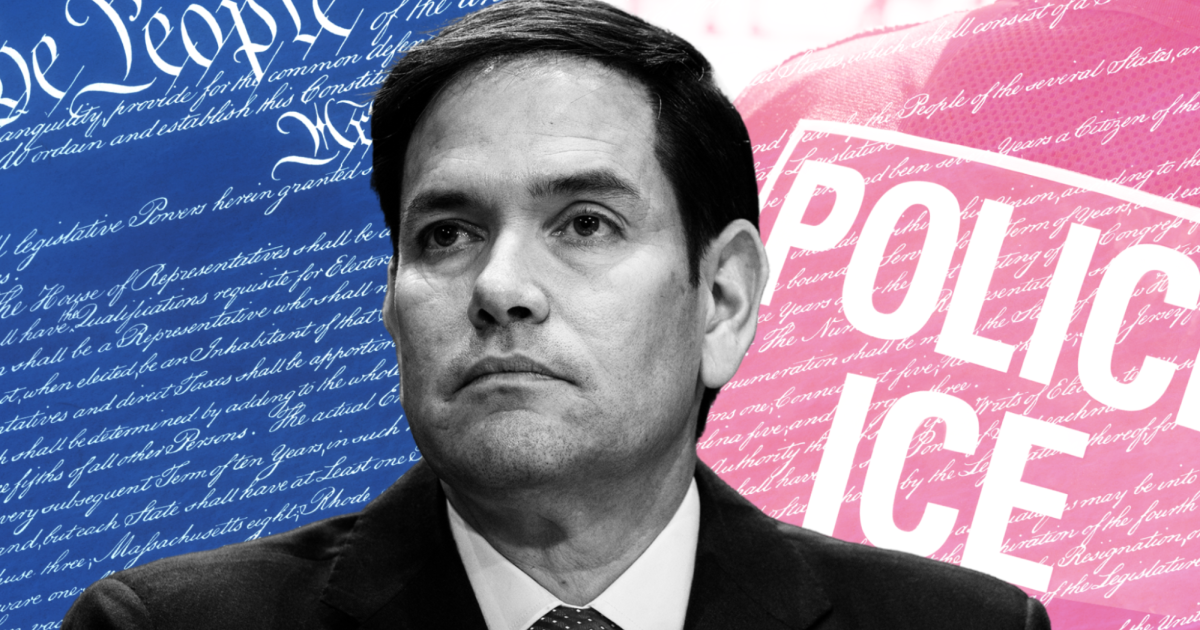
    SAN JOSE, Calif., Aug. 6, 2025 — Today, the Foundation for Individual Rights and Expression sued Secretary of State Marco Rubio, challenging two federal immigration law provisions that give him unchecked power to revoke legal immigrants’ visas and deport them for protected speech.

    “In the United States of America, no one should fear a midnight knock on the door for voicing the wrong opinion,” said FIRE attorney Conor Fitzpatrick. “Free speech isn’t a privilege the government hands out. Under our Constitution it is the inalienable right of every man, woman, and child.” 

    But since March, Rubio and the Trump administration have waged an assault on free speech, targeting foreign university students for deportation based on bedrock protected speech like writing op-eds and attending protests. Their attack is casting a pall of fear over millions of noncitizens, who now worry that voicing the “wrong” opinion about America or Israel will result in deportation.

    Noncitizens in the United States have First Amendment rights. Despite that, Rubio is wielding two provisions of the Immigration and Nationality Act to target lawfully present noncitizens for their opinions.

    • The first allows the secretary of state to initiate deportation proceedings against  any noncitizen for protected speech if the secretary “personally determines” the speech “compromises a compelling foreign policy interest.”
    • The second enables the secretary of state to revoke the visa of any noncitizen “at any time” for any reason. 

    As FIRE’s lawsuit explains, the provisions are unconstitutional when used to revoke a visa or deport someone for speech the First Amendment protects. 

    The Trump administration is proudly using the provisions to revoke the visas of and deport lawfully present noncitizens for their speech if the government deems it anti-American or anti-Israel. Rubio used the first provision to target Columbia University student Mahmoud Khalil for protected pro-Palestinian speech and the second to target Tufts University student Rümeysa Öztürk for coauthoring an op-ed.

    Rubio and the Trump administration claim — as all censors do — that this time is different. They claim that this political speech comes from noncitizens, which therefore warrants setting aside America’s protection of free speech.

    That’s wrong. America’s founding principle is that liberty comes not from the government, but is an inherent right of every individual. Every person — whether they’re a U.S. citizen, are visiting for the week, or are here on a student visa — has free speech rights in this country.

    “Two lawful residents of the United States holding the same sign at the same protest shouldn’t be treated differently just because one’s here on a visa,” said FIRE Legal Director Will Creeley. “The First Amendment bars the government from punishing protected speech — period. In our free country, you shouldn’t have to show your papers to speak your mind.”

    Plaintiffs in FIRE’s lawsuit represent the wide range of groups and individuals whose speech is threatened by the continued assault on noncitizens’ protected speech:

    • The Stanford Daily, the independent, student-run newspaper at Stanford University, where writers with student visas are declining assignments related to the conflict in the Middle East, worried that even reporting on the war will endanger their immigration status
    • Jane Doe and John Doe, two legal noncitizens with no criminal record who engaged in pro-Palestinian speech and now fear deportation and visa revocation because of their expression

    “There’s real fear on campus and it reaches into the newsroom,” said Greta Reich, editor-in-chief of The Stanford Daily. “I’ve had reporters turn down assignments, request the removal of some of their articles, and even quit the paper because they fear deportation for being associated with speaking on political topics, even in a journalistic capacity. The Daily is losing the voices of a significant portion of our student population.”

    There’s also historical context that should give the government pause. Congress passed the Alien and Sedition Acts 225 years ago. One of those acts allowed President John Adams to deport noncitizens if he thought they posed a “danger” to the country. It was one of the most unconstitutional laws in our nation’s history and died a quick death two years later, after the acts contributed to Adams’ resounding loss in the 1800 presidential election to Thomas Jefferson. 

    FIRE aims to stop the government’s use of the two provisions that stand counter to our ideals as a nation: Provisions that — in their expansive scope and unchecked authority — are more at home in countries like China and Russia than in a free America. By defeating these provisions, no administration of any party will be able to weaponize them against individuals for expression disfavored by the government.

    FIRE moved for a preliminary injunction to stop the government from abusing the visa provision while the case is ongoing.

    Marc Van Der Hout, Johnny Sinodis, and Oona Cahill at Van Der Hout LLP are serving as local and advisory counsel on the case.

    From today’s lawsuit: “Our First Amendment stands as a bulwark against the government infringing the inalienable human rights to think and speak for yourself.”

    The Foundation for Individual Rights and Expression (FIRE) is a nonpartisan, nonprofit organization dedicated to defending and sustaining the individual rights of all Americans to free speech and free thought — the most essential qualities of liberty. 

    CONTACT:

    Daniel Burnett, Senior Director of Communications, FIRE: 215-717-3473; [email protected]

    Source link

  • Adding a trauma-responsive lens for student support

    Adding a trauma-responsive lens for student support

    Key points:

    Across the country, our schools are being taxed beyond their capacity to support educational success. We’ve known for a long time that students need a three-dimensional structure of guidance and encouragement to thrive. That’s why the Multi-Tiered System of Supports (MTSS) framework was created–it’s a prevention framework for early identification of varying student needs and the responses needed to maximize academic success. In theory, an MTSS supports academic, social-emotional, and behavioral needs in equal measure. However, in practice, many schools are struggling to incorporate social-emotional and behavioral components in their MTSS–even as many of their students come to school bearing the effects of adversity, trauma, or crisis.

    This imbalance is leaving millions of children behind.

    Each year, at least 1 in 7 children in the United States experience abuse, violence, natural disasters, or other adverse childhood experiences (ACEs). By age 16, roughly two-thirds of children will have been exposed to at least one traumatic event. This can impair their ability to learn well and contribute to absenteeism, while secondary trauma spirals out from these students to classmates and teachers, multiplying the overall impact. Left unaddressed, the imprint of such events could warp the future of our school and public communities.

    Since COVID-19, schools have reported unprecedented levels of absenteeism and student distress, and supporting trauma-exposed students without training puts more pressure on teachers, who are already burned out and leaving the profession at high rates. Therefore, it is clear to me that creating school-wide networks of trauma-informed adults is essential for fostering supportive learning and growth for students, enhancing educator capacity to nurture trauma-affected learners, and ensuring effective trauma resource management within districts.

    Research has identified a supportive school community as a strong childhood protective factor against the effects of trauma. We should be hopeful about our path forward. But the vision and blueprint for this enhancement of MTSS need to come as soon as possible, and it needs to come from state-level education leaders and school district leaders.

    Gaps in support and expertise

    Consider this scenario: A student who recently experienced a traumatic car accident sits near a window in class, experiencing significant distress or dysregulation without outward signs. A sudden screech of tires outside activates their sympathetic nervous system (the one associated with fight or flight), and the student shuts down, withdrawing into themselves. Their teacher, unaware of the student’s trauma history and unequipped with relevant training, interprets the response as a continuation of past misbehavior or as an academic deficit.

    This sort of misunderstanding takes place in a thousand places every day. I would stress that this isn’t a reflection of bad intentions, but rather a symptom of fragmented systems and knowledge. Even when trauma is recognized, lack of intentional collaboration and training often result in missed opportunities or inconsistent support, which cannot maximize recovery from trauma and may, in fact, hinder it, as research on retraumatization suggests.

    There might be mismatched expectations when teachers send students to the counselor, not knowing that they themselves have a role to play in the healing. In other cases, students may be referred to a school counselor and have a productive support session–but on their way back to class, a seemingly benign statement from a third party can be misconstrued or cause dysregulation, unintentionally undoing the support they’ve received. The solution to all these problems is school-wide training on trauma-informed skills. This way, all educators and staff alike develop a shared knowledge, understanding, language, and responses as they collaborate and connect with students. With the right tools, adults on campus have better trauma-informed strategies to use in their relationships with students and in building a safe and supportive school community.

    The proof is all around us

    Trauma training works synergistically within MTSS: social-emotional and trauma-responsive support allows for better academic outcomes, which work to further reduce behavioral problems, and so on. At the Center for Safe & Resilient Schools and Workplaces, we see this play out often with our school district partners. For example, at Pasadena Unified School District, which was recently ravaged by the Eaton Canyon Fire, trauma-informed best practices and preparations have enabled district leaders to reopen schools with sufficient psychological understanding and interventions along with the needed material support for the 10,000 students who were affected.

    A truly effective MTSS model does not treat trauma as a peripheral concern. It integrates trauma-responsive strategies into every tier of support–from universal practices, to targeted interventions, to intensive mental health services. In that environment, every adult who comes in contact with students has the training to adhere to trauma best practices.

    We are at a juncture where the impact of trauma poses serious risks to the education system, but evidence-based approaches exist to solve the problem. Change from the state level down is the best way to transform school cultures quickly, and I urge state education leaders to take action. Any MTSS plan isn’t complete without a trauma-informed foundation, lens, and programming. And our students–each and every one–deserve nothing less.

    Latest posts by eSchool Media Contributors (see all)

    Source link

  • Call an ambulance! But be ready to pay.

    Call an ambulance! But be ready to pay.

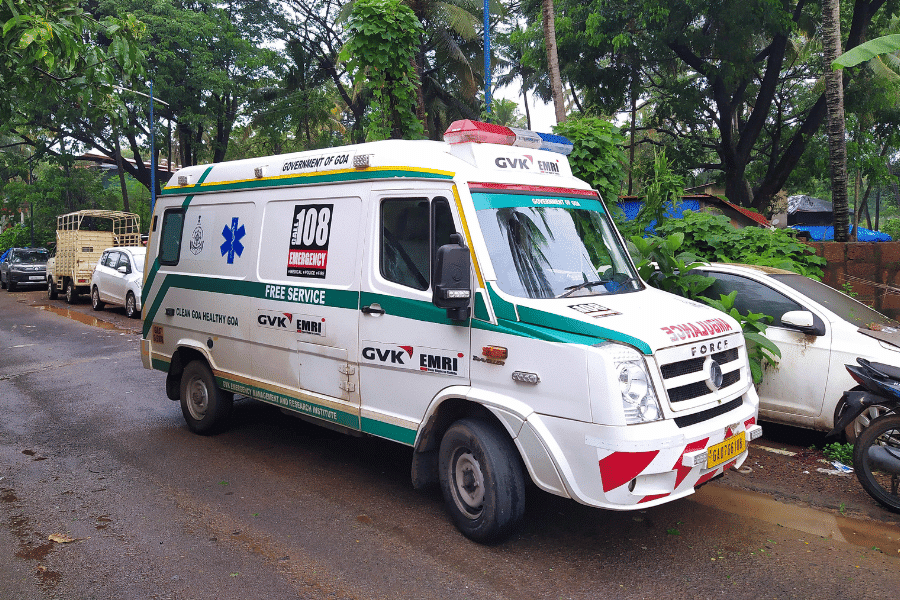
    Quick-commerce service Blinkit — best known in India for delivering groceries in 10 minutes — rolled out an ambulance service last winter promising the same speedy service and setting the nation off on a new debate about privatized medicine.

    Five ambulances equipped with lifesaving medical equipment, emergency medicines and a three-person team, including a paramedic, are now operating in Gurgaon, a relatively wealthy city north of Delhi, at 2,000 rupees or about US $23 per trip. That’s affordable for less than a third of the population.

    Touted as India’s first app-based private emergency healthcare service, this has set off a debate about its implications for a sprawling public health system that is notoriously overstretched, with only one ambulance per five million people.

    A few weeks after the service launched, one of its ambulance teams was able to stabilize a trauma patient on the way to the emergency department. This led neurosurgeon Deepak Agarwal at All India Institute of Medical Sciences, a premier medical college and hospital to laud the new service on social media. He called it a “healthcare revolution” that offers care he had only read about happening in developed countries.

    It was a stark contrast, though, with the experience of Roopa Rawat Singhvi, a regional nursing lead in emergency and trauma care, who encountered a road accident victim near the hospital on 3 March.

    “I continued to call 108 and 102 (India’s version of 911) to reach ambulance services,” she said. “However, the calls were not going through.”

    After call finally went through, it took half an hour for the first responders to arrive and they were police, not an ambulance, she said.

    Healthcare for those who can pay

    This contrast — one patient whisked away with ventilatory support and trained staff, another left waiting while vital minutes passed — captures the growing debate around Blinkit’s entry into emergency healthcare.

    This contrast shows the need to explore India’s first app-based private ambulance initiative as more than just a tech innovation story, but as a symptom of a deeper tension between privatization and public neglect.

    As India’s public health infrastructure is eroding, private players are stepping into the vacated spaces under the guise of innovation. The question is: Will this be a temporary fix or a long-term threat to equitable emergency care?

    It wasn’t meant to be this way. In 2007, P.V. Ramesh was the principal health secretary of the Indian state of Andhra Pradesh and worked on the first National Health Mission project to establish emergency ambulance services.

    He said that the public sector ambulance services that evolved into the current nationwide emergency service started as a partnership in Andhra Pradesh between the government and a not-for-profit entity, Byrraju Foundation.

    There was a clear understanding, he said, that it would be operated strictly as a public service without a profit motive.

    “It combined the ambulances equipped with essential emergency care infrastructure, trained human resources and a call center provided by the Byrraju Foundation with the funding, hospital network and effective oversight from the public sector that served all citizens of Andhra Pradesh in case of medical or surgical emergencies,” Ramesh said.

    A dire need for ambulances

    That not-for-profit plan quickly collapsed.

    “Ambulance drivers started taking money from the private hospitals to take patients there and the private sector companies that oversaw the operations also began to cut corners,” Ramesh said. “Even doctors became complicit in the slow rotting of the system. The system deteriorated when the political and bureaucratic masters stopped monitoring the system after awarding the contracts to their favorites.”

    Pre-hospital care is far from ideal in both the public and private sectors in India, says Gayatri, an emergency medicine physician in Mumbai. Gayatri, who asked that her last name not be used, has worked in both public and private hospitals.

    “I used to work in villages in Chhattisgarh and Bihar,” she said. “In some areas, we used to call the government ambulance, but they would often refuse to come, either because it was a conflict-ridden area or because the road was in poor condition. If we put pressure and keep calling, the ambulance would come, but then the driver would ask for 3,000 to 5,000 rupees from the patient to transfer them.”

    Gayatri said that because many of her patients feel scared and disempowered, they agree to pay. “Sometimes we have to fight with the ambulance drivers and tell them not to ask for money,” she said.

    Stalling for time when saving lives

    Gayatri vividly remembers a night when she was transferring a patient in a vehicle and the patient had a cardiac arrest. She called for an ambulance, but it arrived without essential medications or even an oxygen cylinder. They had to borrow an oxygen cylinder from a referral center in a nearby village, losing time.

    “In emergencies, every minute counts,” she said. “And not having access to even an oxygen mask or cylinder in the ambulance was shocking and distressing for me.”

    But even private sector hospitals where she has worked used to send doctors trained in traditional medicine who are not qualified to administer emergency care in place of paramedics to attend home emergencies or to transport patients from emergency sites to the hospital.

    India currently has an almost non-existent emergency response system.

    According to Indian government data, there are a total of 28,250 ambulances across its states and Union Territories such as Jammu and Kashmir. This includes ambulances with advanced medical services and paramedics, vehicles that only transfer patients in non-emergency conditions, even bicycles.

    Meeting international standards

    While international standards recommend one ambulance for every 50,000 population, with one basic life support ambulance or BLS and one advanced cardiac life support ambulance or ACLS per 100,000 population, India has one ACLS ambulance for every five million people — the number in the United States is one per 25,000 population — and one BLS ambulance for every 100,000 people.

    Meanwhile, quality is a more persistent issue than quantity. According to a 2020 study by the All India Institute of Medical Science in Delhi and the National Institution for Transforming India, 90% of ambulances lacked essential medical equipment and 95% were operated by untrained professionals.

    “The corruption and deterioration of the service, coupled with a lack of infrastructure to provide adequate emergency referral systems, has created a vacuum that has invited private players to reframe this as a business opportunity,” Ramesh said.

    That’s why, he said, it makes sense for Blinkit to fill that hole. They recognized that the current system doesn’t meet the demand for reliable ambulance service in case of medical and surgical emergencies and realized they could develop a service to cater to those with the means to pay for it.

    Singhvi believes there are lessons to be learned from Blinkit’s efficiency. “They’ve hired trained paramedics, optimized logistics and used technology effectively,” Singhvi said. “Public systems could adapt these strategies to improve accessibility and response times.”

    Profits and regulations

    Ramesh said that with the current public infrastructure in shambles, he only hopes that the private ambulance companies run this service ethically and that there isn’t a monopoly that will allow them to charge unreasonable rates.

    But Gayatri does not offer them the benefit of the doubt. “Blinkit is a private company and private companies operate on the principle of making a profit,” she said. “It is unreasonable to expect that they will function in a way that keeps the welfare of the people in mind.”

    Gayatri believes that the gap is intentional. It is because of lobbying by the private sector that has made the public sector reluctant to invest in strengthening its health systems. Good regulatory oversight from the government, could prevent private companies from charging too much, but Ramesh is not optimistic it will happen.

    “Even if robust regulations are formulated and a law is enacted, does the government have the capacity to enforce it?” he said. “Regulations have not been successful in the health sector.”

    Instead, Ramesh said that the emergence of private ambulance services should be seen as a wake-up call to the government to strengthen public sector ambulance services.

    Ramesh acknowledges that Blinkit fills a need. But ultimately, while Blinkit’s initiative may cater to a small, affluent population segment, it underscores the urgent need to address the systemic inadequacies plaguing public healthcare.

    “If they provide equitable, high-quality service at a fair price, without bias toward certain hospitals, they could complement existing healthcare services,” he said. “But private models inherently exclude the poor. In a country where universal health care isn’t prioritized, do people have an alternative?”


    Questions to consider:

    1. What are the concerns some people have over private ambulance services?

    2. How can a government ensure that an ambulance service won’t gouge people in need?

    3. Do you know how to call for an ambulance and do you know how long it might take to reach you if you needed one?


    Source link

  • FSA Launches Beta Version of FAFSA

    FSA Launches Beta Version of FAFSA

    Photo illustration by Justin Morrison/Inside Higher Ed | SimoneN/iStock/Getty Images

    The Office for Federal Student Aid made history this week, launching the test version of this year’s Free Application for Federal Student Aid earlier than ever before, Aaron Lemon-Strauss, executive director of the FAFSA program, announced in a LinkedIn post Monday. 

    It marks the beginning of “the next chapter in making higher ed more accessible,” he wrote.

    This comes less than two years after the botched rollout of what was supposed to be a simpler FAFSA form for the 2024–25 academic year. The opening of that year’s application platform, which typically occurs in October, was delayed until the very end of the year. And even when it launched in late December 2023, it had a myriad of glitches, significantly delaying financial aid award processing for colleges and students.

    For the next FAFSA cycle, the Education Department revamped its planning processing, bringing in an outsider to lead the effort. The launch of the 2025–26 FAFSA was slightly delayed, but the agency spent months testing the form before opening it up to all students. Now, for the 2026–27 FAFSA, the application is set to open on time on Oct. 1.

    To meet that deadline, the department kicked off several weeks of selective beta testing this week, starting with a small number of students and families. The plan is for the beta version to become public in early September. By launching ahead of schedule, the department hopes to boost application completion rates, improve troubleshooting tools for financial aid advisers and increase overall speed of the process, Lemon-Strauss explained.

    “As we celebrate this milestone, we also push forward,” he said, “building a FAFSA that truly meets the evolving needs of students, families, and schools.”

    Source link

  • The Resilience of First-Generation Students

    The Resilience of First-Generation Students

    First-generation students face a host of barriers when they go to college. Terms commonly used in higher ed, like “registrar,” “provost” or “credit hours,” can be mystifying. They’re confronted with a hidden curriculum, a set of unspoken expectations for how to succeed. And they don’t always know whom to turn to for help.

    But a new book, the first of three volumes on first-generation students, argues that these challenges, while important to study, offer an incomplete picture of who these students are.

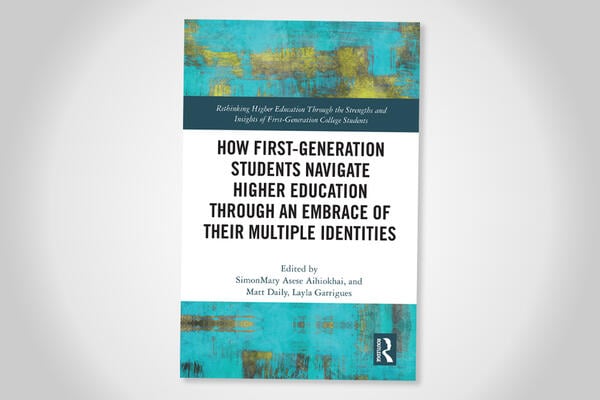
    The book, How First-Generation Students Navigate Higher Education Through an Embrace of their Multiple Identities (Routledge, 2025), explores in a series of essays how different identities, including class and race, affect the first-generation student experience and how these students bring unique strengths and assets to the classroom. It also offers guidance to different types of institutions about how to support first-generation students better and highlights colleges and universities that have modeled successful reforms and programs. Some of the essays are research-focused and written by scholars, while others are personal narratives authored by first-generation college graduates.

    Co-editor Matt Daily, assistant vice president and dean of students at Idaho State University, spoke with Inside Higher Ed about why he’s working to change the discourse around first-generation students, alongside his co-editors, University of Portland professors SimonMary Asese Aihiokhai and Layla Garrigues. The conversation has been edited for length and clarity.

    Q: A theme throughout this book is the idea that too often first-generation students are studied through a deficit-focused lens that emphasizes their challenges rather than their strengths. Why was it important to you to shift that approach?

    A: For a long time, when we’ve talked about first-gen, we’ve come in thinking that they need something, that they are lacking something, and I think for the last five years or so, that narrative has really shifted. It’s shifted from “What are they lacking?” to “What are they contributing?”

    As we were doing a lot of research, as we were having a lot of conversations, while that’s something that we’re talking about at our respective institutions and starting to do more across the United States and beyond, it’s still something that we have to keep reminding ourselves is important—to really focus on the assets or the strengths that students bring.

    And so, we thought that when we were dreaming up this project—and that’s a fun story, too, about how it came to be—we thought it really needs to be based in the strengths. And it would be so nice for practitioners, scholars, students, that they could find that the real theme and the real foundation and the real thread through it is the strengths of first-gen students, and what it is that they’re really bringing to these college campuses.

    Q: What are some of the strengths and assets of first-generation students that you think are too often overlooked?

    A: There’s really no one-size-fits-all for first-gen. Each first-gen student is as unique as the experience itself. I think that’s actually one trap we fall into: We really have to take each case as they come in and create that space.

    In the introduction, I mention how Tara Yosso talks about her “community cultural wealth” model and cultural capital and talks about this idea of [ties to] family and culture [as] strengths. I think those are strengths that are really important. Laura Rendón also talks about—what Yosso was saying and building on it—this idea of ganas or perseverance, which is that ability to really develop inner strength and becoming self-reliant and determined to succeed.

    There’s something about first-gen students where they are just so gritty. They really stick with it, and they are so inspiring. I love the way that they’re able to sort of exist in multiple worlds. I could have my college world, my peers, but also a lot of first-gen students work, so I can have that world, and then my family, and then maybe I’m from a different country. Really understanding how to exist in all those different worlds and being able to do that successfully, I think that is an incredible strength.

    My biggest criticism of first-gen students is that they are too humble. They don’t think that their story is worthy enough to share. They don’t think it has worth, and I think they’re dismissive [of themselves], and that is my biggest criticism. Because for the amount of different first-gen students we have, there are an equal amount of stories that come with them. We need to encourage them to really share those and know that they have worth.

    Q: Going off of that, you interspersed scholarly research with student narratives in this essay collection. Why was it important to you to include both perspectives?

    A: That was really intentional. I think that the student voice gets ignored if we’re just talking about theory. If we’re going to talk about students, we need to hear their voice, right? It needs to be expressed, and we need to really have that authentic perspective. And so that was something we talked about early on in the project … especially in the last chapter, where we wanted to have students themselves or recent graduates share.

    And I think that there’s equally as much value in terms of the research as to what the students are expressing, as they’re sort of in the moment, so to speak. I think [it’s important] even just coaching students that their voice matters … that you can go up and talk to senior administrators … and there’s value in that. I think that was one thing we were really hoping with this anthology was that maybe a graduate student or an undergraduate student could read that and feel inspired and go, “Oh, you know, this is something I could see myself doing,” and really get that spark, too. Gosh, if that happened, I would be over the moon.

    Q: The book also emphasizes taking an intersectional approach to serving first-generation students. What does that mean to you? And what do you think we miss when we don’t factor in these students’ other identities?

    A: I think that’s just so important. And I have to kind of acknowledge my own positionality. I’m a white male. And I am not first-gen. I will never understand a lot of these identities because I don’t identify that way. And so that’s something that’s been a part of my own journey. That was why it was so important with Simon, myself and Layla—we’re just a diverse collection. And then when you get to the other contributors, they do identify in a variety of different ways.

    But that being said, identity is so important to the cultural richness of our college campuses. When I talk to college students, we talk about their gender identity, and sometimes that can be fluid; we talk about their racial or ethnic identity. We talk about their sexual identity, even their academic identity—meaning, what does it mean when I go from high school to college? Does that academic identity come into question when I experience different levels of success? But I think a lot of those identities we talk about, they’re visible. A lot of those identities we can see.

    First-gen is not one of them. And that’s what’s interesting about being first-gen is you will never see physically if someone is first-gen. And so, it’s sort of this hidden identity. In a lot of my experiences working with first-gen students, I almost feel that I’ve outed them. When I explain to them, “Hey, I think you’re first-generation based on the information you’ve given me,” there’s a variety of different reactions, because it’s sort of a later-emerging identity. It’s not maybe one that’s discussed when a student is in elementary school, [with someone telling them], “Hey, you’re going to be a first-generation college student.” And so, I think what’s interesting is when you talk about this identity with other first-gen students, it’s one of many that intersect. But I think the timing of the intersection is so different for every first-gen student, if that makes sense.

    In my previous role in Portland, when I would reach out to say, “I think you’re a first-gen student,” a lot of students would say, “No, I don’t want to be a first-gen student,” because they would think me identifying them in that way is something that’s negative. And part of that was really [making] that shift and going, “I am identifying you based on your mom and dad’s educational history or parent or guardian, and you might be first-gen—and that is so beautiful. Let’s celebrate that.”

    I can be first-gen and a male or first-gen and African American male or I can be first-gen and a student athlete. What do those identities mean? Just being able to share what that identity means is so important for why a student is in college.

    And I think that they forget that even as they graduate and go on to whatever’s next after college, to share that they’re first-gen is something that graduate schools, employers, what have you—they really value that.

    It’s been programmed for so long that this is such a deficit. We’re working really hard at institutions to say, “Yeah, share that out—because of those qualities we talked about, this makes you a valuable part of this community.”

    Q: I thought it was interesting that multiple chapters described how first-generation students can feel isolated from campus life, but also that campus life made them feel isolated from their home lives and families. How do you see the role of family and community for first-generation students’ success, and how do you think higher ed institutions can better account for that?

    A: We assume that for first-gen students, when they go to college, that their families are behind it 100 percent, and that is not always the case. I think a lot of times the person that’s the most in favor of them going to college is themselves. And there’s a lot of, you know, “Why don’t you just work at the store?” The argument to convince others to go to college sometimes falls on the first-gen student, and we forget that. And so that kind of carries on through the experience, [family] going, “Why do you need to go to these programs?” or “Why do you need to go abroad?” It’s sort of having to be the explainer and the decoder for college life, and that is a lot for one student.

    And so, I think that there is some push and pull with families sometimes, because the family wants to be supportive, but they don’t know how to be supportive strategically. In talking to a lot of families, I’ve coached them, saying, “Hey, you can just call your daughter or son and just say, ‘I love you. I support you doing this. I don’t know how I can strategically do that, but I want you to know I support you.’” That type of thing just goes so far.

    The thing that’s also interesting, to your point about feeling isolated, we talk about programs and strategies that can really help first-gen students. But also on college campuses, the onus is on the student. You need to go do these things to be successful. And that’s not a first-gen thing, that’s a college thing. And I sort of push back on that. I think it’s on the institution to really create these spaces, to make students feel welcome, that they belong, that they matter, that they feel that they can have some sense of value in these spaces with their peers. And going back to first-gen identity, they’re not going to know who else is first-gen unless we create spaces where the students can find who else among their peer group is. And so, I think you kind of have to shift it a little bit.

    They maybe feel isolated from family because we’re asking them to do a lot of things, such as engage with campus community, campus life, but sometimes that might come into conflict with what they’re being asked to do with their families, whether it’s watch my little brother or go to Grandma’s birthday party. That happened one time where a student really had to negotiate why they had to be on campus that first weekend of school for a lot of the programming [when] they were going to miss Grandma’s birthday. It really puts them in this code-switching situation where they feel isolated because they don’t feel anyone really gets what they’re going through.

    Q: The book also offers a lot of concrete advice on how to better structure services and support for first-generation students and ensure they’re engaged and able to take advantage of opportunities like internships and study abroad. What do you think are some of the practical action steps you want to see higher ed leaders take away after reading this book?

    A: I think high-impact practices are so important.

    We talk so much about what student success means—what does it mean to have a sense of belonging, that type of thing—but I think one thing we really don’t talk a lot about is, other than the degree that the students are seeking, what is it that we really want them to take away from the college experience? What type of skills? Do we want them to think critically? Do we want them to be really engaged with the community? I think that we need to be really intentional on our college campuses about talking about what we want the students to take away, besides the degree. That can really help them in their next step. And I hope that maybe this book can talk a little bit about that. Can we really reimagine what we’re trying to do rather than just be very transactional about the degree?

    I hope that they realize that it’s important to invest in this, that we need to invest in sustainable programs. Because I think a lot of times, what you have happen is different leaders or champions of first-gen work will leave institutions and then these initiatives really fizzle out. So, how can we think strategically that it’s not about the person, it’s about the program and initiatives. I think some of the things we talk about in here are almost a love letter to higher education institutions to say, “Look, this population is worth investing in, and it’s not just a one-size-fits-all, but if we can all adopt something that’s really creative and sustainable, all these students across the United States and even globally can benefit.”

    Source link

  • Community College Instructor Quits Over Barring Noncitizens From Adult Ed

    Community College Instructor Quits Over Barring Noncitizens From Adult Ed

    Matthew Fowler/iStock/Getty Images

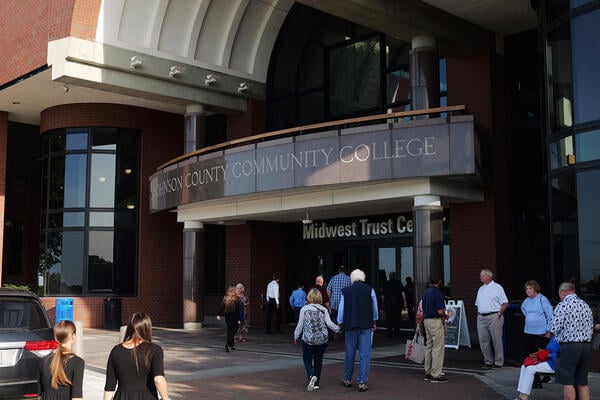
    An adult education instructor at Johnson County Community College in Kansas resigned after finding out the college would require proof of immigration status for adult ed programs in response to federal policy shifts, The Kansas City Star first reported.

    Daniel Tyx, previously a middle school Spanish teacher, started teaching English to adults part-time at the college last year. He told the Inside Higher Ed that he took the job because he has a passion for working with immigrant students, and he planned to stay if not for the new policy. He described the college’s English language learner program as thriving, with over 800 students.

    These students “always come to class. They’re always excited to be there. They’re full of questions. It’s just a dream job,” Tyx said.

    But Tyx quit his job last Friday after he was told that he would have to verify students’ immigration statuses.

    “That was not in alignment with my values,” Tyx said. “And I didn’t feel like, as a matter of conscience, that I was going to be able to continue.”

    The college’s decision came after a February executive order demanded “no taxpayer-funded benefits go to unqualified aliens.” The U.S. Department of Education then announced in July that, to comply with the order, it would end Clinton-era guidance that allowed undocumented students to participate in adult and career and technical education programs. The department insisted that institutions receiving federal funds for these programs begin verifying that students are eligible to benefit from them.

    “Under President Trump’s leadership, hardworking American taxpayers will no longer foot the bill for illegal aliens to participate in our career, technical, or adult education programs or activities,” U.S. Secretary of Education Linda McMahon said in the announcement. “The department will ensure that taxpayer funds are reserved for citizens and individuals who have entered our country through legal means who meet federal eligibility criteria.”

    Checking a student’s immigration status is not a typical practice for community colleges, which are now grappling with how to comply with the federal edicts and continue to serve students, and staffers are uncertain how to move forward. Another complication for community colleges and other public institutions is the Trump administration’s crackdown on policies that allow undocumented students to pay in-state tuition if they meet other requirements. After Texas overturned its policy, state officials asked universities to identify undocumented students. At least one Texas institution, the University of Texas at Austin, now requires students to submit proof of immigration status, as well, KVUE reported.

    The department’s guidance to bar undocumented students was the second blow to adult education programs after the Trump administration held up about $716 million in federal funds to these programs as part of a wider review of education-related grants in early July. The funds have since been released.

    Johnson County Community College now has a message on its website saying that, starting in late July, students are required to show a Real ID, birth certificate, U.S. passport or their most recent immigration documents when they register for adult education classes.

    Chris Gray, vice president of strategic communications and marketing at JCCC, said in an email to Inside Higher Ed that the college’s “compliance with federal requirements in this matter allows us to continue to serve qualified individuals” in adult education programs.

    Tyx said he felt that college administrators were trying to get ahead of the federal guidance, which he considers “cruel and unjust.” He’s worried for his students, who have been peppering him with questions about whether their documents will suffice.

    “My students make such sacrifices to come to class,” he said. “They have so many different reasons to want to learn English, and they’re all good ones. My students want to be able to connect better with their children or their children’s schools. They want to be able to employ the skills that they already have at work and progress in their work lives … It’s very weird that would be something that would be considered to be not desirable by our government.”

    Source link

  • New Survey Measures Student Academic Flourishing in College

    New Survey Measures Student Academic Flourishing in College

    Joseph Prezioso/AFP/Getty Images

    For prospective students looking to enroll in higher education, there are a variety of institutional factors to consider, among them location, course of study, cost of tuition and campus culture. Various sets of rankings provide additional information that might matter to students, such as spending on research or socioeconomic mobility for graduates.

    But one key outcome of higher education remains underappraised, according to Tyler VanderWeele, a professor of epidemiology and biostatistics at Harvard University and director of the Human Flourishing Program: a student’s personal growth.

    Many institutions publish lofty mission statements that connect the learning experience to students’ personal growth, leadership skills, vocation and sense of purpose upon graduation. But beyond anecdotal testimony, there are few measures to understand the influence of colleges and universities on student flourishing.

    Next spring, Harvard University and Wanderweele are launching a new assessment tool as part of the Human Flourishing Program. The Flourishing Data Collaborative survey asks students to reflect on their college experience and provide their home institution with feedback as to what’s working and what needs additional intervention to affect student thriving.

    What’s the need: Researchers created the survey in part to encourage colleges and universities to consider flourishing and student development a core function of the institution.

    “I really do believe that what we measure shapes what we discuss, what we aim for, what policies are put in place to achieve those aims,” VanderWeele said. “So the very act of measurement, in some sense, itself constitutes an intervention and might help colleges and universities better pursue this.”

    The assessment is not designed as a replacement for other measures of student success, including job placement or retention rates, Wanderweele noted. But sometimes a focus on ranking metrics can shift institutional priorities in a way that neglects the human-centered mission of postsecondary education, he said.

    “For example, U.S. News & World Report rankings [have] very much shaped higher education, and people pay a lot of attention to this, but I think it’s also reoriented colleges and universities to specific metrics and ends that will help them go up in those rankings,” VanderWeele said. “Is it really the most important thing how much money has been spent on new student center facilities?”

    The program also wants to better understand the role of higher education in promoting student well-being. Large numbers of young people report feeling on edge, lonely, unmoored or directionless, according to a study from Harvard’s Graduate School of Education. To get at this question, the survey asks about a learner’s sense of happiness and meaning and their financial security.

    How it works: After promising results from pilot surveys conducted at the University of North Carolina at Chapel Hill, Harvard and Campus Bio-Medico University of Rome last year, the annual survey will launch in spring 2026, allowing first-year students to have at least one semester of undergraduate experience under their belts. Learners will respond to 24 questions ranging from “to what extent has university life helped you pursue truth?” to “to what extent has university life helped you to better lead a moral life?”

    VanderWeele hopes the survey will serve as a reflection tool for students to consider how education has contributed to their development, but also where they can be self-motivated to improve their well-being.

    After data collection is complete, each institution will receive a 50-page report and a dashboard with their survey results, allowing them to filter by specific data points.

    What’s next: Presently, the program is recruiting member institutions to participate in the survey and engage in a community of practice, Wanderweele said. The goal is for institutions to gain insight about their current practices, or even assess interventions across several surveys, but also to learn from their peers.

    “Our goal with this is not to differentially rank institutions, but to help each of these institutions come together, reflect on their strengths [and] areas for growth and to learn from one another in these different ways,” VanderWeele said.

    Institutions will pay an annual $10,000 membership fee to participate, which VanderWeele said is a similar rate to other survey offerings of this kind.

    Approximately 20 colleges have indicated interest in membership and another 100 have signed up for an upcoming webinar on Aug. 20 for additional information. VanderWeele said he is hoping a few dozen colleges and universities join the initiative this year.

    In addition to providing institution-specific insights and policy recommendations, VanderWeele and his team hope to use survey results to conduct research on human flourishing in higher education in general.

    Get more content like this directly to your inbox. Subscribe to the Student Success newsletter here.

    This article has been updated to correct the spelling of Tyler VanderWeele’s last name.

    Source link