A 61-year-old Tennessee man is finally free after spending a shocking 37 days in jail — all for posting a meme.
Retired police officer Larry Bushart told a local radio station he’s “very happy to be going home” after his nightmarish ordeal.
But for Larry and FIRE, the fight isn’t over.
In September, after Charlie Kirk’s assassination, Larry shared a meme on a Facebook thread about a vigil in Perry County, Tennessee. The meme quoted President Donald Trump saying, “We have to get over it” following a January 2024 school shooting at Perry High School in Iowa. The meme included the commentary, “This seems relevant today …”
The meme that Larry Bushart shared on Facebook.
Just after 11 p.m. on Sept. 21, four officers came to Larry’s home, handcuffed him, and took him to jail. He was locked up for “threatening mass violence at a school.” His bond — an astronomical $2 million!
Police justified the arrest by saying that people took the meme as a threat to their high school, which has a similar name to the one where the school shooting occurred 20 months earlier. However, police have been unable to produce any evidence that members of the public took the meme as a threat. As The Interceptnoted: “There were no public signs of this hysteria. Nor was there much evidence of an investigation—or any efforts to warn county schools.”
Larry was jailed for more than five weeks. But that wasn’t the only thing he suffered. During that time, he lost his post-retirement job doing medical transportation and missed the birth of his granddaughter.
Bushart during his arrest in September, Perry County, Tennessee.
Prosecutors finally dropped the charges — only after the arrest went viral. Now a newly freed Larry, who spent over three decades with law enforcement and the Tennessee Department of Correction, is preparing to sue.
“A free country does not dispatch police in the dead of night to pull people from their homes because a sheriff objects to their social media posts,” FIRE’s Adam Steinbaugh toldThe Washington Post. Now, FIRE is representing Larry to defend his rights — and yours.
A meme doesn’t become a threat just because a sheriff says it is. In America, there are very few exceptions to the First Amendment, including true threats or incitement of imminent lawless action.
Jailing first, justifying later, flips those limits on their head. If officials can arrest you because they dislike your social media posts, then none of us are safe to express ourselves.
Artificial Intelligence is reshaping how school administrators, from K–12 principals to university registrars, manage operations, make decisions, and communicate with stakeholders. As resources tighten and expectations rise, AI tools for school administrators offer a powerful opportunity to do more with less. In the 2023–24 school year, a growing majority of K–12 staff are now using AI tools in their work. In a recent Ellucian survey, 61% of higher ed respondents said they’re already using AI, and about 80% cited productivity and efficiency as their main reasons for adopting it.
This isn’t just a tech trend. It’s a real shift in how schools function. AI can automate repetitive tasks, surface data-driven insights, and generate personalized communications. For busy administrators, that means less time on paperwork and more time supporting students and staff.
In this article, we’ll break down how AI is transforming educational management. You’ll see practical use cases, benefits like faster decision-making and streamlined workflows, and what to watch out for when it comes to ethics and implementation. Whether you’re running a district office or managing a registrar’s team, this guide will help you lead smarter and work more efficiently, with AI as your partner.
Are you ready to improve visibility, engagement, and enrollment?
Partner with HEM for solutions designed to help your institution stand out.
How AI Enhances Decision-Making for Administrators
How does AI help school administrators make better decisions? AI’s greatest strength in school management lies in transforming raw data into clear, actionable insights. Administrators regularly face overwhelming volumes of information, grades, attendance, budget reports, and surveys that can be difficult to parse manually. AI tools help by quickly identifying patterns that support evidence-based decisions.
Predictive analytics, for example, can forecast enrollment trends or flag early warning signs. A high school principal might spot which student groups are at risk of chronic absenteeism, while a registrar could project staffing needs for upcoming semesters based on historical data.
AI dashboards make this analysis easy to interpret. They can highlight underused programs, suggest reallocating resources, or model different outcomes to support strategic planning. If an extracurricular activity shows consistently low participation, the system might recommend shifting resources to better-performing initiatives.
The result is faster, more informed decision-making. With AI as a planning partner, administrators gain a sharper view of their institution and can act with confidence and precision.
Automating Routine Administrative Tasks with AI
What routine administrative tasks can AI automate in schools? From attendance logs to class schedules, school administrators are buried in repetitive tasks that sap time and focus. AI is stepping in to take care of the busywork, streamlining operations and giving staff space to lead more strategically.
Take attendance tracking. Instead of manual entry, AI-powered systems can log student presence through smart ID cards or facial recognition check-ins. These tools don’t just record absences; they spot trends. A sudden drop in attendance? The system flags it, prompting early intervention. Some schools now pair attendance with performance data to identify at-risk students before grades slip or disengagement deepens.
Scheduling is another pain point. Building a timetable involves balancing staff availability, room assignments, student choices, and course caps. AI algorithms solve this puzzle fast. In Boston, a genetic algorithm optimized school bus routes in under an hour, cutting 50 buses and saving $5 million annually. That same principle applies to class scheduling, resource allocation, and beyond.
Report generation also gets a boost. AI tools for school administrators can pull data and format it into accurate, ready-to-send reports, such as monthly summaries, performance dashboards, and compliance logs, without human input. Even tedious data entry tasks like processing forms or invoices are simplified through OCR-powered automation.
Need to review a long policy or school social media policy? AI tools now scan, summarize, and highlight what matters. Post-meeting? Transcription services like Otter.ai generate action items and summaries within minutes.
The impact is clear: by automating the everyday, AI frees up time for what truly matters, strategic thinking, collaboration, and student support.
AI for Communication and Writing in School Administration
Strong communication is central to effective school leadership. Yet writing everything from newsletters to policy updates can eat up an administrator’s already busy schedule. That’s where AI can step in, not to replace the human voice, but to support it.
Generative AI tools like Grammarly, ChatGPT, and Jasper are helping school leaders draft clearer, more consistent communications. Do you need to send a monthly update to parents? AI can suggest section headers, polish grammar, and help set the right tone. Drafting a memo to staff? AI can create a first version that administrators can refine for local context. These tools are especially helpful when writing in a non-native language or tailoring content to a specific reading level.
They also save time on summarizing. AI can distill a lengthy school board report into a concise briefing in seconds, or help craft sensitive messages with more precision. One district principal used AI to write a winter holiday letter. The tone was spot on, but the AI mistakenly referenced sledding, forgetting the school was in a warm climate. The principal simply edited it. This type of human oversight ensures accuracy while significantly reducing drafting time.
AI’s reach extends beyond written documents. Many schools and universities now use chatbots to handle FAQs around enrollment, deadlines, and policies. Georgia State’s “Pounce” chatbot reduced summer melt by 21 percent by keeping students engaged. CSUN’s “CSUNny” improved retention by providing 24/7 support. In K–12, chatbots answer parent questions or send automated reminders, freeing staff from phone call overload.
In short, AI acts as a communication partner, speeding up writing, strengthening clarity, and helping administrators stay connected without burning out.
Key Benefits of AI in School Management
When thoughtfully implemented, AI can significantly improve how schools are run, especially for administrators balancing limited resources, increasing demands, and time-sensitive responsibilities. Here are five key advantages that AI brings to school management.
Greater Efficiency and Time Savings AI handles repetitive, time-consuming tasks such as data entry, attendance tracking, report generation, and scheduling. Automating these processes minimizes errors and frees up valuable hours for principals and support staff to focus on more impactful activities, like supporting teachers, engaging with parents, and driving instructional improvements. According to the McKinsey report, AI tools can help educators and administrators reclaim 20 to 40 percent of their time previously spent on routine tasks.
Cost Savings and Better Use of Resources Schools often operate on tight budgets. AI helps by identifying operational inefficiencies and suggesting cost-saving alternatives. AI also helps in allocating resources more wisely, whether adjusting staffing based on predicted needs or identifying underutilized facilities to repurpose. These efficiencies help schools manage tight budgets. Schools can avoid unnecessary expenditures by relying on AI analysis to guide decisions.
Smarter, Data-Driven Decisions AI systems analyze student performance, behaviour trends, and resource utilization far more quickly than a human could. For instance, if data shows that a particular grade level is struggling in math, school leaders can intervene early with targeted support. Having these insights readily available leads to stronger decisions grounded in real evidence.
Stronger, Personalized Communication AI-powered tools like chatbots and automated messaging platforms allow schools to provide timely, personalized updates to parents and students. From attendance alerts to event reminders, these systems ensure important information gets delivered and acted on, without staff needing to make dozens of phone calls or send multiple emails.
Strategic Focus and Innovation By handling operational tasks in the background, AI gives administrators more bandwidth to focus on long-term priorities. Whether that’s improving school culture, mentoring educators, or piloting new programs, leaders can spend less time buried in paperwork and more time driving change.
Challenges of Implementing AI for School Administrators
What challenges do schools face when implementing AI tools? The potential of AI in education is vast, but unlocking it requires more than just installing a new tool. For school administrators, adopting AI often brings a mix of excitement and logistical complexity. Here are the key implementation challenges leaders should be prepared to navigate.
Upfront Costs and Infrastructure Needs Launching AI systems can involve steep initial costs. Schools may need to purchase licenses, upgrade hardware, or improve network connectivity. Basic requirements like reliable internet and compatible devices can be hurdles, especially in underfunded or rural districts. While grants or partnerships may offset expenses, planning for these investments is essential.
Staff Training and Resistance to Change AI adoption means changes in workflows. Teachers, clerical staff, and leadership teams must learn how to use new tools effectively. Resistance often stems from fear of job displacement or lack of familiarity. Providing professional development, starting with small pilots, and showing quick wins are all important steps in gaining staff buy-in.
Data Integration and Quality Issues AI is only as good as the data it works with. Many schools operate with siloed or inconsistent data systems. AI needs clean, well-integrated data to function properly. If attendance, grades, or behaviour logs aren’t standardized, outputs can be skewed or misleading. Administrators may need to revamp data practices and work closely with IT teams to ensure accuracy and consistency.
Ongoing Maintenance and Oversight AI tools aren’t set-it-and-forget-it. They require regular updates, monitoring, and occasional recalibration. Schools without dedicated IT support may struggle to sustain them. Assigning responsibility for AI upkeep and budgeting for long-term maintenance are key to success.
Human Trust and Role Clarity Some staff may worry that automation threatens their jobs. Others may be skeptical of the AI’s accuracy. Administrators should communicate clearly that AI augments human work, not replaces it, and maintain human oversight to ensure outputs are reviewed and contextualized.
Addressing these challenges proactively can turn early hurdles into long-term advantages.
Ethical and Privacy Considerations with AI in Schools
Alongside technical and logistical challenges, school administrators must carefully consider the ethical implications of using AI. Because education involves minors and sensitive data, ethical missteps can have lasting consequences. From student privacy to algorithmic bias, it’s essential to put safeguards in place that prioritize safety, equity, and transparency.
Data Privacy and Security AI systems often require access to student records, health information, and sometimes even biometric data. Feeding this information into cloud-based tools or algorithms increases the risk of misuse or breaches. Administrators must ensure that all systems meet rigorous data protection standards, and that families are informed about what data is collected and how it’s used. Best practices include strong encryption, regular audits, transparent data policies, and opt-out or deletion options when appropriate. Over-surveillance, like constant monitoring or facial recognition, can also undermine trust. Schools must strike a balance between data-driven insights and preserving a respectful learning environment.
Bias and Fairness AI systems trained on historical data can unintentionally reinforce existing inequalities. Predictive models used to identify at-risk students, allocate resources, or evaluate staff must be tested for fairness across race, gender, and socioeconomic status. If unchecked, biased outputs could deepen disparities instead of correcting them. Administrators should work with vendors to ensure diverse training data and conduct regular audits of AI decisions. Involving stakeholders, teachers, parents, and even students in reviewing AI use helps bring community accountability into the process.
Transparency and Accountability Schools should avoid “black box” tools that make recommendations without clear reasoning. Any AI system used to inform decisions, like admissions or discipline, should offer interpretable outputs and allow for human oversight. Clear policies must be in place to define who is responsible if the AI makes a mistake. Human judgment should always remain central.
Academic Integrity and Human Development Generative AI tools raise new questions about cheating, originality, and learning. Administrators must set clear guidelines on acceptable and unacceptable use, emphasizing that AI should support learning, not replace it. Over-reliance on AI for writing or problem-solving can weaken essential student skills. Responsible use requires balancing innovation with the core educational mission of developing thinkers and communicators.
Equity of Access AI should not become a new driver of inequality. If only well-funded schools can afford effective AI tools, achievement gaps will widen. Public institutions, nonprofits, and policymakers must work together to promote equitable access through shared resources, training, and support. Every student deserves the benefits of smart technology, not just those in the most resourced districts.
In short, the power of AI for school management must be matched with principled leadership. Ethical implementation demands vigilance, humility, and transparency, qualities that define the best
How to Implement AI in School Administration
Bringing AI into school administration is a strategic process, not a quick plug-and-play solution. To maximize its benefits and minimize disruption, education leaders need to approach AI adoption methodically. Here’s a roadmap for successfully implementing AI in school operations.
Assess Needs and Define Goals Start with a clear-eyed look at current workflows. What drains staff time? Where are inefficiencies or bottlenecks? Pinpoint specific areas where AI could make a meaningful difference, such as automating repetitive data entry or improving enrollment forecasting. From there, define measurable goals, like reducing schedule conflicts or increasing the speed of report generation. These targets will shape your entire implementation and help evaluate success.
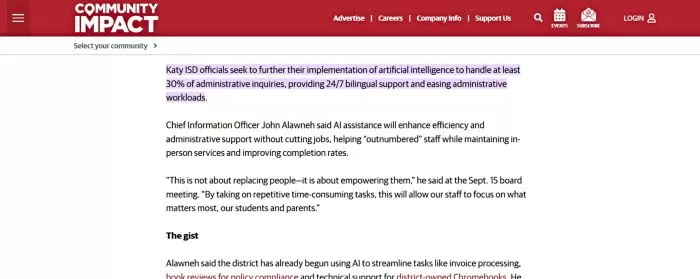
Example: Katy Independent School District (Texas, USA): Facing a growing administrative burden, Katy ISD recognized that its support staff were “outnumbered” by high volumes of repetitive tasks (answering routine inquiries, data entry, etc.). District leaders set a concrete goal for their AI initiative: have AI handle roughly 30% of routine administrative inquiries – with 24/7, bilingual support – so that human staff can focus on high-value interactions. This target was born from a needs assessment of where staff time was being drained. By defining this goal (30% automation of inquiries), Katy ISD created a clear metric for success and a focused vision: use AI as a virtual assistant to improve responsiveness to families while freeing staff for more complex student and parent needs.
Research and Select the Right Tools Not all AI tools are created equal. Once you’ve identified priorities, explore tools designed for education. Look for platforms that integrate easily with your existing systems (SIS, LMS, HR) and are user-friendly for staff. Prioritize solutions with strong vendor support and a track record in the education sector. Talking to peer institutions or reviewing relevant case studies can offer valuable insights.
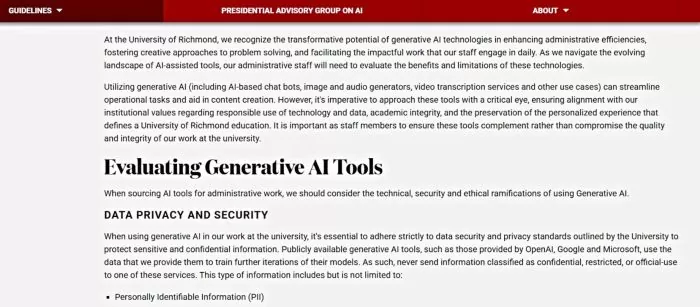
Example: University of Richmond (Virginia, USA): In higher education, institutions are also methodical in choosing AI for administrative use. The University of Richmond explicitly notes the “transformative potential of generative AI…in enhancing administrative efficiencies”, but pairs that excitement with careful evaluation criteria. In official staff guidelines, the university directs its administrative teams to critically vet AI tools for technical fit, security, and ethical considerations. Staff are encouraged to pilot new AI-based services (from chatbots to transcription tools) in a controlled manner – checking that any chosen tool aligns with data privacy policies and the university’s values.
Start with a Pilot Choose a small-scale pilot to test your chosen tool. This might mean introducing a scheduling AI in one department or using a chatbot for financial aid inquiries. Track outcomes closely—are tasks being completed faster? Are users more satisfied? Gather feedback and refine the approach before expanding. A strong pilot builds confidence and creates internal champions.
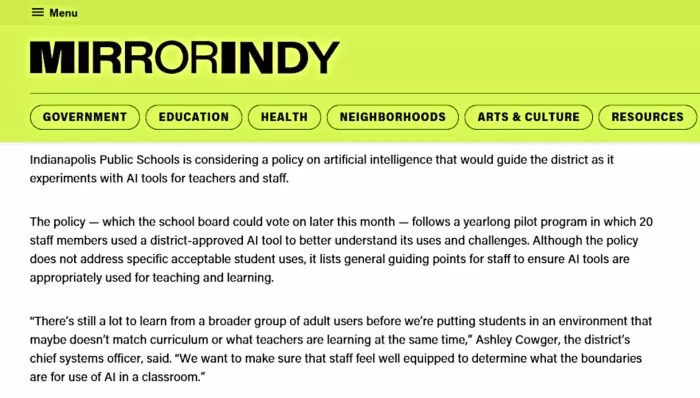
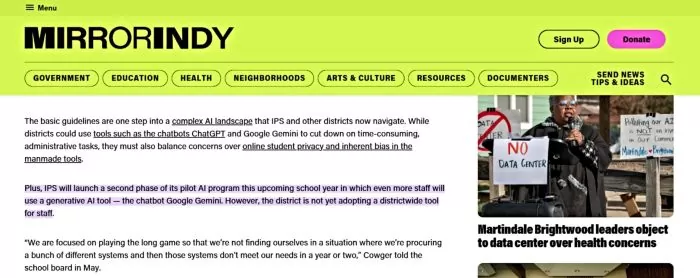
Example: Indianapolis Public Schools (Indiana, USA): IPS illustrates the wisdom of beginning AI adoption on a small scale. In the first year of its AI initiative, the district ran a pilot with just 20 staff members using a district-approved AI tool to handle some of their tasks. This limited pilot let IPS observe real-world uses and challenges (e.g., how an AI writing assistant might help draft reports) without impacting all schools. District leaders gathered feedback and saw improvements, which informed an official AI policy in development. This phased pilot approach gave IPS the chance to refine guidelines and train users in between phases.
Train Staff and Build Buy-In Training is critical. Provide hands-on sessions, user guides, and a forum for questions. Explain how the AI will support, not replace, staff, and share early successes. Framing AI as a helpful assistant rather than a threat makes adoption smoother. Emphasize the time-saving potential and how it frees up staff for more meaningful work.
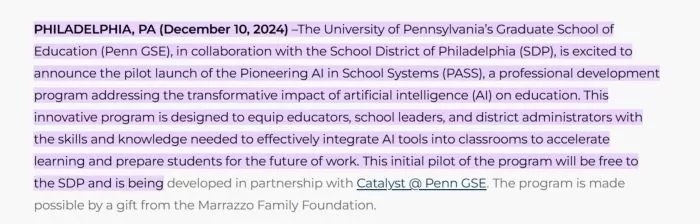
Example: School District of Philadelphia (Pennsylvania, USA): Philadelphia’s public school system, in partnership with the University of Pennsylvania, launched a first-of-its-kind AI training pilot to ensure educators and administrators were on board and prepared. The program, called PASS (Pioneering AI in School Systems), was announced in late 2024 and offers multi-tiered professional development free to a pilot group of district staff. Crucially, PASS explicitly targets mindset and skill-building: it trains district administrators on strategic planning for AI, guides school leaders on implementing AI tools in their schools, and coaches teachers on using AI to enhance (not replace) instruction.
Scale Gradually and Integrate Thoughtfully With a successful pilot in hand, plan for phased implementation. Avoid overwhelming staff by rolling out AI features in stages: first attendance, then scheduling, then reporting. Make sure each step integrates well with existing workflows. Be prepared to revise outdated processes to accommodate the new tool, and keep communication open throughout the transition.
Example: Indianapolis Public Schools (Indiana, USA): After its initial small-scale pilot, IPS is deliberately not rushing into a district-wide rollout – exemplifying thoughtful integration. The district is entering a second pilot year with more staff and a new tool (Google’s Gemini chatbot), but has held off on immediately procuring a permanent, system-wide AI platform. This restraint is intentional: IPS leaders want to ensure any AI tool is truly effective and fits their needs before integrating it into all schools. They are also developing an AI Advisory Committee (including administrators, teachers, tech, and legal experts) to guide integration and update usage policies as the pilot expands. By scaling usage gradually – first 20 staff, now a larger cohort, still not yet student-facing – IPS can adjust its data integration, security settings, and training materials in parallel.
Monitor, Measure, Improve Implementation doesn’t stop at rollout. Regularly assess whether the AI is meeting your goals. Track KPIs like time saved, error rates, or satisfaction levels. Use this data to fine-tune the system and report outcomes to stakeholders. AI platforms often improve with use, especially those built on machine learning. Feeding back your school’s data will make them more effective over time.
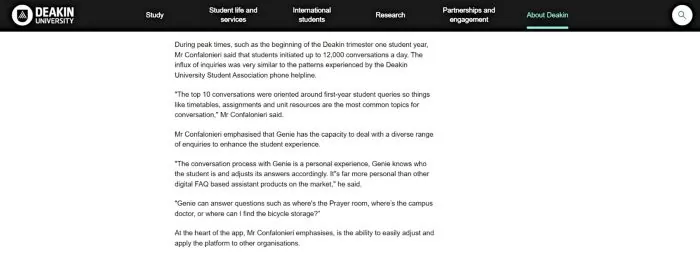
Example: Deakin University (Victoria, Australia): Deakin’s IT and administrative teams exemplify continuous improvement with their AI-powered student services. The university’s digital assistant “Genie” was rolled out in stages and is closely monitored for usage and performance. Since launching across campus, Genie’s user base has more than doubled within a year over 25,000 students having downloaded the app, a metric the university tracks to gauge adoption. Deakin’s Chief Digital Officer noted they analyze conversation data: at peak times, Genie handles up to 12,000 conversations a day, and they review the top categories of student questions (e.g., timetable info, assignment deadlines). By identifying the most common inquiries, the team continuously updates Genie’s responses and adds new features. This ongoing measurement extends to quality checks – the university monitors whether Genie’s answers resolved students’ issues or if human staff had to follow up, informing further training of the AI.
Foster a Culture of Innovation Successful AI integration requires a mindset shift. Leaders should create an environment where staff feel empowered to try new approaches and share feedback. Celebrate wins, learn from setbacks, and reinforce that AI is a tool to enhance human capacity, not replace it.
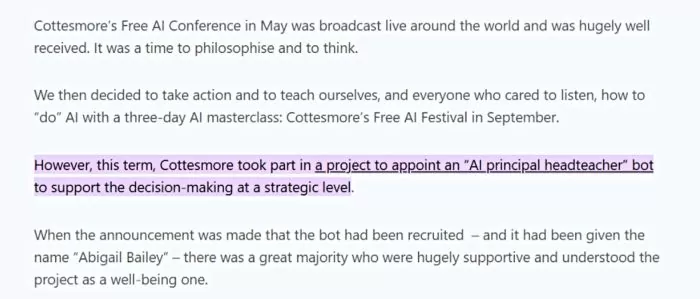
Example: Cottesmore School (West Sussex, UK): This independent boarding school has embraced an innovation-first culture in its administration, particularly with AI. Headmaster Tom Rogerson gained international attention in 2023 for appointing an AI chatbot as an “assistant headteacher” – named “Abigail Bailey” – to support strategic decision-making. The move was less about the tech itself and more about signaling to staff and students that experimenting with new ideas is welcome. Rogerson frames the project as a well-being and innovation initiative: the AI assistant serves as a “strategic leadership mentor,” providing impartial insights, while human leaders remain in charge. In addition to this high-profile experiment, Cottesmore has hosted free AI conferences and masterclasses for educators. For example, the school ran an “AI Festival” where staff from Cottesmore and other schools tried out AI tools and shared ideas in a collaborative environment. By openly discussing both the opportunities and challenges of AI, and even inviting outside experts to weigh in, the headmaster created a safe space for his team to be curious and creative.
Implementing AI in school administration is an ongoing journey, but with a clear strategy and commitment to collaboration, schools can unlock new levels of efficiency, insight, and impact. The result is a smarter, more responsive administrative operation that supports the broader mission of education.
Final Thoughts
AI is transforming education management by enhancing, not replacing, the work of school administrators. It takes on time-consuming tasks, delivers faster insights from data, and strengthens communication with students, families, and staff. The result is more time for leaders to focus on strategy, mentorship, and school culture.
At HEM, we view AI as a vital part of a modern, responsive education strategy. Schools that adopt AI thoughtfully are better prepared to navigate enrollment shifts, budget pressures, and rising expectations. The key is clear planning, ethical use, and keeping people at the centre.
AI gives administrators the support they need to lead more effectively. With the right approach, it can elevate the quality and impact of school leadership.
Are you ready to improve visibility, engagement, and enrollment?
Partner with HEM for solutions designed to help your institution stand out.
Frequently Asked Questions
Question: How does AI help school administrators make better decisions?
Answer: AI’s greatest strength in school management lies in transforming raw data into clear, actionable insights. Administrators regularly face overwhelming volumes of information, grades, attendance, budget reports, and surveys that can be difficult to parse manually. AI tools help by quickly identifying patterns that support evidence-based decisions.
Question: What routine administrative tasks can AI automate in schools?
Answer: From attendance logs to class schedules, school administrators are buried in repetitive tasks that sap time and focus. AI is stepping in to take care of the busywork, streamlining operations and giving staff space to lead more strategically.
Question: What challenges do schools face when implementing AI tools?
Answer: The potential of AI in education is vast, but unlocking it requires more than just installing a new tool. For school administrators, adopting AI often brings a mix of excitement and logistical complexity.
The silence of America’s elite is deafening. Jeffrey Sonnenfeld, Yale professor and corporate leadership expert, does not hesitate to call it out. In a recent email, he warned that the nation’s corporate, academic, and religious leaders—once the backbone of moral and civic accountability—are now “smugly, safely, silently on the sidelines,” while authoritarian forces surge.
“Nope,” Sonnenfeld wrote, “but it’s high time for the neo whiners to get off their lazy, cowardly butts and follow the courageous path of activists across sectors and fields from the 1960s and 1970s. It took nine years to get the No Kings rallies going. Shameful.”
He recalls an era when activism cut across sectors: interfaith clergy, college presidents—from elite universities to small faith-based institutions and HBCUs—trade union leaders, professional associations, environmentalists, and human rights advocates all marched together. Blue state treasurers and attorneys general held corporations accountable; red state officials sometimes applied pressure from the opposite side. CEOs, Sonnenfeld reminds us, are mostly “hired hands, stewards of other people’s money” who respond to engaged stakeholders. Without pressure, they retreat into inaction.
Today, the chorus of accountability is eerily silent. Clergy barely speak out. University presidents remain cautious. Activists blog while the nation teeters. Sonnenfeld’s indictment is clear: where once there was collective courage, there is now passivity—an effective alignment with the very forces undermining democracy.
In practical terms, elite inaction has consequences. Trump and his allies wield influence not only through electoral politics but by exploiting institutional inertia. By failing to mobilize, elites—through default inaction—allow a political agenda that often mirrors their own neoliberal priorities to advance unchecked: deregulation, tax favoritism, corporate consolidation, and a shrinking social safety net.
Sonnenfeld’s challenge is urgent: Will today’s corporate boards, clergy, and academic leaders rise to the occasion, reclaim the moral authority they once wielded, and demand accountability from those they employ and fund? Or will the next generation of Americans grow up seeing democracy as a performance, not a lived responsibility?
The 1960s and 1970s were not perfect, but they demonstrated what cross-sectoral solidarity could achieve. Today, silence is complicity. In a nation at moral and political crossroads, elites cannot afford to play it safe. History is watching—and so is the rest of the world.
The standout quote for me from new Office for Students (OfS) commissioned research on student consumer rights comes from a 21-year-old undergrad in a focus group:
If you were unhappy with your course, I don’t know how you’d actually say to them, ‘I want my money back, this was rubbish,’ basically. I don’t think that they would actually do that. It would just be a long, drawn-out process and they could just probably just argue for their own sake that your experience was your experience, other students didn’t agree, for example, on your course.
There’s a lot going on in there. It captures the power imbalance between students and institutions, predicts institutional defensiveness, anticipates bureaucratic obstacles, and reveals a kind of learned helplessness – this student hasn’t even tried to complain, and has already concluded it’s futile.
It’s partly about dissatisfaction with what’s being delivered, and a lack of clarity about their rights. But it’s also about students who don’t believe that raising concerns will achieve anything meaningful.
Earlier this year, the regulator asked Public First to examine students’ perceptions of their consumer rights, and here we have the results of a nationally representative poll of 2,001 students at providers in England, alongside two focus groups.
On the surface, things look pretty healthy – 83 per cent of students believe the information they received before enrolment was upfront, clear, timely, accurate, accessible and comprehensive, and the same proportion say their learning experience aligns with what they were promised.
But scratch a bit and we find a student body that struggles to distinguish between promises and expectations, that has limited awareness of their rights, that doesn’t trust complaints processes to achieve anything meaningful, and that is largely unaware of the external bodies that exist to protect them.
Whether you see this as a problem of comms, regulatory effectiveness, or student engagement probably depends on where you sit – but it’s hard to argue it represents a protection regime that’s working as intended.
Learning to be helpless
Research on complaints tends towards five interlocking barriers that prevent people from holding institutions and service providers to account – and each of them can be found in this data.
There’s opportunity costs (complaining takes time and energy), conflict aversion (people fear confrontation), confidence and capital (people doubt they have standing to complain), ignorance (people don’t know their rights), and fear of retribution (people worry about consequences). In this research, they combine to create an environment in which students who experience problems just put up with them.
When they were asked about the biggest barrier to making a complaint, the top answer was doubt that it would make a difference – cited by 36 per cent of respondents. The polling also found that 26 per cent of students said they have “no faith” that something would change if they raised a complaint, and around one in six students (17 per cent) disagreed with the statement “at my university, students have a meaningful say in decisions that affect their education.”
One postgrad described the experience of repeatedly raising concerns about poor organisation:
People also just don’t think anything’s going to happen if they make a complaint, like I don’t think it would. With my masters’, it was so badly organised at the start, like we kept turning up for lectures and people just wouldn’t turn up and things like that […] We had this group chat and we were all like, ‘What’s going on? We’re paying so much money for this,’ and […] it just seemed like no one knew what was going on, but we raised it to the rep to raise it to like one of the lecturers and then […] it would just still happen. So it’s like they’re not going to change it.
That’s someone who tried to work the system, followed the proper channels, raised concerns through the designated representative – and concluded it was futile.
The second most common barrier captures the opportunity costs thing – lack of time or energy to go through the process, cited by 35 per cent. Combined with doubting it would make a difference, we end up with a decent proportion of students who have cost-benefit analysed complaining and decided it’s not worth the effort. Domestic students were particularly likely to cite futility as a barrier – 41 per cent versus 25 per cent of international students.
They’ve learned helplessness – and only change their ways when failures impact their marks, only to find that “you should should have complained earlier” is the key response they’ll get when the academic appeal goes in.
Fear of retribution is also in there. About a quarter of students cited concern that complaining might affect their grades or relationships with staff (25-26 per cent) or said they felt intimidated or worried about possible consequences (23-26 per cent). A postgraduate put it bluntly:
I think people are scared of getting struck off their course.
Another student imagined what would happen if they tried to escalate to an external body:
I think [going to the OIA] would have to be a pretty serious thing to do, and I think that because it’s external to the university, I’d feel a little bit like a snitch. I would have to have a lot of evidence to back up what I’m saying, and I think that it would be a really long, drawn-out process, that I ultimately wouldn’t really trust would get resolved. And so I just wouldn’t really see it as worth it to make that complaint.
That’s the way it is
What are students accepting as just how things are? The two things students were most likely to identify as promises from their university were a well-equipped campus, facilities and accommodation (79 per cent) and high quality teaching and resources (78 per cent).
Over three-quarters of students said the promises made by their university had not been fully met – 59 per cent said they had been mostly met, 14 per cent partially met and 1 per cent not met at all, leaving just 24 per cent who thought promises had been fully met.
Yet fewer than half of respondents said these were “clear and consistent parts of their university experiences” – 42 per cent for physical resources and just 37 per cent for teaching and resources. In other words, the things students most clearly remember being promised are precisely the things that, for a large minority, show up as patchy, unreliable features of day-to-day university life rather than dependable fixtures.
There’s also a 41 percentage point gap between what students believe they were promised on teaching quality and what they report actually experiencing – 78 per cent say high quality teaching and resources were promised, but only 37 per cent say that kind of provision is a clear and consistent part of their experience. Public First note that “high quality” wasn’t explicitly defined in the polling, so these are students’ own judgements rather than a technical standard – but the size of the mismatch is still striking.
About a quarter of students (23 per cent) reported receiving lower quality teaching than expected, rising to 26 per cent among undergraduates. Twenty-two per cent experienced fewer contact hours and more online or hybrid teaching than expected, and twenty-one per cent reported limited access to academic staff.
One undergraduate described being taught by someone who made clear he didn’t want to be there:
One of our lecturers, he wasn’t actually a sports journalism lecturer, he’s just off the normal journalism course, and he made it pretty clear that he didn’t like any of us and he didn’t want to be there when he was teaching us. And we basically got told that we had to go and get on with it, pretty much. So there wasn’t any sort of solution of, ‘We’ll change lecturers,’ or anything, it’s just, ‘You’ll get in more trouble if you don’t go, so just get on with it and finish it.
When presented with a list of possible disruptions and asked which they’d experienced, 70 per cent identified at least one type. The most common was cancellation or postponement of in-person teaching, reported by 35 per cent of undergraduates. Industrial action affecting teaching or marking hit 20 per cent of students overall, and 16 per cent said it had significantly impacted their academic experience.
Limited support from academic staff affected 20 per cent overall, rising to one in four postgraduate students – and this was the disruption that students were most likely to say had significantly impacted their experience (23 per cent overall, climbing to 32 per cent among international students).
Telling is how dissatisfied students were with institutional responses to disruptions. Forty-two per cent said they were not that satisfied or not at all satisfied with their institution’s response to cancelled or postponed teaching – 45 per cent said the same about the response to strikes or industrial action. In other words, students experienced disruption, they weren’t happy with how it was handled, and yet most didn’t complain, because (again) they didn’t think it would achieve anything.
Informal v informant
Unsurprisingly, most students (65 per cent) had never lodged a formal complaint against their institution. On its face, that could look like satisfaction – if students aren’t complaining, perhaps things are generally fine. But when you dig into the reasons students give for not complaining, about one in four students (24 per cent) who hadn’t complained said they weren’t confident they’d know how to go about it – that’s the ignorance barrier.
And the bigger obstacles weren’t procedural – they were about believing it was pointless or fearing consequences.
When students did complain, they were at least twice as likely to have done so through informal channels (such as course representatives or conversations, 23 per cent) than through formal procedures (11 per cent). That’s your conflict aversion in action – you try the informal route first, see if you can get something fixed quietly without escalating to a formal process that might create confrontation.
But it also means the formal complaints processes that are supposed to provide accountability and redress (and documented institutional learning) are being bypassed by students who’ve concluded they’re not worth engaging with.
Among those who did complain formally, around half (54 per cent) felt satisfied with their institution’s handling of it – which means nearly half didn’t. So if you’re a student considering whether to raise a complaint, and you believe there’s roughly a 50-50 chance it won’t be handled satisfactorily, if you’ve already concluded there’s a strong likelihood it won’t change anything anyway, why would you bother?
Especially when you add in the other barriers – concern it might affect grades or relationships with staff, feeling intimidated or worried about consequences, lack of trust in the university to handle it fairly.
The focus groups reinforce the picture of systematic dismissal. One undergraduate explained the calculation:
If you were unhappy with your course, I don’t know how you’d actually say to them, ‘I want my money back, this was rubbish,’ basically. I don’t think that they would actually do that. It would just be a long, drawn-out process and they could just probably just argue for their own sake that your experience was your experience, other students didn’t agree, for example, on your course.
That’s someone that has already mapped out in their head exactly how the institution would respond – they’d argue it’s subjective, other students were happy, your experience doesn’t represent a breach of contract. And, of course, they’re probably right.
An entitled generation
If students don’t believe complaining will achieve anything, part of the reason is that they don’t really understand what they’re entitled to expect in the first place. The research found that only 50 per cent of students said they understood and could describe their rights and entitlements as a student – which very much undermines the whole premise of students as empowered consumers able to hold institutions to account.
When asked how well informed they felt about various rights, the results were even worse. Only 32 per cent of students felt well informed about their right to fair and transparent assessment – the highest figure for any right listed. More than half (52 per cent) said they felt not that well informed or not at all informed about their right to receive compensation. You can’t assert rights you don’t know you have.
The focus groups then show just how fuzzy students’ understanding of “promises” really is. Participants found it difficult to identify what had been explicitly promised to them, with received ideas about higher education playing a significant role in shaping student expectations.
They could articulate areas where their experiences fell short – reduced contact hours, poor teaching quality, limited access to careers support – but struggled to identify where these amounted to broken promises.
One undergraduate captured this confusion as follows:
I personally think I do get what I was promised when I applied to university. Not like I’m an easy-going person or anything, but I do get what I need in the university, yes.
Notice the subtle shift from “promised” to “need” – the student can’t quite articulate what was promised, so they fall back on whether they’re getting what they need, which is a much vaguer and more subjective standard.
This matters a lot, because if you don’t know what you were promised, you can’t confidently assert that a promise has been broken. You might feel disappointed, you might think things should be better, but you can’t point to a specific commitment and say “you told me X and you’ve given me Y.”
Which means that even when students want to complain, they’re starting from a position of uncertainty about whether they have grounds to do so. It’s the perfect recipe for learned helplessness – you’re dissatisfied, but you’re not sure if you’re entitled to be dissatisfied, so you conclude it’s safer to just accept it.
The one clear exception? Doctoral students, who were confident they’d been promised the support of a supervisor:
When I was applying for a PhD, I applied to several universities, so I was selected and accepted in [Institution A] and [Institution B], but I decided to come to [Institution A] for the supervisor – he interviewed me, he sent me the acceptance letter.
Getting on the escalator
If the picture so far suggests a system where students lack confidence in internal complaints processes, the findings on external avenues for redress make sense. Only 8 per cent of all students had heard of the Office of the Independent Adjudicator (OIAHE), and the focus groups confirm there was “little to no awareness of external organisations or avenues of redress for students”.
More broadly, more than a third (35 per cent) of students said they were unaware of any of the external organisations or routes listed through which students in England can raise complaints about their university – rising to 41 per cent among undergraduates and 38 per cent among domestic students. The list they were shown included the OIA, the OfS, Citizens Advice, solicitors, local MPs, the QAA, and trade unions or SUs like NUS. More than a third couldn’t identify a single one of these as somewhere you might go with a concern about your university.
As for OfS itself, just 18 per cent of students overall had heard of it, falling to 14 per cent among undergraduates. Let’s go ahead and assume that they’ve not read Condition B2.
When asked where they would go for information about their rights, the most common answer was the university website (53 per cent) or just searching online (51 per cent). About 42 per cent said they’d look to their SU for information about rights. That’s positive – SUs are meant to provide independent advice and advocacy for students. But the fact that only 42 per cent think to go there, versus 53 per cent who’d go to the university website, suggests SUs aren’t being seen as the first port of call.
Among postgraduates in the focus groups, there was “limited interest in the use of these avenues for redress”, with the implicit sense that if intra-institutional channels of redress seemed drawn-out, daunting and potentially fruitless, it was unlikely that “resorting to extra-institutional channels would make the situation better”. If students have concluded that internal processes are bureaucratic and ineffective, they’re not going to invest additional time and energy in external ones – especially when they don’t know those external routes exist in the first place.
Explorations
It’s an odd little bit of research in many ways. It’s hard to tell if recommendations have been deleted, or just weren’t asked for – either way, they’re missing. It’s also frustratingly divorced from OfS’ wider work on “treating students fairly” – I know from my own work over the decades that students tend initially to be overconfident about their rights knowledge, only to realise they’ve over or undercooked when you give them crunchier statements like these “prohibited behaviours” (which of course only seem to be “prohibited”, for the time being, in providers that will join the register in the future).
More curious is the extent to which OfS knows all of this already. Six years ago this board paper made clear that consumer protection arrangements were failing students on multiple fronts. It knew that information available to support student choice was inadequate – insufficiently detailed about matters that actually concern students and poorly structured for meaningful comparisons between providers and courses, with disadvantaged students and mature learners particularly affected by lack of accessible support and guidance.
It knew that the contractual relationship between students and providers remains fundamentally unequal, with ongoing cases of unclear or unfair terms that leave students uncertain about what they’re actually purchasing in terms of quality, contact time, support and costs, while terms systematically favoured providers.
It also knew that its existing tools weren’t allowing intervention even when it saw evidence that regulatory objectives were being delivered, and questioned whether a model requiring individual students to challenge providers for breaches was realistic or desirable.
So many things would help – recognition of the role of student advocacy, closer adjudication, better coordination between OfS and the OIA, banning NDAs for more than sexual misconduct are four that spring to mind, all of which should be underpinned by a proper theory of change that assumes that not all power over English HE is held in Westward House in Bristol.
If students have concluded that complaining is futile, there are really three possible responses. One would be to figure that the promises being made raise expectations too high. But there are so many actors specifically dedicated to not talking down a particular university or the sector in general as to render “tell them reality” fairly futile.
Another is to try to convince them they’re wrong – better communications about rights, clearer signposting of redress routes, more prominent information about successful complaints. You obviously can’t give that job to universities.
The third would be to ask what would need to change for complaining to actually be worthwhile. That would require processes that are genuinely quick and accessible, institutional cultures where raising concerns is welcomed rather than seen as troublemaking, meaningful remedies when things go wrong, and external oversight bodies that can intervene quickly and effectively.
But there’s no sign of any of that. A cynic might conclude that a regulator under pressure to help providers manage their finances might need to keep busy and look the other way while modules are slashed and facilities cut.
Why this matters more than it might seem
Over the years, people have asserted to me that students-as-consumers, or even the whole idea of student rights, is antithetical to the partnership between students and educators required to create learning and its outcomes.
“It’s like going to the gym”, they’ll say. “You don’t get fit just by joining”. Sure. But if the toilets are out of order or the equipment is broken, you’re not a partner then. The odd one will try it on. But most of them are perfectly capable of keeping two analogies in their head at the same time.
In reality, it’s not rights but resignation, when it becomes systematic, that corrodes the basis on which the student-university relationship is supposed to work. If students don’t believe they can hold institutions to account, then all the partnership talk in the world becomes hollow.
National bodies can write ever more detailed conditions about complaint processes, information provision, and student engagement. Universities can publish ever more comprehensive policies about policies and redress mechanisms. None of it matters if students have concluded that actually using those mechanisms is futile.
There’s something profoundly upsetting about a system where three-quarters of students believe promises haven’t been kept, but most conclude there’s no point complaining because nothing will change. It speaks to a deeper breakdown than just poor communications or inadequate complaints processes.
It’s precisely because students aren’t just consumers purchasing a service that we should worry. They’re participants in an institution that’s supposed to be about more than transactions. Universities ask students to trust them with years of their lives, substantial amounts of money (whether paid upfront by international students or through future loan repayments by domestic students), and significant life decisions about career paths and personal development.
In return, students are supposed to be able to trust that universities will deliver what they promise, listen when things go wrong, and be held accountable when they fail to meet their end of the deal.
The parallels with broader social contract failures are hard to miss. Just as students don’t believe complaining will change anything at their university, many young people don’t believe political engagement will change anything in society more broadly. Just as students have concluded that formal institutional processes are unlikely to deliver meaningful redress, many citizens have concluded that formal democratic processes are unlikely to deliver meaningful change.
The learned helplessness this research documents in higher education mirrors learned helplessness – which later turns to extremism – in civic life.
I don’t think I’ve ever heard of any uni willing to reimburse or cover if they’ve done a poor job of teaching. That’s never come to me.
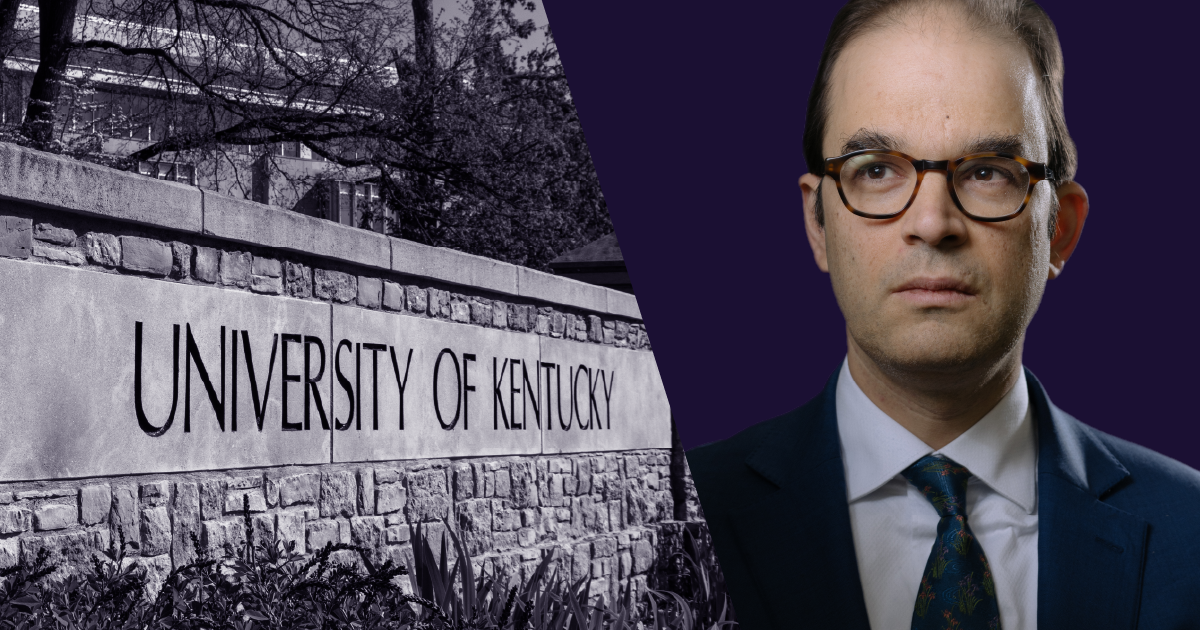
The University of Kentucky suspended tenured professor Ramsi Woodcock in July for his comments about Israel. Now, Woodcock is suing his university for violating his First Amendment rights.
Woodcock’s lawsuit, filed last week in federal district court in Kentucky, asks the judge for two things: let him go back to teaching and stop the university from enforcing the International Holocaust Remembrance Alliance’s definition of antisemitism.
The lawsuit lays out a damning timeline of UK’s abuse of his First Amendment rights. Woodcock, long an outspoken critic of Israel, remained steadily employed at UK for seven years, gaining tenure in 2022 and a promotion to full professorship this year. But less than two weeks after his promotion, UK removed him from teaching and banned him from campus. This was purportedly because of unspecified complaints about his petition to a faculty listserv in March 2024, more than a year earlier, calling for global war against Israel and its annihilation. On his website, antizionist.net, he claims Israel is waging a genocide and that the world has a “moral duty” to step in.
After UK suspended Woodcock, describing his online petition as “calling for the destruction of a people based on national origin,” FIRE’s Faculty Legal Defense Fund, which provides legal resources for faculty free of charge, intervened with UK to explain that Woodcock’s speech was protected by the First Amendment. While members of the public or UK’s community may have taken offense to Woodcock’s strong views about Israel, faculty members have the First Amendment right to present arguments on matters of public concern outside the classroom. Using Woodcock’s speech as a cudgel to remove him from the classroom was a clear violation of his expressive rights as a faculty member at UK.
The FLDF also announced that Joe Childers, a Kentucky-based attorney, would defend Woodcock through the university’s investigative process. Now Woodcock is taking his fight to court. The Council on American-Islamic Relations (CAIR) is representing Woodcock in the lawsuit, with help from the Chicago-based law firm Kapitan Gomaa Law. Childers is serving as local counsel.
“The University’s suspension of Professor Woodcock violates his First Amendment right of freedom of expression and his right to procedural due process, discriminates against him in violation of the Civil Rights Act of 1866, threatens the democratic principles which sustain this Country’s form of government, and degrades the quality of education at the University of Kentucky,” the lawsuit states.
A university cannot censor the ideas it dislikes out of existence. And it certainly cannot punish its own faculty for making provocative arguments both at the university and in the court of public opinion. FIRE will keep readers apprised about the status of Woodcock’s lawsuit.
If you are a public university or college professor facing investigations or punishment for your speech, contact the Faculty Legal Defense Fund: Submit a case or call the 24-hour hotline at 254-500-FLDF (3533).
by John Katzman, The Hechinger Report November 19, 2025
The Trump administration’s dismantling of the U.S. Department of Education this week provides a rare opportunity to rethink our current top-down approach to school governance.
We should jump on it. It’s not sexy to talk about governance, but we can’t fix K-12 education until we do so, no matter how we feel about the latest changes.
Since the Department of Education opened in 1980, we’ve doubled per-pupil spending, and now spend about twice as much per student as does the average country in the European Union. Yet despite that funding — and the reforms, reports and technologies introduced over the past 45 years — U.S. students consistently underperform on international benchmarks. And people are opting out: 22 percent of U.S. district students are now chronically absent, while record numbers of families are opting out of those schools, choosing charters, private schools and homeschooling.
Most federal and state reform approaches have been focused on curricular standards and have accomplished little. The many billions spent on the Common Core standards coincided with — or triggered — a 13-year decline in academic performance. The underlying principles of the standards movement — that every student should learn the same things at the same time, that we know what those things are and that they don’t change over time — have made our schools even less compelling while narrowing instruction to what gets tested.
We need to address the real problem: how federal, state and district rules combine to create a dense fog of regulations and directives that often conflict or constrain one another. Educators are losing a rigged game: It’s not that they’re doing the wrong things, it’s that governance makes them unresponsive, bureaucratic, ineffective and paralyzed — can you name an industry that spends less on research and development?
Fixing governance won’t be simple, but it shouldn’t take more than 13 years to do it: three years to design a better system of state governance and 10 more to thoroughly test and debug it.
I would start by bringing together experts from a variety of disciplines, ideally at a new “Center for K-12 Governance” at a university’s school of education or school of public policy, and give them three years to think through a comprehensive set of state laws and regulations to manage schools.
The center would convene experts from inside and outside of education, in small groups focused on topics including labor, funding, data, evaluation, transportation, construction, athletics, counseling, technology, curricula and connections to higher education and the workforce. Its frameworks would address various educational and funding alternatives currently in use, including independent, charter and parochial schools, home schooling and Education Savings Accounts, all of which speak to the role of parents in making choices about their children’s education.
Each group would start with the questions and not the answers, and there are hundreds of really interesting questions to be considered: What are the various goals of our K-12 schools and how do we authentically measure schools against them? What choices do we give parents, and what information might help them make the right decisions for their kids? How do we allow for new approaches to attract, support and pay great teachers and administrators? How does money follow each student? What data do we collect and how do we use it?
After careful consideration, the center would hand its proposed statutes to a governor committed to running a long-term pilot to fully test the model. He or she would create a small alternative department of education, which would oversee a few hundred volunteer schools matched to a control group of similar schools running under the state’s legacy regime; both groups would include schools with a range of demographic and performance profiles. The two systems could run side by side for up to a decade.
Each year, the state would assess the two departments’ performance against metrics like graduation and college-completion rates, teacher retention, income trajectories, civic participation, student and parent satisfaction, and, yes, NAEP scores. Under intense scrutiny by interested parties, both groups would be free to tweak their playbooks and evaluate solutions against a range of real-world outcomes. Once definitive longitudinal data comes in, the state would shutter one department and move the governance of its schools over to the other, perhaps launching a new test with an even better system.
This all may seem like a lot of work, but it’s a patient approach to a root problem. Schools remain the nation’s most local public square; they determine income mobility, civic health and democratic resilience. If we fail to rewire the system now to support them properly, we guarantee their continued decline, to the detriment of students and society. Instead of celebrating students, teachers and principals who succeed despite the odds, we should address why we made those odds so steep.
That’s why we should use this moment to draft and test something audacious, and give the next Supreme Court a happier education case to decide: how to retire a legacy system that finally lost a fair fight.
John Katzman has founded and run three large ed tech companies: The Princeton Review, 2U and Noodle. He has worked closely with many large school districts and has served on the boards of NAPCS and NAIS.
This story about fixing K-12 education was produced by The Hechinger Report, a nonprofit, independent news organization focused on inequality and innovation in education. Sign up for Hechinger’sweekly newsletter.
This <a target=”_blank” href=”https://hechingerreport.org/opinion-it-will-take-patience-and-courage-to-fix-k-12-education-without-the-department-of-education/”>article</a> first appeared on <a target=”_blank” href=”https://hechingerreport.org”>The Hechinger Report</a> and is republished here under a <a target=”_blank” href=”https://creativecommons.org/licenses/by-nc-nd/4.0/”>Creative Commons Attribution-NonCommercial-NoDerivatives 4.0 International License</a>.<img src=”https://i0.wp.com/hechingerreport.org/wp-content/uploads/2018/06/cropped-favicon.jpg?fit=150%2C150&ssl=1″ style=”width:1em;height:1em;margin-left:10px;”>
Amazon removed several James Bond posters last month after fans noticed that Bond’s iconic Walther PPK pistol had been airbrushed out of each one. Sean Connery and Pierce Brosnan were left standing in various awkward poses, raising their empty hands.
The posters, which Prime Video had put up for Global James Bond Day on Oct. 5, were later replaced with “safer” film stills, most of which still omitted firearms.
If the edit felt eerie, it also felt familiar. Last year, Prime Video displayed Philip Castle’s Full Metal Jacket poster. But the words “Born to Kill,” which originally appeared next to a peace sign in reference to the film’s core theme of the duality of man, were notably absent from Private Joker’s helmet. After actor Matthew Modine objected, and Warner Bros. intervened, Amazon restored the original artwork. But no explanation followed.
These edits aren’t one-offs. They follow Amazon’s own rules. Prime Video’s artwork requirements tell partners to “avoid adult or profane language” in titles, “keep text to a minimum,” and “avoid images of . . . guns, or other weapons.” If a realistic firearm appears, it cannot be dominant, aimed, in use, or pointed at the viewer. A companion Graphic Assets Guide adds, “We avoid using violence in Amazon promotions.”
From a corporate perspective, such guidelines serve practical aims: Amazon cites maintaining brand safety and optimizing user interfaces as reasons for these rules. As a private entity, Amazon can prioritize those goals above third-party expressive interests; the company has its own First Amendment right to exercise editorial discretion about what it posts online. Amazon has no legal obligation to carry every title or preserve every poster exactly as originally designed.
Yet when Amazon treats works like the iconic Full Metal Jacket poster as expendable marketing collateral, editing them for risk management rather than preserving them as legacy art, the result is cultural bowdlerization. In a Bond poster, a pistol is not merely decorative — it’s essential to the franchise’s aesthetic.
After the opening credits, what’s Bond’s first move? He breaks the fourth wall by shooting the viewer. In Full Metal Jacket, “Born to Kill” isn’t just a slogan — it embodies the film’s thesis that there are no good or bad people, but that inclinations toward peace and violence run through each of us. Removing these elements doesn’t make the images safer. It makes them artistically compromised, less reflective of their cinematic and literary sources.
Bond and Private Joker aren’t the only victims either. In recent years, Prime Video has removed, demoted, or delayed a number of controversial films — often without a clear rationale. In 2019, Amazon removed several anti-vaccine documentaries, hours after Rep. Adam Schiff wrote an open letter asking Amazon CEO Jeff Bezos to curb such content. Private platforms can decide how to treat third-party content they publish, but doing so based on government pressure is to succumb to a form of censorship-by-proxy known as “jawboning” — which, as FIRE Legal Director Will Creeley recently told the Senate Commerce Committee, violates the First Amendment.
During Black History Month in 2021, the documentary Created Equal: Clarence Thomas in His Own Words disappeared from Amazon’s catalog without explanation — and returned only after media coverage of its removal. Amazon’s self‑distribution portal initially rejected conservative writer Shelby Steele’s documentary What Killed Michael Brown? before it later appeared on Prime Video. In late 2023, Amazon removed the Russiagate documentary The Plot Against the President. A source toldNewsweek the takedown wasn’t political, but Amazon didn’t elaborate. In 2024, filmmaker Robby Starbuck said Prime Video banned his documentary The War on Children. Months later, it was available on Amazon again.
Even where calling something a “ban” is overstated, the optics create a chilling pattern: clumsy decisions first and clarity later, but only when pressed. Early coverage of FIRE’s own documentary, The Coddling of the American Mind,even asked whether Amazon would carry it. It’s now rentable on Prime Video, but Amazon’s distribution lagged behind the premiere.
Globally, Amazon often adjusts content to satisfy illiberal governments. A Citizen Lab study of Amazon’s U.S. storefront found 17,050 products — mainly books — restricted from shipment to certain regions. The clusters weren’t random either. LGBT topics, Christianity, erotica, the occult, and health/wellness were overrepresented, and users were rarely told why. In the United Arab Emirates in 2022, under government pressure, Amazon restricted searches for LGBT‑related terms and removed certain items, including books, from local sale. In China, Amazon’s site disabled ratings and reviews on a book of Xi Jinping’s speeches — at Beijing’s request.
It’s not tidying the user interface. It’s repainting the past, affecting our cinematic and literary heritage.
Threaded together, a pattern emerges. Amazon doesn’t bowdlerize in the old sense. It sanitizes — quietly, sometimes briefly, and rarely with a paper trail. Its poster guidelines nudge against weapons and text, its film platform sometimes disappears politically touchy work, its book storefront can demote titles under political pressure or restrict shipments by region, and its foreign subsidiaries comply with illiberal laws.
Again — none of this is unconstitutional for an American company. Private companies have First Amendment rights to curate their platforms however they want. But what’s legal isn’t always wise.
When a company edits Bond’s gun out of a poster or scrubs Private Joker’s motto, it’s not tidying the user interface. It’s repainting the past, affecting our cinematic and literary heritage. When it removes a title without explanation and restores it only after fuss, it signals that cultural expression is disposable and subservient to political and corporate interests.
What is your major malfunction, Amazon?
Prime Video bowdlerizes “Full Metal Jacket” movie poster, removing the phrase “Born to Kill” written on the helmet.
Amazon says on its own website, “We approach our technology design with a focus on privacy, safety, security, access to information, and free expression.” That’s a fine start. But if Amazon truly wants to honor that promise, it should bring sunlight and accountability to its moderation practices. Amazon should report country-by-country restrictions, and if it must edit an image, tag it “Modified for Prime Video artwork standards” with a link to uniform rules. On its website, Amazon further states:
We understand that what one person considers offensive may not necessarily be offensive to others and that views can change over time. As a store, we’ve chosen to offer a very broad range of viewpoints … We strive to maximize selection for all customers, even if we don’t agree with the message or sentiment of all of the products.
But on that very same page, Amazon “prohibit[s] the sale of products that promote, incite, or glorify hatred, violence, racial, sexual, or religious intolerance or promote organizations with such views.” These claims appear to contradict each other.
Amazon would be doing the culture of free expression a great service if it embraced the same principle that made the open internet possible in the first place: the belief that people can think for themselves.
Art exists to confront us, not flatter us. Bond’s pistol and Private Joker’s helmet offer such confrontations. Violent, racial, and sexual content can disturb, but these are also core themes in art. A platform that smooths those edges may follow corporate best practices, but it imposes a heavy cultural cost on us all — one we should refuse to pay.
The unprecedented mob assault on the U.S. Capitol on January 6 represents perhaps the most stunning collision yet between the world of online disinformation and reality.
The supporters of U.S. President Donald Trump who broke into Congress did so in the belief that the U.S. election was stolen from them after weeks of consuming unproven narratives about “ballot dumps,” manipulated voting machines and Democrat big-city corruption. Some — including the woman who was shot dead — were driven by the discredited QAnon conspiracy theory that represents Democratic Party elites as a pedophile ring and Trump as the savior.
It’s tempting to hope that disinformation and its corrosive effects on democracy may have reached a high-water mark with the events of January 6 and the end of Trump’s presidency. But trends in technology and society’s increasing separation into social media echo chambers suggest that worse may be to come.
Imagine for a moment if video of the Capitol riot had been manipulated to replace the faces of Trump supporters with those of known protestors for antifa, a left-wing, anti-fascist and anti-racist political movement. This would have bolstered the unproven story that has emerged about a “false flag” operation. Or imagine if thousands of different stories written by artificial intelligence software and pedaling that version of events had flooded social media and been picked up by news organizations in the hours after the assault.
That technology not only exists. It’s getting more sophisticated and easier to access by the day.
Trust in democracy is eroding.
Deepfake, or synthetic, videos are starting to seep from pornography — where they’ve mostly been concentrated — into the world of politics. A deepfake of former President Barack Obama using an expletive to describe Trump has garnered over eight million views on YouTube since it was released in 2018.
Most anyone familiar with Obama’s appearance and speaking style can tell there’s something amiss with that video. But two years is an eternity in AI-driven technology and many experts believe it will soon be impossible for the human eye and ear to spot the best deepfakes.
A deepfake specialist was hailed early last year for using freely available software to “de-age” Robert DeNiro and Joe Pesci in the movie “The Irishman,” producing a result that many critics considered superior to the work of the visual-effects supervisor in the actual film.
In recent years, the sense of shared, objective reality and trust in institutions have already come under strain as social media bubbles hasten the spread of fake news and conspiracy theories. The worry is that deepfakes and other AI-generated content will supercharge this trend in coming years.
“This is disastrous to any liberal democratic model because in a world where anything can be faked, everyone becomes a target,” Nina Schick, the author of “Deepfakes — The Coming Infopocalypse,” told U.S. author Sam Harris in a recent podcast.
“But even more than that, if anything can be faked … everything can also be denied. So the very basis of what is reality starts to become corroded.”
Governments must do more to combat disinformation.
Illustrating her point is reaction to Trump’s video statement released a day after the storming of Congress. While some of his followers online saw it as a betrayal, others reassured themselves by saying it was a deepfake.
On the text side, the advent of GPT-3 — an AI program that can produce articles indistinguishable from those written by humans — has potentially powerful implications for disinformation. Writing bots could be programmed to produce fake articles or spew political and racial hatred at a volume that could overwhelm text based on facts and moderation.
Society has been grappling with written fake news for years and photographs have long been easily manipulated through software. But convincingly faked videos and AI-generated stories seem to many to represent a deeper, more viral threat to reality-based discourse.
It’s clear that there’s no silver-bullet solution to the disinformation problem. Social media platforms like Facebook have a major role to play and are developing their own AI technology to better detect fake content. While fakers are likely to keep evolving to stay ahead, stricter policing and quicker action by online platforms can at least limit the impact of false videos and stories.
Governments are coming under pressure to push Big Tech into taking a harder line against fake news, including through regulation. Authorities can devote more funding to digital media literacy programs in schools and elsewhere to help individuals become more alert and proficient in identifying suspect content.
When it comes down to it, the real power of fake news hinges on those who believe it and spread it.
Questions to consider:
1. How can technology be used to spread fake news?
2. Why is disinformation potentially harmful to democracy?
3. How do you think the rise of AI technology will affect the type of information people consume?
In the long decline of American higher education, a certain class of professionals has quietly prospered—lawyers who specialize in defending institutions from the consequences of their own behavior. These attorneys rarely appear in public debates over student debt, predatory recruitment, or collapsing regional colleges. Yet their fingerprints are everywhere: in courtroom strategies designed to run out the clock, in motions that narrow the rights of borrowers, in settlement agreements that mask wrongdoing without forcing structural reform. They are the legal custodians of an industry that has spent decades avoiding accountability.
These lawyers often frame their role as neutral, simply providing representation to clients who need it. But the nature of the representation matters. When institutions mislead students, inflate job-placement claims, push them into unaffordable debt, or fire whistleblowers who object to unethical practices, these firms defend the institution—not the student, not the truth, and certainly not the public interest. Litigation summaries and public communications frequently present a parallel universe in which colleges are the victims, regulators are overreaching meddlers, and students who seek restitution are opportunists or pawns of political forces.
The legal work is highly lucrative. In many cases, struggling institutions spend more on their attorneys than they do on direct student support. Colleges on the brink of closure still find six-figure retainers to fight state attorney general investigations or borrower defense claims. Public institutions use taxpayer dollars to shield themselves from transparency, all while students—particularly first-generation, low-income, and working-class students—absorb the losses. Attorneys in this sector are acutely aware of the harms their clients may have caused, yet their work consistently prioritizes institutional preservation over student restitution.
The history of this defense strategy is well documented. In 2011, federal courts began seeing cases from former students challenging institutions for misleading claims, untransferable credits, and failure to provide promised training. Courts often compelled arbitration, effectively removing class action rights and leaving individual students to pursue costly and complex proceedings alone. This pattern set a precedent: institutional defense relied on procedural tools rather than addressing substantive misconduct. Between 2012 and 2013, state supreme courts upheld arbitration clauses that stripped students of collective redress, signaling to institutions that strategic legal defenses could block accountability. Students’ claims of misrepresentation, fraud, and breaches of enrollment agreements were repeatedly forced into private arbitration. The courts emphasized procedural enforcement over consideration of the underlying harms, allowing institutions to continue operating without public scrutiny.
From 2015 to 2018, the Department of Education’s Inspector General documented widespread mismanagement of federal Title IV funds, showing that hundreds of millions in federal loans were issued to students at institutions that were later found to have misrepresented outcomes or violated federal regulations. Lawsuits brought by former students during this period, including allegations under the False Claims Act, were often dismissed or compelled to arbitration. Institutions were shielded, while borrowers were left with debt and limited recourse.
In 2018 and 2019, state attorneys general filed enforcement actions against multiple institutions for fraudulent recruitment practices and misrepresentation of accreditation status. In almost every case, institutions relied on their legal teams to secure procedural victories: dismissal of class action claims, enforcement of arbitration clauses, and delays in settlements. While regulators attempted to intervene, the structural power of corporate legal defense delayed, diluted, or obscured accountability. During the COVID-19 pandemic in 2020–2021, students sued institutions for failure to provide adequate online instruction and for abrupt changes in course delivery. Defense attorneys successfully argued that enrollment agreements allowed these operational changes, resulting in widespread dismissal of student claims. Again, institutional defense won the day while students absorbed the financial and educational consequences.
From 2022 to 2025, the Borrower Defense to Repayment program and the SAVE Plan promised relief for students harmed by mismanaged institutions. Yet litigation and regulatory challenges have slowed implementation. Institutions and their attorneys have repeatedly used procedural maneuvers to contest forgiveness, compel arbitration, or delay repayments, leaving thousands of students in limbo while debt accumulates. Throughout this period, legal strategy has consistently prioritized institutional survival over student restitution. Arbitration clauses, procedural dismissals, and regulatory delay have allowed colleges and universities to maintain access to federal funds, complete mergers, or restructure under bankruptcy protection, all while leaving harmed students with debt, disrupted education, and minimal legal recourse.
These attorneys also help shape the narratives consumed by policymakers, journalists, and college trustees. Public-facing summaries often downplay institutional misconduct and amplify court decisions that limit student rights. They rarely acknowledge the emotional and financial devastation suffered by borrowers or the systemic risks created when institutions know their lawyers can absorb most of the blow. Instead, they champion a legal environment that treats higher education primarily as a business subject to claims risk, not as a public trust.
Justice, in this ecosystem, becomes a matter of resources. Students and former employees face a wall of corporate legal expertise, while institutions with long records of abuse continue to operate behind settlements and sealed agreements. Attorneys who could use their considerable skills to protect the most vulnerable instead use them to reinforce a system that extracts value from students and leaves them to fend for themselves once the promises fall apart.
The Higher Education Inquirer has long documented the College Meltdown: the closures, the debt, the failed oversight, and the human cost. But the meltdown is not only a story about administrators, investors, or federal agencies. It is also a story about the lawyers who defend the indefensible and who help maintain a higher education marketplace where accountability is optional and harm is routine. They may sleep well, but only because the consequences of their work are borne by others.
The question is not how they sleep at night. The question is how many more students will lose before the legal strategies that protect institutions are no longer enough to protect the industry itself.
Sources:
U.S. Department of Education, Borrower Defense to Repayment decision data, 2022–2025
Government Accountability Office (GAO), “For-Profit Colleges: Student Outcomes and Federal Oversight,” 2021
Department of Education Office of Federal Student Aid, Borrower Defense decisions, 2020–2025
State Attorneys General filings and enforcement actions against higher education institutions, 2018–2023
U.S. Department of Education Office of Inspector General, audits and reports on Title IV program compliance, 2015–2022
GAO report on arbitration clauses in for-profit colleges, 2018
When we imagine the future of America’s workforce, we often picture engineers, coders, scientists, and innovators tackling the challenges of tomorrow. However, the truth is that a student’s future does not begin in a college classroom, or even in high school–it starts in the earliest years of a child’s education.
Early exposure to science, technology, engineering, arts, and mathematics (STEAM) builds the foundation for critical thinking, collaboration, and creativity. Research indicates that children introduced to STEAM concepts before the age of eight are significantly more likely to pursue STEM-related fields later in life. Yet for too many children, especially neurodivergent learners and those in underserved communities, STEAM education comes too late or not at all. That gap represents a missed opportunity not only for those children, but also for the industries and communities that will rely on their talents in the future.
The missed opportunity in early education
In most school systems, STEAM instruction ramps up in middle school or high school, long after the formative years when children are naturally most curious and open to exploring. By waiting until later grades, we miss the chance to harness early curiosity, which is the spark that drives innovation.
This late introduction disproportionately affects children with disabilities or learning differences. These learners often benefit from structured, hands-on exploration and thrive when provided with tools to connect abstract concepts to real-world applications. Without early access, they may struggle to build confidence or see themselves as capable contributors to fields like aerospace, technology, or engineering. If STEAM employers fail to cultivate neurodivergent learners, they miss out on theirunique problem-solving skills, specialized strengths, and diverse thinking that drives true innovation. Beyond shrinking the talent pipeline, this oversight risks stalling progress in fields like aerospace, energy, and technology while weakening their competitive edge.
The result is a long-term underrepresentation of neurodivergent individuals in high-demand, high-paying fields. Without access to an early STEAM curriculum, both neurodivergent students and employers will miss opportunities for advancement.
Why neurodivergent learners benefit most
Neurodivergent learners, such as children with autism, ADHD, or dyslexia, often excel when lessons are tactile, visual, and inquiry-based. Early STEAM education naturally aligns with these learning styles. For example, building a simple bridge with blocks is more than play; it’s an exercise in engineering, problem-solving, and teamwork. Programming a toy robot introduces logic, sequencing, and cause-and-effect.
These types of early STEAM experiences also support executive functioning, improve social-emotional development, and build persistence. These are crucial skills in STEM careers, where theories often fail, and continued experimentation is necessary. Additionally, building these skills helps children see themselves as creators and innovators rather than passive participants in their education.
When neurodivergent children are given access to STEAM at an early age, they are not only better equipped academically but also more confident in their ability to belong in spaces that have traditionally excluded them.
Houston as a case study
Here in Houston, we recognize the importance of early STEAM education in shaping our collective future. As the world’s Energy Capital and a hub for aerospace innovation, Houston’s economy will continue to rely on the next generation of thinkers, builders and problem-solvers. That pipeline begins not in a university laboratory, but in preschool classrooms and afterschool programs.
At Collaborative for Children, we’ve seen this firsthand through our Collab-Lab, a mobile classroom that brings hands-on STEAM experiences to underserved neighborhoods. In these spaces, children experiment with coding, explore engineering principles, and engage in collaborative problem-solving long before they reach middle school. For neurodivergent learners in particular, the Collab-Lab provides an environment where curiosity is encouraged, mistakes are celebrated as part of the learning process, and every child has the chance to succeed. Additionally, we are equipping the teachers in our 125 Centers of Excellence throughout the city in practical teaching modalities for neurodivergent learners. We are committed to creating equal opportunity for all students.
Our approach demonstrates what is possible when early childhood education is viewed not just as childcare, but as workforce development. If we can prioritize early STEAM access in Houston, other cities across the country can also expand access for all students.
A national priority
To prepare America’s workforce for the challenges ahead, we must treat early STEAM education as a national priority. This requires policymakers, educators and industry leaders to collaborate in new and meaningful ways.
Here are three critical steps we must take:
Expand funding and resources for early STEAM curriculum. Every preschool and early elementary program should have access to inquiry-based materials that spark curiosity in young learners.
Ensure inclusion of neurodivergent learners in program design. Curricula and classrooms must reflect diverse learning needs so that all children, regardless of ability, have the opportunity to engage fully.
Forge stronger partnerships between early education and industry. Employers in aerospace, energy, and technology should see investment in early childhood STEAM as part of their long-term workforce strategy.
The stakes are high. If we delay STEAM learning until later grades, we risk leaving behind countless children and narrowing the talent pipeline that will fuel our nation’s most critical industries. But if we act early, we unlock not just potential careers, but potential lives filled with confidence, creativity and contribution.
Closing thoughts
The innovators of tomorrow are sitting in preschool classrooms today. They are building with blocks, asking “why,” and imagining worlds we cannot yet see. Among them are children who are neurodivergent–who, with the proper support, may go on to design spacecrafts, engineer renewable energy solutions, or code the next groundbreaking technology.
If we want a future that is diverse, inclusive, and innovative, the path is clear: We must start with STEAM education in the earliest years, for every child.
Dr. Melanie Johnson, Collaborative for Children
Dr. Melanie Johnson is the President & CEO of the Collaborative for Children.
Latest posts by eSchool Media Contributors (see all)