Category: Featured

  • How Colleges and States Can Make Workforce Pell a Reality

    How Colleges and States Can Make Workforce Pell a Reality

    Community colleges secured a massive legislative win earlier this month after more than a decade of advocacy. Workforce Pell, at long last, is en route to become a reality.

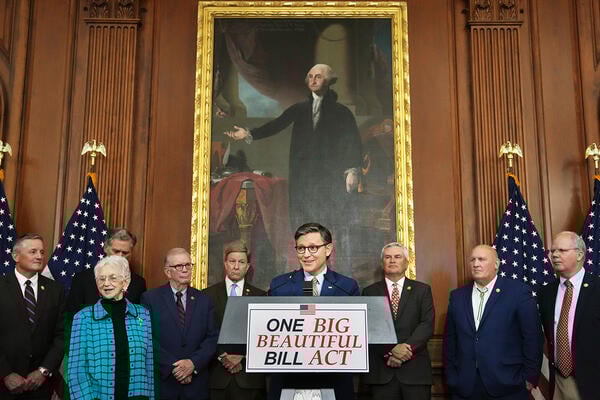
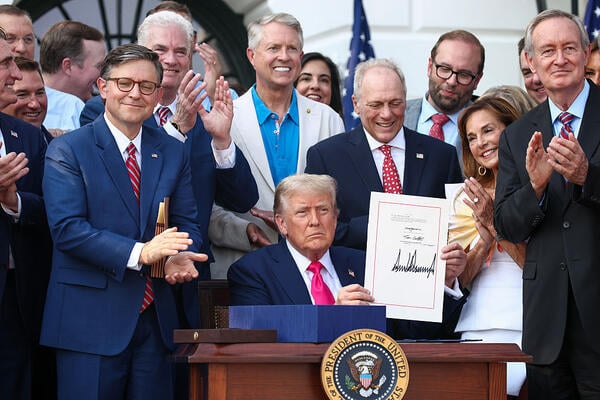
    The One Big Beautiful Bill Act, signed into law July 4, extends Pell Grants to low-income students enrolled in eligible short-term programs, between eight and 15 weeks long. The policy shift is expected to put money in the pockets of hundreds of thousands of students per year to help them afford these quicker, increasingly popular programs—and bring an influx of funds to the institutions that offer them. 

    But realizing those gains will take some time, and with the policy scheduled to get off the ground next summer, some experts are worried a year won’t be long enough to parse the program’s details and ensure a smooth rollout.

    Lawmakers in Congress and colleges have been working toward some form of workforce Pell since former senator Mary Landrieu of Louisiana pushed it forward as a part of the JOBS Act in 2014.

    Since then, multiple attempts to enact the Pell expansion have failed even as the idea gained more bipartisan support. And for a moment in late June, workforce Pell seemed dead in the water when a nonpartisan Senate official, known as the parliamentarian, claimed it violated the rules of the Senate’s reconciliation process. Senators ultimately kept it in their version of the bill but limited the new Pell funds to accredited providers, appeasing the parliamentarian.

    “We’re very thankful to the persistence of our champions in Congress on this legislation from both parties in both chambers, for the commitment they made to this legislation,” said David Baime, senior vice president of government relations at the American Association of Community Colleges, noting that while the bill was partisan, support for this provision has been “bipartisan all down the line.”

    Community college leaders are “extremely enthusiastic” about the policy change after the immense “political effort that’s gone into this,” he added. “We consistently hear reports from our campuses about the importance of finding financing sources for low-income students to participate in these programs.”

    Others, however, feel trepidation, as workforce Pell is on the precipice.

    Wesley Whistle, project director for student success and affordability at New America, a liberal think tank, said for-profit colleges and online program managers, which set up short-term online programs for community colleges and other institutions, have also been eagerly awaiting the policy shift. Despite safeguards built into the legislation, such as job-placement rates, he worries students will still be lured into subpar programs at for-profits or slapdash, mass-produced online programs also eligible for the funds.

    “I hope I’m wrong,” he said. “We’re talking about our most vulnerable students.”

    Despite the bill’s passage, debates over workforce Pell are hardly over. Now, the hard work of planning for implementation begins.

    What Happens Next

    Workforce Pell is slated to take effect next July. But for that to happen, numerous details need to be hashed out by the U.S. Department of Education, states and program providers in the coming months.

    Under the legislation, short-term programs need to meet a set of standards to be eligible for Pell money. And the task of making sure programs meet the qualifications is divvied up between states and the federal government.

    The Education Department is responsible for checking that programs have existed for at least a year, boast completion and job-placement rates of at least 70 percent, and charge tuitions below graduates’ median “value-added earnings,” or the degree to which their income exceeds 150 percent of the federal poverty line three years out of the program.

    State governors must ensure short-term programs prepare students for high-skill, high-wage or in-demand jobs. The resulting credentials also must be “stackable and portable across more than one employer,” unless preparing students for jobs with just one recognized credential. Credentials need to count toward academic credit for a certificate or degree program, as well.

    Still, many questions linger about how workforce Pell will operate—likely to be answered through negotiated rule making, a lengthy process by which the Education Department creates rules and regulations by convening and listening to key stakeholders and experts, as well as public comment.

    “There isn’t a lot of meat on the bones of the outline of what implementation would look like,” said Katie Spiker, chief of federal affairs for the National Skills Coalition, a research and advocacy organization focused on workforce training. “A whole lot of decisions and next steps … that will ultimately decide how impactful and effectively short-term Pell rolls out are still left to be determined.”

    For example, some states already have quality frameworks in place for short-term programs and have spent more than $5 billion subsidizing these programs; it’s unclear how federal workforce Pell will work alongside these existing state-level initiatives. The legislation also doesn’t say who’s involved in deciding how “high-skill, high-wage or in-demand” jobs are defined. Spiker hopes those decisions draw on input from business leaders, education providers and state workforce agencies to make “public workforce and education systems better aligned.”

    Whistle agreed some of the guardrails need ironing out. He was heartened to see a tuition limit based on graduates’ salaries—a new addition since earlier versions of the policy—but he finds aspects of the requirement murky. For example, bachelor’s degree holders qualify for workforce Pell under the law, so he worries their higher salaries could throw off the metric, intended to ensure tuitions are reasonable relative to what graduates will earn. The measure is also based on graduates’ earnings three years down the line, raising questions about how to ensure programs younger than three years don’t rip students off, he said.

    Colleges’ To-Do List

    As the department works through the policymaking process, colleges will also have their own work to do to get workforce Pell ready.

    Higher ed institutions that want to participate will need to collect the data to prove they meet eligibility metrics, said Jennifer Stiddard, senior director of government relations at Jobs for the Future, an organization focused on the intersection between education and the workforce. If they don’t have that data, they’ll need to build up the reporting infrastructure.

    In addition to measuring completion and job-placement rates, “do they think they have the data to prove a program is in demand?” Stiddard said. “Are they going to be able to demonstrate that the program articulates for credit?”

    She expects community college systems in some states will be more ready than others to answer those questions, based on their states’ existing investments in short-term programs. For example, Virginia community colleges already have outcomes data on hand because of the FastForward program, which offers short-term training for jobs locally in high demand, with the state covering much of the cost. Institutions in other states, like Indiana, Iowa, Louisiana, Michigan, North Carolina and Texas, may have a head start, as well, she said. And some colleges that are further behind could decide it’s not worth it.

    Baime, of AACC, said the association plans “to work as closely as we can with the administration to ensure that institutions are able to make their programs eligible as soon as possible.”

    Among community college leaders, “the overwhelming feeling, of course, is positive,” he added, “but there are issues of implementation that need to be ironed out sometime hopefully before next July 1 so we can get this program up and running.”

    An ‘Aggressive’ Timeline

    Some experts guffawed at the yearlong timeline set for implementing workforce Pell.

    Karishma Merchant, associate vice president of policy and advocacy at Jobs for the Future, called the July 2026 deadline “aggressive” but “possible” if the department gets started immediately. (Workforce Pell is just one item on the department’s task list for the next year, and experts are skeptical that the agency can get all the work done.)

    Even if the process could be done in a year, Spiker believes it shouldn’t be. She said a year doesn’t seem like an “effective and reasonable” amount of time to solicit feedback from different stakeholders and disentangle how the program aligns with the patchwork of existing state investments in short-term training.

    “We will be encouraging the department and states to take the time to be able to do a successful implementation that enables short-term Pell to grow over time and to serve more students and more workers, instead of pushing just to meet a relatively arbitrary timeline,” Spiker said.

    She emphasized that the process comes on the heels of drastic staff cuts at the Education Department and a larger plan to dismantle the agency, which so far includes shifting career and technical education and adult basic education programs to the Department of Labor.

    These changes are “taxing already on the agency,” she said, “and then to be spearheading an implementation simultaneous with all of those huge shifts … just makes the path forward even more difficult.”
    Source link

  • Student Preferences in On-Campus Housing

    Student Preferences in On-Campus Housing

    YinYang/iStock/Getty Images Plus

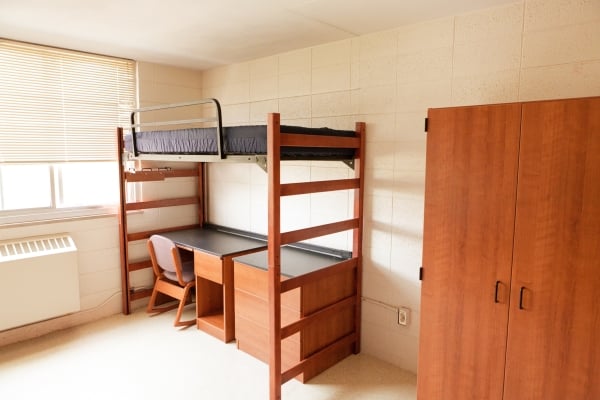
    What do students look for in on-campus housing? According to university staff, students are most satisfied with their space when it’s well furnished and clean.

    A new report from StarRez, a student housing management platform, identified room conditions and a sense of community as top priorities for on-campus housing residents. The survey also found that a majority of institutions see social events and mental health support as key to the student experience in residence halls.

    In addition, the research reveals that today’s students prefer privacy in their living space but are still interested in creating connections and engaging with peers who share their residence hall. They are also open to opportunities to build living-learning communities.

    Methodology

    StarRez’s survey was fielded between Feb. 10 and April 14, 2025. It yielded 459 responses from 418 institutions across the globe, including 360 institutions based in the Americas.

    Setting the stage: An estimated 16 percent of all undergraduates live on campus, including 30 percent of those who attend four-year, public institutions and 43 percent of students at independent colleges, according to an analysis from the American Association of Community Colleges.

    Previous research shows that students who live in residential housing on campus are more likely than their peers who live off campus to persist and complete a degree. This trend may be due in part to the proximity to peer support, academic resources and security in basic needs that living on campus affords.

    In recent years, many colleges have seen a housing crunch impact their students, resulting in less-than-ideal accommodations and residence halls exceeding capacity. StarRez’s survey found that 64 percent of responding institutions had 90 percent or higher occupancy rates; 15 percent had occupancy rates of 99 percent or higher. Yet nearly 57 percent of students do not have access to on-campus housing, according to respondent data.

    But StarRez’s report points to a post-pandemic spike in students interested in living on campus—a trend that has leveled out this year—meaning the exceptionally high demand for on-campus housing may decline.

    Affordability also remains a growing concern in the campus housing market. Student housing prices are rising faster than those of single-family housing, growing 8.8 percent in 2023 compared to multifamily rentals, which rose 4.5 percent in cost over the same period.

    Survey says: When students say they’re satisfied with their housing, approximately one-third are referring to the room conditions and furnishings, their sense of community, or the residence hall’s amenities, according to institutional respondents.

    On the flip side, cost, facility issues and dissatisfaction with food or meal plans were the most commonly reported criticisms of on-campus living. Inside Higher Ed’s Student Voice survey from 2023 found that 48 percent of students believe their dining hall options need improvement and 37 percent said dining facilities need improvement.

    Across room types, apartment-style housing is the most requested option by students (34 percent), followed by suite-style housing (27 percent) and traditional dorms (21 percent), according to StarRez’s survey. The report also found that a greater share of students want their own space; at a majority of institutions (51 percent), students rank single rooms as their top choice on the housing application.

    Not every housing placement turns out to be successful. A majority of colleges said more than 10 percent of their residents requested a room change during the year, with 8 percent saying between 25 and 50 percent of residents asked for a new room.

    Among events offered to residents, 90 percent said social events are the most popular and widely attended, followed by recreational activities (56 percent) and wellness programs (39 percent).

    When asked which health and well-being activities students most often requested of their housing facility, nearly 60 percent of respondents said mental health support programs, and over half (56 percent) wanted social events and community-building activities. Less popular responses included counseling and peer support networks (46 percent), healthy dining options (38 percent), and financial and academic support services (36 percent).

    Living-learning communities continue to grow in popularity, with four out of five colleges offering this type of student housing. Academic-focused communities (23 percent) and honors programs (17 percent) were the most popular LLCs, while career (5 percent) and leadership-focused (6 percent) groups were the least popular.

    National data shows students with disabilities are enrolling in higher education at higher rates, and StarRez’s report points to an increase in emotional support animals making their way to campus as well. One-third of institutions said between 3 and 10 percent of residents have emotional support animals, with 3 percent of respondents saying more than 10 percent of students have them.

    Fewer institutions reported offering gender-inclusive housing in 2025 (69 percent) than in 2024 (73 percent), and there was little difference in the number who said they were considering implementing gender-inclusive housing space.

    Growth in international student enrollment is also pushing an increase in housing demand from international students, with 34 percent of respondents indicating a slight increase and 6 percent reporting a significant increase. A majority of respondents house fewer than 10 percent of their international students on campus. The report data does not reflect recent federal actions this spring that may impede international student enrollment in the fall.

    So what? Based on the report’s findings, authors recommend housing providers consider:

    • Students’ desire for privacy, mental health and belonging, which are core to their experiences on campus.
    • More students want apartment-style and single-room housing options, creating opportunities for institutions to adapt spaces to match this need.
    • Living and learning communities can provide high-impact experiences for residents, leading to greater satisfaction and retention.

    How does your institution promote belonging and well-being in the residence halls? Tell us more.

    Source link

  • Columbia “Incorporating” IHRA Antisemitism Definition

    Columbia “Incorporating” IHRA Antisemitism Definition

    Columbia University’s acting president says the institution is incorporating the controversial International Holocaust Remembrance Alliance definition of antisemitism into the Office of Institutional Equity’s work. That office investigates discrimination complaints against students and employees.

    “Formally adding the consideration of the IHRA definition into our existing anti-discrimination policies strengthens our approach to combating antisemitism,” Claire Shipman said in a statement Tuesday announcing “additional commitments to combatting antisemitism.”

    The IHRA, which calls its definition a “working definition,” says antisemitism “might include the targeting of the state of Israel, conceived as a Jewish collectivity. However, criticism of Israel similar to that leveled against any other country cannot be regarded as antisemitic.”

    It also says antisemitism might include “comparisons of contemporary Israeli policy to that of the Nazis” or “claiming that the existence of a State of Israel is a racist endeavor.”

    Columbia’s leaders, like those at Harvard University, have been negotiating with the Trump administration to restore funding the federal government said it froze over alleged campus antisemitism. Harvard announced in January that it would start using the IHRA definition when evaluating complaints of antisemitic harassment or discrimination—before its public war with the Trump administration began.

    In a statement, Afaf Nasher, executive director of the Council on American-Islamic Relations’ New York chapter, called Columbia’s move “an attack on free speech” and a “shameless weaponization of antisemitism in order to stifle the ability of students to speak out against the ongoing genocide of Palestinians by the Israeli government.”

    Shipman also announced that Columbia would not “recognize or meet with the group that calls itself ‘Columbia University Apartheid Divest’ (CUAD), its representatives, or any of its affiliated organizations. Organizations that promote violence or encourage disruptions of our academic mission are not welcome on our campuses and the University will not engage with them.”

    Source link

  • F-1, J-1 Student Visa Issuances Dropped in May

    F-1, J-1 Student Visa Issuances Dropped in May

    The U.S. Department of State issued 12,689 fewer F-1 visas in May 2025 compared to the May before, which could forecast a decline in international students able to attend U.S. universities this fall.

    Recently published data from the State Department shows a 22 percent drop in F-1 visas issued across the world and a 13 percent decline in J-1 visas.

    While visa issuances can help predict international student enrollment trends, they don’t tell the full story, said Rachel Banks, senior director for public policy and legislative strategy at NAFSA, the association of international educators. Still, the trend line isn’t positive.

    “We’re not really going to know until we get through September to know everyone who arrives, to know what the enrollment really looks like,” Banks said. “But it’s certainly not encouraging.”

    Over the past few months, President Donald Trump has cracked down on international students via arrests, travel bans and revocations of legal status. Those moves and other executive orders could affect the number of F-1 and J-1 visas issued.

    In May, the administration said it would revoke visas from Chinese nationals who have ties to the Chinese Communist Party. The number of Chinese nationals issued a F-1 visa in May declined by 15 percent (or about 2,578 students). The State Department also paused visa interviews in late May while the agency developed a policy to screen international students’ social media profiles. Interviews resumed in June once the policy was in place.

    The interview pause may have contributed to but cannot fully explain the decline in visa issuances, said Finn Reynolds, head of market research at Lawfully, a legal tech start-up focused on immigration.

    The State Department doesn’t publish the number of visa applications or interviews it engages in, which means the decline could be tied to a decreased demand or slower processing by the department, Reynolds added. A May 27 survey by Study Portal found student interest in studying in the U.S. has dropped to its lowest point since COVID-19, with fewer students interested in U.S. programs and instead considering other English-speaking nations such as the U.K. or Australia.

    Additionally, the State Department doesn’t share daily visa issuance numbers, meaning the drop could be tied solely to the pause in the final week of May, Banks said. The connection, over all, is unclear.

    The data also points to the effect of travel restrictions on students from certain nations. The Trump administration banned visitors from 12 countries and implement heightened restrictions for seven other countries in June. The May numbers show a nearly 150 percent decline in F-1 visa issuances (or 451 visas) and a 105 percent decline in J-1 issuances (157 visas) to citizens from the impacted nations, even before the ban took place.

    One factor not reflected in the data is the number of students returning to their institutions who already hold visas. Students don’t need to receive a new visa if they remain in the U.S.; they only need one when traveling in and out of the country. Given the disruption to Student Exchange and Visitor Information System statuses in April, many students chose to remain in the U.S. over their summer break, Banks said.

    Reynolds expects to see a further drop in visa issuances for June and July, because social media vetting procedures result in fewer appointment slots.

    Students in China, Ghana, India, Japan, Niger and Nigeria have had the most trouble getting appointments, according to NAFSA members.

    “We’re halfway through July, and there’s still students who are struggling to get an appointment; that’s troubling,” Banks said.

    Future policies could also bottleneck the visa pipeline for international students. A proposed rule at the Office of Management and Budget would end duration-of-stay policies and instead implement a fixed date for how long students can remain in country on their visa.

    “We’re very concerned that if that were to go through, that sort of adds to further disruptions and hurdles that students have to jump over, that then gives students more reason to say, ‘You know, this seems like a hassle, this seems like I’m not welcome, I’m going to find another opportunity to pursue,’” Banks said.

    Enrollment Declines Loom

    Colleges and universities are already anticipating declines in their international student populations. The Institute of International Education found that 40 percent of institutions projected declines in their undergraduate population of international students, and 49 percent anticipated a drop in graduate student populations.

    A NAFSA survey of about 150 members institutions this summer found 78 percent of institutions predict a decline in both undergrad and graduate international students.

    Each year, institutions enroll 1.1 million international students, about 6 percent of all college students in the U.S.

    Calculations by The Financial Times, published last week, found that a decline of even 10 percent in international student enrollment would cost U.S. colleges and universities $3 billion in revenue. A significant portion of this loss would be in tuition revenue; a 10 percent drop would result in a $900 million decrease in tuition dollars.

    Source link

  • Wins and Losses of the Reconciliation Bill

    Wins and Losses of the Reconciliation Bill

    Kevin Dietsch/Getty Images

    It’s been six months since the second Trump administration took office, and in that time it has radically changed the policy around federal student loans, grants and college accountability. With the One Big Beautiful Bill Act now signed into law, Inside Higher Ed’s editor in chief, Sara Custer, spoke with news editor Katherine Knott about what’s in the bill and the outcome of the sector’s efforts to influence the massive piece of legislation. 

    In a recent episode of The Key, Inside Higher Ed’s news and analysis podcast, they also checked in on Harvard and Columbia’s negotiations with the administration and shared what they’ll be looking out for in the next six months. 

    Source link

  • China “Will Blow Us Away” if Trump Destroys U.S. Universities

    China “Will Blow Us Away” if Trump Destroys U.S. Universities

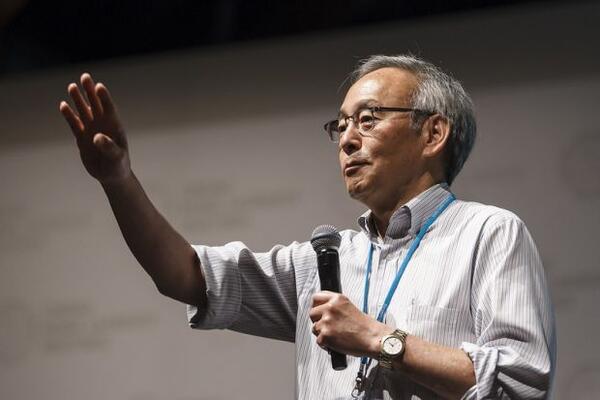
    The first Nobel Prize–winning scientist to join a White House cabinet, Steven Chu made history when he became Barack Obama’s energy secretary in 2009. But his move to Washington cost him an incredible $300 million.

    “I joined the Nvidia board in 2004, before the company took off, but I had to sell my shares in 2009 when I joined government,” Chu said about his early involvement in the microchip firm that recently became the world’s most valuable company with a $4 trillion capitalization.

    “At the time Nvidia was a small graphics company, but there were rules about conflict of interest so I had to sell,” he told Times Higher Education. With Nvidia’s stock rising 22,000 percent in the past decade alone, Chu’s stake would be worth $300 million, he said.

    Nvidia’s astonishing rise has amazed the stock market in recent years, but Chu, who won the Nobel Prize in physics in 1997, felt the company had huge promise when he joined.

    “When Jenson Huang [Nvidia’s founder] told me about developing this high-level chip, I said, ‘If you do that, this computer will be at the heart of every supercomputer in the world.’ And he did it,” recalled Chu.

    Sanguine about his lost wealth, Chu’s main takeaway from Nvidia is not his own misfortune. Instead, he worries that this American success story—co-created by a Taiwanese-born Stanford graduate, employing foreign-born engineering talent—might not have been able to happen today given the double whammy faced by U.S. academia: massive cuts to federal science budgets and an immigration crackdown deterring many students, particularly from China, from applying to U.S. institutions.

    “Trump wants to cut science budgets by half or more and reduce the number of foreign postdocs—particularly from China,” explained Chu, speaking earlier this month at the annual Lindau Nobel Laureate Meeting in southern Germany.

    “That’s a problem because if you go to any major research university, you’ll find about a third of researchers are East Asian.”

    Chu’s own parents—born and educated in China before moving to the Massachusetts Institute of Technology in the 1940s—are a good example of how this brain gain has worked in America’s favor. “When the Communists took over, they couldn’t go back, but this is how America got many of its best scientists and engineers—as refugees from Germany, Italy and China.”

    “That’s true for business, too—many of America’s captains of industry, from Jenson Huang to [ex-Intel boss] Andy Grove and Alexander Graham Bell, were immigrants,” he said.

    Reflecting on how America “didn’t become a scientific superpower until World War II,” Chu said he believes the 1930s are instructive in other ways. “In this era America took what was innovative and applied it to industry. That allowed places like Ford to take what Volkswagen and Peugeot was doing but do it cheaper, but good enough to work,” he said.

    “That is what China is doing to America now—for instance, taking the electric car and making it cheaper and now better. What we did to Europe, China and now Korea are doing to us,” he said.

    Traditionally, the U.S. has been able to stay ahead thanks to its education system, in particular its generously funded world-leading research universities. With that system under attack, however, that advantage is weaker, he said. “Something magical happens at Ph.D. level in U.S. universities—we teach creativity. China is trying to learn this … and then apply it to their industrial sector. When they do, they will blow us away.”

    Without America’s outstanding universities and with its foreign talent pool diminished, China’s path to global dominance will be immeasurably easier, predicted Chu. “Trump is perfectly willing to destroy institutions that any country in the world would give its eyeteeth for,” he said.

    Unusually for a Nobel laureate, Chu’s prize did not mark the peak of his scientific achievements. He led a committee that recommended the creation of ARPA-E, a science agency that has funded more than $4 billion in battery, nanotech and other types of energy research since 2009, generating spin-out companies worth more than $22 billion.

    Meanwhile, his time as energy secretary saw further investment, including the funding of an experimental $1 billion carbon-capture plant in Louisiana—a stark contrast to the “drill, baby, drill” priorities of the current administration. Obama also credited his expertise as a major reason why the cleanup after the Deepwater Horizon disaster in 2010—the biggest oil spill in history—was successful.

    And there are his brushes with some of the 21st century’s biggest tech companies, even if Nvidia wasn’t the only big fish he missed out on. “I knew [financier] Richard Blum, who said he could get me on the board of Apple— I didn’t say yes because I had a lot of nonprofit activities, but that was 2006, the year before the iPhone was launched,” he reflected.

    Not that he thinks the money would have made much difference. “If I was worth a couple of hundred million dollars, would I have stopped doing science and just bought sports cars and houses? I hope not.”

    Source link

  • Americans Recognize Nuances of Higher Ed’s Value

    Americans Recognize Nuances of Higher Ed’s Value

    While the Trump administration has painted a bleak picture of the higher education sector as a costly enterprise that burdens taxpayers and pushes leftist ideologies, new survey data shows that most Americans—regardless of their political leanings—still value it.

    “Increasingly, higher ed is being cast as elite, expensive and not connected with everyday Americans,” said Sophie Nguyen, senior policy manager with the higher education team at New America, the left-leaning think tank that published its annual Varying Degrees survey on Wednesday. “There’s a significant disconnect in the narrative about what higher ed is” and how it’s perceived.

    Capturing the American public’s views on the purpose of higher education drove many of the questions Nguyen and her colleagues asked 1,631 respondents in March for the ninth iteration of the survey.

    After reaching a low point last year, the data shows that satisfaction with higher education is on the rise: 40 percent of respondents—including 42 percent of both Republicans and Democrats—reported that higher education is “fine as it is,” compared to 36 percent who said the same last year.

    “We see a lot of alignment between Democrats and Republicans, something we haven’t heard a lot about,” Nguyen said, describing such data points as “the common ground” colleges can tap into when defending their worth to both consumers and lawmakers.

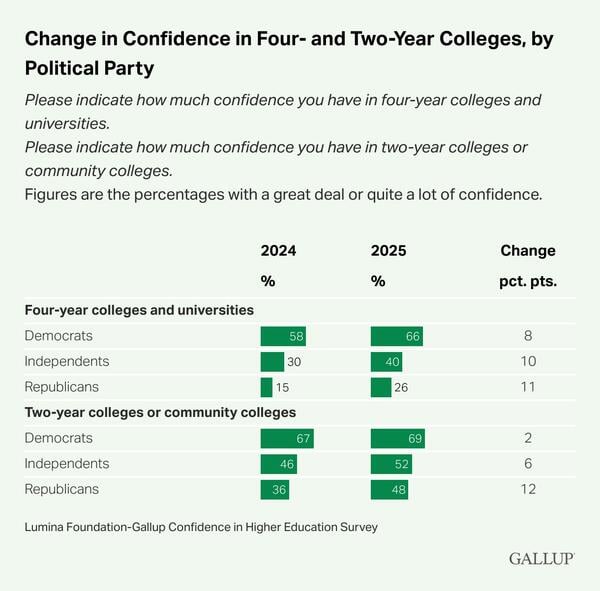
    New America’s findings are in line with a poll Gallup also released Wednesday in partnership with the Lumina Foundation, which shows that 42 percent of Americans surveyed said they have a “great deal” or “quite a lot” of confidence in higher education, compared to a low of 36 percent in 2024 and 2023—though it’s still far from the nearly 60 percent confidence peak in 2015. The share of people who reported “very little” or no confidence is also on the decline, falling from 32 percent last year to 23 percent this year. Although Democrats reported much higher confidence in higher education institutions, Republican confidence in both four- and two-year colleges rose by 11 and 12 percentage points, respectively, compared to last year.

    Data visualization of change in confidence in four- and two-year colleges, by political party.

    Respondents cited the economic and social benefits of higher education, its standing at the forefront of innovation, the quality of education and training—both for jobs and exposure to different viewpoints—as drivers of the uptick in their confidence.

    The Trump administration’s war on higher ed may have played a role, said Courtney Brown, Lumina’s vice president of impact and planning.

    “It is possible that we are seeing people in support of the sector because they see so many attacks,” she said. Whatever the reason, she said the new data is positive, and if institutions want to restore confidence to 2015 levels they should consider “how they can build on this moment and show up for students and ensure they’re getting value.”

    Like Gallup’s report, New America’s survey revealed partisan divides as well as agreements. Sixty percent of Republicans said colleges are having a negative impact on the country, while 75 percent of Democrats said they’re having a positive impact. But respondents from both parties were much more aligned on questions about specific aspects of higher ed’s value and purpose.

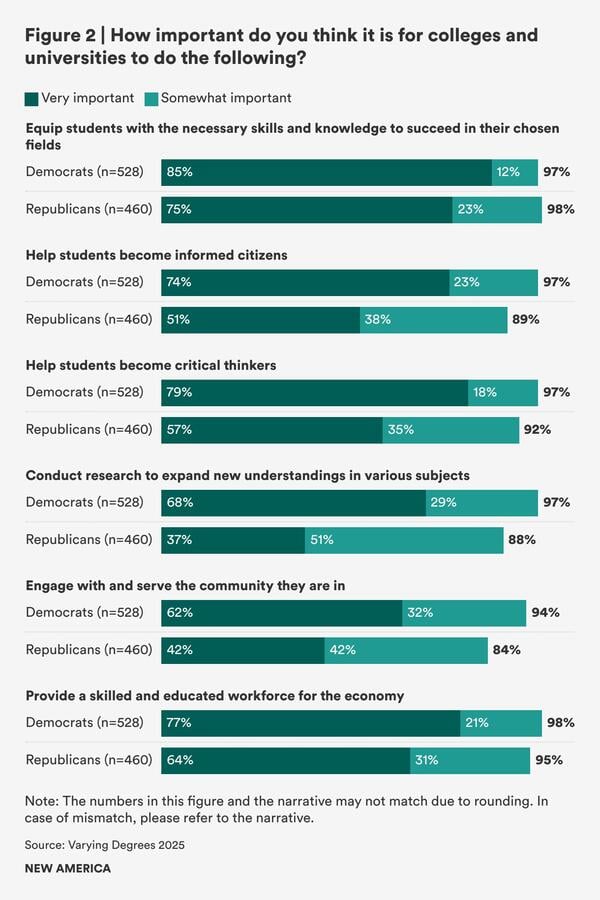
    While Republican lawmakers pressure universities into proving their return on investment, the vast majority of Americans, including both Republicans and Democrats, believe higher education should function as more than a transaction. They say it should not only equip students with the skills and knowledge to succeed in their chosen fields (97 percent of Democrats; 98 percent of Republicans), but also help students become informed citizens (97 percent of Democrats; 89 percent of Republicans) and critical thinkers (97 percent of Democrats; 92 percent of Republicans).

    “The rhetoric coming from Washington tends to be a caricature of what are some real issues facing college campuses and the sector in general,” Beth Akers, a senior fellow at the right-leaning American Enterprise Institute who focuses on the economics of higher education, said at a media briefing about New America’s survey. While “there’s room for improvement … it’s unfortunate that the rhetoric is empowering misinformation about what institutions are doing.”

    Bar chart of responses to the question "How important do you think it is for colleges and universities to do the following?" Responses are detailed earlier in thes tory.

    Even as Trump and his political allies move to dramatically cut federal funding for university research—which advocates say will devastate university budgets, local economies and progress toward lifesaving research—88 percent of Republicans and 97 percent of Democrats believe it’s important to some degree that colleges and universities conduct research to expand understanding in various subjects.

    Despite political rhetoric that suggests otherwise, American higher education has delivered an array of personal and societal benefits for decades, Lynn Pasquerella, president of the American Association of Colleges and Universities, said during a news briefing on the report.

    “Higher ed continues to be the single most powerful socioeconomic catalyst in America, which is associated not only with higher earnings, but longer productive lives, better physical and mental health, resilience, adaptability, and personal development and fulfillment,” she said. “At the societal level, education drives long-term economic growth for local communities and the nation.”

    More broadly, it “strengthens our democracy,” because it “tends to mitigate or tame authoritarian tendencies” and “reduces individuals’ sensitivities to potential triggers by providing them with psychological protection in the form of self-esteem, personal security and autonomy,” she said. “It fosters a moral imagination—imagining what it’s like to be in the shoes of another, different from oneself—and interpersonal trust.”

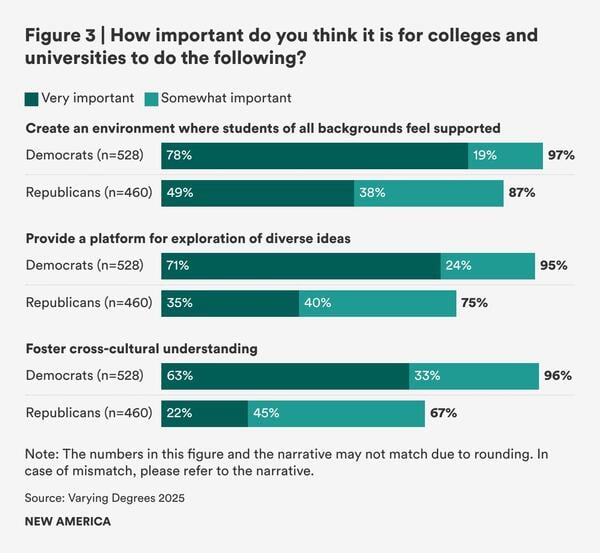
    Despite the Trump administration and its allies’ attacks on diversity, equity and inclusion initiatives, the survey data shows that an overwhelming majority of Republicans and Democrats agree that higher education should create an environment where students of all backgrounds feel supported, provide a platform for exploration of diverse ideas and foster cross-cultural understanding.

    Bar chart showing responses to the question "How important do you think it is for colleges and universities to do the following" including "create an environment where students of all backgrounds feel supported" and "provide a platform for exploration of diverse ideas."

    Although New America’s survey suggests that most Americans recognize the layered value of higher education, Republican lawmakers have increasingly focused on both controlling the subjects colleges can teach and research and making it harder for students and colleges to access federal funding.

    The sweeping policy bill Trump signed into law earlier this month requires colleges to show that their graduates earn more than an adult with only a high school diploma or risk losing access to federal loans. Trump has also proposed billions of dollars in cuts to education funding, including eliminating all federal support for college-access programs that have long helped low-income, first-generation and students with disabilities navigate higher education.

    While Republicans and Democrats are divided on who they think should be primarily responsible for paying for college—76 percent of Democrats believe the government should; 67 percent of Republicans believe students should—respondents from both parties cited cost as the single biggest barrier to enrolling in or finishing college.

    At the same time, 75 percent of respondents over all (91 percent of Democrats and 58 percent of Republicans) said the federal government should spend more on making college more affordable.

    Hironao Okahana, vice president and executive director of the Education Futures Lab at the American Council on Education, said this data offers a ray of optimism for the higher education sector navigating an onslaught of partisan attacks from Republican policymakers.

    “The public is seeing higher education as a sector beyond some of the sound bites we’re hearing,” he said. “They’re seeing that it has more nuance and texture, and that there’s not just one way higher education can contribute to society.”

    Source link

  • Ideological Agendas Undermine Effective Governance (opinion)

    Ideological Agendas Undermine Effective Governance (opinion)

    Higher education has reached its canary-in-a-coal-mine moment: The recent resignation of the University of Virginia president under intense political pressure isn’t just another leadership transition but an indicator of hazards ahead, with similar pressures mounting George Mason University. Higher education governing boards cannot ignore these urgent warning signs that signal peril for the governance structures that have supported our universities and colleges for centuries.

    U.S. higher education is built on a unique model of governance in which independent citizen trustees exercise fiduciary oversight, set policy, safeguard institutional autonomy, support fulfillment of the mission and act in the best interests of the university or college as stewards of the public trust. This model of self-governance has preserved the academic freedom and driven the innovation that are hallmarks of U.S. higher education and that form the foundation of the profound societal impact and global prominence of the sector.

    Today, this governance model faces significant disruption. At both public and private institutions, trustees are being encouraged by policy-driven think tanks to serve as ideological agents and interfere with management rather than act as true fiduciaries. This violation of institutional autonomy is destabilizing and harmful to governance, yielding fractured boards, diminished presidential authority, politicized decision-making, academic censorship and loss of public trust.

    Boards must take this warning very seriously and take a hard look at whether their decisions reflect independent judgment aligned with the institution’s mission or, instead, the influence of external agendas. If governance fails, academic freedom is compromised, academic quality is weakened, public trust is eroded and the promise of U.S. higher education and its role in a democracy will disappear.

    To guide boards in upholding institutional autonomy and mission stewardship, the Association of Governing Boards of Universities and Colleges recently launched the Govern NOW initiative with support from a Mellon Foundation grant. As part of this initiative, AGB developed a models of governance comparison and checklist for governance integrity. These tools help board members distinguish between effective governance and ideologically driven overreach and provide a framework to assess their practices and recommit to their fiduciary responsibilities.

    This is especially critical due to growing misinformation about the role of trustees. Without a true understanding of their responsibilities, they might act independently of board consensus, undermine governance norms, overstep management boundaries and pursue ideological agendas. These actions not only weaken governance by harming board cohesion and culture but also threaten the institutional stability and mission that trustees are charged to uphold.

    This moment is not about partisan politics. It is about leadership and whether we will allow institutional governance to be hijacked by ideological conflict. At stake is the integrity of the governance system that has been the foundation on which the strength and distinction of U.S. higher education has been built.

    To every trustee, I implore you to look inward. Ask whether your board is governing with independence and as stewards of mission and public trust. Use the tools AGB developed to evaluate your culture and boundaries. Engage in real dialogue with your president. Lead together with courage and clarity to secure higher education’s promise.

    Ross Mugler is board chair and acting president and CEO of the Association of Governing Boards of Universities and Colleges.

    Source link

  • Ten Things I Learned at DETcon 2025

    Ten Things I Learned at DETcon 2025

    • By Rob Carthy, Director of International Development, Northumbria University.

    Attending Duolingo’s inaugural DETcon London, I anticipated a day focused on the evolving landscape of language testing. What I experienced was a candid, and at times controversial, conversation about the geopolitical, political, and technological pressures facing UK higher education. Duolingo may have been the convenor, but the themes of the day went to the heart of the sector’s future.

    Here are ten of my key takeaways from a thought-provoking day.

    1. Crisis is the New Business-as-Usual

    “Since I started, we’ve faced crisis after crisis.” These words from Katja Lamping, Director of Student Recruitment at UCL, resonated deeply. From the pandemic to the fall of Kabul, Ukraine, and Gaza, the past five years have demanded a level of institutional reactivity we’ve never seen before. The clear message was that this isn’t a blip. As former Home and Foreign Secretary Jack Straw bluntly put it, the first rule of preparing for uncertainty is to “expect that the unexpected is going to happen.” For university leaders, strategic planning now looks less like a road map and more like training for a cross-country race in the dark.

    2. Agility is Now a Core Competency

    The flip side of constant crisis is the need for agile solutions. We heard how the Duolingo English Test (DET) became a vital tool during the pandemic because it was accessible when physical test centres were not. This story is symbolic of a wider truth: our traditional processes and partnerships can be brittle. To keep our doors open to global talent, we must build resilience and responsiveness into our operations, from admissions to student support.

    3. The Political Headwinds are Strengthening

    Jack Straw’s portrayal of the government’s immigration white paper was sobering. He spoke of a view that some university business models are “not sustainable.” And highlighted the view in Westminster that the student visa route was being used as a “racket” for asylum claims. I might have disagreed with him – many in the room did – but this is a view held by many and is a reality we must face.

    Straw, and later in the day Rory Stewart, said the mood in Westminster is hardening regardless of who is in power. This government wants to bring down immigration. It’s often said Brits don’t mean students, but the stark reality is the government wants to get numbers down, and students are one, if not the easiest, lever they can pull. We must be on the front foot, demonstrating our commitment to robust compliance and ethical recruitment, and articulating the immense value international students bring—a value HEPI’s own research has quantified at a net £37.4 billion for the 2021/22 cohort alone.

    4. Technology Can Deliver Both Access and Integrity 

    A powerful message came from Duolingo’s CEO and co-founder, Luis Von Ahn, who shared his personal story of growing up in Guatemala and seeing how English proficiency could transform a person’s life, yet how prohibitive the cost of testing was. His core argument was that technology should be a democratising force. But most compellingly, he tackled the security question head-on. He argued that far from being less secure, an AI-powered test can offer greater integrity than a traditional test centre. The ability to use AI to monitor hundreds of behaviours simultaneously—from eye-gaze to keystroke patterns—in addition to human proctors, presented a powerful case that a digital-first approach doesn’t have to mean a compromise on security; it could, in fact, mean the opposite.

    5. The Biggest Risk of AI Might Be Inaction

    In a fascinating session on technology, Dr. Laura Gilbert OBE of the Tony Blair Institute offered a powerful counter-narrative to the usual fears around AI. She argued that the biggest risk might be “not doing it at all.” While we worry about academic integrity, we risk missing the opportunity to use AI to solve our biggest challenges, from relieving the administrative burden in admissions to revolutionising personalised learning. Her point that technology like AI is essential to sustaining public services like the NHS has direct parallels with the financial challenges in our own sector.

    6. Trust in Technology Must Be Earned

    Dr. Gilbert was clear: you cannot just demand trust in AI. It must be earned through what she called “radical transparency.” For universities adopting tools like the DET for high-stakes admissions, this is a critical lesson. We must demand evidence from our tech partners that their tools are secure, equitable, and have been rigorously evaluated for bias. Publishing that evidence, as Duolingo was highlighted as a good example, should become the industry standard.

    A crucial warning from Dr. Gilbert was that if left to market forces, AI will inevitably make the advantage more advantaged, worsening societal inequality. For a sector committed to widening participation, this is a profound challenge. As we adopt AI, we must actively and consciously steer it towards closing, not widening, access gaps. The goal of using technology to reach students from previously untapped regions is a noble one, but it requires a constant and active focus on equity.

    7. AI Isn’t Just A Buzzword

    It’s a transformative force in assessment, personalisation and inclusion. I was struck by Duolingo’s mission-led approach, especially its ability to deliver high-quality, low-cost English testing to learners across the globe, including refugee and displaced students. Innovations like adaptive testing, AI-driven speaking practice, and real-time fraud detection redefine what “secure” and “authentic” assessment looks like. The session challenged my assumptions about test integrity and proved that democratisation doesn’t mean compromise. The balance between rigour and compassion resonated strongly—proof that access and excellence can coexist. At Northumbria, we’re increasingly mindful of our role in enabling fairer pathways into UK higher education. The Duolingo English Test is no longer a disruptor—it’s fast becoming a vital enabler that we should all be paying attention to.

    8. Is it a Brave New World?

    Rory Stewart’s session offered a powerful analysis of our turbulent times, contrasting the post-1989 era of liberal democracy and globalisation with our current “shadow world” of populism, protectionism, and a retreat from a rules-based international order. Stewart highlighted key shifts, including China’s rise without democratisation, the 2008 financial crisis, and the chaotic impact of social media and failed interventions in Iraq and Afghanistan. Stewart warned that global trends, like Trump’s attacks on US universities, could easily manifest in the UK, emphasizing that “what happens in the US can come here”. These attacks include significant funding cuts and threats to academic freedom over perceived ideological biases. This serves as a stark reminder for UK higher education to remain vigilant against similar political pressures.

    9. A Little Can Go A Long Way

    The session on the carbon cost of testing made me sit up. John Crick from the International Education Sustainability Group (IESG)  revealed that switching from test centre-based exams to online alternatives can cut carbon emissions by up to 98%. The equivalent of planting a Sherwood Forest of trees every year. The analysis showed that the biggest environmental impact comes from travel to test centres, especially in regions without local provision. What struck me was how easily we overlook this area in our sustainability strategies. IESG’s meticulous modelling gives us a much-needed baseline to challenge assumptions and examine the unintended carbon consequences of our English language policies. It’s a conversation starter—but one we in international education need to have now if we’re serious about meeting climate goals.

    10. Our Soft Power is Precious, But Not Guaranteed

    The conference ended with a discussion on the UK’s soft power and the launch of Duolingo’s Welcome Project, which seeks to provide a place for students displaced by the turmoil in the US with opportunities in the UK.

    While our leading universities remain beacons of global influence, the day’s discussions made it clear this cannot be taken for granted. A domestic political narrative focused on clamping down on immigration, combined with financial models that are visibly creaking, risks tarnishing one of the UK’s greatest exports. We must collectively find a way to reconcile the need for control and sustainability with the projection of being an open, welcoming, and world-leading destination for education.


    Rob Carthy is the Director of International Development at Northumbria University, where he leads the university’s international student recruitment strategies. He is focused on developing a sustainable and diverse international community in Newcastle upon Tyne. Find him on LinkedIn.

    Source link

  • A government climate website teachers rely on is in peril

    A government climate website teachers rely on is in peril

    For the last 15 years, science teacher Jeff Grant has used information on climate change from the federal website Climate.gov to create lesson plans, prepare students for Advanced Placement tests and educate fellow teachers. Now, Grant says, he is “grabbing what [he] can” from the site run by the National Oceanic and Atmospheric Administration’s Climate Program Office, amid concerns that the Trump administration is mothballing it as part of a broader effort to undermine climate science and education.

    “It’s just one more thing stifling science education,” said Grant, who teaches at Downers Grove North High School in the Chicago suburbs. 

    Since early May, all 10 editorial contributors to Climate.gov have lost their jobs, and the organization that produces its education resources will soon run out of money. On June 24, the site’s homepage was redirected to NOAA.gov, a change NOAA said was made to comply with an earlier executive order on “restoring gold standard science.” Those steps follow many others the president has made to dismantle federal efforts to fight climate change, which his administration refers to as the “new green scam.”

    Former employees of Climate.gov and other educators say they fear that the site, which will no longer produce new content, could be transformed into a platform for disinformation. 

    “It will make it harder for teachers to do a good job in educating their students about climate change,” said Glenn Branch, deputy director of the nonprofit National Center for Science Education. “Previously, they could rely on the federal government to provide free, up-to-date, accurate resources on climate change that were aimed at helping educators in particular, and they won’t be able to do so if some of these more dire predictions come to pass.”

    Such concerns have some foundation. For example, Covid.gov, which during the Biden administration offered health information and access to Covid-19 tests, has been revamped to promote the controversial theory that the coronavirus was created in a lab. The administration has also moved aggressively to delete from government sites other terms that are currently out of favor, such as references to transgender people that were once on the National Park Service website of the Stonewall National Memorial, honoring a major milestone in the fight for LGBTQ+ rights.

    Kim Doster, director of NOAA’s office of communications, declined to answer specific questions but shared a version of the statement posted on the NOAA website when Climate.gov was transferred. “In compliance with Executive Order 14303, Restoring Gold Standard Science, NOAA is relocating all research products from Climate.gov to NOAA.gov in an effort to centralize and consolidate resources,” it says.  

    Related: Want to read more about how climate change is shaping education? Subscribe to our free newsletter.

    Climate.gov, founded in 2010 to support earth science instruction in schools, had become a go-to site for educators and the general public for news and information about temperature, sea level rise and other indicators of global warming.

    For many educators, it has served a particularly key role. Because its resources are free, they are vital in schools that lack resources and funding, teachers and experts say. 

    Rebecca Lindsey, Climate.gov’s lead editor and writer, was one of several hundred NOAA probationary employees fired in February, then rehired and put on administrative leave, before being terminated again in March. The rest of the content production team — which included a meteorologist, a graphic artist and data visualizers — lost their jobs in mid-May. Only the site’s two web developers still have their jobs. 

    A screenshot of the Sea Level Rise Viewer, an interactive NOAA that’s listed as a resource on Climate.gov, a government climate website. Credit: NOAA Office for Coastal Management

    Lindsey said she worries that the government “intended to keep the site up and use it to spread climate misinformation, because they were keeping the web developers and getting rid of the content team.”

    In addition, the Climate Literacy and Energy Awareness Network, the official content provider for the education section of the site, has not received the latest installment of its three-year grant and expects its funds to run out in August. 

    “We won’t have funding to provide updates, fix hyperlinks and make sure that new resources are being added, or help teachers manage or address or use the resources,” said Anne Gold, CLEAN’s principal investigator. “It’s going to start deteriorating in quality.” 

    CLEAN, whose website is hosted by Carleton College, is now searching for other sources of money to continue its work, Gold said. 

    With the June 24 change redirecting visitors from Climate.gov to NOAA.gov/climate, the website  for the first time falls under the purview of a political appointee: Doster. Its previous leader, David Herring, is a science writer and educator.

    Melissa Lau, an AP environmental science teacher in Piedmont, Oklahoma, said the relocated site was “really difficult to navigate.”

    As someone who lives in Tornado Alley, Lau said, she frequented CLEAN and NOAA sites to show her students localized, real-time data on storm seasons. She said she is concerned that teachers won’t have time to track down information that was shifted in the website’s move and, as a result, may opt not to teach climate change. 

    The executive order on “restoring gold standard science” that appears to have triggered the shift gives political appointees the authority to decide what science information needs to be modified to align with its tenets. 

    While the disclaimer posted to NOAA.gov seems to imply that Climate.gov did not meet this requirement, educators and researchers said that the site and its CLEAN education resources were the epitome of a gold standard.

    “I want to stress that the reason why CLEAN is considered the gold standard is because we have such high standards for scientific accuracy, classroom readiness and maintenance,” Gold said. “We all know that knowledge is power, and power gives hope. … [Losing funding] is going to be a huge loss to classrooms and to students and the next generation.”

    Related: One state mandates teaching climate change in almost all subjects — even PE

    This is only the latest attack by the Trump administration on education around climate change. This month, the U.S. Global Change Research Program’s website, GlobalChange.gov, was shut down by the administration, after the program was defunded in April. The website once hosted an extensive climate literacy guide, along with all five iterations of the National Climate Assessment — a congressionally required report that informed the public about the effects and risks of climate change, along with local, actionable responses. 

    The Department of Commerce, which oversees NOAA, has cut other federal funding for climate research, including at Princeton University, arguing that these climate grant awards promoted “exaggerated and implausible climate threats, contributing to a phenomenon known as ‘climate anxiety,’ which has increased significantly among America’s youth.” 

    Studies, though, suggest that if young people have a greater understanding of why weather is changing and how to take action, they are less likely to feel anxious. 

    “The more you know [about climate change], the more it’s not a scary monster in the closet,” said Lauren Madden, professor of elementary science education at the College of New Jersey. “It’s a thing you can react to.” She added, “We’re going to have more storms, we’re going to have more fires, we’re going to have more droughts. There are things we can do to help slow this. … I think that quells anxiety, that doesn’t spark it.”

    And climate education has broad public support — about 3 in 4 registered voters say schools should teach children about global warming, according to a 2024 report from the Yale Program on Climate Change Communication. Similarly, 77 percent of Americans regard it as very or somewhat important for elementary and secondary school students to learn about climate change, according to a 2019 study. And all but five states have adopted science standards that incorporate at least some instruction on climate change.

    Yet few teachers have received training on climate change. There is also not much professional development for climate educators, and textbooks tend to downplay the effects of climate change

    As a result, many science teachers rely on federal tools and embed them in their curriculum. They are worried that the information will no longer be relevant, or disappear entirely, according to Lori Henrickson, former climate integration specialist for Washington state’s education department. Henrickson, who lost her job this June as the result of state budget cuts, was in charge of integrating climate education across content areas in the state, from language arts to physical education.

    The .gov top-level domain connotes credibility and accessibility, according to Branch: “It is also easier for teachers facing or fearing climate change denial backlash to cite a reliable, free source from the federal government.”

    Related: How Trump is disrupting efforts by schools and colleges to combat climate change

    With Climate.gov’s future uncertain, educators are looking to other resources, like university websites and tools from other countries. 

    “I’m sure there will continue to be tools, and there will be enough people who will be willing to pay to access them,” Madden said. But, she added, “they probably won’t be as comprehensive, and it won’t feel like it’s a democratic process. It’ll feel like: If you or your employer are willing to chip in for it, then you’ll have access.”

    Madden, along with many other educators, frequently used the Environmental Protection Agency’s environmental justice toolkit, but the site was taken down earlier this year. 

    “I feel like with all the federal websites, I’m constantly checking to see what’s still up and what’s not,” Madden said. 

    Bertha Vazquez, education director for the Center of Inquiry, an organization that works to preserve science and critical thinking, said she worried that the disappearance of climate information could leave U.S. students behind. 

    “The future of the American economy is not in oil, the future of the American economy is in solar and wind and geothermal. And if we’re going to keep up with the international economy, we need to go in that direction,” she said. But while the U.S. should be leading the way in scientific discovery, Vazquez said, such work will now be left to other countries.

    Lau said she felt helpless and frustrated about Climate.gov’s shutdown and about the “attack on American science in general.” 

    “I don’t know what to do. I can contact my legislators, but my legislators from my state are not going to be really open to my concerns,” she said. “If students next year are asking me questions about [science research and funding], I have to tell them, ‘I do not know,’ and just have to leave it at that.”

    Contact editor Caroline Preston at 212-870-8965, via Signal at CarolineP.83 or on email at [email protected].

    This story about the government climate website was produced by The Hechinger Report, a nonprofit, independent news organization focused on inequality and innovation in education. Sign up for the Hechinger climate and education newsletter.

    The Hechinger Report provides in-depth, fact-based, unbiased reporting on education that is free to all readers. But that doesn’t mean it’s free to produce. Our work keeps educators and the public informed about pressing issues at schools and on campuses throughout the country. We tell the whole story, even when the details are inconvenient. Help us keep doing that.

    Join us today.

    Source link