Crucial Insights: Understanding College Financial Aid Dynamics
(00:02:56) Variety of College Financial Assistance Options
(00:05:18) Scholarships: Balancing Merit and Financial Need
(00:10:00) Student Selection Strategies in College Admissions
(00:21:40) Financial Aid Strategy at Competitive vs. Smaller Schools
(00:26:29) Major-based Financial Aid Allocation in Colleges
Nearly two-thirds of teachers utilized artificial intelligence this past school year, and weekly users saved almost six hours of work per week, according to a recently released Gallup survey. But 28% of teachers still oppose AI tools in the classroom.
The poll, published by the research firm and the Walton Family Foundation, includes perspectives from 2,232 U.S. public school teachers.
“[The results] reflect a keen understanding on the part of teachers that this is a technology that is here, and it’s here to stay,” said Zach Hrynowski, a Gallup research director. “It’s never going to mean that students are always going to be taught by artificial intelligence and teachers are going to take a backseat. But I do like that they’re testing the waters and seeing how they can start integrating it and augmenting their teaching activities rather than replacing them.”
At least once a month, 37% of educators take advantage of tools to prepare to teach, including creating worksheets, modifying materials to meet student needs, doing administrative work and making assessments, the survey found. Less common uses include grading, providing one-on-one instruction and analyzing student data.
A 2023 study from the RAND Corp. found the most common AI tools used by teachers include virtual learning platforms, like Google Classroom, and adaptive learning systems, like i-Ready or the Khan Academy. Educators also used chatbots, automated grading tools and lesson plan generators.
Most teachers who use AI tools say they help improve the quality of their work, according to the Gallup survey. About 61% said they receive better insights about student learning or achievement data, while 57% said the tools help improve their grading and student feedback.
Nearly 60% of teachers agreed that AI improves the accessibility of learning materials for students with disabilities. For example, some kids use text-to-speech devices or translators.
More teachers in the Gallup survey agreed on AI’s risks for students versus its opportunities. Roughly a third said students using AI tools weekly would increase their grades, motivation, preparation for jobs in the future and engagement in class. But 57% said it would decrease students’ independent thinking, and 52% said it would decrease critical thinking. Nearly half said it would decrease student persistence in solving problems, ability to build meaningful relationships and resilience for overcoming challenges.
In 2023, the U.S. Department of Education published a report recommending the creation of standards to govern the use of AI.
“Educators recognize that AI can automatically produce output that is inappropriate or wrong. They are well-aware of ‘teachable moments’ that a human teacher can address but are undetected or misunderstood by AI models,” the report said. “Everyone in education has a responsibility to harness the good to serve educational priorities while also protecting against the dangers that may arise as a result of AI being integrated in ed tech.”
Hrynowski said teachers are seeking guidance from their schools about how they can use AI. While many are getting used to setting boundaries for their students, they don’t know in what capacity they can use AI tools to improve their jobs.
The survey found that 19% of teachers are employed at schools with an AI policy. During the 2024-25 school year, 68% of those surveyed said they didn’t receive training on how to use AI tools. Roughly half of them taught themselves how to use it.
“There aren’t very many buildings or districts that are giving really clear instructions, and we kind of see that hindering the adoption and use among both students and teachers,” Hrynowski said. “We probably need to start looking at having a more systematic approach to laying down the ground rules and establishing where you can, can’t, should or should not, use AI In the classroom.”
Disclosure: Walton Family Foundation provides financial support to The 74.
Early in our careers, when we were fresh-faced and idealistic (we still are!) the prepackaged curriculum and the advice of more experienced colleagues was the go-to resource. Largely, we were advised that teaching writing was a simple matter of having students walk through and complete organizers, spending about one day for each “stage” of the writing process. At the end of the writing unit, students had finished their compositions–the standardized, boring, recreated ideas that we taught them to write.
As we matured and grew as teachers of writing, we learned that teaching writing in such simplistic ways may be easier, but it was not actually teaching students to be writers. We learned with time and experience that writing instruction is a complex task within a complex system.
Complex systems and wicked problems
Complexity as it is applied to composition instruction recognizes that there is more than just a linear relationship between the student, the teacher, and the composition. It juggles the experiences of individual composers, characteristics of genre, availability of resources, assignment and individual goals, and constraints of composing environments. As with other complex systems and processes, it is non-linear, self-organizing, and unpredictable (Waltuck, 2012).
Complex systems are wicked in their complexity; therefore, wicked problems cannot be solved by simple solutions. Wicked problems are emergent and generative; they are nonlinear as they do not follow a straight path or necessarily have a clear cause-and-effect relationship. They are self-organizing, evolving and changing over time through the interactions of various elements. They are unpredictable and therefore difficult to anticipate how they will unfold or what the consequences of any intervention might be. Finally, they are often interconnected, as they are symptoms of other problems. In essence, a wicked problem is a complex issue embedded in a dynamic system (Rittel & Webber, 1973).
Writing formulas are wicked
As formulaic writing has become and remains prevalent in instruction and classroom writing activity, graphic organizers and structural guides, which were introduced as a tool to support acts of writing, have become a wicked problem of formula; the resource facilitating process has become the focus of product. High-stakes standardized assessment has led to a focus on compliance, production, and quality control, which has encouraged the use of formulas to simplify and standardize writing instruction, the student writing produced, and the process of evaluation of student work. Standardization may improve test scores in certain situations, but does not necessarily improve learning. Teachers resort to short, formulaic writing to help students get through material more quickly as well as data and assessment compliance. This serves to not only create product-oriented instruction, but a false dichotomy between process and product, ignoring the complex thinking and design that goes into writing.
As a result of such a narrow view of and limited focus on writing process and purpose, formulas have been shown to constrain thinking and limit creativity by prioritizing product over the composing process. The five-paragraph essay, specifically, is a structure that hinders authentic composing because it doesn’t allow for the “associative leaps” between ideas that come about in less constrained writing. Formulas undermine student agency by limiting writers’ abilities to express their unique voices because of over-reliance on rigid structures (Campbell, 2014; Lannin & Fox, 2010; Rico, 1988).
An objective process lens: A wicked solution
The use of writing formulas grew from a well-intentioned desire to improve student writing, but ultimately creates a system that is out of balance, lacking the flexibility to respond to a system that is constantly evolving. To address this, we advocate for shifting away from rigid formulas and towards a design framework that emphasizes the individual needs and strategies of student composers, which allows for a more differentiated approach to teaching acts of writing.
The proposed framework is an objective process lens that is informed by design principles. It focuses on the needs and strategies that drive the composing process (Sharples, 1999). This approach includes two types of needs and two types of strategies:
Formal needs: The assigned task itself
Informal needs: How a composer wishes to execute the task
“What” strategies: The concrete resources and available tools
“How” strategies: The ability to use the tools
An objective process lens acknowledges that composing is influenced by the unique experiences composers bring to the task. It allows teachers to view the funds of knowledge composers bring to a task and create entry points for support.
The objective process lens encourages teachers to ask key questions when designing instruction:
Do students have a clear idea of how to execute the formal need?
Do they have access to the tools necessary to be successful?
What instruction and/or supports do they need to make shifts in ideas when strategies are not available?
What instruction in strategies is necessary to help students communicate their desired message effectively?
Now how do we do that?
Working within a design framework that balances needs and strategies starts with understanding the type of composers you are working with. Composers bring different needs and strategies to each new composing task, and it is important for instructors to be aware of those differences. While individual composers are, of course, individuals with individual proclivities and approaches, we propose that there are (at least) four common types of student composers who bring certain combinations of strategies and needs to the composition process: the experience-limited, the irresolute, the flexible, and the perfectionist composers. By recognizing these common composer types, composition instructors can develop a flexible design for their instruction.
An experience-limited composer lacks experience in applying both needs and strategies to a composition, so they are entirely reliant on the formal needs of the assigned task and any what-strategies that are assigned by the instructor. These students gravitate towards formulaic writing because of their lack of experience with other types of writing. Relatedly, an irresolute composer may have a better understanding of the formal and informal needs, but they struggle with the application of what and how strategies for the composition. They can become overwhelmed with options of what without a clear how and become stalled during the composing process. Where the irresolute composer becomes stalled, the flexible composer is more comfortable adapting their composition. This type of composer has a solid grasp on both the formal and informal needs and is willing to adapt the informal needs as necessary to meet the formal needs of the task. As with the flexible composer, the perfectionist composer is also needs-driven, with clear expectations for the formal task and their own goals for the informal tasks. Rather than adjusting the informal needs as the composition develops, a perfectionist composer will focus intensely on ensuring that their final product exactly meets their formal and informal needs.
Teaching writing requires embracing its complexity and moving beyond formulaic approaches prioritizing product over process. Writing is a dynamic and individualized task that takes place within a complex system, where composers bring diverse needs, strategies, and experiences. By adopting a design framework, teachers of writing and composing can support students in navigating this complexity, fostering creativity, agency, and authentic expression. It is an approach that values funds of knowledge students bring to the writing process, recognizing the interplay of formal and informal needs, as well as their “what” and “how” strategies; those they have and those that need growth via instruction and experience. Through thoughtful design, we can grow flexible, reflective, and skilled communicators who are prepared to navigate the wicked challenges of composing in all its various forms.
These ideas and more can be found in When Teaching Writing Gets Tough: Challenges and Possibilities in Secondary Writing Instruction.
References
Campbell, K. H. (2014). Beyond the five-paragraph essay. Educational Leadership, 71(7), 60-65.
Lannin, A. A., & Fox, R. F. (2010). Chained and confused: Teacher perceptions of formulaic writing. Writing & Pedagogy, 2(1), 39-64.
Rico, G. L. (1988). Against formulaic writing. The English Journal, 77(6), 57-58.
Rittel, H. W. J., & Webber, M. M. (1973). Dilemmas in a general theory of planning. Policy Sciences, 4(2), 155–169.
Sharples, M. (1999). How we write : writing as creative design (1st ed.). Routledge. https://doi.org/10.4324/9780203019900
Waltuck, B. A. (2012). Characteristics of complex systems. The Journal for Quality & Participation, 34(4), 13–15.
Brett Stamm, University of Southern Mississippi & Tiffany Larson, University of Central Oklahoma
Brett Stamm is a husband, dad, educator, and persistent learner with 20 years of K-8 public school teaching and administrative experiences. He currently serves as Assistant Professor of Elementary Education at the University of Southern Mississippi and is an AERA Study of Deeper Learning Fellow.
Tiffany Larson is a teacher educator who is passionate about literacy education.She worked in secondary schools for 12 years as an English teacher and campus administrator before moving to higher education.She is currently an Assistant Professor at the University of Central Oklahoma where she is the program coordinator for English Education.
Latest posts by eSchool Media Contributors (see all)
Student loan debt in the United States has ballooned into a $1.7 trillion crisis, affecting over 43 million borrowers.Beyond the staggering figures, this debt exacts a profound human cost, influencing personal relationships, family dynamics, and long-term financial stability.
Student debt doesn’t just affect individual borrowers; it reverberates across generations.Parents and grandparents often co-sign loans or take on debt themselves to support their children’s education.The TIAA and MIT AgeLab study revealed that 43% of parents and grandparents who took out loans for their children or grandchildren plan to increase retirement savings once the student loan is paid off. This shift in financial priorities underscores the long-term impact of educational debt on family financial planning.
The student loan crisis is more than a financial issue; it’s a pervasive force affecting the fabric of American life.From delayed life milestones and strained family relationships to mental health challenges and economic repercussions, the impact is profound and far-reaching.Addressing this crisis requires comprehensive policy reforms that consider the human stories behind the debt figures.Only then can we hope to alleviate the burden and restore financial freedom to millions of Americans.
Share Your Story
The student loan crisis is more than a financial issue; it’s a pervasive force affecting the fabric of American life.From delayed life milestones and strained family relationships to mental health challenges and economic repercussions, the impact is profound and far-reaching.
We want to hear from you.If you or someone you know is grappling with the weight of student debt, please consider sharing your story.Your experiences can shed light on the real-world implications of this crisis and help others understand they’re not alone.
To share your story, please email us at [email protected]with the subject line “Student Debt Story.”Include your name, location, and a brief summary of your experience.We may feature your story in an upcoming article to highlight the human toll of student debt.
Together, we can bring attention to this pressing issue and advocate for meaningful change.
This audio is auto-generated. Please let us know if you have feedback.
The “One, Big, Beautiful Bill,” a major tax and spending package narrowly passed by Congress and signed by President Donald Trump on July 4, includes a Republican-led national school choice provision that public school advocates and some researchers say will disrupt the traditional public school K-12 model by driving more competition with public schools.
This controversial issue has been debated at the local, state and national levels for decades, but this is the first federally funded, nationwide private school choice program. While unknowns remain about how many students, schools and states will participate, reaction has been swift, with opponents calling the law harmful to public schools and supporters labeling it as a historic move for educational freedom.
“Parents should decide where their kids go to school. This bill helps them do that,” said Sen. Bill Cassidy, R-La., author of the Educational Choice for Children Act included in the “One, Big, Beautiful Bill” and chair of the Senate Health, Education, Labor and Pensions Committee, in a Thursday statement.
Here’s what you need to know about the newly enacted measure:
What the new school choice provision says
The law provides a federal tax incentive to generate funds for families’ educational expenses, including private school tuition at secular and religious schools, as well as costs incurred for children at public and private schools such as fees, tutoring, educational therapies, transportation, technology and other expenses. It would also apply to homeschooling costs.
To be eligible, families’ household incomes must not exceed 300% of the median gross income for their locality. The means, for example, students in Memphis living in households with incomes of up to $364,400 could be eligible, based on a median family income of $91,100.
States, however, can opt out of participating, meaning none of the students in that state would be eligible for the program. It was not immediately clear which state agency or leader decides this.
Under the new school choice law, any taxpayer who donates up to $1,700 annually to a scholarship granting organization — a 501(c)(3) charity organization — would be eligible for a 100% federal income tax credit for their contribution, or the equal amount in a reduction of taxes owed. According to the Institute on Taxation and Economic Policy, there is no other charitable giving structure that allows this type of dollar-for-dollar tax incentive.
ITEP’s analysis of Internal Revenue Service data shows that more than 138 million people could use this tax credit in 2027 if they choose to. But some might not participate because of the paperwork involved or because they disagree with private school vouchers, ITEP said.
If 43% of taxpayers — which would be about 59 million people — participate, the cost to the federal government would be $101 billion per year, according to ITEP.
The law does not cap the program’s cost, despite earlier versions of the bill limiting it to $4 billion or $5 billion per year. In addition, the program is permanent with no expiration date.
The scholarship-granting organizations that will distribute tuition vouchers for education expenses must be independent entities and cannot be affiliated with a school, according to ACE Scholarships, a nonprofit scholarship-granting organization that has analyzed the law. The organization, in an FAQ, also said parents cannot direct their tax credit directly to their child’s education expenses.
Rather, the scholarship-granting organizations will be charged with independently determining students’ eligibility.
Protestors participate in a “study-in” in front of the U.S. Department of Education on March 21, 2025, in Washington, D.C.
Kayla Bartkowski via Getty Images
What people are saying
Reaction to the law was swift, with critics voicing concern about the impacts on public school budgets and supporters applauding what they call a significant step toward parental empowerment in K-12 education.
Robert Kim, executive director of the Education Law Center, blasted the new program. Studies have shown private school vouchers “sweep aside civil rights protections, support segregation, decimate public school budgets, and do not improve student outcomes,” Kim said in a statement.
He added, “Vouchers undermine public education, the cornerstone of our democracy, and have no place in federal policy.”
EdTrust, a nonprofit organization that works to improve outcomes for students of color, lambasted the law as an “extremely costly federal voucher program that will spend billions in public money to subsidize wealthy families accessing private schools.” and will operate with “little oversight.”
EdTrust has nicknamed the law the “Great American Heist” for its private school choice provision and changes to Medicaid, food stamps and college loan repayment programs. The law “would dismantle the very programs that make education and economic advancement possible for students of color, first-generation college students, and low- and middle-income families,” EdTrust’s statement said.
Rachel Laser, president and CEO of Americans United for Separation of Church and State, said in a statement that the school choice program “will divert billions of taxpayer dollars to private religious schools that indoctrinate and can discriminate against students and their families based on the schools’ beliefs.”
Supporters of private school choice, however, struck a different note. They said parents have become frustrated at disappointing student academic performances in public schools and want more options for their children.
“This is a huge victory for American families that have been praying and hoping for a financial lifeline to provide their children with the education they need to thrive,” said Anthony J. de Nicola, chairman of the board of Invest in Education Coalition, an organization that has promoted a federal school choice program, in a statement.
Tommy Schultz, CEO of the American Federation for Children, a school choice advocacy organization, said the law’s passage will “supercharge” school choice across the country.
“For a generation, our movement has fought to give all families, especially lower-income families, the freedom to choose the best K-12 education for their sons and daughters, and now President Trump has signed into law the single biggest advancement of that goal,” Schultz said in a statement.
Even with the praise, however, some supporters urged caution.
In an interview with Catholic News Agency published July 3, John DeJak, executive director of the Secretariat of Catholic Education for the U.S. Conference of Catholic Bishops, applauded the law’s passage but also pointed to “unknowns” like how the program would address religious liberty protections.
Success! Not only does the OBBB include historic tax cuts and cost savings for American families – the bill also
✅ Includes massive expansion in school choice
✅ Adds accountability measures for higher ed institutions
✅ Reduces federal student loan borrowing amounts to help…
— Secretary Linda McMahon (@EDSecMcMahon) July 3, 2025
What happens next
The tax incentive starts with the taxable years ending after Dec. 31, 2026, — and there’s a lot to work out before then.
For starters, the new law says that the U.S. secretary of education must draft regulations for how the program will operate, including recordkeeping and reporting, as well as enforcement of a state’s certification of scholarship-granting organizations.
The U.S. Department of Education did not provide a time frame for this by press time on Monday.
Details such as state participation and how the national private school choice program would operate in conjunction with state-level choice programs also need to be worked out. According to EdChoice, an organization that advocates for school choice, 35 states, the District of Columbia and Puerto Rico have private school choice programs that together serve nearly 1.3 million students.
It’s also unclear how this new school choice program will meld into Republican-led plans to close the Education Department.
In the meantime, school choice advocates and supporters of public schools vow to continue advocating for and against the controversial law.
Conservative commentator Charlie Kirk has repeatedly asserted that men are most fulfilled when they marry and have children. This idea, rooted in a traditionalist worldview, has gained traction among some segments of the population, particularly those seeking a return to what they perceive as the moral and social stability of the past. But does the scientific evidence support this claim? A closer look at research from sociology, psychology, and economics suggests a more complex and less ideologically convenient reality.
Marriage and Happiness: The Nuanced Evidence
It is true that some studies show a correlation between marriage and higher reported levels of happiness and well-being. For example, a 2002 study published in the Journal of Marriage and Family found that married individuals reported higher happiness levels than their unmarried counterparts. However, the effect size was relatively modest, and subsequent research has nuanced these findings.
A 2012 meta-analysis by Lucas and Dyrenforth in Personality and Social Psychology Bulletin suggested that the happiness boost associated with marriage is temporary. On average, individuals experience a honeymoon period after marriage, followed by a return to baseline happiness levels within a few years. This phenomenon, known as hedonic adaptation, undermines the idea that marriage itself produces sustained happiness.
Moreover, the benefits of marriage appear to be highly contingent on the quality of the relationship. A study published in Journal of Family Psychology (Carr et al., 2014) found that people in high-conflict marriages reported significantly lower well-being than unmarried individuals. Men in unhappy marriages often experience increased psychological distress, which may lead to health problems, substance abuse, and even premature death (Whisman et al., 2006).
Children and Male Well-being: A Complicated Relationship
Kirk’s view also hinges on the assumption that fatherhood enhances male happiness. While parenthood is often meaningful and rewarding, the scientific literature offers mixed findings regarding its impact on overall well-being.
A major study by Nelson et al. (2014) in Psychological Bulletin found that the association between parenthood and well-being is neither universally positive nor negative. The effects depend heavily on contextual factors like marital status, socioeconomic resources, and the age of the children. Fathers in stable, supportive relationships often report satisfaction from parenting, but those facing financial stress, lack of social support, or conflict with a co-parent frequently experience declines in mental health.
Another longitudinal study by Herbst and Ifcher (2016) found that fathers experience both gains and losses in subjective well-being. While they may report a greater sense of purpose and life meaning, they also experience declines in leisure time, sleep quality, and perceived freedom—all factors associated with lower happiness levels. Notably, single fathers and those in contentious co-parenting arrangements report lower life satisfaction than child-free men.
The Importance of Autonomy and Purpose
Perhaps most revealing are studies showing that autonomy and life purpose are stronger predictors of long-term happiness than marital or parental status alone. Deci and Ryan’s Self-Determination Theory, which has been widely validated across cultures, suggests that autonomy, competence, and relatedness are the key psychological needs for well-being. Marriage and children can contribute to these needs, but they can also undermine them, especially if the roles are imposed or filled with conflict.
Research from the Pew Research Center and Gallup also shows that life satisfaction is more closely tied to financial security, meaningful work, physical health, and strong social networks than to marital or parental status alone. Men who are engaged in purposeful careers, maintain close friendships, and have control over their time report higher levels of happiness—even if they are single or child-free.
The Rise of Alternative Lifestyles
Recent demographic trends reflect changing attitudes about what constitutes a fulfilling life. Census data show that marriage rates among men have declined steadily over the past 50 years. Meanwhile, increasing numbers of men are choosing to remain child-free or delay fatherhood. A 2021 Pew Research Center report found that 44% of men under 50 without children expected to remain child-free, a marked increase from previous decades.
While some conservatives view these changes as signs of cultural decline, others interpret them as evidence that men are exercising greater personal agency in crafting their lives outside traditional expectations. Men who reject marriage and fatherhood are not necessarily unhappy or aimless. For many, this path allows greater freedom to travel, pursue creative or intellectual goals, contribute to their communities, or engage in activism and caregiving in non-familial forms.
What About Mental Health?
Importantly, mental health outcomes among men do not uniformly improve with marriage and children. According to the National Institute of Mental Health, men in high-conflict or financially strained marriages report elevated rates of depression, anxiety, and substance abuse. Fatherhood under conditions of instability or poverty can exacerbate stress levels. Conversely, single men who cultivate strong support systems and engage in regular exercise, therapy, or meaningful social activities often show comparable or better mental health outcomes than married peers.
Beyond Simplistic Narratives
Charlie Kirk’s assertion that men are “happiest” when married with children oversimplifies a set of deeply personal and variable life experiences. While marriage and fatherhood can be sources of joy, meaning, and fulfillment, they are not universal prescriptions for happiness. The scientific consensus indicates that well-being is shaped by a complex interplay of autonomy, relationship quality, health, socioeconomic status, and personal values.
Higher education—particularly in the social sciences—has a role to play in challenging ideological assumptions with empirical research. In a pluralistic society, young men deserve the freedom to critically examine diverse paths to meaning and well-being, without being pressured into a one-size-fits-all model of masculinity. If anything, the data reveal that the happiest men are not necessarily husbands and fathers, but those who are allowed to define their own lives on their own terms.
Sources:
Lucas, R. E., & Dyrenforth, P. S. (2012). Does the honeymoon last? Personality and Social Psychology Bulletin.
Carr, D., Freedman, V. A., Cornman, J. C., & Schwarz, N. (2014). Happy marriage, happy life? Journal of Family Psychology.
Nelson, S. K., Kushlev, K., & Lyubomirsky, S. (2014). Is parenthood associated with well-being? Psychological Bulletin.
Whisman, M. A., Uebelacker, L. A., & Weinstock, L. M. (2006). Marital distress and mental health. Journal of Consulting and Clinical Psychology.
Deci, E. L., & Ryan, R. M. (2000). The “what” and “why” of goal pursuits: Human needs and the self-determination of behavior. Psychological Inquiry.
Pew Research Center. (2021). More Americans say they are unlikely to have children.
Herbst, C. M., & Ifcher, J. (2016). The increasing happiness of U.S. parents. Review of Economics of the Household.
National Institute of Mental Health. (2023). Mental Health and Marriage.
Scenario 1: You’re part of a cross-disciplinary group of faculty members working on the new general education requirement. By the end of the semester, your group has to produce a report for your institution’s administration. As you start to generate content, one member’s primary contributions focus on editing for style and mechanics, while the other members are focused on coming to an agreement on the content and recommendations.
Scenario 2: When you’re at the stage of drafting content for a grant, one member of a writing team uses strikethrough to delete a large chunk of text, with no annotation or explanation for the decision. The writing stops as individual participants angrily back channel.
Scenario 3: A team of colleagues decides to draft a vision statement for their unit on campus. They come to the process assuming that everyone has a shared idea about the vision and mission of their department. But when they each contribute a section to the draft, it becomes clear that they are not, in fact, on the same page about how they imagine the future of their unit’s work.
In the best case scenarios, we choose people to write with. People whom we trust, who we know will pull their weight and might even be fun to work with. However, many situations are thrust upon us rather than carefully selected. We have to complete a report, write an important email, articulate a new policy, compose and submit a grant proposal, author a shared memo, etc., with a bunch of folks we would likely not have chosen on our own.
Further, teams of employees tasked with writing are rarely selected because of their ability to write well with others, and many don’t have the language to talk through their preferred composing practices. Across professional writing and within higher education, the inability to work collaboratively on a writing product is the cause of endless strife and inefficiency. How can we learn how to collaborate with people we don’t choose to write with?
Instead of just jumping into the writing task, we argue for a quick conversation about writing before any team authorship even starts. If time is limited, this conversation doesn’t necessarily need to be more than 15 minutes (though devoting 30 minutes might be more effective) depending on the size of the writing team, but it will save you time—and, likely, frustration—in the long run.
Drawing from knowledge in our discipline—writing studies—we offer the following strategies for a guided conversation before starting any joint writing project. The quick convo should serve to surface assumptions about each member’s beliefs about writing, articulate the project’s goal and genre, align expectations, and plan the logistics.
Shouldn’t We Just Use AI for This Kind of Writing?
Because writing is thinking. Certainly, the final writing product matters—a lot—but the reason getting to the product can be so hard is that writing requires critical thinking around project alignment. Asking AI to do the writing skips the hard planning, thinking and drafting work that will make the action/project/product that the writing addresses more successful.
Further, we do more than just complete a product/document when we write (either alone or together)—we surface shared assumptions, we come together through conversation and we build relationships. A final written product that has a real audience and purpose can be a powerful way to build community, and not just in the sense that it might make writers feel good. An engaged community is important, not just for faculty and staff happiness, but for productivity, for effective project completion and for long-term institutional stability.
Set the Relational Vibe
To get the conversation started, talk to each other: Do real introductions in which participants talk about how they write and what works for them. Talk to yourself: Do a personal gut check, acknowledging any feelings/biases about group members, and commit to being aware of how these personal relationships/feelings might influence how you perceive and accept their contributions. Ideas about authorship, ownership and credit, including emotional investments in one’s own words, are all factors in how people approach writing with others.
Articulate the Project Purpose and Genre
Get on the same page about what the writing should do (purpose) and what form it should take (genre). Often the initial purpose of a writing project is that you’ve been assigned to a task—students may find it funny that so much faculty and staff writing at the university is essentially homework! Just like our students, we have to go beyond the bare minimum of meeting a requirement to find out why that writing product matters, what it responds to and what we want it to accomplish. To help the group come to agreement about form and writing conventions, find some effective examples of the type of project you’re trying to write and talk through what you like about each one.
Align Your Approach
Work to establish a sense of shared authorship—a “we” approach to the work. This is not easy, but it’s important to the success of the product and for the sake of your sanity. Confront style differences and try to come to agreement about not making changes to each other’s writing that don’t necessarily improve the content. There’s always that one person who wants to add “nevertheless” for every transition or write “next” instead of “then”—make peace with not being too picky. Or, agree to let AI come in at the end and talk about the proofreading recommendations from the nonperson writer.
This raises another question: With people increasingly integrating ChatGPT and its ilk into their processes (and Word/Google documents offering AI-assisted authorship tools), how comfortable is each member of the writing team with integrating AI-generated text into a final product?
Where will collaboration occur? In person, online? Synchronously or asynchronously? In a Google doc, on Zoom, in the office, in a coffee shop? Technologies and timing both influence process, and writers might have different ideas about how and when to write (ideas that might vary based on the tools that your team is going to use).
When will collaboration occur? Set deadlines and agree to stick with them. Be transparent about expectations from and for each member.
How will collaboration occur? In smaller groups/pairs, all together, or completely individually? How will issues be discussed and resolved?
Finally, Some Recommendations on What Not to Do
Don’t:
Just divvy up the jobs and call it a day. This will often result in a disconnected, confusing and lower-quality final product.
Take on everything because you’re the only one who can do it. This is almost never true and is a missed opportunity to build capacity among colleagues. Developing new skills is an investment.
Overextend yourself and then resent your colleagues. This is a surefire path to burnout.
Sit back and let other folks take over. Don’t be that person.
I work at Marquette University. As a Roman Catholic, Jesuit university, we’re called to be an academic community that, as Pope John Paul II wrote, “scrutinize[s] reality with the methods proper to each academic discipline.” That’s a tall order, and I remain in the academy, for all its problems, because I find that job description to be the best one on offer, particularly as we have the honor of practicing this scrutinizing along with ever-renewing groups of students.
This bedrock assumption of what a university is continues to give me hope for the liberal educational project despite the ongoing neoliberalization of higher education and some administrators’ and educators’ willingness to either look the other way regarding or uncritically celebrate the generative software (commonly referred to as “generative artificial intelligence”) explosion over the last two years.
In the time since my last essay in Inside Higher Ed, and as Marquette’s director of academic integrity, I’ve had plenty of time to think about this and to observe praxis. In contrast to the earlier essay, which was more philosophical, let’s get more practical here about how access to generative software is impacting higher education and our students and what we might do differently.
At the academic integrity office, we recently had a case in which a student “found an academic article” by prompting ChatGPT to find one for them. The chat bot obeyed, as mechanisms do, and generated a couple pages of text with a title. This was not from any actual example of academic writing but instead was a statistically probable string of text having no basis in the real world of knowledge and experience. The student made a short summary of that text and submitted it. They were, in the end, not found in violation of Marquette’s honor code, since what they submitted was not plagiarized. It was a complex situation to analyze and interpret, done by thoughtful people who care about the integrity of our academic community: The system works.
In some ways, though, such activity is more concerning than plagiarism, for, at least when students plagiarize, they tend to know the ways they are contravening social and professional codes of conduct—the formalizations of our principles of working together honestly. In this case, the student didn’t see the difference between a peer-reviewed essay published by an academic journal and a string of probabilistically generated text in a chat bot’s dialogue box. To not see the difference between these two things—or to not care about that difference—is more disconcerting and concerning to me than straightforward breaches of an honor code, however harmful and sad such breaches are.
I already hear folks saying: “That’s why we need AI literacy!” We do need to educate our students (and our colleagues) on what generative software is and is not. But that’s not enough. Because one also needs to want to understand and, as is central to the Ignatian Pedagogical Paradigm that we draw upon at Marquette, one must understand in context.
Another case this spring term involved a student whom I had spent several months last fall teaching in a writing course that took “critical AI” as its subject matter. Yet this spring term the student still used a chat bot to “find a quote in a YouTube video” for an assignment and then commented briefly on that quote. The problem was that the quote used in the assignment does not appear in the selected video. It was a simulacrum of a quote; it was a string of probabilistically generated text, which is all generative software can produce. It did not accurately reflect reality, and the student did not cite the chat bot they’d copied and pasted from, so they were found in violation of the honor code.
Another student last term in the Critical AI class prompted Microsoft Copilot to give them quotations from an essay, which it mechanically and probabilistically did. They proceeded to base their three-page argument on these quotations, none of which said anything like what the author in question actually said (not even the same topic); their argument was based in irreality. We cannot scrutinize reality together if we cannot see reality. And many of our students (and colleagues) are, at least at times, not seeing reality right now. They’re seeing probabilistic text as “good enough” as, or conflated with, reality.
Let me point more precisely to the problem I’m trying to put my finger on. The student who had a chat bot “find” a quote from a video sent an email to me, which I take to be completely in earnest and much of which I appreciated. They ended the email by letting me know that they still think that “AI” is a really powerful and helpful tool, especially as it “continues to improve.” The cognitive dissonance between the situation and the student’s assertion took me aback.
Again: the problem with the “We just need AI literacy” argument. People tend not to learn what they do not want to learn. If our students (and people generally) do not particularly want to do work, and they have been conditioned by the use of computing and their society’s habits to see computing as an intrinsic good, “AI” must be a powerful and helpful tool. It must be able to do all the things that all the rich and powerful people say it does. It must not need discipline or critical acumen to employ, because it will “supercharge” your productivity or give you “10x efficiency” (whatever that actually means). And if that’s the case, all these educators telling you not to offload your cognition must be behind the curve, or reactionaries. At the moment, we can teach at least some people all about “AI literacy” and it will not matter, because such knowledge refuses to jibe with the mythology concerning digital technology so pervasive in our society right now.
If we still believe in the value of humanistic, liberal education, we cannot be quiet about these larger social systems and problems that shape our pupils, our selves and our institutions. We cannot be quiet about these limits of vision and questioning. Because not only do universities exist for the scrutinizing of reality with the various methods of the disciplines as noted at the outset of this essay, but liberal education also assumes a view of the human person that does not see education as instrumental but as formative.
The long tradition of liberal education, for all its complicity in social stratification down the centuries, assumes that our highest calling is not to make money, to live in comfort, to be entertained. (All three are all right in their place, though we must be aware of how our moneymaking, comfort and entertainment derive from the exploitation of the most vulnerable humans and the other creatures with whom we share the earth, and how they impact our own spiritual health.)
We are called to growth and wisdom, to caring for the common good of the societies in which we live—which at this juncture certainly involves caring for our common home, the Earth, and the other creatures living with us on it. As Antiqua et nova, the note released from the Vatican’s Dicastery for Culture and Education earlier this year (cited commendingly by secular ed-tech critics like Audrey Watters) reiterates, education plays its role in this by contributing “to the person’s holistic formation in its various aspects (intellectual, cultural, spiritual, etc.) … in keeping with the nature and dignity of the human person.”
These objectives of education are not being served by students using generative software to satisfy their instructors’ prompts. And no amount of “literacy” is going to ameliorate the situation on its own. People have to want to change, or to see through the neoliberal, machine-obsessed myth, for literacy to matter.
I do believe that the students I’ve referred to are generally striving for the good as they know how. On a practical level, I am confident they’ll go on to lead modestly successful lives as our society defines that term with regard to material well-being. I assume their motivation is not to cause harm or dupe their instructors; they’re taking part in “hustle” culture, “doing school” and possibly overwhelmed by all their commitments. Even if all this is indeed the case, liberal education calls us to more, and it’s the role of instructors and administrators to invite our students into that larger vision again and again.
If we refuse to give up on humanistic, liberal education, then what do we do? The answer is becoming clearer by the day, with plenty of folks all over the internet weighing in, though it is one many of us do not really want to hear. Because at least one major part of the answer is that we need to make an education genuinely oriented toward our students. A human-scale education, not an industrial-scale education (let’s recall over and over that computers are industrial technology). The grand irony of the generative software moment for education in neoliberal, late-capitalist society is that it is revealing so many of the limits we’ve been putting on education in the first place.
If we can’t “AI literacy” our educational problems away, we have to change our pedagogy. We have to change the ways we interact with our students inside the classroom and out: to cultivate personal relationships with them whenever possible, to model the intellectual life as something that is indeed lived out with the whole person in a many-partied dialogue stretching over millennia, decidedly not as the mere ability to move information around. This is not a time for dismay or defeat but an incitement to do the experimenting, questioning, joyful intellectual work many of us have likely wanted to do all along but have not had a reason to go off script for.
This probably means getting creative. Part of getting creative in our day probably means de-computing (as Dan McQuillan at the University of London labels it). To de-compute is to ask ourselves—given our ambient maximalist computing habits of the last couple decades—what is of value in this situation? What is important here? And then: Does a computer add value to this that it is not detracting from in some other way? Computers may help educators collect assignments neatly and read them clearly, but if that convenience is outweighed by constantly having to wonder if a student has simply copied and pasted or patch-written text with generative software, is the value of the convenience worth the problems?
Likewise, getting creative in our day probably means looking at the forms of our assessments. If the highly structured student essay makes it easier for instructors to assess because of its regularity and predictability, yet that very regularity and predictability make it a form that chat bots can produce fairly readily, well: 1) the value for assessing may not be worth the problems of teeing up chat bot–ifiable assignments and 2) maybe that wasn’t the best form for inviting genuinely insightful and exciting intellectual engagement with our disciplines’ materials in the first place.
I’ve experimented with research journals rather than papers, with oral exams as structured conversations, with essays that focus intently on one detail of a text and do not need introductions and conclusions and that privilege the student’s own voice, and other in-person, handmade, leaving-the-classroom kinds of assessments over the last academic year. Not everything succeeded the way I wanted, but it was a lively, interactive year. A convivial year. A year in which mostly I did not have to worry about whether students were automating their educations.
We have a chance as educators to rethink everything in light of what we want for our societies and for our students; let’s not miss it because it’s hard to redesign assignments and courses. (And it is hard.) Let’s experiment, for our own sakes and for our students’ sakes. Let’s experiment for the sakes of our institutions that, though they are often scoffed at in our popular discourse, I hope we believe in as vibrant communities in which we have the immense privilege of scrutinizing reality together.
Jacob Riyeff is a teaching associate professor and director of academic integrity at Marquette University.
Jack Booth and Maike Halterbeck at London Economics take a closer look at the recently published HESA Finance data to investigate the financial state of UK higher education.
At 11am today, we will host a webinar to mark the launch of the Unite Students Applicant Index. You can register for a free place here.
With the recent release of the full HESA Finance data for 2023-24, we now have an updated picture of the scale of the financial challenges facing higher education providers (HEPs). London Economicsanalysed HEPs’ financial data between 2018-19 and 2023-24to better understand the current financial circumstances of the sector.
While other recent analyses focused on England only or covered other types of financial variables, here, we include providers across all of the UK and focus on three core financial indicators.
What does the analysis cover?
Our analysis focuses on four broad clusters of HEPs, following the approach originally developed by Boliver (2015), which categorises a total of 126 providers according to differences in their research activity, teaching quality, economic resources, and other characteristics. Cluster 1 includes just two institutions: the University of Oxford and the University of Cambridge. Cluster 2 is composed mainly of other Russell Group universities and the majority of other pre-1992 institutions (totalling 39 institutions). Cluster 3 includes the remaining pre-1992 universities and most post-1992 institutions (67 institutions), and Cluster 4 consists of around a quarter of post-1992 universities (totalling 18 institutions). The latest HESA Finance data were, unfortunately, not available for 8 of these clustered institutions, meaning that our analysis covers 118 institutions in total.
We focus on three key financial indicators (KFIs):
Net cash inflow from operating activities after finance costs (NCIF). This measure provides a key indication of an institution’s financial health in relation to its day-to-day operations. Unlike the more common ‘surplus’/‘deficit’ measure, NCIF excludes non-cash items as well as financing-related income or expenditure.
Net current assets (NCA), that is, ‘real’ reserves. This measure captures the value of current assets that can be turned into cash relatively quickly (i.e. in the short term, within 12 months), minus short-term liabilities.
Liquidity days. This is based on the sum of NCA and NCIF, to evaluate whether institutions can cover operational shortfalls using their short-term resources. We then estimate the number of liquidity days each institution holds, defined as the number of days of average cash expenditure (excluding depreciation) that can be covered by cash and equivalents. The Office for Students requires providers to maintain enough liquid funds to cover at least 30 days’ worth of expenditures (excluding depreciation).
What are the key findings?
The key findings from the analysis are as follows:
In terms of financial deficits (NCIF), 40% of HEPs included in the analysis (47) posted a negative NCIFin2023-24.
The average surplus across the institutions analysed (in terms of NCIF as a percentage of income) declined from 6.1% in 2018-19 to just 0.5% in 2023-24.
In terms of financial assets/resilience (NCA), 55% of HEPs analysed (65) saw a reduction in their NCA (as a proportion of their income) in 2023-24 as compared to 2018-19.
The decline in NCA has been particularly large in recent years, with average NCA declining from 27.4% of income in 2021-22 to 20.0% in 2023-24.
In terms of liquidity days, 20% of HEPs (24) had less than 30 days of liquidity in 2023-24, including 17 providers that posted zero liquidity days.
A challenging time for the sector
The analysis shows that the financial position of UK higher education institutions is worsening, with all three indicators analysed (i.e. NCIF, NCA, and liquidity days) showing a decline in providers’ financial stability. Major challenges to the sector’s finances are set to continue, especially as the UK government is looking to further curb net migration through potential additional restrictions on international student visas. Therefore, the financial pressures on UK HE providers are expected to remain significant.
Want to know more?
Our more detailed analysis, including a number of charts and additional findings on each indicator by university ‘cluster’, can be found on our website.
DES MOINES, Iowa — Macon Smith stood in front of a nearly empty classroom 1,000 miles from home. He asked his opponent and the two judges in the room if they were ready to start, then he set a six-minute timer and took a deep breath.
“When tyranny becomes law, rebellion becomes duty,” he began.
In front of Macon, a 17-year-old high school junior, was a daunting task: to outline and defend the argument that violent revolution is a just response to political oppression.
In a few hours, Macon would stand in another classroom with new judges and a different opponent. He would break apart his entire argument and undo everything he had just said.
“An eye for an eye makes the whole world blind,” Macon started.
It doesn’t really matter what opinion Macon holds on violence or political oppression. In this moment in front of the judges, he believes what he’s saying. His job is to get the judges to believe with him.
Macon was one of more than 7,000 middle and high school students to compete in the National Speech and Debate Tournament this summer in Iowa, run by an organization that is celebrating a century in existence.
In that time, the National Speech and Debate Association has persevered through economic and social upheaval. It is entering its next era, one in which the very notion of engaging in informed and respectful debate seems impossible. The organizers of this event see the activity as even more important in a fracturing society.
“I don’t think there’s an activity in the world that develops empathy and listening skills like speech and debate,” said Scott Wunn, the organization’s president. “We’re continuing to create better citizens.”
Macon Smith, a rising senior from Bob Jones Academy in South Carolina, competes in the third round of the Lincoln-Douglas Debate at the National Speech and Debate Tournament in Iowa this summer. Credit: Meenakshi Van Zee for The Hechinger Report
Though the tournament is held in different cities around the country, for the 100th anniversary, the organizers chose to host it in Des Moines, where the association’s headquarters is based.
Preparing for this competition was a year in the making for Macon, who will be a senior at Bob Jones Academy, a Christian school in Greenville, South Carolina, this fall. Students here compete in more than two dozen categories, such as Original Oratory, in which they write and recite their own 10-minute speeches, or Big Questions, where they attempt to argue broad, philosophical ideas.
Macon’s specialty, the Lincoln-Douglas Debate, is modeled after a series of public, three-hour debates between Abraham Lincoln and Sen. Stephen Douglas in 1858. In this event, two students have just 40 minutes to set up their arguments, cross-examine each other and sway the judges.
“Even if I don’t personally believe it, I can still look at the facts and determine, OK, this is a good fact, or it’s true, and argue for that side,” Macon said.
Debaters often have to tackle topics that are difficult, controversial and timely: Students in 1927 debated whether there was a need for a federal Department of Education. In 1987, they argued about mandatory AIDS testing. In 2004, they debated whether the United States was losing the war on terror. This year, in the Public Forum division, students debated whether the benefits of presidential executive orders outweigh the harms.
While the speech and debate students practiced for their national event, adults running the country screamed over each other during a congressional hearing on state sanctuary policies. A senator was thrown to the floor and handcuffed during a press conference on sending the National Guard to immigration enforcement protests in Los Angeles. Most Americans feel political discourse is moving in the wrong direction — both conservatives and progressives say talking politics with someone they disagree with has become increasingly stressful and frustrating.
Speech and debate club, though, is different.
“First of all, it gives a kid a place to speak out and have a voice,” said Gail Nicholas, who for 40 years has coached speech and debate at Bob Jones Academy alongside her husband, Chuck Nicholas, who is Macon’s coach. “But then also learn to talk to other people civilly, and I think that’s not what’s being modeled out there in the real world right now.”
Macon Smith, a rising senior from Bob Jones Academy in South Carolina, shows off the notes that he took during debates at the National Speech and Debate Tournament in Iowa. Credit: Meenakshi Van Zee for The Hechinger Report
On the second day of the competition in a school cafeteria in West Des Moines, Macon was anxiously refreshing the webpage that would show the results of his rounds to learn whether he would advance to semifinals.
For most of the school year, Macon spent two days a week practicing after school, researching and writing out his arguments. Like many competitors, he has found that it’s easy to make snap judgments when you don’t know much about an issue. Decisively defending that view, to yourself and to others, is much harder.
“I tend to go in with an opinion and lose my opinion as the topic goes on,” said Daphne DiFrancesco, a rising senior from Cary Academy in Cary, North Carolina.
Traveling for regional events throughout the school year means Macon has become friends with students who don’t always share his conservative views. He knows this because in debate, discussing politics and religion is almost unavoidable.
“It doesn’t make me uncomfortable at all,” Macon said. “You don’t want to burn down a bridge before you make it with other people. If you stop your connection with a person right at their political beliefs, you’re already cutting off half of the country. That’s not a good way to conduct yourself.”
Macon, and other students in the clubs, said participating has made them think more deeply about their own beliefs. Last year, Macon debated a bill that would defund Immigration and Customs Enforcement, an agency he supports. After listening to other students, he developed a more nuanced view of the organization.
“When you look at the principle of enforcing illegal immigration, that can still be upheld, but the agency that does so itself is flawed,” he said.
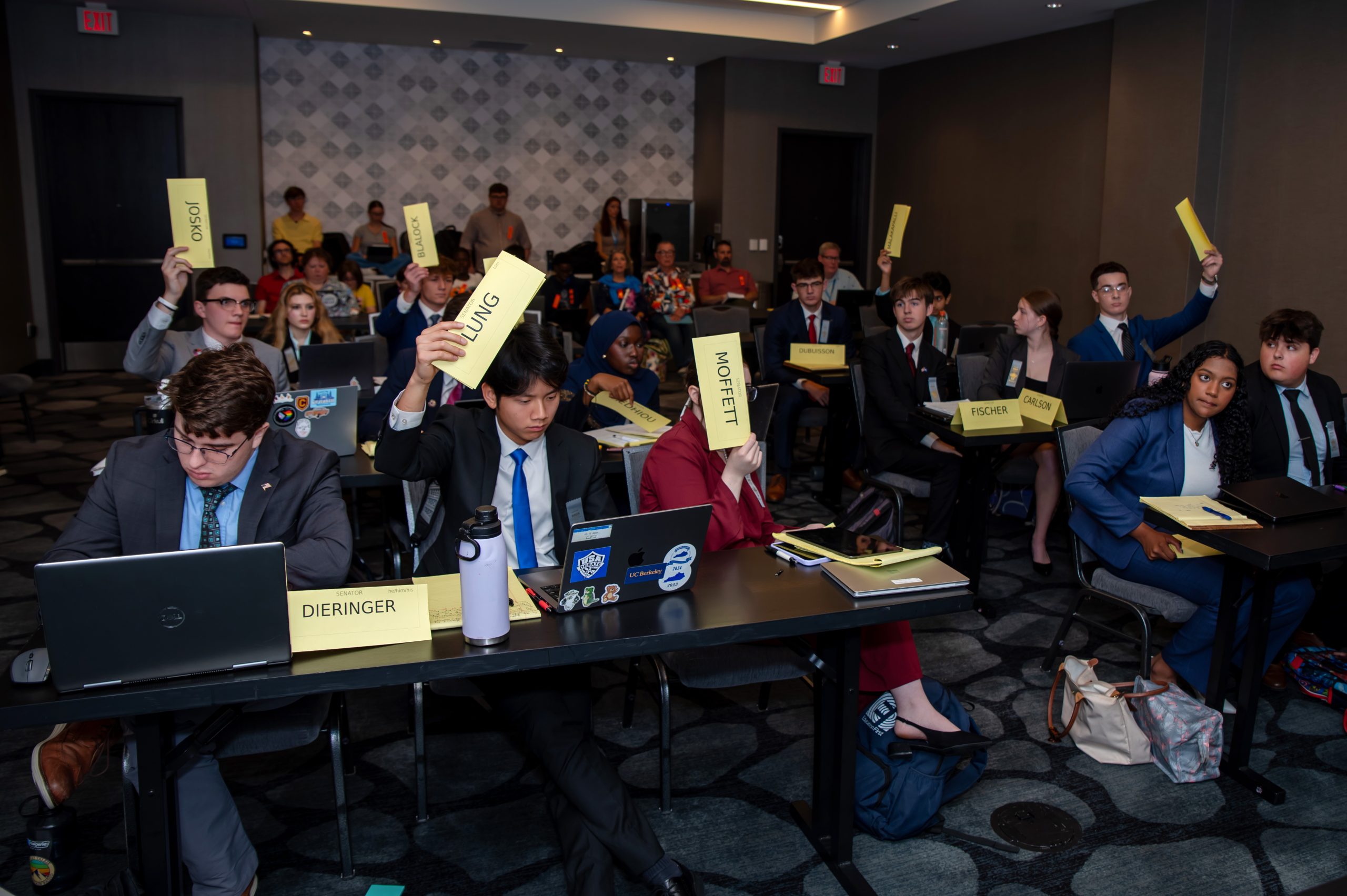
Henry Dieringer, a senior from L.C. Anderson High School in Austin, Texas, went into one competition thinking he would argue in favor of a bill that would provide work permits for immigrants, which he agrees with. Further research led him to oppose the idea of creating a federal database on immigrants.
“It made me think more about the way that public policy is so much more nuanced than what we believe,” Henry said.
On the afternoon of the second day of the national tournament, Macon learned he didn’t advance to the next round. What’s sad, he said, is he probably won’t have to think this hard about the justness of violent revolution ever again.
“There’s always next year,” Macon said.
Callista Martin, 16, a rising senior from Bainbridge High School in Washington state, also didn’t make the semifinals. Callista and Macon met online this year through speech and debate so they could scrimmage with someone they hadn’t practiced with before. It gave them the chance to debate someone with differing political views and argument styles.
Macon Smith, a rising senior from Bob Jones Academy in South Carolina, takes notes during a round of the Lincoln-Douglas Debate at the National Speech and Debate Tournament in Iowa. Credit: Meenakshi Van Zee for The Hechinger Report
“In the rounds, I’m an entirely different person. I’m pretty aggressive, my voice turns kind of mean,” Callista said. “But outside of the rounds, I always make sure to say hi to them before and after and say things I liked about their case, ask them about their school.”
Talking to her peers outside of rounds is perhaps the most important part of being in the club, Callista said. This summer, she will travel to meet with some of her closest friends, people she met at debate camps and tournaments in Washington.
Since Callista fell in love with speech and debate as a freshman, she has devoted herself to keeping it alive at her school. No teacher has volunteered to be a coach for the debate club, so the 16-year-old is coaching both her classmates and herself.
A lack of coaches is a common problem. Just under 3,800 public and private high schools and middle schools were members of the National Speech and Debate Association at the end of this past school year, just a fraction of the tens of thousands of secondary schools in the country. The organization would like to double its membership in the next five years.
That would mean recruiting more teachers to lead clubs, but neither educators nor schools are lining up to take on the responsibility, said David Yastremski, an English teacher at Ridge High School in New Jersey who has coached teams for about 30 years.
It’s a major time commitment for teachers to dedicate their evenings and weekends to the events with little supplemental pay or recognition. Also, it may seem like a risk to some teachers at a time when states such as Virginia and Louisiana have banned teachers from talking about what some call “divisive concepts,” to oversee a school activity where engaging with controversial topics is the point.
“I primarily teach and coach in a space where kids can still have those conversations,” Yastremski said. “I fear that in other parts of the country, that’s not the case.”
Dennis Philbert, a coach from Central High School in Newark, New Jersey, who had two students become finalists in the tournament’s Dramatic Interpretation category, said he fears for his profession because of the scrutiny educators are under. It takes the fun out of teaching, he said, but this club can reignite that passion.
“All of my assistant coaches are former members of my team,” Philbert said. “They love this activity [so much] that they came back to help younger students … to show that this is an activity that is needed.”
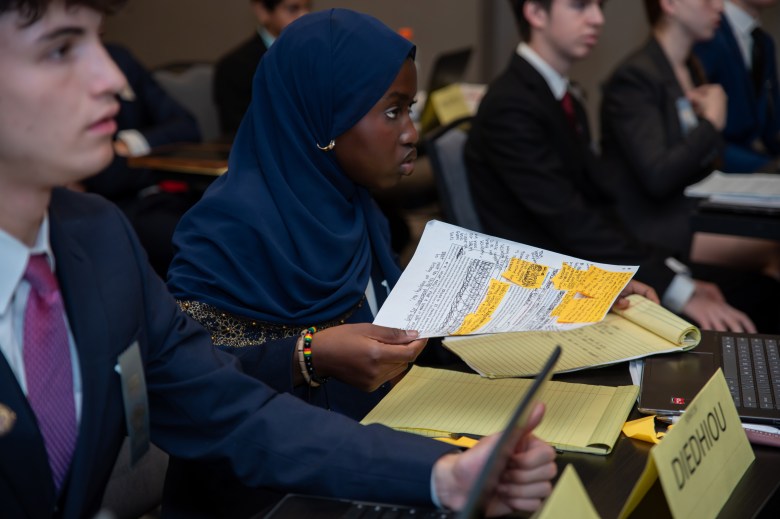
On the other side of Des Moines, Gagnado Diedhiou was competing in the Congressional Debate, a division of the tournament that mimics Congress and requires students to argue for or against bills modeled after current events. During one round, Gagnado spoke in favor of a bill to shift the country to use more nuclear energy, for a bill that would grant Puerto Rico statehood, and against legislation requiring hospitals to publicly post prices.
Gagnado Diedhiou, a senior from Eastside High School in South Carolina, competing in the first round of the Congressional Debate at the National Speech and Debate Tournament in Iowa in June. Credit: Meenakshi Van Zee for The Hechinger Report
Just like in Congress, boys outnumbered girls in this classroom. Gagnado was the only Black teenager and the only student wearing a hijab. The senior, who just graduated from Eastside High School in Greenville, South Carolina, is accustomed to being in rooms where nobody looks like her — it’s part of the reason she joined Equality in Forensics, a national student-led debate organization that provides free resources to schools and students across the country.
“It kind of makes you have to walk on eggshells a little bit. Especially because when you’re the only person in that room who looks like you, it makes you a lot more obvious to the judges,” said Gagnado, who won regional Student of the Year for speech and debate in her South Carolina district this year. “You stand out, and not always in a good way.”
Camille Fernandez, a rising junior at West Broward High School in Florida, said the competitions she has participated in have been dominated by male students. One opponent called her a vulgar and sexist slur after their round was over. Camille is a member of a student-led group — called Outreach Debate — trying to bridge inequities in the clubs.
“A lot of people think that debate should stay the same way that it’s always been, where it’s kind of just — and this is my personal bias — a lot of white men winning,” Camille said. “A lot of people think that should be changed, me included.”
Despite the challenges, Gagnado said her time in debate club has made her realize she could have an influence in the world.
“With my three-minute speech, I can convince a whole chamber, I can convince a judge to vote for this bill. I can advocate and make a difference with some legislation,” said Gagnado, who is bound for Yale.
About 10,000 people attended the National Speech and Debate Tournament in Iowa this June during the organization’s centennial anniversary. Credit: Meenakshi Van Zee for The Hechinger Report
A day before the national tournament’s concluding ceremony, a 22-year-old attendee rushed the stage at the Iowa Event Center in Des Moines during the final round of the Humorous Interpretation speech competition, scaring everyone in the audience. After he bent down to open his backpack, 3,000 people in the auditorium fled for the exits. The man was later charged with possession of a controlled substance and disorderly conduct. For a brief moment, it seemed like the angry discourse and extreme politics from outside of the competition had become a part of it.
In response, the speech and debate organization shifted the time of some events, limited entrances into the building and brought in metal detectors, police officers and counselors. Some students, Gagnado among them, chose not to return to the event.
Still, thousands of attendees stayed until the end to celebrate the national champions. During the awards ceremony, where therapy dogs roamed the grounds, Angad Singh, a student from Bellarmine College Preparatory in California competing in Original Oratory, took the national prize for his speech on his Sikh identity and the phrase “thoughts and prayers” commonly repeated by American leaders after a tragedy, titled “Living on a Prayer.”
“I’ve prayed for change,” Singh told the audience. “Then I joined speech and debate to use my voice and fight for it.”
The Hechinger Report provides in-depth, fact-based, unbiased reporting on education that is free to all readers. But that doesn’t mean it’s free to produce. Our work keeps educators and the public informed about pressing issues at schools and on campuses throughout the country. We tell the whole story, even when the details are inconvenient. Help us keep doing that.