Category: Featured

  • High school speech and debate allows students to find common ground

    High school speech and debate allows students to find common ground

    This story about high school speech and debate was produced by The Hechinger Report, a nonprofit, independent news organization focused on inequality and innovation in education. Sign up for the Hechinger newsletter.

    DES MOINES, Iowa — Macon Smith stood in front of a nearly empty classroom 1,000 miles from home. He asked his opponent and the two judges in the room if they were ready to start, then he set a six-minute timer and took a deep breath.

    “When tyranny becomes law, rebellion becomes duty,” he began. 

    In front of Macon, a 17-year-old high school junior, was a daunting task: to outline and defend the argument that violent revolution is a just response to political oppression.

    In a few hours, Macon would stand in another classroom with new judges and a different opponent. He would break apart his entire argument and undo everything he had just said.

    “An eye for an eye makes the whole world blind,” Macon started.

    It doesn’t really matter what opinion Macon holds on violence or political oppression. In this moment in front of the judges, he believes what he’s saying. His job is to get the judges to believe with him.

    Related: A lot goes on in classrooms from kindergarten to high school. Keep up with our free weekly newsletter on K-12 education.

    Macon was one of more than 7,000 middle and high school students to compete in the National Speech and Debate Tournament this summer in Iowa, run by an organization that is celebrating a century in existence.

    In that time, the National Speech and Debate Association has persevered through economic and social upheaval. It is entering its next era, one in which the very notion of engaging in informed and respectful debate seems impossible. The organizers of this event see the activity as even more important in a fracturing society.

    “I don’t think there’s an activity in the world that develops empathy and listening skills like speech and debate,” said Scott Wunn, the organization’s president. “We’re continuing to create better citizens.” 

    Macon Smith, a rising senior from Bob Jones Academy in South Carolina, competes in the third round of the Lincoln-Douglas Debate at the National Speech and Debate Tournament in Iowa this summer. Credit: Meenakshi Van Zee for The Hechinger Report

    Though the tournament is held in different cities around the country, for the 100th anniversary, the organizers chose to host it in Des Moines, where the association’s headquarters is based.

    Preparing for this competition was a year in the making for Macon, who will be a senior at Bob Jones Academy, a Christian school in Greenville, South Carolina, this fall. Students here compete in more than two dozen categories, such as Original Oratory, in which they write and recite their own 10-minute speeches, or Big Questions, where they attempt to argue broad, philosophical ideas. 

    Macon’s specialty, the Lincoln-Douglas Debate, is modeled after a series of public, three-hour debates between Abraham Lincoln and Sen. Stephen Douglas in 1858. In this event, two students have just 40 minutes to set up their arguments, cross-examine each other and sway the judges.

    “Even if I don’t personally believe it, I can still look at the facts and determine, OK, this is a good fact, or it’s true, and argue for that side,” Macon said.

    Debaters often have to tackle topics that are difficult, controversial and timely: Students in 1927 debated whether there was a need for a federal Department of Education. In 1987, they argued about mandatory AIDS testing. In 2004, they debated whether the United States was losing the war on terror. This year, in the Public Forum division, students debated whether the benefits of presidential executive orders outweigh the harms. 

    Related: Teaching social studies in a polarized world

    While the speech and debate students practiced for their national event, adults running the country screamed over each other during a congressional hearing on state sanctuary policies. A senator was thrown to the floor and handcuffed during a press conference on sending the National Guard to immigration enforcement protests in Los Angeles. Most Americans feel political discourse is moving in the wrong direction — both conservatives and progressives say talking politics with someone they disagree with has become increasingly stressful and frustrating

    Speech and debate club, though, is different.

    “First of all, it gives a kid a place to speak out and have a voice,” said Gail Nicholas, who for 40 years has coached speech and debate at Bob Jones Academy alongside her husband, Chuck Nicholas, who is Macon’s coach. “But then also learn to talk to other people civilly, and I think that’s not what’s being modeled out there in the real world right now.” 

    Macon Smith, a rising senior from Bob Jones Academy in South Carolina, shows off the notes that he took during debates at the National Speech and Debate Tournament in Iowa. Credit: Meenakshi Van Zee for The Hechinger Report

    On the second day of the competition in a school cafeteria in West Des Moines, Macon was anxiously refreshing the webpage that would show the results of his rounds to learn whether he would advance to semifinals.  

    For most of the school year, Macon spent two days a week practicing after school, researching and writing out his arguments. Like many competitors, he has found that it’s easy to make snap judgments when you don’t know much about an issue. Decisively defending that view, to yourself and to others, is much harder.  

    “I tend to go in with an opinion and lose my opinion as the topic goes on,” said Daphne DiFrancesco, a rising senior from Cary Academy in Cary, North Carolina.

    Traveling for regional events throughout the school year means Macon has become friends with students who don’t always share his conservative views. He knows this because in debate, discussing politics and religion is almost unavoidable.

    “It doesn’t make me uncomfortable at all,” Macon said. “You don’t want to burn down a bridge before you make it with other people. If you stop your connection with a person right at their political beliefs, you’re already cutting off half of the country. That’s not a good way to conduct yourself.”

    Macon, and other students in the clubs, said participating has made them think more deeply about their own beliefs. Last year, Macon debated a bill that would defund Immigration and Customs Enforcement, an agency he supports. After listening to other students, he developed a more nuanced view of the organization. 

    “When you look at the principle of enforcing illegal immigration, that can still be upheld, but the agency that does so itself is flawed,” he said.

    Related: ‘I can tell you don’t agree with me’:’ Colleges teach kids how to hear differing opinions

    Henry Dieringer, a senior from L.C. Anderson High School in Austin, Texas, went into one competition thinking he would argue in favor of a bill that would provide work permits for immigrants, which he agrees with. Further research led him to oppose the idea of creating a federal database on immigrants.

    “It made me think more about the way that public policy is so much more nuanced than what we believe,” Henry said. 

    On the afternoon of the second day of the national tournament, Macon learned he didn’t advance to the next round. What’s sad, he said, is he probably won’t have to think this hard about the justness of violent revolution ever again. 

    “There’s always next year,” Macon said.

    Callista Martin, 16, a rising senior from Bainbridge High School in Washington state, also didn’t make the semifinals. Callista and Macon met online this year through speech and debate so they could scrimmage with someone they hadn’t practiced with before. It gave them the chance to debate someone with differing political views and argument styles.
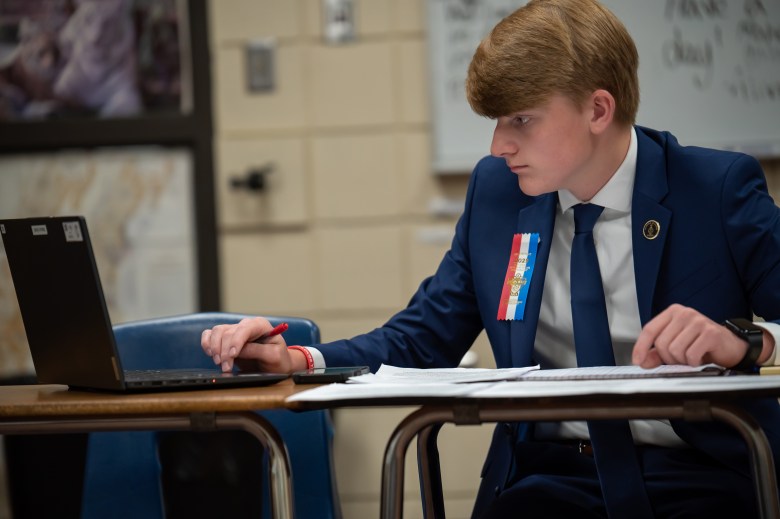
    Macon Smith, a rising senior from Bob Jones Academy in South Carolina, takes notes during a round of the Lincoln-Douglas Debate at the National Speech and Debate Tournament in Iowa. Credit: Meenakshi Van Zee for The Hechinger Report

    “In the rounds, I’m an entirely different person. I’m pretty aggressive, my voice turns kind of mean,” Callista said. “But outside of the rounds, I always make sure to say hi to them before and after and say things I liked about their case, ask them about their school.”

    Talking to her peers outside of rounds is perhaps the most important part of being in the club, Callista said. This summer, she will travel to meet with some of her closest friends, people she met at debate camps and tournaments in Washington.  

    Since Callista fell in love with speech and debate as a freshman, she has devoted herself to keeping it alive at her school. No teacher has volunteered to be a coach for the debate club, so the 16-year-old is coaching both her classmates and herself.

    A lack of coaches is a common problem. Just under 3,800 public and private high schools and middle schools were members of the National Speech and Debate Association at the end of this past school year, just a fraction of the tens of thousands of secondary schools in the country. The organization would like to double its membership in the next five years.

    That would mean recruiting more teachers to lead clubs, but neither educators nor schools are lining up to take on the responsibility, said David Yastremski, an English teacher at Ridge High School in New Jersey who has coached teams for about 30 years.

    It’s a major time commitment for teachers to dedicate their evenings and weekends to the events with little supplemental pay or recognition. Also, it may seem like a risk to some teachers at a time when states such as Virginia and Louisiana have banned teachers from talking about what some call “divisive concepts,” to oversee a school activity where engaging with controversial topics is the point.

    “I primarily teach and coach in a space where kids can still have those conversations,” Yastremski said. “I fear that in other parts of the country, that’s not the case.” 

    Related: A school district singled out by Trump says it teaches ‘whole truth history’ 

    Dennis Philbert, a coach from Central High School in Newark, New Jersey, who had two students become finalists in the tournament’s Dramatic Interpretation category, said he fears for his profession because of the scrutiny educators are under. It takes the fun out of teaching, he said, but this club can reignite that passion.

    “All of my assistant coaches are former members of my team,” Philbert said. “They love this activity [so much] that they came back to help younger students … to show that this is an activity that is needed.”

    On the other side of Des Moines, Gagnado Diedhiou was competing in the Congressional Debate, a division of the tournament that mimics Congress and requires students to argue for or against bills modeled after current events. During one round, Gagnado spoke in favor of a bill to shift the country to use more nuclear energy, for a bill that would grant Puerto Rico statehood, and against legislation requiring hospitals to publicly post prices.
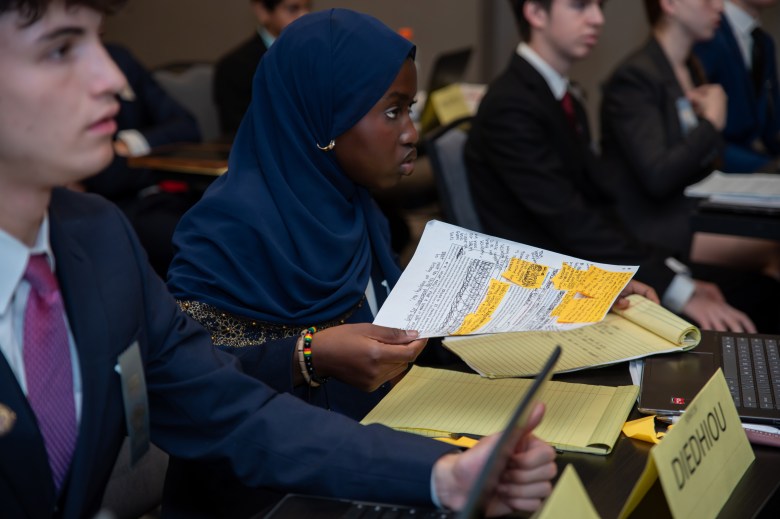
    Gagnado Diedhiou, a senior from Eastside High School in South Carolina, competing in the first round of the Congressional Debate at the National Speech and Debate Tournament in Iowa in June. Credit: Meenakshi Van Zee for The Hechinger Report

    Just like in Congress, boys outnumbered girls in this classroom. Gagnado was the only Black teenager and the only student wearing a hijab. The senior, who just graduated from Eastside High School in Greenville, South Carolina, is accustomed to being in rooms where nobody looks like her — it’s part of the reason she joined Equality in Forensics, a national student-led debate organization that provides free resources to schools and students across the country.

    “It kind of makes you have to walk on eggshells a little bit. Especially because when you’re the only person in that room who looks like you, it makes you a lot more obvious to the judges,” said Gagnado, who won regional Student of the Year for speech and debate in her South Carolina district this year. “You stand out, and not always in a good way.”

    Camille Fernandez, a rising junior at West Broward High School in Florida, said the competitions she has participated in have been dominated by male students. One opponent called her a vulgar and sexist slur after their round was over. Camille is a member of a student-led group — called Outreach Debate — trying to bridge inequities in the clubs. 

    “A lot of people think that debate should stay the same way that it’s always been, where it’s kind of just — and this is my personal bias — a lot of white men winning,” Camille said. “A lot of people think that should be changed, me included.” 

    Despite the challenges, Gagnado said her time in debate club has made her realize she could have an influence in the world.

    “With my three-minute speech, I can convince a whole chamber, I can convince a judge to vote for this bill. I can advocate and make a difference with some legislation,” said Gagnado, who is bound for Yale. 
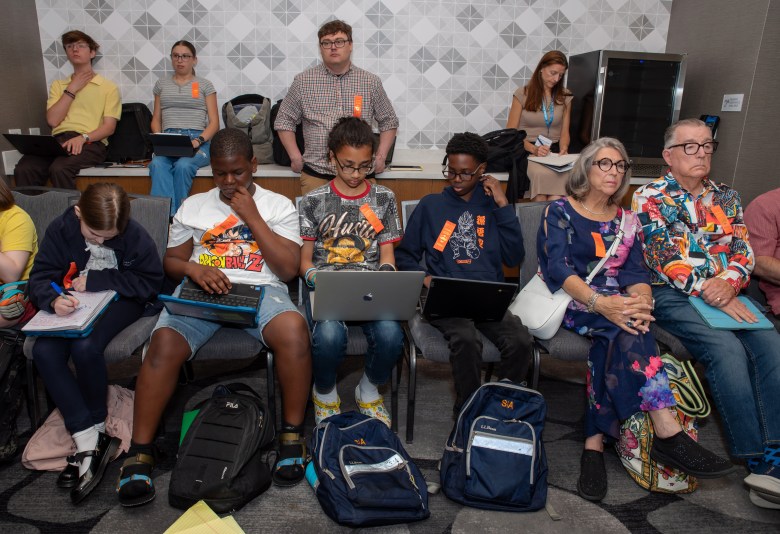
    About 10,000 people attended the National Speech and Debate Tournament in Iowa this June during the organization’s centennial anniversary. Credit: Meenakshi Van Zee for The Hechinger Report

    A day before the national tournament’s concluding ceremony, a 22-year-old attendee rushed the stage at the Iowa Event Center in Des Moines during the final round of the Humorous Interpretation speech competition, scaring everyone in the audience. After he bent down to open his backpack, 3,000 people in the auditorium fled for the exits. The man was later charged with possession of a controlled substance and disorderly conduct. For a brief moment, it seemed like the angry discourse and extreme politics from outside of the competition had become a part of it. 

    In response, the speech and debate organization shifted the time of some events, limited entrances into the building and brought in metal detectors, police officers and counselors. Some students, Gagnado among them, chose not to return to the event. 

    Still, thousands of attendees stayed until the end to celebrate the national champions. During the awards ceremony, where therapy dogs roamed the grounds, Angad Singh, a student from Bellarmine College Preparatory in California competing in Original Oratory, took the national prize for his speech on his Sikh identity and the phrase “thoughts and prayers” commonly repeated by American leaders after a tragedy, titled “Living on a Prayer.”

    “I’ve prayed for change,” Singh told the audience. “Then I joined speech and debate to use my voice and fight for it.”

    This story about high school speech and debate was produced by The Hechinger Report, a nonprofit, independent news organization focused on inequality and innovation in education. Sign up for the Hechinger newsletter.


    The Hechinger Report provides in-depth, fact-based, unbiased reporting on education that is free to all readers. But that doesn’t mean it’s free to produce. Our work keeps educators and the public informed about pressing issues at schools and on campuses throughout the country. We tell the whole story, even when the details are inconvenient. Help us keep doing that.

    Join us today.

    Source link

  • REF panels must reflect the diversity of the UK higher education sector

    REF panels must reflect the diversity of the UK higher education sector

    As the sector begins to prepare for REF 2029, with a greater emphasis on people, culture and environment and the breadth of forms of research and inclusive production, one critical issue demands renewed attention: the composition of the REF panels themselves. While much of the focus rightly centres on shaping fairer metrics and redefining engagement and impact, we should not overlook who is sitting at the table making the judgments.

    If the Research Excellence Framework is to command the trust of the full spectrum of UK higher education institutions, then its panels must reflect the diversity of that spectrum. That means ensuring meaningful representation from a wide range of universities, including Russell Group institutions, pre- and post-92s, specialist colleges, teaching-led universities, and those with strong regional or civic missions.

    Without diverse panel representation, there is a real risk that excellence will be defined too narrowly, inadvertently privileging certain types of research and institutional profiles over others.

    Broadening the lens

    Research excellence looks different in different contexts. A university with a strong regional engagement strategy might produce research that is deeply embedded in local communities, with impacts that are tangible but not easily measured by traditional academic metrics, but with clear international excellence. A specialist arts institution may demonstrate world-leading innovation through creative practice that doesn’t align neatly with standard research output categories.

    The RAND report looking at the impact of research through the lens of the REF 2021 impact cases rightly recognised the importance of “hyperlocality” – and we need to ensure that research and impact is equally recognised in the forthcoming REF exercise.

    UK higher education institutions are incredibly diverse, with different institutions having distinct missions, research priorities, and challenges. REF panels that lack representation from the full spectrum of institutions risks bias toward certain types of research outputs or methodologies, particularly those dominant in elite institutions.

    Dominance of one type of institution on the panels could lead to an underappreciation of applied, practice-based, or interdisciplinary research, which is often produced by newer or specialist institutions.

    Fairness, credibility, and innovation

    Fair assessment depends not only on the criteria applied but also on the perspectives and experiences of those applying them. Including assessors from a wide range of institutional backgrounds helps surface blind spots and reduce unconscious bias. It also allows the panels to better understand and account for contextual factors, such as variations in institutional resources, missions, and community roles, when evaluating submissions.

    Diverse panels also enhance the credibility of the process. The REF is not just a technical exercise; it shapes funding, reputations, and careers. A panel that visibly includes internationally recognised experts from across the breadth of the sector helps ensure that all institutions – and their staff – feel seen, heard, and fairly treated, and that a rigorous assessment of UK’s research prowess is made across the diversity of research outputs whatever their form.

    Academic prestige and structural advantages (such as funding, legacy reputations, or networks) can skew assessment outcomes if not checked. Diversity helps counter bias that may favour research norms associated with more research established institutions. Panel diversity encourages broader thinking about what constitutes excellence, helping to recognize high-quality work regardless of institutional setting.

    Plus there is the question of innovation. Fresh thinking often comes from the edges. A wider variety of voices on REF panels can challenge groupthink and encourage more inclusive and creative understandings of impact, quality, and engagement.

    A test of the sector’s commitment

    This isn’t about ticking boxes. True diversity means valuing the insights and expertise of panel members from all corners of the sector and ensuring they have the opportunity to shape outcomes, not just observe them. It also means recognising that institutional diversity intersects with other forms of diversity, including protected characteristics, professions and career stage, which must also be addressed.

    The REF is one of the most powerful instruments shaping UK research culture. Who gets to define excellence in the international context has a profound impact on what research is done, how it is valued, and who is supported to succeed. REF panels should reflect the diversity of UK HEIs to ensure fairness, credibility, and a comprehensive understanding of research excellence across all contexts.

    If REF 2029 is to live up to the sector’s ambitions for equity, inclusion, and innovation, then we must start with its panels. Without diverse panels, the REF risks perpetuating inequality and undervaluing the full range of scholarly contributions made across the sector, even as it evaluates universities on their own people, culture, and environment. The composition of those panels will be a litmus test for how seriously we take those commitments.

    Source link

  • Defining the value of the UK’s international research partnerships

    Defining the value of the UK’s international research partnerships

    It might not be news that the UK research sector is strikingly international, but the scale of our global collaboration is striking – and it’s growing.

    Over 60 per cent of Russell Group academics’ publications involved an international co-author in 2023, 16 per cent higher than in 2019, and in 2022 this proportion was higher for UK academics than any of our global competitors. Pooling ideas and talent makes for better research and more innovation, so supporting them to do more matters deeply to researchers – as our universities are well aware, given their own longstanding global connections.

    International collaboration matters for the UK at large too, helping us tackle shared challenges and forming a large part of our global contribution. In a more uncertain world, protecting and growing research collaborations is becoming more important – complementing the government’s efforts to deepen links with the EU, protect ties with the US, and build relationships in India.

    These initiatives are bound up with both security and growth. This is no accident: a strong economy is the route to creating jobs and supporting public services. We have always argued that international university partnerships should be part of the wider offer to global investors and trade partners, but we need to find new ways to demonstrate their value.

    To that end, Jisc has done new analysis for the Russell Group looking at the scale and value of international research partnerships. Jisc’s unique data-matching analysis of UK, US and EU patent data held by the European Patents Office covers over 30 years of international collaboration in patent applications. The data identifies partnerships that UK institutions hold with both international companies and universities.

    It’s booming

    So what did we learn? Jisc’s analysis shows the proportion of patents co-filed by UK universities and an international partner grew from 12 per cent in 2000 to 22 per cent in 2022. It also found a remarkably high share of collaborations with international businesses, not just fellow academics: 43 per cent of co-filings since 2018 were with an overseas company and 36 per cent with a university abroad.

    Since 2018, the data shows UK universities filed over 100 EU, US and UK patents with international partners every year. The analysis also allows us to see individual patents, not just numbers, so we can understand how impactful this work is not just to academic excellence, but to society. For example:

    • the world’s first gene therapy for adults with severe haemophilia A, from pioneering research between University College London and St. Jude Children’s Research Hospital in the US
    • a new type of gene therapy from Newcastle University and the University of Heidelberg in Germany, which can help to protect and strengthen muscles in people with muscular dystrophy
    • improvements to machine-learning models by the University of Edinburgh and University of Manchester with Toyota in Japan – refining the ability to interpret images, a step on the way to driverless cars.

    These projects, and many more of their kind, demonstrate the cutting-edge R&D that can underpin the government’s growth mission, industrial strategy and NHS ambitions. Jisc’s analysis therefore suggests that to make the most of universities’ strengths, and secure a global advantage for the UK, support for both home-grown innovation and high-value overseas collaborations will be crucial.

    Potential for even more

    This includes additional support for the work universities do with and for businesses, in sectors like clean energy and advanced manufacturing. Academics and innovators can do much of this themselves, but government can help by working with us to deliver a stable platform to build on including reliable funding streams, improved incentives for SME-university collaboration and a long-term strategy for industrial renewal.

    We also need a strategic focus on higher education’s financial sustainability, so universities can maximise the impact of the £86bn government is committing to R&D over the next few years and support plans for economic growth and public service improvement.

    It also means maintaining a supportive, stable and cost-effective visa system for staff and students – further expanding the commitments already made on building global talent pathways – so UK universities can attract and educate our future academics, innovators and collaborators, as well as securing important cross-subsidies for research and teaching. A strategic approach to skills and infrastructure across the UK would complement this, ensuring all nations and regions can benefit.

    Finally, building the right platform for international collaboration means backing stable, flexible routes for academics and innovators to work together. UKRI’s work to develop lead agency agreements with counterparts in other countries has been a positive and warmly-welcomed example. Above all, however, our relationship with the world’s largest international collaborative programme for R&D – Horizon Europe, and its successor Framework Programme 10 – will be vital.

    We’re currently awaiting the European Commission’s official “first draft” for FP10. We know it will be a standalone programme with a research and innovation focus, which is very reassuring. At the moment, Horizon Europe is providing more collaborative research opportunities than any one country can alone, as well as helping UK universities attract top researchers. Universities are working hard to boost Horizon participation, taking the lead in European Research Council Advanced Grant wins in 2024, and nurturing the encouraging green shoots in the collaborative Pillar II. Keeping this going is vital for global collaborations which contribute so much to our, and our partners’, economic and societal progress.

    Researchers need certainty so they can rely on a shared long-term framework when building collaborations. The more open FP10 is to like-minded countries, and the more positive the UK is about association early on, the more confidence academics can be in continuing – and indeed expanding – invaluable international partnerships.

    Source link

  • ‘One big mistake’: Higher ed sounds warning over GOP budget law

    ‘One big mistake’: Higher ed sounds warning over GOP budget law

    This audio is auto-generated. Please let us know if you have feedback.

    The American higher education system is in for a big shake-up with the enactment of Republicans’ massive bill full of tax and spending cuts 

    The Senate voted 51-50 on the package, with Vice President JD Vance casting the deciding ballot, after which the bill passed the House by a four-vote margin. President Donald Trump signed it into law on Friday, the deadline he had set for lawmakers

    One of the architects of the bill’s higher ed provisions, Sen. Tim Walberg, a Michigan Republican who chairs his chamber’s education committee, called it “the first set of significant conservative reforms to the higher education landscape in two decades,” adding that it would “maintain America’s world-class higher education system.”

    The new law means higher taxes for some university endowments and a new college accountability system tied to financial aid, as well as several changes to the federal student aid program — including ending the GRAD Plus loan program and capping student borrowing overall — that advocates say will limit college access. 

    The American Council on Education on Thursday described the bill as “a significant improvement” over an earlier House version, but added that it “combines major tax changes with deep spending cuts that will carry significant negative consequences for campuses and students.” 

    Sameer Gadkaree, president and CEO of The Institute for College Access & Success, said in a July 3 statement, “This bill can only be described as one big mistakethe consequences of which will negatively affect college students, borrowers, and their families for years to come.”

    The law cuts $300 billion in federal support to students over 10 years, including by limiting borrowing to graduate students — to $100,000 per borrower, or $200,000 for those in professional programs such as law or medicine. It would also cap Parent PLUS loans to $65,000 per student. 

    The caps on federal student lending will likely lead more borrowers “to pursue riskier private loans or forego further education,” Gadkaree said.

    At the same time, the law culls a handful of federal student loan repayment programs down to just two choices. That reduction — billed as a simplification by supporters — which will leave many borrowers on the hook for larger monthly payments, according to TICAS. 

    By increasing the amount, riskiness, and duration of student loan debt, the law directly reduces the likelihood that current borrowers and future students can do better financially than their parents,” Gadkaree said. 

    He also noted that the law’s funding cuts to Medicaid — the largest in the program’s history — and food assistance could add to the financial difficulties of attending college for many. 

    Aissa Canchola Bañez, policy director of the Student Borrower Protection Center, decried the law as one that will “push millions off their healthcare, leave children to go hungry, and push dreams of a college education even further out of reach for working people across this country.” 

    Walberg, meanwhile, said the loan system changes “increase simplicity and affordability so students don’t borrow excessive debt they can never repay.”

    Changes to the federal student aid program will also bring financial impact to colleges. 

    Combined with higher tax rates on the wealthiest private college endowments, the bill’s aid cuts “will force even more difficult decisions on chief business officers and further strain revenue that helps make college affordable for students and families,” Kara Freeman, CEO and president of the National Association of College and University Business Officers, said in a July 3 statement. 

    Colleges could also be rendered ineligible to receive student loan funds entirely if their former students don’t meet new earnings measures in the bill.

    However, changes to the bill narrowed the funds at stake for colleges from a previous version and tweaked the metrics to include only graduates of the programs in question. The accountability system “represents a more targeted and data-informed alternative” to the “punitiverisk-sharing proposal in an earlier House version of the bill, the American Council on Education said on July 3. 

    Source link

  • Trump’s OCR steps up pace for dismissing complaints

    Trump’s OCR steps up pace for dismissing complaints

    This audio is auto-generated. Please let us know if you have feedback.

    As public complaints continue to pile up at the U.S. Department of Education’s Office for Civil Rights, the agency is dismissing them at a pace that is alarming former OCR employees.

    From the time of the agency’s reduction in force on March 11 until June 27, OCR dismissed 3,424 complaints, according to court documents filed by Rachel Oglesby, who has been chief of staff at the Education Department since January. By comparison, the office dismissed 2,527 cases in the three-month period between November 2024 and January 2025 under the Biden administration, according to Catherine Lhamon, who led the agency under the last presidency. 

    A similar contrast can be seen in the agency’s other benchmarks. 

    The Trump administration’s OCR opened 309 complaints for investigation in the March-June period, compared to 674 during the Biden administration’s final three months between Nov. 1, 2024, and Jan. 1, 2025. The Trump Education Department recently resolved 290 complaints with voluntary agreements, OCR-mediated settlements and technical assistance, while Lhamon said the previous administration, around the same three-month period, resolved 595 through mediation or voluntary resolution alone. 

    The contrast “reflects a shocking diminution of work output from the office,” Lhamon said by text message on Monday.  

    “A dismissal rate this high suggests a fundamental shift in how OCR is triaging and processing complaints,” said Jackie Gharapour Wernz, an education civil rights attorney who worked for the OCR under the Obama and first Trump administrations. “It raises serious concerns about whether civil rights issues are being meaningfully evaluated and whether the agency is adhering to its own case processing manual and relevant law in dismissing cases.”

    An Education Department spokesperson, however, strongly defended the agency’s work.

    In dismissing complaints, OCR is taking actions according to federal law, regulations and the OCR case processing manual, which outlines the steps the agency must take to process complaints, said Julie Hartman, an Education Department spokesperson, in an email to K-12 Dive late Monday. 

    Hartman also pointed to the agency’s work with the Department of Justice, which it partnered with to expedite climbing sex-based discrimination claims.

    “OCR has taken unprecedented steps to streamline its functions according to demand,” said Hartman. “OCR’s daily accomplishments under the Trump Administration disprove the rampant fear-mongering by the media” and makes clear that “OCR is vigorously upholding its responsibilities to protect all Americans’ civil rights.”

    The high number of case dismissals comes after the department let go of hundreds of its OCR employees and shut down seven of its 12 regional offices. The moves prompted concerns from civil rights advocates that the agency wouldn’t be able to fulfill its duties to protect students — especially those from traditionally marginalized groups. 

    Those layoffs came amid historic high OCR caseloads, which had prompted the Biden administration to advocate for increased funding to beef up the office’s investigative staff. Lhamon at the time had said investigators were juggling “untenable” caseloads of upward of 40 cases per person.

    Since the mass layoffs, existing investigative staff have been juggling nearly double that workload. And the Trump administration has proposed slashing the office’s funding for fiscal year 2026 by $49 million compared to the $140 million appropriated in 2024.

    The concerns led to a lawsuit, Victim Rights Law Center v. U.S. Department of Education, filed by Victim Rights Law Center. In a ruling last month, U.S. District Judge Myong Joun said the mass terminations and closure of multiple OCR offices meant the office had “abdicated its enforcement duties” and ordered that OCR be restored to its status quo. 

    Source link

  • N.C. Gov. Vetoes Bills Targeting ‘DEI,’ ‘Divisive Concepts’

    N.C. Gov. Vetoes Bills Targeting ‘DEI,’ ‘Divisive Concepts’

    North Carolina’s Democratic governor has vetoed two bills the Republican-led General Assembly passed targeting what lawmakers dubbed “diversity, equity and inclusion”; “discriminatory practices”; and “divisive concepts” in public higher education.

    Senate Bill 558 would have banned institutions from having offices “promoting discriminatory practices or divisive concepts” or focused on DEI. The bill defined “discriminatory practices” as “treating an individual differently [based on their protected federal law classification] solely to advantage or disadvantage that individual as compared to other individuals or groups.”

    SB 558’s list of restricted divisive concepts mirrored the lists that Republicans have inserted into laws in other states, including the idea that “a meritocracy is inherently racist or sexist” or that “the rule of law does not exist.” The legislation would have prohibited colleges and universities from endorsing these concepts.

    The bill would have also banned institutions from establishing processes “for reporting or investigating offensive or unwanted speech that is protected by the First Amendment, including satire or speech labeled as microaggression.”

    In his veto message Thursday, Gov. Josh Stein wrote, “Diversity is our strength. We should not whitewash history, police dorm room conversations, or ban books. Rather than fearing differing viewpoints and cracking down on free speech, we should ensure our students learn from diverse perspectives and form their own opinions.”

    Stein also vetoed House Bill 171, which would have broadly banned DEI from state government. It defined DEI in multiple ways, including the promotion of “differential treatment of or providing special benefits to individuals on the basis of race, sex, color, ethnicity, nationality, country of origin, or sexual orientation.”

    “House Bill 171 is riddled with vague definitions yet imposes extreme penalties for unknowable violations,” Stein wrote in his HB 171 veto message. NC Newsline reported that lawmakers might still override the vetoes.

    Source link

  • Extortion in plain sight | The Foundation for Individual Rights and Expression

    Extortion in plain sight | The Foundation for Individual Rights and Expression

    This essay was originally published by The Dispatch on July 4, 2025.


    Paramount Global’s decision to pay $16 million to end President Donald Trump’s lawsuit over a 60 Minutes interview with Kamala Harris was a “win for the American people,” according to Trump’s lawyers. And it happened because “CBS and Paramount Global realized the strength of this historic case and had no choice but to settle.”

    Well, not quite.

    The case is “historic” for sure, but not in a good way or because the advocates came up with profound theories of media law. Quite to the contrary: The case is so baseless, so devoid of factual or legal support, and so diametrically opposed to basic First Amendment principles it is hard to imagine how those who filed it sleep at night. 

    The main question about Paramount’s decision to settle this comically frivolous lawsuit is not why the company decided to settle, but why did resolving it take this long if the “historic case” were so “strong?” The reason for the settlement is obvious. Paramount, the corporate parent of the CBS television network, had a gun to its head. 

    Paramount must get approval from the Federal Communications Commission for its proposed $8 billion merger with Skydance Media (which includes the transfer of 28 CBS-owned and -operated broadcast stations). The merger agreement expired April 7 but was extended to July 7. So it was pay-up or shut-up time.

    The holdup, in every sense of that word, came in the form of FCC Chairman Brendan Carr, whom President Trump elevated to head the commission on Inauguration Day. As one of his first official acts, Carr opened his own investigation of the Harris interview over supposed “news distortion,” and he slow-rolled the FCC’s merger review process. The Securities and Exchange Commission and European regulators had approved the merger back in February, but the FCC continued to “ponder” the matter as the deal clock ticked down.

    Trump’s $16M win over ’60 Minutes’ edit sends chilling message to journalists everywhere

    Trump’s $16M win over a “60 Minutes” edit sends a chilling message to journalists everywhere. FIRE’s Bob Corn-Revere calls it what it is: the FCC playing politics.


    Read More

    But let’s give him the benefit of the doubt: Couldn’t it be that Carr was just carefully considering nuanced issues of media law in order to safeguard the public from big-network media bias? After all, Trump had claimed that CBS had edited its interview deceptively to make Harris “look better” — something he called “totally illegal,” an “UNPRECEDENTED SCANDAL,” and for which the FCC should “TAKE AWAY THE CBS LICENSE.” Never mind that networks are not licensed by the FCC (stations are), the rant led to the lawsuit in Texas and later the FCC investigation.

    Loopy all-cap social media posts aside, there was never a legitimate basis either for the lawsuit or the FCC action. Every day, from the smallest newspaper to the largest network, reporters and editors must digest and condense the information they collect — including quotes from politicians and other newsmakers — to tell their stories concisely and understandably. For instance, Trump has repeatedly received the same treatment. Fox News repeatedly edited interviews with then-candidate Trump during the campaign, editing answers to enhance coherence, eliminate digressions, and excise insults. Making sense of the stuff that pours from politicians’ mouths is not easy. And here, CBS was accused of something unforgivable: committing standard journalism. 

    This was never about swapping out answers to different questions or rewriting answers, as Trump and his supporters falsely claim. During the interview, 60 Minutes correspondent Bill Whitaker asked then-Vice President Harris a question about the Biden administration’s relationship with Israeli Prime Minister Benjamin Netanyahu: 

    MR. BILL WHITAKER: But it seems that Prime Minister Netanyahu is not listening. The Wall Street Journal said that he — that your administration has repeatedly been blindsided by Netanyahu, and in fact, he has rebuffed just about all of your administration’s entreaties.

    VICE PRESIDENT KAMALA HARRIS: Well, Bill, the work that we have done has resulted in a number of movements in that region by Israel that were very much prompted by, or a result of many things, including our advocacy for what needs to happen in the region. And we’re not going to stop doing that. We are not going to stop pursuing what is necessary for the United States to be clear about where we stand on the need for this war to end.

    CBS broadcast two excerpts of Harris’ answer on two separate programs: On Face the Nation, CBS aired the first sentence of Harris’ answer. On 60 Minutes, CBS aired the last sentence of the answer. Really — that’s all this is about.

    The FCC in the past has never defined the editing process as “news distortion.” In fact, it has steadfastly maintained the First Amendment bars it from doing so. Chairman Carr’s decision to reopen a closed complaint in a matter he knows to be baseless and beyond the FCC’s authority is unprecedented and indefensible.

    We need a far stronger word than ‘hypocrite’ to capture this moment. We have a president who on day one issued an executive order purporting to ‘restore free speech’ … [then] deployed agency heads to retaliate against news organizations that displease him.

    And the arguments in the now-settled lawsuit are even more frivolous (if that’s even possible). Trump’s lawyers argued that the Harris interview violated the Texas Deceptive Trade Practices Act and the federal Lanham Act as a “false, misleading, or deceptive act or practice” and asserted $20 billion in damages. Those laws are designed to prevent consumer deception in marketing practices (like turning back the odometer on a used car) or false advertising. They simply don’t apply to editorial judgments by news organizations. No court in any jurisdiction has ever held that such a cause of action might be valid, and few plaintiffs have ever attempted to bring such outlandish claims. Those who have done so were promptly dismissed.

    But who needs good arguments or supporting legal authority when federal regulators are willing to ignore their oath to uphold the Constitution and back your political power play?

    Of course, Carr has maintained that there was no link between the Texas lawsuit and the FCC’s merger review or news distortion investigation. But let’s get real. Before he was named chairman, Carr said he didn’t think the 60 Minutes interview “should be a federal case,” and “we don’t want to get into authenticating news or being a Ministry of Truth.”

    But once Trump announced Carr as his pick to head the agency, Carr changed his tune, telling Fox News the FCC would review the 60 Minutes complaint while considering whether to approve the Paramount-Skydance merger. The hypocrisy here is staggering. As chairman, Carr has routinely boasted that he wants to move quickly to spur business and investment. Yet here, he mysteriously lagged in reviewing the Paramount Global-Skydance merger (coincidentally, no doubt) as settlement negotiations dragged on in Texas.

    We need a far stronger word than “hypocrite” to capture this moment. We have a president who on day one issued an executive order purporting to “restore free speech” and to bar any federal official from engaging in censorship. At the same time, the very same president deployed agency heads to retaliate against news organizations that displease him and to do so in support of his private litigation efforts. And we have an FCC chairman who used to say things like “[a] newsroom’s decision about what stories to cover and how to frame them should be beyond the reach of any government official, not targeted by them,” who has made micromanaging news editing a defining principle of his administration.

    Meanwhile, settlement of Trump’s case against CBS and the anticipated merger approval raise some significant questions. Sens. Elizabeth Warren, Bernie Sanders, and Ron Wyden have asked whether the settlement might violate federal bribery laws, which prohibit corruptly giving anything of value to public officials to influence an official act. In a similar vein, the Freedom of the Press Foundation has threatened (as a Paramount shareholder) to bring a derivative action against the company for conflict of interest, and last May filed a shareholder information demand. 

    Whatever else may happen, this week’s settlement announcement is not the end of this saga. But one thing is clear: The bullying tactics that led to this settlement stain our nation’s character and taint not just those who engage in them but also those who give in.

    Source link

  • Trump Team Weakens Bipartisan Law That Protects Students and Veterans From Predatory Colleges (David Halperin)

    Trump Team Weakens Bipartisan Law That Protects Students and Veterans From Predatory Colleges (David Halperin)

    On the eve of the 4th of July holiday, when they probably hoped no one was paying attention, the Trump Department of Education issued an Interpretive Rule that will make it easier for for-profit colleges to evade regulations aimed at protecting students, and especially student veterans and military service members, from low-quality schools.

    The Department’s 90-10 rule, created by Congress, requires for-profit colleges to obtain at least ten percent of their revenue from sources other than taxpayer-funded federal student grants and loans, or else — if they flunk two years in a row — lose eligibility for federal aid. The purpose is to remove from federal aid those schools of such poor quality that few students, employers, or scholarship programs would put their own money into them.

    For decades, low quality schools have been able to avoid accountability through a giant loophole: only Department of Education funding counted on the federal side of the 90-10 ledger, while other government funding, including GI Bill money from the VA, and tuition assistance for active duty troops and their families from the Pentagon, counted as non-federal. That situation was particularly bad because it motivated low-quality predatory schools, worried about their 90-10 ratios, to aggressively target U.S. veterans and service members for recruitment.

    After years of efforts by veterans organizations and other advocates to close the loophole, Congress in 2021 passed, on a bipartisan basis, and President Biden signed, legislation that appropriately put all federal education aid, including VA and Defense Department money, on the federal side of the ledger.

    The Department was required by the new law to issue regulations specifying in detail how this realignment would work, and the Department under the Biden administration did so in 2022, after engaging in a legally-mandated negotiated rulemaking that brought together representatives of relevant stakeholders. In an unusual development, that rulemaking actually achieved consensus among the groups at the table, from veterans organizations to the for-profit schools themselves, on what the final revised 90-10 rule should be.

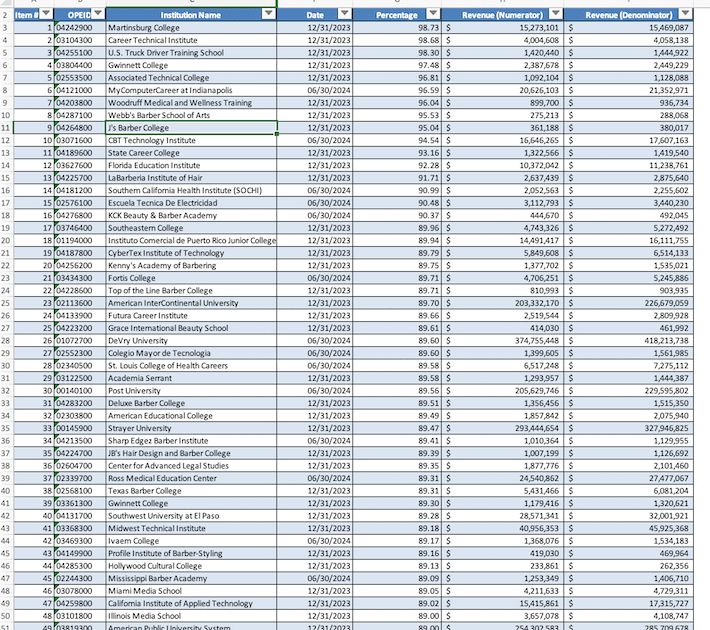
    The new rule took effect in 2023, and when the Department released the latest 90-10 calculations, for the 2023-24 academic year, sixteen for-profit colleges had flunked, compared with just five the previous year. These were mostly smaller schools, led by West Virginia’s Martinsburg College, which got 98.73 percent of its revenue from federal taxpayer dollars, and Washington DC’s Career Technical Institute, which reported 98.68 percent. Another 36 schools, including major institutions such as DeVry University, Strayer University, and American Public University, came perilously close to the line, at 89 percent or higher.

    The education department last week altered the calculation by effectively restoring an old loophole that allowed for-profit colleges to use revenue from programs that are ineligible for federal aid to count on the non-federal side. That loophole was expressly addressed, via a compromise agreement, after Department officials discussed the details with representatives of for-profit colleges, during the 2022 negotiated rulemaking meetings.

    All the flunking or near-flunking schools can now get a new, potentially more favorable, calculation of their 90-10 ratio under the Trump administration’s re-interpretation of the rule.

    In the lawless fashion of the Trump regime, the Department has now undermined a provision of its own regulation without going through the required negotiated rulemaking process. (The Department’s notice last week included a labored argument about why its action was lawful.)

    As it has done multiple times over its first six months, the Trump Department of Education, under Secretary Linda McMahon, has again taken a step that allows poor-quality predatory for-profit colleges to rip off students and taxpayers.

    Source link

  • Jailed for basic journalism, Texas reporter takes free speech fight to Supreme Court

    Jailed for basic journalism, Texas reporter takes free speech fight to Supreme Court

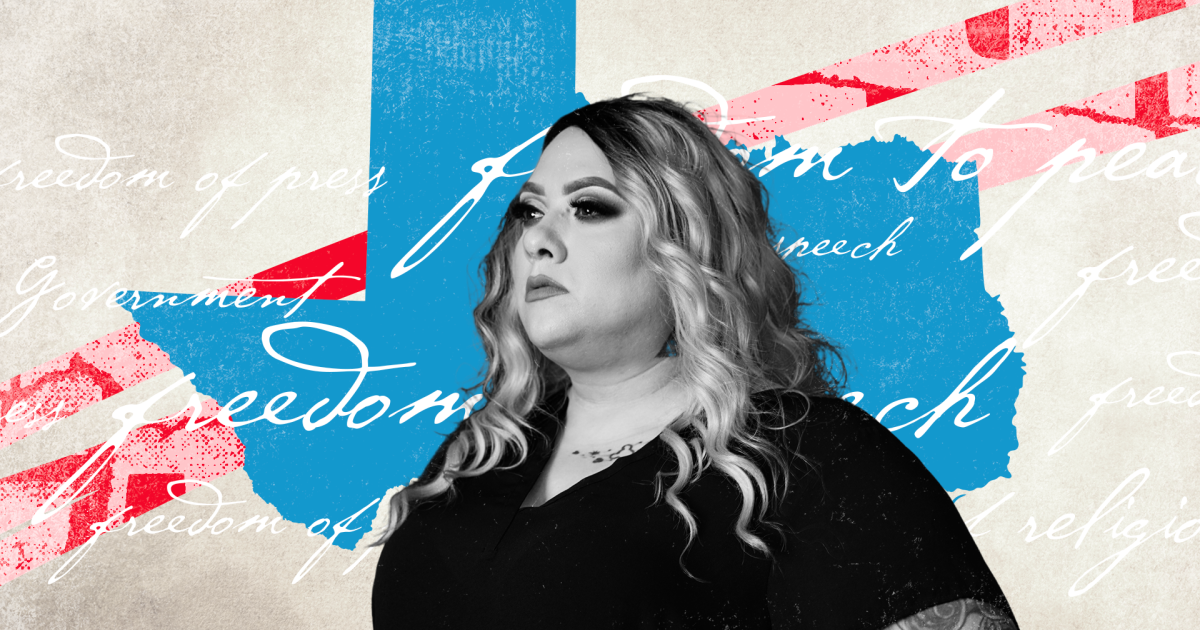
    For years, Priscilla Villarreal has fought to hold officials accountable when they violate Americans’ First Amendment rights, including the Laredo officials who threw her in jail just for asking police to verify facts as part of her everyday news reporting. 

    Priscilla sued, and last fall, the Supreme Court gave her a shot at justice, granting her petition and ordering the U.S. Court of Appeals for the Fifth Circuit to reconsider Priscilla’s case against the officials who tried to turn routine journalism into a felony.

    But in April, a divided Fifth Circuit doubled down, holding the Laredo officials had qualified immunity, a doctrine that often shields government officials from lawsuits even when they violate the Constitution. In his dissent, one judge lamented that the court had simply reinstated what it “mistakenly said before, just in different packaging.”

    So Priscilla and FIRE are doubling down, too. We’re heading back to the Supreme Court, asking it to make crystal clear that Americans have every ability to hold officials accountable for violating core First Amendment rights — like the right to ask government officials questions, and publish what they share.

    That’s exactly what Priscilla has been doing for years, reporting on local crime, traffic, and other news for her 200,000 Facebook followers. She’s made a name for herself too. The New York Times describes her as “arguably the most influential journalist in Laredo.”  But despite her experience, her journey from Laredo, a city on the Mexican border, to the Supreme Court has been a long one.

    In 2017, she reported on a high-profile suicide and a fatal car accident. For both stories, Priscilla received tips from private citizens and verified those facts by asking a Laredo police officer. The First Amendment squarely protects this routine journalistic practice. After all, at the heart of the First Amendment is the freedom to ask government officials and institutions questions, even tough ones.

    Angered by Priscilla’s reporting on these incidents, Laredo officials tried to bully her into silence by arresting her. But with no legitimate basis on which to charge her with a crime, police and prosecutors turned to a decades-old statute that no local official had ever enforced. 

    That law makes it a felony to ask for or receive non-public information from a government official with the intent to benefit from that information. Laredo police and prosecutors pursued two warrants for Priscilla’s arrest under the statute. In short, Priscilla went to jail for basic journalism. 

    So in 2019, she sued the officials for violating her First and Fourth Amendment rights. As Judge James Ho later remarked in his dissent at the Fifth Circuit, it “should’ve been an easy case for denying qualified immunity.”

    But it hasn’t been. A Texas federal district court dismissed her claims on the basis of qualified immunity. A three-judge panel of the Fifth Circuit reversed that decision, denying qualified immunity. But when the whole Fifth Circuit reheard the case at the government’s request, it reversed the panel ruling in a splintered 9-7 decision.

    In 2024, Priscilla and FIRE took her fight to the Supreme Court for the first time. The Court granted Priscilla’s petition to review the Fifth Circuit’s decision and ordered it to reconsider her case in light of the Supreme Court’s 2024 decision, Gonzalez v. Trevino. That decision affirmed the ability to sue government officials when they retaliate against protected speech by selectively enforcing statutes.

    But last April, a splintered Fifth Circuit decided against Priscilla again, granting qualified immunity to the officials who defied longstanding Supreme Court precedent and core principles of American liberty by orchestrating her arrest.

    The Fifth Circuit’s ruling not only denies Priscilla justice, but gives police and prosecutors a free pass to turn core First Amendment rights into a crime. That result cannot stand. And that’s why Priscilla and FIRE are going back to the Supreme Court.

    Priscilla’s fearless reporting has made her a local “folk hero.” Now, she’s channeling the same grit into defending not just her own rights, but the First Amendment rights of all Americans.

    Source link

  • Release of NAEP science scores

    Release of NAEP science scores

    UPDATE: After this story was published, the Education Department issued a press release Monday afternoon, July 7, announcing that Matthew Soldner will serve as acting commissioner of the National Center for Education Statistics, in addition to his role as acting director of the Institute of Education Sciences. The job of statistics chief had been vacant since March and had prevented the release of assessment results.

    The repercussions from the decimation of staff at the Education Department keep coming. Last week, the fallout led to a delay in releasing results from a national science test.

    The National Assessment of Educational Progress (NAEP) is best known for tests that track reading and math achievement but includes other subjects, too. In early 2024, when the main reading and math tests were administered, there was also a science section for eighth graders. 

    The board that oversees NAEP had announced at its May meeting that it planned to release the science results in June. But that month has since come and gone. 

    Why the delay? There is no commissioner of education statistics to sign off on the score report, a requirement before it is released, according to five current and former officials who are familiar with the release of NAEP scores, but asked to remain anonymous because they were not authorized to speak to the press or feared retaliation. 

    Related: Our free weekly newsletter alerts you to what research says about schools and classrooms.

    Peggy Carr, a Biden administration appointee, was dismissed as the commissioner of the National Center for Education Statistics in February, two years before the end of her six-year term set by Congress. Chris Chapman was named acting commissioner, but he was fired in March, along with half the employees at the Education Department. The role has remained vacant since.

    A spokesman for the National Assessment Governing Board, which oversees NAEP,  said the science scores will be released later this summer, but denied that the lack of a commissioner is the obstacle. “The report building is proceeding so the naming of a commissioner is not a bureaucratic hold-up to its progress,” Stephaan Harris said by email.

    The delay matters. Education policymakers have been keen to learn if science achievement had held steady after the pandemic or tumbled along with reading and math. (Those reading and math scores were released in January.)

    The Trump administration has vowed to dismantle the Education Department and did not respond to an emailed question about when a new commissioner would be appointed. 

    Related: Chaos and confusion as the statistics arm of the Education Department is reduced to a skeletal staff of 3

    Researchers hang onto data

    Keeping up with administration policy can be head-spinning these days. Education researchers were notified in March that they would have to relinquish federal data they were using for their studies. (The department shares restricted datasets, which can include personally identifiable information about students, with approved researchers.) 

    But researchers learned on June 30 that the department had changed its mind and decided not to terminate this remote access. 

    Lawyers who are suing the Trump administration on behalf of education researchers heralded this about-face as a “big win.” Researchers can now finish projects in progress. 

    Still, researchers don’t have a way of publishing or presenting papers that use this data. Since the mass firings in mid-March, there is no one remaining inside the Education Department to review their papers for any inadvertent disclosure of student data, a required step before public release. And there is no process at the moment for researchers to request data access for future studies. 

    “While ED’s change-of-heart regarding remote access is welcome,” said Adam Pulver of Public Citizen Litigation Group, “other vital services provided by the Institute of Education Sciences have been senselessly, illogically halted without consideration of the impact on the nation’s educational researchers and the education community more broadly.  We will continue to press ahead with our case as to the other arbitrarily canceled programs.”

    Pulver is the lead attorney for one of three suits fighting the Education Department’s termination of research and statistics activities. Judges in the District of Columbia and Maryland have denied researchers a preliminary injunction to restore the research and data cuts. But the Maryland case is now fast-tracked and the court has asked the Trump administration to produce an administrative record of its decision-making process by July 11. (See this previous story for more background on the court cases.)

    Related: Education researchers sue Trump administration, testing executive power

    Some NSF grants restored in California

    Just as the Education Department is quietly restarting some activities that DOGE killed, so is the National Science Foundation (NSF). The federal science agency posted on its website that it had reinstated 114 awards to 45 institutions as of June 30. NSF said it was doing so to comply with a federal court order to reinstate awards to all University of California researchers. It was unclear how many of these research projects concerned education, one of the major areas that NSF funds.

    Researchers and universities outside the University of California system are hoping for the same reversal. In June, the largest professional organization of education researchers, the American Educational Research Association, joined forces with a large coalition of organizations and institutions in filing a legal challenge to the mass termination of grants by the NSF. Education grants were especially hard hit in a series of cuts in April and May. Democracy Forward, a public interest law firm, is spearheading this case.

    Contact staff writer Jill Barshay at 212-678-3595, jillbarshay.35 on Signal, or [email protected].

    This story about delaying the NAEP science score report was written by Jill Barshay and produced by The Hechinger Report, a nonprofit, independent news organization focused on inequality and innovation in education. Sign up for Proof Points and other Hechinger newsletters.

    The Hechinger Report provides in-depth, fact-based, unbiased reporting on education that is free to all readers. But that doesn’t mean it’s free to produce. Our work keeps educators and the public informed about pressing issues at schools and on campuses throughout the country. We tell the whole story, even when the details are inconvenient. Help us keep doing that.

    Join us today.

    Source link