A not-for-profit research centre that provided media training for academics and disseminated education research to the public will close after eight years of operation.
Please login below to view content or subscribe now.
Membership Login


A not-for-profit research centre that provided media training for academics and disseminated education research to the public will close after eight years of operation.
Please login below to view content or subscribe now.
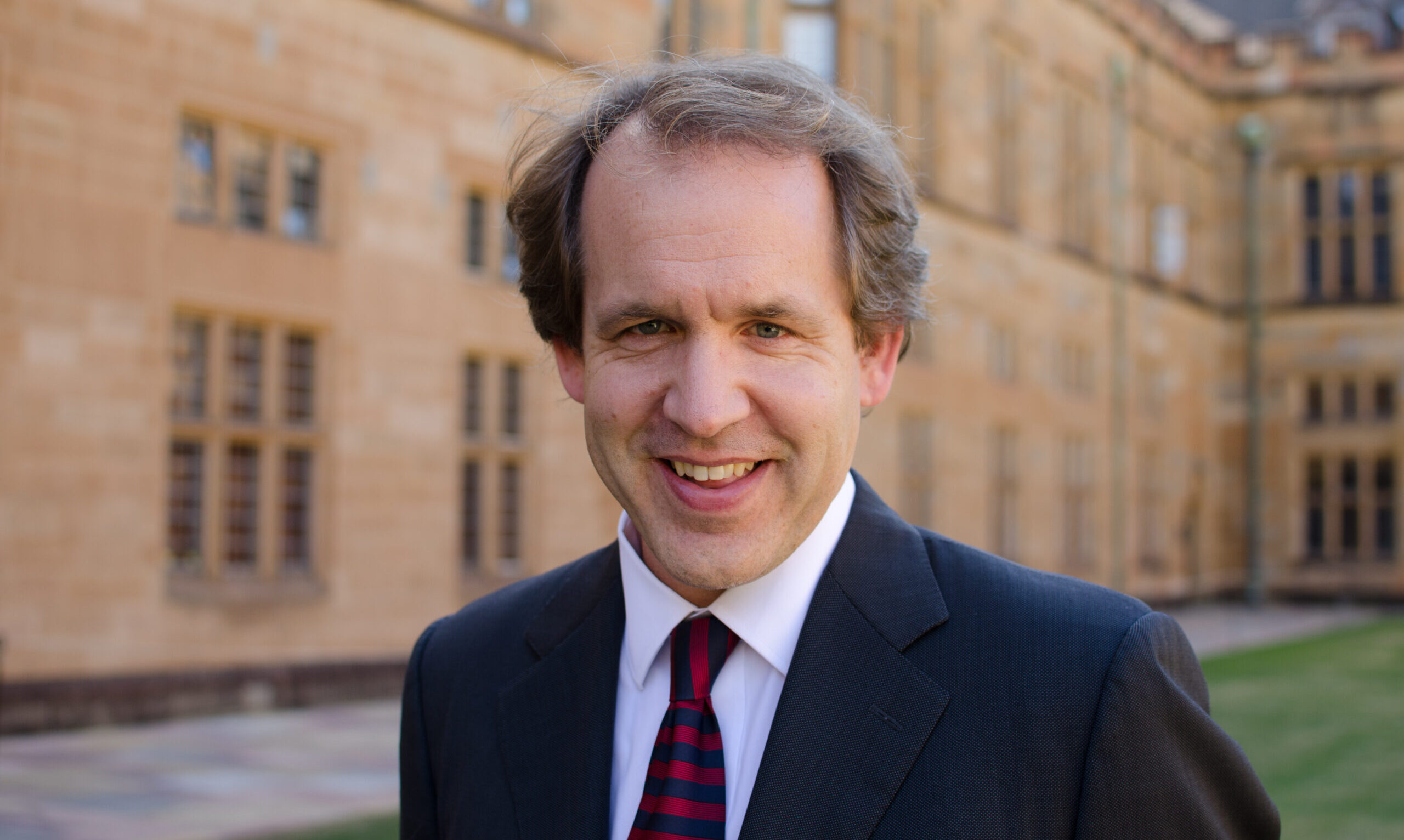
Professor Duncan Ivison is vice-chancellor of the University of Manchester, the birthplace of the computer.
Please login below to view content or subscribe now.
![The Digital Twin: How to Connect and Enable Your Student Data for Outreach, Personalization, and Predictive Insights [Webinar]](https://blog.college-counseling.com/wp-content/uploads/2025/04/How-to-Unlock-Graduate-Enrollment-Growth-Webinar.webp.webp)
You’re sitting on mountains of student data scattered across CRMs, SIS, LMS, and advising tools. Systems don’t talk. Dashboards are disconnected. And AI? Not even close. Without connection, context, or clarity, that data is nothing more than a headache and a barrier to impact.
In this webinar, Bryan Chitwood, Director of Data Enablement, breaks down how you can start building your students’ Digital Twin and turn your fragmented data into real-time, actionable intelligence. We’ll show you how unified student data profiles fuel more innovative outreach, personalized engagement, and predictive insights across the student lifecycle.
If your campus is drowning in data but starving for strategy, this is the conversation you need.
If you are a data-minded decision-maker in higher ed or a cabinet-level leader being asked to do more with less, this webinar is for you.
Bryan Chitwood
Director of Data Enablement, Collegis Education
Complete the form on the right to reserve your spot! We look forward to seeing you on Thursday, July 24.
Edited To Add
Decisions Class are streamlined R and R submissions.
Post-class denials MUST ask the DOE for a reconsideration, which allows you to add additional evidence.
Orginial Post:
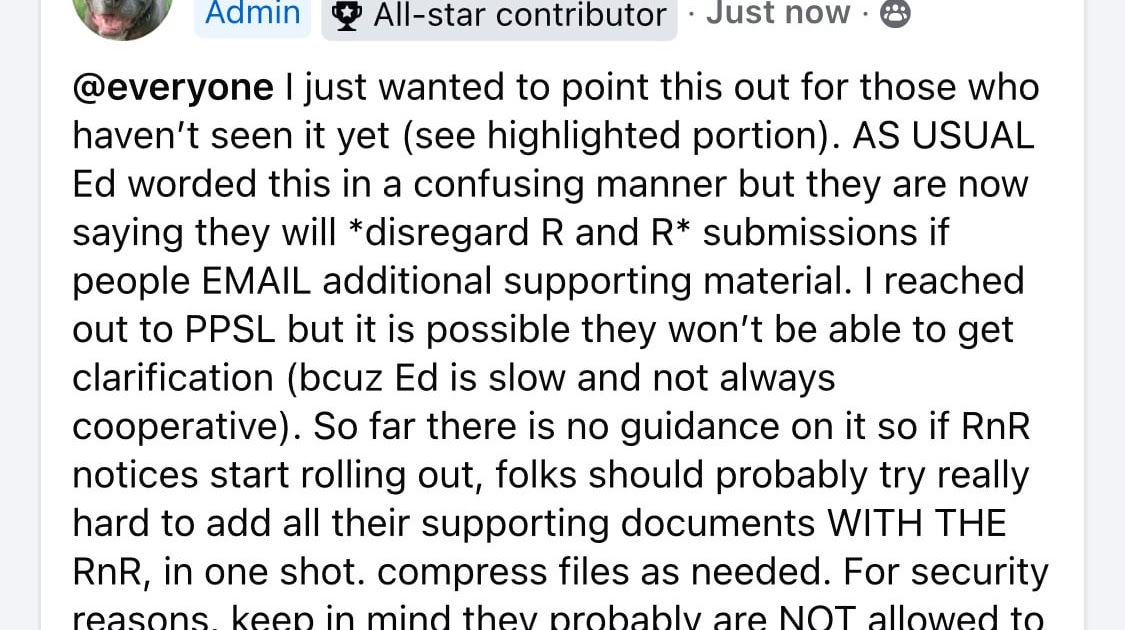
For REVISE and RESUBMITS (R and R) notices, the DOE is now saying that they WILL “disregard R and R*”* submissions if you EMAIL additional supporting documents or material. You CANNOT email the R and R back.
You MUST submit a NEW BDTR APPLICATION and INCLUDE your previous BDTR application number which can be fund on the Denial letter.
YOU HAVE 6 MONTHS TO RE-SUBMIT FROM THE RECEIPT OF THE R AND NOTICE (Here: https://studentaid.gov/borrower-defense**/
**)
The DOE states, “If you email supplemental information to the DOE or attempt to update your existing application, you will be treated as having failed to Revise and Resubmit”.
ALSO, If you are still trying to add more evidence to your BDTR application this late in the game, you may want to wait for the decision letter to come out. We are reaching Group 5 Decision deadline, and Post-Class is 6 months after that. If you feel uneasy about your evidence, START collecting it now!
Follow all DIRECTIONS on anything you get from the DOE relating to BDTR (except demanding payment, they can pound sand LOL).
In Solidarity!!!
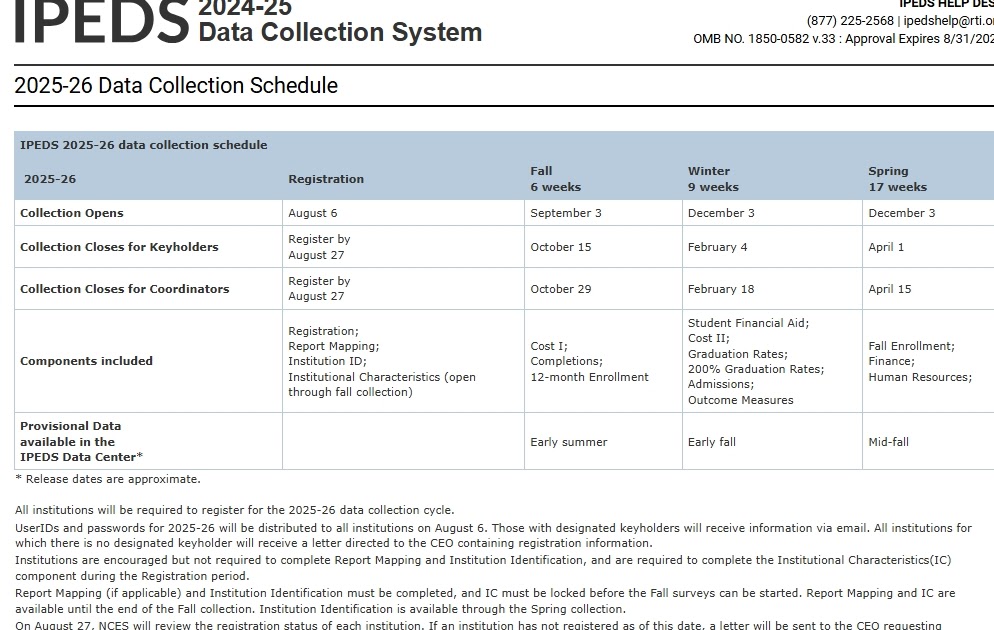
IPEDS is the Integrated Postsecondary Education Data System. It is a system of interrelated surveys conducted annually by the U.S. Department of Education’s National Center for Education Statistics (NCES). IPEDS gathers information from every college, university, and technical and vocational institution that participates in the federal student financial aid programs. The Higher Education Act of 1965, as amended, requires that institutions that participate in federal student aid programs report data on enrollments, program completions, graduation rates, faculty and staff, finances, institutional prices, and student financial aid. These data are made available to students and parents through the College Navigator college search Web site and to researchers and others through the IPEDS Data Center. To learn more about IPEDS Survey components, visit https://nces.ed.gov/Ipeds/use-the-data/survey-components.
IPEDS provides basic data needed to describe — and analyze trends in — postsecondary education in the United States, in terms of the numbers of students enrolled, staff employed, dollars expended, and degrees earned. Congress, federal agencies, state governments, education providers, professional associations, private businesses, media, students and parents, and others rely on IPEDS data for this basic information on postsecondary institutions.
IPEDS forms the institutional sampling frame for other NCES postsecondary surveys, such as the National Postsecondary Student Aid Study.
The completion of all IPEDS surveys is mandatory for institutions that participate in or are applicants for participation in any federal student financial aid program (such as Pell grants and federal student loans) authorized by Title IV of the Higher Education Act of 1965, as amended (20 USC 1094, Section 487(a)(17) and 34 CFR 668.14(b)(19)).
Institutions that complete IPEDS surveys each year include research universities, state colleges and universities, private religious and liberal arts colleges, for-profit institutions, community and technical colleges, non-degree-granting institutions such as beauty colleges, and others.
To find out if a particular institution reports to IPEDS, go to College Navigator and search by the institution name.
IPEDS collects data on postsecondary education in the United States in eight areas: institutional characteristics; institutional prices; admissions; enrollment; student financial aid; degrees and certificates conferred; student persistence and success; and institutional resources including human, resources, finance, and academic libraries.

In 2001, conservative activist Grover Norquist declared that his goal was to shrink government “to the size where I can drag it into the bathroom and drown it in the bathtub.” More than two decades later, under the leadership of Secretary Linda McMahon, the U.S. Department of Education’s March 2025 reorganization delivers on that radical vision—not with fire and fury, but with vacancies, ambiguity, and quiet institutional collapse.
Vacant Seats, Hollow Power
With dozens of senior leadership roles left vacant, enforcement functions gutted, and policymaking handed over to political allies and industry insiders, the Department no longer resembles a federal agency tasked with protecting students and public investment. Instead, it has become a hollowed-out vessel primed for deregulation, privatization, and corporate exploitation.
The new organizational chart is littered with the word “VACANT.” From Chiefs of Staff and Deputy Assistant Secretaries to senior advisors in enforcement, civil rights, and postsecondary education, entire divisions have been effectively immobilized. The Office of Civil Rights is barely staffed at the top. The Rehabilitation Services Administration is leaderless. The General Counsel’s office lacks oversight in key regulatory areas. This is not streamlining—it is strategic self-sabotage.
Federal Student Aid (FSA), overseeing over $1.5 trillion in loans, is run by an acting chief. Critical offices such as the Office of Postsecondary Education (OPE) are fragmented, missing key leadership across multiple branches—especially those charged with accreditation, innovation, and borrower protections.
The Kent Controversy: A Symptom of Systemic Rot
The collapse of federal oversight is not only evident in the vacancies—it is also embodied in controversial political appointments. As education policy watchdog David Halperin has reported, the Trump administration’s nominee for Under Secretary of Education, Nicholas Kent, epitomizes the revolving door between the Department of Education and the for-profit college industry.
Kent’s career includes roles at Education Affiliates, which in 2015 paid $13 million to settle a Department of Justice case involving false claims for federal student aid, and later at Career Education Colleges and Universities (CECU), the lobbying group for the for-profit college sector. Under Kent’s policy leadership at CECU, the organization actively fought against borrower defense rules, gainful employment regulations, and other safeguards meant to protect students from exploitative educational institutions.
Despite this record, the Senate Health, Education, Labor and Pensions (HELP) Committee advanced Kent’s nomination on May 22, 2025, in a party-line 12–11 vote—without a hearing. HELP Ranking Member Bernie Sanders objected, saying, “In my view, we should not be confirming the former lobbyist that represented for-profit colleges.” Advocates, including Halperin and six education justice organizations, sent a letter to Chairman Bill Cassidy calling for public scrutiny of Kent’s background and the Trump administration’s destructive higher education agenda.
Among their concerns are the elimination of key enforcement staff and research arms at the Department, the cancellation of ongoing research contracts, the rollback of borrower defense and gainful employment protections, the $37 million fine reversal against Grand Canyon University for deceptive practices, and the Department’s silence on accreditation reform and oversight of predatory schools. These developments, the letter argued, mark a decisive return to the era of unchecked corporate education—where taxpayer dollars are funneled to dubious institutions and students are left with mountains of debt and worthless credentials.
“Mission Accomplished” for the Privatization Movement
This version of the Department of Education, stripped of its regulatory muscle and stocked with industry sympathizers, is not an accident. It’s the culmination of decades of libertarian, neoliberal, and religious-right agitation to disempower public education. The policy pipeline now flows directly from organizations like the Heritage Foundation and ALEC to appointed officials with deep ties to the industries they were once charged with policing.
Rather than serving the public, the department’s primary role now appears to be facilitating the private sector’s conquest of higher education—through deregulation, outsourcing, and the erosion of civil rights protections.
A Shrinking Federal Presence, an Expanding Crisis
The consequences are far-reaching. Marginalized students—Black, brown, low-income, first-generation, disabled—depend disproportionately on federal guarantees, oversight, and funding. As these protections recede, so too does their access to meaningful educational opportunity. Instead, they are increasingly funneled into high-debt, low-return programs or shut out entirely.
Meanwhile, the political vacuum left by this strategic dismantling is being filled by corporate actors, right-wing religious institutions, and profit-seeking “ed-tech” startups. The dream of public education as a democratic equalizer is being replaced by a market of extraction and exploitation.
The Dream Realized
Grover Norquist’s fantasy of drowning the government has now been partially fulfilled in the U.S. Department of Education. What remains is an agency in name only—a shell that no longer enforces its core mission. In the name of efficiency and deregulation, the department has abandoned millions of students and ceded its authority to those who view education as a commodity rather than a public right.
The danger now is not only what’s been lost, but what is being built in its place. The Higher Education Inquirer will continue to monitor the ongoing capture of education policy and fight for a system that serves students, not shareholders.
U.S. Department of Education, Organizational Chart, March 17, 2025
David Halperin, Republic Report, “The Senate Shouldn’t Vote on Trump Higher Education Pick without a Hearing”
U.S. Department of Justice press releases on Education Affiliates
Politico Pro Education updates, May 2025
Senate HELP Committee voting record, May 22, 2025
Heritage Foundation and CECU policy recommendations

The report by the Universities of Dundee and Cambridge highlights concerns about “the preparedness of students admitted through less traditional tests” as well as worries about the “security, validity and perceived inadequacy” of tests run by Duolingo and Oxford Education Group (OIEG).
The study draws on evidence from 50 UK universities, though its critics point out that many of the statements seem to be based on qualitative perspectives and anecdotal evidence from a small sample – comments that the report’s authors have hit out against.
It is causing disturbance in the ELT world, with Duolingo highlighting that four out of the five authors are affiliated with a “single competitor test” – the IELTS test. For their part, the report’s authors have maintained that the study was carried out objectively.
The study found the IELTS test to be widely regarded as the “common currency” of SELT, “largely due to the high level of trust in IELTS as a reliable and valid measure of language proficiency”, said the authors.
The most widely accepted English language test by UK universities, IELTS, is co-owned by IDP, Cambridge University Press and the British Council.
Other tests including TOEFL, C1 Advanced, and the Pearson Test of English (PTE), were found to be accepted by a high number of the institutions surveyed, while Duolingo was only accepted by six universities.
“Unfortunately, this study is based on the perceptions of a small group and relies on outdated views rather than robust empirical evidence,” a spokesperson for Duolingo told The PIE News in response to the findings.
They commented: “Every Ivy League university accepts the Duolingo English Test (DET), as do a third of Russell Group institutions and over 5,900 institutions worldwide,” adding that the DET “combines academic rigour and integrity with accessibility and affordability”.
Meanwhile, English testing expert Michael Goodine advised test takers “to keep in mind that the criticisms mentioned in the study are anecdotal and not presently supported by comparative data”.
What’s more, at the time of the survey, Duolingo was only accepted at six universities, compared to IELTS. which was accepted at all 50.
Given the experiences of surveyed staff sharing their worries about declining standards of English: “Clearly, then, Duolingo isn’t the problem,” suggested Goodine. “Maybe the traditional tests are also problematic,” he posed.
For its part, Cambridge University Press & Assessment maintained the study was independently peer-reviewed, objecting to comments about the research being conducted on a “small” group or to their views being “outdated”.
“The researchers did not seek views on any specific test,” said the spokesperson, adding that interviewees were asked about their personal experiences with the tests, changes since the pandemic, internal decision-making processes around test selection and their experience of the English levels of students admitted with such tests.
“We hope this evidence will help universities to consider the relative merits of different modes of language assessment. Now is the time to put quality first,” they added.
Maybe the traditional tests are also problematic
Michael Goodine, Test Resources
The report’s authors note that the shift to online learning and testing during the pandemic “has led to a perceived decline in language standards, with many staff members worried that students are not meeting the necessary threshold for successful academic engagement”.
“The lack of transparency and external validation, especially for newer tests, exacerbates these concerns, as many of these tests provide little evidence of comparability beyond marketing information,” they say, calling for universities to use evidence-based approaches when selecting which English language tests to use.
In addition to the choice of test, much of the report is dedicated to findings highlighting the growing concerns among university personnel about the declining English language proficiency of international students.
When asked to evaluate the academic literacy of the international students they teach, 44% of respondents said it was ‘poor’, 47% deemed it to be ‘mixed’ or ‘varied’, with less than 10% judging it to be ‘good’.
“Admitting students without sufficient English jeopardises their educational experience and places strains on institutions and faculty,” said Pamela Baxter, managing director for IELTS at Cambridge University Press & Assessment.
“These are some of the highest stakes exams around – that enable people to migrate and study”, said Baxter, adding that international students comprise 23% of the UK’s total student population, and “greatly enrich” universities, but must be admitted with the right standards.
The study finds a “great divide” between EAP and academic staff placing a greater emphasis on test validity and language proficiency, as compared to recruitment and admissions personnel who tend to priorities accessibility and cost.
Such a disparity highlights the “need for a more integrated approach to decision-making”, the authors argue.
The report comes as the UK SELT sector is bracing for a dramatic overhaul, caused by the government’s ongoing development of a dedicated Home Office English Language Test (HOELT), for which a tender process is currently underway.
Most recently, the Home Office launched a fourth round of market engagement about digital testing, exploring the viability of incorporating remote testing into the HOELT service.

Use this form to cancel your conference registration or to designate a substitute attendee. See the conference registration policies for more information.
The post 2025 Annual Conference Cancellations and Substitutions appeared first on CUPA-HR.
What happened to the President of UVA is devastating. And we have let ourselves believe it is surprising. But, while it should be shocking that the federal government – one that has been repeatedly talking about the return of education to the states – is interfering with the administration of a public university, it should have been expected if you were paying attention.
The tools in this Administration’s toolbox include cancelling funding, slashing federal student aid, investigating and auditing schools, removing and threatening international students and immigrants, and increasing the costs of higher education institutions doing their work – from indirect cost increases on research funds to attempting to revoke tax-exempt status, and the list goes on.
These actions have, and will, hit institutions across the board hard – from Columbia and Harvard to public state schools to small independent colleges to community colleges. All of these schools – and their students – rely on and benefit from public investments in higher education.
And the damage is not just to the schools and students. The communities, cities, and states where these schools are located benefit economically when colleges and their students thrive. Our nation’s standing as a leader in innovation – in technology, medical advancements, and other fields – will be threatened without federal investments in higher education. And, without academic freedom ensuring a diversity of viewpoints at our institutions, free from political interference, our democracy will be at risk.
So, what lessons can we take from what happened at UVA and the forced resignation of President Ryan?
First, this has never been just about the Ivies. There has been a belief that the elite schools are the target. Just take a look at the list of the 60 colleges that the Trump Administration opened investigations into, under the pretext of antisemitism, in March – Ivy League schools but also publics (in blue states and red states), privates, and small independent colleges. The reconciliation bill, which was signed into law last week, eliminated Grad PLUS loans and capped Parent PLUS loans – programs that help students at all schools, including HBCUs. And, the President’s FY26 budget would eliminate programs that fund wraparound services which will hurt community college students who rely most heavily on those federal investments.
Second, it is not just about the words used. Following UVA President Ryan’s resignation, DOJ Assistant Attorney General for Civil Rights Harmeet Dhillon told CNN that although UVA decided in March 2025 to dissolve its DEI office, it “used a series of euphemisms to simply rebrand and repackage the exact same discriminatory programs that are illegal under federal law.”
This raises a couple of lessons that can be learned as higher ed institutions look ahead. Following the President’s executive orders on diversity, equity and inclusion, many organizations began scrubbing their websites, shuttering DEI offices, and disbanding committees with diversity and equity in their titles. Schools instead need to first do a campus-wide review of their activities. Then, they should undertake a risk assessment to both determine which activities can be viewed as being in contrast to Trump’s executive orders and the new certifications being tied to federal funding and to determine which activities are actually in violation of current state and federal antidiscrimination laws. The first bucket of activities – those that do not follow the executive orders – may put schools’ funding at risk but are not necessarily illegal. This Administration is using a chilling effect to stop allowable initiatives that are in contrast with their ideology and politics. Understanding the risk is important for schools to protect themselves but schools must also continue to fulfill their missions of serving all students and providing diverse environments and inclusive communities and must be ready to push back when wrongly being accused of engaging in “illegal DEI,” which isn’t in and of itself a thing.
Sometimes changing the words, or renaming or eliminating an office, may be necessary. In fact, for federal grants, agencies are utilizing AI to do word searches so there may be a reason to use different words and reframe proposals for federal funds. But, if schools are going to do so, they need to engage in genuine stakeholder outreach to explain what is and what isn’t changing. In addition to the closing of UVA’s DEI office now being criticized as irrelevant in the eyes of the Trump Administration, the school leadership faced criticism from faculty, students and other university community members when they did so, which likely caused them to lose some of the support they needed to push back against the false charges by DOJ. Explaining which changes are being made early – and which aren’t and why – can help college leaders on multiple fronts.
Third, this Administration is continuing to not tell the truth about what the U.S. Supreme Court 2023 ruling in Students for Fair Admissions vs. Harvard (SFFA) meant. Assistant Attorney General Dhillon told CNN in her interview about UVA, “It’s not just admissions part, it’s also preferences in special programs while students are at the school … this is all illegal under Students for Fair Admissions.” Well, no. The Supreme Court’s decision in SFFA was about admissions. Telling schools to stop activities because of SFFA in other areas is again a scare tactic that must be pushed back on both in courts and in the court of public opinion.
This is the time for higher ed institutions and their stakeholders to come together and fight back. Institutions must think outside the box and do the hard work so that they can continue to fulfill their missions of serving all students and being inclusive communities while not increasing the risks of harmful actions that will hurt their students, their communities, the economy, and our democracy.
_____________
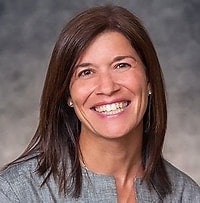
Amanda Fuchs Miller served as the Deputy Assistant Secretary for Higher Education Programs at the U.S. Department of Education in the Biden-Harris Administration. She is the president of Seventh Street Strategies, which provides advocacy and policy supports to higher ed institutions, nonprofit organizations, and foundations.

Crucial Insights: Understanding College Financial Aid Dynamics
(00:02:56) Variety of College Financial Assistance Options
(00:05:18) Scholarships: Balancing Merit and Financial Need
(00:10:00) Student Selection Strategies in College Admissions
(00:21:40) Financial Aid Strategy at Competitive vs. Smaller Schools
(00:26:29) Major-based Financial Aid Allocation in Colleges

